Archive for August 16, 2014

After shunning Europe, Russia turning to Israel for fruit imports

August 16, 2014

After shunning Europe, Russia turning to Israel for fruit importsIsrael, in danger of losing business over Gaza war, gains a client interested in shunning Europe.

By Ora Coren | Aug. 13, 2014 | 9:10 PM

via After shunning Europe, Russia turning to Israel for fruit imports – Business Israel News | Haaretz.


An Israeli Clementine orange. Photo by Tomer Appelbaum
 

Russia is interested in increasing its fruit imports from Israel, after deciding to boycott imports from Europe as part of the ongoing diplomatic spat between Russia and the West.

This development comes as buyers in Gaza, Jordan and some European nations have started refusing to buy Israeli mangoes due to Operation Protective Edge. Most recently, a buyer for a supermarket chain in Montreal announced that it would not be buying Israeli fruit.

Amir Porat, marketing manager for Adom Fruits, which exports primarily pomegranate and mango, said that as opposed to the Montreal buyer, his buyers in Canada are still interested in Israeli produce.

“My customer is happy to receive Israeli products, he’s clearly pro-Israel and very satisfied with the produce,” said Porat. He acknowledged that not all Canadians may feel that way, however.

Due to the tension between Russia and Europe, and Russia’s decision to halt imports from Europe, Israel has been asked to increase exports of fruits, specifically apples and plums, said Porat.

“Unfortunately, the Russian market isn’t a big consumer of mangoes, so it can’t replace the declining demand from Europe,” said Porat.

Porat noted that lower European demand could be tied to an excess of produce there created by the Russian boycott, and not necessarily due to anti-Israel sentiments in Europe.

Meanwhile, Israeli importers and exporters are reconsidering ties with Turkey as relations with that nation sour.

The Foreign Ministry has recommended against flights to Turkey, and businesses are reconsidering their ties there. While Turkish businesses have said they are interested in continuing to work with Israelis, some Israelis are considering leaving the Turkish market, particularly importers and exporters of medical equipment.

“You can’t keep up a relationship by e-mail and phone,” said Eli Cohen, CEO of Termokir Industries, which imports gypsum, a construction material, from Turkey.

Cohen said he recently canceled two work trips to Turkey.

Obama’s Campaign Against Israel

August 16, 2014

Obama’s Campaign Against Israel, The Jewish PressJ. E. Dyer, August 15, 2014

Hellfire-300x194

The most positive interpretation of the administration’s posture, as revealed in the incendiary WSJ article, is that it is ideologically committed to a radical-left view in which Israel figures as the villain. From this ideological motive, Obama hopes to use American influence to limit and confound Israeli policy. Think of the policy the typical flotilla activist would adopt toward Israel, and that’s the thematic pattern in Obama’s executive-branch campaign. The campaign can’t be waged too overtly, because of the inevitable blowback from Congress.

*****************

It’s getting harder and harder for even diehard apologists to make a case that the Obama administration supports Israel. The latest news comes after a very rocky period in which the administration tried to do an end-around to coerce Israel into a bad ceasefire deal with Hamas, while experimenting with an unseemly and embarrassing (and short-lived) flight ban to Israel’s international airport, and straightforwardly mouthing the false Hamas narrative about an Israeli attack in southern Gaza.

Now administration officials have disclosed, in a leak-blast full of astonishing quotes, that a shipment of arms to resupply Israel after the recent operation in Gaza was stopped when senior officials became aware of it.

But they aren’t just disclosing that the shipment was halted, and that other shipments will be getting a closer look. They are concocting an entire narrative about the Israelis “outflanking” the administration, running off on their own, and being unreceptive to U.S. influence.

Obama is transparent, if you read his oracular signs with the right key. Most responsible observers have been reluctant up to now to use that key. But there’s really nothing else left to do. We’re beyond the point at which the damaging implications of tailored “leaks” from the Obama administration can be explained away.

The most positive interpretation of the administration’s posture, as revealed in the incendiary WSJ article, is that it is ideologically committed to a radical-left view in which Israel figures as the villain. From this ideological motive, Obama hopes to use American influence to limit and confound Israeli policy. Think of the policy the typical flotilla activist would adopt toward Israel, and that’s the thematic pattern in Obama’s executive-branch campaign. The campaign can’t be waged too overtly, because of the inevitable blowback from Congress.

Tending the “BASE

Characteristically, the latest escapade with the halted arms shipment is being disclosed in a way that will gratify Obama’s radical-left political base. Right away, the disclosure has the Obama signature on it (emphasis added):

White House and State Department officials who were leading U.S. efforts to rein in Israel’s military campaign in the Gaza Strip were caught off guard last month when they learned that the Israeli military had been quietly securing supplies of ammunition from the Pentagon without their approval.

Is Obama ever not caught off guard? This opening sentence explains to his base that he and his top officials weren’t responsible for seeming to approve of the IDF’s operation in Gaza by providing supplies to it.

But the sentence also flat-out lies – by implying that there was something sneaky about Israel’s procurement of ammunition. In fact, Israel was reordering ammunition under Foreign Military Sales cases for which reordering is already authorized, without the need for renewed approval. This is not uncommon with foreign military sales (and is actually acknowledged later in the same article, as Jeff Dunetz points out). Depicting a reorder of ammo as “adroit bureaucratic maneuvering” is worse than tendentious, and can have only one purpose. The purpose is clarified here:

But Israeli and U.S. officials say that the adroit bureaucratic maneuvering made it plain how little influence the White House and State Department have with the government of Israeli Prime Minister Benjamin Netanyahu —and that both sides know it.

Certainly this can be read as the Obama administration distancing itself from Israel in a diplomatic and geopolitical sense. But don’t discount the reality of who Obama is as a politician. He’s equally invested in distancing himself, in the minds of his most loyal supporters, from whatever outcome Israel is able to secure from the current conflict. The narrative crafted by this very tailored “leak” is perfectly designed to appeal to those supporters, who at this point are virtually certain to be disappointed in Israel’s outcome.

This attempt at massaging the narrative for preemptive damage control may be slightly subtler than Obama’s recent, absurd disavowal of his once-celebrated troop withdrawal from Iraq. But it’s being done on the same principle. It’s part of a pair of patterns observable with the Obama administration from its earliest days.

Team Obama’s methods

One of those patterns is “leaking” intricate, fully formed narratives to an obedient press. Where the George W. Bush administration could barely make its most open and categorical statements heard over the cacophony of skeptical caveats advanced by the mainstream media, many in the same MSM act today as mere repeaters for whatever tortuous tale the Obama administration wants to broadcast anonymously.

This often results in internally contradictory narratives like the one in the arms-shipment story, which confirms that there wasn’t anything sneaky in Israel’s application to the Pentagon for a resupply of arms, but leads off with the unmistakable suggestion that there was.

John Podhoretz concludes at Commentary that the Obama administration is essentially just having a hissy fit.

These transfers were taking place through entirely traditional, legal, and uncontroversial means. Israel is an ally. It’s at war. War depletes stocks. So why is this happening?

Simply put: It’s a gigantic hissy fit, an expression of rage against Bibi Netanyahu, by whom the administration feels dissed. The quotes in this article are almost beyond belief. In the annals of American foreign policy, no ally has ever been talked about in this way.

And I think there’s a good deal to that. But it’s not the only thing going on. The Obama administration’s highest priority is always the community organizer’s: tending its constituency base. As discussed above, that’s part of the purpose.

The administration has also shown a preternatural aptitude for exploiting the political opportunities afforded by a gigantic, often unaccountable federal bureaucracy: from holding tax-exempt status over the heads of rival political groups to implementing regulations on the sly and distributing favors to Obama’s constituencies. Leveraging anonymous bureaucratic activities is a great way to get around political opposition – and sometimes to paint a political picture with obscure data points the public won’t really understand – and Team Obama makes an art of it.

This method has been used against Israel a number of times. An early instance was one I wrote about four years ago, when Israel was expressing concerns about design features in the F-35 Joint Strike Fighter. The collegial practice with allies – any allies – is to at least give such concerns a hearing, and try to find common ground. The Obama administration instead simply stonewalled Israeli concerns, because it could. As a problem at the bureaucratic and technical level, one the general public never heard about, the administration had the leeway to ignore it. Call it passive-aggressive maneuvering.

Team Obama is also good at creating lists of policy accomplishments out of regularly scheduled programming. The public doesn’t pay much attention to joint military exercises or military sales in general, nor does it know the first thing about military-to-military exchanges (e.g., in intelligence, or consultation on tactics and common warfighting issues). These activities make excellent fodder for superficial “resume enhancement,” and that’s exactly how the Obama administration has used them to bolster its image vis-à-vis Israel.

(It also tried to “leak” false information in 2011 that it was the first U.S. administration to supply Israel with 5,000-pound bunker-buster bombs.)

There’s no telling how many little bureaucratic whacks Team Obama has taken at Israel in the last six weeks. The beauty of these measures is that they can be taken without fanfare by executive fiat, and can even be attributed conveniently to autonomous bureaucratic processes, as the FAA flight ban against Israel was.

Just today, we’re hearing that the U.S. Post Office didn’t get the memo after the flight ban was lifted, and has been advising customers at some locations – since 23 July – that it can’t deliver their items to Israel. Adam Kredo points out that there was never an official directive to suspend postal deliveries to Israel, even during the flight ban. But that’s what a passive-aggressive approach is all about: finding flimsy excuses for inaction rather than doing the honest work to justify action.

Obama’s interdiction of the resupply shipment to Israel is a classic of its kind: executive, passive-aggressive, and framed for political effect. Soon enough, Democrats in Congress will probably get Obama to quietly back off on this little “hissy fit.” But the goal of reassuring Obama’s radical base will have been served (how effectively is a separate question; I refer here to the attempt). And if poisoning U.S. relations with Israel is a goal – and it’s hard to argue at this point that it isn’t – a blow will have been struck in that regard as well.

Russia, Iran Collaborating to Bypass Western Sanctions

August 16, 2014

Russia, Iran Collaborating to Bypass Western Sanctions, Newsmax, Sandy Fitzgerald, August 16, 2014

Russia and Iran appear to be working together to get around Washington’s stricter sanctions by joining forces in an oil deal that doesn’t appear to make much financial sense.

Earlier this month, Russian Energy Minister Alexander Novak and his counterpart in Tehran, Bijan Zanganeh signed a five-year memorandum of understanding in Moscow, which includes helping Iran ship crude oil even into the oil-saturated Russian market, reports Reuters.

The agreement appears to be an oil-for-goods swap that will allow Iran to ship out more oil and get around Western sanctions. The deal initially called for Russia to buy up to one-third of Iran’s oil exports, up to 500,000 barrels a day, in exchange for equipment and goods, sources told Reuters.

The deal has been in the works since January, and while the Russian government initially announced earlier this month that an agreement had been reached, it later pulled back its statement and released a new one that gave no specifics on volumes or timeframes on the deal, saying just that “volumes are to be determined by market needs.”

However, while Russia was not giving details about the deal, The Telegraph of London, quoting sources from Moscow, reported that Russian President Vladimir Putin had agreed on a $20 billion trade deal with Iran.

Russia is under a series of strict sanctions from the United States and the European Union, including measures against oil exploration and drilling related products. Likewise, Iran is under sanctions because of its nuclear program, and has been involved in talks with world powers for months in Vienna.

Meanwhile, Iran has been attempting to double its oil production by 2018, The Telegraph reports The Telegraph, setting a new output target of 5.7 million barrels of crude oil a day.

But to sell that oil, Iran will need international oil companies, such as in Russia, to help.

Fortune Magazine’s Cyrus Sanati, however, said the pact will not have much effect beyond making Washington nervous over its sanctions.

“While a pact between the two countries may make sense politically as they both face economic sanctions from the West, the two sides truly have little in economic benefit to offer each other,” said the analyst.

The pact makes sense on paper, he wrote, but in reality, neither country has anything the other wants.

“The last thing Russia needs is more oil,” he said, pointing out that Russia is the world’s second-largest oil exporter, putting out about 5 million barrels a day.

“Russia lacks the basic infrastructure to import foreign oil,” Sanati wrote. “There are no oil pipelines that link Iran and Russia, meaning that everything would need to go by ship.”

Russia also has no coastal refineries, so it would not be able to receive or process crude oil, he continued, and the country’s pipelines pump oil out of Russia, not into it.

Meanwhile, he said, Russia has little to offer Iran beyond oil exports, which Iran does not need. In addition, Russia will likely not offer agricultural exports, as Putin has banned all foods coming in the West and has to either make up the difference from neutral countries such as Brazil and Turkey or boost its own domestic production.

Russia may also be looking to boost its own oil production through Iran, The Quartz  reported earlier this year. Russia signed a $270 billion supply agreement with China in 2013 that promises 290,000 barrels of oil daily for 25 years, but may be having trouble meeting that agreement.

The oil was to be shipped out of the Kashagan oilfield in Kazakhstan, but the facility’s launch was delayed until the end of this year, or later, by a gas leak. Instead of sending Russian oil, Moscow could be looking at selling China oil from Iran.

And with the sanctions, Russia could still sell its surplus through Morgan Stanley’s oil trading desk, owned in part by Russia’s Rosneft since last year, reports The Quartz.

The amount of oil under discussion has also changed drastically. While at the beginning of the year, talks were underway to sell Russia some 500,000 barrels a day, Troy Media reports that Moscow’s Kommersant business daily said discussions put that amount at about 70,000 a day, just a portion of the 3.2 million barrels a day Iran produces.

Iran has already found another way to get round Western sanctions and exporting higher amounts of an “ultralight oil” to the Asian markets, reports The New York Times.

Iranian customs data shows the country has exported 525,000 barrels a day of the ultralight oil, or condensates, in recent months. This figure is more than twice what Iran exported last year, and as a result, the sales have already brought in some $1.5 billion in extra trade .

This has resulted in Iran making an overall increase to the Asian markets beyond what the United States has called for in its sanctions, which called for Iranian oil exports to remain at about one million barrels a day. However, the condensate sales have allowed Iran to export 1.4 million barrels a day between January and May, the Energy Department reports.

Hamas rejects Cairo ceasefire terms, promises war of attrition

August 16, 2014

Hamas rejects Cairo ceasefire terms, promises war of attrition, Times of Israel, August 16, 2014

Abbas breaks ranks with Islamists, says no alternative to Cairo deal; Israel said unwilling to compromise on its security demands

Let's launch a rocketIn footage captured by al-Mayadeen, Izz ad-Din al-Qassam Brigades fighters are seen preparing rockets to launch against Israel in a tunnel underneath the Gaza Strip. (screen capture, YouTube)

[An] Israeli official was quoted saying that the chances of reaching a long-term ceasefire deal by the end of Monday, when the current truce expires, were very faint. Consequently, he said, according to the Walla news site, the government is considering a unilateral move to ease some restrictions on access to the Gaza Strip and provide its residents with funds for rebuilding.

***************

Hamas on Saturday night rejected an Egyptian proposal for a long-term ceasefire with Israel. Spokesman Osama Hamdan said Israel must either accepts its demands — including for a lifting of the security blockade on Gaza — or face “a war of attrition.” At the same time, Hamas’s military wing in Gaza declared, “We are continuing our struggle.

Israel has not formally responded to the Egyptian proposal – an 11-point proposal that was leaked to the press Friday. Israel’s Channel 10 said, however, that Israel was not prepared to dilute its security demands as would be required under the Egyptian proposal.

The Egyptian proposal speaks of lifting the Israeli and Egyptian security blockade on Gaza, but any such easing of restrictions would apparently be overseen by Israeli and Egyptian forces on their sides of Gaza’s borders, and by the Palestinian Authority of President Mahmoud Abbas on the Gaza side. The PA would also play a dominant role in the reconstruction of post-conflict Gaza. The Egyptian formula also pushes off negotiations on the opening of a Gaza seaport and airport — key Hamas demands in recent weeks — to a month’s time.

Negotiations on the long-term deal, 40 days after Israel launched Operation Protective Edge against Hamas, were set to resume in Cairo on Sunday morning. It was not clear how Hamas’s declared rejection of the Egyptian terms would affect the planned resumption of talks. A five-day truce agreed by Hamas and Israel is to expire at midnight on Monday.

Abbas on Saturday publicly broke ranks with Hamas, declaring in Ramallah that there was no alternative but to “stick to” the Egyptian proposal.

Hamas guyHamas chief Khaled Mashaal answers AFP journalists’ questions during an interview in the Qatari capital of Doha, on August 10, 2014. (photo credit: AFP/al-Watan Doha/Karim Jaafar)

Earlier, in Qatar, the Hamas political bureau chief Khaled Mashaal, declared that “The Palestinian people will continue their struggle until they end the occupation, the colonization and the siege [on Gaza].”

Spokesman Hamdan warned earlier that the terror group’s tunnels will be a “strategic threat” to Israel and its rockets will be more precise “next time.”

Israel’s security cabinet met on Friday, but did not release a formal response to the Egyptian proposals. An unnamed cabinet minister was quoted by Ynet late Saturday predicting the negotiations might collapse, and that it was possible that the sides would revert to “quiet in exchange for quiet” — that is, an informal ceasefire. The official said that the Israeli negotiation team will return to Cairo on Sunday — not Saturday as previously reported — to continue the talks.

Another Israeli official was quoted saying that the chances of reaching a long-term ceasefire deal by the end of Monday, when the current truce expires, were very faint. Consequently, he said, according to the Walla news site, the government is considering a unilateral move to ease some restrictions on access to the Gaza Strip and provide its residents with funds for rebuilding.

Israel and Egypt imposed the blockade after Hamas seized control of Gaza from Abbas in 2007, and maintain it in order to prevent Hamas importing more weaponry. Israel has pushed for Hamas to disarm and for a lifting of the blockade to be tied to the demilitarizing of Hamas, designated a terrorist group by Israel, the US and others. Hamas has rejected the notion.

The first two clauses of the Egyptian proposal call for Israel as well as all Palestinian factions in the Gaza Strip to mutually halt all cross border attacks — by land, air or sea. Construction of tunnels into Israel must be stopped at once, the Egyptian document also demands. Israel has repeatedly accepted previous Egyptian proposals for an unconditional ceasefire; Hamas has repeatedly rejected them.

Negotiations about handing over the remains of two dead Israeli soldiers in exchange for the release of Palestinian prisoners in Israeli jails would also be postponed, according to the document.

The European Union on Friday said it was ready to expand a police mission in Rafah, on the border with Egypt, and train Palestinian Authority customs personnel and police for redeployment in Gaza.

The EU also said a durable ceasefire must be accompanied by lifting closures on Gaza and called on “all terrorist groups” in the territory to disarm. Israel welcomed that call.

Almost 2,000 people have been killed in Gaza in the past 40 days of  fighting. Israel says 750-1,000 of the dead are Hamas and other gunmen. It also blames Hamas for all civilian fatalities, since Hamas set up its rocket-launchers, tunnel openings and other elements of its war machine in Gaza neighborhoods and uses Gazans as “human shields.”

Israel has lost 64 soldiers and three civilians in the fighting. Eleven of the soldiers were killed by Hamas gunmen emerging from cross-border tunnels dug under the Israeli border. Hamas has fired over 3,000 rockets at Israel, including some 600 from close to schools, mosques and other civilian facilities, the Israeli army says.

BBC News UK jihadists British Muslim willing to join Islamic State

August 16, 2014

.

From Jail to Jihad ? BBC Panorama 2014 BBC full Documentary British convert to Muslim islam

Christians in the Caliphate: The Islamic State (Part 4)

August 16, 2014

Islamic State: What do young British Muslims think about the Caliphate? BBC News

August 16, 2014

Few “moderate” Muslims oppose an Islamic Caliphate

August 16, 2014

Few “moderate” Muslims oppose an Islamic Caliphate, Dan Miller’s Blog, August 16, 2014

Most who appear to be “moderate” approve of or refuse to acknowledge what their “extremist” brethren of the Islamic State are doing.

(The views of even “moderate” Muslims on an Islamic Caliphate and the Islamic State suggest that Israel needs to be cautious in dealing with and relying on Islamic nations, with the possible exception of Egypt, to help resolve her problems in Gaza and the West Bank. — DM)

In this video, seven young British Muslims discuss their understandings of the meaning of an Islamic Caliphate and their views on the Islamic State. Five of them approve an Islamic Caliphate, as they understand it.

This article (hat tip to The Counter Jihad Report for the link) may provide a basis for understanding the different views articulated by the young Muslims who support their versions of an Islamic Caliphate: Defensive or offensive Jihad: History, exegesis vs. contemporary propagation.

The issue at stake is the deep gap between the horrific acts of terrorism coming from the World Jihad groups, and, at the same time, the propagation emanating from Islamists, Muslims and Westerners; firstly, that Islam is a religion of peace and tolerance, hijacked by extremists; secondly, that there is only one Jihād, the spiritual, that means to worship Allah; and thirdly that the Muslims are ordered to fight their enemies only defensively. [Emphasis added.]

. . . .

The Arab-Islamic terrorist organization’s strategy against the Free World is comprised of two parallel but coordinated arms: Jihād – a holy war against the infidels, and Da`wah – the persuasive methods used to convince people to join Islam. Both arms are intended to achieve the same objectives, yet both are used at the same time by different activists and are aimed against different targets. However, between both, Da`wah is more dangerous to the Free World. Jihād appears 41 times in 18 Suwar (plural of Sûrah) in the Qur’ān, mostly coupled with fi-Sabīlillah (in the way of Allah; for the sake of Allah), which transforms it into a religious sanction. Da’wah is the Islamic concept of missionary activity, aimed at persuading all human beings to believe in Allâh. Da`wah is the moderate and graceful opening address used to approach non-believers and convince them to submit to Islam, and if it fails, it is the duty of Jihād to achieve the Islamic goals. [Emphasis added.]

. . . .

All four Islamic Schools of Jurisprudence and most of Islamic exegetes agree that the aims of Jihad are to remove the infidel’s oppression and injustice, to eliminate the barriers to the spread of Allah’s truth, and, to establish Islamic justice universally. There are four different ways in which the believer may fulfill his obligations: a) by his heart; b) by his tongue; c) by his hands; d) by the sword. This demonstrates the close connection between Jihād and Da’wah, as well as the fact that they are aimed at establishing Allah’s rule on earth, until either the non-believers embrace Islam (as a result of Da’wah), or submit to Islamic rule and agree to pay the tax poll, the Jizyah; or be killed in the battleground (as a result of Jihad war). [Emphasis added.]

From the Islamic viewpoint, all wars in Islam are religious; the concept of “secular war” does not exist; and Jihād is the only just war known. So, even according to Islamic Jurisdiction, one can wage the most aggressive war using atrocious evil deeds and still see it as a defensive war. The Muslim legal theory states that Islam cannot exist in conjunction with idolatry. This is Shirk, meaning association of other gods and idols with Allah. According to a Hadīth related to Muhammad, he declared: “I am ordered to fight polytheists until they say there is no God but Allah.” Muslims are under the Qur’ān Commandments’ obligation to slay the idolaters. Hence, terrorizing Islamic enemies is Allah’s commandment. [Emphasis added.]

According to Majid Khadduri, Muslims view peace as a tactical means for achieving their strategic objective, by defeating the enemy. Peace constitutes a temporary break in the ongoing war against the enemy, until Islam controls the whole world. They might come to terms with the enemy, provided that they resume the Jihād after the expiration of the treaty. Defeated Muslims maintained that their battle with the enemy would resume, however long they had to wait for the second round. By their very nature, treaties must be of temporary duration, for the normal relations between Muslim and non-Muslim territories are not peaceful, but war-like. [Emphasis added.]

Khadduri states that Muhammad has set the classic example by concluding the Khudaybiyah Treaty, in 628 with the Meccans: a peace treaty with the enemy is a valid instrument. That is, if it serves Muslim interests. Muhammad and his successors always reserved their right to repudiate any treaty or arrangement which they considered as harmful to Islam. Muslim authorities might have come to terms with the enemy, provided it was only for a temporary period. In practice, however, Jihād underwent certain changes in its meaning to suit the changing circumstances of life. This change, did not imply an abandonment of the Jihād duty; it only meant the entry of the obligation into a period of suspension – it assumed a dormant status, from which the leader may revive it at any time he deems necessary. [Emphasis added.]

Assuming that the young people in the video — evidently long exposed to Western culture while immersed in Islamic culture — are representative of their peers, it is unfortunately their prevailing view that Islam will conquer the world, either by persuasion or the sword. If persuasion does not work, the sword will be used. Why not ask “moderate” Muslims of your acquaintance about their understandings of “jihad,” the Islamic State, other versions of an Islamic Caliphate and what fate they think they hold for themselves and for non-Muslims?

A candid expression of President Obama’s views would be even more interesting. He spent His early years in a Muslim environment and apparently continues to believe that Islam is the religion of peace.  Does His 2009 Cairo Address provide a candid expression of His views?

I have come here to seek a new beginning between the United States and Muslims around the world; one based upon mutual interest and mutual respect; and one based upon the truth that America and Islam are not exclusive, and need not be in competition. Instead, they overlap, and share common principles – principles of justice and progress; tolerance and the dignity of all human beings. [Emphasis added.]

How about His more recent, July 27, 2014 Eid greeting?

While Eid marks the completion of Ramadan, it also celebrates the common values that unite us in our humanity and reinforces the obligations that people of all faiths have to each other, especially those impacted by poverty, conflict, and disease. [Emphasis added.]

In the United States, Eid also reminds us of the many achievements and contributions of Muslim Americans to building the very fabric of our nation and strengthening the core of our democracy.  That is why we stand with people of all faiths, here at home and around the world, to protect and advance their rights to prosper, and we welcome their commitment to giving back to their communities. [Emphasis added.}

A July 22nd article in The Tehran Times (the voice of the Islamic Revolution) titled Muslim world must adopt proactive approach to international discourse on human rights seems to parallel President Obama’s views as He articulated them above:

On the occasion of [Islamic] Human Rights Day, the Muslim world should reflect on ways to improve the international discourse on human rights and to promote human rights based on the moral values of divine teachings. [Emphasis added.]

Undoubtedly, the immortal teachings of Islam concerning freedom, justice, peace, the fraternity and equality of all people, the universality and comprehensive nature of the Islamic laws on human rights and the prominent place they give to Man provide valuable sources for the Muslim world to make a substantial contribution to the global discourse of human rights. [Emphasis added.]

The West, which has reached an advanced stage in materialistic science, is still and shall remain in dire need of faith to support its civilization. Indeed, Islam has much to offer to Western societies currently dominated by the anarchic demands of endless “isms”, such as individualism, materialism, consumerism, and secularism. [Emphasis added.]

President Obama’s foreign policy (assuming that He has one, and I am concerned that He does) seems to be grounded in His views of Islam.

In the next video a Muslim from Canada, who was raised in the Muslim culture, explains why his brethren (with whom he disagrees) favor or are at best indifferent to the Islamic State. He also notes that leftists tend to support Islam and that Islamists use leftist narratives to reinforce and support their own views.

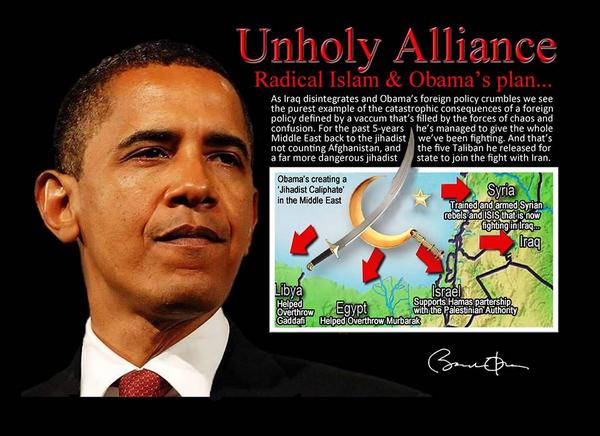
Until we in the West gain better understandings of the religion of peace death and the views of President Obama and His ilk concerning it, we will continue to be unwilling and unable to deal with it effectively. Even then, it will be extraordinarily difficult.

unholyalliance

UPDATE

Islamic nations (other than The Islamic State) seem to be principally concerned that the Islamic State’s brutality tarnishes their own image, rather than about the realities of what IS is doing.

In the past, Muslim leaders have faced criticism from inside and outside the religion for being slow to condemn terrorism in the name of Islam. An editorial in the London-based Al-Quds Al-Arabi last month called on moderate Muslims to denounce the actions of the group formerly known as ISIS, which has killed thousands and left an estimated 1.5 million people displaced in northern Iraq. [Emphasis added.]

“All we have to do to understand the high price that Muslims pay on all levels [for such actions] is to see how Westerners snatch up [such reports on] ISIS’s conquests, invasions and despicable actions, and share them on social media in order to tarnish the image of Islam,” the July 24 editorial read. “We haven’t heard one single voice in the camp of moderate Islam condemning taking women prisoner or expropriating peaceful citizens’ property and money for ISI in Mosul, or any who distanced themselves from the shocking fatwas that seem to be carefully formulated for [maximum] service to the enemy.” [Emphasis added.]

The actions of the extreme militants threatens “not only Christians or Iraq,” but serves as a warning about the potential elimination of the region’s ethnic and religious minorities, the editorial continued.

“Therefore, an Arab position that attempts to downplay the dangers of the cancerous spread of terrorist organizations in the region … in order to serve the political agendas will actually be an accessory to the crimes against humanity, and will morally legitimize criminals who have lost any vestige of their humanity,” it read.

The apparent absence of criticism of IS by “moderate” Muslims is consistent with the views expressed in the two videos provided above.

Canada Stands With Israel

August 16, 2014

Dr. Brown Interviews Walid Shoebat (July 31, 2014)

August 16, 2014

.