Archive for August 14, 2014

FRIEDMAN: As The Middle East Burns, The UN Simply Blames Jews

August 14, 2014

FRIEDMAN: As The Middle East Burns, The UN Simply Blames JewsBoth the media and the United Nations are willing to legitimize Hamas while reprimanding Israel for defending herself against an existential threat

.8.14.2014 Israel Revolt Truth Revolt

via FRIEDMAN: As The Middle East Burns, The UN Simply Blames Jews | Truth Revolt.


Yesterday, Hamas broke yet another cease-fire, only hours after Israel had agreed to extend the lull in the fighting. On Monday, the United Nations announced the creation of a special three-person Human Rights Council panel that will review allegations of human rights and international law violations occurring in the current Israel-Gaza conflict. One of the members of this panel has openly stated that Prime Minister Benjamin Netanyahu would be his favorite person to have tried in the International Criminal Court. This council is supposed to be unbiased and impartial. While the United Nations was busy focusing all its energy on these allegations, they forgot to discuss a few other crises occurring in the Middle East.

In Iraq:

Over the last year and a half, the terrorist organization known as the Islamic State of Iraq and Syria, an Al-Qaeda splinter cell, has taken control of large swaths of territory via violent means. At a glance:

Over 13,300: is the number of civilians killed by ISIS since the beginning of 2013

6,000: is the number of Iraqi civilians butchered by ISIS this year

500: is the number of Yazidis (a Kurdish Iraqi minority) killed by ISIS, some of which were buried alive

0: is the number of practicing Christians left in Mosul, a city that is now controlled by ISIS; ISIS has made Christianity punishable by death, thus forcing all Christians to either convert or flee.

As ISIS is carrying out targeted killings against minority groups and Iraqi Christians, it is safe to say that they are successfully carrying out genocide in Iraq. Unlike the Israel-Gaza conflict, this crisis has gone almost unmentioned for the last year and a half, even though scores of more people have been killed in Iraq than in the current Israel-Gaza conflict.

In Syria:

More than 170,000: is the number of people killed since start of the civil war

More than 54,000: is a conservative estimate of the number of civilians killed in the Syrian Civil War

More than 14,100: is the number of women and children killed in the Syrian Civil War

More than 1800: is the number of Palestinian-Arabs killed in the Syrian Civil War

The media scarcely reports on the ongoing civil war that is still raging in Syria; this past July was one of the deadliest months of the conflict thus far. It is of note that the United Nations has stopped updating its count of the Syrian death toll; it claims it cannot verify the sources behind the numbers. Essentially, they refuse to take the time to verify the sources and keep track of the death toll.

Last but not least, for the sake of comparison, Israel:

Approximately 87,000: is the number of Palestinian-Arabs killed in the Israeli-Arab conflict since 1948. More people have died in the last three years alone in the Syrian Civil War, but these victims have largely been forgotten by the international community.

More than 3500: is the number of rockets launched at Israel since the start of Protective Edge, each one of which constitutes an attempt to murder Israeli civilians. This is a war crime.

Approximately 1900: is the number of Palestinian Arabs killed since the start of Protective Edge.

Approximately 900-1300: is the estimated number of Palestinian-Arabs civilians killed amongst the 1900 total. The lower number is that estimated by the IDF, while the higher number is that estimated by Palestinian sources, many of which are run by Hamas. There are varying other estimates that fall between these numbers.

Recently, reports have surfaced that disprove the claim that the majority of the people killed in this conflict have been Palestinian civilians. In fact, research done by both the BBC as well as an Israeli research group indicates that the numbers of civilians and militants killed may be closer to equal. This is not a means to justify the number of civilians killed, because loss of innocent life is terrible. However, it is unfair and unjust to inflate figures merely to claim that one party’s response is disproportionate to the other’s actions. If the validity of war were judged based on the number of casualties on each side, then the Allies would bear the blame for World War II.

As for the allegations Israel of committing war crimes, indiscriminately ordering strikes within Gaza and violating human rights:

4,762: is the number of terror targets the IDF struck between July 8 and August 5. Again, without trying to justify loss of civilian life and using the larger estimates for the number of civilian casualties, this works out to one civilian killed for every 3.6 strikes. If Israel were truly indiscriminately targeting Palestinian civilians, the number of civilians killed in each strike would be much higher.

Additionally, the mainstream media often states that the Gaza Strip is one of the most densely populated areas on Earth, and Hamas only fires from civilian areas because of this fact. This is a distortion of the truth.

Here is the salient point:

Information recently released by the Gatestone Institute indicates that while the city centers of Gaza are very densely populated, there are many emptier areas of Gaza. Mainstream media outlets never show these areas because there is scarcely fighting there. Additionally, maps that show the origin of rocket attacks show that almost none of the attacks originate in these empty areas. This begs the question, if Hamas were concerned with Gaza’s civilians, why not fire rockets from these emptier areas? Why fire them from some of the most populated areas in the world? The answer is that as a terrorist organization, Hamas has no regard for civilians of any kind.

Up to this point I have refrained from addressing the claim that Hamas uses the civilians of Gaza as human shields. There is real and jarring evidence to support this claim. Hamas hides behind the civilians of Gaza by choosing to launch rocket attacks from densely populated areas and leaves the IDF no choice but to carry out strikes in these areas. Hamas does this knowing that images of deceased civilians will flood TV screens throughout the world, and that the international community will cry out in rage against Israel. Hamas has the option to set up their headquarters in empty areas of Gaza instead of in hospitals and homes, but has repeatedly choose the latter. By making this choice, Hamas bears the blame for the loss of civilian life and is committing war crimes.

Lastly, during Operation Protective Edge, Israel provided the following supplies to Gaza:

40,550: is the number of tons of supplies transferred to Gaza

37,178: is the number of tons of food transferred to Gaza

1,694: is the number of tons of humanitarian goods transferred to Gaza

1,029: is the number of tons of medicine and medical supplies transferred to Gaza

1,856: is the number of trucks needed to carry these supplies

Many of these supplies were delivered via the Kerem Shalom crossing, which has been repeatedly attacked with barrages of Hamas rockets in order to prevent these aid shipments from entering the Gaza Strip. So even though Israel has been more than willing to give assistance to the people of Gaza, Hamas will not allow them to have it.

Given the force with which the United States carried out its strikes against terrorists in Afghanistan and Iraq, there is no doubt that they would have responded in the same manner to a barrage of rockets raining down on the United States homeland. Additionally, the United States has renewed airstrikes against ISIS in Iraq and is being credited not only with further securing the homeland, but with saving the lives of civilians in Northern Iraq. These airstrikes serve the same purpose to the people of the Iraq as Operation Protective Edge does to the people of Israel: to protect the lives of civilians against terrorist attacks. Throughout history, there have been numerous cases of countries striking back at terrorists in order to secure the safety of their people. In the larger majority of these instances, civilians have died, as war is mayhem. No other country in the world is forced to live under the constant fear that Israel lives with day in and day out, and yet no other country in the world has faced the amount of backlash that Israel continues to receive in the name of self-defense.

When the mainstream media reports on ISIS, they waste no time calling them a dangerous terrorist organization that must be stopped. ISIS and Hamas are incredibly similar; they are both extremist groups perverting the beliefs of a peace-loving religion to further their cause. It is truly mind-boggling that the mainstream media is willing to ignore this fact, as is the United Nations. Both the media and the United Nations are willing to legitimize Hamas while reprimanding Israel for defending herself against an existential threat. At the end of the day, all Israel wants is to live in peace with her neighbors; this operation must continue so that Israel is able to do just that.

Ashley Friedman is a 2014 graduate of the University of Miami with a Bachelor of Science in Biology. She is a proud Zionist and dual Israeli-American citizen.

The unraveling of the Gaza blockade?

August 14, 2014

The unraveling of the Gaza blockade?Restrictions on the Strip, in place since Hamas seized control in 2007, are at the heart of negotiations on a long-term deal.

Hamas says it wants freedom for Gaza, but is likely to exploit any eased access to bring in more arms

By Mitch Ginsburg August 14, 2014, 2:39 pm

via The unraveling of the Gaza blockade? | The Times of Israel.


The negotiations in Cairo, apparently renewed for five days Wednesday amid rocket fire and counterstrikes at the midnight hour, have been conducted behind closed doors. There is much to discuss – the role, henceforth, of the Palestinian Authority in Gaza, the return of the remains of two Israeli soldiers, the fate of the Palestinian gunmen arrested during the operation, the notion, perhaps, of the demilitarization of the Gaza Strip, the duration of the ceasefire. But at the heart of the discussion, quite likely, is the blockade, the mechanism that restricts, to a small extent, the goods entering Gaza, and, to a great extent, everything that leaves the 140-square-mile enclave boxed in between Israel, Egypt, and the sea.

A look at the different crossings, for people and goods, may help paint a picture of the current situation, the way it has evolved over the past several years, and where it might develop at the close of the current campaign.

Kerem Shalom is today the sole passageway for goods in and out of Gaza. In 2005, before the rise of Hamas to power, a monthly average of 10,400 trucks of supplies entered Gaza from Israel. After Hamas, a terrorist organization avowedly committed to the destruction of Israel, won a popular election and, with brutal efficiency, ousted the PA from power in Gaza in 2007, Israel imposed a blockade on the Gaza Strip. For the first three years, from June 2007 to June 2010, during which only “vital supplies” were allowed to enter the Strip, a monthly average of 2,400 trucks passed into Gaza, according to statistics provided by the Gisha organization, which promotes a freer flow of supplies in and out of Gaza.

The blockade, barring everything from benzene to beef, was altered significantly by the Mavi Marmara incident in May 2010, in which Israeli naval commandos, under assault, killed nine Turkish activists on a vessel seeking to break the blockade. In response, Israel eased the blockade, allowing nearly all commodities to enter the Strip.


Trucks carrying fuel for the Gaza Strip enter Rafah town through the Kerem Shalom crossing between Israel and the southern Gaza Strip on March 16, 2014. (photo credit: AFP PHOTO/ SAID KHATIB)
 

The central sticking point, though, was, and continues to be, the restrictions on dual-use supplies, those with the potential of being used for nefarious purposes. Foremost among them is cement.

The civilian population in Gaza is in need of building materials. Gisha estimates that the Strip is short 75,000 new housing units and 259 schools. Additionally, 10,000 homes were destroyed during Operation Protective Edge, both by Israeli munitions and Hamas IEDs. The construction industry in Gaza supports 70,000 workers, Gisha co-founder Sari Bashi said, and once accounted for 28 percent of the GDP.

And yet Hamas priorities in Gaza are evidently such that cement is funneled first toward military projects. Khaled Mashaal, head of Hamas’s political bureau, admitted as much at a conference held in Damascus several months after Operation Cast Lead in 2008-9, the Meir Amit Intelligence and Information Center reported. “Outwardly, the visible picture is talks about reconciliation… and construction; however, the hidden picture is that most of the money and effort is invested in the resistance and military preparations,” Mashaal said.

Nowhere was this more evident than in the uniform cement arches that were found to support the network of Hamas attack tunnels dug under the border and into Israel. Brig. Gen. Michael Edelstein, the commander of the Gaza Division, said during a briefing near the Gaza border two weeks ago that Hamas had created “a terror Metro” in Gaza, using dozens of millions of dollars and “thousands and thousands of pounds of cement.”

Rocket launch sites, internal tunnels, and bunkers were all also fortified with cement.


Section of a tunnel discovered running from the Gaza Strip to Israel, October 13, 2013. (photo credit: Times of Israel/Mitch Ginsburg)
 

According to the Meir Amit Center, an organization run by former Israeli intelligence officers, the cement was ferried into Gaza underground quite freely before Abdel Fatah el-Sissi rose to power in Egypt and staunched the flow of goods from his territory through the tunnels. Today, a recent report suggests, the concrete is either made in Gaza, out of raw materials like fly ash and sea sand, or seized from international organizations, which must formally request the import of cement and submit plans and update reports to the Israeli authorities in order to receive clearance for bringing cement into Gaza.

Bashi said that fuel, too, was once considered a dual-use substance – as it is used for rockets – and that today it is allowed freely into Gaza, with the IDF’s Coordinator of Government Activities in the Territories sending some 7.6 million liters of fuel and benzene into Gaza during the last month of war alone. (A total of 3,324 trucks of supplies have entered Gaza via Israel since the outbreak of Operation Protective Edge on July 7, according to COGAT figures.)

Citing a 45 percent unemployment rate in Gaza, up from 28 percent last year, Bashi said that the restrictions failed to prevent the tunnels and instead disproportionately punished the public, creating an economic situation that is anathema to stability. “It’s a mistake to think of it as a zero-sum game,” she said.

The price in blood, though, paid by Israeli soldiers in (at least temporarily) removing the threat of the tunnels, coupled with the life-changing insecurity felt by residents of the border region, make it highly unlikely that Israel will allow the free and open transport of cement to the Strip at this time, especially now that the tunnels under Rafah have been shut. More likely, it will be doled out to responsible actors and supervised to the extent possible. (Israel lost 64 soldiers in the first month of fighting — 11 of them killed by Hamas gunmen emerging from the tunnels inside Israel, and many more in the course of finding and demolishing the tunnels inside Gaza.)

Outgoing goods, too, can only pass through Kerem Shalom. The land border crossing to Egypt, in Rafah, is utterly closed to goods. And while Gazans are permitted to export preciously little, Israeli businesses profit from import sales of commodities such as mangoes and beef to Gaza.

Udi Tamir, a part owner of Eglei Tal, one of the largest Israeli cattle importers, said the industry sends roughly 35,000 head of live cattle into Gaza annually for beef, for example. He quipped during an earlier conversation, several years ago, that some Israeli raisers of cattle might be willing to offer Turkey’s newly elected president Recep Tayyip Erdogan a lifetime achievement award.


The Mavi Marmara is tugged out of Haifa harbor long after the raid (photo credit: Herzl Shapira/Flash 90)
 

From January to June 2014 an average of 17 truckloads of goods exited Gaza each month – 2% of the pre-2007 average, according to Gisha figures, and, while once Gaza exported 85 percent of its goods to the West Bank and Israel, today, based on an Israeli policy of separation between the PA-controlled West Bank and the Hamas-controlled Gaza Strip, virtually no goods at all are allowed to travel from Gaza, via Israel, to the West Bank. According to Gisha, a sum total of 49 truckloads of date bars for an international organization, four truckloads of school desks for the PA and two truckloads of palm fronds for Israel are all that have passed to Israel and the West Bank since March 2012.

In this arena, quite likely, progress could be made with relatively little security risk and palpable benefit.
Pedestrian crossing

The Erez Crossing is the pathway for people between Israel, Gaza, and the West Bank; the Rafah Crossing, intermittently opened and closed over the years and closely monitored by Egypt, is the central pathway out of the Strip for international travel. Thus far this year, from January to June, a monthly average of 6,445 people exited Gaza via Rafah – a number that represents some 16 percent of the average during those same months in 2013, when Egypt was in the hands of Sissi’s predecessor Mohammad Morsi. Since the outbreak of war, the crossing has been shut down almost entirely.

During that same period of time, Gisha figures show, a monthly average of 5,920 Palestinians exited Gaza via Erez. Most were medical patients and their companions, and business people.


Palestinian Christian couple from the Gaza Strip leaves through the Israeli Erez crossing, Thursday, Dec. 24, 2009 (photo credit: Tsafrir Abayov/Flash90)
 

According to Gisha, mourners for a first-degree relative are allowed to travel to the West Bank, as are Christians wishing to visit holy sites, first-degree relatives wishing to attend a wedding, students en route abroad, and orphans without first-degree relations in Gaza. Those wishing to marry in the West Bank, though, along with students seeking to study there, for example, are barred from exiting Gaza via Erez.

Bashi noted that 31 percent of the people in Gaza have relatives in the West Bank and called for increased freedom of travel, as permitted by security assessments. The Shin Bet, though, over the past year, has repeatedly intercepted messages between Gaza and the West Bank and has warned, even before the June 12 kidnapping and murder of the three Israeli teens, apparently orchestrated from Gaza, that Hamas has perpetually sought to reinvigorate the old terror cells in the West Bank.
Arms

With no airport and no seaport, the tried and true route of smuggling professionally made weapons into Gaza, a senior intelligence officer said during the current campaign, was from “the axis of resistance” — Iran, Hezbollah, Syria — to Sudan and from there north, via the Sinai peninsula to the Rafah tunnels and into Gaza. Perhaps because the flow of terror ideology and materiel did not only move northwest into Gaza but also southeast into Rafah, the Sinai Peninsula, and mainland Egypt, fueling violence there, Egyptian President Sissi has largely eradicated the Rafah tunnels, which were used to transport everything from cars and cement to M-302 rockets.

Like the drug trade, though, it may be that the flow of arms can never be fully staunched. In early March, Israeli naval commandos boarded the Panama-flagged Klos-C ship and found 40 M-302 rockets and 180 120mm. mortar rounds beneath many tons of cement. A UN report found that the arms were in fact sent from Iran but disputed the Israeli claim that they were bound for Gaza. Neither Israeli nor UN officials provided hard evidence for the ultimate destination of the weapons, but it is hard to fathom why Israeli troops would intercept a ship more than 1,000 nautical miles from its territorial waters unless Prime Minister Benjamin Netanyahu and others truly believed that the arms might otherwise later be fired at Israeli citizens.

Hamas demands the lifting of the blockade and the opening of a naval port, a tangible achievement that could be presented to the people of Gaza as a sign of autonomy and freedom. Such demands are weighed, however, against its ceaseless efforts to import the sort of arms that have made Hezbollah such a formidable fighting force in the region.

On Wednesday night, shortly before the ceasefire was extended, Hamas offered footage of the homemade assembly of the M-75 rocket, lovingly glossed and sanded like a surfboard. The metals it is made of, and the explosives in the warhead, are meant to be caught in the fine net of the Israeli blockade.

At the close of this campaign, as after the Mavi Marmara incident, many of the facets of the blockade will be addressed at the negotiating table. Israel, it stands to reason, will be relatively pliable on concessions that strengthen the economy – such as, say, the export of strawberries and other goods. It will be far less so on the importing of dual-use goods of the sort that enable the construction of the M-75.

The trick will be finding a formula that widens the holes in the netting so as to support ordinary Gazans, grants achievements to the PA rather than Hamas, and allows Israel to ensure that Hamas, with its sworn allegiance to jihad, is shackled in its bid to replicate the Lebanese Hezbollah terror group.

The New Romantics — “Being Fair” to Terrorist Groups

August 14, 2014

The New Romantics — “Being Fair” to Terrorist Groups, Gatestone InstituteDenis MacEoin, August 14, 2014

(This historical analysis may help to explain — but by no means excuse — increasing levels of antisemitism and pro-Islamism throughout the free and “civilized” world. Israel, the current focus of antisemitism, is viewed by “romantics” as representative of imperialism and harm to the “repressed.” Their view is that she must, therefore, be destroyed.– DM)

“Because perfect democracy does not exist anywhere, the imperfect democracies of the West can be damned and the worst forms of political power legitimated.” — Pascal Bruckner, The Tears of the White Man.

What sort of pink-tinted spectacles do you need to march while chanting, “Hamas, Hamas, Jews to the Gas”? Or to march alongside the black flags of the Islamic State of Iraq and Syria? It is not just the new Romantics that bow down to the myth of Islam as the path to peace. Governments, church-leaders, do-gooders of every stripe accommodate every demand made by Muslim minorities. “Shari’a law? No problem.” “Islamic Banking? Why not?’

What answer can there be to explain such wished-for self- defeat?


It is terribly easy to romanticize. Human beings do it all the time. But romanticizing can get out of hand. Think of all those millions of German women who swooned as Hitler drove past; the groupies of Stalin, the steadfast admirers of Osama bin Laden, or the women who offer to marry murderers on death row. Charisma, as Max Weber told us, is not so much an innate characteristic of a leader or guru as something brought to him by others.[1]

Hitler was not a good-looking man, not tall, not prepossessing, not particularly intelligent, not a great orator — more a strident tub-thumper — yet millions of Germans loved him and died for him. In the end, Germany itself all but died for him.

Today, the romanticizing of sociopaths has not ended. However much we know about the clay-footed idols of the past, or the enormities committed by those demagogues and rabble-rousers and charlatans, many of us just transfer our allegiance to the next monster-in-waiting.

Those in Europe and the United States who romanticized Communism and the Soviet Union in Europe have gone through such transitions more than once since the days of the 19th-century anarchists and Marxists. Often they have woken up, only to fall asleep again. They have idolized Lenin, Stalin, Mao, Castro, Che Guevera, and Ho Chi Minh. Some, such as the former German Foreign Minister, Joschka Fischer, have moved in a less delusional direction. Disavowing violent activism, he wound up as a Green party parliamentarian who supported NATO and intervention in Bosnia. Others still just stumble on from hero to hero, cause to cause, embracing whatever seems most anti-democratic, “anti-establishment” or most comfortable among their friends.[2]

In recent years, however, these graying adolescents of the European and America “Left” have moved in a direction that could not have been predicted even in their own darkest nightmares. They have allied themselves with the most fascistic, reactionary and anti-liberal forces on the planet. Today they march arm in arm, not as fellow-travellers with the Vietcong or the Fidelistas, but step by step alongside anti-Semitic Islamists: pro-jihad extremists who threaten death and destruction on all of Western society, including the very people now defending them. The gay solidarity groups back the speech of radical Muslim clerics who, in the Middle East, would kill any stray homosexual crossing their path. There go the sisterhoods, arm in friendly arm with men who despise women and would put all of them back into niqabs, burqas and house-seclusion at the first opportunity. There go the fresh-faced young women-converts to Islam, on a desperate hunt for husbands to dominate and possibly beat them while dreaming of children to train as future martyrs. And there march Neturei Karta and other Jewish extremists and leftists, hand in hand with their future killers.

The Communists in Germany often gave their lives to prevent the Nazis from destroying their country. Many died in concentration camps. Brave idealists from many countries fought in the Spanish Civil War to prevent the fascist forces of Franco from taking over. But their heirs today march through the streets of European cities chanting “We are all Hamas now!” and worse, the genocidal, “Hamas, Hamas, Jews to the gas.”

The anti-fascist Marxist sympathizers have never quite died out, but other, sinister, things have happened, beginning with the extraordinary eruption of outrage that convulsed parts of Europe and the United States in 1968 and 1969. These same Romantics, appalled by the steady decline of the Soviet Union and the successes of the liberal democracies, turned on the societies that had fed and clothed them. The anti-Vietnam war protestors, for all their purported moral concern, simply joined forces with the enemy. It was no longer a case of “war is bad” — not unreasonable to say in the abstract — but, “we want the Vietcong to win and to defeat America.”

In the same period, support for third-world countries (especially Communist regimes) burgeoned. Western intellectuals, students, madcap suckers for victimhood, hippies, “anti-establishment” rioters and many more suddenly found themselves enamoured of the cult of death peddled by Che Guevara, Chairman Mao and the PLO. It did not matter that these were all mass murderers or terrorists, so long as they fought the brave fight against “Western imperialism,” now declared the greatest evil in the world.[3]

The 1968 rebellions slowly died away, but their hardline sympathizers remained. Many, such as the Weather Underground in the U.S., the Red Brigades in Italy, the Direct Action group in France, and the Red Army Faction/Baader-Meinhof Gang in Germany turned to violence, yet were beloved of many who saw them as fearless fighters against Western governments and institutions. Their cold-blooded assassinations and bombings sent a frisson of admiration among those wished that permanent rebellion might actually be a meaningful goal in life.

Something else happened, however, that was to have — and still has — a lasting effect on how these Romantics see the world. This was “Third Worldism,” the cult of unexamined, misguided, and often exaggerated respect for the non-Western world. Built at first on understandable and even commendable instincts of pity for the poor and oppressed in Africa and Asia, this sympathy before long was turned into an instrument for hatred of the West. Here again, angry young people dreamed up shimmering visions of a Utopia from the many insanities that engulfed country after country in their favored regions. The illusion was linked to frequently naïve beliefs that saw wisdom, spirituality, and human perfection in Eastern charlatans such as Guru Maharaji and Bhagwan Shree Rajnesh. As thousands of gullible young Westerners (and not a few riper dreamers) went out to the East in a bizarre replay of late 19th-century occultism, or costly trips to Tibet or the Sahara in search of enlightenment, many more stayed at home to wage their war on the West by affiliating themselves with romanticized figures and groups from Mao Zedong to the “freedom fighters” of the PLO. Anti-colonialism was the latest chic.

No one has drawn a more engaging and penetrating picture of Third World Romanticism than the French philosopher Pascal Bruckner.[4] He saw the start of the problem in European hatred of the United States following World War II:

Neither France, nor Italy, nor Germany could forgive America for having liberated them from the Nazi and fascist yokes…. The little American cousin had surpassed her European elders in vigor, power and creativity. It is hard to forgive assistance when it shows up such weakness.[5]

But when it came to the Third World, the haters of America performed a massive U-turn:

Being non-European is enough to put one on the side of right…. What seems criminal in Cuba, Angola, and Guinea has the real purpose of washing away the far greater crime of colonialism.[6]

To admire the crimes of Cuba or China is to damn the West for its liberalism and democratic practices:

Because perfect democracy does not exist anywhere, the imperfect democracies of the West can be damned and the worst forms of political power legitimated.[7]

There is one catch:

But almost everybody… was ignorant of the countries they talked about; that explains both the emptiness and the radicalism of prattle about the Third World.

Bruckner is scathing, but total ignorance of other countries, cultures and religions seems to play a crucial role in the current denigration of Israel and the romanticizing of cults such as Hamas or Hizbullah, more black-hearted than the Nazis whom these Romantics so often feign to despise.

Bruckner also draws vivid attention to the inversion of values that characterizes this admiration of the Other:

The only societies that seem worthy are those that contradict our values, and our attempts to escape the grasp of our cultural milieux are a shameful way of asserting our superiority.

And at one point he gets to the nub of the issue:

The question of Israel is fundamental in this regard. Through non-recognition of the Jewish state, the entire Western World is held to be illegitimate.

When the Romantics refuse to recognize Israel as legitimate, they are using its existence as an indictment of the Western values that brought it into being in the first place.

The new Romantics had already come out strongly in favor of Palestinian “resistance” movements. The 1972 massacre of Israel athletes at the Munich Olympics was in part enabled by the anti-Semitic West German Red Cells. Many in other countries applauded the attacks, and some went on to help attack other Israeli or Jewish targets.

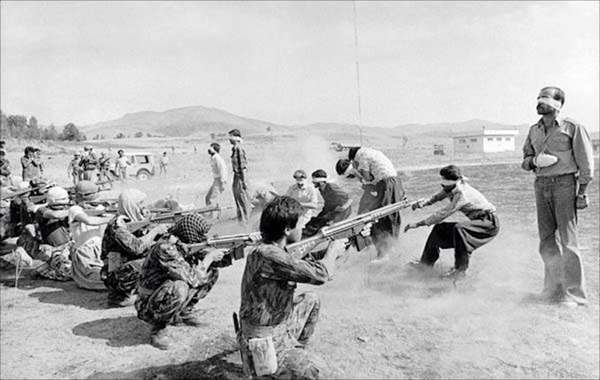
Meanwhile, behind the scenes, something else was brewing fast. This was Islamism, which first came to global prominence when, in 1979, a hardline coalition of the Iranian Communist Party (Tudeh), the Marxist Fedayeen Organization, and Islamist visionaries led by the Ayatollah Ruhollah Khomeini, carried out the greatest revolution since 1917. With the Shah ousted, however, and his functionaries headed for the firing squad and the hangman’s noose, the religious revolutionaries turned on their erstwhile comrades and all but wiped them out. This came as a shock to Romantics outside Iran, including America’s Revolutionary Communist Party, which had cheered on the Iranian coup d’état in tandem with thousands of Iranian Marxists in American universities.

633History has taught that revolutions devour their own children: Jahangir Razmi’s Pulitzer Prize-winning photograph of Islamist revolutionaries in Iran executing Kurdish men and others in 1979.

Now, you might think this would have taught the European and American Romantics a lesson — that it pays to choose your friends carefully or that revolutions devour their own children. But for almost unfathomable reasons, that lesson was never learned. Today’s Romantics march side by side with Islamists — secularists, atheists, anti-totalitarians alongside religious fanatics who would slit their throats, shoulder-to-shoulder with sexual revolutionaries, feminists, lesbians, and gay men whom the Muslim hardliners would as happily stone to death or hang in a back room in Iran’s Evin prison.

What answer can there be to explain such wished-for self-defeat? From the 1970s on, the Romantics could find salvation in a hatred of democracy, colonialism, imperialism and the West in general and idealize the Third World and the Islamic world, for was that not where the anti-Western revolutionaries had lived their lives as victims of universal terror, pawns of American imperialism, proud bearers of the endless proletarian struggle?

In the end, that old specter, anti-Semitism, came once more into focus. In the 1930s, British Socialists and others had fought the Nazis and given their hearts to the Jews. That strain of moderate Romanticism — close at times to the sort of liberalism that underpins the liberal democracies — remains. But the new Romantics still bear the imprint of the Red Cells who joined forces with PLO murderers in Munich.

Today in France, anti-Semitism endangers the lives and property of Jews, who are being driven out of their own country by a coalition of “left-wing” Romantics and Islamists. The French communists once hoped to engage with the working classes, yet never won the victories they sought. The French proletariat, though happy, like all French man and women, to go on strike as often as possible, was never prepared nor willing to launch a revolution or wheel out the guillotines for a new round of the Terror. But, in recent years, it has dawned on them that they have on their doorstep a ready-made band of potential terrorist revolutionaries — the masses of Algerian, Moroccan and other Muslims and Islamists — agitators of whom the French government is already afraid.

A French Jewish agency recently told the major French paper, Le Figaro, that “For 2014, one will have to register a record number of departures of French Jews for Israel since its creation in 1948. It will safely exceed 5,000 people. In 2013, there were already 3,300, an increase of 73 percent compared with 2012.”[8]

It is now fashionable to be anti-Semitic again, so long as you disguise it as anti-Zionism and anti-Israelism. Here, the Romantics can join hands, not only with the Islamists but with the anti-Semitic new Nazis in Europe, where, over the last several years, hatred of Jews has re-emerged as a major political force.

What sort of pink-tinted spectacles do you need to march while chanting, “Hamas, Hamas, Jews to the gas”? Or to march alongside the black flags of the Islamic State of Iraq and Syria that terrorize millions and threaten to slaughter thousands as those who hold them dream of glory and triumph? Throughout Europe, it is not just the new Romantics that bow down to the myth of Islam as the path to peace. Governments, church leaders, do-gooders of every stripe accommodate every demand made by Muslim minorities. “Shari’a Law? No problem.” “Islamic banking? Why not?” “Muslim prayer groups obstructing our roads and pavements? They have every right.”

This all illustrates a different sort of acquiescence: infatuation probably born out of fear rather than out of revolutionary zeal and hatred of the abominable West. Both are dangerous, but there is still time for democratic publics everywhere to turn back the tide of submission to Islam. Given its history and predilections, the Romantics will cling to the coat-tails of Hamas, Hizbullah, the Islamic State, and the Muslim Brotherhood until they triumph. When that happens, the Gays for Palestine, B’tselem, the Marxists, the Presbyterians, the Socialist Workers Party, EAPPI, the Quakers and everyone else will smile as they are led to the gallows, knowing they have wrought a great change in the world but destroyed democracy, love and liberty, and personal freedom in their tragic journey to romantic fulfilment.


[1] See Max Weber (S. N. Eisenstadt ed.) On Charisma and Institution Building, Chicago, 1965. And see Laurence Rees, The Dark Charisma of Adolf Hitler, London, 2013.

[2] On Fischer’s development, do read the very fine account by Paul Berman, Power and the Idealists, Or the Passion of Joschka Fischer and its Aftermath, New York, 2005; and, while you’re at it, read his broader and no less incisive story of the American and European left in A Tale of Two Utopias: The Political Journey of the Generation of 1968, New York, 1996.

[3] There are a great many books and articles about this period, but for a graphic depiction of the lunacy of the times, you must read a work of superlative fiction, Keith Maillard’s 2006 novel, Morgantown.

[4] Most famously in his 1983 study, translated as The Tears of the White Man. Bruckner himself marched in the 1968 demonstrations, but he later became one of the French New Philosophers (nouveaux philosophes) who broke with Marxism, in the 1970s — many in a moral reaction to the revelations in Solzhenitzyn’s Gulag Archipelago. Among them, Bruckner moved to a position critical of multiculturalism and what he termed “Third Worldism.”

[5] Tears of the White Man, New York, 1986, p.15

[6] Ibid p. 21

[7] Ibid p. 26

[8] Quoted Stephen Brown, “‘Exodus’ – French-Style“, Frontpage Magazine, 4 August 2014.

Hamas Funeral: I See Dead People … Move

August 14, 2014


hamas zombies

Khamenei says no dice on a nuclear deal – The Washington Post

August 14, 2014

Khamenei says no dice on a nuclear deal – The Washington Post.

August 13 at 4:31 PM
Iran’s semi-official news agency Fars reports that the Supreme Leader is supremely uninterested in making any deal with the West on the regime’s illicit nuclear program:

Khamenei said on Wednesday that negotiations with the United States “don’t have any benefits” for Iran and rejected the prospect of further discussions.

“Relations with the U.S. and negotiations with that country, except for very specific cases, don’t have any benefits for the Islamic Republic and it is even harmful,” Khamenei told Iran’s diplomatic corps, according to Fars.

Recent negotiations between the United States and Iran on its nuclear program have proved that no issues “will be settled,” according to Khamenei.

“Some people pretended that if we sit to the negotiating table with the Americans, many problems will be settled; of course, we knew that it is not correct but the events during the recent years has now proved this reality several times,” he was quoted as saying.

Nuclear talks “proved futile” and only “emboldened the U.S.” to make demands on Iran, according to Fars.

“Generally speaking, it was revealed that despite the imaginations of certain people, negotiations won’t help anything,” Khamenei said.

So long as economic sanctions remain in place on Iran, negotiations are “unjustified,” Khamenei said.

This suggests that for all the nice words from the “moderate” Iranian President Hassan Rouhani, the regime is fundamentally unwilling to give up its nuclear capabilities — and feels no particular pressure to do so. Mark Dubowitz of the Foundation for Defense of Democracies tells me, “[Khamenei] loathes America and doesn’t appear to share Rouhani’s fondness for using diplomacy to divide Europe and the United States. In his view, bowing to Westerners is a sin. The same is true for the Islamic Revolutionary Guards, who aren’t clever but are powerful.” Dubowitz acknowledges that this may be blustering, but it is also very possible that “Khamenei believes that continued intransigence involves no cost and that he has no interest in any kind of compromise. The White House’s palpable fear of conventional conflict, which Khamenei regularly mocks, and the West’s track record of giving ground in talks and eroding its negotiating position by de-escalating the economic pressure, probably proves in Khamenei’s eyes the strategic wisdom of his nuclear aspirations.”

It is likely this will have no effect on the president, whose main purpose appears to be keeping the talks alive and thereby any demands for action at bay. What we should do — and what Congress can certainly set in motion – is a shift in the cost- benefit analysis for Iranian intransigence. Increase sanctions, begin interdiction of Iranian arms shipments to its surrogates, coordinate with our Sunni allies and transfer bunker-buster bombs and other offensive equipment to Israel so as to increase the threat of a military strike on Iran. And rather than lend a helping hand to Hamas, Iran’s surrogate, we should forcefully insist on disarmament of Gaza, back continued Israeli action if needed against Hamas and put an end to any “war crimes” investigation of Israel by threat of defunding it and the entire United Nations Human Rights Council. A more forceful U.S. approach also means robust action to provide training and military assistance to the Free Syrian Army in its two-front battle against Iran’s junior partner, Syrian President Bashar al-Assad, and the Islamic State.

Israel, it seems, is the only country on the planet willing to stand up to Iranian-inspired aggression and draw red lines that its enemies respect. That suggests less talk with Iran and more talk with Israel and other allies about a military option. Iran won’t believe President Obama will ever act, but it might figure out that Israel is fully capable of a robust attack that would deeply wound Iran’s economy (and perhaps undermine its hard-line leaders) and set back Iran’s program a number of years. That may buy enough time for a new U.S. president to change our Iran policy and to convince the Iranians the choice is between regime survival and giving up nukes. By the way, what does Hillary Clinton favor at this point? Just asking.

Hamas Breaches New Ceasefire With Rocket Attack

August 14, 2014

Hamas Breaches New Ceasefire With Rocket Attack

New five-day extension doesn’t even make it past a day, as Hamas renews rocket fire Thursday after missiles night before.

By Ari YasharFirst Publish: 8/14/2014, 10:03 AM

via Hamas Breaches New Ceasefire With Rocket Attack – Defense/Security – News – Arutz Sheva.


Rocket fire from Gaza (file) Flash 90

Hamas already breached the last 72-hour ceasefire three hours ahead of its conclusion Wednesday at midnight; on Thursday morning it proved that it does not intend to honor the newly achieved five-day ceasefire either.

Rocket warning sirens were sounded just after 10 a.m. on Thursday in the Eshkol Regional Council and Hof Ashkelon region, as well in the Kerem Shalom area.

Shortly afterwards it was reported that a rocket fell in open ground in the Eshkol Regional Council, causing no injuries or damage.

The attack comes after Hamas fired at least one rocket at the Hof Ashkelon region on Wednesday night around 9 p.m., hitting open ground.

The terrorist organization then continued firing into the night until 1 a.m., even after the ceasefire extension was announced, with the Iron Dome anti-missile system intercepting one rocket over the city of Netivot. Two other rockets exploded in the Sdot Negev region.

No injuries were reported in either of the rounds of rocket attacks Wednesday night. The IDF responded by launching several airstrikes on terror targets in the Hamas enclave of Gaza.

Israeli MKs on Wednesday night called for a strong response to the renewed rocket attacks, with Deputy Transportation Minister Tzipi Hotovely (Likud) saying “Israel cannot be a prisoner of Hamas. Operation Protective Edge must end with a mortal blow to Hamas’s capabilities, eliminating the leaders of Hamas and achieving deterrence.”

Likewise, MK Miri Regev (Likud) commented “all attempts to reach an agreement with Hamas have ended and are doomed to fail because it is a dangerous terrorist organization which aims to destroy Israel. We have seen that all the diplomatic elements cannot influence a terrorist organization.”

US President Barack Obama called Prime Minister Binyamin Netanyahu on Wednesday night ahead of the ceasefire extension, pressing him to achieve a “sustainable” ceasefire with Hamas.

Wall Street Journal reports late Wednesday night reveal Obama’s administration recently cancelled a shipment of Hellfire missiles to Israel due to Operation Protective Edge, and ordered all future arms requests to be closely scrutinized.

PLO reports new Gaza truce, Hamas denies and shoots rockets. Israel is silent, retaliates with air strikes

August 14, 2014

PLO reports new Gaza truce, Hamas denies and shoots rockets. Israel is silent, retaliates with air strikes.

Debka

Total confusion reigned Thursday morning, Aug. 14, stirred up by a night of contradictory words and actions around the mirage of yet another truce in the Gaza war. The only immutable fact was Hamas rocket fire starting two hours before the last 72-hour ceasefire was scheduled to end Wednesday midnight and continuing up until 2 a.m. Thursday – namely before and after PLO-Ramallah envoys in Cairo and Egyptian officials reported a new five-day ceasefire had been agreed.

Hamas-Gaza denied any such deal until all its conditions met. No Israeli official was available to confirm or deny the PLO-Egyptian claims. However, the Israeli air force retaliated for the Palestinian rocket fire with air strikes over the Gaza Strip.

Early Thursday, the unofficial word from Jerusalem was that the indirect talks in Cairo, which according to Hamas had broken down, will “apparently” be resumed Sunday.

Egypt, Hamas, the PLO and Israel appear to be totally at loggerheads. This impasse has produced a volatile and unpredictable situation that is closer to a lingering war of attrition between Hamas and Israel than a negotiated accommodation.  Towards dawn Thursday, Ashkelon, Kiryat Gath, Netivot, and the Lachish, Eshkol and Shear Hanegev Districts again heard the explosions of Hamas rockets and Israeli air strikes over Khan Younes and central Gaza.
Members of the Israeli cabinet say that Prime Minister Binyamin Netanyahu and Defense Minister Moshe Ya’alon don’t keep them in the picture. Its hazy outline indicates that the two war leaders still hope to maneuver Hamas into accepting a prolonged ceasefire. Because that is the last thing that the Palestinian Islamists seek, they will keep on shooting.
debkafile reported Wednesday night:

Two hours before the Gaza truce was due to end Wednesday midnight, Palestinian rockets were fired from the Gaza Strip at large parts of southern Israel, including Ashkelon, Kiryat Gath, Yoav District, Shear Hanegev. Two were intercepted. No casualties were reported. Hamas envoys said that the Cairo talks had broken down and the truce would not be renewed unless their conditions were met. They called off a scheduled news conference without explanation.

Hamas went back to launching rockets after Israel nodded its acceptance of a further truce, while at the same time concentrating armored forces on the Gaza border in case the Palestinians against fired rockets. Wednesday afternoon, IDF reservists were called up, as columns of tanks, tank carriers and APCs thundered down the roads leading to the Gaza border.
debkafile reported Tuesday: The seventh truce in the ongoing Israel-Hamas passage of arms is generally expected to end Wednesday night Aug. 13, in a fresh outbreak of hostilities triggered by resumed Hamas rocket fire. The general media trend predicted a further ceasefire.

Our sources also reported that the indirect Egyptian-brokered talks between the parties in Cairo never got off the ground. From the start, all three realized that the gaps between Israel and the Palestinians were unbridgeable and, moreover, that Hamas and the Palestinian Authority were totally at odds on a common negotiating stance.
debkafile’s intelligence sources learned that Egyptian intelligence mediators presented separate papers to the Israelis and Palestinians, knowing – as they acknowledged behind the scenes – that the two papers were miles apart but they were not overly concerned about the lack of headway.
Our military sources say that Israel’s government and military leaders were braced for the next stage of the confrontation with Hamas, which will be a lot tougher, deeper and broader than a few restrained air strikes.

Bi-Partisan Senate Trio Demand Answers From Kerry on UNRWA Conduct in Gaza

August 14, 2014

Senators use harsh language to call UNRWA on its outrageous ties to Hamas and its one-sided condemnations of Israel

By: Lori Lowenthal Marcus

Published: August 14th, 2014

via The Jewish Press » » Bi-Partisan Senate Trio Demand Answers From Kerry on UNRWA Conduct in Gaza.


Senator Ben Cardin (D-MD)(pictured), Senator Marco Rubio (R-FL) and Senator Mark Kirk (R-IL) issued a harsh denunciation of UNRWA’s role in the Gaza conflict and demanded an investigation.
Photo Credit: cspanvideo.org

At least some members of the U.S. congress finally realized that if weapons belonging to Hamas were found in UNRWA facilities, questions need to be asked of UNRWA employees as to how those weapons got there, who put them there, who observed them, what – if anything – was done to remove them (or to keep them there), along with other pertinent and essential lines of inquiry.

U.S. senators Mark Kirk (R-IL), Ben Cardin (D-MD) and Marco Rubio (R-FL), sent a letter last week to U.S. Secretary of State John Kerry, demanding an investigation into the actions of the United Nations Refugee and Works Agency (UNRWA) during the fighting in Gaza.

The senators used very strong language to condemn the agency on several different bases.

First, the discovery, on three different occasions, of Hamas weapons in UNRWA facilities, whereupon the weapons were returned to the terrorist organization, Hamas.

Second, UNRWA has repeatedly issued statements condemning Israel and ignoring the wrongdoing of Hamas.

And third, the senators pointed out the very troubling close affiliation between Hamas and UNRWA, the irrefutable proof of which was the election of 25 Hamas candidates were voted onto the 27 member UNRWA ‘s workers’ union board in 2012.

Next, the senators explained why they are convinced it is appropriate for them to demand such an investigation into UNRWA: we pay for it! The United States contributed $294 million in 2013. It is the single largest donor to UNRWA. Since 1950, more than $5 billion U.S. taxpayers’ dollars were funneled into UNRWA.

Senator Mark Kirk is a member of the Senate Appropriations sub-committee which has jurisdiction over the Department of State, as well as U.S. contributions to U.N. activities. Kirk said in a statement posted on his website:

I am demanding a credible and independent assessment of UNRWA’s actions during this crisis. Given UNRWA’s ties to terrorism in the past, U.S. taxpayers deserve immediate answers and full transparency regarding their intentions and actions. The State Department must make clear to the U.N. that it need to take all necessary steps to prevent Hamas from using taxpayer-funded property to launch attacks against our allies.

Senator Cardin, a member of the Senate Foreign Relations Committee, added:

When leaders and organizations of the United Nations blur the clear distinction between a nation-state defending itself and a terrorist organization attempting to murder civilians, Americans take note. When an organization funded in part by the U.S. suggests that the two are morally equivalent, U.S. taxpayers take note. Israel is undertaking extraordinary efforts to avoid civilian casualties while Hamas cynically uses other Palestinians as human shields and deliberately attempts to kill Israeli civilians. U.N. resources and personnel cannot be complicit in Hamas’ violent terrorist actions.

Senator Marco Rubio is also a member of the Senate Foreign Relations Committee. Rubio had the following to say:

As the U.N.’s leading source of funding, American taxpayers will not tolerate the use of U.N. facilities by terrorists to stage attacks against our allies. We know Hamas has been using civilians as human shields and stores its weapons and fighters in civilian buildings, but for the U.N. to stand idly by while Hamas attacks Israel from its facilities is an outrage. This is the latest example of why the U.S. needs to bring greater transparency and accountability to the U.N. by pursuing reform of its programs and institutions.

The text of the letter the senators sent to Secretary of State Kerry:

Dear Secretary Kerry,

We write to express our profound concern with the troubling role the United Nations Refugee and Work Agency (UNRWA) has played during the ongoing crisis in Gaza, including multiple instances of weapons found at UNRWA schools as well as one-sided statements from UNRWA leadership that unjustly condemn Israel. For instance, on July 14, UNRWA Commissioner General Pierre Krahenbuhl stated that Israeli security forces are acting “contrary to international humanitarian law” and also called Israel’s Gaza blockade “illegal.”

As you know, UNRWA admitted on July 17, July 22nd, and July 30th that it found rockets belonging to Hamas on its property. We commend UNRWA’s quick condemnation of these incidents, but are concerned with the ultimate fate of these rockets, which UNRWA claimed to have turned over to the “local authorities” or have gone missing. We fear that this means these rockets may have found their way back into Hamas’ hands.

We urge the State Department to launch an independent investigation into these incidents and to call on the United Nations leadership to hold UNRWA accountable, including by reprimanding or dismissing the UNRWA staff responsible as appropriate, as well as asking the U.N. to ensure that these incidents never take place again.

In the course of your investigation, we ask you to examine the fate of these rockets, what measures the U.N. took to secure UNRWA property, and how the U.S. intends to work with the U.N. to make sure incidents like these are never repeated.

As you know, the United States is the largest donor to UNRWA and has contributed almost $5 billion to the organization since 1950. The United States taxpayers deserve to know if UNRWA is fulfilling its mission or taking sides in this tragic conflict.

We look forward to your reply,

Sincerely,

Now that the strong statements have been made and a letter from three members of senate committees with jurisdiction over the State Department and the U.N. has been sent to the secretary of state, it behooves Israel’s supporters to demand follow-through.

Oren: Israel May ‘Take on Iran’ when Nuclear Talks ‘Expire’

August 14, 2014

Oren: Israel May ‘Take on Iran’ when Nuclear Talks ‘Expire’.

In contrast to those Israeli leaders who have said that the Israel Defense Forces needed to “re-occupy” Gaza to root out Hamas, Oren said a ground operation should be more limited. Not only would a larger invasion require fighting in civilian areas, but there was the “possibility that Iranian nuclear negotiations go into a prolonged state, and expire. I don’t think Israel wants to be fighting in Gaza at the same time that we take on Iran.”

The six-month deadline for the nuclear talks is July 20. Negotiators are far apart on the core issues, and the interim deal that led to the talks already backed down from earlier international demands to stop all nuclear enrichment activity. The Obama administration has repeatedly claimed that the interim deal would “eliminate” Iran’s stockpile of highly enriched uranium, but that is false, because the oxidization process is reversible.

Iran touted the interim deal in January as a “surrender” by the West, with Foreign Minister Zavad Jarif noting that the regime “did not agree to dismantle anything.” Israeli Prime Minister Benjamin Netanyahu called the deal as an “historic mistake.” Events thus far have confirmed that assessment, as the Iranian economy recovers due to sanctions relief and the Tehran regime feels even less pressure than before to accede to U.S. demands.

Oren told Breitbart News that the possibility of Israeli military action against the Iranian nuclear threat was not something new, and that Israel had always reserved the right to act in its own self-defense.

The possibility of an Israeli pre-emptive strike without American approval may have increased during the Gaza conflict, as the U.S. has called for a ceasefire rather than offering full support from the outset to Israel’s response to Hamas attacks.

That widened a gap that has been growing in recent months, not only over Iran but also over Iraq, as Israel has supported Kurdish independence as a counter to both Sunni extremists in ISIS and Iranian-backed Shia forces. The U.S. has discouraged Kurdish independence, urging Kurdish leaders to continue to support a unified Iraq.

The nuclear talks may be extended–but they will eventually “expire,” Oren said, and Israel had to be free to act.

U.S. halts missile transfer requested by Israel

August 14, 2014

U.S. halts missile transfer requested by Israel

Wall Street Journal reports supply of Hellfire missiles canceled, U.S. officials demanding to review Israeli requests on individual basis.

By Barak Ravid | Aug. 14, 2014 | 8:54 AM

via U.S. halts missile transfer requested by Israel – Diplomacy and Defense Israel News | Haaretz.


n Israeli Air Force Apache helicopter fires flares in the sky
above the Israel-Gaza border July 30, 2014. Photo by Reuters
 

The White House has instructed the Pentagon and the U.S. military to put on hold a transfer of Hellfire missiles that Israel had requested during its recent operation in the Gaza Strip, the Wall Street Journal reports.

According to the report, during Israel’s Operation Protective Edge, White House officials were dismayed to discover how little influence they wield over the topic of Israeli arms replenishment, against the backdrop of the U.S. government’s unhappiness with the widespread damage inflicted upon Palestinian civilians.

Officials in the White House and the State Department are now demanding to review every Israeli request for American arms individually, rather than let them move relatively unchecked through a direct military-to-military channel, a fact that slows down the process.

“The allegations are unfounded,” Israel’s ambassador to the U.S. Ron Dermer was quoted as saying by the WSJ, in response to the Wall Street Journal’s description of a significant “fraying of relations” between the two nations’ leaders. “Israel deeply appreciates the support we have received during the recent conflict in Gaza from both the Obama administration and the Congress for Israel’s right to defend itself and for increased funding of Iron Dome.”