Archive for August 13, 2014

Islamists seek to destroy Israel and leftist say, “Negotiate with them!”

August 13, 2014

Islamists seek to destroy Israel and leftist say, “Negotiate with them!” Dan Miller’s Blog, August 13, 2014

It’s a figment of their imagination, but leftists evidently believe that only through persistent negotiation and compromise with evil can peace everlasting be bought.  

Kerry-Idiot-copy

A burglar breaks into your home to rape you and steal your TV set. Don’t shoot. Meet him at least half way and he may agree merely to rape you. That’s the modern version of a “win win” situation. He can come back for the TV later, while you are hospitalized to recover from being raped.

History is being ignored

Islam, a fanatical cult like Hitler’s, wants to conquer your ally, Israel, and eliminate the “Jewish problem” there. Negotiate like Chamberlain and demand that Israel yield to its “reasonable” demands. All may turn out OK for you briefly, but not for Israel — while Islam continues to prepare for war on your own country and much of the rest of the somewhat free world. You will be praised (briefly and mainly by the left) for bringing peace in your time, and what could be sweeter than that?

Don’t consider any lessons of history; that’s old fashioned and this is the Age of Aquarius Obama. His legacy needs to be that He brought peace in His time; war (in His time) is prohibited.

Do we have a Churchill? Does Israel?

We need a Churchill and so does Israel. So does formerly Great Britain, which on August 12th announced the suspension of arms exports to Israel should fighting resume.

Britain said on Tuesday it would suspend 12 licenses to export military items to Israel, including tank, aircraft and radar parts, if hostilities with Hamas in Gaza resumed, citing concerns the exports may be used to breach international laws. [Emphasis added.]

Britain said last week it was reviewing all arms export licenses to Israel after fierce fighting which has resulted in heavy civilian casualties in the Palestinian enclave of Gaza.

Israel is fighting for her survival against Hamas, Islamic Jihad, its other brother “freedom fighters” and their supporters such as Iran, which also seek the death of Israel and Jews. So does the “moderate” Palestinian Authority (PA).

Palestinian Authority Envoy to Tehran Salah al-Zawawi told supporters of Gaza on Tuesday that “Israel’s annihilation has begun and the new generation in Iran will certainly witness our victory over Israel, “according to Iranian semi-official state news agency Fars.”

. . . .

During Operation Protective Edge, Iranian military commanders called for a formal alliance among Iran, Syria, Hezbollah in Lebanon and Hamas in Gaza to fight “the Zionist enemy.” On Monday, the deputy chief of staff of the Iranian Army called for an armed Palestinian Intifada in the West Bank.

Hamas has acknowledged that it wants ceasefires to prepare for further military action against Israel.

Even as Israeli representatives are in Cairo to discuss a truce with Hamas on Tuesday, the terrorist group is taking pains to clarify it has no intentions of desisting from trying to wipe Israel off the map.

Hamas’s “military wing,” the Al-Qassam Brigades, released a statement presenting its position on the ongoing talks in Egypt.

“The warriors in Gaza are waiting with Allah’s help to renew the fighting, or to return to planning the next campaign. There’s no escape. Either jihad or planning (for the next jihad),” declared the statement. [Emphasis added.]

Nevertheless, it is the leftist view that Israel should continue to enter into multiple ceasefires, continue to negotiate for peace with Hamas, et al and yield to their “reasonable” demands. That might bring peace for a few days, or for as long as Hamas, et al, consider necessary to rearm and refurbish their military infrastructures to pursue their goal, Israel’s destruction. The left doesn’t mind. (Note: the video immediately below gets to the point at about the four minute mark.)

The Islamic State

Like Hamas, the Islamic State — which has joined Hamas in Gaza — seeks death for its enemies — Christians, the very few remaining Jews, Yazidis and Islamists of differing ideologies. It has enjoyed substantial success. Even so,

The United States has ironically called for greater cooperation.  UN Ambassador, Samantha Power, urged ‘all parties to the conflict’ to allow access to UN relief agencies. She called on Iraqis to ‘come together’ so that Iraq will ‘get back on the path to a peaceful future’ and ‘prevent ISIL from obliterating Iraq’s vibrant diversity’. [Emphasis added.]

Of course it is not ‘vibrant diversity’ which is being wiped out in Iraq, but men, women and children by their tens of thousands.  This is not about the failure of coexistence, and the problem is not ‘conflict’. This is not about people who have trouble getting on and who need to somehow make up and ‘come together’. It is about a well-articulated and well-documented theological worldview hell-bent on dominating ‘infidels’, if necessary wiping them off the face of the earth, in order to establish the power and grandeur of a radical vision of Islam. [Emphasis added.]

. . . .

[T]he West is in the grip of theological illiteracy.  It has stubbornly refused to grasp the implications of a global Islamic revival which has been gaining steam for the best part of a century.  The Islamic Movement looks back to the glory days of conquest as Islam’s finest hour, and seeks to revive Islamic supremacy through jihad and sacrifice.  It longs for a truly Islamic state – the caliphate reborn – and considers jihad to be the God-given means to usher it in. [Emphasis added.]

This worldview was promoted in compelling, visionary terms by Indian scholar Abul A’la Maududi, whose writings continue to be widely disseminated by Islamic bookshops and mosques across the West.  Maududi argued in his radicalisation primer Let us be Muslims that the only valid form of government is Islamic theocracy – i.e. sharia rule – and Muslims are duty-bound to use whatever power they can muster to impose this goal on the world: ‘whoever you are, in whichever country you live, you must strive to change the wrong basis of government, and seize all powers to rule and make laws from those who do not fear God. … The name of this striving is jihad.’  And ‘If you believe Islam to be true, you have no alternative but to exert your utmost strength to make it prevail on earth: you either establish it or give your lives in this struggle.’

Belatedly and at least for now, Obama’s America — along with Iran — has dipped its toes in the water by taking limited military actions against the Islamic State; it may consider doing a little bit more militarily. Even the Vatican is urging limited military action in Iraq.

Military intervention in Iraq may be the only way to stop the genocide against the country’s Christian minority by the Islamic State (formerly the Islamic State of Iraq and Syria, or ISIS), a senior Vatican diplomat says. [Emphasis added.]

Will “limited” military action be sufficient, or would it need to be proportional to the long term and limitless Islamic threat?

Since IS is not yet an existential threat to Obama’s America, will the leftist cry of “Negotiate!” soon be heard if IS pauses briefly to regroup in its genocidal efforts in Iraq? Were the words of the U.S. Ambassador to the UN referenced above a beginning? A trial balloon? Peace, of sorts, might result for awhile as IS pursues its long term goal of peace everlasting through death. Do we care about long term Islamic goals? “We” seem not to have paid much attention in the recent past.

Obama Clinton and Muslim Brotherhood

Hamas, et al, have not yet enjoyed successes comparable to those of IS, and Obama’s America as well as other other allies continue to urge Israel to continue to negotiate a “peaceful settlement” with Hamas, et al.

There is a double standard

The world agrees that the Islamic State (IS) is morally repugnant and must be stopped from wiping out 40,000 mountain-bound Yazdis, but Hamas is able to escape the same condemnation. Why is IS’s sudden genocide of Yazdis alarming, but Hamas’s agenda of genocide against six million Jews in Israel given a pass? [Emphasis added.]

The double standards in dealing with Hamas and IS are logically incoherent. Both implement sharia governance, deliberately target civilians, have genocidal beliefs and seek the establishment of a caliphate.

Hamas would love nothing more than to put Israelis in the position that the Yazidis are in today. Article 7 of its founding charter quotes from a commonly quoted hadith:

“The prophet, prayer and peace be upon him, said: The time will not come until Muslims will fight the Jews (and kill them); until the Jews hide behind rocks and trees, which will cry: O Muslim! there is a Jew hiding behind me, come on and kill him! This will not apply to the Gharqad, which is a Jewish tree (cited by Bukhari and Muslim).”

Hamas not only want to eliminate the state of Israel — a genocidal aspiration in its own right — but Hamas explicitly believes it is required by Allah to wage war against Jews until the end of time. Just as IS believes that the Yazdis are apostates deserving of death, Hamas sees Jews as the incarnation of evil. [Emphasis added.]

. . ..

IS and Hamas violate every standard of morality. They stand together, shoulder-to-shoulder, waging the same overall jihad – only in different battlefields.

There are few Jews left in Iraq. There are many in Israel and more continue to arrive. Might that be among the reasons for a double standard?

In the next video, Geert Wilders presents his views on the Islamic threat.

By rejecting the religion of death peace, Mr. Wilders rejects the version of peace sought by Islam. Here’s are examples of Islam’s efforts to pursue “peace” and what its efforts bring:

But isn’t the peace of Islam good enough for a “war weary,” multicultural and post-sanity nation? Much depends on which way unicorn worshipers and other leftists believe the winds are blowing.

Fresh Gaza hostilities likely Wednesday. IDF to expand counteraction for Hamas rockets

August 13, 2014

Fresh Gaza hostilities likely Wednesday. IDF to expand counteraction for Hamas rockets
DEBKAfile Exclusive Report August 12, 2014, 11:18 PM (IDT)


(Looks like the Egyptians are using Israel to do the ‘heavy lifting’.-LS)

The seventh truce in the ongoing Israel-Hamas passage of arms is generally expected to end Wednesday night Aug. 13, with a fresh outbreak of hostilities triggered by resumed Hamas rocket fire. The indirect Egyptian-brokered talks between the parties in Cairo have never got off the ground. From the start, all three realized that the gaps between Israel and the Palestinians were unbridgeable and, moreover, that Hamas and the Palestinian Authority were totally at odds on a common negotiating stance.

DEBKAfile’s intelligence sources report exclusively that Egyptian intelligence mediators presented separate papers to the Israelis and Palestinians, knowing – as they acknowledged informally – that the two papers were miles apart.

A source close to the talks told DEBKAfile Tuesday night that the Israeli envoys had nothing to do all day in Cairo except to drink hot cups of strong tea in the hotel room assigned them by their Egyptian hosts.

In any case, the Egyptian mediators were in no hurry to push for results and, in fact, appeared fairly unconcerned by the prospect of hostilities resuming in a day or two.

This indifference was also noticeable at the joint news conference addressed by Egyptian President Abdel-Fattah El-Sisi and President Vladimir Putin at the Russian resort of Sochi, Tuesday, when neither made any reference to the Gaza conflict.

The Palestinian team is in no shape to hold practical negotiations on any sort of resolution in Gaza, because it is deeply divided two ways.
For one, Hamas rejects the PA-PLO group as not fit to represent its interests because they say PA chairman Mahmoud Abbas is locked onto the Egyptian side.

The rancor between the two Palestinian factions came to the fore Tuesday night, our sources disclose, when PA security forces began detaining Hamas activists on the West Bank for the first time since the current conflict broke out in July. The arrests took place in the Qalqilya and Tulkarm refugee camps.

And for the second, the Hamas team itself was split between the envoys from Gaza and the delegates from Qatar. The Gaza group want the Cairo talks to lead off by setting conditions for a prolonged ceasefire, during which their political and military demands would be negotiated.

The Qatar envoys insist on reversing this order: first agreed solutions for the long term and only then a deal for extending the ceasefire.
Our Washington sources report that the US tried interceding with the Palestinian Authority in Ramallah, and also with Israel and Egypt, to persuade them to accept another extension of the three-day truce. This effort fell on deaf ears because the Obama administration has not carved out a role or gained levers of influence in the Gaza conflict.

The one thing that can avert a fresh outbreak of violence Wednesday night is a declaration by Hamas’ military wing, Ezz e-Din al-Qassam, unconditionally halting further rocket fire and other aggressive activity.

Israel is not holding its breath for this to happen. Our military sources say that Israel’s government and military leaders are ready for the next stage of the confrontation with Hamas. This time, Prime Minister Binyamin Netanyahu and Defense Minister Moshe Ya’alon are preparing action a lot tougher than limited air strikes in response to Palestinian rocket fire of any intensity. They know that public patience has run out and will no longer tolerate a return to the situation that leaves Hamas holding the initiative to shoot rockets or not.

Not only the public, but the army too will no longer put off with half-measures and is ready to fight Hamas until it is no longer capable of harassing Israel with threats of violence.

Saudi king grants Sisi medal of honour

August 13, 2014
Monday, 11 August 2014 15:56
King Abdullah giving Sisi medal of honourThe visit by Al-Sisi is his first to the Kingdom since he assumed office on June 8. During the trip the leaders discussed bilateral relatios and issues of mutual concern, especially the developments in Gaza, Anadolu reported.

Saudi’s King Abdallah presented Egypt’s President Abdel Fatah Al-Sisi with the highest medal of honour in the Kingdom during their meeting in Jeddah yesterday.

The visit by Al-Sisi is his first to the Kingdom since he assumed office on June 8. During the trip the leaders discussed bilateral relatios and issues of mutual concern, especially the developments in Gaza, Anadolu reported.
The two sides are expected to discuss the preparations for the donors’ conference for Egypt, promised by the Saudi king and endorsed by the United Arab Emirates.

A day before his trip to the Kingdom, Al-Sisi called for the formation of an “Arab Alliance” to counter the danger of the Islamic State in Iraq and Sham (ISIS) which has seized control of vast swaths of Iraq and Syria.

Following the military’s ouster of President Mohamed Morsi in July last year, Gulf countries were quick to lend support to the new regime, led by Al-Sisi. Gulf aid to Egypt since Morsi’s ouster amounted to $15.9 billion, including $6.9 billion from the UAE, $5 billion from Saudi, and $4 billion from Kuwait.

Following his visit to Saudi, Al-Sisi is scheduled to pay a brief visit to Russia tomorrow based on an invite from Russian President Vladimir Putin.

UNRWA = United Nations Rocket Warehousing Agency

August 13, 2014


United Nations Rocket Warehousing Agency (Again)

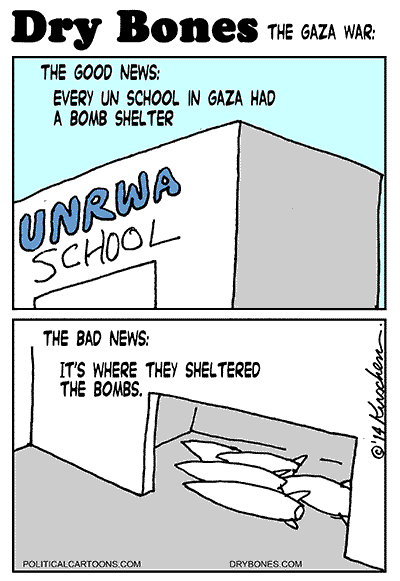
UN Rocket Warehousing Agency Logo largeDing Ding – Seconds out, Round Three! Buried (much like they hide weapons) at the end of an unrelated story on the UN site with this title: “Citing humanitarian impact, Ban warns against further escalation in Gaza conflict” we find the THIRD admission of weapons concealment by, what shall be forthwith be known as, the United Nations Rocket Warehousing Agency (UNRWA):

In a related development, UNRWA said that a cache of rockets was found today at one of its schools in central Gaza. The discovery came during a regular UNRWA inspection of the school, which was closed for the summer and not being used as a shelter. All the relevant parties have been notified. “We condemn the group or groups who endangered civilians by placing these munitions in our school,” said UNRWA spokesperson Chris Gunness. “This is yet another flagrant violation of the neutrality of our premises. We call on all the warring parties to respect the inviolability of UN property.”

As ever we have no firm idea what they did with the rockets but the chances are high they gave them back to the terrorists. Again. Here are the previous times they’ve done this: The Answer To My Question: UNRWA Supplies Weapons To Hamas Terrorists Weapons Found At UNRWA School. Again And lets not forget that Hamas likes to fire rockets from next to these schools and sometimes these go astray. Deaths In Beit Hanoun: Hamas Crime And UNRWA Cover-Up? H/t to my Facebook friend John for the new name of UNRWA.

Senators want UNRWA investigated over ‘troubling’ Gaza role

Norwegian TV 2 says many journalist have been thrown out from Gaza if they say or do things Hamas does not like

August 13, 2014

http://www.tv2.no/2014/08/10/nyheter/5887617  (Norwegian)

– Journalister blir utvist fra Gaza fordi Hamas ikke liker det de gjør

GAZA ( TV 2) Reporter Pål T. Jørgensen forteller at pressen har fått strenge restriksjoner og trusler i Gaza.

Tension mounts as clock ticks down on Gaza cease-fire

August 13, 2014

Israel Hayom | Tension mounts as clock ticks down on Gaza cease-fire.

 With 72-hour cease-fire set to expire at midnight Wednesday, Cairo talks reach a decisive stage • Defense Minister Moshe Ya’alon: Fighting may break out again; we must be alert and ready • Foreign Minister Avigdor Lieberman: Israel must take the initiative, finish the story.

Defense Minister Moshe Ya’alon visits a Navy ship in Ashdod, Tuesday

|

Photo credit: Ariel Hermoni

Hamas ‘Experts’ Kill Foreign Journalist while Neutralizing Tank Shell

August 13, 2014

By: Tzvi Ben-GedalyahuPublished: August 13th, 2014

via The Jewish Press » » Hamas ‘Experts’ Kill Foreign Journalist while Neutralizing Tank Shell.


Hamas’ so-called sappers managed to kill themselves and a foreign journalist Wednesday.
 

Hamas terrorists accidentally killed at least four and maybe five of their own members and an Italian photo journalist Wednesday when they tried dismantling what apparently was an IDF artillery shell that did not explode.

The Italian civilian was reportedly working for several news agencies, including Associated Press, according to the Greek news service ANSA.

Several others, including a Gaza journalist and medics, were wounded in the blast around 11 a.m. in Beit Lahiya, located in northern Gaza.

The incident occurred in a civilian neighborhood, one of Hamas’ favorite areas for launching rockets and using human shields to attack Israel.

As tragic as the death of the journalist is, the sappers’ bungling parallels the terrorist organization’s military, diplomatic blunders in the war, not to mention its horrendous war crimes that have exposed Hams for what it is.

It remains to be seen if Hamas blames Israel for the death of a civilian because it failed to explode a bomb aimed at terrorists.

Liberman: If cease-fire ends, Israel should defeat Hamas as quickly as possible

August 13, 2014

Liberman: If cease-fire ends, Israel should defeat Hamas as quickly as possible | JPost | Israel News.

08/13/2014 11:38

Foreign minister says that if bodies of IDF soldiers in Hamas’s hands not returned to Israel, Hamas will get back instead the bodies of Mohammed Deff, Ismail Haniyeh, and all Hamas leaders in Gaza.

If the 72-hour cease-fire with Hamas is not going to be renewed after midnight, then Israel needs to take the initiative and roundly defeat Hamas as soon as possible, Foreign Minister Avigdor Liberman said Wednesday.

“Israel cannot allow itself a war of attrition,” Liberman said at a meeting with local council heads in the South held in Ashkelon. “We must subdue them, even at the price of escalation.” He said Israel could not accept a situation whereby it cannot roundly defeat 26,000 terrorists in Gaza.

After more than a month of Operation Protective Edge, he said, “it is time to say ‘enough’.”

Echoing what he said Tuesday in an interview with The Jerusalem Post, Liberman said that without getting rid of Hamas it would be impossible to move forward with any wider security or diplomatic arrangement.

Liberman also made clear that his Yisrael Beytenu party would not accept any arrangement with Hamas that does not include the return of the remains of the two IDF soldiers in Hamas’ hands.

“If the terrorists on the other side don’t understand or are unwilling to accept that as part of a [ceasefire] framework, they must understand that they will get back instead the bodies of Mohammed Deff, [Ismail] Haniyeh, and all the Hamas leaders in Gaza,” he declared. .

Regarding the UN Human Rights Committee headed by Canadian professor William Schabas, Liberman said Israel will have to “deal” with the committee, but not “cooperate” with it.

Schabas — who Liberman highlighted, has said that both Prime Minister Binyamin Netanyahu and Nobel Peace Prize laureate and former president Shimon Peres should be brought to the International Criminal Court —  should not be allowed to step inside Israel, he said.

“Israel should not cooperate with the committee,” he said. “We must deal with them, but not cooperate or give legitimization to haters of Israel.”

On Tuesday, during his interview with the Post, Liberman would not say whether Israel would cooperate with the probe, saying then only that “we don’t have to say what we are going to do.”

US Readies More Advisers for Iraq, Steps Up Air Strikes

August 13, 2014

US Sends More Advisers to Iraq, Steps Up Air Strikes

Tuesday, 12 Aug 2014 07:23 PM

via US Readies More Advisers for Iraq, Steps Up Air Strikes.


(AP)

Breaking:

The Obama administration has sent about 130 additional military personnel to Iraq, U.S Defense Secretary Chuck Hagel said on Tuesday, as Washington seeks to help Iraq contain the threat posed by hardline militants from the Islamic State.

Hagel, speaking to troops in California, said the soldiers had arrived in the area around Iraqi Kurdistan’s capital, Arbil, earlier in the day on Tuesday.

A U.S. defense official, in a statement issued as Hagel was speaking, said the soldiers sent to northern Iraq would “assess the scope of the humanitarian mission and develop additional humanitarian assistance options beyond the current airdrop effort in support of displaced Iraqi civilians trapped on Sinjar Mountain by the Islamic State of Iraq and the Levant.”
Earlier Story:

Iraq’s new prime minister-designate won swift endorsements from uneasy mutual allies the United States and Iran on Tuesday as he called on political leaders to end crippling feuds that have let jihadists seize a third of the country.

Haider al-Abadi still faces opposition closer to home, where his Shi’ite party colleague Nuri al-Maliki has refused to step aside after eight years as premier that have alienated Iraq’s once dominant Sunni minority and irked Washington and Tehran.

However, Shi’ite militia and army commanders long loyal to Maliki signaled their backing for the change, as did many people on the streets of Baghdad, eager for an end to fears of a further descent into sectarian and ethnic bloodletting.

Sunni neighbors Turkey and Saudi Arabia also welcomed Abadi’s appointment.

A statement from Maliki’s office said he met senior security officials and army and police commanders to urge them “not to interfere in the political crisis”. At least 17 people were killed in two car bombings in Shi’ite areas of Baghdad – a kind of attack that has become increasingly routine in recent months.

As Western powers and international aid agencies considered further help for tens of thousands of people driven from their homes and under threat from the Sunni militants of the Islamic State near the Syrian border, Secretary of State John Kerry said the United States would consider requests for military and other assistance once Abadi forms a government to unite the country.

However, U.S. officials said the Obama administration was already considering sending more military advisers to Iraq. Speaking on condition of anonymity, several said a decision to send at least 70 extra military personnel was likely later on Tuesday, although a final decision had not yet been made.

Underscoring the convergence of interest in Iraq that marks the normally hostile relationship between Washington and Iran, senior Iranian officials congratulated Abadi on his nomination, three months after a parliamentary election left Maliki’s bloc as the biggest in the legislature. Like Western powers, Shi’ite Iran is alarmed by Sunni militants’ hold in Syria and Iraq.

“Iran supports the legal process that has taken its course with respect to choosing Iraq’s new prime minister,” the representative of Supreme Leader Ayatollah Ali Khamenei on the Supreme National Security Council was quoted as saying.

“Iran favors a cohesive, integrated and secure Iraq,” he said, adding an apparent appeal to Maliki to concede.

Abadi himself, long exiled in Britain, is seen as a far less polarizing, sectarian figure than Maliki, who is also from the Shi’ite Islamic Dawa party. Abadi appears to have the blessing of Iraq’s powerful Shi’ite clergy, a major force since U.S. troops toppled Sunni dictator Saddam Hussein in 2003.

Iraqi state television said Abadi “called on all political powers who believe in the constitution and democracy to unite efforts and close ranks to respond to Iraq’s great challenges”.

One politician close to Abadi told Reuters that the prime minister-designate had begun contacting leaders of major groups to sound them out on forming a new cabinet. The president said on Monday he hoped he would succeed within the next month.

A statement from a major Shi’ite militia group, Asaib Ahl Haq, which has backed Maliki and reinforced the Iraqi army as it fell back from the north in June, called for an end to the legalistic arguments of the kind used by Maliki to justify his retaining power and urged “self-restraint by all sides”.

It said leaders should “give priority to the public interest over the private” and respect clerical guidance – a clear reference to indications that Grand Ayatollah Ali al-Sistani favors the removal of Maliki to address the national crisis.

While U.S. officials have been at pains not to appear to be imposing a new leadership on Iraq, three years after U.S. troops left the country, President Barack Obama was quick to welcome the appointment. Wrangling over a new government since Iraqis elected the new parliament in April has been exploited by the Islamic State to seize much of the north and west.

Obama has sent hundreds of U.S. military advisers and last week launched air strikes on the militants after they made dramatic gains against the Peshmerga forces of Iraq’s autonomous ethnic Kurdish region, an ally of the Baghdad authorities.

Kurdish president Masoud Barzani told U.S. Vice President Joe Biden that he would work with Abadi, the White House said.

U.S. officials have said the Kurds are also receiving direct military aid, and U.S. and British aircraft have dropped food and other supplies to terrified civilians, including from the Yazidi religious minority, who have taken refuge in remote mountains. The United Nations said on Tuesday that 20,000 to 30,000 Yazidis may still be sheltering on the arid Mount Sinjar.

U.N. Secretary-General Ban Ki-moon described the Yazidis’ plight on the mountain as dire. “I urge the international community to do even more to provide the protection they need,” he told reporters.

Kerry, who on Monday had warned Maliki not to resort to force to hold on to power, said on Tuesday that Abadi could win more U.S. military and economic assistance.

“We are prepared to consider additional political, economic and security options as Iraq’s government starts to build a new government,” he told a news conference in Australia, where he also reaffirmed that Washington would not send combat troops.

“The best thing for stability in Iraq is for an inclusive government to bring the disaffected parties to the table and work with them in order to make sure there is the kind of sharing of power and decision-making that people feel confident the government represents all of their interests,” Kerry added.

It remains unclear how much support Maliki, who remains acting premier, has to obstruct the formation of a new administration. One senior government official told Reuters that his fears of a military standoff in the capital had eased as police and troops had reduced their presence on the streets.

“Yesterday Baghdad was very tense,” he said. “But key military commanders have since contacted the president and said they would support him and not Maliki.”

In both Shi’ite and Sunni districts of the capital, many spoke of a sense of relief and cautious hope for change.

“I’m very happy Maliki will not be prime minister again. I hate him; he killed my sons and broke my heart,” said 68-year-old Um Aqeel as she walked in the Karrada shopping district.

Saying two of her sons had died in violence in the past year – one while serving as a soldier in the north in May – she said: “Maliki knows only the language of war and never believes in peace, just like Saddam. Yesterday when I heard he was out I felt justice has been done by God, and my two beloved sons who were killed because of him will rest in peace.”

But as Um Aqeel offered sweets to passers-by in the mainly Shi’ite area to share her satisfaction, one man, Murtadha al-Waeli, warned her angrily that she was wrong to celebrate.

“Soon you will all regret Maliki’s going,” he said. “It was he who built a strong army. Iraq will fall apart after Maliki, and we will lose the battle with the terrorists. Shi’ites will pay a high price for losing Maliki. Just wait and see.”

In the mainly Sunni district of Adhamiya, where many people have long resented what they saw as Maliki’s determination to keep Sunnis out of positions of influence, cafe owner Khalid Saad said he hoped Abadi would learn a lesson from the past by keeping his distance from Iran and leaving Sunnis in peace.

“Maliki treated us Sunni like aliens,” he said. “We hope Abadi will learn from Maliki’s fatal mistakes and pull the country back from its sea of troubles.

Ministers say Netanyahu concerned over cabinet dissent

August 13, 2014

Ministers say Netanyahu concerned over cabinet dissent

A day before the ceasefire ends, the Prime Minister is worried about the possibility that the cabinet will reject the developing agreement.

‘We didn’t get enough details, Netanyahu is trying to set a trap for us,” ministers say.

Attila Somfalvi Published: 08.13.14, 01:27 / Israel News

via Ministers say Netanyahu concerned over cabinet dissent – Israel News, Ynetnews.


The Israeli and Palestinian delegations will convene Wednesday for the third and final day of talks during the current 72-hour ceasefire, but Prime Minister Benjamin Netanyahu is concerned of the outcome of the cabinet vote on any agreement reached in Cairo.

Netanyahu summoned senior ministers late Tuesday night to discuss the developments in Cairo and to have a “preparation talk” as one minister called his conversation with the prime minister.

The impression gleaned by the ministers invited to the talks was that Netanyahu was troubled and worried from the possibility that the cabinet would reject the developing agreement.

“He is worried it will not pass,” said one of the ministers. “He is preparing for the day after, trying to soften the ministers. There are more than a few problems with this agreement, and Netanyahu is concerned about the possibility that we will say no, and then he will be mired in an international disaster.”

Though the cabinet agreed to send a delegation for the talks with Hamas in Cairo, there were more than a few clauses in the agreement that were deeply divisive. One of the issues revolves around the wages of Hamas officials in Gaza.

“How do we determine who gets paid and who doesn’t? Who supervises this money?” asked one of the cabinet ministers, who had a difficult conversation with Netanyahu.

If a nurse in a hospital receives her salary, maybe Mohammed Deif will also receive one. We need to supervise this cash.”

Netanyahu’s worries have opened the door for demands from his coalition partners. Cabinet ministers are formulating demands that Netanyahu will have to adhere to in order to win their vote in the upcoming vote on the agreement.

One minister stressed to the prime minister that he will lose his support if an international committee to draft a proposal to demilitarize and rehabilitate the Gaza Strip is not part of the agreement.

“Netanyahu is in crisis, that he decided to meet with us privately just reflects on the problems; it doesn’t solve them,” said another minister after his conversation with Netanyahu.

The ministers said that they were not fully involved in the details of the negotiations in Cairo. “We don’t really know. Netanyahu is trying to set a trap for us with this Egyptian agreement so we cannot reject him, but he has a problem.”

Among her other concerns, Justice Minister Tzipi Livni said she would not agree to the construction of a seaport.

Listening to the ministers present their assorted political plans and new demands, there is an understanding that beyond the diplomatic and defense issues, the agreement hinges on political issues – which will continue to rock the coalition after the calm returns to the south.

Elior Levy and Roi Kais contributed to this report.


