Archive for August 12, 2014

Fresh Gaza hostilities likely Wednesday. IDF to expand counteraction for Hamas rockets

August 12, 2014

Fresh Gaza hostilities likely Wednesday. IDF to expand counteraction for Hamas rockets, DEBKAfile, August 12, 2014

GOLANmobile_artillery_units_IDF mobile artillery ready for resumed Gaza warfare

The seventh truce in the ongoing Israel-Hamas passage of arms is generally expected to end Wednesday night Aug. 13, with a fresh outbreak of hostilities triggered by resumed Hamas rocket fire. The indirect Egyptian-brokered talks between the parties in Cairo have never got off the ground. From the start, all three realized that the gaps between Israel and the Palestinians were unbridgeable and, moreover, that Hamas and the Palestinian Authority were totally at odds on a common negotiating stance.

DEBKAfile’s intelligence sources report exclusively that Egyptian intelligence mediators presented separate papers to the Israelis and Palestinians, knowing – as they acknowledged informally – that the two papers were miles apart.

A source close to the talks told DEBKAfile Tuesday night that the Israeli envoys had nothing to do all day in Cairo except to drink hot cups of strong tea in the hotel room assigned them by their Egyptian hosts.

In any case, the Egyptian mediators were in no hurry to push for results and, in fact, appeared fairly unconcerned by the prospect of hostilities resuming in a day or two.

This indifference was also noticeable at the joint news conference addressed by Egyptian President Abdel-Fattah El-Sisi and President Vladimir Putin at the Russian resort of Sochi, Tuesday, when neither made any reference to the Gaza conflict.

The Palestinian team is in no shape to hold practical negotiations on any sort of resolution in Gaza, because it is deeply divided two ways.

For one, Hamas rejects the PA-PLO group as not fit to represent its interests because they say PA chairman Mahmoud Abbas is locked onto the Egyptian side.

The rancor between the two Palestinian factions came to the fore Tuesday night, our sources disclose, when PA security forces began detaining Hamas activists on the West Bank for the first time since the current conflict broke out in July. The arrests took place in the Qalqilya and Tulkarm refugee camps.

And for the second, the Hamas team itself was split between the envoys from Gaza and the delegates from Qatar. The Gaza group want the Cairo talks to lead off by setting conditions for a prolonged ceasefire, during which their political and military demands would be negotiated.

The Qatar envoys insist on reversing this order: first agreed solutions for the long term and only then a deal for extending the ceasefire.

Our Washington sources report that the US tried interceding with the Palestinian Authority in Ramallah, and also with Israel and Egypt, to persuade them to accept another extension of the three-day truce. This effort fell on deaf ears because the Obama administration has not carved out a role or gained levers of influence in the Gaza conflict.

The coming issue of DEBKA Weekly, out next Friday, Aug. 15 will examine the process leading up to the US administration’s loss of standing in the Gaza crisis. If you are not a subscriber, you may click here to sign on.

The one thing that can avert a fresh outbreak of violence Wednesday night is a declaration by Hamas’ military wing, Ezz e-Din al-Qassam, unconditionally halting further rocket fire and other aggressive activity.

Israel is not holding its breath for this to happen. Our military sources say that Israel’s government and military leaders are ready for the next stage of the confrontation with Hamas. This time, Prime Minister Binyamin Netanyahu and Defense Minister Moshe Ya’alon are preparing action a lot tougher than limited air strikes in response to Palestinian rocket fire of any intensity. They know that public patience has run out and will no longer tolerate a return to the situation that leaves Hamas holding the initiative to shoot rockets or not.

Not only the public, but the army too will no longer put off with half-measures and is ready to fight Hamas until it is no longer capable of harassing Israel with threats of violence.

UK says to suspend some Israel arms exports if Gaza truce fails

August 12, 2014

UK says to suspend some Israel arms exports if Gaza truce fails

After reviewing all licenses to Israel last week, Britain announces sale of 12 military items would be temporarily halted pending further investigation if fighting resumes.

ReutersPublished: 08.12.14, 21:51 / Israel Business

via UK says to suspend some Israel arms exports if Gaza truce fails – Israel Business, Ynetnews.

Britain said on Tuesday it would suspend 12 licenses to export military items to Israel, including tank, aircraft and radar parts, if hostilities with Hamas in Gaza resumed, citing concerns the exports may be used to breach international laws

Britain said last week it was reviewing all arms export licenses to Israel after fierce fighting which has resulted in heavy civilian casualties in the Palestinian enclave of Gaza.

That review concluded on Tuesday that 12 licenses would be temporarily suspended pending further investigation if the current truce breaks down and heavy fighting resumes.

“The UK government has not been able to clarify if the export license criteria are being met,” Business Secretary Vince Cable said in a statement.

“In light of that uncertainty, we have taken the decision to suspend these existing export licenses in the event of a resumption of significant hostilities.”

Israel says its operation in Gaza is self-defense, aimed at stopping rockets being fired from the enclave by Islamist militants.

According to a report by a British parliamentary committee last month, outstanding government-approved contracts for export of dual use or military goods to Israel are worth more than 7.8 billion pounds ($13 billion). These include contracts to supply body armor, drone components and missile parts.

Cable’s department said the vast majority of export licenses were not for items that could be used by Israeli forces in its operations in Gaza, but it was unable to immediately confirm the value of the licenses that could be suspended.

Britain said that the suspensions would not include components for Israel’s “Iron Dome” system which protects the country from rockets fired by Hamas.

Last week Sayeeda Warsi, a senior Foreign Office minister, resigned, accusing Prime Minister David Cameron’s government of taking a “morally indefensible” approach on Gaza.

IDF successfully tests system designed to detect terror tunnels

August 12, 2014

IDF successfully tests system designed to detect terror tunnels

By JPOST.COM STAFF
08/11/2014 18:13

Senior army officer says system passed lab tests, currently undergoing field testing; could be deployed around Gaza within 1 year; system will cost at least NIS 1.5 billion.


Tunnel uncovered by IDF in Gaza , July 23 Photo: IDF SPOKESMAN’S OFFICE

A system designed to detect infiltration tunnels proved successful in laboratory tests for the first time ever and is now being tested in the field, a senior IDF officer said Monday.

If the field test proves successful, the system can be deployed around the Gaza Strip within approximately one year, the officer added.

The system will cost from NIS 1.5 billlion to NIS 2.5 billion to deploy.

The officer said that the IDF is also working to improve the Iron Dome.  It is believed that, in the future, Israel’s enemies will try to overcome the rocket defense system by launching a number of missiles and rockets at the same time, including more advanced projectiles that can reach a greater height than those previously fired from Gaza. Among the improvements being worked on is giving the Iron Dome the ability to intercept rockets over enemy territory, before they enter Israel.

The officer also touted the Trophy tank defense system for its success in saving the lives of IDF soldiers during Operation Protective Edge.

He said the Trophy system had neutralized dozens of anti-tank missiles fired at tanks and armored personnel carriers during the operation.

The officer said the defense establishment was in need of an additional NIS 3 billion in order to bolster Israel’s ground forces.

Hamas says group preparing for ‘long battle,’ as three-day truce nears end

August 12, 2014

Hamas says group preparing for ‘long battle,’ as three-day truce nears end

By HERB KEINON, KHALED ABU TOAMEH 08/12/2014 22:30

As Netanyahu briefs coalition on cease-fire efforts, Palestinian sources say Israel has accepted few demands, and no progress has been made on key issues.

via Hamas says group preparing for ‘long battle,’ as three-day truce nears end | JPost | Israel News.


Palestinian chief negotiator Saeb Erekat (L) talks with Arab League Chief Nabil el-Araby during their meeting at the Arab League in Cairo August 11, 2014. Photo: REUTERS
 

The 72-hour cease-fire that went into effect in Gaza on Sunday is to expire at midnight Wednesday, with Israeli officials unable or unwilling to predict whether it will be extended or the fighting will start anew.

Finance Minister Yair Lapid, a member of the eight-person security cabinet, said the gaps between Israel and Hamas holding indirect talks in Cairo were “wide.”

“It is possible that the fighting will begin again at midnight,” he said in a Channel 2 interview. “But it will not be the same fighting, because we will hit them much harder.”

Lapid said that Israel was dealing “with a murderous terrorist organization that wants to kill Jews,” and it will be “impossible to move forward” unless the security of the communities in the south is secured.

Prime Minister Binyamin Netanyahu cancelled a security-cabinet that was scheduled for Tuesday after it became apparent that there had been no progress in the Cairo talks on Monday, and there was no need for any decisions to be taken. Rather than hold the security cabinet meeting, Netanyahu briefed the heads of his coalition partners in the afternoon.

One diplomatic official said that Israel hoped that the cease-fire would be extended, but that Hamas was the “wild card” and it was not clear how they would react.

Diplomatic officials said that all the options were on the table, and that three scenarios were being taken into consideration: that a longer-term cease fire is agreed upon by midnight; that another 72-hour cease-fire is declared during which negotiations continue on a longer deal; that the cease-fire ends and Hamas again begins rocketing Israeli towns.

The Palestinians, meanwhile, said that almost no progress has been achieved during the Egyptian-sponsored talks.

Unconfirmed reports suggested that Hamas and Islamic Jihad members of the Palestinian negotiating team were considering pulling out from the talks in protest against Israel’s refusal to accept their demands.

They accused Israel of “procrastination” and warned that Hamas and other Palestinian factions would not agree to an extension of the cease-fire.

“Israel is continuing with its policy of foot-dragging and is not taking our demands seriously,” a Palestinian official in Cairo told the Palestinian daily Al-Quds.

“Israel is trying to impose its conditions and this will never happen regardless of the cost. If Israel requests another extension of the cease-fire, our delegation won’t agree.”

The Cairo talks are being under the auspices of Egypt’s General Intelligence Service, with the Israeli team shuttling back and forth between Cairo and Jerusalem. .

Qais Abu Laila, member of the Palestinian team to the cease-fire talks, said that the gap between the two sides remained “very wide.”

Abu Laila said that he and his colleagues have informed the Egyptians that this would be the last cease-fire with Israel.

Yehya Musa, a senior Hamas official in the Gaza Strip, said that his movement was preparing for a “long battle” with Israel.

Musa, who was speaking during a pro-Hamas rally in Khan Yunis, said that the Palestinians “won’t accept humiliation.”

Addressing the Palestinian team in Cairo, Musa said: “We are all behind you until you achieve our just demands. We know that everyone is conspiring against you, but we are confident that you won’t make concessions. Be patient because we have nothing more to lose.”

Palestinian sources told the Palestinian Ma’an news agency that Israel was insisting on discussing the fate of two missing IDF soldiers who were killed during Operation protective Edge, while the Palestinians asked to delay this issue.

According to the sources, Israel has thus far accepted only a few of the Palestinian demands, including increasing the number of trucks loaded with food and goods that enter through Kerem Shalom and Nahal Oz and allowing 5000 Palestinians from the Gaza Strip to enter Israel every month.

Israel has also agreed to drop its opposition to the transfer of funds to pay salaries of Hamas civil servants in the Gaza Strip and expanding the fishing zone gradually, the sources said.

In addition, the sources added, the Israelis and Palestinians have agreed on the reopening of the Rafah border crossing and the deployment of 1000 Palestinian Authority police officers at the terminal, as well as the release of the fourth patch of Palestinian prisoners, who were supposed to be freed earlier this year in accordance with a US-sponsored agreement between the PA and Israel.

However, the two sides have still failed to make progress on several other issues, such the disarming of Palestinian groups in the Gaza Strip, the airport and seaport and a safe passage between the West Bank and Gaza Strip, the sources added.

Israeli officials refused to relate to these reports, with one official saying that Israel did not feel the need to respond to Palestinian “disinformation.”

In New York, meanwhile, US Secretary-General Ban Ki-moon said at a news conference that he hoped a “durable cease-fire “ would be reached soon.

Ban said that 2,000 Palestinians have been killed, including more children than were killed in the two previous Gaza crisis combined; 300,000 people were being sheltered in UNRWA facilities; and 100,000 people have had their homes destroyed or damaged.

“Israel’s duty to protect its citizens from rocket attacks by Hamas and other threats is beyond question,” Ban said. “At the same time, the fighting has raised serious questions about Israel’s respect for the principles of distinction and proportionality. Reports of militant activity does not justify jeopardizing the lives and safety of many thousands of innocent civilians.”

Ban did not mention that on at least three occasions Hamas rockets were stored in UNRWA schools, and that when when discovered they were turned over to Hamas, nor did he mention evidence showing that rockets were launched perilously close to UN facilities.

While directly condemning Israel, Ban only obliquely criticized Hamas, saying at one time during the press conference, though without mentioning the organization by name: “They simply have not listened to those voices of reason and they have not cared [for] their own people. In the name of protecting their own people, they have been letting their people be killed by others.”

Hamas: This will be last truce; Israel: No progress in talks

August 12, 2014

Hamas: This will be last truce; Israel: No progress in talks
Mati Tuchfeld, Yoav Limor, Israel Hayom Staff and Reuters August 12, 2014


(If this is the last, then what?-LS)

Israeli official says gaps between Israel’s and Hamas’ positions are big • Palestinian delegation consents to Palestinian unity government of technocrats overseeing reconstruction in Gaza, official says • Israeli cabinet meeting on truce talks canceled.

Talks to end a month-long war between Israel and Palestinian terrorist groups in the Gaza Strip have made no progress so far, an Israeli official said on Tuesday, as a 72-hour cease-fire in the Palestinian coastal enclave held for a second day.

Israeli and Palestinian negotiators were expected to reconvene later Tuesday in Cairo where Hamas and its allies are seeking an end to an Israeli and Egyptian blockade of Gaza.

“The gaps between the sides are big and there is no progress in the negotiations,” said an Israeli official who declined to be named.

Meanwhile, Hamas deputy political bureau chief Moussa Abu Marzouk told the Palestinian news agency Maan that “we are facing difficult negotiations, the first truce passed without any notable achievement, and this is the second and last truce. Its gravity now is clear. The delegation must achieve the people’s wishes.”

Hamas also seeks a seaport for Gaza, a project Israel says should be dealt with only under the framework of future talks on a permanent peace agreement with the Palestinians.

Israel has resisted lifting its blockade on Gaza out of fear that Hamas would restock with weapons from abroad if access to Gaza was eased. Neighboring Egypt also sees Hamas as a security threat.

Israel pulled ground forces out of Gaza last week after it said the IDF had completed its main mission of destroying more than 30 tunnels dug by terrorists for cross-border attacks. Israel now wants guarantees Hamas will not use any reconstruction supplies sent into Gaza to rebuild those tunnels.

A Palestinian official said Tuesday that the Palestinian delegation had consented that reconstruction in Gaza should be carried out by the unity government of technocrats set up in June by Hamas and the more secular Fatah party of Western-backed Palestinian Authority President Mahmoud Abbas, who is based in the West Bank.

Israeli representatives are not meeting face-to-face with the Palestinian delegation because it includes Hamas, which Israel regards as a terrorist organization. Hamas for its part is sworn to Israel’s destruction.

Israel’s cabinet was scheduled to convene on Tuesday to discuss the details of the potential cease-fire agreement, but the meeting was canceled in the morning.

Hamas and the Islamic State: Why the World’s Double Standard?

August 12, 2014

Hamas and the Islamic State: Why the World’s Double Standard? Clarion ProjectRyan Mauro, August 12, 2014

Islamic State’s intended genocide of Yazdis alarming, but Hamas’s desire of genocide against 6 million Jews in Israel given a pass.

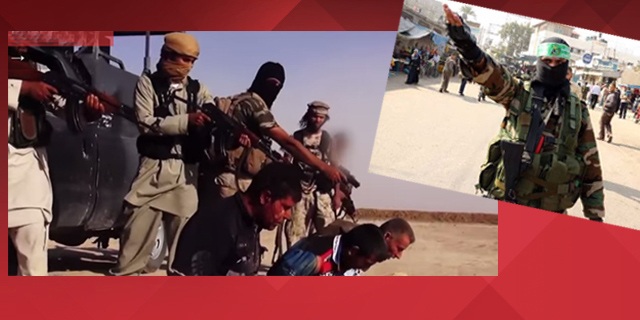
ISIS-Hamas-HPISIS fighters execute in cold blood(left); a Hamas fighter raises his hand in a Nazi salute (right)

The double standards in dealing with Hamas and IS are logically incoherent. Both implement sharia governance, deliberately target civilians, have genocidal beliefs and seek the establishment of a caliphate.

The calculated restraint of Hamas is mistaken for moderation. Hamas engages in negotiations and ceasefires only to strengthen its hand. It should not be interpreted as a reluctant acceptance of Israel’s existence.

**************

The world agrees that the Islamic State (IS) is morally repugnant and must be stopped from wiping out 40,000 mountain-bound Yazdis, but Hamas is able to escape the same condemnation. Why is IS’s sudden genocide of Yazdis alarming, but Hamas’s agenda of genocide against six million Jews in Israel given a pass?

The double standards in dealing with Hamas and IS are logically incoherent. Both implement sharia governance, deliberately target civilians, have genocidal beliefs and seek the establishment of a caliphate.

Hamas would love nothing more than to put Israelis in the position that the Yazidis are in today. Article 7 of its founding charter quotes from a commonly quoted hadith:

“The prophet, prayer and peace be upon him, said: The time will not come until Muslims will fight the Jews (and kill them); until the Jews hide behind rocks and trees, which will cry: O Muslim! there is a Jew hiding behind me, come on and kill him! This will not apply to the Gharqad, which is a Jewish tree (cited by Bukhari and Muslim).”

Hamas not only want to eliminate the state of Israel — a genocidal aspiration in its own right — but Hamas explicitly believes it is required by Allah to wage war against Jews until the end of time. Just as IS believes that the Yazdis are apostates deserving of death, Hamas sees Jews as the incarnation of evil.

The potential massacre of the 40,000 Yazdis is an imminent crisis warranting immediate action, but IS’s assault is not more egregious than Hamas’s desire to massacre millions of Israelis. To argue otherwise is to argue that a Yazdi life is worth more than that of an Israeli Jew.

Governance under IS and Hamas would be virtually indistinguishable because of their shared Islamist ideology. Their differences merely lie in tactics towards the same end.

Hamas’s parent organization, the Muslim Brotherhood, rejects IS’s declaration of a caliphate – but only on technical grounds. In November 2013, Hamas Interior Minister Fathi Hammad explained that his group’s aspirations to “uproot the Jews” are part of a larger project.

“We shall liberate our Al-Aqsa Mosque [in Jerusalem], and our cities and villages [in Israel], as a prelude to the establishment of the future Islamic caliphate,” he said.

The Muslim Brotherhood, of which Hamas is a subset, has always had the same agenda. However, the Brotherhood and its offspring follow a doctrine of gradualism towards establishing Sharia governance and the caliphate. IS terrorists use all means necessary to immediately implement sharia and have already declared a caliphate.

The Brotherhood and Hamas believe this should be done by an Islamist government that comes to power incrementally. IS rejects the democratic process entirely, viewing voting as an act of heresy, whereas Hamas believes voting is permissible within Islamist confines.

“Democracy itself also can make what it wants as lawful, or prohibit anything it does not like. In comparison, the sharia as a political system has limits. If we are to adopt democracy, we should adopt its best features,” preaches Sheikh Yousef Qaradawi, the spiritual leader of the Brotherhood.

The recent arrest of IS supporter Donald Ray Morgan on August 2 in New York shows the overlap between the two groups. He declared his loyalty to IS, but supported Hamas’s terrorism against Israel on Twitter. Under the name of “Abu Omar Al-Amreeki,” he tweeted, “I say Hamas is doing what they should, defending itself.”

Hamas and IS are cut from the same cloth. This raises the question of why many view IS as irreconcilable extremists but Hamas as a potential peace partner whose terrorism is an act of desperation against a superior adversary.

The calculated restraint of Hamas is mistaken for moderation. Hamas engages in negotiations and ceasefires only to strengthen its hand. It should not be interpreted as a reluctant acceptance of Israel’s existence.

Hamas’s victory in the 2006 Palestinian elections is often upheld as its certification of “legitimacy,” but democracy is much more than elections; it requires pluralism, human rights and freedoms that Hamas regularly stomps out.

Further, whatever “legitimacy” Hamas earned in 2006 has long since expired. That was eight years ago. There have been no elections since. The latest polls show the group’s support has collapsed among Gazans.

IS and Hamas violate every standard of morality. They stand together, shoulder-to-shoulder, waging the same overall jihad – only in different battlefields.

Mideast powers endorse new Iraqi prime minister-designate

August 12, 2014

Mideast powers endorse new Iraqi prime minister-designate

By MICHAEL WILNER 08/12/2014 20:23

via Mideast powers endorse new Iraqi prime minister-designate | JPost | Israel News.

Pentagon broadens air campaign on the Islamic State; car bombs kill twelve in Baghdad; UN, Vatican call for greater mobilization against terrorist group.


Iraqi Prime Minister Nouri al-Maliki Photo: REUTERS
 

WASHINGTON — Iran, Turkey and Saudi Arabia joined an international chorus of praise for Iraq’s nomination of a new prime minister on Tuesday, spurning the current premier, Nouri al-Maliki, who is refusing to leave his post.

The encirclement leaves Maliki with few allies, as his party colleague, Haider al-Abadi, prepares to form a new unity government.

Iran’s state-run news agency reported that the head of its National Security Council, Ali Shamkhani, congratulated Abadi on his appointment. Iran wields significant influence within Iraqi political circles, in particular within Maliki’s Shi’ite Dawa Party.

Turkey’s foreign ministry said the naming of a new prime minister was a “positive and important development,” and wished Abadi success in his new post. Meanwhile, Saudi Arabia’s King Abdullah prayed to God that Abadi might “restore cohesion” to the fractured state of Iraqi politics.

Maliki also lost support from the once-loyal Asaib Ahl al-Haq militia, which has provided security for the veteran leader in the past. Al-Haq leaders endorsed Abadi’s nomination on Tuesday.

Abadi was elected deputy speaker of Iraq’s parliament only weeks ago, and beforehand served in communications for his party.

Hoping for a smooth transition, US President Barack Obama called on Abadi to form the new coalition “as quickly as possible” on Monday afternoon. The White House seeks a new Iraqi government that can help it confront the fast-moving advance of the Islamic State through eastern Syria and northern Iraq.

The extremist Sunni army continued its military operations this week, targeting the semi-autonomous Kurdistan Regional forces fighting to protect Iraqi citizens seeking to escape religious persecution.

Aiding the Kurds, the American navy and air force broadened its air campaign against the Islamist group over the last 48 hours. US warplanes struck checkpoints, mortar positions, vehicle convoys and US-made humvees operated by the Islamic State at the base of Mount Sinjar, a refuge for fleeing religious minorities, for the first time, possibly clearing a path of escape for those perched on the mountaintop.

Men and women of the Yazidi faith, an ancient ethno-religious minority, face slaughter at the hands of the Islamic State unless they choose to convert to Sunni Islam. The Obama administration fears the Islamic State would commit genocide against the Yazidis without international protection.

The US military conducted a fifth airdrop of aid overnight to those stranded on Sinjar without food, water or shelter, a population estimated in the tens of thousands. In total, the US has now delivered 85,000 ready-to-eat meals and 20,000 gallons of fresh drinking water.

The United Kingdom has committed its own cargo planes to the delivery of aid, and fighter jets to accompany them. Germany on Tuesday suggested it might be willing to provide the Iraqi government with military equipment in its fight against the terrorist group.

But United Nations secretary-general Ban Ki-moon suggested he was unsatisfied with the pace of the international response, calling the Yazidi crisis “harrowing” and urging more haste from the global community.

The Vatican also renewed its condemnation of the Islamic State on Tuesday, calling on leaders in the Muslim world to speak out against the brutality.

Egypt’s chief religious authority did just that, according to MENA, the country’s state-run news media, in a first from the grand mufti, Shawqi Allam.

“An extremist and bloody group such as this poses a danger to Islam and Muslims, tarnishing its image as well as shedding blood and spreading corruption,” said Allam, Egypt’s most influential Muslim cleric.

Car bombings in Baghdad killed twelve people throughout the day, though it was not immediately clear who was responsible, or why the acts occurred.

Reuters contributed to this report.

Opposition to Netanyahu strengthens after Gaza war

August 12, 2014

Opposition to Netanyahu strengthens after Gaza war

By GIL HOFFMAN08/12/2014 21:20

PM also faces criticism from right-wing MKs inside Likud ahead of a potential agreement with Hamas to formally end the standoff.

via Opposition to Netanyahu strengthens after Gaza war | JPost | Israel News.


Prime Minister Binyamin Netanyahu. Photo: AVI OHAYON – GPO
 

Prime Minister Binyamin Netanyahu was not honest to the people of Israel regarding the fate of the Gaza Strip, opposition leader Isaac Herzog said in a speech to residents of Nativ Ha’asara, a moshav near the Gaza border.

Herzog backed Netanyahu throughout Operation Protective Edge, but he has been increasingly critical since IDF troops  pulled out last week.

“Whoever said they would topple Hamas from power lied,” Herzog said. “The real victory will only come in a diplomatic agreement and not in any other way. The problem is that the citizens are not being told the truth, which is that it could take weeks but in the end there will be a deal that will lead to quiet.”

Shas leader Arye Deri said Netanyahu’s governing coalition had already fallen apart before the operation. He accused the leaders of Bayit Yehudi and Yisrael Beytenu of “cynically” using the operation to build up their right-wing credentials instead of supporting Netanyahu during a security crisis.

“The opposition gave full support to the government since the kidnappings of the boys, but inside the coalition, since the war started, they forgot that during a war you don’t criticize a prime minister,” Deri told Israel Radio. “They are giving a big victory to Hamas, which sees the coalition and the government crumbling. When ministers say the prime minister did not achieve anything, for what did we fight, lose 64 soldiers, lose billions and make residents of the South suffer?”

Netanyahu also faced criticism from right-wing MKs inside Likud ahead of a potential agreement with Hamas to formally end the standoff.

“The agreement would cancel out all the achievements of Operation Protective Edge and crown Hamas the victor,” warned Deputy Transportation Minister Tzipi Hotovely. “Any situation in which Hamas gets benefits would shame the heroism of our soldiers.”

MK Danny Danon said that if Hamas leaders Ismail Haniya and Mahmoud a-Zahar are granted immunity in such an agreement it would significantly harm Israel’s deterence.

“You don’t make deals with a terrorist organization,” Danon said. “The apparent understandings would enable Hamas to rehabilitate its standing on the Arab street and its military capabilities, which will be turned on us whenever Hamas leaders choose.”

MK Miri Regev added that “any deal with Hamas would jump start them to the next attack, which will be even worse for both sides.”

Netanyahu summons senior ministers for ‘prep’ talks

August 12, 2014

Netanyahu summons senior ministers for ‘prep’ talks

Prime minister to speak with Lieberman, Lapid, Bennett, Livni, and Erdan on latest developments in Cairo negotiations for extended truce.

Attila Somfalv Published: 08.12.14, 20:53 / Israel News

via Netanyahu summons senior ministers for ‘prep’ talks – Israel News, Ynetnews.


Prime Minister Benjamin Netanyahu summoned senior ministers for private consultations Tuesday night to update them about the negotiations in Cairo and the latest developments regarding a truce agreement.

Avigdor Lieberman, Yair Lapid, Naftali Bennett, Tzipi Livni, and Gilad Erdan will speak to Netanyahu tonight in what one minister defined as “preparation” for the news expected from Cairo, where the Israeli and Palestinian delegations have been negotiating with the aid of Egyptian mediators.

Internal Security Minister Yitzhak Aharonovich was not summoned, but was expected to vote in the Cabinet based on the position of Yisrael Beiteinu Chairman Avigdor Lieberman.

Earlier on Tuesday Bennett went on the offensive against the agreement developing in Cairo. Bennett slammed one potential concession by Israel – the transfer of salaries to Hamas officials in the Strip – as a “dangerous euphemism.”

Bennett compared the concession with a protection racket. “Pay us – we’ll shoot at you later, don’t pay us – we’ll shoot at you now.”

Likud MK Danny Dannon also criticized the expected agreement. “We do not negotiate with terror organizations, the developing agreement will allow Hamas to rehabilitate its image on the Arab street and its military capabilities, which will be turned on us at a date determined by Hamas.”

He emphasized that if “Ismail Haniyeh and Mahmoud al-Zahar receive immunity as part of the agreement, it will be a significant hit to our deterrence capability.”

The Israeli delegation to Cairo includes Shin Bet chief Yoram Cohen, Amos Gilad, Yitzhak Molcho, Maj. Gen. Nimrod Sheffer, and Maj. Gen. Yoav Mordechai.

Israel has agreed to ease the closure on the Gaza Strip, according to information obtained by Ynet regarding an apparent agreement between

Hamas and Israel, achieved via Egyptian mediation at the negotiations currently underway in Cairo. In contrast, there is no agreement to demilitarize Gaza, as demanded by Israel.

Ynet has learned that Israel will agree to transfer the Hamas government salaries through a third party – facilitating the payment of Hamas officials’ salaries. It was further agreed that Israel would gradually expand the fishing area off the Gaza coast, initially expected to be six nautical miles. It was also decided that construction materials will enter Gaza under close supervision.

Jordan is Palestine

August 12, 2014

Jordan is Palestine

Which is Palestinian
and which is Jordanian?

On the same day Dutch politician, Geert Wilders, delivered a speech in Tel Aviv where he declared that Jordan is indeed the state of the Palestinians, the Argentinean government also made a declaration, it said it recognized a Palestinian state in pre-1967 borders of Judea, Samaria and Gaza. Both statements caused a stir in many places around the world.

PVV Dutch MP, Geert Wilders:
“Jordan is Palestine and Palestine is Jordan.”

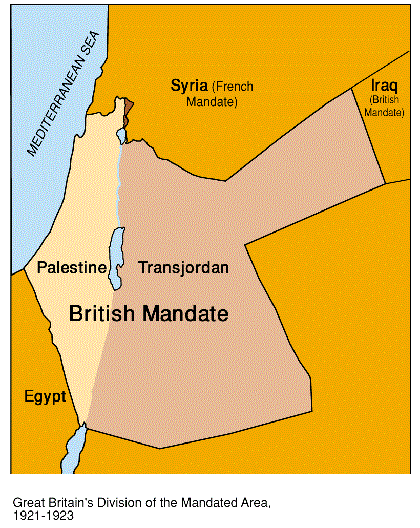
In light of the far reaching ramifications of both statements, they should be then scrutinized for their veracity and historical factuality. First of all, is Jordan a Palestinian state? When looking at the map of the British mandate for what was known then as “Palestine”, it becomes quite clear what area was originally earmarked for the Jewish homeland.

At the end of the First World War, the division of responsibilities for the administering of the Middle East areas fell to the various Western powers victorious over the Ottoman Turks, as mandates, under the auspices of the League of Nations, it was during that time that the famous Balfour Declaration was made:

November 2nd, 1917

Dear Lord Rothschild,

I have much pleasure in conveying to you, on behalf of His Majesty’s Government, the following declaration of sympathy with Jewish Zionist aspirations which has been submitted to, and approved by, the Cabinet.

“His Majesty’s Government view with favour the establishment in Palestine of a national home for the Jewish people, and will use their best endeavours to facilitate the achievement of this object, it being clearly understood that nothing shall be done which may prejudice the civil and religious rights of existing non-Jewish communities in Palestine, or the rights and political status enjoyed by Jews in any other country.”

I should be grateful if you would bring this declaration to the knowledge of the Zionist Federation.

Yours sincerely,

Arthur James Balfour

The Balfour Declaration was accepted by the British Mandate in 1917, which then became subject to a White Paper that many believe reneged on it’s earlier promise, that being a commitment to allowing Jews a homeland. But the paper did insist however that:

“the Jewish community should know that it is in Palestine as of right and not on the sufferance. That is the reason why it is necessary that the existence of a Jewish National Home in Palestine should be internationally guaranteed, and that it should be formally recognized to rest upon ancient historic connection.”

Palestine Facts states that: “The area of the Mandate was originally 118,000 square kilometers (about 45,000 square miles). In 1921, Britain took the 91,000 square kilometers of the Palestine Mandate east of the Jordan River, and created Trans-Jordan (later the Arab country of Jordan) as a new Arabprotectorate. Jews were barred by law from living or owning property east of the Jordan river, even though that land was over three-fourths of the original Mandate.”

A Jordanian State stamp dating from 1964, bearing the likeness of King Hussein and pictures Mandated Palestine as an undivided territory

The Arab official line before a “two state solution” became stated policy of Israel and the West, was that the people in Trans-Jordan cum Jordan were indivisible from those Arabs inside Israel proper, Judea and Samaria. In fact there are statements by leading Arabs buttressing the notion that indeed: Jordan is Palestine and Palestine is Jordan.

This is the royal decree and sentiments of two of the kings of Jordan.

“Palestine and Jordan are one…” said King Abdullah in 1948.

“The truth is that Jordan is Palestine and Palestine is Jordan,” said King Hussein of Jordan, in 1981.

“Palestine is Jordan and Jordan is Palestine; there is only one land, with one history and one and the same fate,” Prince Hassan of the Jordanian National Assembly was quoted as saying on February 2, 1970.

Abdul Hamid Sharif, Prime Minister of Jordan declared, in 1980, “The Palestinians and Jordanians do not belong to different nationalities. They hold the same Jordanian passports, are Arabs and have the same Jordanian culture.”

What are we to conclude from this other than the historical perspective at the time, that being, they (the Arabs) saw themselves as being part of Palestine/Palestinian. Around 70%of the Jordanian population today, still see themselves as Palestinians. Even Yasser Arafat and his PLO thugs looked to Jordan as being a part of their homeland.

Abu Toameh:

When the PLO tried to establish a state-within-a-state in the kingdom in the late 60′s and early 70′s, Jordan’s King Hussein ordered the army to launch a massive assault on the refugee camps in the kingdom, massacring thousands of Palestinians in what has since become to be known as Black September.

The Palestinians who were expelled from Jordan to Lebanon later played a major role in the Lebanese civil war. Over 100,000 people are believed to have been killed in that war, which lasted for more than a decade.

Lets face facts, the three state solution has become an intractable mess, there is no room for budging on the Israeli side, every square centimeter given to these Arabs as a permanent part of a second Palestinian state, spells trouble for the Jewish state as it’s used as a launching pad for further aggression against it.

The Palestinians (which used to mean Jews in Palestine before Israel became a state) are not able to form a state for themselves, because they refuse to accept the responsibility for actually running it. They have proven themselves to be more comfortable in accepting massive amounts of foreign aid, while they continually try to chip away at Israeli legitimacy on the world stage.

Time to end the pretending that these Arabs are really serious about wanting a state of their own, and accept the fact that it’s the massive amounts of foreign aid that really interests them most, as well as the hope of one day getting rid of the highly successful  Jewish one. KGS