Archive for August 10, 2014

Report: Palestinians accept new 3-day cease-fire offer + Update

August 10, 2014

Report: Palestinians accept new 3-day cease-fire offer

AP, Al Arabiya claim that despite days of threats to leave Cairo talks, Palestinian delegations accepts 72-hour lull, after Netanyahu said the operation would continue until rocket fire stops.

Roi Kais Published: 08.10.14, 15:21 / Israel News

via Report: Palestinians accept new 3-day cease-fire offer – Israel News, Ynetnews.

Palestinian negotiators in Cairo say they have accepted an Egyptian proposal for a new, three-day cease-fire with Israel, the Associated Press and Al Araibya reported.

The comments came after Israel said on Sunday it was prepared for protracted military action in Gaza and would not return to Egyptian-mediated ceasefire talks as long as Palestinians kept up cross-border rocket and mortar fire.

The Palestinian decision aims to clear the way for renewed negotiations with Israel on a long-term truce arrangement in the Gaza Strip. The officials, representing various Palestinian factions, spoke on condition of anonymity because they were discussing sensitive negotiations.

A Hamas spokesman was more cautious, saying “There is a proposal for another 72-hour truce which would allow negotiations to continue. This proposal is under consideration,” Sami Abu Zuhri said, stating that the decision of the Palestinian delegation depended on the “seriousness” of Israel’s position in regards to the groups demands.

 IN DEPTH: What does Hamas want, and what it may get?

Earlier the head of the Palestinian delegation in Cairo had said it would leave unless Israeli negotiators, who flew home on Friday hours before a three-day truce expired, came back to the talks. But Egypt’s state news agency, MENA, said the Palestinians would remain for an urgent meeting with the Arab League on Monday. A source told Ynet that senior Palestinian official Saeb Erekat could also join the meeting.

Israeli air strikes and shelling killed three Palestinians in Gaza on Sunday, including a boy of 14 and a woman, medics said, in a third day of renewed fighting that has jeopardised international efforts to end a more-than-month-old conflict.

 Ceasefire efforts

Palestinian negotiators say their team will quit Egyptian-brokered talks on ending the Gaza fighting unless Israeli negotiators return to Cairo.

Izzat al-Rishq, a member of Hamas’ political bureau participating in the Cairo talks, said that the chances to reach an agreement are low and that the delegation may leave Cairo at any minute. “The possibility of negotiations to succeed is weak. It is possible that the Palestinian delegation will leave to consult its leaders any minute,” he said

Prime Minister Benjamin Netanyahu said Sunday “Operation Protective Edge continues… Israel will not conduct negotiations under fire,” indicating Israel is not shifting from its position.

Begining hours before Friday’s ceasefire was set to expire, Gaza militants renewed rocket fire, demanding talks continue, and have since fired dozens of rockets and mortar shells at Israel over the weekend, including two on Sunday morning.

Bassam Salhi, a Palestinian negotiator from Palestinian President Mahmoud Abbas’ PLO movement, says his team met with Egyptian mediators late Saturday.

He said Sunday: “We told the Egyptians that if the Israelis are not coming and if there is no significant development, we are leaving today.”

Similar comments were made by lead negotiator Azzam al-Ahmed to AFP: “We have a meeting tomorrow with Egyptian (mediators). If we confirm that the Israeli delegation is placing conditions for its return, we will not accept any conditions,” he said.

Prime Minister Benjamin Netanyahu is set to convene the Cabinet at 10:30 am Sunday, at the Defense Ministry in Tel Aviv, where the issue will likely be discussed, however since Hamas decided to renew rocket fire instead of unconditionally extending the ceasefire, Israel’s position has been that it refuses to talk while violence continues.

One of Hamas’ central demands has been an end of the Egyptian-Israeli siege on Gaza, a demand both Egypt and Israel have rejected, but indicated willingness to ease some restrictions.

Qais Abu Laila, a member of the Palestinian negotiations team in Cairo, said that “Israel wants to regulate and not lift the siege. It is has rejected most of the Palestinian demands.”

According to Abu Laila, Israel wants to renew restrictions over materials entered into Gaza and the movement of people into the Strip.

Hamas has said it wants assurances by Israel that it is willing to lift the blockade on Gaza before observing another ceasefire. Israel has said it will not open Gaza’s borders unless militant groups, including Hamas, disarm. Hamas has said handing over its weapons arsenal, which is believed to include several thousand remaining rockets, is inconceivable.

Instead, one proposal circulated by the Egyptian mediators over the weekend offered a minor easing of some of the restrictions, according to Palestinian negotiators who spoke on condition of anonymity because they were not allowed to discuss internal deliberations with journalists. It was not clear if this was an Egyptian or an Israeli proposal.

The Palestinian negotiators said they rejected the ideas, insisting on a complete end to the blockade.

A Palestinian official in Cairo said on Sunday that Turkey and Norway have expressed their willingness to operate the seaport the Palestinians have been seeking to open in the Gaza Strip.

The source also added that Israel would respond to the demands of the Palestinian delegation on Sunday. During the day, the Palestinian delegation is expected to meet with the Egyptian mediators and receive the answers in writing.

 Hamas: Israel wasting our time

Accusing Israel of stalling on ceasefire negotiations, Hamas has threatened on Saturday to quit the talks if Israel doesn’t start negotiating in earnest in the next 24 hours.

“There’s no real seriousness from Israel. The Israeli side is intentionally stalling on his response to the Palestinian demands,” Hamas spokesman in Cairo, Moussa Abu Marzouk, said.

“We won’t stay for long in the talks without a serious negotiation. The next 24 hours will determine the fate of the talks,” he added. “We’re not interested in an escalation, but we won’t accept that there’s no response to our demands.”


Update

Palestinians agree to 3-day truce, but rocket fire continues unabated

Jerusalem says no negotiations under fire, operation to continue; Palestinian foreign minister says PA will sue Israelis for war crimes; 8 Palestinians killed since Saturday, including senior Hamas official
http://www.timesofisrael.com/day-34-anti-war-protesters-gather-in-tel-aviv-as-israel-hamas-conflict-presses-on

Secret Cairo message: Hamas won’t bend because it wasn’t beaten. IDF: Beware of waiting game

August 10, 2014

Secret Cairo message: Hamas won’t bend because it wasn’t beaten. IDF: Beware of waiting game.

DEBKA – August 10, 2014, 11:08 AM (IDT)

tanksCairo sent a secret message to Jerusalem Saturday night, Aug. 9, saying that Egypt had been unable to bring Hamas around to any compromise because “you [Israel and the IDF] haven’t hit them hard enough.” This is revealed by DEBKAfile’s exclusive military and intelligence sources. Therefore, there was no point in sending Israel’s envoys back to the Egyptian capital for negotiations on a durable ceasefire, because they would be coming on a fool’s errand.

Prime Minister Binyamin Netanyahu cancelled their departure, after understanding the import of the message: The Egyptian ceasefire initiative proposed by Egyptian President Abdel-Fattah El-Sisi had nowhere to go, until Israel’s armed forces clobbered Hamas’ military wing, Ezz e-Din Al-Qassam, into submission.

After their price for a ceasefire was rejected, Hamas and Islamic Jihad considered dropping out of the negotiating track. But meanwhile, on Friday, Aug. 8, they went back at their old practice of shooting rockets at the Israeli population, while also reserving the option to ramp the barrage up or down as it suited their plans.

By Sunday morning, Aug. 10, the short 72-hour respite for southern Israeli was over and the diplomatic impasse in Cairo had evolved into a diplomatic void.

From the first week of the IDF ground operation in the Gaza Strip, Israel’s leaders had been groping for a way out of the hostilities. Half a dozen ceasefires were declared – and violated by Hamas, who viewed the effort as a sign of Israeli weakness.

The prime minister and defense minister Moshe Ya’alon had counted on the 72-hour ceasefire, which expired Friday morning, providing Hamas commanders with a chance to come out of their bunker hidey-holes and view the devastation on the Gaza Strip surface. They would then be shocked into throwing in the towel – or so it was hoped.

But instead, Hamas commanders immediately seized on the ruins as an opportunity to parade the Palestinians of Gaza to the world as victims of “Zionist” inhumanity, of which they hands were entirely clean.

By now, Netanyahu and Ya’alon appear to be stumped for a policy.

All their military and political maneuvers, including their decision to limit the IDF ground incursion in the Gaza Strip last month to a depth of no more than one kilometer, failed to wrest the tactical initiative of the war from Hamas or bring harm to its military wing.

Friday, when Hamas resumed its rocket barrage Friday, it was in good shape, unlike the Gazan population, to embark on a war of attrition and keep it going for weeks, if not months.

The inhabitants of the communities adjacent to the Gaza Strip were cast into a depressing uncertainty. After living under rocket attacks of varying intensity for 14 years, many decided to finally pull up roots, when promises by the prime minister and army leaders, that the bane was finally over and they could live in peace and safety, went out the window.

IDF generals warned Sunday morning of the dangers to the Gaza communities of a protracted period of indecision. They recalled the situation on the eve of the 1967 Six Day War, when the army stood ready, day after day, to rebuff Arab aggressors around its borders, while the late Prime Minister Levi Eshkol dithered and the Chief of Staff, the late Yitzhak Rabin, couldn’t take the suspense.

Today, too, IDF divisions stand at their staging posts, ready and willing – just as soon as they get the order – to drive deep into the Gaza Strip and finally dislodge the fundamentalist Palestinian orchestrators of the senseless violence emanating for so many years from this sliver of territory.
If this order goes out, then, perhaps, Egypt may find Hamas more amenable to negotiating some sort of durable cessation of hostilities and an end to the destruction.

Netanyahu: Gaza operation continues, Israel will not negotiate under fire

August 10, 2014

Netanyahu: Gaza operation continues, Israel will not negotiate under fire | JPost | Israel News.

08/10/2014 11:44

At cabinet meeting, Netanyahu calls for patience as ministers voice criticism; Liberman: “The only thing left to do is defeat Hamas, clean up the territory and get out as quickly as possible.”

benjamin netanyahu

Prime Minister Binyamin Netanyahu at the weekly cabinet meeting in Tel Aviv, July 13, 2014. Photo: HAIM ZACH/GPO

Operation Protective Edge will continue until quiet is returned, and Israel will not negotiate under fire, Prime Minister Binyamin Netanyahu said at the opening of the weekly cabinet meeting Sunday in Tel Aviv.

“I said at the beginning of the campaign that it will take time, and patience is needed,” Netanyahu said to his ministers, some of whom voiced criticism before the meeting – both direct and veiled – of how the government was waging the campaign.

Israel will continue to act “in all ways to change the current reality, to bring peace to all its citizens,” Netanyahu said.

Defense Minister Moshe Ya’alon said that Israel entered the negotiations in Cairo last week after the terror tunnels were destroyed and neutralized, and a 72-hour cease-fire was declared.

Since Hamas restarted the rocket fire on Friday morning, he said, the IDF has hit back hard, attacking “many dozens” of targets, including terrorists, command centers, rocket depots, and rocket launchers.

In an apparent reference to increasing frustration being voiced by residents of the South, Ya’alon said he understands their desire for security and quiet, and that Israel would not compromise until the rocket fire and terror from Gaza  ends. “Operation Protective Edge will continue until we achieve that,” he said.

Before the meeting, Foreign Minister Avigdor Liberman told reporters that the current situation cannot be allowed to continue, and if the government had listened to his arguments from day one, “we would now be beyond all this.”  Liberman called from the beginning for the toppling of Hamas.

“The  only thing left to do is defeat Hamas, clean up the territory and get out as quickly as possible,” he said.

Interior Minister Gideon Sa’ar said that “what we need to do is break Hamas’s military strength in Gaza. That was true before, it is true now, and will be true the longer we wait.”

A Dictator will be elected in Turkey

August 10, 2014

‘Erdoğan will become ‘dictator’ with de facto presidential system’

'Erdoğan will become 'dictator' with de facto presidential system'
In this March 31, 2014 file photo released by the Turkish Presidency Press Office, Turkish President Abdullah Gül, (R), and Prime Minister Recep Tayyip Erdoğan are seen during a meeting in Ankara, Turkey. (Photo: AP/Turkish Presidency Press Office)
May 04, 2014, Sunday/ 18:57:35/ TODAY’S ZAMAN / ISTANBUL
The Justice and Development Party (AK Party) has, for the most part, decided on its strategy for the presidential election in August and will seek a plan to switch to a de facto presidential or semi-presidential system, which opposition parties have slammed as a move that will pave the way for dictatorship.“This would lead to a de facto dictatorship,” Faruk Bal, deputy chairman of the Nationalist Movement Party (MHP), told Today’s Zaman, noting that as per the Constitution, presidents are not accountable for their acts before the law.Whether Prime Minister Recep Tayyip Erdoğan will run for president in the election in August has been a source of controversy, but according to a report by the Radikal daily on Sunday, Erdoğan’s plan is no longer a mystery.According to decisions reached by Erdoğan, President Abdullah Gül and senior members of the AK Party, Erdoğan will run for president. Should Erdoğan be elected president, a temporary prime minister — though no name has yet been finalized — will run the country for the next 10 months until the 2015 general elections, during which Erdoğan will reportedly be de facto acting like a president in a presidential system. Another part of the plan is to have Gül elected as leader of the AK Party following the 2015 general elections.Not only is the president not accountable before the law other than for charges of treason under the Turkish parliamentarian system, the current political system also lacks checks and balances required in a presidential system to counterbalance a powerful president. “In the current system, it is not possible to counterbalance the president [who would hold extensive powers as in a presidential system]. A ruler who is not restricted by a system of checks and balances is called a dictator,” Bal commented. The AK Party’s plan rests on two important factors. Firstly, this year the people will be electing the president for the first time as opposed to the previous system where presidents were voted in by Parliament. According to Radikal, as president, Erdoğan will try to use the powers of a president in a presidential system, creating a de-facto regime change. If the AK Party faces no obstacles to this plan and if the formula of a new and powerful president is accepted by society, Erdoğan will continue as president with his ineffective prime minister. If however, problems emerge during the course of his presidency, the AK Party will opt for a stronger prime minister. According to Atilla Kart, a deputy from the main opposition Republican People’s Party (CHP), such a step would represent a violation of the Constitution given that it is based on the requirements of a parliamentarian democracy. “Such a move would in fact be a de facto coup d’état in the constitutional sense,” Kart told Today’s Zaman, accusing Erdoğan of having dictatorial tendencies. Noting that such a step would disturb the balance of the current parliamentarian system, Kart challengingly said: “The Turkish Republic would prevent such attempts.” President Gül will likely be elected as leader of the AK Party and prime minister after the 2015 elections. Radikal reported that the AK Party will be consulting with its senior members throughout May to lay out the final version of the plan. The AK Party will have a meeting in Afyon on May 9 in which all deputies will attend. On May 16, there will be a larger meeting in which provincial chapter chairmen and mayors will also be present. Erdoğan and Gül will continue their talks on the presidential plan throughout May. Although the AK Party has not yet decided on a prime minister to lead the government during the “transition” to a presidential or a semi-presidential system, Radikal reported that Deputy Prime Minister Bülent Arınç appears to be a strong candidate. If Turkey eventually gives up the parliamentary system, Gül might not seek leadership of the AK Party. However, if the plan works out, he will most certainly head the AK Party after the 2015 general elections. The prime minister who will run Turkey in the interim will be a senior member who will be running for the last time as per the AK Party’s three-term rule, which states that a deputy cannot serve in Parliament for more than three consecutive terms. The AK Party has, over the previous months, considered removing this rule because Prime Minister Erdoğan is currently serving his third term, but the AK Party’s Central Executive and Steering Committee (MKYK) on Friday ruled to keep the rule in place in line with Erdoğan’s plan to run for president. The AK Party MKYK also decided to abandon its earlier plans to overhaul the current electoral system to introduce single-member or five-member constituencies in an effort to give the AK Party sufficient majority power to draft the constitution and transform the regime into a presidential one. Although the system change would have most certainly benefitted the AK Party overall, sources suggest the plan was abandoned because changing the electoral system would cost the AK Party significantly in İzmir and the Southeast. Arınç, one of the “founding fathers” of the AK Party, will lead the party to the general elections. Other possible individuals for this post are Ali Babacan and Binali Yıldırım. Foreign Minister Ahmet Davutoğlu and former Felicity Party (SP) leader Numan Kurtulmuş are also among others who might be the AK Party’s choice for prime minister in the transitional period. Deputy Prime Minister Beşir Atalay confirmed on Sunday that the possibility of Erdoğan running for president had become stronger. “But of course we would not want to see our president detached from his own cause, his mission and this movement and want him to have a say in his future,” Atalay said, speaking about President Gül’s future in the party during a program aired on Kanal 24. He said the 2015 general elections are extremely important for the AK Party and the party would be stronger if both Erdoğan and Gül remain in politics.

Who wants to help the birth of a dictator?

The graft and bribery investigations of Dec. 17 and 25, 2013 have shown that Recep Tayyip Erdoğan’s boundless tyrannical power is financing its ruthlessly anti-democratic and unlawful policies with money from graft, bribery and theft. In addition to informal pools of funds obtained from pro-government businessmen who are awarded public contracts in non-transparent and uncompetitive tenders, Erdoğan also started to abuse public resources for his presidential campaign. Even though election law requires every public official to resign from office when he runs as a candidate in an election, Erdoğan skillfully used his influence over the legislature to ensure that he was exempt from this ban. Election law says that if you are the governor of a district and if you run as a candidate in an election, you must resign from office in order to circumvent abuses of public resources in your election campaign. However, Erdoğan is exempt from this requirement even though, as prime minister, he can abuse public resources to any extent he wishes. Given the political financing through illegitimate methods, the abuse of public resources by a candidate in government, the unequal coverage of the presidential candidates by state-owned media and broadcasters — such as the Turkish Radio and Television Corporation (TRT), the Anatolia News Agency and the so-called private media outlets that are controlled by the government — the printing of 18 million extra ballots, the power outages in more than 40 locations while votes were being counted in the local elections of March 30, the hundreds of minutes about the ruling party’s gerrymandering efforts and numerous findings and claims about election rigging, especially in Ankara, everyone must be on high alert for the fairness and soundness of the presidential elections slated for Sunday. Regardless of the level of democratic maturity, Turkey has always performed satisfactorily in terms of election security and fairness, starting in the final days of the Ottoman Empire, excluding the 1946 elections and especially during the multiparty regime. Although many other deficiencies of Turkish democracy were stressed, no one would have voiced concerns that the country didn’t hold fair and just elections. No one would have complained about any systematic effort to rig the elections, including those held in the wake of the military coup of September 12, 1980 and the post-modern coup of February 28, 1997. No doubts about systematic gerrymandering efforts were heard. However, Turkey lost this proud quality during the last elections, held with the Erdoğan-led government at the helm of the so-called “New Turkey” with an “advanced democracy.” The doubts and controversies regarding the March 30 local elections have further escalated the concerns about the fairness and security of the elections slated for Sunday. These worries compelled many international organizations, including the Organization for Security and Cooperation in Europe (OSCE) and the Parliamentary Assembly of the Council of Europe (PACE), to send their observers to Turkey. Putting to one side all the other sins of Erdoğan, who is growing more despotic each day, this anti-democratic sin is enough to have Erdoğan remembered as a black stain on Turkey’s history of democratization. Having designed a tremendous propaganda machine modeled after Hitler’s Germany or Mussolini’s Italy — using illegitimate funds obtained through the abuse of public resources, graft and fraud — Erdoğan can be prevented from turning Turkey into a full-fledged dictatorship only with the prudence and foresight of the public, in spite of the fact that their democratic consciousness seems to have been maimed by the intense propaganda. If the nation fails to exhibit this democratic prudence and foresight on Sunday, you can be assured that a much more dangerous adventure awaits this country. When an impatient, intolerant and bigoted leader who does not respect fundamental rights and freedoms is given, through democratic means, the mandate to meddle arbitrarily with the very nature of the democratic regime, we face the risk of completely losing the country’s already limping democracy and paralyzed legal system. Problematic reactions by a significant majority of the public, exposed to media illusion, do not look promising for the future of the country. Nevertheless, we cannot lose our hope in the nation as it has a tendency to play an affirmative role with its conscience and problem-solving stance even in the darkest, most chaotic and most complicated periods. If people refuse to wake up to the realities, if they refuse to reject efforts to paralyze their will under the heavy media bombardment of lies and slander as well as fear and worry, I am afraid they will lend a helping hand to the creation of a terrible dictatorship in the presidential elections. A significant portion of the public, whose willpower has been trapped with various devilish methods, will pave the way, through democratic means, for the birth of a despotic Frankenstein whom they will find very difficult to get rid of in the future. To understand what sort of despot might result from this likely imprudence and lack of foresight by the public, we don’t have to wait for the outcome of the elections. Even a cursory look at what Erdoğan promises in his election rallies is enough to reveal the dictatorship awaiting Turkey. A leader who has undermined his own prestige in the eyes of many social groups and foreign countries due to his anti-democratic, unlawful and unethical actions cannot promise anything but dictatorship and tyranny. Isn’t it nonsensical to expect this leader to comply with democratic principles, rights and laws — a leader who believes he represents both the nation and the state, who believes both the nation and the state will become manifest in his personality in Sunday’s elections and who sees this as his most natural right? As you know, Louis-Dieudonné de France, or Louis XIV, underwent a serious erosion of personality after ruling France for 72 years between 1643 and 1715. He was not satisfied with being referred to as Louis Le Grand or Le Roi-Soleil, and he had become a symbol of absolutist dictatorship with his infamous phrase, “L’État, c’est moi.” Yet, Louis XIV was only claiming to be the state. He hadn’t gone further to claim that he was both the state and the nation, as a certain leader is currently doing in his election rallies. Don’t you think a leader who chose to follow in the footsteps of Louis XIV some 300 years later — taking the will of the public hostage through propaganda decorated with lies and slander — is in a situation that is more scandalous than that of Louis XIV? This is not a joke. It is true. But, unfortunately, Prime Minister Erdoğan is coming with new and terrible scandals each day. So much so that the shocking words he uttered during his rally in Tokat on July 9, 2014 — in which he said he was both the state and the nation — were not noticed by anyone. In that speech, Erdoğan argued that he, instead of deputies in Parliament, will directly represent the public, and thus, in addition to identifying himself with the state, he promised that the nation will be manifest in him. In other words, in addition to declaring that he will not comply with the limits defined under the Constitution, Erdoğan promised that he will unify the state and the nation in his personality. If Le Roi-Soleil was alive today and saw Erdoğan’s audacity, I am sure he would be very jealous of him. Therefore, before going to the polls on Sunday, people should make up their minds about whether they will lend support to the birth of a despot who would be envied by Louis XIV or they will elect a president who will set the country’s course back to democracy, human rights, and rule of law.

Inside the UNRWA Classroom

August 10, 2014

IDF Pulled Out Tanks and Soldiers before Ceasefire Ended

August 10, 2014

Israel declared the war was over before it is over.

By: Tzvi Ben-Gedalyahu

Published: August 10th, 2014

via The Jewish Press » » IDF Pulled Out Tanks and Soldiers before Ceasefire Ended.


The IDF pulled tanks out of Gaza before the ceasefire ended.
Photo Credit: Flash 90
 

The IDF gave Hamas to green light to resume rocket fire towards the end of the 72-hour ceasefire by sending home tens of thousands of soldiers and transporting hundreds of tanks and armored personnel carriers (APCs) to training bases in the north.

Convoys of trucks carrying tanks to the north were seen as early as Wednesday, and the Jewish Press has learned from several sources in the army that orders had been prepared as early as Tuesday to release thousands of Reservists on Thursday, even there were no assurances that the ceasefire would be extended. It wasn’t.

The IDF also sent back to advanced basic training camps combat soldiers who had been called to Gaza at the beginning of the war.

The large-scale redeployment was accompanied by premature boasts by IDF Chief of Staff Benny Gantz that residents of Israel could go back to their homes without any fear of rocket attacks.

By Friday, Ashkelon and the Western Negev again were under rocket fire, making Gantz, who had become one of other most popular figures in Israel during the war, look like a fool in the eyes of people who have repeatedly and accurately, accused the “government of Tel Aviv” of a policy of abandoning them.

Israel had two stated goals by calling up approximately 75,000 Reservists and transporting tanks and other equipment to the Gaza front from bases in the north and from near Eilat.

The IDF successfully bombed all of the terror tunnels known to exist. Massive aerial bombing of rocket launching sites, along with artillery fire from tanks and from the Navy, sharply reduced the number of missiles launched at Israel.

There was little to be gained from keeping troops in Gaza because many of the remaining underground missile launchers are being operated electronically from Qatar.

Striking Hamas’ de facto headquarters in Gaza is virtually impossible because their leaders are operating underground, beneath the Shifa Hospital in Gaza. The only to destroy the headquarters is to drop a bunker buster bomb on the hospital.

Moving troops deeper into Gaza would have cost the lives of many soldiers with questionable gains, but the rapid redeployment to the north was both an unofficial and premature declaration of victory and an announcement that Israel was not prepared to escalate the war.

As far back as last Saturday, media reported that Israel was pulling out troops. Netanyahu quickly reassured the nation that the ground operation had not ended and the war would continue until tunnels were destroyed. The military said troops were simply being re-deployed along the Gaza border, but that was true only to a limited extent and for a short period of time.

Negotiations for a ceasefire were taking place at the same minute Netanyahu was saying that the war would continue until its goals were accomplished.

Hamas tried and still is trying to exploit ceasefire talks to negotiate under fire. Dozens of rockets on Israel on Friday and on the Sabbath were met with sporadic aerial bombings, far less than the intense air raids than before the ceasefire.

The rapid retaliation made it clear to Hamas that it will have to compromise on its demands, but the massive withdrawal of tanks to the north and sending home or redeploying soldiers far from Gaza left the government in a far weaker position diplomatically.

Removing the threat of the IDF being able to immediately re-enter Gaza has given Hamas a big advantage because it has given Hamas an incentive to drag out the war. The longer it does so, the more it can count on President Barack Obama to try to undermine the strength of Prime Minister Binyamin Netanyahu.

The left in Europe is not looking for a two state solution

August 10, 2014

.

.

.

Israeli officials: We won’t return to Cairo talks until rocket fire ends

August 10, 2014

Israeli officials: We won’t return to Cairo talks until rocket fire ends
By HERB KEINON, KHALED ABU TOAMEH
08/09/2014 23:40 via The Jerusalem Post


(ISIS or whatever the hell the press calls them now is watching and taking notes. You can bet on it.-LS)

Israel will not send a team back to Cairo to discuss a cease-fire until Hamas rocket fire ceases, and will respond forcefully to all Hamas attacks, senior diplomatic officials said Saturday night.

The officials said if there was a continuation of the rocket fire that began at 4 a.m on Friday, and intensified four hours later with the end of the 72-hour cease-fire, then Israel would consider “all options on the table” and was not limiting itself to striking back from the air.

The officials said the Israeli team that was in Cairo negotiating with the Egyptians over a longer-term deal returned to Israel at 7 a.m. on Friday when it became apparent that Hamas was not going to extend the cease-fire.

Once the cease-fire formally ended, and Hamas fired rockets into Israel, Prime Minister Binyamin Netanyahu and Defense Minister Moshe Ya’alon instructed the IDF to respond “forcefully.”

It was also made clear that Israel would not conduct any type of negotiations under fire.

The full cabinet is scheduled to meet Sunday in Tel Aviv to discuss the developments.

Communications Minister Gilad Erdan, a member of the eight-person security cabinet, said in a Channel 2 interview Saturday night that while no one has a formula for ensuring that one day “it all ends,” the government is determined and has made commitments to the Israeli public that “what was, is not what will be, and we will stand by that promise.”

It is possible, Erdan said, that Israel might send its ground forces back in to Gaza.

“A wide ground incursion and the toppling of Hamas is being discussed,” he said.

Economy Minister Naftali Bennett said on Friday after the firing restarted that this was a test for Israel’s deterrence that would have ramifications for years. As such, he said, the response needed to be “hard and painful.”

He said Israel needed to decisively win this battle, whether UN Secretary- General Ban Ki-moon “likes it or not. Operation Protective Edge is not over, Hamas has not yet been defeated, and Israel’s citizens need to be strong and prepared for what comes next.”

Another security cabinet member, Justice Minister Tzipi Livni, said Hamas should not get anything it is asking from Israel that applies to a possible final agreement with the Palestinians, such as a safe passage – which they are demanding – from the Gaza Strip to the West Bank, an airport or a seaport.

“I support continuing firing toward Hamas,” she said. “We should not pay Hamas for quiet. Hamas’s fire will not bring it to better achievements.”

Hamas, meanwhile, warned over the weekend that it would continue to attack Israel as long as its demands are not fulfilled.

The warning came as a Palestinian delegation representing various groups, including Fatah, Hamas and Islamic Jihad, continued discussions with Egyptian security officials about achieving a long-term cease-fire with Israel.

The Hezbollah-affiliated newspaper Al-Akhbar quoted Hamas sources as saying that the movement would attack Tel Aviv on Sunday if its demands were not met by then.

The sources said the Palestinian delegation has informed the Egyptians that its members would leave Cairo on Sunday if no progress is made in the cease-fire talks.

However, the head of the Palestinian delegation, Azzam al-Ahmed of Fatah, said on Friday that the team would not leave Cairo until an agreement is reached that complies with all Palestinian demands, including giving the Gaza Strip its own airport and seaport.

“We haven’t asked for anything new and that’s why Israel has no right to say this is permitted or that it not permitted,” the Fatah official said. “We have told the Egyptians that we will stay in Cairo until we reach an agreement to end the bloodshed and lift the siege on the Gaza Strip.”

Hamas spokesman Fawzi Barhoum said, “There is no going back and the resistance will continue with full force. There will be no concessions on the demands presented by the Palestinian delegation in Cairo. Israel’s intransigence and foot-dragging won’t benefit it.”

Izzat al-Risheq, a Hamas member of the delegation, claimed that Israel used Saturday as an excuse to stay away from indirect talks [with Hamas] in Cairo.

“Its army is continuing its aggression and shelling of the Gaza Strip on Saturday,” Risheq said. “This excuse is silly.”

Hamas spokesman Sami Abu Zuhri said his movement would not make any concessions regarding its demand to have a seaport in the Gaza Strip.

“Such a port would be the Palestinian gate to the outside world,” he said.

Senior Hamas official Ahmed Bahr reiterated his movement’s refusal to disarm.

“The weapons of the Palestinian resistance will stay as long as Israeli occupation exists on our occupied land,” Bahr said. “The painful strikes of the resistance on Israel will drive the Israeli negotiator to accept all the demands of the resistance. This is the only language of negotiations they understand.”

Meanwhile, a Palestinian official told AFP that Egyptian and Palestinian delegates have reportedly reached a new agreement on a draft cease-fire proposal that will be submitted to Israel.

According to the official, the deal would see the Palestinian Authority and the government in Cairo render control of the Rafah border between Gaza and Egypt.

Israeli officials told The Jerusalem Post that Israel already accepted the idea of Palestinian Authority security officials manning the Rafah proposal, when it was presented in Egypt’s initial cease-fire proposal some three weeks ago.

In addition, under the reported terms of the new proposal to be presented to Israel, Hamas would in effect enact a unity deal signed in April with the PA, entrusting the group’s demands for a port in Gaza to the Ramallah-based government for negotiations at a later point with Israel.

In a related development, Netanyahu gave interviews over the weekend to three leading US, French and German television stations.

In the interview with both Fox News and France’s ITV, the prime minister responded to criticism of civilian casualties by underlining an incident that happened during World War II.

Netanyahu told ITV that in 1944, “the British Royal Air Force sets out to bomb the Gestapo headquarters in Copenhagen. A legitimate target.

Okay? But the British pilots miss. And instead of the Gestapo headquarters, they hit a children’s hospital nearby, right next to it, and some 83 children, I think, are horribly burned to death.

That’s not a war crime. And that’s not a massacre. What that is, is a terrible tragedy of war that accompanies every legitimate action.”

The difference between Israel and Hamas, he stressed, was that while Israel deliberately targets military and terrorist targets, and accidentally hurt civilians, “they deliberately hurt civilians, target civilians.”

In a related development, US President Barack Obama and British Prime Minister David Cameron on Saturday called for an immediate cessation of hostilities in Gaza and pressed for action that would lead to a permanent cease-fire.

“On Gaza, they condemned the resumption of rocket fire and called for an immediate cessation of hostilities leading to a sustainable ceasefire,” the White House said in a statement about the call between the two leaders. “President Obama and Prime Minister Cameron reiterated support for Israel’s right to self-defense while emphasizing the need for all sides to minimize civilian casualties.”

Jerusalem Post staff and Reuters contributed to this report.

Gaza’s morning after

August 10, 2014

Gaza’s morning after, Jerusalem PostAmotz Asa-El, August 10, 2014

As Hamas and Israel sift their way through the rubble, the asymmetry that characterized their fight will shift to the economic and political arenas.

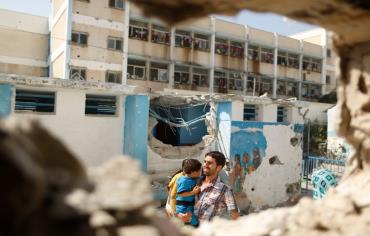
UNWRA messUNRWA school damaged by fighting in Gaza Photo: REUTERS

The efficiency with which Israel will fight on this front remains to be seen, but the broader diplomatic picture will eventually become clear in any event. Yes, the guns of Summer ’14 have set forth some tremors in Israel’s foreign relations, but when the dust settles two fundamentals will loom: the non-Muslim world faces a scourge called Islamism, and the West faces a ploy called asymmetrical warfare, which should be renamed “unfair fighting.”

As understanding of these grim facts spreads, the effort to present Israel as part of the problem will give way to its acceptance as part of the solution.


Gaza’s time for such a transition has no doubt arrived, yet the coastal town that has been sacked and rebuilt countless times during its 3,500 years is about to learn that, much like the latest war it provoked, its economic and political healing will be asymmetrical with Israel’s.

The lull in fighting has yet to mature into a longer- term arrangement. However, as negotiators talk in Cairo, this round’s violence seems to have peaked, and its preliminary damage assessment indicates that the fighting’s impact on the Israeli economy is marginal.

The most glaring proof of Hamas’s economic ineffectiveness was the successful initial public offering last week on the New York Stock Exchange of MobilEye, an Israeli inventor of – how ironic – collision- prevention technology. Having raised $1.02 billion, reflecting a company valuation of $5.3b., it was the most successful share offering an Israeli firm ever managed abroad, and it happened in the heat of the fighting in Gaza.

MobilEye’s success, which would have been remarkable regardless of its unique timing, reflects not only American investors’ underplaying Hamas’s threat to their money, but also a dramatic transformation in Israel’s wartime economics.

During the great conventional wars of 1967 and 1973, Israel’s population was hardly half its current size, the economy was but a fraction of its present numbers and diversity, and the battlefield demanded hundreds of thousands of reservists, a massive recruitment which nearly paralyzed the economy.

In this bout, by contrast, the IDF made do with 86,000 reserve soldiers, a number which hardly even dented the overall economy. Whereas the economy and the population multiplied over the past four decades, the battlefield shrank. In the past, the IDF faced entire countries and multiple conventional armies; now it faced a guerrilla force limited to one urban sprawl.

While Hamas’s location and tactics created new military challenges, economically the warfare it required cost less than previous wars. One tabloid’s alarmist headline this week, that this summer’s was the most expensive war in the IDF’s history, could not have been more ignorant.

Iron Dome’s roughly 500 rocket interceptions during the operation cost up to $50 million. The air force’s hundreds of sorties and the munitions they used, the armored corps’ and artillery’s shells and engine hours, and the reserves’ enlistment were surely expensive, and Treasury officials assess them at roughly NIS 4.5b. Still, this cannot even begin to compare with the costs of the Yom Kippur War’s losses of hundreds of tanks and fighter jets, and the enlistment of hundreds of thousands of reservists, often for half a year.

Obviously, Operation Protective Edge hurt the economy in several of its corners. The main victim is the tourism industry, whose leaders believe that incoming tourism for the year’s second half will be halved, and one-fifth of hotel employees will be laid off. Yet the entire hotel industry’s turnover last year, which benefited from a record 3.54 million arrivals in Israel, was $2.7b., which is but 1.2 percent of Israel’s gross domestic product.

The main microeconomic victims have been factories and businesses in the most intensively targeted locations. Retailing in places like Ashdod and Ashkelon obviously slowed sharply over the past four weeks, and industrial plants’ output declined in some cases up to 30%, due to disruptions in shipments and worker attendance.

Still, the Manufacturers Association of Israel assessed that nationwide industrial profits declined during the fighting by up to 8% at most.

Similarly, farmers in the South who have seen crops rot while they were prevented from going to the fields sustained much damage as individuals. However, collectively they lost an estimated NIS 50m.

The numbers being as they are, compensation from the Treasury for the war’s economic victims is overall affordable, and already in the process of being calculated and delivered – based on the principles that businesses within 40 kilometers of the Gaza border will get the most, and hotels will receive aid regardless of their location.

In all, the government will likely spend NIS 1b.

in compensation packages, Tax Authority director Moshe Asher estimated this week.

Hamas’s equivalent of Moshe Asher, if he exists, has yet to emerge and explain to the Gazans who lost houses and businesses how their government intends to help them back on their feet.

THE DAMAGE in Gaza is clearly in the billions of dollars, though exact and impartial figures will take a while to emerge.

With thousands of its houses leveled and the sewage, power and water infrastructures even more inadequate than they were before the fighting, Gaza is thirsting for a massive reconstruction. Then again, the 365-square-kilometer coastal strip has been begging for economic surgery for years, and there were those who actively blocked the surgeon’s arrival.

Gaza has been on its own for nearly a decade now, since Israel’s retreat in ’05. Throughout this period, the US, EU, Japan and China were eager to help it build a viable economy, a relatively easy task.

Considering its seaside location, fertile soil and skilled workforce, Gaza can develop solid farming, industry and tourism that will honorably feed its generously estimated 1.8 million inhabitants. However, Hamas provoked both Egypt and Israel into closing its borders, and at the same time deterred large foreign investors from putting its population to work.

With its investments in rockets, tunnels and troops now evident, it is clear that Hamas valued fighting more than prosperity. Indeed, prosperity was no goal at all, if not anathema, for a government that wanted the people both available and fueled for war.

Changing this attitude, then, is the challenge that now awaits the international community as it sets out to salvage a new Gaza from the old one’s ruins.

Chances that Hamas will change its spots and embrace a civilian agenda are slim at best. Instead, Hamas wants money from Qatar and Turkey, open borders and new ports. This way it can oversee just enough reconstruction to keep a lid on public wrath, while resuming its hefty spending on guerrilla and terror.

Most of this will not happen, as Hamas will learn that in going to war, it has overplayed its diplomatic hand.

The European proposal this week, to establish an international apparatus that will finance and oversee Gaza’s reconstruction through the Palestinian Authority while preventing military imports and buildups will be difficult for Hamas to digest, yet some such arrangement is where things are now headed. Eight years after throwing PA President Mahmoud Abbas’s people from Gaza’s rooftops, they will soon emerge from under those rooftops’ debris.

Moreover, Hamas’s other nemesis, Egypt, will also be heavily involved in Gaza’s future, a role Hamas has already grudgingly acquiesced to by accepting Cairo’s mediation.

In all, Hamas is diplomatically isolated because its last remaining allies, Turkey and Qatar, are geographically distant and politically in no position to rival Egypt and Saudi Arabia in shaping intra-Arab affairs.

Gaza’s leaders must now accept a reconstruction effort or they will lose everything, and this effort will not be theirs to control and abuse.

Meanwhile, as the fighting subsided some were under the impression that Israel, too, emerged from Gaza’s rubble diplomatically debilitated. They are wrong.

THE REPRIMANDS to Israel by the White House, UN Secretary-General Ban Ki-moon and French President Francois Hollande were nothing to scoff at. All were genuinely concerned with what they decried.

Yet in Israel, too, practically everyone is unhappy with the civilian toll of the recent fighting.

The difference is only in the Israelis’ conclusion – that this is the cost of asymmetrical fighting, and it’s either their children or the enemy’s – which has yet to convince those who do not live under rockets and above tunnels.

Israel therefore emerges from Gaza with an advocacy challenge that it will have to treat as part of the asymmetrical war, and meet it with the same resourcefulness which produced Iron Dome and the same fighting spirit that felled the tunnels.

This front has three sections: diplomacy, law and media. In all these, Israel will have two overarching aims: Firstly, rid Hamas of its image as a national liberator and present it instead as a fundamentalist oppressor, part of a belt that stretches from Nigeria’s Boko Haram through Lebanon’s Hezbollah, Iraq’s Islamic State, and Iran’s ayatollahs to Afghanistan’s Taliban and China’s Uighurs. While most of these are at odds with the majority of the rest, all of them share an Islamism that is anathema to the rest of the world, from the US and Europe to China, India and Africa.

Secondly, Israel will have to shift the debate from “what have you done” to “what could be done?” With Iranian training, Israel’s enemies have reshaped the battlefield in ways that international law and Western military doctrines do not address.

The updating of war laws may therefore emerge from the recent fighting as an Israeli goal, as will military solutions for isolating weapons planted among civilians.

The efficiency with which Israel will fight on this front remains to be seen, but the broader diplomatic picture will eventually become clear in any event. Yes, the guns of Summer ’14 have set forth some tremors in Israel’s foreign relations, but when the dust settles two fundamentals will loom: the non-Muslim world faces a scourge called Islamism, and the West faces a ploy called asymmetrical warfare, which should be renamed “unfair fighting.”

As understanding of these grim facts spreads, the effort to present Israel as part of the problem will give way to its acceptance as part of the solution.