How Does the IDF Minimize Civilian Casualties in Gaza? You Tube, IDF, August 10, 2014
Archive for August 10, 2014
How Does the IDF Minimize Civilian Casualties in Gaza?
August 10, 2014Israel accepts Egyptian-brokered temporary truce
August 10, 2014Israel accepts Egyptian-brokered temporary truce, Ynet News, Attila Somfalvi, August 10, 2014

(Here we go again? — DM)
Officials say delegation will arrive in Cairo if ceasefire holds in Gaza, after Netanyahu said the operation would continue until rocket fire stops.
Political officials confirmed Sunday night that Israel agreed to renew the Egyptian-brokered ceasefire.
The officials said that – as per Israeli’s demands – a delegation will arrive in Cairo if there if a temporary truce holds on the ground.
Palestinian negotiators in Cairo say they have accepted an Egyptian proposal for a new, three-day cease-fire with Israel, the Associated Press and Al Araibya reported.
The comments came after Israel said on Sunday it was prepared for protracted military action in Gaza and would not return to Egyptian-mediated ceasefire talks as long as Palestinians kept up cross-border rocket and mortar fire.
The Palestinian decision aims to clear the way for renewed negotiations with Israel on a long-term truce arrangement in the Gaza Strip. The officials, representing various Palestinian factions, spoke on condition of anonymity because they were discussing sensitive negotiations.
A Hamas spokesman was more cautious, saying “There is a proposal for another 72-hour truce which would allow negotiations to continue. This proposal is under consideration,” Sami Abu Zuhri said, stating that the decision of the Palestinian delegation depended on the “seriousness” of Israel’s position in regards to the groups demands.
IN DEPTH: What does Hamas want, and what it may get?
Earlier the head of the Palestinian delegation in Cairo had said it would leave unless Israeli negotiators, who flew home on Friday hours before a three-day truce expired, came back to the talks. But Egypt’s state news agency, MENA, said the Palestinians would remain for an urgent meeting with the Arab League on Monday. A source told Ynet that senior Palestinian official Saeb Erekat could also join the meeting.
Israeli air strikes and shelling killed three Palestinians in Gaza on Sunday, including a boy of 14 and a woman, medics said, in a third day of renewed fighting that has jeopardised international efforts to end a more-than-month-old conflict.
Ceasefire efforts
Palestinian negotiators say their team will quit Egyptian-brokered talks on ending the Gaza fighting unless Israeli negotiators return to Cairo.
Izzat al-Rishq, a member of Hamas’ political bureau participating in the Cairo talks, said that the chances to reach an agreement are low and that the delegation may leave Cairo at any minute. “The possibility of negotiations to succeed is weak. It is possible that the Palestinian delegation will leave to consult its leaders any minute,” he said
Prime Minister Benjamin Netanyahu said Sunday “Operation Protective Edge continues… Israel will not conduct negotiations under fire,” indicating Israel is not shifting from its position.
Begining hours before Friday’s ceasefire was set to expire, Gaza militants renewed rocket fire, demanding talks continue, and have since fired dozens of rockets and mortar shells at Israel over the weekend, including two on Sunday morning.
Bassam Salhi, a Palestinian negotiator from Palestinian President Mahmoud Abbas’ PLO movement, says his team met with Egyptian mediators late Saturday.
He said Sunday: “We told the Egyptians that if the Israelis are not coming and if there is no significant development, we are leaving today.”
Similar comments were made by lead negotiator Azzam al-Ahmed to AFP: “We have a meeting tomorrow with Egyptian (mediators). If we confirm that the Israeli delegation is placing conditions for its return, we will not accept any conditions,” he said.
Prime Minister Benjamin Netanyahu is set to convene the Cabinet at 10:30 am Sunday, at the Defense Ministry in Tel Aviv, where the issue will likely be discussed, however since Hamas decided to renew rocket fire instead of unconditionally extending the ceasefire, Israel’s position has been that it refuses to talk while violence continues.
One of Hamas’ central demands has been an end of the Egyptian-Israeli siege on Gaza, a demand both Egypt and Israel have rejected, but indicated willingness to ease some restrictions.
Qais Abu Laila, a member of the Palestinian negotiations team in Cairo, said that “Israel wants to regulate and not lift the siege. It is has rejected most of the Palestinian demands.”
According to Abu Laila, Israel wants to renew restrictions over materials entered into Gaza and the movement of people into the Strip.
Hamas has said it wants assurances by Israel that it is willing to lift the blockade on Gaza before observing another ceasefire. Israel has said it will not open Gaza’s borders unless militant groups, including Hamas, disarm. Hamas has said handing over its weapons arsenal, which is believed to include several thousand remaining rockets, is inconceivable.
Instead, one proposal circulated by the Egyptian mediators over the weekend offered a minor easing of some of the restrictions, according to Palestinian negotiators who spoke on condition of anonymity because they were not allowed to discuss internal deliberations with journalists. It was not clear if this was an Egyptian or an Israeli proposal.
The Palestinian negotiators said they rejected the ideas, insisting on a complete end to the blockade.
A Palestinian official in Cairo said on Sunday that Turkey and Norway have expressed their willingness to operate the seaport the Palestinians have been seeking to open in the Gaza Strip.
The source also added that Israel would respond to the demands of the Palestinian delegation on Sunday. During the day, the Palestinian delegation is expected to meet with the Egyptian mediators and receive the answers in writing.
Hamas: Israel wasting our time
Accusing Israel of stalling on ceasefire negotiations, Hamas has threatened on Saturday to quit the talks if Israel doesn’t start negotiating in earnest in the next 24 hours.
“There’s no real seriousness from Israel. The Israeli side is intentionally stalling on his response to the Palestinian demands,” Hamas spokesman in Cairo, Moussa Abu Marzouk, said.
“We won’t stay for long in the talks without a serious negotiation. The next 24 hours will determine the fate of the talks,” he added. “We’re not interested in an escalation, but we won’t accept that there’s no response to our demands.”
Abbas’s Fatah Boasts of Shooting Attack
August 10, 2014Abbas’s Fatah Boasts of Shooting Attack, Israel National News, Dalit Halevy, August 10, 2014
(Fatah is “moderate” only in its moderation. — DM)
‘Moderate’ Mahmoud Abbas’s Fatah takes responsibility for an attack on ‘a group of Zionists’ near Bethlehem.
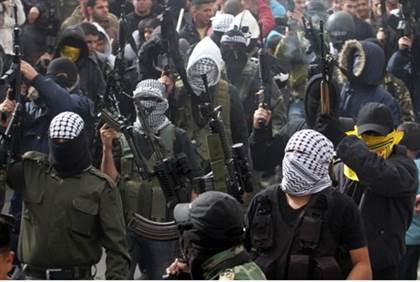 Fatah’s Al Aqsa Martyrs’ Brigade in Kalandiya Flash 90
The Al Aqsa Brigades, the armed wing of Fatah, took reponsibility for a shooting attack that it claims to have executed Sunday south of Bethlehem. Fatah is headed by Palestinian Authority head Mahoud Abbas, considered “moderate” by many Israelis.
The announcement read:
“Out of a belief in the right and legitimacy of the struggle and defense ofthe land of Palestine and its nation, from the enemy’s impurity, and as support for our compatriots in the Gaza Strip, which stands firm in the faceof the Zionist machine of oppression and destruction… and with the grace of Allah and his assistance, our Fatah battalions – the Al Aqsa / Palestine Brigades – succeeded in opening fire at a patrol and a group of Zionists who were in front of the entrance to the El Aroub camp, at 1:08 a.m. Sunday, August 10 2014. The gunfire caused several casualties in the enemy ranks and large occupation forces were deployed to the location. We stress that our fighters returned safely to base.”
“We in the Al Aqsa Brigades warn the enemy from the continuation of our painful blows. Fire will be met with fire, killing with killing and bombing with bombing. When the Al Aqsa Brigades say, they do; when they promisethey carry ou; they attack and their blows are painful. Allahu Akbar and bless Allah. This is an ongoing struggle until the victory or until we fall dead for the path of Allah. The Al Aqsa / Palestine Brigades.”
Several weeks ago, the Al Aqsa Brigades announced that they were launching an “open campaign” againt Israel and instructed all squads under their command to carry out terror attacks in Judea, Samaria and “the Israeli depth.” The organization took responsibility for several attacks, including a gunfire attack near El Hader, west of Bethlehem, several days ago.
Hamas said to obtain cash for salaries in Gaza
August 10, 2014Hamas said to obtain cash for salaries in Gaza, Times of Israel, Avi Issacjarpff, August 10, 2014
It is still unclear how Gaza rulers obtained the money, an issue in the recent conflict.
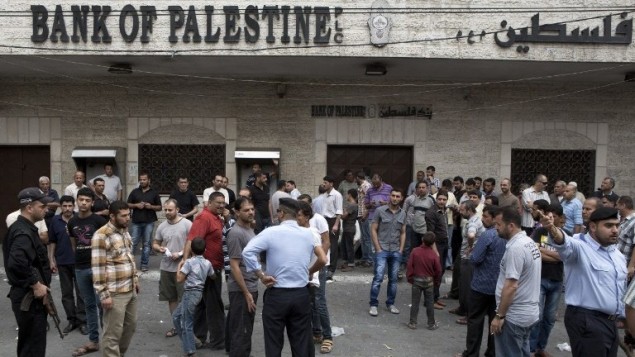 Hamas security forces in Gaza City stand guard as employees paid by the Palestinian Authority wait to receive their salaries outside a closed bank, on Thursday, June 5, 2014 (photo credit: AFP/Mohammed Abed)
A diplomatic source in the Gulf state, speaking on condition of anonymity, said at the time that Qatar had transferred hundreds of millions of dollars to the Arab Bank for the salaries of some 44,000 Hamas civil servants. Those civil servants — employed by Hamas in Gaza since its takeover of the Strip in 2007 – were rendered jobless by the unity agreement with Fatah in May.
Hamas has managed to inject millions of dollars into the Gaza Strip to pay the salaries of thousands of workers, a Gaza-based news agency reported on Sunday, after two months in which no such payments were made.
According to the Palestinian Sawa news, salaries were given to all members of Hamas’s military wing, and the salaries of government officials in the Strip were expected to be paid as well. It is unclear how Hamas managed to transfer the money into the Strip or whether the move was intended to quell unrest in the Palestinian enclave, thus paving the way for a ceasefire.
Payment of the salaries has been one of the key demands by Hamas for a ceasefire in the ongoing conflict with Israel. Egypt has been engaged in trying to broker an end to Operation Protective Edge, which Israel launched on July 8 to halt rocket fire from the Gaza Strip and to destroy a network of tunnels, dug by Hamas under the border and used to launch attacks inside Israeli territory.
The unpaid salaries of Hamas members have also been the focus of a major dispute between Fatah and Hamas, and were a significant factor prompting the recent escalation in Gaza.
The salary crisis, which has plagued Hamas for months, compounded the most severe financial shortfall in the organization’s history, caused by significant loss of revenue following the destruction of smuggling tunnels under the Egyptian border.
In mid-July the United States blocked the transfer of Qatari funds earmarked for the salaries of civil servants hired by Hamas in Gaza.
A diplomatic source in the Gulf state, speaking on condition of anonymity, said at the time that Qatar had transferred hundreds of millions of dollars to the Arab Bank for the salaries of some 44,000 Hamas civil servants. Those civil servants — employed by Hamas in Gaza since its takeover of the Strip in 2007 – were rendered jobless by the unity agreement with Fatah in May.
Behind the Lines: Islamic State’s explosive advance
August 10, 2014Behind the Lines: Islamic State’s explosive advance, Jerusalem Post, Jonathan Spyer, August 10, 2014
(Here’s a video about how IS soldiers love their children to death.
Are they fanatics? Perish the thought.– DM)
Islamist group is advancing on three fronts, but the fantaticism that serves it well in the battlefield is leading to increased internal and external resistance.
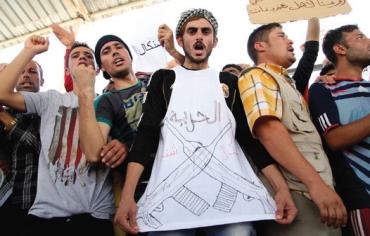 DISPLACED DEMONSTRATORS from the minority Yezidi sect gather during a protest against militants of the Islamic State, in Arbil, north of Baghdad. Photo: REUTERS
A number of incidents have taken place this week that further confirm the power and reach of the Islamic State organization. IS is now engaged in war on three fronts – in Iraq, Syria, and as of this week, Lebanon.
Yet the week was also witness to the first stirrings of active opposition to the rule of the jihadis from within the boundaries of their self-declared state.
In a dramatic development, Sunni jihadi fighters seized control of the northern Bekaa Valley town of Arsal. The fighting began after Lebanese authorities arrested Ahmad Joma’a, an Islamist rebel commander. IS and Jabhat al-Nusra gunmen took control of the town and demanded Joma’a’s release as the price of their withdrawal.
As of now, IS terrorists are battling the Lebanese for control of Arsal, and some media reports have asserted that Hezbollah fighters are taking part in the battle alongside the Lebanese Army. The movement itself denies this; but in past battles between the army and Syrian jihadi forces, such as in Sidon, Hezbollah fighters were proven to be involved despite the party’s denials.
Thus, it is likely they are in Arsal as well.
The Nusra fighters, according to Lebanese media reports, have largely withdrawn. A number of Lebanese Army soldiers, meanwhile, have been captured by the jihadis.
The fighting in Arsal does not yet represent a general eruption of the Syrian war onto Lebanese soil, in the way that it has spilled over into Iraq. But its outbreak casts light on a number of important elements.
Firstly, the Arsal fighting makes a mockery of the claims by Syrian President Bashar Assad’s regime and Hezbollah that they were approaching a final victory in the long battle to drive the rebels out of the area adjoining the Lebanese border.
The story the regime and Hezbollah have been telling the media is one of slow but steady progress. But while the regime undoubtedly has made some gains, it appears the Sunni rebels are still able to operate freely across the border, even after six months of a focused regime attempt to prevent this.
Secondly, the events in Arsal may offer a worrying pointer to the shape of future events in Lebanon.
Arsal is a town whose population has become swollen by an influx of Syrian Sunni refugees. The jihadis are able to count on the support – or at least the acquiescence of this population – for their activities.
Probably around a million Syrian Sunnis have arrived in Lebanon as a result of the war. This has upended the sectarian balance of power in the country. It appears to also have introduced a militant jihadi subculture previously alien to Lebanon. It remains to be seen whether fear of Hezbollah and dread of civil war will continue to prevent a wholesale spillover of the conflict.
Further east, meanwhile, IS made dramatic advances against the Kurdish Peshmerga forces, in the process triggering a general crisis in the Kurdish Regional Government area of northern Iraq. The jihadis took the towns of Sinjar and Zummar, triggering a refugee crisis as 200,000 inhabitants of Sinjar fled to Kurdish-controlled areas.
Sinjar is inhabited by Yezidis, followers of a pre-Islamic, non-monotheistic creed; they are regarded by the IS as “devil worshipers.” Given the treatment meted out by IS to Christians in Mosul, their decision to flee was probably a correct one. However, a refugee crisis is now developing, with thousands of Yezidi refugees trapped on Mount Sinjar, lacking food and water and exposed to the elements. Indeed, a number have already died from dehydration.
In Sinjar itself, meanwhile, there are reports of atrocities including mass killing and rapes.
The Kurds are dismayed at the poor performance of their well-regarded Peshmerga armed forces, who abandoned Sinjar, and a counterattack is currently being planned. Reinforcements are arriving; 5,000 highly motivated Syrian Kurdish fighters from the YPG organization have crossed the border to fight alongside the Iraqi Kurds. PKK fighters are also heading for the Sinjar area, from their bases in the Qandil Mountains area on the Iraqi-Turkish border.
The Iraqi air force is set to back up the ground forces in the attack, which will also involve the use of artillery and heavy armor.
Much depends on the success of this counterattack.
So it has been a good week for IS. Still, the organization is already beginning to experience some of the difficulties involved in ruling.
The first signs of tribal resistance and resentment have begun to surface.
Fighting took place between IS fighters and members of the Shaitat tribe in Deir al-Zor, following the detention by the jihadis of three members of this powerful tribe. There have been manifestations of popular opposition to IS rule in Mosul city in Iraq.
Moreover, in Deir al-Zor, a new organization has appeared – the White Shroud – which is committed to violent resistance against IS.
So even as IS expands the borders of its quasi-state, a contradiction emerges. The same fanaticism that serves it well on the battlefield leads to rapid alienation and then resistance among the populations it controls. It was this very factor that enabled the US to defeat the Sunni insurgency in western Iraq during the “surge” of 2007.
As of now, however, the West is absent, and it is not clear if local forces will be strong enough to do anything more than hold IS in its current position. The Islamic State is likely to be an explosive factor in the Levant for some considerable time to come.
The Spin of Things to Come
August 10, 2014The Spin of Things to Come, American Thinker, Mike Konrad, August 10, 2014
(Please see also Holy War Arrives in Germany. Is barbarism coming to be preferred to civilization? — DM)
Christian Arab-Latins now support Hamas. They have forgotten their own history.
Five Latin American nations pulled their ambassadors from Israel over the recent Gaza war. Fear not for Latin America. Rather, fear is what is coming to the United States.
El Salvador recalled its Israeli ambassador from Tel Aviv on Wednesday to protest the military operation in Gaza, making it the fifth Latin American country to do so.
Brazil, Chile, Ecuador and Peru have already recalled their ambassadors. – Haaretz
Why? Latin Culture is based on the Reconquista; the war against Islam. Why on earth would they support Islamist Hamas?
Two of the five nations stand out: Chile, and El Salvador. Both have elite, very influential Palestinian populations. Chile and El Salvador might have been expected to do something.
Or maybe not?
The Palestinians in Chile and El Salvador are almost all Christian. Yes, El Salvador had a Palestinian president, Antonio Saca, but he was an Evangelical Christian. How on earth are these nations supporting an Islamist regime like Hamas in Gaza?
Moreover, there is a massive pro-Zionist Evangelical revival in Latin America, especially strong in Guatemala, Chile, and Brazil. Guatemala is 40% Protestant; Chile 15%, and Brazil 22%. What on earth is happening?
Even the history flabbergasts us. Arab-Latins fled Muslims.
There was an enormous flight to Latin America from the Mideast after a series of genocidal anti-Christian pogroms occurred in Syria and Lebanon from 1840-60. By 1890, floods of Arabs went to South America. Over 80% of all Arabs who immigrated were Christian. Those few Muslims who did arrive either converted or married into Christianity.
Some 40% of all Arab-Argentines have one Muslim ancestor, yet only 10% or less of Arab-Argentines are Muslim. Conversion, until recently, was the norm. In other countries, almost no Muslims arrived at all. Chile’s Palestinian Arabs are 99.1% Christian. Though Muslims have recently started to arrive and set up mosques in Chile, there still may be less than 10 mosques in the whole country.Yet, small though they are, they are at the center of smuggling in Iquique, Chile, a major Pacific seaport.
Christian Arabs rose to be elites in South Americ;a; captains of industry, bankers. They have their own Arab Ethnic TV internet network. They have massive power, far above their numbers.
“The Palestinian community is to Chile what the Jewish community is to the US,” – Gabriel Zalisnak, Chilean Jewish leader – Haaretz
One would expect the Arabs to take pride in their Arab power, but why would these Arab Christians support an Islamic revolt, just because their ancestors shared a geographic connection with the Muslims? American Jews never supported the Nazis, even if their ancestors came from Germany. Yet, Arab-Latins are supporting the very same people who slaughtered their ancestors, and who persecute Christians in Gaza, today. Christian Arab-Latins now support Hamas. They have forgotten their own history.
Most of these Arab-Latins are third- and fourth-generation Latino. The majority are intermarried with Spanish-, Indio-, Italian-, French-, or German-Latins. Yet, now, they’re suddenly deciding to rediscover long lost Arab roots and learn the forgotten Arabic of their ancestors! How many Scottish-Americans do you know who are interested in learning Highland Gaelic? Or Shetland Norse?
Even more incomprehensible, depending on the country, roughly half of Arab-Latinos are Maronite Lebanese Catholics, who have no historic animus towards Israel at all; and who have every reason to hate Islam. Palestinians are strong only in Chile, El Salvador, and Honduras. So how did the moderate Maronite voice get drowned out, and the Palestinian voice gain supremacy?
There are four reasons:
1) There is almost no strong Jewish lobby anywhere in South America, except possibly Argentina. There is no equivalent of an AIPAC or ADL to contest the rising tide of anti-Israelism. Yes, there are Jews in South America, and yes, they contributed mightily, but their numbers were fewer; their influence was muted by a very powerful Catholic culture. They have power, but it is far weaker than they have in America.
The only exception might have been Argentina, which once had a very large Jewish population. However, Argentina’s instabilities in government and economy have persuaded almost half of Argentina’s Jews to leave. Once 2% of Argentina (similar to the USA), Jews are now ½%. They wield a shadow of their former clout.
In Chile, the small Jewish community is fighting a losing battle against Palestinianism.
2) A powerful, incredibly rich Arab community, especially among the subset of Palestinians. Though only 3% of Chile, Palestinians are 10% of the Senate. They have strong armed the Chilean government into positions no other government would have taken. When the rabble-rousing Palestinian-Chilean Maurico Abu Ghosh was stopped at Ben Gurion airport, and prevented from entering the contested territories, and deported, it was headline news in Chile. The Chilean government protested. No other government would have done this. It certainly is not national news in America when Israel deports American activists. Our government would have kept quiet.
3) Saudi and Iranian oil money have been allowed to go into Latin America uncontested. While Israel and America slept, the Arabs pumped in tens of millions of dollars to swing a continent. And it has worked. Arab language courses subsidized by the Saudis. A gigantic mosque in downtown Buenos Aires that almost no native Argentine attends.Saudi financed Islamic schools offering quality education to Christian children. They rarely make converts but they do impart a worldview.
Islamic TV shows on Argentine public TV which the locals are convinced are the results of bribery.
Venezuela allowed in Iran’s HispanTV to broadcast to a continent, even though European countries like Britain and Spain banned Iranian propaganda.
The Arabs focused heavily on South America for decades, and it paid off.
4) A Latin fascination with leftist ideology which views anything American or Israeli as retrograde. Forget Arab brutalization, mutilation, and murder of women. Forget Islam’s retrograde tyranny. It has to be the fault of los yanquis y israel.
Meanwhile Israel has yet to learn. Israel’s I24 TV News broadcasts in English, Arabic, and French. Why no Spanish? Even now, Israel is ignoring a rising Latin power.
The head of the Yesha settler movement is Dani Dayan, a tri-lingual Argentine-born Jew. Urbane and persuasive, he has written Op-Eds in the New York Times. I have to assume he has been pleading with Israel to do something. Yet, Israel ignores South America, and seems surprised at the present results.
Give Dani Dayan a show on I24, for crying out loud. He could be the voice of Israel in South America, in their own accent. There are 70,000 Argentine Jews in Israel. There is no excuse for Israel to have allowed this to happen.
And America?
With the rising power of CAIR, the Council on American-Islamic Relations; and the diminishing power of AIPAC and the ADL, we will not be far behind the Latin Americans.
One may bemoan the extraordinary power of the Jewish/Israel lobbies, but they kept Arab power in check. The author John Loftus has shown in his book The Secret War Against the Jews that Arab power has been in America since the 40s, often operating through oil companies. Now, Arab power is ascendant and rising, as Jewish influence is dying.
Nor was this power unique to Jewry. In the 1950s and 60s, the Roman Catholic Cardinals of New York and Boston yielded extraordinary influence. Attendance at the annual Al Smith dinner was de rigeur even for Protestant Presidential Candidates. In Quebec, the Catholic Church was supreme until the 1960s.
Catholic power has long since faded. Jewish influence has now peaked. Now, Islam is rising.
God help us. Whatever faults or excesses are in Catholicism or Judaism, they at least produce high civilization. Power has passed to the civilization destroyers. If you want to see where we are heading, learn a little Spanish and look at Latin America.
Holy War Arrives in Germany
August 10, 2014Holy War Arrives in Germany, Gatestone Institute, Soeren Kern, August 10, 2014
(Please see also War on Hamas is war on the Islamic State. — DM)
“Never before have the sympathizers of Islamic terror appeared so openly in Germany.” — Editorial, Westfalen-Blatt.
“Anyone who thought the civil war in Syria or the barbarity of the Islamic State in Iraq does not affect us, you are wrong.” — Editorial, Frankfurter Allgemeine Zeitung.
“IS, Al-Qaeda, Hamas and Boko Haram—these four groups are the linchpins of the attempt to bomb an unstoppable modernity back into the Middle Ages.” — Editorial,Westfalen-Blatt.
“The religions of the world are increasingly being misused for ideological struggles and excesses of violence between people of different faiths. Religions are never violent per se, but the market criers of violence are using them to promote their own interests.” — Editorial, Neue Westfälische.
Supporters of the jihadist group “Islamic State” [IS] have clashed with Kurdish Yazidis in North Rhine-Westphalia, the state with the largest Muslim population in Germany.
The violence—which comes amid threats by a German jihadist to blow up an American nuclear weapons storage facility in Germany—has counter-terrorism officials concerned that radical Muslims are deliberately exploiting the ethnic and religious tensions in the Middle East to stir up trouble on the streets of Europe.
Police say the Muslim-Yazidi clash was triggered after six Islamists stormed a restaurant in the eastern Westphalian town of Herford at around 4 pm on August 7. The Muslims were attempting forcibly to remove a poster inviting people to join a demonstration in support of the Yazidis in Iraq.
Thousands of Yazidis, an ethnic Kurdish non-Muslim minority, were forced to flee their homes in northern Iraq in early August to escape advancing Islamic State fighters, who are forcing the Yazidis to convert to Islam or be killed.
The 30-year-old owner of the restaurant in Herford and two others, all Yazidis, were injured in the brawl, which police say was fought with knives and bottles.
Several hours after the restaurant attack, between 300 and 500 Yazidis gathered in the Herford town center, where they clashed with a large group of hooded Salafists.
More than 100 police reinforcements from across eastern Westphalia were called in to restore order. Police, who used pepper spray to disperse the two groups, confiscated makeshift weapons and one firearm, and questioned 86 people.
In the final tally, police arrested six individuals involved in the attack on the Yazidi restaurant: Five ethnic Chechen Salafists and one German convert to Islam. According to German media, two of the individuals are leading Salafist operatives who were already being monitored by German intelligence.
A German intelligence official was quoted as saying that one of the Chechens is a trained fighter who participated in guerrilla warfare against Russian troops and who is considered to be “highly dangerous.”
German authorities have long warned of the threat posed by Salafism, a radically anti-Western ideology that seeks to impose Islamic sharia law in Germany and other parts of Europe.
Membership in Islamic extremist groups in Germany rose to 43,185 in 2013, up from 42,550 in 2012, according to German intelligence estimates. The number of Salafists in Germany rose to 5,500 in 2013, up from 4,500 in 2012, and 3,800 in 2011.
Although Salafists make up only a fraction of the estimated 4.3 million Muslims in Germany, authorities are increasingly concerned that most of those attracted to Salafi ideology are impressionable young Muslims who are susceptible to perpetrating terrorist acts in the name of Islam.
North Rhine-Westphalia is home to the largest concentration (about 1,500) of Salafists in Germany. The region is also home to most of the estimated 60,000 Yazidis who live in Germany.
The area around Herford has long been a magnet for Salafists, and mosques in the town are known to convert young people to Salafism. “Even the operator of a fitness center is suspected of wanting to inspire young Germans, under the guise of sports, for Salafism,” an intelligence official was quoted as saying.
More than a dozen men from the Herford area have joined IS in Syria and Iraq, and at least one, a 22-year-old German convert to Islam, is known to have been killed in the fighting.
On August 7, a German jihadist from the Westphalian city of Essen, who is believed to be fighting in Syria,threatened to bomb the American nuclear weapons storage facility situated near the city of Koblenz. The 27-year-old convert to Islam, who is known as Silvio K., also threatened to attack churches, government agencies and transport networks across Germany.
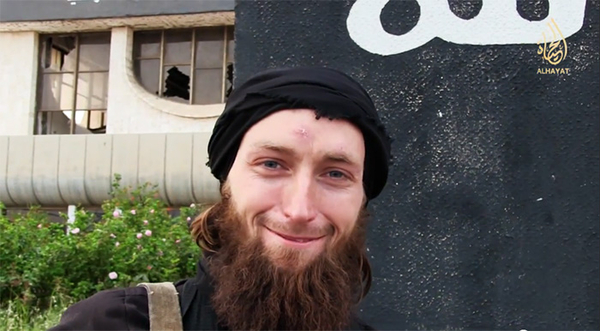 The German known as Silvio K., shown here in a jihadist recruitment video, last week threatened to bomb an American nuclear weapons storage facility located in Germany.
A German Interior Ministry spokesperson said that although “the threat is abstract, it may become real at any time.” He said it proves that Germany “is still the focus of jihadist terrorism,” especially from jihadists returning from Syria with combat experience and contacts to jihadist groups.
German commentators have reacted to the events in Herford with a sense of foreboding, with some saying that the war in Syria and Iraq has now arrived on Germany’s doorstep.
In an editorial entitled, “The Madness Reaches Eastern Westphalia,” the newspaper Westfalen-Blatt states:
“The Yazidis deserve our sympathy and support as do any other oppressed people in the world. The call for participation in a demonstration against genocide, which triggered the events in Herford, is perfectly legitimate in a democracy. It is to be hoped that many German flags will be flown at the rally to protest the misuse of religion for political purposes. Hopefully Herford is not the beginning of an escalation that could reach further levels of violence over the next few days….
“And this is frightening: Never before have the sympathizers of Islamic terror appeared so openly in Germany. These are the circles in which European fighters are recruited for jihad. This is also the milieu in which the Salafist ultra-radicals develop when they are back in Europe again. Therefore, police and secret service are required to monitor the scene closely.
“And no, we did not know that Chechen Muslims are such vehement supporters of the IS-terrorists in Iraq. The Chechens in the southern Russian Caucasus are themselves victims of repression and human rights violations.
“IS, Al-Qaeda, Hamas and Boko Haram—these four groups are the linchpins of the attempt to bomb an unstoppable modernity back into the Middle Ages. The means to this end are Sharia, hatred and glorification of a supposedly “holy” war—what madness!”
The newspaper Neue Westfälische stated:
“When—if as now in Herford—the Kurdish Yazidi religious community and the radicalized Islamist ideology of the Salafists collide, then a city in eastern Westphalia is in danger of going up in flames.
“The conflict between the Yazidis and Salafists has arrived at our front door because it is part of a global conflict. The religions of the world are increasingly being misused for ideological struggles and excesses of violence between people of different faiths. Religions are never violent per se, but the agents of violence are using them to promote their own interests.
“We should not be surprised by the tumult of Wednesday, as German intelligence has long warned that Herford is a center of Salafism. The Islamists, among them Russian Chechens, who have nothing to lose and are mainly driven by poverty and hopelessness, are in our midst. And the citizens react in disbelief and resignation… a silent horror.”
In an editorial entitled, “No Battleground for Radicals,” the newspaper Westdeutsche Allgemeine Zeitung writes:
“Herford is not Mosul and North Rhine-Westphalia is not Iraq. Germany must not become an arena for clashes that take place beyond our borders, but that nevertheless are close to home, just because many people from the different ethnic groups involved live permanently among us.
“The clashes in eastern Westphalia are a warning that radical tendencies are directed not only against ‘infidels,’ but also against the entire Western liberal democratic order. There are indications that the attack on a Yazidi restaurant in Herford by supporters of the Islamic State was specifically planned. Perhaps it was to serve as a blueprint for a wave of hate attacks that may soon occur elsewhere. Islamic jihadists are ready for anything. This was already proved by the attack on the Jewish Museum in Brussels, with four victims.”
In another editorial entitled, “Looking the Other Way Will No Longer Work,” the Frankfurter Allgemeine Zeitungsummed it up this way:
“Anyone who thought the civil war in Syria or the barbarity of the Islamic State in Iraq does not affect us, you are now wrong. No matter how far away Qaraqosh [Iraq’s largest Christian city] and Sinjar [home to the Yazidis in Iraq] may be: What happens there also affects us here in Germany. Sympathizers of the Islamic State have attacked the Yazidi in Herford, which means that Qaraqosh, Sinjar and Herford are now inseparable.
“For far too long, Germany’s political leaders, and especially the leaders of German Muslim organizations, have sat by and idly watched the proliferation of the Salafist-jihadist hatred culture, in the purported belief that it poses no danger. It is absolutely outrageous that local politicians have played down the risk of Islamism, while the capabilities of the security authorities are increasingly being overstretched by the need to deal with this threat.
“Muslim organizations should hang their heads in shame. Rather than bluntly stating that the barbarians in northern Iraq are ‘not Muslims,’ they whistle away to say that Islam is ‘only peace.’ In the future, this kind of obfuscation will no longer suffice, especially if German Muslims, who are subject to the German legal system, wish to avoid being held accountable for the killings in the name of Islam.
“The Islamic State under its leader Abu Bakr al-Baghdadi may not last very long; but the propaganda from his jihad certainly will survive him. This is because the seeds of hatred that ‘Caliph’ Baghdadi has sown are far more toxic than those of Osama Bin Laden. For disaffected youth, the Islamic State exerts great appeal, and not only in Herford.”
War on Hamas is war on the Islamic State
August 10, 2014War on Hamas is war on the Islamic State, Israel Hayom, Boaz Bismuth, August 10, 2014
Gaza has been shoved to the back pages. France and other European nations are concerned with the threat of Islamic terrorism. For some reason, that same threat didn’t show up on their radar during the Gaza war.
The West is gearing up for war, too. This weekend, U.S. President Barack Obama gave the U.S. Air Force the go-ahead to attack the Islamic State in Iraq to prevent the radical Sunni group from committing genocide. Britain is already giving off signs that it will soon join in, and France, which recently launched anti-terrorism operations in Libya, Mali, and the Central African Republic, doesn’t intend to be left out. Some wars are justified.
The threat of terrorism and radical Islam has returned to the headlines in the West. News broadcasts in France are reporting, obviously, on the threat the Islamic State represents. Iraqi Christians who fled the group have received asylum in France, but on Saturday, rather than demonstrating in solidarity with their Christian brothers, people in Paris took to the streets in a show of support for Gaza and the Muslim Brotherhood.
But let’s be clear — Gaza has been shoved to the back pages. France and other European nations are concerned with the threat of Islamic terrorism. For some reason, that same threat didn’t show up on their radar during the Gaza war.
And if we’re talking about Gaza, we could assume that the European street would understand that a war against Hamas is the same thing as a war on the Islamic State. Hamas and the Islamic State are both Islamist terrorist organizations that seek to change society and swathe it in Islamic green, whether Muslim civilians want that or not. Heretics, by the way, have no place there.
Islam expert Anne-Clementine Larroque, writing in Le Figaro on Saturday, explained the difference between Hamas, the Muslim Brotherhood, and the jihadists. An interesting analysis, which will help Israelis realize that what is perfectly clear to us is not yet clear to the Europeans.
Larroque explains that the Muslim Brotherhood are reformist Islamists with a political agenda: Some of its branches might display violent tendencies, but that is not its goal. Hamas was founded by the Muslim Brotherhood. It is a movement, but also has a military arm. The Islamic State, on the other hand, is a jihadist group.
Conclusion: We should talk with Hamas, and eliminate the Islamic State. Who would have thought we’d ever draw the line between acceptable and unacceptable terrorism?
The rocket that spelled the end of the two-state solution?
August 10, 2014The rocket that spelled the end of the two-state solution?
A single missile that landed near Tel Aviv last month led three-quarters of foreign airlines to briefly abandon Ben Gurion Airport. Does that mean Israel can never leave the West Bank?
By Raphael Ahren August 10, 2014, 2:18 pm
via The rocket that spelled the end of the two-state solution? | The Times of Israel.

On July 22, two weeks into Operation Protective Edge, a rocket fired from Gaza landed in the Tel Aviv suburb of Yehud, about one mile (1.6 kilometers) from Ben-Gurion Airport’s perimeter fence. The United States Federal Aviation Administration immediately issued a Notice to Airmen instructing them that “due to the potentially hazardous situation created by the armed conflict in Israel and Gaza,” all flight operations into and out of Ben Gurion were prohibited until further notice.
Major airlines across the world followed suit, and over the next 36 hours, until the FAA removed the order, some 60 flights in and out of Israel’s most important international gateway were canceled.
In addition to the economic and psychological damage that followed, which received relatively little attention during a chaotic month-long war that caused nearly 2,000 deaths, the abandonment also revived discussions about Israel’s security concerns in a future peace agreement with the Palestinians.
If a single rocket fired from Gaza could bring Israel’s international air traffic to near standstill, it was argued, how could Israel ever hand over control of the West Bank to the Palestinians? After all, it was reasoned, the future Palestine’s western border would be much closer to Ben Gurion than Gaza, and given the West Bank’s mountainous topography, it would be simple for terrorists to rain rocket fire on the airport. This argument was made mostly, but not only, by observers leaning to the right.
Senior members of the government are among those who endorse it, contending that Ben Gurion’s near-shutdown strengthens their concerns over Palestinian sovereignty in the West Bank. Other observers, including some with bona fide security credentials, argue that in today’s day and age, the only way to really ensure Israel’s safety is through diplomacy.

Hamas has delivered a powerful message to the world,” Dani Dayan, the chief foreign envoy of the settlers’ umbrella Yesha Council, said the day after the missile landed in Yehud. “With one rocket from Gaza they closed down our airport. With an independent state overlooking three quarters of Israel’s population, they could close down the entire country.” The incident had sealed the “fate of Palestinian statehood,” he declared joyfully.
Economy Minister Naftali Bennett, the head of the nationalist Jewish Home party, refused to comment on the issue this week, but he has warned in the past that a withdrawal from the West Bank would turn Ben Gurion Airport into a major target for rocket attacks from the east. The July 22 attack and the dozens of cancellations it prompted were a demonstration of this threat, a source close to Bennett said. “If this is what happens with one rocket from Gaza, we can imagine what would happen with terrorists on the mountains overlooking the airport.”
Alan Dershowitz, one of America’s most prominent pro-Israel advocates, also said he felt that Hamas’s firing at Ben Gurion Airport “may well have ended any real prospect of a two-state solution.”
In an article for the Gatestone Institute, a foreign policy think tank, Dershowitz surmised that Israel “will now be more reluctant than ever to give up military control over the West Bank, which is even closer to Ben Gurion Airport than is Gaza.”
If Israel were to withdraw its military from the West Bank it would risk a Hamas takeover similar to that which occurred in 2007 in Gaza, the retired Harvard law professor wrote. “Hamas took control, fired thousands of rockets at Israeli civilian targets and have now succeeded in stopping international air traffic into and out of Israel.”

The new reality caused by Hamas’ shutting down of international air travel to and from Israel would plainly justify an Israeli demand that it maintain military control over the West Bank in any two-state deal,” Dershowitz added. Hamas actually wants to prevent a peace deal between the Palestinian Authority and Israel, he argued. “The Hamas Charter categorically rejects the two-state solution, as does the military wing of Hamas. In this tragic respect, Hamas has already succeeded. By aiming its rockets in the direction of Ben Gurion Airport, Hamas may well have scuttled any realistic prospects for a two-state solution.” He concluded. “It cannot be allowed to succeed.”
To date, there have been no rockets fired into Israel from the West Bank because Israel controls the borders — but if that were to change, Jerusalem could no longer guarantee the airport’s safety, said Dore Gold, the president of the Jerusalem Center for Public Affairs and a senior adviser to Prime Minister Benjamin Netanyahu. The Jordan Valley, at the West Bank’s eastern border, is Israel’s ultimate barrier to infiltration and the smuggling from abroad of anti-aircraft missiles that could be fired by operatives from various terrorist organizations, Gold said.

“In the last number of years, Hamas has smuggled anti-aircraft missiles into the Gaza Strip, which Israel has always taken into account,” Gold told The Times of Israel. “But fortunately, none of these missiles came into the West Bank since Israel controlled the outer perimeter of the territory in the Jordan Valley. Israel had no such control in the outer perimeter of Gaza for many years in the Philadelphi Route [the narrow strip of land on the border of Gaza and Egypt], which explains the difference between the two situations.”
Last month’s temporary cessation of flights in and out of Ben Gurion “only reinforces the importance of making sure that anti-aircraft and other missiles do not get into the West Bank in the future,” Gold added. “What Israel has to do in future negotiations is clarify its security interests and firmly protect them in any negotiation.” The fact that one rocket largely paralyzed international air traffic for several days illustrates that the threat to the airport is “not theoretical,” he warned.

A second senior Israeli official close to Netanyahu said last week that the missile threat to Ben Gurion “comes up in conversations” occasionally, but that the prime minister hasn’t yet made the connection between what happened in July and his argument that a future Palestinian state needs to be demilitarized. It could certainly give his reasoning “additional impetus,” the official said, speaking on condition of anonymity.
On July 11, Netanyahu warned that “there cannot be a situation, under any agreement, in which we relinquish security control of the territory west of the River Jordan” — a reference to the Jordan Valley and the West Bank. “Adjacent territory has huge importance,” he said, and could be used by terrorists to dig tunnels and to fire rockets. The closer terrorists can get to Israel’s borders, he said, the more rockets they fire — as proven by Operation Protective Edge. “At present we have a problem with the territory called Gaza,” the prime minister continued, noting that the West Bank is 20 times the size of Gaza. He is not prepared “to create another 20 Gazas” in the West Bank, he vowed.
‘All airlines would immediately halt their flights, isolating the country’
The threat from precision-guided weapons shot at Ben Gurion from Palestinian territory, which is situated topographically higher than the airport, has often been cited in discussions about Israel’s concerns in a future peace deal. “It should be expected that if Palestinian terrorists open fire toward Ben Gurion Airport, even once, all foreign airlines would immediately halt their flights, effectively isolating the country,” Brig.-Gen. (res.) Udi Dekel, a former head of research at the Israel Air Force intelligence, wrote in 2011.
‘Turning 2.7 million Palestinians into a permanent part of Israel is an even greater threat’
But some Israeli security experts say that the fear of rockets should not serve as a pretext for the refusal to agree to Palestinian statehood. Former deputy national security adviser Chuck Freilich, for instance, said that rejecting the creation of a Palestinian state based on the specter of rockets on Ben Gurion is a “fallacious argument.”
Israel obviously has serious and justified security concerns over a future Palestinian state in the West Bank, said Freilich. They’re further highlighted by what just happened in July, he told The Times of Israel in recent interview. “But the real question that people from the Yesha Council or anyone else should be asking themselves is: Do we really want to incorporate the Palestinian problem – the West Bank – into Israel? Do we want to ensure that that remains our problem forever? Or do we want to disengage from the Palestinians to ensure our future as a Jewish and democratic state, and at the same time find security arrangements that would provide for what will never be 100 percent security, but reasonable security?”
There is no such thing as 100 percent security, asserted Freilich, a former senior analyst at Israel’s Defense Ministry. Therefore, the government will have to insist on security guarantees and look for ways to protect Ben Gurion Airport from rockets, which he admits is a very serious threat. “But turning 2.7 million Palestinians into a permanent part of Israel is an even greater threat.”
Right-wingers who argue that the possibility of missile fire on Israel’s airport trumps the need to implement a two-state solution are merely “looking for every excuse to justify ongoing political control” over the West Bank, Freilich added. “But we have to separate between dealing with legitimate, totally understandable security concerns, and not being in control of 2.7 million people who don’t share our dream of a Jewish and democratic state.”
Other security experts deem the discussion about the threat of rockets entirely anachronistic. “Rockets can hit the airport from Gaza; they can hit us from the West Bank, from Jordan and also from Iraq — so what?” said Col. (Ret.) Shaul Arieli, a former commander of the Northern Brigade of the IDF’s Gaza division, who has since made a name for himself as a dovish expert on possible border demarcations between Israel and a future Palestinian state. “The West Bank’s proximity to the airport has absolutely no significance. We no longer live in the 1920s.”
Contradicting Netanyahu’s assertion about the importance of adjacent territory, Arieli argued that once a target such as the airport could be attacked theoretically from anywhere, the key to peace and security lies not in the demarcation of borders, but in diplomacy. “What you need is [diplomatic] relations and mutual deterrence between the countries. Israel needs to reach an agreement [with the Palestinians] and end this conflict.”




 anneinpt
 artaxes
 danmillerinpanama
 davidking1530
 Peter Hofman
 Joseph Wouk
 Peter
Peter Louisiana Steve
 WarSclerotic


Recent Comments