Archive for August 7, 2014

Alleged mastermind behind kidnapping of three Israeli teens arrested

August 7, 2014

Alleged mastermind behind kidnapping of three Israeli teens arrested
By YONAH JEREMY BOB 05/08/2014 Via The Jerusalem Post


(They caught a rat!-LS)

State prosecutors say Hussam Kawasme confessed to giving orders, collecting weapons, getting funds from Hamas; 2 chief suspects still at large.

Husam al-Qawasmi was the mastermind who gave the mid-June order to Marwan al-Qawasmi and Amir Abu Aisha to kidnap teenagers Gil-Ad Shaer, Eyal Yifrah and Naftali Fraenkel, the state prosecution revealed on Tuesday.

The kidnapping and murder, according to many, was the spark that ignited a rapid deterioration in the Israeli-Palestinian conflict culminating in the Gaza war that has rocked the region this past month.

The UN Security Council went out of its way to condemn the brutal murders.

According to the state, Husam confessed not only that he gave the orders, but also that he collected weapons and raised funding for the attack by the Hamas cell.

In addition, Husam assisted Marwan in concealing the bodies by burying them on land he had bought in recent months.

Husam was attempting to flee the area and disappear across the Jordanian border with false documents subsequent to the bodies being found when he was caught on July 11.

The state said the evidence it had was at the level of a near certainty, having interrogated Husam and collected other evidence.

That said, confessions to police can be withdrawn at trial, and to date, Husam has not been indicted, and may not be for some time.

Marwan and Amir are still at large.

The kidnapping took place when the three teens hitchhiked with their eventual assailants in the Gush Etzion settlement bloc.

The revelations arose in the state’s legal response to the High Court of Justice, justifying its request to demolish the residences of the families of the three suspected terrorists.

The High Court of Justice on Thursday had frozen three IDF demolition orders against those residences.

The knocking down of the family homes were originally scheduled for late Thursday afternoon.

On July 1, the state dropped a self-imposed ban on house demolitions that had been in place since 2005.

Egypt-Hamas animosity casts pall over ceasefire hopes

August 7, 2014

Egypt-Hamas animosity casts pall over ceasefire hopes
By Elhanan Miller August 7, 2014, 10:27 pm Via The Times of Israel


Yemeni boys attend a protest supporting Gaza in front of the Egyptian embassy in Sanaa, Yemen, August 5, 2014 [photo credit: AP/Hani Mohammed]


(Doomed to fail. Besides, it’s not about concessions. Hamas just wants to kill Jews. The rest is bullshit.-LS)

Egypt’s future attitude toward the Gaza Strip, an issue scarcely mentioned as a key point of contention between Israel and Egypt, may cause the shaky 72-hour ceasefire ending Friday morning to collapse, leaks from the talks in Cairo reveal.

“There is no agreement to extend the ceasefire,” Moussa Abu Marzouk, deputy head of Hamas’s political bureau and a participant in the Cairo negotiations, wrote on Facebook late Wednesday night, upping the ante if negotiations failed to address his movement’s list of demands.

A day later, an Egyptian security official said that the Palestinian delegation was refusing to compromise. The Egyptian security official, who spoke on condition of anonymity because he was not authorized to talk to the media, said Thursday that the Palestinian delegation’s stance had hardened after the arrival in Cairo of Hamas and Islamic Jihad leaders from the Gaza Strip. He said Azzam al-Ahmad, the leader of the delegation and the representative of Western-backed Palestinian Authority President Mahmoud Abbas, had threatened to withdraw from the talks if the two terror groups do not show more “flexibility,” adding that the delegation, which was supposed to leave Cairo on Thursday, would stay through the weekend.

On Thursday evening, Hamas announced that it would resume attacks against Israel on Friday morning if its demand to end the blockade on Gaza was not met.

One key Hamas demand has always been “the opening of crossings,” often used as shorthand for the permanent opening of the Rafah border crossing with Egypt. Rafah, the sole portal from Gaza to the Arab world, has remained largely shuttered since the ouster of Egyptian Muslim Brotherhood president Mohammed Morsi in July 2013. The closure, as well as the chaos and confusion in the terminal during the few erratic hours when it is open, serve as a source of unending anguish for many in Gaza seeking medical treatment, study, or travel abroad.

The Rafah crossing was administered by Israel until the Israeli withdrawal from the Gaza Strip in 2005, when it was handed over to the Palestinian Authority. In June 2007 Hamas took control of the Gaza Strip, ousting the PA from the crossing and prompting EU monitors on location to retreat. On Thursday, the EU proposed reactivating its EUBAM supervision force at Rafah and permanently opening the crossing.

According to Gaza’s Interior Ministry, in past months the crossing was shut for a total of 175 days and open for only 42 days. Data collected by Gisha, and Israeli NGO dealing with freedom of movement in Gaza, is similarly bleak. Crossings between Gaza and Egypt dropped by 84 percent since the fall of the Muslim Brotherhood in Egypt: from an average of 40,000 crossings per month during the first six months of 2013 to an average of 6,500 since July 2013.

Israel would like to see Gaza rely more significantly on Egypt for its sustenance. The Coordination of Government Activities in the Territories (COGAT), the IDF branch dealing with Palestinian civil affairs, is displeased with the current Israeli “monopoly” over the entry of commodities and consumer goods into the Strip through Kerem Shalom crossing, The Times of Israel has learned from official sources.

Yet Egypt is reluctant to amend its current policy of closure; nor is it willing to discuss the development of Rafah crossing to allow for commercial use.

Qais Abdul Karim, a member of the Palestinian negotiations team in Cairo for the Democratic Front for the Liberation of Palestine (DFLP), told the Hamas daily Felesteen on Wednesday that the opening of the Rafah crossing was taken off the agenda in Cairo. Hamas presented the refusal to discuss Rafah as an unfair Egyptian dictate.

Quoting a “knowledgeable source,” Hamas daily Al-Resalah reported on Thursday that Egypt had informed the Palestinian factions in Cairo of its decision to exclude the Rafah crossing from negotiations. “The Egyptian side refused to consider the closure of the crossings as part of the siege imposed on Gaza,” Al-Resalah’s source claimed, adding that Egypt would be willing to reactivate the crossing “as soon as it is handed over to PA President Mahmoud Abbas and the unity government.”

“By refusing to consider the Rafah crossing part of the siege, the Egyptians clearly don’t want to remove the siege completely or partially ” Al-Resalah charged.

Obviously, Egypt doesn’t consider itself part of the solution for the Gaza crisis. When asked on Wednesday about Cairo’s vision for the outcome of talks on Wednesday, Egyptian Foreign Minister Sameh Shukri spoke of the need to rebuild Gaza and provide humanitarian aid to its population, and “for the Israeli authorities to open the crossings and break the siege.”

Except that, unlike Egypt, the Israeli authorities never closed the crossings throughout Operation Protective Edge. Even as mortar shells fell on the northern Erez crossing (used for pedestrian traffic) and the southern Kerem Shalom crossing (used for goods), trucks continued to enter the Strip and passengers continued to pass in and out of the territory. According to COGAT, more than 1,500 trucks loaded with produce and medicine entered the Gaza Strip since July 8, when the operation began, and over 3,000 civilians crossed through Erez in both directions, nearly 1,000 of them for medical reasons.

Gisha, the Israeli NGO, has called on Israel to expand import and export to and from Gaza, and to allow freer passage out of the Strip for civilians. Currently, mostly patients and their family members are able to cross into Israel, constituting less than 1 percent of the traffic prior to September 2000, when the Second Intifada erupted.

But there is clearly a larger issue at play here, namely Egypt’s future relations with Hamas. On its border, Egypt would like to deal exclusively with Abbas and the PA; never with their Islamist rivals.

Asked whether Egypt would consider engaging the Palestinian organization (after having dubbed it a terror organization in March), Egyptian sources told A-Sharq Al-Awsat Thursday that “it is much too early to discuss the matter,” which could negatively impact the ceasefire talks.

Hamas, for its part, seemed fed up with the Egyptian mediation on Thursday, continuing to eye Turkey and Qatar as alternative brokers if talks in Cairo collapsed.

“Despite the Egyptian position, which deals negatively with the demands of the [Palestinian] factions, observers believe that its position could change due to the insistence of Hamas’s representatives on the Palestinian demands; especially considering there are other mediators, Turkey and Qatar, which are prepared to take an alternative role if talks in Cairo fail,” read the article in Al-Resalah, the Hamas newspaper.

Indeed, on Thursday morning Hamas official Moussa Abu Marzouk signaled that his movement was ready to walk away from the table.

“If peace ever had a chance, it was lost with the body parts of our children and the stones of our homes,” he wrote on Facebook. “There is no guarantee for what is agreed upon but the weapons of the resistance. America is no guarantor, since it decided on the siege and provided weapons for the destruction.”

The Associated Press contributed to this report.

Carr: John Kerry pedals new Nantucket photo op

August 7, 2014

Carr: John Kerry pedals new Nantucket photo op, Boston HeraldHowie Carr, August 7, 2014

(I know, it’s ad hominem nonsense, but it’s still funny and could provide a (very little) bit of entertainment while awaiting the resumption of hostilities with Hamas, et al tomorrow.– DM)

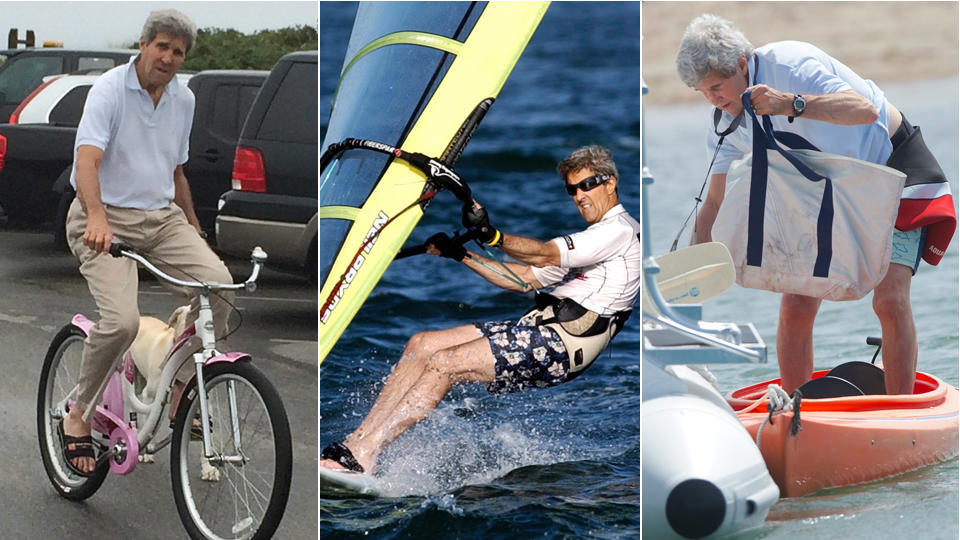
ctpkerryAny potential museum of John Kerry should feature images from his time on Nantucket, as this shot of Kerry on a girl’s bicycle in the parking lot at Jetties Beach, taken by Lando from his Instagram, Landogramms; or the photo of Kerry windsurfing, taken after he won the Democratic nomination in 2004; or the image of him boarding the Isabella in 2013.

Has Vladimir Putin seen this photo of John Kerry yet? Has Benjamin Netanyahu?

When they do, I think one of them will be laughing and the other — well, no, even Bibi will be cracking up when he sees Hamas’ best buddy wobbling on a bicycle on Nantucket last weekend.

A girl’s bike.

A girl’s pink bike.

As usual with these annual summer photos on Nantucket, Kerry looks surprised that someone just walking along happens to have a cellphone camera. It’s happened to Liveshot how many times now, just on Nantucket, and he’s still astounded that it’s happened again.

Apparently, he still believes it’s 1984, and the only photographers are from the Globe, and if they take another embarrassing shot, he can just call Mr. Winship or Mrs. Winship and get it killed.

Now, embarrassing photos go around the world when the Globe is Photoshopping tomorrow’s halo above Liveshot’s exquisitely coiffed mane.

Behind him, you can see his new white dog — could his name be Surrender? I don’t see a baggie in Mr. Secretary’s hand, nor do I see Glenn Johnson trailing behind him. That’s a job his aide Johnson is well-suited for — following behind, cleaning up messes left by a clueless Democrat and his pup. After all, Glenn was Kerry’s head cheerleader at the Globe.

I just got back from Dallas, where I went to the museums for George W. Bush and JFK. They have some amazing photos at both locations, but after seeing this last photo of the secretary of state, I have an idea for where John Kerry’s “mu­seum” should go.

On Nantucket, where his greatest photos have been taken.

Last year, it was the Herald’s photo of him climbing onto his $7.5-million yacht, the Isabella, the one he tried to avoid paying taxes on, as Egypt was convulsed in revolution.

Then there was the late-night photo of him with some female teenyboppers, one of them sipping a cold one out of a red Solo cup with a penis straw.

And speaking of Nan­tucket, don’t forget the famous video from the 2004 election, of Kerry wind­surfing — a man of the people, all right, as long as the people are gigolos.

If we include off-island photos as well, the JFK Museum of Nantucket must include another 2004 keeper, when he dressed up like a sperm in the Woody Allen movie, “Everything You Wanted to Know About Sex But Were Afraid to Ask.”

Another thing I noticed about the presidential museums in Dallas was the audio from their presidents’ memorable speeches. Since Kerry still believes he was robbed of the presidency, doesn’t his museum need some of Liveshot’s greatest quotes thundering down through the halls?

“I voted for the $87 billion before I voted against the $87 billion.”

“I’m fascinated by rap.”

“I was an altar boy.”

“This tunnel (the Big Dig) will be a bargain.”

“Manny Ortez … I have a final score for you … Detroit 2, Red Sox 3.”

“You’re looking at the biggest cheesehead in America.”

Come to think of it, maybe Nantucket isn’t the best place for a Kerry museum. Where is the Comedy Hall of Fame located? Could they use a Liveshot wing?

Makes You Wonder Why

August 7, 2014

Jihadi Work Accident: Four Hamas Fighters Killed When Explosives Detonate Prematurely…


(With a cease fire in place, why would they be preparing explosives?-LS)

Via Reuters Correspondent Dan Williams August 7, 2014:

“Hamas TV says four of the group’s fighters were killed while preparing explosives today.”

Hamas ultimatum: Failing a Gaza seaport, the war goes on and thousands of Israelis will die

August 7, 2014

Hamas ultimatum: Failing a Gaza seaport, the war goes on and thousands of Israelis will die, DEBKAfile, August 7, 2014

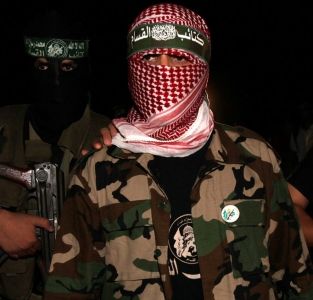
abu_obaida_7.8.14 (1)Hamas military spokesman Abu Obaida declares war

Hours before the 72-hour ceasefire was due to expire Friday morning, Aug. 8, the Palestinian Hamas’ military wing slapped down an ultimatum before Israel: Either allow the Gaza Strip to have an open seaport – which would be tantamount to lifting the Gaza blockade – or prepare for a long and brutal war of attrition with thousands of fatalities.

Hamas’ decision about extending the ceasefire was tensely awaited Thursday night after Israel’s acceptance. Instead, the Palestinian Islamists declared that the war would go on unless Israel bowed to their dictates.

Israel’s envoys had previously rejected their demand for a deep sea Gaza port in the talks taking place in Cairo under Egyptian auspices.

Abu Obeida, spokesman of Hamas’ military wing, Ezz e-Din Al-Qassam,  also announced that his movement had acquired new rockets with larger warheads than the more than 3,000 fired against the Israeli population in the month-long conflict, and they would be aimed at Israel’s Ben Gurion international airport. Israel would be severed from its air transport ties with the outside world, he said.

“We demand our fundamental rights,” said the Hamas spokesman, in a statement that was broadcast live Thursday night. “We call on our envoys to the Cairo talks not to continue negotiations until Israel surrenders to our demand for a seaport. The war is not over until the siege of Gaza ends.”

Vladimir Putin’s pointless conflict with Europe leaves it a vassal of China

August 7, 2014

Vladimir Putin’s pointless conflict with Europe leaves it a vassal of China
By Ambrose Evans-Pritchard 8:34PM BST 06 Aug 2014


(I know posting this article might seem a bit off topic. However, when you consider that Russia is key to Iran and Syria, I believe it to be quite relevant. According to this article, Russia could be in for another collapse due to Putin’s aggressions and the world would be better for it. While the article is a bit long, it’s well worth studying.-LS)

Russian president Vladimir Putin has been obsessed with an imaginary threat from an ageing, pacifist Europe in slow decline, while throwing his country at the feet of a greater threat – China

The world faces a moment of maximum danger in Ukraine. Vladimir Putin has perhaps 72 hours to decide whether to launch a full invasion of the Donbass, or accept defeat and let the Ukrainian military crush his proxy forces.

Nato officials say Russia has massed 20,000 troops in battle-readiness near the border, backed by Spetsnaz commandos, tanks and aircraft. Vehicles have been marked with peace-keeper labels already. Nato sees every sign that the Kremlin intends to disguise an attack as a “humanitarian mission”.

This is more serious than the Russian invasion of Afghanistan in 1980. That was a “colonial war”. The Soviet Union was a careful, status quo power in its final decades. It held captive nations but did not overrun new borders in Europe. Mr Putin is expansionist, and far less predictable. He is, in any case, captive to the chauvinist fever that he has so successfully stoked.

He has been clear from the outset that he will deploy any means necessary to bring Ukraine back into Russia’s orbit. Only war can now achieve this, since all else has failed, and since he has turned a friendly Ukraine into an enemy by his actions. The awful implications of this are at last starting to hit the markets.

“People thought that Russia was just playing a game of brinkmanship,and that pragmatism would prevail in the end. There is real fear now that this will spin out of control. Nothing cannot be excluded at this point, even a cut-off in oil and gas,” said Chris Weafer, from Macro Advisory in Moscow.

Yields on 10-year rouble bonds have jumped to 9.7pc, up 130 basis points since June. The sanctioned bank VTB is up 180 points in a month. A liquidity crunch is rapidly taking hold across the financial system. “The market is shut. Not a single Russian entity has been able to borrow anything in dollars, euro or yen since early July,” said Mr Weafer.

The Kremlin’s gamble has gone horribly wrong. The eastern regions of Ukraine have failed to rise in mass support for Putin’s front organisations, led by political operatives from Moscow, and patently run by the Russian security apparatus (FSB/GRU) as even Russian newspapers admit. The latest report by the United Nations accuses these units of “eggregious abuses”, carrying out systematic intimidation through torture and execution.

Mr Putin has failed equally to drive a wedge between America and Europe, or to paralyse the EU by playing off one country against another. Germany has not cut a special deal, though its 6,000 companies in Russia are on the frontline. It has gone beyond the EU measures, blocking a €100m export of combat training kit by Rheinmetall.

Cyprus, Bulgaria, Hungary and Austria quietly towed the EU line on “Tier 3” sanctions. None dared to veto measures that shut Russia’s banks out of global finance, and that block technology needed to open up Russia’s oil and gas fields in the Arctic or the shale reserves of the Bazhenov Basin.

President Barack Obama’s slow, methodical escalation suits the complicated chemistry of Europe, the region that will pay the economic price. There would have been a trans-Atlantic crisis if the hotheads in Washington had prevailed.

Mr Putin now faces draconian sanctions from the US, EU, Japan, Canada and Australia together. He can strike back by asymmetric means – perhaps a cyberattack – but tit-for-tat retaliation can achieve nothing. There is no equivalence. Russia’s economy is no bigger than California’s. This is an economic showdown between a $40 trillion power structure, and a $2 trillion producer of raw materials that has hollowed out its industrial core.

The new arsenal of sanctions refined by a cell at the US Treasury – already used with crisp effect against nine countries – is nothing like the blunt toolkit of the 1980s or 1990s. Nor can Russia retreat into Soviet autarky. It is locked into global finance. The International Energy Agency says Russia needs to invest $100bn a year for two decades just to stop its oil and gas output declining.

Russian companies and state bodies owe $610bn in foreign currencies. They must repay $84bn by the end of the year, and $10bn a month thereafter. There is no immediate crisis. Russian companies have $130bn of cash holdings. The central bank has promised to deploy its $470bn of foreign reserves as second line of defence. Russia can muddle through for a while, depending on the pace of capital flight. At best it is slow suffocation.

European officials calculate that Mr Putin will not dare to cut off energy supplies, since to do so would bring the Russian state to its knees within months. But even if he tried – as a shock tactic – it would not achieve much. Oil can be obtained anywhere.

Europe’s gas inventories have risen to 81pc of capacity, up from 46pc in March. Britain is at 94pc. There is a sudden glut of liquefied natural gas in Asia that has caused prices to fall from more than $20 per million BTU earlier this year to $10.50. The LNG is being diverted to Europe, landing in Britain at just $6.50.

Japan has just given the go-ahead for two nuclear reactors to restart in October, with seven likely by the end of the year. Koreans are also firing up closed nuclear reactors. All this frees up LNG.

Whether this is fruit of a co-ordinated strategy, the net effect is that inventories and spare LNG could cover a Russian cut-off for a long time, probably through the winter with rationing. Areas of eastern Europe have no pipeline supply from the West, but “regas” ships could plug some gaps in an emergency. The gas weapon is not what it seems.

The Kremlin is counting on acquiescence from the BRICS quintet as it confronts the West, and counting on capital from China to offset the loss of Western money. This is a pipedream. China’s Xi Jinping drove a brutal bargain in May on a future Gazprom pipeline, securing a price near $350 per 1,000 cubic metres that is barely above Russia’s production costs.

Pieties aside, the two countries are rivals in central Asia, where China is systematically building pipelines that break Russia’s stranglehold. China has large territorial claims on Far Eastern Russia, land seized from the Qing Dynasty in the 19th century.

Even if Mr Putin’s strategy of a Euro-Asia alliance with China succeeds, it will reduce Russia to a vassal state of China, a supplier of commodities with a development model that dooms it to backwardness. “It is a dangerous illusion. We are witnessing the funeral of Russia,” said Aleksandr Kokh, a former top Kremlin official.

Mr Putin is stuck in a Cold War timewarp, deaf to the shifts in world power. He has been obsessed with an imaginary threat from an ageing, pacifist Europe in slow decline, turning manageable differences into needless conflict.

Yet at the same time he is throwing his country at the feet of a rising power that poses a far greater threat in the end, and that will not hesitate to extract the maximum advantage from Russia’s self-inflicted weakness.

Mr Putin has misjudged everything. He has decisive force only on the east Europe’s battlefield. Ukraine is not a member of Nato, and has no Article V protection. The West has already stated that it will not deploy forces if it is invaded. Novorossiya is his for the taking. It is his last lethal card.

Leader of ‘Moderate’ Fatah Calls For The Destruction Of Israel

August 7, 2014

Leader of ‘Moderate’ Fatah Calls For The Destruction Of Israel, Truth RevoltJeff Dunetz, August 7, 2014

(Please see also Abbas is a charlatan.– DM)

“Expel the occupier from all the pure land from the river to the sea”

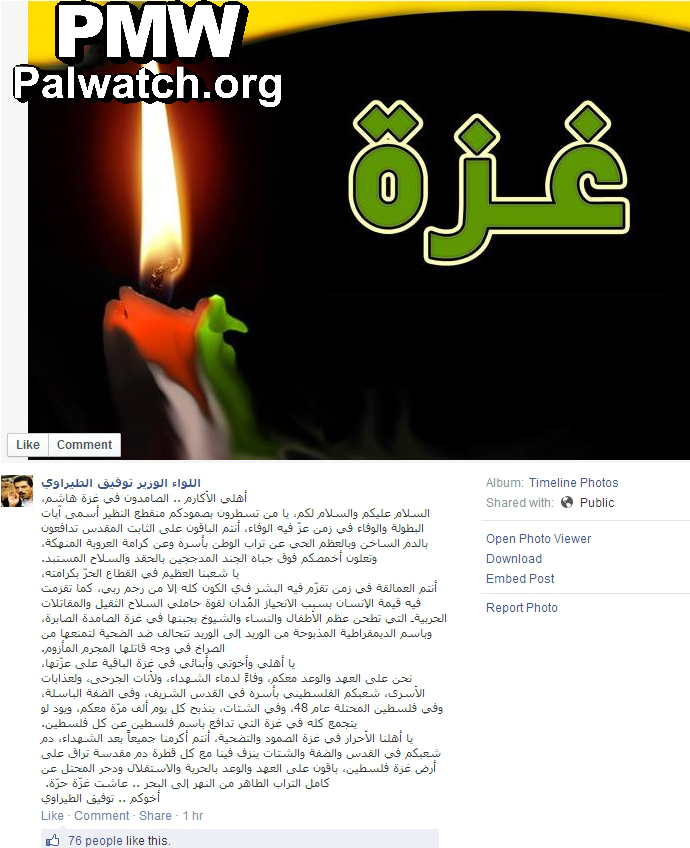
Fatah, the political party created by terrorist Yasser Arafat and now run by “moderate” Palestinian authority President Mahmoud Abbas, talks peace in English but war in Arabic. On Tuesday, Fatah Central Committee member Tawfiq Tirawi posted on his Facebook page his party’s desire to drive “out the occupier from the entire pure land, from the [Jordan] River to the [Mediterranean] Sea.

As reported by Palestinian Media Watch, the Tawfiq Tirawi Facebook post says, in part:

O our free people of resolve and sacrifice in Gaza, you are more honored than us all… We remain committed to the promise: freedom, independence, and driving out the occupier from the entire pure land, from the [Jordan] River to the [Mediterranean] Sea.

Long live free Gaza!

Your brother, Tawfiq Tirawi.

tirawwi

This isn’t the first time this leader of Fatah has openly rejected coexistence with Israel and called for “one Palestine from the river to the sea.” The video embedded above is from an interview Tirawi gave on Hezbollah’s Al-Manar TV in April 2014.

I repeat my humble opinion once again: I’m telling you that the two-state solution does not exist. The two-state solution does not exist. The two-state solution is over. We must return to the option of one Palestine from the [Jordan] River to the [Mediterranean] Sea. Palestinians, Palestinian leadership, listen to me: The only solution before us is the historic solution presented by Fatah in 1968.

Iraq’s largest Christian town falls to Islamic State

August 7, 2014

Iraq’s largest Christian town falls to Islamic State, Long War Journal, Bill Roggio & Oren Adaki, August 7, 2014

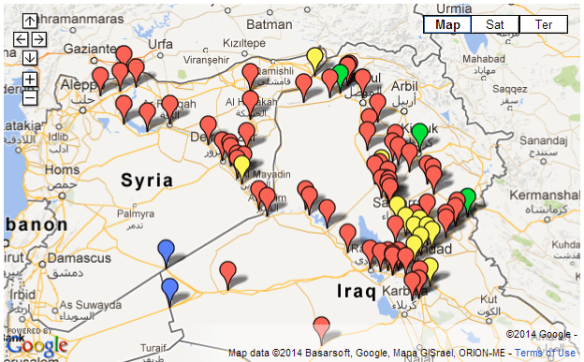
map-of-is-gainsIraqi and Syrian towns and cities seized by the Islamic State and its allies. Map created by The Long War Journal. Click to view larger map.
 

The Islamic State has taken control of Qaraqosh, Iraq’s largest Christian town, and other surrounding towns in an advance eastward into an area formerly held by the Peshmerga, the military force of the Kurdish Regional Government.

“Qaraqosh, Tal Kayf, Bartella and Karamlesh have been emptied of their original population and are now under the control of the militants,” Joseph Thomas, the archbishop of the Iraqi cities of Kirkuk and Sulaimaniyah, told AFP. Qaraqosh (or Bakhdida on the map) has a Chaldean Christian population estimated at 50,000.

The Islamic State advanced into the towns unopposed, according to reports. The Peshmerga, which is considered to be a well-organized and hardened force, withdrew from the towns rather than fighting the Islamic State. The Peshmerga have controlled towns and villages east of Mosul since the US invasion of Iraq in 2003. The Islamic State’s eastward advance puts the terror group about 20 miles from Irbil, the capital of the Kurdistan Regional Government.

Chaldean Patriarch Louis Sako told AFP that the Islamic State’s advance has created a “a humanitarian disaster” and that more than 100,000 Christians have been forced to leave their homes. “The churches are occupied, their crosses were taken down,” and more than 1,500 documents have been destroyed, he said.

The Islamic State previously issued an ultimatum to Christians in Mosul that they convert to Islam, pay a tax, or be killed. Thousands of Christian families fled Iraq’s second largest city after the Islamic State issued their directive. The Islamic State has also been destroying Christian, Jewish, and Muslim shrines, churches, and mosques in Mosul. Among the religious sites destroyed by the jihadist group are the tomb of Jonah and an accompanying mosque, and the tomb of George.

The Islamic State’s Ninewa Division released a statement on Twitter, claiming it had taken control of 17 towns, villages, and military bases in Ninewa [the list, translated by The Long War Journal, is below]. The Islamic State said it is in full control of the Mosul Dam.

The jihadist group also released a statement on its Twitter account noting that it “launched a ‘big invasion’ yesterday, Aug. 6, on locations of the ‘apostate Kurds and those loyal to them.'” The group said that a German suicide bomber known as Abu Osama al Almani launched a “truck bomb filled with 5 tons of explosive material on a Peshmerga brigade in the Ali Rash/al-Hamdaniya district: 20 people were killed and many were injured.” Another Libyan known as Mu’awiya Al-Libi killed “tens” of Peshmerga fighters in an attack on another Peshmerga unit in the same area. The jihadist group listed other attacks in Ninewa, and claimed to have captured “four Peshmerga soldiers, including a deputy officer.” The Islamic State’s claims could not be verified.

The Islamic State’s gains east of Mosul are part of a larger push by the group to consolidate its control over Ninewa province. Last weekend, the Islamic State took control of Sinjar, a town with a large Yazidi minority; Zumar; and two oil fields. The jihadist group also was reported to have seized control of the Mosul Dam, which generates power and controls floodwaters on the Tigris River. Kurdish officials denied that the Islamic State took the Mosul Dam, but today, reports have emerged that the dam is now under the jihadist group’s control.

The Islamic State’s advances in the north over the past week constitute the group’s first major gains after a blitzkrieg offensive launched on June 10 in conjunction with allied groups that put it in control of Mosul, Tikrit, and a number of cities and towns in Salahaddin, Ninewa, and Diyala provinces. That offensive stalled on the outskirts of Samarra, just north of Baghdad. Meanwhile, the Islamic State controls most of Anbar province and much of northern Babil province. The fighting has largely stalemated as Iraqi forces backed by Shia militias, including many supported by Iran, have failed to regain lost ground but have held most areas under their control.

Across the border in Syria, the Islamic State has taken control of most of Deir al Zour province and has made gains in Homs province as well. Large areas of Raqqah, Hasakah, and Aleppo provinces are also under Islamic State control. Two weeks ago, the Islamic State overran a Syrian army artillery base in Hasakah and seized a large quantity of heavy weapons, including artillery pieces, a tank, and Grad rocket launchers, as well as stockpiles of RPGs, AK-47s, anti-tank rockets, and ammunition.

The Islamic State, which was previously known as the Islamic State of Iraq and the Sham, declared the establishment of its caliphate on June 29, and appointed Abu Bakr al Baghdadi as Caliph Ibrahim. Baghdadi appeared for the first time in public at a mosque in Mosul on July 4.

The declaration of the caliphate is controversial in jihadist circles and among Islamic State allies such as the Baathists and other insurgent groups in Iraq. Several al Qaeda affiliates as well as well-respected jihadist ideologues have denounced the Islamic State’s announcement as premature and said the group did not properly consult leading clerics and jihadist groups. Al Qaeda disowned the Islamic State in February after the group refused to follow Ayman al Zawahiri’s orders to reconcile with the Al Nusrah Front, al Qaeda’s affiliate in Syria.

List of areas the Islamic State claims it controls after this week’s offensive in Ninewa, from its Aug. 7 statement on Twitter:

1. All of Sinjar municipality and the areas belonging to it.2. All of Talkif municipality and the areas belonging to it.

3. All of al-Hamdaniya municipality and the areas belonging to it.

4. All of Makhmour municipality and the areas belonging to it.

5. Zammar township and all the villages belonging to it.

6. Rabee’ah township and all the villages belonging to it.

7. Bartala township and all the villages belonging to it.

8. Karam Lays township and all the villages belonging to it.

9. Al-Kweir township and all the villages belonging to it.

10. Wana township and all the villages belonging to it.

11. Large areas in Filfeel township.

12. Large areas of Ba’ashiqa township.

13. Some of the al-Shalalat areas in Mosul.

14. The Sada and Ba’wiza area of Mosul.

15. The oil-rich ‘Ayn Zalah area.

16. The strategic Mosul dam.

17. The large Tumarat base.


Hamas fired rockets from my church !!!

August 7, 2014

World encourages Hamas

August 7, 2014

World encourages Hamas, Israel Hayom, Boaz Bismuth, August 7, 2014

Israel, as expected, is taking much criticism, while Hamas, a terrorist group, is getting the benefit of the doubt from the world. By doing this, the world is encouraging Hamas to use Palestinian civilians as human shields again during the next war.

***********

The military campaign in the Gaza Strip has not yet officially ended, but for U.N. Secretary-General Ban Ki-moon, things are clear: Israel violated international law, and those responsible for the shelling of U.N. facilities in Gaza must be prosecuted.

There is no rest for Israel. After four weeks of Hamas rocket fire, Israel is now facing diplomatic artillery fire from the U.N., which is testing Israel’s legal Iron Dome.

The world is hypocritical, as we’ve already said many times. On Wednesday, at the pro-Palestinian U.N. General Assembly, which held a special meeting to discuss the situation in Gaza (not Iraq, Pakistan, Nigeria or Libya), Ban said there was one guilty party — Israel. No, not the terrorist group that fires rockets and mortars at a sovereign nation. And not the terrorist group that uses civilians as human shields. At the U.N., Israel has no competition for the role of guilty party.

Before a commission of inquiry has even made any findings, United Nations High Commissioner for Human Rights Navi Pillay is already talking about Israeli “war crimes.”

The international media provided unbalanced coverage of the war in Gaza, but at least three respectable journalists from different countries (France, India and Finland) revealed in their reports that Hamas fired rockets at Israel from launchers positioned next to civilian areas and U.N. facilities.

But for Ban, this “does not justify jeopardizing the lives and safety of many thousands of innocent civilians. Our U.N. flag must be respected and assure protection to those in need.” Interpretation: If you’re an IDF soldier and someone near a UNRWA school tries to kill you, you should hide, escape or ignore it.

Let us recall that NATO, with U.N. backing, bombed Serbia for more than 70 straight days during the Kosovo War in 1999. Many sites in Belgrade were struck, including the Chinese embassy.

But the world decides which attacks are justified. If, for example, you were an American soldier who shot at Iraqi civilians during the tough battle for the city of Fallujah (remember this?), you made an fair mistake. But if you are Israeli, you are a war criminal.

Israel, as expected, is taking much criticism, while Hamas, a terrorist group, is getting the benefit of the doubt from the world. By doing this, the world is encouraging Hamas to use Palestinian civilians as human shields again during the next war.