Archive for August 5, 2014

What should Israel do? What would the United States do?

August 5, 2014

What should Israel do? What would the United States do? | JPost | Israel News.

By ALAN DERSHOWITZ

08/05/2014 13:20

Israel is doing precisely what every other western democracy would do if confronted with the situation Israel now faces.

gaza

Smoke rises following what witnesses said was an IAF air strike in the east of Gaza City. Photo: REUTERS

Imagine you are the Prime Minister of Israel or the President of the United States, or the Chief-of-Staff of either Army.  Your soldiers are fighting a just war to try to prevent rockets from hitting your civilians or tunnels from being used to murder and kidnap your people.  Your enemy, knowing that you wish to prevent casualties among their civilians, purposely shoots at your soldiers from civilian areas.  Your soldiers, caught in the midst of an ongoing fire fight, basically have two choices:  one, fire back and try to stop the enemy from killing you, while trying to avoid or minimize civilian casualties; or two, lay down your arms, because you don’t want to endanger civilians, and accept the risk that your soldiers may be killed.

The United Nations, and much of the rest of the world—sitting in the safety of peaceful areas—have condemned Israel for allowing its soldiers to try to stop the attacks on them while also trying to minimize civilian casualties.  “You can do more,” the White House has insisted.

But what more could Israel do, that would not endanger its own civilians and soldiers?  Would President Obama like to be the one who has to call the parents of an American soldier and explain to them that their son was killed because he, the Commander in Chief, had ordered the soldier not to fire back at enemy mortars that were being fired at him from behind human shields?

Israel is doing precisely what every other western democracy would do if confronted with the situation Israel now faces.  Colonel Richard Kemp—a British expert on this kind of warfare—has said:  that Israel it is doing it more carefully and with more concern for civilian life that any other country.  The Israeli military devotes considerable resources to trying to minimize Palestinian civilian casualties, while Hamas devotes its resources to trying to maximize both Israeli and Palestinian civilians.

It is worth remembering what the United States and Great Britain did during the Second World War.  After German rockets were fired at London, Winston Churchill ordered the carpet bombing of Dresden, deliberately intending to kill as many civilians—men, women and children—as possible in order to weaken the morale of his enemy.  The United States firebombed Tokyo killing 100,000 people and then dropped two nuclear bombs killing many more.  The United States has also killed many civilians in Afghanistan, Iraq and Kosovo, as has Great Britain and other members of NATO.  In none of these wars did western armies take the precautions and give the warnings that Israel has undertaken.

It is unseemly and hypocritical for the western world to castigate Israel for doing exactly what it would do and has done when faced with comparable or even less serious threats.

In Israel, these moral issues are debated endlessly, among philosophers, in the media, within the military, by politicians and by the general public.  There are no easy answers, except to those sitting the safety of Washington DC, Turtle Bay, London and Paris.  For Israelis, the questions are real, involving life and death decisions.  How should the democratic nation balance the lives of its own civilians and soldiers against risks to the lives of enemy civilians?  Those who condemn Israel in simplistic terms should try to address some of these more nuanced questions.  A reasonable moralist might answer these questions differently than Israel and other democracies have, but Israel’s answers are well within the rules of engagement employed by the United States, NATO and even the United Nations.

President Obama has recognized the difficulties faced by Israel in protecting its citizens from rockets and terror tunnels that are deliberately placed in hospitals, United Nations facilities, mosques and civilian homes.  There is a considerable amount of open spaces in the Gaza Strip.  Just look at population density maps rather than listening to the misstatement repeatedly parroted by the media:  namely that the Gaza Strip is the most densely populated area on earth.  It’s not even close.  There are cities within the Strip that are densely populated, but there are other areas—some of them quite large—in the Gaza Strip that are relatively sparsely populated.  If Hamas were to fire its rockets from, and placed their terror tunnels in these open areas, there would be few civilian casualties.  But it is part of Hamas’ strategy to place these lethal weapons in densely populated areas, precisely in order to maximize Palestinian civilian casualties.

Israeli soldiers and civilians should not have to pay the price for this cruel, unlawful and barbaric tactic.

Off topic: U.S. General Is Reportedly Killed by an Afghan Soldier

August 5, 2014

U.S. General Is Reportedly Killed by an Afghan Soldier
By MATTHEW ROSENBERG and HARIS KAKAR August 5, 2014


Though I’d mention it since everyone seems to be in a trusting mood. – LS

KABUL, Afghanistan — A United States Army major general was killed on Tuesday by an Afghan soldier, shot at close range at a military training academy on the outskirts of Kabul, officials of the American-led coalition said Tuesday. The officer was the highest-ranking member of the American military to die in hostilities in the Afghanistan war.

The coalition officials, who spoke on condition of anonymity and would not release the name of the major general, said an unspecified number of other service members of the American-led coalition and Afghan soldiers, including a senior Afghan commander, also were shot. Their conditions were not immediately known.

Other details of the shooting were sketchy, and the coalition, in an official statement, would only confirm that one of its service members had been killed in what it described as “an incident” at the Marshall Fahim National Defense University in Kabul. The coalition declined to specify any further details, saying it was still working to notify the family of the deceased.

An Afghanistan National Army soldier at a gate of Camp Qargha after the shooting on Tuesday. Credit Massoud Hossaini/Associated Press

Tensions at the military academy ran high in the immediate aftermath of the shooting, which took place around noon, and foreign troops appeared to be on edge, fearful of another attack.

Massoud Hossaini, a photographer for The Associated Press, said that he arrived at the camp’s gate ahead of other journalists, and just as coalition armored vehicles were pulling out of the compound. A coalition soldier manning the roof-mounted gun on one of the vehicles shouted for Mr. Hossaini to “get away,” and then fired an apparent warning shot.

“I don’t know what he fired. It was fired near our car,” he said, adding that he left the scene straight away.

The Afghan Defense Ministry said in a statement that a “few people were wounded” in the shooting, and that they had been immediately evacuated to a hospital. It described the attacker as “wearing Afghan National Army uniform,” which has long been a standard description offered after Afghan troops attack their foreign counterparts.

Other Afghan and coalition officials said they believed the shooter was an Afghan soldier. The coalition, in its brief statement, said the incident had involved “local Afghan and ISAF troops,” using the initials for the International Security Assistance Force, the formal name of the NATO-led coalition.

Sher Alam, an Afghan soldier guarding the entrance to the academy, located at Camp Qargha, said that senior Afghan and coalition officers had been meeting there on Tuesday, and that reports from inside the camp indicated that a number of the foreign officers were shot in the attack. He said that soon after the shooting, coalition helicopters landed inside the academy to evacuate the victims.

Tuesday’s shooting was the first so-called insider attack in Afghanistan in months. Such attacks, in which Afghan troops open fire on unsuspecting coalition forces, at one point posed a serious challenge to the war effort, sowing distrust and threatening to upend the American-led training mission that is vital to the long-term strategy for keeping the Taliban at bay.

Though the number of attacks has dropped sharply since 2012, when dozens occurred, they remain a persistent threat for coalition troops serving alongside Afghan forces.

Afghan and American commanders have said that they believe most of the insider attacks that have taken place were the work of ordinary soldiers who had grown alienated and angry over the continued presence of foreign troops here, and not carried out by Taliban fighters planted in Afghan units.

The Taliban, which often takes credit for insider attacks, had no immediate comment on Tuesday. Zabiullah Mujahid, a spokesman for the insurgents, said he was still trying to collect information about the incident.

But, he added, the Taliban had many people inside the camp, and that one of their loyalists could have been responsible for the attack.

Ahmad Shakib and Jawad Sukhanyar in Kabul contributed reporting.

Sweet while it lasted

August 5, 2014

Sweet while it lasted, Israel Hayom, Ruthie Blum, August 5, 2014

(Is it conceivable that Israel and Egypt will grant the demands of Hamas, et al? I don’t think so and it seems highly unlikely that PM Netanyahu does. If their demands are not met, the war is likely to resume and Israel is likely to deal with them as she should. 

Perhaps Israel’s participation in the talks in Egypt is little more than necessary political theater, intended to minimize the damage done by grossly distorted media reports, most recently on Israel’s “appalling,”  “horrific” and “indefensible” “attack on” a UN shelter for Gazans, accepted by the UN and Obama administration as true. Initial reports are often misleading, whether they be of military action or political strategy.– DM)

A funny thing happened on the way to the demolition of 32 terror tunnels in Hamastan: ‎Israeli society experienced nearly a solid month of internal unity. This would not be worth ‎mentioning if it weren’t so extraordinary. Indeed, in the 37 years that I have lived in the ‎Jewish state, I have never witnessed anything like it, even during wartime.‎

One could argue that the reason public support for Operation Protective Edge reached a ‎whopping 95 percent was the utter justice of its cause; that the incessant rocket-‎fire from Gaza, now hitting the center of country, was too much even for the peace ‎utopians to bear. ‎

One could assume that no matter what an Israeli’s personal political leanings, he would ‎see the virtue in defeating an enemy that glorifies death; uses children as canon fodder; ‎abuses women; tortures homosexuals and the disabled; and vows to annihilate the world’s ‎Jews while converting or slaughtering its Christians. ‎

Nevertheless, it is usually impossible to get even those Israelis with similar outlooks to ‎agree on anything, including where to hang a communal clothesline, for more than five ‎minutes. Hence the quip, “Two Jews, three opinions.”‎

As a result, when almost everyone across the ideological spectrum began to defend the ‎government, it felt as though we were witnessing a miracle. ‎

True, the far Left held demonstrations in which they waved placards calling Israeli Air ‎Force pilots murderers, while the riffraff Right got violent and screamed for “death to ‎the Arabs.” But neither of these expressions of extremism was representative of the ‎general population. On the contrary, the overall sanity, rhetorical restraint and accord of ‎the populace were as palpable as the international community’s condemnations of Israel ‎were predictable.‎

To add wonderment to the mix, Egypt, Jordan and Saudi Arabia were practically begging ‎Israel to finish off Hamas. And since none of those regimes would give a hoot about ‎civilian casualties in Gaza, it’s too bad they didn’t do the job themselves. In such an ‎event, as is apparent from every conflict in the Middle East that involves Arabs killing ‎Arabs, the United States, Europe and the United Nations would have looked the other ‎way, at best, and assisted the wrong side at worst.‎

Still, the acknowledgement on the part of some of Israel’s neighbors that Hamas is an evil ‎regional threat with backing from Iran was not only ironic; it was also comforting.‎

In short, though Israelis have been spending time in bomb shelters, burying dead soldiers ‎and worrying about what appears to be a brewing intifada in Judea and Samaria (aka ‎the West Bank), we have felt like a family. We have had a sense of being in this together.‎

Though such solidarity has characterized the very beginning of previous battles, it never ‎lasted more than a few days. This is because the local media — always quick to focus on ‎Israel’s flaws — harbor and promote the notion that none of Israel’s defensive wars would ‎be necessary if Israel would only make peace with the Palestinians. When presented with ‎the inconvenient fact that Israel has done little else since its inception than attempt to do ‎live in peace alongside its neighbors, and has a proven record of withdrawing from ‎territory to achieve this, the pundits claim that Israel hasn’t done enough. (You know, like ‎the Obama administration chiding Israel for not doing enough to prevent civilian deaths ‎in Gaza; making any greater effort in either endeavor would have entailed holding up a ‎white flag before drowning ourselves in the Mediterranean.)‎

But during the current war, even the mainstream media have been keeping their knees ‎from jerking too far in their usual direction. ‎

Most astonishing of all is that this sweeping unity has occurred under the stewardship of ‎Prime Minister Benjamin Netanyahu. Normally disdained by the Right as a weak leader ‎who betrayed his Likud party’s platform by favoring a two-state solution, and reviled by ‎the Left as an intransigent obstacle to peace and international acceptance, Netanyahu has ‎managed to steer the ship with almost no serious opposition at home.‎

At 8 a.m. on Tuesday morning, a 72-hour cease-fire went into effect, just as the Israel Defense Forces ‎announced it had completed the political echelon’s mission of eliminating those tunnels ‎leading from Gaza into Israel. Prior to agreeing to this particular halt in fighting — after ‎Hamas violated each previous one — Netanyahu assured the Israeli public that troops were ‎on the border, ready to go back in if it were to become necessary.‎

And thus ended the honeymoon.‎

The dysfunctional family that constitutes Israeli society has resumed its bickering and ‎dissatisfaction. From those enraged that Netanyahu pulled out of Gaza too soon, to those ‎already picking at the carcass of his coalition — gleefully praying for it to be toppled ‎before the next election — the vultures didn’t miss a beat. ‎

It is too early to assume that the war is finally over, with a questionable victory for Israel. ‎Nor can one judge whether Netanyahu has been doing a dance of accepting cease-fires ‎and then gaining the moral backing of the public that he needs to proceed in order to ‎continue pummeling the terrorists and their infrastructure. ‎

This is a marathon, not a sprint. And Hamas is a tiny piece of a much larger puzzle with ‎which Israel, as a part of the West, has to contend.‎

This is why I am urging my fellow Israelis to pause before coming to literal and figurative ‎blows. It won’t do any good, of course. The morning-after pill has been swallowed, and it ‎is impossible to reverse its course.‎

But the glimpse of consensus was truly sweet while it lasted.‎

Palestinians: United Against Israel

August 5, 2014

Palestinians: United Against Israel, Gatestone InstituteKhaled Abu Toameh, August 5, 2014

By strengthening his ties with Hamas, Abbas is burying any chance of a peaceful solution with Israel.

Despite predictions to the contrary, the unity agreement between Fatah and Hamas seems not only alive and well, but stronger than ever.

Over the past month, the two parties have been waging separate wars against Israel – one (Hamas) on the battlefield and the second (Fatah) in the international arena.

At the beginning of the war in the Gaza Strip, political analysts predicted that the unity agreement that was signed between Hamas and Fatah last April would be one of the war’s first victims.

During the war, however, Fatah and Hamas refrained from criticizing each other, as they have been doing ever since they signed the unity agreement.

Palestinian Authority [PA] President Mahmoud Abbas, who is also head of Fatah, took advantage of the war to launch scathing attacks on Israel, accusing it of perpetrating war crimes and genocide.

Nonetheless, Abbas did not criticize Hamas or other Palestinian terror groups for firing rockets and mortars at Israel. Nor did he ever denounce Hamas for breaking several cease-fires with Israel.

Similarly, Hamas’s top political leaders have largely refrained from criticizing Abbas or Fatah throughout the war.

True, at the beginning of the war some Hamas officials expressed discontent over the way Abbas was handling the conflict, especially regarding to his failure quickly to rally the Arab world in solidarity with the Palestinians.

On July 12, Hamas spokesman Fawzi Barhoum criticized Abbas for requesting a postponement of an Arab League meeting to discuss the war.

But Hamas has since changed its position, particularly in light of Abbas’s decision to endorse the Islamist movement’s conditions for a cease-fire.

Abbas and his Fatah officials have even chosen to act as unofficial spokesmen for Hamas and Islamic Jihad, often endorsing their statements and positions.

Most of the Hamas political leaders in the Gaza Strip were unable to appear on foreign TV networks out of concern for their safety. Instead, they were replaced with senior Fatah and PLO officials who did their utmost todefend Hamas and hold Israel alone responsible for the war.

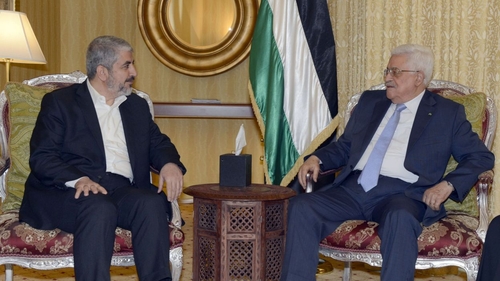
The war has also seen Abbas and Hamas work together to coordinate their moves. Last month, Abbas met in Qatar with Hamas leader Khaled Mashaal to discuss a joint strategy toward the war.

593 (1)Mahmoud Abbas (r) meets with the Hamas political bureau chief Khaled Mashaal in Qatar, July 20, 2014. (Image source: Handout from the Palestinian Authority President’s Office/ Thaer Ghanem)

After the meeting, the two issued a joint statement calling for an end to Israeli “aggression” and lifting the blockade on the Gaza Strip.

Prior to the meeting, some Palestinian political analysts had predicted that the encounter between the two men would be tense and difficult.

Instead, the meeting between Abbas and Mashaal turned out to be friendly, with the Hamas leader praising the PA president for his anti-Israel campaign in the international arena.

Later, Arab media outlets quoted Mashaal as saying that Abbas’s endorsement of Hamas’s demands for a cease-fire and his moves in the international arena, including calls for emergency meetings of the UN Security Council, would serve to solidify “national unity” between Hamas and Fatah.

As part of continued coordination between Hamas and Fatah, Abbas last week dispatched PLO negotiator Saeb Erekat to Doha for another meeting with Mashaal.

Although the declared goal of the meeting was to discuss the prospects of a cease-fire with Israel, Erekatrevealed that the discussion also focused on Palestinian efforts to join the International Criminal Court in order to file “war crimes” charges against Israel.

Another sign of the coordination between Hamas and Fatah was provided earlier this week when Abbas announced the formation of a Palestinian delegation to the cease-fire talks in Cairo. For the first time, Hamas agreed to include its representatives in a delegation formed by Abbas and headed by top Fatah official, Azzam al-Ahmed.

Hamas and Fatah not only agreed on the formation of a joint delegation, they also reached agreement on a document detailing Palestinian demands for a cease-fire. If anything, the document, which was presented to the Egyptians on August 3, confirms that Abbas and Fatah have fully endorsed Hamas’s conditions for a cease-fire.

The document calls for, among other things, lifting the blockade and opening all border crossings in the Gaza Strip, including the airport and seaport. It also calls for the reconstruction of the Gaza Strip in cooperation between the Hamas-Fatah government and the UN.

The document does not mention the disarming of Hamas and other Palestinian groups in the Gaza Strip – a demand that appears to be backed by the US, EU, UN and some Arab countries such as Egypt, Saudi Arabia and Jordan.

Over the past few weeks, Abbas has done almost everything he could to demonstrate his keenness on maintaining the unity agreement with Hamas. In his public statements, Abbas repeatedly claimed that the Israeli military offensive in the Gaza Strip was primarily aimed at “destroying” the unity between Hamas and Fatah.

This week, Abbas took another step toward consolidating the unity agreement by agreeing to pay salaries to tens of thousands of Hamas civil servants in the Gaza Strip. Abbas had refused to pay the salaries to the Hamas civil servants, even after the signing of the unity deal and the formation of the Palestinian “national consensus” government.

The previous wars between Israel and Hamas had resulted in a deterioration in relations between Hamas and Fatah. During the past two wars, Hamas did not hesitate to accuse Abbas and Fatah of “collusion” with the “Zionist enemy.”

But the current war has thus far has brought the two sides closer to one another. Abbas even instructed his security forces in the West Bank to suspend their crackdown on Hamas supporters, a senior Palestinian official in Ramallah disclosed.

Abbas is expected to continue his efforts to enhance his partnership with Hamas even after a cease-fire is reached in the Gaza Strip. This may be good for Palestinian “national unity” and Hamas, but it also means that the prospects for peace with Israel on the basis of a two-state solution – an idea vehemently opposed by Hamas – will be as remote as ever. By strengthening his ties with Hamas, Abbas is burying any chance of a peaceful solution with Israel.

Think it will last? Vote and See How Others Feel

August 5, 2014

Take the Survey by Clicking Here
By Louisiana Steve Date 8-5-2014


Let us know what you think. How they arranged this cease fire is beyond me. Must have been a lot of ‘arm twisting’. – LS

Please click on the above link. Vote and see the results.

Israel-Hamas talks to open in Cairo after 72-hour ceasefire. Netanyahu faces credibility gap at home

August 5, 2014

Israel-Hamas talks to open in Cairo after 72-hour ceasefire. Netanyahu faces credibility gap at home.

DEBKAfile Exclusive Analysis August 5, 2014, 8:33 AM (IDT)

Where does the Gaza operation go now?

Where does the Gaza operation go now?

Israel and a Palestinian delegation to talks in Cairo, including Hamas, were due to start observing a 72-hour ceasefire in the Gaza Strip starting Tuesday, Aug. 5, at 8 a.m., to be followed by negotiations under Egyptian aegis for a long-term cessation of hostilities.

This decision flies in the face of Prime Minister Binyamin Netanyahu’s solemn pledge 48 hours earlier to continue Operation Defensive Edge until Hamas and its terrorist allies stopped firing rockets (a massive barrage was fired up to five minutes to eight).
He stated that Israel was turning away from ceasefire accords, which Hamas had violated six times causing IDF fatalities, and reserving its military and diplomatic freedom of action to act solely in its own security interests. “No accommodation, only deterrence” was the motto of the moment Saturday night, Aug. 2.

Even as he spoke, the bulk of Israel’s ground troops were on their way out of the Gaza Strip. But he assured the public that they were regrouping and refreshing ranks for a new, offensive formation that would stand ready to cross back in a trice if necessary.

But already then, the prime minister had quietly conceded to the demands of Egyptian President Abdel-Fattah El-Sisi and US Foreign Secretary John Kerry to withdraw IDF contingents from the Gaza Strip. This was in obedience to Hamas’ precondition for talks, following which Israeli envoys would present themselves in Cairo for indirect negotiations on a long-term accommodation with Hamas through Egyptian intermediaries.

The slogan designed for the goal of these talks was now: “Rehabilitation in exchange for demilitarization.”

By Monday, when the ceasefire deal was already in the bag, the prime minister, defense minister Moshe Ya’alon and a group of senior officers led by Chief of Staff Lt. Gen. Benny Gantz, met the community leaders of the 250,000 Israelis whose homes and lands abut the Gaza Strip. They promised the communities that, for the first time in 13 years, they would be safe from Palestinian rocket fire.

The IDF would build a new security fence enclosing Gaza like the barrier along the Egyptian border and instal a home guard system backed by electronic sensors and other gadgets in all their communities.

Doubters, who wondered how a fence would stop rockets and the underground terror tunnels burrowed surreptitiously under their homes, were not heeded. By then, tens of thousands of reservists called up for the Gaza war were being released and columns of tanks and heavy equipment were heading north.
The military traffic rolling away from the Gaza Strip was so heavy Monday night that the police issued a notice to civilian drivers using those roads.
When the 72-hour ceasefire was announced after midnight Monday, a “high-ranking Israel official” noted that if the ceasefire holds, an Israeli military presence in Gaza will not be necessary. He said Israel had upheld its commitment not to accept ceasefire deal with Hamas, so long as it was accompanied by preconditions and until the terror tunnels were dismantled. The 32nd tunnel was destroyed Monday night, he announced, and the work would continue henceforth on the Israeli side of the border.

A former National Security Adviser Gen (res) Giora Eiland, summed up the month-long Israeli military offensive against Hamas in the Gaza Strip as a draw between the two adversaries, with neither side the winner. This judgment, shared by many military experts contradicted the way the operation’s outcome is presented by the prime minister and defense minister who directed it. They describe Hamas as reeling from the heavy damage the IDF wrought to its military machine and weakened enough to be finished off at the negotiating table in Cairo.

Israel reckons that around 50 percent of the 1,867 Gazans estimated killed and 9,500 injured in the operation were Hamas or Islamic Jihad fighters.
The damage was undoubtedly heavy, but still Hamas has come out of the Israeli offensive standing on its feet, an outcome that will have profound political and security ramifications upon and beyond the forthcoming Cairo negotiations.

The reality facing Israel’s war planners at home is also grim: For the first time, the country comes out of a major conflict with a domestic refugee problem.  Longtime inhabitants of the region around the Gazan border who have lost homes, property or livelihood have nothing to return to after the ceasefire.

There are no official figures for Israel’s internal refugee problem, but it is believed that up to half of the quarter of a million people inhabiting 57 communities, many of them kibbutzim and private farms, who fled during the hostilities, may refuse to return.

While many endured 13 years of on-and-off rocket fire, they are consumed by the dread of Hamas terrorists jumping out of tunnels in their fields, classrooms or kitchens.
They point to negative side of the IDF official statement: “We have destroyed all the tunnels we know about” as being far from an ironclad guarantee to have obliterated that menace. And the rockets never let up for a single day in the month-long IDF operation – 3,300 in all.

Israel’s first ghost villages are clearly visible to the enemy and no doubt chalked up on the credit side of the Hamas war ledger.

Haim Yelin, head of the Eshkol District Council said Monday that 75 percent of the frontline population has moved north. He said he believes the assurances he received from Netanyahu and Ya’alon that the IDF has solved the tunnel threat and would provide the communities with protection against new tunnels. But he said, people are no longer willing to live under the threat of terrorist rocket fire, which they don’t believe has been finally curbed.

This credibility gap is part of the general unease over the outcome of this long-delayed counter-terror operation. It started out with 86 percent of the population canvassed holding high hopes of curing the festering terrorist woe emanting from the Gaza Strip. But now, Israel’s leaders, no less than Hamas, face a rehabilitation challenge – not just the reconstruction of damaged businesses, farms and buildings, but also of faith in government.


Israel, Hamas agree to 3-day truce to take effect Tuesday

August 5, 2014

Israel, Hamas agree to 3-day truce to take effect Tuesday, Jerusalem Post, Herb Keinon, Khaled Abu Tomeh, August 4, 2014

IDF ground forces to withdraw from Gaza before truce; UN Sec.-Gen. calls on both sides to respect terms of cease-fire, to begin negotiations for long-term solution.

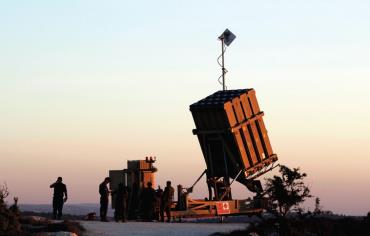
Iron Dome and soldiersSoldiers stand next to an Iron Dome battery. Photo: REUTERS

The officials said Israel was preparing for the possibility that Hamas would violate the cease-fire, as it has done in the past, and also cautioned the Israeli public to continue to be vigilant as Hamas could try to carry out a major attack for a final “victory picture” before the cease-fire goes into effect.

The officials said that if the cease-fire was honored there would be no reason for a continued IDF presence inside the Gaza Strip.


Israel accepted an Egyptian cease-fire proposal on Monday night that is to go into effect Tuesday at 8:00 a.m.

Senior diplomatic officials pointed out that from the early stages of the Gaza operation Israel had accepted the Egyptian proposal.

They stressed that the ceasefire was unconditional and pointed out that its acceptance came after Israel finished destroying the terror tunnels.

The officials said Israel was preparing for the possibility that Hamas would violate the cease-fire, as it has done in the past, and also cautioned the Israeli public to continue to be vigilant as Hamas could try to carry out a major attack for a final “victory picture” before the cease-fire goes into effect.

It was not immediately clear when an Israeli delegation would head to Cairo for indirect talks on a long-term agreement.

The officials said that if the cease-fire was honored there would be no reason for a continued IDF presence inside the Gaza Strip.

The members of the security cabinet were informed of the decision, but there was no reason for a vote.

Earlier on Monday, Azzam al-Ahmed, head of the Palestinian delegation to the Cairo discussions on a cease-fire formula, confirmed that a ceasefire would go into effect Tuesday morning. Al-Ahmed, a senior Fatah official, said the cease-fire would be for 72-hours, during which Israel and the Palestinian factions would hold indirect talks in Cairo about consolidating the truce.

Other Palestinian and Egyptian sources had claimed on Monday night that a cease-fire agreement would go into effect at 8 a.m. on Tuesday.

Ziad al-Nakhaleh, deputy head of Islamic Jihad and a member of the delegation, said in a TV interview that he expected a cease-fire agreement to be announced “in the coming hours.” He added that the Egyptians had demonstrated “great understanding” for the demands of the Palestinians regarding a cease-fire.

The Palestinian delegation presented their demands to the Egyptians late on Sunday. The demands called for an immediate cease-fire and a lifting of the siege on the Gaza Strip, in addition to the reopening of all border crossings. They also called for international assurances that Israel would refrain from launching military attacks, and for UN assistance in rebuilding the Gaza Strip.

The Palestinians also demanded an airport and seaport in addition to free passage between the Gaza Strip and the West Bank.

Israeli officials dismissed this list of demands in recent days as “completely unrealistic.”

Before the flurry of reports about a possible cease-fire, Prime Minister Binyamin Netanyahu said on Monday afternoon that the Gaza campaign was continuing and the only element coming to a conclusion right now was the actions against the tunnels.

“The campaign will end only when quiet and security for a prolonged period of time is restored to Israeli citizens,” Netanyahu said following security deliberations with Defense Minister Moshe Ya’alon and IDF Chief of Staff Lt.-Gen Benny Gantz at the headquarters of the IDF’s Southern Command in Beersheba.

Netanyahu, in his comments, made no mention of an imminent ceasefire.

A 72-hour cease-fire brokered last week by US Secretary of State John Kerry and UN Secretary-General Ban Ki-moon ended 90 minutes after it began, with the killing of three soldiers in Rafah.

With questions increasingly being raised in Israel as to the wisdom of redeploying IDF troops along the Gaza border as Hamas rocket fire on Israel continues, Netanyahu reiterated what he had said repeatedly over the past few weeks: that Israel was delivering a very hard blow to Hamas and the other terrorist organizations.

“We have no intention of harming Gaza civilians, and those harming them are for all intents and purposes Hamas, which also denies them access to humanitarian aid,” the prime minister said. “I think the international community needs to roundly condemn Hamas and demand, as we are, that the rehabilitation of Gaza will be linked to its demilitarization.”

Ya’alon, who also stressed that the campaign had not yet ended, said it had “set Hamas back five years.”

In light of Hamas’s violation of the 72-hour cease fire declared on Friday, Ya’alon said, “we are acting independently without [being involved] in any process. If someone in the final analysis wants to stop the fire, they should call us.”

Israel’s campaign would not end “until there will be a full cease-fire and an understanding that they don’t fire on us and don’t threaten us,” the defense minister added.

Intelligence Minister Yuval Steinitz said on Monday during a visit to Rafael Advanced Defense Systems’s Iron Dome development and manufacturing facility that “since Israel cannot agree to a long-term war of attrition, in the coming days we will need to decide – according to the developments on the ground – if we are headed to a cease-fire and an agreement or to new escalation of the campaign and a decision.”

Earlier in the day, Netanyahu visited wounded soldiers at Soroka University Medical Center in Beersheba.

“You are the finest of our sons,” he told some of the soldiers. “You are doing holy work in defending the citizens of Israel. The entire nation is behind you. I am proud of each one of you.”

In the halls of the hospital Netanyahu spoke, and at times exchanged hugs, with the families of the soldiers, as well as with the medical staff.

In a related development, diplomatic officials did not attach too much significance to a statement by French Foreign Minister Laurent Fabius on Monday calling on the world powers to impose a political solution to halt the conflict.

Relating to Sunday’s killing of 10 people at a UN school facility in Rafah and the ongoing rocket fire on Israel, Fabius said: “This is why we need a political solution, of which the components are known, and which I believe should be imposed by the international community, because the two parties – despite countless efforts – have unfortunately shown themselves incapable of completing talks.”

“Cease-fire, imposition of a twostate solution and security for Israel – there is no other way,” he added.

One diplomatic official in Jerusalem dismissed this as simply “posturing,” saying there was no “organized idea or plan” behind the words.

It shows a certain degree of frustration at the situation, but no more than that, the official said, adding that there was no move inside the EU at this time to try to impose a solution on the sides.

Another official said that Jerusalem had been “pleasantly” surprised by support from European leaders such as Germany’s Angela Merkel, Britain’s David Cameron and France’s François Hollande.

The problem in Europe, the official said, was not with the leaders but with the various publics, which were heavily influenced by the unending pictures of the carnage and destruction inside Gaza. That public opinion does trickle up and impact on the leaders, the official acknowledged.