Archive for August 3, 2014

Hamas TV: Muslim Mothers ‘Must Nurse Children on Hatred of the Sons of Zion’

August 3, 2014

Hamas TV: Muslim Mothers ‘Must Nurse Children on Hatred of the Sons of Zion,’ Front Page MagazineTrey Sanchez, August 3, 2014

“So that a new generation…will erase them from the face of the Earth.”

Al-Aqsa TV (Hamas) broadcast a speech Friday by leader of the Muslim Brotherhood in Kuwait, Tareq Al-Suwaidan, calling for all Muslim mothers to nurse hatred for Jews in their young children so that the next generation can finally wipe Israel from the Earth.

Adding that the blood of the dead in Gaza is “dear,” Al-Suwaidan proclaims that martyrdom is the apex of life and in fact, the desired outcome for Muslims — unlike Israelis who prefer life.

Al-Suwaidan’s diabolical message calls for the eradication of Jews, not just from the Middle East, but “from the face of the Earth.” Here is the transcript of the video:

Without a doubt, the blood being spilled [in Gaza] is dear. But the equation is, “Those killed from our side are in Paradise, and those killed from their side in Hell.” (Hadith)

We are not afraid of martyrdom. Not long ago, you cried out loud: “Death for Allah is our most exalted wish!” (Muslim Brotherhood slogan) You received the death you wanted. We have no problem with death. We are not like the children of Israel: ‘And you will surely find them the most greedy of people for life.’ (Quran) Whereas we yearn for death and martyrdom… Every mother – especially the mothers in Palestine, but every mother in the [Islamic] Nation, not just Palestine – must nurse her children on hatred of the sons of Zion. We hate them and they are our enemies. We will plant this in their [our children’s] souls, so that a new generation will grow among us, which will erase them from the face of the Earth.

According to Wikipedia, Al-Suwaidan is a millionaire who studied in the U.S., receiving a Bachelor’s of Science in petroleum and natural gas engineering from Penn State and a Masters of Science and a Doctor of Philosophy in petroleum engineering from the University of Tulsa. Forbes Arabia ranks Al-Suwaidan as second in annual net income among Islamic speakers.


H/T Palestinian Media Watch

US, UN condemn attack on UN Gaza school that killed 10

August 3, 2014

US, UN condemn attack on UN Gaza school that killed 10, Ynet News, August 3, 2014

(If the Obama Administration and the UN were as quick to learn the facts (assuming that they care about facts) as they are to condemn, their reputations would be better served. — DM)

IDF says it targeted 3 Islamic Jihad terrorists in vicinity of school, but that it did not initially appear like school had been hit.

The US and UN condemned an IAF strike that killed 10 people and wounded about 30 others on Sunday in a UN-run school in the southern Gaza Strip.

In the town of Rafah, where the military has been battling militants, a missile from an IAF aircraft struck the entrance to the school, where Palestinians who had fled their homes were sheltering, witnesses and medics said.

The IDF said it targeted three Islamic Jihad terrorists Thursday morning near the UNRWA school, but that it did not initially appear like the school had been hit. The army said it was still investigating the attack.

The United States criticized the “disgraceful shelling” and urged Israel to do more to prevent civilian casualties in its war against Hamas militants.

State Department spokeswoman Jen Psaki also called for an investigation into recent attacks on UN schools.

“The United States is appalled by today’s disgraceful shelling outside an UNRWA school in Rafah sheltering some 3,000 displaced persons, in which at least ten more Palestinian civilians were tragically killed,” Psaki said in a statement.

UN Secretary General Ban Ki-moon said that the attack constituted, “A moral outrage and a criminal act.” He added that those responsible must be held accountable.

Robert Serry, UN Middle East Special Coordinator, said the school had been sheltering 3,000 displaced persons and the strike caused multiple deaths and injuries.

“It is simply intolerable that another school has come under fire while designated to provide shelter for civilians fleeing the hostilities,” he said.

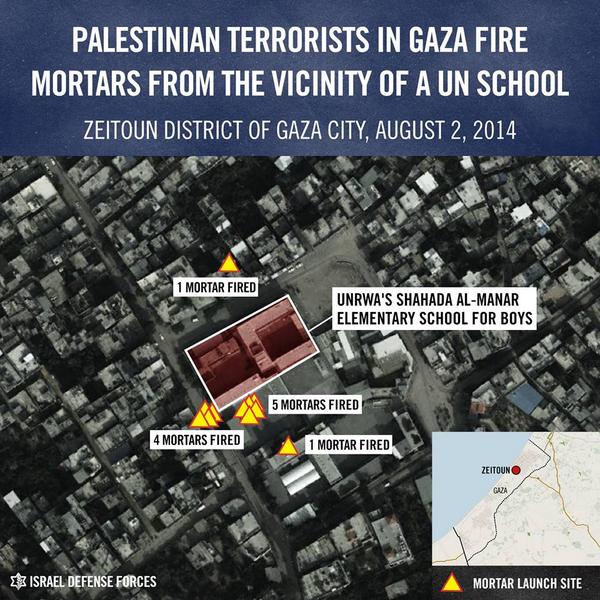
The IDF says Palestinian terrorists fire missiles at troops from the vicinity of UNRWA schools, prompting return fire. On Saturday, Palestinian militants fired 11 mortars from the vicinity of an UNRWA school in the Zeitoun district of Gaza City.

Terror attacks from schools

Last Wednesday, at least 15 Palestinians who sought refuge in a UN-run school in Jabalya refugee camp were killed during fighting, and the UN said Israeli artillery had apparently hit the building. The Israeli military said gunmen had fired mortar bombs from near the school and it shot back in response.


IDF Transfers Truckloads of Goods into Gaza

August 3, 2014

Dermer on Including Hamas in Govt: Is Solution for Iraq to Include ISIS in Govt?

August 3, 2014

Dermer on Including Hamas in Govt: Is Solution for Iraq to Include ISIS in Govt? You Tube, August 3, 2014


Palestinian factions unanimously agree on main points of cease-fire deal, says official

August 3, 2014

Palestinian factions unanimously agree on main points of cease-fire deal, says official, Jerusalem Post, By Reuters, Khaled Abu Toameh, August 3, 2014

(They neglected to include a demand that Israel commit ritual suicide as well. That must have been an oversight.– DM)

Israel refuses to send envoys to Cairo for indirect negotiations on truce in Gaza; Palestinian conditions said to include pullout of Israeli forces, ending blockade of Gaza, prisoners releases.

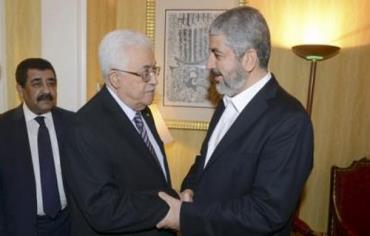
Abass and friendPalestinian President Mahmoud Abbas (L) shakes hands with Hamas chief Khaled Mashaal in Doha May 5, 2014. Photo: REUTERS

The representatives of various Palestinian factions in Cairo for talks have reportedly agreed on a number of main points for a cease-fire with Israel regarding the fighting in Gaza.

Qais Abu Laila, a senior leader from the Democratic Front for the Liberation of Palestine who was in Cairo, said the different Palestinian factions had agreed on a unified list of conditions.

“Cease-fire, the pullout of Israeli forces, ending the blockade, releasing the prisoners … and starting the reconstruction process,” he told Reuters by phone.

“There are details attached to each of these points and there will be a meeting soon with the Egyptian side to discuss the (Palestinian) paper,” he said.

A delegation from Palestinian groups, including militant organizations Hamas and Islamic Jihad, met in Cairo on Sunday for cease-fire talks to be conducted through Egyptian officials, Egyptian and Palestinian sources said.

American and Egyptian officials conducting the negotiations were apparently pressing Israel to take part in diplomatic talks to end hostilities in Gaza.

On Saturday, Israel said it would not send envoys as scheduled, accusing Palestinian Islamists of misleading international mediators.

The document detailing the Palestinian conditions, which was drafted by representatives of Fatah, Hamas, Islamic Jihad and other Palestinian groups, called, among other things, for a cease-fire in return for an immediate Israeli pullout from the Gaza Strip, Palestinian sources said.

The document calls for an end to Israeli “incursions, invasions, assassinations, house shelling and flights over the Gaza Strip,” the sources told the Palestinian news agency Safa.

Palestinian demands include lifting the siege, reopening the border crossings, and allowing construction material into the Gaza Strip.

The Palestinians are also demanding free passage between the West Bank and Gaza Strip, freedom of fishing within 12 miles of the coast, reopening the Palestinian airport in the southern Gaza Strip, construction of a seaport and cancellation of buffer zones along the border with Israel.

The document calls for cancelling all measures taken by Israel following the abduction and killing of three Israeli youths in the West Bank in June, including the release of all former prisoners who were rounded up by the IDF since then.

The Palestinians are demanding that the Palestinian “national consensus” government, which was formed following the reconciliation agreement between Fatah and Hamas last April, embark on the reconstruction of the Gaza Strip in cooperation with the United Nations. The document also calls for donor countries to hold an international conference to discuss providing financial aid for rebuilding the Gaza Strip.

The Palestinian delegation, which is headed by Fatah leader Azzam al-Ahmed, arrived in Cairo on Saturday night. On Sunday, Hamas and Islamic Jihad officials – who are not from the Gaza Strip – also arrived in Cairo to join the delegation.

US Deputy Secretary of State Bill Burns and Former British Prime Minister Tony Blair also arrived in Cairo to participate in efforts to achieve a cease-fire in the Gaza Strip.

The discussions in Cairo are focusing on President Abdel Fattah al-Sisi’s cease-fire initiative, which was announced three weeks ago but was rejected by Hamas.

Egyptian sources said that Egypt is “flexible towards any details that the Palestinian factions would find appropriate to add to the initiative whether directly or indirectly, the Egyptian newspaper Ahram reported. “The Egyptian side explained many times in the past few days that the main aim is to put an end to the bloodshed in Gaza and end the severe conditions I which civilians there are living in,” the sources said.

According to the report, the negotiations that began on Sunday afternoon in Cairo would be held in three phases: reaching an agreement between the Palestinian factions concerning the Egyptian initiative, indirect negotiations with Israel through Egyptian mediators to reach a cease-fire or truce, and negotiating about the remaining matters, including the border crossings with the Gaza Strip.

How Will it End? Bibi’s Unenviable Choice

August 3, 2014

How Will it End? Bibi’s Unenviable Choice, Israel National News, Ari Soffer, August 3, 2014

(A  sustainable peace is better than an unsustainable war. That said, achieving a sustainable peace sometimes requires that a war to achieve it be sustained — despite deaths, injuries and other costs that are difficult if not impossible to calculate in advance. Negotiation will not solve Israel’s problems because Hamas, et al, are unwilling to negotiate and when they have pretended to negotiate they have proven themselves to be completely trustworthy.

I do not live in Israel, am not an Israeli and at seventy-three I am far too old and decrepit to fight. I have no vote. If I did, I would choose the second option, that of getting the job done in Gaza completely, so that it would not be necessary to fight Hamas, et al, there again.

There are plenty of other haters of Israel in the Middle East likely if not certain to take their own cracks at Israel. To deal effectively with them later makes it necessary to deal, finally, with Hamas, et al, now. — DM)
IDF soldiers in GazaIDF soldiers in Gaza Flash 90

[T]here are three different kinds of tunnel networks in Gaza. The first two – smuggling tunnels from the Sinai Peninsula into Gaza, and the vast “labyrinth” of tunnels under Gaza’s urban population centers, meticulously constructed in preparation for any IDF ground operation – were not the target of Operation Protective Edge, although those discovered in the course of fighting were usually destroyed by IDF forces.

Only the limited number of tunnels leading into Israeli territory (several dozen – although the precise number may never be known), in preparation for deadly raids or kidnappings were actively targeted by Israel.


The decision to redeploy IDF forces in Gaza was a “purely military one”, but marks a crucial crossroads for the Israeli government to decide whether it will deal decisively with Hamas and other terrorist groups in Gaza, or merely push off the next round of fighting for a few years.

That’s according to former Israeli National Security Adviser Major General (res.) Yaakov Amidror, a fellow at the Begin-Sadat Center for Strategic Studies at Bar Ilan University.

Speaking to Arutz Sheva, Amidror explained that the IDF’s mission upon entering Gaza was very clear: “to identify and destroy” Hamas’s tunnel network.

Amidror clarified that there are three different kinds of tunnel networks in Gaza. The first two – smuggling tunnels from the Sinai Peninsula into Gaza, and the vast “labyrinth” of tunnels under Gaza’s urban population centers, meticulously constructed in preparation for any IDF ground operation – were not the target of Operation Protective Edge, although those discovered in the course of fighting were usually destroyed by IDF forces.

Only the limited number of tunnels leading into Israeli territory (several dozen – although the precise number may never be known), in preparation for deadly raids or kidnappings were actively targeted by Israel.

Echoing statements made earlier on Sunday to Arutz Sheva by a senior military official, Amidror said the IDF was close to completing that mission – although he suggested a post-operation committee of inquiry be set up to determine what gaps, if any, there were between the tunnels which were known about in advance, and those which were eventually discovered.

That being the case, there was therefore simply “no military logic” for forces to remain where they were once they had cleared the areas in question.

But as for the still constant rocket-fire against Israel’s civilian population, Amidror emphasized that there is “no way” for the current operation to succeed in physically putting an end to it once and for all.

“No one promised or said that Israel can neutralize all of Hamas’s rockets without gaining control of (all of) the ground in Gaza. There is no technical way to do it,” he said.

What the current operation can achieve – and largely has – is “to destroy all the rockets and launchers that we know about,” and then rely on the Iron Dome system to frustrate Hamas and Islamic Jihad’s attempts to inflict significant harm on Israel’s civilian population with what remains.

“You can’t neutralize 10,000 rockets purely with air power,” Amidror noted.

With the army’s deployment, signalling the imminent end of the initial phase of the operation, the government is now faced with two stark options – neither of which is especially palatable.

The first would be to accept the aforementioned operational limitations and, once the tunnels had been destroyed along with what rockets and other terrorist infrastructure can be reached, to dig in for a long, attritional battle, in which both sides will slug it out for many more weeks or even months. (It is impossible to know precisely what remains of Gaza’s arsenal of rockets, although Amidror estimates anything between 25-50% still remain out of approximately 10,000 rockets – enough to keep going for quite some time.)

The IDF could then choose to keep its forces where they are inside Gaza and engage with terrorist forces as they surface, or equally to withdraw altogether and exchange fire from Israeli territory, as it did during the initial phase of Operation Protective Edge.

Either way, says Amidror, Israel would eventually emerge the victor – at least in the short-term.

“We have more capabilities than the other side. They cannot hit us because of Iron Dome, while we can hit more Hamas infrastructure and kill more of their members every day.”

Given the fact that, unlike in the past, the current Egyptian government is overtly hostile to Hamas, the Islamists will be unable to resupply quickly enough, “and in the end they will have to agree to a ceasefire without having gained any real advantages from this operation.”

That, coupled with the deterrent effect of the damage Israel has already inflicted on Hamas (“When they come out and see the damage… that is already a very good lesson,”) will ensure that terrorist groups “will not have the ability to rebuild for several years.”

Nonetheless, rearm they eventually shall, and the current operation will ultimately only have succeeded in putting off the next round of fighting. “In the future, we’ll need to face the problem again.”

img68494Yaakov Amidror Flash 90

The second option – one advocated by several cabinet ministers, most notably Foreign Minister Avigdor Liberman – would be to redeploy forces deeper inside Gaza, overthrowing Hamas and seizing complete control of the entire territory.

Clearing the Gaza Strip of all “weapons systems” and arresting or killing all terrorists there would take between 6-12 months in Amidror’s estimation, and “cost us the lives of many soldiers and officers.”

That option would provide a real and lasting solution to both the threat of rocket fire and “terror tunnels”, rather than simply “postponing the next round with Hamas.”

But such an operation would be “very costly, and very bloody.”

Although he refused to speculate on what kind of casualty figures he would expect Israel to endure in such an offensive, “you can see from the first stage, which only involved the outlying parts of Gaza, what kind of price” both sides would pay.

Apart from the Israeli casualties, many more Palestinians would be killed in such an operation as well, given that it would involve entering Gaza’s most densely-populated areas, which ground forces have so far avoided – bringing to bear more international pressure on Israel.

It would also pose long-term problems; such as what to do with the roughly 1.8 million Arabs living in the Gaza Strip “who no one wants to take responsibility for.”

“If you are ready to pay the price, you have a solution,” Amidror notes dryly. He observed that both options were “logical” in their own right, despite each having their own distinct disadvantages: “Either to pay a high price but to solve the problem, or not to pay the price and to meet the problem every five years.”

For its part, Amidror estimates that despite the pain and anguish of further losses, the Israeli public would by and large prefer to pay the price and go for the second option, stamping out the threat once and for all.

“From their point of view the problem should be solved,” he said.

“I’m not sure everyone is aware of the real price, but that is another issue.”
Hamas lies run deep

August 3, 2014

Hamas lies run deep, Israel Hayom, Dan Margalit, August 3, 2014

(Please see also Time to recalculate. — DM)

By Saturday, it had become clear that eradicating Hamas was not in the cards. It would require the active participation of Egypt, Jordan, the Palestinians, Saudi Arabia, the U.S., the U.N. and Europe. Israel cannot go it alone, in part because PA President Mahmoud Abbas said he would not assume control over the Gaza Strip.

A new reality has emerged. Israel will now focus on its pilots, less on tank crews. The enemy, not Israel, will have to suffer most. The tunnel-destruction operation will have to continue. But for this mission to succeed, the Israel Defense Forces must have tunnel vision; it must be allowed to do its job without any distractions — lest we discover that Hamas had managed to rebuild the underground infrastructure faster than expected because some parts had remained in tact. To use military lingo, the IDF has received the following order when it comes to tunnels: “Fire at will.”

**********

On Saturday, just hours before it was announced that Lt. Hadar Goldin had died during an attempted kidnapping, family members spoke to the media. They hoped the appeal would prevent an early IDF withdrawal, which would leave their loved one behind enemy lines. Israelis, who wanted to see this operation draw to a close, stood still and shed a tear. The nation’s collective heart went out to the family, all but temporarily halting the tanks.

The Goldins are exemplary Zionists. A national religious family, they epitomize all of what we hold dear, all the values we are determined to uphold as Jews in the Land of Israel. Their plight has generated tremendous sympathy. So forceful was their sense of pain, so emotional their hopeful concern, it seemed that the sheer force of their pleas could stop the withdrawing of tanks in their tracks.

The ongoing debate over whether Israel should take over the Gaza Strip or hold onto its unprecedented battlefield gains rages on.

On Friday, the news that Hamas deliberately violated a new cease-fire to stage a kidnapping operation put the spotlight on who we were dealing with. Once again, both Israel and the world were forced to grapple with the depressing realization that Hamas has not changed its spots; this was an eye-opener for everyone, a sentiment shared all over the world. That is, except among the villains in Iran and in our neighborhood.

Hamas is a terrorist organization; lying is part and parcel of its modus operandi. It cannot honor its own pledges; its promises are nothing but hollow rhetoric. Even President Barack Obama and U.N. Secretary-General Ban Ki-moon have sobered up. So has Europe, which usually tries to avoid definitive statements. This time there wasn’t any doubt that Hamas breached the cease-fire (again). Israel now has to live with the realization that any form of engagement with that organization is akin to talking to a brick wall.

Having said that, it would still make sense to partake in talks under Egyptian auspices. The Cairo-led initiative could serve as an important dialogue with moderate Arab states, the Palestinian Authority and the rest of the enlightened world. If these negotiations produce a reasonable agreement, no harm will have been done. If they do not — Israel’s military will do the talking. On Saturday, Prime Minister Benjamin Netanyahu and Defense Minister Moshe Ya’alon drove home the oft-repeated claim that the battle against Hamas was being waged on behalf of the entire world.

By Saturday, it had become clear that eradicating Hamas was not in the cards. It would require the active participation of Egypt, Jordan, the Palestinians, Saudi Arabia, the U.S., the U.N. and Europe. Israel cannot go it alone, in part because PA President Mahmoud Abbas said he would not assume control over the Gaza Strip.

A new reality has emerged. Israel will now focus on its pilots, less on tank crews. The enemy, not Israel, will have to suffer most. The tunnel-destruction operation will have to continue. But for this mission to succeed, the Israel Defense Forces must have tunnel vision; it must be allowed to do its job without any distractions — lest we discover that Hamas had managed to rebuild the underground infrastructure faster than expected because some parts had remained in tact. To use military lingo, the IDF has received the following order when it comes to tunnels: “Fire at will.”

Israel cannot afford to ignore the tunnels; it must provide air cover for this.

It must also drop flyers, on a daily basis, to appeal to Gazans. Israel must get the message across that they have been ill-served by a victimizing Hamas. As Operation Protective Edge continues, Israel must talk directly to Gazans, over the heads of Al Jazeera executives.

Time to recalculate

August 3, 2014

Time to recalculate, Israel Hayom, Doug Lamborn, August 3, 2014

(Insanity: doing the same thing over and over again and expecting different results. Einstein. Has this thought occurred to enough people in Israel and elsewhere yet?– DM)

Seeing as the prophecies of the Right have materialized, it seems prudent to heed the solutions proposed by the Right.


Since the beginning of the Oslo paradigm, security experts, intellectuals and politicians from the right warned of the outcomes. We were warned that if Israel supplied Palestinians with weapons and the U.S. trained the Palestinian Authority forces, those weapons and that training would be aimed at Israeli soldiers and civilians. But the hope for an era of a new Middle East was dazzling and these prophecies were scornfully rejected.

The same people warned that tracts of lands conceded to the Palestinians would be used as bases of war and terror against Israel. When they spoke of the threat of rockets that could shut down Ben-Gurion International airport, and ultimately all of Israel, American and Israeli security experts scoffed at them and brushed them off, asking the Right to stop disseminating fear. Instead the Israeli Left, together with the U.S State Department, continued to push Israel’s leadership to make greater and more painful concessions to appease the Palestinians, believing almost religiously in the spirit of Oslo and the two-state solution.

While they remained obtuse and ignored reality, the harsh reality did make its way into the hearts and minds of other Americans and Israelis. For years now, more and more Israelis and Americans are beginning to understand that the two-state paradigm does not fit into reality and that the time has come to recalculate.

It is hard to guess how the current war in Gaza will end. However, it seems that this war will mark the tipping point in the way we view the two-state paradigm. During this latest Gaza operation, all the warnings and prophecies materialized. Flights were grounded and the airport was shut down. Hamas death tunnels from the below and Hamas rockets from the air made it very clear why a border fence is not enough, and why the size of the land does carry importance. Palestinian Authority President Mahmoud Abbas’ support of Hamas’ aggression made it clear not only that there is no partner on the Palestinian side, but that any future Palestinian state would become a second Gaza, only bigger, less isolated and more threatening.

Seeing as the prophecies of the Right have materialized, it seems prudent to heed the solutions proposed by the Right. It is time to consider keeping Judea and Samaria under Israeli sovereignty and applying Israeli law there. There are a number of different ideas. There are ideas with gradual implementation, like the one proposed by Economy and Trade Minister Naftali Bennett. There are comprehensive suggestions such as was outlined by Caroline Glick. There are other, similar proposals and they all require further thought, but a thorough examination of these ideas can bring about a new paradigm. Not only will such a paradigm provide better security for Israeli citizens, but it will also promise a better future to the Arabs living in Judea and Samaria, and will afford them better quality of life.

As President Barack Obama and Secretary of State John Kerry continue with their messianic and obsessive approach, hurting the trust of America’s allies and chiefly Israel, some in Congress have begun the recalculating process. Last week I initiated a conference where some of these ideas were shared. This is but the first step, but the attendees enjoyed the breath of fresh air and new out-of-the-box thinking. It seems that slowly, the discourse on this conflict is shifting, and ideas other than the two-state solution are gaining legitimacy.

I can understand people from the Left who refuse to give up their dreams. Being a religious person they remind me of Israel in the books of prophets. Despite explicit prophecies and warning from God, they refused to believe the coming evil and chose to believe in the false prophets. We the Americans and Israelis pursue peace and justice. We dream and hope for a just and better future. Sadly it seems that some people confuse reality with our hopes and wishes. They convince themselves that the dream is the reality and don’t allow facts and reality to deter them. But we must not be dragged by them; we cannot wait for more evil to materialize. The process of change will be long; other players such as the Europe will have to get accustomed to the idea. But I believe and hope that in America and Israel it is already understood it is time to take the first steps on this new path.

Mohammed Deif, the shadowy figure who heads Hamas’s military wing

August 3, 2014

Mohammed Deif, the shadowy figure who heads Hamas’s military wing, The Washington PostSudarsan Raghavan, August 2, 2014

Deif, according to Israeli military and intelligence officials, is the mastermind of the Palestinian militant group’s current strategy of firing rockets at Israel and building tunnel networks through which highly trained fighters can infiltrate Israel. Those and other tactics have killed 63 Israeli soldiers and three civilians inside Israel since the war began July 8, making Deif the most wanted man in Gaza.


On a narrow, rubble-strewn Gaza street, where an Israeli airstrike recently obliterated the home of a top Hamas leader, a group of boys and men praised a shadowy, middle-age man most Palestinians have never seen — and whom Israel is eager to kill.

“He’s a role model for us,” declared Ahmed, 32, a Hamas security detail, clutching a walkie-talkie. “He’s a legend for the children, for everyone in Gaza.”

“He is defending our homeland,” agreed Yassin Abu Rialah, 14.

To Israelis, Mohammed Deif is enemy number one. As the top commander of the Izzedine al-Qassam Brigades, Hamas’s military wing, Deif has tormented the Jewish state for three decades, deploying suicide bombers and directing the kidnapping of Israeli soldiers. He has survived several attempts by Israel to assassinate him, earning him the nickname “the cat with nine lives.”

Deif, according to Israeli military and intelligence officials, is the mastermind of the Palestinian militant group’s current strategy of firing rockets at Israel and building tunnel networks through which highly trained fighters can infiltrate Israel. Those and other tactics have killed 63 Israeli soldiers and three civilians inside Israel since the war began July 8, making Deif the most wanted man in Gaza.

As Israel presses forward with its ground offensive, Deif is also viewed by some Israeli military analysts as a key obstacle to a negotiated end to the conflict. Al-Qassam Brigades fighters on Friday attacked Israeli soldiers and, according to Israel’s military, abducted an officer — shattering a 72-hour humanitarian truce brokered by the United States and the United Nations. That attack and other cease-fire violations by Hamas reflect divisions between the organization’s political and military wings, with the latter wielding greater influence, analysts said.

“The decision-maker in Hamas is Mohammed Deif, leader of the military wing, and he is against the cease-fire because he believes every day they continue to fight is another achievement for them,” said retired Gen. Giora Eiland, a former Israeli national security adviser.

To Palestinians, Deif is a heroic figure, one of the last remaining leaders from Hamas’s first and second generations, long admired for his defiance of Israel. A former stage actor, he is said to be a master of disguise, known for a chameleon-like ability to melt into the population.

He is thought to be about 50, but the last known photo of him dates back two decades. Little is known about his family life. No one even knows whether Deif is his real name. Some analysts say his name is actually Mohammed al-Masri and that he took his nom de guerre from a role he took in a play at university. Today, the soft-spoken Deif is rumored to be in a wheelchair, after an Israeli attack in 2006 that also cost him an eye and an arm.

“He’s very quiet. He keeps a low profile and lives hidden among the population. He moves with different passports and different identities,” said Imad Falouji, a former senior Hamas leader who helped found the al-Qassam Brigades and is one of the few people who has met Deif. “He’s successful until now because the circle around him is very small. That is why he is still alive.”

The fact that Deif’s life is shrouded in secrecy has only burnished his reputation. In a poll of Hamas leaders taken several months ago by a Palestinian news Web site, Deif was voted more popular than Khaled Meshal, the overall leader of Hamas, and Ismael Haniyeh, the group’s top political leader in Gaza — both highly visible personalities and known to every Palestinian.

Compared to Meshal, who reportedly lives in a five-star hotel in Qatar, Deif is perceived by Palestinians as down-to-earth, a man of the people, Falouji said. Deif’s hard-line attitude toward Israel is seen as an accurate representation of the interests and demands of Palestinians.

During this conflict, Deif’s profile has risen sharply. Palestinians were glued to their television sets last Tuesday when a fiery pre-recorded audio statement said to be from Deif was played on Hamas’s Al-Aqsa network. Shown as a shadowy image seated in a chair, Deif declared there would be no cease-fire in Gaza unless Israel lifts an economic blockade of the enclave and opens border crossings.

“What the air force and your artillery shelling has failed to accomplish will not be accomplished by ground forces,” the man purported to be Deif said. “You are sending your soldiers to a definite slaughterhouse, God willing.”

“The Zionist entity will not know security unless the Palestinian people live in peace,” he added.

One Israeli analyst, Avi Issacharoff, wrote in the Times of Israel newspaper that Deif’s statement, peppered with Koranic slogans, was meant “to create the sense that this was a sacred message, and his voice echoed as though he were a living saint.” It represented “a personal victory for Deif in his struggle for supremacy” within Hamas, Issacharoff wrote.

Born in southern Gaza’s Khan Younis enclave, Deif was introduced as a teenager to the Muslim Brotherhood, of which Hamas would later become an offshoot. In the 1980s, he studied science at the Islamic University of Gaza, where he deepened his involvement with the Islamist movement.

He set up a theater group called “The Returners,”a reference to the Palestinian refugees yearning to return to lands they owned before the creation of the state of Israel in 1948. Deif kept up his acting after he joined Hamas, sometimes playing small roles in propaganda videos, said Avi Melamed, a Middle East expert at the Eisenhower Institute in Washington.

In 1990, Israel arrested Deif for his involvement with Hamas but later released him. Soon after, he helped found the al-Qassam Brigades, along with Falouji and others. Deif quickly become known for his patience and his grasp of weaponry, and he played an instrumental role in developing Hamas’s capabilities, especially in the fields of rockets and bombs.

After Israeli agents killed his mentor, Yahya Ayash, in 1996 with a cellphone packed with explosives, Deif’s role in building up Hamas’s arsenal expanded. That was when he also began to lower his profile to avoid assassination, analysts said.

“He went off the radar around 20 years ago,” said Hamza Abu Shanab, a political analyst, whose father was a Hamas founder and senior leader in Gaza before Israeli forces assassinated him in 2003.

In 2002, at the height of the second Palestinian intifada, or uprising, Deif was appointed head of the al-Qassam Brigades after Israel killed his predecessor. Israel considers him the architect of a lethal campaign of suicide attacks on buses and public areas that lasted until the mid-2000s.

By then, Deif was already working on Hamas’s long-term strategy against Israel.

He oversaw committees that sought ways to increase financing and arms deliveries from Iran and other places and to develop and build sophisticated rockets in Gaza. He created a force of trained fighters who could go into combat and return without blowing themselves up. The building of tunnels was also his brainchild, analysts said.

“He has said for a while that Hamas’s war needs to be moved into Israeli territory, and he came up with the strategy of the tunnels,” said Melamed.

Despite his enhanced stature, Deif has no desire to replace Meshal as Hamas’s top leader, according to analysts. The elusive warrior, who rarely speaks in public, would need to run in elections inside the movement, increasing his visibility — and Israel’s ability to assassinate him.

“Political life does not serve his ambitions,” Abu Shanab said. “He only wants to overthrow the Israeli occupation through armed resistance.”


Cartoon of the day

August 3, 2014

Tip o’ the hat to Power line.

Kerry-Idiot-copy