Archive for July 2014

Hamas must be defeated the old-fashioned way, beginning with a demand for unconditional surrender

July 30, 2014

Hamas must be defeated the old-fashioned way, beginning with a demand for unconditional surrender
By Zev Chafets Published July 28, 2014


Has anyone considered this form of ceasefire?-LS

On Monday morning, the Jerusalem Post published the results of a poll on Israel’s next steps. About 10 percent of the public said that enough was enough and it was time for a cease-fire. Another 3 percent weren’t sure.

But 86.5% of Jewish Israelis said that they want to keep fighting.

Nobody asked me, but I’m with the majority.

Twice before, in 2008 and 2012, Israel attempted to end Hamas infiltration and rocket fire with limited military actions. Both of those efforts ended in a cease-fire accompanied by Israeli government threats to Hamas of the “don’t make me come back here again” variety.

When Hamas opened fire three weeks ago, many Israelis hoped that this time would be different. Instead, Prime Minister Netanyahu and his cabinet adopted a limited set of war aims: destroying Hamas tunnels into Israel, weakening its rocket capacity and improving the conditions of the next cease fire.

Since then, Israel has blown up a lot of tunnels. It has shot down a lot of missiles and rockets. And it has agreed to four or five temporary cease fires. And still, it has yet to achieve any of these limited goals. Hamas is still firing missiles (it killed five inside Israel Monday), infiltrating commando units via the supposedly destroyed tunnels (another team struck Monday), and violating every “humanitarian ceasefire” (as it did Monday). In short, Hamas is fighting for real. It sees this as a real war, a life and death struggle.

On this, I’m with Hamas.

This is a real war. And the goal of a real war is victory.

Hamas will not be defeated by blowing up its tunnels. If Israel withdraws after the next temporary cease fire, it will dig deeper, better tunnels. Hamas will not be defeated by depleting its arsenal of rockets. If Israel lets Hamas stand, it will get more from Iran (which freely admits supplying them) or build them from smuggled parts. If it can, it will fill these new rockets with chemicals, which will make it impossibly dangerous for Israel to shoot them down over civilian areas, which is what Hamas aims at.

No, Hamas has to be defeated the old-fashioned way. That begins with a new demand — unconditional surrender — and the willingness to do whatever it takes to achieve it.

Will the TV footage be bad for Israel’s image? That depends on who’s watching. The anti-Israel European left and anti-Jewish European Muslims will be incensed, but they already are. Some blushing liberal rabbis and Jewish celebrities will echo Michael Corleone (“It’s my family, Kay, it’s not me”). Op-ed columnists and editorial writers may decry the loss of Israel’s “moral high ground.” Experts who insist that it is settled political science that terror can’t be defeated militarily will refuse to believe their eyes.

How do I know this? I’ve seen this show before.

But television land is a big place. The rulers of Egypt and Saudi Arabia, which consider Hamas a terrorist enemy, will probably enjoy the show. So will the leaders of Russia, China, India, Nigeria and other countries currently engaged in efforts to defeat Islamic fundamentalist insurrections.

For Israel, Jihadis are a key demographic. They may not like seeing Gaza in flames and Hamas defeated, but these are scenes that will concentrate their minds. Will the Iranian Ayatollahs, Hezbollah, Al Qaeda, the Kaliphate Killer Kids of ISIL and other modern-day Saladins come away hating Israel even more than they do now? Maybe so. But they will also have a more realistic view of what they can do about it.

As always, the most important audience of all is right here at home. Over the years, Israelis have become habituated to a certain level of Hamas violence. Missiles? Hey, they don’t kill that many people. Kidnapping? Give up a thousand terrorists and you get your guy back. Replace Hamas? What comes next could be worse! Can’t we just make a better deal this time, get a few more years of relative quiet before the next round?

The answer is, no. There is no deal to make with Hamas, and no successor Israel should fear more. Hamas is the devil it knows but it is also the demon it has to slay. How much slaying depends on how fast the Hamasniks surrender or — here’s a long shot — the people of Gaza decide they’ve had enough and turn on them.

Does Bibi Netanyahu have the stomach to bring this about? Does he even want to? I don’t know. But I do know who wants him to try — 86.5% of the Jewish Israeli public.
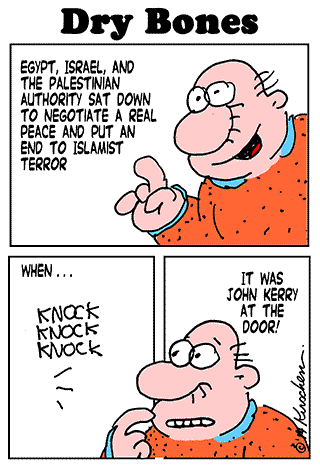
What was Kerry doing?

July 30, 2014

What was Kerry doing? Power LinePaul Mirengoff, July 29, 2014

(Are attempts to apply logic even useful when trying to explain Obama/Kerry motivations? — DM)

My theory is that the Obama administration expected some within the Israeli government to go ballistic, and wanted that reaction.

Why would the American administration want to generate openly expressed outrage against its Secretary of State? To create leverage. Team Obama could respond to Israeli outrage with outrage of its own. Israel, fearing a deterioration in relations with its traditional ally, would then feel pressure to “make nice” by offering concessions.


David Harsanyi tries to account for John Kerry’s decision to hand Israel a proposed ceasefire agreement, driven by Qatar (Hamas’ sponsor) and Turkey, so favorable to Hamas that Israel was bound not only to reject it, but to take offense. This is what Kerry proposed:

• Rather than empowering Fatah, recognizing Hamas as the legitimate authority in the Gaza Strip, though it is considered a terrorist organization by the Justice Department and an entity that’s founding principle and driving purpose is to eliminate Israel and replace it with an Islamic state.

•Rather than choking off this organization’s lifeline, allowing them to collect billions in ‘charity’ that would be been able to use to rearm, retrench and reengage in hostilities.

•Making no demands on Hamas to get rid of its rockets, or its tunnels and other weaponry used to instigate war – while at the same it limiting Israel’s ability to take them out. (This final point is disputed by U.S. officials.)

What was Kerry doing?

David Ignatius, as to whom Scott has goods, believes that Kerry’s proposal was not the product of anti-Israel bias. Rather, it stemmed from his “bias in favor of an executable, short-term deal.”

This is absurd. There was never a chance that Kerry’s one-sided proposal would produce such a deal.

Harsanyi thus concludes that “we either have an incompetent Secretary of State or a momentous shift in Middle East policy.”

We do, indeed, have an incompetent Secretary of State. And under President Obama, our Middle East policy has shifted momentously.

But neither phenomenon seems sufficient to explain Kerry’s proposal. Incompetence is one thing; stupidity another. And the U.S. could have manifested its tilt away from Israel without presenting a proposal it knew would be rejected so emphatically.

My theory is that the Obama administration expected some within the Israeli government to go ballistic, and wanted that reaction.

Why would the American administration want to generate openly expressed outrage against its Secretary of State? To create leverage. Team Obama could respond to Israeli outrage with outrage of its own. Israel, fearing a deterioration in relations with its traditional ally, would then feel pressure to “make nice” by offering concessions.

We’ve seen a variation on this act before. In March 2010, during a visit to Israel by Joe Biden, the Interior Ministry announced plans to build new 1,600 apartment units in Ramat Schlomo.

The Obama administration hit the roof. Hillary Clinton, for example, chewed out Prime Minister Netayahu for 45 minutes and then ordered her PR department to boast to the press about it (Clinton would now like rewrite this history).

The result? Israel froze both the Ramat Schlomo building and other projects. The freeze lasted until, two and a half years later, the PA announced that it would attempt to gain observer status at the U.N.

The announcement of the construction plans during Biden’s visit was a gaffe. As for the U.S. reaction, one can debate whether it was proportionate to the Israeli offense.

For present purposes, the point is that the Obama administration learned that by taking offense at alleged disrespect for its leading players, it can influence Israeli policy.

This, I suspect, is why Kerry proffered a ceasefire proposal that he (or someone smarter) knew would produce a show of disrespect for our foghorn Secretary of State.

But building housing units lacks the urgency of degrading Hamas’ ability to attack Israel. One hopes, therefore, that the Obama administration’s ginned up outrage will have no discernible effect on Israeli policy in Gaza.

Kerry’s delusional ceasefire proposal: When the left and right are in agreement you know you’ve lost the argument

July 29, 2014

Kerry’s delusional ceasefire proposal: When the left and right are in agreement you know you’ve lost the argument | Anne’s Opinions

John Kerry is back, like a bad penny


A lot has been said and much fun been made of John Kerry’s ridiculous ceasefire proposal, which was utterly rejected by Israel. It turns out that John Kerry’s delicate feelings and fragile ego have been mortally wounded by the mockery.

Below are a series of items from yesterday’s Times of Israel live-blog which illustrate this:

First, an overview from Avi Issacharoff regarding the ongoing dispute with Kerry:

Labor opposition leader Isaac Herzog told Channel 2 earlier that Secretary Kerry, with whom he says he speaks often, has been “hurt to the depths of his soul” by the criticisms he’s received in Israel for his handling of the ceasefire effort.

ToI’s Avi Issacharoff explains in an analysis piece why Kerry has so infuriated his allies.

One key point: “Kerry and his staff made an outrageous decision to turn their backs on the Egyptian framework for a ceasefire in a manner that encouraged Hamas to continue shooting rockets… By turning to Doha and Ankara behind the backs of Cairo and Jerusalem, Washington — no doubt unintentionally — strengthened Hamas’s resolve against Egypt and Israel.”

Another: “The farce continued with the amateurish draft that was immediately rejected by Israel’s security cabinet.”

And a third: “It then reached new heights on Saturday in Paris, when Kerry decided to participate in an international summit on Gaza, attended by his new friends al-Attiyah and Davutoglu (the foreign ministers of Qatar and Turkey) as well as the foreign ministers of the European Union, but not by a few players that Kerry apparently perceives as marginal – representatives of Egypt, the Palestinian Authority and, of course, Israel.

It’s hard to say what caused the Obama administration to join forces with the Muslim Brotherhood of all camps — loyally represented by Turkey and Qatar — and turn its back on the movement’s sworn enemy, the Egyptian government. The best case scenario is that it might have been amateurism or a misreading of the situation. In a less ideal scenario, Washington decided to forge an alliance with organizations and entities that would be happy to see Israel disappear from the map.”

Says Issacharoff: “I prefer to bet on the first option… that Kerry just doesn’t understand who’s playing against whom in the Wild Mideast.

Here is Avi Issacharoff’s full article.

Here’s just one example of an MK’s scathing view of American diplomacy. Zeev Elkin said “Last time we listened to the US, Hamas took Gaza”.

The US clearly can’t abide any criticism and use nasty menacing language against Israel’s legitimate criticism as we read that “Criticism of Kerry could jeopardize Israeli-US ties — US officials“. It seems that criticism is a one-way street. The US, particularly the State Deparment, can and does criticise Israel loudly, publicly and often, but cannot dish it out. We’ve been here before.

The State Department goes on the defensive Monday afternoon, critiquing Israeli sources for leaking details of a Gaza ceasefire draft, and then denying allegations that the draft represented a capitulation to Hamas demands.

Leaks and criticism of the sort that Secretary of State John Kerry faced over the weekend are “simply not the way allies and partners treat each other,” State Department Spokesperson Jen Psaki complains.

Riiight. The US has never criticised Israel. Not.

The US ought to know that in the Middle East, but especially in Israel, you know you’ve lost your argument when you’ve lost the left as well as the right, and when their views converge –Voices from left, right wary of US ceasefire proposal.

However, despite all America’s sound and fury at Israel’s audacity in rejecting their ceasefire proposal, Israeli criticism did manage to alter the US ceasefire terms:

While American officials continue to fume at the Israeli media for its harsh criticism of US Secretary of State John Kerry’s efforts to reach a ceasefire last week, apparently it had some effect. During a speech, Kerry says that “any process to resolve the crisis in Gaza… must lead to the disarmament of Hamas.” In a ceasefire proposal Kerry had submitted to Israel on Friday, no disarmament of Hamas was mentioned.

Small comfort but we have take the crumbs that we can find.

Israel’s confusion at John Kerry’s delusional behaviour has not gone unnoticed in the foreign press. The Daily Telegraph’s Robert Tail reports that “Israel thinks that John Kerry is an alien, an ongoing embarrassment“:

John Kerry has almost certainly been called worse things than a space alien – particularly by Israel’s Right-wing camp, where contempt for the US secretary of state and his failed peacemaking efforts is unabashed.

But when the insult is levelled by the previously supportive Haaretz newspaper, standard-bearer of the country’s liberal-Left, it may be time for him – and by extension, President Barack Obama – to take notice.

The withering description was coined by Barack Ravid, the paper’s well-informed and normally restrained diplomatic editor, to describe Mr Kerry’s attempts at brokering a truce to the bloody conflict in Gaza – rejected by Israel amid widespread mockery.

“It’s as if he isn’t the foreign minister of the world’s most powerful nation, but an alien, who just disembarked his spaceship in the Mideast,” wrote Mr Ravid, even while softening his remarks by describing Mr Kerry as “a true friend to Israel”.

Worse still from Mr Kerry’s viewpoint, the journalist suggested that, Moshe Ya’alon, the Israeli defence minister, “may have had a point” earlier this year when he labelled America’s top diplomat “obsessive and messianic” in remarks that were widely disparaged at the time over his abortive attempts to mediate a peace deal with the Palestinians.

The Israeli media carried similarly mocking depictions in abundance on Sunday – all fuelled by senior figures in Benjamin Netanyahu’s government, who professed amazement at the terms of a proposed ceasefire deal which they said were skewed in favour of Hamas, the Islamist militant group which Israel is fighting.

Yet it is the Haaretz insult that signals Mr Kerry’s credibility loss in the eyes of Washington’s closest Middle East ally, according to Israeli government insiders.

“If he gets rubbished by Haaretz, it means he really goofed up,” said one official, who said the criticism was widely shared across the Israeli political spectrum.

Debka reports (h/t DavidinPT) that it wasn’t only Israel who was furious at the Kerry proposal. The Palestinian Authority strongly objected too:

The Palestinian Authority was much more open and blunt than Netanyahu in its disapproval of the game that was being played out in Paris. Walid Assad, one of the spokesmen of Palestinian Authority chairman Mahmoud Abbas protested what he called Kerry’s “appeasement” of Qatar and Turkey at the expense of Egypt and the PA, and his failure to invite either to the meeting for discussing a ceasefire in Gaza hostilities.

Senior Palestinian officials warned against attempts to “bypass the PLO as the sole and legitimate representative of the Palestinian people.”

In the legitimacy stakes, Netanyahu has three solid allies for crushing Hamas: Saudi King Abdullah, Egyptian President Abdel-Fatteh El-Sisi and the UAE ruler Sheikh Mohammed Bin Rashid Al Maktoum. Sunday, Mahmoud Abbas attached a Palestinian voice to this group.

Debka goes on to try and explain the American rationale behind their ceasefire attempts:

This regional coalition has enormous clout, derived, on the one hand, from the Israeli military and its fight against Hamas in the Gaza Strip and the Egyptian army’s containment of Hamas efforts to break out into Sinai for strategic depth; and, on the other, from the financial might of Saudi Arabia and the oil emirates and the world prestige they enjoy.

So why is the Obama administration shoving this powerful coalition out of his way and building a rival alliance to counter it?

Its primary motive is fear that if this group is allowed to make the Israeli operation in the Gaza Strip a success, it will become the springboard for its next move, a victorious assault on Iran.

This sequence of events would totally derail current US Middle East policy, which hinges on détente with Tehran, Obama’s advisers warn him, and even jeopardize his strategy for bringing the nuclear negotiations between the six world powers and Iran to a successful conclusion.

I can’t see anything wrong with derailing American policy in the Middle East. As far as I’m concerned, and probably most Israelis, that should be a feature, not a bug, of any future agreement.

Turkish PM Erdogan returning Jewish American award

July 29, 2014

Turkish PM Erdogan returning Jewish American award
Published: 07.29.14, 16:01 / Israel News


Now if we could only get that Nobel prize back from Barack.-LS

After American Jewish Congress demands Turkish PM return prize after saying Israel ‘surpassed Hitler in barbarism,’ Erdogan gladly agrees.

Turkish Prime Minister Recep Tayyip Erdogan is returning an award given to him by a Jewish American group in 2004, after the group asked for it back because of comments he made regarding the conflict in Gaza.

Turkey’s US ambassador wrote to Jack Rosen, president of the American Jewish Congress, on Erdogan’s behalf saying that because of Israel’s actions in Gaza and “the regrettable stance” of the American Jewish Congress, Erdogan “will be glad to return the award.” The letter, dated July 27, was made available Tuesday.

Last week, Rosen described Erdogan as “arguably the most virulent anti-Israel leader in the world.” He said Erdogan was given the Profile of Courage award for working for a peaceful solution in the Middle East his commitment to protecting Turkey’s Jewish citizens.

Rosen’s open letter to Erdogan had cited the Turkish leader’s recent comments that Israel had “surpassed Hitler in barbarism” through its attacks on Gaza.

Erdogan’s office released a copy of the response letter to the media, describing it as Turkey’s official response.

“The absence of this award will not prevent Prime Minister Erdogan from resolutely fighting against terrorism, working towards the peaceful solution of the Israeli-Palestinian conflict and upholding the safety and well-being of the Jewish community in Turkey,” the letter continued.

The US State Department called Erdogan’s earlier remarks, in which he likened an Israeli MP to Hitler and said the Jewish state was terrorising the region, “offensive and wrong”.

Relations between Turkey and Israel have hit their “lowest level” amid the Jewish state’s assault on the Gaza Strip, and may not be able to improve for some time, Deputy Prime Minister Bulent Arinc said.

Arinc, one of the founding members of Prime Minister Recep Tayyip Erdogan’s Islamist-influenced AKP party, said Turkey had always calibrated its relations with Israel according to Israel’s behavior towards the Palestinians.

“Our relations have always been reduced to a minimum whenever Israel continued occupation, dropped bombs in Palestine and carried out massacres,” he told AFP in an interview in Ankara on Thursday.

Israel has withdrawn most of its diplomatic staff from Turkey after violent protests against its missions while Erdogan has enraged Israeli leaders by describing the Gaza assault as a genocide.

“The lowest level (in relations) right now will maybe continue for a while,” said Arinc.

A Turkish daily affiliated with Erdogan sparked a furor after it called on the country’s Jewish community to apologize for the Palestinian casualties of the Israeli operation in Gaza.

“You came here after being banished from Spain,” Yeni Akit correspondent Faruk Köse wrote Wednesday in an open letter to Hakham Bashi, the chief rabbi of Turkey’s Jewish community. “You have lived comfortably among us for 500 years and gotten rich at our expense. Is this your gratitude – killing Muslims? Erdogan, demand that the community leader apologize!”

Iran’s Proxy War Against Israel

July 29, 2014

Iran’s Proxy War Against Israel
July 29, 2014 by Majid Rafizadeh


The proverbial snake in the wood pile.-LS)

While the mainstream media has focused solely on Hamas and Israel in the current ongoing war, there has been less attention given to the major role that the Islamic Republic of Iran has been playing in ratcheting up the conflict with its military assistance to Hamas fighters, including Iranian-built Fajr 5 and M-75 with ranges of approximately 75 kilometers.

These are missiles and rockets that can target cities like Tel Aviv and Jerusalem.

It is worth noting that the export of arms as well as military and weaponry assistance by the Islamic Republic to Hamas is legally prohibited by the United Nations Security Council, written in UN Resolution 1747.

Although Iranian leaders often deny that they are supporting Hamas militarily, some, including former Iranian Parliament Speaker Ali Larijani, admitted that the Islamic Republic has been supplying military aid and technology to Hamas in the Gaza Strip. On the Iranian parliament’s website, Larijani stated, “We are honored to provide the Palestinian people with military aid, while all Arabic countries do is hold meetings. Palestinian people do not need lectures and meetings.”

In addition, the commander of Iran’s Revolutionary Guard Mohammad, Ali Jafari, admitted that Iran is supplying weapons to Hamas and other groups: “Iran provides technical assistance to all Muslims who fight against world arrogance.”

What is Iranian President Hassan Rouhani’s stance? Is he truly a moderate? Rouhani’s stance on arming Hamas and standing against Israel is no different from his predecessor, Mahmoud Ahmadinejad.

The Iranian president recently projected Iran’s leadership by calling Kuwaiti Emir Sabah Al-Ahmad Al-Jaber Al-Sabah, and pointing out that tthe Arab League, the Organization of the Islamic Cooperation, and the international community, ought to take immediate and serious steps to assist Hamas and the Palestinians.

After all, Iranian presidents are all loyal to Supreme Leader Ayatollah Ali Khamenei and Iran’s Revolutionary Guard Corps.

In fact, across Iran’s political spectrum, there is no difference with regard to their position towards arming Hamas and fighting Israel. They all share anti-Israeli and pro-Palestinians views. In addition, whenever the international community or the United States has attempted to broker a peace, Iranian leaders have attempted to scuttle it. Their view is the same as what Ahmadinejad previously conveyed: “Who gave them [Mahmoud Abbas’ negotiating team] the right to sell a piece of Palestinian land? The people of Palestine and the people of the region will not allow them to sell even an inch of Palestinian soil to the enemy. The negotiations are stillborn and doomed.”

The Iranian leaders hypocritically and frequently point out that the reasons they support the Palestinians and Hamas are humanitarian. Nevertheless, the main reason is advancing Iran’s regional hegemonic ambitions and its strategic, geopolitical and ideological goals.

In addition, the Islamic Republic has been seeking to project its regional hegemonic supremacy by supporting not only Shiite groups such as Hezbollah (Lebanon), Bashar Al Assad (Syria), and Nori Al Maliki (Iraq), but also penetrating the Sunni communities and supporting groups such as Hamas.

Since the Islamic revolution in Iran, the main foreign policy objectives of the Islamic Republic have been rivalry and antagonism towards the United Sates and its ally Israel.

The Islamic Republic attempted to find or create any group possible to stand against US foreign policy in the region (as well as those of Israel), in order to advance Tehran’s ideological, strategic and geopolitical objectives in the region.

The major force in Iran supporting Hamas are the Quds forces, an elite branch of Iran’s Revolutionary Guard Corps which fight abroad, under the leadership of Khamenei and headed by Qasem Suleimani.

Another admission from the Islamic Republic on arming Hamas came from its own press, surprisingly. Last week, Javan newspaper, an Iranian state newspaper, stated, “The Islamic Republic of Iran is the only country in which a consensus on the Palestinian issue exists between the regime and its people. Together with popular support for the Palestinian fighters, the [Iranian] regime also provides important aid to the Palestinian fighters, including military weaponry… This measure by the Islamic Republic – arming the Palestinian groups – is carried out publicly, and not in secret, and has even been publicly emphasized by the leader [Khamenei],” according to Algemeiner and MEMRI’s translation of the Persian text.

Accordingly, the Islamic Republic has also provided Hamas with Fajr 5 missiles and Abadil drones before the war.

Across Iran’s political spectrum, Iranian leaders follow the words of the founder of this theocratic regime, Iran’s former Supreme Leader, Ayatollah and Ali Khomeini, who repeatedly attempted to rally people against Israel and the United States, “To liberate Qods [Jerusalem], Muslims should use faith-dependent machine guns and the power of Islam and keep away from political games which reek of compromise… Muslim nations, especially the Palestinian and Lebanese nations, should punish those who waste time indulging in political maneuvers.”

Under the presidency of Hassan Rouhani, Iran’s foreign policy has not shifted and it is crucial to draw attention to Iran’s intervention and military assistance as the Islamic Republic is major player in ratcheting up the ongoing war.

Fighting for us: The Real stakes in Israel’s war

July 29, 2014

Fighting for us: The Real stakes in Israel’s war, John Bolton PAC, John Bolton, July 29, 2014

Israel’s effort to destroy Hamas’ underground Gaza Strip infrastructure is about defeating terrorism, yes — but even graver issues are involved.

Hamas’s long record of indiscriminate rocket attacks (over 11,000 since Israel left Gaza in 2005), its suicide bombers and its determination to destroy the Jewish state are all too real.

This is more than ample justification for Israel not just to retaliate against Hamas, but to destroy it.

But in Gaza today, Israel is also battling the existential peril of Iran’s nuclear program.

Despite Hamas’ 2011 refusal to support Assad in Syria, Iran never forgot Hamas’ potential usefulness against “the little Satan”; Tehran and Hamas have resumed their strategic partnership.

By confronting Hamas, Israel is simultaneously also striving against the fear of a new holocaust courtesy of Iranian nuclear weapons.

Removing or at least substantially degrading this mortal threat is the key imperative in Gaza, and could take considerable time to accomplish.

Appreciating this objective requires understanding the interwoven layers of deterrence and military capability involved in Israel’s war on Iran’s nuclear threat.

Of course, a nuclear Iran is not simply Israel’s problem, but America’s as well. Unfortunately, Washington and its allies have abdicated their responsibilities.

President Obama says repeatedly that “all options are on the table,” but no one really believes he’ll ever order military strikes against Iran’s nuclear program, and few think the endless talks with Iran will even slow Tehran’s progress. Israel is the only power that may act.

Yet Iran’s most likely response to an Israeli attack would be to unleash Hamas and Hezbollah against the Israeli civilian population.

A direct Iranian attack on Israel is unlikely, since Tehran wouldn’t want to risk an Israeli nuclear response. Retaliating indirectly through its terrorist surrogates is safer, while providing an air of plausible deniability.

Other options (closing the Strait of Hormuz; attacking US forces in the region) are highly unlikely, since they’d prompt an American military response, even from Obama.

(Incidentally, an Israeli strike would not prompt a broader Middle East war, because key Arab states also oppose a nuclear Iran.)

Thus the Hamas and Hezbollah arsenals in Gaza and southern Lebanon are crucial.

Most of Hamas’ rockets are short-range and not terribly accurate. If they hit civilian targets, they are of course lethal, but for Hamas their main use is as a weapon of terror.

After the 2006 Hezbollah-Israel war, however, Tehran not only replenished Hezbollah’s more muscular missile stockpiles, but also substantially upgraded Hamas’ assets. Longer-range missiles began appearing in Gaza, smuggled in courtesy of Iran, such as the Fajr-5 and the Khaibar (Syrian-built from Iranian design).

As recently as March, Israel intercepted the Klos-C in the Red Sea carrying Khaibar missiles, mortars and assault-rifle ammunition, which Israel credibly says were Gaza-bound. Although shipping records were counterfeited, Iran was undoubtedly the source.

Thus Iran could order the launching of longer-range, more accurate missiles from both Lebanon and Gaza, substantially increasing the threat to Israel.

Despite Israel’s huge strides in missile defense, especially Iron Dome, such systems can still be defeated by overwhelming them with large numbers of rockets arriving simultaneously on a given target, especially if they’re launched from two disparate locations.

Iran fully understands the deterrent effect these missiles have on any Israeli government contemplating a pre-emptive strike. The Khaibar’s range of about 200 miles means it can strike Israel’s port of Haifa from Gaza.

With its 50-mile range, the Fajr-5 can hit Tel Aviv, Jerusalem and Israel’s Dimona nuclear reactor. (Missile ranges rise or fall depending on the weight of the weapons payload being carried.)

Israel needs to feel confident it can successfully attack Iran’s nuclear program without risking unacceptable civilian losses when Tehran retaliates via Hamas and Hezbollah.

Thus, Israel should destroy Hamas’ missile capabilities now, as well as any unmanned aerial vehicles in Gaza that might disperse biological or chemical weapons.

Ideally, Israel would do the same to Hezbollah — which helps explain why Hezbollah has held back during the current hostilities.

But there is little doubt that Iran and Hamas desperately hope John Kerry or others will manage to impose a cease-fire in Gaza before their stocks of long-range missiles are uncovered and destroyed.

This is why it is so important that Israel continue its Gaza operations for as long as it deems necessary, precisely to destroy those missiles.

In so doing, Israel is acting not only in its own legitimate self-defense, but in America’s as well.

This op-ed originally appeared in the New York Post on July 29, 2014. Click here to view the original op-ed.

US and Israel deny report of harsh Obama-Netanyahu conversation

July 29, 2014

US and Israel deny report of harsh Obama-Netanyahu conversation | The Times of Israel.

Netanyahu rejects PMO-POTUS call transcript

The Prime Minister’s Office says in a statement that the Channel 1 report is false, using precisely the same words as the White House.

“We have seen these reports, and neither the reports nor the alleged transcript bear any resemblance to reality. It’s shocking and disappointing that someone would sink to misrepresenting a private conversation between the President and the Prime Minister in fabrications to the Israeli press,” the PMO says.

– Raphael Ahren

Hostile Obama Tried to Force Bibi to Accept Truce

July 29, 2014

Hostile Obama Tried to Force Bibi to Accept Truce – Defense/Security – News – Arutz Sheva.

US president markedly unfriendly, interrupted prime minister as he attempted to push unfavorable truce on Israel.

By Ari Soffer
First Publish: 7/29/2014, 9:56 PM

Barack Obama in Jerusalem

Barack Obama in Jerusalem

Flash 90

Damning evidence has emerged of US President Barack Obama’s dismissal of Israel’s position in favor of supporting the position of Hamas and its allies during ceasefire talks.

A “senior US official” leaked an audio recording of a telephone conversation between Obama and Prime Minister Binyamin Netanyahu to Channel One. In it the 35-minute conversation, which took place on Sunday, the US President appears downright hostile at points, and even cuts off Netanyahu in the middle of his protestations over a one-sided truce proposal which would have seen Hamas receive all its key demands, but that Israel ultimately rejected.

The following is an excerpt of the conversation, published in Hebrew by Channel One:

Obama: I demand that Israel agrees to an immediate, unilateral ceasefire and halt all offensive activities – particularly airstrikes.

Netanyahu: What will Israel receive in return for a ceasefire?

Obama: I believe that Hamas will stop firing rockets – silence will be met with silence.

Netanyahu: Hamas violated all five previous ceasefires, it is a terrorist organization which is dedicated to the destruction of Israel.

Obama: I repeat and expect Israel to unilaterally stop all its military activity. The pictures of destruction from Gaza distance the world from Israel’s position.

Netanyahu: Kerry’s proposal was completely unrealistic and gives Hamas the military and diplomatic advantage.

Obama: Within a week of the end of Israel’s military activities, Qatar and Turkey will begin negotiations with Hamas on the basis of the 2012 understanding [following the end of Operation Pillar of Defense – ed.], including Israel’s commitment to removing the siege and restrictions on Gaza,

Netanyahu: Qatar and Turkey are the biggest supporters of Hamas. It is impossible to rely on them to be fair mediators.

Obama: I trust Qatar and Turkey, and Israel is in no position to choose its mediators.

Netanyahu: I object, because Hamas is able to continue and to fire rockets and to use tunnels for terror attacks…

Obama – interrupts Netanyahu mid-sentence: The ball is in Israel’s court – it is obligated to end all military activities.

The Channel One journalist who received the tape emphasized that at other points during the conversation there were more “positive” word exchanged between the two, such as Obama repeating America’s commitment to Israel’s security.

But those words will ring hollow to Israelis, considering that the proposal put together by John Kerry, Qatar and Turkey did not address a single one of Israel’s demands and – as alluded to by Obama himself – relied on little more than the goodwill of Hamas to stop firing rockets. This, despite the group (which the US itself lists as a terrorist organization) being unabashedly committed to the destruction of the State of Israel and the genocide of all Israeli Jews.

For his part, earlier on Tuesday John Kerry claimed that Prime Minister Netanyahu had in fact approached him to ask him to help hammer out a ceasefire deal, after previous truce proposals were rejected by Hamas.

If that was indeed the case what resulted could hardly have been what Netanyahu had in mind: a joint initiative with two states overtly hostile towards Israel, concluding in a draft proposal which would have granted Hamas all of its key conditions – including the opening of air and sea ports and the total lifting on Israel’s security blockade – but which addressed Israel’s “security concerns” in only the vaguest possible terms.

A Cartoon About Israel That Even A Lib Can Understand

July 29, 2014

A Cartoon About Israel That Even A Lib Can Understand
by Shifra on July 22, 2014

It is usually during a time of crisis that we get to see who our true friends really are.

Israel is now in a time of crisis.

And if you take a quick glance at Twitter, it is immediately obvious that Conservatives, and especially Christian Conservatives, “have Israel’s back.”

Libs? Not so much.

The ones on the extreme Left?

As they say in Brooklyn, “fuhgeddaboudit.”

Nothing will change their minds, and they will continue to spew their hateful venom. (The tweets about Hitler, Jews and ovens are particularly classy. Not)

Other Libs are just Low Information People. (Remember, they all voted for the Gum-Chewer-in Chief.)

Kudos to Tammy for engaging with one of ‘em: Mia Farrow. You can follow the entire exchange here: Via Twitchy: Mia Farrow: ‘Why are they bombing homes in Gaza City?’ Tammy Bruce answers

The following Youtube was sent to me by a friend, yesterday. Not sure of the original source.

But since it is in cartoon form, maybe some of the Low Information peeps will “get” it.

Congress to UN: Hamas’ Arsenal Must Be Removed

July 29, 2014

Congress to UN: Hamas’ Arsenal Must Be Removed
BY: Adam Kredo July 29, 2014 9:00 am


There are a lot of good folks in the US government. Problem is, the bad ones make too much damn noise.-LS

Nearly 100 House lawmakers will petition the United Nations this week to formally designate Hamas’ rocket arsenal as “an impenetrable barrier to regional peace” and to make their removal from the Gaza Strip a “top priority,” according to a copy of the unsent letter obtained by the Washington Free Beacon.

A bipartisan coalition of House lawmakers have already signed on to the letter, which will be sent later this week to U.N. Secretary General Ban Ki-moon.

The letter comes as Hamas ignores all recent ceasefire agreements and continues to fire rockets at Israeli civilians, who have been seeking shelter from these attacks for weeks since Hamas launched its latest war on Israel.

As the Israeli military continues its campaign to dismantle Hamas’ network of underground tunnels and clear the strip of missiles, House lawmakers led by Reps. Doug Lamborn (R., Colo.) and Brad Schneider (D., Ill.) are pushing the U.N. to take a more active stance against Hamas.

“We, the elected representatives of the American people, call on the United Nations to formally recognize Gaza’s rockets as an impenetrable barrier to regional peace, and to make their immediate removal a top priority,” write the lawmakers, who are joined on the letter by 10 leading pro-Israel organizations.

“We urge the United Nations to take the steps necessary to make the removal of Hamas’ rockets a top priority,” states the letter, which is signed by lawmakers who, in a somewhat surprising show of bipartisan support, are both extremely liberal and extremely conservative.

“Doing so will bring much needed stability to a region that has been plagued by terror and suffering for too long and is imperative to any effort to bring a lasting peace to the people of Israel and Gaza,” they write.

The U.N. has done little to censure Hamas for engaging in a litany of war crimes in recent weeks, including using civilians as human shields and intentionally targeting civilians with rockets.

However, the United Nations, led by Arab member states, has sought to condemn Israel’s defensive maneuvers and force Israel to make concessions to Hamas, a U.S.-designated terror organization.

U.S. efforts to broker a ceasefire have also favored Hamas’ demands on Israel, which has forced the Jewish state to flatly reject these proposals, according to reports.

Lawmakers petition the U.N. to take Hamas’ rocket supply—some of which is supplied by Iran and its affiliates—as a serious threat to international safety.

“More than 9,000 rockets have been fired out of Gaza since 2001,” the letter states. “Once considered to be short-range threats with minimal payloads, Hamas has continuously improved the range and lethality of these rockets to ensure a maximum threat to Israel.”

“Hamas can now reach virtually every major population center in Israel, with deadly effect,” they write. “Today, every rocket fired puts the long-sought peace between Israel and the Palestinians further out of reach.”

While U.S. lawmakers are coming together to express their support for Israel and disdain for Hamas, many leaders across the world have focused solely on Israel’s military campaign, chastising the Jewish state for its efforts to destroy Hamas’ terror network.

“In its rush to secure a ceasefire, the international community is ignoring the most important factor,” said Aaron Menenberg, a fellow at the Israel Allies Foundation (IAF), one of the many Jewish groups supporting the House letter to the U.N.

Like the lawmakers who signed on, a diverse mix of interest groups back the letter, including: The Jewish Federation of North America (JFNA), the Republican Jewish Coalition, the National Jewish Democratic Council (NJDC), the Zionist Organization of America, and even the liberal fringe group J Street, among others.

“For Hamas this war is about fundraising and credibility-boosting,” said IAF’s Menenberg. “For Israel, it’s about restoring calm and preserving life. Both are fighting for survival, but only one is worth preserving. If the world wants to end the fighting, it needs to end Hamas, and that starts with getting rid of its rockets.”

Hamas’ use of sophisticated Iranian-made rockets that can reach deep into Israel has been a game changer this time around, Menenberg said.

“It was always unacceptable to fire rockets on civilian populations. But now, Hamas has the capacity to reach nearly all of Israel’s population,” he said. “It takes the threat to a whole new level. Without removing the rockets, this will only continue and become deadlier in the months and years ahead.”


