Archive for July 2014

Iran’s Supreme Leader Calls for More Enrichment Capacity

July 8, 2014

Iran’s Supreme Leader Calls for More Enrichment Capacity, Washington Free Beacon, Michelle Moghtader and Fredrik Dahl, July 8, 2014

(Iran wants only a “moderate” ten fold increase in centrifuges. No problem; it’s all for the children. — DM)
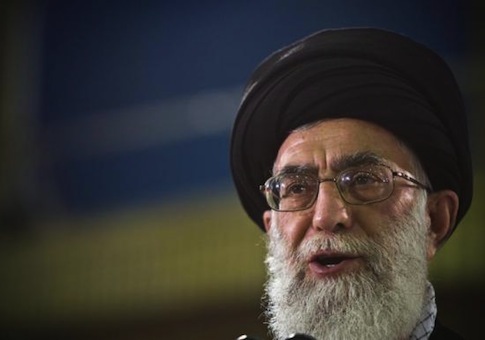
Iran sup leaderAli Khamenei / Reuters

Iran now has more than 19,000 installed enrichment centrifuges, mostly old-generation IR-1 machines, with about 10,000 of them operating to increase the concentration of uranium’s fissile isotope U-235.

“Their aim is that we accept a capacity of 10,000 separative work units (SWUs), which is equivalent to 10,000 centrifuges of the older type that we already have. Our officials say we need 190,000 SWU. Perhaps this is not a need this year or in two years or five years, but this is the country’s absolute need,” Khamenei said in a statement published on his website late on Monday.


DUBAI (Reuters) – Supreme Leader Ayatollah Ali Khamenei said on Tuesday Iran would need to significantly increase its uranium enrichment capacity, underlining a gap in positions between Tehran and world powers as they hold talks aimed at clinching a nuclear accord.

Iran and six major powers – the United States, Russia, France, Germany, China and Britain – have less than two weeks to bridge wide differences on the future scope of Iran’s enrichment program and other issues if they are to meet a self-imposed July 20 deadline for a deal.

They resumed talks in Vienna last week and their negotiators continued meetings in the Austrian capital on Tuesday; but there was no immediate sign of any substantive progress.

Iran’s capacity to refine uranium lies at the center of the nuclear stalemate and is seen as the hardest issue to resolve.

Iran insists it needs to expand its capacity to refine uranium to fuel a planned network of atomic energy plants. The powers say Tehran must sharply reduce the capacity to prevent it being able to quickly produce a nuclear bomb using uranium enriched to a far higher degree. (Full Story)

“Their aim is that we accept a capacity of 10,000 separative work units (SWUs), which is equivalent to 10,000 centrifuges of the older type that we already have. Our officials say we need 190,000 SWU. Perhaps this is not a need this year or in two years or five years, but this is the country’s absolute need,” Khamenei said in a statement published on his website late on Monday.

An SWU is a measurement of the effort necessary for the separation of isotopes of uranium.

Iran says its program is for civilian purposes such as electricity generation and denies any ambitions to build an atomic bomb.

Ending the decade-long dispute with Iran is seen as central to defusing tensions and averting the danger of a Middle East war.

A Western diplomat made clear the uphill task negotiations face if they are to hammer out an agreement: “We’re still far from a deal…(However) the deadline is July 20 and that’s what we’re working towards.”

Iran expert Ali Vaez said the negotiations were now at a precarious stage. “This has once again turned into a contest of wills,” Vaez, of the International Crisis Group, said.

HARDLINERS

Last week, other Western diplomats said Iran had reduced demands for the size of its future nuclear enrichment program in the negotiations, although Western governments were urging Tehran to compromise further. They did not give details.

But Mark Fitzpatrick, director of the non-proliferation program at the International Institute for Strategic Studies (IISS) think-tank, said Khamenei’s statement “confirms what I have suspected: that although Iranian negotiators have leeway on some issues, such as transparency and the timeframe for lifting sanctions, they are not authorized to accept cutbacks to the enrichment program”.

Iran now has more than 19,000 installed enrichment centrifuges, mostly old-generation IR-1 machines, with about 10,000 of them operating to increase the concentration of uranium’s fissile isotope U-235.

Mohammad Ali Shabani, a Tehran-based political analyst, said Khamenei’s statement was in line with what Iran’s negotiators have been saying for months in Vienna.

“The open timeline, however, allows enough flexibility for the two sides to come to consensus,” he added.

In defiance of Western pressure, Iran has expanded the centrifuge number sharply over the last decade until it stopped doing that under a Nov. 24 interim deal agreed between Iran and the world powers in exchange for limited sanctions relief.

Iran wants an end to sanctions, which have stifled its economy and hindered oil exports. But Khamenei, ultimate arbiter on all major decisions in Iran, said the country “should plan for the future, supposing the enemy won’t ease on sanctions”.

Khamenei said the idea of shutting down the underground Fordow enrichment plant was “laughable”, his website said.

Israel blocks rocket headed for Tel Aviv – CNN.com

July 8, 2014

Israel blocks rocket headed for Tel Aviv – CNN.com.

Jerusalem (CNN) — Israel intercepted a rocket fired at Tel Aviv on Tuesday and killed militants who stormed into Israeli territory, the military said, as people on both sides of the Gaza border were living under a barrage of attacks from the air.

In a dramatic escalation of the conflict, militants fired more than 130 rockets at Israeli civilians, Israel said. Palestinians reported 15 people killed in Israeli airstrikes targeting militants. Israel said it targeted about 150 “terror sites” in Gaza.

The warning sirens that blared in Tel Aviv, one of Israel’s most populated areas, showed a threat Israel had warned of. The country said Hamas rockets from Gaza are powerful enough to reach 3.5 million Israeli citizens. “Hamas will pay a heavy price for its vicious attacks on millions of Israeli civilians,” the Israel Defense Forces said on Twitter.

Army: Dozens of rockets fired into Israel

Arrests made in killing of Palestinian

“No nation would accept constant rocket fire. Neither will we,” the IDF said, using the hashtag #ItMustStop.

Hamas, on Twitter, used the hashtag #Gazaunderattack and warned, “Retaliations are coming, it is a matter of time.”

Flare-up in Israeli-Palestinian violence: Why now?

The possibility of an Israeli incursion into Gaza loomed, with the Cabinet authorizing the military to call up 40,000 troops if needed — 10,000 more than were called up during Israel’s offensive into Gaza in November of 2012. Lt. Col. Peter Lerner, a military spokesman, referred to “possible ground maneuvers.”

But it was Hamas that claimed responsibility for storming into Israeli territory Tuesday. Hamas-controlled television reported “from the heart of the battlefield” that a group of its “commandos” was “conducting its duties in Zikim Zionist military base according to plan.”

Zikim lies just north of Gaza and south of the Israeli city of Ashkelon. The group of militants tried to enter Zikim through the water, Israeli media reported. Israeli soldiers spotted the divers in the water and called in an infantry force, Channel 10 reported. An exchange of fire ensued.

“Four terrorists were killed,” Lerner said. “Two by infantry, one by air force, one by navy. They were armed with Kalashnikovs and hand grenades.” One Israeli soldier was lightly wounded, and the situation was ongoing as of Tuesday evening on the beach near the military’s base in Zikim, he said.

People in ‘human shield’ killed on Gaza rooftop

Among the dead in Gaza, meanwhile, was Mohammad Sha’aban, a leader of Hamas’ militant wing, Palestinian sources said. Israel confirmed that Sha’aban, “a senior Hamas terrorist,” was killed. Another militant was killed in an Israeli airstrike on an open field in Gaza.

Several Palestinians were killed in an airstrike on a Gaza rooftop. Palestinian medical sources told CNN the death toll was 10, but then lowered it to seven. Official Palestinian news agency WAFA reported that six were killed. Those killed were forming a “human shield” on the roof of a home belonging to members of Hamas’ militant wing, Palestinian sources said. Two were children, WAFA and Palestinian medical sources said.

Israeli teen’s chilling emergency call

Israeli PM: Teen’s murder was ‘abhorrent’

The home was near another home belonging to the same Hamas members that Israel struck Monday night, Palestinian sources said.

Palestinians said another of the 15 killed was a child who died of wounds after an airstrike on a motorcycle.

The Israeli military, on Twitter, said Hamas “uses Palestinians as human shields when firing rockets at Israel.” The tweet included a photo of what Israel said showed Hamas “caught firing a rocket” from a civilian area.

Israeli warnings: Stay away from Hamas

A CNN producer was among those who received an automated phone call from the Israeli military. It warned people in Arabic to stay away from members of Hamas and other terrorist groups in Gaza and not to cooperate with them “because they are risking your lives.” The message told people not to use their homes to store arsenals for terrorist groups. “Anyone who is present in these buildings risks their lives.”

On Monday, Israel dropped fliers telling residents that terrorist groups and those who smuggle weapons continue to hide among residents even though they know they are “always a target for the Israel Defense Forces.” It warned that those activities create dangers for residents and their children. The fliers provided phone numbers and e-mail addresses for Gazans to secretly provide information about militant activities.

The Israeli military’s Operation Protective Edge against Hamas is part of an effort “to restore a state of security,” Lerner, the Israeli military spokesman, told CNN on Tuesday.

Teens’ deaths sparked new violence

Tensions in the region reached a fever pitch after three Israeli teens, including one dual U.S. citizen, on their way home from school in the West Bank were kidnapped last month. Israel blames Hamas. Their bodies were found last week.

Later in the week, a Palestinian teen was abducted and then found dead within an hour in Jerusalem. Israel has arrested suspects and says there’s “strong indication” it was a revenge killing. Amid clashes in the days following, the Palestinian teen’s American cousin, who was visiting, was beaten by men in Israeli security uniforms.

Beaten American teen speaks to CNN

‘The tipping point’ in Israel?

Clashes follow Palestinian teen’s funeral
Israel also announced a confession in the May killing of another Israeli Jewish teen. The suspect is an Arab resident of northern Israel, and police believe the attack was fueled by Palestinian “nationalism.”

Palestinian Authority President Mahmoud Abbas, who was criticized by Palestinians when he condemned the Israeli teens’ kidnappings, called on Israel on Tuesday to immediately stop its strikes, warning the operation would drag the region into instability.

Abbas said a truce was needed to “spare the innocent from mass destruction.”

And presidential spokesman Nabil Abu Rdainah accused Israel of carrying out an “open massacre” against children, women and the elderly, WAFA reported. He said Israel is making a “decision to expand the war,” which he said will drag “the region into a spiral of bloody violence” that “will burn everyone.”

Long-range threat

Israel says the aim of its offensive is to strike Hamas in Gaza and stop rocket fire into Israel that threatens civilians. Hamas is estimated to have 10,000 rockets of varying ranges, Lerner said, including some that can reach as far north as Tel Aviv and beyond.

“They have substantial armaments which can strike the soft underbelly of Israel,” he said.

Lerner said the Israel Defense Forces’ position had changed from focusing on de-escalation to preparing for a deterioration of the situation.

‘Red lines’ crossed

The conflict between the two sides has worsened in the past few days.

“The enemy has crossed the red lines and will be made to pay the price for its crimes,” Mushir Al-Masri, a Hamas leadership figure and member of the Palestinian parliament, wrote on his Facebook page Monday. “The blood of our martyrs is precious … and is fuel for the intifada and the resistance.”

After that statement, the barrage of rockets from Gaza into Israel increased, with Hamas claiming responsibility.

Political strains

The conflict is creating strains within the governing coalition of Israeli Prime Minister Benjamin Netanyahu.

Foreign Minister Avigdor Lieberman, head of the Yisrael Beiteinu party, said in a news conference Monday that he told Netanyahu of his intention to dissolve his party’s joint faction with Netanyahu’s Likud party, saying it was “not working.”

Lieberman criticized Netanyahu’s handling of Gaza.

Tensions are also increasing between Hamas, which controls Gaza, and the more moderate Palestinian Authority in the West Bank.

Jerusalem starts preparing for rockets

July 8, 2014

Netanyahu orders ‘dramatic widening’ of Gaza operation | The Times of Israel.

The Jerusalem Municipality announces on Tuesday night it will open all public bomb shelters and is “preparing for every possible scenario.”

A list of shelters are published on the municipality website (www.jerusalem.muni.il).

“The municipality also recommends that residents open their private shelters,” according to a statement from Brachie Sprung, senior adviser to Jerusalem Mayor Nir Barkat.

“In the case of a siren or explosion, residents should go to the closest protected area within a minute and a half and close all doors and windows and stay indoors for 10 minutes,” the statement reads. “All residents are asked to continue to listen to instructions from the Home Front Command.”

Despite the precautions, “as of now, all municipal events will take place as scheduled.”

Islamic Jihad Claims Credit for Tel Aviv Missile

July 8, 2014

Islamic Jihad Claims Credit for Tel Aviv Missile, The Jewish PressHana Levi Julian, July 8, 2014

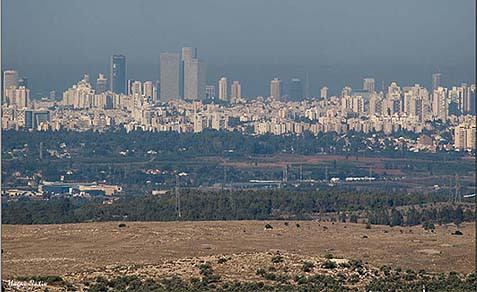
tel-aviv-west-bankA view of Tel Aviv from the area governed by the Palestinian Authority. Photo Credit: middle-east-info.org

The Islamic Jihad terrorist organization claimed responsibility for the missile barrage fired at Tel Aviv on Tuesday evening.

One missile was intercepted directly over Tel Aviv by the Iron Dome anti-missile defense system, indicating that it was headed for a populated area.

The terror group is generously funded and equipped by Iran, as is Hamas and the Lebanon-based Hezbollah terrorist organization.

IDF actively begins calling up 40,000 reserves for Operation Protective Edge

July 8, 2014

IDF actively begins calling up 40,000 reserves for Operation Protective Edge, Jerusalem PostYaakov LappinHerb Keinon, July 8, 2014

The cabinet approved the request and the IDF has already begun issuing reserve notices.


Gantz requests call-up in order to replace conscripted forces in the West Bank, and enable their deployment to the Gaza border.

The IDF has begun actively calling up the 40,000 reserves approved to it by the cabinet for Operation Protective Edge.

IDF chief of Staff Lt.-Gen. Benny Gantz requested the call-up of 40,000 reserves in order to replace conscripted forces in the West Bank, and enable their deployment to the Gaza border.

The cabinet approved the request and the IDF has already begun issuing reserve notices.

The IDF had previously called up 1,500 reserves on Monday.

Operation Protective Edge, which has seen the IAF strike some 100 terror targets in the Gaza Strip, came after more than 250 rockets were fired into southern Israel in recent weeks.

The rocket fire continued on Tuesday, with dozens of rockets fired into Israel, including some which targeted Beersheba and Ashdod.

Following high level security deliberations Tuesday morning Prime Minister Binyamin Netanyahu decided to expand the military operation in Gaza, including beginning preparations for a ground operation.

No time limit was put on the operation but senior diplomatic officials said it could be “for a long time.”

The objective of the operation, according to the officials, is to return quiet to the South, but the equation that “quiet would be met with quiet” was no longer the operative principle.

During the day Netanyahu expected to talk to a number of world leaders to explain Israel’s position and another security cabinet meeting will be held later in the afternoon if necessary.

Iron Dome intercepts rocket over Tel Aviv

July 8, 2014

Iron Dome intercepts rocket over Tel Aviv | JPost | Israel News.

By JPOST.COM STAFF

07/08/2014 19:14

Code Red siren sounds in central Israeli cities, including Petah Tikva, Lod and Givatayim for first time since 2012 Gaza escalations; no injuries or damage reported.

Kassam rockets being fired from Gaza Strip [file]

Kassam rockets being fired from Gaza Strip [file] Photo: Nikola Solic / Reuters

The Iron Dome rocket defense system intercepted a projectile over Tel Aviv on Tuesday evening. No injuries or damage were reported.

Israeli television showed a double-burst of smoke in skies above Tel Aviv after air raid sirens sounded, sending residents running for shelter.

The Code Red siren sounded in all of Gush Dan, including the central Israeli cities of Petah Tikva, Lod and Givatayim.

It was the first Gaza rocket that reached Tel Aviv since Operation Pillar of Defense in 2012.

Earlier on Tuesday, the Tel Aviv Municipality was instructed to inspect and open public bomb shelters in the city in order to “provide an optimal response for residents if necessary” in the event that escalations in the South reach the Center.

The Home Front Command also instructed Tel Aviv residents to prepare for utilizing protected rooms and shelters in their private homes.

Under the same instruction, the division responsible for civil security ordered for bomb shelters in Tel Aviv schools to be opened.

The IDF launched Operation Protective Edge in the early hours of Tuesday morning in order to quell the ongoing barrage of rocket fire from the Gaza Strip.

Since midnight Tuesday, more than 30 rockets fired from the Gaza Strip have exploded in Israel.

Terrorists in Gaza have launched more than 250 projectiles at Israel in recent weeks.

Reuters contributed to this report.

Hamas Vows Revenge After Use of Human Shields Goes Awry

July 8, 2014

Hamas Vows Revenge After Use of Human Shields Goes Awry, Israel National News, Ari Soffer, Dalit Halevi and AFP, July 8, 2014

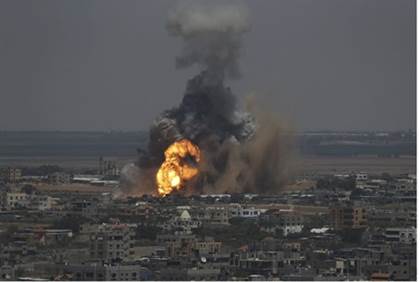
(The photo below may well be of an Israeli airstrike against Rafah on July 8th, not June 8th as stated in the caption. — DM)

IAF strikeIAF strike on target in Rafah, Gaza, 8th June 2014 Reuters

Hamas has vowed revenge after an attempt to use Palestinian civilians as human shields resulted in several fatalities, as Israeli Air Force planes targeted the home of a Hamas commander.

Gazan emergency services claim Israeli strikes on Gaza killed 14 people on Tuesday and wounded 80 others, as the military began an aerial campaign against terrorists in the Strip and prepares for a potential ground offensive.

It was the most serious flare-up in and around the Islamist-controlled territory since November 2012, and came as Israel’s cabinet reportedly authorized the army to call up 40,000 reservists for a possible assault on Gaza.

The deadliest single airstrike was on a house in the southern city of Khan Yunis belonging to a Hamas commander, killing seven people and wounding 25 others, medics said.

The attack “targeted the house of the al-Kaware family,” emergency services spokesman Ashraf al-Qudra told AFP, saying children were among the injured.

The events leading up to the strike offer an insight into the difficulties facing IDF forces in combating Gaza-based terrorism. It also provides a revealing glimpse into the way Hamas and other terrorist groups violate international law through the use of human shields. Israeli leaders have in the past referred to such tactics as a “double war crime”: firing missiles at Israeli civilians, while using Palestinian civilians as human shields.

Witnesses said an Israeli drone launched a warning flare prior to the strike, in a bid to allow innocent civilians to evacuate the area. Instead, relatives and neighbors gathered at the house to act as human shields, but shortly afterwards an F-16 fired a missile which leveled the building.

In response, Hamas said “all Israelis” would be potential targets for retaliation. “The Khan Yunis massacre… of children is a horrendous war crime, and all Israelis have now become legitimate targets for the resistance,” spokesman Sami Abu Zuhri said on Facebook.

Hamas has repeatedly vowed to target Israeli civilians, including in a recent propaganda video aimed at the residents of the southern Israeli city of Beersheva.

Earlier, four terrorists were killed in a separate strike on a car in the Daraj neighborhood in the center of Gaza City, Qudra said.

Hamas’s Al-Aqsa TV showed gruesome images of charred body parts being loaded onto ambulance stretchers.

Family members said all of them were Hamas militants, identifying one as Mohammed Shaaban, 32, a senior commander in Hamas’s armed wing, the Ezzedine Al-Qassam Brigades. He was also head of the group’s naval operations, they said.

Israel’s army confirmed targeting Shaaban, describing him as “a senior Hamas operative”.

In a separate strike near Nusseirat refugee camp, another man was killed, with witnesses telling AFP he was also a Hamas operative.

Later, two Palestinians were killed Tuesday in a fresh Israeli air strike east of Gaza City, a spokesman for the emergency services said. Their identities have not yet been released.

“At least two people were killed and several wounded in an air strike on Shejaiya, east of Gaza City,” Ashraf al-Qudra told AFP.

Hamas spokesman Sami Abu Zuhri warned Israel was “playing with fire” and would pay for its ongoing operations.

The deaths came hours after Israel announced the start of Operation Protective Edge, a military campaign aimed at stamping out rocket fire on southern Israel and destroying Hamas’s military infrastructure.

Army figures show that since midnight, terrorists have fired 130 rockets at southern Israel, prompting the air force to strike 150 “terror targets” in Gaza.

Israel must ‘wave the white flag’

Meanwhile, Hamas leader Ismail al-Askar, who serves as a “member of parliament” for the group’s Gaza-based government, reiterated previous Hamas demands that the only way they would agree to stop the current barrage of rockets against Israeli civilians would be for Israel to agree to several conditions.

The first would be to end its air strikes against terrorists in Gaza, which he termed “aggression”; the second would be to end the limited blockade on the Strip, which Israel imposed to stop Hamas and other terrorist groups smuggling in weapons. The third condition, he said, was that Israel release the dozens of terrorists who were initially freed during the 2011 Shalit Deal, but rearrested during the IDF’s recent operations in Judea and Samaria after they broke the terms of their release.

If not, Askar warned, Hamas was ready for a protracted war with Israel which could last months or even years.

“The resistance will not raise the white flag, and will not put down its weapons until the occupation waves the white flag and surrenders to the terms of the resistance.

IDF on Gaza border gets ready to GO IN ! – YouTube

July 8, 2014

IDF on Gaza border grts ready to GO IN ! – YouTube.


The Myth of Israeli Collective Punishment

July 8, 2014

The Myth of Israeli Collective Punishment, Front Page Magazine, Daniel Greenfield, July 8, 2014

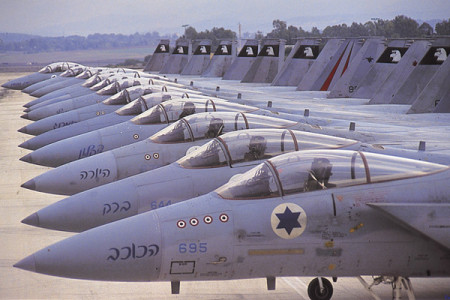
IAF aircraft

Western liberals romanticize Third Worlders by assigning to them rights without responsibilities. The Muslims of Gaza and the West Bank are assumed to have the right to elect political representatives, but not the responsibility to be held accountable for what those representatives go on to do in their name.

They have political powers, but not political responsibilities.

That’s not just dishonest, it’s an admission that they believe that the Muslims of Gaza and the West Bank are not ready for statehood.


The most enduring critique of Israel’s struggle against Islamic terrorism is the recurring accusation of “collective punishment.” Every time Israelis are murdered, the Jewish State is accused of punishing Muslims in the West Bank and Gaza for the actions of a few individuals.

Israel is fighting an enemy that insists on having all the advantages of a state and statelessness with none of the disadvantages. The PLO/Hamas unity government is a state when it wants something from the United Nations or the United States, but it’s not a state when it comes to taking responsibility. The Muslims who live in Gaza and the West Bank are considered citizens when it comes to having political rights, but not when it comes to taking responsibility for the consequences of their political decisions.

Their votes are to be taken seriously, but once those votes lead to war they are no longer responsible.

The Palestinian Authority is a state when it comes to its territorial claims, but not a state when it insists on open borders with Israel while claiming that any Israeli border security is a violation of its rights.

Terrorists routinely operate in such legal twilight zones, but the Palestinian Authority is unique in that it has all the structure of a state with none of the responsibilities of statehood. If Israel treats it as a state in response to acts of war, it is accused of collective punishment, even though the Palestinian Authority is the product of a collective political will and attacking it is not a collective punishment, but simply war.

When the Palestinian Authority unity government of Hamas and the PLO wants to go to the UN, it is said to represent the political will of a populace. But when Hamas attacks Israel, suddenly it’s not a collective act, but an individual crime. If Israel targets Hamas leaders, then it’s attacking political representatives. But if Israel blockades an area run by terrorists who claim to be a state, it’s accused of engaging in collective punishment. The terrorists claim political immunity as leaders of a collective and immunity from collective attack as individuals, rather than leaders and citizens of a political entity.

Critics of Israel not only want to have it both ways, they want to have it every single possible way that advantages the terrorists and disadvantages Israel, so that in every possible scenario Israel is wrong.

The paradox deepens when it comes to Israel.

The PLO and Hamas political leadership of the PA aren’t held responsible for their terrorist attacks, but Israel is held responsible for the individual actions of its civilians. Meanwhile the entire BDS movement is one big collective punishment against Israelis of all religions and ethnic backgrounds implemented by activists who claim to be against collective punishment.

But collective punishment has always been acceptable when it comes to Israelis.

When Israeli teens are killed by Hamas terrorists, instead of it being a case of a statelet engaging in random terror as a collective punishment, it’s put down to some populist impulse as a result of the “occupation.” But when Israel strikes Hamas, it’s suddenly collective punishment if any members of the civilian population that support the terrorist group and willingly act as its human shields are killed. And it’s collective punishment if Israel further shuts off access to territory ruled by Hamas.

Collective punishment, like everything else about the conflict, only works one way. Anything that Israel does to the PLO and Hamas can be considered collective punishment. Anything that they do to Israel, including randomly firing rockets at schools and houses, isn’t.

If Israel were indeed the sole authority in Gaza and the West Bank, it would be expected to function as a police force, rather than a military force. But Israel is in a state of armed conflict with the statelet of the Palestinian Authority. This armed conflict has been going on for around two decades.

The Palestinian Authority’s leadership is open about this conflict, even though Abbas, its leader, has learned to be more discreet than his predecessor, Yasser Arafat. The Palestinian Authority promotes terrorism and the political subgroups that run it engage in it.

The international community however pretends that it’s still 1985 instead of 2014. It expects Israel to act as if it had total control over the West Bank and Gaza and its cities weren’t being barraged by rockets. And if it responds to acts of war with war, then it’s guilty of collective punishment.

When half-a-million Israelis have to flee to bomb shelters, that’s not an individual crime. It’s a war.

All the peace process accomplished was to give the PLO and Hamas the power and infrastructure to wage full scale war without the obligation to follow any of the rules of war and without giving their victims the right to fight back by treating them as an enemy state.

Israel has been dealing with this as a military conflict. Its enemies have the support of the civilian population that they hide behind. Despite having the appurtenances of a state, they also have immunity from suffering the consequences of the wars that they start.

The only way that Israel can stop dealing with this as a military conflict is if it restores control over Gaza and the West Bank and evicts all other authorities, including the PLO and Hamas. At that point it will exercise police powers over a civilian population, rather than military powers against an enemy statelet.

Otherwise its military actions against that statelet are not collective punishment, but on the low scale of the norms of warfare, which at their very least involve bombing enemy installations and cutting off the enemy’s freedom of movement.

Israel cannot be expected to treat the Palestinian Authority as a political entity, but not a military entity, when rockets are falling on its cities. Either the PA is both or neither. If it’s both, then it is indisputably at war with Israel. If it’s neither, then Israel ought to restore control over a lawless Gaza and West Bank.

The underlying problem isn’t collective punishment, but collective immaturity.

Western liberals romanticize Third Worlders by assigning to them rights without responsibilities. The Muslims of Gaza and the West Bank are assumed to have the right to elect political representatives, but not the responsibility to be held accountable for what those representatives go on to do in their name.

They have political powers, but not political responsibilities.

That’s not just dishonest, it’s an admission that they believe that the Muslims of Gaza and the West Bank are not ready for statehood.

Five Points on ‘The Situation’

July 8, 2014

’Hard to admit, but 20 years of Israeli blindness has contributed to the current situation.

By: Meir Halevi SiegelPublished: July 8th, 2014

via The Jewish Press » » Five Points on ‘The Situation’.


Gaza after being hit by the IDF. If Israel hasn’t knocked out Hamas by now, why should this time be any different?
Photo Credit: Abed Rahim Khatib / Flash90
 

I. Palestinian duplicity did not begin the day that Yasser Arafat immigrated to Gaza City from Tunis in 1994, but the Chairman’s arrival on the scene in Israel set into motion a trend that Israel has proved unable to reverse over the ensuing two decades.

The original Oslo accord called for the nascent Palestinian Authority to create a “lightly armed” police force, in order to maintain public order but lacking the ability to pose a threat to Israelis or to Israeli police. The sides agreed that the PA police could hold 13,000 light weapons.

But that number had been exceed nearly four-fold by the time Rabin was assassinated just 16 months after Arafat’s celebrated arrival in Gaza. International observers at the time said weapons far in excess of the “light weapons” agreed upon had been smuggled into the PA.

The first time PA “police” opened fire with their brand-new, American-supplied weapons was several weeks after Arafat’s arrival. Arafat and other Palestinian spokespeople made clear that whatever peaceful process there was would be temporary.

And yet, Israel was undeterred. Senior officials such as then-Prime Minister Shimon Peres and then-Justice Minister Yossi Beilin prosecuted the Oslo process with full diligence, ignoring bus bombings and other clear signs along the way that the Palestinians were using the process to create the conditions for war, not peace. Palestinian terror was eventually met with Israeli withdrawals, and thousands of Israelis and Palestinians were maimed or killed when the storm finally hit, on September 29, 2000.

This history is relevant as Israel moves to prosecute yet another round of fighting with Hamas in Gaza. During the years Israel governed the Gaza Strip, local residents and terror operatives felt free to dig tunnels under the Egyptian border, and to smuggle weapons into the Strip from Egypt. Here, too, the process continued unabated, and the results of that police are clear. Once again, Israelis will pay the price of that police from their bomb shelters and protected rooms as the air force tries to convince Hamas to “play nice” by holding their fire.

II. Upon leaving the south Lebanon security zone in May, 2000, Prime Minister Ehud Barak warned that any attack against the international border would be treated as an act of war. At the same time, Foreign Minister David Levy warned Hezbollah not to “play with fire” by attacking Israeli civilians or troops.

But when Hezbollah responded to the Israeli pullout by kidnapping three IDF soldiers, Adi Avitan, Omer Soued and Binyamin Avraham less than six months later, Israel’s response was… non-existent.

Similarly, when Ariel Sharon evicted 1,600 Jewish families from their homes in Gush Katif five years later, he warned that the first rocket from the Judenrein Strip would be met with the “fires of hell.”

But again, it turned out that the fires of Sharon’s hell weren’t all that hot: On August 25, 2005 – less than two weeks after Sharon’s troops “disengaged” from Gaza, Arab “freedom fighters fired two Qassam rockets at Sderot. Two weeks later, on September 12, several hours after the last IDF troops left the Strip, Palestinians celebrated by burning down the synagogues in former Jewish communities and firing rockets at Sderot and Kibbutz Yad Mordechai.

Like his predecessor, however, Sharon granted a free pass to Palestinians, sending a clear message that the “fires of hell” had actually turned into something closer to a grudging acceptance of the reality of rocket fire on the Israeli home front.

In both cases, the terror groups involved understood that despite exhortations to the contrary, Israel would, indeed, resolve itself to living with the attacks on its civilian population. As the saying goes: There is no second chance to make a first impression.

III. If Israel has not managed to eliminate Hamas in previous rounds of fighting, which were no less painful for Israeli and Palestinian civilians, there is no reason to expect the political establishment to give the IDF a green light to do so now. Were the political will there, the army could complete a Hamasectomy in Gaza in short order. The unhappy truth, however, is that Israel is in a painful dance with Hamas: Of course, the current situation is untenable, but it is worth remembering that Hamas is far from the worst enemy Israel could find on the Gaza doorstep.

As Alex Fishman, military correspondent for Yedioth Aharonoth, wrote Sunday, knocking Hamas out of Gaza could cause a vacuum there, one that could be filled with Islamic radicals that would make Israel long for the good old days of Hamas.ISIS is just one example.

IV. If Avigdor Liberman makes the leap from foreign minister to prime minister at the next election, Israel will experience the largest round of international condemnation since Operation Cast Lead in 2008. Washington will mumble its usual line about “expecting the elected leaders to show commitment to the peace process” but will privately – or not so privately – shun Liberman. So, too, the Arab world, which will use the election of the “extreme” Liberman as evidence of the “Nazi” nature of Israeli society, and Israeli leftists will moan that the recent election of right-wing extremists in Europe has hit Israel as well.

As “proof,” they will quote Liberman’s suggestions to re-draw the Israel-Palestinian border as part of a final peace deal that would re-apportion a large majority of the Palestinian Arabs in the Land of Israel as citizens of the Palestinian state (his plan does not call for uprooting anybody from their homes, with the exception of some Jews. Presumably, the latter point is “okay”). They will cite election success to Israel’s “racism” and “fascist” nature.

On that day, the refutation to those libels will be nothing more than photographs from this week’s riots in Omer, Nazareth, Tamra and other Arab-majority towns around the country.

Ultimately, Yisrael Beteinu will campaign on one essential point: Israeli citizenship comes with rights and responsibilities. Arab citizens of this country should feel free to forego the former if they are unwilling to exercise the latter. But Liberman will argue strongly that the former will be unavailable without a strong commitment to the latter.

V. In June, 2000, following Israel’s pullout from the south Lebanon security zone, I predicted that Israel would eventually pull its civilians and military forces out of the Gaza Strip. I feared two things: One, that Israel was losing the mettle to complete the dirty task of eliminating an enemy and demanding unconditional surrender.

Second, even at that early stage, I worried that Israel had ignored our enemies drive to build offensive weapons arsenals for so long that the Home Front cost of such an operation would make a drive towards absolute victory nary impossible.

But it is my last point from that time that bears repeating today: I predicted that Israel would eventually leave the Gaza Strip, but also that Palestinians would eventually force Israel to return. The fact of an un-occupied Gaza is a disaster for Palestinians, for it requires them to take responsibility for building a civil society, an economy, etc.

Frightening words that bear repeating today.