Archive for July 2014

Siren in Tel Aviv morning after peak Hamas launch of 120 rockets

July 9, 2014

Siren in Tel Aviv morning after peak Hamas launch of 120 rockets.

DEBKAfileJuly 9, 2014, 8:38 AM (IDT)

Tel Aviv woke up early Wednesday to its second rocket siren in two days, the morning after Hamas and Jihad Islami fired 120 rockets Tuesday, bringing half of Israel under attack. Iron Dome intercepted 30. The farthest point north was Hadera, a town between Tel Aviv and Haifa, but Tel Aviv and Jerusalem as well as towns like Rehovot and Kfar Saba were added to the Hamas roster of southern Israel targets between Ashdod and Beersheba. All parts of the country have now opened air raid shelters ready for more surprises, like the rocket that reached Hadera, 110 km away from the Gaza Strip, now identified as a Syrian-made M-302 Khaibar.

▶ Life in Israel: Gaza Rockets Interrupt Wedding in Ashdod – YouTube

July 9, 2014

▶ Life in Israel: Gaza Rockets Interrupt Wedding in Ashdod – YouTube.


Published on Jul 8, 2014

Gaza rockets fall in the middle of wedding ceremony and send the guests running for shelter on July 8, 2014. Since the beginning of the year, Gaza terrorists have fired over 450 rockets towards Israeli citizens.

Israel pounds Gaza targets after rocket barrage hits as far north as Hadera

July 9, 2014

Israel pounds Gaza targets after rocket barrage hits as far north as Hadera | The Times of Israel.

IDF hits 160 targets overnight

Israeli forces carried out a total of 160 strikes on Gaza since midnight, the army reports, including raids from the air and from naval-based forces.

Since that start of Operation Proterctive Edge over 24 hours ago, Israel has hit 435 targets in Gaza, Ynet news reports.

During that same time, Gaza terror groups shot 225 rockets at Israel, reaching Jerusalem, Tel Aviv, points all around the Western and central Negev and southern Israel, and as far north as Hadera.

Forty of those rockets were shot down by the Iron Dome anti-missile system.

Iraq: ‘Terrorists’ Seize Ex-Chemical Weapons Site

July 9, 2014

Iraq: ‘Terrorists’ Seize Ex-Chemical Weapons Site, ABC News, July 8, 2014

(That’s impossible! As all right left thinking people know, Iraq had no WMDs in 2003. — DM)

The last major report by U.N. inspectors on the status of Iraq’s weapons of mass destruction program was released about a year after the experts left in March 2003. It states that Bunker 13 contained 2,500 sarin-filled 122-mm chemical rockets produced and filled before 1991, and about 180 tons of sodium cyanide, “a very toxic chemical and a precursor for the warfare agent tabun.”


The Islamic State extremist group has taken control of a vast former chemical weapons facility northwest of Baghdad, where 2,500 degraded chemical rockets filled decades ago with the deadly nerve agent sarin or their remnants were stored along with other chemical warfare agents, Iraq said in a letter circulated Tuesday at the United Nations.

The U.S. government played down the threat from the takeover, saying there are no intact chemical weapons and it would be very difficult, if not impossible, to use the material for military purposes.

Iraq’s U.N. Ambassador Mohamed Ali Alhakim told U.N. Secretary-General Ban Ki-moon in a letter that “armed terrorist groups” entered the Muthanna site on June 11, detained officers and soldiers from the protection force guarding the facilities and seized their weapons. The following morning, the project manager spotted the looting of some equipment via the camera surveillance system before the “terrorists” disabled it, he said.

The Islamic State group, which controls parts of Syria, sent its fighters into neighboring Iraq last month and quickly captured a vast stretch of territory straddling the border between the two countries. Last week, its leader, Abu Bakr al-Baghdadi, declared the establishment of an Islamic state, or caliphate, in the land the extremists control.

Alhakim said as a result of the takeover of Muthanna, Iraq is unable “to fulfil its obligations to destroy chemical weapons” because of the deteriorating security situation. He said it would resume its obligations “as soon as the security situation has improved and control of the facility has been regained.”

Alhakim singled out the capture of bunkers 13 and 41 in the sprawling complex 35 miles (56 kilometers) northwest of Baghdad in the notorious “Sunni Triangle.”

The last major report by U.N. inspectors on the status of Iraq’s weapons of mass destruction program was released about a year after the experts left in March 2003. It states that Bunker 13 contained 2,500 sarin-filled 122-mm chemical rockets produced and filled before 1991, and about 180 tons of sodium cyanide, “a very toxic chemical and a precursor for the warfare agent tabun.”

The U.N. said the bunker was bombed during the first Gulf War in February 1991, which routed Iraq from Kuwait, and the rockets were “partially destroyed or damaged.”

It said the sarin munitions were “of poor quality” and “would largely be degraded after years of storage under the conditions existing there.” It said the tabun-filled containers were all treated with decontamination solution and likely no longer contain any agent, but “the residue of this decontamination would contain cyanides, which would still be a hazard.”

According to the report, Bunker 41 contained 2,000 empty 155-mm artillery shells contaminated with the chemical warfare agent mustard, 605 one-ton mustard containers with residues, and heavily contaminated construction material. It said the shells could contain mustard residues which can’t be used for chemical warfare but “remain highly toxic.”

U.S. State Department spokeswoman Jen Psaki expressed concern on June 20 about the Islamic State of Iraq and the Levant seizing the complex, but played down the importance of the two bunkers with “degraded chemical remnants,” saying the material dates back to the 1980s and was stored after being dismantled by U.N. inspectors in the 1990s.

She said the remnants “don’t include intact chemical weapons … and would be very difficult, if not impossible, to safely use this for military purposes or, frankly, to move it.”

The Muthanna facility, south of the city of Samarra, was Iraq’s primary site for the production of chemical weapons agents. After the end of the first Gulf War, U.N. weapons inspectors worked there to get rid of chemicals that could be used in weapons, destroy production plants and equipment, and eliminate chemical warfare agents. The U.N. inspectors left just before the U.S. invasion of Iraq in March 2003 and never returned. The U.S.-led Iraq Survey Group then took over the search for Iraqi weapons of mass destruction and found none.

News of the facility’s takeover came amid continued political uncertainty in Iraq as leaders must agree on a new government that can confront the militant offensive that has plunged the country into its worst crisis since the last U.S. troops left in 2011.

Iraq’s parliament on Tuesday officially rescheduled its next session for Sunday after it was criticized for earlier plans to take a five-week break.

Watch: Arabs Celebrate Rocket Strikes at Al Aqsa

July 9, 2014

Watch: Arabs Celebrate Rocket Strikes at Al Aqsa, Virtual Jerusalem, July 8, 2014

US backs Israeli ‘right to defend itself,’ UN chief condemns rockets

July 9, 2014

US backs Israeli ‘right to defend itself,’ UN chief condemns rockets, Times of Israel, July 8, 2014

PA, Arab League, Turkey and Egypt demand halt to Israeli airstrikes against targets in Gaza Strip

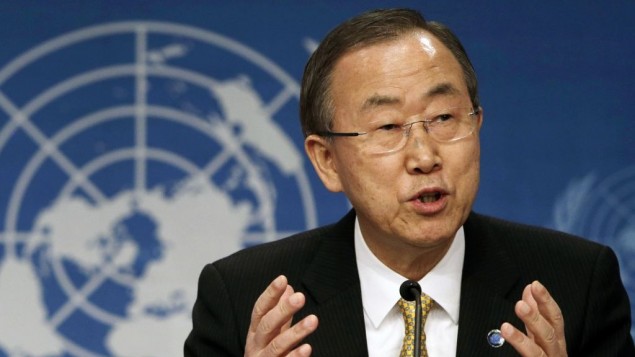
Switzerland-Syria-Pea_Horo-1-e1390433248668-635x357UN Secretary-General Ban Ki-Moon in Montreux, Switzerland, in January (photo credit: AP/Gary Cameron)

The US and UN condemned ongoing rocket fire into Israel Tuesday, amid calls for both sides to pull back escalating violence between Gaza-based Hamas and Israel on Tuesday.

United Nations Secretary General Ban Ki-moon Tuesday condemned the rocket attacks from Gaza and called on both sides of the conflict to halt aggressions.

Ban “reiterates his call on all actors to exercise maximum restraint and avoid further civilian casualties and overall destabilization,” his spokesman Stephane Dujarric said.

He added that Ban “condemns the recent multiple rocket attacks on Israel from Gaza” and that “these indiscriminate attacks on civilian areas must stop.”

Israeli strikes on Gaza Tuesday killed 15 people and wounded around 100, local emergency services said, as the military launched an aerial campaign against Hamas and other groups in the Strip.

Army figures showed that Gaza-based terror groups fired 130 rockets at southern Israel since midnight without causing any casualties, while the air force struck 150 “terror targets” in Gaza.

The United States Tuesday condemned Hamas rocket and said it was concerned for civilians on both sides after Israeli air strikes in Gaza killed 15 people.

White House spokesman Josh Earnest also urged Israeli Prime Minister Benjamin Netanyahu to keep a diplomatic channel open with Palestinians to resolve the crisis sparked by the murders of three Israeli teenagers and a Palestinian youth.

“We strongly condemn the continuing rocket fire into Israel and the deliberate targeting of civilians by terrorist organizations in Gaza,” Earnest said.

The spokesman also backed the Jewish state’s right to respond to the attacks.

“No country can accept rocket fire aimed at civilians, and we support Israel’s right to defend itself against these vicious attacks,” he said.

At the same time, Earnest said Washington was mindful of the plight of civilians caught in the crossfire between Israel and Hamas.

“This means both the residents of southern Israel who are forced to live under rocket fire in their homes and the civilians in Gaza who are subjected to the conflict because of Hamas’ violence,” he said.

In Cairo, Egypt’s foreign ministry condemned the Israeli raids. The country, which has brokered cease-fires between Israel and Hamas in the past, has thus far not gotten involved, according to reports.

Turkey called on Israel on Tuesday to “immediately” halt its strikes against Hamas.

“We are calling on Israel to immediately halt its attacks on Gaza,” the foreign ministry said in a statement.

It urged the international community, especially the United Nations, to step in and warn the Jewish state to abandon its policy of “collective punishment,” and called on all parties concerned to take lessons from the past and act with “restraint and common sense” to prevent an escalation of violence.

The Arab League called Tuesday for the UN Security Council to hold an urgent meeting to discuss the Israeli air campaign, Secretary General Nabil al-Arabi said.

An official from the pan-Arab bloc told AFP Arabi had “instructed the Arab League’s UN representative to initiate urgent consultations within the Arab group calling for an emergency security meeting of the Security Council.”

Arabi said he had been “in touch with [Palestinian Authority] president [Mahmoud] Abbas to follow the latest developments in the Gaza Strip” while also continuing “consultations with Arab foreign ministers on this subject.”

He denounced the “dangerous Israeli escalation” and warned against its humanitarian consequences in Gaza.

“The continued attacks on Palestinian civilians by Israel is a flagrant violation of international humanitarian law, the Geneva Convention and international resolutions on occupied Palestine,” said the Arab League chief.

Meanwhile, the 57-member Organization of Islamic Cooperation (OIC), announced it would hold an “extraordinary” ministerial meeting Thursday in the Saudi city of Jeddah to discuss the “intensifying and fierce Israeli campaign against Palestine.”

Abbas on Tuesday demanded Israel immediately halt its latest offensive.

“Palestinian president Mahmud Abbas demanded Israel immediately stop its escalation and the raids on Gaza,” said a statement from his office published shortly after midnight (2100 GMT), early Tuesday, by the official WAFA news agency.

He also asked the international community “to immediately intervene to halt this dangerous escalation which would lead the region to more destruction and instability.”

Abbas said the Palestinian leadership was making “intensive and urgent calls” to many Arab leaders in the hope of exerting pressure on Israel to deescalate the situation.


Hamas rocket attacks skyrocket as UN & Obama administration focus on “restraining” Israel

July 9, 2014

Hamas rocket attacks skyrocket as UN & Obama administration focus on “restraining” Israel, Human Rights Voices, July 8, 2014

(Please see also US backs Israeli ‘right to defend itself,’ UN chief condemns rockets. — DM)

gaza-rocket

Gaza rocket attacks from Hamas have escalated from 6 on June 27, 2014 to more than 160 on July 8, 2014. Targets include a day care center, summer camps, schools, and homes, the clear intention being to target and murder as many Jewish civilians as possible. The attacks follow days during which the UN and the Obama administration issued repeated calls for Israeli “restraint” – in effect attempting to diminish Israel’s essential right of self-defense.

In the latest salvo, UN Secretary-General Ban Ki-moon refuses to name the perpetrators of the attacks “from Gaza.” No mention is made of “Hamas.” And while the rockets should “stop,” what is really bothering the UNSG is alleged Palestinian victims. “The Secretary-General is extremely concerned at the dangerous escalation of violence, which has already resulted in multiple Palestinian deaths and injuries as a result of Israeli operations against Gaza.”

Instead of an Israeli right of self-defense, Ban Ki-moon “reiterates his call on all actors to exercise maximum restraint.” He goes even further and legitimizes Palestinian terrorism with his simultaneous complaint directed at Israel that “the unsustainable situation in Gaza will also need to be addressed in its political, security, humanitarian and development dimensions as part of a comprehensive solution.”

As for the notoriously anti-Israel UN High Commissioner for Human Rights Navi Pillay, she had this to say: “From a human rights point of view, I utterly condemn these rocket attacks and more especially I condemn Israel’s excessive acts of retaliation.”

More than half of Israel under Hamas rocket attack – from Beersheba up to Greater Tel Aviv. No casualties. Hamas tries smuggling terrorists in by tunnels and sea

July 8, 2014

More than half of Israel under Hamas rocket attack – from Beersheba up to Greater Tel Aviv. No casualties. Hamas tries smuggling terrorists in by tunnels and sea, DEBKAfile, July 8, 2014

GazaIsraelDebka (1)

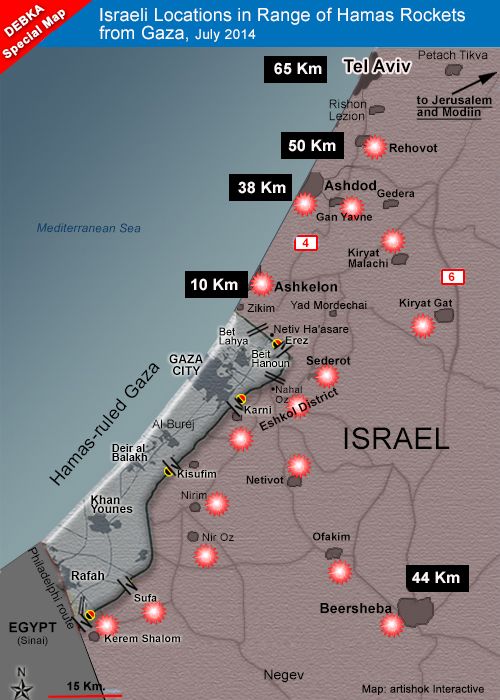
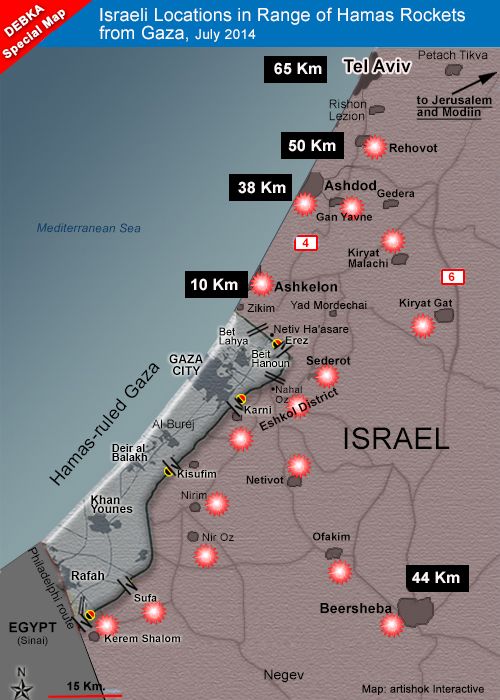
First Hamas rockets were fired or intercepted Tuesday night, July 8, over Jerusalem, Tel Aviv, Rishon Lezion, Givatayim, Raanana, Caesaria and Yavne, as well as southern Israeli cities. No casualties but a house was hit in North Jerusalem. Beyond shooting dozens of rockets, Hamas also made several attempts Tuesday, July 8, to smuggle terrorists into Israel for attacks. A Hamas naval commando which tried in the afternoon to land from the sea near Ashkelon’s Zikkim beach was repelled by an IDF coast guard. Later, another group of terrorists tried to creep into Israel through a tunnel running under the Kerem Shalom crossing. This was discovered when a tunnel exploded there under an Israeli military post. A large IDF force backed by tanks raked the entire area with fire in case of a network of hidden tunnels was serving Hamas to secretly transport terrorists to civilian locations in Israel. The people living there were told to stay at home and lock their doors.

A wide-ranging search continues in the Ashkelon coastal area in case Hamas terrorists made it through to land. Local roads are blocked.

During the day, the first Hamas rocket over Tel Aviv was blown up in mid-air by an Iron Dome battery after volley after volley hit southern and central Israel. .

In readiness for attack, public shelters were earlier opened in Tel Aviv, the beaches along the Mediterranean coast from the south to Netanyahu further north were cleared of bathers and Sdei Dov airport was been closed. Arrivals and departures of flights at Ben Gurion international and Eilat airports were thrown off schedule by Israeli Air Force sorties against Hamas in the Gaza Strip.

The IDF called up another 40,000 reservists Tuesday, July 8, after Prime Minister Binyamin Netanyahu ordered Operation Solid Rock expanded against mounting Palestinian rocket assaults – 100 by mid-afternoon. This was after Israel carried out dozens of air strikes Monday night, culminating during the day in raids that killed five leading Hamas operatives: Hamas Naval Commando chief Mahmoud Shaaban, 24, and three passengers were killed when their car was hit from the air. Another airborne raid bombed the Rafah home of Abdul Rahman Juda which served as a command and control center. Thirty Palestinians were injured.

Magen David Adom has treated nine people for minor injuries and anxiety attacks from emergency call centers in the southern and central Israeli regions under rocket attack.

The high-intensity rocket offensive from Gaza, now in its fourth week, has seriously disrupted normal life for millions of Israelis in the rocket-blasted regions – especially within a 40km radius from Gaza. Ashdod port has stopped working, major transport routes like the Ashkelon-Sderot railway halted, end-of-term exams in colleges postponed, children sent home from summer camps and social events called off.

DEBKAfile reported earlier Tuesday: Israeli finally launched its military operation Solid Rock against Hamas Monday night, July 7, after the Palestinians directed a steady stream of 100 rockets from Gaza to expanded targets as far as Rehovot, 50 km away. Most of the 50 IDF strikes were conducted from the air and two from the sea. Ten destroyed Hamas infrastructure facilities plus 4 private buildings which, according to the Palestinians, included the homes of the Hamas commander and a Democratic Front operative in Khan Younes, after Israel gave them advance warning. Hamas reported 17 injured – but kept on shooting rockets through the night and early Tuesday, threatening to further expand the range of their rocket fire.

The government and the IDF have billed the operation as a long-term, staged offensive to destroy Hamas’ logistical and strategic infrastructure, to be escalated stage by stage as needed, up to a limited ground incursion, which would require additional reserve call-ups, as well targeted assassinations. This progression will be adjusted to the enemy’s response and how quickly “quiet is restored to the South.”

The population has been forewarned that the contest may be protracted and asked to refrain from public events within a 40km radius from Gaza.

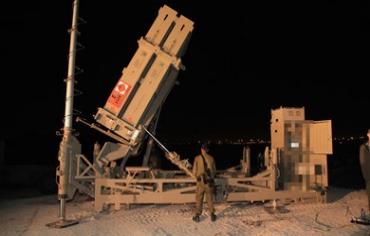
Iron Dome batteries are in place.

Israel’s security cabinet and the IDF command are counting on the prospect of losing its infrastructure deterring Hamas and persuading it to halt its rocket war on Israel.

But Hamas has its own game book and is unlikely to play by the rules dictated by Israel.

Both sides have therefore entered a dark corridor in which the two adversaries will try and outdo each other in damage. Israel began by limiting itself to air strikes. Hamas hit back with a mighty barrage of 100 missiles and expanding its range of targets.

The rules of Operation Solid Rock now require Israel to scale its response up to the next stage, in response to which Hamas will no doubt go for Tel Aviv. No one seems to know how this tit-for-tat duel will end.

The inherent weakness of the thinking behind Israeli military operation is that it requires the IDF to catch up with and undo the damage caused by Israel’s passivity after the three boys, Gil-Ad Shaer, Naftali Fraenkel and Eyal Yifrach, were kidnapped and murdered on July 12. The IDF’s campaign against its facilities on the West Bank left Hamas more confident than ever. In the space of a month, the Palestinian Islamists have maneuvered Israel into launching not one but two major operations – Brother’s Keeper to find the kidnapped boys and their abductors (who are still at large) and now Solid Rock – and they still hold the initiative against Israel, as well as the whip hand in the Palestinian movement.

They certainly owe their advantage in part to the atrocious murder by a handful of Israelis of the Palestinian boy Muhammad Abu Khdeir from Shuafat, Jerusalem. This was a gift which Hamas had never dreamed of. The Islamists have been able to assert control over and calibrate Palestinian fury across the board, in Gaza, the West Bank and the Israeli Arab community – a second front against Israel.

With all these cards stacked against Solid Rock, the IDF will have its work cut out to repair the damage and bring its operation to a successful conclusion.

On the diplomatic front, Israel suffered another letdown when Egyptian President Abdel-Fattah El-Sisi disappointed the hopes Prime Minister Binyamin Netanyahu had vested in him to intercede powerfully with Hamas for a ceasefire. El-Sisi decided that the Israeli-Hamas conflict was a minor episode in regional terms and no real threat to Egypt’s national interests and dropped his role as peace broker.

This was a bitter disappointment to Jerusalem. It left Israel facing the Palestinian aggressor alone, but for the Europeans. They are willing to assume this role, but they are seeking the restoration of the short-lived Palestinian reconciliation and a unity government, which is the direct opposite of Netanyahu’s most fervent objective.

First rockets over Jerusalem, Tel Aviv, Caesarea, Rishon. No casualties, Hamas tries sending terror squads into Israel through tunnels and by sea

July 8, 2014

First rockets over Jerusalem, Tel Aviv, Caesarea, Rishon. No casualties, Hamas tries sending terror squads into Israel through tunnels and by sea, DEBKAfile, July 8, 2014
GazaIsraelDebka

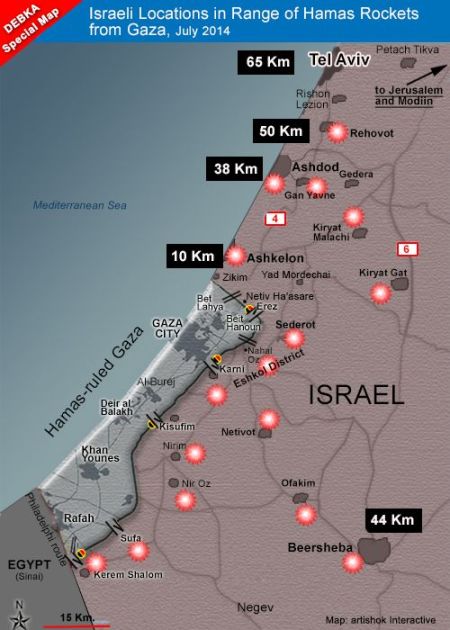
First Hamas rockets were fired or intercepted Tuesday night, July 8, over Jerusalem, Tel Aviv, Rishon Lezion, Givatayim, Raanana, Caesaria and Yavne, as well as southern Israeli cities. No casualties but a house was hit in North Jerusalem. Beyond shooting dozens of rockets, Hamas also made several attempts Tuesday, July 8, to smuggle terrorists into Israel for attacks. A Hamas naval commando which tried in the afternoon to land from the sea near Ashkelon’s Zikkim beach was repelled by an IDF coast guard. Later, another group of terrorists tried to creep into Israel through a tunnel running under the Kerem Shalom crossing. This was discovered when a tunnel exploded there under an Israeli military post. A large IDF force backed by tanks raked the entire area with fire in case of a network of hidden tunnels was serving Hamas to secretly transport terrorists to civilian locations in Israel. The people living there were told to stay at home and lock their doors.

A wide-ranging search continues in the Ashkelon coastal area in case Hamas terrorists made it through to land. Local roads are blocked.

During the day, the first Hamas rocket over Tel Aviv was blown up in mid-air by an Iron Dome battery after volley after volley hit southern and central Israel.

In readiness for attack, public shelters were earlier opened in Tel Aviv, the beaches along the Mediterranean coast from the south to Netanyahu further north were cleared of bathers and Sdei Dov airport was been closed. Arrivals and departures of flights at Ben Gurion international and Eilat airports were thrown off schedule by Israeli Air Force sorties against Hamas in the Gaza Strip.

The IDF called up another 40,000 reservists Tuesday, July 8, after Prime Minister Binyamin Netanyahu ordered Operation Solid Rock expanded against mounting Palestinian rocket assaults – 100 by mid-afternoon. This was after Israel carried out dozens of air strikes Monday night, culminating during the day in raids that killed five leading Hamas operatives: Hamas Naval Commando chief Mahmoud Shaaban, 24, and three passengers were killed when their car was hit from the air. Another airborne raid bombed the Rafah home of Abdul Rahman Juda which served as a command and control center. Thirty Palestinians were injured.

Magen David Adom has treated nine people for minor injuries and anxiety attacks from emergency call centers in the southern and central Israeli regions under rocket attack.

The high-intensity rocket offensive from Gaza, now in its fourth week, has seriously disrupted normal life for millions of Israelis in the rocket-blasted regions – especially within a 40km radius from Gaza. Ashdod port has stopped working, major transport routes like the Ashkelon-Sderot railway halted, end-of-term exams in colleges postponed, children sent home from summer camps and social events called off.

DEBKAfile reported earlier Tuesday: Israeli finally launched its military operation Solid Rock against Hamas Monday night, July 7, after the Palestinians directed a steady stream of 100 rockets from Gaza to expanded targets as far as Rehovot, 50 km away. Most of the 50 IDF strikes were conducted from the air and two from the sea. Ten destroyed Hamas infrastructure facilities plus 4 private buildings which, according to the Palestinians, included the homes of the Hamas commander and a Democratic Front operative in Khan Younes, after Israel gave them advance warning. Hamas reported 17 injured – but kept on shooting rockets through the night and early Tuesday, threatening to further expand the range of their rocket fire.

The government and the IDF have billed the operation as a long-term, staged offensive to destroy Hamas’ logistical and strategic infrastructure, to be escalated stage by stage as needed, up to a limited ground incursion, which would require additional reserve call-ups, as well targeted assassinations. This progression will be adjusted to the enemy’s response and how quickly “quiet is restored to the South.”

The population has been forewarned that the contest may be protracted and asked to refrain from public events within a 40km radius from Gaza.

Iron Dome batteries are in place.

Israel’s security cabinet and the IDF command are counting on the prospect of losing its infrastructure deterring Hamas and persuading it to halt its rocket war on Israel.

But Hamas has its own game book and is unlikely to play by the rules dictated by Israel.

Both sides have therefore entered a dark corridor in which the two adversaries will try and outdo each other in damage. Israel began by limiting itself to air strikes. Hamas hit back with a mighty barrage of 100 missiles and expanding its range of targets.

The rules of Operation Solid Rock now require Israel to scale its response up to the next stage, in response to which Hamas will no doubt go for Tel Aviv. No one seems to know how this tit-for-tat duel will end.

The inherent weakness of the thinking behind Israeli military operation is that it requires the IDF to catch up with and undo the damage caused by Israel’s passivity after the three boys, Gil-Ad Shaer, Naftali Fraenkel and Eyal Yifrach, were kidnapped and murdered on July 12. The IDF’s campaign against its facilities on the West Bank left Hamas more confident than ever. In the space of a month, the Palestinian Islamists have maneuvered Israel into launching not one but two major operations – Brother’s Keeper to find the kidnapped boys and their abductors (who are still at large) and now Solid Rock – and they still hold the initiative against Israel, as well as the whip hand in the Palestinian movement.

They certainly owe their advantage in part to the atrocious murder by a handful of Israelis of the Palestinian boy Muhammad Abu Khdeir from Shuafat, Jerusalem. This was a gift which Hamas had never dreamed of. The Islamists have been able to assert control over and calibrate Palestinian fury across the board, in Gaza, the West Bank and the Israeli Arab community – a second front against Israel.

With all these cards stacked against Solid Rock, the IDF will have its work cut out to repair the damage and bring its operation to a successful conclusion.

On the diplomatic front, Israel suffered another letdown when Egyptian President Abdel-Fattah El-Sisi disappointed the hopes Prime Minister Binyamin Netanyahu had vested in him to intercede powerfully with Hamas for a ceasefire. El-Sisi decided that the Israeli-Hamas conflict was a minor episode in regional terms and no real threat to Egypt’s national interests and dropped his role as peace broker.

This was a bitter disappointment to Jerusalem. It left Israel facing the Palestinian aggressor alone, but for the Europeans. They are willing to assume this role, but they are seeking the restoration of the short-lived Palestinian reconciliation and a unity government, which is the direct opposite of Netanyahu’s most fervent objective.
Iron Dome intercepts second rocket over greater Tel Aviv

July 8, 2014

Iron Dome intercepts second rocket over greater Tel Aviv, Jerusalem Post, July 8, 2014

For second time on Tuesday evening, Gaza terrorists launch rocket at central Israel; air raid sirens sounds in central Israel, blasts heard in Tel Aviv; Tel Aviv opens public bomb shelters; no injuries reported.

IDF 5th Iron Dome deploymentIDF deploys 5th Iron Dome Battery Photo: IDF SPOKESMAN’S OFFICE

For the second time on Tuesday evening, a rocket was launched at central Israel from the Gaza Strip.

An Iron Dome battery intercepted a projectile over the greater Tel Aviv area.

Sirens sounded in various cities in central Israel on Tuesday night and blasts were heard in Tel Aviv.

The air raid siren was activated in cities including Rishon Lezion, Bat Yam, Holon and Bnei Barak, but not in Tel Aviv.

Earlier on Tuesday evening, the Iron Dome rocket defense system intercepted a projectile near Tel Aviv over the city of Rishon Lezion, as air raid sirens sounded in central Israeli cities for the first time amid recent escalations.

No injuries or damage were reported in the attack, which marked a widening of the range of rocket fire the Gaza Strip.

Israeli television showed a double-burst of smoke in skies above Tel Aviv after air raid sirens sounded, sending residents running for shelter.

Air raid sirens sounded in all of Gush Dan, including Tel Aviv, Petah Tikva, Lod and Givatayim.

It was the first Gaza rocket that reached Tel Aviv since Operation Pillar of Defense in 2012.

Following the attack over central Israel, the Home Front Command instructed the Tel Aviv Municipality to open public bomb shelters in the city.

The Home Front Command had earlier instructed Tel Aviv residents to prepare for utilizing protected rooms and shelters in their private homes.

Under the same instruction, the division responsible for civil security ordered for bomb shelters in Tel Aviv schools to be opened.

The IDF launched Operation Protective Edge in the early hours of Tuesday morning in order to quell the ongoing barrage of rocket fire from the Gaza Strip. Later in the day, the IDF begun actively calling up 40,000 reserves approved to it by the cabinet.

Palestinian rocket fire from Gaza continued to pound southern Israel throughout Tuesday, with some 80 rockets landing in Israeli territory by the evening. Iron Dome made 23 interceptions throughout the day, shooting down projectiles over Ashdod, Ashkelon, and Gaza border communities.

Meanwhile, the Israel Air force struck 150 targets in Gaza, and Palestinians reported multiple casualties in a number of the strikes.

Some 100 underground rocket launchers and ten attack tunnels were among the targets.