Archive for July 2014

IAF Hits Rocket Launcher, Hamas Gathering

July 11, 2014

IAF Hits Rocket Launcher,

Hamas Gathering in GazaLatest Israeli airstrikes target launcher used to fire rockets at Tel Aviv and a gathering of Hamas terrorist in Gaza City.

By Elad Benari, CanadaFirst Publish: 7/11/2014, 11:10 PM

via IAF Hits Rocket Launcher, Hamas Gathering – Defense/Security – News – Arutz Sheva.


Light flare over Gaza after airstrike Flash 90
 

The Israel Air Force (IAF) on Friday night launched several airstrikes in Gaza, hitting the launcher from which rockets were fired towards Tel Aviv earlier in the evening.

A second airstrike targeted a gathering of Hamas terrorist in the Sajaiya neighborhood in Gaza City. Palestinian Authority media reported that several people were wounded in the attack.

The airstrikes are a part of Operation Protective Edge, which was in its fourth day on Friday.

Prime Minister Binyamin Netanyahu said on Friday afternoon that the operation will continue until rocket fire from Gaza terrorists stops.

“The pace of attacks in this operation is double that of Operation Pillar of Defense and the military strikes will continue until we can be certain that the quiet has returned to Israeli citizens,” declared Netanyahu, who made clear that “no terrorist target in the Gaza Strip is immune, but it must be pointed out that Hamas’s leaders, commanders and activists are hiding behind the residents of Gaza and they are responsible for any injury to them.”

IDF Chief of Staff Benny Gantz said on Friday that the operation will be widened as necessary.

“They made a mistake in Gaza in deciding to exert force against us. They understand that it was a great mistake. At this stage we are using all of our offensive means. On the other hand, we know there are civilians (in Gaza), Hamas has turned them into hostages,” said Gantz.

(Arutz Sheva’s North American Desk is keeping you updated until the start of Shabbat in New York. The time posted automatically on all Arutz Sheva articles, however, is Israeli time.)

‘In the end, we will have to go in’

July 11, 2014

‘In the end, we will have to go in’, Israel Hayom, Lilach Shoval, July 11, 2014

At this time no one can hedge when or how Operation Protective Edge will end, but a ground incursion seems unavoidable • Eradicating the robust terror infrastructure in the Gaza Strip cannot be done in one fell swoop, military officials say.

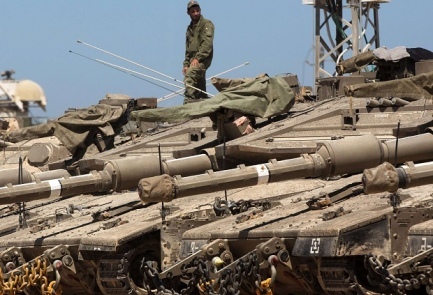
Israeli tanks deployedIsraeli tanks deployed on the Israel-Gaza Strip border | Photo credit: AFP

Without a trick up its sleeve or a fell swoop, Israel will have to bring ground forces into Gaza. Although a ground operation tends to become complicated and lead to casualties among the troops, the brilliant deterrent move from Operation Pillar of Defense cannot be done again without an incursion. It is impossible to threaten again without following through on the threat, since the threat then loses credibility. Army officials say that to maintain deterrence, Israel will be required to prove that it does not fear a ground operation in the Gaza Strip and bring troops inside, even if in a limited manner.

It has been a few days since the beginning of Operation Protective Edge in the Gaza Strip, and neither side can tell how much longer it will go on, or how it will end. Army officials are increasingly talking about how Israel will have no alternative but a ground incursion into the Gaza Strip, even a small and limited one.

There are many reasons for this. The first is that unlike 2008’s Operation Cast Lead and 2012’s Operation Pillar of Defense, Operation Protective Edge did not begin with a warning strike, such as the killing of a high-ranking figure or the destruction of Hamas’ long-term capabilities. This time, there was a gradual deterioration. It went from the kidnapping and murder of the three boys in Judea and Samaria to the army’s operation to find their bodies, with the terrible internal state of affairs in Gaza as a backdrop. All these things led Hamas to escalate its rocket fire at Israel.

What made Hamas finally take off the gloves this week was the killing of several of its operatives in a tunnel rigged with explosives that they had prepared in the Kerem Shalom area. On Monday evening, after several days of sporadic rocket fire and disregard of rebel groups, Hamas fired a barrage of rockets at Israel.

The decision to begin the operation was delayed for several days because the top security echelon wanted to avoid being dragged into a operation in Gaza of a larger scale than it had planned. Even after the decision was made to begin the operation, Israel, in an effort to keep a way open to end the operation quickly, announced a policy of “stages of using force” according to which Israel’s response would escalate according to Hamas’s action.

Hamas tried to surprise Israel in almost every way possible in an attempt to create a “picture of victory.” Among other things, it sent a special force of divers to infiltrate into Israel near Kibbutz Zikim to perpetrate a terror attack. Members of Hamas’ special forces also tried to use a tunnel rigged with explosives in Kerem Shalom. In addition, they launched shoulder-fired Strela and Igla missiles at Air Force aircraft. Their purpose in doing all this was to create a “picture of victory.” All their attempts failed.

In addition, Hamas fired rockets at Tel Aviv, later expanding its range of fire almost to Haifa in the north and Dimona in the east, hoping to strike the strategic “textile factory.” The rocket fire at these ranges confirmed Israel’s fears that Hamas had managed to smuggle working M-302 rocket into the Gaza Strip.

Just four months ago, Israel sent a vessel 1,500 kilometers (930 miles) away from Israel’s shores to prevent 40 of those rockets from reaching the Gaza Strip. It is very doubtful that Israel’s intelligence services could say with certainty that Hamas in Gaza had similar rockets in its possession.

Another problem is that Israeli intelligence has only partial information about the location of the long-range rockets, which makes it difficult to destroy them. The second limitation preventing the Air Force from attacking them is that some of these rockets are being kept near innocent civilians, and harming them would compromise Israel’s legitimacy for the operation in Gaza.

It cannot be done in one fell swoop

At the same time, Israel can take pride in its successes. Three years after the Iron Dome system intercepted its first rocket, the army already fully admits that it has strategic significance. Thanks to Iron Dome, of the hundreds of rockets fired at populated areas in Israel at a range of more than 10 kilometers from the Gaza Strip, only a few fell in urban areas.

In Operation Protective Edge, the Air Force’s aerial defense array reconstructed what it did during Operation Pillar of Defense. Seven Iron Dome batteries are deployed in the south of Israel, the center and the Judean Hills region.

Yet, as successful as it is, Iron Dome is a defense system that cannot be Israel’s winning ace in the Gaza Strip. Israel can continue attacking the Gaza Strip from the air, but it is important to remember that the number of targets that can be attacked without causing massive casualties among innocent civilians is limited, even if targets are “manufactured” during the fighting.

Without a trick up its sleeve or a fell swoop, Israel will have to bring ground forces into Gaza. Although a ground operation tends to become complicated and lead to casualties among the troops, the brilliant deterrent move from Operation Pillar of Defense cannot be done again without an incursion. It is impossible to threaten again without following through on the threat, since the threat then loses credibility. Army officials say that to maintain deterrence, Israel will be required to prove that it does not fear a ground operation in the Gaza Strip and bring troops inside, even if in a limited manner.

It seems at this stage that the ground incursion will be relatively limited and smaller than the one we saw in Operation Cast Lead. The security cabinet has allowed the army to call up 40,000 reserve troops. As of this writing, only part of that number was mobilized, and those who were called up were sent to replace regular troops in the north, south and center to free up the better-trained regular-army troops for the operation in the Gaza Strip.

It is also important to recall that a ground incursion into the Gaza Strip will not bring Hamas down. Although the incursion’s purpose is to claim a price from Hamas and apply pressure to it, Israel will try to make sure that the operation stays limited, and a limited operation will not topple Hamas from power. Army officials say that we must also consider that a ground incursion could also lead to trouble erupting in other areas, such as Judea and Samaria, where only recently we were painfully reminded of how explosive it was.

Defense establishment officials realize that the operation will not be able to end in military action alone. According to a senior officer, “There will not be a final bombardment after which they will wave a white flag. The military process must be combined with a political one. In claiming the price, the army needs to create conditions for the political echelon so that the political process will work.” The problem is that in the meantime, both sides are behaving as though they were under no pressure to end the operation by a specific time.

Obama’s Mixed Middle East Messages

July 11, 2014

Obama’s Mixed Middle East Messages, Commentary Magazine, July 11, 2014

Palestinians can be forgiven for thinking Obama’s mixed messages give them no reason to make their own hard decisions about embracing peace.

Israelis can also draw conclusions from America’s ambivalent attitude toward Hamas. While it’s not clear that any Israeli strike on Gaza will restore a sense of deterrence, Netanyahu would be wise not to base a decision about his country’s security on any assumptions about how to retain the good will of the Obama administration. Either way, they are very much on their own.


President Obama called Israeli Prime Minister Netanyahu and offered to help mediate a cease-fire with Hamasthat was accompanied by a statement of support for Israel’s right to self-defense. But Israel is not jumping at the proposal. And, as much as Israelis would love for the rocket attacks from Gaza to stop, that reluctance is well founded.

It’s still not clear if the Israeli ground operation that many have suggested is inevitable will actually take place. In a rare press conference held today, Netanyahu played his cards pretty close to his vest, merely saying that he will continue Israeli operations against Hamas terrorist bases in Gaza “until all quiet is restored to Israeli citizens.” But the assumption is that while the characteristically cautious Netanyahu is deeply reluctant to send troops into Gaza—a move that would likely cause casualties on both sides to spike—he also knows that merely letting Hamas stop shooting and then declare victory is not in Israel’s interest either.

Though Gaza is being pounded hard by strikes aimed at silencing the rocket attacks that have rained down by their hundreds on Israel in the last week without causing a single fatality, Hamas may well emerge as the victor in this exchange if it is allowed to exit the conflict with its rocket arsenal and infrastructure intact. More importantly, if, thanks to U.S. diplomacy, Hamas is allowed to remain inside the Palestinian Authority government and strengthened by its stance defying Israel, then the result will make it even less likely that PA leader Mahmoud Abbas will ever summon the will to break with the Islamists and make peace with the Jewish state.

The irony here is that even though Hamas is clearly losing the military battle in this contest of Israeli air power and missile defense against the terrorist rocket launchers, it believes it is winning the political battle. In its isolation after the fall of the Muslim Brotherhood government in Egypt and the sealing of the Gaza smuggling tunnels by the new military regime in Cairo, causing a severe cash-flow problem, Hamas was forced to embrace unity with Abbas’s Fatah. That exposed them to criticism from Palestinians who said they had given up the struggle against Israel but also offered the group a chance to strengthen its organization in the West Bank.

In the wake of the kidnapping and murder of three Israeli teenagers by Hamas operatives, Israel rounded up many of the group’s members on the West Bank. Hamas then stepped up the missile fire from Gaza that had never really stopped completely even after the latest cease-fire brokered by Egypt and the U.S. in 2012. But by starting what appears to be a new war, the Islamists have regained their credibility among Palestinians as the address for violence against Israelis, a quality that has always served as the principal credential for any party seeking their support.

That means Hamas gains ground—at least in a political sense—vis-à-vis Fatah no matter whether the Israelis invade Gaza. If the Israelis don’t strike back on the ground and a cease-fire leaves Hamas’s infrastructure and arsenal intact, it can claim victory. But even if the Israelis do attack and take out much of their armaments, they can also claim that they stood up to the Israelis and strengthened their claim of being a better exponent of Palestinian nationalism than Fatah in an environment that will have become more radicalized.

Where does the United States fit into this?

The problem with the president’s expressions of support for Israel is that they have also been accompanied not only by calls for “restraint”—which are rightly interpreted as a not-so-subtle demand that the Jewish state’s armed forces stand down—but by continuing ambivalence about Hamas’s presence in the PA government. Just this week Obama praised Abbas, who embraced Hamas as his partner in April, while pointedly snubbing Netanyahu. The U.S. has refused to cut aid to the PA even though U.S. law demands that it be shut down due to the Fatah alliance with Hamas.

While the Palestinians don’t need encouragement from the U.S. to cause them to embrace radical positions that make peace impossible, the mixed messages from Washington, including today’s offer of mediation with a group that even Obama’s State Department still classifies as a terror group, heightens Israel’s sense of isolation and makes it harder for the Jewish state to deter Hamas terror.

Deterrence is the key word here since the Israelis understandably have no appetite to a return to control of Gaza or even of toppling Hamas since they worry about which radical group would replace it. However, the goal of making it more difficult for Hamas to launch strikes such as the ones that have paralyzed Israeli life the past few days remains.

The Obama administration has strengthened security ties with Israel and been generous with military aid, a point that has re-emphasized the importance of the Iron Dome system. But it has accompanied that help with constant criticism and diplomatic maneuvering that has made it clear that Netanyahu cannot count on Washington’s support if he seeks to significantly weaken Hamas in Gaza.

Moreover, so long as the administration refuses to pressure Abbas to cut ties with Hamas, it is impossible to expect the so-called moderates of Fatah—whose members have joined in the launching of rockets from Gaza at civilian targets in Israel—to reject the Islamists or their determination to keep the conflict simmering. Indeed, it is a given that any cease-fire with Hamas will be followed by renewed American calls for Israeli withdrawal from the West Bank and other concessions. Rewarding Hamas for terror won’t convince either side to take risks for peace. In exchange for real peace, most Israelis would be willing to make painful sacrifices. But the latest bout of terrorism and the barrage of hundreds of rockets aimed at Israeli cities understandably make most citizens of the Jewish state reluctant to replicate the independent Palestinian state in all but name that exists in Gaza in the West Bank.

Palestinians can be forgiven for thinking Obama’s mixed messages give them no reason to make their own hard decisions about embracing peace.

Israelis can also draw conclusions from America’s ambivalent attitude toward Hamas. While it’s not clear that any Israeli strike on Gaza will restore a sense of deterrence, Netanyahu would be wise not to base a decision about his country’s security on any assumptions about how to retain the good will of the Obama administration. Either way, they are very much on their own.

House passes resolution to support Israel in face of rocket attacks

July 11, 2014

House passes resolution to support Israel in face of rocket attacks, The HillCristina Marcos, July 11, 2014

The House on Friday passed a resolution by unanimous consent to express U.S. support for Israel after rocket attacks from the terrorist group Hamas. 

Rockets launched into Israel were intercepted by Israel’s Iron Dome system near parts of Tel Aviv. Israel’s Defense Forces said that it had hit 160 terrorist targets in Gaza overnight on Wednesday. At least 44 people died in those attacks, according to reports.

Violence in the Middle East has escalated recently after the bodies of three kidnapped Israeli teenagers were found and a Palestinian teen was killed in an attack believed to be retaliatory.

House Foreign Affairs Committee Chairman Ed Royce (R-Calif.) said the resolution supported the U.S. commitment to Israel.

“Today, the House reaffirmed its support for Israel to take all necessary and appropriate action to defend its citizens,” Royce said in a statement. “With these threats arrayed against Israel, we will continue [to] stand with the Israeli people.”

Outgoing House Majority Leader Eric Cantor (R-Va.), the only Jewish Republican in Congress, said that the U.S. should condemn Iran for its role in the conflict between Israel and Hamas.

“I call on the Obama administration to dispense with the fantasy that Iranian President Rouhani is a reformer and acknowledge the Iranian regime for what it is: the world’s most active state sponsor of terrorism and a driver of regional instability,” Cantor said.


Egypt shuts border with Gaza, thwarts bid to smuggle rockets into Sinai

July 11, 2014

Egypt shuts border with Gaza, thwarts bid to smuggle rockets into Sinai

Israel still letting supplies into Strip; Hamas spokesman says Cairo’s conduct exposes ‘contempt and disregard for suffering of the injured

’By Elhanan Miller July 11, 2014, 8:01 pm

via Egypt shuts border with Gaza, thwarts bid to smuggle rockets into Sinai | The Times of Israel.


Palestinians walk toward the Egyptian border crossing with Gaza at Rafah, August 2012 (photo credit: AP)
 

Egypt closed the Rafah border crossing with the Gaza Strip on Friday, preventing ambulances and passenger buses from leaving. Israel, meanwhile, continues to maintain its commercial gateway open, allowing in fuel, food, and medical supplies.

Get The Times of Israel’s Daily Edition by email
and never miss our top stories Free Sign up!

Also Friday, Egyptian security forces said they thwarted an attempt to smuggle 20 Grad rockets from the Gaza Strip into the Sinai region. The projectiles were apparently meant to be used in attacks against Israel from the peninsula.

“The Egyptian authorities notified us a short while ago that they are shutting the Rafah Crossing, after it had been partially open on Thursday, without explaining the reasons,” wrote Gaza’s Interior Ministry spokesman Iyad El-Bozom on his Facebook page Friday morning.

“The Interior Ministry is sorry about this Egyptian move. After the Borders Authority had prepared passenger buses and ambulances waiting for the border gate to open, we were surprised by this move, which represents contempt and disregard for the suffering of travelers and the injured,” El-Bozom wrote.

Egypt has significantly reduced the number of travelers allowed to enter it from Gaza since the overthrow of Muslim Brotherhood President Mohammed Morsi in June 2013, opening the Rafah border crossing to passenger traffic only sporadically. According to Gisha, an Israeli NGO dealing with freedom of movement in Gaza, last October, for the first time, more residents of the Strip entered Israel through the Erez Crossing than entered Egypt, as Israel loosened its entry restrictions.


Members of Hamas’ security forces standing guard in front of the Rafah border crossing with Egypt in the southern Gaza Strip, September 16, 2013. (photo credit: AFP PHOTO/SAID KHATIB)
 

Egypt has not allowed for a commercial border crossing with the Gaza Strip, despite repeated pleas by Hamas to allow the free flow of commodities which would render smuggling tunnels superfluous.

Since the start of Operation Protective Edge on Tuesday, Israel has allowed approximately 200 trucks to enter the Gaza Strip on a daily basis through the commercial Kerem Shalom border crossing. The trucks carry fuel for cars and or the local power plant, food products, and medical supplies. According to Gisha, Israel is restricting the entry of other commodities such as clothes, shoes and paper.

According to the Coordinator of Government Activities in the Territories, the Kerem Shalom Crossing is currently operating under heavy security, after a Hamas terror tunnel was exposed and detonated not far from the crossing earlier this week.

Tel Aviv Targeted; Islamic Jihad Claims Attack

July 11, 2014

Tel Aviv Targeted by Rockets Again; Islamic Jihad Claims Attack

Iron Dome intercepts Gaza rockets fired at Tel Aviv and Ashdod.

Islamic Jihad claims it targeted PM Netanyahu in Tel Aviv attack.

By Elad Benari, CanadaFirst Publish: 7/11/2014, 8:29 PM

via Tel Aviv Targeted; Islamic Jihad Claims Attack – Defense/Security – News – Arutz Sheva.

Tel Aviv Reuters
 

A siren was heard on Friday evening in central Israel, including in Tel Aviv and the region, sending residents to protected spaces.

Shortly afterwards, a rocket that was fired from Gaza was intercepted over Holon, near Tel Aviv, by the Iron Dome anti-missile system.

A barrage of rockets was later fired towards southern Israel. At least five rockets were fired towards Ashdod, where a rocket hit a gas station Friday morning.

Two rockets were intercepted by Iron Dome. Three other rockets exploded in open areas.

According to Army Radio, the Islamic Jihad claimed responsibility for the rocket attack on Tel Aviv.

The terrorist organization said in a statement that it purposely fired the rocket while Prime Minister Binyamin Netanyahu was giving a speech about Operation Protective Edge, in order to harm the Prime Minister and his staff.

Meanwhile, two rockets exploded in open regions in the Sdot Negev region of southern Israel shortly after 8:20 p.m.

The rockets did not cause physical injuries or damages.

True colors revealed in war – The Washington Post

July 11, 2014

True colors revealed in war – The Washington Post.

July 11 at 11:14 AM

We see individuals’ true colors in a crisis, artifice is swept away.


President Barack Obama shakes hands with Palestinian President Mahmoud Abbas during their meetingat the White House in March. (Pablo Martinez Monsivais/Associate Press)

Take for example Iran, which President Obama believes can be trusted to retain “a little” enrichment capacity. The so-called “moderate” Iranian President Hassan Rouhani declares, “Helping the oppressed Palestinians and preventing the Zionist regime from carrying out its atrocities is the responsibility of the international organizations and the freedom-loving countries of the world. The Palestinian nation, which is difficult to defeat, will undoubtedly once again defeat the Zionist regime.” He is speaking of the Iran-supplied and -funded Hamas and the wholly owned Iran terrorist subsidiary Palestinian Islamic Jihad, another terror outfit in Gaza.

And the “man of peace,” according to Obama? Well, Palestinian Authority President Mahmoud Abbas accuses Israel of genocide while Fatah maintains its relationship with the pro-genocide group Hamas. The Times of Israel reports, “A short video clip posted on the Fatah movement’s official Facebook page Thursday glorified a female army unit training to launch rockets at Israel and presented suicide bombers as role models for the Palestinian population. In the video, a group of Palestinian women are seen training, assembling and setting up rockets, shooting and engaging in physical training. A narrator explains that the female fighters have ‘willpower stronger than mountains,’ and that they ‘strive to become an important part of the path of Jihad and the struggle — the path walked by Dalal Mughrabi, Hanadi Jaradat and Reem Riyashi.’ Mughrabi, Jaradat and Riyashi all carried out deadly terror attacks against Israeli civilians and soldiers.”

In the United States, so-called “peace groups” continue to advocated boycotts, divestments and sanctions against Israel and blame Israel for the current conflict. No BDS effort is directed toward Gaza; to the contrary, they demand that the obviously insufficient blockade intended to keep weapons out of Gaza be lifted.

The Egyptian government also shows what a difference a coup can make. The now military-led government, unlike its Muslim Brotherhood predecessor, is working to destroy and close terrorist tunnels in Gaza. It reports having thwarted a smuggling attempt to take weapons from Gaza into the Sinai.

Israel calculates that three-fourths of the population has had to go to bomb shelters, but there is no panic and the political parties are united in support of the military campaign. For a country entitled to have “war fatigue,” Israelis exhibit none and remain steely-eyed, using gallows humor to maintain their emotional equilibrium. The Israeli army has destroyed some 2,000 Hamas rockets but continues to send out warnings ahead of strikes to try to minimize civilian casualties.

It is not hard here to figure out who stands on the side of death and who stands in defense of civilization itself. It’s also not hard to see how wildly unrealistic the Obama administration has been about the intentions and nature of the PA, about Iran’s “moderate” leader and about Israel’s predicament. It’s revealing of the moral wasteland in the Oval Office that in his first and very belated conversation with the Israeli Prime Minister, Obama is already angling for a cease fire. In other words, Obama would prefer Israel not eradicate the Iranian-backed terrorist threat. But unlike Obama, Netanyahu won’t “end” a war until his country’s national security objectives are obtained. He knows that ending a war without destroying the other side’s war-making capabilities is not peace but an invitation to more wars.

In a crisis like this you know the essential nature and intentions – for better or worse — of the players on the world stage.

Netanyahu: Gaza conflict proves Israel can’t relinquish control of West Bank

July 11, 2014

Netanyahu: Gaza conflict proves Israel can’t relinquish control of West Bank

Citing John Kerry by name, PM says he knows best about keeping Israel safe, and won’t allow West Bank to become ‘another 20 Gazas’

By Times of Israel staff July 11, 2014, 7:49 pm

via Netanyahu: Gaza conflict proves Israel can’t relinquish control of West Bank | The Times of Israel.

Prime Minister Benjamin Netanyahu. (Photo credit: Tomer Neuberg/Flash90)
 

Israel’s Prime Minister Benjamin Netanyahu on Friday vowed to fight Hamas and other Gaza terror groups until Israel was safe from the threat of missile attack, and then launched a highly unusual and extremely bitter verbal assault on would-be peace-brokers, including US Secretary of State John Kerry, who have been urging Israel to relinquish security control of the West Bank to a Palestinian state.

Speaking to the Israeli public on the fourth day of Israel’s Operation Protective Edge, which he said has seen Israel attack “over 1,000″ terror targets while sustaining hundreds of rocket attacks from Gaza, Netanyahu vowed that the IDF campaign “will continue until we are sure that Israel’s residents have quiet.” He said that no terrorist target was off-limits, and accused Hamas’s leaders and gunmen of “hiding behind Gaza’s residents” — using them as human shields — and thus being responsible “for any harm that comes to them.”

While Israel did everything to protect its citizens, he said, and had “spent billions to protect the homefront” in recent years, Gaza’s terror groups deliberately put Gazans “in harm’s way.” Israel does its utmost not to harm Gaza’s civilians while targeting the terrorists, while Hamas targets Israel’s civilians, he said.

Netanyahu said he had made this point in conversations with a series of world leaders, including Presidents Barack Obama and Vladimir Putin, in recent days, and that all the world leaders with whom he spoke understood Israel’s imperative to act. “No state would allow its citizens to be targeted without a harsh response,” he said.


Prime Minister Benjamin Netanyahu (right) and Russian President Vladimir Putin in Jerusalem on June 25, 2012 (photo credit: Marc Israel Sellem/Pool/Flash90)
 

He also vowed that “no international pressure will prevent us from acting with all force against a terrorist organization that seeks to destroy us” and that he would take whatever action was necessary to protect Israelis.

He said he had encountered “lots of good will” from world leaders, and that he had asked them, “Would you tolerate missile attacks on London, Washington, Paris, Berlin and Moscow? Of course not.”

Asked if he was interested in a ceasefire, Netanyahu said, “We are in the midst of a struggle” and that it would end only when his goal of guaranteed, long-term calm had been achieved.

He praised the success of the Iron Dome missile defense system — which has intercepted about 100 Gaza rockets heading into residential areas this week — calling it “an immense asset” and “proof of Israel’s technological supremacy.” And he said his ultimate goal was to protect all of Israel from missiles of all ranges. He praised Israelis’ resilience, as most of the country has found itself within the range of Hamas’s extended missile capabilities over the past few days.

Departing from his prepared text to take questions, Netanyahu said Israel was “weighing all possibilities” for expanding the campaign against Hamas in Gaza, including the possibility of a major ground offensive. “We’ve prepared for all options… That’s what I told the army to do, and it has done so… My uppermost consideration is to restore quiet for all of Israel’s citizens in all of Israel’s cities. I will do whatever is necessary to achieve that goal. Beyond that, I cannot go into details.”

At present, Hamas continues to attack, he noted. “You see it. You hear it. You all live it,” he said. “Five million Israelis are in rocket range right now. So when they fight us, we fight them.”

Indeed, precisely as Netanyahu was speaking, Hamas launched a rocket barrage at central Israel, apparently seeking to embarrass him. There were no immediate reports of damage or injuries.

Netanyahu then expanded the scope of his press conference to talk about the rise of Islamic extremism across the Middle East. He said Israel finds itself in a region “that is being seized by Islamic extremism. It is bringing down countries, many countries. It is knocking on our door, in the north and south. We will defend ourselves on every front, defensively and offensively. Nobody should mess with us.”

While other states were collapsing, said Netanyahu, Israel was not — because of the strength of its leadership, its army and its people.

He then used the dangers posed by Hamas in Gaza to underline his opposition to security concessions urged by Kerry and the international community in the West Bank. Since Israel pulled out Gaza in 2005, a move he opposed, Hamas had created a terrorist bunker there. “So we have to take care of Hamas.”

But at the same time, Israel had to ensure that “we don’t get another Gaza in Judea and Samaria” — the biblical name for the West Bank.

Amid the current conflict, he elaborated, “I think the Israeli people understand now what I always say: that there cannot be a situation, under any agreement, in which we relinquish security control of the territory west of the River Jordan” — a reference to the Jordan Valley and the West Bank — as Kerry had urged during a US-led peace effort that collapsed in April.

Citing by name both Kerry and the US security adviser Gen. John Allen, who was charged by the secretary of state to draw up security proposals that the US argued could enable Israel to withdraw from most of the West Bank, including the Jordan Valley, Netanyahu said passionately, “I told John Kerry and General Allen, the Americans’ expert: We live here, I live here, I know what we need to ensure the security of Israel’s people.”


General John Allen (photo credit: US Department of Defense/Wikimedia Commons)
 

He said the current conflict also underlined the importance of retaining territory, noting that Hamas had tunneled relentlessly under Gaza’s borders with both Egypt, for smuggling purposes, and Israel, for terrorism purposes. “If we were to pull out of Judea and Samaria, like they tell us to, there’d be a possibility of thousands of tunnels” being dug by terrorists to attack Israel, he said. There were 1,200 tunnels dug in a 14-kilometer stretch between Egypt and Gaza alone, which Egypt had sealed, he noted.

“Adjacent territory has huge importance,” Netanyahu said, and could be used by terrorists to dig tunnels and to fire rockets. The closer terrorists can get to Israel’s borders, he said, the more rockets they fire — as the current conflict was proving.

“At present we have a problem with the territory called Gaza,” the prime minister said. But he noted that the West Bank is 20 times the size of Gaza, and vowed that he was not prepared “to create another 20 Gazas” in the West Bank.


Prime Minister Benjamin Netanyahu and US Secretary Of State John Kerry speak to the press in Jerusalem. Sunday, September 15, 2013 (photo credit: Emil Salman/Pool/Flash90)

Netanyahu: IDF offensive in Gaza to continue until quiet is restored in south

July 11, 2014

Netanyahu: IDF offensive in Gaza to continue until quiet is restored in south | JPost | Israel News.

07/11/2014 18:25

When asked whether Israel was preparing a ground invasion, Netanyahu said, “We are preparing all options.”

Prime Minister Binyamin Netanyahu

Prime Minister Binyamin Netanyahu at the weekly cabinet meeting on Sunday, June 22, 2014. Photo: MARC ISRAEL SELLEM/THE JERUSALEM POST

Operation Protective Edge will continue until the quiet is restored, Prime Minister Binyamin Netanyahu said Friday, minutes before Shabbat, after holding high-level security deliberations in Tel Aviv.

Netanyahu, who took questions from reporters for the first time since the operation, would not reveal when or whether a ground operation inside Gaza would begin.

“We are weighing all possibilities, and are prepared for all possibilities,” he said, adding that everyone understands that he cannot give details of tactical decisions.

A calm Netanyahu said that the terror kingdom Hamas set up in Gaza – where there are not only thousands of rockets, but also well over a thousand tunnels – will not be allowed to be replicated in the West Bank.

“We need to understand one fact, we are living in a Middle East that is being taken over from radical Islam, leading to the collapse of a number of counties, and is knocking on our doors, both in the and the south.”

In addition to dealing with Hamas, he said, “I say we cannot allow a situation where we get Gaza in Judea and Samaria.”

“Today I think that Israel’s citizens understand why I say all the time, that there cannot be a situation in any agreement that we will give up security control from the Jordan River westward,” he said.

“I don’t want to create another 20 Gazas in Judea and Samaria,” he added.

“Those who say that territory has no importance, look how much importance there is,’ he said. “In a contiguous territory, you can build tunnels.”

If Israel would leave the West Bank completely, he said, there would be the possibility of thousands of tunnels burrowing into Israel. “There are 1,200 tunnels in the 14 kilometers between Egypt and Gaza,” the prime minister revealed, adding that Egypt has sealed most of them.

He said the tunnels illustrate that territory “has tremendous importance.”

Netanyahu said that the IAF has so far hit more than 1,000 Hamas and Islamic Jihad targets, and that the “military blow” will continue until Israel is sure that that the quiet is restored.

Netanyahu did not spell out any conditions for a cease fire, or give any indication about whether a third party was now involved in trying to broker one.

The prime minister did not stray from the goal he set out for the operation from the very beginning: to restore quiet. He did not widen the goal to destroying Hamas or re-taking Gaza.

Netanyahu, who spoke overnight with US President Barack Obama, and has spoken over the last few days with numerous world leaders, said that “no international pressure will prevent us from acting with all our strength against a terrorist organization that calls for our destruction.”

Netanyahu said that there is an understanding for Israel’s actions among the leaders, and that the slow and measured manner in which Israel entered the operation was due not only to operational considerations, but also to create an international atmosphere that would understand why Israel felt the need to hit Hamas, as it is doing.

“All the leaders understand our need to act,” he said. “I also asked them what they would do. Would they be willing to absorb a rocket barrage attacks on London, Washington, Paris and Moscow? Of course not.”

Regarding an exit strategy, Netanyahu said that he will finish the operation when the goals are achieved, and the primary goal is to restore the quiet to Israeli citizens.

Netanyahu also sent a warning to Hezbollah, saying that Israel would act aggressively against any others who will fire missiles on Israel. “I would not recommend anyone to test us,” he said.

Netanyahu was full of praise for the country for its “fortitude,” and for Iron Dome. He said that over the years his governments have sp

Netanyahu says Gaza operation will not cease until missile threat is over

July 11, 2014

Netanyahu says Gaza operation will not cease until missile threat is over

PM: No amount of world pressure will prevent Israel from hitting Hamas;

rockets launched at greater Tel Aviv area; over 2,000 projectiles destroyed over past 4 days of operation,

military says; man severely injured in Ashdod rocket attackBy Ricky Ben-David, Lazar Berman and Haviv Rettig Gur July 11, 2014, 2:10 am

via Netanyahu says Gaza operation will not cease until missile threat is over | The Times of Israel.


An Israeli soldier sleeps on a mobile artillery unit at a position on the Israel-Gaza border, Friday, July 11, 2014. (AP Photo/Lefteris Pitarakis)
 

Operation Protective Edge entered its fourth day on Friday. By nightfall Thursday, over 350 rockets had been fired at Israel, about 90 of them intercepted by Iron Dome, and the Israeli Air Force had carried out almost 900 airstrikes on the Gaza Strip. By midday Friday, Palestinian reports said at least 100 Palestinians had been killed. Ceasefire offers are ‘irrelevant’ at this stage, says Israel, because Hamas continues to fire. Chief of Staff Gantz says the IDF is waiting for orders to commence a ground operation, as it masses increased forces on the Gaza border. The Times of Israel is liveblogging events as they unfold. (Wednesday’s liveblog is here.)


