Archive for July 2014

The battle in Saja’iyya is not just against Hamas and Islamic Jihad

July 21, 2014

The battle in Saja’iyya is not just against Hamas and Islamic Jihad, Ynet News, July 21, 2014

Analysis: As the IDF tackles the heart of the terrorist groups’ presence in Gaza, Israel can also give a lesson in deterrence to Hezbollah and other enemies of Israel that may soon be on its doorstep.

Most of the fighting in Gaza is now in the suburb of Saja’iyya. On both Saturday and Sunday nights, Golani Brigade soldiers, primarily patrol troops, fought multiple battles with terrorists, as they worked to uncover the terrorist infrastructure.

And although Hamas is trying to spring some surprises in other sectors too – such as the infiltration Monday morning from northern Gaza – Saja’iyya is now the almost exclusive focus of the fighting on the ground. It has been identified as a hotspot for terrorism of all kinds and at all levels, both logistical and operational.

The moment the IDF went in there, Hamas and Islamic Jihad were delivered direct blow to the solar plexus. It is not by chance that rocket fire at distances of more than 40 km ceased shortly after the fighting in Saja’iyya began.

While a few tunnels shafts have also been exposed, but a third of the infrastructure in the area is still intact, and there is a lot of work still to do. As such, Defense Minister Moshe Ya’alon is under political pressure from heads of the communities surrounding Gaza not to end the operation before they can be assured that the tunnels have been dealt with, a move in line with his own comments on the situation Sunday night.

As Saja’iyya is the operational and logistical center for the two major terrorist organizations in the Gaza Strip (primarily because of its proximity to Israel’s Gaza-area communities, and the possibility it offers for firing on the central region), Hamas and Islamic Jihad have a significant presence there. This is quite different to their presence in, for example, the nearby Beit Lahiya, Beit Hanoun and Zeitoun neighborhoods; only Jabaliya and al-Shati are they stronger.

As noted by Nahum Barnea, Saja’iyya is to Hamas more or less what Bint Jbeil in southern Lebanon was to Hezbollah in the Second Lebanon War – both a symbol and a military stronghold. The destruction in Saja’iyya that I see in the pictures reminds me very much of what I myself saw in Bint Jbeil in 2006.

So the battle of the Gaza Strip will not be decided in Omar al-Mukhtar Square in the center of Gaza City, but in Saja’iyya. When the IDF completes its mission there – and if the political leadership gives it the time and freedom to act – Golani troops, backed by engineering and armored units, will be the decider.

If it is at all possible to have a deciding factor in a war against terrorism and guerrilla warfare, this will be the place.

Let’s put things into clearer perspective: What is at stake in Saja’iyya are not just the shafts from terror tunnels and the subterranean warfare system, nor is solely about the rocket launching systems. This is a battle for hearts and minds.

The IDF will make every effort to clearly demonstrate its can fight terrorism and win, thereby cementing itself in the enemy’s psyche as a beast one should not provoke.

And this objective is the essence of the deterrence that Israel is seeking, not just against Gaza but also against Hezbollah, and perhaps the global jihad organizations that may reach its borders to the north and the east. As such, the battle in Saja’iyya is critical and fateful; Hamas and Islamic Jihad know it too, and it will be bitter.

One ray of light is that in Golani, commanders live – and, sadly, die – by the principle that can be summed up in one shout: “Follow me!”

US Support Wavering? Obama Has ‘Serious Concern’ Over Gaza Casualties

July 21, 2014

US Support Wavering? Obama Has ‘Serious Concern’ Over Gaza Casualties, The Jewish PressHana Levi Julian, July 21, 2014

(A not yet viral rumor that President Obama intends to dispatch a brigade of his most persuasive unicorns to Gaza to discuss civilian casualties with Hamas, et al, has not yet been confirmed. However, his unicorn offensive may follow collapse of the cease fire negotiations Secretary Kerry hopes to play with advance. — DM)

Secy of State John Kerry is on his way to the region to begin efforts to force another ‘cease fire’ down Israel’s throat before the threat from Hamas is ended.

Obama-on-phone-aboard-Air-Force-OneUS President Barack Obama speaking on phone aboard Air Force One, July 17, 2014. Photo Credit: White House.gov

Israel’s ‘strongest supporter’ is already wavering. Doubts about the wisdom of continuing Operation Protective Edge are being expressed from the White House as soon as the IDF struck a decisive blow in a Gaza neighborhood where Hamas terrorists stored some of their most deadly missiles. The ordnance was, of course, stashed under civilian buildings — a mosque, a hospital, a children’s playround, and more.

For three days the IDF dropped flyers, called homes and sent SMS text messages warning residents to leave the area so they would not be harmed when the attack began. Hamas pressured its people not to. Some had the sense to flee the area, and others chose to remain as human shields. The brutal, bloody firefight in Seijaiya cost a lot of lives on both sides and panicked leaders around the world — including officials in the White House.

In his second call to Prime Minister Binyamin Netanyahu since Friday, U.S. President Barack Obama expressed “serious concern about the growing number of casualties” in Gaza.

Israel’s prime minister was also notified during the call that Obama was sending Secretary of State John Kerry back to the region. Kerry was boarding a plane to head for Cairo, where he would pressure Israel and Hamas to negotiate another cease fire.

According to a statement issued by the White House, the move was aimed at helping ‘protect civilians in both Gaza and Israel.’ United Nations Secretary-General Ban Ki-moon, meanwhile, has called on Israel to “exercise maximum restraint and do far more to protect civilians” without specifying exactly how the IDF should accomplish that task. He also called on Hamas to end its rocket fire from Gaza.

The IDF drops flyers warning civilians in every target neighborhood prior to an attack, calls homes and sends SMS text messages asking residents to leave the area hours and sometimes days before carrying out operations – all of which puts its own forces in danger and of course alerts the enemy to its plans. Not one armed force of any other nation in the world does the same.

Ban Ki-moon weighs long-term humanitarian ceasefire

July 21, 2014

Ban Ki-moon weighs long-term humanitarian ceasefire, Times of IsraelAvi Issacharoff, July 21, 2014

UN chief has plan based on Egyptian ceasefire, but for now, few are on board

The Hamas spokesman in Gaza, Sami Abu Zuhri, said Monday that the international efforts are meant to “save the defeated occupation. The Resistance will not respond to pressure, and will impose its demands.”

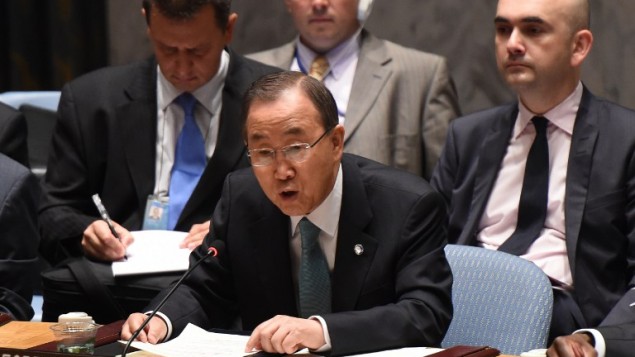
Ban Ki Moon JulyUnited Nations Secretary-General Ban Ki-moon addresses the United Nations Security Council during an emergency meeting in New York to discuss the situation in the Middle East, July 10, 2014. (photo credit: Don Emmert/AFP)

UN Secretary-General Ban Ki-moon is weighing the possibility of announcing on Tuesday in Cairo a long-term humanitarian ceasefire, in the presence of Palestinian Authority President Mahmoud Abbas and US Secretary of State John Kerry, Palestinian sources told The Times of Israel.

Ban plans to first present an initiative based on the Egyptian ceasefire proposal, with the addition of Egypt giving security guarantees for the opening of the Rafah crossing, with PA forces present. In addition, Gaza residents would enjoy the easing of restrictions on goods coming into the Strip from Israel. There would be a mechanism to transfer the salaries of Hamas government clerks in an organized fashion, distinguishing between those who worked in Hamas’s civil offices and those who work in its military wing.

But it’s not clear that the UN chief’s plan will be implemented. For now, there is no Egyptian agreement about border crossing guarantees, and Cairo again demanded that Hamas first stop firing, and only after would the other issues be discussed. Hamas is not responding positively to the initiative, either. It is still unclear whether Ban will declare his ceasefire on Tuesday.

But the UN secretary-general did manage to convince Abbas during their meeting to join his call for the truce.

In order to advance the initiative, Ban is expected to arrive in Israel Tuesday, after he met Sunday with Abbas and Qatar’s emir, Hamid bin Khalifa II. Ban will arrive Monday in Cairo to meet with President Abdal-Fattouh el-Sissi, at the same time US Secretary of State John Kerry arrives.

State Department Spokeswoman Jen Psaki said Sunday that the US is “deeply concerned about the risk of further escalation, and the loss of more innocent life.” She also said that her government believes that a ceasefire should begin as soon possible, based on the November 2012 understandings reached after Operation Pillar of Defense.

She added that Kerry is working to advance the Egyptian ceasefire framework, and will arrive in the region for that purpose.

In New York, the UN Security Council expressed “serious concern” about Gaza’s rising civilian death toll and demanded an immediate end to the fighting following an emergency session.

The Hamas spokesman in Gaza, Sami Abu Zuhri, said Monday that the international efforts are meant to “save the defeated occupation. The Resistance will not respond to pressure, and will impose its demands.”


Palestinians: The Arabs Betrayed Us – Again

July 21, 2014

Palestinians: The Arabs Betrayed Us – Again, Gatestone InstituteKhaled Abu Toameh, July 21, 2014

Since 1948, the Arab countries and government have been paying mostly lip service to the Palestinians.

“They have money and oil, but don’t care about the Palestinians, even though we are Arabs and Muslims like them. What a Saudi or Qatari sheikh spends in one night in London, Paris or Las Vegas could solve the problem of tens of thousands of Palestinians.” — Abdel Bari Atwan, Palestinian editor.

“Some Arabs were hoping that Israel would rid them of Hamas.” — Ashraf Salameh, Gaza City.

“Some of the Arab regimes are interested in getting rid of the resistance in order to remove the burden of the Palestinian cause, which threatens the stability of their regimes.” — Mustafa al-Sawwaf, Palestinian political analyst.

“Most Arabs are busy these days with bloody battles waged by their leaders, who are struggling to survive. These battles are raging in Yemen, Syria, Iraq, Egypt, Libya and the Palestinian Authority.” — Mohammed al-Musafer, columnist.

“The Arab leaders don’t know what they want from the Gaza Strip. They don’t even know what they want from Israel.” — Yusef Rizka, Hamas official.


Every now and then, the Palestinians are reminded of the fact that most Arabs don’t care about them and their problems.

Arab “indifference” and “silence” toward the current war between Israel and Hamas has once again reminded Palestinians of the “betrayal” by their Arab brethren.

It is not that Palestinians were expecting the Arab countries to send their armies to fight Israel and prevent an IDF ground invasion of the Gaza Strip.

Moreover, Palestinians say they were not even expecting the Arab governments to send money and medicine to thousands of families inside the Gaza Strip.

The Palestinians in general and Hamas in particular feel that the Arab world simply does not care about them and does not even want to hear from them.

Some Palestinians argue that the Arab world was perhaps too busy with the 2014 Mondial [Soccer World Cup] or Ramadan feasts to pay enough attention to the war in the Gaza Strip. But the Mondial has ended and most Arabs still don’t seem to be interested in what is going on between Palestinians and Israel.

True, there have been some marches in a number of Arab countries in solidarity with the Palestinians and in protest against the war in the Gaza Strip. Still, Palestinians say they are still disappointed at the small number of participants. They are also disappointed that the Arab governments had moved quickly to suppress any show of support for Palestinians.

“The Arab regimes hate us and this is not new,” said Palestinian political analyst Ali Hableh. “It took Saudi Arabia seven days to issue a statement condemning the current Israeli attack on the Gaza Strip. Palestinians have always known that they could never rely on their Arab brothers who have turned their backs on us.”

For Hableh and many Palestinians, the Arab “betrayal” dates back to 1948, when the state of Israel was created. They are convinced that Arab “collusion” and “treason” contributed to the defeat of the Arab armies and the subsequent creation of Israel.

Since then, the Arab countries and governments have been mostly paying lip service to the Palestinians.

And this is what is exactly happening these days, Palestinians point out.

Almost every Palestinian is today talking about the sense of betrayal by the Arab world. It is a feeling that has increased Palestinians’ hostility and mistrust toward their Arab brethren.

Palestinian cartoonist Umaya Juha expressed Palestinian feelings toward the Arab “betrayal” in a drawing that shows an Arab and Islamic arm stabbing a Palestinian woman from the back – while she had also been stabbed in the chest by Israel.

Prominent Palestinian editor Abdel Bari Atwan said it was “shameful” for the Arabs that the UN Security Council convened to discuss the Israeli military offensive in the Gaza Strip before Arab foreign ministers gathered in Cairo.

The Palestinians, he said, have given up on the Arab leaders and governments a long time ago. He also accused the Arab governments of starving the Palestinians and participating in the blockade on the Gaza Strip.

“The Palestinian people’s problem with their Arab brothers is much bigger than their problem with the Israelis,” Atwan explained. “The Palestinians can resist Israel and fire rockets at it, but they don’t want to do the same against their Arab executioners because they continue to regard them as brothers.”

A Palestinian human rights activist in the West Bank also talked about the “historic” betrayal of the Arabs.

“We never expected anything good from the Arabs,” he said. “They have money and oil, but don’t care about the Palestinians even though we are Arabs and Muslims like them. What a Saudi or Qatari sheikh spends in one night in London, Paris and Las Vegas could solve the problem of tens of thousands of Palestinians. Only an idiot would have expected the Arab world to rise against Israel for attacking the Gaza Strip. We saw more protests in Europe against the war than in the Arab countries.”

The sense of being betrayed has driven some Palestinians to openly accuse Arab governments of being part of the “Zionist aggression” on the Gaza Strip.

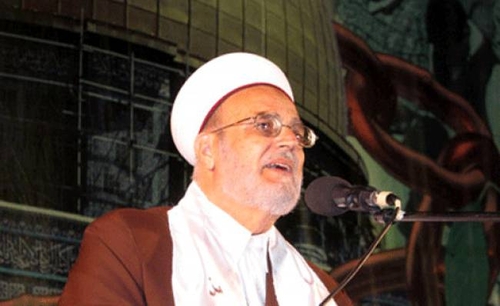
Sheikh Ekremah Sabri, the former mufti of Jerusalem who currently serves as a leading preacher of Al-Aqsa Mosque, claimed that the three wars waged by Israel against Hamas have been “coordinated” with the Arab countries.

Sheikh Sabri went on to claim that some Arabs have even covered the expenses of the Israeli military operations.

Voicing widespread resentment and disappointment among Palestinians over Arab “silence,” the top Islamic official stated: “The Arabs work for Israel.”

It now remains to be seen whether Sheikh Sabri will be permitted to set foot in any Arab country that feels itself targeted by his fiery rhetoric.
589Sheikh Ekremah Sabri, the former mufti of Jerusalem and a leading preacher of Al-Aqsa Mosque, claims that the three wars waged by Israel against Hamas have been “coordinated” with the Arab countries

As he was speaking abut Arab “betrayal,” the Palestine Scholar’s Council issued a strongly-worded statement in which it lashed out at the Arab world for failing to take action to save the Palestinians in the Gaza Strip.

“When will the Arabs wake up? Why aren’t the Arabs providing the Gaza Strip with any assistance?” the statement wondered.

“The absence of an Arab response to the aggression is frustrating,” Ashraf Salameh, of Gaza City, said. “The aggression has shown that some Arabs were hoping that Israel would rid them of Hamas.”

Another Gaza Strip resident, Mohammed Aref, was quoted as saying that Palestinians are very disappointed with the stance of the Arabs and Muslims toward the war in the Gaza Strip. “We didn’t expect this silence,” he said.

Hamas official Yusef Rizka also denounced the Arab world for failing to help the Palestinians. “Gaza is facing the aggression alone,” he complained. “This is the bitter truth. The Arab leaders don’t know what they want from the Gaza Strip. They don’t even know what they want from Israel.”

Jordanian columnist Tamara al-Darawsheh said that the war in the Gaza Strip has seriously embarrassed the Arabs. “As the war continues, we see some marches here and there (in the Arab countries),” she wrote.

“As usual, these marches were suppressed. We didn’t hear anything new from the Arabs other than sheepish condemnations. Gaza has embarrassed us, because we have been busy with the Mondial and Ramadan feasts and TV dramas.”

Another columnist, Mohammed al-Musafer said that Israel has nothing to worry about as it attacks the Gaza Strip.

“Israel knows that (President Abdel Fattah) Sisi’s Egypt is not opposed to the destruction of the spirit of resistance in the Gaza Strip and silencing it for ever,” he remarked. “Most Arabs are busy these days with bloody battles waged by their leaders, who are struggling to survive. These battles are raging in Yemen, Syria, Iraq, Egypt, Libya and the Palestinian Authority.”

Hamas and many Palestinians are now convinced more than ever that they could never rely on their Arab brothers for any kind of assistance. In fact, a growing number of Palestinians are beginning to place some Arab regimes on the side of Israel.

According to noted Palestinian political analyst Mustafa al-Sawwaf: “Some of the Arab regimes are interested in getting rid of the resistance in order to remove the burden of the Palestinian cause, which threatens the stability of their regimes.”

Another analyst, Adnan Abu Amer, expressed fear that the Arab “silence” has already reached the level of “collusion” with Israel.

He pointed out the failure of the Arab heads of state to hold a summit to discuss the war in the Gaza Strip while many international organizations have been holding meetings to voice solidarity with the Palestinians.

“Some Arab countries don’t want to exert pressure on Israel because they want to give it time to achieve its mission and destroy the Gaza Strip,” Abu Amer said. “The Arab people are too busy with their own problems and don’t have time to put pressure on their regimes. This encourages the Arab governments to remain silent.”

Pursue decisive results

July 21, 2014

Pursue decisive results, Israel Hayom, Zvika Fogel, July 21, 2014

War is a compilation of dangerous battles and complex missions, and it is full of ups and downs, successes and casualties. Each battle entails its own set of circumstances and emotional toll, but the result of the military campaign as a whole will be the one to determine the future of Israel.

We cannot afford another round of violence and we have the moral right to do whatever it takes not to be held hostage by radical fanatics. We must use this opportunity to indicate to others that when it comes to the threat of terror, our patience has worn out.

***********

Today, one can only hope, the war outlined by Hamas leaders Mohammed Deif, Marwan Issa and their Islamic Jihad counterparts, is clear to all. Ten thousand rockets, thousands of mortal shells, dozens of terror tunnels, hundreds of tons of explosives, drones, amphibian terror cells, and thousand of murderous terrorists, all aimed against the Israel Defense Forces and Israel as a whole.

The terrorists meant to overrun communities near the border, commit mass murder, carry out abductions and wreak havoc in their wake. Hamas has been training for such attacks since it seized control of the Gaza Strip in 2007. Hamas has never recognized our right to live here and has gone to great lengths to exhaust its nefarious intents.

This horrific scenario was outlined by hate-filled minds immediately after 2008’s Operation Cast Lead was concluded, when Israel’s aerial superiority became clear. Hamas’ plans was upset slightly by 2012’s Operation Pillar of Defense and Abdel Fattah el-Sissi rise to power in Egypt, but the original outline was always clear in Hamas leaders Khaled Mashaal’s and Ismail Haniyeh’s minds.

The Islamic bloodlust coursing through their veins was realized mostly due to our inability to put the pieces of the intelligence puzzle completely together. The funds, donations, and raw materials funneled to Gaza by Israel and many other nations to facilitate the Gazans’ hope for a better future were seized and used by Hamas leaders to create the military and human infrastructure of their terrorist venture.

We had preferred to believe that the Palestinian population in Gaza Strip would not allow Hamas to drag it into yet another bloody campaign. “Hamas has no interest in an escalation at this time,” various Israeli experts claimed, presuming to know what Hamas has planned for our future.

We were wrong, and only the ability to admit that will enable us to understand the need to seize the opportunity at hand, make the right decision and segue from an operation into all out war; one meant to target Hamas’ very centers of gravity, and defeat it in a way that would leave it unable to realize its plans in the foreseeable future.

War is a compilation of dangerous battles and complex missions, and it is full of ups and downs, successes and casualties. Each battle entails its own set of circumstances and emotional toll, but the result of the military campaign as a whole will be the one to determine the future of Israel.

We cannot afford another round of violence and we have the moral right to do whatever it takes not to be held hostage by radical fanatics. We must use this opportunity to indicate to others that when it comes to the threat of terror, our patience has worn out.

Report: Alleged Israeli strike on Sudanese weapons arsenal

July 21, 2014

Report: Alleged Israeli strike on Sudanese weapons arsenal | JPost | Israel News.

By YASSER OKBI/ MAARIV HASHAVUA

07/21/2014 11:53

Arsenal reportedly held long range missiles for Hamas; Sudanese officials deny Israeli strike weeks after Sudan’s president met with Mashaal in Qatar.

An Israel Air Force jet

An Israel Air Force jet Photo: REUTERS

Sources in Khartoum claimed on Monday that Israeli forces struck a weapons arsenal which held long range missiles for Hamas.

The Arabic-language UK-based newspaper Al-Arab reported that the government in Sudan is not confirming the incident in order to cover up relations with the terrorist organization in Gaza. Such ties could entangle the country’s president Omar al-Bashir with an accusation of supporting terrorism from the US and Western nations.

The attack came only hours after Israel accused the Sudanese government of storing long range missiles for Hamas.

Eye witnesses claimed to have seen a “huge explosion” and billows of smoke before ambulances and firefighters arrived at the scene. Six people were allegedly wounded in the attack.

Sudanese security forces stated that the huge explosion in a weapons arsenal was the result of a fire that broke out and took place on Friday morning in the al-Jili neighborhood of the capital.

The Sudanese Army Spokesman Khaled Sa’ad denied all connections in the incident to an attack by foreign forces.

Two weeks before the alleged Israeli strike, Sudan’s President al-Bashir was seen meeting with Hamas chief Khaled Mashaal in Qatar.

Five IDF task forces begin driving into Gaza City. Israel draws up over-plan for control of the Gaza Strip

July 21, 2014

Five IDF task forces begin driving into Gaza City. Israel draws up over-plan for control of the Gaza Strip.

DEBKAfile Exclusive Report July 21, 2014, 10:09 AM (IDT)


Israeli paratroops fighting in Gaza

The IDF’s Shejaiya operation in the Gaza Strip continues apace, carried forward by five task forces now heading for the center of Gaza City amid casualties on both sides. Sunday, July 20, Israel’s crack Golani Brigades lost 18 fighters, without slowing down, compared with 170 Palestinian fatalities.

debkafile’s military sources report that each task force, the size of half a division, is an integrated amalgam of air, armored, artillery and engineering forces, capable of operating almost autonomously in field combat. The buildup of the last 24 hours has expanded Israel’s fighting strength in the Gaza Strip to a total of 75,000 men, the largest ever fielded in this territory. Because of its scale, Israeli leaders are referring to Defensive Edge as a war rather than an operation.

The battle for Shejaiya waged Sunday burst into public prominence because of the heavy losses suffered by the Golani Brigades, but it is not the largest engagement underway at present. The other ongoing IDF battles, their progress, the units involved and their locations, are kept secret. We can only point to their general locations as being around Beit Hanoun in the north; Zeitun, south of Gaza City and the Shati refugee camp to the north.

More arenas are scheduled to be added to the list of battle zones Monday.

Rather than causing despondency, the high IDF casualty toll Sunday – the highest in a single engagement since the 2006 Lebanon War – has invigorated the fighting forces in the field, making them more determined than ever to get the better of Hamas with all possible speed.

Whereas their orders on Sunday were to advance warily and slowly, meanwhile testing the strength of Hamas resistance and observing their tactics, the tempo went into high gear at dawn Monday, when the troops were told to speed their advance from the outer fringes of Gaza City into its center.

Their performance in Shejaiya and other engagements Sunday deeply impressed Israel’s war leaders and made them confident enough to step up the rate of advance.

This upbeat mood was evident in the comments made Sunday night by Prime Minister Binyamin Netanyahu, Defense Minister Moshe Ya’alon and, from the field, by Chief of Staff Lt. Gen. Benny Gantz. While condoling deeply with the bereaved families of the 18 soldiers who died in combat, they were full of praise for the troops’ performance “in defense of our home” which outdid all expectations.

The following decisions were reached in consequence:

1. Gen. Gantz would stay in the field and lead the forces from there, rather than from staff headquarters in Tel Aviv.

2. The prime minister and defense minister would manage the war, without constant recourse to security cabinet sessions to obtain its approval of every stage of the plan of operation, the final goal of which debkafile has learned, is Israel’s military takeover of the Gaza Strip.

3. As the military operation unfolded, the three war leaders were convinced more than ever that demolishing Hamas’ terror tunnel complex was not optional, any more than wiping out the rocket menace hanging latterly over five million Israelis and, for nearly a decade over the million people living directly in the shadow of the Gaza border. Publicity guidelines were to be built around this conclusion.
International statesmen are flitting busily around regional capitals, including Jerusalem, in search of an opening to broker a ceasefire in Gaza hostilities. UN Secretary General Ban Ki-moon has been holding meetings and US Secretary John Kerry will try and reach the Middle East in the coming days, according to a White House directive – unless he again cancels at the last minute.

According to debkafile’s sources, the requisite political and military conditions for a ceasefire are not yet in place because of a number of circumstances, not least of which is Hamas’ refusal to contemplate a halt.

Israel, for its part, is fighting for the first time in its history with solid Arab backing from the Egyptian-Saudi-United Arab Emirates bloc. So determined are its members to obliterate the Muslim Brotherhood that they have virtually blacklisted Qatar for supporting the Brothers and for patronizing the Palestinian Hamas, regarded as the MB’s paramilitary arm.
This rift has put a spoke in the diplomatic effort to set in motion effctive mediation for a Gaza ceasefire predicated on co-opting Qatar.

A bid to make Palestinian Authority chairman Mahmoud Abbas the bridge between the Egyptian-Saudi-UAE grouping and Qatar has likewise foundered. And there isn’t much Secretary Kerry can do if and when he comes over to try his hand.

President Barack Obama’s suggestion, when he called Netanyahu Sunday, to build a new Gaza ceasefire around the 2012 formula concocted by the US, Egypt, Qatar and Turkey – and accepted by Israel and Hamas – for ending Operation Pillar of Defense, shows him to be cut off from the fundamentally altered diplomatic and military realities of the current Gaza conflict.

He declines to recognize the emergence of a powerful new Arab bloc. It will be necessary to twist the arms of each of its members, Egypt, Saudi Arabia and UAE, to gain their consent for a bid to cut the Israeli offensive short to rescue Hamas from defeat. And even then, they will stall.
And although anti-Israel demonstrations are being staged in some parts of the world, the most violent in Paris, hardly any world governments have openly condemned the Israeli operation – as yet.

Pat Condell Takes on Hamas vs Jews in Gaza – YouTube

July 21, 2014

Pat Condell Takes on Hamas vs Jews in Gaza – YouTube.


IDF Makes Progress in Cleaning Out Sujaiya

July 21, 2014

By: Jewish Press News Briefs Published: July 21st, 2014

via The Jewish Press » » IDF Makes Progress in Cleaning Out Sujaiya.


Photo Credit: IDF
 

The IDF continues to advance in the Sajayia neighborhood of Gaza, a Hamas stronghold. Sajayia is a Hamas stronghold which the IDF has described as a Hamas fotress.

The neighborhood is used for storing and launching rockets, and also contains dozens of terror tunnels, and is full of armed Hamas terrorists, who use the population as human shields for their terror attacks.

6 tunnels were found on Sunday, including a tunnel that was 1.2 kilometers (.75 miles) long. It was full of explosives, and access to it was via a house in Gaza. It exited into Israel, and was going to be used for a mega-terror attack.

In heavy battles overnight in the Sajayia neighborhood, the IDF killed 10 terrorists in gun battles.


In a separate battle, an IAF strike took out the had of a Hamas surveillance unit.

20 terrorists were arrested, and number of them have been brought to interrogation.

More than a dozen rockets were launched at Israel overnight. Iron Dome intercepted 2 of them targeting Be’er Sheva.

A total of 1790 rockets have been fired at Israel since the operation began.

Three soldiers were injured in the fighting.

Tunnels Matter More Than Rockets to Hamas

July 21, 2014

Tunnels Matter More Than Rockets to Hamas, Wall Street Journal, Michael Mukasy, July 20, 2014

Early in the current clash between Hamas and Israel, much of the drama was in the air. The Palestinian terrorist group launched hundreds of rockets at Israel, and Israel responded by knocking down rockets in the sky with its Iron Dome defense system and by bombing the rocket-launch sites in Gaza. But the real story has been underground. Hamas’s tunnels into Israel are potentially much more dangerous than its random rocket barrages.

Israel started a ground offensive against Hamas in Gaza on Thursday, intending to destroy Hamas’s tunnel network. The challenge became obvious on Saturday when eight Palestinian fighters wearing Israeli military uniforms emerged from a tunnel 300 yards inside Israel and killed two Israeli soldiers in a firefight. One of the Palestinian fighters was killed before the others fled through the tunnel back to Gaza.

According to Yigal Carmon, who heads the Middle East Media Research Institute, his organization’s monitoring of published material and discussions with Israeli officials indicate that Hamas’s tunnels—and not the well-publicized episode of kidnapping and murder involving young Israelis and a Palestinian teenager—were the spark for the conflict.

Consider: On July 5 Israeli planes damaged a tunnel dug by Hamas that ran for several kilometers from inside the Gaza Strip. The tunnel emerged near an Israeli kibbutz named Kerem Shalom —vineyard of peace.

That Israeli strike presented Hamas with a dilemma, because the tunnel was one of scores that the group had dug at great cost. Were the Israelis specifically aware of the tunnel or had their strike been a random guess? Several members of the Hamas military leadership came to inspect the damage the following day, July 6. A later official Israeli report said that the Hamas inspectors were killed in a “work accident.” But what if the Israelis had been waiting for the follow-up and struck again?

Hamas now saw its strategic plan unraveling. The tunnel network gave it the ability to launch a coordinated attack within Israel like the 2008 Islamist rampage in Mumbai that killed 164 people. Recall that in 2011 Israel released more than 1,000 Palestinian prisoners, more than 200 of whom were under a life sentence for planning and perpetrating terror attacks. They were exchanged for one Israeli soldier, Gilad Shalit, who had been taken hostage in a cross-border raid by Hamas. Imagine the leverage that Hamas could have achieved by sneaking fighters through the tunnels and taking hostages throughout Israel; the terrorists intercepted Saturday night were carrying tranquilizers and handcuffs.

Israeli tank at wadiAn Israeli tank in the shadows of a ‘wadi’ or river bed with other tanks on the ridge behind as they maneuver inside southern Israel near the border with the Gaza Strip. European Pressphoto Agency

If the Israeli strike on the tunnel near the Kerem Shalom kibbutz presaged a drive to destroy the entire network—the jewel of Hamas’s war-planning—the terrorist group must have been thrown into a panic. Because by this summer Hamas was already in desperate political straits.

For years Hamas was receiving weapons and funding from Shiite Iran and Syria, under the banner of militant resistance to Israel. But when Mohammed Morsi became president of Egypt in June 2012, Hamas abandoned its relationship with Iran and Syria and took up instead with Mr. Morsi and the Sunni Muslim Brotherhood. Hamas also took up with Turkey and Qatar, also Sunni states, describing them at one point as the saviors of Hamas. Former benefactors Syria and Iran then called Hamas traitorous for abandoning the resistance-to-Israel camp.

The Hamas romance with Mr. Morsi was especially galling to Shiite-led Iran and Syria. The Shiites are only 10% of the world’s Muslims, and neither Iran nor Syria welcomed the loss of a patron to Sunni Egypt. The coup that removed Mr. Morsi and the Muslim Brotherhood regime in June 2013 brought a chill in Egypt’s relationship with Hamas that has kept Egypt’s border with Gaza closed, denying Hamas that route of supply.

But Iran and Syria did not rush to embrace their former beneficiary. When Hamas tried to re-ingratiate itself with Iran this May, its political bureau head, Khaled Mash’al, was denied an audience in Tehran and could only meet a minor diplomat in Qatar. On June 26 the Iranian website Tabnak posted an article titled, “Mr. Mash’al, Answer the Following Questions Before Asking for Help.” The questions included: “How can Iran go back to trusting an organization that turned its back on the Syrian regime after it sat in Damascus for years and received all kinds of assistance?” and “How can we trust an organization that enjoyed Iranian support for years and then described Turkey and Qatar as its saviors?”

So on July 6, Hamas stood politically isolated and strategically vulnerable. It had lost the financial support of Egypt and could not get renewed support from Iran in the measure it needed. To some in the organization it appeared that Hamas had only one card to play—and on July 7 it played that card with rockets. As to the tunnels, last Thursday Israeli forces intercepted 13 armed terrorists as they emerged from a tunnel near Kibbutz Sufa in Israel.

There are other messages out there for the Palestinians instead of the violent one sent by Hamas. Writing in the London-based Arabic daily Al Hayat on July 12, Saudi intellectual Abdallah Hamid al-Din, no friend of Israel, urged Palestinians to abandon as unrealistic demands for a right of return, and to forgo as hypocritical calls to boycott Israel:

“The only way to stop Israel is peace. . . . Israel does not want peace, because it does not need it. But the Palestinians do. Therefore it is necessary to persist with efforts to impose peace. No other option exists. True resistance is resistance to illusions and false hopes, and no longer leaning on the past in building the future. Real resistance is to silently endure the handshake of your enemy so as to enable your people to learn and to live.”

Plenty of others are sending the same message today. Whether Palestinians will listen is another matter.