Archive for July 2014

Nine IDF soldiers killed in battles with Hamas Monday

July 22, 2014

Nine IDF soldiers killed in battles with Hamas Monday | The Times of Israel.

Two more soldiers killed in afternoon in addition to seven early Monday as IDF toll rises to 27; four were hit by Hamas terrorists who tunneled into Israel with plan to attack kibbutz; 10 Hamas gunmen killed

July 22, 2014, 6:37 am

Two IDF soldiers were killed and seven injured during clashes in Gaza on Monday afternoon, the military cleared for publication overnight Monday-Tuesday, bringing the death toll of military personnel since Israel launched a ground incursion into the Strip last Thursday to 27.

The toll is greater than the number of soldiers who died in the two previous major Israeli efforts to thwart Hamas terrorism in 2008-2009 and 2012.

The IDF said one of the soldiers, Sgt. First Class Oded Ben-Sira, 22, from Nir Etzion in northern Israel, who served in the Nahal Brigade will be laid to rest at 5pm on Tuesday at the military cemetery in the moshav.

He was killed by sniper fire in Gaza. The name of the second soldier has yet to be released.

Three soldiers were seriously wounded overnight, while four sustained light injuries in battles with Hamas, the IDF said

Early Monday, seven IDF soldiers were killed battling Hamas on the Israeli side of the border and inside Gaza, the IDF announced on Monday evening. Four of them were killed during a pre-dawn tunnel infiltration into southern Israel in which Hamas terrorists planned to attack Kibbutz Nir Am, military sources said.

The seven were named as Lt. Col. Dolev Kedar, 38 from Modi’in; SS. Tal Yifrach, 21, from Rishon Lezion; SSgt. Yuval Dagan, 22, from Kfar Sava; Sgt. Nadav Goldmacher, 23, from Beersheba; SFC. Baynesain Kasahun, 39 from Netivot; Sec. Lt. Yuval Haiman, 21 from Efrat; and SS Jordan Ben-Simon, 22 from Ashkelon.

Haiman will be laid to rest at 11am Tuesday at Mount Herzl’s military section while the funeral for Kasahun is set for 1:00pm at the military cemetery in Netivot.

Four of the seven were killed by a rocket-propelled grenade, fired by Hamas gunmen who emerged from a tunnel dug from Gaza into Israel near Kibbutz Nir Am. The Hamas cell, clad in IDF uniforms, emerged from the tunnel, and waited for an approaching IDF jeep before opening fire, killing the IDF officer and the three other soldiers in the vehicle.

The jeep had been sent to the scene as information on the infiltration was received.

Simultaneously, Hamas opened diversionary fire across the border.

Residents of Kibbutz Nir Am were told to stay in their homes while the IDF tackled the terrorist cell.

Troops from the Nahal Brigade converged and killed 10 of the Hamas gunmen. Two of the gunmen may have escaped back into Gaza.

Part of the incident was filmed in footage later released by the IDF.

“We paid a heavy price, but we averted a grave disaster,” said Sami Turgeman, the general in charge of the IDF’s Southern Command. “There is no Iron Dome protection against tunnel infiltration.”

The three other Israeli soldiers were killed in Shejaiya. Two were hit by an anti-tank missile fired into a building. Like the 13 IDF soldiers killed there overnight Saturday-Sunday, they were members of the Golani Brigade. The third may have been killed by IDF forces in error.

Dagan was laid to rest Monday night.

Three more soldiers were badly hurt in the fighting over the past 24 hours, eight were moderately injured, and 19 were lightly injured, the IDF said.

Military sources said Monday night that Hamas was trying to utilize the “attack tunnels” it had spent years building before the IDF discovered them and blew them up. They said some 18 of the sophisticated tunnels had been discovered since the ground offensive began on Thursday.

Earlier Monday, Prime Minister Benjamin Netanyahu said the ongoing military campaign in the Gaza Strip to uncover terrorist tunnels would continue and even be broadened until it achieves its goal of bringing a prolonged quiet to the area.

Prime Minister Benjamin Netanyahu(L) meets with IDF Chief of Staff Benny Gantz (C) and Defense Minister Moshe Boogie Yaalon (R) at the Command and Control Center of the 162nd Armor Division in Southern Israel, on July 21, 2014. (photo credit: Kobi Gideon/GPO/Flash90)

During a visit to the IDF’s 162nd Armored Division — known as the Steel Division — in the south of the country, Netanyahu held a security meeting with Defense Minister Moshe Ya’alon, IDF Chief of Staff Benny Gantz, and Southern Region Commander Turgeman.

“The operation will continue and be expanded until the goal is achieved — the restoration of quiet to Israel’s citizens for a prolonged period,” Netanyahu said.

The tunnel infiltration early Monday involved two groups of Hamas gunmen who surfaced shortly after six in the morning. Apart from the terror cell that emerged near Nir Am, the second cell, also clad in what looked like standard IDF military gear, emerged near Erez, on Israeli territory, several kilometers northeast of the Gaza city of Beit Hanoun. Surveillance soldiers spotted the infiltrators and summoned an aircraft to the area, the army said. The aircraft opened fire, killing the gunmen. No Israelis were hurt in the battle.

“My understanding is that the Shin Bet security service provided an alert,” Lt. Col. Peter Lerner of the IDF Spokesperson’s Unit said of both cross-border attacks.

The squad that surfaced near Nir Am emerged from either a separate tunnel or a more southeasterly branch of the same one and was not immediately detected.

Army spokesman Brig. Gen. Moti Almoz told Israel Radio that the army believed the tunnel squads sought either to enter a civilian community or to attack a significant army post, with the ultimate aim of abducting a soldier or a civilian.

Smoke rises after an Israeli missile hits the Shejaiya neighborhood in Gaza City, northern Gaza Strip, Sunday, July 20, 2014.  (Photo credit: AP/Hatem Moussa)

Earlier Monday, in the Shejaiya neighborhood of Gaza City, forces from the Egoz unit engaged and killed 10 operatives, including one who detonated a suicide vest.

There were conflicting reports about the sex of the suicide bomber, but later reports said it was a woman.

Lerner, in depicting the pitch of the battles in Shejaiya, where dozens of Palestinians and 13 Israeli soldiers were killed Sunday, said that the combat there is “reminiscent of ‘Black Hawk Down,’ ” the film [and book] describing the 1993 battles in Mogadishu, Somalia.

Five soldiers died on Friday and Saturday. Sgt. Eitan Barak, 20 was killed overnight Thursday-Friday in circumstances that remain unclear but are beleived to be a friendly fire incident. Sgt. Adar Barsano, 20; Major (res.) Amotz Greenberg, 45, were killed Saturday when Hamas gunmen infiltrated into Israel opening fire on troops. Sgt. Bnaya Rubel, 20, was killed after a Hamas gunman merged from a tunnel in Gaza and opened fire and Second Lieutenant Bar Rahav, 21 was killed by an antitank missile fired at a paratrooper position in Gaza Saturday.

Hamas, Israel signal unwillingness to compromise – The Washington Post

July 22, 2014

Hamas, Israel signal unwillingness to compromise – The Washington Post.

July 22 at 12:50 AM

The Islamist militant organization Hamas said Monday that it would not agree to a cease-fire with Israel until its demands were met, as Israel warned that its incursion into the Gaza Strip could continue for days or even weeks.

The stark assessments offered little hope for quick progress toward ending a 14-day-old conflict that has inflicted heavy costs on each side.

Seven more Israeli soldiers were killed in fierce fighting Monday, bringing the Israeli military toll to 27 dead, more than twice as many as in Israel’s last Gaza ground incursion in 2009 and the highest toll since Israel’s war with Lebanon in 2006. Two Israeli civilians have died in the conflict.

More than 560 people in Gaza, many of them women and children, have been killed since Israel’s Operation Protective Edge began.

Israeli Defense Minister Moshe Yaalon said the Gaza military operation, which is now focused on finding and destroying underground tunnels, would continue “as long as necessary until the completion of the task and the return of the quiet in the whole of Israel.”

But the most senior Hamas leader in the Gaza Strip, Ismail Haniyeh, warned that “invaders” would find a graveyard awaiting them in Gaza. In a televised broadcast, Haniyeh said Hamas fighters would not put down their weapons until Israel and Egypt agree to open border crossings, ease travel and the flow of goods, and free Hamas members who were jailed after the killing of three Jewish teenagers in the West Bank last month.

“We’ll never go back to the slow death,” Haniyeh said. “Our demands are fair and they are humane. Our people have decided.”

The Israeli military said that at least four of its soldiers were killed in a firefight with Hamas militants who sneaked into Israel through a tunnel from northern Gaza. Ten Gaza militants died in the exchange, a military spokesman said, and another underground infiltration attempt by Hamas was repelled by an Israeli airstrike.

The fresh casualties came a day after 13 Israeli troops were killed in combat in the east Gaza neighborhood of Shijaiyah on Sunday, the bloodiest day of the conflict.

Israeli airstrikes and artillery fired over the past 24 hours hit the al-Aqsa Hospital in the central town of Deir al-Balah, which Israel said was being used to hide antitank missiles, killing four, and a house in Khan Younis where a midlevel Hamas leader was believed to be. Gaza Health Ministry officials said 28 Palestinians were buried in the debris, including women and children.

With violence and the death toll rising, and as Israeli troops moved from the margins to the population centers in Gaza, diplomatic efforts to secure a truce intensified.

At the White House, President Obama said, “We don’t want to see any more civilians killed.” He instructed Secretary of State John F. Kerry to seek “an immediate cease-fire” between Hamas and Israel. Kerry arrived in Cairo on Monday night.

Palestinian Authority President Mahmoud Abbas met Monday with his political rival, Hamas leader Khaled Meshal, in Qatar. According to aides traveling with Abbas, the Palestinian leader from Ramallah in the West Bank is looking for a cease-fire brokered by Egypt based on a return to the November 2012 agreement between Israel and Hamas in Gaza, according to the Israeli newspaper Haaretz.

“Everyone is supporting the Egyptian initiative for a cease-fire — the Palestinian Authority, the Arab League, the Americans, Israel,” said Tzipi Livni, Israel’s justice minister and the country’s top peace negotiator.

Livni said the only opponent to a truce was Hamas leader Meshal, who, she said, “is not even living in Gaza and who has a good life in a nice hotel somewhere but wants to continue putting his people under stress.”

But any mediation effort could run into an obstacle. If Israel agrees to a cease-fire, it would have to abandon its core objective in Gaza of destroying Hamas tunnel networks. But Israeli military officials say that they believe the tunnels are more extensive than previously thought and that it will take more time to demolish them, raising a dilemma.

“We have a mission, and we are going to fulfill it. Israel is not going to leave the threats of tunnels beneath the border between Gaza Strip and Israel,” a senior Israeli military official told reporters Sunday, speaking on the condition of anonymity because of military guidelines. But he also acknowledged that with the growing casualties on both sides, “it’s the right time for all sides to stop.”

Palestinian fighters in Gaza continued to offer stiff resistance. The number of rockets fired into Israel by Palestinian militants rebounded from a brief lull, with the Israeli military saying that more than 100 rockets struck the Jewish state Monday, mostly in southern areas close to the Gaza border.

Three rockets were fired into Tel Aviv, Israel’s second-most populated city. One struck the metropolitan area but did not inflict any casualties, the military said, while Israel’s Iron Dome missile defense system intercepted the other two.

The number of Palestinians seeking refuge with the United Nations also rose overnight, growing to at least 85,000 people now living in 67 shelters, mostly at schools, the U.N. Relief and Works Agency said Monday. U.N. agencies report that more than 100,000 Gazans have been displaced from their homes.

The United Nations also said a preliminary review in Gaza found that more than 72 percent of those killed were civilians, not militants, and include large numbers of women and children. The U.N. Office for the Coordination of Humanitarian Affairs said the high numbers of children and noncombatants raise “concern about respect for the principle of distinction and proportionality under international humanitarian law.”

Two of the Israeli soldiers killed were American citizens who had come to Israel, like many Jewish Americans, to volunteer in Israel’s army. One, Max Steinberg, was from Woodland Hills, Calif., while the other, Nissim Sean Carmeli, was from South Padre Island, Tex., Israel’s military said.

The State Department recommended Monday that U.S. citizens consider deferring non­essential travel to Israel and the West Bank, a possible economic blow to both during the peak summer tourist season.

Raghavan and Eglash reported from Jerusalem. Islam Abdul Kareem in Gaza City contributed to this report.

A fight for Israel’s existence – The Washington Post

July 22, 2014

Richard Cohen: A fight for Israel’s existence – The Washington Post.

July 21 at 7:29 PM

Israel fought its first war, in 1948, against five Arab nations — Egypt, Iraq, Lebanon, Syria and Jordan — as well as the Palestinians. In the prediction of the fairly new CIA, the outcome was never in doubt: “Without substantial outside aid in terms of manpower and material, they [the Jews] will be able to hold out no longer than two years.” It has now been 66 years, but I fear that sooner or later, the CIA’s conclusion could turn out to be right.

It does not seem that way at the moment. The five Arab armies of 1948 are now down to Hamas in the Gaza Strip. This is a struggle whose end cannot be in doubt. The Israelis will degrade Hamas’s military capabilities — its rocket-launching sites and its tunnels — and end for a time its ability to attack Israel. Every rocket, no matter how primitive and wobbly, is an act of war.

Since 1948, nation after nation has retired to the sidelines. Egypt and Jordan have made peace with Israel. Saudi Arabia, which stayed out of the first war, has little desire for any subsequent one. Lebanon has been battered too often by Israel to still have a taste for war. Iraq is coming apart at the seams and can fight no one. Syria, too, is a chaotic mess, no longer really a nation and now more of a geographic designation. With the exception of Hezbollah and Hamas, no one much wants to fight. Happy days should be here . . . again.

But they are not. In my estimation, Israel now fights not just to clear out the tunnels and rid Gaza of its rockets but for its very existence. This war that Israel will, of course, win has seen its once hapless enemy, Hamas, launch hundreds of rockets a day, some of them landing in the Tel Aviv area, a few going as far as Haifa. The Iron Dome anti-missile system has reportedly done wonders, but the law of averages insists that a rocket will get through and Tel Aviv will be hit — and then hit again.

The nations that once went to war vowing to push Israel into the sea are unstable, rickety creations. They are under siege not from Israel but from their own religious zealots. Whatever emerges is going to be either less accepting of Israel or manically intent on annihilating it. Even Egypt, which is now under military dictatorship, could revert once again to a government of the Muslim Brotherhood, the ideological parent of Hamas, and deeply anti-Semitic. In time, Israel could be surrounded by states that would make Hamas seem the soul of moderation. It does not, after all, go in for beheadings and such.

There is a sad, metronomic rhythm to Israel’s wars with Hamas and Hezbollah. Israel wins every time, but every war is incrementally existential. Israelis are increasingly looking over their shoulder. About 60 percent of them either have or wish they had a second passport (often from an ancestral European country) and a large number of them — an estimated 500,000 or more — already live in the United States. The wayward Hamas rocket, so idiotically trivialized by Israel’s critics, doesn’t have to kill anyone to take a toll. People will seek safety as surely as water seeks its own level.

Hamas thinks it is winning the current war — which is why it rejected the Egyptian-brokered cease-fire proposal. Not a single major Hamas leader has been killed. Sooner or later an intermediary will insist on a peace agreement. That intermediary should be Secretary of State John Kerry. He must demand no more tunnels and no more rockets. Hamas can stay in Gaza, and Israel seems willing to ease its blockade. But both goods and funds have to be used to benefit the Palestinian people — not to build (or import) rockets or resume the tunneling.

A deal is there to be made but the United States has to either make it or determine its outcome. The effort cannot be left to countries that are hostile to Israel — Turkey and Qatar come to mind — or the Middle East will once again wind up with a peace that is just a prelude to more war.

Israel is the legal creation of the United Nations. It has an absolute right not merely to exist but to do so safe from rockets or incursions by tunneling terrorists. In 1948, Harry Truman swiftly recognized Israel. The United States took the lead. It is time for it to do so again.

Kerry and Ban in truce bid to save Hamas from defeat. Israel holds reply. Cairo won’t amend truce proposal

July 22, 2014

Kerry and Ban in truce bid to save Hamas from defeat. Israel holds reply. Cairo won’t amend truce proposal.

DEBKAfile Special Report July 21, 2014, 11:59 PM (IDT)

Three rival groups are in a tug-o’-war over a ceasefire initiative for the Gaza conflict: The US and UN are pulling one way; Israel, Egypt and Saudi Arabia, the other; and Qatar, Turkey, Hamas and the Palestinian Authority, are trying to manipulate the others.

Monday night, July 21, US Secretary of State John Kerry and UN Secretary General Ban Ki-moon arrived in Cairo to press their case with Egyptian President Abdel-Fatteh El-Sisi: Kerry’s directive was outlined by President Barack Obama a few hours earlier, “to focus on bringing about a ceasefire than ends the fighting and can stop the death of innocent civilians.”
Ban came from Doha, Qatar, as part of a whistle stop tour of Kuwait City, Jerusalem, Cairo, Ramallah and Amman. Upon landing in Cairo, he told reporters: “The violence must stop, it must stop now. I urge all parties to stop violence unconditionally and return to dialogue.”

Reported to be pushing for a long-term ceasefire, the UN Secretary went on to comment that it was impossible to go back to the situation that caused the conflict. He ruled out the “status quo ante” for the Gaza Strip as untenable.

This was an indirect vote of support for Hamas’s terms for a ceasefire, such as ending the blockade on the Gaza Strip and reopening all the crossings.

The UN Secretary had nary a word to say about the Palestinian Islamists’ long record of terrorism, culminating last month in the kidnap and murder of three Israeli teenagers, the shooting of 1,850 rockets at the Israeli population in less than a month and the network of secret tunnels dug especially to burrow under the Israeli border for attacks and kidnappings.
After hearing the two comments, Hamas’ political leader Meshaal Hamas called off the statement he had planned to issue Monday night from his base in Qatar. He saw he had no need to push any further to win the support of the UN and US officials. They were already on his side and he could count on them both to twist Israel’s arm for an early ceasefire to rescue Hamas from defeat before its terrorist machine was completely ravaged by Israeli troops.

Hamas officials also rejected suggestions floated for a long-term humanitarian ceasefire.
Following reports that Cairo had agreed to give in to Hamas demands, Egypt’s Foreign Minister Sameh Shokri said firmly that Cairo is not willing to amend its former truce initiative.

The Egyptian president Abdel-Fattah El-Sisi had won Saudi endorsement for this proposal in two conversations they held in the last few days. It is based essentially on a ceasefire which, if it holds, would be followed by separate Egyptian talks with Israel and Hamas on future arrangements.
This proposal was accepted by Israel and snubbed by Hamas, which continued to shoot rockets instead. Israel reacted four days ago, by sending ground troops into the Gaza Strip to finally dismantle Hamas’ long-running terror machine.

That Hamas stands by its negative response to the Egyptian ceasefire initiative was underscored by Gaza Prime Minster Ismail Haniya in a pre-recorded statement Monday from his hideout: “Hamas will fight with blood before giving up its terms,” he said. “Their [Israel’s] air strikes did not break us, and neither will their ground attacks.”

Hama leaders have grasped that the truce initiatives promoted by Kerry and Ban will essentially allow them to carry on as before with certain benefits thrown in.

As of writing this report, the Netanyahu government has not reacted to the web of ceasefire diplomacy being woven. His silence can be interpreted in three ways:

1. Prime Minister Binyamin Netanyahu, who has been running Israel’s campaign against Hamas in close rapport with Saudi King Abdullah and President El-Sisi, is saving his biggest gun – flat rejection of their truce proposals – for use in direct encounters with Kerry and Ban when they arrive in Jerusalem Tuesday, July 22.

2. The IDF needs more time to complete its missions, which are to destroy Hamas’ network of terror tunnels and disarm, or at least degrade, its rocket and military infrastructure.

3.  Netanyahu is keeping his cards close to his chest for a reckoning with Palestinian Authority Chairman Mahmoud Abbas, touted as go-between in the ceasefire bid, over his threat Monday to bring charges of war crimes against Israel before the international court in The Hague and UN institutions, as well as accusations of apartheid.
The prime minister may well stipulate that Kerry and Ban rein in the Palestinian leader before Israel gives its attention to any requests for joining a ceasefire.

Israel’s cerebral war in Gaza, and its risks

July 22, 2014

Israel’s cerebral war in Gaza, and its risks | The Times of Israel.

Israel has proceeded logically, each escalation equipped with an exit ramp. But Hamas, pleased with its bloody accomplishments, may be in no mood to stop

July 22, 2014, 12:48 am 9
Tunnel opening discovered by IDF in Gaza,  July 20, 2014. (Photo credit: IDF)

Tunnel opening discovered by IDF in Gaza, July 20, 2014. (Photo credit: IDF)

The Israeli army is fighting a war in the service of a ceasefire. It is, like its leaders, very cerebral. But is it getting the job done?

The rationale, at the onset, was this: If the aerial strikes do not prevail, as they did last time, Israel will address the threat of tunnels, unearthing the strategic channels dug by Hamas. As the organization sees its labor demolished, as the rocket stores are depleted, as the troops draw closer to the heart of Gaza, Hamas will wait until the PR conditions are ripe and, as is its custom, dress defeat in the gowns of victory.

Understanding the risks of each further escalation, though, the IDF and the government built an exit ramp into each stage of the operation.

Stage One: the aerial campaign. The thinking was as follows: The bombing will be dreadful. It may not get too many operatives, and certainly not many senior ones, and it will not address the threat of the tunnels, but it will deplete some of the Hamas rocket stores and, when this terrible season of killing is over, it will leave a mark on the landscape and the psyche of the people, who will not again soon allow their leaders to invite such destruction.

Smoke from Israeli strikes rise over Gaza City, northern Gaza Strip, Monday, July 21, 2014. (photo credit: AP Photo/Lefteris Pitarakis)

The army thinks of this as the Dahiyeh doctrine on account of the Hezbollah neighborhood in Beirut that was pounded [and promptly re-built with Iranian cash] during [and directly after] the Second Lebanon War in 2006. Since then, Hezbollah has been largely deterred from acting along the Lebanon border.

An F-16 pilot and squadron commander who has flown many sorties over Gaza during this conflict said in a phone interview, during the aerial stage of the war, that he did not envy Hamas leaders when they emerged from their bunkers and had to explain to their people what has transpired.

In November 2012 this sufficed. The sight of thousands of troops amassed on the border, along with the heavy losses already inflicted, along with other regional geo-political considerations, brought Hamas to the table after eight days of violence.

This time, though, as Prime Minister Benjamin Netanyahu intimated on Sunday, Israel’s leadership accepted an Egyptian ceasefire proposal with the understanding that Hamas would likely not use the first exit ramp.

Prime Minister Benjamin Netanyahu(L) meets with IDF Chief of Staff Benny Gantz (C) and Defense Minister Moshe Boogie Yaalon (R) at the Command and Control Center of the 162nd Armor Division in Southern Israel, on July 21, 2014. (photo credit: Kobi Gideon/GPO/Flash90)

Stage two: the tunnels. These underground passages across the border and into Israel are a strategic threat. Each one carries with it the potential for a mega-attack. Israel has spent the past five days, ever since the ground stage began, trying to eradicate that threat. Defense Minister Moshe Ya’alon said Sunday that “the lion’s share” of cross-border tunnels would be detected and demolished within the coming two to three days.

Which is to say, there is another exit ramp in the not-too-distant future.

If Hamas opts to take it, and a deal is reached – one that keeps terrorists and operatives away from the fence; makes it impossible to tunnel into Israel again; and offers some carrots in the form of civilian aid, greater access to Egypt through Rafah and increased flow of goods into the Strip, alongside a ceasefire agreement; — then the operational action, despite the loss of 25 Israeli soldiers’ lives at time of writing, will have been a success.

Of course, there will be some questions asked. For instance about the wisdom of sending troops into battle – seven of whom were killed – in an M-113 armed personnel carrier, which was made in the 60s and already debuted with the IDF during the Yom Kippur War. Even the M-113 Wikipedia page in Hebrew notes, straight off, that “today the APC is considered to have insufficient protection: its hull is made of aluminum…”

When the dust settles over Shejaiya, Israel will also have to make sure the civilian death toll is in line with its values, on the one hand [there is currently not information to know], and that the approach into the Hamas stronghold in the Gaza City neighborhood, on the other, was not too telegraphed, too obvious to the heavily armed Hamas operatives.

But what if Hamas, pleased with its bloody accomplishments, speeds past the next exit ramp as well? What if it believes that Israel has no intention of toppling its rule and that, as Udi Dekel and Shlomo Brom wrote for the INSS think tank on Monday, “the only advantage Hamas has over Israel is patience and endurance.”

In that case, which still seems unlikely, Israel will advance, somewhat fatigued, deeper into Gaza, and it will have to project that it has cast aside the cerebral approach.

As former general and national security adviser Uzi Dayan said early in this conflict, when advocating for a two-division push deep into Gaza at the onset, “I don’t dictate who will replace Hamas and I don’t care. It’s not strategically important.”

Instead, he said, while speaking to a group of journalists in a safe room in Sderot, “what’s important is that he knows that whoever will mess with Israel will pay for it.”

Hamas-Tip of the Muslim Brotherhood Spear

July 22, 2014

Hamas-Tip of the Muslim Brotherhood Spear, Center for Security PolicyKyle Shideler, July 21, 2014

As Israeli forces continue advance into Gaza to combat Hamas- with a particular focus on combating the infiltration tunnels used by Hamas to conduct raids targeting Israeli civilians, it’s worth raising the question, why is it that Hamas, an isolated terrorist organization, feels comfortable repeatedly going head to head with the most powerful regional military in the Middle East?

They have state sponsors, such as Iran, Turkey and Qatar, who provide financing, true, but ultimately, Hamas is comfortable operating because they know that behind them stands the entire Global Muslim Brotherhood movement.

This has never been a secret. Hamas’ founding charter (Article 2:) states:

the Islamic Resistance Movement is one of the wings of the Muslim Brothers in Palestine. The Muslim Brotherhood Movement is a world organization, the largest Islamic Movement in the modern era.

Nor has this changed. During the Muslim Brotherhood’s rule over Egypt, Hamas leader Ismail Haniyeh pointed out that Hamas, “was the Jihadi movement of the Brotherhood, with a Palestinian face.” That’s important to note. Hamas’ supposed interest in the Palestinians is but a face Hamas wears to further their real interest. Jihad.  Indeed, during Brotherhood rule in Egypt, Hamas was formally raised to a position within the Global Muslim Brotherhood.

The global Muslim Brotherhood has been oriented to support jihad on behalf of “Palestine” since Hamas was established. The 1982 “Global Project for Palestine” document acquired by Swiss Law Enforcement during a raid on Muslim Brotherhood financier Yousef Nada after 9/11 indicates the role of the Global Muslim Brotherhood in directing policy for the”Palestinian Cause”:

THE ELEVENTH POINT OF DEPARTURE

To adopt the Palestinian cause as part of a worldwide Islamic plan, with the policy plan and by means of jihad, since it acts as the keystone of the renaissance of the Arab world today.

a-Elements:

To provide an Islamic view on all areas, problems and solutions relative to the Palestinian question, based on the precepts of Islam.

To prepare the community of believers for jihad for the liberation of Palestine.

[One can lead the Ummah to realize the plans of the Islamic movement above all if victory is ours], if God wills it.

To create a modest nucleus of jihad in Palestine, and to nourish it in order to maintain the flame that will light the road toward the liberation of Palestine, and in order that the Palestinian cause will endure until the moment of liberation.

This global direction was confirmed by documents seized in the home of US Muslim Brotherhood member Ismail Elbarasse, who was arrested by a Maryland law enforcement on a material witness warrant after being caught with his wife videotaping the structural supports for the Chesapeake Bay Bridge.  On such document, an internal 1992 memo from the Muslim Brotherhood front the Islamic Association of Palestine notes:

D- Palestine Committees in the countries:

With the growth of the blessed Intifada and the spread of’ the spirit of Jihad amidst the children of Palestine and the nation, it became incumbent upon the remainder of the lkhwan branches to play a role in attributing this Intifada and this Islamic action to Palestine. Therefore, a resolution was issued by the Guidance Office and the Shura Council of the International Movement to form “Palestine Committees” in all the Arab, the Islamic and the Western nations whose job is to make the Palestinian cause victorious and to support it with what it needs of media, money, men and all of that. (Refer to the resolution in the supplement).

Three: a- The Islamic Resistance Movement:

With the increase of the Intifada and the advance of the Islamic action inside and outside Palestine, the Islamic Resistance Movement (Hamas), provided through its activities in resisting the Zionist occupation a lot of sacrifices from martyrs, detainees, wounded, injured, fugitives and deportees and it was able to prove that it is an original and an effective movement in leading the Palestinian people. This Movement – which was bred in the bosom of the mother movement, “The Muslim Brotherhood” – restored hope and life to the Muslim nation and the notion that the flare of Jihad has not died out and that the banner of Islamic Jihad is still raised.

As the Israel Defense Forces hunt down Hamas terrorists in the Gaza Strip, it’s worth reminding ourselves that behind the men with rockets, mortars and AK-47s, lies a global organization prepared to fund them, to manipulate the media on their behalf, and to defend them from world opinion. The Muslim Brotherhood affiliated International Union of the Muslim Scholars called out for, “the Islamic and Arab peoples to rise up in all parts of the world for the sake of Palestine and Jerusalem since it is the central issue of the nation…” Founded by chief Muslim Brotherhood jurist Yusuf Al Qaradawi, IUMS has previously called for the killing of American troops and civilians in Iraq. But that did not stop the Obama White House from meeting with IUMs vice President Abdallah Bin Bayyah last year. Shortly after the IUMS issued their call for a global uprising, the Muslim Brotherhood website Ikhwanweb.com echoed the same call. Not surprisingly, we now see violent riots breaking out in Paris, and elsewhere.

While we can applaud the careful and deliberate counterterrorism operation now being conducted by the IDF, we should remember that to truly defeat Hamas we must uproot the Global Muslim Brotherhood. We should also be wary that when the Muslim Brotherhood does calls for violence, there are those out there like Ismail Elbarasse who have done the reconnaissance, filmed the targets, and spent decades indoctrinating the young men who will answer the call.

Abbas, Mashaal demand end to ‘Israeli aggression’

July 21, 2014

Abbas, Mashaal demand end to ‘Israeli aggression’, Times of Israel, July 21, 2014

Palestinian leaders, meeting for first time since IDF’s Gaza offensive began, urge lifting of blockade.

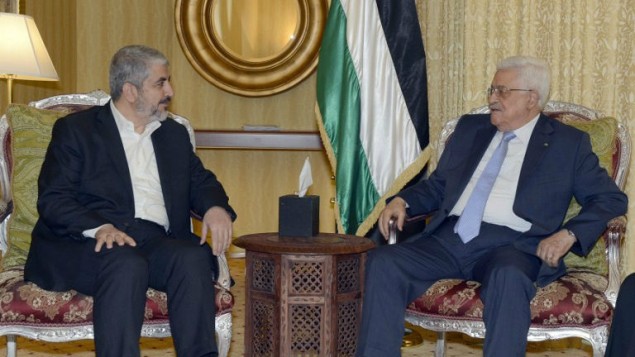
pall-635x357A handout picture released by the Palestinian Authority president’s office shows Mahmoud Abbas (R) in a meeting with the head of the political bureau of Hamas, Khaled Mashaal, in Doha, on July 20, 2014 (photo credit: AFP/ PPO / Thaer Ghanem)

Palestinian Authority President Mahmoud Abbas and Hamas leader Khaled Mashaal issued a joint appeal for an end to “Israeli aggression” in Gaza during talks in Doha on Monday.

Meeting for the first time since the start of Operation Protective Edge on July 8, the two men also called for Israel to lift its security blockade of the Hamas-controlled territory.

They “underlined the necessity of an end to the Israeli aggression and a lifting of the blockade,” chief Palestinian negotiator Saeb Erekat said.

He said the two men also “decided to hold further consultations with different Palestinian factions and contacts” on ceasefire efforts.

Israel and Egypt impose a security blockade on Gaza to prevent the import and export of weapons and the cross-border activities of terrorists.

Azzam al-Ahmed, a senior official in Abbas’s Fatah party, is to travel to Egypt, which last week proposed a ceasefire plan accepted by Israel, supported by the Arab League but rejected by Hamas, Erekat said.

Israel launched the operation to stop Hamas rocket fire on Israel, and has said it will continue until sustained quiet is achieved.

UN chief Ban Ki-moon arrived Monday in Cairo, where US Secretary of State John Kerry was also due later the same day, as international efforts to secure a ceasefire gathered pace.

Hamas has demanded the release of scores of prisoners from Israeli jails, the reopening of the Rafah border crossing with Egypt and an end to Israel’s blockade of Gaza.

“These are not conditions but engagements that Israel must honor,” Erekat said.

UN Secretary-General Ban, who arrived Monday in Cairo, is said to be weighing the possibility of announcing on Tuesday a long-term humanitarian ceasefire, in the presence of Abbas and Kerry, Palestinian sources told The Times of Israel.

Moon moons IsraelUnited Nations Secretary-General Ban Ki-moon addresses the United Nations Security Council during an emergency meeting in New York to discuss the situation in the Middle East, July 10, 2014. (photo credit: Don Emmert/AFP)

The UN Security Council had expressed “serious concern” about Gaza’s rising civilian death toll and demanded an immediate end to the fighting following an emergency session.

Twenty-five Israeli soldiers, as well as two Israeli civilians, have been killed and over 100 injured since the conflict erupted two weeks ago. According to Gaza’s Health Ministry, at least 509 people were killed and 3,150 more were injured in the Strip during the same time. The United Nation’s refugee agency for Palestinians, UNRWA, reported that at least 83,000 Gazans are taking refuge in the organization’s schools.

Iran extension blasted — by ex-Obama senior officials

July 21, 2014

Iran extension blasted — by ex-Obama senior officials, Washington PostJennifer Rubin, July 21, 2014

(But the four month extension  puts the next extension (or whatever) well past the November 2014 U.S. elections. That’s important! — DM)

[T]he president doesn’t much care what experts, ex-advisers, Sunni Arab leaders and the Israeli government have to say. He’s got flunkies like senior adviser Valerie Jarrett and the hapless Secretary of State John Kerry telling him he’s been a great success. 


The announcement that the Iran talks would be continued — with additional sanctions relief on oil, petrochemicals, auto, aviation and gold — was met with predictably harsh bipartisan criticism.

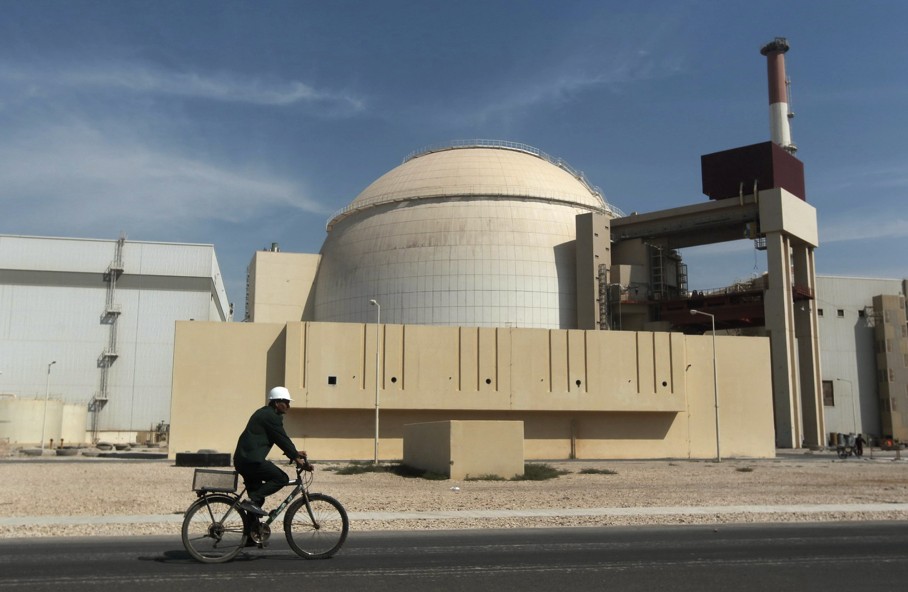
Bushehr reactorThe reactor building of the Bushehr nuclear power plant, just outside Bushehr, Iran. (Majid Asgaripour/Associated Press via Mehr News Agency)

Michael Makovsky, chief executive of the Jewish Institute for National Security Affairs (which recently put out its Iran task force report co-authored by the president’s former adviser on Iran, Dennis Ross) tells Right Turn, “The recent four-month extension of a January 20 interim deal with Iran, greased by the promised release of additional $2.8 billion in frozen Iranian assets, marks a significant but predictable failure for President Obama’s befuddling strategy of seeking diplomatic success through reduction of leverage — by eschewing tougher sanctions and a credible military option.” The result is the exact opposite of the president’s policy objective.” Iran feels less compelled to make concessions now than before the interim deal,” he explains. “It’s time for an intervention of sorts: Congress should impose new overwhelming sanctions and, more importantly, augment the military capability of Israel to strike Iran’s nuclear facilities. This would strengthen American diplomatic leverage, send a strong signal to Iran and our allies and, if needed, help Israel succeed in the role that the U.S. has seemingly abdicated.”

Many former policy experts agree. Former deputy national security adviser Elliott Abrams makes the case that “it is critical now for Congress to act, imposing crippling sanctions on Iran to go into effect in four months unless a good deal is reached. Iran must be told that it cannot stretch the talks out, one delay after another, and must abandon its nuclear weapons program or face economic privation starting this year. As of now they simply do not believe that.” The bipartisan United Against a Nuclear Iran (of which Ross is a member) also blasted the president. A statement co-authored by Gary Samore, Obama’s former coordinator for arms control and weapons of mass destruction, commonly referred to as the WMD “czar” read: “To date, the economic benefits accrued to Iran are greater than what was contemplated in the [Joint Plan of Action]. While the state of the Iranian economy remains in difficulty, Iran’s economy has improved and the regime’s diplomatic isolation has lessened. So far, however, Iran has not shown a willingness to dismantle any of its uranium enrichment capabilities and it continues to research and develop missile delivery systems and advanced centrifuges.” The statement continued:

The course of the negotiations has revealed a clear gap on the most important issue — the number and type of centrifuges. With its current enrichment capacity, Iran’s breakout time to produce fissile material for a bomb remains at a few months. However, Iran has been unwilling to consider a reduction in its current capacity, and the Supreme Leader recently proclaimed that Iran seeks a much larger enrichment program. This is unacceptable. If Iran remains unwilling to dismantle its nuclear infrastructure, forgo an industrial-scale enrichment program and address the ongoing questions about the military dimensions of its nuclear program, there is little potential for a diplomatic resolution.

They therefore recommend that P5+1 group of international powers continues to insist that “Iran remains closed for business and that the uncertainty surrounding these nuclear negotiations makes the business climate in Iran far too risky for responsible businesses to return; ensure existing sanctions are enforced more aggressively; and agree on decisive sanctions that would constitute a virtual economic blockade of Iran should Iran fail to agree to an acceptable deal over the term of the extended negotiation.” The UANI supports these steps so that the current “state of diplomatic inertia . . . [does] not become the new status quo.”

It is stunning that two of the president’s former top advisers on the subject have so obviously lost faith in the president’s handling of negotiations and have openly embraced the same measure virtually all Republicans and a large number of Democrats have advocated. The White House has called those pushing for additional sanctions to increase pressure on Iran “war mongers.” That is an untrue and vile accusation against his former senior aides and figures like Sen. Bob Menendez (D-N.J.) Rather than name-calling, the White House needs to listen to the broadest bipartisan majority on any topic these days, which is telling him that the Iranians are playing him and that his refusal to increase pressure on Iran makes a diplomatic agreement less, not more, likely.

I suspect, however, the president doesn’t much care what experts, ex-advisers, Sunni Arab leaders and the Israeli government  have to say. He’s got flunkies like senior adviser Valerie Jarrett and the hapless Secretary of State John Kerry telling him he’s been a great success. In any event, we’ve seen time and time again this president has not the nerve nor the spine to stand up to international bullies. We can only hope that a new Republican Senate majority will come along and allow a vote on sanctions, and this and the threat of Israeli military action is enough to prevent Iran from realizing its nuclear ambitions. Left to their own devices, Obama and Kerry will preside over a de facto policy of containment, which many of us suspected was the game plan all along.

UPDATE: AIPAC has weighed in as well with unusually strong language for this group. It pronounced itself “deeply disappointed” and in essence told the White House, “We told you so.” (“We have been concerned from the outset that Iran would drag out talks to improve its position, and Tehran has actually enjoyed some economic improvement as a result of sanctions relief in the Joint Plan of Action. In addition, during the last six months, Iran has continued both enriching uranium and conducting research and development on advanced centrifuges.  . . . We must find new means to step up pressure on Tehran. And Iran must verifiably dismantle its nuclear weapons program or face harsh consequences for its ongoing violations of treaty commitments and international law.)

Op-Ed: Those Gazans, What’s Their Story?

July 21, 2014

Op-Ed: Those Gazans, What’s Their Story? Israel National News, Oded Revivi — Mayor of Efrat, July 21, 2014

Gaza is the dilapidated backyard of the Palestinians. Nobody ever wanted Gaza or wants Gaza now and even Prime Minister Ariel Sharon, when he wanted to make a political concession to the Arabs, preferred to give them Gaza.


We have no more tears to shed with regard to the state of the Palestinian Arabs in general and that of the people of Gaza in particular. The 100 years of the Arab-Israeli conflict are primarily 100 years of Arab hatred and violence that have only brought them misery and poverty. But even though the Palestinians are to blame for their own plight, the people of Gaza are among the most wretched of people.

The curse “Go to Gaza” is an idiomatic phrase copied from Arabic and expresses accurately the contempt with which their Arab brothers regard them.

Gaza is the dilapidated backyard of the Palestinians. Nobody ever wanted Gaza or wants Gaza now and even Prime Minister Ariel Sharon, when he wanted to make a political concession to the Arabs, preferred to give them Gaza.

Up until 1967 Gaza was under Egyptian rule and was treated like an unwanted stepchild. After the Six Day War, Israel gained control and in 1982 when Israel returned to Egypt, as part of the Camp David Accords, what it had captured from Egypt in 1967, the Egyptians preferred to leave Gaza under Israeli control.

They preferred not to take responsibility for Gaza and with all due respect to the importance of liberating “Arab Lands”, the Egyptians had their red lines.

Since 2006, when Israel withdrew from Gaza, Gaza has remained stagnant. The option of independence granted by Israel has been funneled into fortifying its position as a terrorist entity.

The huge amounts of money that it has received from countries all around the world was invested in building tunnels, producing missiles and in training terrorists. Political control in Gaza passed from Fatah to even more radical Islamic organizations. Their energies are directed to smuggling weapons and munitions instead of building centers for industry and businesses. The beautiful Gaza coastline, which could have been turned into a tourist gem, has been turned into a smuggling area for ships carrying weapons.

Even Egypt, which allowed Gazans throughout the years, to make use of their common boundary, are fed up with the Gazan treachery, and closed their borders. Gaza found itself politically isolated from the Palestinian Arab leadership in Judea and Samaria, cut off from the Egyptian border and seaway and unable to import raw materials for production and industry.

You look at the Gazans and ask yourself, what’s their story? Why are they doing this to themselves? Why do they continue with aggressive provocations of war that they know from the outset will inflict upon themselves ongoing damage and destruction? Is it stupidity, cowardice of the local leadership or a primitive ideology that holds in contempt the disastrous consequences of their actions?

Is the idea of independence too much for them to handle? Are they afraid to take responsibility and instead flee to “holy wars”?

I have no doubt that there are Gazans who want to pass their days and nights in quiet and enjoy personal and economic security, but I wonder where they are. Why do they elect terrorist organizations that only cause them damage? Why don’t they demand a leadership that will free them from their many years of misery? Why is there not a local Gaza movementto protest the leadership’s endangering of their children’s lives?

Why do they not make a desperate call for a normal life?

Seven Israeli officers and men die in combat with Hamas. Number of Israeli fallen rises to 25

July 21, 2014

Seven Israeli officers and men die in combat with Hamas. Number of Israeli fallen rises to 25, DEBKAfile, July 21, 2014

Paratroopers_Gaza_7.14Israeli paratroops fighting in Gaza

Another seven IDF officers and men died in combat with Hamas Monday, July 21 on the fourth day of Israel’s ground operation in the Gaza Strip, raising the total of Israeli fallen in this operation to 25. Four men were killed guarding the Israeli side of the Gaza border by terrorists who jumped out of a tunnel 200 meters from Kibbutz Nir Am, disguised in IDF uniforms and flak vests. Ten were killed in a counter-attack and helicopter strike averting a mega terrorist attack of kidnap attempt. This was the fourth tunnel terrorist attack in three days.

Two more soldiers died in combat in the Shejaiya district of Gaza, and one by friendly fire.

There was no let-up in Hamas rocket barrages, two of which were carried out during Monday against a wide range of Israeli targets including the Tel Aviv metropolitan area. Iron Dome knocked out a large number.

DEBKAfile reported earlier Monday:

The IDF’s Shejaiya operation in the Gaza Strip continues apace, carried forward by five task forces now heading for the center of Gaza City amid casualties on both sides. Sunday, July 20, Israel’s crack Golani Brigades lost 18 fighters, without slowing down, compared with 170 Palestinian fatalities.

DEBKAfile’s military sources report that each task force, the size of half a division, is an integrated amalgam of air, armored, artillery and engineering forces, capable of operating almost autonomously in field combat. The buildup of the last 24 hours has expanded Israel’s fighting strength in the Gaza Strip to a total of 75,000 men, the largest ever fielded in this territory. Because of its scale, Israeli leaders are referring to Defensive Edge as a war rather than an operation.

The battle for Shejaiya waged Sunday burst into public prominence because of the heavy losses suffered by the Golani Brigades, but it is not the largest engagement underway at present. The other ongoing IDF battles, their progress, the units involved and their locations, are kept secret. We can only point to their general locations as being around Beit Hanoun in the north; Zeitun, south of Gaza City and the Shati refugee camp to the north.

More arenas are scheduled to be added to the list of battle zones Monday.

Rather than causing despondency, the high IDF casualty toll Sunday – the highest in a single engagement since the 2006 Lebanon War – has invigorated the fighting forces in the field, making them more determined than ever to get the better of Hamas with all possible speed.

Whereas their orders on Sunday were to advance warily and slowly, meanwhile testing the strength of Hamas resistance and observing their tactics, the tempo went into high gear at dawn Monday, when the troops were told to speed their advance from the outer fringes of Gaza City into its center.

Their performance in Shejaiya and other engagements Sunday deeply impressed Israel’s war leaders and made them confident enough to step up the rate of advance.

This upbeat mood was evident in the comments made Sunday night by Prime Minister Binyamin Netanyahu, Defense Minister Moshe Ya’alon and, from the field, by Chief of Staff Lt. Gen. Benny Gantz. While condoling deeply with the bereaved families of the 18 soldiers who died in combat, they were full of praise for the troops’ performance “in defense of our home” which outdid all expectations.

The following decisions were reached in consequence:

1. Gen. Gantz would stay in the field and lead the forces from there, rather than from staff headquarters in Tel Aviv.

2. The prime minister and defense minister would manage the war, without constant recourse to security cabinet sessions to obtain its approval of every stage of the plan of operation, the final goal of which DEBKAfile has learned, is Israel’s military takeover of the Gaza Strip.

3. As the military operation unfolded, the three war leaders were convinced more than ever that demolishing Hamas’ terror tunnel complex was not optional, any more than wiping out the rocket menace hanging latterly over five million Israelis and, for nearly a decade over the million people living directly in the shadow of the Gaza border. Publicity guidelines were to be built around this conclusion.

International statesmen are flitting busily around regional capitals, including Jerusalem, in search of an opening to broker a ceasefire in Gaza hostilities. UN Secretary General Ban Ki-moon has been holding meetings and US Secretary John Kerry will try and reach the Middle East in the coming days, according to a White House directive – unless he again cancels at the last minute.

According to DEBKAfile’s sources, the requisite political and military conditions for a ceasefire are not yet in place because of a number of circumstances, not least of which is Hamas’ refusal to contemplate a halt.

Israel, for its part, is fighting for the first time in its history with solid Arab backing from the Egyptian-Saudi-United Arab Emirates bloc. So determined are its members to obliterate the Muslim Brotherhood that they have virtually blacklisted Qatar for supporting the Brothers and for patronizing the Palestinian Hamas, regarded as the MB’s paramilitary arm.

This rift has put a spoke in the diplomatic effort to set in motion effective mediation for a Gaza ceasefire predicated on co-opting Qatar.

A bid to make Palestinian Authority chairman Mahmoud Abbas the bridge between the Egyptian-Saudi-UAE grouping and Qatar has likewise foundered. And there isn’t much Secretary Kerry can do if and when he comes over to try his hand.

US President Barack Obama’s suggestion, when he called Netanyahu Sunday, to build a new Gaza ceasefire around the 2012 formula concocted by the US, Egypt, Qatar and Turkey – and accepted by Israel and Hamas – for ending Operation Pillar of Defense, shows him to be cut off from the fundamentally altered diplomatic and military realities of the current Gaza conflict.

He declines to recognize the emergence of a powerful new Arab bloc. It will be necessary to twist the arms of each of its members, Egypt, Saudi Arabia and UAE, to gain their consent for a bid to cut the Israeli offensive short to rescue Hamas from defeat. And even then, they will stall.

And although anti-Israel demonstrations are being staged in some parts of the world, the most violent in Paris, hardly any world governments have openly condemned the Israeli operation – as yet.