Archive for July 25, 2014

Israel and US openly at odds over Gaza ceasefire terms

July 25, 2014

Israel and US openly at odds over Gaza ceasefire terms, Times of Israel, July 25, 2014

Israeli ministers unanimously reject Kerry proposal, and government sources say it leans heavily toward Hamas, wouldn’t enable Israel to keep tackling Hamas tunnels.
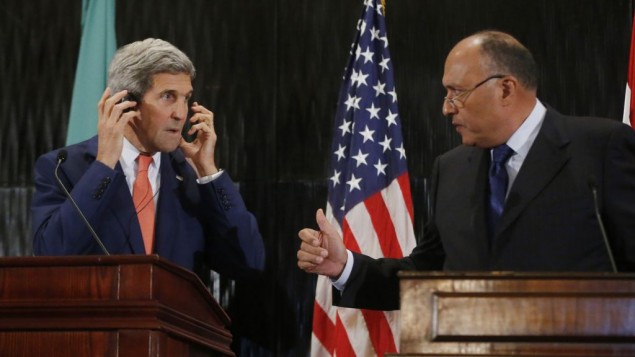
Kerry Egypt FMUS Secretary of State John Kerry stands with Egypt’s Foreign Minister Sameh Shukri during a press conference in Cairo, Friday, July 25, 2014. Kerry said he has not yet reached a deal between Israel and Hamas to call a 7-day humanitarian truce in the Israel-Hamas conflict but is continuing work. (AP Photo/Pool)

Israel and its key ally the United States were in open disagreement Friday night, after the Israeli cabinet unanimously rejected a ceasefire offer drawn up by Secretary of State John Kerry to halt 18 days of Israeli-Hamas conflict.

Kerry, speaking in Cairo, vowed to keep working on a ceasefire, and said Israel’s Prime Minister Benjamin Netanyahu was “committed” to working to narrow the gaps that were preventing a seven-day humanitarian ceasefire intended to lead to a longer-term deal. He also said Netanyahu had accepted an idea, proposed by UN Secretary-General Ban Ki-moon, of a 12-hour humanitarian time out. Israeli sources said the idea was under consideration.

But Israeli government sources told Army Radio the ceasefire terms proposed by Kerry were “completely unreasonable.” An unnamed senior Israeli government official flatly disputed Kerry’s assertion that his offer was “built on the Egyptian initiative” – which Israel accepted last week and Hamas rejected. In fact, the official was quoted saying, the Kerry offer is not built on the Egyptian proposal and tilts heavily toward Hamas.

The Army Radio report highlighted that the US on Monday signed an $11 billion arms deal with Qatar, and noted that Qatar is championing Hamas’s demands in the ceasefire negotiations, and is also alleged by Israel to be financing Hamas’s rocket production, tunnel digging infrastructure, and other elements of its military infrastructure. The radio report also claimed that Ban Ki-moon “is flying around the region on a Qatari plane.”

Indications from the lengthy Israeli cabinet meeting that rejected Kerry’s offer Friday are that the ministers were incensed that the terms of the deal would not have enabled Israel to continue to locate and demolish a network of dozens of tunnels that Hamas has dug, up to a mile or more long, from under Gaza residential areas all the way beneath the Israeli border.

Six Israeli soldiers have been killed by Hamas gunmen emerging from these tunnels in five incidents in the past 18 days, and Netanyahu said on Sunday that Hamas was planning massive terrorist attacks via the tunnels on Israeli kibbutzim that would have had “catastrophic consequences.”

Israel’s relations with Kerry, strained for a long time, were not helped when he was caught on a hot-mic earlier this week apparently sneering at Israel’s insistence that it is trying to tackle Hamas terror targets in Gaza with “pinpoint” accuracy. Comments made by the secretary in the same incident also indicated that Israel had not invited him to embark on this ceasefire mission, presumably because Israel wanted more time to tackle the Hamas tunnels.

The Israeli army’s southern commander, who is overseeing Israel’s ground offensive in Gaza, confirmed earlier Friday that he felt the army needed more time, although it had located what it believes are most of the tunnels.

The formal text of the ceasefire proposal offered by Kerry and rejected by Israel had not been released as of Friday evening. Earlier, though, The Times of Israel reported on what Arab sources said were its key elements.

The Kerry proposal, they said, provides for an immediate halt to hostilities to be followed 48 hours later by the start of five to-seven days of contacts between Israel, Palestinian and Egyptian delegations in Cairo, with the Palestinian delegation including Hamas officials. The talks in Egypt would include discussion of Hamas’s call for the lifting of the so-called siege of the Gaza Strip, and other demands.

In his comments on Friday in Cairo, Kerry said that Egypt had indeed offered to bring the “Palestinian factions,” and other interested parties, and Israel, to Cairo for such talks. “We still have some terminology” to work through, Kerry said. “But we are confident that we have a fundamental framework” that can work.

The Arab sources said the Kerry terms would provide for all military activity by the sides to halt immediately. On the Palestinian side, this provision was interpreted as meaning that Israel’s activities to find and destroy Hamas’s cross-border tunnels would also immediately be halted. But Israel has reportedly pushed for terms that would enable it to continue tackling the Hamas tunnels after a halt to hostilities.

The Arab sources said the discussions in Cairo would cover Hamas demands relating to: opening border crossings between Gaza and Israel; opening the Rafah crossing between Gaza and Egypt; the release of recently rearrested prisoners from the Shalit deal; the release of some 30 convicted terrorists, including Israeli Arabs, who were set to go free under the collapsed Israeli-Palestinian peace talks in late March; widening Palestinian fishing rights off the Gaza coast, and the establishment of a Gaza seaport.

Netanyahu has said Operation Protective Edge will continue and expand as necessary until sustained calm has been achieved for the people of Israel and Hamas’s terrorist infrastructure has been significantly weakened. Israeli officials have spoken of the need to have Gaza demilitarized, and the EU earlier this week demanded the disarming of Hamas and other Gaza terror groups. Hamas has fired over 2,000 rockets at Israel over the past 18 days. The IDF launched a ground offensive last Thursday that has focused on finding and demolishing the network of dozens of tunnels dug by Hamas under the Israel border.



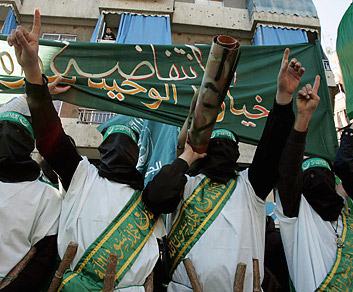
Gaza Would Have Been Occupied without Iran’s Support, Cleric Says

July 25, 2014

Gaza Would Have Been Occupied without Iran’s Support, Cleric Says

July 25, 2014 – 17:49


​ (Yep, occupied and a lot better off when you consider what Iran has to offer. Isn’t it amazing the tough stand Iran always takes when someone else is doing the fighting?-LS)

TEHRAN (Tasnim) – A top Iranian cleric said that had it not been for Iran’s support for Gaza, the entire coastal enclave would have been occupied by the Zionist regime of Israel.

“The Islamic Iran is proud of its all-out support for Palestine,” Tehran’s Provisional Friday Prayers Leader Ayatollah Ahmad Khatami said Friday, adding “If it had not been for Iran’s proper supports, the Zionist regime would have (been able to) occupy the entire Gaza (Strip) today”.

He noted that according to the Zionist regime’s interior minister, the order had been issued for the Israeli forces to occupy Gaza “but you can see now that they have become grounded (there)… and the Zionist regime is desperately seeking a ceasefire”.

Ayatollah Khatami underlined that the Palestinian Resistance Movement would not agree to a ceasefire until its demands, including the release of Palestinian prisoners and an end to the Gaza blockade, are met.

Earlier and in a Wednesday speech Supreme Leader of the Islamic Revolution Imam Khamenei also highlighted Tel Aviv’s desperation for a ceasefire in Gaza.

Imam Khamenei referred to Israel’s efforts to broker a truce with Palestinian fighters, saying the regime “which commits crimes beyond human imagination has become desperate” after facing strong resistance from Palestinians.

Ayatollah Khatami, elsewhere in his Friday prayers sermon, referred to the issue of Palestine and support for the oppressed Palestinian nation as a pivot of the Iranian nation’s unity.

He added that all Iranian groups, factions and political figures with various political inclinations got united and participated in Friday’s rallies marking the International Quds Day.

Iranians of different social strata held massive rallies all over the country on Friday morning to mark the International Quds Day in a show of support for the oppressed nation of Palestine.

The huge demonstrations saw Iranians venting their anger on the Tel Aviv regime and its allies and calling for an end to the Israeli attacks on the besieged Gaza Strip.

Carrying placards and chanting slogans against Israel and the US, marchers voiced their support for the people of Gaza, and reiterated their opposition to the occupation of the Palestinian territories by the Zionists.

Each year, the International Quds Day is celebrated on the last Friday of the holy Muslim month of Ramadan.

This year’s rallies came against the backdrop of a massive Israeli onslaught on the besieged Gaza Strip.

As the 18-day Israeli offensive on Gaza rages on, above 800 Palestinians have been killed, and over 5,200 other injured in the besieged enclave.

Kerry Vows to Press On After Israel Rejects Gaza Cease-Fire Proposal

July 25, 2014

Kerry Vows to Press On After Israel Rejects Gaza Cease-Fire Proposal, Voice of America, July 25, 2014

(Kerry says he will keep on keeping on. The positions of Israel and Hamas remain far apart.– DM)

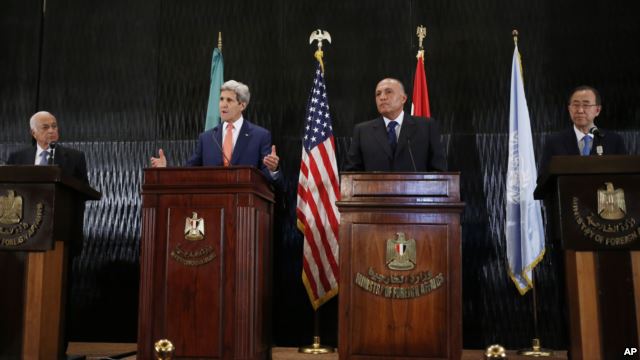
Kerry at al at press conf in CairoU.S. Secretary of State John Kerry, second left, with Secretary-General of the Arab League Nabil al-Araby, far left, Egypt’s Foreign Minister Sameh Shukri, second right, and U.N. Secretary-General Ban Ki-moon, speaks at a hotel in Cairo, Egypt, July 25, 2014

“None of us is stopping,” Kerry said, adding he will continue negotiations from Paris on Saturday.

Kerry described a broad timetable for continued talks and said there was “no formal proposal” presented to the Israeli cabinet for approval by vote. Kerry said Israeli Prime Minster Netanyahu has assured him that he wants to find a way forward.


U.S. Secretary of State John Kerry vowed to press on for a truce after Israel  rejected a proposal for a cease-fire between Israel’s military and Hamas militants in the Gaza Strip.

Israeli public television said Prime Minister Benjamin Netanyahu’s security cabinet is seeking modifications before any agreement to end hostilities.

Kerry said late Friday that efforts will continue towards an agreement . He proposed a plan that would begin with a week-long cease-fire starting Sunday to stop two weeks of intense fighting that has sent the death toll soaring among Palestinian civilians.

“This is broad effort,” Kerry said, speaking to reporters alongside the Egyptian foreign minister in Cairo. “At this moment we are working toward a brief, seven-day cease-fire in honor of Eid.”

Kerry was referring to the days concluding the Muslim holy month of Ramadan.

​Kerry’s proposal calls for prompt negotiations among Palestinian and Israeli officials on major economic, political and security issues. Representatives of other nations would attend the talks.

“None of us is stopping,” Kerry said, adding he will continue negotiations from Paris on Saturday.

Kerry described a broad timetable for continued talks and said there was “no formal proposal” presented to the Israeli cabinet for approval by vote. Kerry said Israeli Prime Minster Netanyahu has assured him that he wants to find a way forward.

Kerry met for hours in Cairo with Egypt’s foreign minister, Sameh Shukri, and the United Nations’ chief, Secretary-General Ban Ki-moon.

“The people of Gaza have bled enough,” Ban told reporters in Cairo, appearing with Kerry. “First, stop the fighting…Second start talking. There is no military solution.”

Ban has decried the conflict’s impact on civilians.

On Friday, five Palestinians were killed in the West Bank as the conflict in Gaza spread. The death toll rose to more than 800 Palestinians – mostly civilians – 35 Israelis and one foreign worker in Israel.

Egypt has mediated previous conflicts between Israel and Hamas, including a 2012 cease-fire. The United States, Israel’s closest ally, does not negotiate directly with the militant Palestinian group, which it has branded a terrorist organization.

Israeli security cabinet meeting

Netanyahu convened his security cabinet on Friday and Israeli media said the cabinet continued to meet into the night.

An Israeli official said the Netanyahu government envisaged an initial halt to the fighting lasting seven days, during which the army would keep digging up tunnels on Gaza’s eastern frontier.

According to Western and Palestinian officials, once a humanitarian lull takes hold, delegations from Israel and Hamas would arrive in Cairo for indirect talks that could lead to a lasting truce.

“First Israel wants to hear Hamas’s response to the [Kerry] proposals,” the official said, adding that some members of the security cabinet also sought assurances that Gaza would be stripped of its remaining rockets under any extended cease-fire.

Hamas had no immediate comment. On Wednesday, its leader Khaled Meshaal voiced support for a humanitarian truce, but only if Israel eased restrictions on Gaza’s 1.8 million people.

Hamas wants Egypt to open up its border with Gaza, too, and has demanded that Israel release hundreds of prisoners rounded up by Israel in a sweep of the West Bank last month following the kidnap and killing of three Jewish teenagers.

Calls for a cease-fire have escalated, especially since Thursday, the 18-day-old conflict’s deadliest day, when more than 100 Palestinians were killed.

The U.N. secretary-general said he was “appalled” by Thursday’s shelling of a United Nations-run school being used as a shelter from the violence. The victims included “women and children, as well as U.N. staff,” Ban said.

The U.S. State Department said it was “deeply concerned,” though it did not explicitly blame Israel for the shelling.

Israel’s military, which has hit two other U.N. shelters in recent days, did not say it was behind the attack, but acknowledged fighting in the area Thursday.

The military said it warned civilians to vacate the area, but blamed Hamas for not allowing them to leave before the deadline.

Palestinian protesters have clashed with Israeli troops in the West Bank and East Jerusalem.

Palestinian medics say five Palestinians died in the West Bank during protests Friday. Demonstrators in the Palestinian territory marched in solidarity with Gaza in the northern village of Hawara. Thousands also demonstrated overnight, in what many observers are calling the West Bank’s biggest protest in a decade.

In East Jerusalem, dozens of Palestinian protesters hurled rocks and threw Molotov cocktails at an Israeli army checkpoint.

In Iran, government-run broadcasts said “millions” of people joined rallies nationwide to mark solidarity with Palestinians on Friday for its annual al-Quds Day event. Quds is the Arabic word for Jerusalem, one of the most important cities in the Muslim faith. The yearly show of support occurs on the last Friday of Ramadan.

Clashes continue

On Friday, dozens of Palestinian youths clashed with Israeli police near Jerusalem’s Old City and clashes erupted in other parts of the West Bank near Hebron and Nablus.

Police in Jerusalem barred entrance to the al-Aqsa mosque to men younger than 50 years. But many gathered on streets outside the barricades to hold prayers on the last Friday of Ramadan.

The Palestinians were staging what they called a day of rage against the Israeli military operation in the Gaza Strip.

In addition to killing hundreds, the conflict has wounded thousands and destroyed thousands of homes and a dozen hospitals and clinics.

Hebrew University Professor Moshe Ma’oz said the outbreak of violence was inevitable due to rising tensions after the collapse of a nine-month effort to revive peace talks between Israel and the Palestinians.

“It’s a vicious cycle of struggles and conflict,” Ma’oz said. There are no saints in the Middle East and certainly not on this issue. Everybody contributed to it.”

The collapse led to a reconciliation agreement between Hamas, which controls Gaza, and Fatah which dominates the Palestinian Authority in the West Bank.

The accord angered the Israeli government, which considers Hamas a terrorist organization. Some Israeli officials have called for the operation in Gaza to continue until Hamas is destroyed.

Hamas invincible?

The head of East Jerusalem’s International Peace and Cooperation Center, Rami Nasrallah, it isn’t possible to destroy Hamas.

“I mean, we’re not talking about a gang of 10 or 200 people,” Nasrallah said. “We’re talking about a major social, political power within the Palestinian society, whether in Gaza or in the West Bank.”

He said the Israeli strikes in Gaza rather have strengthened support for Hamas among Palestinians and obliged Palestinian Authority President Mahmoud Abbas to express public support for the demands of Hamas.

Israel Rejects Kerry’s Ceasefire Proposal

July 25, 2014

Israel Rejects Kerry’s Ceasefire Proposal – Defense/Security – News – Arutz Sheva.

Cabinet unanimously votes to reject the ceasefire proposed by U.S. Secretary of State John Kerry.

By Elad Benari, Canada

First Publish: 7/25/2014, 8:49 PM
Tanks gearing up for Gaza

Tanks gearing up for Gaza
Flash 90

Israel rejected U.S. Secretary of State John Kerry’s proposal for a ceasefire in Gaza on Friday evening.

According to reports in the Israeli media, the Cabinet which met on the issue unanimously voted to reject the proposal.

“The security cabinet has unanimously rejected the ceasefire proposal of Kerry, as it stands,” Channel 1 News reported, adding that ministers would continue discussing it.

According to Channel 10 News, even though the ceasefire proposal was rejected, Prime Minister Binyamin Netanyahu would still prefer to avoid an extensive ground operation in Gaza at this time.

Earlier on Friday, the London-based Al Hayat newspaper reported that Hamas had agreed to a five-day “humanitarian ceasefire” on terms suggested by Kerry.

Kerry’s proposal reportedly includes some of the unprecedented terms proposed by Hamas leaders, but not all. According to the daily, the truce would not see any terrorists released, despite Hamas’s demands.

An official involved in the negotiations for a ceasefire told The New York Times earlier Friday that Kerry has proposed a two-stage plan that would first impose a weeklong truce starting Sunday.

As soon as the truce took effect, Palestinian Authority and Israeli officials would begin negotiations on the principal economic, political and security concerns about Gaza, with other nations attending.

It was not clear if the final plan would be endorsed by Hamas, noted The New York Times.

Hamas leader Khaled Meshaal declared on Wednesday that Israel must accept his list of unprecedented conditions for a ceasefire in order for any truce to be declared.

Hip Hop Artists Create Song About Gaza-Israel War

July 25, 2014

Hip Hop Artists Create Song About Gaza-Israel War

By: Lori Lowenthal Marcus
Published: July 25th, 2014


​ (“A twist of war into a peaceful moment.”-LS)

Two musician lovers of Israel chose to express their views about the current “matzav” in their own language: Hip Hop music.

Kosha Dillz (born Rami Matan Even-Esh) and his musical colleague Diwon have strong ties to Israel. Dillz is the child of Israeli immigrants, and Diwon was born in Israel. Both now in Los Angeles.

The conflict was a topic of conversation and the one thing they and almost everyone else could agree on, is that there should be “No More War.”

Diwon was shown a video of an Israeli soldier in the reserves, Dror Gomel, who loves music and who turned his APC into a musical instrument for a performance he called “No More War.”

When Diwon showed Dillz Gomel’s video, they decided to create a song around the beat, called, not surprisingly, “No More War. (Drums of Peace.)”

The result is a song and video they released Thursday, July 24.

The two will be performing their song in Los Angeles, where both live, just a few hours after this article is published, at a fundraiser for Israel held by StandWithUs and Amit Children.

The lyrics are not what really drives the song, it’s the beat and the refrain that moves it forward. Howerver, there is one stanza almost entirely in Hebrew, which starts with “Shalom chaverim, this is my rechov, kol ha yeladim.” And then a few lines later it says, “ve ba boker atah rotseh shalom, kol ha kulam – peace no balagon.”

“When you see the video, maybe you can enjoy a twist of war into a peaceful moment. It shows you the heart of a soldier who just wants to play some drums. Music has brought me friends from all different races including Muslims. The world would be better if there was ‘No More War,’” Dillz told The Jewish Press when asked what he wants people to think when they hear the song and watch the video.

So watch the video and see how Israeli-American west coast Hip Hop artists are responding to what’s happening right now in Israel and Gaza.

SPOILER: Although the musicians wish there was no need for war, they are clear about who they think is at fault.

Israel rejects Kerry cease-fire proposal in Gaza

July 25, 2014

Report: Israel likely to reject Kerry cease-fire proposal in Gaza | JPost | Israel News.

By JPOST.COM STAFF

07/25/2014 18:13

Channel 10 reports that the diplomatic-security cabinet “flatly rejects” American proposals for a week-long humanitarian halt to fighting.


Israel is leaning toward rejecting US Secretary of State John Kerry’s proposal for a cease-fire in the Gaza Strip, Channel 10 reported on Friday.

Citing sources in the diplomatic-security cabinet that convened in Tel Aviv on Friday, Channel 10 said that Israel viewed Kerry’s bridging proposals as “a Qatari proposal with ornaments.”aza operation, cease-fire efforts

Qatar has been accused by Israel of providing financing and political support to Hamas. According to Channel 10, senior Israeli ministers have ruled as “out of the question” a cease-fire in which the IDF would be prevented from fully rooting out the threat of underground tunnels built by Hamas in the Gaza Strip.

Media reports indicated that Kerry’s cease-fire proposal included a week-long halt to fighting so that humanitarian supplies could be distributed in Gaza.

Earlier on Friday, aides to Kerry were said to be cautiously optimistic regarding the chances of a cease-fire between Israel and Hamas, Channel 10 reported.

According to the report, officials close to the secretary of state said that there is a chance a week-long halt in fighting could be announced as soon as Friday evening.

Prime Minister Binyamin Netanyahu convened his security cabinet on Friday to discuss Kerry’s pitch for a limited humanitarian truce under which Palestinian movement would be freed up to allow in aid and for casualties to be recovered.

Earlier Friday, Channel 2 quoted “senior Hamas officials” as saying that the leadership of the Islamist group was “leaning toward” accepting the Kerry framework.

An Israeli official said the Netanyahu government envisages the initial halt to the fighting lasting seven days, during which the army would keep digging up tunnels on Gaza’s eastern frontier.

“First Israel wants to hear Hamas’s response to the (Kerry) proposals,” an official said, adding that some members of the security cabinet also sought assurances that Gaza would be stripped of its remaining rockets under any extended ceasefire.

Officially, Hamas had no immediate comment on the proposal. On Wednesday, its leader, Khaled Meshaal, voiced support for a humanitarian truce, but only if Israel eased restrictions on Gaza’s 1.8 million people.

Hamas wants Egypt to open up its border with Gaza, too, and has demanded that Israel release hundreds of prisoners rounded up by Israel in a sweep of the West Bank last month following the kidnap and killing of three Jewish teenagers.

Such concessions appear unlikely, however, as both Israel and Egypt consider Hamas a security threat.

One Cairo official said next week’s Eid al-Fitr festival, which concludes Ramadan, was a possible date for a truce. But US officials were circumspect on progress made by Kerry in the mediation that has involved Egypt, Turkey, Qatar and Abbas.

“Gaps remain between the parties, so his focus is on finding a formula that both sides can accept,” a senior US official said on Thursday, adding that Kerry would not stay “for an indefinite amount of time”.

Zo on PJ — Israel! How Dare You Fight Back!

July 25, 2014

Zo on PJ — Israel! How Dare You Fight Back!, You Tube, July 25, 2014


Israel’s Pyrrhic Moral Victory

July 25, 2014

Israel’s Pyrrhic Moral Victory, Front Page Magazine, July 25, 2014


ij-450x300

As the Israeli-Hamas conflict rages, a familiar pattern asserts itself: Israel bends over backward to demonstrate her moral innocence to the world, and the world heaps condemnation on her anyway. Israel always feels compelled to restrain her military superiority because victory in that arena means losing the battle in the arena of public opinion despite extraordinary efforts. It’s worth questioning whether the moral victory Israel is striving for accomplishes anything except to perpetuate the hostilities and ensure more Israeli deaths at the hands of Arab terrorists.

Forced to defend herself, but under the microscope of worldwide scrutiny, Israel has gone to extreme lengths to avoid civilian deaths. Business Insidercalculated that Israel has taken such unprecedented measures that she is “raising the standards of what can be expected in warfare.” The IDF issues warnings to civilians prior to neighborhood incursions. Israeli doctors treat wounded Gazans. Israel agrees to a ceasefire only to have Hamas break it. In one instance, Israel even spared the lives of fourteen Hamas operatives in order not to incur civilian casualties. And yet she is still decried for a “disproportionate response” against the craven Hamas, who hide behind women and children, store weapons in hospitals, and happily press their own citizens into martyrdom to wage a very effective propaganda war.

“Disproportionate response” is a completely idiotic complaint that has never before been raised in wartime except to punish Israel, itself surrounded by a massively disproportionate Arab population. No one ever won a war by countering an aggressor with carefully measured, tit-for-tat responses. Conflicts are won by striking back so disproportionately that the enemy’s military forces are devastated and, more importantly, its will to fight is crushed so thoroughly that the threat is extinguished.

Defense Minister and former chief of staff Moshe Ya’alon recently accusedNetanyahu of not combating terrorism with a strong enough hand: “Why are we, a sovereign nation with a strong army, begging a terror organization to give us calm? We need to recover the deterrence in a way that they are the ones begging for calm. What are we teaching our enemies all over the world? That they can do anything to us and we’ll turn the other cheek.”

It is worth reminding ourselves what sort of enemy Israel is dealing with, and what kicked off this most recent warfare: the murder of three Jewish teenagers – one an American citizen – kidnapped by Hamas and left in a shallow grave last month, which left the world – or at least the civilized world – heartsick and angry. The boys had been shot shortly after they went missing, “killed in cold blood by human animals,” as Prime Minister Netanyahu said. So Israel and decent people everywhere mourned, because we love life; meanwhile our nihilistic enemy, who boasts that they love death more, celebrated.

Around the world, those who sided with those human animals had expressed their sick joy over the three kidnapped teens with a three-fingered salute which they taught to their brainwashed children, preparing the next generational wave of Jew hatred. Then, their viciousness not sated with having executed three innocents, they even attacked the IDF ambulance transporting the bodies home.

Feckless President Obama, who has never been a friend to Israel (and Israel’s enemies there and abroad are keenly aware of that), decried the kidnapping/murders as “a senseless act of terror.” But terrorism is never senseless; by definition, terrorism is not random and pointless but waged with a terrible, specific intent. Eyal Yifrach, 19, and Gilad Shaar and Naftali Frenkel, both 16, were kidnapped and murdered because they were Jews, the people whom Hamas has sworn to wipe from the face of the earth.

Abroad, meanwhile, Jews – particularly in France – have become the targets of raging anti-Israel “protesters” using the Gaza conflict as an excuse to firebomb synagogues, burn down Jewish-owned stores, and chant for the murder of Jews in ovens. “Anti-Semitic incidents are an almost daily occurrence,” the president of France’s National Bureau for Vigilance Against Anti-Semitism told The Blaze even before the Gaza operation began. British Jews have experienceda doubling of anti-Semitic incidents, from verbal abuse to attacks on buildings and people. From Boston to Berlin, Palestinian sympathizers have called for the hunting of Jews. In the understatement of the year, the president of the Council for Jewish Institutions in France said, “This is not a good time for Jews.”

As Jordan Chandler Hirsch wrote in Tablet, “Israel’s operation in Gaza is not causing deep-seated prejudices, it is revealing them.” In the eyes of the Jew-haters, Israel can do no right. And still Israel suffers from what Bret Stephenscalled, in the Wall Street Journal, “the Jewish state’s most obvious weakness”:

a certain kind of vanity that confuses stainlessness with virtue, favors moral self-regard over normal self-interest, and believes in politics as an exercise not in power but in self-examination. People, and nations, with such attitudes cannot be beaten militarily. But they can easily—too easily—be shamed.

In a joint call on both Israelis and the self-proclaimed Palestinians to end the violence, Israel’s President Shimon Peres and President-elect Reuven Rivlin expressed their desire to live in peace with their Arab neighbors and their faith in the ability to live together. “The bloodshed will only stop when we all realize that we have not been sentenced to live together, but destined to live together.”

That is a very lofty sentiment, but the reality is that there can be no coexistence with a ruthless, relentless enemy whose very raison d’etre is your total and complete extermination. There will be no peace until either that murderous hatred or the bearers of it themselves are stamped out. This can only be accomplished by making the enemy pay terribly; that is how wars are won. Victory and lasting peace cannot be achieved through rules of engagement that tie both hands behind one’s back in order to curry the world’s “favor” – a favor Israel will never win, no matter how extraordinarily well she behaves.

Cartoon of the Year

July 25, 2014

A Thank You Letter From Hamas to the Media

July 25, 2014

A Thank You Letter From Hamas to the Media, Front Page Magazine, July 25, 2014

(It’s not really from Hamas. It’s too candid. Still, it’s a very good summary of media “reporting.” — DM)

hamas_lebanon_0224

Dear Members of the Mainstream Media,

You’ve been awesome! Everyone knows that we start unwinnable wars with Israel because the real victory happens when you predictably side with us each time. And you’ve been so supportive of our strategy that we really want to acknowledge your helpfulness. In particular, we thank you for:

Focusing so much more on our suffering than anyone else’s. Nigerians must die in far greater numbers before you take notice, so we’re glad that you value our lives so much more.

-Minimizing your coverage, if any, of our attacks that led up to Israel’s military response and generally providing so little context that outsiders think that Israelis kill Palestinians just for fun. We’re especially grateful to the French media for this. Their distortions of the conflict are so one-sided that they incite Muslims across France to attack Jews and synagogues, and that is welcomed by our anti-Semitic worldview (although, unfortunately, such attacks remind everyone why Jews need a state).

-Emphasizing our civilian death toll without explaining that (1) our casualty reports are hasty and inflated, and (2) we maximize that total by using Palestinians to shield our weapons and by urging them to stay in the very areas that the IDF — in its annoying effort to minimize our civilian deaths — warns Gazans to evacuate.

-Never mentioning the fact that if we could kill millions of Israelis, we would (after all, our charter calls for Israel’s destruction). Just as the 9/11 hijackers made the most of what they had but would have liked to kill far more Americans (for example, with the help of WMD), we too would love to kill far more Israelis. Indeed, we have purposely targeted Israel’s nuclear reactor on several occasions, with that very goal in mind. Fortunately, you never highlight the genocidal intent behind our attacks when mentioning Israel’s “disproportionate” response.

-Never calling us jihadists even though we persecute Christians (like the ISIS, which just compelled Mosul’s Christians to convert to Islam). The forced conversion, expulsion, or murder of Christians and other religious minorities by Islamists has been happening for millennia, as assiduously documented in Crucified Again, but such historical context is thankfully absent from your reporting on our conflict with Israel.

-Downplaying how bad we are for Gazans by not reporting on, for example, our attack on the very Israeli power station that provides electricity to 70,000 Gazans. Thankfully, you also ignored how the Israelis — in their stupid display of goodwill — exposed their workers to the perils of our rockets so that they could restore power to Gaza.

-Minimally reporting on our corruptionunfair wealth, or vast expenditures on tunnels to attack Israel while ordinary Palestinians grew poorer.

-Overlooking how — to maximize Palestinian deaths — we store our missiles in an UNWRA-run school and how, when UNWRA finds out, they just hand us back our missiles.

-Disregarding Arabs who have the courage to critique us — like Dr. Tawfik Hamid, an Islamist-turned-reformer who blames Palestinian suffering entirely on us.

-Ignoring Israelis’ humanitarian folly in providing medical aid to the very terrorists trying to kill them.

-Failing to acknowledge Israel’s immense restraint. Had we been fighting Syria’s Assad regime, by now Gaza would have been flattened — devastated by barrel bombs, poison gas, and other attacks that are far more indiscriminate than Israel’s intelligence-directed strikes. And of course, if Syria were killing us, you’d hardly care. But luckily, we’re dealing with Israel — that country that everyone loves to hate — so we can count on your helpful coverage here.

-Omitting how Israel chose to sacrifice dozens of IDF soldiers when destroying our tunnels and weapons in densely populated areas like Shejaiya because doing so with airstrikes (which risks no soldiers) would have killed many thousands of Palestinians. Your friendly omission of such crucial facts reminds us of how wonderfully you covered Jenin in 2002, when (again) — rather than praise Israel’s humane but costly decision to use ground troops rather than airstrikes – you very helpfully and falsely accused Israel of a massacre during another IDF operation to stop Palestinian terrorist attacks on Israeli civilians.

-Not sharing with your English readers what we openly say in Arabic: that we view any truce as just an opportunity to rearm for our next war against Israel (as our spokesman, Musheer Al Masri, recently declared on TV).

-Not underscoring that Israel can do nothing to make peace with us (after all, Israelis ended their occupation of Gaza in 2005 and we’ve been rocketing them ever since). It’s a bit nervy of Israel to use its border controls to limit our ability to rearm and rebuild cross-border attack tunnels, but — with your help — maybe the next cease-fire will remove Israel’s blockade so that we can more easily replenish our weapons and restore our tunnels for our next attack. And yes, we’re embarrassed that our fellow Arab Muslims in Egypt also choose to blockade us because of the problems that we’ve caused them.

-Not reminding readers, when you mention potential truce arrangements, that world powers are no more capable of ensuring a demilitarized Gaza than they were capable of disarming Hezbollah in south Lebanon.

Seriously, you’ve been AMAZING. Please keep it up!