Archive for July 22, 2014

Iran Urges Palestinian, Syrian, Lebanese Resistance Groups to Ink Defense Pact

July 22, 2014

Iran Urges Palestinian, Syrian, Lebanese Resistance Groups to Ink Defense Pact, FARs News Agency, July 22, 2014

Me and my shadow

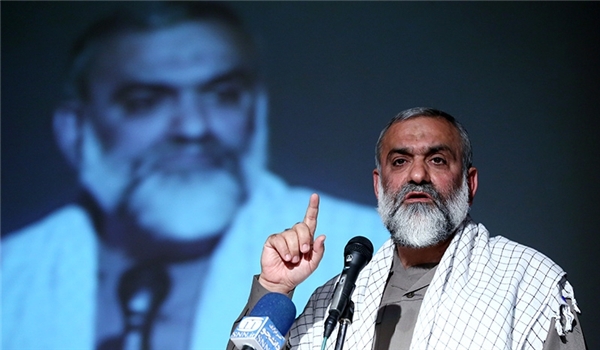
TEHRAN (FNA)- Commander of Iran’s Basij (volunteer) Force Brigadier General Mohammad Reza Naqdi called on the resistance groups in Palestine, Syria and Lebanon to sign a defense treaty to help and support each other in case of enemy attacks on any one of them.

“We ask the resistance forces in Palestine, Syria and Lebanon to endorse a defense pact so that an attack on any of them will be an attack on all of them and if the Zionist regime makes an aggression against any of them, all of them will grow united to confront it,” Naqdi said, addressing a gathering in Tehran on Monday night.

He also warned the Zionist regime that Muslims will not sit idly to witness aggression against their brothers in Gaza, “rather they will certainly show a firm and serious reaction”.

Naqdi underlined the Iranian nation and government’s support for the Palestinians, and said, “The Islamic Republic has and will always be beside the Palestinian nation.”

In relevant remarks on Monday, Hezbollah Secretary General Seyed Hassan Nasrallah praised the steadfastness of Palestinian resistance fighters, and vowed to stand by the resistance and people of Gaza.

In a phone talk with Hamas Chief Khaled Mashaal, Seyed Nasrallah said Hezbollah and the Lebanese resistance will support the Palestinian Intifada and resistance, with all their hearts, willpower, hope and destiny.

His praised the persistence of the Hamas resistance and the tremendous patience of the people of Gaza and strongly supported their rightful demands to end the current battle.

Mashaal, for his part, reassured that Hamas resistance was ready to make a second victory in July.

Seyed Nasrallah also contacted the leader of the Palestinian Islamic Jihad Movement, Ramadan Abdullah Shallah, where they discussed the developments on the battleground in Gaza, including field conditions and political advances.

They warned Israeli Prime Minister Benjamin Netanyahu that if he is relying on governmental and international support in the Gaza offensive, the resistance in Gaza is relying on the strongest popular support ever.

The missing Israeli sergeant’s uncertain fate. His family denies his death. Hamas claims his capture

July 22, 2014

The missing Israeli sergeant’s uncertain fate. His family denies his death. Hamas claims his capture, DEBKAfile, July 22, 2014

OROON_2Missing soldier Sgt. Shaul Oron

The IDF finally Tuesday, July 22, listed Golani soldier Sgt. Oron Shaul, aged 20, from Poriya Elite, “missing” after an initial attempt to declare him presumed dead. Sgt. Shaul was in the IDF’s APC, in which the entire squad was killed by a Hamas anti-tank missile early Sunday morning.  Six bodies were recovered from the blasted and burnt tank and identified. The seventh, Oron Shaul, was not found or identified. After an exhaustive probe and tests, the army informed his parents that they had not found his remains, but there was no way Shaul could have possibly survived this devastating attack.

The IDF was anxious to nullify the Hamas claim to have taken the missing soldier prisoner, although no real evidence was offered that he was in their hands, whether alive, dead or wounded. It was important to head off the coming extortions in military or political coin for a name tag, a singed ID card or even a body part.

And indeed, Hamas – once branded “a trafficker in bodies” by Palestinian leader Mahmoud Abbas – announced Tuesday that it would make Israel pay dear for ever scrap of information about the missing soldier.

Another statement issued by Hamas later stressed that its price for information about Sgt. Shaul was separate from its terms for a ceasefire.

And still, although the haggling had started, there was no proof that Sgt. Shaul had fallen into enemy hands or was even alilve.

The family of the missing soldier was firmly opposed to the line taken by the IDF. A relative, Racheli Gazit made a statement to reporters, saying: “So long as the family sees no irrefutable proof of the soldier’s death, we refuse to accept it.”  She added that while tests continued and no contrary evidence was forthcoming, Sgt. Oron Shaul would be deemed to be living.

This episode is just one instance of the military’s policy of fashioning a picture of events in the Gaza War for public consumption which may turn out to be contradictory and is often wide of reality.

Another insistence of this was Defense Minister Moshe Ya’alon’s comment Monday that Israel would finish off Hamas’ terror tunnels “in a day or two.”

A senior IDF officer said the next day that most of the tunnels had been found, but another “week or two” were needed to fully map the structures and demolish them.

Col. Uri Gordin, commander of the Nahal Brigade, was the first senior officer leading the war in the Gaza Strip to level with the public about the state of play in his sector, the northern area of Beit Hanoun. He confirmed that while his men had located most of the tunnels, they were not yet ready to be demolished.

He went on to confirm that the IDF faced a hard fight against Hamas, which he said was a tenacious and coherent enemy. The Islamists, he said, were throwing into battle everything they had in the way of manpower and weaponry for repelling the IDF assault on their infrastructure. “We are at war,” said Col. Gordin.

Earlier Tuesday, DEBKAfile ran a report under the heading: Israeli forces are fighting hard to win their first battle against Hamas, a savage and tenacious enemy.

The battle for Shejaiya, the Hamas stronghold on Gaza City’s outskirts, was still unresolved Tuesday, July 22, indicating that the Islamists were not giving up. Indeed, fresh Hamas reinforcements appeared to have taken up new positions in the battle zone during the night. They may have arrived through Hamas’ many-branched tunnel system.

Every few hours, the IDF spokesman releases two sets of figures: Israeli casualty statistics and the number of IDF strikes against Hamas. He has little to say about Israel’s military movements. Neither Israeli nor foreign correspondents have been permitted to accompany IDF troops fighting in the Gaza Strip – a policy the IDF has pursued since the second Lebanon war of 2006. Military leaders are therefore free to manage the data, human and electronic, coming out of the war, including images from the various fronts, without independent coverage. The public sees the same IDF surveillance footage day after day.

This policy reduces the hazards faced by Israeli forces and keeps their scale and identities secret from the enemy – and that is good for Israel’s war effort.

On the other hand, it creates a widening gap between the “official version” and the real state of affairs on the battlefield. Since most people have access to relatives on the front – not to mention prolific rumor mills powered by the social media – the credibility of national war leaders suffers.

Official communiqués are studded with impressive figures. Tuesday morning, the IDF was reported to have struck 3,200 Hamas targets since the start of the operation. In the last four days, the soldiers located 23 secret tunnels and 36 shafts leading into Hamas’ subterranean complex, and killed 186 Hamas operatives in combat. Israel lost 27 officers and men in the same period.

Those figures are telling in that they illustrate the hardships confronting the IDF from a ferocious enemy which refuses to crack under air or ground assault.

Because the Golani Brigades’ losses in Shejaiya were so heavy, IDF chiefs had no choice but to disclose information about the combatants on this front. But no one, aside from the combatants and their officers, knows what is going on in the other arenas to which the five special IDF task forces have been assigned. There is no news for instance from the southern sector of Rafah and Khan Younes. or the northern towns of Shati and Zeitun. No one knows how many Hamas tunnels are left to be destroyed – and where – before the IDF claims to have completed this critical part of its counter-terror mission

By any military standard, the IDF has the edge over Hamas. But the battle still needs to be won.

This situation has stiffened Hamas’ resistance to any of the ceasefire proposals taking shape in various parts of the region in the last couple of days. Its leaders feel strong enough to carry on fighting and holding out for better terms than those on offer at present.

Hostilities are therefore likely to drag out for an indeterminate period.

For Israel, the diplomatic clock is ticking too fast. As the warfare stretches out without a decisive battle on at least one Gaza front, the rising casualty toll threatens to undermine Israel’s ability to stand up to the pressures of international truce diplomacy.
EU calls on Hamas to disarm, condemns use of civilians as shields

July 22, 2014

EU calls on Hamas to disarm, condemns use of civilians as shields, Jerusalem PostHerb Keinon, July 22, 2014

Jerusalem hails European condemnation of Hamas violence; EU condemns rocket fire, calls for renunciation of violence.

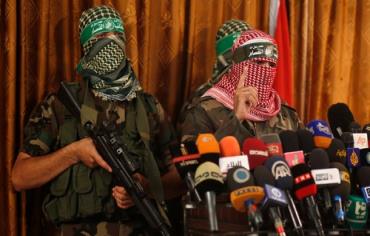
Hamas spokespersonHamas’ armed wing spokesman speaks during a news conference in Gaza City July 3, 2014. Photo: REUTERS

One senior diplomatic official said that Israel was pleased with the statement, even though after dealing with the Gaza situation it went on to repeat the EU’s well-known position regarding a two state solution, settlements and negotiations.

The elements regarding Hamas, the official said, were nothing short of “dramatic.” He said that it was no small thing for the EU to call Hamas’ actions “criminal,” and say Hamas needed to disarm.

Even in the paragraph condemning the loss of civilian lives, the official pointed out that the EU called on Israel to act proportionally, but did not say it was not doing so – an important matter of diplomatic nuance.

Some countries wanted Israel to be condemned for acting “disproportionately,” the official said, without naming names. He did say, however, that Germany, Britain, the Czech Republic and Holland were instrumental in getting the favorable language of the statement approved.


Israel received a strong back-wind from an unlikely source on Tuesday, when the EU issued a statement strongly denouncing Hamas and condemning their use of civilians as human shields.

The EU’s foreign ministers, following a monthly meeting in Brussels, issued a statement on the Middle East condemning “the indiscriminate firing of rockets into Israel by Hamas and militant groups in the Gaza Strip, directly harming civilians. These are criminal and unjustifiable acts.”

The statement also called on Hamas to immediately put an end to its rocket attacks, and to renounce violence. “All terrorist groups in Gaza must disarm. The EU strongly condemns calls on the civilian population of Gaza to provide themselves as human shields. “

Regarding civilian losses inside Gaza Strip, the statement “condemns the loss of hundreds of civilian lives, among them many women and children.”

“While recognizing Israel’s legitimate right to defend itself against any attacks, the EU underlines that the Israeli military operation must be proportionate and in line with international humanitarian law,” the statement read.

The statement said the EU was “particularly appalled by the human cost” of the operation in Shejaia, and is “deeply concerned at the rapidly deteriorating humanitarian situation.” The foreign ministers called on all sides to immediately implement a cease fire.

One senior diplomatic official said that Israel was pleased with the statement, even though after dealing with the Gaza situation it went on to repeat the EU’s well-known position regarding a two state solution, settlements and negotiations.

The elements regarding Hamas, the official said, were nothing short of “dramatic.” He said that it was no small thing for the EU to call Hamas’ actions “criminal,” and say Hamas needed to disarm.

Even in the paragraph condemning the loss of civilian lives, the official pointed out that the EU called on Israel to act proportionally, but did not say it was not doing so – an important matter of diplomatic nuance.

Some countries wanted Israel to be condemned for acting “disproportionately,” the official said, without naming names. He did say, however, that Germany, Britain, the Czech Republic and Holland were instrumental in getting the favorable language of the statement approved.

The Foreign Ministry issued a communique expressing “satisfaction” at the EU statement. “These statements of the EU are consistent with the concepts that guide Israel in its struggle against terrorism, and opens the door to implementing these common principles to restore quiet and security.”

Not everything in the rest of the statement that dealt with the diplomatic process found favor in Jerusalem, however. But, as the senior diplomatic official said, “what is good in the statement is new and dramatic, and what is not good is old and was expected.”

Netanyahu Wanted to Attack Iran

July 22, 2014


A little distraction compliments of our playful little friends in Iran-LS

Netanyahu wanted to attack Iran, but got stuck in Gaza instead

Hamas hasn’t metamorphosed into an existential threat to Israel, but there’s no way to ignore it, either.

By | Jul. 20, 2014 | 1:03 AM

Netanyahu, July 16, 2014.

Prime Minister Benjamin Netanyahu speaks following a meeting with Italian Foreign Minister Federica Mogherini at the Knesset in Jerusalem on July 16, 2014. Photo by AFP

With a major proportion of the Israel Defense Forces’ regular units fighting in and around the Gaza Strip, some 70,000 reservists being called up, the Palestinian death toll already over 300 and five dead Israelis so far, the one thing Netanyahu wants to keep is the support of those very leaders backing the Vienna talks. In recent months, Israeli officials warned that the worst outcome would be “turning this weak interim agreement into a permanent situation. That is exactly what Iran wants to weaken the sanctions regime, without giving anything of substance in return.” But whatever Netanyahu really thinks of the agreement to extend the deadline to November, the criticism will almost certainly be relatively muted. He’s stuck in Gaza.

It wasn’t supposed to be like this.

On the list of threats facing Israel, from the Netanyahu perspective Hamas in Gaza was at most a distant fourth after Iran, Hezbollah and the rising tide of Jihadism throughout the region. Even the prime minister’s inner circle assessed the prospect of “delegitimization” – the Palestinian Authority taking Israel to the International Criminal Court and mobilizing global opinion and diplomatic pressure – as a greater threat than anything Hamas, shut away in Gaza, could possibly muster.

It didn’t work out that way.

The full extent of the power struggle within the Israeli defense establishment to block Netanyahu and his then Defense Minister Ehud Barak’s plans to unilaterally strike Iran’s nuclear installations has yet to emerge. But led by the triumvirate of the three previous service heads – IDF Chief of Staff Gabi Ashkenazi, Mossad head Meir Dagan and Shin Bet chief Yuval Diskin – and silently backed up by President Shimon Peres, it did not come to pass. The Obama administration, along with other western governments, also paid a part in pressuring Netanyahu, against both his judgment and his instincts to give up the military option in favor of a combined approach of sanctions and diplomacy.

Netanyahu wasn’t bluffing three years ago – he was prepared to go ahead with a strike on Iran. He saw it as his historic duty. And his threats certainly played a part in motivating the Americans and Europeans to launch significant sanctions. But there was a limit to the opposition he could overcome. Now Iran’s nuclear program is the subject of a long and protracted diplomatic process, with its end out of sight. And like his disgraced predecessor, Ehud Olmert, Netanyahu is also stuck with a ground offensive in Gaza.

Hamas hasn’t metamorphosed into an existential threat to Israel – we have seen in recent days how its efforts to cause maximum harm to Israel have come to relatively little. But there was no way to ignore it either.

The inescapable question is, did Netanyahu and his security advisers take their eyes off the ball? To what extent did the relentless focus on Iran prevent Israel from warding off this current conflict?

On Friday, Netanyahu spoke with Barack Obama and thanked him for the U.S.’ financial support in building new Iron Dome batteries; one assumes he’s said some kind words as well to his environmental protection minister, Amir Peretz, who, as defense minister and Labor leader eight years ago, insisted on developing the missile defense system – against the professional position of nearly all the defense chiefs.

But while Iron Dome – which prevented multiple casualties and supplied Netanyahu with crucial breathing space before making the fateful decision on launching the ground operation – was being developed, other systems – especially an underground warning network against tunnels – languished. And now it’s the Hamas tunnels that have forced the IDF into Gaza.

Military readiness is only part of the equation. Hamas in recent years has been increasingly weakened, failing to deliver many of the most basic services to the 1.7 million people of Gaza. There have been initiatives during this period in Israel’s National Security, and other official forums, to create a new reality in and around Gaza, that would alleviate the local suffering, reduce the desperation there and perhaps also the motivation to continue launching rockets against Israel.

Officials who tried to push these ideas up to the decision makers realized that it just wasn’t on the national agenda. Iran and other matters took up all the attention in the periods between the brief flare-ups. Gaza has no votes and little media attention when the rockets and air strikes are just a steady drip of tit-for-tat. And while the diplomatic process with the Palestinian Authority, when it actually exists, is focused on issues such as the West Bank borders and Jerusalem, Gaza under Hamas remains little more than an afterthought. This is not just Netanyahu’s failure. It is also a result of Egypt’s hostility toward the Palestinians and, under President Abdel-Fattah al-Sissi, a hatred of Hamas, and of international indifference.

But, overall, it’s the lack of initiative by Netanyahu for five years to address Gaza as a major issue that has made this his war.


Abbas: Israel’s main goal is to ‘thwart reconciliation’ deal with Hamas

July 22, 2014

Abbas: Israel’s main goal is to ‘thwart reconciliation’ deal with Hamas, Jerusalem Post, Khaled Abu Tomameh, July 22, 2014

Palestinian Authority President Mahmoud Abbas returns to Ramallah from Qatar where he met with Hamas leader Khaled Mashaal.

A PA official in Ramallah said that Abbas was “furious” with Mashaal for rejecting his demand that Hamas accept the Egyptian-brokered cease-fire that was announced last week.

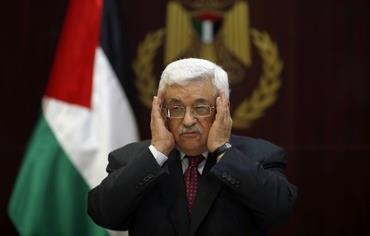
Abbas headacheMahmoud Abbas Photo: REUTERS

Palestinian Authority President Mahmoud Abbas on Tuesday night convened an emergency meeting of the Palestinian leadership in Ramallah to discuss the latest developments surrounding the IDF operation in the Gaza Strip.

The meeting came as Abbas cancelled a planned visit to Saudi Arabia and returned to Ramallah from Qatar, where he held talks with Hamas leader Khaled Mashaal on ways of ending the fighting in the Gaza Strip.

A PA official in Ramallah said that Abbas was “furious” with Mashaal for rejecting his demand that Hamas accept the Egyptian-brokered cease-fire that was announced last week.

Abbas also met in Doha with Qatari emir Sheikh Tamim bin Hamad al-Thani, who arrived unexpectedly in Jeddah late Tuesday for talks with Saudi King Abdullah bin Abdel Aziz.

In a televised speech after the meeting of the Palestinian leadership in Ramallah, Abbas again condemned the Israeli “aggression” on the Gaza Strip, saying its main goal was to “destroy our cause and thwart the reconciliation [with Hamas].”

On Twitter, Iran’s Ayatollah Khamenei Admits to Being the Head of the Serpent Whose Tail is Hamas in Gaza

July 22, 2014

On Twitter, Iran’s Ayatollah Khamenei Admits to Being the Head of the Serpent Whose Tail is Hamas in Gaza, Algemeiner, July 21, 2014

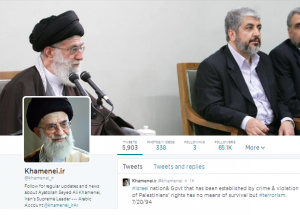
khameini-mashaal-300x215The Twitter page of Iranian Supreme Leader Ayatollah Khamenei, photographed sitting next to Hamas leader Khaled Meshaal. Photo: Screenshot / Twitter.

Iranian Supreme Leader Ayatollah Khamenei admitted to providing support for Hamas in Gaza, in a series of hateful tweets against Israel on Sunday and Monday.

Iran’s military and financial support for Hamas was also touted openly in the Iranian press, which even named the Fajr 5 missiles and Abadil drones given to militants by Iran’s Revolutionary Guard.

The hypocrisy of it all was called out on Monday by AIPAC, the America-Israel Public Affairs Committee, which asked how the U.S. and world powers could remove further economic sanctions and extend talks with Iran, “at the very moment when Hamas is using arms supplied by Tehran to attack Israeli civilians.”

Khamenei’s social media outburst gave further credence to the accusations at a hearing held by U.S. House Foreign Affairs Committee Chairman Ed Royce last week that “Iran’s nuclear program is just the tip of a revolutionary spear that extends across the world and threatens key U.S. interests,” with Tehran’s foreign policy being “subversive, sectarian, and set on goals that would come at the expense of U.S. interests in the region.”

Rather than “revolutionary spear,” this column seeks to use language the Iranian mullahs in Tehran will understand, with Khamenei’s Twitter rant showing that Iran’s Supreme Leader is the very head of the serpent whose tail is Hamas in Gaza.

Much has been written about Tehran’s role in financing and arming its allies and its role in the region’s shifting alliances. One Op-Ed at the weekend went further to now paint an internal proxy war within the Sunni axis in the Middle East, now split with Egypt, the Palestinian Authority, Jordan and Saudi Arabia, on one side against Qatar, Turkey and Hamas, along with other global supporters of the Muslim Brotherhood, on the other.

But that analysis left out the alliance that has been most directly threatening to Israel; Iran-Syria-Lebanon-Gaza, with the first pair represented by the entrenched regimes and the second by Hezbollah and Hamas, both of which are classified internationally as terrorist groups.

Another question that wasn’t directly explored by pundits was that if Hamas is fighting Israel in some proxy war, would it really just be another way of saying, quite simply, this is Iran versus the U.S.?

And, more specifically, if Hamas takes orders from Tehran and receives its missiles from Iran’s Islamic Revolutionary Guards Corps, was the flare-up in the past two weeks of Gaza’s sworn war against Israel just some sick and twisted smokescreen to divert the world’s attention from Sunday’s July 20th expiration of the six-month negotiation window set by the U.S. to reach an agreement with Tehran to slow Iran’s nuclear program?

In other words, should the blood of hundreds of Gazans, following Hamas orders to stand on the rooftops of their homes, rather than follow IDF instructions to vacate and seek shelter, be on the hands of Hamas leader Khaled Meshaal, or his benefactor, the Supreme Leader of the Islamic Republic of Iran?

On Twitter, via @khamenei_ir, Khamenei showed the world his hatred for Jews, Israel, and the U.S., combining new tweets with some from his archive, which he even dated, with one self-referenced quote going back 20 years.

His Twitter account was also updated with a new background photo, showing Khamenei at a news conference with Meshaal, now living in exile, who was also accused by Israel media at the weekend for having embezzled perhaps billions of dollars from donations for humanitarian support into a property empire in Qatar.

On Sunday, Khamenei said on Twitter: “We back and assist any nations that confront the Zionist regime and we are not at all afraid of declaring it. 2/3/12 #GazaUnderAttack #Gaza”.

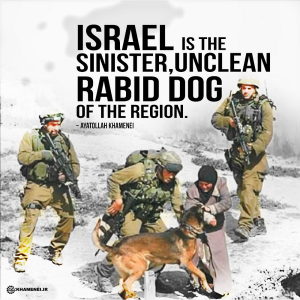
zion-dog-300x300

Tweet from Iranian Ayatollah Khamenei: “#Israel, sinister filthy rabid dog in the region, is a threat to the world. 11/2/13 Zionism is The Real Terrorism #Gaza.”

He also re-published one infamous tweet that triggered international condemnation: “#Israel, sinister filthy rabid dog in the region, is a threat to the world. 11/2/13 Zionism is The Real Terrorism #Gaza.”

He said Western governments, especially the U.S. have “disgraced themselves by their silence and support” of Israel, a repeat from October 27, 2010.

A fresh one read: “Even if ppl from across the world stage protests against #Israel’s crimes, the only thing western govts will do is speak! #GazaUnderAttack.”

On Monday, he resumed his Twitter rant, focusing on denigrating Israel and denying the Jewish State’s legitimacy, even quoting himself speaking in 1994.

“#Israel nation& Govt that has been established by crime & violation of Palestinians’ rights has no means of survival but #terrorism. 7/20/94″

He said Jews who emigrated to Israel were “greedy ppl & sometimes wicked & killer who are gathered fr across the world.”

He also tried to separate Jews living in tiny minorities, such as the 30,000 claimed to live among Iran’s 76 million people, as being different from those living in the Jewish national home:
“There are Jews living in various countries;in Iran Jews live respectably ‘cuz its their own country but #Zionism is different from #Judaism.”

He said: “What’s #Israel? A fake regime & a false nation. They gathered some greedy ppl fr across the world on the pretext of a better life in #Palestine.”

He continued: “Usurper #Israel’s govt, over half a century since this cancer tumor was formed in the body of Islam, has always led its course by #terrorism.”

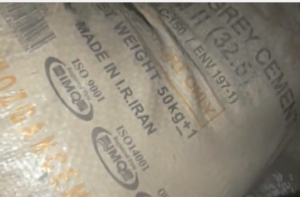
iran-cement-300x197“Made in Iran” stamped on a bag of cement used to conceal rockets aboard an Irani ship destined for Gaza via Sudan. Photo: IDF.

While Khamenei tried to denounce Israel for terrorism, it was Chairman Royce last week who pointed the finger at the Islamic Republic for being the world’s largest terrorist organization.

Royce said,“It is Iran that provides the funding, weapons, and training to Hamas and other Palestinian terror groups.  Iranian leaders have admitted to providing the missile technology that Hamas used against Israel during the last Gaza conflict in November 2012. And just the other week, a U.N. panel of experts concluded that rockets and weapons concealed on the Klos-C – including long-range M-302 rockets – originated from Iran.”

The Klos-C ship was seized by Israel in MarchHidden under bags of Iranian cement, Israel found 40 M-302 missiles, 181 122-mm mortars, and 400,000 7.62 caliber bullets. The weapons were originally flown from Syria to Iran. From Iran, they were shipped by boat to Iraq. The shipment was intercepted as it was being moved by boat from Iraq to Sudan, from where the weapons would have been smuggled into Gaza.

“Indeed, with Iran’s long support of terrorist groups, militias and regimes, the region has been feeling the brunt of this ‘revolutionary spear’ for quite some time,” Royce said.

Or, in the words familiar to the Ayatollah’s mullahs, Iran’s Supreme Leader is the very head of the serpent whose tail is Hamas in Gaza.

Iran Completes Process of Eliminating Enriched Uranium

July 22, 2014


(OK, so we’re supposed to believe this??-LS)

Iran has turned all of its enriched uranium closest to the level needed to make nuclear arms into more harmless forms, the UN nuclear agency says. The conversion of its stock of 20%-enriched uranium was part of a deal to curb Iran’s nuclear programme. The US said last week it would unblock $2.8bn in frozen Iranian funds in return for Iran’s compliance.
A four-month extension to talks on Iran’s nuclear ambitions was agreed on Friday between Iran and world powers. The talks are aimed at persuading Iran to limit its nuclear programme in exchange for the lifting of sanctions. The six world powers involved in the talks – the US, France, China, Russia, Germany and the UK – suspect Iran seeks atomic weapons, which Iran denies.
The country insists that it is enriching uranium for use in nuclear power stations and for medical purposes.

Promising sign
Correspondents say Iran’s completion of eliminating its most worrying uranium stockpile is a promising sign that its leaders do not want to derail the diplomatic process. A new report from the International Atomic Energy Agency (IAEA) says Iran is observing all of its other commitments as well. Iran had more than 200kg of 20%-enriched uranium when the preliminary agreement to convert it was reached last November. At 20%, enriched uranium can be converted quickly to arm a nuclear weapon and experts said 200kg was enough to make one nuclear warhead.

Negotiations between the six powers and Iran are set to resume in September, with the deadline for an agreement on 24 November. Despite the news, the BBC’s Bethany Bell says a long-term solution to Iran’s nuclear ambitions still seems a long way off. The parties have been unable to reach agreement on imposing long-term restrictions over Iran’s uranium enrichment and plutonium production – processes that could yield material for nuclear warheads. In a joint statement after last week’s talks, EU foreign policy chief Catherine Ashton and Iran’s Foreign Minister Mohammad Javad Zarif said: “There are still significant gaps on some core issues which will require more time and effort.” A deal could see the lifting of oil and trade sanctions on Iran.

Alan M. Dershowitz: Has Hamas ended the prospects for a two state solution?

July 22, 2014

Has Hamas ended the prospects for a two state solution?.

Ben Gurion International Airport, near Tel Aviv, Israel. (Image source: Wikimedia Commons)

This of course is part of Hamas’ grand strategy: by targeting Israeli civilians and international air travel from its own civilian areas, Hamas leaves Israel no choice but to take military actions that risk the lives of innocent Palestinians. There will be even more innocent Palestinian deaths now, as Hamas has raised the stakes considerably for Israel. Every country in the world would do everything in its power to keep open the airports, which are the lifelines to its economic viability. Hamas knows this and welcomes Israeli military action that produces more dead Palestinian civilians and hence more international criticism of Israel.

Even more importantly, Hamas’ actions in essentially closing down international air traffic into Israel, considerably reduces the prospect of any two-state solution. Israel will now be more reluctant than ever to give up military control over the West Bank, which is even closer to Ben Gurion Airport than is Gaza.

Were Israel to end its military occupation of the West Bank—as distinguished from its civilian settlements deep in the West Bank—it would risk the possibility of a Hamas takeover. That is precisely what happened when Israel removed both its civilian settlements and its military presence in Gaza. Hamas took control, fired thousands of rockets at Israeli civilian targets and have now succeeded in stopping international air traffic into and out of Israel.

Israel could not accept the risk of a Hamas takeover of the West Bank and the resulting Hamas rocket attacks at the nearby Ben Gurion Airport. It may still be possible to create a two-state solution whereby Israel withdraws its civilian settlers from most of the West Bank and agrees to land swaps for areas that now contain large settlement blocks. But Israel will have to retain military control over its security borders, which extend to the Jordan River. It will also have to maintain a sufficient military presence to assure that what happened in Gaza does not happen in the West Bank. These military realities do not have to exist forever. Israel’s military presence could be reduced if the Palestinian Authority were to maintain effective control over the West Bank and prevent terrorists from using that area to send rockets and terrorists into Israel.

The new reality caused by Hamas’ shutting down of international air travel to and from Israel would plainly justify an Israeli demand that it maintain military control over the West Bank in any two-state deal. The Israeli public would never accept a deal that did not include a continued Israeli military presence in the West Bank. They have learned the tragic lesson of Gaza and they will not allow it to be repeated in the West Bank. The Palestinian Authority, however, is unlikely to accept such a condition, though it should. This will simply make it far more difficult for an agreement to be reached.

It was precisely one of the goals of the Hamas rocket and tunnel assaults to scuttle any two-state agreement between the Palestinian Authority and Israel. The Hamas Charter categorically rejects the two-state solution, as does the military wing of Hamas. In this tragic respect, Hamas has already succeeded. By aiming its rockets in the direction of Ben Gurion Airport, Hamas may well have scuttled any realistic prospects for a two-state solution. It cannot be allowed to succeed.

The international community, which has a significant stake in protecting international air traffic from terrorist rocket attacks, must support Israel’s efforts to stop these attacks—permanently. If Hamas is allowed to shut down Israel’s major airport, every terrorist group in the world will begin to target airports throughout the world. The shooting down of the Malaysian airliner over the Ukraine will be but one of many such tragedies, if Hamas is allowed to succeed. An attack on the safety on Israel’s airport is an attack on the safety of all international aviation. Israel is the canary in the mine. What Hamas has done to Israeli aviation is a warning to the world. In its efforts to prevent Hamas from firing rockets at Ben Gurion Airport, Israel is fighting for the entire civilized world against those who would shoot down civilian airliners. The world should support Israel in this noble fight.

For second time, rockets found at UN school in Gaza

July 22, 2014

For second time, rockets found at UN school in Gaza | The Times of Israel.

‘How many more schools will have to be abused by Hamas missile squads before the international community will intervene?’ Foreign Ministry fumes

July 22, 2014, 9:31 pm

Palestinian girls at a UNRWA school in Gaza. (photo credit: Abed Rahim Khatib / Flash90)

Palestinian girls at a UNRWA school in Gaza. (photo credit: Abed Rahim Khatib / Flash90)

For the second time in less than a week, rockets have been found in a school in Gaza operated by the United Nations Relief and Works Agency, the body said.

“Today, in the course of the regular inspection of its premises, UNRWA discovered rockets hidden in a vacant school in the Gaza Strip,” the organization said in a statement issued Tuesday. “As soon as the rockets were discovered, UNRWA staff were withdrawn from the premises, and so we are unable to confirm the precise number of rockets. The school is situated between two other UNRWA schools that currently each accommodate 1,500 internally displaced persons.”

As it did the last time around when missiles were found in a school it operates, UNRWA said it “strongly and unequivocally condemns the group or groups responsible for this flagrant violation of the inviolability of its premises under international law.”

UNRWA, the UN agency charged with overseeing humanitarian efforts in Gaza, said it immediately “informed the relevant parties and is pursuing all possible measures for the removal of the objects in order to preserve the safety and security of the school.” The organization again pledged to launch a “comprehensive investigation into the circumstances surrounding this incident.”

Israeli officials reacted furiously to the discovery. “How many more schools will have to be abused by Hamas missile squads before the international community will intervene,” Foreign Ministry spokesperson Yigal Palmor told The Times of Israel. “How many times can it turn its head the other way and pretend that it just doesn’t see?”

Last Wednesday, UNRWA found some 20 rockets in a school under its auspices, also during a standard inspection. A spokesperson for UNRWA said the organization gave the rockets to “local authorities,” which answer to the Hamas-backed unity government led by Palestinian Authority President Mahmoud Abbas. “According to longstanding UN practice in UN humanitarian operations worldwide, incidents involving unexploded ordnance that could endanger beneficiaries and staff are referred to the local authorities,” UNRWA’s director of advocacy and strategic communications, Christopher Gunness, told The Times of Israel Sunday.

In Jerusalem, such assertions are rejected, even ridiculed, with officials charging that the weaponry was returned to Hamas. “The rockets were passed on to the government authorities in Gaza, which is Hamas. In other words, UNRWA handed to Hamas rockets that could well be shot at Israel,” a senior Israeli official told The Times of Israel.

Another senior official pointed out that UNRWA has a history of letting Hamas use its facilities for its terrorist activities. “Time and again, over the years, UNRWA has been abused by gunmen from different terrorist factions who are using UN facilities to stockpile weapons, to fire rockets from, to steal UNRWA humanitarian equipment and to cause damage and fire in UNRWA’s hangars,” a senior Foreign Ministry official told The Times of Israel.

“Against all evidence, UNRWA refuses to acknowledge reality and pathetically attempts to ingratiate itself with Hamas, pretending that nothing serious has happened,” the senior official said. “This is a classic case of beaten-wife syndrome, which we have been witnessing for years from UNRWA. The people of Gaza, and indeed taxpayers from countries who contribute to UNRWA’s budget — including Israel — deserve better.”


After Delta Reroutes Flight Into Israel, 5 Other Airlines Suspend Flights To Tel Aviv On Missile Worries

July 22, 2014

After Delta Reroutes Flight Into Israel, 5 Other Airlines Suspend Flights To Tel Aviv On Missile Worries | Zero Hedge.

( This is the cover story.  Rockets fell closer to BG last week to no effect.  This is Obama/Kerry putting a HUGE (plausibly deniable) economic sanction on Israel for refusing to accede to Kerry’s ceasefire as formulated by Hamas’ only allies, Qatar and Turkey. – JW )

U.S. FLIGHTS TO ISRAEL HALTED BY FAA

About two hours ago, and in the aftermath of the public outcry regarding flights in conflict zones, first Delta then most other major international carriers announced they would suspend flights to Israel “until further notice” amid concerns that a rocket landed near Ben Gurion International Airport in Tel Aviv. The list of confirmed airlines that have halted such flights is shown below.

  • US Airways also said it has canceled two flights to and from Tel Aviv from Philadelphia.
  • United Airlines canceled two flights from Newark to Tel Aviv, according to FlightAware.com.
  • American Airlines told NBC News that it is meeting to discuss the situation.
  • Lufthansa said there are no changes to its Tel Aviv flight schedules for now.
  • British Airways said it continued to operate as normal but is monitoring the situation.
  • KLM said it was meeting to discuss the issue.

According to NBC, “the move comes amid heightened concerns over the safety of passenger aircraft flying over war zones. A Malaysian Air Lines jet with 298 aboard was brought down as it was flying over contested Ukrainian territory. The White House said the Federal Aviation Administration has not issued any notices about flights over the Middle East. Israeli police spokesman Micky Rosenfeld told NBC News there is no event to the best of his knowledge taking place now at Ben Gurion. He said he believes the Delta cancellation probably came after a rocket fell 3 miles from the airport earlier Tuesday.”

The flight redirection is shown most vividly in the following flight pattern of Delta flight 468 from New York to Tel Aviv (via Flightradar24) which was rerouted shortly before arrival and landed in Paris instead.

Meanwhile Israel says there is nothing to fear. From Bloomberg:

After US Air and Delta cancel flights scheduled to land in Israeli airport this evening, Transport Minister Israel Katz says Ben-Gurion safe for landings and take-offs, according to Aviation Authority. No concern for safety of planes or passengers.

For now, however, nobody is taking chances with another MH17 tragedy.