US State Department: “The Israelis welcomed the ceasefire, the cabinet supported it and as Hamas continued to fire rockets, Israel declined to respond for several hours.”
US Secretary of State John Kerry and Spokeswoman Jen Psaki Photo: REUTERS
VIENNA — Israel demonstrated restraint for hours after Egypt’s proposed ceasefire was set to take effect, the United States said on Tuesday, as Israel and Hamas in Gaza resumed attacks on one another this afternoon.
”The Israelis welcomed the ceasefire, the cabinet supported it and as Hamas continued to fire rockets, Israel declined to respond for several hours,” State Department spokeswoman Jen Psaki told reporters in Washington on Tuesday.
As was true yesterday, and the day before, Washington continues to believe that Israel has the right to defend itself, which includes “responding to indiscriminate attacks into their country on civilians,” she added.
Kerry and his team have spoken to a host of regional players, Psaki said, in the hopes of de-escalating the situation. The US is still not in direct contact with Hamas, however.
The US and Israel list Hamas as a terrorist organization, while the European Union only considers the party’s military wing a terrorist entity.
US Secretary of State John Kerry blamed Hamas for powering through a ceasefire with Israel, brokered by the Egyptian government and accepted by Israel’s cabinet Tuesday morning.
At least 35 rockets have been fired from the Gaza Strip since the ceasefire was set to begin, mere hours ago.
“I cannot condemn strongly enough the actions of Hamas in so brazenly firing rockets in multiple numbers in the face of a goodwill effort to offer a ceasefire, in which Egypt and Israel worked together, that the international community strongly supports,” Kerry told reporters in Vienna on Tuesday morning.
Kerry said that Hamas is “purposely playing politics” by continuing the rocket fire, using innocents as “human shields… against the laws of war.” “And that is why they are a terrorist organization,” Kerry added.
The secretary is ready to fly back to the region at any moment, he said, and is declining to do so now in the hopes that Egypt’s effort to broker a ceasefire itself will bear fruit. But the US fears the potential for an even greater escalation of violence, he said.
“Perhaps reason could prevail” within Hamas, Kerry continued, “if the political wing could deal with the military wing.”
Kerry canceled a trip to the Middle East on Tuesday morning, relying instead on a ceasefire brokered by the Egyptian government between Israel and the Palestinians to at least temporarily end the conflict.
Israel’s government has accepted the proposal, but Hamas – the primary perpetrator of rocket fire from Gaza against Israeli cities and towns over the last month – has yet to respond to the paper, which calls for an end to hostilities followed by dialogue.
“The Egyptian proposal for a ceasefire and negotiations provides an opportunity to end the violence and restore calm,” Kerry said. “We welcome the Israeli cabinet’s decision to accept it. We urge all other parties to accept the proposal.”
Kerry will instead return to Washington from Vienna, where he has been engaging Iranian leadership directly over its controversial nuclear program.
“Secretary Kerry has been deeply engaged in conversations with Prime Minister Netanyahu, Egyptian government officials and President Abbas throughout this difficult period, and the United States remains committed to working with them and our regional partners to find a resolution to this dangerous and volatile situation,” State Department spokeswoman Jen Psaki said.
Gaza’s rulers have three options, but have yet to find a formula that will make all of its scattered and disparate leaderships happy.
By early Tuesday evening, Hamas had still not formally responded to the Egyptian initiative for a ceasefire, which apparently came into effect at 9am, but in reality had been violated from the start by rocket fire on Israel’s central and southern communities. The organization’s military wing claimed responsibility, as well as for the fire in the Carmel in the north.
Meanwhile, the Hamas leadership is in a state of deliberation and disagreement about its next steps. Some want to end the current campaign due to the extensive damage in the Gaza Strip and return to the understandings reached after Pillar of Defense in 2012, or would settle for even less than that.
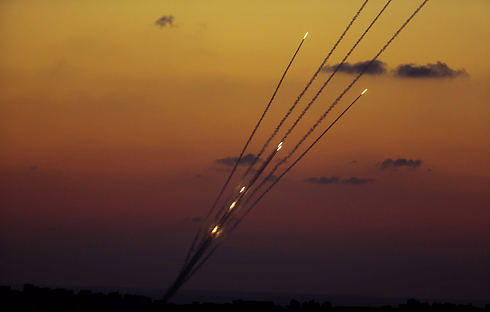
Gaza rocket fire on Israel (Photo: EPA)
Hamas appears to have been kept in the dark about the plan, which was drafted by officials in Egypt, an ally in the era of former Muslim Brotherhood president Mohamed Morsi, and now a perceived enemy.
“No one updated us about the Egyptian proposal,” said Hamas spokesman Sami Abu Zuhri. “We found out about it only through the media. No one consulted us about this initiative.”
“The Egyptian initiative is an attempt to defeat us,” said another Hamas spokesman, Fawzi Barhoum, while Hamas official Moussa Abu Marzook sounded defiant note.
“They will not scare us with threats,” Abu Marzouk said, without addressing the proposal directly. “Israel has turned Gaza into a pool of blood, and we remain opposed to the occupation and to aggression, whatever the circumstances.”
Islamic Jihad spokesman Yusef al-Hasayina said that the movement had also been surprised by the initiative, but did not reject it outright.
“Islamic Jihad has reservations about the initiative, as it did not take part in the deliberations,” he said. “We are still considering it (and) our reservations will be transferred to the Egyptian side.”
A Hamas member of the Palestinian Legislative Council, Mushir al-Masri, dismissed reports of efforts to calm the situation, and derided Egypt for proposing a ceasefire.
“Those who ignore the Palestinian resistance should not be dealt with. “The sections calling for calm are offering a free service to the Israeli enemy,” al- Masri said, adding that the decision by Jerusalem to accept the initiative was, “indicative of Israel’s weakness.”
The discourse within Hamas is now underway in three locations: the leadership in Gaza, headed by Ismail Haniyeh; the leadership abroad, headed by politburo chief Khaled Mashal and Egypt-based senior official Mousa Abu Marzook, who is most likely the link thread between the two. The Gaza leadership is inclined to accept the initiative and end the current situation, while Mashal and his camp may take a more radical approach in order to get better terms.
Gaza residents fleeing their homes after an IDF evacuation call (Photo: EPA)
There are officials in Hamas who understand that they have paid a heavy price in the current round of fighting, and are aware of the damage it has caused. A lack of response by Hamas to the Egyptian initiative reflects a kind of embarrassment, as it comes to the conclusion that it is surrounded on all sides by parties now seeking to end the escalation, from Abbas through to regional players like Egypt, Qatar and Jordan.
It seems that the reason why there has not yet been a formal Hamas response to the initiative stems from the fact that there is still no decision that is acceptable to the leadership in Gaza, the leadership abroad and the military wing.
Egypt announced its ceasefire initiative on Monday and not before for two reasons. Firstly, the initiative required a process of maturation by all parties. Secondly, Egypt has not found a way to end the conflict due to a decline in relations between the new regime in Cairo regime and Gaza.
Gaza losers, West Bank winners
Hamas now has three options. First, it could accept the Egyptian initiative and political process. Secondly, it could keep firing and see a damaging escalation. Finally, it could turn a blind eye to rocket fire from other factions in Gaza, and place the blame on their shoulders.
Islamic Jihad will come out of this round poorly, even though its military wing was the first to fire on central Israel during Operation Protective Edge. But it then yielded center stage to Hamas during the current campaign, and is unlikely to challenge Hamas if it does decide to accept the Egyptian initiative.
Hamas will also come out of this finish with a negative balance in terms of regional standing. The movement failed to harness the support of the Arab world, and prominent Arab news channels have not covered the situation with intensity that they had anticipated, largely leaving Hamas alone on the battlefield.
However, there has been an upswing in Palestinian sympathy for Hamas, in particular in the West Bank and at the expense of support for Mahmoud Abbas and the Fatah leadership – beginning with the abduction of the three Israeli boys through to the Egyptian announcement of its ceasefire initiative.
In Gaza, though, things look a little different. As the days passed, the Gazan public indicated that it wanted an end to the conflict – both because of the customary poor economic situation in Gaza and because of the devastation caused there since the conflict began.
Hamas has managed during the operation to keep launching rockets, but the damage to Israel was lower than expected. The military wing also failed to make good on the surprises it had planned.
As in the previous rounds of fighting, the organization’s members fired during the operation from inside Gaza’s population centers, and then hid. It is for this reason that Israel failed to hit all the rocket launchers.
While it is unlikely that Hamas will try to persuade the Palestinian public of their victory, it is worth noting that in the eyes of the street, Hamas did score many successes during the current operation, a perception that has translated into sympathy and even expressions of admiration.
Moshe feiglin speaking at the Third Annual Conference on the Application of Israeli Sovereignty to Judea and Samaria, Jan 1 2013. Photo Credit: Gershon Elinson / Flash 90
MK Moshe Feiglin, head of the Likud’s Manhigut Yehudi faction, confirmed in an exclusive interview with TheJewishPress.com Tuesday night that he become a member of the Knesset Foreign Affairs and Defense Committee.
Feiglin is replacing President-elect Reuven Rivlin, who has left the committee to take his place as the leader of the nation in the presidential position.
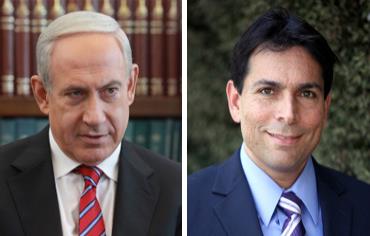
Likud’s Danon had earlier said that Netanyahu’s acceptance of ceasefire was “a slap in the face to all the residents of Israel.”
Netanyahu and Danon Photo: MARC ISRAEL SELLEM/THE JERUSALEM POST
Danon has challenged Netanyahu’s leadership of the Likud over the past year as head of the party’s Central Committee. Despite his removal from his position as a deputy minister, Danon will remain a Likud MK and chairman of the Likud Central Committee.
Prime Minister Binyamin Netanyahu fired Deputy Defense Minister Danny Danon (Likud) on Tuesday.
Danon had been highly critical of Netanyahu’s security policies, often attacking the prime minister from the Right.
Netanyahu reportedly wrote in his decision to fire Danon, “At a time that the Israeli government and the IDF are at the height of a military campaign, it cannot be that the deputy defense minister attacks the leadership of the state.”
Earlier on Tuesday, after the security cabinet decided to accept an Egyptian-initiated ceasefire to end the current round of hostilities with Gaza, Danon stated that the truce was “a slap in the face to all the residents of Israel, especially those in the south who were willing to pay a heavy price for significant achievements in the war on Hamas.”
Danon has challenged Netanyahu’s leadership of the Likud over the past year as head of the party’s Central Committee. Despite his removal from his position as a deputy minister, Danon will remain a Likud MK and chairman of the Likud Central Committee.
Prime Minister Binyamin Netanyahu addressed the security situation in Israel on Tuesday night, threatening a full ground invasion in the event that escalation from Gaza continues.
“If Islamic Jihad and Hamas do not respond to the Egyptian[-mediated] ceasefire, I will tell the IDF to act against them with great force,” he said. “And this is what we did: the IDF bombed many terror targets in Gaza, the attacks will continue.”
“Hamas chose to continue the conflict and it will pay the price for it,” he continued. “Anyone who tries to harm the citizens of Israel, Israel will hurt them.”
“For as long as there is no cease-fire, we will respond with fire [of our own],” Netanyahu added.
The Prime Minister vowed to take all necessary measures to protect Israeli civilians.
He added that “this campaign has several fronts: the operational front, the political front and the home front. We operate in accordance with our determination, judgment and experience to protect Israeli citizens.”
“It would be better to resolve it politically but Hamas does not leave us any other choice but to expand and intensify the campaign,” he continued. “We will act to restore peace to the citizens of Israel.”
Netanyahu also implied that the operation, which is finishing up its eighth day, will only intensify.
“These are moments when decisions must be made patiently and not recklessly, and I know you trust me to arrive at the decision that would bring peace,” he said. “We will do everything necessary to ensure that calm will return to Israeli citizens.”
Hamas and Islamic Jihad fired more than 100 rockets on Israeli civilians on Tuesday, despite Israel’s agreement to adhere to an Egyptian-brokered truce deal early Tuesday morning. Hamas categorically rejected the cease-fire in multiple statements, insisting that the terms of the agreement ‘did not apply’ to them.
The latest volley of rockets left one Israeli dead, a 38 year-old man serving food to soldiers near the Gaza border.
The Israeli Air Force responded by launching 30 airstrikes on terrorist targets in Gaza.
Charleston, SC, June 14, 2014 – “If the Obama White House can’t see the connections among the situation in Iraq, Hamas rockets raining down on Israel and the nuclear weapons talks with Tehran, they are either blind or willfully ignoring reality. In either case it’s potentially disastrous for your country and mine.”
So began my most recent conversation with a friend who has two adult children mobilized for service in the Israeli Defense Forces (IDF). When I asked him to explain he said, “It’s just like in your most recent book, ‘Counterfeit Lies,’ only worse. Obama is apparently desperate to keep the Maliki government from collapsing in Baghdad – and the Iranians are willing to help. The rockets being fired into Israel from Gaza and Syria have a ‘made in Iran’ label. And Kerry is meeting right now with the ayatollahs in Vienna to conclude a ‘Permanent International Agreement’ on Iran’s nuclear program.” He finished our call: “Hopefully your NSA is recording this conversation and will send a transcript to someone in Washington who cares.”
Perhaps. But finding anyone in the Obama administration who cares about anything other than political fundraising isn’t likely. Fruit flies have a longer attention span than O-Team in Washington or the elites in our so-called mainstream media. The distraction du jour is how to blame Republicans for the ongoing humanitarian and national security disaster on our southern border. The debacle in Baghdad and what will become of the new “Islamic Caliphate” have dropped off the radar. And discourse about Tehran acquiring nuclear weapons under the umbrella of a diplomatic concord hardly compares with the “visuals” of Hamas rocket sites in Gaza being taken out by Israeli aircraft.
Unfortunately, our nation’s adversaries do know what they want – and how to achieve their ends. Vladimir Putin is extending Russian hegemony over his neighbors – as in the Ukraine. In Beijing, a new generation of “commie capitalists” are laying claim to territory and waters long recognized as belonging to the Philippines, Japan, the Republic Korea, Vietnam and Taiwan. And in Tehran, the ayatollahs remain intent on the goal established 35 years ago by “Supreme Leader” Ruholleh Khomeini: destroying the “Great Satan” and the “Little Satan” – meaning the U.S. and Israel.
Apparently few in Washington seem to recall that our destruction remains one of the pillars of the 1979 Iranian Revolution. Khomeini’s pledge has been routinely reiterated by each of his successors – and explains Tehran’s unwavering goal of acquiring nuclear weapons “by whatever means necessary.” Thus the nexus among events in Iraq, Hamas rocket attacks on Israel and the nuclear arms talks now taking place in Vienna.
According to Congressional sources, the Obama administration was either “blindsided,” during last month’s “unexpected” onslaught in Iraq by radical Sunni Islamists now calling themselves the “Islamic Caliphate” or the O-Team “ignored warnings” from U.S. intelligence services. Given the abysmal state of our HUMINT – human intelligence – capabilities, I’m inclined toward the former explanation – but it hardly matters in the short term. Washington is unlikely to rectify our abysmal “Intel-problems” either way until after the November elections at the earliest.
What’s more important immediately is that the Iranians – deeply committed to the Maliki regime in Baghdad, the Assad dynasty in Damascus and Hezbollah in Lebanon – were either surprised by events in Iraq or unable to alter the outcome. That’s crucial because all three are key to their goal of keeping pressure on Israel – the “Little Satan.”
In one of the great ironies of modern times, the brutal advance and swift capture of key terrain in Iraq by a few thousand radical Islamists initially calling themselves the Islamic State in Iraq and Syria (ISIS), and now the “Islamic State” (IS), presents us with an extraordinary opportunity. Reports from friends on the ground in Iraq indicate IS militants have captured at least 1,500 armored HUMVEEs, 4,000 heavy machine guns, more than 50 tanks and an equal number of U.S. 155mm howitzers. One third to one-half of Maliki’s Iraqi Security Forces have deserted and IS assertions to have seized more than one-half billion in gold and currency is uncontested – as is their claim to control the land route from the Iran-Iraq border, west to Syria.
How is this an opportunity for the U.S.? Simply this: If the Maliki government collapses and is replaced by a Shiite-Sunni-Kurd coalition in Baghdad friendlier to the U.S., the Iranians lose. Tehran’s ability to support Assad in Syria and Hezbollah in Lebanon depends on air and land routes over and through Iraq granted by Maliki.
The Iranians – Persians after all – are good at reading tealeaves. Tehran’s primary objective is acquiring nuclear weapons. They know the O-Team is committed to supporting Maliki – Iran’s puppet in Bagdad. The ayatollahs also know Ahmad Chalabi – once America’s friend – is trying to put together an Iraqi coalition that would unseat Tehran’s chosen leader – and worry that Maliki might cave and flee (probably to Iran).
To conclude a favorable nuclear deal in Vienna and deter the U.S. from overtly or covertly backing Chalabi – the ayatollahs have ordered their Sunni-Hamas proxies in Gaza to up the ante by firing as many Iranian-made rockets as possible into Israel – despite inevitable Palestinian casualties. Predictably, the anti-Jewish-state lobbies in the U.S. and Europe have gone into high dudgeon decrying Jerusalem’s inherent right of self-defense.
And in Vienna, Iran’s U.S. educated Foreign Minister, Mohammad Javad Zarif, has presented U.S. Secretary of State John Kerry with an enticing opportunity: joining Barack Obama in the “Pantheon of Nobel Laureates” by concluding a favorable “Nuclear Deal” with Tehran in exchange for Hamas stopping the rockets and help keeping Maliki in power.
Is it too much to hope the Obama-Kerry brain-trust will see this for what it is? Probably. But if Washington does any such deal with the Iranians, the end result will be a trifecta for Tehran – and a disaster for the U.S. and our ally Israel.
Oliver North is host of “War Stories” on FOX News, a nationally syndicated columnist, co-founder of Freedom Alliance, an organization providing college scholarships to children of U.S. military personnel killed in the line of duty, and author of the bestselling book, “Counterfeit Lies.”
A 30-year old civilian man was fatally injured by mortar fire from the Gaza Strip Tuesday while distributing gifts of food to soldiers posted at the border fence. Magen David paramedics tried to save his life under Palestinian fire without success. A second volunteer was moderately injured.
One person was killed near the Erez border crossing after suffering a direct hit from a mortar fired by terrorists in the Gaza Strip. The person had received emergency treatment and was rushed to a nearby hospital, where doctors announced him dead.
The person was visiting IDF soldiers in the area and had come to bring them food, Channel 2 reports.
With multi-million-dollar land deals, luxury villas and black market fuel from Egypt, Gaza’s rulers made billions while the rest of the population struggled with 38-percent poverty and 40-percent unemployment.
While the fighting is only expected to worsen the distress of the residents of Gaza, the Strip’s economic outlook for the Strip was never good. The unemployment rate in Gaza stood at approximately 40% before the latest conflict, with a similar proportion being classed as living under the poverty line.
But while most of the Gaza population tries to deal with the difficulties of daily life, it seems that one sector at least has had few worries about their livelihoods – Hamas leaders and their associates.
Multi-million-dollar deal
Someone who has benefitted financially is the former Hamas prime minister in Gaza, Ismail Haniyeh. Before 2006 and Hamas’ shocking electoral win and subsequent dominance of the Palestinian government , 51-year-old Haniyeh was not considered a senior figure in Hamas in the Gaza Strip. But according to reports in the past few years, Haniyeh’s new-found senior status has allowed him to become a millionaire. This is an unusual feat, given that he was born to a refugee family in the al-Shati refugee camp in northern Gaza.
In 2010, Egyptian magazine Rose al-Yusuf reported that Haniyeh paid for $4 million for a 2,500msq parcel of land area in Rimal, a tony beachfront neighborhood of Gaza City. To avoid embarrassment, the land was registered in the name of the husband of Haniyeh’s daughter. Since then, there have been reports that Haniyeh has purchased several homes in the Gaza Strip, registered in the names of his children – no hardship, as he has 13 of them.
At least with regards to his eldest son, it seems that the apple does not fall far from the tree, given his arrest on the Egyptian side of the Rafah border crossing with millions of dollars in cash in possession, which he intended to take into Gaza.
Subsidized fuel sold for profit
According to sources in Gaza, Haniyeh’s wealth, like others high up in Hamas, came primarily from the flourishing tunnel industry. Senior Hamas figures, Haniyeh included, would levy 20 percent taxation on all of the trade passing through the tunnels.
Hamas’s heyday came after the overthrow of former Egyptian president Hosni Mubarak, as its parent organization the Muslim Brotherhood was growing in popularity in Egypt.
In those days, Hamas leaders and their associates were not afraid to show off their ostentatious wealth. Gaza’s market for luxury villas costing at least a million dollars was booming, most purchased by people associated with the establishment of Hamas. A Gazan familiar with the real estate market summed it up at the time with a quip about a Hamas crony who had recently acquired a luxury villa: “Two years ago, he couldn’t afford a packet of cigarettes.”
At the same time, Khairat a-Shater, a senior member of the Muslim Brotherhood in Egypt who headed his own business empire, made sure to personally transfer tens of millions in cash to senior administration officials in Gaza as well as to commanders from the Hamas military wing.
There were senior Hamas members who preferred that the money be kept in a safer place than the Gaza Strip, and invested it in various Egyptian assets, often through business partnerships with Muslim Brotherhood officials. In some cases, the man conducting the deals on behalf of Hamas officials, who ensured that they received their dividends in cash, was Ayman Taha, a Hamas founder once considered one of its key spokesmen. In 2011, Taha himself paid $700,000 for a luxury three-floor villa in the central Gaza Strip; a year ago, he was charged with being an agent for Egypt.
The Egyptian street has become inflamed with anger directed against Hamas over the last three years, partly due to what appears to be its financial gains at the expense of the Egyptian people. The tunnels in Rafah, the town straddling the Gaza-Egypt border, for example, saw a flourishing fuel-smuggling industry from Sinai. The fuel subsidized by the Egyptian government was entering Gaza at a low price, but being sold for eight times that. Those who made the greatest profits from the sale of the fuel were Hamas members, even as Egypt often reported shortages for its own people.
Hamas, says Professor Ahmed Karima of Al-Azhar University in Egypt, has long become a movement of millionaires. According to Karima, the organization can count no less than 1,200 millionaires among its members. He did not, however, specify the source of this information.
Mashal’s mall
It was not only Hamas members in Gaza who became rich. It appears that political leader Khaled Mashal is another member of the organization who used Hamas funds to his own ends. In 2012, a Jordanian website reported that Mashal had control of a massive $2.6 billion, in large part deposited in Qatari and Egyptian banks. This is likely Hamas’ accumulated assets from years through donations, as well as its investments in various projects in the Arab and Muslim world. It is also known that, among other things, Hamas has invested in real estate projects in Saudi Arabia, Syria and Dubai. And, according to reports, Mashal did not always separate Hamas money and his own.
Hamas’ expulsion from Syria was a severe financial blow for the movement. In 2011, before the start of the Syrian conflict, Hamas’s assets in the country had reached a value of $550 million. Apart from its real estate holdings, Hamas invested in various commercial companies, including a cargo company registered to a Syrian businessman close to Moussa Abu Marzook, Mashal’s deputy.
As with other areas, in its financial dealings Hamas leaders keep their cards close to their chest and maintain a high level of secrecy. Investments are made through front companies, using family and associates. Companies linked to Mashal in Qatar are registered to his wife and daughter.
Once he was forced to close his office in Damascus (after falling out with the Assad regime over its oppressive response to the conflict), Mashal declared that his place was in Qatar. There, he claimed that $12 million he had stored in his safe in his Damascus office had been lost. Not many accepted this story, and to this day believe that Mashal kept the money, transferring it to his own personal accounts.
Reliable sources claim that a project by the Fadil real estate firm in Qatar is linked to Mashal, his son and his son’s wife. The prestigious project in Doha, the Qatari capital, includes the construction of four towers of more than 27,000 square meters, including office and commercial space attached to a mall with an area of 10,000 square meters. The company has never disclosed the source of its funding.
According to a World Bank report released in November of last year, the Gaza Strip ranks third in the Arab region in terms of poverty, ranking above only Sudan and Yemen. The report stated that the poverty rate in Gaza stands at 38 percent. Furthermore, of the 144 countries included in the report, Gaza was the 44th poorest, with most of the countries with a higher poverty rate being located in Africa







 anneinpt
 artaxes
 danmillerinpanama
 davidking1530
 Peter Hofman
 Joseph Wouk
 Peter
Peter Louisiana Steve
 WarSclerotic
Recent Comments