Archive for July 14, 2014

Reactions to the Gaza-Israel War — Hamas Needs to Worry

July 14, 2014

Reactions to the Gaza-Israel War — Hamas Needs to Worry, Huffington Post, July 14, 2014

(Not the normal fare for Huff & Puff. — DM)
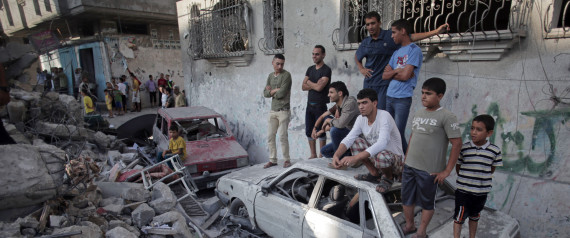
Mideast Israel Palestinians

The current round of hostilities between Hamas and Israel is continuing along familiar lines. First, Hamas starts the round by indiscriminately firing rockets designed to hit civilians. Then, the Israelis start reacting, first slowly, then more intensely, and inevitably Hamas launches the campaign of self-victimization, yelling of foul play, claiming that the Israeli reaction is disproportional, as if there is any universally accepted scale of reaction to barbaric attacks on civilian population, the type of which Hamas is engaged in.

As it all drags itself into the second week, without any end in sight, there are other familiar features from former rounds which come out into the open, almost as an inevitable ritual. One of them is demonstrations by pro-Palestinians in Europe and South America, mostly attended by Muslims, much less so by others. What is SO noticeable in many of these demonstrations is the overt anti-Semitic tone. There is no attempt even to hide it, and while once it was the shout of “down with Zionists” (bad enough…), now it is “burn all the Jews,” and a siege on a crowded synagogue in Paris. PR and psychological warfare are always a very integral part of all that, so in Israel, at least, these manifestations of hatred achieve the obvious effect of solidifying and cementing nationalist feelings, not something that the Netanyahu government is sorry about … If there is a sense of some isolation in Israel, then it is largely mitigated by the obvious anger at the double standards that are so much in display, surely as is being viewed by the vast majority of Israelis.

Jews abroad, however, react very strongly. French Jews, for example, are already engaged in what some call as the exodus from France, as more and more Jews move to Israel and/or are considering doing this. Not bad for the Israelis either.

The truth is that in this round the volume of international criticism of Israel voiced by governments is more muted than before, at least until now. Altogether, there is NO domestic pressure on the government to go softer on Hamas and public opinion polls indicate over 90% support for the government. As the hostilities will drag on, this rate of support is likely to drop somewhat, but not in a way leading to any major problem for Netanyahu. Such pressure will be more significant only if the public will sense that the round ends with no clear victory in sight, a scenario which will then play to the hands of the likes of Benett and Lieberman. But that remains to be seen.

Where there is a noticeable departure from the all too familiar features of previous rounds it is in the Middle East itself. Let us start in Gaza, where many thousands of locals DO NOT heed the cruel call of their hiding leaders, and DO evacuate large parts of the northern strip in compliance with the Israeli calls to do so. They want to live, and the well-sheltered Hamas leaders want them to be a “human shield.” Now, the Hamas leaders from underneath the hospitals and schools of Gaza lament the absence of shelters for their population. Who stopped them from doing exactly that, providing their people with this elementary service? Better, who asked them to start the current round of aggression in the first place?

Many Gazans are interviewed by foreign news organizations and say loudly and clearly exactly that. This was NOT the case in previous rounds. Even Gazan journalists are interviewed in Israeli media outlets and say exactly that.

Then there is Egypt, which is playing an important role, not only behind the scenes. As was explained in this blog previously, the Israelis take note of the al-Sisi administration. According to unverified reports, Hamas rejects Egyptian attempts to mediate a ceasefire, and they know why … While the campaign is on, the Egyptian army publicly announces the closure of smuggling tunnels from Sinai to Gaza and the Gaza-Sinai crossing points are closed, something which puts enormous pressure on the Palestinians, at a time, by the way, when the Israelis ALLOW convoys of supply to cross from Israel to Gaza.

Surely, Hamas pays the price for the alliance with the Muslim Brotherhood (MB), and there are many in Egypt who know, remember and cannot forgive it. There are many all over the Sunni Middle East who also remember how Hamas has played a double game about Syria, and its greatest sin of all, the ongoing relationships with Iran. There are more than few references to that in the Arab press; the Arab League is very sluggish in its reactions; and there are bigger demonstrations in Europe than in the Middle East. A new Middle East? Far from it, but a changing one, as the automatic instinct to blame Israel, while still there, is diminishing in favor of a more nuanced approach — one which is based on the TRUE interests of some countries, which places the Palestinians and their problems much lower in the list of priorities than ever before.

All this may be good news for Israel, but only just. The Netanyahu government plays cleverly the card of a major ground attack, basically telling the Arab states and the international community “hold us,” while it REALLY does not want to engage in such a campaign. It could be conceived as a bluff, and when bluffs are called, positions and situations tend to change, and in the Middle East, such changes can be swift.

So, also Netanyhu acts within constraints, and while he has quite a few reasons to feel that he still has time on his side, he SHOULD realize that it is not limitless.
For Israel, a Little Disengagement Can Go a Very Long Way

July 14, 2014

For Israel, a Little Disengagement Can Go a Very Long Way, Commentary Magazine, July 14, 2014

Netanyahu’s words on Friday about not relinquishing control of territory west of the Jordan River will likely make sense to a growing number of Israelis. A little disengagement from Gaza has put almost the entire country within reach of Hamas rockets; what might a dramatically larger disengagement from the West Bank lead to?


It was news in 2006 when Hezbollah was hitting Haifa with rockets from Lebanon: Israel’s third largest city was now suddenly in reach of the Iranian terror proxy. Today, Haifa is being by struck by rockets once again. But this time they are not coming from the northern border, but rather from far to Israel’s south in Gaza. Indeed, the warning sirens have even been heard in Nahariya to the north of Haifa. Almost the entirety of Israel is within reach of rockets from the small Gaza enclave.

Prior to Israel’s 2005 evacuation from Gaza, when that move was being debated in the Knesset, several of Israel’s parliamentarians scoffed at the idea that retreat from Gaza would bring further rocket fire or greater insecurity. Rather, they insisted that this move was essential for bringing safety to the communities bordering Gaza. At the time Kadima MK Meir Shitrit scoffed “There is an argument according to which there will be a threat … a threat on the Negev communities, I have never before heard such a ridiculous argument.” Similarly, Meretz’s Ran Cohen declared “The disengagement is good for security. The right-wing people stood here and talked about kassams flying from here to there. I’m telling you … if we don’t get out of the Gaza strip in two or three years, maybe after one year, the range will reach Ashkelon!” How grateful most Israelis would be if Hamas rockets had only gotten as far as Ashkelon. As it is, more than seventy percent of the country is now under Hamas’s rocket barrage.

Yet, as much as disengagement from Gaza has been a security disaster for Israel, it is not at all clear what a feasible strategy for success might look like.

The prospect of permanently redeploying the IDF in the strip and sending Israel’s sons to police the backstreets of Gaza’s slums is virtually unthinkable. Equally, an attempt to overthrow Hamas and reinstate the Fatah-led Palestinian Authority there could also quickly unravel. Another alternative might be to permanently station Israel’s military along Gaza’s Philadelphi Corridor on the Egyptian border, so giving Israel greater ability to prevent the smuggling of weaponry into the strip. That, however, would mean that Israel would become solely responsible for Gaza’s borders, whereas at least as things currently stand the military blockade of Gaza is given added legitimacy by the fact that the Egyptians also help maintain it; not that one would know this from the popular discourse on the subject.

This question of legitimacy is no small matter for Israel in its handling of the threat from Gaza. A permanent Israeli presence in Gaza could easily become the source of much international condemnation. But that has to be contrasted with the existing scenario where, in addition to the necessity a constant military embargo of Gaza, there is a pattern of intensive conflicts breaking out every two or three years. These see a high casualty rate—albeit far lower than the figures for other similar conflicts—and that in turn causes a level of hysterical condemnation from parts of the media, the UN, and the streets of Europe, that greatly undermines Israel’s international standing.

It is with all this in mind that Israelis turn their gaze to low lying Samarian hills of the West Bank that overlook Israel’s densely populated central region, where the country’s international airport and the bulk of its energy infrastructure is situated. If a small-scale disengagement from Gaza can bring almost the entire country within range of Hamas rockets, then what might withdrawal from the West Bank bring? As Prime Minister Netanyahu noted on Friday, the West Bank could quickly become 20 Gazas. Even with the Iron Dome missile defense system, at present Israelis find themselves scurrying in and out of bomb shelters every few hours. How long can people realistically live like that? Besides, with every Iron Dome interception of a cheaply made kassam rocket costing tens of thousands of dollars, a war of attrition could quickly become completely unsustainable for the Israelis.

Preventing infiltration by militants attempting to breach Gaza’s border with Israel has proven a difficult and resource consuming task. The winding West Bank border is far longer and much closer to large population centers than the Gazan border is. And given that Iranian supplied anti-tank missiles have been fired at civilian traffic from Gaza, it is quite conceivable that similar attacks could emanate from a Palestinian controlled West Bank. After all, with the sheer volume of weaponry that has made its way beneath Gaza’s border with Egypt, it is highly likely that far more could cross undetected over the far lengthier Jordanian border with the West Bank.

Netanyahu’s words on Friday about not relinquishing control of territory west of the Jordan River will likely make sense to a growing number of Israelis. A little disengagement from Gaza has put almost the entire country within reach of Hamas rockets; what might a dramatically larger disengagement from the West Bank lead to?

Don’t believe the hype: Hamas isn’t desperate for a truce

July 14, 2014

Don’t believe the hype: Hamas isn’t desperate for a truce, Times of IsraelAvi Issacharoff, July 14, 2014

Despite devastation in Gaza, and its inability to inflict Israeli casualties, the organization is in robust shape — personnel unharmed, rocket supplies plentiful, popularity soaring.

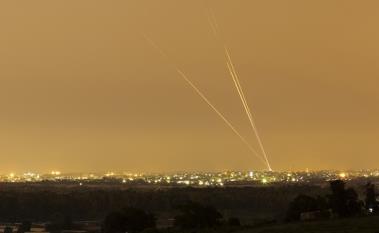
Gaza rocket launchA picture taken from the southern Israeli Gaza border shows a rocket being launched from the Gaza Strip into Israel on Friday, July 11, 2014. (photo credit: Menahem Kahana/AFP)

[T]he damage to Hamas from Israel’s air campaign, at least so far, has been minimal. Not one senior member of the movement’s political or military echelons has been as much as scratched by Israeli fire.

Meanwhile, the organization’s ability to fire rockets at Israel has remained formidable, as has the functioning of its command and control system. According to the assessments of Israeli defense officials, the IDF has destroyed 2,000 rockets, which along with the 1,000 or so that were fired, means Hamas’s arsenal has declined by some 3,000. The problem is that Hamas is still in possession of 6,000-7,000 rockets, enough to continue fighting for weeks.


More than a few senior people in Jerusalem, the Kirya military headquarters and the IDF have been repeating over the past two days assertions like “Hamas is frustrated” and “Hamas wants a ceasefire.”In principle, they’re right, but those statements must be accompanied by two critical caveats that in practice prevent a halt in the fighting.

True, Gaza’s Hamas rulers are frustrated to a certain extent. They aren’t happy that the almost 1,000 rockets they’ve fired at Israel so far have caused few injuries and haven’t even significantly disrupted life in Israel. Hamas also had far-reaching plans for terrorist attacks inside Israeli territory, but so far they’ve all been thwarted. Even attacks on communities and army bases by way of tunnels that were dug over years did not bear fruit, thanks to Israeli intelligence efforts.

However – and this is a major reservation – the damage to Hamas from Israel’s air campaign, at least so far, has been minimal. Not one senior member of the movement’s political or military echelons has been as much as scratched by Israeli fire.

Meanwhile, the organization’s ability to fire rockets at Israel has remained formidable, as has the functioning of its command and control system. According to the assessments of Israeli defense officials, the IDF has destroyed 2,000 rockets, which along with the 1,000 or so that were fired, means Hamas’s arsenal has declined by some 3,000. The problem is that Hamas is still in possession of 6,000-7,000 rockets, enough to continue fighting for weeks.

Another matter that is no less important for Hamas and is being overlooked by the Israeli decision makers is the opinion of the Palestinian and Arab public. Just a few weeks ago Hamas was considered a weak and vulnerable organization, caught between an Israeli rock and an Egyptian hard place. Its regime was on the verge of collapse, and the movement as a whole had lost the support of the public in the West Bank and Gaza. Simply put, no one in the Arab world was ready to bet on Hamas.

And yet, in less than a week, Hamas has become the darling of the Arab media, a popular hero that has rained rockets on Tel Aviv, Haifa, and the famed reactor at Dimona. This is one of the points that Israel’s political and military leaders aren’t taking into account. While it may be frustrated by its inability to inflict Israel casualties, Hamas is basking in its newfound popularity and celebrating a renewed interest in Gaza among Arabs and Palestinians. It also knows that under any future arrangement, Egypt will have to take that into consideration and will no longer be able to ignore the Strip.

That leads us to the second caveat, which is that Hamas is intent on dictating its own ceasefire terms.

After just two days of fighting, members of the group’s military wing called a press conference at which they laid out their demands. Israel interpreted this as a display of weakness, but there’s reason to think that that’s not necessarily the most accurate assessment. Rather, Hamas wished to present to its public the reasons for launching the campaign.

Since then Hamas has repeated those demands again and again, including on Sunday, when spokesman Sami Abu Zuhri said that Israel’s offer of “quiet for quiet” was unacceptable to the organization.

Contrary to the opinion of some senior Israeli officials, Hamas doesn’t seem to be in a panic or on the verge of collapse. Far from it: Most people who come into contact with Hamas these days are under the impression that the organization doesn’t want to stop the fighting without a significant achievement.

What could constitute a significant achievement?

A senior Hamas member said his organization will insist upon the release of those former prisoners who were set free under the Gilad Shalit deal but then rearrested after the abduction and killing of three Israel teenagers in June. In Israel they won’t rush to accept that idea.

No less critical for the organization is the matter of permanently opening the Rafah crossing into Egypt. Except that here Israel is dependent on Cairo’s goodwill. For the time being, at least, Cairo is demanding that in return for opening the crossing permanently, Hamas must agree to station Palestinian Authority security forces there; that is to say, PA President Mahmoud Abbas’s people.

In addition, the Egyptians are demanding the deployment of Abbas’s forces along the Philadelphi Route, which runs along the Gaza-Egyptian border.

Another problem that could arise in that context is that Cairo is expected, within the framework of such an agreement, to demand the extradition of 30 wanted members of jihadist organizations who are hiding in Gaza.

Israel is not expected to oppose the idea of opening the Rafah crossing and it is not yet clear what Hamas’s stance will be on the deployment of PA personnel there. The presence of armed Fatah men would be a first indication of the return, in one manner or another, of Abbas to the Gaza Strip.

In the meantime, Israel is cementing its own position. The gist of the messages passed from Jerusalem to various emissaries traveling along the Tel Aviv-Cairo-Doha line was that Israel has no intention of agreeing to a ceasefire that won’t guarantee the removal of existing rockets from Gaza and an end to Hamas’s ability to manufacture new ones.

It is hard to imagine a scenario wherein Hamas would agree to such a condition. And even if it did agree, it is doubtful that it would last for long – and therein, perhaps, lies the biggest problem: Without a significant change in the reality in the south, it will only be a matter of time before the next round of fighting in Gaza.


Irrelevant in War

July 14, 2014

Irrelevant in War, The American Spectator, July 14, 2014

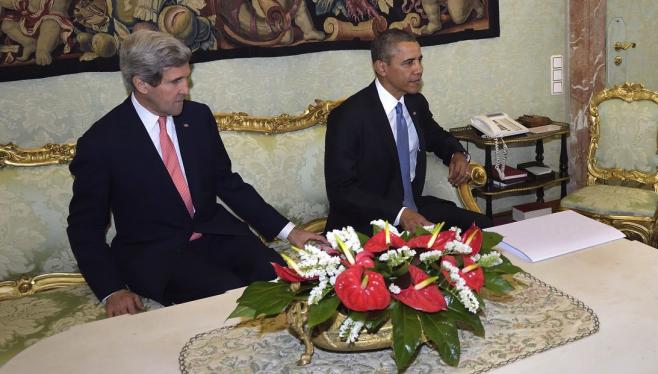
Obama and Kerry

As to the other irrelevancies, the United States and the UN lead the pack. UN Secretary General Ban ki-Moon’s pleas for a cease-fire — which at this point would benefit only Hamas — have been rejected outright by Netanyahu. Which brings us to President Obama and his Secretary of State, the comprehensively biased and ineffectual John Kerry.

Last in war, last in peace — and were they a baseball team, last in the National League — Obama and Kerry spent months trying to pressure the Israelis into a peace agreement that would have forced them to retreat to the indefensible pre-1967 war borders and created a Palestinian state. By levying American pressure only on Israel — and placing the blame on the Israelis when the negotiations failed — Obama and Kerry laid the foundation for the current war.


Much of the reporting on the fighting between Israeli forces and those of the Hamas terrorist network describes various parts and parties as “increasingly irrelevant.” It’s a term that is generally applied well, but not widely enough. It deserves greater breadth and judgment in its application. There are those who are highly relevant, increasingly irrelevant, and entirely irrelevant. Let’s begin with the last category.

Palestinian Prime Minister Mahmoud Abbas was increasingly irrelevant to the possibilities of renewed war, but with the formation of his “reconciliation” government with Hamas terrorists, Abbas has been demoted to utter irrelevance. He has no power to speak for the Palestinians, no ability to enter into a cease-fire agreement with the Israelis. His powers are a nullity: he can make noises in the international press, which should ignore him. It would, but for the fact that the media would have to admit Abbas’s irrelevance in reaching out to interview the Hamas leaders. It is, for now, more consistent with the media narrative that Palestinians are victims and Israelis evildoers, to keep up the pretense that Abbas is still a leader of his people.

On the other hand, Israeli Prime Minister Binyamin Netanyahu is entirely relevant to the conflict. Netanyahu has chosen — correctly, on moral, factual, and strategic grounds — to do as much damage to Hamas in the Gaza Strip as can be done by the highly-capable Israeli military. Netanyahu knows, as Tony Blair admonished Israel this week, that he cannot entirely stamp out Hamas because it exists as a political and ideological entity, not only a terrorist force. But he can destroy vast parts of its networks, its command structure, and its rocket arsenal.

The fact that the Israelis have used the “knock on the roof” tactic (a smoke bomb dropped on a roof to warn of imminent air attack on the building) — and have been dropping leaflets and making phone calls to individual Gazans warning of impending attacks — proves that Israel is doing everything it can to avoid civilian casualties. Hamas is reportedly forcing people back into buildings they attempt to flee, but hasn’t been able to stem the tide of people warned by leaflet drops who are crowding the roads out of the northern area of the Gaza Strip.

The Israelis will almost certainly send a large ground force into the leaflet-drop area in the next day. They will attack Hamas assets, especially rocket stockpiles and launchers, and leave when the job is done.

Perhaps the most relevant aspect of the conflict is Israel’s “Iron Dome” anti-missile system. It has reportedly scored hits on over 90% of the Hamas rockets launched at Israeli cities. It is a game changer: no longer are Israeli civilians defenseless against rocket barrages that kill, maim, and destroy property. Iron Dome isn’t perfect — no current anti-missile technology is — but its success does reduce massively the threat of rocket attacks.

Also highly relevant is the launching of a terrorist rocket attack from Lebanon against an Israeli town on the Lebanon border. The attack was perpetrated — apparently — by a low-ranking Hizballah terrorist. From the immediate apologies coming out of the Lebanese Hizballah-dominated government, we can gather that it is learning from the effectiveness of the Iron Dome system. (Hizballah, literally “the Party of God,” is an Iranian-backed terrorist network that has taken many American lives.) That is not to say that Hizballah may not decide to launch its longer-range and far more destructive missiles (provided by Iran) at cities across Israel. It only means that Hizballah is deterred from igniting a much wider war, at least for the moment.

As to the other irrelevancies, the United States and the UN lead the pack. UN Secretary General Ban ki-Moon’s pleas for a cease-fire — which at this point would benefit only Hamas — have been rejected outright by Netanyahu. Which brings us to President Obama and his Secretary of State, the comprehensively biased and ineffectual John Kerry.

Last in war, last in peace — and were they a baseball team, last in the National League — Obama and Kerry spent months trying to pressure the Israelis into a peace agreement that would have forced them to retreat to the indefensible pre-1967 war borders and created a Palestinian state. By levying American pressure only on Israel — and placing the blame on the Israelis when the negotiations failed — Obama and Kerry laid the foundation for the current war.

The unequal treatment of the Israelis and the Palestinians emboldened the Palestinians to return to violence after the negotiations predictably failed. Kerry has gone so far as to embrace the rhetoric of the BDS Movement which seeks to cast Israel out of the community of nations, making it a pariah equal to North Korea. Kerry has done so twice. In the first instance, he used the occasion of a negotiation with Iran in Tehran to state last April that Israel risked boycotts if his peace process failed. He later said that Israel risked becoming an “apartheid state” if the negotiations failed.

Now, all Obama and Kerry can do is watch. They have forfeited the Israelis’ trust and can do no more than whinge from the sidelines.

The most interesting application of the “growing irrelevance” standard applies to the pro-Palestinian elements of the media. Palestinian media spokesmen — including reporters — are finding it harder to be believed. Even on the pro-Palestinian BBC, they are more and more frequently encountering opposition from people who are not willing to be shouted down, and who are capable of telling the world about the three murdered Israeli teenagers whose only crime was to be hitchhiking in the West Bank when they were kidnapped, igniting an increasingly desperate search for them that ended with the discovery of their bodies buried in a shallow grave. The Hamas rocket attacks began around the time the bodies were discovered.

At this writing, the rocket barrage from the Gaza Strip is continuing, and some of the rockets are penetrating the Iron Dome system to land in Bethlehem and Hebron in the West Bank. The Palestinian rockets now have the range to attack about 80 percent of Israel. Their new M-302 rocket — which is about ten inches in diameter — not only has far greater range, but carries a much larger warhead than the older Qassam and Grad rockets used by Palestinians in the earlier terror campaigns — “intifadas” — against Israel.

The new attacks make an Israeli ground incursion into Gaza a certainty. Netanyahu’s government will have no choice. It may have begun by the time you read this. There will be casualties on both sides, and the Israelis will bear the brunt of the criticism despite the fact that the Palestinian launches of rockets intentionally targeting civilians is a war crime under the Geneva Conventions.

Superpowers, as America once was, don’t suffer the irrelevance Obama has brought us to. We can become relevant again if our next president has the abilities that Obama lacks, such as the ability to tell enemy from friend and act in support of our friends. Israel is a friend left isolated by a president who has determined it deserves to be abandoned.

Gaza Situation Report

July 14, 2014

Gaza Situation Report, Stratfor, George Friedman, July 14, 2014

At this moment, we know for certain that Israel is bombing Gaza and has amassed a force sufficient to initiate ground operations but has not done so. Hamas has not fired a saturation attack, assuming it could, but has forced Israel to assume that such an attack is possible, and that its Iron Dome defensive system would be overwhelmed by the numbers. The next move is Israel’s. We can assume there are those in the Israeli command authority arguing that the Gaza rockets will be fired at some point, and must be eliminated now, and others arguing that without better intelligence the likelihood of casualties and of triggering a saturation launch is too high.

We have no idea who will win the argument, if there is one, but right now, Israel is holding.


The current confrontation in Gaza began July 12 after three Israeli teenagers disappeared in the West Bank the month before. Israel announced the disappearance June 13, shortly thereafter placing blame on Hamas for the kidnappings. On June 14, Hamas fired three rockets into the Hof Ashkelon region. This was followed by Israeli attacks on Palestinians in the Jerusalem region. On July 8, the Israelis announced Operation Protective Edge and began calling up reservists. Hamas launched a longer-range rocket at Tel Aviv. Israel then increased its airstrikes against targets in Gaza.

At this point, it would appear that Israel has deployed sufficient force to be ready to conduct an incursion into Gaza. However, Israel has not done so yet. The conflict has consisted of airstrikes and some special operations forces raids by Israel and rocket launches by Hamas against targets in Israel.

From a purely military standpoint, the issue has been Hamas’s search for a deterrent to Israeli operations against Gaza. Operation Cast Lead in late 2008 and early 2009 disrupted Gaza deeply, and Hamas found itself without any options beyond attempts to impose high casualties on Israeli forces. But the size of the casualties in Cast Lead did not prove a deterrent.

Hamas augmented its short-range rocket arsenal with much longer-range rockets. The latest generation of rockets it has acquired can reach the population center of Israel: the triangle of Jerusalem, Tel Aviv and Haifa. However, these are rockets, not missiles. That means they have no guidance system, and their point of impact once launched is a matter of chance. Given these limits, Hamas hoped having a large number of rockets of different ranges would create the risk of substantial Israeli civilian casualties, and that that risk would deter Israel from action against Gaza.

The threat posed by the rockets was in fact substantial. According to senior Israeli Air Force officers quoted on the subject, Israel lacked intelligence on precisely where the rockets were stored and all the sites from which they might be launched. Gaza is honeycombed with a complex of tunnels, many quite deep. This limits intelligence. It also limits the ability of Israeli airborne munitions from penetrating to their storage area and destroying them.

The Israeli objective is to destroy Hamas’ rocket capacity. Israel ideally would like to do this from the air, but while some can be destroyed from the air, and from special operations, it appears the Israelis lack the ability to eliminate the threat. The only solution would be a large-scale assault on Gaza designed to occupy it such that a full-scale search for the weapons and their destruction on the ground would be possible.

Hamas has been firing rockets to convince the Israelis that they have enough to increase casualties in the triangle if they choose to. The Israelis must in fact assume that an assault on Gaza would in its earliest stages result in a massive barrage, especially since Hamas would be in a “use-it-or-lose-it” position. Hamas hopes this will deter an Israeli attack.

Thus far, Israel has restrained its attack beyond airstrikes. The extent to which the fear of massed rocketry was the constraining factor is not clear. Certainly, the Israelis are concerned that Hamas is better prepared for an attack than it was during Cast Lead, and that its ability to use anti-tank missiles against Israel’s Merkava tanks and improvised explosive devices against infantry has evolved. Moreover, the occupation of Gaza would be costly and complex. It would take perhaps weeks to search for rockets and in that time, Israeli casualties would mount. When the political consequences, particularly in Europe, of such an attack were added to this calculus, the ground component of Protective Edge was put off.

As mentioned, a major issue for the Israelis is the intelligence factor. It is said that Iran provided Hamas with these rockets via smuggling routes through Sudan. It is hard to imagine the route these weapons would take such that Israeli (and American) intelligence would not detect them on their thousand-plus mile transit, and that they would move into Gaza in spite of Israeli and Egyptian hostile watchfulness. Even if Iran didn’t provide the weapons, and someone else did, the same question would arise.

The failure of the Israelis to detect and interdict the movement of rockets or rocket parts has an immediate effect on the confidence with which senior Israeli commanders and political leaders calculate their course. Therefore, to this point, there has been a stalemate, with what we assume is a small fraction of Hamas’ rockets being fired, and limited operations against Gaza. The ground operation is being held in check for now.

While there have been a few public attempts to mediate between Hamas and Israel, most of these efforts have been lackluster, and the condemnations of violence and calls for peace have been more perfunctory than usual. Rather than leaving Egypt as the principle mediator, Turkey and Qatar have also weighed into the cease-fire discussion.  U.S. Secretary of State John Kerry also reportedly contacted Israeli Prime Minister Benjamin Netanyahu on Sunday, offering assistance in mediating a truce. Meanwhile, high-ranking diplomats from the United States, the United Kingdom, France and Germany discussed truce efforts on the sidelines of talks on Iran, and Israel’s government has began mulling a plan to offer development aid in exchange for a demilitarization of Gaza.

There is good reason for the slow pace of these cease-fire efforts, however. As evidenced by Hamas’ ability to replenish its rocket supply through routes traversing Sinai, Israel cannot rely exclusively on Egypt to uphold a cease-fire agreement — nor does it trust Qatar and Turkey to do so. Instead, Israel is attempting to place responsibility for cease-fire enforcement on its main external patron, the United States. Of equal importance, Hamas shares a deep distrust of the current regime in Egypt, given Hamas’ past links to the Muslim Brotherhood, whose brief reign in Egypt ended with a military coup. As these negotiations move slowly forward, Israel’s focus is on trying to degrade Hamas’ military capabilities enough to compensate for the weaknesses implicit in any cease-fire agreement. But tackling the problem primarily through the air has limits, and Israel’s questionable confidence in its own intelligence is what has prevented a ground incursion so far.

The problem for Israel in any cease-fire is that it would keep the current status quo in place. Hamas would retain its rockets, and might be able to attain more advanced models. Israel was not able to stop the influx of this load, so Israel can’t be confident that it can stop the next. A cease-fire is a victory for Hamas because they have retained their rocket force and have the potential to increase it. But for Israel, if it assumes that it cannot absorb the cost of rooting out all of the rockets (assuming that is possible) then a cease-fire brings it some political benefits without having to take too many risks.

At this moment, we know for certain that Israel is bombing Gaza and has amassed a force sufficient to initiate ground operations but has not done so. Hamas has not fired a saturation attack, assuming it could, but has forced Israel to assume that such an attack is possible, and that its Iron Dome defensive system would be overwhelmed by the numbers. The next move is Israel’s. We can assume there are those in the Israeli command authority arguing that the Gaza rockets will be fired at some point, and must be eliminated now, and others arguing that without better intelligence the likelihood of casualties and of triggering a saturation launch is too high.

We have no idea who will win the argument, if there is one, but right now, Israel is holding.

Gaza Situation Report is republished with permission of Stratfor.

The disproportionate focus on Israel’s proportionality

July 14, 2014

The disproportionate focus on Israel’s proportionality, Anne’s Opinions, Anne in PT, July 14, 2014

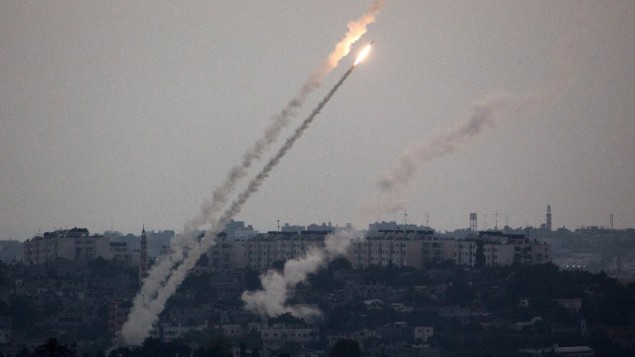
Rockets launched from GazaRockets launched from Gaza into Israel

[T]here is the disproportion in the world’s microscopic focus on Israel’s minutest acts committed even in the fog of war and even under intense rocket fire, and its disproportionate accusations against Israel.


One of the favourite weapons of Israel’s opponents (when they aren’t using rockets, missiles and bombs) is to accuse it in the court of public opinion of using “disproportionate force” in its response to the attacks on it.  Besides the fact that this argument makes no sense (would you expect a person punched in the face to punch his attacker in the exact same spot on his face? Or would you expect him to deliver a knock-out blow to prevent a recurrence?)  the accusation does not stand up to scrutiny of international law, despite Israel’s opponents’ fervent wishes.

Eli E. Hertz at Myths and Facts explains this thesis in Proportionality and Collective Punishment:

Israel is often portrayed in the media, by Western leaders, human rights activists and the many different organs of the United Nations as inflicting disproportionate and collective punishment on many Palestinian Arabs for the deeds of a few terrorists.

Ironically, the prohibition of imposing “collective penalties [punishment]  intimidation and terrorism” that Article 33 of the Fourth Geneva Convention talks about, should be applied in this case to the millions of innocent men, women, and children of Israel that are collectively being punished day-in and day-out by Arab terrorists for “offenses” they never “personally committed.” As to the “terrorism” Article 33 speaks about; it is the Israelis that fight to prevent Palestinian terrorism, and not the other way around.

Palestinian Arabs, by their first use of armed force against Israeli civilians and non-combatant Jews in contravention of the United Nations Charter, constituted prima facie [Latin: on its face] evidence of an act of aggression – aggression being defined by international law as “the most serious and dangerous form of illegal use of force.”

Therefore, the rule of proportionality in this case of continuous aggressionneeds to be met by Israeli acts that will induce the aggressors to comply with its international obligations. Israel countermeasures need not be the exact equivalent of the breaching act.Judge Schwebel, the former president of the International Court of Justice is quoted saying:

“In the case of action taken for the specific purpose of halting and repelling an armed attack, this does not mean that the action should be more or less commensurate with the attack.”

The perception among Palestinians that politically motivated violence is legitimate and effective is nothing new. From a broader perspective, if the Palestinians are rewarded with political gains following their acts of aggression, it can be expected that other radical groups will also make use of their tactics. Israel will no longer be the main target.

There is more in the article about the use of collective punishment by the British against the Jews in Mandate-era Palestine. Read the whole thing. The law is clearly on Israel’s side.

A similar article by Arlene Kushner (one of the best commentators on Israel and the Middle East in my opinion) at Jews Down Under discusses Proportionality and other matters:

There is a widespread – but very erroneous – impression that if an enemy attacks, a proportional response means a nation can only return what was received and no more. That is, the mistaken impression is that if Hamas shot one rocket, we could only shoot one rocket back.

International law, however, defines proportionality very differently: it is a question of legitimate military goals and intentionality.  Put very simply, we would not be restricted to only shooting one rocket back at Hamas, but rather doing what is necessary (within certain defined limits) to ensure that Hamas does not shoot any more rockets.  That is a legitimate military goal.

Luis Moreno-Ocampo, who was the Chief Prosecutor at the International Criminal Court in 2003, wrote this about proportionality:

“Under international humanitarian law and the Rome Statute, the death of civilians during an armed conflict, no matter how grave and regrettable, does not in itself constitute a war crime. International humanitarian law and the Rome Statute permit belligerents to carry out proportionate attacks against military objectives, even when it is known that some civilian deaths or injuries will occur. A crime occurs if there is anintentional attack directed against civilians…or an attack is launched on a military objective in the knowledge that the incidental civilian injuries would be clearly excessive in relation to the anticipated military advantage (principle of proportionality).”

The sort of bombing we are doing is entirely legitimate and proportional to our military goals of making it impossible for Hamas to launch rockets at our people. If in the process some civilians in Gaza are hit, our military action remains entirely legitimate.  Do not believe otherwise.  In point of fact there are bound to be civilian deaths because Hamas uses civilians as human shields and places its arsenal of weapons in civilian areas.

What is not legitimate according to international law is the sort of deliberate targeting of Israeli civilians that Hamas is doing day in and day out.  Here the intentionality is to hit civilians.

We need to make a point of noting that it is not only Hamas that is targeting Israel. Our “peace partners, Fatah, aka Mahmoud Abbas’s party, are actively giving encouragement and support to Hamas in their genocidal aims, no matter what their PR propagandists say. Arlene Kushner’s article continues:

So let’s take a look, just for a moment, at Fatah, which is Abbas’s party.

Palestinian Media Watch tells us that Fatah put up on its Facebook page today an announcement that:

“One god, one homeland, one enemy, one goal” unites Hamas, Fatah and Islamic Jihad.


~~~~~~~~~~

While Khaled abu Toameh writes that:

“At least two Fatah armed groups announced that they had started firing rockets at the ‘settlements’ of Ashkelon and Sderot, cities inside the pre-1967 borders of Israel, with another Fatah group claiming responsibility for firing 35 rockets into Israel since Sunday.”

The use of the word “settlements” is a tip-off to the fact that Fatah considers Jewish presence even within the ‘67 armistice line to be an illegitimate “occupation,” i.e., they want it all.

For further elucidation listen to international law expert, Prof. Eugene Kontorovich who says that Israel hasn’t learned anything from the Goldstone Report because there was no lesson to be learned!

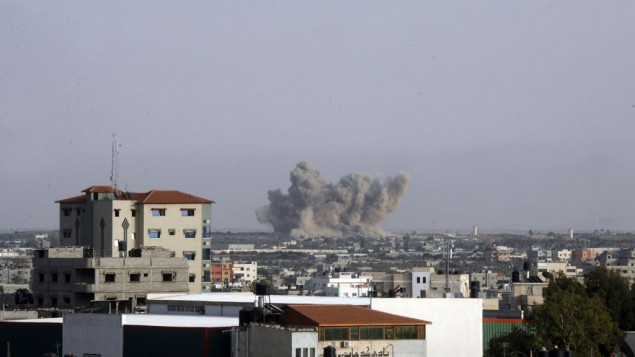
Knock knockSmoke rises from a Rafah building in Gaza after IAF bombing

To see an example of how Israel goes to extraordinary lengths to preserve the lives of Gaza civilians, watch this video of how the IAF aborted a bombing strike after the pilots spotted civilians in the building:

And now see this Memri TV clip  (click on the link to view) of a Hamas spokesman bragging about how they use human shields in order to cause maximum harm to their own people and to Israel’s reputation.  Here’s the transcript:

Following are excerpts from an interview with Hamas spokesman Sami Abu Zuhri, which aired on Al-Aqsa TV on July 8, 2014:

Interviewer: “Are people still going up to the rooftops?”

Ayad Abu Rida (Reporter) : “Witnesses told us that there is a large gathering, and people are still going to the Kawari family house, in order to prevent the Zionist occupation’s warplanes from targeting it.”

Interviewer: “What is your comment about this? People are reverting to the (human-shield) method, which proved very successful in the days of martyr Nizar Riyan…”

Sami Abu Zuhri: “This attests to the character of our noble, Jihad-fighting people, who defend their rights and their homes with their bare chests and their blood. The policy of people confronting the Israeli warplanes with their bare chests in order to protect their homes has proven effective against the occupation. Also, this policy reflects the character of our brave, courageous people. We in Hamas call upon our people to adopt this policy, in order to protect the Palestinian homes.”

In order to avoid such casualties the IAF has instituted the unprecedented and inimitable routine of “knocking on the roof” of a target: dropping a non-explosive charge on the roof of a targeted building in order to scare the civilians into leaving. Only then does the air force bomb the target.

However even that is too “contentious” for some (e.g. the NY Times, what a surprise). David Gerstman at Legal Insurrection gives us the details of the invented “controversy”, and then provides us with a refreshing take from William Saletan at Slate Magazine who writes about “the Gaza rules“.

The worst civilian death toll—seven, at the latest count—occurred in a strike on the Khan Yunis home of a terrorist commander. Hamas calls it a “massacre against women and children.” But residents say the family gotboth a warning call and a knock on the roof. An Israeli security official says Israeli forces didn’t fire their missile until the family had left the house. The official didn’t understand why some members of the family, and apparently their neighbors, went back inside. The residents say they were trying to “form a human shield.”

The Khan Yunis scenario is different. There, the human shield was voluntary. According to Ha’aretz, an Israeli officer insisted on Wednesday morning that if other civilians followed this example—responding to prestrike warnings by going onto the roofs to form human shields—Israelwouldn’t be deterred. Maybe the officer was bluffing. But what if this scenario happens again? And what if the would-be martyrs appear on the roof while Israel still has time to avert the strike, which wasn’t the case in Khan Yunis? Would their deaths be homicide? Would they be suicide?

That’s a tough call. But anyone concerned about the deliberate targeting of civilians in this conflict should first look at Hamas.

For more reading on the ridiculous accusation of disproportionality, read Jeremy Havardiat the Commentator who writes about the vile anti-Israel commentary in the British press;Elliot Abrams at Israel Hayom who explains “The sick math of the Gaza war“; and Tzvi Ben Gedalyahu at the Jewish Press who says that Israel is guilty of disproportion in not wiping out Hamas.

It is clear that the only disproportionality in this whole conflict is the way in which Hamas not only disregards the safety of its civilians, but goes out of its way to place them in harms way, whether by force or by persuasion. Israel on the other hand acts in a disproportionate manner to protect the enemy’s civilians. No other army in the world can make such a claim, and if anyone disagrees with this statement, I challenge them to find me proof.

And as I have shown above, there is the disproportion in the world’s microscopic focus on Israel’s minutest acts committed even in the fog of war and even under intense rocket fire, and its disproportionate accusations against Israel.

Natan Sharansky had a word for this double standard: Antisemitism.

The IDF declares an area north of the Gaza Strip a closed military zone.

July 14, 2014

Boy lightly wounded in Ashdod as rockets continue to rain down | The Times of Israel.

( This is q very frightening announcement.  My worst fear is that the drone that was downed may have carried WMDs. – JW )

Speculation is circulating on the significance of the move, which may indicate that ground forces are preparing for battle.

One Israeli news site, NRG, suggests that the move is connected to the downing of a Hamas UAV earlier in the day.

The IDF is continuing to build up ground forces on the Gaza border, but no decision has been made by the cabinet — as far as Israeli media outlets know — to enter Gaza with significant ground forces.

Yosef Rabin, No Ceasefire – Destroy Hamas Now! SIGN THE PETITION!

July 14, 2014

No Ceasefire – Destroy Hamas Now! SIGN THE PETITION!

By Yosef Rabin7/13/2014, 1:07 PM

via Blog: Yosef Rabin, No Ceasefire – Destroy Hamas Now! SIGN THE PETITION! – Arutz Sheva.


Dear world,


Israel is doing everything in its power to try to stop the ongoing Hamas terror war against us. The army has struck over 1,500 terror targets in Gaza and is now preparing the IDF for a large scale invasion on Gaza. The world that reacts to rockets on Israel in silence, only speaks out when Israel begins to beat back her enemies. The UN, EU, US and many other countries and international organizations are pressuring Israel for a ceasefire. As history shows, the world only pressures Israel for a ceasefire when Israel begins to win the battle. Ceasefire is a code for “do not allow Israel to destroy her enemies”.

I would like to urge everyone who cares to push back against this unholy call for ceasefire. The Government of Israel must know that all citizens of the free world back the total destruction of the evil Hamas regime.

Petition Background (Preamble):

Since Israel withdrew from the Gaza Strip in 2005, terrorists have fired more than 10,000 rockets into Israel. Over 3.5 million Israelis are currently living under threat of rocket attacks.

More than half a million Israelis have less than 60 seconds to find shelter after a rocket is launched from Gaza into Israel. Most rockets launched from Gaza into Israel are capable of reaching Israel’s biggest southern cities. With the introduction of long ranch J-80 Rocket, Hamas is reaching major population centers including Tel Aviv and Jerusalem putting virtually all Israeli citizens at risk.


Petition:

The terrorist organization Hamas, is dedicated to the destruction of Israel and the total genocide of the Jewish People worldwide.

Most of the Israeli population is currently living under the threat of rocket fire. Life between sirens, in and out of bomb shelters, has become the daily reality for millions of Israelis. Hamas terrorists have fired more than 540 rockets at Israel since Operation Protective Edge began on Monday, July 7 – and over 830 rockets since the beginning of 2014.

Therefore, we demand that the Government of Israel not accept any ceasefire, or bend to any international pressure and act aggressively to completely destroy Hamas by all means necessary.

SIGN THE PETITION HERE


Still no green light for ground operation in Gaza

July 14, 2014

Still no green light for ground operation in Gaza

Cabinet decides to continue mobilizing troops while persisting in carrying our aerial attacks; 40,000 out of authorized 48,000 reservists called up so far.

Attila Somfalvi, Yoav ZitunPublished: 07.14.14, 00:44 / Israel News

via Still no green light for ground operation in Gaza – Israel News, Ynetnews.


The IDF presented the security cabinet with a few possibilities for a ground offensive in the Gaza Strip over the past few days, and was waiting for the green light from the government. But the security cabinet decided not to approve the entrance of IDF ground troops to Gaza on Sunday, with such an authorization depending on future events.

For the time being, the security cabinet decided to continue mobilizing troops while persisting in carrying out aerial attacks.

The options being explored include the entrance of thousands of ground troops, armored corps and engineering forces to the Strip. All of these forces have already been deployed to the Gaza border.

A senior government official said that as long as the forces in the border of the Strip increase in number, the chances of a ground operation increase as well. The operation “would eventually end one way or another. (Hamas) will not agree to relinquish their arms.” the official said.

A senior IDF source said that “the operation did not start in order to bring to Hamas’ collapse, but rather in order to restore peace to the south. We’re taking every necessary step to differentiate the Strip to the West Bank, in order to maintain the understandings reached at the end of the 2012 Operation Pillar of Defense. In the future, we’d want to see Hamas as a weakened sovereign in the Strip without any offensive capabilities.”

The senior source noted that “all of the possibilities are being presented to the political echelon, and it must decide how to proceed. The dilemma is what to strike and when, and the objective is to hurt the least amount of innocent people.”

The source noted that “as far as international law is concerned, there’s some leeway in hurting a certain amount of innocent people in any operation to thwart terrorism, and we do the best we can to prevent that (innocent people being hurt).”

Even though the cabinet authorized the IDF to call up 48,000 reservists, so far only 40,000 have been called up, most of them for reserve battalions that will free up conscript battalions to deploy in Gaza.