Archive for July 14, 2014

Netanyahu expected to recommend acceptance of Egyptian ceasefire proposal

July 14, 2014

Netanyahu expected to recommend acceptance of Egyptian ceasefire proposal

By HERB KEINON, KHALED ABU TOAMEH, JERRY LEWISLAST UPDATED: 07/15/2014 00:27

Security cabinet to meet at 7 a.m; Egyptian initiative calls for end of all “hostilities” from both sides, meeting in Cairo within 48 hours after quiet restored; Kerry expected to visit Egyptian capital.

via Netanyahu expected to recommend acceptance of Egyptian ceasefire proposal | JPost | Israel News.


Israeli soldiers stand atop a tank at a staging area, near the border with the Gaza Strip Photo: REUTERS
 

The Egyptian government on Monday evening proposed a cease-fire between Israel and the Palestinian groups in the Gaza Strip, according to which the two sides would end “hostilities” as of 9 a.m.on Tuesday.

Prime Minister Binyamin Netanyahu is to convene the security cabinet early Tuesday morning to discuss the proposal.
Related:

Netanyahu giving no indication when Gaza operation will end

Diplomatic officials said that Netanyahu was expected to encourage the other seven members of the security cabinet to accept the proposal, which would return the situation in Gaza to what it was before Operation Protective Edge began a week ago. Foreign Minister Avigdor Liberman and Economy Minister are expected to oppose the proposal in the security cabinet, but are unlikely to be able to prevent the forum from accepting it.

Some 48 hours after the cease fire goes into effect, Egypt is to convene representatives of both Israel and Hamas for further negotiations.

One diplomatic official said that the cease fire would be returned to what it was last Sunday, but “with Hamas much weaker.”

“The effectiveness of their rockets have been neutralized, their storehouses and manufacturing capabilities have been hit, and they have been caused deep frustration because of the effectiveness of Iron Dome,” he said.

In addition, he said, Hamas failed in effort to carry out attacks by land air and seat, and is at a low point in public opinion in Judea and Samaria, the international community, the Arab world and even inside Gaza.

“Th goals of the operation were to restore quiet for a long period of time, and that goal has been achieved.,” he said. “The bottom line is that Hamas did not hit Israel to the degree it thought it would, and – on the other hand – it’s power was weakened.”

Israel, the official said, would now work in the international arena for the dismantling of the rockets and the closing of the tunnels.

The proposal states that Israel would end all “hostilities in the Gaza Strip from the land, air, and sea and would refrain from launching a ground offensive that targets civilians.”

According to the proposal, the Palestinian factions would cease all “hostilities” emanating from the Gaza Strip against Israel.

The Egyptian initiative calls for reopening the border crossings into the Gaza Strip to passengers and goods as the security situation becomes stable. It also calls for receiving representatives of the Israeli government and the Palestinian factions in Cairo within 48 hours after the cease-fire goes into effect to discuss “confidence-building measures” between the two sides. The Egyptians, according to the plan, would hold separate talks with the Israelis and Palestinians in Cairo.

In response to the Egyptian proposal, Hamas spokesman Fawzi Barhoum said his movement would not accept any truce that “excludes the conditions of the Palestinian groups and people.”

Israel’s government had no immediate comment on the Egyptian proposal.

US Secretary of State John Kerry is likely to fly to Egypt Tuesday to hold talks with senior Egyptian officials, Egypt’s official MENA news agency reported on Monday, amid stepped-up international diplomatic efforts to bring an end to the ongoing terrorist rocket fire.

Despite the Egyptian report, US officials said Kerry’s trip to Egypt remained “unconfirmed.”

Kerry is currently in Vienna for talks with Iran over its nuclear program.

Israeli officials also would not confirm reports that Kerry was coming to the region.

Kerry, according to the MENA report, spoke on Sunday with Egyptian Foreign Minister Sameh Shoukry, as he did with Prime Minister Binyamin Netanyahu. Kerry also spoke Sunday on the sidelines of the talks in Vienna with his counterparts from Germany, France, and Britain, as the EU issued a statement calling for a cease-fire.

German Foreign Minister Frank-Walter Steinmeier is scheduled to arrive Tuesday and meet – among others – with Netanyahu, Palestinian Authority President Mahmoud Abbas, Foreign Minister Avigdor Liberman, and Justice Minister Tzipi Livni. In addition, Italy’s Foreign Minister Federica Mogherini will also arrive for talks on Tuesday, and Norway’s Foreign Minister Borge Brende will come the next day. Each of those visits was not scheduled in advance and is a result of the current crisis.

Diplomatic officials in Jerusalem were not saying what Israel’s conditions for a ceasefire are, but have indicated that Jerusalem will not agree to the type of agreement that put an end to Operation Pillar of Defense in 2012.

Netanyahu has said repeatedly in recent days that the goals of the operation are to restore long-term quiet to the country’s cities and significantly damage Hamas’s infrastructure, and that those goals could be attained either militarily or through diplomatic means.

Differences of opinion inside the cabinet have emerged publicly as the talk of a cease-fire gets louder.

Economy Minister Naftali Bennett (Bayit Yehudi) said during an interview on Channel 2 that Israel is “grinding Hamas, their officers, the terrorist activists, their homes, their tunnels. They are absorbing a very hard blow.

And precisely because this is the situation, and they [Hamas] are isolated in the world, including in the Arab world, now is the time to change the situation so we don’t go find ourselves in the same situation in another half a year.”

Transportation Minister Israel Katz (Likud) said Israel should hold out for a deal that includes the demilitarization of Gaza.

Science and Technology Minister Yaakov Peri (Yesh Atid) said the dismantling of Hamas’s rocket capabilities would be the ideal option, “but we should not lie to ourselves or the public about this; it’s not realistic to demand demilitarization.”

Meanwhile, the PA said Monday the countdown for reaching a new cease-fire between Israel and Hamas has begun.

“Hamas is desperate for a cease-fire,” a Palestinian official in Ramallah said. “They have appealed to Qatar, Egypt, and Turkey to help in reaching a new truce with Israel.”

The official claimed that Hamas has been under heavy pressure from Palestinians in the Gaza Strip, who have “paid an unusually heavy price” during the fighting.

Hamas and Islamic Jihad officials reiterated their readiness to reach an agreement that would end the current fighting with Israel, but have conditions of their own.

Islamic Jihad leader Ramadan Shalah said his organization would agree to a new truce with Israel if the “aggression” on the Gaza Strip stopped and the border crossings are reopened. Shalah said the only party that could play a role in achieving a truce is the US administration. He added that without Egyptian mediation, it would also be impossible to stop the fighting.

Channel 10 reported that one idea being floated was for the PA to take control of the border crossings with Egypt, which would then be opened.

Meanwhile, the visits by the European foreign ministers come amid signals reaching Jerusalem that at the regularly scheduled EU foreign ministers meeting at the end of the month, there are those who want a strong statement that would not only deal with Gaza, but also slam Israel for settlements, dragging its feet in the peace process, and not allowing Palestinian development in Area C.

An indication of European thinking came Monday in London when British Foreign Secretary William Hague called in Parliament for Israel and Hamas to implement an immediate cease-fire.

Israel, he said, had suffered sustained barrages of rocket fire from militants in Gaza and, he emphasized, is entitled to defend itself against indiscriminate attacks against its civilian population.

The people of Gaza, he added, have a fundamental right to live in peace and security. Hague expressed great concern over the number of civilian deaths, saying that some 80% of those killed were civilians a and a third were children.

“The whole House will share our deep concern at these events,” he said. “This is the third major military operation in Gaza in six years. It underlines the terrible human cost, to both sides, of the Israeli-Palestinian conflict, and it comes at a time when the security situation in the Middle East is the worst it has been in decades.”

Hague said international efforts are being made to broker a cease-fire, but with Egypt no longer having the influence and contacts with Hamas he indicated that other Arab states including Jordan and Qatar were involved in trying to bring about an agreement. He declined to say which other countries.

During the 80-minute session, numerous MPs pressed Hague to call on Israel to halt its operation, but besides suggesting Israel should show restraint he studiously avoided using the word proportionate even when challenged to do so. However, he repeatedly made clear that Israel has a right to defend itself and he was equally adamant that Hamas has to shoulder responsibility for firing rockets at Israel from civilian areas.

The only mild warning he had for Israel was to make sure its actions were within the requirements of international humanitarian law. Both sides have to distinguish between civilian and military targets, he added.

“The world looks on in horror once again as Israel suffers from rocket attacks and Palestinians die. Only a real peace, with a safe and secure Israel living alongside a viable and contiguous Palestinian state, can end this cycle of violence. And it is only the parties themselves, with our support, who can make peace.”

Michael Wilner contributed to this report from Vienna.

Khamenei reins in nuclear negotiators in secret speech

July 14, 2014

Khamenei reins in nuclear negotiators in secret speech, Ynet News, Reuters, July 14, 2014

(The “secret speech” referred to in the title may, or may not, have been made on July 7th. It may, or may not, have been the “public address filled with technical detail, [in which] Ayatollah Ali Khamenei said last week Iran needs to significantly increase its uranium enrichment capacity, clashing with the powers’ push for it to be reduced to minimize the risk of nuclear bomb making, as July 20 deadline for a deal nears” It’s a tad confusing, but whether public or “secret” it may well kill the P5 + 1 “deal.” — DM)

One Western diplomat said the delegation appeared “taken aback” by Khamenei’s remarks at such a sensitive time in the nuclear negotiations – just ahead of the July 20 deadline for a deal. Two Iranian sources confirmed that assessment.

“(Khamenei’s) statement served both as a directive upon his negotiating team and as an apparent effort to shift the framework of the debate away from Western demands, essentially grounding the talks,” the intelligence analysis said.


Diplomats claim Iranian supreme leader changes course, makes new demands of nuclear delegation, possibly hindering ability to reach international deal; analyst: ” Khamenei does not want to share power with Rouhani and he feels his power might be challenged by a nuclear deal.’

A major speech by Iran’s Supreme Leader has limited the ability of the Iranian delegation at high-level nuclear talks to make concessions with six world powers and this could scuttle chances for Tehran to reach an accord to end sanctions, diplomats said.

In a public address filled with technical detail, Ayatollah Ali Khamenei said last week Iran needs to significantly increase its uranium enrichment capacity, clashing with the powers’ push for it to be reduced to minimize the risk of nuclear bomb making, as July 20 deadline for a deal nears.

The talks with the United States, Britain, France, Germany, Russia and China are aimed at concluding a long-term accord on Iran curbing its nuclear energy program in exchange a gradual end of sanctions that have crippled the OPEC member’s economy.

In his speech, which analysts compared in importance to a State of the Union address by a US president, Khamenei said he had faith in his negotiating team led by Foreign Minister Mohammad Javad Zarif and his deputy, Abbas Araqchi.

Several diplomats close to the talks said the speech, which included many details about the nuclear program and Iranian demands on it, came as a surprise to the Iranian delegation.

One Western diplomat said the delegation appeared “taken aback” by Khamenei’s remarks at such a sensitive time in the nuclear negotiations – just ahead of the July 20 deadline for a deal. Two Iranian sources confirmed that assessment.

“In ostensibly expressing support for the Iranian negotiating team, close scrutiny of Khamenei’s speech shows that in reality his remarks were aimed at severely curtailing his team’s room for maneuver, making it effectively impossible to bridge gaps with the stance of the (six powers),” according to a Western intelligence analysis of the speech seen by Reuters.

Khamenei’s message was a reminder of the tensions within Iran’s complex power elite between conservative hardliners – like him – wary of any detente with the West they fear would imperil the Islamic Revolution – and moderates who see a nuclear deal as Iran’s ticket out of economically crippling isolation.

Pragmatist Hassan Rouhani’s landslide 2013 election as Iranian president on a platform of improving Iran’s foreign relations to revive the economy opened the door to nuclear diplomacy and a possible improvement of ties with the West. Resolving the decade-long nuclear standoff with Iran is seen as vital to allaying fears of a new war in the Middle East.

Iran and the six resumed talks in Vienna on July 2 and their negotiators continued meetings in the Austrian capital on Monday, though there was no immediate sign of any substantive progress. Western and Iranian officials have complained publicly that the sides remain far apart on all key issues in the talks.

Iran’s capacity to refine uranium lies at the centre of the nuclear stalemate and is seen as the hardest issue to resolve in the Vienna talks, which began in February. US Secretary of State John Kerry is in Vienna to help break the deadlock. He met Zarif for a second day in a row on Monday.

The Islamic Republic denies Western allegations that its declared programme to enrich fuel for civilian nuclear energy is a front for pursuing the capability to produce atomic weapons.

Dispute over centrifuges

A relative of Khamenei’s explained to Reuters the motivation for the speech. “The leader is above all the factions. He felt that it was essential to state his red lines publicly to avoid any misunderstanding by either side involved in the talks.

“His speech contained clear technical points,” the relative added. “Now everyone, whether Iranian or non-Iranian, clearly understands what is negotiable and what is not.”

Unusually, Khamenei’s July 7 speech included details on what he described as Iran’s enrichment “needs”, defending it against what he indicated was the West’s dismissive attitude towards the Islamic Republic. Western officials say that enrichment on home soil is not a “need” for Iran and that it can obtain cheaper and better fuel for civilian reactors from Russia and elsewhere.

Khamenei suggested that Iran needed 190,000 centrifuge machines in the long term – a 19-fold increase in its current operational capacity to refine uranium.

US and European negotiators want Iran to have a figure in the low thousands to ensure it cannot quickly amass enough for atomic bomb fuel, should it someday choose to do so.

Some analysts have suggested that Khamenei’s speech actually indicated a level of flexibility because he was talking about long-term Iranian plans. Others disagree.

“(Khamenei’s) statement served both as a directive upon his negotiating team and as an apparent effort to shift the framework of the debate away from Western demands, essentially grounding the talks,” the intelligence analysis said.

Earlier this month, Iranian and Western officials close to the talks said Iran was reducing its demands for centrifuges well below the figure Khamenei used. But in the wake of Khamenei’s speech, diplomats said, far-reaching compromises by the Iranians will be more difficult.

“In our assessment, Khamenei’s remarks were not coordinated with the Iranian negotiating team in Vienna at present, and were intended to cut off their ability to negotiate effectively,” the intelligence analysis said.

“Furthermore, they were aimed at sending a clear message to the international community that the negotiating team does not have the mandate to compromise on the most critical issues under discussion – above all, Iran’s uranium enrichment capacity.”

Iran expert Ali Vaez of the International Crisis Group said of Khamenei’s speech that “drawing public red lines won’t help the negotiators to narrow the gaps” in positions.

Western and Iranian diplomats said that after Khamenei’s speech it would be more difficult for Zarif and Araqchi to sell concessions back in Tehran on centrifuges and other issues, such as Western demands that Iran shut the Fordow enrichment site. Khamenei said that demand was “laughable.”

President Rouhani’s brother Hossein Fereydoun arrived in Vienna to join the talks and send details of the negotiations back to the president, Iran’s state news agency IRNA reported on Sunday. It was not immediately clear if that was linked to concerns on Rouhani’s part in the wake of Khamenei’s speech.

While Rouhani and Zarif may sincerely want to reach a deal that would dismantle the sanctions that have devastated Iran’s economy, diplomats and analysts say that Khamenei is wary of reaching a swift accord with the West, above all with the United States – the “Great Satan” and Iran’s arch-enemy since 1979.

“Obviously Khamenei does not want to share his power and authority with Rouhani or anyone else,” said a diplomat in Tehran. “For him an extension is an ideal situation. If he feels that his power might be challenged by a nuclear deal, Khamenei will ignore its economic benefits by rejecting it.”

The talks on a long-term nuclear deal can theoretically be prolonged for up to six months if all sides agree. Some analysts and diplomats say an extension might be necessary but US officials say there needs to be further progress on key issues in the coming days if an extension is to be approved.

PA hopes ceasefire will yield restart of peace talks

July 14, 2014

PA hopes ceasefire will yield restart of peace talks

Officials push for int’l conference, concerned that a truce without a renewal of negotiations will damage future diplomatic efforts

By Avi Issacharoff and Elhanan Miller July 14, 2014, 1:33 pm

via PA hopes ceasefire will yield restart of peace talks | The Times of Israel.


Palestinian Authority President Mahmoud Abbas (photo credit: Issam Rimawi/Flash90)
 

he Palestinian Authority is trying to promote the idea of convening an international peace summit between the Israelis and the Palestinians that would take place in conjunction with a ceasefire in the Gaza Strip.

The PA is requesting that a ceasefire agreement provide not only for the cessation of hostilities, but also include a number of measures that would restart the stalled peace process, senior Palestinian officials told The Times of Israel on Monday.

Aside from convening an international summit that would include representatives from the PA, Israel, Arab states and other actors, the Palestinian proposal includes a number of other provisions: transferring authority over the Rafah border crossing between Gaza and Egypt to the PA (specifically President Mahmoud Abbas’s presidential guard); deploying PA forces along the Philadelphi Route on the border between the Gaza Strip and the Sinai Peninsula (from which Israel withdrew in September 2005, and which has since been under the control of the Egyptian army); releasing those Hamas members (approximately 50) who were re-arrested by Israeli security forces in recent weeks after being released in the 2011 prisoner exchange deal to free kidnapped IDF soldier Gilad Shalit; and increasing Palestinian control of the Erez Crossing between Israel and the northern Gaza Strip.

The PA is concerned that a ceasefire deal that does not stipulate the renewal of the peace process will harm the chances of resuming negotiations in the future, which explains the numerous messages relayed between Ramallah and those states involved in negotiating a ceasefire, including the US, Egypt and Qatar.

Abbas’s aides have hinted that in a scenario that does not include a resumption of negotiations, the Palestinian Authority will return to unilaterally seeking full membership in international bodies, including the International Criminal Court in The Hague.

According to the same Palestinian sources, Israel’s Justice Minister Tzipi Livni has advocated for some of these proposals.

Livni has also facilitated communication between Israel and those involved in brokering a ceasefire, which she believes must include both the neutralization of Hamas’s ability to manufacture and obtain missiles and rockets, and relaxing restrictions along Gaza’s borders in order to strengthen Abbas’s presence.

Last week, the Palestinian representative at the UN’s Human Rights Council told Palestinian TV that the PA could face charges of crimes against humanity if it joined the International Criminal Court.

“Each and every missile being launched against Israel is a crime against humanity, whether it hits or misses, because it is directed at civilian targets,” Ibrahim Khreisheh told Palestinian Authority TV, according to MEMRI.

While Palestinians had a good case against Israel for committing war crimes in the West Bank under the Fourth Geneva Convention, Israel maintains the better argument with regards to crimes against humanity, he said.

“Targeting civilians, whether one or a thousand, is considered a crime against humanity,” he said, noting the difference between Israel, which strikes civilian targets after having warned residents to evacuate their homes, and the Palestinians, who give no such notice.

In May, a group of 17 Palestinian and international human rights organizations appealed to Abbas to join the ICC, arguing that it would make both sides of the conflict accountable under international law. The PA, recognized as a UN General Assembly “nonmember observer state” in November 2012, could request ICC jurisdiction by acceding to the Court’s Rome Statute.

Palestinian officials including chief negotiator Saeb Erekat and PLO member Hanan Ashrawi have called for more robust Palestinian action against Israel in the international arena, criticizing Abbas for neglecting the matter.

But Khreisheh, the UN representative, said that such calls were “emotional” and ill-advised. “Before speaking emotionally about applying to the ICC, one requires proper knowledge,” he said.

Hamas has scathingly denounced a number of PA officials for criticizing its missile launches into Israel. Moussa Abu Marzouk, deputy director of Hamas’s political wing, called PA Foreign Minister Riyad al-Maliki “Netanyahu’s foreign minister” on July 11 for saying it was Israel’s right to defend itself against Hamas rockets. Hamas has also attacked Abbas for calling the Islamic movement “war profiteers.”

Egypt proposes Gaza ceasefire deal

July 14, 2014

Egypt proposes Gaza ceasefire deal

After reports say Kerry to arrive in Egypt to help broker deal, reports say Israel, Hamas agree to deal which will come into effect 9 am Tuesday morning.

Yitzhak Benhorin, AFPLatest Update: 07.14.14, 22:39 / Israel News

via Egypt proposes Gaza ceasefire deal – Israel News, Ynetnews.

Egypt has raised a proposal for a ceasefire between Hamas and Israel Monday night, while Arab media has claimed both Israel and Hamas have accepted the deal. The news came amid reports that US Secretary of State John Kerry will arrive in Egypt Tuesday for an unplanned meet with senior government officials

According to initial reports, the deal stipulates an end to all aggressions as of 9 am Tuesday morning and according to Al Arabiya, both Israel and Hamas agreed.

Cairo proposed that ceasefire shortly before the opening of a meeting of the Arab League Foreign Ministers who convened in Cairo to discuss the Gaza conflict.

Egyptian paper Al-Youm Al-Sabee purported to publish the details of the deal. According to the report in Arabic, Israel will stop its aerial and naval attacks on Gaza, specifically refraining from any ground incursion into the strip.

Hamas for their part will rein in the Palestinian factions, and work to put an end to all types of attacks on Israel, including by rockets, sea or even underground tunnels; specifically attacks on civilians and the border region between Gaza and Israel.

Egyptian paper Al-Youm Al-Sabee purported to publish the details of the deal. According to the report in Arabic, Israel will stop its aerial and naval attacks on Gaza, specifically refraining from any ground incursion into the strip.

Hamas for their part will rein in the Palestinian factions, and work to put an end to all types of attacks on Israel, including by rockets, sea or even underground tunnels; specifically attacks on civilians and the border region between Gaza and Israel.

According to the report, the two sides also agreed to increase the flow of goods into Gaza, as well as the gradual opening of the crossings into Gaza, in return for calm. However, further details regarding security arraignments are still supposed to be discussed.

The ceasefire is supposed to come into effect 9 am (Israel time, 6 am GMT) and is expected to be followed by a 12 hour lull in aggressions. Within 48 hours delegations will meet under Egyptian auspices to continue discussions.

In accordance with the formula reached at the end of Operation Pillar of Defense in November 2012, which was also brokered by Egypt, the two sides will not meet directly, but through mediators, and will commit to halting unilateral actions which could harm talks, with Egypt reportedly receiving assurances from both sides promising as much.

US urges calm as Kerry set to visit area

Meanwhile, the US warned against any ground invasion by Israel of Gaza Strip, and said such a move would put even more civilians at risk than are currently in the crossfire of attacks on Hamas.

But the White House stopped short of criticizing Israel over the civilian toll so far in Gaza of the offensive, saying the government had a “right” and “responsibility” to defend their citizens against rocket attacks.

Kerry is set to arrive in Egypt on Tuesday for an unplanned meet with senior government officials, regarding attempts to end the fighting between Israel and Hamas in Gaza, Egyptian media sources reported Monday. Meanwhile, Hamas set out its terms for a ceasefire, but said a deal was not close.

Meanwhile, President Peres was set to meet Tuesday with International Quartet Special Envoy Tony Blair, his office announced.

Arab League foreign ministers will also meet in Cairo later Monday to discuss Israel’s offensive in Gaza Strip. The Arab League meeting comes amid intense international efforts to end the conflict, and with President Mahmoud Abbas seeking UN intervention.

Hamas said Monday it would not end hostilities with Israel without concessions by the Jewish state and that no serious efforts towards a truce had been made.

“Talk of a ceasefire requires real and serious efforts, which we haven’t seen so far,” Hamas MP Mushir al-Masri told AFP in Gaza City. Masri said Hamas would only negotiate on the basis of a set of concessions it wants to see Israel agree to.

Those include the lifting of Israel’s eight-year blockade on the Gaza Strip, the opening of the Rafah border crossing with Egypt and the release of Palestinian prisoners Israel has rearrested after freeing them in exchange for kidnapped Israeli soldier Gilad Shalit in 2011.

Egypt truce?

The Egyptian foreign minister spoke with Kerry Sunday concerning Egypt’s efforts to reach a cease-fire in Gaza Strip.

A source in the Egyptian president’s office spoke to the local newspaper Al-Watan Monday, and claimed that Kerry was expected to meet with President Abdel Fattah el-Sisi regarding the current escalations in Gaza, though there has been no official confirmation that this was true.

The European Union said on Monday it was in touch with “all parties in the region” to press for an immediate halt to the hostilities, a day after Kerry offered to help secure a Gaza truce.

Egypt and Qatar were also involved but peace efforts were complicated by Hamas’s rejection of a mere “calm for calm” in which both sides hold their fire in favor of wider conditions including prisoner release and an end to Israel’s Gaza blockade.

An Egyptian-brokered truce doused the last big Gaza flare-up in 2012, and U.N. Secretary General Ban Ki-moon told Egyptian President Sisi in a phone call that his country is the most credible party capable of persuading both sides to stand down, an official Egyptian statement said.

But Cairo’s government is at odds with Islamist Hamas, complicating a mediation bid with the group, an offshoot of the now-outlawed Egyptian Muslim Brotherhood.

Asked if Egypt was mediating, Foreign Ministry spokesman Badr Abdelatty said only that Cairo was “in close contact with the Israelis and all Palestinian factions as well as with regional and international countries”.

He said he did not want to predict whether those efforts were moving Israel and Hamas close to a ceasefire.

A Hamas politbureau member said Kerry called the foreign minister of Qatar this week, asking him to mediate with the Palestinian movement. A Qatari government source said, however, that Hamas had unrealistic conditions for a ceasefire.

“Qatar is the only one that reached out to us,” Hamas official Ezzat al-Rishq said in Doha. “I wouldn’t say it’s mediation – it’s still too early – they have just opened a line of communication with us, but there is no clear plan on what form of mediation this will be.”

Hamas and Islamic Jihad, the second-most potent Gaza faction, have made clear they would not accept a mere “calm for calm” where both Palestinian fighters and Israeli forces stand down.

Hamas leaders have said a ceasefire must include an end to Israel’s Gaza blockade and a recommitment to the 2012 truce agreement.

In addition, Hamas wants Egypt to ease restrictions it imposed at its Rafah crossing with the Gaza Strip since the military toppled Islamist president Mohamed Mursi last July.

Hamas has faced a cash crisis and Gaza’s economic hardship has deepened as a result of Egypt’s destruction of cross-border smuggling tunnels. Cairo accuses Hamas of aiding anti-government Islamist militants in Egypt’s Sinai peninsula, an allegation the Palestinian group denies.

For its part, Hamas leaders said, Israel would have to release hundreds of the group’s activists it arrested in the occupied West Bank last month while searching for three Jewish seminary students who it said were kidnapped by Hamas.

Roi Kais and Reuters contributed to this report


First Published: 07.14.14, 21:15


IEC Restores Power to Gaza Border Communities After Rocket Strike

July 14, 2014

IEC restores to gaza border power  Communities After Rocket Strike

Power lines to Israeli communities were also knocked out near Gaza.

The IEC sent in workers to fix them.

By: Shalom BearPublished: July 14th, 2014

via The Jewish Press » » IEC Restores Power to Gaza Border Communities After Rocket Strike.


An electric company worker risking his life to restore power to Israeli communities along the Gaza border.
Photo Credit: Mishel Dahan / IEC / News0404
 

Yesterday, a rocket launched from Gaza hit the high-tension power lines near Kissufim that brings electricity to Khan Younis and Dir Elbalach in Gaza.

An estimated 70,000 Gazans are without electricity, because of Hamas.

Prime Minister Netanyahu and the Israel Electric Company (IEC) made it clear they will not risk their workers lives to restore the electricity to Gaza. But once the shooting is over, the IEC plans to fix the power lines.

As it happens, rockets from Gaza also damaged power lines in Hof Ashkelon, and left some of the Israeli towns around the Gaza area also without electricity.

This afternoon, the IEC sent heavily protected workers to the area to restore power to the Israeli towns.

The IEC employees wore bomb vests and helmets as they quickly worked to restore power to Israel’s Gaza border communities.

They were protected by IDF troops.

Iran Celebrates Use of Rockets Supplied to Hamas

July 14, 2014

Iran Celebrates Use of Rockets Supplied to Hamas, Washington Free Beacon, July 14, 2014

(The nukes and missiles for “peace” process with Iran continues. — DM)

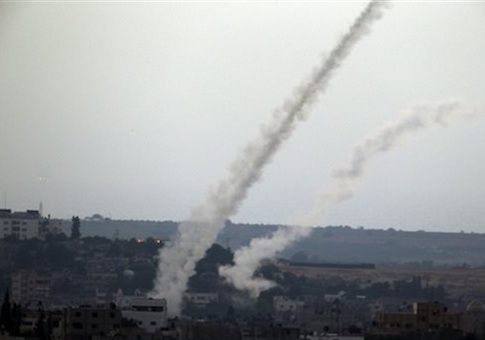
Israel Palestinians Nonstop RocketsSmoke trails are seen after missiles are fired by Palestinian militants from Gaza City towards southern Israel / AP

Rep. Ed Royce (R., Calif.), the author of the resolution’s Iran-related language, said the regime’s proud support of Hamas should give U.S. negotiators “pause” and indicates that Tehran cannot be trusted to abandon its nuclear program.

State Department spokeswoman Jen Psaki confirmed in a July 9 briefing that she is “not aware” of the issue of Iran’s support for Hamas being mentioned during talks.

“The focus is on the nuclear issue,” she said. “There’s plenty to discuss on that particular issue.”

[According to “a senior House aide,”] “It’s becoming increasingly harder for the president to ignore the Iran-funded terrorism coming out of the Gaza Strip, which thus far he’s brazenly overlooked in order to preserve prospects for a final nuclear agreement with Iran.”


Iranian military leaders on Monday celebrated Hamas’ use of advanced long-range rockets that were supplied to the terror group by the Iranian regime.

Iran’s role in arming Hamas militants with more sophisticated artillery capable of reaching deep into Israel has fueled concerns among lawmakers that U.S. negotiators are not doing enough to address Iran’s support for terror during ongoing nuclear discussions.

Israeli and United Nations officials have confirmed that Hamas is firing rockets on civilians provided to it by Iran.

A Senior Iranian Revolutionary Guard Corps (IRGC) general praised Hamas’ rocket attacks on Monday and warned that between Hamas and other Iranian-backed terror groups, “all Zionists are within the range of the resistance’s missiles.”

“The defense capacity and capabilities of the Islamic resistance and Hamas forces has left no safe place for the Zionists in the occupied territories,” General Ramezan Sharif, head of the IRGC’s public relations department, said in public remarks Monday.

Palestinian terror groups, including Hamas and other Iranian-backed groups, are well armed and can strike Jewish civilians inside and outside of Israel, Sharif said.

“The quality and trend of action of the Palestinian resistance movement in recent days indicates that the defensive and offensive power of Hamas, Ezzedin Al-Qassam, and Quds brigades forces have increased so much that one can dare say that all Zionists are within the range of the resistance’s missiles,” Sharif was quoted as saying by Iran’s semi-official Fars News Agency.

The Quds brigades are an elite Iranian force that trains terrorists, including Hezbollah, and is responsible for waging terror attacks across the Middle East against Western targets.

Iran’s arming of Hamas is beginning to receive attention at the highest levels of the U.S. government as the terror group continues to barrage Israel with more sophisticated rockets aimed at Tel Aviv, Jerusalem, and even the northern city of Haifa.

House lawmakers explicitly referenced Iran’s role in the conflict in a recent resolution supporting Israel’s right to self-defense.

“Iran has long provided material support to Hamas and Palestinian Islamic Jihad, including assistance that has enabled these terrorist organizations to produce longer-range rockets capable of striking Tel Aviv and Jerusalem,” the resolution stated.

Rep. Ed Royce (R., Calif.), the author of the resolution’s Iran-related language, said the regime’s proud support of Hamas should give U.S. negotiators “pause” and indicates that Tehran cannot be trusted to abandon its nuclear program.

“The failure of the government in Iran to adjust its behavior … gives us pause on how much seriousness they’re putting into these [nuclear] negotiations,” Royce was quoted as saying late Friday during a meeting with reporters.

The State Department has said that it shares Congress’ concerns, but that the issue is not being broached during nuclear talks with Iran, which are set to expire on July 20.

State Department spokeswoman Jen Psaki confirmed in a July 9 briefing that she is “not aware” of the issue of Iran’s support for Hamas being mentioned during talks.

“The focus is on the nuclear issue,” she said. “There’s plenty to discuss on that particular issue.”

“How do you discuss just nuclear issues with Iran when all this is going on, them supplying rockets to Hamas or Syria, and also possible destabilizing efforts in Iraq?” a reporter followed up, according to the official transcript.

“Obviously resolving the nuclear issue and preventing Iran from acquiring a nuclear weapon is not the only issue we have with Iran,” Psaki said. “But it’s such an important issue and it’s one that’s vital to our national security interests and to the security of the region that we feel a focus on that at these discussions is absolutely appropriate.”

A State Department spokesman on Monday did not respond to further inquiries about conversations it may or may not have had with Iran about Hamas.

House insiders working on the nuclear issue have expressed frustration over the administration’s hesitance to broach Iran’s larger support for terror groups such as Hamas.

“As the administration continues nuclear negotiations with Iran—the world’s largest state sponsor of terrorism—its proxy Hamas is firing hundreds of rockets at population centers in Israel,” one senior House aide told the Washington Free Beacon. “It’s becoming increasingly harder for the president to ignore the Iran-funded terrorism coming out of the Gaza Strip, which thus far he’s brazenly overlooked in order to preserve prospects for a final nuclear agreement with Iran.”

US warns against Israeli ground invasion of Gaza

July 14, 2014

US warns against Israeli ground invasion of Gaza – Israel News, Ynetnews.

AFP
Published:     07.14.14, 20:50 / Israel News

The United States on Monday warned against any Israeli ground invasion of Gaza, saying it would put even more civilians at risk than are currently in the crossfire of attacks on Hamas.
But the White House stopped short of criticizing Israel over the civilian toll so far in Gaza of the offensive, saying the government had a “right” and “responsibility” to defend their citizens against rocket attacks.

Soon in Gaza? IDF Paratroopers Train for Urban Warfare

July 14, 2014

Soon in Gaza? IDF Paratroopers Train for Urban Warfare, Israel National News, Yoni Kempinski, Tova Dvorin, July 14, 2014

Seven days after Operation Protective Edge began to stop a constantbarrage of rocket fire from Gaza, the IDF has begun training its paratroopers for a ground offensive.

Arutz Sheva obtained footage of the training exercises, all of which feature tactics for urban warfare.

The Security Cabinet approved an order to call up 40,000 soldiers for reserve duty ahead of a possible ground offensive last week.

As of Sunday morning, roughly 33,000 reserve soldiers were estimated to have been called up, as preparations to deepen the offensive against Hamas and Islamic Jihad continues.

The hidden intelligence agenda behind Hamas’ 1,000-rocket barrage: The case for Israeli ground incursion

July 14, 2014

The hidden intelligence agenda behind Hamas’ 1,000-rocket barrage: The case for Israeli ground incursion.

Debka

Speculation has been rife about the motivations behind Hamas’ more than 100-rocket-a-day barrage against the Israeli population, week after week.

The most popular theory is that the Palestinian Islamists are aiming for a spectacular victory over Israel by hitting an important strategic target and/or causing a high number of fatalities. Until one or both those objectives is achieved, the Palestinian Islamists won’t stop shooting.

But, as the Israeli Operation Defends Edge ended its first week on July 14, another explanation was finding acceptance among well-informed military and intelligence observers: They don’t believe Hamas tacticians have squandered 1,000 rockets thus far on a whim or at random. They are most likely motivated by three goals, which are also important to Hamas’ future plans – and not just Hamas:

1. Why would Hamas keep on shooting when so many of its rockets miss their targets or are destined to be downed by Israel’s Iron Dome interception batteries? The answer is that its tacticians have a hidden agenda. The rocket crews and their masters are testing the strengths and weaknesses of Israel’s wonder weapon for future reference.

Hamas knew in advance of the massive rocket blitz it launched against Israel in the last week of June that the Iron Dome defensive shield was if not impermeable then a major impediment.

At the same time, by battering the very areas where this shield was deployed, Hamas planners sought to expose its weak points and provide the Palestinians terrorists and their allies, Iran and Hizballah, with valuable data about the linchpin of Israel’s defenses.

This explanation would account for the changing focus of the rocket barrage:  After three days of concentrated fire on Israel’s three main cities, the Tel Aviv conurbation, Jerusalem and Haifa, Hamas turned Monday, July 14, to its familiar victims around the Gaza Strip’s borders. In those three days, data had been collected on Iron Dome’s performance and handed over to the analysts.
2. When the distribution of Hamas targets is examined, a premeditated program becomes visible: They were not randomly aimed at Dimona, Tel Aviv, Modiin and Hadera, but sought out the nuclear reactor (Dimona), Israel’s national and business heartland (Tel Aviv), the national power center (Hadera), Ben Gurion airport (Modiin), Israeli air bases near Negev towns, and military and port installations in Haifa, Ashkelon and Ashdod.

Hamas strategists noted that when the rocket fire intensified, so too did the Iron Dome interceptions.

While not averse to hitting Israel’s prime strategic sites directly, the Palestinians were their missed launches to develop data for guidance systems that would make their rockets and mortars more accurate in future conflicts.
The first Hamas drone from Gaza over Ashdod coast, shot down by a Patriot anti-missile early Monday, served this strategy,

The drone appears to have spent some time over the Mediterranean without approaching the Israeli coast before it was detected and downed. It may have been gathering information on the Israel coast and the strategic facilities located there.

Hamas later boasted that it had lofted not one but six unmanned aerial vehicles, whose range was 60 km and which were claimed capable of both surveillance and attack.

The IDF responded fast by declaring the southern coastal area a closed military zone.
Israel’s armed forces have been engaged in rocket-air combat for seven days, conducting a total of 1,470 air strikes, compared with more than 1,000 rockets fired by Hamas and its partner Jihad Islami.

Hamas still retains the bulk of its rocket stockpile. Some observers suggest that the Israeli Air Force will soon run out of worthwhile targets. The air force’s target bank is renewed almost hourly by incoming data. To replenish the dwindling stock, the military would have to expand its intelligence assets and resources, including surveillance and other means of monitoring the sites used by the enemy for control and command, as welll as informers.

Inserting a variety of sensitive intelligence resources at key points in the Gaza Strip is an essential requisite – not just for the current conflict, but for the long term. They would be there to have quality intelligence ready and available in real time, so providing a key factor for tipping the scales in the current and future rounds of violence.
Special forces working under cover to “label” targets for dedicated payloads to be delivered by air or “smart artillery” would provide such intelligence, just as Hamas uses rocket attacks and drones to suss out the secrets of Israel’s advanced defenses.

Above all, the clandestine insertion of special forces into the Gaza Strip could break the standoff between Israel and Hamas by cracking the control and surveillance communications systems linking commanders with the ranks and the politicians running the territory.
Ironically, the primitive nature of those communications makes them invulnerable to the IDF’s sophisticated Signal Intelligence (SIGINT) methods.

Hamas Wants Israel to Kill Palestinians

July 14, 2014

Hamas Wants Israel to Kill Palestinians, NewsmaxJeffrey Goldberg, July 14, 2014

Dead Palestinians represent a crucial propaganda victory for the nihilists of Hamas. It is perverse, but true. It is also the best possible explanation for Hamas’s behavior, because Hamas has no other plausible strategic goal here.

Mahmoud Abbas, the sometimes moderate, often ineffectual leader of the Palestinian Authority, just asked his rivals in Hamas a question that other bewildered people are also asking: “What are you trying to achieve by sending rockets?”

The Gaza-based Hamas has recently fired more than 500 rockets at Israeli towns and cities. This has terrorized the citizenry, though caused few casualties, in large part because Israel is protected by the Iron Dome anti-rocket system.

In reaction to these indiscriminately fired missiles, Israel has bombarded targets across Gaza, killing roughly 100 people so far. Compared with violent death rates in other parts of the Middle East, the number is small. (More than 170,000 people have been killed in the Syrian civil war to date.) But it is large enough to suggest an answer to Abbas’ question: Hamas is trying to get Israel to kill as many Palestinians as possible.

Dead Palestinians represent a crucial propaganda victory for the nihilists of Hamas. It is perverse, but true. It is also the best possible explanation for Hamas’s behavior, because Hamas has no other plausible strategic goal here.

The men who run Hamas, engineers and doctors and lawyers by training, are smart enough to understand that though they wish to bring about the annihilation of the Jewish state and to replace it with a Muslim Brotherhood state (Hamas is the Palestinian branch of the Brotherhood), they are in no position to do so. Hamas is a militarily weak group, mostly friendless, that is firing rockets at the civilians of a powerful neighboring state.

The Israeli military has the operational capability to level the entire Gaza Strip in a day, if it so chooses. It is constrained by international pressure, by its own morality and by the understanding that the deaths of innocent Palestinians are not in its best political interest.The men who run Hamas — the ones hiding in bunkers deep underground, the ones who send other people’s children to their deaths as suicide bombers — also understand that their current campaign will not bring the end of Israel’s legitimacy as a state.

I’ve been struck, over the last few days, by the world’s indifference to Gaza’s fate. Perhaps this conflict has been demoted to the status of a Middle East sideshow by the cataclysms in Iraq and Syria. Perhaps even the most accommodationist European governments know that Israel is within its right to hunt down the people trying to kill its citizens. Regardless of the cause, Israel seems under less pressure than usual to curb its campaign.

There is no doubt that Hamas could protect Palestinian lives by ceasing its current campaign to end Israeli lives. The decision is Hamas’s. As the secretary-general of the United Nations, Ban Ki-moon, said yesterday, “We face the risk of an all-out escalation in Israel and Gaza, with the threat of a ground offensive still palpable — and preventable only if Hamas stops rocket firing.”

I understand that this latest round in the never-ending Israel-Gaza war was, in many ways, a mistake. Israel was uninterested in an all-out confrontation with Hamas at the moment, and Hamas, which is trying to manage a threat to its control of Gaza from — believe it or not — groups even more radical and nihilistic than it is, is particularly ill-prepared to confront Israel.

The politics of the moment are fascinating and dreadful, but what really interests me currently is a counterfactual: What if, nine years ago, when Israel withdrew its soldiers and settlers from Gaza, the Palestinians had made a different choice. What if they chose to build the nucleus of a state, rather than a series of subterranean rocket factories?

This thought is prompted by something a pair of Iraqi Kurdish leaders once told me. Iraqi Kurdistan is today on the cusp of independence. Like the Palestinians, the Kurds deserve a state. Unlike most of the Palestinian leadership, the Kurds have played a long and clever game to bring them to freedom.

This is what Barham Salih, the former prime minister of the Kurdistan Regional Government, told me years ago: “Compare us to other liberation movements around the world. We are very mature. We don’t engage in terror. We don’t condone extremist nationalist notions that can only burden our people. Please compare what we have achieved in the Kurdistan national-authority areas to the Palestinian national authority . . . We have spent the last 10 years building a secular, democratic society, a civil society.”

What, he asked, have the Palestinians built?

So too, Massoud Barzani, the president of the Kurdistan Regional Government, once told me this: “We had the opportunity to use terrorism against Baghdad. We chose not to.”

In 2005, the Palestinians of Gaza, free from their Israeli occupiers, could have taken a lesson from the Kurds — and from David Ben-Gurion, the principal Israeli state-builder — and created the necessary infrastructure for eventual freedom. Gaza is centrally located between two large economies, those of Israel and Egypt. Europe is just across the Mediterranean. Gaza could have easily attracted untold billions in economic aid.

The Israelis did not impose a blockade on Gaza right away. That came later, when it became clear that Palestinian groups were considering using their newly liberated territory as a launching pad for attacks. In the days after withdrawal, the Israelis encouraged Gaza’s development. A group of American Jewish donors paid $14 million for 3,000 greenhouses left behind by expelled Jewish settlers and donated them to the Palestinian Authority. The greenhouses were soon looted and destroyed, serving, until today, as a perfect metaphor for Gaza’s wasted opportunity.

If Gaza had, despite all the difficulties, despite all the handicaps imposed on it by Israel and Egypt, taken practical steps toward creating the nucleus of a state, I believe Israel would have soon moved to evacuate large sections of the West Bank as well. But what Hamas wants most is not a state in a part of Palestine. What it wants is the elimination of Israel. It will not achieve the latter, and it is actively thwarting the former.