DEBKAfile Special Report July 10, 2014, 10:25 AM (IDT)
Israel air strikes over the Gaza Strip
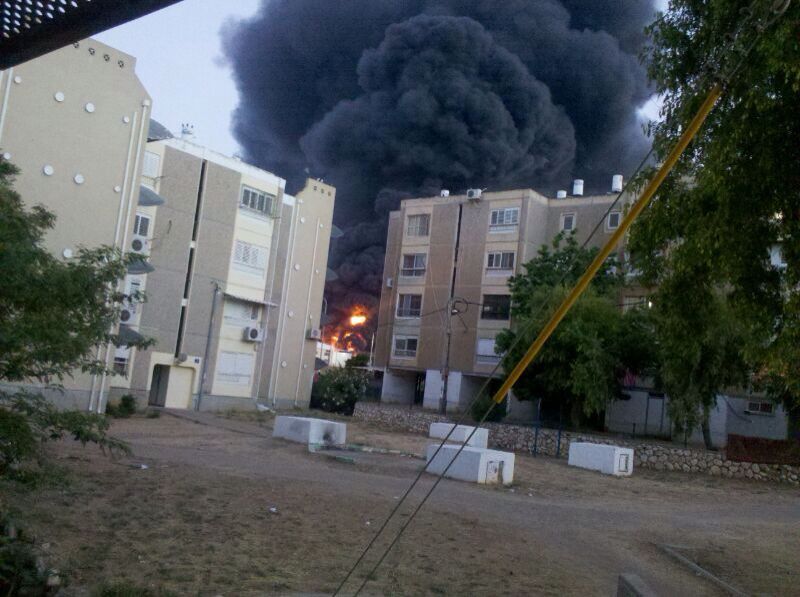
Early Thursday, July 10, two more rockets were fired from the Gaza Strip at Tel Aviv. Iron Dome intercepted one. By 9 am, 10 more landed in Negev sites. Between Wednesday midnight and Thursday morning, the Israeli Air Force and Navy had carried out 108 strikes in the Gaza Strip – 322 in 24 hours. Targeted were a weapons store, 5 arms manufacturing plants, 5 military compounds, 58 tunnels, 2 surveillance posts, 217 buried rocket launching pads, one command and control base and 46 homes of Hamas and Jihad Islami commanders.
In this time span, the Palestinians fired 234 rockets.
On Wednesday July 9, the second day of Operation Protective Edge, Prime Minister Netanyahu announced that he had ordered its expansion “until the [Palestinian] shooting stopped.”
debkafile‘s military sources say that the IDF high command replied that expansion would necessitate adding a ground incursion into the Gaza Strip to complement the air strikes. Enough equipment is present around the enclave but not enough troops. The call-up of 10,000 reservists did not meet requirements.
Since the prime minister had not yet provided them with specific orders, the air force continued to bomb rocket-related targets in Gaza, tallying strikes and publishing video clips of exploding targets and pillars of smoke.
But the facts in the field speak for themselves.
Despite the smoke and thunder, no senior Hamas commander or key command center has been hit – for lack of a clear directive. The Hamas chain of command is therefore still functioning.
This situation is fast developing into a standoff. Hamas leaders are perfectly aware of Israel’s dilemmas and quick to exploit them. They hear Netanyahu’s solemn words, but see for themselves that the concentration of IDF ground strength on the Gaza border is short of the numbers needed for an incursion and mobilizing them will take time.
Hamas is also listening to President Shimon Peres, who assured CNN that if Hamas holds its rocket fire, the IDF won’t go through with a ground incursion.
The Hamas rocket blitz has so far caused no Israeli fatalities thanks to a highly effective home defense system. On the Palestinian side, they are mounting, which they are beginning to use as a propaganda tool accompanied by vivid footage.
This situation decided Hamas Wednesday night to save its rockets, especially the more valuable ones with the longest range, and so confound Israeli predictions of another massive rocket blitz in store that would again widen out to reach Haifa.
Israel’s indecision about the next stage of Operation Protective Edge has given Hamas the time and breathing space it needs. Meanwhile, its most effective rockets for longer distances can be reserved for major confrontations.
And, meanwhile too, the perceived weakening of the government’s resolve and its reluctance to fix on a clear final objective have become fertile ground for self-doubts and unfounded rumors. The most damaging in circulation claimed that IDF and Air Force chiefs were complaining of a shortage of good intelligence for continuing their operations.
Our military sources confirm, without going into details on how much Israel knows about Hamas’ field setup, that the air force has all the intelligence it needs to carry on. What is lacking is not intelligence but a clear decision by Prime Minister Netanyahu about the operation’s ultimate goal and correlatively whether to go through with the ground operation necessary to complement the aerial operation. Until that is settled, Israel’s military operation against Hamas will continue to tread water.
Analysis: Israel made a strategic mistake by informing Hamas that it does not wish to hit it too hard. In Middle Eastern language, such a statement serves as an insurance policy for Hamas.
Yitzhak Ben Yisrael
Published: 07.10.14, 09:55 / Israel Opinion
As I write these words, the surface-to-surface missile fire from the Gaza Strip is intensifying and increasingly expanding northward.
Here’s a Middle Eastern paradox on a reduced scale: Both sides declare that they are not interested in escalation, and the fire increases. Understanding this paradox can also teach us a few basic rules about our situation in the Middle East.
Hamas’ situation in the past few years is not what it used to be. The economic situation in the Strip is deteriorating, the population already understands that its salvation will not come from the Hamas leadership, and even salaries are barely being paid.
We must also remember what happened in Egypt to Hamas’ ideological fathers, the Muslim Brotherhood, who were put behind bars. A conflict with Israel at this time looks almost suicidal. The rocket fire directed at Israel calls for a harsh response, which could lead to a real existential threat to the Hamas government.
So why do they continue to fire? Because they have an opportunity to prove to their audience (in the Strip) that “the resistance” goes on and that they are continuing to lead the war on the Zionist devil.
But what about the risk?
This is where Israel comes into the picture. It has no interest in destroying Hamas right now and bringing a new source of uncertainty into the Middle Eastern field, which is overflowing with uncertainty as it is.
Moreover, Israel made a strategic mistake by informing Hamas that it does not wish to hit it too hard. “We suggest that you calm down, and we promise that a clam will be met with a clam,” its spokespeople said.
In Middle Eastern language, such a statement serves as an insurance policy for Hamas. In its ears it sounds like “we have no intention of entering the Strip, and so you are free to fire.”
A dialogue of the deaf? Perhaps, but that’s the regular dialogue in the deterrence doctrine.
If you want peace, the Romans said, prepare for war. In the cruel world we live in, Hamas won’t stop firing out of “Zionist” motives. It’s an enemy which wants to see us disappear off the Middle Eastern map. It will only stop if it fears for its existence.
We have at least come to our senses. The government understood the aforesaid and asked the IDF to prepare “for every possible option,” including an extensive call-up of reserves required for entering Gaza.
It’s reasonable to assume that the tables will now be turned: The fear of a ground operation (if it is backed by additional steps on Israel’s part which will increase the credibility of deterrence) will lead Hamas to find a ladder and get off its high horse – in other words, to return to the relative calm we had here before. Until when? Until the next round in a year, two or more (depending on the strength of our blow).
This story may be generalized: What sustains us in the hostile world around us is neither a recognition that Israel’s existence is justified, nor a Zionist vision shared by the region’s nations. What sustains us is the knowledge that no one can overcome our force.
That is the reason, by the way, why we must keep the IDF strong even if the visible threats are growing weaker. It sounds like a paradox, but such a paradoxical situation is an inseparable part of strategy in general and of deterrence in particular. Damaging the IDF’s force (and image) is the main reason why the threats will grow again.
Remember what the Romans said? If you want peace, prepare for war.
Iranian President Hassan Rouhani (Vahid Salemi/Associated Press)
So much for the blockade of Gaza. Despite calls to lift it, it seems the real problem is that it is not stringent enough. Hamas has managed to acquire missiles able to reach deep into Israel, a capacity that surprises many long-time Middle East watchers (and perhaps the Israeli government as well).
Former deputy national security adviser Elliott Abrams writes that Hamas’s eagerness for war is a bid for attention and relevance in the Middle East, but it comes with a big risk:
For so far, Hamas has not done much damage to Israel. The swimmers were killed the minute they came out of the water. The tunnels have been discovered and bombed. The missiles are causing Israelis to flee to bomb shelters, but thank God (and Iron Dome) they have so far not caused much property damage and no loss of life. Meanwhile Israel targets Hamas’s missiles and especially its missile launchers, headquarters, arsenals and warehouses, and leaders. There is not much Hamas can call a victory except proving the range of its rockets. . . . Hamas wants more than calm: it has demands. It wants the men who were freed in exchange for Gilad Shalit, and recently re-arrested, to be freed again by Israel, and even has demands of Egypt—to open the border with Sinai far wider.
Hamas may have reached the conclusion that it must soon abandon those demands and agree to a truce, but be unwilling to stop until it can point to some “achievement” like hitting a major tower in downtown Tel Aviv or killing a large group of Israelis. But if there are no such “victories” and the Israeli assaults continue, that will change. This appears to be Israel’s assessment: keep increasing the pressure until Hamas, which started this war because it saw too many threats to its survival and dominance in Gaza, comes to see continued war as the key threat. Those who want the violence to end must realize that the larger is the Israeli effort now, the sooner Hamas will conclude this round must be ended.
Meanwhile, the clock ticks down on the P5+1 talks, with nervous onlookers concerned that President Obama, desperate for any foreign policy success, will promise to lift sanctions without dismantling (not simply freezing) Iran’s enrichment program, agree to let Iran “re-purpose” (not destroy) its heavy water reactor and stop short of requiring intrusive inspections anywhere in Iran. In other words, the president may break the back of sanctions but not of Iran’s nuclear weapons program.
That would set off a number of key decisions:
Will long-time Israel supporters on the Democratic side once again circle the wagons around the White House or decry the deal as a fraud? There are only so many times Democratic Sens. Bob Menendez (N.J.) and Chuck Schumer (N.Y.) can crumple under White House pressure, do its bidding and avoid the difficult task of putting national security above party loyalty — as they have so often done (e.g. confirmation of Defense Secretary Chuck Hagel, refusing to force a vote on sanctions this year).
Will the White House unilaterally try to relax sanctions, and, if so, will Congress act in response? The president has tried the patience of lawmakers, but a decision to ignore sanctions passed and signed into law so he can claim a face-saving victory will likely enrage a good many in Congress.
Will Congress refuse in the face of an inadequate deal to vote for full and permanent sanctions relief? The result may be a sort of stalemate — a final “deal” that can’t be implemented because Congress won’t lift sanctions and new sanctions can’t get by Sen. Harry Reid and the White House.
The Gaza conflict is distracting attention from the main event in the Middle East: Iran. There are no hearings in the offing on Iran; no new push for sanctions has begun.
Congress would do well to stiffen its spine and declare outright that no sanctions will be lifted absent the conditions previously set forth in bipartisan resolutions. If straggling lawmakers really want to “stand with Israel,” they would support sanctions, cease any talk of containment and make certain Israel has all the necessary equipment not simply to battle Hamas but also to take the fight if need be to Iran. (To fixate on cutting aid to the Palestinian Authority – which has not been requested, is not in the pipeline and would never get through House appropriators — is pure grandstanding.) Standing with Israel means standing there on its existential threat and halting indulgence of the administration (how unwise was it to give the administration room to negotiate?), which has shown no capacity to stand firm on the biggest national security challenge of our time. House Foreign Affairs Committee chairman Edward Royce (R-Calif.) had it exactly right in a written statement calling on Obama to publicly condemn Iran for providing these missiles to Hamas. That alone should be reason to increase, not decrease, sanctions.
A final deal, if there is one, that fails to achieve previously defined aims will raise a tricky issue for Hillary Clinton. If she is really going to separate from Obama and define her legacy as distinct from the passive tolerance of Iran’s nuclear capacity, she will need to register her concerns. However, if she does that, the Democratic left will skewer her. Given the choice between primary viability and foreign policy nerve, you can bet Hillary Clinton will choose the former. Republicans who want to be president should start exerting some leadership by taking meaningful action to turn up the heat on Iran.
750 targets hit in 56 hours, 800 tons of explosives used in strikes, source says; the increase in firepower comes as the IDF continues to amass Ground Forces on the border with Gaza.
IAF strikes Gaza Photo: PALESTINIAN MEDIA
Rocket sirens sounded in Tel Aviv on Thursday morning. The sirens were immediately followed by a series of audible explosions, most likely the Iron Dome interception system which picked off the rockets as they were heading toward the area.
Three rockets were intercepted by the Iron Dome system.
Meanwhile, a Palestinian news site is reporting on Thursday that eight Palestinians were killed in an Israeli strike in the southern Gaza town of Khan Yunis.
According to Palinfo, the eight Palestinians, including four women and two children, were killed when an IAF jet struck a home in the Khan Yunis refugee camp.
Six of the dead were from the same family, Palinfo is reporting.
A health ministry spokesperson in Gaza told the site that 30 people were injured in the attack, which came without any warning.
An Israeli airstrike killed four members of the Gaza Strip’s main security apparatus, the Ma’an news agency is reporting on Thursday.
Three Islamic Jihad operatives were killed in an IAF strike in Gaza. The IDF Spokesperson said that the three men were involved in the firing of rockets at Israel.
The Israel Air Force has struck 320 targets in Gaza over the past 24 hours, and 750 targets since the operation that began Monday night to extinguish Hamas rocket on Israel.
In overnight air strikes, 58 Hamas tunnels, 220 underground rocket launchers, and 46 command and control facilities – many located in the homes of senior Hamas commanders – have been destroyed, a senior military source said Thursday morning.
Some 80 command and control centers have been bombed since the start of the operation, the source added, and 513 underground rocket launchers have been destroyed.
Around 800 tons of explosives have been fired by air force jets on targets this week, the source said. The IAF’s current rate of fire is double that of Operation Pillar of Defense, launched in 2012 to stop Hamas rocket fire from Gaza. “We’ll see this trend increasing, as part of our firepower policy,” he said.
The increase in firepower comes as the IDF continues to amass Ground Forces on the border with Gaza. The source said Hamas is waking up on Thursday to “a lot of damage in Gaza. Its facilities are destroyed, as are the homes of its battalion and deputy battalion commanders that were used as command and control centers in every way. Hamas was running the operations of their units out of these homes. Some had weapons storage caches in them.”
The IDF is continuing the pressure on Hamas, he said, and the Gazan regime is frustrated by the fact that military power it has built up over years is systematically being destroyed. Iron Dome’s high effectiveness in stopping rocket fire on the Israeli home front is also frustrating Hamas, he said.
Israel’s Operation Protective Edge entered its second day Wednesday after a chaotic first 24 hours. Terrorist groups in the Gaza Strip fired over 150 rockets into Israel, reaching farther into the country than ever before, and Israeli Air Force jets and Navy ships bombarded Hamas and Islamic Jihad targets, putting the groups’ leadership in the crosshairs.
Hamas have been shooting their rockets scattershot all over the country, from the south to the center to the north. They are apparently using Syrian-made M302 long-range rocketsin order to target towns as far north as Zichron Yaakov, just south of Haifa, and, for the first time, as far east as Dimona, which despite being in the south of the country is about 80 km east of Gaza.
However the Iron Dome has exceeded all expectations and has managed to shoot down at least 90% of the missiles that would have landed in populated areas. The ones that “got away” were those that were going to land in empty areas or the sea. However Israel’s air corridors have been changed slightly to avoid incoming rockets or Iron Dome projectiles:
Israel’s seven Iron Dome batteries have been deployed across the country to protect populated areas from short-range rockets, with the assistance of the David’s Sling missile defense system, which is designed to shoot down missiles with ranges of between 100 kilometers and 200 kilometers. Though the David’s Sling system, sometimes called Magic Wand, is still under development, it has been integrated into one of the Iron Dome batteries.
Meanwhile, there have been some changes to civilian aviation, including takeoff and landing paths, because Hamas is aiming some of its rockets at Ben-Gurion International Airport, about 80 kilometers from Gaza. This has also affected flight schedules, which have been spread out over more hours rather than clustered together.
Nonetheless most Israelis feel protected by the Iron Dome and are trying to keep some semblance of normal life. So Hamas in its frustration, like a spoiled child acting out, is going all out to try and achieve a “quality” attack, one that either results in many deaths or one that will grab Israel’s attention, for example a kidnapping, an infiltration into an army base or a civilian community, or bombing the nuclear reactor in Dimona.
They are also making use of human shields in order to cause many civilian casualties on their own side and thus turn public opinion against Israel but the world doesn’t seem so interested this time around.
“The international community is totally disinterested. Yes, there were a few press releases from [UK Foreign Secretary] William Hague and a few others, but generally the world doesn’t show any particular interest in this,” the official told The Times of Israel. “They’re either very tired of [the Israeli-Palestinian conflict], or their attention is elsewhere, or they want to go on a summer vacation and don’t think this story is important enough.”
…
Even the Arab world has not gotten too excited about Israel’s offensive in Gaza, an Israeli diplomatic official said. “Egypt has given up on Hamas, they don’t care if we clobber them.” The Foreign Ministry in Cairo has condemned Operation Protective Edge but so far not gotten involved in efforts to reach a ceasefire.
Today Hamas frogmen once more tried to infiltrate Kibbutz Zikim and once more were repulsed and killed, though the army is still searching the area in case there are more terrorists lurking about.
Watch how the army and air-force acted in concert to target and neutralize the 5 terrorists who tried to infiltrate Zikim yesterday:
Hamas also shot rockets at the Dimona nuclear reactor, but without success since the IDF had either foreknowledge or suspicions that this would be a target, and moved an Iron Dome battery into the vicinity.
Since the start of the operation, the IDF has attacked a large number of targets, some of Hamas, others of Islamic Jihad, including the homes of operatives who are using their families as human shields. That was the case on Tuesday with the Kaware family from Khan Yunis. Initially, warning shots were fired at the home of a family member, a Hamas operative, but instead of evacuating the building a large number of his relatives gathered on the roof to try to prevent an attack. Minutes later, however, the bombing took place, and seven members of a single family were killed, children among them.
This incident gave Hamas the pretext it wanted to launch rockets at the Dan region. For now, that is Hamas’s “great” achievement…
…
This isn’t the only Hezbollah tactic that Hamas is attempting to imitate. Just like the Lebanese Shiite group, Hamas is also attempting to carry out “quality” acts of terrorism. Thus far, its two attempts have failed: the infiltration of Hamas frogmen via the northern beaches of Gaza, heading to Zikim; and the explosives-filled tunnel at Rafah. In the case of the Zikim attack, all five members of the Hamas terror cell were killed. Not long before, the commander of that Hamas unit, Muhammed Shaaban, and two of his aides were eliminated in an Israeli airstrike. As for the Rafah tunnel, Israeli intelligence managed to thwart an unusual attempted attack: Hamas had spent months, if not years, digging that tunnel, which was intended to enable dozens of armed Hamas terrorists to carry out simultaneous raids inside Israel on numerous targets, including civilians.
The paradox, the Catch-22, is that the absence of a “victory picture,” so frustrating for Hamas, is only encouraging its operatives to intensify their attempted attacks. Hamas TV and the Arabic satellite stations are celebrating the rocket attacks and the “raids” on Zikim and at Rafah, but Hamas’s military chiefs can be expected to continue to invest no little planning and effort in the bid for a successful “quality” attack.
Hamas has options: raids via Sinai, paragliders or explosive-carrying drones, Zikim-style infiltrations from the sea, attacks on Israeli naval vessels, and more. The IDF suspects that Hamas has land-to-sea rockets with a 35-kilometer (22 mile) range.
In contrast to the inhuman behaviour of the terrorists, the elephants at the Ramat Gan Safari showed how they protect their young during an air raid alert. This must be one of the most moving videos I’ve seen. The translation of the blurb explains:
This morning as a Red Alert siren was sounded in the area of the Ramat Gan Safari, the adult elephants trumpeted a loud warning and gathered round the young calves Latangi and Lalana in an attempt to protect them.
To conclude today’s update, if you should come across people who claim that the rockets are only “puny fireworks” or “crude home-made missiles” and that since no Israelis have died, these attacks are not so terrible, send them to read the IDF blog’s article “Life comes to a halt“. There is an excellent photo essay which clearly demonstrates the difficulty of living a normal life under fire.
The IDF spokesman describes the harsh reality of Life under Fire:
Most of the Israeli population is currently living under the threat of rocket fire. Life between sirens, in and out of bomb shelters, has become the daily reality for millions of Israelis. Hamas terrorists have fired more than 200 rockets at Israel since Operation Protective Edge began on Monday, July 7 – and over 650 rockets since the beginning of 2014.
This is an intolerable and dangerous reality for Israelis under fire, especially in the south of Israel where thousands of people have less than15 seconds to run to a bomb shelter when an alarm goes off.
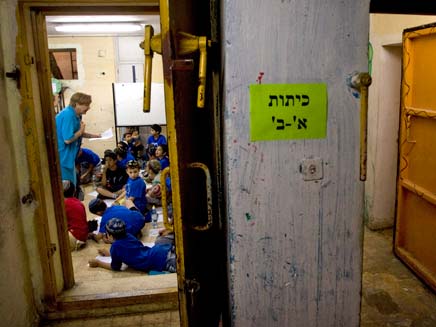
Life under constant rocket fire has disrupted the daily routines of millions of Israelis. Summer camps for children have been canceled. Children are advised to be with their parents, in close proximity to bomb shelters. In many places, children remain in bomb shelters for the entire day in order to avoid being in open areas when the rocket siren sounds.
Transportation networks have been disrupted as train service in southern Israel has been canceled. Israelis are hesitant to drive in their cars because they do not want to be caught in the open when the rocket siren sounds. Public gatherings, such as concerts or festivals, have been canceled.
Businesses around the country, especially in the south, have suffered due to ongoing rocket fire. Many restaurants and shops have closed, as people prefer to be at home with their families near shelters.
Summer camp in a bomb shelter
Drivers taking shelter from rocket attack in Tel Aviv
A simple story from my daughter illustrates how absurd the situation has become. She and her husband were invited to a wedding which was supposed to take place in Ofakim, not far from Sderot. Since the army has banned all gatherings of over 300 people (Israeli weddings are big), the families moved the wedding – at a day’s notice – to Jerusalem… where they got caught up in a rocket attack.
This is what Hamas is hoping for – to make normal life impossible for Israelis, while at the same time trying to kill as many of us as they can, and causing us to kill as many of their civilians as possible, thus enabling them to cry “Victim!” and plead for help at the UN.
Too bad for them that no one is paying them much attention at the moment – though I expect that to change eventually. Israel is never allowed to finish the job properly once and for all.







 anneinpt
 artaxes
 danmillerinpanama
 davidking1530
 Peter Hofman
 Joseph Wouk
 Peter
Peter Louisiana Steve
 WarSclerotic
Recent Comments