Archive for July 9, 2014

John Kerry’s War

July 9, 2014

John Kerry’s War, Commentary Magazine, July 9, 2014

(President Obama also deserves his fair share of the “credit.” — DM)

[F]ailed peace talks exacerbate Israeli-Palestinian tensions rather than calming them. And when tensions rise, so does the likelihood of violence. That’s true in any situation, but doubly so for the Israeli-Palestinian conflict, because terrorist groups like Hamas are always happy to throw a match into a barrel of explosives. The unsurprising result is that spasms of violence, like the second intifada and the current war, have frequently followed failed peace talks.


Being a pessimist means that having your predictions come true rarely brings much joy. That’s the situation I and many other Israelis and Palestinians are in right now–all those who warned that John Kerry’s insistence on restarting Israeli-Palestinian talks would likely spark a new round of Palestinian-Israeli violence, but were drowned out by those who insist that talking never does any harm. It’s already too late to spare Israelis and Palestinians the bloody consequences of Kerry’s hubris. But it’s important to understand why such initiatives so frequently result in bloodshed, so that future secretaries of state can avoid a recurrence.

First, as repeated efforts over the last 14 years have shown, Palestinians and Israelis aren’t ready to make a deal. Serious efforts were made at the Camp David talks in 2000, the Taba talks in 2001, the Livni-Qureia talks in 2007-08, the Olmert-Abbas talks in 2008, and, most recently, Kerry’s talks, but all failed because the gaps between the parties couldn’t be bridged. As Shmuel Rosner noted in a perceptive New York Times op-ed in May, that’s because many issues Westerners don’t much care about, and therefore imagine are easy to compromise on, are actually very important to the parties involved and thus impossible to compromise on. That isn’t likely to change anytime soon, and until it does, negotiations will never bring peace.

But failed peace talks inevitably make violence more likely, for two main reasons. First, they force both sides to focus on their most passionate disagreements–the so-called “core issues” that go to the heart of both Israeli and Palestinian identity–rather than on less emotional issues. On more mundane issues, Israel and the Palestinian Authority can sometimes agree–as they did on a series of economic cooperation projects last June, before Kerry’s peace talks gummed up the works. But even if they don’t, it’s hard for people on either side to get too upset when their governments squabble over, say, sewage treatment. In contrast, people on both sides do get upset when their governments argue over, say, the “right of return,” because that’s an issue where both sides view the other’s narrative as negating their own existence.

Second, failed peace talks always result in both sides feeling that they’ve lost or conceded something important without receiving a suitable quid pro quo. Palestinians, for instance, were outraged when Kerry reportedly backed Israel’s demand for recognition as a Jewish state, while Israelis were outraged by Kerry’s subsequent U-turn on the issue. Thus both sides ended up feeling as if their positions on this issue were undermined during the talks. The same goes for the Jordan Valley, where both Israelis and Palestinians felt Kerry’s proposals didn’t meet their respective needs, but now fear these proposals will serve as the starting point for additional concessions next time.

Added to this were the “gestures” Kerry demanded of both sides: that Israel free dozens of vicious killers and the PA temporarily refrain from joining international organizations. Though the price Kerry demanded of Israel was incomparably greater, neither side wanted to pay its assigned share. So when the talks collapsed, both felt they had made a sacrifice for nothing.

In short, failed peace talks exacerbate Israeli-Palestinian tensions rather than calming them. And when tensions rise, so does the likelihood of violence. That’s true in any situation, but doubly so for the Israeli-Palestinian conflict, because terrorist groups like Hamas are always happy to throw a match into a barrel of explosives. The unsurprising result is that spasms of violence, like the second intifada and the current war, have frequently followed failed peace talks.

So if Washington truly wants to avoid Israeli-Palestinian violence, the best thing it could do is stop trying to force both sides into talks that are doomed to fail. For contrary to the accepted wisdom, which holds that “political negotiations” are the best way to forestall violence, they’re actually the best way to make violence more likely.
State Dept. Will Not Defend White House Criticism of Israel

July 9, 2014

State Dept. Will Not Defend White House Criticism of Israel, Washington Free Beacon, July 9, 2014

(If the administration is “fully coordinated in our message,” what would be considered “uncoordinated?” — DM)

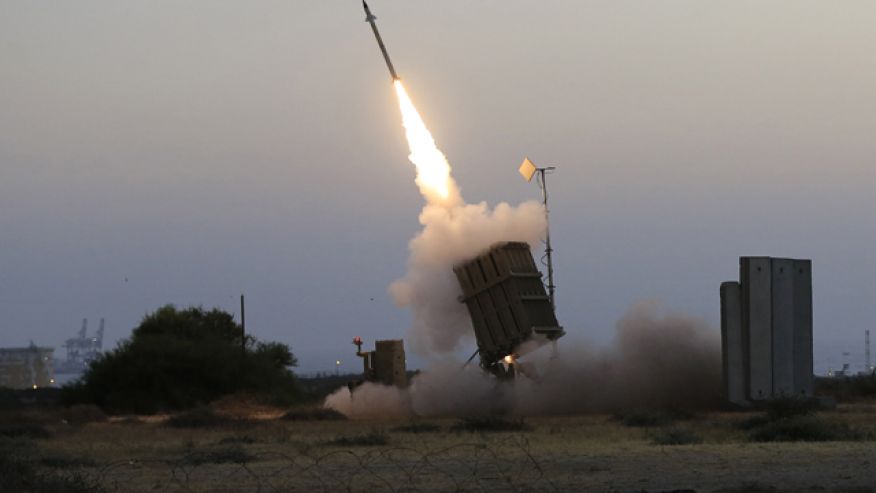
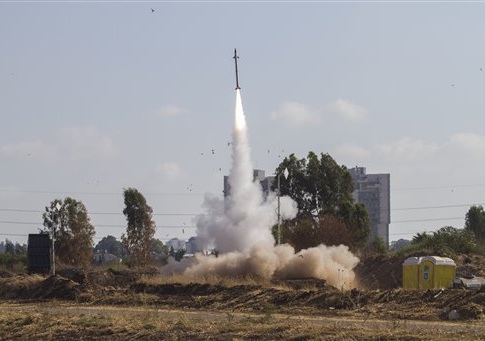
APTOPIX Mideast Israel PalestiniansAn Iron Dome air defense system fires to intercept a rocket from the Gaza Strip in Tel Aviv / AP

“This administration is fully coordinated in our message,” a senior Obama administration official told the Free Beacon when asked about the series of remarks.


Conflicting messages from the Obama administration to Israel are prompting concerns that the White House may not have a coherent strategy in place as the crisis in the Middle East escalates, according to former U.S. and Israeli officials.

Senior Obama administration officials in recent days have alternatively lashed out at Israel in increasingly stark terms and defended the Jewish state’s right to defend itself against terror.

Questions about the disparate messages led the State Department on Wednesday to distance itself from a top White House aide who harshly lashed out at Israel during a speech yesterday.

The inconsistent messages have caused confusion and worry in both Jerusalem and Washington, D.C., according to multiple sources in both cities who told the Washington Free Beacon that team Obama’s disarray is fostering greater unrest across the Middle East and emboldening rogue regimes.

Israeli and U.S. sources following the issue described a dangerous lack of clarity at the White House, which comes as Israel is being barraged by some 300 rockets, including advanced long-range missiles capable of reaching deep into the country.

Senior White House aide Philip Gordon, the White House coordinator for the Middle East, surprised Jewish officials and insiders late Tuesday when he derided Israel and accused it of denying the Palestinians dignity and sovereignty during a speech in Israel held as Hamas rockets rained down on the Jewish state.

Top officials from leading Jewish organizations in D.C. and Israel privately expressed shock at the remarks and could be heard grumbling about the timing of Gordon’s speech during events held early Wednesday in the Capitol.

“Israel confronts an undeniable reality: It cannot maintain military control of another people indefinitely. Doing so is not only wrong but a recipe for resentment and recurring instability. It will embolden extremists on both sides, tear at Israel’s democratic fabric and feed mutual dehumanization,” Gordon was quoted as saying during a speech at the Haaretz newspaper’s Israel Conference on Peace, an event that was marred by physical violence.

State Department spokeswoman Jen Psaki was forced to distance herself from Gordon’s remarks when asked about the speech by reporters on Wednesday.

“I’m not going to parse his words,” Psaki said multiple times, explaining that the administration blames both Israel and the Palestinians for the failure of the peace process.

“This administration is fully coordinated in our message,” a senior Obama administration official told the Free Beacon when asked about the series of remarks.

Gordon’s harsh remarks clashed with separate comments issued this week by White House and State Department officials in D.C., who expressed solidarity with Israel’s military campaign to root out Hamas terrorists.

“We strongly condemn the continuing rocket fire into Israel and the deliberate targeting of civilians by terrorist organizations in Gaza,” White House Press Secretary Josh Earnest said at Tuesday’s White House briefing. “No country can accept rocket fire aimed at civilians, and we support Israel’s right to defend itself against these vicious attacks.”

“We certainly support Israel’s right to defend itself against these attacks,” Psaki added in a separate briefing on the same day.

Former officials in both Israel and the United States said that the Obama administration’s erratic messages on Israel come at a dangerous time and are contributing to regional chaos.

“Right now the administration sees no contradiction between condemning the Hamas rocket fire and maintaining its recognition of the Hamas-Fatah unity government,” former Israeli Ambassador Michael Oren said on a conference call hosted by the Israel Project (TIP).

The formation of the Palestinian unity government, and the quick endorsement by Western nations, helped pave the way for the current instability, Oren said.

“There’s been no indication whatsoever that the United States or other members of the Quartet are willing to renew or reassess their very quick recognition of the unity government,” Oren said.

Palestinian Authority President Mahmoud Abbas is taking “no responsibility” for the rocket attacks, yet is claiming to be “a victim of Israelis reprisals,” Oren explained. “No one is taking Mahmoud Abbas to task for this at all.”

The Obama administration’s disparate messages betray a lack of support for Israel, according to former White House National Security Adviser Elliott Abrams.

“Israel is under attack, with millions forced to flee into bomb shelters every day, so it is incredible that the administration chose these days to have an official deliver a speech in Tel Aviv that blames Israel for the failure to achieve peace,” Abrams told the Free Beacon. “It was not just bad timing but shocking timing, because allies who are under military attack deserve to hear one message from us: solidarity. That is not what Israelis heard from the United States this week.”

“And as always,” Abrams added, “the administration’s failure or unwillingness to send that unified message reverberates in Riyadh and Abu Dhabi, and Tokyo and Seoul, Kiev and Warsaw. And it is loudly heard in Tehran, Moscow, and Beijing.”

One former Israeli diplomat told the Free Beacon that the Obama administration’s unfocused diplomacy has made it nearly irrelevant in Israeli society.

“Gordon’s speech was unscripted [and] it was an example of what not to do,” said the former official. “These were incredible things to say to an audience that I’m sure wanted to hear what he was saying, but it was not based in reality to talk about the good will and the peace process when the bodies from terrorism in the West Bank were just buried.”

“If I were an Arab leader still in power in the Middle East I’d be fearful of either the naiveté or their conspiratorial nonsense,” said the source, who described Gordon’s remarks as “very strange.”

Senior officials with leading pro-Israel organizations in Washington also admitted to having trouble wrapping their heads around the Obama administration’s strategy, or lack their of, as they put it.

“The strategy is bizarre even by the standards of this White House, which has a history of declaring that it is Israel’s best friend while working against Jerusalem behind the scenes,” said one senior official with a pro-Israel organization who would only speak on background about the White House’s internal strategy.

“What’s the point of expressing support from the podium in D.C., if you’re just going to undermine it by publicly attacking the Israelis on their home turf while they’re being hit with rockets?” the source asked. “What’s the point … when the only possible result is that you’ll look out of touch and hostile?”

Analysts say the White House’s conflicting messages betray a larger lack of focus on foreign policy issues and a total disengagement from the fraught politics of the Middle East.

“The problem is that the White House isn’t interested; this is part and parcel of a larger disengagement from the Middle East,” said Danielle Pletka, vice president of foreign and defense policy studies at the American Enterprise Institute (AEI).

“What do we want from Iran? A place in the Nobel pantheon. What do we want from Iraq? For [President] Maliki to go away and make it all better. What do we want from Egypt? Nothing. Syria? Kill people more quietly,” Pletka said. “Having no policies puts the White House in a bind, because unfortunately, ‘duh’ is not foreign policy.”

Israel’s next move: ground invasion of Gaza?

July 9, 2014

Israel’s next move: ground invasion of Gaza? Al Arabiya News, Brooklyn Middleton, July 9, 2014

(Al Arabiya is a Saudi-owned publication. Of no interest whatever(?), “On 26 January 2009, American president Barack Obama gave his first formal interview as president to the television channel.”– DM)

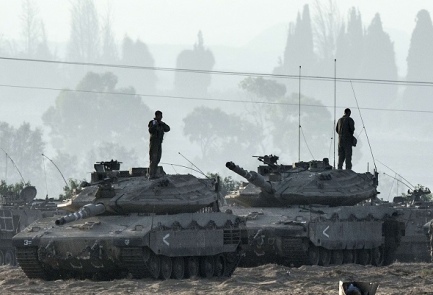
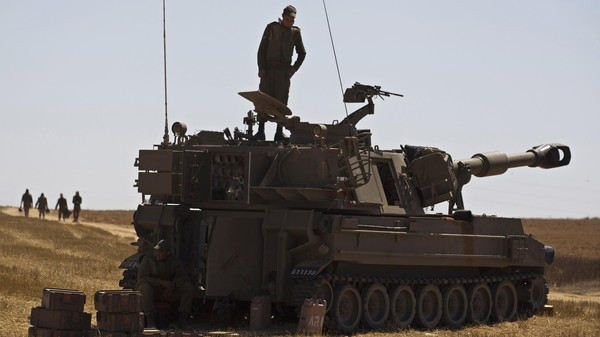
An Israeli soldier stands atop a mobile artillery unit stationed near the border with the Gaza StripAn Israeli soldier stands atop a mobile artillery unit stationed near the border with the Gaza Strip July 9, 2014. (Reuters)

While in the coming days Israel will continue and likely step up its airborne assault on positions in the Strip, a ground incursion in the near term cannot be ruled out.


Since the Israeli Defense Forces (IDF) launched Operation Protective Edge during overnight hours on Monday, at least 48 Palestinians have been killed – including several senior Hamas and Palestinian Islamic Jihad (PIJ) militants as well as an 8 year-old child and an 80-year-old civilian; meanwhile, Hamas and other Gaza-based militants have indiscriminately fired at least 225 rockets at civilian populations targeting most of Israel’s major cities including Jerusalem, Tel Aviv and Beersheva, without causing deaths.

At least 40 of these rockets were intercepted and destroyed by Israel’s Iron Dome anti-missile defense system.

The first major Israel-Hamas flare up since the eight-day-war in November 2012 shows little signs of de-escalating in the near term. In the first 48-hours, the intensity of Israel’s operation has already proven far greater than the last with the IDF confirming over 500 targets have been hit.

While at the same time, Hamas has already demonstrated an unprecedented capability to hit Israel’s northern cities, with at least one rocket striking Hof HaCarmel, located just south of the major city of Haifa and a total of approximately 145 kilometers away from the Strip.

Moreover, according to security reports, militant factions in Gaza are now in possession of double the amount of rockets they had during the 2012 war – one factor alone that significantly increases the likelihood for a much broader conflict with Israel.

Prime Minister Benjamin Netanyahu publicly indicated the IDF would expand the operation, asking Israelis to “display patience, because this operation could take time.”

While in the coming days Israel will continue and likely step up its airborne assault on positions in the Strip, a ground incursion in the near term cannot be ruled out.

In an interview with Al Arabiya, Daniel Nisman, President of Levantine Group, a geopolitical risk consultancy based in Tel Aviv, noted preparations for a ground offensive were already likely underway and that the longer Hamas fails to stop firing rockets, the greater the likelihood for a ground incursion becomes, perhaps even as soon as within “the next 1-2 weeks,” Nisman said.

He further noted that, “This would be a much larger ground offensive than Hamas is anticipating,” and that the operation, “would first aim to cut the Gaza Strip into different sections, then take control of peripheral areas which are used to launch short and medium range rockets.”

Former IDF officer Dror Markus echoed this analysis, in a separate interview, indicating that if Hamas fulfills its goals of inflicting casualties on Israeli civilians, “Netanyahu will be left with no choice other than a limited ground military incursion.”

That said, Markus also pointed out what he indicated were “interesting patterns with the rocket fire” with “heavy, simultaneous barrages trying to test the Iron dome system [but with] more focus on shooting rockets at Tel Aviv and the center than [at] Beersheva.”

He noted that this pattern could signify a subtle message that Hamas is unwilling to do something that would immediately guarantee a ground invasion such as launching a massive volley of rockets at the southern cities of Sderot or Beersheva – which would be more likely to cause injuries or casualties than firing a limited amount of rockets at center cities like Tel Aviv.

Meanwhile, domestically, tensions between Israelis and Palestinians continue skyrocketing over the grotesque revenge murder of a Palestinian teenager at the hands of radical Israelis.

A ground incursion in the Gaza strip could further exacerbate the unrest, likely triggering riots in East Jerusalem and across Arab-Israeli towns. That said, whether or not a third intifada is indeed imminent, according to Nisman, remains unlikely at the moment. “Palestinian Authority media outlets in the West Bank are not showing sympathy for Hamas,” he noted.

This is an important point; while the embryonic Fatah-Hamas unity government spirals once again into nothingness, Hamas could align itself – politically – with other fringe factions in the Gaza Strip as it has now done once again, militarily.

Return Gaza to the Stone Age

July 9, 2014

Return Gaza to the Stone Age, Israel Hayom, Amos Regev, July 9, 2014

Israel must destroy the arsenal Hamas has built up over the past decade. The only way to do this: an extensive ground operation.


IDF tanks on borderIDF tanks on the Gaza border, Tuesday | Photo credit: AFP

The Gaza Strip must be returned to the Stone Age. Not in the sense of destroying every home and all the infrastructure, which would leave Gaza residents wandering among ruins. Rather, Israel should eliminate every rocket, bomb and gun in Gaza. In other words, get rid of the arsenal Hamas has accumulated over the past 10 years. The snake must be defanged, leaving Hamas without rockets. The most it would have left would be stones.

There is only one way to do this — an extensive ground operation. This must be carried out with determination and clenched lips, with the knowledge that this is a war of no choice.

Over the past decade, intentionally or negligently, Israeli governments have allowed Gaza to turn into a terror base. There have been military operations and targeted assassinations, yet Gaza terror groups, led by Hamas, have nevertheless been able, via both smuggling from outside Gaza and internal production, to build up stockpiles of rockets. This has created a “balance of terror” between Israel, with its large and sophisticated army and air force, and Hamas, armed with several thousand rockets. Israeli deterrence has been eroded by Hamas’ ability to strike the central Gush Dan area.

This is an intolerable situation, yet it has become a fact. Given the current circumstances, the time has come to change this reality. Restoring quiet would not be enough. Rather, Israel must return Hamas to a situation in which the most it can do is throw stones. This is how it was when Hamas was founded, in Gaza, during the First Intifada. But since then, particularly over the past 10 years, Hamas equipped itself with long-range rockets. It would take only 10 days to return Hamas to the Stone Age.

The current crisis began with horrible kidnapping and murder of the three Israeli teens last month. This was followed by the revolting killing of the Arab teen, after which the violence in Gaza and its surrounding area began. Three and a half weeks passed between the start of the crisis and the launch of Operation Protective Edge. On one hand, the government could perhaps be praised for the levelheadedness, restraint and sound judgment it exhibited before ordering the Israel Defense Forces to launch Operation Protective Edge. On the other hand, the government could perhaps be questioned over why it took so long for it to give such a necessary order.

But on Monday, the order was given. Thousands of reserve soldiers have been called up. Our forces are preparing. The Israeli Air Force is attacking. And Hamas is continuing to do what it does.

There are moments in the life of a nation when history is made. This could be such a moment, if we utilize it. This time, the method must be different — no pinpricks or surgical strikes, but rather a massive concentration of force.

Instead of battalions or brigades, whole divisions must march shoulder to shoulder, moving forward like a steamroller, slowly but also very powerfully. Anyone familiar with military history knows how this method works. It has been used successfully in the past. Not on the “modern battlefield,” but the battlefields of old. A massive concentration of force covering every meter of the front, rolling into Gaza, destroying all points of resistance, blowing up every tunnel and eliminating the entire terrorist arsenal there. After completing the mission, the force will pull out.

Such an operation would enjoy the support of the Israeli public, including residents of the south, who have suffered enough, and residents of the center and the north, who are now being threatened by the long-range rockets of Hamas.

The task assigned to our forces must be much more than “returning the quiet.” The order must be to eliminate Hamas’ ability to threaten us. And when our forces depart Gaza, they must leave Hamas, or what remains of it, back in the Stone Age.

Gaza rockets aimed at Israel: What would you do with just 15 seconds?

July 9, 2014

Gaza rockets aimed at Israel: What would you do with just 15 seconds? Fox News, July 9, 2014

Iron Dome July 5July 5, 2014: An Iron Dome air defense system fires to intercept a rocket from Gaza Strip in the costal city of Ashkelon, Israel. (AP Photo/Tsafrir Abayov)

For those not blinded by unmitigated hope, it is clear that Hamas never changed one bit. And so it was disappointing that the White House and State Department, followed by our European allies, so quickly welcomed formation of the Palestinian unity government, instinctively accepting the Palestinian narrative that this Fatah-Hamas marriage, blessed by President Abbas, would be the panacea to advance the peace process.

Tragically, the international community has long ignored the evil festering in Hamas-ruled Gaza. Indeed, Gaza was barely mentioned during Secretary of State John Kerry’s nine-month effort to achieve a negotiated two-state settlement. That hopeful effort was buried when Abbas rebuffed Kerry’s last-minute attempt to extend the talks that summarily ended in April. Abbas has not been held accountable for joining up with Hamas, nor has any government that recognized the marriage pressed him to declare a divorce.

Hope is not policy. Amidst the escalating conflict, Israeli Prime Minister Netanyahu is wondering whom he can trust as he carefully considers options to protect all of Israel’s citizens.


Imagine that wherever you live in the United States you have only 15 seconds to reach a secure place to avoid a rocket or missile. Seriously, count down from 15 to 1, and think about what you would do. For more than 3.5 million Israelis, Jews and Arabs, their mental stopwatch is ticking as Hamas extends the reach of its barrage from Israeli communities near the Gaza border to Hadera, 26 miles north of Tel Aviv.

Some of the hundred-per-day rockets have been stopped by Israel’s Iron Dome anti-missile system. Most have landed in open fields or in buildings that, by chance, were empty. But given past experience with Hamas, the deadly projectiles are likely to soon maim or kill.

The international community has long ignored the evil festering in Hamas-ruled Gaza.

A few years ago, I visited Sderot, the Israeli town that has borne the brunt of Hamas rockets for years. I stood next to a crater in a kindergarten playground where a Qassam rocket had landed the previous Saturday. Since that was the Jewish Sabbath, the 50-plus children were not on site. Then, as now, it has largely been good fortune that Hamas has failed to inflict mass casualties, but they have vowed to not give up.

The current Hamas offensive began shortly after Palestinian Authority President Mahmoud Abbas refused to extend peace talks with Israel, and instead formed a unity government with the unrepentant terrorist organization on June 2. The frequency and reach of rockets fired into Israel increased after three Israeli teens, abducted and murdered by Hamas, were found on June 30. Hamas leaders, who earlier had encouraged the kidnapping of Israelis, now both celebrated and denied responsibility for the abduction.

One twisted narrative, reported as fact by some Western media, is that Hamas was “provoked” by Israeli actions aimed at bringing to justice the individuals responsible for killing the teens. But that myopic view belies the very essence of Hamas, which is intent on using all kinds of violence to fulfill its mission of destroying the State of Israel. While it does not have the capacity to overwhelm the IDF, Hamas can certainly wreak havoc, and right now is doing its best to provoke a wider conflict.

It did not have to be this way. In 2005, Gaza was liberated as Israel withdrew totally and transferred the territory to the Palestinian Authority, as a first step towards the potential achievement of a two-state solution. But Hamas never shared that vision of peace, and immediately after seizing control of Gaza in 2007, returned to its terrorist raison d’etre. Instead of finding ways to build constructively in Gaza, Hamas focused on acquiring and manufacturing rockets. Today, this remains Gaza’s primary export, and the rockets are arriving uninvited in Israel at a fast and furious pace.

For those not blinded by unmitigated hope, it is clear that Hamas never changed one bit. And so it was disappointing that the White House and State Department, followed by our European allies, so quickly welcomed formation of the Palestinian unity government, instinctively accepting the Palestinian narrative that this Fatah-Hamas marriage, blessed by President Abbas, would be the panacea to advance the peace process.

Tragically, the international community has long ignored the evil festering in Hamas-ruled Gaza. Indeed, Gaza was barely mentioned during Secretary of State John Kerry’s nine-month effort to achieve a negotiated two-state settlement. That hopeful effort was buried when Abbas rebuffed Kerry’s last-minute attempt to extend the talks that summarily ended in April. Abbas has not been held accountable for joining up with Hamas, nor has any government that recognized the marriage pressed him to declare a divorce.

Hope is not policy. Amidst the escalating conflict, Israeli Prime Minister Netanyahu is wondering whom he can trust as he carefully considers options to protect all of Israel’s citizens.

Will the international community get off the fence and unequivocally condemn Hamas’s relentless attacks on Israel? Will there be worldwide expressions of full solidarity with Israelis – men, women and children – forced to endure the ceaseless, frequent assaults?

And, most importantly, when Israel does take further actions, will world leaders ask themselves what they would do if their own countries were similarly threatened and attacked, and their citizens had only 15 seconds to find shelter?

And again: Hamas leadership hiding in basement of Shifa Hospital

July 9, 2014

And again: Hamas leadership hiding in basement of Shifa Hospital, Israel Matzav, July 9, 2014

(IF the story is accurate, perhaps the Shifa Hospital’s basement should be a principal target if and when IDF ground forces go into Gaza. — DM)

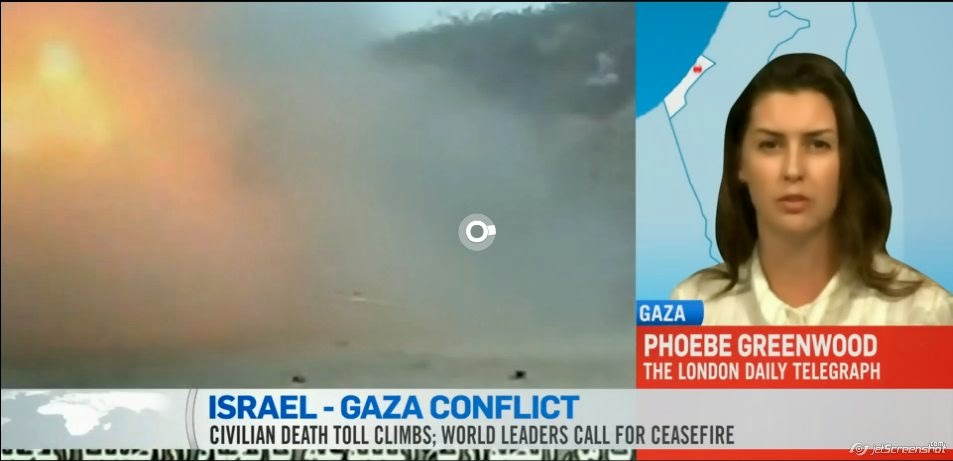
London Telegraph reporter clip

As in 2009, Hamas is using Shifa Hospital to hide its leadership, and as in 2012, it is using the hospital as part of its war effort (link in Hebrew) (Hat Tip: Shaul). This one is only three short paragraphs, so I will translate it and then ask a question.

A journalist source who is close to security sources in the Middle East says ‘Hamas’ leadership is taking advantage of the underground structures underneath the Shifa Central Hospital in Gaza as a hideout for commanders and Hamas leaders to protect them against attack by the Israel Air Force.

“In the ongoing battle between Hamas and the Israeli army,” the source further related, “Hamas leaders aren’t just using the underground facility at Shifa Hospital as a hideout, but also as a command center for Hamas’ leaders and commanders, and from here all orders are issued to Hamas activists in the field. Shifa Hospital, which is in the Rimal district in Gaza, is one of the main absorption centers for treating the sick and wounded in Gaza.”

Ironically, in 1980, Israel helped renovate Shifa Hospital in an effort to improve relations with the ‘Palestinians.’ Part of the Israeli renovation included a large underground basement, which includes offices and hospital rooms to absorb the wounded. Until 1940, the facility was a medical base for the British army, until 1950 when the Egyptians, who then ruled the Gaza Strip, turned it into a hospital. According to the source, “during an emergency you can enter the facility through hidden, underground tunnels, which are hundreds of meters away from the facility.”

Many years ago, I had a beehive in front of my house in New Jersey. To get rid of the bees, I waited until nightfall, sprayed the entrance to the beehive with alcohol, and then set it on fire. The bees were forced out in the dark and were unable to return.

Did we build these tunnels or did the ‘Palestinians’? Do we know where the entrances are? (If we built them, then obviously we do). If yes, why aren’t we closing off those entrances so that the only way out is if they come out the front door, where they can be picked off like low-hanging fruit? You know, flush them out like the bees….

Anyone know the answer?


Iran’s Path to the Bomb

July 9, 2014

Iran’s Path to the Bomb, Front Page Magazine, July 9, 2014

76114095_3c03127b-b8dc-47c0-af9c-66715d0adff4

According to most estimations, the focus of the talks has shifted from dismantling Iran’s nuclear infrastructure, as demanded by Jerusalem, to creating a verification network that would, ideally, grant inspectors unfettered access to Iranian sites to ensure the peaceful nature of its nuclear operations.

In “Inspections: The Weak Link in a Nuclear Agreement with Iran,” Dore Gold, a former Israeli Ambassador to the United Nations and currently an advisor to Prime Minister Benjamin Netanyahu, questions “the advisability of erecting a comprehensive agreement with Iran that is so highly dependent upon the efficacy of its inspection system and the willingness of Iran to agree to what some analysts call unprecedented levels of transparency.”


As nuclear negotiations resume between Iran and world powers, it is becoming increasingly clear that any deal signed will be considered negatively by Israel as “ill-conceived.”

According to most estimations, the focus of the talks has shifted from dismantling Iran’s nuclear infrastructure, as demanded by Jerusalem, to creating a verification network that would, ideally, grant inspectors unfettered access to Iranian sites to ensure the peaceful nature of its nuclear operations.

In “Inspections: The Weak Link in a Nuclear Agreement with Iran,” Dore Gold, a former Israeli Ambassador to the United Nations and currently an advisor to Prime Minister Benjamin Netanyahu, questions “the advisability of erecting a comprehensive agreement with Iran that is so highly dependent upon the efficacy of its inspection system and the willingness of Iran to agree to what some analysts call unprecedented levels of transparency.”

The drawbacks should be evident, especially when considering Iran’s ongoing refusal to grant the IAEA access to its Parchin facility, where the UN nuclear watchdog believes Tehran has conducted military research into the development of atomic weapons. That the underground Fordow nuclear plant remained unknown to the West for years casts further doubt on both the Islamic Republic’s trustworthiness and the ability of monitors to keep tabs on the whole of its nuclear activities.

The fact that U.S. Secretary of State John Kerry recently revealed that Iran’s breakout capacity stands at a mere two months should alone obviate any such deal, as this window is surely too close for comfort.

Nonetheless, it appears as though the prospects of reversing the Islamic Republic’s nuclear progress by significantly reducing the number of its centrifuges is off the table.

In the prescient words of Iranian Foreign Minister Mohammed Javad Zarif, the “talks are not about nuclear capability…they are about Iranian integrity and dignity.”

But the world’s largest state sponsor of terrorism is undeserving of respect.

Iran continues to fuel the debauchery in Syria, and now has boots on the ground in Iraq; with the aim there, in conjunction with local Shiite fighters, almost certainly to carve out an Iranian protectorate.

Moreover, the widely held belief that Iran opposes the Sunni terror group ISIS, which is active in both Iraq and Syria, is tenuous at best, with recent reports suggesting the organization may well have been spawn by Tehran.

As the Jerusalem Center for Public Affairs’ Pinhas Inbari recently pointed out, “the more time passes, the more this notion of a link between ISIS, Syrian and Iranian intelligence has become fixed in the minds of leading Arab analysts.”

To support this claim, Inbari highlights a February 2012 U.S. Treasury Department document which states that ISIS’ precursor, “al-Qaeda in Iraq,” was provided with money and weapons by Iran. He also raises the intriguing possibility that Iran facilitated ISIS’ advances in Iraq in order to force the U.S. to deepen its coordination with Tehran.

As journalist Melanie Phillips recently noted in the Jerusalem Post, “the Iranian leadership [has] suggested the price of its ‘help’ in ‘stabilizing’ Iraq would be a deal over its nuclear program.”

And this is the key point: The road to an Iranian bomb is paved with instability.

Iran’s carefully crafted plan is two-tiered; first, to foment widespread regional unrest, thereby removing the focus on is illicit nuclear work while, concurrently, convincing the West, which shuns chaos in favor of stability, that the only solution is to engage, rather than defeat, Iran.

And it has worked.

The West has misunderstood, or otherwise turned a blind eye to, Iran’s strategy, devised to buy time while Tehran becomes a nuclear power, which, in turn, will allow it to pursue its ultimate ambition of spreading its Islamic “revolution” throughout the world.

The ramifications of an expansionist, nuclear-armed Iran would be devastating.

Even without the bomb, in the near future Iran will effectively control territory spanning from eastern Iraq to southern Lebanon. The so-called Shi’ite crescent warned of years ago by Jordan’s King Abdullah is, for all intents and purposes, a fait accompli.

An Iran with atomic bombs can be expected to set its sights on Sunni Gulf states, including Kuwait and Bahrain, where its meddling during the Arab Spring prompted Saudi Arabia to deploy troops to the country.

In fact, Tehran appears to be on a collision course with Riyadh (which, parenthetically, is alleged to have pre-paid atomic weapons waiting for it in Pakistan).

Were tensions to explode between the Mullahs and the House of Saud, the entire region could be drawn into a bloody conflict; not unlike the Sunni-Shiite proxy war currently being waged in Syria, although the effects of a direct clash between the leading purveyors of these competing forms of Islam would, almost inconceivably, be much worse.

Like it or not, such a prospect would force the hand of the United States, which could not sit idly by as its allies, as well as the global oil economy, became endangered.

It is possible that an emboldened Russia would likewise become involved, at the very least as an arms supplier, and perhaps even ascendant China if to protect its growing interests in the region.

Israel, undoubtedly, would be targeted by its enemies and thus dragged into the fighting.

This is but a snapshot of the bleak picture facing the Middle East if Iran goes nuclear, and the Obama administration in particular is seemingly oblivious.

While the U.S. president reiterated last month—this time to his outgoing Israeli counterpart—that he remains committed to preventing Iran from obtaining a nuclear weapon, Obama’s words are no longer trusted by many in Jerusalem given his willingness (eagerness) to treat a rogue regime, ideologically committed to the West’s destruction, as a friend.

Hence the recent dispatch to Washington of Israeli National Security Adviser Yossi Cohen and Intelligence Minister Yuval Steinitz, in order to spell out the Jewish state’s positions perhaps for the last time.

Speaking to prior to his departure, Steinitz made clear that a good deal “will not allow the Iranians to remain a nuclear threshold state…. Our position is that an agreement needs to be based not only on supervision and verification, but on dismantling infrastructure,” he affirmed.

Netanyahu likewise weighed in last week, granting interviews to major television networks in each of the P5+1 countries.

“Inspectors can be deceived,” he warned, before advocating for an agreement along the lines of the Syrian one, which “remove[s] what’s not destroyed.”

But given Obama’s ongoing rapprochement with Iran, Israel’s expectations are surely being tempered. In fact, it would be surprising if the government was not already intensifying covert preparations for “plan-B.”

What this entails could be revealed as early as July 21st, the day after the deadline for a nuclear agreement is set to expire.

Only then will it become known whether Netanyahu is serious about preventing an Iranian bomb—and the lengths to which he is willing to go in order to do so.

Op-Ed: Why This Operation is Different

July 9, 2014

Op-Ed: Why This Operation is Different, Israel National News, Phyllis Chesler, July 9, 2014

Operation Protective Edge may look like its predecessors–Operation Cast Lead in 2008-9 and Operation Pillar of Defense in 2012–in that it is a response to Palestinian terrorism launched from Gaza against Israeli civilians. The previous two rounds of the conflict ended with Hamas still in power in the Gaza Strip, weakened but able to re-arm over time and to project a strategic threat. There are five reasons, however, this time may be different.

1. By Attacking Tel Aviv and Jerusalem, Hamas Has Invited Its Own Destruction. By launching its Iranian-and Syrian-made missiles against Israel’s two major cities–especially Tel Aviv, normally a safe distance from conflict–Hamas has broken the unwritten rules of the game. It has long been known that Hamas in the south and Hezbollah in the north had the ability to reach those cities. But those groups had not exercised it.

Now that Hamas has shown it is willing to attack Israel’s commercial, spiritual, and political centers, the terror group has left Israel no choice but to destroy it completely. There is no way Israel can accept life under an active threat of rockets, enjoying safety only at Hamas’s whim. Attacking border towns like Sderot–or even, as in 2006, a northern city like Haifa–is one thing. Attacking Tel Aviv is a provocation Israel cannot ignore.

In particular, Netanyahu must maintain Israel’s deterrent. While he needs to keep forces at the ready in case of an attack from Hezbollah, or a more direct escalation by Iran, he knows that if he fails to show that Israel is ready to defend itself, he will strengthen Tehran. With nuclear negotiators just days away from their deadline for a (bad) deal, Netanyahu needs to maintain pressure on Iran–and remind the U.S. it can act on its own.

2. Obama Is on the Wrong Side–and Irrelevant. On the first day of Operation Protective Edge, President Obama published an op-ed in the left-wing daily Ha’aretz calling for “restraint” and a Palestinian state. As if to make clear that the publication was not an accident of timing, a senior Obama adviser gave a harsh speech to a peace conference in Tel Aviv the same day at which he blasted Israel for continuing to occupy the West Bank.

These gestures–informed, as usual, by misleading Palestinian demographic statistics that falsely predict Arab majorities in the near future–send the message that the White House disapproves of Israel’soperation and its general strategic posture. Normally, that would be very bad news for Israel. But it may help, ironically, because Obama has already alienated Israel to such an extent that the Israeli government feels at liberty to ignore him.

In addition, Israel previously held back due to political considerations in the U.S., cutting Cast Lead short in time for Obama’s inauguration, and postponing Pillar of Defense until Obama’s re-election campaign was over. This time conflict has erupted at the height of the midterm elections, meaning that anything Obama tries to do to stop Israel will boost Republican criticism of his foreign policy, and place Democrats in a tough spot.

3. None of Hamas’s Usual Allies Are Going to Help. Egypt, which as of last year was controlled by a very Hamas-friendly Muslim Brotherhood, is now run by Abdel Fattah el-Sisi, who led a military coup that pushed the Muslim Brotherhood out of power, cutting off a critical source of military and diplomatic support. The fact that Hamas is the Palestinian branch of the Muslim Brotherhood means Sisi has no love for the organization.

Iran might normally be expected to help, especially by smuggling weapons and stirring up Hezbollah to create a potential second front for Israel in Lebanon. However, Iran is tied down in fighting to defend the Assad regime in Syria and the Maliki regime in Iraq. Syria has long since expelled Hamas from Damascus, and Jordan is too preoccupied with the threat of ISIS to care. Even ISIS is too busy to make Israel a priority. Hamas is on its own.

4. Iron Dome Has Neutralized Hamas’s Offensive Arsenal. Though Hamas targeted Tel Aviv and Jerusalem, those two cities have (thus far) emerged unscathed, thanks to the effectiveness of Israel’s Iron Dome system, which tracks and destroys small, short-range projectiles. (Here the Obama administration will try to take some credit for Israel’s security, although the project had U.S. support before Obama came to power.)

The other weapon Hamas still retains is kidnapping. It is still a potent threat, as last month’s abduction and murder to three Israeli teens shows. Yet to carry out that threat, Hamas must either rely on infiltrating from Gaza, which has become very difficult, or on activating terror cells in the West Bank, where the Israeli military operates relatively freely. There is a reason Hamas is resorting to its best weapons first: it is rather desperate.

5. There is Israeli Support for Invading Gaza. Or, rather, Netanyahu will pay a political price if he fails to do what is necessary to oust Hamas. That could include re-occupying Gaza for some time–not re-introducing the settlements that were abandoned in the 2005 disengagement, but enforcing stability and preventing Hamas from operating militarily or politically in the Strip, withdrawing only once its terror infrastructure is destroyed.

The Israel peace camp has become a joke. On Tuesday, attendees at a conference of peace activists physically assaulted one of Israel’s conservative leaders. Though a few die-hards–including Israel’s outgoingPresident Shimon Peres–will stress the importance of negotiations and a two-state solution, the more potent political threat is on Netanyahu’s right, ready to exploit impressions that he has not done enough to secure Israel.

Iran: ‘Substantial differences’ remain in Vienna

July 9, 2014

Iran: ‘Substantial differences’ remain in Vienna | The Times of Israel.

Diplomats familiar with the talks say uranium enrichment is the main bone of contention between the parties

July 9, 2014, 4:27 pm

A meeting at the P5+1 talks with Iran at UN headquarters in Vienna, on July 3, 2014 (photo credit: AFP/Joe Klamar)

A meeting at the P5+1 talks with Iran at UN headquarters in Vienna, on July 3, 2014 (photo credit: AFP/Joe Klamar)

VIENNA — An Iranian official on Wednesday said that while some progress is being made at nuclear talks with six world powers ahead of a July 20 target date for a deal, “substantial differences” remain.

Foreign Ministry spokesman Marzieh Afkham spoke as negotiators worked on a draft agreement meant to curb Iran’s nuclear program in exchange for an end to sanctions.

Diplomats familiar with the closed-door talks say the main problem remains uranium enrichment, which can make both reactor fuel and the core of a nuclear weapon.

Iran denies wanting nuclear arms but insists on having either 50,000 enriching centrifuges, or fewer but more advanced machines with the same total output. The US wants to a much smaller program.

Russia, China, Britain, France and Germany are also at the Vienna talks.

Copyright 2014 The Associated Press.


Lecturing us on security, as the rockets fly in

July 9, 2014

Lecturing us on security, as the rockets fly in | The Times of Israel.

The White House’s Middle East coordinator gave a risible speech Tuesday, asserting that the US knows how to keep Israel safe, at a conference that was halted by a Hamas attack

July 9, 2014, 3:28 pm
An Iron Dome Missile Battery near Tel Aviv, on the first day of Operation Protective Edge, July 8, 2014. (Photo by Flash90)

An Iron Dome Missile Battery near Tel Aviv, on the first day of Operation Protective Edge, July 8, 2014. (

Sometimes you don’t know whether to laugh or cry. On Tuesday, at a conference organized by the Haaretz daily in Tel Aviv, the White House’s Coordinator for the Middle East, Philip Gordon, delivered an address that dealt at some length with the US effort to both broker an Israeli-Palestinian peace deal and draw up the security arrangements that would leave Israel feeling safe enough to carry out significant territorial withdrawals.

Gordon made lots of valid points about Israel’s essential interests requiring an accommodation with the Palestinians. But parts of his oration read as though Gordon is a recent arrival from Planet Zog who has mistaken the Middle East for Finland.

You can read the entire address here, but the first passage I want to highlight is one of the questions Gordon puts to us Israelis — as a representative of “Israel’s closest friend” — when he wonders, “how will [Israel] have peace if it is unwilling to delineate a border, end the occupation and allow for Palestinian sovereignty, security, and dignity?” The answer, of course, is that we won’t. Unfortunately, as things stand, however, we won’t have peace, either, if we do “end the occupation and allow for Palestinian sovereignty, security, and dignity.”

You’d think this sad truth might have permeated the administration’s mindset by now, as it surveys the dismal, terror-riven Middle East, and contemplates the abject collapse of its policies in Iraq, Syria, Afghanistan and the rest of the area. But no, Gordon goes on to explain that America will always have our back, and sets out his conviction, undimmed by grisly Middle Eastern reality, that it can help provide us with the security we need against those who would wipe us out. “We know that many Israelis fear withdrawal from the West Bank due to the experience in Gaza, from which rockets continue to strike Israel, notwithstanding the full withdrawal of Israeli troops and settlements,” he offers magnanimously. “But it is precisely this outcome that we are determined to ensure is never repeated. That is why President Obama, supported by Secretary of State Kerry and Secretary of Defense Hagel, asked General John Allen to lead a Security Dialogue with the Israel Defense Forces regarding Israel’s security in a two-state context. General Allen, a recently retired four-star Marine Corps general, is one of the sharpest military minds in the United States. He has worked closely with Israeli counterparts for years. There is no American better suited for this job.”

And how is this supremely suited officer going to keep us safe in the spectacularly unstable Middle East? “For over a year now, General Allen has coordinated closely with his Israeli counterparts in the IDF to fully understand Israel’s security challenges from Israel’s perspective in a two-state context. He and his team have developed a broad series of approaches to security that address, but are certainly not limited to, the Jordan River Valley. We believe these approaches can make Israel more secure than it is today, and are consistent with the sovereignty of a future Palestinian state.”

Unfortunately, Gordon can’t give us all the specifics — “the details of this work remain classified.” But he is at liberty “to make clear that General Allen and his IDF counterparts are taking into account a range of contingencies, including the rising threats we see around the Middle East today…” And “the bottom line is that, based on this Security Dialogue, we are confident that, together with Israel, Jordan and the Palestinians, we can create a comprehensive approach to security, proven through operational testing, to meet the highest standards anywhere in the world.”

Why does Gordon’s championing of these security arrangements — presented as a veritable panacea that we foolish Israelis have pigheadedly spurned — sound so particularly risible? Because he was speaking soon after the very conference he was addressing in the David Intercontinental Hotel had been forced to shut down temporarily, its participants evacuated to a safer floor of the hotel.

And why was that? Because Tel Aviv was being targeted by rocket fire, and the sirens were wailing to warn of incoming warheads.

And where were the rockets being fired from? Oh, that would be the Gaza Strip, controlled by an organization called Hamas, on whose support the Palestinian unity government of Mahmoud Abbas rests. That’s the unity government, sworn in early last month, that the US administration immediately announced it would work with because, as Kerry explained, Abbas had “made clear that this new technocratic government is committed to the principles of nonviolence, negotiations, recognizing the state of Israel, acceptance of the previous agreements and the Quartet principles.”

Of course it is.

White House coordinator for the Middle East Philip Gordon speaks at the Israel Conference on Peace in Tel Aviv, July 8, 2014 (photo credit: screen shot haaretz.co.il)

Just to avoid any misunderstandings about where I’m coming from: Yes, Israel needs an accommodation with the Palestinians. Yes, we must retain a Jewish, democratic Israel. Yes, ruling the lives of another people is bad for them and lousy for us.

Fixing the conflict, however, will not be advanced by our “closest friend” repeatedly berating us for our perceived self-destructive idiocy. Gordon is the latest, minor culprit. It is the president who is principally to blame, including in interviews such as this one — which, incidentally, was not followed by a similar interview querying Abbas’s policies when the PA leader visited Washington soon after. Peace does not solely depend on our willingness to end the occupation and give the Palestinians sovereignty, security and dignity. It also requires a Palestinian leadership and a Palestinian public truly committed to Israel’s ongoing sovereignty, security and dignity.

Our closest friend doesn’t help us, or the Palestinians, or its regional interests, by pretending that a government whose ministers were subject to a Hamas veto is not compromised by that association. It doesn’t help by heaping disproportionate blame on Israel for failures in the peace process, heightening the Palestinian sense of grievance, reducing the likelihood of Palestinian compromise, and legitimizing the assaults on Israel’s very existence by those who are not our closest friends. And it doesn’t help by failing to acknowledge that it hasn’t got a clue as to how to protect its own interests from “a range of contingencies, including the rising threats we see around the Middle East today,” much less protect our interests.

Gordon delivered his speech after the Iron Dome missile defense system kept him safe from Hamas’s rockets, launched by an organization which his administration has implicitly legitimized as an acceptable backer of the Palestinian government. The US, to its great credit, has funded Iron Dome’s development. But the security innovations behind its life-savingly effective performance are Israeli.

There’s a lesson in there which Gordon and the rest of the Obama administration should have long since internalized. It’s that our closest friend should be just a little less arrogant in telling us what we need and don’t need to do in order to keep ourselves safe.