Archive for July 8, 2014

Netanyahu: The time has come to ‘take the gloves off’ against Hamas

July 8, 2014

Netanyahu: The time has come to ‘take the gloves off’ against Hamas | JPost | Israel News.

By YAAKOV LAPPIN, JPOST.COM STAFF

 07/08/2014 11:25

Ahead of security consultation on Operation Protective Edge, prime minister says “Hamas chose to escalate the situation and it will pay a heavy price for doing so”; Special situation declared in 40 km. radius around Gaza.

Prime Minister Binyamin Netanyahu said Tuesday that the time had come to “take off the gloves” against Hamas.

Netanyahu was speaking ahead of military consultations that he was holding with security officials at the Kirya Military Headquarters in Tel Aviv.

“Hamas chose to escalate the situation and it will pay a heavy price for doing so,” the prime minister said.

Following the launching of Operation Protective Edge to extinguish Hamas rocket fire, Israel declared a “special situation” in all areas of the South within 40 kilometers of the Gaza Strip on Tuesday morning.

A special situation is a legal decree that allows various authorities to safeguard public safety through a variety of means reserved for times of conflict.

The decision came after Defense Minister Moshe Ya’alon completed a security evaluation meeting with the Home Front Commander, Maj.-Gen. Eyal Eizenberg, as well as other civil defense chiefs, in which they examined the latest developments in the clash with Hamas.

“We are prepared for a campaign against Hamas, which will not end within days. Hamas is leading the current confrontation to a place in which it seeks to exact a heavy price from our home front. There is a need for patience,” Ya’alon said at the end of the meeting.

The defense minister called on the public to behave in accordance with Home Front Command safety instructions, adding that it is vital that the Israeli home front not sustain casualties.

“In recent hours, we have struck with force and hit dozens of Hamas assets. The IDF is continuing with the offensive effort, in a manner that will exact a very heavy price from Hamas. We will not tolerate missile and rocket fire on Israel, and we are prepared to expand the campaign through all of the means available to us, to continue striking Hamas,” he continued.

“I’d like to send my support to residents of the South and to local government leaders there, who are displaying leadership and responsibility, and are allowing us to continue with the offensive efforts,” Ya’alon added.

Hamas gets its first taste of Israel’s retaliation on Gaza – YouTube

July 8, 2014

Hamas gets its first taste of Israel’s retaliation on Gaza – YouTube.


Retaliation for the 100 + rockets fired at Israel’s civilians yesterday.

Iran nuke talks make little progress, diplomats say

July 8, 2014

Iran nuke talks make little progress, diplomats say | The Times of Israel.

As negotiations deadline approaches, supreme leader rejects West’s attempt to curb Tehran’s uranium enrichment

July 8, 2014, 5:33 am

The Iranian flag flies in front of a UN building where closed-door nuclear talks take place at the International Center in Vienna, Austria, Friday, July 4, 2014. (photo credit: AP/Ronald Zak)

The Iranian flag flies in front of a UN building where closed-door nuclear talks take place at the International Center in Vienna, Austria, Friday, July 4, 2014. (photo credit: AP/Ronald Zak)

VIENNA (AP) — Talks over Iran’s nuclear program are making little headway, with Tehran resisting US-led efforts to crimp activities that could be turned toward making weapons, diplomats said Monday.

As negotiations move closer to a July 20 target date for a deal, both sides are trying to plug holes in a sketchy draft agreement.

Five days into the latest round of talks between Iran and six global powers, two diplomats told The Associated Press that there is still a disagreement on the constraints Iran is ready to accept in exchange for a full end to the sanctions stifling its economy. The diplomats demanded anonymity because they are not authorized to discuss the confidential negotiations.

Tehran’s resistance was underscored late Monday when Iran’s supreme leader Ayatollah Ali Khamenei rejected pressure by the US and its allies at the Vienna talks to force Iran into making concessions. He said the Islamic republic would not give in to attempts by the West to greatly restrict its uranium enrichment program.

Khamenei told top officials that the country should plan as if sanctions will remain in place so that Iran will be immune to outside threats.

Khamenei said in a state television broadcast that the US goal at the nuclear talks is to convince Iran to limit its uranium enrichment capacity to 10,000 Separative Work Units (SWUs) while Tehran needs at least 190,000 SWUs.

The biggest hurdle remains uranium enrichment, a process that can make reactor fuel or the core of a nuclear weapon depending on the grade of material produced. Iran, which insists it does not want such arms, now has nearly 20,000 centrifuges either on standby or churning out reactor-grade fuel.

Tehran has long demanded that it be allowed to run up to 50,000 centrifuges to power its one existing nuclear reactor, and the two diplomats said Monday’s expert talks began with no formal change in that position.

The United States wants no more than a small fraction of that number. Its strongest backers at the negotiating table are Britain, France and Germany, with Russia and China leaning to agreeing on any deal acceptable to Tehran and Washington.

Khamenei said Iran is prepared to give guarantees that it won’t weaponize its nuclear program but said the US, which has a record of using nuclear weapons during World War II, has no right to be worried about it.

The diplomats said there’s still disagreement over how to minimize proliferation dangers from a nearly built reactor that would produce substantial amounts of plutonium — like enriched uranium, a potential pathway to nuclear arms.

In addition, Iran is resisting pressure to turn a uranium enrichment site dug into a mountain as protection against air attack to another use, they said. Differences also exist over the length of any agreement placing limits on Tehran’s nuclear activities.

Khamenei rejected demands from the West that Iran shut down the underground Fordo enrichment site.

“On the Fordo facility, they say it should be shut down because it is not accessible and cannot be damaged. This is laughable,” Kahmenei said. “We are sure our negotiating team won’t agree that the rights of the country and the nation’s dignity be encroached,” he said.

Khamenei said “military threats” and “sanctions” are two instruments used by the US to pressure Iran, but insisted that such tactics would not force Iran to give in.

“Sanctions must be thwarted through struggles in the field of resistance economy. And military threats are just words since it’s not affordable,” he said. “Economic planning should take this assumption that the enemy won’t reduce sanctions one iota. Don’t let the enemy affect your calculations.”

Khamenei, however, offered words of strong support for moderate President Hassan Rouhani, whose administration has been accused by hardliners of selling out Iran’s nuclear achievements.

“I endorse and support the government and will use everything in my power to back it … we trust our negotiating team,” he said.

Iran and the six-nation group signed an interim deal last November in Geneva that curtailed Iran’s enrichment program in return for an easing of some sanctions. Under the historic deal, Tehran stopped enrichment of uranium to 20 percent – which is just steps away from bomb-making grade – in exchange for the easing of some Western sanctions. It has diluted half of its 20 percent enriched uranium into 5 percent and is to turn the remaining half into oxide, which is very difficult to be used for bomb-making materials.

Copyright 2014 The Associated Press.


July 8 – Live Blog: Israel pounds dozens of Gaza targets in major counteroffensive

July 8, 2014

Israel pounds dozens of Gaza targets in major counteroffensive | The Times of Israel.


Hamas official hopes Israel invades ‘so we can kidnap soldiers’

Hamas spokesman Sami Abu Zuhri responded to the possibility of an expected Israeli ground incursion into the Gaza Strip on Tuesday, saying it would offer Hamas an opportunity to kidnap soldiers.

“As long as the occupation attacks, we’ll respond, and it will pay the price of its crimes. Our will won’t break,” he vowed.

“I hope the occupation makes this error and enters Gaza in a ground operation, so that we’ll have an opportunity to abduct soldiers.”

Abu Zuhri also said a meeting of Palestinian factions was expected on Tuesday, apparently in an effort to unify the various organizations.

Knesset defense committee chair: Retake Gaza

Voices are growing on the right to retake the Gaza Strip. Foreign Minister Avigdor Liberman has suggested it. On Tuesday afternoon, Likud MK Ze’ev Elkin, chair of the Knesset Foreign Affairs and Defense Committee, announced his own support for a full IDF takeover.

“Over the long term, there won’t be any escaping correcting the mistake we made,” Elkin told Channel 2 News. “The Islamist terror base [in Gaza], with its thousands of rockets pointed at us, didn’t happen by accident. It happened because of our mistakes, pulling out of Gaza and letting Hamas run in the [2006 Palestinian] elections.”

“It’s clear that every other act [short of a retaking of the Strip] will only serve as a deterrent until the next time they want to test us.”

IDF ‘not familiar’ with reported anti-aircraft attack by Hamas

The army says it is “not familiar” with reports from earlier Tuesday about an SA-7 surface-to-air missile allegedly fired at an air force helicopter. The report, though, raises the issue of what Hamas and other terror groups possess in their arsenals of imported and self-made weapons.

The SA-7, which was reportedly first used in combat by Egyptian troops during the War of Attrition with Israel in 1969, is “a well-known and obsolete weapon,” says Tal Inbar of the Fisher Institute for Air and Space Strategic Studies.

Israeli aircraft are all equipped with the appropriate defensive systems and flight regulations that keep them out of range of the low-altitude, Soviet-made missile, he says, adding that there have been roughly 10 cases of SA-7 missiles fired from Gaza.

For a more in-depth look into Hamas’s weapons capabilities, click here.

Red alert sounds in Beersheba area

Rocket sirens are sounding around the Beersheba and Ofakim areas, bringing the total number of rockets fired from the Strip to over 100, according to the IDF.

Video said to show strike on Gaza car

Warning: Graphic content

Up to 5 killed in strike on Gaza car

At least one person died in an IDF strike on a vehicle in the Gaza strip, Palestinian sources are reporting.

Conflicting figures are coming out of Gaza as to the death toll, with figures ranging from one to five dead.

Reports are saying one of the men killed was an officer in Hamas’s naval commando unit.

Livni: Ground incursion up to Hamas

Whether or not Israel will launch a ground operation in Gaza will depend on Hamas, Justice Minister Tzipi Livni says.

“It is our duty to provide security to our citizens. The question is what’s the right way to do that. It very much depends on the extent to which Hamas will not allow Israel’s citizens to live in peace,” she declares at Haaretz’s peace conference.

Livni refuses to say whether the security cabinet, of which she is a member, currently favors a ground operation, saying merely that it is not the government’s “first choice” but that it will be weighed if need be.

Livni is speaking on a session about the peace talks, at which Palestinian top peace negotiator Saeb Erekat was originally scheduled to speak as well. However, citing the Israeli-Palestinian tensions of the recent days, Erekat canceled his appearance.

– Raphael Ahren

IDF targets terrorist command center


Socialist MK urges leaders to ‘break cycle of violence’

MK Dov Khenin of the socialist Hadash Party is urging Israeli leaders to find a diplomatic solution to the incessant rocket fire from Gaza on southern Israel.

Hadash MK Dov Khenin. (photo credit: Miriam Alster/Flash90)

Quoting a letter he received from a resident of the south, Khenin writes on his Facebook page, “More strikes on Gaza will not solve the problem. With every attack the chances of us getting a life worth living decrease. I challenge you [leaders] to do the courageous thing and find a diplomatic way to stop all this destruction and killing. Do every thing you can to bring true quiet to our region.”

In his post Khenin asserts that “it is important to listen to such things and instead of reacting — to think.”

“The cycle of violence is not a foregone conclusion,” he adds. “Let’s really do everything in our power to break it.”

French envoy to visit Ashdod

France’s ambassador to Israel, Patrick Maisonnave, is visiting the francophone community in Ashdod to express France’s “support and solidarity in these difficult moments.”

The diplomat will arrive in the city at 5 p.m.

– Raphael Ahren

Gaza factions demanding Israel lift siege

“The Palestinian factions will not agree to a truce and will not stop [attacking] until Israel surrenders to their terms — stop the aggression and lift the siege on the strip,” Ynet’s Palestinian affairs correspondent quotes Hamas official Ismail Al-Ashqar, a member of the freedoms committee established under the reconciliation agreement of Fatah and Hamas.

Palestinians report one dead in central Gaza

An Israeli air strike on the central Gaza Strip killed a Palestinian man on Tuesday in the first reported casualty of Operation Protective Edge, an emergency services spokesman reports.

“A man named Ashraf Yassin was killed in an Israeli air strike west of Nusseirat refugee camp in central Gaza,” spokesman Ashraf al-Qudra tells AFP.

Witnesses say the man was a militant of the Izz ad-Din al-Qassam Brigades, the armed wing of the Islamist Hamas movement.

Ynet reports that working on Shin Bet intelligence, the IDF struck the home of Hamas operative Mohammed Abdel Rahman Goda. The house was part of the organization’s infrastructure. Palestinian sources say no one was injured in the strike.

Officials say Israel weighing land invasion

Officials in Jerusalem tell The Times of Israel that Hamas chose to escalate the exchange of fire with Israel and that Prime Minister Benjamin Netanyahu has therefore instructed the army to launch a “continuous, methodological, and forceful campaign” against the terrorist group in the Gaza Strip.

“The directive to the Israel Defense Forces is to be ready to go until the end,” the sources say, adding that even a ground operation is on the table.

It is likely that the IDF will call up additional reservists to prepare for a possible invasion of the strip, the sources say.

The purpose of Operation Protective Edge is to “is exact a heavy price from Hamas, to hit it hard, and to create a significant attack that that will lead to deterrence,” the sources say.

In addition to the op’s military aspect, the prime minister is also active in the diplomatic arena, planning to call to several international leaders to explain to them why Israel was forced to act, they add.

– Raphael Ahren

Three rockets land in Eshkol region

Three rockets fall in open fields in the Eshkol region east of the Gaza Strip, causing no injuries.

Paramedics say that two people were lightly injured from rockets that struck Ashdod and the surrounding area. One was treated for injuries to his legs from shrapnel, while another sustained a bruise after falling while running for cover. Seven more people were treated for shock.

Three Palestinians were injured in an earlier IDF strike on Beit Lahiya in the north of the strip, a Palestinian source tells Ynet.

Israel halts train service in the south

Israels Railways is halting service between Sderot and Ashkelon in both directions after receiving a directive from the Home Front Command.

Shuttles will be available between the two stations,

Trains will be running only north from Ashkelon until further notice.

Ex-PM Barak throws support behind offensive

“We have to respond forcefully, with determination and reason,” former prime minister Ehud Barak says. “Israel cannot afford to have millions of civilians under rocket threat.”

Speaking at the Israeli Conference on Peace, Barak — who served as defense minister during the 2012 Operation Pillar of Defense — refuses to make concrete policy recommendations on how to deal with the current rain of rockets, but said that Israel’s military leadership consists of professionals who understand these issues better than the government.

– Raphael Ahren

Netanyahu says ground operation possible

Prime Minister Benjamin Netanyahu has instructed the IDF to be ready to “go all the way,” Israel Radio reports.

Even a ground operation is possible, the prime minister says after a security meeting in Tel Aviv, adding that Hamas chose escalation and will pay the price for it. “This will be a long and strong operation that will create deterrence.”

Meanwhile, in the Strip, Hamas says it has fired a Sam-7 anti-aircraft missile at Israeli Air Force jets over Khan Yunis, but missed the target. The IDF is looking into the claim.

The IAF is carrying out regular strikes against targets in Gaza. There are reports of injuries from one strike on Shojaya in east Gaza.

– Raphael Ahren

Police arrest two teens for ‘price tag’ attack

Police say they have arrested two Jewish teenagers from Haifa in connection with price tag vandalism last month.

Hanin Zoabi (photo credit: Flash90)

The youths allegedly spray-painted anti-Arab slogans and other graffiti on the walls of an Arab school disparaging Balad MK Hanin Zoabi, who made incendiary comments about the kidnapping of three Israeli teens last month.

Police are naming the 18-year-old suspect, Yaakov Yair Vaknin, but are withholding the name of the 15-year-old suspect because of his age.

The prosecution is seeking to keep them in custody.

IDF to call up thousands of reservists

Haaretz reports that the IDF plans to call up several thousand additional reservists to join the 1,500 the military called up Monday, ahead of a possible ground invasion.

Israel warned Gaza militants before offensive

Arabic daily Al-Hayat reports that Israel warned Hamas and Islamic Jihad through Egypt on Monday that if the rocket fire persists, the IDF will respond strongly.

“Israel will strike Gaza with a heavy hand if the two movements don’t accept a truce,” a senior Egyptian official told representatives of the two organizations, according to a Palestinian official.

Islamic Jihad has taken credit for at least 60 of the rockets fired on Israel in the last two days.

IDF to call up thousands of reservists

Haaretz reports that the IDF plans to call up several thousand additional reservists to join the 1,500 the military called up Monday, ahead of a possible ground invasion.

EU expresses ‘unreserved solidarity’ with Israelis

The European Union’s ambassador to Israel, Lars Faaborg-Andersen, says the EU would like to “express its unreserved solidarity with citizens of Israel.”

Speaking at a conference on peace talks organized by Haaretz, the ambassador says that “indiscriminate shooting of rockets against civilians can never be a legitimate response, no matter what your grievances.”

– Raphael Ahren

Operation Protective Edge gets meme treatment

Benji Lovitt, Times of Israel blogger and comedian, ribs the IDF’s choice of English name for its Gaza operation.

The op’s original Hebrew name is Tzuk Eitan, which can literally be translated as “firm cliff,” but the army went with a non-literal translation, opting for “Protective Edge” for its English name.

Ex-top adviser: Israel could invade Gaza if ‘no other choice’

Maj. Gen. (ret) Yaakov Amidror, a former national security adviser to Prime Minister Benjamin Netanyahu, says in a conference call with journalists that there is only one aim to current operation: to stop the rocket fire on Israeli cities and citizens.

He says that Israel could conquer Gaza “and clean it from all the facilities and terrorists of Hamas,” but that such an operation would take months and does not now seem to be among the immediate goals of the current government.

If the security situation continues to deteriorate, though, he says, “if we do not find a solution through this exchange of fire, and Hamas will not understand what we can do, we will not have any other choice but the big operation, which we don’t want.”

Saying that for Hamas every civilian street and building is a target, Amidror asserts that the organization, which has several thousand rockets with a range of up to 40 kilometers and hundreds with an 80-kilometter range, could technically continue launching “forever.”

Minister says government is giving IDF whatever it needs

The IDF has the authority to do whatever is necessary to restore quiet to the south, Public Security Minister Yitzhak Aharonovitch says.

“The IDF has a free hand to act in whatever steps it determines,” he says, according to Ynet. “The political leadership has effectively authorized everything the IDF has requested.”

Netanyahu says ‘gloves are off’

Netanyahu says “the gloves are off” in a meeting with the heads of Israel’s security establishment in Tel Aviv.

“Hamas chose this escalation and will pay a heavy price,” he adds.

Meanwhile at the Israel Conference for Peace, President Shimon Peres says that while Hamas is Israel’s enemy, there has never been a greater partner for peace on the Palestinian side that Palestinian Authority President Mahmoud Abbas, pointing to Abbas’ condemnation of the kidnapping of three Israeli as proof that he is willing to risk his life for peace.

6 rockets fired in past hour; 5 downed

The IDF Spokesperson’t Unit says 6 rockets have been fired at Israel over the past hour, five of which were intercepted over the coastal cities of Ashkelon and Ashdod.

– Mitch Ginsburg

Minister says government is giving IDF whatever it needs

The IDF has a has the authority to do whatever is necessary to restore quiet to the south, Public Security Minister Yitzhak Aharonovitch says.

“The IDF has a free hand to act in whatever steps it determines,” he says, according to Ynet. “The political leadership has effectively authorized everything the IDF has requested.”

IAF strikes more targets in Gaza

Israel Radio reports that the Israeli Air Force struck targets in Gaza City and Beit Hanoun in the north of the Strip.

Islamic Jihad takes credit for rockets

For the first time in the latest round of violence, Islamic Jihad is claiming responsibility for some of the rocket attacks on Ashdod and Ashkelon on Tuesday morning.

The organization says it has fired some 60 rockets in recent days.

The armed wing of Islamic Jihad, the Al-Quds Brigades, has initiated an operation called “Stable Building,” Gaza’s Safa news agency reports.

Ynet reports that one of the rocket fired earlier hit near a house in the Hof Ashkelon region, causing a brush fire to break out.

Two other rockets landed in open areas between Ashkelon and Ashdod.

Defense minister says Gaza op will take time

Defense Minister Moshe Ya’alon, in consultation with the IDF Home Front Command chief, Maj. Gen. Eyal Eisenberg, and the director general of the Defense Ministry, Dan Harel, declares a special security situation on the home front, granting the chief of staff the authority to issue life-saving orders to civilians living within 40 kilometers of the Gaza Strip.

The declaration also ensures that employees living within the declared zone will not be fired from their jobs or penalized for missing work.

Defense Minister Moshe Ya'alon (photo credit:Flash90)

“We are preparing for a campaign against Hamas, which will not end within several days,” Ya’alon says at a security assessment Tuesday. “Hamas is guiding the current clash to a place where it is able to exact a price from our home front. There is a need for perseverance. Proper civilian conduct has a decisive role in our ability to avoid civilian casualties, and [do] listen to Home Front Command orders regarding proximity to and entry into safe rooms.”

Ya’alon says the army has struck dozens of Hamas assets over the past hours and that the IDF is continuing its offensive “in a manner that will exact a very heavy price from Hamas.”

He reiterates that Israel will not tolerate rocket fire on its civilians and cities and says that Israel is prepared to broaden the campaign, “using all of the means at our disposal to strike Hamas.”

– Mitch Ginsburg

Hamas official: Don’t expect a ‘white flag’

Hamas spokesman Husam Badran says that Hamas is not looking for a war, but will not simply “raise the white flag” in the face of the major Israeli offensive launched Tuesday morning.

In an interview with the BBC, he also accuses Israel of violating the truce several times in the past two weeks and says Hamas has no choice but to “teach Israel a lesson.

Iron Dome intercepts rocket from Gaza

Israel’s Iron Dome defensive system intercepted a rocket over the city of Ashdod.

Meanwhile there are reports of more sirens in Ashdod, Gan Yavne and Beersheba.

Sirens wail in two major Israeli cities

Sirens go off in Ashkelon and Ashdod as Gaza militants target major Israeli cities for the first time today.

IDF strikes two targets in Gaza

The Israeli Air Force carries out two strikes, one in Beith Lahiya in the north of the Gaza Strip and another in Deir el-Balah in the center of the territory.

Palestinians sources are reporting that several people were injured.

Abbas calls on Israel to stop ‘dangerous escalation’

Palestinian Authority President Mahmoud Abbas releases a statement calling on Israel to end what he calls “a dangerous escalation” after Israel launched a major operation in the Gaza strip Tuesday morning.

Meanwhile, another rocket falls in an open field, this time in the Sdot Negev region just east of Gaza.

Sirens sound east of Gaza

Sirens wail in the Sdot Negev region near the Gaza border.

The mayor of Ashkelon says that the IDF must strike a blow to Hamas as it did to Hezbollah in the north during the second Lebanon war, according to Ynet.

IDF plans to intensify operation in Gaza

IDF spokesman Brig.-Gen. Moti Almoz says that the IDF is planning to intensify its operation in Gaza in the coming days as long as rocket fire continues.

“We are very determined and have an aggressive plan in Gaza,” Almoz tells Ynet. “We are conducting this [operation] in steps that will escalate in the coming days. Residents of the south need to heed Home Front Command guidelines.”

Gaza rocket lands in field north of Gaza border

A rocket from Gaza falls in an open field in the Hof Ashkelon region.

The attack comes hours after multiple missiles strike the Eshkol region.

No injuries or damages are reported.

Arabs said targeted by stone-throwers

There were several incidents of attacks on Arabs overnight, Israel Radio reports.

Close the community of Katzir, near Haifa, rocks were thrown at Arab cars as they passed by. The vehicle of a resident from the Arab town of Ar’ara was damaged.

In Baqa al-Gharbiya, a predominately Arab town near Haifa, a Molotov cocktail was thrown at the community police building, causing damage to an outside wall.

In Hadera, vandals smashed the windscreen of a car and sprayed “death to Arabs” on the side of the vehicle.

Vandals also threw rocks at cars outside Fureidis, which is also near Haifa, causing damage to a vehicle.

Recent days have seen rioting in the north by Arabs, enraged over the killing of Muhammad Abu Khdeir.

Lapid says Israel is strong, Hamas weak and crumbling

Finance Minister Yair Lapid says in an interview with Israel Radio that Israel has a distinct advantage in this round of fighting as Hamas is currently “weak and crumbling.” While he won’t comment on any specific measures the IDF plans to take, he warns that no Hamas member is safe.

Meanwhile, opposition leader Isaac Herzog (Labor Party) acknowledges that the launch of dozens of rockets last night represented a serious escalation, and Israel has no choice but to “strike a blow to the head of Hamas.”

Herzog says he is confident that Israel is better prepared to handle this round of fighting than in the past, but also cautions that in order to restore quiet, the government must avoid making false promises such as re-conquering Gaza or toppling the Hamas government.

Interior Minister Gideon Sa’ar says a major operation was necessary because Israel’s deterrence has eroded. Addressing ongoing clashes between Arab Israeli protesters and Israeli security forces, Sa’ar commends Arab community, saying they are acting responsibly to cool tensions and that only a minority are participating in riots.

17 reported injured in Israeli airstrikes

According to Palestinian medics, Israeli strikes in the Gaza Strip overnight leave 17 people injured, including seven children and two women. Two of the injured are in serious condition, Palestinian medics say.

On the Israeli side of the border, schools and summer camps in an area of 40 kilometers (30 miles) around Gaza are closed and residents are being asked to avoid any rallies.

– AFP

Obama calls for restraint

US President Barack Obama calls for Israelis and Palestinians alike to restrain themselves and put an end to acts of retribution, in some of his first public comments on the matter since the murder of three Israeli teenagers touched off a new round of violence and deepening mistrust.

In an op-ed in the Israeli newspaper Haaretz, Obama calls it a “dangerous moment” for the region where a vaunted US peace effort recently collapsed. Writing in emotional terms, he says he couldn’t imagine the pain suffered by the parents of the three Israeli teens, but was also heartbroken by the senseless murder of a Palestinian teenager who many suspect was killed as payback.

“All parties must protect the innocent and act with reasonableness and restraint, not vengeance and retribution,” Obama says.

– AP

IDF hits 50 targets overnight

The IDF announces that it hit 50 targets in the Gaza strip overnight Monday after launching a major operation aimed at “restoring stability to the South.”

Among the targets hit were concealed “rocket launchers, launching infrastructures, a weapon storage facility, training bases and terror tunnels shafts” The IDF names the Hamas operatives running the targets as Ei’ad Sakik, Abdullah Hshash, Samer Abu Daka and Hassan Abdullah, all of whom have been involved in terrorist activities in the past.

“We are determined to lay a significant blow on Hamas’ terror capabilities and infrastructure, eliminate any threat on Israeli sovereignty emanating from the Gaza Strip and restore stability to the southern region,” IDF spokesman Lt. Col. Peter Lerner says. “Terrorists perpetrating the aggression against Israel have a personal price to pay and will bear the consequences of their actions.”

The IDF launched Operation Protective Edge against Hamas in the Gaza Strip early Tuesday morning after militants launched over 100 missiles and mortars at Israeli territory in 24 hours. The army has called up 1,500 reserve soldiers in anticipation of continuing escalation.

Meanwhile, Hamas is giving no indication that the rocket fire on Israel will subside, warning that it will respond to further Israeli air raids by firing on targets deeper into Israel, including Tel Aviv.

Hamas spokesperson Fawzi Barhoum says: “This is not the time for quiet. We have a bank of various targets. An Iron Dome [missile battery] will be needed in every Israeli home.”

A rocket landed in an open area of the Eshkol region bordering Gaza just after sun-up, causing no injuries or damage.

Read more: Israel pounds dozens of Gaza targets in major counteroffensive | The Times of Israel http://www.timesofisrael.com/israel-pounds-dozens-of-gaza-targets-in-major-counteroffensive/#ixzz36qqUOswa
Follow us: @timesofisrael on Twitter | timesofisrael on Facebook

How war with Hamas might play out

July 8, 2014

How war with Hamas might play out | The Times of Israel.

Hit by 100 rockets in 24 hours, Israel is being goaded into a major Gaza offensive. Some ministers want the Strip reconquered; other voices urge more ‘modest and attainable’ objectives

July 8, 2014, 1:36 am
An illustrative photo of an Israeli tank overlooking the Gaza Strip (photo credit: Courtesy Yad L'shiryon)

An illustrative photo of an Israeli tank overlooking the Gaza Strip (photo credit: Courtesy Yad L’shiryon)

On November 10, 2012, Gaza terrorists fired a guided missile at an army jeep. All of the soldiers within were injured, two gravely. Over the ensuing days, Hamas rained rockets and missiles down on Israel, which responded with cautious air strikes. On November 14, both Defense Minister Ehud Barak and Prime Minister Benjamin Netanyahu ostentatiously toured the northern front in the Golan Heights. The move cloaked the strike that followed: the targeted killing of Hamas military leader Ahmed Jaabri and the elimination, by the air force, of the majority of Hamas’s long range Fajr-5 rockets.

Those moves, enabled by meticulous and penetrating intelligence, rocked the Islamist organization back on its heels as the army began an eight-day operation, which, despite the 1,500 projectiles fired at Israel, many saw as a success.

The army will be hard-pressed to duplicate that sort of opening move this week in what now seems, after the launch of over 100 rockets and mortars at Israel in the past 24 hours, as a possible coming offensive in Gaza.

Partially this is because Hamas has goaded Israel into action – whether because of unpaid salaries; or hopes of fanning the flames of the unrest in Israel and the West Bank; or a need to stave off its rivals Palestinian Islamic Jihad and the assorted Salafi organizations; or in-house disagreements between its political and military wings, or as an expression of its alienation from Egypt and Iran (and those are just a few of the current theories).

There could still be surprises. Egyptian mediation could produce an agreement. It stands to reason, too, that Israel has learnt the lessons of the 2006 Second Lebanon War. It will likely, as in November 2012, first call up the reserves en masse before launching a major operation, giving the troops time to train and signaling to the other side that a major blow may soon fall.

But if Hamas is not to be deterred, then Israel, terribly, as a sovereign state, will be left with no choice but to respond to Hamas’s attacks and defend its citizens through military action. Blood will be shed. Innocents on both sides will pay a price.

The question, then, is not so much if Israel will respond to the barrage of rockets, but what shape that response will take; what sort of ambitions the government will have if it is forced into an operation in Gaza.

Foreign Minister Avigdor Liberman has called for the sort of operation that would enable reassertion of Israeli control over the Gaza Strip. Economics Minister Naftali Bennett on Monday refused to state his position over the air waves but likely advocates for a similar move. This, Brig. Gen. (res) Udi Dekel and Dr. Kobi Michael of the INSS wrote recently, would require a massive reserves call-up, unlike the one issued thus far for 1,500 soldiers total; a lengthy operation in the Gaza Strip, including ground troops; and a prolonged toll on the Israeli civilian population, which would be under fire for weeks if not months. The researchers put the economic toll of such an action at 15 billion shekels ($4.4 billion).

It would also leave Israel in charge of 1.5 million Palestinians.

Therefore, Dekel and Michael argued, “it is best to have a modest and attainable strategic objective.”

Maj. Gen. (ret) Amos Yadlin, the head of the INSS and former commander of Israel’s military intelligence directorate, called the notion of a re-occupation “a strategic mistake.”

Writing on his Facebook page on Sunday he advocated instead for an offensive that targets the military wing of Hamas, the organization’s leaders, its firepower, and its weapons-production capabilities.

Such an operation, Yadlin wrote, which would combine aerial fire power and limited ground actions in order to secure strategic locations, “might include damage to the fabric of life in Israel, the Israeli economy, and even fatalities. But it is necessary.”

Efraim Halevy (Photo credit: Yossi Zamir/Flash 90)

Ideally, if forced into a limited war, the army will begin with a coordinated strike, probably against Hamas’s long-range rockets, which are less mobile than its leaders, who have probably gone underground. From there it will attempt to score maximum gains in minimum time.

But as former Mossad head Efraim Halevy said during a recent phone interview, one knows where a war starts, but never where it ends. “The fortunes of war,” he said in his native English, “are not pre-destined.”

IDF strikes 50 targets across Gaza as operation gets underway

July 8, 2014

IDF strikes 50 targets across Gaza as operation gets underway | JPost | Israel News.

By YAAKOV LAPPIN

 07/08/2014 06:55

“We are entering into a long operation. This is only the start,” senior security source says of IDF’s Operation Protective Edge. “We are preparing to increase ground forces on Gaza border.”

IDF Gaza

Plumes of smoke are seen following an Israeli military strike in southern Gaza. Photo: REUTERS

 The IDF struck 50 targets throughout the Gaza Strip overnight between Monday and Tuesday, marking the start of Operation Protective Edge, launched to extinguish Hamas rocket fire on Israel. Forty seven targets were hit by Israel Air Force aircraft, and an additional three were hit by Israel Navy ships off the coast of Gaza.

“We are entering into a long operation,” a senior IDF source said. “We are only at the start. Patience is required. We are preparing further steps and a gradual expansion of our order of battle,” the source said, referring to a growing presence of Ground Forces deployed to the Gaza Border. The operation is being led by the IDF’s Southern Command.

During the overnight strikes, the IDF hit 18 underground rocket launchers, dozens of homes belonging to Hamas facilities, three Hamas command and control facilities, and then targets described by the source as “infrastructure.” Most of the air strikes targeted Hamas, though some targeted other terror groups that have been involved in recent projectile fire on Israel.

The IDF is currently gathering intelligence ahead of its next wave of strikes, according to the source. In recent hours, Hamas fired rockets at Kiryat Malachi, and at Kibbutz Ein Hashlosha in the Eshkol region.

“We are preparing to add to our two special infantry formations that are on the Gaza border, and which are now busy with efforts against [cross-border] attack tunnels,” the source said. “We have fully deployed Iron Dome batteries. And we are moving towards a significant phase of the operation, in terms of attacks on targets,” he added.

IDF Chief of Staff Lt.-Gen. Benny Gantz has begun a series of security evaluations on Tuesday. On Monday evening, he gave final approval for an operation based on a phased increase of attacks on Hamas.

Hamas initiated this round of fighting to try and alleviate the distress it has found itself in recent months, the source said. In the West Bank, its position has been damaged by the army’s response to the kidnap and murder of three Israeli youths in June, which resulted in the arrest of hundreds of Hamas members, raids on weapons caches, and against its civilian and economic networks.

In Gaza too, it is feeling increased pressure, the source stated. As a result, Hamas is currently “seeking an accomplishment,” the source said. “Hamas had high expectations two months ago. It had just joined a Palestinian unity government [with Fatah]. Now, it finds itself in a poor situation. It’s gotten poor results from the kidnapping, its position in terms of Palestinian security prisoners has worsened [due to the arrest of hundreds of Hamas members last month], and its sovereignty in Gaza has sustained blows,” he continued.

“Hamas is under pressure, and this has caused it to begin shooting. It’s status among the public [in Gaza] is also problematic. In the middle of Ramadan, it has no good news to offer Palestinians recently,” the source said. Hamas has been directly and indirectly orchestrating the growing rocket salvos from Gaza, which reached a peak on Monday night, when many dozens of rockets were launched within an hour.

“Hamas will always want to be the one that fires the last rocket, and to be able to claim that Israel is deterred. On the other side, Israel will gradually increase the scope of the operation, to obtain deterrence and damage Hamas,” the source warned.

IDF Launches ‘Operation Protective Edge’

July 8, 2014

IDF Launches ‘Operation Protective Edge’ in Gaza In response to the escalation in rocket attacks,

IDF launches operation in Gaza, conducts airstrikes over terror targets.

via IDF Launches ‘Operation Protective Edge’ – Defense/Security – News – Arutz Sheva.

Light flare over Gaza after airstrike Flash 90

The IDF has launched “Operation Protective Edge” in Gaza, in order “to stop the terror Israel’s citizens face on a daily basis,” the IDF Spokesperson’s Unit said on Twitter Monday night.

As part of the operation, Israeli media reported, the Israeli Air Force (IAF) launched intensive airstrikes on targets in Gaza.

“Hamas will not be safe as long as it continues to threaten the lives of Israeli civilians,” tweeted the IDF.

The decision on the operation was made by the Cabinet after the rocket fire escalated dramatically on Monday. As of 10:30 p.m., the number of rockets that were fired towards Israel stood at over 80, including over 30 rockets that were fired in a ten-minute period between 8:00 p.m. and 8:10 p.m.

At least 1,500 reserve soldiers had been called up for preparatory training for a possible operation, security officials stated earlier Monday. Hours earlier, photos surfaced showing tanks and IDF forces gathering close to the Gaza border.

Sources said earlier Monday that regardless of Israel’s actions, it was possible that Hamas would expand the range of attacks against Israel and could possibly target Tel Aviv and other cities in central Israel.

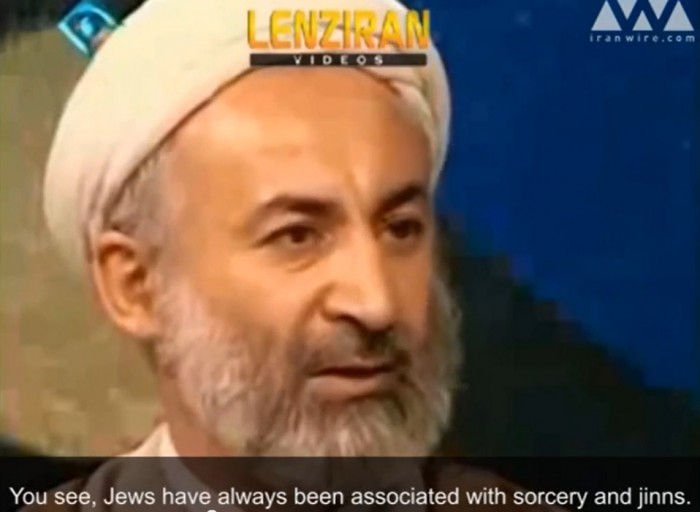
Tehran University Cleric Claims Jews are ‘Sorcerers’ who Use Supernatural Powers

July 8, 2014

Tehran University Cleric Claims Jews are ‘Sorcerers’ who Use Supernatural Powers, International Business Times, July 7, 2014

(Quick! Pass the word to Hamas and other Palestinian Islamists so they will stop rioting, sending missiles into Israel and doing other nasty stuff. — DM)

naghipourfarNaghipourfar believes Jews use sorcery to undermine Iran.  Islamic Republic of Iran Broadcasting

Islamic Republic of Iran Broadcasting (IRIB), the Republic’s version of the BBC, has broadcast an interview with prominent cleric and professor Valiollah Naghipourfar. Naghipoufar, a cleric and professor at Tehran University, launches an extraordinary attack on Jews, alleging they use sorcery to undermine the Iranian state.


The West and Iran may be attempting to put aside their mutual mistrust to deal with Isis – now known as Islamic State – in neighbouring Iraq, but judging by one of Iran’s most popular channels there’s still a long way to go.

Islamic Republic of Iran Broadcasting (IRIB), the Republic’s version of the BBC, has broadcast an interview with prominent cleric and professor Valiollah Naghipourfar. Naghipoufar, a cleric and professor at Tehran University, launches an extraordinary attack on Jews, alleging they use sorcery to undermine the Iranian state.

The Jew is very practiced in sorcery. Indeed most sorcerers are Jews
– Valiollah Naghipourfar

On being asked by his interviewer “Can jinns be put to use in intelligence gathering?” Naghipourfar replies: “The Jew is very practiced in sorcery. Indeed most sorcerers are Jews.” In Islamic mythology jinns are tiny supernatural beings who can be either good or bad – and often choose to be naughty.

Iranian state TV has form when it comes to broadcasting anti-Semitic propaganda, down-playing or denying the Holocaust and claiming Israel uses the killing of six million Jews to manipulate world sympathy. Former President Mahmoud Ahmadinejad was reported as saying “Israel should be wiped off the map” – though later he said he was misinterpreted, claims supported by some interpreters of Persian. The IRIB’s 24-hour news service, Press TV, also attracts its share of controversy, with presenters including George Galloway MP, who has refused to enter into debate with Israelis and does not recognise the country.

george-gallowayGeorge Galloway told an audience at Oxford University: “I don’t debate with Israelis” Reuters

However within Iran there seems to be a widening gap between the arch-conservatives who control the country and an increasingly educated, affluent young people who are able to access the internet and international satellite TV. A poll by the Anti-Defamation League in May found Iranians as a whole as being the least anti-Semitic people in the region – with the obvious exception of Israel itself.

Whether many of Iran’s young people will find time to watch a TV interview with someone claiming to be an academic who believes in pixies and the supernatural is debatable; but the fact such views are apparently common among Iran’s hierarchy shows just how hard it will be for Iran and the West to find common ground – even when they have what seems to be a common foe in Isis.

As Israel prepares wider campaign on Gaza, US signals limited support

July 8, 2014

As Israel prepares wider campaign on Gaza, US signals limited support

By MICHAEL WILNER07/07/2014 23:08

Amid onslaught of rocket fire from Gaza, State Department condemns “deliberate targeting of civilians by terrorist organizations” while urging restraint from government in Jerusalem.

via As Israel prepares wider campaign on Gaza, US signals limited support | JPost | Israel News.


Rocket from Gaza lands in Lachish region. Photo: POLICE SPOKESPERSON’S UNIT
 

WASHINGTON – The United States issued a message of support for Israel on Monday amid an onslaught of rockets on its south, condemning “the deliberate targeting of civilians by terrorist organizations” in the Gaza Strip.

“We support Israel’s right to defend itself against these attacks,” State Department spokeswoman Jen Psaki told reporters, while calling for restraint from the government in Jerusalem.

The focus of the call “was on reiterating our concern about escalating tensions,” Psaki said, adding that “more needs to be done” on both sides to calm the crisis.

But the message, consistent with previous US responses after rocket barrages from either Lebanon or Gaza, was coupled with a strong urge of restraint against escalating the conflict. The Obama administration fears a wider Israeli military campaign against Hamas in Gaza might destabilize political control in the Palestinian Authority, with riots in the West Bank reminding many of past intifadas.

US Secretary of State John Kerry spoke with Prime Minister Binyamin Netanyahu this weekend, reiterating Washington’s concern over an escalation in the conflict – exacerbated by the murders of Israeli and Palestinian teenagers in the West Bank and East Jerusalem.

Since that weekend call, more than 90 projectiles have been fired from the coastal Palestinian territory into Israeli towns. One Israeli has been reported injured.

“We look to both the government of Israel and the Palestinian Authority to take all necessary steps to prevent acts of violence, bring perpetrators to justice, and protect the innocent,” State Department spokesman Edgar Vasquez added. “We are concerned about the safety and security of civilians on both sides – in Israel and in Gaza – and urge the protection of civilians.”