Archive for July 4, 2014

Al Qaeda-Iraq forces advance on Baghdad military air base. US ponders air strike ahead of Iran and Russia

July 4, 2014

Al Qaeda-Iraq forces advance on Baghdad military air base. US ponders air strike ahead of Iran and Russia.

DEBKAfile  Exclusive Report  July 4, 2014, 10:03 PM (IDT)

Sukhoi SU-25 warplane in Baghdad

Sukhoi SU-25 warplane in Baghdad

Al Qaeda Iraq (IS) and its Sunni tribal allies are advancing on the al-Muthanna military air base at Baghdad international airport, according to the latest intelligence dated Friday, July 4. Three columns, of 1,000-1,500 fighters each, are descending on their target from the north and the west in US-made armored Humvees and APCs taken booty from the Iraqi army.

The air field is situated 16 km west of central Baghdad. The Islamist State’s military planners, many of whom were officers in Saddam Hussein’s army – the president ousted in 2003 by the US invasion of Iraq – have calculated that there was no need at this stage to conquer the Iraqi capital.

Seizing the military air field will afford them control of Baghdad air space and provide a forward base for bombing forays in different quarters of the city. The Islamists count on support in the Sunni suburbs of West Baghad.

debkafile’s sources also reveal that Iraqi Prime Minister Nouri al-Maliki made the fatal mistake of withdrawing his army’s 4th Division from the southern Shiite town of Karbala and deploying it in defense of Samarra 125 km north of Baghdad. By this maneuver, he cleared the way for the IS columns to press forward toward the al-Muthanna air base with no obstacles in their path.

This alarming development may well force President Barack Obama to hurry up and issue the order for air or missile operations to stop al Qaeda’s forces in their tracks. Most of this week, intense discussions were taking place in the White House and Pentagon. It appeared that a final decision was impending.

Thursday, July 3, Gen. Martin Dempsey, chairman of the US Joint Chiefs of Staff, left open the possibility of an expanded role for US military advisers in Iraq. Air strikes are one of the options, he said.

More than ever before, speed is of the essence.

IS’s commanders have their eye on the assault planes stored at the Baghdad air base which Iran and Russia delivered in the last 10 days to help Maliki fight the Sunni Islamists. They are all designed for striking ground targets. Iran sent eight fighters – four Su-25UBKMs and four Su-25Kms with crews, and the Russians six Sukhoi Su-25 Frogfoots, along with air and ground maintenance crews.

Since al-Muthanna is guarded by Iraqi special forces, IS reckons that the takeover of the base and its valuable prize of warplanes before they become operational will be a walkover, especially after they proved their mettle by commandeering a mountain of advanced US weaponry.

The Obama administration therefore needs to decide in the coming hours on a US air strike that will head off the Iraqi Islamists before they grab the strategic air base and acquire their first fleet of warplanes.

It is just as important for Washington to embark on this action before America is beaten to the draw by Tehran or Moscow.

ISIS Already in Gaza Strip

July 4, 2014

ISIS Already in Gaza Strip, Gatestone InstituteKhaled Abu Toameh, July 4, 2014

Hamas seems to be losing control of the dozens of terror cells in the Gaza Strip.

Hamas prevented local journalists from covering the ISIS rally in the Gaza Strip last month as part of its effort to deny the existence of ISIS in the Gaza Strip. But Hamas seems to be trying to cover the sun with one finger.

The Gaza Strip is no longer only a threat to Israel, but also to Egypt. The only way to confront this threat is through security cooperation between Israel and Egypt.

Hamas is obviously nervous about the presence of ISIS terrorists in the Gaza Strip and sees them as a direct challenge to its rule. ISIS believes that Hamas is “too moderate” and is not doing enough to achieve the destruction of Israel.


Despite denials by Hamas, there is growing evidence that the terrorist group Islamic State of Iraq and Syria [ISIS] — also known as “The Islamic State” — has begun operating in the Gaza Strip.

Palestinian Authority [PA] and Israeli security sources are convinced that followers of ISIS in the Gaza Strip are responsible for some of the recent rocket attacks on Israel.

Hamas, they say, seems to be losing control over the dozens of terror cells belonging to ISIS and other jihadi groups.

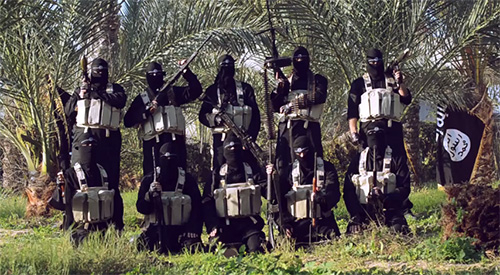
ISIS in GazaMembers of the Islamic State of Iraq and Syria, in Gaza. (Image source: ISIS YouTube video)

Eyad al-Bazam, spokesman for the Hamas-controlled Ministry of Interior, earlier this week denied reports ISIS terrorists had infiltrated into Egypt through tunnels along the border with the Gaza Strip. He described the reports as “lies and fabrications,” adding that they are part of a campaign to “distort the image of the Gaza Strip,” and that “There is no presence of ISIS in the Gaza Strip.”

The denial came in response to a report in the Egyptian newspaper Al-Masry Al-Youm according to which Egyptian security forces arrested 15 ISIS terrorists who tried to enter Sinai from the Gaza Strip. According to the report, Palestinian terrorists in the Gaza Strip facilitated the infiltration of the ISIS terrorists into Egypt so that they could carry out a terrorist attack against Egyptians.

The report said that the terrorists had been entrusted with establishing terror cells and branches of ISIS in Egypt.

Hamas is obviously nervous about the presence of ISIS terrorists in the Gaza Strip and sees them as a direct challenge to its rule. ISIS believes that Hamas is “too moderate” and is not doing enough to achieve the destruction of Israel.

Last month, Hamas sent its policemen and militias to disperse a rally organized by ISIS followers in the Gaza Strip to celebrate the recent “military victories” of the terrorist group in Iraq. Hamas prevented local journalists from covering the event as part of its attempt to deny the existence of ISIS in the Gaza Strip.

At the rally, attended by dozens of Islamists, the crowd chanted, “Khaybar, Khyabar, Ya Yahud, Jaish Mohamed Saya’ud!” (“O Jews, Mohamed’s army will return.”)

This is a battle cry that many Islamists like to chant to remind the Jews of the story of the battle fought in 629 CE by the Prophet Mohamed against the Jews of Khaybar, an oasis in northwestern Arabia. The battle resulted in the killing of many Jews, and their women and children were taken as slaves.

Earlier this year, masked militiamen in the Gaza Strip posted a video on YouTube in which they declared their allegiance to ISIS. The militiamen are believed to be members of a radical Islamist salafist group that has been operating in the Gaza Strip for the past few years.

Then, Hamas also denied that ISIS had any followers in the Gaza Strip. But Hamas seems to be trying to cover the sun with one finger.

At the funeral of two Islamists killed by the Israel Defense Forces last week in Gaza, funeral-goers carried flagsand banners of ISIS.

Over the past decade, it has become clear that Hamas is not the only terrorist organization operating in the Gaza Strip, which has become a base for dozens of jihadi groups, some linked to Al-Qaeda and ISIS.

The smuggling tunnels that used to link the Gaza Strip with Egypt (most have been destroyed by the Egyptian army over the past year) have facilitated the movement of thousands of Islamist terrorists in both directions.

The Gaza Strip is no longer a threat to Israel, but also to the national security of Egypt.

The only way to confront this threat is through security cooperation between Israel and Egypt, which have a common interest in preventing the Islamists from exporting their terrorism beyond the borders of the Gaza Strip.

Instructions Released for Terror Against ‘Settlers’

July 4, 2014

Instructions Released for Terror Against ‘Settlers,’ Israel National News, Dalit Halevi, Tova Dvorin, July 4, 2014

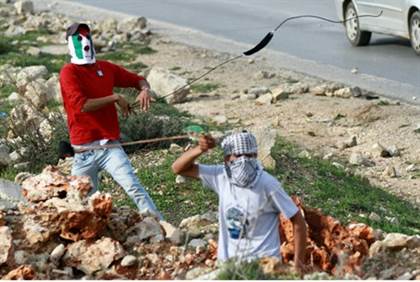
Masked Pal terror kidsMasked Palestinian Arab teenage terrorists Flash90

A Palestinian Arab terror group dubbed the “Coalition of Youth for an Intifada” released a notice calling for violence against Jews in Judea and Samaria Thursday, including detailed operational and doctrinal instructions to “raise hell.” 

In the notice, entitled “Expelling Zionists Through Rocks,” young Palestinian Arabs are called on to “scorch the earth and make it a living hell under the feet of the invaders”, through the following methods:

A. Creating huge barricades to block “settlers” from leaving their communities and vandalize their cars;

B. Torching tires on common roads in the area;

C. Hurling rocks at cars and paint barrels at their drivers;

D. Placing sharp objects, nails, and shrapnel on roads to damage passing vehicles;

E. Spraying anti-Jewish graffiti near Jewish communities;

F. Participating in raging clashes against IDF and police in Judea, Samaria, and Jerusalem.

Systemic Arab incitement against Jews and Israel has skyrocketed this month, since the abduction and murder of Israeli teens Naftali Frenkel (16), Gilad Sha’ar (16), and Eyal Yifrah (19), hy”d.

Besides for escalating calls to violence from Hamas – which has fired a hail of rockets onto Israel near-continuously over the past week – Fatah has both justified and encouraged Palestinian Arabs to become violent and hide evidence from the abduction.

In addition, rioting and unrest have exploded in Jerusalem and across Judea and Samaria since Wednesday, in reaction to the murder of 16-year-old Mohammed Abu Khder, who was found in the Jerusalem Forest that morning after allegedly being forced into a black car outside the neighborhood of Beit Hanina.

Following the news – which both Palestinian Authority Chairman Mahmoud Abbas and the international media blamed as a “revenge killing” despite the lack of evidence for such a claim – several Fatah officials called for local Arabs to “rise up” and “declare a revolution” for Israel to “get out.”

Abu Khder’s mother has also called for violence against Israelis, stating in an interview Friday that rioting and rocket fire are an “exercise [in] Palestinian rights.”

Liberman Slams Ceasefire Offer as ‘Huge Mistake’

July 4, 2014

Liberman Slams Ceasefire Proposal With Hamas as ‘Huge Mistake’

Foreign Minister slams lack of deterrence during Sderot visit, calls for systematic operation against Hamas with US involvement.

By Orly Harari, Tova DvorinFirst Publish: 7/4/2014, 3:08 PM

via Liberman Slams Ceasefire Offer as ‘Huge Mistake’ – Defense/Security – News – Arutz Sheva.


Avigdor Liberman Flash 90
 

Foreign Minister Avigdor Liberman (Yisrael Beytenu) released harsh criticism against the government’s response to Hamas on Friday, amid a constant barrage of rocket fire and rumors of peace being brokered through Egypt.

“These quiet messages we send to Hamas offering a ceasefire are a huge mistake,” Liberman said Friday while visiting the city of Sderot. “Answering this [terror] with silence is a serious mistake and we in Yisrael Beytenu reject this approach.”

“How can it be that, after we have three boys kidnapped and murdered, and two consecutive weeks of rocket fire, Israel’s approach is: silence will be met with silence?” he asked. “Even while we visit here, Hamas continues to grow stronger, and produce an eight inch diameter rocket that can reach Tel Aviv and Gush Dan.”

“We must accept the reality that this is a mistake,” he added. “Instead of dealing with the problem, we are rejecting the problem.”

Liberman than laid out a plan, saying “we must first destroy the terrorist infrastructure and stop rocket production today,” noting that rockets now “are capable of reaching Netanya.”

He also proposed a ground assault.

“It is impossible to destroy terrorist infrastructures only from the air,” he dismissed. “Most of these plants for missile production are under schools, clinics, and mosques.”

“We need to get our hands on all those who committed and supported the kidnapping and murder of children,” he continued, calling for the targeting of Hamas leaders.

“That also includes the Ismail Haniyeh and Khaled Mashaal, the heads of Hamas; and all those who came out, encouraged and supported [the abduction] – and it does not matter if they sit in Qatar or Gaza,” he stated. “The money comes from Qatar – and Hamas, Khaled Mashaal and Azmi Bishara are sitting in Qatar. Bishara sits there and puts money in operations in Israel.”

Liberman added that he has high hopes for US involvement in the situation.

“I spoke with the chairman of the Subcommittee of the Foreign Affairs Committee of the U.S. Congress, Ileana Ros-Lehtinen about it,” he said. “Hamas is a terrorist organization even by American law. One of the [abducted] boys was a US citizen [Naftali Frenkel hy”d; ed.] and I hope that Congress will act against the Qataris.”

“I look forward to seeing that Jewish communities and organizations in the US have their say in this matter,” he added.

Liberman has been particularly vocal about launching another ground assault into Gaza, and even more so since the horrific abduction and murder of yeshiva students Eyal Yifrah (19), Gilad Sha’ar (16), and Naftali Frenkel (16) last month.

Earlier this week, Liberman proposed – and not for the first time – that Israel should “consider” retaking Gaza, noting that a “limited” operation in Judea and Samaria against Hamas could prove ineffective.

“We have to decide whether we are going to explore the alternative of full occupation of the Gaza Strip,” Liberman said. “We saw that a limited operation only strengthens Hamas in the end; the alternative is clear.”

Friday’s remarks surface in the wake of rumors of a ceasefire being negotiated with Hamas through Cairo, although Israel has yet to confirm those rumors.

In the meantime, several top-ranking officials have noted that Hamas’s time during the 48-hour ultimatum to stop the rocket fire is dwindling, and the IDF is preparing for a strike.

Radical Islam: Raging unabated

July 4, 2014

Radical Islam: Raging unabated, Israel Hayom, Dr. Reuven Berko, July 4, 2014

(Why do we persist in calling it “radical” Islam rather than merely Islam?)

The Islamic Movement in Israel, which stars Sheikh Raed Salah and is committed to the same goals, also enjoys — for the present — the protection of democracy, which does not know how to defend itself. Any criticism directed toward them comes up again the self-righteous Muslims, “the moderate and nonviolent ones” — who refrain from condemning Islamic radicalism to a man.

Why is it so difficult to explain to the Western world who Israel’s enemies are and the nature of the person facing us? The average terrorist whom we face is typified by psychopathic behavior — to put it succinctly, he is disturbed. As more time passes, and the waves of blood shed by the Islamists sweep over the Middle East, it appears that the Western World regards most of these Arabs and radical Muslims as a disturbed, developmentally-delayed child who seeks honor, whom it is better to forgive each time he ruins everything.

When the efforts of the “disturbed child” to accomplish his goal by force fail, as others are harmed and the surroundings suffer enormous damage, he yells “Freeze” as if he were playing tag, and demands a “do-over” because none of it ever happened.

The global Islamic killing spree is carving its way toward the West, which is burying its head in the sand • Israel can take care of itself here, but will have a much tougher road combating the anti-Semitism poisoning the West.
Jihadists in IraqJihadists in Iraq | Photo credit: Reuters

The kidnapping and brutal murder of the three teenage boys by members of the Islamic terrorist group Hamas is part of an inconceivable array of global Islamic atrocity. Mass murders, rape, theft and the mass flight of people from their homes — offered as a message of persuasion by radical Islam and Muslim Brotherhood commentators to the world as part of the Hamas power center, the dawa network. While Western world leaders refuse to internalize the Islamic threat to their countries and families, signs indicate that it is precisely those of weak intellect in Europe and the United States who understand exactly what the Islamist sheiks are talking about.

It appears that the mentally ill and the moonstruck understand the message of Islam and its preachers, and are responding to the call of Allah. These “joonim” and “jamaisim,” alongside young European-born Muslims who wish to destroy Europe from within, volunteer in their numbers and travel to the Middle East to do the murderous work of the sheikhs, who deliver their incitement under the protection of democracy.

These young people join the mujahedin on various battlefronts in the crumbling Arab states. They joyfully adapt themselves to the terrain, grow beard, slaughter and execute thousands of innocent civilians. They record their bloody acts of murder on video and send the videos to the West.

When they finish their work in this region, they will return to the West, armed with indoctrination, experience in killing and a taste for blood, to complete the work of murder, intimidation and terrorism (“irhab”). All this will be done precisely according to the biography of the messenger Mohammed, which they acquired at the price of blood in the Middle East’s killing fields.

The leaders of Hamas and the Islamic Movement in Israel also serve as part of the web of global dawa. In Israel’s case, it means the elimination of Israel and its Jewish inhabitants, “who disguise themselves as the children of Israel, robbers of waqf property in Palestine, part of Western imperialism, a religious group with whom God is eternally angry and that does not deserve a homeland.”

The purpose of the message of dawa is to intimidate and convince the infidels (Christians and Jews alike), by persuasion or by the sword, to accept the up-to-date, correct and only religion that is supposed to control and rule the world. The grotesque version of Israel’s national anthem, “Hatikvah,” that Hamas published makes the message very clear: Any Jew who does not leave “Palestine” voluntarily will be killed.

The Islamic killing campaign of dawa is run by subcontractors who commit murder in the name of Allah. Hamas and Islamic Jihad nest in global Islamism’s hothouse of murder alongside al-Qaida, the Nusra Front and the Islamic State of Iraq and the Levant (ISIS). In Islamist language, these groups are known as the “hard core.” They make no move without prior instructions and guidance, covert and open, from the production managers — meaning the sheikhs, who preach their genocidal doctrine on radio stations, on website and in mosques, just like Ismail Haniyeh, Khaled Mashaal and the other groups of “saints” we know well, who also ordered the kidnapping of our young men.

While the sheikhs claim that the political-ideological wings of their groups are kept separate from the operational wings, the operational groups go out to do their murderous work well-fueled with Koranic verses and bizarre interpretations, products of the fevered brains of the “innocent” sheikhs. Those who run the murderous Islamist show live in luxury homes and ride in Mercedes cars in the West, even as they enjoy the protection of democracy and the obligation to be politically correct.

The Islamic Movement in Israel, which stars Sheikh Raed Salah and is committed to the same goals, also enjoys — for the present — the protection of democracy, which does not know how to defend itself. Any criticism directed toward them comes up again the self-righteous Muslims, “the moderate and nonviolent ones” — who refrain from condemning Islamic radicalism to a man.

The production of the murder of the three teenagers by Hamas was managed similarly. The sheikhs incited, the operational personnel of the time succeeded in kidnapping Gilad Schalit and profited handsomely. Later on, Hamas members tried dozens of times to recreate that success and failed. After the “successful” kidnapping and murder that the Hamas operatives perpetrated in Hebron, “high-ranking members of Hamas blessed the hands that had committed the crime” and, as usual, denied any involvement by the “leadership” in the crimes committed by the “staff.”

This maneuvering room made it possible for Palestinian Authority Chairman Mahmoud Abbas, whom Hamas wanted to embarrass and push out, not to sever the relationship with Hamas and demand clear proof of the Hamas leadership’s involvement in the crime. In this way, he sought to maintain the existing state of “unity.”

The Hamas leadership initiated the kidnapping — whose purpose, if it worked, was to recreate the Schalit prisoner-exchange deal with a higher yield. Terrorist groups are usually quick to take public credit for terror attacks and sometimes steal that credit from one another. This time, the plan was to kidnap Israelis without leaving any signature, at least at the first stages.

With their backs to the wall

For a long time before the kidnapping, Hamas planned to hide the kidnappers until such time as they chose to reveal them. The kidnapping was timed to take place on the eve of the elections that are scheduled to take place in the Palestinian Authority in about six months. At that point, Hamas had planned to reveal them and demand the release of an exorbitant number of prisoners. The gain from that would have been huge: Without any explicit statement, the Palestinian population was supposed to figure out that Hamas had carried out that “lofty” mission.

That was how Hamas planned to emerge from the trap of its political, economic and military isolation and, like a Trojan horse, join the “legitimate” Palestinian government without violating, at least at first, Abbas’ commitments to the West and to Israel. At the same time, Hamas would have emerged from its hardship and won the elections, carried on the wings of its success. In case of Israeli pressure, Abbas would be portrayed as a collaborator with Israel, as indeed happened.

Unlike “jihad tourists” who commit murder in the name of Allah, who are indifferent to the local Islamic population, Hamas, which has civilian control over its population, is sensitive to damage to property and life, and that is where its vulnerability lies. In the balance between profit and loss, Hamas emerged by the skin of its teeth from the bloody adventure of the murder of the three boys. The radical Islamic bloc that sprouted in Sinai was suppressed by the Egyptians, and the Islamic bloc in Gaza is also in a bad way because of the Israeli-Egyptian grip.

It turns out that even an abhorrent group of murderers that portrays itself as people “whose lust for death is stronger than the Jews’ desire for life” cannot ignore the Palestinian casualties, who paid with their lives for the kidnapping and murder it committed. Even if Hamas were to try to ignore it, the Palestinian public, which calculates its successes in “heads,” would remind it.

No revenge must be taken against Hamas that would restore it to the status of the popular underdog in the territories and throughout the world. Even the expansion of settlements would serve as moral justification for Hamas’ activity and would remove the world’s support for the existing settlement enterprise, which rests on accepted reasons.

While Hamas’ back was up against the tough wall of Egypt, its infrastructure in Judea and Samaria was crushed and its operatives jailed, and Israel’s arm is still outstretched both in Judea and Samaria and in Gaza. Hamas’ political isolation and economic and military troubles have increased following the failed attack, and the future of its reconciliation with Fatah is in doubt. We should bear in mind that even in this stalemate, the reserves of rockets, cement and other resources are steadily decreasing. Hamas will try to conserve them, and we will reduce them over a long surgical and meticulous process, not in a single blow.

While Palestinian Authority officials wax sanctimonious and warn against Israel’s response, even as they wait for Israel to eradicate the competing group, it appears that Hamas is having trouble enforcing discipline among the rejectionist organizations. After all, that is what its people did to the Palestinian Authority as it was taking form.

This trap, which will also be at the foundation of Palestinian chaos in the future, will make every agreement with them irrelevant.

After all, there will always be someone who stands up against the governmental monopoly over the sovereign power. In the situation that has been created, Abbas must not benefit from the “goat syndrome,” since he was the one who brought the “goat” of Hamas into the house, but is in no hurry to remove it. This being the case, whenever he should bid Hamas farewell, he will not be deserving of any political reward.

A slap to the West

Hamas is well integrated into the strategic view of the global Sunni Islamic project, which is funded by the Gulf states, mainly Qatar. From Israel’s vantage point, the organization’s great advantage is its “honesty,” which lies in the fact that it openly states its goal of destroying Israel. This makes it easier for Israel to act against it, including in the public-relations arena.

Unlike Hamas, the Palestine Liberation Organization strives for the same goals, but its manipulative approach to accomplishing them makes it difficult for Israel to fight back against its schemes to destroy it (such as the “right of return”).

Since Hamas is responsible for the original population from which it sprang, the possibility that it will take over Judea and Samaria as well is not such a bad scenario, since if that happened, Israel would be able to free itself of the political and operational restraints on its behavior there. One way or the other, Hamas’ preparations for taking over Judea and Samaria, alongside the existing lack of trust in the PA’s intentions, require long-term Israeli control over the Jordan Valley and the crossing points in any future political formula. This control will keep the adventurers of the global jihad movement from infiltrating into the territory and protect the western part of Jordan from subversive ferment.

The purpose of the Islamic effort is to create a contiguity of salients and armed Islamic “emirates” in the region and in various parts of the world, and the Islamists have set their sights on Jordan. These salients are to unite eventually as a “large global Islamic caliphate.” Radical Islam has many nesting sites. They are in Africa, the Middle East, Russia and the Arabian peninsula. Signs of this nesting are also evident in Europe, the U.S. and other countries.

The situational picture that reflects the progress of global Islam’s invasion is full of contradictions, dynamic and utterly unstable. No one can tell what the outcome of the war will be, since some of the countries that cooperate with the West against radical Islamist terrorism, including Turkey and Saudi Arabia, are actually aiding the radical Islamist groups that plan to destroy the West in the end.

The U.S. itself is embroiled in that contradiction, since on the one hand it is aiding the Islamists who follow the doctrine of al-Qaida and ISIS and are working against Bashar Assad’s regime in Syria. On the other hand, it is working against them in their fight against its protege, Prime Minister Nouri al-Maliki, the Shiite ruler of Iraq, who is actually the emissary of Iran. And Iran is part of the awful axis that consists of itself together with the Shiites, Syria and Lebanon, which is working against the West and its friends, including Israel, which they see as an obstacle, perhaps the last one, to an Islamic invasion.

Taking care of the disturbed child

In the meantime, the battlefront between the Sunnis and the Shiites has revived. The rioters of the region, who never really regarded Israel as the major problem, are now focusing on this crisis to decide, once and for all, who will control the Islamic world. The Palestinian problem, which was always marginal, has now been pushed into a forgotten corner, so we must not interfere with the “neighbors’ slaughterhouse.”

Why is it so difficult to explain to the Western world who Israel’s enemies are and the nature of the person facing us? The average terrorist whom we face is typified by psychopathic behavior — to put it succinctly, he is disturbed. As more time passes, and the waves of blood shed by the Islamists sweep over the Middle East, it appears that the Western World regards most of these Arabs and radical Muslims as a disturbed, developmentally-delayed child who seeks honor, whom it is better to forgive each time he ruins everything.

When the efforts of the “disturbed child” to accomplish his goal by force fail, as others are harmed and the surroundings suffer enormous damage, he yells “Freeze” as if he were playing tag, and demands a “do-over” because none of it ever happened. The West’s attitude toward the psychotic rioter who murders his own co-religionists, Christians and Jews is one of tolerance, solidarity and empathy. This approach denies the danger that this “disturbed child” will eventually strike at the women and children of Europe and America.

As far as the West is concerned, nothing can be expected of such a madman, and his antics must be put up with in a spirit of understanding in the hope that he will improve. Indeed, as part of this patronizing, caring, tolerant and inclusive approach, the West has decided that despite his violent and destructive nature, he must not be judged harshly.

The assumption is that the murderer has “Arab pride,” and because of that, his word may be relied upon if he will just give it and sign. Because of this, the West is always willing to start the game over out of a desire to appease him, particularly if the “petri dish” is far from where they live and the victims of this experiment on human beings are the inhabitants of Israel.

The sad expression of this mistaken approach to treatment is the collection of illogical strategic measures being taken in the West’s operation in our region, which stand out for their double standard and biased judgment of the measures Israel takes to survive. While the inconceivable acts of slaughter committed by the Arabs and the Muslims against one another and against us continue, the leaders of the West absurdly demand of Israel “proportionality,” concessions and restraint that endanger its existence.

The Presbyterians, Lutherans and others latched on to this absurdity in this biased attitude toward Israel. These Christian denominations put a yellow badge on Israel’s products with their decision to boycott Israeli products that come from Judea and Samaria (whose factories give a livelihood to many Palestinians). This measure was done in denial of terrorism against Israel and the acts of murder, expulsion, rape and theft that the radical Muslims also perpetrate against Christian communities in the Middle East.

Since the West has abandoned the Christian communities in the Middle East, it is easier to blame Israel’s so-called “rejection of peace” for the regional chaos instead of the ferment and bloodshed so well-entrenched in the natures of the murderous tribes living around us. It is likely that the attitude of these Christian denominations stems from an attempt to appease the Islamic radicals by marking the Jews as a common enemy. By doing so, they expect to ease the Islamic pressure on Christians.

Understanding the jungle

This sick person, the radical Muslim in the Middle East, feels no respect toward either the Christians in the West or even toward his fellow Muslims. The norms of this region have no respect for the life of another, nor for a word, oath or promise. The painful reality, which can be seen on Arab television screens, shows the uncompromising brutality of the inhabitants of the regional jungle and poses existential challenges to Israel.

The law that prevails in this part of the world, since the Jahiliyya (the pre-Islamic period), throughout the Islamic period to this day, is the law of the jungle, which dictates that the inhabitants live in a state of lack of mutual respect and deterrence that stems from the threat of mutual murder. The existence of one human being is a disaster for another, so the view that expresses the proper punishment for harming an enemy is either the destruction of his home or blood feud.

It is hard for Israelis and for moral Western people trying to learn the code of the region’s inhabitants, to adapt to its laws and survive under them. It is also very difficult to internalize that the killing of a family member requires the retaliatory killing of a relative of the murderer to the fifth degree to create balance and deterrence.

According to our neighbors’ code, prison is not a place of disgrace, shame, deterrence or punishment for criminals, but a source of great pride, as the Arabic saying goes: “Prison is for men.” It is hard for one who lives by the saying “respect has to be earned” to internalize the fact that for Arab pride, one does not need to work, since in that culture, honor, in a twisted way, comes from guarding one’s daughter’s virginity until her marriage, and if she fails to preserve it, she must be killed either by her loving father or by one of her brothers at the father’s behest (using a stone to crush her skull).

Anyone who could kill his own daughter in that way is capable of committing any atrocity against anyone else. EU foreign affairs chief Catherine Ashton and her colleagues have never heard of any of this before.

On the brink of war: Hamas may still back down

July 4, 2014

On the brink of war: Hamas may still back down – Israel Opinion, Ynetnews.

Analysis: Escalation in tensions serve Hamas’ interests to improve standing among Palestinians, but war with Israel does not.

Published: 07.04.14, 17:18 / Israel Opinion

Just today, on the first Friday of Ramadan, when there is always calamity, it will be possible as the evening closes in, to know where things are headed: either toward further escalation that will result in a military operation in Gaza, or toward relative calm.

The Shin Bet and police investigators still have no concrete evidence who killed the Palestinian teenager Muhammad Hussein Abu Khdeir or why, but the Palestinians in the West Bank, like in Gaza, are convinced beyond any doubt that the murder was committed by the ‘settlers’ and there is no hope that they will be convinced otherwise.

The murder of Abu Khdeir is the match that ignited the recent escalation in Jerusalem and the surrounding areas as well as Gaza. But, it was only the match that fell on gasoline that had been waiting for ignition for several days already.

Funeral of Palestinian teen Abu Khdeir. (Photo: AFP)

The main reasons for the current flare up consist firstly of the difficult situation that Hamas has been stuck in for a long time due to lack of foreign aid, which has led to serious financial difficulties in Gaza, and the damage they are suffering as a result of IDF operation in the West Bank aimed at their infrastructure.

The recent abduction and murder of three Israeli teens led to the IDF crackdown in the West Bank, which greatly worsened Hamas’ position among Palestinian politicians and also threatened the current unity government formed with Palestinian President Mahmoud Abbas.

This also inadvertently made it all the more difficult for Hamas to find a way to pay the 43,000 government officials in Gaza who are currently waiting for back pay.

There’s no point in listing all of the problems that Hamas is facing, but the bottom line is that Hamas hopes that through escalation and eventual Egyptian intervention, fresh cards will be laid out on the table, and their position will improve.

The murder of the Palestinian teen gave Hamas the opportunity and legitimization to fire rockets on the Negev while it plays a dangerous game of incitement, mainly because it doesn’t have much to lose.

In other words, influence from Hamas has been in a slump and now its military wing, the Izz al-Din Qassam Brigades, is trying to change the downward trend and at least win back some of their prestige that was lost among Palestinians after losing significant sources of funds and helpful infrastructure.

The political leadership of Hamas, from their offices in Qatar to Haniyeh himself, are trying to retain control over Gaza, and don’t want to handle an Israeli invasion which, in the current situation, would likely lead to the end of Hamas.

The riot-torn streets of east Jerusalem Friday afternoon. (Photo: Gil Yochanon)

However, the Izz al-Din Qassam Brigades has ceased to obey the political leadership and is currently dictating the course of events and the escalation in the hope of winning said prestige by striking Israel and then ceasing just before Israel goes to war.

It must be remembered however, that the political and military leadership of Hamas faces many powerful forces attempting to restrain an escalation.

Firstly, the Egyptian government under President Abdel Fatah al-Sisi doesn’t favor escalation and works tirelessly to curb Hamas and its allies.

Secondly, Hamas is afraid that if it causes significant damage in the central cities of Israel, a larger conflict will erupt. In other words, Hamas is dependent on Israel for its existence, both literally and figuratively.

Protesters pray in front of riot police in East Jerusalem on first Friday of Ramadan. (Photo: Reuters)

If Israel decides to tighten the siege on Gaza and refuses to send fuel, food, and construction materials through the border crossings, it will surely mean the end of Hamas. The Egyptians won’t agree to open the Rafah border crossing for more than a few hours every few days, in order to prevent cooperation and aid between Hamas and the Muslim Brotherhood.

In this situation, even the most hotheaded leaders in Hamas and rogue organization know that a big showdown with Israel may result in a fiasco for them.

Apart from the inevitable destruction of war, they know that Israel is very keen at this point to destroy as much as possible, not only the Hamas infrastructure but also the arsenal of rockets and long-range missiles available to the organization and to Islamic Jihad.

But in the meantime, the organization’s leaders remain bold, borne of the waves of outrage over the murder of Abu-Khdeir and the religious fervor that affects them during the month of Ramadan.

The violence in Judea and Samaria in the meantime has been restricted to the area of Jerusalem and there is a good chance that it won’t expand from there. Therefore is can be assumed that even with Friday’s violent protests in Jerusalem and refugee camps across the West Bank, they will calm down.

Riot police rush down an East Jerusalem street to confront protesters on Friday. (Photo: Gil Yochanon)

But this is on one condition – that no one is killed by security forces during the riots after the funeral of Abu-Khdeir. Any Palestinian death on the first Friday of Ramadan may ignite record violence that could possibly be called the Third Intifada.

Palestinian streets are now at their most sensitive and volatile, not only because of Ramadan, but because of confrontations that broke out since the kidnapping and murder of the Israeli boys and because Hamas incitement continues.

Therefore, Israel must be prepared for the unexpected. A relaxation of tensions is definitely possible, but security officials in particular must prepare for greater escalation.

This was most certainly the main issue on the agenda of the Cabinet meeting on Thursday, but not the only one. The Cabinet has convened four times since the boys’ bodies were found to discuss reactions of a political nature.

Steps were considered such as constructing new outposts and massively increasing construction in West Bank settlements along with other measures meant to bruise Hamas and its leadership.

But there was also need to discuss incitement and escalation because of the murder of the Palestinian boy. MKs spoke seriously about ‘situations and responses’ if tensions don’t relax by Friday evening or Saturday morning through Egyptian mediation.

The IDF has moved a limited number of forces, including tanks and foot soldiers and several dozens of reservists have even been called up. These moves serve multiple purposes. First and foremost, to signal to Hamas that the IDF is seriously preparing for a large military incursion if the rocket fire on the Negev doesn’t come to an end.

A senior officer even said in a private conversation, “If Hamas wants a war, they’ll get a war.”

The second purpose is to prepare the forces that are required for this type of operation, including defensive measures like Iron Dome batteries that must cover key areas when fighting begins.

Israel strikes Gaza after day of rockets in south

July 4, 2014

Israel strikes Gaza after day of rockets in south | The Times of Israel.

23:25 – rocket volley

22:54 – Palestinians in Gaza launched at least four rockets which exploded in the Eshkol regional council late Friday night.

22:41 – Rocket volley

22:03 – Five rockets hit open areas in Eshkol marking over 20 rockets fired into Israel on Friday.

21:55 – 2 rocket volleys

IDF bombs 3 Hamas targets as rockets hit deeper into the country, but response remains limited amid talk of impending ceasefire

July 4, 2014, 9:06 pm
The aftermath of an Israeli air strike in the Gaza Strip, file photo (Photo credit: Abed Rahim Katib/Flash90)

The aftermath of an Israeli air strike in the Gaza Strip, file photo (Photo credit: Abed Rahim Katib/Flash90)
 
The Israeli Air Force carried out a series of air strikes on militant targets in the Gaza Strip on Friday evening, after a day in which around 15 rockets and mortar shells were launched at Israel from the Palestinian enclave.
The army said it hit three Hamas targets, but did not give further details. Palestinian officials did not report any casualties in the strikes.The seemingly limited Israeli response to the continuing rocket salvos appeared to indicate that Jerusalem was waiting to see whether Hamas would curb the rocket-fire as reports proliferated of an impending ceasefire agreement.Four rockets were fired from the Gaza Strip into Israel Friday afternoon, with three apparently targeting the towns of Ofakim and Netivot southeast of Sderot, as Gaza militants increased the range of their attacks.One of the rockets hit a kibbutz in the Eshkol Region, causing some damage to a house. Two others were intercepted by the Iron Dome defense system and one hit an open field. No injuries were reported in the attacks.While the Israeli government appeared interested in de-escalation, not all of its members seemed to agree that restoring calm was the best course of action.“The idea that ‘quiet will be answered with quiet’ is a serious mistake,” Foreign Minister Avigdor Liberman said on a visit to Sderot on Friday, adding that he believed Israel must now strike Hamas hard.“It cannot be that after the kidnapping and murder of three teenagers and two consecutive weeks of rockets fall, the approach of Israel will be ‘quiet is answered with quiet,’” he said. “There can not be an agreement with Hamas. Ignoring the problem or being afraid to deal with it will lead us to a situation in which thousands of missiles are fired at us, not hundreds.“We cannot to accept a situation in which Hamas controls the pace of events and dictates when it flares up the region, and all we do is respond,” he added.Sirens had wailed in Israel’s southern city of Sderot, the Eshkol Region, Sdot Negev and the Sha’ar Hanegev Regional Council, warning of incoming rocket fire from Gaza, from early in the morning. Five rockets were launched at Israel in the morning, with one landing in Palestinian territory. No injuries or damage were reported as the projectiles struck open areas. In addition, two mortar shells from Gaza exploded near the Eshkol regional council buildings. No injuries or damage were reported.

On Friday morning Egyptian and Palestinian sources confirmed to The Times of Israel that a ceasefire was set to be declared between Israel and Hamas, but the exact timing has yet to be set. The truce was mediated by Egyptian intelligence officials, as has been the case in similar negotiations in the past.

According to the sources, the understanding that the Egyptians reached with Israel and Hamas is that “quiet will be met with quiet.”

“Neither side is interested in an escalation,” the sources told The Times of Israel.

The sources also reported that the Egyptians passed messages from Israel to the deputy head of Hamas’s political desk, Moussa Abu Marzouk, based in Cairo. Israeli sources said they were waiting for an answer from Hamas. “The ball is in Hamas’s court,” an official told the Ynet news site.

Commentators in Gaza attributed the escalation in rocket fire over the past 48 hours to the feeling in Hamas that Israel is looking to avoid a fight, and that a cease-fire is impending.

According to the commentators, Hamas is trying to achieve a public relations victory in the eyes of the Gaza public, to be seen as unafraid of an escalation. But, they said, Hamas is itself uninterested in a deterioration into a larger conflict.

Over 15 rockets were fired from the Gaza Strip Thursday evening, leaving one soldier lightly injured. As the southern border continued to heat up Thursday, with intermittent rocket fire striking southern Israel, residents were advised to stay within 15 seconds of bomb shelters.

Israel on Thursday reportedly issued a 48-hour ultimatum to Hamas in Gaza to halt the incessant fire or face a massive Israeli strike. The ultimatum was conveyed to Hamas leaders via Egyptian intelligence, they said.

An hour before the Thursday evening rocket barrage, Hamas said that in the event of an escalation, Israel would “be surprised” by its rocket arsenal and range.

“We promise that one stupid move your leaders make will constitute sufficient ground to turn all of your towns, even those you wouldn’t expect, into targets and burning cinders,” said Abu Ubaida, a spokesman for the Izz ad-Din al-Qassam Brigades, Hamas’s armed wing. Israel may initiate the escalation, “but it doesn’t know how it will continue and how it will end,” he said.

“The threats the occupiers issue, and the allusions to war against Gaza, are threats that have no meaning in our dictionaries, other than drawing the hour of vengeance and difficult lesson-learning closer,” Ubaida added.

He said that Israel’s move to rearrest — during an 18-day operation to find three kidnapped Israeli teens (their bodies were found in the West Bank earlier this week) — prisoners released during the 2011 swap for IDF soldier Gilad Shalit “crossed a line and we won’t be silent about it.”

The IDF beefed up its ground forces around the Gaza Strip on Thursday, as tensions continued to rise along the southern border region; and in East Jerusalem, where the recent killing of a Muslim teenager, in an alleged revenge attack over the killings of the Israeli teens, triggered widespread riots on Wednesday.

But the move came in conjunction with unusually soothing messages from the army. “We want to deescalate the situation and restore calm,” said Lt. Col. Peter Lerner, who described the deployment as defensive in nature.

The region has been increasingly tense since the June 12 kidnapping of the three Israeli teens and the onset of the holy month of Ramadan.

Hamas, which has apparently taken part in the rocket fire recently for the first time since 2012, failed in its attempt to kidnap and trade the Israeli youths for Palestinian prisoners, Lerner said, and therefore has been “pushed into a corner.”

In the West Bank, he added, the army’s current strategy comprises three main components: finding those responsible for the killing of Eyal Yifrach, Gil-ad Shaar, and Naftali Fraenkel; finding those who killed Muhammed Abu Khdeir, the 16-year-old youth who was abducted from his hometown of Beit Hanina on Wednesday; and avoiding violence on the first Friday of Ramadan.

IDF Chief of Staff Lt. Gen. Benny Gantz, in advance of Friday’s mass prayer gatherings, has instructed all Central Command troops to “limit points of friction,” Lerner said.

Israel’s cabinet, meanwhile, has remained mum on possible anti-Hamas operations in the wake of the kidnapping and murder of the three Israeli teens by Hebron-based Hamas members.

Whether or not a larger IDF operation is imminent, the build-up is a message to Hamas — under pressure from the shuttering of its border with Egypt, a multi-year siege on its Israeli border and a collapsing economy in the Strip — that escalation could spell significant damage for Gaza and its rulers.

Rocket fire from Gaza damaged two buildings in Sderot on Thursday morning. No injuries were reported. One of the rockets hit the side of a building that houses a preschool, but did not explode. The area was closed off to passersby, police spokesman Micky Rosenfeld tweeted on Thursday morning, as police sappers removed the unexploded warhead.

Israel’s Iron Dome system shot down two rockets fired from Gaza in the direction of the southern town of Netivot early Thursday morning.

Lazar Berman and Marissa Newman contributed to this report.

IAF strikes Gaza in response to Palestinian rockets; Egypt given 24 hours to broker truce

July 4, 2014

IAF strikes Gaza in response to Palestinian rockets; Egypt given 24 hours to broker truce | JPost | Israel News.

( Israel to Gaza: “Stop or We’ll Say Stop Again !”  – JW )

By JPOST.COM STAFF

07/04/2014 20:28

Israel will wait an additional 24 hours to allow the Egyptian government to broker a ceasefire which Jerusalem hopes will restore calm along the Gaza frontier, Channel 10 television reported on Friday.

ISRAEL AIR FORCE F16c’s

ISRAEL AIR FORCE F16c’s Photo: IDF SPOKESMAN’S OFFICE

The Israel Air Force has struck targets in the southern Gaza Strip on Friday evening in retaliation for the Palestinian rocket barrage that pounded the south, Channel 10 reported. There is no word of casualties.

According to the IDF Spokesperson’s Office, IAF aircraft struck three sites near the southern Gaza town of Rafah. Channel 1 is reporting on Friday that the targets were apparently pieces of equipment used to launch rockets.

Israel will wait an additional 24 hours to allow the Egyptian government to broker a ceasefire which Jerusalem hopes will restore calm along the Gaza frontier, Channel 10 television reported on Friday.

Israeli commentators reported on Friday that Hamas has communicated to Cairo its desire to end the current round of fighting in the south. According to reports, Hamas has no wish to escalate the situation in the south, which has heated up in recent days as Palestinians in Gaza continue to pound the western Negev communities with rockets and mortars.

Channel 10 is reporting on Friday that Prime Minister Binyamin Netanyahu has opted for a restrained Israeli military response against Hamas despite the fact that rockets continue to explode in the south.

The Israeli cabinet is reportedly divided over the appropriate Israeli response to the Palestinian rocket barrage. Hawkish ministers like Naftali Bennett, Avigdor Liberman, and Gilad Erdan want a more aggressive military blow against Hamas, while Tzipi Livni, Yair Lapid, and Yitzhak Aharonovich have urged the prime minister to refrain from ordering a stepped-up assault on Hamas.

Thus far, Netanyahu is siding with the moderates in the cabinet, according to Channel 10.

IAF strikes 3 Gaza terror targets in response to rocket fire

July 4, 2014

IAF strikes 3 Gaza terror targets in response to rocket fire – Israel News, Ynetnews.

Southern residents warned to stay 15 seconds from bomb shelters; Lieberman: Cease fire ‘a serious mistake’.

Ynetnews

Latest Update: 07.04.14, 21:14 / Israel News

The Israeli Air Force (IAF) responded to over 15 rockets fired on Israel from Gaza on Friday, launching attacks on terrorist targets inside Gaza. The IDF Spokesperson Lt. Colonel Peter Lerner confirmed that 3 targets had been struck in the south of the Gaza Strip.

A rocket from Gaza landed in a Kibbutz in southern Israel Friday afternoon causing minor damage to several buildings while no injuries were reported as a result of the attack.

The attack marked more than 15 rockets to be fired on Israel since midnight and southern council leaders warned residents to stay within 15 seconds from bomb shelters.

Meanwhile, IDF forces identified two Palestinians next to the border fence of central Gaza as they attempted to place in improvised explosive device along the fence. The soldiers opened fire and hit at least one of the perpetrators.

Earlier, the Iron Dome anti-missile defense system shot down two incoming rockets over the southern town of Ofakim Friday afternoon, while another fell in an open area. Several mortar rounds were also fired toward Keren Shalom, but only one fell in Israeli territory.

Code red sirens were also heard in the Eshkol Regional Council where two more rockets fell in open areas. Another rocket landed in Eshkol near the border fence. No injuries were reported after any of the fire of the Gaza.

The afternoon rockets were the first to strike Israel since attacks earlier Friday morning. A BBC report surfaced in the early afternoon that Israel and Hamas had reached a ceasefire agreement that would put an end to the recent escalation in southern Israel, citing an unnamed source in Hamas.

A civilian living in the kibbutz where a rocket caused damage recounted his experience saying, “We were sitting in the living room. Even our adult children came to visit us and we were watching tennis on the television.”

“The house was closed because we had the air conditioning on and we didn’t hear the code red siren,” he continued. “Then all of a sudden there was a crazy explosion and the entire house shook. We immediately understood that the rocket had fallen nearby.”

“We went out and saw the damage caused to vehicles and the holes that the Shrapnel has caused. They’re talking about a cease fire or relaxation but in the meantime that’s not what it looks like.”

The current rocket fire on southern Israel could threaten any cease fire agreement however, as Prime Minister Benjamin Netanyahu apparently contacted Hamas through back-channels and said that calm would be met with calm, but also warned that if the situation in Gaza escalates, the IDF will severely hit Hamas and launch a significant operation in the Strip.

The sentiments appeared to be in action in the field Friday and no IDF retaliation to rocket fire was reported.

Howver, there was significant troop movement toward the Gaza border Thursday night which including extra rockets for Iron Dome that would be needed to protect Israeli cities in the case of a military operation in Gaza.

The Director of the Eshkol Regional Council, Chaim Yelin responded to the rocket fire saying, “Since the talk of a cease fire began, six rockets have exploded in the Eshkol Region. I call on the Security Cabinet to stop the rocket fire, no with words, but with action. The residents of the Eshkol region also deserve a peaceful Shabbat.”

Foreign Minister Avigdor Lieberman slammed the reports of a looming ceasefire as he visited the rocket-battered town of Sderot. Lieberman said that “I object to this move, we are making a serious mistake. The message that ‘calm will be met with calm’ is misleading.

“We need to put our hands on those supporting and encouraging terror, this includes (Hamas leaders) Khaled Mashal and Ismail Haniyeh. They need to know they are a target.”

Lieberman explained his position by decrying Hamas, saying “while we talk about a ceasefire, Hamas continues to develop missiles that can reach Tel Aviv. All we are doing is postponing the problem and not finding a solution. This is not the answer we need to be giving Hamas.”

Matan Tzuri and Yoav Zitun contributed to this report.

MivtsaYonatan – Operation Thunderbolt

July 4, 2014

MivtsaYonatan.AKA.Entebbe.Operation.Thunderbolt.1977.DVDRip.XviD-KG – YouTube.

God Bless America


https://i0.wp.com/www.iwojima.com/raising/l721flag.gif

on her 237th Independence DAY !


37 years ago today

The US Bicentennial coincided with the greatest special ops mission ever launched by any country.


Operation Tunderbolt was a counter-terrorist hostage-rescue mission carried out by commandos of the Israel Defense Forces (IDF) at Entebbe Airport in Uganda on 4 July 1976.[6] A week earlier, on 27 June, an Air France plane with 248 passengers was hijacked, by members of the Popular Front for the Liberation of Palestine and the German Revolutionary Cells, and flown to Entebbe, the main airport of Uganda. The local government supported the hijackers and dictator Idi Amin personally welcomed them. The hijackers separated the Israelis and Jews from the larger group and forced them into another room.[7][8][9] That afternoon, 47 non-Israeli hostages were released.[7][9][10] The next day, 101 more non-Israeli hostages were allowed to leave on board an Air France aircraft. More than 100 Israeli and Jewish passengers, along with the non-Jewish pilot Captain Bacos, remained as hostages and were threatened with death.[11][12]

The IDF acted on intelligence provided by the Israeli intelligence agency Mossad. The hijackers threatened to kill the hostages if their prisoner release demands were not met. This threat led to the planning of the rescue operation.[13] These plans included preparation for armed resistance from Ugandan military troops.[14]

The operation took place at night. Israeli transport planes carried 100 commandos over 2,500 miles (4,000 km) to Uganda for the rescue operation. The operation, which took a week of planning, lasted 90 minutes. 102 hostages were rescued. Five Israeli commandos were wounded and one, the unit commander, Lt. Col. Yonatan Netanyahu, was killed. All the hijackers, three hostages and 45 Ugandan soldiers were killed, and thirty (some say 11[4][5]) Soviet-built MiG-17s and MiG-21s of Uganda’s air force were destroyed.[3] Kenyan sources supported Israel, and in the aftermath of the operation Idi Amin issued orders to retaliate and slaughter several hundred Kenyans present in Uganda.[15]

Operation Entebbe, which had the military codename Operation Thunderbolt, is sometimes referred to retroactively as Operation Jonathan in memory of the unit’s leader, Yonatan Netanyahu. He was the older brother of Benjamin Netanyahu, the current Prime Minister of Israel.[16]