Archive for July 2, 2014

Clashes ongoing as East Jerusalem seethes over killed teen

July 2, 2014

Three mortars hit southern

Day after three slain Israeli teens laid to rest, Israelis mourn and tensions flare in the capital;
Temple Mount closed for fear of violent clashes

By Yifa Yaakov July 2, 2014, 10:34 am

via The Times of Israel | News from Israel, the Middle East and the Jewish World.


A day after slain Israeli teens Gil-ad Shaar, Naftali Fraenkel and Eyal Yifrach were laid to rest, Jewish-Arab tensions are flaring. Meanwhile, in Jerusalem, the government is weighing further responses to the killings. Stay with The Times of Israel for live coverage throughout the day.


16:02
Three mortars hit southern Israel

Three mortars fired from Gaza hit the Eshkol regional council in southern Israel.

This brings the total number of rockets fired since midnight to five.

No injuries or damage reported.
15:49
UK Jewish community to hold vigil outside Israeli embassy

The UK Jewish community plans to hold a candlelight vigil this evening outside the Israeli embassy in London to show solidarity with the families of Gilad Shaar, Eyal Yifrach and Naftali Fraenkel.

The leadership of the community, which will gather outside the embassy building in Kensington at 6:45 p.m. London time, invites the British Jewish community and friends of Israel to join in expressing “solidarity with the families, loved ones and the Israeli public for the three innocent teenagers who were murdered in cold blood after being abducted more than two weeks ago.”

The vigil will also be attended by representatives of the embassy and communal organizations, including the Board of Deputies of British Jews, the Jewish Leadership Council, United Jewish Israel Appeal, the Zionist Federation, We Believe in Israel and the Union of Jewish Students.

UK Chief Rabbi Ephraim Mirvis and Senior Rabbi to the Movement for Reform Judaism Laura Janner Klausner are slated to speak at the gathering.

In other news, a spokesman the Board of Deputies of British Jews “unequivocally” condemns the “deplorable” killing of Mohammad Abu Khdeir.

“Whatever the motive for this killing, it is utterly deplorable and we condemn it unequivocally. At this fragile time — in aftermath of the killings of the three Israeli teenagers — we all have a responsibility to promote an atmosphere in which peace and justice, rather than violence and aggression, can prevail. We all need to see the humanity in one another; this region does not need any more grieving mothers.”
15:27
UN special envoy denounces killing of Arab teen

Robert Serry, UN special envoy to the Middle East, “strongly condemns” the death of 16-year-old Muhammad Hussein Abu Khdeir.

“I recall the Secretary-General’s message: there can be no justification for the deliberate killing of civilians – any civilians. The perpetrators of such heinous acts must be brought to justice. I repeat my call on all sides to do everything they can not to further exacerbate an already tense atmosphere. Our thoughts are with the bereaved family,” he writes in a statement.
15:20
Kidnappers heard whooping, singing in full emergency call recording

The full recording of the call made by one of the kidnapped youths to the emergency police hotline is released, less than a day after police lifted the gag order on a 49-second clip from it.

In the full recording, the kidnappers can be heard singing in Arabic and whooping after what are presumably shots ring out in the car.

In the 49-second recording released by police yesterday, one of the teens, identified by Bat-Galim and Ofir Shaar as their son Gilad, can be heard whispering “They’ve kidnapped me” to the operator before the kidnappers shout at him in Arabic-accented Hebrew, “Keep your heads down.”

The operator tries to interact with the caller, said to have been Gil-ad Shaar, but receives no answer. Seconds later, several loud noises, which might be gunshots, are heard. Someone in the car is heard groaning.

The shorter recording ends with the sound of a Hebrew radio interview blaring in the car.

In the full recording, which is over two minutes long, the sound of the radio is interrupted by a voice on the phone — a different operator, this time a policewoman, who asks the caller where he is.

However, this operator, too, receives no answer. Instead, more loud noises — presumably gunshots — are heard.

When the noises die down, one of the kidnappers shouts “Three!” in Arabic. He and his accomplice can then be heard singing happily in Arabic and whooping, before the recording ends.
15:12
Rocks, firebombs, pipe bomb flung at police

Rioters hurl stones, Molotov cocktails, and a pipe bomb — which did not explode — at security forces in Beit Hanina as protests against the death of the Arab teen continue, the Ynet news website reports.

Police respond with riot dispersal methods. The area has been sealed off, and police ask residents to steer clear.


Palestinians clash with Israeli border police in the East Jerusalem neighborhood of Shuafat after the body of a Palestinian teen from East Jerusalem is found in the Jerusalem Forest, Wednesday, July 2, 2014. (photo credit: Hadas Parush/Flash90)
 
A lot more here


http://www.timesofisrael.com/riots-in-east-jerusalem-after-body-of-arab-teen-found/

If Co-Existence is Impossible, Then What?

July 2, 2014

“If a man comes to kill you, rise up and kill him first.”
Good advice, but how do we follow it when a whole culture has been created out of the idea that they should kill us?

By: Vic RosenthalPublished: July 2nd, 2014

via The Jewish Press » » If Co-Existence is Impossible, Then What?.


President Shimon Peres eulogizes the three murdered Jewish boys in the Modiin cemetery, on July 1, 2014.
Photo Credit: Flash90
 

We found out that the three boys, Eyal, Gilad and Naftali, were murdered shortly after their abduction. I’m sure we’ll hear the full story, in horrifying detail, at some point.

I can’t imagine how the families must feel. Or rather, I can imagine it but I am certain that their actual experience must be far worse than what I can imagine.

There have been so many terrorist murders, so many murders of children. The Ma’alot massacre, The bus of blood, the Haran family, the Sbarro bombing, the Dolphinarium, the Fogel family. The Palestinians and their supporters tell you it is “resistance to occupation” but in fact it is pure evil, hate made substance. Hate made flesh.

The Left says that it is our fault that they are doing these things because we are not giving them what they want. But what if what they want is to kill us?

Societies protect themselves against murderous criminals by killing or imprisoning them in order to separate them from normal society.

“If a man comes to kill you, rise up and kill him first.” Good advice, but how do we follow it when a whole culture has been created out of the idea that they should kill us?

The Palestinian people have demonstrated by the whole-hearted support shown for the kidnappers, the murderers, that they are satisfied with the path they have taken, the path of hate.

The problem is not a few extremists or criminals or terrorists who need to be killed or captured. The problem is a culture whose essence is to negate ours. These acts will not stop until the culture changes or dies out, or we completely separate ourselves from it. I don’t think our society can tolerate living as a target of terrorism forever.

First we have to decide that yes, we want our society, the Jewish people, to survive, and to continue to do so in its historic homeland. It’s not such a forgone conclusion — many, especially the intellectual elite among us are not so sure. But let’s suppose that we do. Since the nature of the Palestinian Arab culture is not under our control, since we can’t educate them or change them, our survival depends on separation and deterrence.

Then we need to look at geography and military realities. What territories do we need to control as a necessary condition for our survival? Authorities agree that the Jordan Valley and the high ground of Judea and Samaria must remain under our control. This isn’t a political issue, and we don’t need to bring in the spiritual dimension to decide this. It is simply a fact that follows from the topography of the region.

But some of the area that is essential is heavily populated by Arabs, many of whom belong to terror organizations and most of whom wouldn’t accept Jewish sovereignty.

Caroline Glick is probably correct that annexation of all of Judea and Samaria wouldn’t create an Arab majority. She estimates that the Arab population of Israel would go from about 20% to about 30%. She believes that the same relationship that has been established with the Israeli Arabs could be extended to the Arabs of the territories.

The lesson I have drawn from these murders is that she is not correct. It won’t work. This marriage cannot be saved. The educational enterprise of Yasser Arafat and his followers, aided by the West, has succeeded — perhaps beyond expectations. There is no going back. The Palestinian Arabs will not, cannot, coexist with the Jewish people.

The Left wants to trade territories for peace. That isn’t possible. The Right (at least, the moderate Right represented by Ms Glick) wants to keep the territories and coexist with the Arabs. That isn’t possible either.

The logic is inexorable, unfortunately. We commit suicide as a society or we keep the territories — without the Arabs. The Arabs of Judea and Samaria must be encouraged to emigrate. Maybe it can be peaceful and even profitable for them, maybe not. That will depend on them and on the “international community.”

I expect to hear that I’m crazy, a racist, an extremist, a Kahane-ist, and worse. But I don’t hate Arabs. The problem is that the Palestinian culture hates me, and worse, hates my children and grandchildren. I can’t change this, but I need to protect those children and grandchildren.

So if I am crazy, here is a suggestion: explain to me how you would deal with the situation. Do you want the Jewish people to survive? If so, do you agree that we can’t give up control of the territories? If so, do you think we can coexist with the Arabs? Can Israel become a 30% Arab state when most of those Arabs hate our Jewish guts?

If you want to refute my argument, show me where I’m wrong. Nothing would make me happier.

Count to 10, and act in full force

July 2, 2014

Israel Hayom | Count to 10, and act in full force.

Zvika Fogol

I have never received so much advice, directly or indirectly. The bombardment of counsel did not pass me over. “Control your temper,” “Don’t make decisions while your blood is still boiling,” “Show restraint,” “Count to 10,” were just some of the suggestions the pundits have showered upon us. I decided to answer the challenge, and at least heed the last bit of advice by counting to 10:

1. Three yeshiva students, who were on their way home after a day of classes, paid the price for not internalizing, not understanding and willfully ignoring the need to truly acknowledge the vicious enemy, which has declared its goal of destroying us.

2. Two weeks ago, a 12-year-old boy, who on his first day of summer break joined his father at work on the Golan Heights, was killed by a missile fired from Syrian territory. This followed dozens of shooting incidents of various types toward communities, civilians and soldiers in that sector.

3. Since Operation Pillar of Defense in Gaza in 2012, more than 180 rockets have been fired at Israel, an average of 10 per month. Deterrence was not achieved.

4. In that time, 10 rockets have been fired at Israel from Sinai. One soldier and one civilian have been killed in attacks perpetrated by global jihadists and al-Qaida. Sinai has become a breeding ground and safe haven for vagabond terrorist groups, motivated by a religious ideology resolutely aimed at harming us.

5. The hundreds of underground smuggling tunnels connecting Sinai to Gaza and the dozens of vessels and arms shipments are a testament to the financial aid and encouragement Hamas and Hezbollah receive from Arab states that support the extermination of Israel.

6. In 2000, we frantically retreated from southern Lebanon with the intention of allowing the Lebanese government to assume its sovereign responsibility. By doing so we helped establish the Hezbollah terrorist state, which has built itself an organized terrorist army.

7. In 2005, we disengaged from the Gaza Strip with the intention of allowing the Palestinians to determine their own fate, and two years later they formed a Hamas state which slaughtered Palestinian Authority representatives there and established a terrorist army.

8. In the wake of the Oslo Accords, the PA was given authority and responsibility in the areas evacuated by the Israel Defense Forces, areas which have “exported” terrorist attacks against Israelis every year since, most of them perpetrated by Hamas and Islamic Jihad.

9. The Islamic State of Iraq and the Levant, which is inspired by al-Qaida, has declared its goal of declaring an Islamic caliphate in Iraq and Syria. Jordan has taken up defensive positions and our eastern border could turn into yet another terrorist hot zone.

10. For over 20 years, we have tried finding a way to create two states for two peoples. We have made concessions, compromised, showed restraint, released murderers, gainfully employed masses of Palestinians, granted medical treatment to kin of terrorist leaders, and they do not recognize our right to a state.

I counted to 10. And what now? How do we change the reality, not out of vengeance but out of a determination and sense of responsibility for our children’s futures, a sentiment that has never been a component of Palestinian considerations? How do we prevent the next attack and create a chance for progress?

We need courageous leadership to look at the big picture and understand that the terrorist armies and states around us are an existential threat. The answer is hard and painful to hear. There, without responding tempestuously, without making empty promises and threats, we have no choice but to eliminate Hamas in Gaza, from its leadership down to the very last of its terrorists. No pinpoint assassinations, no increasing our deterrence, no special operation — a war over our right to exist.


Israel has an opportunity for a long-lasting strategic achievement

July 2, 2014

Israel has an opportunity for a long-lasting strategic achievement – Israel Opinion, Ynetnews.

Analysis: In order to effectively punish Hamas, Israeli operation’s goal should be to deal a critical blow to organization’s rocket arsenal.

Giora Eiland
Published:     07.02.14, 08:32 / Israel Opinion

The discovery of the kidnapped teens’ bodies and the ongoing rocket fire in recent days are bringing closer the moment in which Israel may launch a more significant operation in Gaza. Is such an operation indeed necessary? And if it is, what will be its goal?

Neither Israel nor Hamas are interested in an escalation right now. Israel is not interested in it because our only interest in regards to Gaza is security-related, and its purpose is to maintain an ongoing calm. If that can be guaranteed without a wide-scale operation, it may be preferable.

Hamas is not interested in an escalation either, mainly because of its political weakness. Hamas is basically left today without any supporters. Syria and Hezbollah are on the other side, in the Sunni-Shiite conflict, Turkey is preoccupied with itself, Iran is busy with what is taking place in Iraq and, most importantly, Egypt defines Hamas as an enemy and is acting accordingly. The only supporter it has left is Qatar, which has little influence.

In this state of affairs, and precisely in light of the tragic ending of the kidnapping affair, there is a possibility to calm things down even without a major operation. On the other hand, if the exchanges of fire continue and we want to launch a major operation, we’ll have to deal with the question of its goal.

The goal of the operation could be one of the following, from the easiest to the hardest: Punishment for the teens’ murder; punishment and the creation of renewed deterrence against rocket fire; punishment and achieving deterrence, but mainly dealing a critical blow to Hamas’ stockpile of missiles; and bringing down the Hamas rule.

Despite the urge to punish Hamas, a punishment operation in Gaza is unlikely to be effective. It would be preferable to increase the damage caused to Hamas in Judea and Samaria, including destroying the murderers’ homes and keeping some of those released in the Shalit deal in prison, thereby creating direct deterrence against the next potential kidnappers.

If we settle for the second goal, like in the case of Operation Pillar of Defense, we have to assume that the achieved deterrence will last for a limited period of time (a year and a half has passed since Operation Pillar of Defense). From the other end, the attempt to achieve the fourth goal may get us entangled in a long operation, while it is not at all clear whether we will be better off with the new government in Gaza on the day after than we were with Hamas.

The third goal, the ones seeking to inflict long and ongoing damage on the rocket arsenal, is the one worth looking into seriously. This goal was not defined in the past two operations (Cast Lead and Pillar of Defense), but the circumstances have changed greatly now.

First of all, this threat, which includes dozens of missiles or more that are capable of hitting Tel Aviv, is more serious that what we knew before, and therefore justifies a deeper operation. Secondly, the diplomatic reality is more convenient for Israel. Because of the teens’ murder on the one hand, and what is happening in Syria and Iraq on the other hand, no one in the world will try to prevent us from reaching this achievement at this time.

Thirdly, and most importantly, the route connecting Gaza to Egypt is now blocked by the Egyptians. As opposed to the past, when every damage to Hamas’ stockpile of weapons led to the renewed smuggling of even more advanced missiles through Sinai, this time this route is blocked. It’s true that Hamas already has its own knowledge, but considerable damage to the existing missiles and to their production facilities in Gaza will make it very difficult on the organization to recover.

Achieving this goal will likely require a certain ground operation, but the risk in using this option will be worthwhile considering the achievement. A sensible definition of the goal is a critical condition for success.

The grim ending of the abduction incident, alongside Hamas’ difficult situation in Gaza, create an opportunity for an operation which will achieve a long-lasting strategic result. We should not waste it on an operation solely for the sake of retaliation and punishment.

Israel’s mission

July 2, 2014

Israel’s mission | JPost | Israel News.

By JPOST EDITORIAL

 07/01/2014 22:08

There is nothing we can do to stop the Palestinians from choosing, time and again, violence over compromise, destruction over construction, and we should not deceive ourselves that we can.

Hamas

Hamas supporters enact a scene simulating the abduction of three Israeli soldiers during a rally in the Gaza Strip, June 20, 2014. Photo: REUTERS

The tragic end to the kidnapping of Naftali Fraenkel, Gil-Ad Shaer and Eyal Yifrah has elicited a number of responses from the government.

An intensive military operation against Hamas in the Gaza Strip is being considered along with a continued crackdown in areas in the West Bank where Hamas is known to operate or receive funds. This would send a clear message to Hamas that no differentiation will be made among its various activities, whether they are political or “military.” Rather, the terrorist organization as a whole must be held responsible for any act of violence carried out by a person or group that identifies with Hamas’s goals, clearly stated in its charter.

It hardly matters that the two Hamas terrorists Amer Abu Aysha and Marwan Kawasme, who went missing hours before the June 12 kidnapping, murdered the three boys without a specific order from the organization’s leadership. They carried out their ugly act with the full knowledge that what they did reflects Hamas’s spirit.

Implementing the death penalty against terrorists convicted of murder is another option being weighed. Not necessarily a deterrent, instituting a death penalty for terrorist murderers would be a moral statement. The State of Israel would be upholding an ethical principle: Anyone who commits murder and justifies it in the name of religion – in this case a violent and reactionary form of political Islam that is responsible for most of the suffering in the region – deserves to be obliterated.

Regardless of the steps Israel takes in response to the kidnapping, however, it is yet another reminder that swathes of Palestinian society continue to be irreconcilably committed to Israel’s destruction and are willing to condone the most despicable acts of violence, even if by doing they doom to oblivion any chances for national self-determination.

From its inception, the Palestinian national movement has chosen time and again violence over compromise, a strategy that has consistently failed and brought ruin upon Palestinians.

It began with the 1929 Hebron massacre, which left 67 Jews dead, including a dozen women and three children under the age of five. It continued with a series of riots launched by Palestinians between 1936 and 1939 that resulted in the deaths of several hundred Jews. Ultimately, however, the Palestinians suffered from the results of their own actions. The aggressive response of British Mandatory forces resulted in the death, wounding, imprisonment or exile of more than 10 percent of male Palestinians aged 20 to 60. While the Palestinians emerged from the riots severely weakened, pre-state Zionist militias such as the Hagana received crucial support from the British Mandate.

This set the stage for the next Palestinian debacle: the rejection of the 1947 UN Partition Plan and the misguided decision to launch a military offensive against the fledgling Jewish state. The result was aptly called the “Nakba,” or disaster, by the Palestinians and it was entirely their own doing because they chose violence over compromise.

Palestinian political choices after the Six Day War resulted in additional defeats. Yasser Arafat’s return to terrorism after the breakdown of the 2000 Camp David talks yielded similarly disastrous results. So did Palestinians’ decision in the 2006 Palestinian Authority legislative election to vote Hamas into power. Dozens of suicide bombings and shootings, thousands of Kassam rockets have yielded no benefits for Palestinians.

Meanwhile, the Jewish state has continued to flourish and grow and develop in leaps and bounds. It has produced amazing people such as Naftali, Gil-Ad, Eyal and their families and it will produce many more.

While Palestinians focus their energies on destruction and victimization, Israel has became one of the most innovative economies in the world, producing technologies in every field from medicine and computers to agriculture.

There is nothing we can do to stop the Palestinians from choosing, time and again, violence over compromise, destruction over construction, and we should not deceive ourselves that we can.

All we can do is mourn the terrible loss of Naftali, Gil- Ad and Eyal, and continue with the amazing project of Zionism. This is our revenge and our way of honoring the memory of the three boys. This is our mission.

John Kerry: Iranian nuclear deal still is possible, but time is running out – The Washington Post

July 2, 2014

Iranian nuclear deal still is possible, but time is running out – The Washington Post.

June 30

John Kerry is secretary of state.

July 20, the deadline to negotiate a comprehensive agreement on Iran’s nuclear program, is fast approaching.

All along, these negotiations have been about a choice for Iran’s leaders. They can agree to the steps necessary to assure the world that their country’s nuclear program will be exclusively peaceful and not be used to build a weapon, or they can squander a historic opportunity to end Iran’s economic and diplomatic isolation and improve the lives of their people.

Diplomacy and leadership are marked by tough calls. This shouldn’t be one of them.

Iranian officials have stated repeatedly and unambiguously that they have no intention of building a nuclear weapon and that their nuclear activities are designed solely to fulfill civilian needs. Assuming that’s true, it’s not a hard proposition to prove.

The United States and our partners have demonstrated to Iran how serious we are. During the negotiations to reach the Joint Plan of Action, we extended our hand to the Iranians and met with them directly to understand what Iran wanted from its nuclear program. Along with our international partners, we helped chart a path that would allow Iran to have a domestic program for exclusively peaceful purposes. We proved that we were flexible in offering financial relief.

Throughout these talks, Iran’s negotiators have been serious. Iran has also defied the expectations of some by meeting its obligations under the Joint Plan of Action, which has allowed time and space for the comprehensive negotiations to proceed. Specifically, Iran has been eliminating its stockpile of higher levels of enriched uranium, limited its enrichment capability by not installing or starting up additional centrifuges, refrained from making further advances at its enrichment facilities and heavy-water reactor, and allowed new and more frequent inspections. In exchange, the European Union and the P5+1 have provided limited financial relief to Iran, even as the architecture of international sanctions and the vast majority of sanctions themselves remained firmly in place.

Now Iran must choose. During the comprehensive negotiations, the world has sought nothing more than for Iran to back up its words with concrete and verifiable actions. We have, over the past several months, proposed a series of reasonable, verifiable and easily achievable measures that would ensure Iran cannot obtain a nuclear weapon and that its program is limited to peaceful purposes. In return, Iran would be granted phased relief from nuclear-related sanctions.

What will Iran choose? Despite many months of discussion, we don’t know yet. We do know that substantial gaps still exist between what Iran’s negotiators say they are willing to do and what they must do to achieve a comprehensive agreement. We also know that their public optimism about the potential outcome of these negotiations has not been matched, to date, by the positions they have articulated behind closed doors.

These gaps aren’t caused by excessive demands on our part. On the contrary, the E.U. and P5+1 negotiators have listened closely to Iran’s questions and concerns and showed flexibility to the extent possible consistent with our fundamental goals for this negotiation. We have worked closely with Iran to design a pathway for a program that meets all of the requirements for peaceful, civilian purposes.

There remains a discrepancy, however, between Iran’s professed intent with respect to its nuclear program and the actual content of that program to date. The divide between what Iran says and what it has done underscores why these negotiations are necessary and why the international community united to impose sanctions in the first place.

Iran’s claim that the world should simply trust its words ignores the fact that the International Atomic Energy Agency has reported since 2002 on dozens of violations by Iran of its international nonproliferation obligations, starting in the early 1980s. The U.N. Security Council responded by adopting four resolutions under Chapter VII, requiring Iran to take steps to address these violations. These issues cannot be dismissed; they must be addressed by the Iranians if a comprehensive solution is to be reached. These are not just the expectations of any one country, but of the community of nations.

To gain relief from sanctions, the world is simply asking Iran to demonstrate that its nuclear activities are what it claims them to be.

Nine months ago, Iran’s president, Hassan Rouhani, wrote in The Post that: “International politics is no longer a zero sum game but a multi-dimensional arena where cooperation and competition often occur simultaneously. . . . World leaders are expected to lead in turning threats into opportunities.”

It was in that spirit that President Obama committed the United States to exploring the possibility of a negotiated solution to Iran’s nuclear standoff. We entered into this negotiating process because we believed it had a real chance to succeed.

It still does, but time is running short.

If Iran is able to make these choices, there will be positive outcomes for the Iranian people and for their economy. Iran will be able to use its significant scientific know-how for international civil nuclear cooperation. Businesses could return to Iran, bringing much needed investment, jobs and many additional goods and services. Iran could have greater access to the international financial system. The result would be an Iranian economy that begins to grow at a significant and sustainable pace, boosting the standard of living among the Iranian population. If Iran is not ready to do so, international sanctions will tighten and Iran’s isolation will deepen.

Our negotiators will be working constantly in Vienna between now and July 20. There may be pressure to put more time on the clock. But no extension is possible unless all sides agree, and the United States and our partners will not consent to an extension merely to drag out negotiations. Iran must show a genuine willingness to respond to the international community’s legitimate concerns in the time that remains.

In this troubled world, the chance does not often arise to reach an agreement peacefully that will meet the essential and publicly expressed needs of all sides, make the world safer, ease regional tensions and enable greater prosperity. We have such an opportunity, and a historic breakthrough is possible. It’s a matter of political will and proving intentions, not of capacity. It’s a matter of choices. Let us all choose wisely.


ISIS Expected to Take Aim at the ‘Baghdad Belt’

July 2, 2014

ISIS Expected to Take Aim at the ‘Baghdad Belt,’ Newsweek, July 1, 2014

(Please see also Analysis: ISIS, allies reviving ‘Baghdad belts’ battle plan — DM)
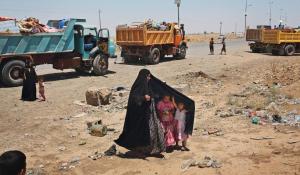
7.04pg0102iraq01Iraqis, predominantly from Tikrit, parked by the side of the highway after crossing a checkpoint south of Kirkuk into the Kurdish Peshmerga-controlled zone after fleeing Iraqi areas overrun by Jihadists from the Islamic State of Iraq and the Levant (ISIL). Andrew Quilty/Oculi

In Baghdad, they call it “zero hour.

It is the moment Iraqis believe is coming soon, when the Islamic State of Iraq and Syria (ISIS), which now controls large parts of the north and west of the country, arrives in their capital.

According to experts there, if Baghdad falls, it will not be from a full-frontal attack, in which the militants rush forward and raise their Black Flag defiantly. Instead, they will win the way rebels in Sierra Leone took Freetown. And the way Bosnian Serbs ringed Sarajevo before shelling it. Their conquest will come from a creeping, steady infiltration designed to break the will of the population.

An estimated 80 percent of Baghdad’s population is Shia, so it would be difficult for ISIS to overrun it in a conventional way. “It would be very hard to take Baghdad,” says Adnan Hussein, editor of the city’s Almada newspaper. “What is going on now is psychological warfare to frighten people.”

“They will not take central Baghdad,” says Hisham al-Hashimi, a security strategist there. “I am not even sure they want it.” Instead, he says, the Islamic insurgents will take “the Baghdad belt”—a series of towns ringing the city, from which they will wage their brutal war. The main Baghdad belt towns are Tarmiyah and Taji, to the north, and Abu Ghraib, site of the notorious prison, to the west. The southwest towns of Yusufiyah, Lutufiyah and Mahmudiyah are also vulnerable, as is Salman Pak to the southeast.

According to military sources, ISIS already has “footprints”—agents on the ground—in those towns, which have increased in number since January due to the insurgency in neighboring Anbar province. There are also grave fears over the fate of Mahmudiyah, a former Al-Qaeda stronghold on the road to Karbala, one of the cities that are sacred to the majority Shias, who make up the Baghdad government.

Caches of ISIS weapons have been discovered in towns on the Tigris River, southeast of Baghdad. Once the Islamists secure those and other crucial posts, according to military sources, “DAISH”—the Arabic name for the insurgents— is expected to activate its “sleeper” Sunni cells, which run like an artery through the city.

According to al-Hashimi, their goal is to intimidate and psychologically wound the population, instill fear, make them abandon their homes and leave the territory free for ISIS to set up an Islamic state in Baghdad.

Irish separatist group the Provisional Irish Republican Army used similar tactics in London in the 1970s and 1980s, when it attempted to intimidate Londoners with the constant threat of bombs planted in crowded public places, like stores and restaurants. “When the IRA started to bomb the mainland of England, they only had to place one or two bombs—and that induced fear in the general population,” says one Western security expert in Baghdad who has worked in Iraq since 2003. “And that is the aim of terrorism. The IRA used to give coded messages to the police as an early message. Why? It’s to instil fear in people more than the bomb itself.”

Hussein says hundreds of thousands have fled Baghdad in the past two weeks. “Because they don’t know what is going to happen. That is fear. That is terrorism.”

General Saad Maan Ibrahim, the Iraqi Army’s Baghdad Operations Command spokesman, says Iraqi security forces are eradicating ISIS sleeper cells. “We are getting good information,” he says. “We have captured two cells this week.” He says there have been more than 100,000 calls to a hot line to which civilians can report suspicious activity. “Or people come in and tell us face to face what is going on. They see it as their duty. They are not afraid.”

“The Missing” Room

While ISIS surges through the north and west of the country, life is becoming increasingly desperate in places under its control. In Mosul, overrun on June 10, most stores are closed, but the ones that are operating are selling their wares at exorbitant prices. Tinned meat is said to cost three times the usual price—from 1,000 Iraqi dinars (86 cents) before the ISIS invasion to 3,000 dinars ($2.58) today.

“People are buying food that is expired because it is cheaper,” says Sallama al-Khafaji, a former member of parliament and a board member of the Iraq High Commission for Human Rights. “Worse is the situation of the sick. If they need medicine, they risk getting poisoned, because there is no electricity in the pharmacies. So the drugs they buy are not good.”

I met al-Khafaji 10 years ago in Baghdad, shortly after she lost her 17-year-old son and her sister to a car bomb. Then (as now) she was heavily guarded, and when she leaves her home or office, she travels in a car that automatically blocks electronic signals between a detonator switch and a bomb. “My son would have been 27 this year,” she reminds me.

But tragedy has not stopped al-Khafaji, whose husband is an adviser to embattled President Nouri al-Maliki. She still believes in a multicultural Iraq, and she now spends her days tracking the ISIS abuses against civilians. “When people from Mosul talked to me,” she says, “they said they saw these men with ‘long hair and short clothes’—that is how they describe ISIS to me—and they ran. They took nothing but the clothes on their backs. Some did not even put on their shoes. Some forgot to take their identification cards.”

The civilians fleeing the terror, she says, are Sunni, Shia and Christians. Recent attacks against Christians have been particularly severe, with the first stories of rape emerging. Al-Khafaji says one Christian father killed himself after members of ISIS raped his daughter.

“It’s starting,” she says. “The crimes against women. They came in the houses in Mosul and took the clothes of women that were un-Islamic and threw them on the street. They tore down the statues of Our Lady.”

“People are afraid,” al-Khafaji says, “because they just don’t know their future.”

William Warda, who works for Hammurabi Human Rights Organization in Baghdad and is active with the Assyrian Democratic Movement, confirms this. “Never have Iraqi Christians been so insecure,” he says. “In Baghdad, they feel they are at the mercy of the majority [Shias] to protect them. In the north, they have to rely on the peshmerga [Kurdish fighters] to protect them. In fact, they have no idea who will protect them.

“Unlike Lebanese Christians, we have not had our own militia since 1933,” he adds. “The future of the Christians in the Middle East is very black. But we cannot run away from Iraq. We have to resist. We are urging the Christian population to stay. Fleeing is not the solution.”

But it is not just the Shias and the Christians who fear for their lives. In Baghdad it is the Sunnis, too, who are terrified, even though ISIS is largely a Sunni army. This time, the Sunnis fear the Shia death squads who are once again operating with impunity. One Western diplomat says, “They never really went away.”

In the Baghdad morgue, Dr. Munjid al-Rezali, the chief pathologist and former director, leads us to a small room called “The Missing.” Inside, on a hard-backed chair, sits Sommaya, a Sunni woman in her 40s. She says she is here to identify the body of her younger brother, Abdullah, an engineer she says was so gentle “he would not hurt anyone.”

Al-Rezali says that, day by day, there is an increase in bodies found on the street—and they are all male Sunnis. In a two-day period, 72 bodies were delivered to the morgue, most bearing the hallmarks of torture, with each Shia militia leaving behind its individual grotesque signature. One militia, for instance, likes to put a flame to nylon, then drip the liquid onto the naked bodies of its victims.

Unlike the 2006–2007 ethnic cleansing of Sunnis here—“the blood years,” as one Sunni woman called it—the Sunni men in the morgue are not prominent members of the communities; they appear to have been average Sunni citizens in mixed neighborhoods. They are being targeted because they symbolize what the international community wants: a multicultural Iraq.

Loss at the Deepest Level

The Shia death squads—in this case, well-dressed men, not the clichéd picture of militiamen dressed in black with balaclavas over their faces—arrived at Sommaya’s southwest Baghdad home on a quiet Sunday, looking for Abdullah. They brandished pistols and searched the house. Sommaya says the men, who described themselves as “officials,” said they would “rape me if I did not bring out my brother.” Eventually, the militiamen found him and dragged him away.

The pathologists say Abdullah was killed one hour after he was taken from his home; his body was dumped behind a nearby school.

As five video screens flash photos of the bodies brought into the morgue that day, Sommaya recognizes her brother. He is wearing only shorts, and his head is a pool of blood. There are bruises on his chest, his arms and his torso, where it appears he was kicked or punched or beaten with a hard object. The blood is clotted where he was shot in the head. The string that tied his hands into a stress position is still in place. Sommaya collapses and sobs, the wails of a broken woman who understands loss at the deepest level.

On the way out of the morgue, we pass five men in dirty yellow jumpsuits, squatting, their hands tied behind them. They are blindfolded. They are all young and look drained of life, as if they know what lies ahead of them. Heavily armed soldiers with steely eyes guard them. As we pass, the prisoners seem aware of people standing behind them, but they do not move, as though they are afraid that any attempt to communicate will lead to a reprisal.

Officially, they are here for questioning. They are suspected ISIS terrorists. What will happen to them? Will they live or die? Will they be tortured to death and dumped in mass graves? Like the fate of Baghdad, which has entered a long and brutal and probably bloody summer, their future is unclear.

US says Israel accepted offer to help hunt down teens’ killers

July 2, 2014

US says Israel accepted offer to help hunt down teens’ killers

State Department confirms ‘many indications’ Hamas was involved;
White House urges Jerusalem to not be ‘heavy-handed’

By Rebecca Shimoni Stoil July 2, 2014, 12:54 am

via US says Israel accepted offer to help hunt down teens’ killers | The Times of Israel.


Israeli Prime Minister Benjamin Netanyahu, right, stands next to Avi Fraenkel, left, and Ofir Shaar (2nd left), fathers of two of the three Israeli teenagers killed in the West Bank, during their funeral on July 1, 2014 in the cemetery of Modiin in central Israel. (photo credit: AFP/POOL/BAZ RATNER)
 

WASHINGTON — A senior White House official revealed Tuesday that Israel had accepted a US offer of assistance in hunting down the killers of three teens, but warned that Israel should “be precise” and avoid an overly “heavy-handed” response to that could further destabilize the situation between Israel and the Palestinians.

The statement by White House Deputy National Security Adviser for Strategic Communication Ben Rhodes came an hour after a State Department spokesperson confirmed the US had received “many indications” that Hamas was “involved” in the kidnapping and killing of three Israeli teenagers whose bodies were discovered Monday.

Rhodes said the US has offered to provide whatever counterterror assistance they can, but did not elaborate on what the aid entailed.

Israeli and US security officials had discussed possibilities for support, but reiterated that Israel “tends to have the clearest understanding of what is taking place when it comes to issues in their neighborhood.”

“In their neighborhood they tend to have the intelligence and law enforcement resources,” he said.

“Our hearts go out to the families of the three teenagers who were found yesterday,” Rhodes told members of Washington’s foreign press corps during a rare question-and-answer session Monday afternoon. “We want to continue to support Israel in finding the perpetrators and bringing them to justice,” he said, adding that “we believe that this is done effectively through working with the Palestinian Authority.”

Rhodes also said that “there has to be an avoidance of steps that can further inflame tensions,” without initially specifying which actors – Israel, Hamas, or the Palestinian Authority’s technocratic government – must do so.

When pressed on Israel’s response to the kidnappings, murders, and continuing rocket attacks launched from the Gaza Strip into southern Israel, Rhodes warned that “Israel needs to be very careful not to be so heavy-handed in their response that they are not threatening the stability of the situation and must respect the dignity of the Palestinian people.”

Rhodes said that “generally, Israel should be precise and they should not cast a net that harms innocent Palestinians in their actions.” In recent days, Israel has faced some international criticism for the rounds of West Bank arrests in which over 400 Palestinians were detained.

At the same time, Rhodes said, “Israel clearly has a deeply held belief that they need to provide for the security of their citizens and when there are three teenagers kidnapped and killed there has to be a response.”

“Terror must be pursued and counterterror measures taken but there must be restraint on both sides,” he said

Although both Rhodes and State Department Deputy Spokeswoman Marie Harf commended Palestinian Authority President Mahmoud Abbas’s stated willingness to work with Israel in the wake of the kidnappings, Harf acknowledged that Abbas did not include Secretary of State John Kerry in a round of calls to world leaders that he reportedly made after the teens’ bodies were discovered outside of Hebron.

Harf, like Rhodes, said that the US was “encouraging restraint from both sides, from the parties, to avoid steps that now could destabilize the situation,” but also noted that the US had offered “full support” both to Israel and to the PA “to find the perpetrator to this crime and bring them to justice.”

Harf declined to comment or criticize the IAF airstrikes carried out overnight against terrorist targets in the Gaza Strip.

She did, however, tread a fine line regarding Hamas’s responsibility for the kidnapping and murders. Although administration officials have been wary of asserting a connection between Hamas and the terror attack, Harf argued Tuesday that “there are many indications pointing to Hamas’s involvement, and it is also important to note that Hamas’s leadership has publicly praised the kidnappings.”

The US, she said, was still waiting to receive more details on the investigation into the youths’ kidnapping and murder.

Israeli security officials have identified two suspects – Marwan Kawasme, 29, and Amar Abu Aysha, 32, both Hamas activists from Hebron — as responsible for the abductions.

“The investigation is still ongoing, and we want to get to the bottom of what happened here,” Harf emphasized, adding that the State Department takes the investigation “very seriously, not just for the fact that these are three teenagers that’ve been killed but also given that one’s an American,” referring to Fraenkel.

Harf then, however, conditioned her remarks by saying that “there are many indications as part of this investigation that Hamas may have been involved. I am not at this point saying they were responsible. I am not putting a specific name out there. I’m saying the investigation’s ongoing.”

White House Spokesperson Josh Earnest also talked up cooperation on Tuesday, noting that ”there was some security cooperation between the Palestinian Authority and Israel as they investigated the disappearance of these young men, as they tried to bring them home safely.”

Earnest highlighted what he described as “an important security relationship between Israel and the Palestinian Authority,” adding that “we hope that that spirit of cooperation, even in the midst of this very difficult time, will continue.”

SHAPIRO: Candlelight Vigils Are Not Enough — It’s Time to Act

July 2, 2014

SHAPIRO: Candlelight Vigils Are Not Enough — It’s Time to ActFight, or get ready for the next slaughter of innocents.

via SHAPIRO: Candlelight Vigils Are Not Enough — It’s Time to Act | Truth Revolt.


he pro-Israel community is often united by tragedy. When five members of the Fogel family, including a three-month-old child, were slaughtered by Palestinian terrorists in 2011, the Jewish community mourned. Candlelight vigils dotted the landscape. 20,000 people turned out for the funerals.

And nothing happened.

Because three years later, the White House continues to fund the Palestinian Authority unity government, which includes Hamas and Islamic Jihad. Three years later, Israel is castigated by the left-wing, Palestinian-supporting media for taking action against terror groups. And three years later, the world community continues to isolate Israel and pressure her to concede to her terrorist enemies.

Now three more Jewish kids are dead, including an American citizen.

And we hear the calls for more candlelight vigils, more shows of unity. We see thousands of Jews and allies gathering internationally to memorialize these three slain teens. We see community leaders expressing sympathy.

And nothing will happen.

Unless we make it happen. The United States must end its support for the Palestinian Authority. It must stop making excuses for the Palestinians’ desire to slaughter Jews wholesale and wipe Israel from the map. It must cease incentivizing the death of Jews, both American and Israeli.

Please tweet with #StopFundingTerror. Please contact the White House and tell them that their support for the Palestinian Authority is unacceptable. Do anything and everything possible to end American taxpayer dollars funding the Palestinian government.

Rabbi Adin Steinsaltz, one of the most renowned sages in the Jewish community and the dean of the high school these boys attended, was told about their murders yesterday. ” “People will light memorial candles, recite prayers, and attend vigils,” he stated, according to the Algemeiner. “Our boys were killed al Kiddush Hashem, because they were Jews.

“Therefore, to best honor their memories – indeed, to confront evil – we must act always as proud Jews, in our deeds and through our lives.”

Now is the time for tears. But it is also the time to act. As proud Jews. As proud Americans. As proud members of Western civilization. If we do not, those who murdered these three boys will keep cashing their checks, preparing for the next opportunity to slaughter innocents.