Archive for June 2014

Iraqi cleric pushes for emergency government

June 26, 2014

Iraqi cleric pushes for emergency government
Muqtada al-Sadr, leader of powerful Mahdi army, says “new faces” are needed to tackle ISIL and Sunni rebellion.

Last updated: 26 Jun 2014 09:50

via Iraqi cleric pushes for emergency government – Middle East – Al Jazeera English.


Fighters loyal to Muqtada al-Sadr vowed to fight the Islamic State of Iraq and the Levant [Getty]
 

Sadr, whose movement, the Mahdi army, has vowed to battle the Islamic State of Iraq and the Levant, on Wednesday said that the Iraqi government “must fulfill the legitimate demands of the moderate Sunnis and stop excluding them because they have been marginalised”.

The cleric demanded “new faces” in a national unity government following April 30 elections that saw Maliki emerge with by far the most seats, albeit short of a majority.

“We also need to rush the formation of a national government with new names and from all backgrounds and not to be based on the usual sectarian quotas,” he said in a televised address.

“I call upon all Iraqis to stop fighting and terrorising the civilians, the Iraqi government must fulfill the legitimate demands of the moderate Sunnis and stop excluding them because they have been marginalised.”

Al Jazeera’s Imran Khan, reporting from Baghdad, said that the comments effectively said that Sadr wanted to get rid of Maliki and choose a new government.

“These comments are strong and will be noticed,” he said, adding they showed a “huge rift” between what Maliki wants and what others believe.

“But Maliki ‎insists that he is the only one that can lead Iraq out of this crisis. July 1st will be a big test for him politically. That’s when parliament are due to meet, and they’ll discuss the formation of the new government.”

Sadr promised his fighters would “shake the ground under the feet of ignorance and extremism”.

Sadr’s remarks came days after fighters loyal to him paraded with weapons in the Sadr City area of north Baghdad, promising to fight the offensive by the fighters of the Islamic State of Iraq and the Levant.

ISIL and associated groups have overrun swaths of several provinces, killed nearly 1,100 people, displaced hundreds of thousands and threaten to tear the country apart.

Barack Obama, the US president, has so far refrained from carrying out air strikes on the rebels, as urged by Maliki, but American military advisers began meeting Iraqi commanders on Wednesday, with Washington having offered up to 300.

Washington has pressed for Iraq’s fractious political leaders to unite in a national emergency government, and on Wednesday brushed off Maliki’s insistence that such a move would be a “coup against the constitution and the political process”.

Washington has stopped short of calling for Maliki to go, but has left little doubt it feels he has squandered the opportunity to rebuild Iraq since American troops withdrew in 2011.

After Syria bombs Iraq, growing fears of regional conflict

June 26, 2014

After Syria bombs Iraq, growing fears of regional conflictJordan,
Kuwait, Saudi Arabia and Turkey all said to be bolstering recon flights inside their airspace;
Kerry warns against exacerbating tensions

By Hamza Hendawi and Lara Jakes June 26, 2014, 2:11 pm

via After Syria bombs Iraq, growing fears of regional conflict | The Times of Israel.


Fleeing Iraqi citizens from Mosul and other northern towns sit on a truck as they cross to secure areas at a Kurdish security forces checkpoint, in the Khazer area between the Iraqi city of Mosul and the Kurdish city of Irbil, northern Iraq, Wednesday June 25, 2014. (photo credit: AP Photo/Hussein Malla)
 

BAGHDAD (AP) — Syrian warplanes bombed Sunni militants’ positions inside Iraq, military officials confirmed Wednesday, deepening the concerns that the extremist insurgency that spans the two neighboring countries could morph into an even wider regional conflict. US Secretary of State John Kerry warned against the threat and said other nations should stay out.

Meanwhile, a new insurgent artillery offensive against Christian villages in the north of Iraq sent thousands of Christians fleeing from their homes, seeking sanctuary in Kurdish-controlled territory, Associated Press reporters who witnessed the scene said.

The United States government and a senior Iraqi military official confirmed that Syrian warplanes bombed militants’ positions Tuesday in and near the border crossing in the town of Qaim. Iraq’s other neighbors — Jordan, Kuwait, Saudi Arabia and Turkey — were all bolstering flights just inside their airspace to monitor the situation, said the Iraqi official, who spoke on condition of anonymity because he was not authorized to speak to the media.

American officials said the target was the Islamic State of Iraq and the Levant, the Sunni extremist group that has seized large swaths of Iraq and seeks to carve out a purist Islamic enclave across both sides of the Syria-Iraq border.

“We’ve made it clear to everyone in the region that we don’t need anything to take place that might exacerbate the sectarian divisions that are already at a heightened level of tension,” Kerry said, speaking in Brussels at a meeting of diplomats from NATO nations. “It’s already important that nothing take place that contributes to the extremism or could act as a flash point with respect to the sectarian divide.”

Meanwhile, two US officials said Iran has been flying surveillance drones in Iraq, controlling them from an airfield in Baghdad. The officials, who spoke on condition of anonymity because they weren’t authorized to discuss the issue publicly, said they believe the drones are surveillance aircraft only, but they could not rule out that they may be armed.

A top Iraqi intelligence official said Iran was secretly supplying the Iraqi security forces with weapons, including rockets, heavy machine guns and multiple rocket launchers. “Iraq is in a grave crisis and the sword is on its neck, so is it even conceivable that we turn down the hand outstretched to us?” said the official, who spoke on condition of anonymity because of the sensitivity of the subject.

The intelligence-gathering and arms supplies come on the heels of a visit to Baghdad this month by one of Iran’s most powerful generals, Qassem Soleimani, commander of the Revolutionary Guard’s Quds Force, to help bolster the defenses of the Iraqi military and the Shiite militias that he has armed and trained.

The involvement of Syria and Iran in Iraq suggests a growing cooperation among the three Shiite-led governments in response to the raging Sunni insurgency. And in an unusual twist, the U.S., Iran and Syria now find themselves with an overlapping interest in stabilizing Iraq’s government.

None-Arab and mostly Shiite, Iran has been playing the role of guarantor of Shiites in Iraq, Syria and Lebanon. It has maintained close ties with successive Shiite-led governments since the 2003 ouster of Saddam Hussein, a Sunni who oppressed the Shiites, and is also the main backer of Syria’s Assad, a follower of Shiism’s Alawite sect.

In a reflection of how intertwined the Syria and Iraq conflicts have become, thousands of Shiite Iraqi militiamen helping President Bashar Assad crush the Sunni-led uprising against him are returning home, putting a strain on the overstretched Syrian military as it struggles to retain territory recaptured in recent months from rebels.

Anthony Cordesman, a prominent foreign policy analyst at the Washington-based Center for Strategic and International Studies, said that with Syria’s apparent willingness to now take on the Islamic State directly, “the real problem is how will Iran, the Iraqi Shiites and the Alawites in Syria coordinate their overall pressure on the Sunni forces?”

Qaim, where the Syrian airstrikes took place Tuesday, is located in vast and mostly Sunni Anbar province. Its provincial government spokesman, Dhari al-Rishawi, said 17 people were killed in an air raid there.

Reports that the Sunni militants have captured advanced weapons, tanks and Humvees from the Iraq military that have made their way into Syria, and that fighters are crossing freely from one side to the other have alarmed the Syrian government, which fears the developments could shift the balance of power in the largely stalemated fight between Assad’s forces and the Sunni rebels fighting to topple him.

Bilal Saab, a senior fellow for Middle East Security at the Atlantic Council’s Brent Scowcroft Center on International Security, said Assad’s immediate priority is to fight the rebels inside his own country.

“His army is already overstretched and every bullet that doesn’t hit enemy targets at home can be a bullet wasted,” he said. “Going after ISIL along border areas could serve tactical goals but is more a luxury than anything else.”

In Brussels, Kerry said Iraqi Prime Minister Nouri al-Maliki appears to be standing by his commitment to start building a new government that fully represents its Shiite, Sunni and Kurdish populations.

However, al-Maliki, in his first public statement since President Barack Obama challenged him last week to create a more inclusive leadership or risk a sectarian civil war, rejected calls for an interim “national salvation government .”

Al-Maliki has faced pressure, including from his onetime Shiite allies, to step down and form an interim government that could provide leadership until a more permanent solution can be found.

Al-Maliki, however, insisted the political process must be allowed to proceed following April elections in which his bloc won the largest share of parliament seats.

“The call to form a national salvation government represents a coup against the constitution and the political process,” he said. He added that “rebels against the constitution” — a thinly veiled reference to Sunni rivals — posed a more serious danger to Iraq than the militants.

Al-Maliki’s coalition, the State of the Law, won 92 seats in the 328-member parliament in the election, but he needs the support of a simple majority to hold on to the job for another four-year term. The legislature is expected to meet before the end of the month, when it will elect a speaker. It has 30 days to elect a new president, who in turn will select the leader of the majority bloc in parliament to form the next government.

More of Iraq’s sectarian tensions boiled over into violence on Wednesday, with Sunni militants shelling a Christian village 45 miles (75 kilometers) from the frontier of the self-ruled Kurdish region, which has so far escaped the deadly turmoil unscathed.

The shelling of the village of Hamdaniya sparked a flight by thousands of Christians from it and other nearby villages toward the Kurdish region. Hundreds of cars, many with crucifixes swinging from their rear-view mirrors, waited to cross into the relatively safe northern Iraqi Kurdish city of Irbil.

Others were forced to walk, including 28-year-old Rasha, who was nine months pregnant and carried her 3-year-old son on her hip. After her husband’s car broke down, the woman, who would give only her first name for fear of militant reprisals, and her mother-in-law walked for miles toward the checkpoint, fearful she would give birth before reaching safety.

Like most others, the women said they had nowhere to go, but hoped strangers would take them in in the Christian-dominated area.

“Otherwise we will sleep in a park,” Rasha said, shrugging.

Meanwhile, pro-government forces battled Sunni militants, threatening a major military air base in Balad, north of Baghdad, military officials said. The militants had advanced into the nearby town of Yathrib, just five kilometers (three miles) from the former U.S. base, which was known as Camp Anaconda. The officials insisted the base was not in immediate danger of falling into the hands of the militants.

Iran Secretly Operates Drone Flights from Former American Base in Iraq

June 26, 2014

Iran Secretly Operates Drone Flights from Former American Base in Iraq.

Iran deploys surveillance drones in Iraq

MQ-1 Predators sit on the Bravo South parking ramp at Balad Air Base, Iraq in this undated USAF handout photo obtained by Reuters February 6, 2013.Reuters

Iran is secretly operating surveillance drones from an airfield in Baghdad as the Sunni militia makes a stronger push across Iraq in its march on the capital to topple the Shiite-led administration of Prime Minister Nouri al-Maliki.

Tehran is also giving Iraqi forces tonnes of military equipment and other supplies after the US-trained troops failed to withstand the onslaught of the fighters from the Islamic State in Iraq and the Levant (Isis) since the beginning of the month.

The New York Times reported that Iranian transport planes are making regular flights to Baghdad, ferrying military equipment and supplies. There are two flights every day and each sortie carries 70 tonnes of equipment and supplies, an unnamed US official told the newspaper.

“It’s a substantial amount … It’s not necessarily heavy weaponry, but it is not just light arms and ammunition.”

Iran has reaffirmed its commitment to assist the Shiite-led administration in Baghdad against the advancing Sunni militants, while officially saying the US should not intervene in the current crisis in Iraq.

However, in reality the US, Iran and Syria are on the same side fighting against the common enemy.

The US is sending as many as 300 military specialists to Iraq, while about a dozen officers from Iran’s paramilitary Quds Force have reached Baghdad to advise the government. Syria carried out airstrikes on Isis fighters in western Iraq.

US allies in the Middle East such as Saudi Arabia are wary of Iran’s direct military involvement in Iraq and Tehran has stopped short of deploying troops in the strife-torn country.

However, it has readied at least 10 divisions of the Quds Force along the border with Iraq and is willing to send the forces in if it perceives a threat to Shiite holy shrines in the country.

According to US officials, Iran has at least two dozen battle-ready aircraft stationed in the west of the country.

Iran’s special control centre at Rasheed Air Base in Baghdad is overseeing the operation of surveillance drone flights over Iraq. The command centre also has a signals intelligence unit that intercepts electronic communications between Isis fighters, the NYT said.

The US army had used the Rasheed Air Base in Baghdad in 2003, in the early phase of its occupation.

The Isis fighters who are closing in on Baghdad aim to establish a hardline Sunni Islamist caliphate straddling Iraq and Syria.

PM fears US hatching bad deal with Iran, summons his DC envoy, calls Putin

June 26, 2014

PM fears US hatching bad deal with Iran, summons his DC envoy, calls Putin
Netanyahu also to dispatch top officials to try to prevent accord that would turn Tehran into a threshold nuclear power

By Times of Israel staff June 26, 2014, 2:31 am

via PM fears US hatching bad deal with Iran, summons his DC envoy, calls Putin | The Times of Israel.


US President Barack Obama and Prime Minister Benjamin Netanyahu shake hands in the Oval Office of the White House in Washington, March 3, 2014 (photo credit: AP/Pablo Martinez Monsivais)
 

Israel’s Prime Minister Benjamin Netanyahu on Wednesday summoned home his ambassador to the US for emergency consultations, spoke by phone with Russian President Vladimir Putin, and prepared to dispatch a delegation of top officials in a bid to thwart what he reportedly fears is a dangerous deal being prepared by US-led negotiators over Iran’s rogue nuclear program.“There is growing concern in Jerusalem that a deal is being hatched,” Israel’s Channel 2 news reported.Ron Dermer, Israel’s ambassador to the United States and one of Netanyahu’s closest advisers, who was on hand in DC Wednesday to greet the visiting Israeli President Shimon Peres, was called home later in the day for two days of urgent consultations with the prime minister, the TV report said.Netanyahu also selected a team of officials, led by his Minister of Intelligence and Strategic Affairs Yuval Steinitz, and his National Security Adviser Yossi Cohen, who are set to leave Israel on Sunday for urgent talks with representatives of the P5+1 nations negotiating with Iran over its nuclear program. Those negotiations are set to resume next Wednesday.


Prime Minister Benjamin Netanyahu and Russian President Vladimir Putin at Netanyahu's residence in Jerusalem on June 25, 2012. (Photo credit: Marc Israel Sellem/POOL/FLASH90)

Prime Minister Benjamin Netanyahu and Russian President Vladimir Putin at Netanyahu’s residence in Jerusalem on June 25, 2012. (Photo credit: Marc Israel Sellem/POOL/FLASH90)


In Netanyahu’s phone conversation with Putin, the TV report said, the message conveyed was that any deal with Iran must leave it years away from a potential breakout to the bomb. Netanyahu’s concern is that the deal being hatched would turn Iran into a threshold nuclear state, capable of breaking out to the bomb in a matter of months.

The White House is well aware of Israel’s worries, the TV report said, but evidently does not share them.

Last November, taken by surprise as the P5+1 negotiators reached an interim agreement with Iran, Netanyahu publicly slammed it as a “historic mistake” and urged the US in vain not to approve it.


President Barack Obama greets President Shimon Peres at the White House on June 25 (photo credit: Kobi Gidon/GPO)

President Barack Obama greets President Shimon Peres at the White House on June 25 (photo credit: Kobi Gidon/GPO)
 

During their talks at the White House on Wednesday, President Barack Obama told Peres — who steps down as president next month — that the US would not allow Iran to develop nuclear weapons. Netanyahu, however, has been demanding that Iran be denied the capacity to build nuclear weapons — which would entail the dismantling of Iran’s entire “military nuclear program,” the prime minister says, notably including its uranium enrichment capabilities. Obama has indicated that Iran could retain an enrichment capacity, if subject to intrusive inspections.

Obama told Peres that there were still gaps between the sides in the P5+1 talks with Iran, which are being held in the hopes of reaching a permanent agreement with Tehran by July 20 to curb its nuclear program. Briefing Peres on the current state of the negotiations, Obama promised that the US position would not change on Iran’s breakout potential or on key aspects of its technological development, and said that the US will not compromise on Israel’s security.

After the meeting, Peres told journalists that he hoped the final agreement with Iran would be similar to the agreement by which Syria was forced to part with its entire chemical weapons stockpile and the dismantling of its related infrastructure earlier this year. With such a deal in place, Peres said, Israel would consider supporting the removal of some of the sanctions against Tehran.

Peres also underlined that no deal with Tehran would be better than a bad deal that turned Iran into a threshold state.

Breaking Down the Enemy

June 26, 2014

Breaking Down the Enemy

The abductors, including all the outer circle of conspirators and collaborators, have nothing to fear for their crimes.

There is nothing to stop them, or future kidnappers, from continuing to abduct and harm Israeli citizens.

By: Rabbi Fishel Jacobs

Published: June 25th, 2014

via The Jewish Press » » Breaking Down the Enemy.


A prisoner in Israel’s Ramle Prison, July 29, 2013.
Photo Credit: Moshe Shai/FLASH90
 

Presently, Israel is in the throes of yet another unimaginable heinous terrorist crime. Specifically, the cold-blooded kidnapping of three innocent high school students, one of whom also holds American citizenship.

At this time, it is fitting to revisit the subject of the treatment of convicted Islamic terrorists in Israel Prison Service, (I.P.S.). As an ex-Israel prison officer, who’s also published a book on that subject, I’ve written my thoughts on this topic on numerous occasions.

There is a pointedly critical relevance between the conditions of terrorists in the I.P.S. and the horrific abduction of harmless teenage youth. It is a two-fold issue.

First. Israel is presently expending unlimited amounts of money and manpower searching for these boys. A house-to-house, cave-to-cave – every nook and cranny – search is now underway in suspected areas of concealment throughout Israel. To date (June 22), a few local Arabs have been killed when they inexplicably attempted to impede this search and rescue mission.

Israeli security utilizes many methods of intelligence gathering. For one, the country has huge numbers of informants seeded within the Arab community. These people have numerous incentives to cooperate. Economic gain is one. Simply, monetary compensation. Another benefit is legal protection. Israel often strikes deals with Arabs convicted of crimes for which punishment is erased in return for favors to the country. In this instance that would be information on the whereabouts of these abducted kids.

However, the reality of things is that pressure always helps. Israel must increase pressure on the Arab community. Pressure jolts information into moving. Intensified pressure gets information into the right hands.

Israel has thousands of convicted Islamic terrorists in their prison service. These men and women are living under extraordinarily comfortable conditions, which would be unfathomable in any other modern country. Televisions and radios in every cell. Kitchenettes and refrigerators in cell blocks. Frequent family and friend visits. Exercise yards full of equipment such as ping-pong tables, soccer balls, weights. Diet considerations specially tailored to their personal quirks. Rights to furthering their education, including post high school degrees.

One very reasonable argument, which arises regularly in the media and in fact in the Israeli parliament, is that these convicted criminals simply don’t deserve these luxuries. The Israeli prison where I served, for over a decade, held two hundred terrorists. Most had multiple life sentences. Not a few had over a dozen life sentences! These include men who murdered pregnant women with their own hands. Men who butchered defenseless children and elderly in coldly premeditated attacks in the light of day. Let it be perfectly clear, these are ruthless criminals.

Beyond that, however, there’s the message being sent to the Arab community at large. That message is: Israel doesn’t punish, even for the most heinous crimes against its citizenship.

By stripping these inmates rights to the bare minimum – as bestowed by other modern countries – this damaging message would be corrected. But, more importantly, pressure would be added to their terrorist organizations and personal supporters outside.

Imagine removing radios, televisions and newspapers from these terrorists. Stop family visits. Remove kitchenettes. Require that these inmates eat government-issued prison food. Any of these actions, and all together, they would dramatically increase pressure.

Increasing pressure inside will get more information flowing outside.

The second reason that Israel must remove the pampering of convicted Islamic terrorists, enjoyed exclusively in its jails, is the message that will be sent to the kidnappers of these three youth.

The abductors, including all the outer circle of conspirators and collaborators, have nothing to fear for their crimes. There is nothing to stop them, or future kidnappers, from continuing to abduct and harm Israeli citizens.

After all, Israel does not enforce the death sentence, even while it remains on the books. Incarceration is pleasant. Cells and cell blocks are shared with comrades in arms. Staff, from the lowest ranking guard to officers, wardens and even the highest echelon of hierarchy deal with terrorists professionally and pleasantly. These are the norms.

There are no deterrents to crimes against Israel today.

The fact that thousands of convicted terrorists are released in the ongoing so called ‘peace’ deals only increases the fact that there is no deterrent to committing crimes against Israel. Even the longest sentenced terrorists hold feasible hope that they will be released. But, that is a subject for a different article.

In short, Israel holds thousands of convicted terrorists in its jails, the majority are serving multiple life sentences. This is a tremendous card to pressure the Arab community. The time has passed to use it.

Al Qaeda in Syria/Iraq Doubles in Size as ISIS and Al Nusra Kiss and Make Up

June 26, 2014

Al Qaeda in Syria/Iraq Doubles in Size as ISIS and Al Nusra Kiss and Make Up, Front Page Magazine, Daniel Greenfield, June 25, 2014

isis-qaeda-450x287

ISIS didn’t just beat the Iraqi military. It also beat Syria’s dominant Al Qaeda group, the Al-Nusra Front, which like ISIS had also been spawned from Al Qaeda in Iraq. The Al-Nusra Front began shooting at ISIS when the latter invaded Syria and claimed authority over it. But now they kissed and made up.

It’s all one big happy Al Qaeda family.

The number of Islamist extremists fighting for ISIS could double after al-Qaeda’s 15,000 strong offshoot in Syria is said to have pledged allegiance to the militant group.

Al-Qaeda’s Syrian offshoot Wednesday made an oath of loyalty to the Islamic State of Iraq and Greater Syria (ISIS) at a key town on the Iraqi border, a monitor said.

News of the merger between ISIS and the al-Nusra front were made by both the British-based Syrian Observatory for Human Rights and an Islamist website this afternoon.

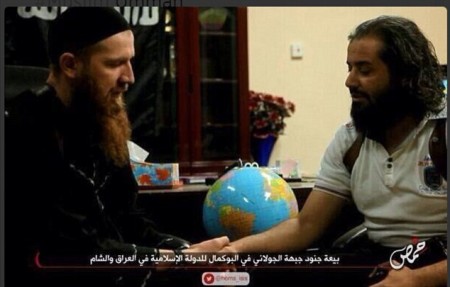
Images widely shared by ISIS supporters online appeared to show al-Nusra’s alleged leader in the Albu Kamel region, Abu Yusuf al-Masri, embracing ISIS fighters after apparently taking an oath of allegiance.

Ayman al-Zawahiri, the overall leader of al-Qaeda, has previously disowned ISIS and proclaimed the al-Nusra Front as its official Syrian affiliate.

An internal report of ISIS’ activities last year put its total number of fighters in Iraq and Syria at 15,000. With al-Nusra boasting a similar sized or possibly even larger force, today’s merger could double the total number of militant Sunni Islamists fighting under the ISIS banner in the Middle East.

Hardest hit are all the “news stories” about how ISIS was too “extreme” for Al Qaeda. So much for that. But nothing to worry about.

As Barack Hussein Obama once said, “If a jayvee team puts on Lakers uniforms that doesn’t make them Kobe Bryant.”

The jayvee team is taking over two countries and has its own air force.

John Boehner to Sue Obama Over Abuse of Executive Powers

June 25, 2014

John Boehner to Sue Obama Over Abuse of Executive Powers

via John Boehner to Sue Obama Over Abuse of Executive Powers.


Wednesday, 25 Jun 2014 01:23 PM
 

The House will vote next month on legislation authorizing a campaign-season lawsuit accusing President Barack Obama of failing to carry out the laws passed by Congress, Speaker John Boehner announced on Wednesday.

In a memo distributed to House members, Boehner accused Obama of “aggressive unilateralism” and said if left unchecked, it would give the president “king-like authority at the expense of the American people and their elected legislators.”

White House press secretary Josh Earnest dismissed any suggestion that the president has failed to act within the law in issuing executive orders or taking other actions. “We feel completely confident that the president was operating within his authority as the president of the United States to take these steps on behalf of the American people,” he told reporters.

Whatever the outcome of the suit in the courts, Boehner’s announcement guarantees creation of yet another political struggle between Republicans and Obama and his Democratic allies in a campaign already full of them.

“On matters ranging from healthcare and energy to foreign policy and education, President Obama has repeatedly run an end-around” on the public and Congress, the speaker wrote. He accused him of “ignoring some statutes completely, selectively enforcing others and at times, creating laws of his own.”

At a news conference, Boehner strongly brushed aside a question of whether impeachment proceedings could result from the suit.

In his memo, he stopped short of accusing the president of violating his oath of office. Instead, he said Obama was “straining the boundaries of the solemn oath he took on Inauguration Day.”

Other Republicans have been less restrained. Rep. Lou Barletta of Pennsylvania said recently the House probably has the votes to impeach Obama, although he said he wasn’t calling for it. One former tea party-backed lawmaker, ex-Rep. Allen West of Florida, has called for the House to vote to remove the president from office.

Boehner also rejected a suggestion that the suit was a political move designed to give traditional Republican voters an added impetus for going to the polls this fall when control of Congress will be at stake.

But Rep. Steve Israel of New York, who chairs the Democratic campaign committee, said Boehner planned a politically motivated lawsuit,” and predicted the voters would punish Republicans for it.

He accused the speaker of a “reprehensible waste of taxpayers’ money and a desperate political stunt meant to gin up the Republican base at a time when House Republicans are historically unpopular.”

Disputes about the balance of power between the executive branch and the Congress are as old as the Constitution under a system in which lawmakers pass laws and the president carries them out.

Boehner said the House “must act as an institution to defend the constitutional principles at stake.”

Official: Intelligence community warned about ‘growing’ ISIS threat in Iraq

June 25, 2014

Official: Intelligence community warned about ‘growing’ ISIS threat in Iraq

Fox News’ James Rosen and Catherine Herridge contributed to this report.
Published June 24, 2014FoxNews.com

via Official: Intelligence community warned about ‘growing’ ISIS threat in Iraq | Fox News.


The U.S. intelligence community warned about the “growing threat” from Sunni militants in Iraq since the beginning of the year, a senior intelligence official said Tuesday — a claim that challenges assertions by top administration officials that they were caught off guard by the capture of key Iraqi cities.

Earlier Tuesday, in an interview with Fox News, Secretary of State John Kerry said “nobody expected” Iraqi security forces to be decisively driven out by the Islamic State of Iraq and Syria, or ISIS, as they were earlier this month in Mosul.

But in a separate briefing with reporters Tuesday afternoon, the senior intelligence official said the intelligence community had warned about the ISIS threat.

“During the past year, the intelligence community has provided strategic warning of Iraq’s deteriorating security situation,” the official said. “We routinely highlighted (ISIS’) growing threat in Iraq, the increasing difficulties Iraq’s security forced faced in combating (ISIS), and the political strains that were contributing to Iraq’s declining stability.”

Asked who failed to act, the official did not explain.

Offering a grave warning about the current strength of the group — which is a State Department-designated terror organization — the official also said that barring a major counteroffensive, the intelligence community assesses that ISIS is “well-positioned to keep the territory it has gained.”The official said the ISIS “strike force” now has between 3,000 and 5,000 members.

Further, the official said ISIS, as a former Al Qaeda affiliate, has the “aspiration and intent” to target U.S. interests. Asked if Americans have joined, the intelligence official said it “stands to reason that Americans have joined.”

The information from the intelligence community adds to the picture of what is known about the ISIS threat, and what might have been known in the weeks and months before its militants seized Mosul and other northern cities and towns.

Kerry, speaking with Fox News on Tuesday in the middle of a multi-country swing through the Middle East and Europe as he tries to calm the sectarian crisis in Iraq, pushed back on the notion that more could have been done from a Washington perspective to prevent the takeovers. Pressed on whether the fall of Mosul and other cities to Sunni militants marks an intelligence failure, Kerry said nobody could have predicted Iraqi security forces would have deserted.

“We don’t have people embedded in those units, and so obviously nobody knew that. I think everybody in Iraq was surprised. People were surprised everywhere,” he said.

The secretary noted that the U.S. and Iraq did not sign a formal agreement allowing troops to stay in the country past 2011, so “we didn’t have eyes in there.”

“But the Iraqis didn’t even have a sense of what was happening,” Kerry said.

When asked what the U.S. did to shore up Mosul, after seeing other Iraqi cities fall earlier this year, Kerry added: “In the end, the Iraqis are responsible for their defense, and nobody expected wholesale desertion and wholesale betrayal, in a sense, by some leaders who literally either signed up with the guys who came in or walked away from their posts and put on their civilian clothes.

“No, nobody expected that.”

But aside from the apparent warnings from the U.S. intelligence community, reports in The Telegraph and Daily Beast claim that Kurdish sources did warn American and British officials that ISIS was gaining strength and ready to advance, but it “fell on deaf ears.”

A senior lieutenant to Lahur Talabani, head of Kurdish intelligence, reportedly told The Daily Beast that the Kurds passed on warnings about a possible takeover of Mosul to British and U.S. government officials.

“We knew exactly what strategy they were going to use, we knew the military planners,” the official said.

The Telegraph reported that Washington and London got warnings months ago about Sunni militant plans to try and take over the northwestern region of Iraq. The Kurds reportedly had been monitoring developments on their own.

At this stage, though, the question for Kerry and the Obama administration is how far they are willing to go to shore up the embattled Iraqi government. Kerry, in Baghdad a day earlier, pressed Prime Minister Nouri al-Maliki to proceed with the formation of a new government — Iraq’s parliament is set to begin this process next week.

In the meantime, President Obama has committed up to 300 U.S. military advisers to help Iraq’s government fend off ISIS forces. The administration continues to weigh whether to authorize airstrikes.

Kerry issues warning after Syria bombs Iraq

June 25, 2014

Kerry issues warning after Syria bombs Iraq, YnetNews, June 25, 2014

(Rumors that Big Bird and Donald Duck have issued similar warnings have yet to be confirmed. — DM)

US secretary of state urges regional actors to refrain from initating further military operations that might worsen ISIS crisis.

US Secretary of State John Kerry warned Mideast nations on Wednesday against taking new military action in Iraq that might heighten sectarian divisions, as reports surfaced that Syria launched airstrikes across the border and Iran flew surveillance drones over the neighboring country.

A senior Iraqi military official confirmed that Syrian warplanes bombed militants’ positions Tuesday in and near the border crossing in the town of Qaim. He said Iraq’s other neighbors – Jordan, Kuwait, Saudi Arabia and Turkey – were all bolstering flights just inside their airspace to monitor the situation. The official spoke on condition of anonymity because he was not authorized to speak to the media.

American officials said the strikes appeared to be the work of Syrian President Bashar Assad’s government. They said the target was the Islamic State of Iraq and al Shams, a Sunni extremist group that seeks to carve out a purist Islamic enclave across both sides of the Syria-Iraq border.

“We’ve made it clear to everyone in the region that we don’t need anything to take place that might exacerbate that sectarian divisions that are already at a heightened level of tension,” Kerry said, speaking at a meeting of diplomats from NATO nations. “It’s already important that nothing take place that contributes to the extremism or could act as a flash point with respects to the sectarian divide.”

Kerry said Baghdad needs to take steps to ensure that Iraq’s military can defend the country without relying on outside forces. The US is sending 300 military advisers.

Nevertheless, the involvement of Syria and Iran in Iraq suggests a developing Shiite axis among the three governments in response to the raging Sunni insurgency. And in an unusual twist, the US, Iran and Syria now find themselves with overlapping interests in stabilizing Iraq’s government.

US officials believe the leadership in Baghdad should seek to draw Sunni support away from the militants led by the Islamic State. The insurgency has drawn support from disaffected Iraqi Sunnis who are angry over perceived mistreatment and random detentions by the Shiite-led government.

Kerry said appears to be standing by his commitment to start building a new government that fully represents its Shiite, Sunni and Kurdish population. But he said the US is watching closely to make sure any new political process does not repeat past mistakes of excluding Iraq’s minorities.
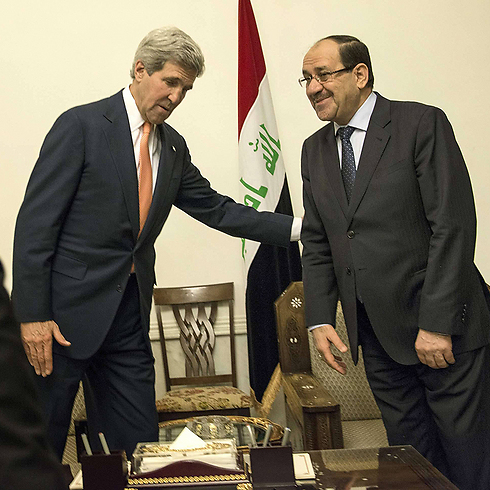
Kerry and MalakiUS Secretary of State John Kerry and Iraqi Prime Minister Nouri al-Maliki (Photo: AFP)

On Wednesday, al-Maliki rejected calls for an interim “national salvation government” in his first public statement since President Barack Obama challenged him last week to create a more inclusive leadership or risk a sectarian civil war.

Several politicians, including Ayad Allawi, a secular Shiite who has been named as a possible contender to replace al-Maliki, have called on him to step down and form an interim government that could provide leadership until a more permanent solution can be found.

Al-Maliki, however, insisted the political process must be allowed to proceed following recent national elections in which his bloc won the largest share of parliament seats.

“The call to form a national salvation government represents a coup against the constitution and the political process,” he said. He added that “rebels against the constitution” – a thinly veiled reference to Sunni rivals – posed a more serious danger to Iraq than the militants.

He called on “political forces” to close ranks in the face of the growing threat by insurgents, but took no concrete steps to meet US demands for greater inclusion of minority Sunnis.

Al-Maliki’s coalition, the State of the Law, won the 92 seats of the 328-member parliament in the election. In office since 2006, al-Maliki needs the support of a simple majority to hold on to the job for another four-year term. The legislature is expected to meet before the end of the month, when it will elect a speaker. It has 30 days to elect a new president, who in turn will select the leader of the majority bloc in parliament to form the next government.

Qaim, where the Syrian airstrikes took place, is located in the vast and mostly Sunni Anbar province. Its provincial government spokesman, Dhari al-Rishawi, told The Associated Press on Tuesday that 17 people were killed in an air raid there.

The White House said intervention by Syria was not the way to stem the insurgents, who have taken control of several cities in northern and western Iraq.

“The solution to the threat confronting Iraq is not the intervention of the Assad regime, which allowed ISIS to thrive in the first place,” said Bernadette Meehan, a National Security Council spokeswoman. “The solution to Iraq’s security challenge does not involve militias or the murderous Assad regime, but the strengthening of the Iraqi security forces to combat threats.”

Underling the persistent danger of Iraq being swept up again by sectarian bloodletting, a suicide bomber blew himself up at an outdoor market south of Baghdad on Wednesday, killing 15 people and wounding 30, police and hospital officials said.

They said the attack took place around sunset in the Shiite majority area of Mahmoudiya area, 20 miles (30 kilometers) south of the capital. No one claimed responsibility for the attack but it bore the hallmarks of Sunni militants who have for years targeted security forces and Shiite civilians.

Earlier Wednesday, Sunni militants launched a dawn raid on a key Iraqi oil refinery they have been trying to take for days, but security forces fought them back, said Col. Ali al-Quraishi, the commander of the Iraqi forces on the scene.

A mortar shell also smashed into a house in Jalula, northeast of Baghdad, killing a woman and her two children. That town in the turbulent Diyala province is under the control of Kurdish fighters known as peshmerga.

Also, a report by Iran’s semi-official Fars news agency said an attack near Iran’s western border with Iraq has killed three Iranian border guards. They were killed Tuesday night while patrolling along the border in western Kermanshah province. A border outpost commander was among the three killed, Fars quoted a local security official, Shahriar Heidari, as saying.

Heidari said an unspecified “terrorist group” was behind the attack but provided no details.

A US official said Wednesday that Iran has been flying surveillance drones in Iraq.

American and Iranian officials have had some direct discussions on the matter, though the Obama administration has ruled out the prospect of direct military involvement. The US is also conducting aerial surveillance over Iraq.

The US officials spoke only on grounds of anonymity because they weren’t authorized to discuss the issue publicly.

In the face of militant advances that have virtually erased Iraq’s western border with Syria and captured territory on the frontier with Jordan, al-Maliki’s focus has been the defense of Baghdad, a majority Shiite city of 7 million fraught with growing tension. The city’s Shiites fear they could be massacred and the revered al-Kazimiyah shrine destroyed if Islamic State fighters capture Baghdad. Sunni residents also fear the extremists, as well as Shiite militiamen in the city, who they worry could turn against them.

The militants have vowed to march to Baghdad and the holy Shiite cities of Najaf and Karbala, a threat that prompted the nation’s top Shiite cleric, Grand Ayatollah Ali al-Sistani, to issue an urgent call to arms that has resonated with young Shiite men.

Al-Maliki, who has no military background but gets the final say on major battlefield decisions, has looked to hundreds of thousands of Shiite volunteers who joined the security forces as the best hope to repel the Islamic State’s offensive.

While giving the conflict a sectarian slant – the overwhelming majority are Shiites – the volunteers have also been a logistical headache as the army tries to clothe, feed and arm them. Furthermore, their inexperience means they will not be combat ready for weeks, even months.

Still, some were sent straight to battle, with disastrous consequences.

New details about the fight for Tal Afar – the first attempt to retake a major city from the insurgents – underscore the challenges facing the Iraqi security forces.

Dozens of young volunteers disembarked last week at an airstrip near the isolated northern city and headed straight to battle, led by an army unit. The volunteers and the accompanying troops initially staved off advances by the militants, but were soon beaten back, according to military officials.

They took refuge in the airstrip, but the militants shelled the facility so heavily the army unit pulled out, leaving 150 panicking volunteers to fend for themselves, said the officials, who spoke on condition of anonymity because they were not authorized to speak to the media.

The ill-fated expedition – at least 30 volunteers and troops were killed and the rest of the recruits remain stranded at the airstrip – does not bode well for al-Maliki’s declared plan to make them the backbone of Iraq’s future army.

IRBIL, Iraq: Islamist fighters reportedly attempting to encircle Baghdad

June 25, 2014

Islamist fighters reportedly attempting to encircle Baghdad

via IRBIL, Iraq: Islamist fighters reportedly attempting to encircle Baghdad – World – MiamiHerald.com.


Kurdish peshmerga fighters takes their positions behind sand barriers at the village of Taza Khormato in the northern oil rich province of Kirkuk, Iraq, June 20, 2014.
Hussein Malla / AP
 

By Mitchell Prothero
McClatchy Foreign Staff

IRBIL, Iraq — Iraq’s dire situation has gone from bad dream to nightmare in two weeks of fighting that have seen Sunni Muslim gunmen assert control over a growing area, including, Kurdish officials said Tuesday, at least two towns that lie on a crucial supply route linking Baghdad, the capital, with the mostly Shiite Muslim south.

The fall of towns in an area that American troops knew as the “triangle of death” because of its propensity for violence provided an ominous signal, the Kurdish officials said, that the Islamic State of Iraq and Syria and its Sunni allies are working to encircle Baghdad.

“The picture is no longer scary,” said Shafin Dizayee, the spokesman for the autonomous Kurdistan Regional Government in Irbil. “It has become close to a nightmare scenario, where we see Daash expanding and taking control of its borders.” “Daash” is the Arabic acronym for ISIS.

Another Kurdish official, Jabbar Yawar, the spokesman for the Kurdish peshmerga militia, said ISIS fighters apparently had seized control of the towns of Iskandariya and Mahmoudiya, south of Baghdad, and were reported in some instances to be just six miles from Baghdad.

“This area controls access to southern Iraq, and it appears as if they might try to push into Baghdad or even south towards the city of Hilla,” he said.

Southern Iraq is mostly Shiite, and it supports the embattled government of Prime Minister Nouri al Malaki. Thousands of young men from the south have flocked to Baghdad to bolster the flagging army, and many observers have assumed that the flow of southern militiamen would help stem an ISIS advance that’s captured much of northern and central Iraq in the weeks since the city of Mosul fell under ISIS control June 10.

But the loss of the southern approaches to the capital would change that calculus and add to the sense that Baghdad was gradually being isolated. On Sunday, Iraqi soldiers lost control of the last major crossing point to Syria, while gunmen allied with ISIS took control Monday of Tirbil, Iraq’s only land crossing to Jordan. Anbar province, to Baghdad’s west, has been largely under ISIS’s sway since last year, and the group is now contesting government forces in Diyala and Salahuddin provinces, to the capital’s north and east.

As one town after another has fallen, the Iraqi government has insisted that most of the lost territory remains in government hands. But officials of the Kurdistan Regional Government provide a decidedly different view, one lent credibility by Kurdish estrangement from the Maliki government and ISIS. Their assessment of what’s taking place in Iraq also matches that of a U.S. defense official, who said ISIS and its allies were consolidating control of the Euphrates River Valley in apparent preparation for attacks on Baghdad.

The official, who spoke only on the condition of anonymity because he wasn’t authorized to speak publicly, said Iraqi security forces were struggling to establish a defensive line centered on Samarra, a key city that controls the northern approaches to Baghdad. In a separate briefing, a senior U.S. intelligence official said ISIS was also menacing the Iraqi air base at Balad, the country’s largest military installation.

The only good news for the Maliki government, the Kurdish officials said, appeared to come from Baiji, where, the Kurds said, government troops remain in control of at least part of Iraq’s largest oil refinery. A government pullout from the refinery, which some news outlets reported Tuesday, would be an economic disaster for the government and a boon for ISIS. The facility produces 60 percent of Iraq’s gasoline.

“My information is that there is still fighting inside the refinery,” Yawar said. “When I last spoke with military officials in Baghdad, they said that about half the facility was in government hands and the other half in Daash hands and the government was sending special forces reinforcements from the besieged city of Samarra.”

So far, ISIS and its allies have mostly avoided direct confrontation with the Kurds’ peshmerga militia, which has a reputation for military effectiveness, and the peshmerga has largely avoided direct confrontations with the Sunni insurgents, refusing to assist Iraq’s army in repulsing ISIS beyond establishing a security line outside Kurdish territory, which stretches from the northern borders with Syria and Turkey south to the Iranian border. That Kurdish arc has remained more or less peaceful since the rebellion began.

The peshmerga also quickly occupied areas of the split Arab-Kurdish city of Kirkuk in the wake of the army’s retreat. The Kurdish government has long coveted Kirkuk for its symbolism as an ancient Kurdish city and its rich oil fields.

The estrangement between the Kurds and Maliki’s government is enormous. In the aftermath of the fall of Mosul, Maliki accused the Kurdistan Regional Government’s president, Massoud Barzani, of collaborating with ISIS, and the Kurds and Maliki have verbally battled over the Kurds’ push for autonomy and efforts to bypass Baghdad on oil sales.

Bridging that gap was the main reason Secretary of State John Kerry was in Irbil on Tuesday, meeting with Barzani, who’s called for replacing Maliki.

Despite the country’s dire security deterioration, there’s been no contact between Barzani and Maliki since Mosul fell, said spokesman Dizayee and Harry Schute, an American security adviser to the Kurdish Ministry of Interior.

The last contact between the peshmerga and the Iraqi army, Schute said, was when “they handed over the keys to the facilities” in Kirkuk.

Added Dizayee, “Maliki has not been in touch with Kurdish leaders once about the crisis. He’s adopted a stubborn position, and we simply cannot see how to go forward in light of this position.”

During his meeting with Kerry, Barzani told the secretary of state that “we are facing a new reality and a new Iraq.” Most analysts thought that statement meant the Kurds were unlikely to relinquish control of Kirkuk or to concede in their battle with Baghdad over oil revenues.

On Monday, Kerry met with Maliki officials in an effort to convince them to reach out to angry Sunnis _ who’ve flocked to support ISIS _ and the Kurds. At least part of that effort was successful: Dizayee said a delegation of officials from Baghdad would arrive in Irbil on Wednesday to begin talks on the crisis.

Jonathan S. Landay contributed to this story from Washington.