Archive for June 2014

Why Should Americans Fund Hamas? – WSJ

June 5, 2014

U.S. Funding for Hamas?The State Department winks at the Palestinian merger with the terror group.June 4, 2014 4:17 p.m. ETThe 1988 Hamas Charter explicitly commits the Palestinian terror group to murdering Jews.

Thanks to the formation this week of an interim government uniting Hamas and the Palestinian Authority, which the U.S. supports to the tune of more than $400 million a year, the American taxpayer may soon become an indirect party to that enterprise.

via Why Should Americans Fund Hamas? – WSJ.

“Today we declare the end of the split and regaining the unity of the homeland,” PA President Mahmoud Abbas said in televised remarks Monday. The split he was referring to is the bloody conflict between Mr. Abbas’s Fatah faction, which controls the West Bank, and Hamas, which in 2007 forcibly expelled Fatah from the Gaza Strip.

Previous attempts at reconciliation had failed in large part because Hamas had refused to subsume its armed wing to the PA. This time Mr. Abbas acquiesced to a partnership with a heavily armed terrorist group. The resulting relationship will likely resemble the one next door between the Lebanese government, with its negligible regular army, and the Shiite terror group Hezbollah, which like Hamas boasts an arsenal of Iranian-supplied missiles.

The question is whether the U.S. government will continue to fund the PA now that Mr. Abbas has cast his lot with a State Department-designated foreign terrorist organization. U.S. law prohibits dispensing taxpayer money to any Palestinian entity over which Hamas exercises “undue influence.”

Palestinian President Mahmoud Abbas Associated Press

To hew as close as possible to the letter of U.S. law, the architects of the Hamas-backed interim government have assembled a cabinet of old PA holdovers and technocrats from Gaza with no obvious links to Hamas. The maneuver was good enough for the Obama State Department. “At this point, it appears that President Abbas has formed an interim technocratic government that does not include ministers affiliated with Hamas,” spokeswoman Jen Psaki told reporters earlier this week. “Moving forward, we will be judging this government by its actions.”

But that still leaves open the question of the PA’s treaty obligations. The Oslo Accords and its progeny, including the 1998 Wye Memorandum, set very clear limits on the extent and potency of the PA arsenal. Under the Wye Memorandum, for example, the PA is required to “establish and vigorously and continuously implement a systematic program for the collection and appropriate handling of” illegal weapons.

Nobody should count on the aging and calculating Mr. Abbas to exercise meaningful control over Hamas’s arsenal, much less its behavior. And nobody should count on the Obama Administration to apply meaningful penalties to the PA for joining forces with Hamas and flouting its obligations toward Israel. That leaves Congress, which can block funding to the Palestinians until they prove capable of governing themselves as something other than a terrorist enterprise.

Taking Iran’s Anti-Semitism Seriously

June 5, 2014

When U.S. policymakers focus on Iran, they tend to look at technical issues—its military capabilities, its economy, its nuclear ambitions. But they seldom pay enough attention to its ideological beliefs.Published on June 2, 2014

via Taking Iran’s Anti-Semitism Seriously – The American Interest.

Radical, theologically based hatred of Judaism, Zionism, and the state of Israel is part of the core ideological beliefs of the leaders of the Islamic Republic of Iran. Yet U.S. policymakers all too rarely consider Iran’s endemic anti-Semitism. In fact, it’s hardly ever discussed outside of Israel and a few Western intellectual circles. To be sure, the Iranian regime’s radical anti-Semitism is of deepest concern to Israel, but a regime driven by such violent hatred also endangers the world, especially modern, Western, democratic nations.

While the U.S. Congress has held hearings about the technical details of Iran’s nuclear programs and the impact of economic sanctions, as far as I know it has never publicly discussed the core ideology of the Iranian regime and how it affects Iran’s quest for nuclear weapons. Such hearings are long overdue. The radical anti-Semitism voiced by Iranian leaders is a worldview so delusional, so removed from actual realities, that those who advocate it will almost certainly not operate according to the customary norms of what constitutes reasonable behavior in international affairs. Indeed, U.S. policymakers cannot assume that Iran will value its own survival more than it does the goal of eliminating the hated Jewish enemy.

The scholarship on the history of anti-Semitism hasn’t yet had a significant impact on the policy discussions in Washington about Iran. Perhaps too many of our policymakers, politicians, and analysts still labor under the mistaken idea that radical anti-Semitism is merely another form of prejudice or, worse, an understandable (and hence excusable?) response to the conflict between Israel, the Arab states, and the Palestinians. In fact it is something far more dangerous, and far less compatible with a system of nuclear deterrence, which assumes that all parties place a premium on their own survival. Iran’s radical anti-Semitism is not in the slightest bit rational; it is a paranoid conspiracy theory that proposes to make sense (or rather nonsense) of the world by claiming that the powerful and evil “Jew” is the driving force in global politics. Leaders who attribute enormous evil and power to the 13 million Jews in the world and to a tiny Middle Eastern state with about eight million citizens have demonstrated that they don’t have a suitable disposition for playing nuclear chess.

Iranian anti-Semitism has been well documented, in particular by Meir Litvak of the Dayan Center for Middle East Studies at the University of Tel Aviv and the Middle East Research and Media Institute (MEMRI). They have offered abundant evidence that hatred of the Jews and a determination to destroy the state of Israel are paramount goals for the Islamic Republic and have been ever since its founder, Ayatollah Ruhollah Khomeini, gave such views theological sanction. Like his fellow Islamists, Haj Amin el-Husseini and Sayyid Qutb, Khomeini asserted that Jews were bent on destroying Islam, a mission he claimed found modern expression in the establishment of Israel. Indeed, he saw no difference between his hatred of Jews and Judaism and his hatred of Israel.1 His successor shares Khomeini’s views: as reported by the Islamic Republic News Agency (IRNA), Ayatollah Ali Khamenei stated in 2001 that “the occupation of Palestine [by the Jews] is part of a satanic design by the world domineering powers, perpetrated by the British in the past and carried out today by the United States, to weaken the solidarity of the Islamic world and to sow the seeds of disunity among nations.”2 As Meir Litvak writes, both Khomenei to Khamenei see Jews and Judaism as a threat to Islam and the Muslims. Khomenei made uncompromising, theologically-based assertions that Israel and Zionism were enemies not only of Islam but of humanity in its entirety, and Khamenei has said the same. Such evil enemies, they believe, must be wiped out for the good of all.

As a historian of modern German history, specializing in the Nazi era and the Holocaust, I know the pitfalls of misplaced historical analogies. Israel’s enemies commonly make such analogies; the Soviet Union, the Arab states, Palestinian organizations, Islamist terror groups and the government of Iran have all compared Israel to Nazi Germany. Yet our current policy debates suffer from the opposite problem. Policymakers are unwilling to openly and frankly discuss radical anti-Semitism when it comes from Islamist sources. Despite their differences, we must remember that the Islamic Republic of Iran is the first government since Hitler’s in which anti-Semitism constitutes a central element of its identity. An Iran with nuclear weapons would thus be the first government since Hitler’s to be both willing and able to threaten a second Holocaust.

No high-ranking member of the Obama Administration has admitted that this is the case—neither the President nor his Secretaries of State and Defense have ever publicly discussed Iran’s anti-Semitism. The issue has faded into the background, replaced by a preoccupation with technical details about centrifuges, percentages of uranium enrichment, and lengths of “break-out times.” When policymakers fail to consider the core beliefs of the Iranian leadership, they foster the impression that Iran is a smaller, Islamic version of the Soviet Union—that is, a state which would act in its own self-interest if it had nuclear weapons. Yet the Soviet Union was governed by atheists who disdained notions of a life after death and would have laughed at the idea of a “12th Imam” descending to earth after an apocalyptic disaster. If Iran acquires nuclear weapons, it would likely be the first such state not to be deterred by the prospect of nuclear retaliation. Yet the irrationality of Iran’s government has received scant attention in the United States government, which seems unable to believe that people could put their faith in a post-apocalyptic messiah. That is both a failure of imagination and a failure of policy.

It is not clear why there has been such consistent disinclination to publicly examine and discuss what the Iranian leaders believe. Part of the blame may lie with the tendency of realist scholars of international relations and politics to dismiss the importance of ideology. Or perhaps it is the fact that Israelis have done the best and most careful work on Iran’s ideology that leads some foreign policy analysts to ignore it. President Obama’s repeated assertions that “the tide of war is receding,” his decision to leave Iraq and Afghanistan, and his refusal to intervene in Syria suggest a different explanation. A close and honest look at the beliefs of Iran’s leaders would undermine the hope that the Islamic Republic is actually a normal, rational actor in world affairs. For if the Iranians actually do believe what they say, and then the unavoidable conclusion is that they are lying about the purposes of their nuclear program and have been playing Western leaders, including the President, for fools. Further, it means that they will not cease their pursuit of the bomb unless, at the very least, they are threatened with more severe damage to their economy—though more likely not, unless the United States credibly thereatens military action against them. Since no one knows how such a military campaign—not an invasion but a naval and air campaign—would end, policymakers understandably wish to consider Iran a “normal” state and tend to neglect the inconvenient evidence of its ideological fanaticism. Yet denying the reality will not make it disappear.

There are other and more familiar reasons why the United States does not want Iran to get the bomb. A nuclear Iran could deter military action against its terrorist proxies, Hamas and Hizballah, and threaten to disrupt the flow of energy in the Persian Gulf. If Iran were to acquire the bomb after several American Presidents had asserted that this must not happen, America’s credibility would be damaged. Without the U.S. as a reliable guarantor, the nuclear non-proliferation treaty would seem less stable, and many other states might begin to develop their own nuclear weapons programs—not least Japan and South Korea.

On February 6, 2014, Senator Robert Menendez, Chairman of the Senate Foreign Relations Committee delivered an historic yet underreported speech on the Senate floor about the state of the negotiations with Iran. Stating his opposition to the relaxation of economic sanctions by the Geneva Agreement of November 2013, the Senator said that “years of obfuscation, delay, and endless negotiation have brought the Iranians to the point of having—according to the Director of National Intelligence—the scientific, technical, and industrial capacity to eventually produce nuclear weapons.” The Iranian’s strategy of using “these negotiations to mothball its nuclear infrastructure program just long enough to undo the international sanctions regime” has “brought them to a nuclear threshold state.” The Obama Administration must surely know this to be true as well. Policymakers must understand that Iran has not invested billions of dollars and weathered years of international isolation only to change course and stop pursuing nuclear weapons. Perhaps the officials involved in the P5 Plus One talks know that the most likely outcome of the current policy is that Iran will get the bomb it claims not to want. If the plan is to contain and deter a nuclear Iran rather than to prevent it from getting the bomb in the first place, then the refusal of the President and other European leaders to consider the Iranians’ ideology makes a certain sense. Such a policy can only rest on a willful ignorance of the regime’s core beliefs.

The United States has the economic and military resources to prevent Iran from getting the bomb. If it becomes necessary to use force to achieve that end, the Administration must present the full range of reasons for that decision. A regime animated by radical anti-Semitism not only poses a threat of a second Holocaust, but due to its dangerous irrationality, poses a threat to the whole world. President Obama and his leading officials insist that their policy remains one of prevention, yet they do not seem to understand the very people they are seeking to deter. Iran’s ideological extremism has become lost in the fog of technical details. If we are to have an effective policy on Iran, we must first understand what makes the country tick, as well as its bombs.

1Meir Litvak, “Iranian Antisemitism: Continuity and Change,” in Charles Asher Small, ed., Global Antisemitism:  A Crisis of Modernity, Volume IV, Islamism and the Modern World (Institute for the Study of Global Antisemitism, 2013), p. 60.

2Alyatollah Ali Khamenei, cited by Litvak, “Iranian Antisemitism,” p. 60.

West prods Tehran to speed up cooperation with IAEA inquiry

June 5, 2014

West prods Tehran to speed up cooperation with IAEA inquiry | Mid-East | Saudi Gazette.

VIENNA — Iran faced Western pressure on Wednesday to speed up its promised cooperation with a long-stalled UN nuclear watchdog investigation into suspected atomic bomb research by Tehran, something the Islamic state denies.

The European Union — which groups three of the six powers seeking to negotiate a settlement to a decade-old dispute with Iran over its nuclear program — noted that “some” progress had been made in separate talks between Iran and the International Atomic Energy Agency (IAEA).

But, the 28-nation EU added in a statement to a quarterly meeting of the IAEA’s 35-nation governing board, “We call on Iran to provide all the relevant information to the agency, to address fully the substance of all of the concerns and to accelerate its cooperation with the agency.”

Canada’s ambassador to the Vienna-based IAEA put it more bluntly, saying Iran was using a kind of “salami-sliced, piece-by-piece approach” in its dealings with the UN watchdog.

“We are definitely of the view that Iran is moving too slowly to address these long-standing questions. They do need to move faster,” Mark Bailey told Reuters.

For several years, the IAEA has been investigating suspicions that Iran may have coordinated efforts to process uranium, test explosives and revamp a ballistic missile cone in a way suitable for a nuclear warhead. Iran says the allegations are false but has offered to help clarify them.

Tehran says its uranium enrichment program is a peaceful energy project whereas the West fears it is covertly oriented to develop nuclear weapons capability. Western diplomats have long accused Tehran of stonewalling the IAEA’s probe.

After years of increasing tension with the West, last June’s election of Hassan Rohani as Iranian president paved the way for a dramatic thaw in relations. However, the sides remain far apart on what a long-term nuclear agreement should look like. US officials say it is vital for Iran to resolve the IAEA’s questions if the US, France, Germany, Britain, China and Russia are to reach a long-term accord with Iran that would set a verifiable framework for its nuclear activity and end punitive international sanctions imposed on Tehran. — Reuters

Israel says Iran giving ‘false explanations’ to U.N. nuclear probe

June 5, 2014

Israel says Iran giving ‘false explanations’ to U.N. nuclear probe – chicagotribune.com.

By Fredrik Dahl

VIENNA (Reuters) – Israel has condemned as unacceptably slow Iran’s cooperation with a U.N. watchdog inquiry into suspected atomic bomb research and accused Tehran of providing “false” explanations for its disputed activities.

At a weekly board meeting of the International Atomic Energy Agency, IAEA Director General Yukiya Amano said Iran had finally begun to engage with an investigation into allegations that it has worked on designing a nuclear warhead.

Western envoys to the IAEA cautiously welcomed the development, calling for Tehran to pick up the pace of its cooperation, but Israel’s ambassador suggested Iran was just trying to buy time while pressing on with its nuclear work.

Widely believed to be the Middle East’s only nuclear-armed power, Israel sees Iran’s atomic program as a direct threat and has in the past warned it could carry out unilateral strikes on Iran’s nuclear sites.

Iran, which rejects accusations that it has been trying to develop a nuclear bomb capability, says it is Israel’s presumed arsenal that endangers regional peace and security.

“Iran continues to abuse what is termed as a ‘step-by-step’ approach to the resolution of outstanding issues,” Israeli Ambassador Merav Zafary-Odiz said, referring to a phased cooperation pact agreed in November between Iran and the IAEA.

“This pace of investigation is unacceptable … Iran will continue to provide false explanations and to hide the true nature of its activities,” she said, without giving details.

Because of a Jewish holiday, Zafary-Odiz did not deliver her statement during Wednesday’s IAEA board debate on Iran, but it was posted later on the U.N. agency’s web site.

WEST WARY

Israel is also deeply skeptical of U.S.-led efforts to reach a final international accord to scale back a nuclear program which Iran says is peaceful but the West fears may be a covert bid to develop the means and expertise to build nuclear weapons.

U.S. officials say it is vital for Iran to resolve the IAEA’s concerns if the parallel negotiations between Tehran and the United States, France, Germany, Britain, China and Russia on the long-term agreement to settle the dispute are to succeed.

Those talks aim to set verifiable, civilian limits to Iran’s nuclear program and end punitive international sanctions imposed on Tehran.

Israeli Prime Minister Benjamin Netanyahu has complained that sanctions on the Islamic Republic are being eased prematurely.

The IAEA’s inquiry focuses specifically on what it calls the possible military dimensions of Iran’s atomic activities, notably whether it has carried out research and tests relevant for nuclear weapons.

Iran says the allegations of a nuclear weapon agenda are baseless but has offered to address them since pragmatist Hassan Rouhani took office as Iranian president last year, partly on a platform to end the Islamic state’s international isolation.

Last month, Iran gave the U.N. watchdog some information requested in the inquiry as to its purpose in developing Exploding Bridge Wire (EBW) detonators, which can be used to set off an atomic explosive device. Iran has said it needed them for civilian purposes.

In a meeting in Tehran on May 20, Iran also agreed to address two other areas of the investigation by Aug. 25.

Western governments regard Iran’s increased readiness to cooperate as positive but are likely to remain skeptical until it has cleared up all allegations of illicit atomic work.

“It is essential that Iran delivers substantive progress in the near future,” the 28-nation European Union said in a statement to the IAEA’s quarterly board of governors meeting.

Report: US held secret talks with Hamas

June 5, 2014

Report: US held secret talks with Hamas – Israel News, Ynetnews.

Diplomat sources claim that US, Hamas negotiated unity deal, democratic elections in secret meetings.

Attila Somfalvi

Mere hours after the formation of a Palestinian unity government, the United States announced that – despite stern Israeli opposition the move – it would not boycott the new Hamas-backed government.

The reason for that announcement may have been revealed; senior diplomatic sources told NY-based news website BuzzFeed that the US has held secret talks with Hamas for the past six months.

According to the aforementioned sources, the meetings between American mediators and Hamas leadership were conducted outside the Gaza Strip – in Egypt, Qatar, and Jordan. The topics of the negotiations included the ceasefire agreement with Israel and the formation of a Palestinian unity government, reported BuzzFeed.

The report claimed that Hamas gave assurances to the US which allowed it to support the unity government despite the firm opposition from Israel. According to the diplomatic sources – one Palestinian and one American – the assurances included a commitment to maintain the de-facto ceasefire with Israel which has been in place since Operation Pillar of Defense.

“Our administration needed to hear from them that this unity government would move toward democratic elections, and toward a more peaceful resolution with the entire region,” said the US official. “It was important to have that line of communication.”

The State Department denied the backchannel talks. These assertions are completely untrue,” Spokeswoman Marie Harf told BuzzFeed. “There is no such back channel. Our position on Hamas has not changed.”

The Americans have denied the existence of a secret line to Hamas in the past; in 2012, then-spokeswoman Victoria Nuland claimed that reports of such a back channel were “bizarre.”

From time to time Israel also makes use of mediators, usually Egypt, in order to talk to Hamas – as happened at the end of Operation Pillar of Defense and after other military operations.

‘Aid to PA will continue’

A US source told Ynet that the American administration intends to continue providing the Palestinian Authority with financial aid. He said such a step should be coordinated with Congress, but that the meaning of the recognition of the new government was merely to continue transferring funds to the PA.

The source said recognition of the new government would require work, but that because of Hamas’ inclusion the US will continue to closely monitor the government’s conduct.

Meanwhile, the right-wing in America criticized President Barack Obama and his administration for recognizing the Palestinian unity government against Israel’s wishes. US representatives and senators examined the possibility of halting the American aid to the PA.

US law determines that the government cannot offer financial aid to bodies that are in contact with terrorist organizations; the US has designated Hamas as a terrorist organization.

Iran’s Khamenei: US has taken military action off table

June 5, 2014

Iran’s Khamenei: US has taken military action off table | The Times of Israel.

Likely reacting to Obama foreign policy address, Iranian leader says strike against nuclear program is not an American priority

June 5, 2014, 10:44 am

Iranian supreme leader Ayatollah Ali Khamenei delivering a speech on the 25th anniversary of the death of the late founder of the Islamic Republic Ayatollah Ruhollah Khomeini, at his mausoleum in a suburb of Tehran on June 4, 2014. (photo credit: AFP/ HO /Iranian Supreme Leader's Website)

Iranian supreme leader Ayatollah Ali Khamenei delivering a speech on the 25th anniversary of the death of the late founder of the Islamic Republic Ayatollah Ruhollah Khomeini, at his mausoleum in a suburb of Tehran on June 4, 2014. (photo credit: AFP/ HO /Iranian Supreme Leader’s Website)
 
The US is no longer interested in carrying out military action against Iran, the country’s supreme leader said Wednesday, extollingTehran’s efforts at overcoming years of “trouble making” by arch-foe Washington.The US has often repeated the refrain that “all options remain on the table” vis-a-vis stymieing Iran’s nuclear program, but speaking in Tehran, Ayatollah Ali Khamenei said Washington was no longer considering hitting Iran.“They realized that military attacks are as dangerous or even more dangerous for the assaulting country as they are for the country attacked,” Khamenei said, according to a New York Times report.A “military attack is not a priority for Americans now,” he said. “They have renounced the idea of any military actions.”Khamenei was speaking to a gathering of the country’s leaders to mark the 25th anniversary of the death of his predecessor Ayatollah Ruhollah Khomeini, who founded the Islamic Republic.

His remarks were likely in response to a foreign policy address by US President Barack Obama in late May, during which the president said a nuclear deal with Iran was likely and the US was finding diplomacy for effective than military action.

Khamenei, who sets the direction Iran takes, made no mention of a rapprochement, warning officials of what he called American efforts to “sow discord among leaderships” and foment coup d’etats and “color revolutions.”

“The external challenge before Iran is the trouble-making of the global arrogance — frankly speaking, that of the United States,” he said in remarks broadcast live on state television from Khomeini’s shrine, south of Tehran.

Iran and the US have had no diplomatic ties for more than three decades, but hopes of a thaw in relations were raised in November after Tehran and world powers signed an interim nuclear deal that it is hoped can be transformed into a lasting accord in further talks.

Iranian President Hassan Rouhani and Obama had also spoken by telephone months earlier in what was seen as a major gesture of willingness toward future dialogue.

Iran’s domestic challenges include “shifting focus away from the real enemy and on to (internal) disputes and losing national unity.”

He did not elaborate but Iran’s fragmented political factions have clashed in recent months over the course of nuclear negotiations, led by Rouhani who favors detente with the West and solving the decade-long nuclear standoff.

The negotiations will resume in mid-June, with Iran and the five permanent members of the UN Security Council — the United States, Britain, France, China and Russia — plus Germany, meeting in Vienna.

They seek a comprehensive agreement against the July 20 deadline that would curb Iran’s nuclear activities and increase international monitoring in exchange for the lifting of painful sanctions.

Western powers suspect Iran is masking a military drive in its nuclear work, while Tehran denies ever seeking atomic weapons.


US envoy condemns new settlement building plans

June 5, 2014

US envoy condemns new settlement building plans | The Times of Israel.

Dan Shapiro criticizes Israel’s decision to push ahead 1,500 units in West Bank and East Jerusalem as response to formation of Palestinian unity government

June 5, 2014, 9:17 am
US Ambassador to Israel Dan Shapiro speaks at the Jewish Federations' General Assembly (GA) in Jerusalem on November 11, 2013. (photo credit: Flash90)

US Ambassador to Israel Dan Shapiro speaks at the Jewish Federations’ General Assembly (GA) in Jerusalem on November 11, 2013. (photo credit: Flash90)

The US ambassador to Israel condemned on Thursday a plan to build 1,500 housing units in the West Bank and East Jerusalem, announced as a retaliatory measure to the formation of a Palestinian unity government earlier this week.

“We oppose settlement construction in the West Bank as well as announcements regarding such construction,” Dan Shapiro told Army Radio. “We would do so with or without this disputed case of a new Palestinian transitional government.”

Shapiro’s statement was the first official US response to the Housing and Construction Ministry decision to publish tenders for the 1,500 units, announced early Thursday morning.

Housing and Construction Minister Uri Ariel called the move an “appropriate Zionist response to the Palestinian terror government.”

Of the housing projects approved by Ariel’s ministry, over 700 are slated for the Etzion Bloc settlements of Efrat and Beitar Illit south of Jerusalem, with another 76 planned in Ariel, 78 in Alfei Menashe, 155 in Givat Ze’ev, and 400 in the northern Jerusalem neighborhood of Ramat Shlomo.

An additional 38 are to be built outside what’s considered the major West Bank settlements blocs, in the West Bank settlement of Geva Binyamin, north of Jerusalem.

The settlement construction announcement came after opposing Palestinian parties Fatah and Hamas set aside their differences and formed a national unity government Monday, ending seven years of hostility.

Israel and the US consider Hamas a terror group. Israel has opposed the government and called on the world to boycott it, but the US said it would continue to work with Ramallah, angering some in Jerusalem.

Shapiro said, though, that the US did not recognize Hamas as a legitimate representative of the Palestinian people despite the establishment of the new government.

“We have no illusions about Hamas; Hamas is a terrorist organization,” he said.

“We have no ties with Hamas and we will not work with them, we will not give them assistance, and we will not work with any government of which Hamas is a member.”

The new Palestinian cabinet sworn in Monday, considered a technocratic interim cabinet meant to steer the Palestinians toward new elections, does not include any Hamas ministers.

The United States, the EU, the UN and Russia have all accepted to work with the cabinet.

Jerusalem on Monday night slammed the United States for announcing that it will work with the new Palestinian unity government. Israeli officials said that Washington ought to be urging Palestinian Authority President Mahmoud Abbas to disband his pact with Hamas and resume peace negotiations with Israel instead of associate with a terror group.

US Secretary of State John Kerry responded to criticism Wednesday saying Abbas “made clear that this new technocratic government is committed to the principles of nonviolence, negotiations, recognizing the state of Israel, acceptance of the previous agreements and the Quartet principles.”

“Based on what we know now about the composition of this technocratic government, which has no minister affiliated to Hamas and is committed to the principles that I describe, we will work with it as we need to, as appropriate,” he said.

Kerry in Beirut promotes US engagement with pro-Iranian Hizballah terrorists, after Hamas

June 5, 2014

Kerry in Beirut promotes US engagement with pro-Iranian Hizballah terrorists, after Hamas.

DEBKAfile Exclusive Report June 5, 2014, 9:42 AM (IDT)

John Kerry in Beirut

John Kerry in Beirut

Secretary of State John Kerry’s visit to Beirut Wednesday June 4 was part and parcel of the new turn in Obama administration policy, which is to start engaging directly with Arab governments backed by pro-Iranian terrorist organizations like the Lebanese Hizballah and Palestinian Hamas. The first visit to Beirut in five years by a US secretary of state came two days after Washington rushed to accept and continue funding the Hamas-backed Palestinian government installed in Ramallah.

On his arrival in Lebanon, Kerry made some awkward comments:

“We do not recognize the government of Palestine – that would mean we recognize a state.” He added that the US will continue to work with the new Palestinian unity government “as we need to” and will monitor daily its policies to ensure it “doesn’t cross the line.”

A leading member of the Lebanese government is Hizballah, which is classied in the US as a terrorist organization. By talking with prime minister Tammam Salam, Kerry articulated the new rule: Washington will maintain ties with a government, whether in Beirut or Ramallah, so long as it “doesn’t cross the line.”
At the same time, the US Secretary delivered into the hands of the Lebanese government a half billion dollar check for the Syrian refugees sheltering in Lebanon, ignoring the fact that its member, Hizballah, has crossed many lines by fighting for President Bashar Assad in the Syria civil war, and the death and destruction Hizballah helped inflict had put those refugees to flight.
But Kerry avoided defining the lines that must not be crossed and saying how the administration would respond if they were.

Talking to journalists later, Kerry himself crossed a line to new ground, when he said:

“Iran, Russia and Hizballah must engage in a legitimate effort to bring this war to an end,”

This was the first time a US Secretary of State has explicitly invited Hizballah, whose forces are fighting in Syrian under Iranian command, to be part of the quest for a political resolution of the Syrian war and accepted the Moscow-Tehran-Beirut axis as a critical partner in this effort. Up until now, Kerry insisted in leaving Iran and Hizballah out of US discussions with Moscow on the Syrian crisis.

Senior sources in Jerusalem sharply criticized Washington’s embrace of the most violent and radical of Middle East terrorist organizations. They saw no difference between the openness to Iran and Hizballah exhibited by Kerry in Beirut and the administration’s readiness to do business with the Palestinian unity government backed to the hilt by Hamas.

According to those sources, by Thursday morning June 5, Prime Minister Binyamin Netanyahu had determined to go head-on against the new Obama administration line with a confrontation in the US Congress over its support for the Palestinian unity government.

Netanyahu will seek, with the aid of the pro-Israel AIPAC lobby, to get a law passed banning the continued transfer of US financial aid of approximately $500,000 a year to the Ramallah government, over its backing by the Hamas terrorist organization.
debkafile’s sources in Washington don’t expect this move to succeed. Even if the both houses of Congress enact such legislation – and that is doubtful – the president has enough legal and administrative resources to circumvent it.

Op-Ed: From Athens to Jerusalem: A Journey in Strategic Wisdom

June 5, 2014

Op-Ed: From Athens to Jerusalem: A Journey in Strategic Wisdom, Israel National News, Louis Rene Beres, June 4, 2014

(Could  Electro Magnetic Pulse (EMP) devices disable Iran’s nuclear command and control infrastructure sufficiently to prevent a successful attack on Israel? — DM)

In Iran, even the relatively “moderate” Rouhani regime has remained fixedly genocidal toward Israel. Reciprocally, moreover, Israel has made no nuclear threats against Tehran, or, for that matter, against anyone else.

[T]here can never be any purposeful Israeli exchange of “the atom” for “peace.” Never.

For Israel . . . . nuclear weapons and doctrine are absolutely necessary, but they are not sufficient.

It is also worth noting that Iranian nuclear threats to Israel could ultimately manifest themselves in certain ways that do not involve ballistic missiles, and that Jerusalem must therefore always be ready to deal capably with these alternate forms of nuclear delivery. A plausible case in point would be the use of container ships or trucks as enemy delivery vehicles, and/or the use of presumptively appropriate terrorist proxies, such as Hezbollah.

When Pericles delivered his Funeral Oration in 431 BCE, the same year as the start of the Peloponnesian War, his oratorical perspective was plainly strategic. As recorded by Thucydides, an early Greek historian whose dominant focus was on a better understanding of military power, Pericles’ speech acknowledged that Athenian security must forever remain uncertain.

“What I fear more than the strategies of our enemies,” lamented the wise Athenian wartime leader Pericles, “is our own mistakes.”

Contemporary Jerusalem is not ancient Athens. Nonetheless, history is often kaleidoscopic, and despite unimaginable changes in science and technology, the most primal inclinations toward war and peace continue largely unaltered. On complex matters of military strategy, there is always considerable reshuffling and recombination of doctrine, but still no genuinely basic transformation of constituent “parts.”

To be sure, Pericles didn’t have to concern himself with nuclear weapons and nuclear war. Still, the core principles of offense and defense in warfare have remained pretty much unchanged. Later, Machiavelli  said as much, when, in the Discourses, he reminded his early sixteenth-century readers that both strategic dilemmas and strategic solutions are endlessly repeating themselves: “We ought to consider,” commented Machiavelli, that “there is nothing in this world at present, or at any other time, but has and will have its counterpart in antiquity.”

Why so? Effectively anticipating Freud during the Italian Renaissance, the prophetic Florentine strategist had answered insightfully: “These things (strategic judgments) are operated by human beings, who, having the same passions in all ages, must necessarily behave uniformly in similar situations.”

With appropriate nuance, modern Israel can learn usefully from Pericles, Thucydides, and Machiavelli. The most conspicuous lesson here for Jerusalem must be to avoid strategic self-delusion at all costs. Significantly, in the huge and always pending “opportunity” to commit irremediable strategic mistakes, no prospective national error can loom larger than compromising Israel’s indispensable nuclear deterrent.

Always, sometimes with contrived shrieks and screams, the “civilized” world calls upon Israel to embrace a nuclear-free world. Each and every year, in this connection, Jerusalem’s most intractable enemies advance high-sounding proposals for a “nuclear-weapons-free-zone” in the Middle East. Just as often, assorted other states in the United Nations call self-righteously upon Israel to become a non-nuclear party to the 1968 Nuclear Non-Proliferation Treaty (NPT).

Why not join? At first glance, all such purportedly jurisprudential proposals sound eminently fair and reasonable. Why, after all, should Tehran be kept by law from “going nuclear,” while Jerusalem is simultaneously allowed to proceed unhindered, with its own uniquely “opaque” nuclear weapons and doctrine?

The short answer is that not all nuclear weapons states are the same. In Iran, even the relatively “moderate” Rouhani regime has remained fixedly genocidal toward Israel. Reciprocally, moreover, Israel has made no nuclear threats against Tehran, or, for that matter, against anyone else.

For now, at least, Jerusalem understands the critical importance of “mass” in military strategy, and also its irrefutable geo-strategic corollary for Israel’s national survival: Without its nuclear weapons and doctrine, whether more openly disclosed, or still “deliberately ambiguous,” the Jewish State’s lack of mass will ultimately be fatal. From the very beginning, Israel’s first prime minister, David Ben-Gurion, had understood the unassailable futility of seeking to protect an eternally beleaguered mini-state with purely conventional forces.

But isn’t a denuclearized Israel simply a strategic straw man? Isn’t it effectively inconceivable?

Perhaps not.

For one thing, the President of the United States, Barack Obama, argues that nuclear weapons are effectively evil in themselves. On September 24, 2009, the UN Security Council unanimously approved a resolution supporting “a world without nuclear weapons.” In response, President Obama then exclaimed confidently: “This resolution enshrines our shared commitment to a goal of a world without nuclear weapons.”

Naturally, Barack Obama does not speak for Israel. Yet, on December 22, 1995, Israel’s Shimon Peres stated publicly: “Give me peace, and we’ll give up the atom.” Years later, on December 11, 2006, then Prime Minister Ehud Olmert offered a similar public nuclear revelation.

Also within Israel itself, a number of the country’s leading academic strategists have sometimes argued openly to exchange the country’s nuclear weapons for “peace.”  I know this to be true. I have debated them myself on the pages of Harvard University’s respected journal, International Security. http://belfercenter.ksg.harvard.edu/publication/533/correspondence.html?breadcrumb=%2Fexperts%2F1076%2Fzeev_maoz.

Committing “our own mistakes,” had most worried Pericles. Apropos of this enduring or generic worry, Israel must never consent to giving up its nuclear weapons. But, what if anything can still be done about Iran’s seemingly unstoppable effort to join the “nuclear club?”

Legally, any resort to an aptly “proportionate” and “discriminate” defensive first-strike – a preemptive attack against Iran’s pertinent nuclear infrastructures – might still be permissible. International law, after all, is never a suicide pact. In law, no country is ever obligated to sit back, and wait passively to be attacked. This authoritative argument for “anticipatory self-defense” can be found as far back as the Hebrew Bible (Deuteronomy),  and has been an integral part of customary international law since the classic case of The Caroline in 1837.

This is no longer, however,  a basically legal or jurisprudential matter. Rather, it is a fundamentally strategic one. And at this very late date, any successful preemption against Iran would be highly improbable. In other words, understood in specifically Periclean terms, attempting such a defensive strike would likely represent a very substantial “own mistake.”

Israel may no longer be able to militarily prevent a nuclear Iran, but it can still maximize the essential security benefits of its nuclear forces. With these forces, even if undisclosed, or “ambiguous,” or “in the basement,” Israel could successfully deter (1) most enemy unconventional attacks; and (2) most large enemy conventional attacks.  Holding such weapons, Israel, when operationally capable, could also reasonably launch certain non-nuclear preemptive strikes against enemy state non-nuclear hard targets.

Without these weapons, any such defensive first strikes would likely represent the onset of a much wider war. After all, there would no longer remain any persuasive threats to the target state of any Israeli counter retaliation.

Although widely unacknowledged, Israel’s nuclear weapons represent a critical impediment to the actual military use of nuclear weapons, and to the commencement of a regional nuclear war. They must, therefore,  remain at the coherent conceptual center of Israel’s security policy, and should be guided by a continuously updated and refined national strategic doctrine. Over time, the essential elements of any such doctrine should begin to include an incrementally measured end to “deliberate ambiguity,” more recognizable emphases on  “counter value” or counter-city targeting, and fully compelling evidence of secure “triad” nuclear forces. These forces, of course, must also be presumed capable of reliably penetrating any foreseeable aggressor’s active defenses.

Israel’s presumed efforts at diversified sea-basing (German Dolphin-class submarines) of nuclear retaliatory forces are costly, but prudent. Similarly prudent will be undertaking all measures needed to prepare the Israel Air Force for executing anticipated strikes at increasingly long distances. Whether preemptive, retaliatory, or counter-retaliatory, the IAF now requires, inter alia,  the “full envelope” of air refueling capabilities, upgraded satellite communications,  state-of-the-art  electronic warfare technologies, armaments fully appropriate to inflicting maximum target damage, and latest-generation UAVs to accompany selected missions.

Adequate national security will also demand persistently close attention to cyber-defense, cyber-war, with an unhindered superiority in emerging space technologies and active defenses. In this connection, as Iran continues to move nearer to a full military nuclear capacity, Israel’s ballistic missile defenses (Arrow) could become increasingly vital, both to selected areas of “soft-point” or civilian protection, and to protection of the country’s “hard-point” nuclear retaliatory forces. This lesser-known second function would be oriented toward safeguarding Israel’s nuclear deterrent, and would be practically supportive only to the extent that Iran were able to deploy a more-or-less limited number of offensive nuclear missiles.

None of this is to suggest that nuclear weapons and doctrine are the answer to all of Israel’s critical security needs. Not at all. The point is that these weapons and doctrine are utterly indispensable for dealing with a small number of very high-urgency (existential) perils, but not for another and wider range of more customary and conventional security threats.

For Israel, in short, nuclear weapons and doctrine are absolutely necessary, but they are not sufficient.

It is also worth noting that Iranian nuclear threats to Israel could ultimately manifest themselves in certain ways that do not involve ballistic missiles, and that Jerusalem must therefore always be ready to deal capably with these alternate forms of nuclear delivery. A plausible case in point would be the use of container ships or trucks as enemy delivery vehicles, and/or the use of presumptively appropriate terrorist proxies, such as Hezbollah.

In any event, it is indisputable that Israel’s nuclear weapons and doctrine will be essential going forward; both will need to be configured to the country’s best advantage. With this core imperative in mind, and with former Prime Minister Peres’ generous public offer of December 22, 1995 notwithstanding, Jerusalem must reaffirm there can never be any purposeful Israeli exchange of “the atom” for “peace.”

Never.

Rather, Jerusalem, very consciously recalling Periclean lessons from ancient Athens, must still fear its “own mistakes” even more than the strategies of its enemies.

Iran Killing More than Two People Per Day

June 4, 2014

Iran Killing More than Two People Per Day, Washington Free Beacon, June 4, 2014

(Why should anyone be concerned about the newly “moderate” Iran and its “moderately” peaceful nukes? Iran hangs, and wants to nuke, only those deemed to deserve it. Hang tough, Israel; it’s darkest just before the dawn storm. — DM)

Group: At least 320 executions in 2014

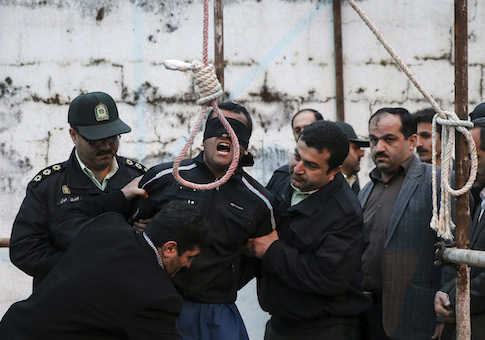
Mideast Iran Saved From The GallowsA man is prepared to be hanged in Iran / AP

Executions in Iran continue to soar to record-breaking levels in 2014, as more than two people are being killed every day and some 320 executions have taken place in the first five months of 2014 alone, according to human rights observers.

Iran is on track to eclipse the number of executions committed in 2013, when they killed around 687 prisoners, including political dissidents and others charged with minor crimes, according to the group Iran Human Rights (IHR), which tracks human rights atrocities in Iran.

Iran hanged a prominent political dissident early Sunday for refusing to renounce his ties to an Iranian opposition group, and hanged another inmate earlier this week, bringing the average to “more than two executions everyday,”according to an IHR tally of both publicized and secret executions in Iran.

With the number of executions growing each week, human rights advocates have expressed horror at the lack of attention brought to these issues by the international community and Obama administration, which continues to negotiate with Tehran over its controversial nuclear program.

“Iranian authorities have once again broken their own records with regards to the extensive use of the death penalty,” IHR spokesman Mahmood Amiry-Moghaddam said in a statement issued on Tuesday.

“The United Nations and the international community must take serious measures to stop the unprecedented wave of the executions in Iran,” said Amiry-Moghaddam, who further urged Western nations to quit remaining silent about the Iranian execution rate.

IHR has determined that Iranian authorities reported at least 147 executions from Jan. 1 to June of this year. It also found that another 180 or more unreported executions have taken place in this time period.

While Iran does not publicly report every execution, IHR and others believe that at least 320 executions have been carried out, despite a three-week halt in all executions that took place in March after the United Nations and others expressed concern about the matter.

Over the weekend, Iranian authorities shocked opposition members by hanging49-year-old Gholamreza Khosravi, who had been imprisoned six years ago for donating money to a satellite television station affiliated with the People’s Mujahideen Organization of Iran (PMOI), an opposition group that seeks to overthrow the ruling regime.

The Obama administration has remained largely silent about these killings and has not been known to broach the subject in talks with Iranian negotiators, prompting criticism from opposition leaders.

“The international community, and in particular the Obama administration, must end their inexcusable silence vis-à-vis the egregious rights abuses in Iran, which have dramatically increased since the so-called moderate Hassan Rouhani became president,” Ali Safavi, the U.S. spokesman for the National Council of Resistance of Iran, a PMOI affiliate, told the Washington Free Beacon on Sunday.