Archive for June 2014

Netanyahu should stick to his guns

June 6, 2014

Netanyahu should stick to his guns, Israel Hayom, Ruthie Blum, June 6, 2014

If there is one thing the Israeli leader should have learned by now is not to take Secretary of State John Kerry at his word, particularly when it involves Palestinian Authority President Mahmoud Abbas.

This is not because Kerry cares about Abbas specifically. No, it is likely that Kerry has as little patience for the PA president as he does for Netanyahu. But the world’s top diplomat, whose dreams of a Nobel Peace Prize keep being mugged by reality, has no desire to live out his term with egg on his face.

If Netanyahu was under any illusions to the contrary, he was engaged in some serious wishful thinking — the very kind that causes the world to believe every promise made by Abbas, no matter how often or egregiously he breaks each one.

On Tuesday, the Obama administration announced it would support the new unity government forged between the Palestinian Authority and Hamas. The only thing surprising about America’s reversal of its original commitment not to recognize or provide financial aid to such a government was that anybody was surprised by it, least of all Prime Minister Benjamin Netanyahu.

If there is one thing the Israeli leader should have learned by now is not to take Secretary of State John Kerry at his word, particularly when it involves Palestinian Authority President Mahmoud Abbas.

This is not because Kerry cares about Abbas specifically. No, it is likely that Kerry has as little patience for the PA president as he does for Netanyahu. But the world’s top diplomat, whose dreams of a Nobel Peace Prize keep being mugged by reality, has no desire to live out his term with egg on his face.

If Netanyahu was under any illusions to the contrary, he was engaged in some serious wishful thinking — the very kind that causes the world to believe every promise made by Abbas, no matter how often or egregiously he breaks each one.

The European Union and other countries satisfied with the merger of what Economy and Trade Minister Naftali Bennett called “terrorists in suits” are a different story where Netanyahu is concerned, though Canada’s ambiguity must have come as somewhat of a shock. While the Harper government said that it would only back a Palestinian unity government that “renounces terrorism and recognizes Israel’s right to exist,” any entity that includes Hamas cannot meet such requirements. (Nor has the PA, when ruled solely by Abbas’ Fatah party, ever actually done so, which is why unity with Hamas was possible in the first place. Indeed, the enmity between the two stems from a struggle over power, money and strategy, not ideology.)

What Netanyahu had not anticipated, however, was that the PA was going to come up with the perfect rhetorical ploy as a defense against Western concerns about legitimizing Hamas: that new unity government is “technocratic” in nature. In spite of how meaningless this assertion is, it has been lapped up eagerly by those at which it was aimed.

The EU, taking its cue from Washington, was thrilled to be able to continue criticizing Israel and funding Palestinian corruption and terrorism, without acknowledging that this is what they are doing. Though the U.S. paid lip service to the need for “monitoring” the unity government, the EU welcomed the process of “Palestinian national consensus,” going so far as to state that it “creates new opportunities for the peace process, for democratic renewal and for the Palestinian people in both Gaza and the West Bank.”

Netanyahu’s reaction, other than expressing his “disappointment” at being lied to by Kerry, was to announce the approval of plans for the construction of 1,800 housing units in existing neighborhoods in Jerusalem and Judea and Samaria (the West Bank).

Naturally, it was this, not Hamas, which elicited outrage from all corners of the globe.

Abbas immediately warned of “an unprecedented [Palestinian] response.”

On Thursday, the 47th anniversary of the outbreak of the Six-Day War, the U.S. and the EU called on Israel to reverse its decision on settlement activity, as did U.N. Secretary General Ban Ki-moon.

In Israel, members of Netanyahu’s coalition, such as Justice Minister and peace negotiator Tzipi Livni and Finance Minister Yair Lapid, are blaming Netanyahu for arousing the ire of the international community. And Opposition Leader and Labor Party head Isaac Herzog is even faulting him for Abbas’ truce with Hamas. The twisted logic of this position is that, due to Netanyahu’s “failure” to establish a Palestinian state, Abbas directed his aspirations for peace at Gaza.

Livni, in particular, ought to bow her head in shame. On Monday, as Rami Hamdallah was being sworn in as prime minister of the new Palestinian government, Mrs. Peace Process was presiding over a gay wedding. “I have come here on the authority of my moral position, and to say that the time has come that the state accept any couple who has chosen to tie their fate together as a couple,” she told the two grooms and their guests.

One wonders how she can criticize her own government’s lack of social and political progress, yet consider a bunch of Islamist homophobes as partners for peace.

Everyone else would do well to take note of the fact that on Tuesday, as the “international community” was welcoming the Fatah-Hamas union, outgoing Hamas prime minister Ismail Haniyeh’s mother-in-law was being ushered into the Augusta Victoria hospital in Israel for cancer treatments. (Last November, his granddaughter — who subsequently died — was treated in Israel for a digestive tract infection.)

Haniyeh’s term in office was marked by hundreds of missiles fired into Israel, in keeping with his organization’s goal to annihilate “Zionists and Jews.” Christians, too, have been are targets of his jihadist ideology. This did not prevent him from rushing his family to a church-run hospital in the Jewish state for medical care. More significantly, it did not cause the Israeli authorities to deny him such a privilege.

It is this that should astound the U.S., the EU and the U.N. about Israel. Alas, a few apartment buildings worry them more than terrorists backed by Iran.

Netanyahu should stop relying on assurances from iffy allies and stick to his guns, literally. It is weapons, not two-faced friends, which Israel is going to need now more than ever.
Obama administration gets it wrong on Hamas

June 6, 2014

Obama administration gets it wrong on Hamas, El Monitor, Erel Sega, June 6, 2014

(Please see also Iran’s plan to destabilize Egypt. — DM)

Egypt has outlawed the Muslim Brotherhood, including Hamas. It has sealed its border with Gaza hermetically and shut down all the smuggling tunnels. Meanwhile, Obama extends a hand to Hamas.

The recent call by Palestinian President Mahmoud Abbas to protect Al-Aqsa Mosque might inflame an already volatile situation around the unity government, which the United States should refuse to recognize.

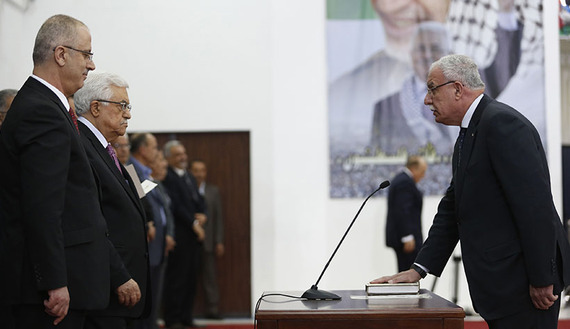
Palestinian Foreign Minister Riyad al-Maliki takes his oath of office in front of Palestinian President Mahmoud Abbas during a swearing-in ceremony of the unity government, in the West Bank city of Ramallah

Palestinian Foreign Minister Riyad al-Maliki (R) takes his oath of office in front of Palestinian President Mahmoud Abbas during a swearing-in ceremony of the unity government in Ramallah, June 2, 2014. (photo by REUTERS/Mohamad Torokman)

The chairman of the Palestinian Authority, Mahmoud Abbas, is playing with fire. Not two days had passed since the reconciliation government with Hamas was formed, when on June 4, Abbas called on Muslims around the world to take practical steps to defend the Al-Aqsa Mosque in Jerusalem. The two haphazard and hasty steps taken by the Palestinian Authority (PA) can be compared to crossing a deep chasm on a slender, electrified wire. When you are riding on a tiger’s back, you know how to get on the tiger, but it’s not at all certain you’ll know how to get off.

Hamas, the PA chair’s partner in the new government, is a terrorist organization that calls for the destruction of Israel. On June 14, 2007, this very organization seized power in the Gaza Strip in a violent coup that left many Fatah members running for their lives in terror. They fled to the Erez border crossing and pleaded to be allowed to enter Israel so they wouldn’t be thrown off the roofs of Gaza’s tallest buildings. It should be noted, by the way, that Israel was not indifferent to their pleas and saved many lives.

Furthermore, if rocket fire from the Gaza Strip on Israeli cities could once be traced back to the Hamas government headed by Ismail Haniyeh, the address had changed once the national unity government was formed. The zip code is now Ramallah. From now on the address is no longer Hamas in Gaza. It is no longer Haniyeh. It is Abbas himself. It makes no difference if the missiles from Gaza were fired by Islamic Jihad, groups tied to al-Qaeda or the Armed Resistance Committees. There’s a new boss in town, and his name is Mahmoud Abbas.

No less serious is Abbas’ dangerous call to Muslims to defend the Al-Aqsa Mosque. Abbas is well-aware that the government of Israel takes every possible step to protect the mosque, as if it was the apple of its eye. The right of Jews to worship freely in Israel suffered a dramatic blow because of the Israeli fear that the security situation could deteriorate. Jews visiting the Temple Mount are not even allowed to mutter to themselves, out of fear that they might mumble a prayer and thereby offend Muslims. The State of Israel is fully aware of how volatile the site is and acts accordingly. Its sole purpose in this regard is to maintain and protect the special status that Muslims have on the Temple Mount.

And yet, frustration apparently drove Abbas to release that thoughtless statement just two weeks after a Muslim militant affiliated with the jihadist groups in Syria was suspected of murdering Jews in Brussels solely because they were Jews. Israel sees this statement as incitement, even if there is no direct link between the jihadist who committed this crime and the Palestinian leadership. Still, the government of Israel must make it perfectly clear to Abbas that if his irresponsible and deceitful appeal to Muslims around the world results in any Israelis or Jews being harmed, there will be severe repercussions.

Another no less serious problem relates to the policies of the Barack Obama administration. It has decided to continue cooperating with Abbas, and by this, de facto recognizing the unity government. This includes providing it with economic aid expected to reach $440 million.

There was good reason for Israel’s Minister of Communication Gilad Erdan to express his regret at the “naivete” of the United States and the way it capitulated to Palestinian dictates. Israel’s ambassador to the United States, Ron Dermer, also deviated from the diplomatic protocol, when, in an unusually severe statement, he declared that Israel is “deeply disappointed” with the Obama administration’s decision to continue to maintain a working relationship with the new government in Ramallah. In a Facebook post, the ambassador referred to “the Palestinian unity government with Hamas, a terrorist organization responsible for the murder of many hundreds of Israelis, which has fired thousands of rockets at Israeli cities, and which remains committed to Israel’s destruction.”

“Had Hamas changed, it would be one thing,” continued Dermer. “But Hamas hasn’t changed. It remains as committed to Israel’s destruction today as it was yesterday.”

The Obama administration abandoned ousted Egyptian President Hosni Mubarak, embraced the regime of former President Mohammed Morsi and the Muslim Brotherhood in Egypt, and was quick to express its reservations about the counter-revolution in which Gen. Abdel Fattah al-Sisi seized power in Cairo. Time and again, the Obama administration keeps proving its geopolitical shortsightedness and moral muddle. And it is not just Jerusalem and Cairo that wonder about the absence of any logic in the administration’s policies. The same is true of Riyadh as well. American actions in the Middle East over the past few years have created a vacuum into which the Russians and Chinese will eventually get sucked in.

Egypt has outlawed the Muslim Brotherhood, including Hamas. It has sealed its border with Gaza hermetically and shut down all the smuggling tunnels. Meanwhile, Obama extends a hand to Hamas.

Beyond Washington’s illogical behavior, its policies also suffer from a moral and ethical problem. Would the United States maintain any relations whatsoever with al-Qaeda or grant aid to any government that included members of al-Qaeda, even only as technocrats? Would the US administration extend a hand to any government, which includes anti-Semitic forces, whose ideas can only be described as a Nazi worldview?

How will Obama explain to his voters in general, and his Jewish voters in particular, that he recognized a government in which Hamas is a participant, even though Article 22 of the Hamas charter states: “The [Jews] enemies have taken control of the media. … They used this wealth to stir revolutions. … They stood behind the French Revolution, the Communist Revolution. … They stood behind World War I, so as to wipe out the Islamic Caliphate. … They established the League of Nations so that they could take over the world. … They also stood behind World War II. … They ordered the creation of the United Nations and the Security Council. … There was no war that broke out anywhere without their fingerprints on it.”

How can Obama reconcile his humanistic values with Article 7 of the Hamas charter, which refers to the war between Muslims and Jews on the day of judgment, saying that on that day, the rocks and trees themselves will call out, “O Muslim! O Servant of Allah! There is a Jew hiding behind me. Come and kill him!”

Congress in Washington has an important task ahead of it. It must put a stop to the administration’s intentions while they are still little more than that. It’s not too late to stop the train.


Palestinian terrorist government – good. Israeli housing – bad

June 6, 2014

Palestinian terrorist government – good. Israeli housing – bad, Anne’s Opinions, June 6, 2014

[W]ho came in galloping like a knight on a white horse to save the day for Israel? Our new best friend, Australia, who (along with Canada, our other very staunch friend) has recently been stepping up to the plate to defend Israel in international forums.

Arab and JewOffensive Jewish housing (a golden oldie that’s as relevant as ever)

In response to the formation of the Fatah-Hamas unity government, Israel announced yesterday the approval for building 1,500 (possibly up to 3,000) housing units in Judea, Samaria and Jerusalem:

The Ministry of Housing and Construction has announced it will approve the construction of 1500-3000 new housing units in Jerusalem’s Ramat Shlomo and Givat Ze’ev neighborhoods, as well as the town’s of Efrat, Beitar Ilit, Adam and other settlements.

These are all in areas “over the Green Line” – in other words areas which are considered by the nations of the world as“verboten” for Jews to build there. After all, Heaven forfend that a Jew should be allowed to build a home in his own homeland.

Well, judging from the outraged squawks emanating from the four corners of the world, one would have thought that… well… that Israel maybe brought a terrorist organization into its government.

The US – never backwards in coming forwards (as we saw with their over-eager rush to recognize the new terrorist Palestinian government) – were the first to condemn Israel’s housing plans:

“We oppose settlement construction in the West Bank as well as announcements regarding such construction,” Dan Shapiro told Army Radio. “We would do so with or without this disputed case of a new Palestinian transitional government.”

This is true, but that makes the American position only worse. They cannot find it in themselves to condemn a Palestinian government comprising a proscribed terrorist group, but Jewish housing on disputed territory deserves an immediate condemnation. This is not even a double standard. It is a stand-alone hypocrisy of the highest order.

A similar harsh condemnation was issued by the French and the EU, followed closely by – who else? – the UN.

The Palestinians, playing the part of the robbed Cossack, threatened an unprecedented response to Israel’s housing plans – as if creating a terrorist governing body isn’t bad enough, although, as Dan Miller points out:

The “unprecedented” Palestinian response is also unspecified. However, complaining to the U.S. and/or the U.N. would hardly be “unprecedented.” Nor, for that matter, would increased terrorist activity be “unprecedented.” What “unprecedented response” do they have in mind?

So far so unexpected.

But then, who came in galloping like a knight on a white horse to save the day for Israel? Our new best friend, Australia, who (along with Canada, our other very staunch friend) has recently been stepping up to the plate to defend Israel in international forums.

George_BrandisAustralian Attorney-General George Brandis

Australia’s Attorney-General George Brandis boldly stated that Australia will not be using the term “occupied territory” any more in regards to Israeli-held “East” Jerusalem:

In a dramatic change of policy, the Australian government on Wednesday declared that it does not consider East Jerusalem to be occupied territory.

The statement was made by Attorney-General George Brandeis during a Senate hearing after Greens Senator Lee Rhiannon referred to East Jerusalem as occupied territory several times. Brandeis reportedly dismissed the use of the term “occupied” and said that labeling it as such would predetermine an issue that is subject of negotiations between Israelis and Palestinians.

“The tendentious description that Senator Rhiannon is using is not the descriptor that the government uses,” he said. ”I don’t profess view on this matter. I’m merely correcting the use of a term.”

Brandeis initially refused to answer when several senators demanded that he specify what the government’s opinion on East Jerusalem is, but several hours later read a written statement that said the government does not define East Jerusalem as occupied.

The statement said that ”The description of East Jerusalem as ‘Occupied East Jerusalem’ is a term freighted with pejorative implications, which is neither appropriate nor useful.”

The statement went on to say that Australia supports a peaceful solution to the “dispute” between Israel and the Palestinian people, which “recognizes the right of Israel to exist peacefully within secure borders and also recognizes the aspiration to statehood of the Palestinian people.”

”The description of areas which are subject to negotiations in the course of the peace process by reference to historical events is unhelpful,” the statement read.

I feel like standing up and applauding, although we have reached a  sad state of affairs if such a statement of plain truth by the Australians is considered so controversial and so courageous in today’s extreme politically-correct climate.

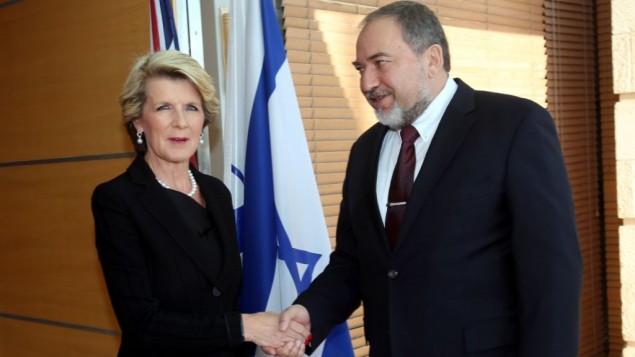
croppedjulie-bishop-and-lieberman-13.1.14-635x357Australian and Israeli Foreign Ministers Julie Bishop and Avigdor Liberman

This is not the first time that Australia has come to Israel’s defence regarding the settlements. In January, Foreign Minister Julie Bishop pointedly asked which precise law the settlements were violating.

Sadly, Australia’s stance runs counter to what some in Israel’s own Knesset declare!

Backing up Australia’s (and Israel’s) reasoned opinion that the “disputed territories” and East Jerusalem are not occupied, here is Eli E. Herz at Myths and Facts:

The term “occupied territory,” which appears in the Fourth Geneva Convention, originated as a result of the Nazi occupation of Europe. Though it has become common parlance to describe the West Bank and Gaza as “occupied territories,” there is no legal basis for using this term in connection to the Arab-Israeli conflict.

Professor Julius Stone, a leading authority on the Law of Nations, categorically rejected the use of the term “occupied territory” to describe the territories controlled by Israel on the following counts:

(1) Article 49 relates to the invasion of sovereign states and is inapplicable because the West Bank did not and does not belong to any other state.

(2) The drafting history of Article 49 [Protection of Civilian Persons in Time of War] – that is, preventing “genocidal objectives” must be taken into account. Those conditions do not exist in Israel’s case.

(3) Settlement of Jews in the West Bank is voluntary and does not displace local inhabitants. Moreover, Stone asserted: that “no serious dilution (much less extinction) of native populations” [exists]; rather “a dramatic improvement in the economic situation of the [local Palestinian] inhabitants since 1967 [has occurred].”

Be that as it may, given the hostile climate towards Israel in international forums, we must applaud Australia’s brave and principled stance, and pray that more nations join her in defending Israel’s basic and inalienable rights to settle its own land. We should also not be afraid to condemn and criticise those, like the US and EU, who condemn and criticise us for no wrong-doing while giving a free pass to terrorists.

Ya’alon: Abbas must disarm Hamas

June 6, 2014

Ya’alon: Abbas must disarm HamasDefense minister says PA president has to control Gaza Strip to prove reconciliation isn’t meant to fool the world

By Lazar Berman June 6, 2014, 3:25 am

via Ya’alon: Abbas must disarm Hamas | The Times of Israel.


Defense Minister Moshe Ya’alon speaks at Tel Aviv University, November 2013. (photo credit: Ariel Hermoni)
 
 
Defense Minister Moshe Ya’alon called on Palestinian Authority President Mahmoud Abbas Thursday to disarm Hamas and take control of the Gaza Strip after creating a unity government with Hamas approval.If Abbas fails to do so, it will be clear that the reconciliation is a farce meant to fool the world, Ya’alon said at a meeting with foreign military attachés in Israel, according to Israel Radio,Ya’alon added that, although Israel desires peace, it is not willing to deceive itself. He blamed the PA for its unwillingness to recognize Israel’s right to exist as a Jewish state, and to reach an agreement that will end the conflict for good.Opposing Palestinian parties Fatah and Hamas set aside their differences earlier this week and formed a national unity government, ending seven years of hostility.Jerusalem on Monday night slammed the United States for announcing that it will work with the new Palestinian unity government. Israeli officials said that Washington ought to be urging Abbas to disband his pact with Hamas and resume peace negotiations with Israel instead of associating with a terror group.

US Secretary of State John Kerry responded to criticism Wednesday, saying Abbas “made clear that this new technocratic government is committed to the principles of nonviolence, negotiations, recognizing the state of Israel, acceptance of the previous agreements and the Quartet principles.”

Kerry added: “Based on what we know now about the composition of this technocratic government, which has no minister affiliated to Hamas and is committed to the principles that I describe, we will work with it as we need to, as appropriate.”

Times of Israel staff contributed to this report.

Iran’s Plan to Destabilize Egypt

June 6, 2014

Iran’s Plan to Destabilize Egypt, Gatestone InstituteAnna Mahjar-Barducci, June 6, 2014

Iran is planning an offensive against Egypt from the west and from the south.

The Iranian government has long-term plans.

The Iranian regime’s new enemy, it seems, is Egypt’s President Abdel Fattah Al-Sisi.

Iran’s mullahs apparently fear Sisi’s secular stance against Islamist movements, and see him as an obstacle to Iran’s future influence in the Middle East.

Although in the Middle East, Sunni and Shia factions usually fight each other, this time an unholy Sunni-Shia alliance has been formed between Shia Iran and the Sunni Muslim Brotherhood to fight their common enemy: Al-Sisi.

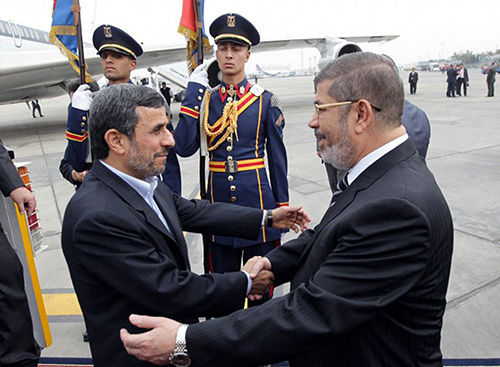
Ahmadinejad and MorsiThen Egyptian President Mohamed Morsi embraces then Iranian President Mahmoud Ahmadinejad upon his arrival in Cairo on February 5, 2013. Ahmadinejad was Iran’s first leader to visit Egypt since the two countries cut diplomatic relations in 1980. (Image source: Ahmadinejad official handout)

According to Al Bawaba, personnel of the Quds Force — the special-forces arm of Iran’s Islamic Revolutionary Guard Corps [IRGC] — arrived in Libya to train the FEA in Misrata, northwestern Libya. Quds Force officers met with FEA leaders — reportedly Abu Dawud Zouhairi and Karam Amrani. There, Lebanese jihadists coming from Syria and led by Abu Fahed Al-Islam also joined the FEA.

Iran is planning an offensive against Egypt not only from the west (Libya), but also from the south.

The Egyptian newspaper El-Watan reports that the Iran has also deployed Quds Force personnel to Sudan, to take advantage of the deterioration of the relationship between the Islamist-led Sudanese government and Sisi’s Egypt, and is now training Muslim Brotherhood militants in Sudan.

A Jordanian newspaper, AlArab Al-Yawm, confirmed the news, and reported in addition that Iran is organizing violent operations to destabilize Egypt from Libya and Sudan.

Although in the Middle East, Sunni and Shia factions usually fight each other, this time an unholy Sunni-Shia alliance has been formed between Shia Iran and the Sunni Muslim Brotherhood to fight their common enemy: Al-Sisi.

For years, Iran’s regime has dreamt of seeing the Muslim Brotherhood rise in Egypt as part of a plan to Islamize the Middle East. In this vision Iran would take the leadership role — brushing aside that for years, Iran and Saudi Arabia have jockeyed over who would assume the leadership of the Muslim world. As the Muslim Brotherhood has always been opposed to the Saudi Kingdom, it was taken for granted that an Egypt governed by the Muslim Brotherhood would be the natural ally of Iran.

As Iranian author and journalist Amir Taheri describes in the Saudi-owned newspaper, Asharq Al-Awsat, Iran cherished Egypt’s Muslim Brotherhood-backed former President, Mohamed Morsi. Iran’s Supreme Leader, Ayatollah Ali Khamenei, and President Morsi, Taheri writes, were supposed to symbolize the triumph of radical Islam. The leadership in Tehran apparently also felt that it had to “profit from its political, propaganda and even financial investment” in ensuring Morsi’s election.

Khamenei took care to woo the newly-elected Morsi to bring Egypt to Iran’s side. He even started speaking about an “Islamic Awakening” in Egypt, and hinting that what was happening in Egypt was similar to Iran’s 1979 Islamic Revolution.

The Iranian Ministry for Culture and Islamic Guidance, according to Taheri, even decreed that the media should no longer use the phrase “Arab Spring,” but “Islamic Awakening.”

“This is an Islamic awakening inspired by Imam Khomeini’s revolution in Iran,” the Iranian diplomat and Khamenei’s long-serving adviser, Ali Akbar Velayati said, in a presumed attempt to have Iran adopt paternity for the Arab Spring.

But as Morsi evidently considered himself sufficiently powerful after winning the election, he failed to endorse Khamenei’s superiority in “an imaginary hierarchy of claims for the leadership of political Islam,” in the words of Amir Taheri.

The Iranian regime now has long-term plans, and the Muslim Brotherhood needs the help of Iran to fight their common enemy: Egypt’s President Al-Sisi.

Should they succeed this time, Iran will no doubt demand that the Muslim Brotherhood publicly recognize Iran as the leader of the Muslim world.

Don’t Be Fooled by the Hamas-Fatah Union

June 6, 2014

Don’t Be Fooled by the Hamas-Fatah Union, U.S. News and World Report, , June 3, 2014

The new unity government puts the lie to U.S. peace efforts.

Now, Hamas plans to retain the Izz al-Din al-Qassam Brigades, its Gaza-based militia, leaving the terrorist group positioned to strike Israel. With Hamas sharing power and retaining its military, the Palestinian territories could come to resemble Lebanon, where Hezbollah shares power and operates militarily.

Soviet dissident Andrei Sakharov famously cautioned, “A country that does not respect the rights of its own people will not respect the rights of its neighbors.” What was true of the former Soviet empire applies in spades to the new Palestinian unity government. It will not make peace with Israel, and neither borders nor settlements will change that reality.

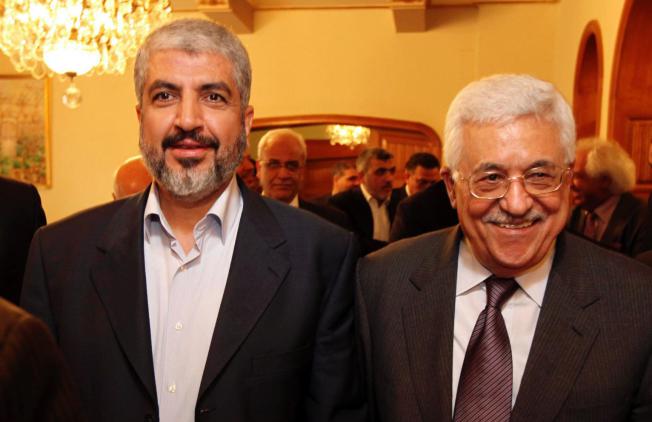
Abbas and HamasPalestinian Authority President Mahmoud Abbas, right, and Palestinian Prime Minister Ismail Haniyeh of Hamas.

The new Palestinian unity government of Fatah and Hamas puts the lie to fundamental assumptions on which the U.S. approach to Israeli-Palestinian peace have long rested, most prominently within the Obama administration.

Washington has long assumed that a two-state solution is attainable, that “land for peace” is the formula for success, that the key remaining issue is final borders for a new “Palestine,” that the main obstacle is Israeli settlements in the West Bank and East Jerusalem, and that Palestinian Authority President Mahmoud Abbas is the rare Palestinian leader who will make peace and deserves Israel’s support. With the terrorist group Hamas (which runs Gaza) now sharing power with Fatah, the ruling party of the Palestinian Authority (which runs the West Bank), the new Palestinian government undercuts all of these central assumptions.

Indeed, as this newly unified Palestinian leadership makes abundantly clear, the far more fundamental problem is broad Palestinian rejection of Israel to begin with and, with that, continuing Palestinian hopes of a new Palestine “from the [Jordan] River to the [Mediterranean] Sea.”

Almost certainly, apologists for the U.S. approach to Israeli-Palestinian peace-making, whether in the administration or outside it, will explain that the Fatah-Hamas agreement is something that it isn’t. They’ll tout the new government as a sign of Hamas’ moderation, or they’ll predict that a governing role will force Hamas to moderate its approach to Israel, or they’ll explain that Abbas’ willingness to team with Hamas proves his desire for a peace that includes both the West Bank and Gaza.

Don’t believe any of it.

Abbas, the former top aide to Palestinian terror mastermind Yasser Arafat, is now partnering with a terrorist group that remains dedicated to Israel’s destruction. That may surprise some U.S. officials, but it won’t surprise those who watch Abbas closely and track his activities in the West Bank. During his supposedly “moderate” presidency, Abbas has honored Israeli-killing Palestinian “martyrs” and “pioneers” – the latter of whom include Grand Mufti of Jerusalem Hajj Muhammad Amin Al-Husseini, who worked with Hitler during World War II and planned to adopt his “final solution” for the Middle East.

In addition, Abbas refuses to recognize Israel as a Jewish state and promotes the “right of return” of all Palestinian refugees, which would end the majority-Jewish status of Israel. And for all his supposed eagerness to make peace, he consistently imposes preconditions on Israeli-Palestinian peace talks, whether a freeze on settlements or the release of more Palestinian murderers from Israeli prisons.

Nor, despite the theory of optimists, has the responsibility to govern moderated either the Palestinian Authority or Hamas. In the West Bank, according to the State Department’s latest annual human rights reports, the authority restricts the freedoms of speech, press and assembly, and it allows for abuses of women, children and people with disabilities. Meanwhile, Abbas, who was elected president in 2005, has subverted the democratic process as he continues to serve even though he was supposed to step down in 2009.

Nevertheless, the West Bank is a democratic paradise compared to Gaza under Hamas.

Founded in 1987 as an offshoot of the Muslim Brotherhood, Hamas won Palestinian parliamentary elections of 2006. Rather than operate within the system, however, it ousted the Palestinian Authority from Gaza in a violent coup a year later.

The Fatah-Hamas civil war not only left the Palestinian territories divided. It left Hamas free to pursue a strict Islamist state on its narrow strip of land on the Mediterranean, while harassing, jailing, torturing and killing its opponents.

Over the last seven years, Hamas has launched, or permitted other terrorist groups to launch, thousands of rockets into southern Israel, terrorizing the Israeli men, women and children of Sderot and elsewhere. In fact, the rockets continued to fly in recent days as Fatah and Hamas came together.

Now, Hamas plans to retain the Izz al-Din al-Qassam Brigades, its Gaza-based militia, leaving the terrorist group positioned to strike Israel. With Hamas sharing power and retaining its military, the Palestinian territories could come to resemble Lebanon, where Hezbollah shares power and operates militarily.

Soviet dissident Andrei Sakharov famously cautioned, “A country that does not respect the rights of its own people will not respect the rights of its neighbors.” What was true of the former Soviet empire applies in spades to the new Palestinian unity government. It will not make peace with Israel, and neither borders nor settlements will change that reality.

A Hizballah force reaches Quneitra crossing, halts opposite Israeli Golan deployment

June 5, 2014

A Hizballah force reaches Quneitra crossing, halts opposite Israeli Golan deployment, DEBKAfile, June 5, 2014

DEBKAfile’s military sources reported on May 26 that Nasrallah is preparing to open a second war front against Israel from the Syrian sector of Golan. Then, on June 4, our Middle East sources revealed that US Secretary of State John Kerry’s talks in Beirut carried a message of indirect US recognition of Hizballah, following the Hamas precedent.

Secretary of State John Kerry’s visit to Beirut Wednesday June 4 was part and parcel of the new turn in Obama administration policy, which is to start engaging directly with Arab governments backed by pro-Iranian terrorist organizations like the Lebanese Hizballah and Palestinian Hamas. 

Hizballah flagHizballah flag unfurls on the Golan

A small Hizballah force took up position Thursday, June 5, on the Syrian side of the Quneitra crossing directly opposite the IDF’s Golan deployment, DEBKAfile reports exclusively. This was the first known instance of a Hizballah unit setting foot on the Golan and, moreover and, coming so close to  Israeli military positions.

Intelligence observers reckon that it may be a small vanguard of a larger Hizballah force on the way to break the stalemate reached by the Syrian army and rebels in their month-long battle for the town of Quneitra. President Bashar Assad and Hizballah’s chief Hassan Nasrallah are known to attach high strategic importance to keeping the town under the control of Damascus.

DEBKAfile’s military sources connect this military movement with a speech Nasrallah is due to deliver Friday, June 6, for making two points:

1. To congratulate Assad on his triumphant re-election as president by an 88 percent majority:

2. To brag about his own success in causing the IDF to be struck down by fear of Hizballah’s military might.

The speech is expected to be accompanied by the arrival of sizeable Hizballah strength to the Golan for deployment opposite the Israeli border.

DEBKAfile’s military sources reported on May 26 that Nasrallah is preparing to open a second war front against Israel from the Syrian sector of Golan. Then, on June 4, our Middle East sources revealed that US Secretary of State John Kerry’s talks in Beirut carried a message of indirect US recognition of Hizballah, following the Hamas precedent.

Secretary of State John Kerry’s visit to Beirut Wednesday June 4 was part and parcel of the new turn in Obama administration policy, which is to start engaging directly with Arab governments backed by pro-Iranian terrorist organizations like the Lebanese Hizballah and Palestinian Hamas. The first visit to Beirut in five years by a US secretary of state came two days after Washington rushed to accept and continue funding the Hamas-backed Palestinian government installed in Ramallah.

On his arrival in Lebanon, Kerry made some awkward comments:

“We do not recognize the government of Palestine – that would mean we recognize a state.” He added that the US will continue to work with the new Palestinian unity government “as we need to” and will monitor daily its policies to ensure it “doesn’t cross the line.”

A leading member of the Lebanese government is Hizballah, which is classied in the US as a terrorist organization. By talking with prime minister Tammam Salam, Kerry articulated the new rule: Washington will maintain ties with a government, whether in Beirut or Ramallah, so long as it “doesn’t cross the line.”

At the same time, the US Secretary delivered into the hands of the Lebanese government a half billion dollar check for the Syrian refugees sheltering in Lebanon, ignoring the fact that its member, Hizballah, has crossed many lines by fighting for President Bashar Assad in the Syria civil war, and the death and destruction Hizballah helped inflict had put those refugees to flight.

But Kerry avoided defining the lines that must not be crossed and saying how the administration would respond if they were.

Talking to journalists later, Kerry himself crossed a line to new ground, when he said:

“Iran, Russia and Hizballah must engage in a legitimate effort to bring this war to an end,”

This was the first time a US Secretary of State has explicitly invited Hizballah, whose forces are fighting in Syrian under Iranian command, to be part of the quest for a political resolution of the Syrian war and accepted the Moscow-Tehran-Beirut axis as a critical partner in this effort. Up until now, Kerry insisted in leaving Iran and Hizballah out of US discussions with Moscow on the Syrian crisis.

Senior sources in Jerusalem sharply criticized Washington’s embrace of the most violent and radical of Middle East terrorist organizations.  They saw no difference between the openness to Iran and Hizballah exhibited by Kerry in Beirut and the administration’s readiness to do business with the Palestinian unity government backed to the hilt by Hamas.

According to those sources, by Thursday morning June 5, Prime Minister Binyamin Netanyahu had determined to go head-on against the new Obama administration line with a confrontation in the US Congress over its support for the Palestinian unity government.

Netanyahu will seek, with the aid of the pro-Israel AIPAC lobby, to get a law passed banning the continued transfer of US financial aid of approximately $500,000 a year to the Ramallah government, over its backing by the Hamas terrorist organization.

DEBKAfile‘s sources in Washington don’t expect this move to succeed. Even if the both houses of Congress enact such legislation –  and that is doubtful – the president has enough legal and administrative resources to circumvent it.

Off Topic: Abbas In Panic Over Temple Mount Passivity

June 5, 2014

Abbas In Panic Over Temple Mount Passivity, The Jewish PressShalom Bear, June 4, 2014 updated June 5th

Apparently this lack of Arab rage has terribly scared and unsettled Abbas, so on Wednesday he called on Muslims around the world to protect the Al Aqsa Mosque. I’m not holding my breath.

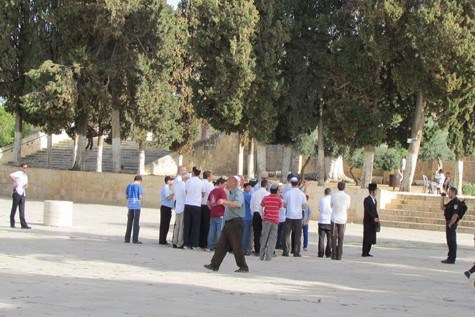
Jews-on-Temple-Mount-Erev-Shavuot-1Jews on the Temple Mount

Palestinian Unity Government (PUG) president Mahmoud Abbas is apparently in a panic over the Temple Mount.

On Tuesday, for the first time ever, Israeli police closed the Temple Mount to Muslim visitors, to block the expected Hamas-funded riots and violence against Jewish visitors.

Despite all the dire warnings and threats, the Muslims took the closure quite passively, and they didn’t riot, throw rocks, get violent, or even launch missiles at Israel. It seems that a little Jewish self-respect can go a long way.

Apparently this lack of Arab rage has terribly scared and unsettled Abbas, so on Wednesday he called on Muslims around the world to protect the Al Aqsa Mosque. I’m not holding my breath.

Friday, June 6, is what the Arabs call Naqsa Day, or in everyday language, the anniversary of the 6 Day War, when Jerusalem was liberated from the Jordanians. Abbas may be hoping for more than the usual Friday violence.

The mosque is currently located on the Jewish People’s holiest site, the Temple Mount.

Off Topic: Behind the Scenes of Bowe Bergdahl’s Release | TIME

June 5, 2014

Behind the Scenes of Bowe Bergdahl’s Release | TIME.

U.S. Army Sergeant Bowe Bergdahl waits in a pick-up truck before he is freed at the Afghan border

Asked whether the Taliban would be inspired by the exchange to kidnap others, a commander laughed. “Definitely.”

In the days and hours leading up to the release of Sgt. Bowe Bergdahl last week, his Taliban captors in Pakistan prepared for a big sendoff. Those selected to physically hand Bergdahl over to U.S. officials at a pre-arranged location on the other side of the border in Afghanistan rehearsed the messages they wanted to convey to the American people. A videographer was assigned to cover the event, for propaganda purposes. And those closest to Bergdahl commissioned a local tailor to make him a set of the local tunic and trousers in white, which, given as a gift, denotes a gesture of respect.

“You know we are also human beings and have hearts in our bodies,” a senior Taliban commander affiliated with the Haqqani network, which was holding Bergdahl captive, tells TIME. “We are fighting a war against each other, in which [the Americans] kill us and we kill them. But we did whatever we could to make [Bergdahl] happy.”

The commander, who has been known to TIME for several years and has consistently supplied reliable information about Bergdahl’s captivity, is not authorized by his superiors to speak to the media, so he has asked not to be identified by name. The commander spoke to TIME by telephone from an undisclosed location in Afghanistan.

Bergdahl, who was the only known remaining U.S. prisoner of war from the long conflict in Afghanistan, had learned basic Pashto during his incarceration, and had made several friends among his Taliban captors, according to the commander. The tunic set, along with the woven scarf that can also be worn as a turban, but is draped across Bergdahl’s shoulders in the Taliban video documenting his release, was a parting gift designed to demonstrate no personal ill will, says the commander: “We wanted him to return home with good memories.”

Bergdahl’s release, as part of the first prisoner exchange between the United States and the Taliban in 13 years of war, was the culmination of a two-and-a-half-year process marred by Taliban intransigence and Afghan government meddling that eventually saw the near simultaneous transfer of five top-level Taliban officials from detention in Guantanamo bay to a form of house arrest in Qatar. The outcome has sparked fierce criticism from Republicans in Congress.

So dispirited was Bergdahl with the process, says the commander, that he didn’t even believe his captors when they announced his pending release. Bergdahl had been there once before, in March of 2012, when negotiations were so close that he had already been handed over to senior members of the Taliban council in Afghanistan conducting the talks. When they collapsed, Bergdahl was shuttled back to Haqqani captivity in Pakistan’s ungoverned tribal areas along the border. “That’s why he didn’t trust us this time when he was told about his likely release,” says the commander.

It is not entirely clear what made the negotiations more successful this time around, other than the sense of urgency triggered by Bergdahl’s apparent declining health and U.S. plans to significantly reduce military troop numbers in Afghanistan over the next couple years. For the Taliban, it doesn’t matter. They see the exchange as an unmitigated victory. “Our talks finally proved successful for the prisoners’ swap,” says the commander. “We returned our valued guest to his people and in return, they freed our five heroes held in Guantanamo Bay since 2002.”

Another senior Taliban commander who is close to the senior Taliban leadership based in Kandahar, Afghanistan and Quetta, Pakistan, and is close to the negotiations, describes scenes of intense jubilation among the Taliban leadership and their supporters. Candies and sweet pastries are being passed around, he says, speaking to TIME via telephone from the Kandahar area. Those close to the leadership and the detainees are feasting on “whole goats cooked in rice”—a special meal usually reserved for celebrations. “I cannot explain how our people are happy and excited over this unbelievable achievement.” (He too has been known to TIME for several years). “This is a historic moment for us. Today our enemy for the first time officially recognized our status.”

The news of the detainees’ release, says the commander from Kandahar, spread like a wildfire. “Besides our field commanders and fighters, our leader Mullah Mohammad Omar is so happy and is anxiously waiting to see his heroes,” he says.

There was some disgruntlement among Taliban ranks over the terms, admits the Kandahar commander. Some members wanted a ransom payment for Bergdahl, in addition to the release of the Guantanamo detainees. But the leadership prevailed. “We told them that these five men are more important than millions of dollars to us,” he says. He was more tolerant of complaints from Taliban foot soldiers that pointed out that for all the celebrations surrounding the officials’ release, there was no reward or recognition for the Taliban fighters who captured Bergdahl in 2009. But that’s not likely to get in the way of future attempts to kidnap American soldiers, across all ranks.

Asked whether the Taliban would be inspired by the exchange to kidnap others, he laughed. “Definitely,” he says. “It’s better to kidnap one person like Bergdahl than kidnapping hundreds of useless people. It has encouraged our people. Now everybody will work hard to capture such an important bird.”

with reporting by Mushtaq Yusufzai / Peshawar

Off Topic: Palestinians vow ‘unprecedented response’ to Israeli construction

June 5, 2014

Palestinians vow ‘unprecedented response’ to Israeli construction, Israel Hayom, June 5, 2014

(The “unprecedented” Palestinian response is also unspecified. However, complaining to the U.S. and/or the U.N. would hardly be “unprecedented.” Nor, for that matter, would increased terrorist activity be “unprecedented.” What “unprecedented response” do they have in mind? — DM)

Israel announces plan to build 1,500 new settlement homes in response to Hamas-backed Palestinian unity government • Housing minister says settlement construction is the only “fitting Zionist response to the formation of a Palestinian terror government” • Livni: This is another diplomatic blunder. 

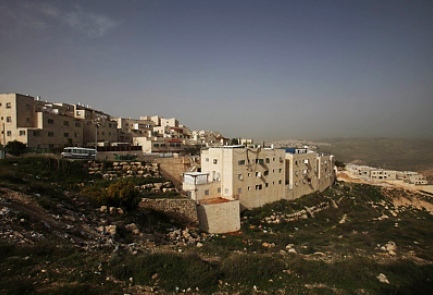
Construction hereThe east Jerusalem neighborhood of Ramat Shlomo | Photo credit: AP

Israel’s Housing Ministry announced Wednesday that it was advancing plans for 1,500 new housing units in Judea, Samaria and east Jerusalem in response to the establishment of a new Palestinian unity government.

Israel has vowed to take punitive action in response to the Palestinian unity government formed last week because it is backed by the militant group Hamas.

The housing tenders announced Wednesday include construction of 400 units in the Ramat Shlomo neighborhood in Jerusalem plus an additional 1,100 units in various settlements throughout Judea and Samaria, most of them within the large settlement blocs.

Housing Minister Uri Ariel said in a statement on Thursday that the move was a “fitting Zionist response to the formation of a Palestinian terror government.” He said the housing plans were “just the beginning.”

Justice Minister and chief Israeli peace negotiator Tzipi Livni told Army Radio meanwhile that “the settlement construction is yet another diplomatic blunder that will only serve to weaken our ability to enlist the world against Hamas.”

To this, Ariel responded that “the approved construction is too little too late. Construction needs to be carried out all the time, as a matter of routine. That is the policy of the government of Israel. Certainly the prime minister and other ministers are in favor of construction in Jerusalem. I haven’t heard anyone coming out against it.”

A spokesman for Palestinian Authority President Mahmoud Abbas also remarked on the announcement, saying that the Palestinian government would issue “an unprecedented response.”

The newly-announced construction is unusual in its scope, particularly coming after a long period in which no construction plans were approved in Judea and Samaria. According to one senior official, “the moment the peace negotiations [between Israel and the Palestinians] collapsed, and a Palestinian unity government was established, as far as Israel is concerned, the understandings with the Americans regarding the talks are no longer relevant.”

The announcement sparked a firestorm across the political spectrum, with Opposition Leader Isaac Herzog (Labor) expressing disappointment with the move, declaring that “once again, this government proved how fundamentally flawed its priorities are.”

“Instead of investing the funds in building up the Negev, Galilee or any of the poor neighborhoods, [the government] has opted to thumb its nose at Barack Obama and engage in diplomatic pyromania,” Herzog told Walla news.

Meretz Chairwoman Zehava Gal-On called on Netanyahu to “stop the price-tag attacks perpetrated by the government of Israel.” In her view, the construction of 1,500 new housing units is a “needless provocation.”

“Not only is the State of Israel undergoing diplomatic collapse and facing international isolation, the world’s recognition of the [Palestinian] government of technocrats is growing. The construction will result in Israel becoming more isolated and shunned by the world. It is time for Netanyahu to recognize reality and approach this unity government as an opportunity to advance Israel’s existential interests,” Gal-On said.

Knesset Foreign Affairs and Defense Committee Chairman Zeev Elkin (Likud) welcomed the announcement, saying, “I commend the government on its decision to market 1,500 new housing units. However, this is only a drop in the bucket, and alone, will not address the most minimal needs or ensure a Jewish majority in the capital.”

“I call on the government to lift all the restrictions on construction. While Abbas is embracing Hamas terrorists, we need to stop being suckers and start looking out for national Israeli interests rather than Palestinian interests,” Elkin added.

MK Omer Bar-Lev (Labor), however, criticized the move, saying that “the very use of punitive measures against the Palestinian Authority is senseless and unwise, and will harm Israeli’s foreign relations.”

“It is far worse when we use construction as a penalty. We are shooting ourselves in the foot, endangering the future of the settlement blocs and turning them into something foul in the eyes of the international community. This is part of the prime minister’s failing policies, and the failed policies of the entire government in terms of public diplomacy and international legitimacy.”