Archive for June 2014

A release that should worry Israel

June 8, 2014

A release that should worry Israel, Israel Hayom, Meir Indor, June 8, 2014

Israel should be worried, because the American government, on its way to its goal, is cynically changing horses and abandoning Afghanistan’s elected government. The Taliban is working with Washington via an independent channel. When Afghan Prime Minister Hamid Karzai visited Qatar (ahead of elections the U.S. labored to secure), he had no meetings scheduled with members of the Taliban Embassy.

If we add Obama’s ongoing policy of not intervening or using force against hotbeds of terrorism or those committing war crimes in Syria to the latest move, we get a very worrying picture for Israel. The American stick, which in the past used necessary force against terror organizations and terrorist states, has been replaced by a diplomacy of constantly changing horses and making shady pacts. This is a combination that should be a red light for anyone who believes the Obama administration’s promises.

The U.S. government’s recognition of the Palestinian Authority-Hamas unity government, while sticking a finger in its friend Israel’s eye, matches the behavioral pattern described above. Israel should draw one conclusion: American guarantees cannot replace an independent Israeli stance on its security needs.

The deal for the release of captive U.S. soldier Bowe Berghdahl in exchange for five terrorist members of the Taliban is bad news for America’s friends in the Middle East. Not because of the deal itself — even Israel frees terrorists in exchange for soldiers — but because of what stood behind the dramatic about-face in the American policy of not negotiating with terrorists for the release of kidnapping victims. This rule has been in place for many years and has cut back on the number of U.S. abductees.

The American public has lived happily with this iron dictate. The story of the “American Gilad Schalit,” who was imprisoned by the Taliban for five years, did not spark the massive public activism that Schalit’s capture did in Israel. Journalists did not write about Bergdahl every day. Ironically enough, it seems that Schalit’s name was better known in Congress than Bergdahl’s.

Bergdahl’s family didn’t set up a protest tent outside the White House. They kept themselves in check and didn’t work to stir up significant public support for the government to give in to Taliban demands, even though the Taliban was asking a much lower price from America than Hamas demanded from Israel. The Taliban wanted to free a few prisoners, not a thousand.

So what, then, prompted the U.S. to change its approach and negotiate with terrorists? Not the fate of the abducted soldier: The America of President Barack Obama and Secretary of State John Kerry is setting up a diplomatic channel for talks with the Taliban about the future of Afghanistan. The American government has already set up a sort of “Taliban Embassy” in Doha, and it agreed that senior Taliban members and their families would reach Qatar. The release of the five senior Taliban members is an addition to the delegation. This all comes as part of planned withdrawal of Allied forces from Afghanistan, which Obama declared and even set a target date for — the end of 2014.

The five top figures who were released, all of whom have experience organizing terror attacks (which is what they were imprisoned for), are strong backup for the “Taliban Embassy.” They were returned for a year in prison in Qatar, with the promise they would be released soon. Trust the Qataris that the members of the delegation will be allowed out a revolving door for work meetings with the Americans.

Israel should be worried, because the American government, on its way to its goal, is cynically changing horses and abandoning Afghanistan’s elected government. The Taliban is working with Washington via an independent channel. When Afghan Prime Minister Hamid Karzai visited Qatar (ahead of elections the U.S. labored to secure), he had no meetings scheduled with members of the Taliban Embassy.

Karzai and other senior members of his government are concerned, and rightfully so. The minute the U.S. conducts policy that circumvents their government and tries to close a “deal” with the Taliban for its withdrawal, along with NATO forces, from the country, the Afghan government loses more and more power. This situation will allow the Taliban back into areas now controlled by Western military forces.

If we add Obama’s ongoing policy of not intervening or using force against hotbeds of terrorism or those committing war crimes in Syria to the latest move, we get a very worrying picture for Israel. The American stick, which in the past used necessary force against terror organizations and terrorist states, has been replaced by a diplomacy of constantly changing horses and making shady pacts. This is a combination that should be a red light for anyone who believes the Obama administration’s promises.

The U.S. government’s recognition of the Palestinian Authority-Hamas unity government, while sticking a finger in its friend Israel’s eye, matches the behavioral pattern described above. Israel should draw one conclusion: American guarantees cannot replace an independent Israeli stance on its security needs.

Israeli-Palestinian Collision Course – NYTimes.com

June 8, 2014

Israeli-Palestinian Collision Course – NYTimes.com.

( The NY Times continues to distance itself from the wasting asset that is the Obama administration.  This pattern has become more and more evident over the last few weeks… – JW )

The recent collapse of Israeli-Palestinian peace talks has sharpened tensions and put the two sides on a collision course.

The feuding Palestinian factions, Fatah and Hamas, formed a government this week, prompting Israel to retaliate with plans for hundreds of new housing units in the West Bank and East Jerusalem. The Palestinians threatened unspecified countermeasures. It is clearly time for all sides to think hard about where this is headed.

Israel’s prime minister, Benjamin Netanyahu, has condemned the Fatah-Hamas reconciliation, at one point accusing the Palestinian president, Mahmoud Abbas, of saying “yes to terrorism and no to peace” and insisting that Israel will never negotiate with a government backed by Hamas.

Mr. Netanyahu is correct that Hamas, the Iran-backed group that took control of the Gaza Strip in 2007, is a violent, extremist organization committed to Israel’s destruction. Gaza militants regularly fire rockets into Israel; in 2012, Hamas fought an eight-day war with Israel.

It is also true that Fatah has renounced violence, recognized Israel and cooperated for years in administering the West Bank through the Palestinian Authority. Mr. Abbas has promised that the new government will abide by those principles, set out in 2006 by the United States and other major powers. To make it more palatable to Israel and the West, the new government, which is supposed to organize elections within six months, is composed of technocrats not affiliated with Hamas or other partisans.

Mr. Netanyahu has scoffed at that distinction — and some skepticism is warranted. While Hamas cannot simply be wished away, the United States and other countries that consider Hamas a terrorist group may find it impossible to continue aiding the Palestinians if Hamas plays a more pronounced role.

The reconciliation between Fatah and Hamas is risky for Fatah, but Mr. Abbas apparently felt he had nothing to lose. Nine months of American-mediated peace talks with Israel produced no progress. Nearing retirement, at age 79, he saw value in trying to reunite the West Bank and the Gaza Strip after seven years of bitter division.

This is a long shot, since previous reconciliation efforts have quickly collapsed, and there are the inescapable facts of Hamas’s hatred of Israel and its heavily armed militia. Given that Mr. Abbas’s call for Palestinian elections in the West Bank and Gaza within six months could bring Hamas to power, this new government could also be Mr. Abbas’s way to make trouble for Mr. Netanyahu.

Israel’s position is not so clear-cut. Even as Mr. Netanyahu demanded that the United States cut off aid to the new government, Israel continued to send tax remittances to the Palestinian Authority. And Mr. Netanyahu is not above negotiating with Hamas himself. In 2011, he traded more than 1,000 Palestinian prisoners for Gilad Shalit, the Israeli soldier held by Hamas for five years. In 2012, working through the United States and Egypt, he negotiated a cease-fire with Hamas that ended a brief war.

Mr. Netanyahu’s failure to persuade the international community not to recognize the new government reflects a growing breach between Israel and its most important allies. On Monday, the United States announced plans to work with and fund the unity government; it typically gives the Palestinians about $500 million annually. The European Union, another major donor, and the United Nations secretary general, Ban Ki-moon, also declared their support. China, India and Russia welcomed the unity government, despite Israel’s efforts to build closer ties with all three.

Many experts say that if there is ever to be an Israeli-Palestinian peace agreement, admittedly a distant dream at this point, the Palestinians must be united. But the United States has to be careful to somehow distinguish between its support for the new government and an endorsement of Hamas and its violent, hateful behavior. To have some hope of doing that, the United States and Europe must continue to insist that Mr. Abbas stick to his promises and not allow Hamas to get the upper hand.

Direct nuclear talks with US ‘essential,’ Iran says

June 8, 2014

Direct nuclear talks with US ‘essential,’ Iran says | The Times of Israel.

Ahead of first full-scale bilateral discussions in decades, Tehran’s chief negotiator says ‘serious phase’ beginning

June 8, 2014, 1:49 pm Iranian Deputy Foreign Minister Abbas Araqchi (photo credit: YouTube/Press TV/File)

Iranian Deputy Foreign Minister Abbas Araqchi (photo credit: YouTube/Press TV/File)

TEHRAN — Iran’s chief negotiator said Sunday that direct talks agreed between Tehran and Washington are essential, as discussions on his country’s disputed nuclear program are entering a “serious phase.”

The two countries will hold their first full-scale bilateral talks in decades on Monday and Tuesday, an unprecedented move toward securing a comprehensive nuclear deal between Iran and the West.

Iranian officials will then hold discussions with Russia in Rome on Wednesday and Thursday.

The Iranian foreign ministry said it was “working to arrange” other bilateral meetings with members of the P5+1 group — Britain, China, France, Russia, the US and Germany — before the powers meet in Vienna from June 16-20.

The talks are aimed at securing a comprehensive agreement on the Islamic republic’s nuclear program, which the west says is aimed at developing weapons, ahead of a July 20 deadline imposed under an interim deal agreed last November.

In return, Iran wants an end to wide-ranging economic sanctions, imposed as punishment for its atomic program and resisting extensive international inspections, that devastated its economy.

“We have always had bilateral discussions with the United States in the margin of the P5+1 group discussions, but since the talks have entered a serious phase, we want to have separate consultations,” said Abbas Araqchi, Iran’s chief negotiator in comments reported by state news agency IRNA.

“Most of the sanctions were imposed by the US and other countries from the P5+1 group were not involved,” he added.

Araqchi said the talks with the US in Geneva will only address the nuclear issue, referring to Iran’s ballistic missile program that Washington had hoped to include in negotiations.

A senior US administration official said the talks “will give us a timely opportunity to exchange views in the context of the next P5+ 1 round in Vienna.”

The US delegation will be led by Deputy Secretary of State Bill Burns and Jake Sullivan, a White House adviser, previously part of a tiny team whose months of secret talks in Oman brought Iran back to the P5+1 negotiating table last year.

Araqchi welcomed Burns’s presence, saying he hoped it would be “as positive during these negotiations.”

After decades of hostility, Iran and the US made the first tentative steps towards rapprochement after the election of self-declared moderate Hassan Rouhani as president last June.

Rouhani called his US counterpart Barack Obama shortly after he took office, which was followed by a meeting between Secretary of State John Kerry and Foreign Minister Mohammad Javad Zarif.

Off Topic: Egypt’s president punishes Hamas, Jihadi Islami in Gaza, fires up strife in Palestinian government

June 8, 2014

Egypt’s president punishes Hamas, Jihadi Islami in Gaza, fires up strife in Palestinian government, DEBKAfile, June 7, 2014

Cairo is meting out harsh treatment not only to Hamas, but also to the pro-Iranian Palestinian Jihad Islami. Egyptian military intelligence made it clear to these extremists that, since their military wing now rivals Hamas’s militia, the Ezz a-Din Al-Qassam, its leader Mohammed Al-Hindi, a personal enemy of El-Sisi, must go.

Al_Sisi_persidet_elections_6.14Egyptian President Abdel-Fattah El-Sisi

President of Egypt Abdul-Fattah El-Sisi, even before taking the oath of office Tuesday June 10, became the first regime head to strike out at the Palestinian unity government installed in Ramallah on June 24, by intensifying the siege on its Gaza partner, Hamas. His steps threaten to stir up strife between the two newly reconciled Palestinian partners over who calls the shots in the Gaza Strip,DEBKAfile’s Middle East sources report.

El-Sisi acted expeditiously to refute the claims by Palestinian Authority sources in Ramallah and Hamas officials in Gaza City that he would open the Rafah crossing from Gaza to Egyptian Sinai as soon as the new Palestinian government was in place, as a gesture of support.

The answer they received from from Cairo to their request was that the border terminals would remain open only if PA security forces from Ramallah assumed control of the borders and officiated at the crossings.

But Hamas has no intention of handing this strategic resource over to Mahmoud Abbas and his Fatah. A standoff has therefore developed between the two partners, souring the amity they have strived to display. Any PA bid to take over control of the Gaza crossings would be forcibly resisted by Hamas, a clash that could spell the end of their reconciliation and power-sharing deal.

Not only has Cairo kept the Rafah crossing shut, it has beefed up military oversight on its borders with Gaza to prevent incursions at any point. A law has been drafted moreover by the Egyptian authorities setting out long prison sentences for anyone attempting to “prepare, dig or use” a tunnel connecting Egypt to a foreign “entity” or nation (i.e. Hamas or the Palestinian government) for the passage of goods or persons.

By these actions, Egypt has begun tightening its blockade of the Gaza Strip.

Friday, June 6, Israel’s President Shimon Peres and Prime Minister Binyamin Netanyahu phoned the incoming Egyptian president to congratulate him on winning the national election. Both Israeli and Egyptian officials declined to comment on the supposition that Cairo’s steps for sealing the Gaza borders and taken inside the enclave had been coordinated with Israel.

The former Egyptian general only stated pointedly that new opportunities had opened up for strengthening the peace pact with Israel. He did not elaborate on this. But DEBKAfile’s sources reveal that Israel has contracted to supply Egypt with 4.5 billion cubic meters of gas annually from its Tamar offshore field, to meet the economy’s desperate shortage of energy. Israel, which already sells gas to Jordan, will shortly become Egypt’s biggest gas supplier.

Our sources add that El-Sisi’s clampdown on Hamas ties in with the heavy Egyptian military deployment on its western border with Libya, and his determination to put a stop to the flow of smuggled weapons to the Sinai Peninsula and Gaza Strip into the hands of Islamist terrorists.

Cairo recently received an intelligence tip-off that a number of Muslim Brotherhood leaders on the run had set up base in the Gaza Strip to engineer terrorist attacks on the Egyptian army, especially in Cairo and the Suez coastal cities.

Cairo is meting out harsh treatment not only to Hamas, but also to the pro-Iranian Palestinian Jihad Islami. Egyptian military intelligence made it clear to these extremists that, since their military wing now rivals Hamas’s militia, the Ezz a-Din Al-Qassam, its leader Mohammed Al-Hindi, a personal enemy of El-Sisi, must go.

If not, Cairo will bar its members’ travel between Egypt and the Gaza Strip, thereby cutting them off from their ties to Iran and the Arab world. This week, Jhad Islami knuckled under and replaced Al-Hindi with a new Gaza leader, Nafez Assam.

Mahmoud Abbas will try, when he visits Cairo next Tuesday to attend El-Sisi’s inauguration as president, to obtain clear answers about his intentions. If Egypt mainains its current restrictions on the Gaza Strip and Hamas into the future, the Palestinians will be unable to hold the elections for president and parliament that are scheduled for Jan. 2, 2015 in the two territories. This will place the survival of the power-sharing government in Ramallah in grave doubt.

Senior US, Iran officials to hold nuclear talks in Geneva

June 7, 2014

Senior US, Iran officials to hold nuclear talks in Geneva | The Times of Israel.

High-level meeting set for Monday, as July 20 deadline approaches; discussions with Russia to take place in Rome Wednesday

June 7, 2014, 4:02 pm
Iranian Foreign Minister Mohammad Javad Zarif, center, attends talks in Geneva on Iran's nuclear program, November 22, 2013 (photo credit: AP/Fabrice Coffrini)

Iranian Foreign Minister Mohammad Javad Zarif, center, attends talks in Geneva on Iran’s nuclear program, November 22, 2013 (photo credit: AP/Fabrice Coffrini)

Iran will hold two days of nuclear talks with the United States starting Monday, and then conduct two further days of negotiations with Russia, the foreign ministry in Tehran announced Saturday.

The US State Department confirmed the upcoming meeting in Geneva with senior US officials.

According to deputy spokeswoman Marie Harf, the American team will be comprised of Deputy Secretary of State Bill Burns, Undersecretary of State Wendy Sherman and senior White House official Jake Sullivan. The meeting between the two sides will take place on June 9 and 10.

Iran’s official IRNA news agency, quoting the ministry, said similar talks with Russia would follow on Wednesday and Thursday in Rome.

As the deadline for the six-month interim nuclear agreement approaches on July 20, both sides are stepping up efforts to work out the details of a final deal.

“We believe we need to engage in as much active diplomacy as we can to test whether we can reach a diplomatic solution with Iran on its nuclear program,” a senior US administration official was quoted by Al Monitor as saying Saturday. “These consultations come at an important juncture of the negotiations.”

Last week, it emerged that a key sticking point in the negotiations was Tehran’s demand that the P5+1 allow it to continue enriching uranium for its Bushehr nuclear power plant as part of a negotiated solution.

In response, a diplomat from one of the P5+1 countries was quoted by Reuters as saying the possibility that world powers would agree to let Iran produce nuclear fuel was “unrealistic.”

Discussions between representatives of the P5+1 and Tehran are set to resume in Vienna June 16.

Under the interim deal in November, Iran agreed to cap its nuclear activities in return for an easing of sanctions by the West. The US and its allies suspect Tehran is seeking atomic weapons, but Iran denies the charge saying its aims are peaceful.

The deal reached by Iran and six world powers — the five permanent members of the Security Council plus Germany — put limits on Iran’s uranium enrichment program in return for the easing of some sanctions. Core sanctions, however, remain in place — including measures targeting Iran’s oil exports, the pillar of its economy.

AP contributed to this report.

West must insist Abbas not let Hamas get upper hand

June 7, 2014

West must insist Abbas not let Hamas get upper hand, New York Times saysIn Friday editorial, daily says Netanyahu’s skepticism toward new Palestinian government is warranted, notes the growing breach between Israel and its allies.By Haaretz

Jun. 7, 2014 | 11:01 AM | 4

via West must insist Abbas not let Hamas get upper hand, New York Times says – Diplomacy and Defense Israel News | Haaretz.

Palestinian Prime Minister Rami Hamdallah (6th L) and Palestinian President Mahmoud Abbas (5th L) with ministers at the unity government’s swearing-in ceremony, Ramallah, West Bank, June 2, 2014. Photo by Reuters

The onus for ensuring continued American support for the new Palestinian unity government rests with Palestinian President Mahmoud Abbas, the New York Times wrote on Friday in an editorial signed by its editorial board.”The United States has to be careful to somehow distinguish between its support for the new government and an endorsement of Hamas and its violent, hateful behavior,” the newspaper writes. “To have some hope of doing that, the United States and Europe must continue to insist that Mr. Abbas stick to his promises and not allow Hamas to get the upper hand.

“The carefully balanced editorial shows a good deal of understanding for Israeli Prime Minister Benjamin Netanyahu, saying that some of his skepticism regarding the technocratic and non-partisan nature of the new government is warranted.

“The United States and other countries that consider Hamas a terrorist group may find it impossible to continue aiding the Palestinians if Hamas plays a more pronounced role,” it writes.

At the same time, the editorial notes inconsistencies between Netanyahu’s demand that the U.S, cut off aid to the new government, and his own government’s remittance of tax revenues to the Palestinians, as well as its history of negotiating with Hamas when it was in its interest – such as for the release of Gilad Shalit and the 2012 ceasefire with the Hamas government in Gaza.

The New York Times notes that Netanyahu’s “failure to persuade the international community not to recognize the new government reflects a growing breach between Israel and its most important allies.” Even China, India and Russia have welcomed the unity government, “despite Israel’s efforts to build closer ties with all three,” it says.

U.S. admits supplying lethal aid to Syrian rebels

June 7, 2014

U.S. admits supplying lethal aid to Syrian rebelsNational Security Adviser Susan Rice also says U.S. working to counter the terrorism threat emanating from Syria.

.By Haaretz | Jun. 7, 2014 | 12:30 PM | 2

via U.S. admits supplying lethal aid to Syrian rebels – Middle East Israel News | Haaretz.

Free Syrian Army fighters fire a rocket towards forces loyal to Syria’s President Bashar Assad in Hama countryside June 3, 2014. Photo by Reuters
 

Washington is providing both “lethal and non-lethal” support to members of the Syrian opposition, U.S. National Security Adviser Susan Rice said on Friday, according to Saudi-owned TV channel al-Arabiya.

Rice gave more details than are usually provided by Obama administration officials, who usually decline to specify the type of support provided to the moderate Syrian opposition forces.

Rice, who was speaking to CNN while traveling with President Barack Obama to the 70th anniversary celebrations of D-Day in Normandy, said the United States “has been the single largest contributor of humanitarian assistance, providing over $1.7 billion dollars.

”She said that the U.S. had “ramped up its support for the moderate, vetted opposition, providing lethal and non-lethal support where we can to support both the civilian opposition and the military opposition.

“Rice’s words echoed those of Obama, who said that the U.S. would “ramp up” support for rebels fighting President Bashar Assad during a major foreign policy speech last week.Caitlin Hayden, Rice’s spokeswoman, later declined to say whether Rice’s openness on U.S. assistance reflected a new policy initiative.”We’re not in a position to detail all of our assistance, but as we’ve made clear, we provide both military and non-military assistance to the opposition,” Hayden said.Rice also told CNN that the U.S. was working with Syria’s neighbors to help alleviate the refugee situation, as well as to confront the threat of terrorism seeping out of Syria.

“We’re working on the counterterrorism challenge because as we have seen there are increasingly emanating from Syria the threat of terrorism to the neighbors and beyond,” she said.“Our efforts are increasing and why we’ll remain very much engaged, both in trying to support the Syrian people and trying to support the Syrian opposition,” she said.

Obama administration gives Iran six-month free pass on [oil] sanctions.

June 6, 2014

Obama administration gives Iran six-month free pass on sanctions, Breitbart, June 5, 2014

(Living in fantasy land must be comforting; reality is sooo upsetting. — DM)

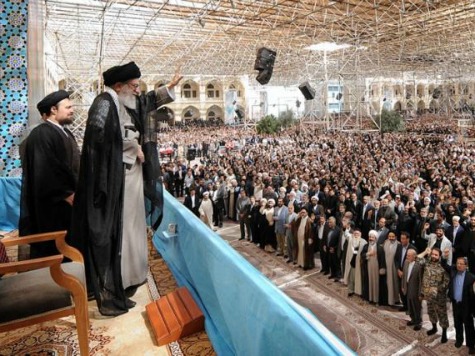
The sanctions relief comes on the heels of Iran’s Ayatollah openly stating that he did not believe the U.S. would ever consider a military strike to thwart Tehran’s nuclear capabilities. The Ayatollah stood on a podium surrounded by banners that read, “America cannot do a damn thing.”

Ayatollah-reuters

The Obama administration is of the opinion that now is the time to reward Iran for supposedly “cooperating” with the international community. In doing so, the White House announced Wednesday that the U.S. would suspend enforcement of Iran oil sanctions for six months.

White House Press Secretary Jay Carney said:

While market conditions suggest that there is sufficient supply to permit additional reductions in purchases of Iranian oil, the United States has committed to suspend Iran oil sanctions for six months and pause efforts to further reduce Iran’s crude oil sales for a six-month period under the Joint Plan of Action between the P5+1 and Iran. In return for this and other limited relief measures, Iran has committed to take steps that halt, and in key respects roll back, progress on its nuclear program.

Carney claimed that the UN’s International Atomic Energy Agency (IAEA) “has verified that Iran is complying with these new commitments.” He continued, “Global oil supply disruptions in recent months increased, compared with earlier this year, but the resulting supply was offset by increased petroleum production, particularly in the United States.” Carney said that because there is a sufficient supply of non-Iranian oil in world markets, the Obama administration felt it necessary to lift the sanctions entirely.

The sanctions relief comes on the heels of Iran’s Ayatollah openly stating that he did not believe the U.S. would ever consider a military strike to thwart Tehran’s nuclear capabilities. The Ayatollah stood on a podium surrounded by banners that read, “America cannot do a damn thing.”

Recently, the Ayatollah, Iran’s chief decision maker and ultimate authority, stressed that Iran would defeat “evil” America through endless “battle and jihad.”

After Khamenei announced for the world to hear that he intends to defeat America, while at West Point, President Obama spoke of the Iranian nuclear program. He stated, “Now we have an opportunity to resolve our differences peacefully.”

Congress Seeks to Designate New Palestinian Gov’t as a Terror Org

June 6, 2014

Congress Seeks to Designate New Palestinian Gov’t as a Terror OrgNew resolution pushes to cut aid, dissolve new Palestinian unity gov’t

via Congress Seeks to Designate New Palestinian Gov’t as a Terror Org | Washington Free Beacon.

BY:
June 6, 2014 11:00 am


Military spokesman for al-Qassam Brigades and Hamas / AP
 

House lawmakers are currently pushing a resolution to classify the newly formed Palestinian unity government as a foreign terrorist organization and cut off U.S. aid following the formation of a new ruling body that includes the terror group Hamas, according to a copy of the draft resolution obtained by the Washington Free Beacon.

The new resolution, sponsored by Reps. Michele Bachmann (R., Minn.) and Trent Franks (R., Ariz.), calls on the State Department to designate the Palestinian Authority (PA) and its new Hamas-backed unity government as a terrorist organization. The resolution is expected to be introduced Monday.

It additionally calls for the Palestinian Liberation Organization (PLO) to be reclassified as a terror group and for the U.S. government to fully cut aid to the Palestinians, who have received around $5 billion in bilateral assistance since the 1990s.

“The Palestinian Authority has shown its true colors by forming a unity government with the terrorist organization Hamas,” Bachmann told the Free Beacon. “This nightmare scenario for the peace process means that Congress must reassert its constitutional authority and suspend foreign aid to the PA. We cannot continue to assist our enemies at the expense of our ally, Israel.”

U.S. lawmakers and Israeli officials have expressed shock in recent days that the Obama administration is willing to work with the new Palestinian unity government, which united the ruling Fatah party with the Hamas terrorist group that runs the Gaza Strip.

Lawmakers on both sides of the aisle maintain that the unity deal violates a U.S. law banning taxpayer dollars from being sent to any Palestinian government that includes Hamas, a designated terrorist organization.

However, the Obama administration has sought to exploit loopholes in the law and announced in recent days that it is willing to work with the new Hamas-backed government, despite Israeli objections.

The new congressional resolution maintains that there should be consequences for these moves and pushes for the PA to quickly dissolve the new government and outlaw Hamas.

“Since Hamas and Fatah have now unified, Congress must reassess our foreign aid and support to the Palestinian Authority (PA), as foreign assistance runs in direct contravention to current law in regards to a unity government,” the lawmakers wrote in a letter to fellow lawmakers urging them to support the resolution.

The resolution explicitly urges the State Department to classify the new government as a terrorist entity, which would effectively block financial transactions with it and cut it off from the international community.

“Since Hamas and Fatah have unified, regardless of it being made up of technocrats from Hamas and Fatah, the secretary of state should designate the Palestinian Authority and such unity government as a foreign terrorist organization, and redesignate the Palestinian Liberation Organization (PLO) as a foreign terrorist organization,” according to the draft language.

The resolution additionally criticizes Palestinian President Mahmoud Abbas for harming U.S. efforts to forge a peace deal by unilaterally pursuing statehood at the United Nations and condoning “anti-Israel incitement,” according to draft text of the measure.

It also takes aim at Abbas and the PA for “rampant corruption” that includes paying salaries and “other forms of compensation” to imprisoned terrorists and their families.

“The Palestinian Authority’s highly advertised terrorist salary program incentivizes killings and bombings against innocent civilians, which includes the murder of at least 54 United States citizens since 1993 and more than 83 injured,” the resolution states.

Lawmakers and experts have maintained that the Obama administration is violating U.S. law by continuing to fund the PA and its unity government.

The 2006 Palestinian Anti-Terrorism Act explicitly states that no U.S. aid can flow to a Palestinian power sharing government that includes Hamas or any members of the terror group. The law further bans aid to any government in which Hamas is given “undue influence” over political decisions.

Aid to such a unity government would be contingent on all parties recognizing Israel’s right to exist as a Jewish state and accepting all past agreements inked with Israel.

However, Hamas has vowed to continue its armed resistance against Israel and has refused to renounce terrorism against Israel.

The White House’s decision to work with the new Hamas-backed Palestinian government sparked a new row with the Israeli government, which publicly expressed outrage with Washington.

It was further reported this week that the Obama administration has been secretly speaking with Hamas for the past several months and may have even suggested ways it can participate in a unity government without triggering a cut in aid.

The American Israeli Public Affairs Committee (AIPAC), the nation’s top pro-Israel lobbying group, announced late Thursday that it is backing a cutoff in aid to the PA.

AIPAC, which was initially hesitant to publicly push for a cut in aid, stated in a memo that the “unity government backed by Hamas is a disturbing setback for peace.”

“Congress should suspend aid to the PA while it conducts a thorough review of continued U.S. assistance to ensure that U.S. law, which prohibits funds to a Palestinian government in which Hamas participates or has undue influence, is completely followed and implemented,” AIPAC wrote.

Capitol Hill insiders maintain that the Obama administration is violating the law and that Congress is prepared to crack down on the PA.

“The law here is crystal clear: we must limit aid to the Palestinian Authority should it formally associate itself with Hamas,” said one senior House aide working on the issue. “However, the Obama administration is likely to dodge this requirement in order to keep its failed peace process on life support. Is the White House really prepared to defend sending taxpayer dollars to a government that includes a terrorist organization?”

The big chill sets in

June 6, 2014

The big chill sets in, Israel Hayom, David M. Weinberg, June 6, 2014

Distancing America from Israel has been Obama’s modus operandi from day one, although his acolytes have been unwilling to concede this.

Abbas’ minions can savage U.S. Secretary of State John Kerry, cast ugly aspersions on his motivations, organize demonstrations against him, brutally mock his proposals, intransigently reject any moves toward Israel, threaten renewed warfare against Israel, cozy-up to Iranian officials in preparation for such future battle, glorify terrorism against Israel, and cuddle with the Hamas — yet Obama remains mum.

Next is a U.S.-Iranian deal, coming perhaps as soon as next month, which apparently will allow the Iranians to maintain a full nuclear fuel cycle. This is a violation of every American commitment to Israel and every U.N. resolution that demanded the dismantlement of the Iranian nuclear effort. But Obama doesn’t care. He is going to cut a softy deal that delays the problem beyond his term as president, while essentially guaranteeing Tehran the additional time it needs to fortify and complete all components of a nuclear weapons arsenal.

The big chill is setting in. Washington’s acquiescence to the Hamas-Fatah unity government — or dare we say U.S. President Barack Obama’s greenlighting of the Palestinian maneuver — has left Israel ominously isolated.

Apart from a few supporters in Congress, and perhaps Canada, Israel stands by its solitary self in absolute opposition to the new-old government cunningly created by Palestinian Authority President Mahmoud Abbas and Hamas political leader Ismail Haniyeh.

Just about every government in the world is prepared to swallow the Palestinian deception in which “technocrats” are to run government ministries as stand-ins for the real power brokers in Palestinian politics. Just about everybody is prepared to play dumb and pretend that Iranian-backed jihadists committed to the genocide of the Jewish people in the Land of Israel are not now going to be the recipients of Western aid and diplomatic cooperation.

No one, not even Washington, is prepared to state plainly: Abbas has allied himself with the devil and thus placed himself and his government beyond the pale.

Nobody is prepared to admit the inevitable conclusions: Oslo is dead. Fatah and Hamas both seek to chip away at Israel’s international legitimacy and to avoid concluding peace at any cost. A Palestinian state would thus be a very bad idea. Israel has no Palestinian partner for a peaceful two-state scenario. Israel will have to draw borders on its own and fight off enemies in its own way — for the long term.

Yet Obama and the Europeans are unable to acknowledge that the Palestinian Authority is defunct and that Abbas is a derelict. They have, after all, invested so heavily in the PA and Abbas, and it’s anyway so much simpler to vilify Israel (especially Prime Minister Benjamin Netanyahu) as the obstacle to peace.

Israel is left with poor policy options and in considerable diplomatic isolation.

The speed with which Washington moved to legitimize the new Palestinian government suggests to me that this is part of a long-planned distancing from Israel. The fact that the administration hasn’t explicitly demanded that all factions of the new government explicitly hew to the Quartet principles tells me that all previous Western commitments to Israel are off the table. Vanished into thin air.

We shouldn’t be surprised. Distancing America from Israel has been Obama’s modus operandi from day one, although his acolytes have been unwilling to concede this.

Obama himself clarified that this was his direction in a candid interview with Jeffrey Goldberg just a few months ago. Obama warned that Israel can “expect” to face international isolation and possible sanctions from countries and companies across the world if Netanyahu fails to endorse a framework agreement with the Palestinians and continues settlement building. He proceeded to lament the fact that America, in his words, didn’t any longer have absolute power in this “diffuse” world, and wouldn’t be able to “manage” the coming anti-Israel fallout.

There wasn’t too much anguish in Obama’s words. It didn’t sound like Obama was too upset about Israel’s impending isolation or the fact that America would “have reduced influence in issues that are of interest to Israel.”

Just the opposite; it was all very artificial. Obama was merely feigning dismay at the possible isolation of Israel, while in practice he was purposefully paving the way towards Israel’s isolation and an American distancing from Israel. Obama has led the world in that direction.

The giveaway was Obama’s total failure, in that interview and in his subsequent acceptance of the Hamas-Fatah government, to hold Abbas even remotely responsible for advancement or retardation of the peace process. There was not and is not a smidgen of answerability that he attaches to Abbas or the Hamas. Only to Netanyahu.

Abbas’ minions can savage U.S. Secretary of State John Kerry, cast ugly aspersions on his motivations, organize demonstrations against him, brutally mock his proposals, intransigently reject any moves toward Israel, threaten renewed warfare against Israel, cozy-up to Iranian officials in preparation for such future battle, glorify terrorism against Israel, and cuddle with the Hamas — yet Obama remains mum.

Abbas says he will “never” recognize Israel as the national state of the Jewish people, “never” forgo the so-called right of return to Israel of Palestinian refugees, “never” accept Israeli security control of Jordan Valley and other key air and ground security assets, “never” allow Jews to live in Judea, and “never” accept Israeli sovereignty in any part of Old Jerusalem. Hamas can continue to stockpile Iranian missiles. Yet Obama has nothing to say about any of this.

Obama has nothing to say about Palestinian political culture that remains violent, anti-democratic, and wedded to historical lies. He issues no warnings of PA diplomatic isolation or economic collapse if Abbas doesn’t compromise and advance the peace process. He pins nothing on the defiant Palestinian Authority and its radical Islamic allies.

Failure can only be blamed on Israel. But of course, Obama truly regrets this and “wishes” he had the “influence” to arrest the isolation of Israel.

Yeah, sure.

Obama’s rapid embrace of the Hamas-Fatah government is a watershed moment. It is a turning point in U.S.-Israel relations, and it portends worse things to come.

Next is a U.S.-Iranian deal, coming perhaps as soon as next month, which apparently will allow the Iranians to maintain a full nuclear fuel cycle. This is a violation of every American commitment to Israel and every U.N. resolution that demanded the dismantlement of the Iranian nuclear effort. But Obama doesn’t care. He is going to cut a softy deal that delays the problem beyond his term as president, while essentially guaranteeing Tehran the additional time it needs to fortify and complete all components of a nuclear weapons arsenal.

After that will come a series of anti-Israel resolutions at the U.N. and in international courts this fall, condemning and penalizing Israel. Internationalizing the conflict and criminalizing Israel was always the central Palestinian strategy, and Obama is now playing along. Alas, Obama will be “unable to manage” and mount a defense of Israel.

But Israel should not knuckle under. It stands quite alone, but what’s new about that? “Lo, the people shall dwell alone, and shall not be reckoned among the nations” (Numbers 23:9). Being “un-reckoned” is uncomfortable but familiar territory. And all is not lost. There is much more we can do to overcome the gaps between Israel’s perception of regional developments and those of other nations.

Eventually Hamas will attack from Gaza or win an election in the West Bank and the paper-thin veneer of Palestinian moderation will peel away. Moreover, the Palestinian issue is not all that important, and the two-state construct need not be a holy grail forever. Israel has allies in Congress and elsewhere; and reliance on current allies is not sacrosanct or etched in stone. There are always alternatives. Perhaps Netanyahu can capitalize on the current impasse for a fresh evaluation of Israel’s alliances and a determined reassertion of its rights.