Archive for June 2014

Iran’s rulers say, “Yes, we can!”

June 11, 2014

Iran’s rulers say, “Yes, we can!” Israel Hayom, Clifford D. May, June 11, 2014

(Does the Iranian Supreme Leader understand America’s past and present better than President Obama, et al? — DM)

At this moment, it would make sense for Iran’s rulers to soothe and reassure ‎their American interlocutors. Why are they provoking and taunting them instead?‎

Because they can. Because they are convinced that the U.S. government is as feckless and self-‎deluding today as it was when “America cannot do a damn thing” was first proclaimed, 35 years ‎ago this fall, by Iran’s revolutionary leader, Ayatollah Ruhollah Khomeini, after his followers ‎seized the American Embassy in Tehran and took the diplomats working there hostage.

At the mausoleum last week, the current supreme ‎leader triumphantly told Iran’s uniformed, religious and political elites that the military option ‎President Barack Obama has often said is “on the table” is now in the trash bin of history.

“America cannot do a damn thing.”‎

banner displaying that slogan ‎adorned the stage of an elegant mausoleum in Tehran where Iranian Supreme Leader Ayatollah Ali ‎Khamenei appeared last week. Negotiations to conclude a deal ending Western sanctions on the ‎Islamic republic, the world’s foremost sponsor of terrorism, in exchange for a verifiable halt to ‎its nuclear weapons program, are now in a critical phase with a new round of talks to begin ‎Monday in Geneva. At this moment, it would make sense for Iran’s rulers to soothe and reassure ‎their American interlocutors. Why are they provoking and taunting them instead?‎

Because they can. Because they are convinced that the U.S. government is as feckless and self-‎deluding today as it was when “America cannot do a damn thing” was first proclaimed, 35 years ‎ago this fall, by Iran’s revolutionary leader, Ayatollah Ruhollah Khomeini, after his followers ‎seized the American Embassy in Tehran and took the diplomats working there hostage. ‎

Doing so was not just a violation of international law. It was a casus belli — an act that ‎unquestionably would have justified going to war against the fledgling Islamic republic. Instead, U.S. ‎President Jimmy Carter launched a rescue attempt that failed. After that, he utilized diplomacy ‎to no effect.‎

Khomeini would go on to hold America’s diplomats hostage for 444 days, the ‎remainder of Carter’s tenure, releasing them only as Ronald Reagan was entering the White ‎House. An important lesson was taught: When the threat of force is credible, the use of force ‎often becomes unnecessary.‎

But teaching is not synonymous with learning. At the mausoleum last week, the current supreme ‎leader triumphantly told Iran’s uniformed, religious and political elites that the military option ‎President Barack Obama has often said is “on the table” is now in the trash bin of history. A “military ‎attack is not a priority for Americans now,” he said. “They have renounced the idea of any ‎military actions.” That he believes this represents a defeat for the U.S. and a victory for the ‎Iranian revolution goes without saying.‎

In recent days, developments have bolstered his analysis. For example, on May 27, Obama ‎announced the withdrawal of American troops from Afghanistan, a conflict he once called a ‎‎”necessary war” that he intended to win but which he now is content merely to “wind down.” ‎‎(Would you really be surprised if, sometime after the next American presidential election, the ‎Taliban returned to power?)‎

A day later, Obama was at West Point disconnecting the dots linking Afghanistan, Iraq, Yemen, Somalia, Syria, Libya, Mali, ‎Kenya, Pakistan, India, Nigeria and so on. After all these years, he appears not to see the big ‎picture: a global jihad against the West with various actors — Iran and al-Qaida most prominent ‎among them — competing to lead it.‎

Next, the president released five senior Taliban officials, all of whom have ties to al-Qaida, in ‎exchange for an American soldier who had abandoned his post on June 30, 2009 and was ‎subsequently taken prisoner by those it was his duty to fight. Obama might at least have ‎made this deal with regret, acknowledging that a steep price was being paid, both by the U.S. ‎and, almost certainly, by those Afghans who have supported the American mission in their ‎country. Instead, he held a celebration in the Rose Garden. His national security advisor, Susan ‎Rice, exulted that it was “an extraordinary day for America … a joyous day.”‎

It needs to be emphasized: “Leave no soldier behind” is a commendable principle. But, like ‎most principles, it is neither absolute nor inviolable. To prove I’m right try this thought ‎experiment: If the Taliban had said they would trade Sgt. Bowe Bergdahl not for five Guantanamo Bay ‎detainees but just one — and that one was Khalid Sheikh Mohammed, the mastermind behind the Sept. 11, 2001 attack, would Obama have taken the deal? What if the Taliban had asked for no ‎detainees but a tactical nuke, or chemical weapons, or even just a dozen Apache helicopters? ‎Would anyone say that Obama had no choice but to agree — because he could not leave Sgt. ‎Bergdahl behind? ‎

Other evidence that Khamenei has no doubt been mulling: In Syria, Obama drew a ‎red line, then erased it, then cut a diplomatic deal that saved dictator Bashar Assad, whose ‎regime he had vowed must end. Last week, Robert Ford, who months ago resigned as American ambassador to Syria, acknowledgedthat he ‎had done so because he could no longer support the administration’s inept and damaging ‎policies. ‎

As if to illustrate his point, Secretary of State John Kerry respectfully asked Hezbollah, Iran’s ‎Lebanon-based terrorist proxy, to help bring the war in Syria “to an end.” And of course ‎Hezbollah will — so long as the war ends with them as winners, and the U.S. diminished.‎

Khamenei also saw the Obama administration decide last week to support the Palestinian ‎‎”unity” government, which means American taxpayers will be funding Hamas, a designated ‎terrorist organization, one to which Iran has sent money and weapons, one openly committed to a ‎genocidal war against Israel, America’s most reliable ally. ‎

Going back further, the supreme leader knows that despite many carrots and a few sticks, U.S. ‎negotiations with North Korea eventually ended with the hermit kingdom becoming nuclear-‎armed. The American diplomats who got beaten have either been promoted or given prestigious ‎academic positions. ‎

For all these decisions and failures there are explanations and justifications aplenty. But there ‎also is a pattern. America’s enemies and allies perceive it. And they are responding.‎

Mofaz: Israel Can’t Handle Iran Alone

June 11, 2014

Mofaz: Israel Can’t Handle Iran AloneIt’s a ‘quiet period’ in Iran, and the Iranians are using the opportunity to continue to develop its nuclear program.

By Yaakov Levi
First Publish: 6/9/2014, 9:44 PM

via Mofaz: Israel Can’t Handle Iran Alone – Defense/Security – News – Arutz Sheva.


Shaul Mofaz Flash 90


Speaking at the Herzliya Conference Monday, former Defense Minister and Chief of Staff Shaul Mofaz discussed Iran’s nuclear program. While many Israelis want the country’s leaders to face the Iranian threat head-on, Mofaz said that Israel “cannot stick to the doctrine of we are all alone. We have to do what is best for us. We need to have good relations with the West and United States.”

Mofaz was giving the concluding address of the session on “Facing Turbulent Global and Regional Arenas: reformulating Israel’s National Security Doctrine” at the 14th annual Herzliya Conference.

He said that the United States had negotiated with Iran for over a year, behind closed doors, on their nuclear situation, but Israel, to whom this is “perhaps one of the most important issues to do with existential threats” was not privy to these meetings.

He said that because of Israel’s attitude of wanting to “attack Iran tomorrow” and standing alone, “we missed the opportunity to be in that closed room” and to be a part of the solution to this issue.

“We need a joint political agenda with the United States,” he added.

Regarding Israel’s national security doctrine, Mofaz felt that it was something that needed updating every decade.

“We need a refreshment of the mind not every year or every month but every decade,” he said. Referring to the address of Lt. Gen. Benny Gantz, Chief of the IDF General Staff, who spoke at the conference earlier in the day, Mofaz said he felt the idea of a national multi-plan was “too big a challenge for the State of Israel, at this time … our security doctrine needs to be based on a long-term view and budgeting.”

He stressed, “When the army has a horizon of one year [thinks only a year ahead], it wastes money because it doesn’t know what is to be.” He said that it was a mistake for the army to talk of the uncertainties in order to increase its budget. “We need money to be earmarked for our capabilities … a protected flower that exists every year and every year it needs to be budgeted for.”

Mofaz also mentioned that Israel’s defense community needed to work on its deterrence capabilities. “When did Khaled Mashal ever dream of reaching the Gaza strip? … If our deterrence were so good, how did we enable him to reach the Gaza strip with such trumpets?”

Cruz: Israeli strike against Iran could happen soon

June 11, 2014

Cruz: Israel Strike Against Iran ‘Could Happen In A Matter Of Months

via Cruz: Israeli strike against Iran could happen soon | The Daily Caller.

3:38 PM 06/10/2014


Texas Sen. Ted Cruz told a small gathering of pro-Israel American leaders Tuesday that an Israeli strike against Iranian nuclear facilities “could happen in a matter of months.”

“In my view, [Iranian Supreme Leader Ali] Khamenei believes there is no credible deterrence from the United States, there’s not realistic risk of significant consequence for moving forward with their nuclear development,” the Republican told the Spring National Leadership Meeting of the Jewish Institute for National Security Affairs (JINSA) at the Willard Hotel. “That means, that if they keep going forward, I think if it comes down to it, I have real confidence that the nation of Israel will act to preserve her national security, even if this administration will not act first. And that could happen sooner rather than later — that could happen in a matter of months.”

Cruz, who met with Israeli Prime Minister Benjamin Netanyahu during a trip to the Jewish state in May, didn’t say how he came to believe an Israeli strike might happen within a matter of months. But Cruz told the assembled JINSA leaders that he believes the Obama administration, which is currently engaged in negotiations with the Islamic Republic over its nuclear program, has shirked its responsibility in dealing with Iran’s nuclear program and is not taken seriously by Iranian leadership.

“In my view, here is what a responsible president would do,” Cruz, who is believed to be considering a 2016 presidential run, said. “A responsible president would stand up on the world stage and say, ‘Let me be clear: Under no circumstances will the nation of Iran be allowed to acquire nuclear weapons capability. We will impose crippling sanctions but they will either stop or we will stop them using all available means, including if necessary direct military force.’”

“In my view, a policy of weakness and appeasement only increases the chance of military conflict,” he said.

Cruz said he believes that preventing Iran from becoming a nuclear-weapons power should be a responsibility shouldered by the United States, but in the absence of U.S. leadership, he takes comfort that Israel will act to defend itself.

“I don’t think Israel should have to act to prevent Iranian nuclear-weapons capability because it is so profoundly in U.S. national security interests that we should act, rather than forcing Israel to act,” he said, “but I do take some comfort that if this administration will not defend our interests, at the very least Israel will defend her interests.”

Over the last several years, there have been many predictions by U.S. political and opinion leaders of an imminent Israeli air attack against Iranian nuclear facilities. So far, none of those predictions have proven accurate.

Parchin: Resolution Urgent

June 11, 2014

Institute for Science and International Security › ISIS Reports › Iran › Parchin: Resolution Urgent.

by David Albright and Serena Kelleher-Vergantini

May 12, 2014

Download PDF

Prospects of a Comprehensive Solution dim if Iran remains intransigent on Parchin. A deal that does not include Iran addressing the IAEA’s concerns about the past and possibly on-going military dimensions of its nuclear program would undermine the verifiability of the deal, and thus the credibility of a comprehensive deal, in addition to the credibility of the Obama administration. 

If Iran does not fully comply with its obligations under the Joint Plan of Action and its November 2013 Framework for Cooperation agreement with the IAEA, it will complicate enormously the prospects for extending the interim deal and likely eliminate the possibility of achieving a final one.

Digital Globe imagery dated April 25, 2014, shows renewed signs of external activity at the Parchin military site where Iran is alleged to have conducted work related to nuclear weapons development (see figure 1).  Parchin represents a key outstanding issue to the International Atomic Energy Agency (IAEA) in resolving its concerns about Iran’s past and possibly on-going nuclear weapons work and military fuel cycle activities.  Before the Parchin issue can be resolved satisfactorily, Iran will need to allow the IAEA to visit the site, provide information and access to officials linked to activities at the site, and possibly permit visits to other sites.  In sum, Iran will need to provide far more cooperation on this issue than it has done so far.  If it does not, it risks not achieving a final deal with the P5+1 or not receiving further sanctions relief as part of an extended interim deal.

Background

The IAEA first asked to visit the Parchin military complex in early 2012. This request was based on evidence that at least one building was the location of high explosive tests related to the development of nuclear weapons. Additionally, the IAEA had evidence that a former Soviet nuclear weapons expert had aided in the development of testing equipment used inside the building. However, after receiving this request, Iran denied access to the IAEA and instead undertook substantial reconstruction and site modifications (see figure 2).  Satellite imagery shows that since early 2012, despite repeated requests by the IAEA and its Board of Governors to stop its site modification activities and allow an IAEA visit, Iran sanitized, demolished portions of, and reconstructed the site in an apparent effort to hide past activities and undermine the IAEA’s ability to conduct effective verification activities.  ISIS has monitored developments at the Parchin complex since February 2012 and has catalogued changes at the site (see ISIS Parchin Reports on Iran) and analyzed the work of the ex-Soviet nuclear weapon expert using his writings in Russian and information developed by the IAEA (information can be found here, here, and here).

Recent Activity at the Site

Digital Globe imagery dated April 25, 2014, shows several signs of new activity. Compared to imagery from January 2014, this recent imagery shows that there has been movement of possible building material and debris in front of two main buildings at the site (figure 1). Two trucks or containers have been removed from the area surrounding the suspected high explosives test building, while a larger object, possibly a truck or large container, appears slightly north of it. Dirt or water runoff is visible in front of the northern building (as if there has been a spill or machinery is being cleaned given that the water color indicates the presence of dust, dirt, or soap), and three vehicles are clearly visible at the south entrance. The protective berm adjacent to the suspected high explosive test building continues to be clearly visible.

In February 2014, ISIS confirmed that new activity was taking place at the site, as reported by the IAEA. Figure 3 shows that in February 2014 possible building material and debris appeared in front of the two main buildings and a container was removed (see February 2014 ISIS Imagery Brief). The renewed activity in 2014 followed a roughly six month period in the second half of 2013 where commercial satellite imagery showed no significant visible alterations (see figure 4).

Need for Resolution
By continuing to modify the site and denying the IAEA access, Iran is reducing the chances of reaching a comprehensive solution by the initial deadline of July 20, 2013.  As described above, before the Parchin issue can be resolved satisfactorily, Iran will need to allow the IAEA to visit the site, provide other information and access to Iranian officials involved with work there, and likely permit visits to other sites.  All of these activities are within the IAEA’s legal rights to determine both the correctness and completeness of Iran’s nuclear declarations, which have had a history of being incomplete and sometimes incorrect.  Iran’s attempt to circumscribe military sites as no-go zones is legally unjustified and, if successful, would make determinations whether Iran had secret nuclear activities almost impossible. For the IAEA to address its outstanding concerns about past and possibly on-going military nuclear activities, Iran will need to provide far more cooperation on the Parchin issue, and other related issues, than it has done so far.  If it does not, it risks not achieving a final deal with the P5+1 or not receiving significant sanctions relief if an extension of the six-month interim deal is necessary.

A deal that does not include Iran addressing the IAEA’s concerns about the past and possible on-going military dimensions of Iran’s nuclear program would undermine the verifiability of that deal. Iran would feel emboldened to resist future IAEA efforts, despite any future implementation of the Additional Protocol, which again would aim both to determine whether Iran’s declaration is correct and complete and to ensure the absence of undeclared nuclear activities and facilities. These efforts will inevitably require visits to military sites and much greater Iranian cooperation.

Moreover, the lack of resolution of the IAEA’s outstanding concerns would represent a significant defeat for the Obama administration. Many senior U.S. officials stated in meetings that a comprehensive deal with Iran is not possible unless Iran addresses the IAEA’s outstanding concerns about past and possible on-going military dimensions.  Not holding Iran to this obligation will damage the administration’s credibility.

Iran needs to take seriously its obligations under the Joint Plan of Action and its November 2013 Framework for Cooperation agreement with the IAEA. Otherwise, it complicates enormously extending the interim deal and almost eliminates the possibility of achieving a final one.

Figure 1. Digital Globe imagery shows the status of the alleged high explosive test site at the Parchin military complex on April 25, 2014. Colors in this image are slightly different compared to previous imagery because this image comprises a near-infrared band (NIR) that creates false colors to enable the human eye to detect and distinguish between elements. Therefore, in this image, the light-red to the right of the buildings signifies new vegetation (possibly recently seeded grass), the dark green to the left of the buildings is in reality brown-colored rocky elevations, and the water runoff, which appears white, is actually an off-white or light-tan color.


Figure 2. Geo Eye/Digital Globe imagery shows the status of the alleged high explosive test site at the Parchin military complex in December 2011 and August 2013.


Figure 3. Digital Globe Imagery shows the status of the alleged high explosive test site at the Parchin military complex on January 30, 2014.
 

Figure 4. Digital Globe Imagery shows the status of the alleged high explosive test site at the Parchin military complex in August and November 2013.

UPDATE 2-Iran questions nuclear deal deadline as talks “hit wall”

June 10, 2014

UPDATE 2-Iran questions nuclear deal deadline as talks “hit wall” Reuters, Stephanie Nebehay and John Irish, June 10, 2014

(What’s the U.S. position on centrifuges and what’s the rush? — DM)

Paris has long held out for strict terms in the negotiations and it was not immediately clear whether Fabius was spelling out Paris’s position or that also of the other five powers, the United States, Germany, Britain, China and Russia.

Iran – which says its nuclear programme is peaceful and mainly aimed at generating electricity – has around 19,000 centrifuges, of which roughly 10,000 are operating, according to the U.N. nuclear agency. Enriched uranium can have both civilian and military uses, depending on the degree of refinement.

“We are still hitting a wall on one absolutely fundamental point which is the number of centrifuges which allow enrichment,” Foreign Minister Laurent Fabius told France Inter radio. “We say that there can be a few hundred centrifuges, but the Iranians want thousands so we’re not in the same framework.”

“We are at a critical juncture in the talks,” State Department spokeswoman Marie Harf said in Washington. Another round of negotiations is scheduled for June 16-20 in Vienna.

“We know we don’t have a lot of time left,” Harf said of the July 20 deadline. “That’s why we’ve said diplomacy will intensify. People need to make tough choices.”

GENEVA/PARIS, June 10 (Reuters) – Iran questioned whether a July deadline for a nuclear deal with world powers will be met, fuelling doubts on the outcome as France spoke out to say talks on curbing Tehran’s uranium enrichment had “hit a wall”.

Iran’s talks with six major powers on curbing its nuclear programme in exchange for an end to Western sanctions could be extended for six months if no deal is reached by a July 20 deadline agreed by all parties, a senior Iranian official said.

While an extension is possible under the terms of the talks, experts believe both Iran and the international powers may face domestic political pressures to argue for better terms during this extra time period, further complicating negotiations.

The Iranian official, Deputy Foreign Minister Abbas Araqchi, said it was “too soon to judge” whether more time was needed.

“But the good thing is all parties are seriously committed to meet that goal,” he said of the July 20 target. “Whether we can do it or not is something else,” he told Iranian media in Geneva. A recording of his remarks were reviewed by Reuters.

Araqchi, in remarks on the sidelines of meetings with senior U.S. officials in the Swiss city, had earlier spoken of a possible half-year extension to the talks.

Singling out a big gap in negotiating positions that will be difficult to overcome in less than two months, France’s foreign minister said Iran should drop a demand to have thousands of uranium enrichment centrifuges. Instead it should restrict itself to a few hundred of the machines used to increase the concentration of the fissile isotope of the metal – a process that can make a weapon, though Iran denies it wants to do that.

Iran – which says its nuclear programme is peaceful and mainly aimed at generating electricity – has around 19,000 centrifuges, of which roughly 10,000 are operating, according to the U.N. nuclear agency. Enriched uranium can have both civilian and military uses, depending on the degree of refinement.

“We are still hitting a wall on one absolutely fundamental point which is the number of centrifuges which allow enrichment,” Foreign Minister Laurent Fabius told France Inter radio. “We say that there can be a few hundred centrifuges, but the Iranians want thousands so we’re not in the same framework.”

“UNREALISTIC DEMANDS”

Paris has long held out for strict terms in the negotiations and it was not immediately clear whether Fabius was spelling out Paris’s position or that also of the other five powers, the United States, Germany, Britain, China and Russia.

French Foreign Ministry spokesman Romain Nadal said the priority was not the July 20 deadline, but to achieve a deal that guaranteed that Tehran would not obtain a nuclear weapon.

Western officials say Iran wants to maintain a uranium enrichment capability far beyond what it currently needs for civilian purposes. Iran says it wants to avoid reliance on foreign suppliers of fuel for planned nuclear reactors.

U.S. and Iranian officials held talks in Geneva to tackle ways of breaking a deadlock which has raised the likelihood that the deadline will lapse without a deal meant to head off the risk of a Middle East war over the nuclear issue.

The negotiations ran into difficulty last month with each side accusing the other of making unrealistic demands, raising doubts about prospects for a breakthrough next month.

An extension should be possible, but U.S. President Barack Obama would need to secure the consent of Congress at a time of fraught relations between his administration and lawmakers.

Close U.S. ally Israel, which in the past has threatened to attack Iranian nuclear sites, has made clear its deep scepticism about the chances of a deal that sufficiently denies Iran any nuclear weapons capability. Iran says it is Israel’s assumed nuclear arsenal that threatens peace in the region.

Iran and the powers included the July 20 deadline to reach a comprehensive agreement in an interim deal agreed in November.

The November agreement – under which Iran suspended some nuclear activities in exchange for limited sanctions relief – allowed for a six-month extension if more time were needed for a settlement. An extension would allow up to half a year more for limited sanctions relief and restraints on Iranian nuclear work.

Nuclear diplomacy expert Mark Fitzpatrick of the International Institute for Strategic Studies think-tank said he did not think an extension was being formally discussed already as that would be to admit failure to meet the target date.

“But some discussion of it must be under way informally because a rollover is not as simple as it might seem,” he said. “To make it politically palatable, each side would want some marginal improvements, which will need to be negotiated.”

Iran expert Ali Vaez said both sides “might require additional interim concessions to placate their domestic sceptics” if the interim deal is rolled over because the parties are far apart. But if they have been able “to narrow the gap and need a few more weeks to hammer out the technical details, they might just opt for a no-cost extension,” Vaez, of the International Crisis Group think-tank, said.

TOUGH CHOICES” REQUIRED

U.S. Deputy Secretary of State Bill Burns and Under Secretary of State Wendy Sherman, the primary U.S. negotiator with Iran, met an Iranian delegation led by Araqchi in Geneva on Monday and Tuesday.

“We are at a critical juncture in the talks,” State Department spokeswoman Marie Harf said in Washington. Another round of negotiations is scheduled for June 16-20 in Vienna.

“We know we don’t have a lot of time left,” Harf said of the July 20 deadline. “That’s why we’ve said diplomacy will intensify. People need to make tough choices.”

Araqchi, the Iranian deputy foreign minister, used similar language: “There are still gaps,” he said. “In order to bring our views closer, the other side must make tough decisions.”

The French Foreign Ministry said officials from France and Iran would meet on Wednesday to discuss the Vienna negotiations. And Russian officials will have talks with the Iranians in Rome on Wednesday and Thursday, according to Iranian media.

U.S. Fostering Closer Iran-Saudi Ties

June 10, 2014

U.S. Fostering Closer Iran-Saudi Ties, Front Page Magazine, June 10, 2014

It seems that the Obama administration is now serving as an agent for Iran. The Islamic Republic that has encouraged street demonstrations calling for “death to America,” is the same regime that has been working hard to remove U.S. influence in the region. . . . The Obama administration has hitherto not been able to stop the Tehran regime from producing advanced centrifuges. Iran has continued its quest for nuclear weapons, despite its ongoing nuclear talks with the P5+1 (U.S. China, Russia, Britain, France, and Germany).

Iran’s efforts to cozy up to the Gulf States and Saudi Arabia in particular, are aimed at isolating Israel and preventing what has been rumored to be a secret Israeli-Saudi understanding that would enable Israel to use Saudi airspace in an attack against Iran’s nuclear facilities.

U.S. President Obama has articulated a revised approach to the Middle East. The U.S. will no longer seek to isolate Iran but will instead attempt to “get Iran to operate in a responsible fashion” to foster a “new equilibrium” between Iran and Saudi Arabia that will be marked by “competition, perhaps suspicion, but not an active or proxy warfare.”

Rouhand and Saudi

According to Arab News, (June 2, 2014) a high official in the Obama administration is “encouraging Riyadh and Tehran to end their dispute.” This was quoted in Kuwait’s Al-Rai Arabic daily in an interview with an unnamed U.S. diplomat. Meanwhile, the Kuwaiti Emir Sheikh Sabah Al-Sabah ended his visit to Tehran.

Last month, U.S. Defense Secretary Chuck Hagel visited Saudi Arabia’s capital Riyadh in a quest to establish a détente between Iran and Saudi Arabia. Hagel got his cue from earlier remarks made by Iran’s President Rouhani, suggesting that Iran would like to improve its ties with Saudi Arabia.

It seems that the Obama administration is now serving as an agent for Iran. The Islamic Republic that has encouraged street demonstrations calling for “death to America,” is the same regime that has been working hard to remove U.S. influence in the region. Iran is an oppressive and radical Islamic state backing the Assad regime in Syria which murdered over 200,000 of its own people, and used chemical agents to poison thousands of innocent civilians. The Obama administration has hitherto not been able to stop the Tehran regime from producing advanced centrifuges. Iran has continued its quest for nuclear weapons, despite its ongoing nuclear talks with the P5+1 (U.S. China, Russia, Britain, France, and Germany).

Saudi-Iranian reconciliation talks are scheduled to take place in the middle of June, and the Obama administration hopes for a new era in the relationship between the two Gulf powers. The Saudis are less than thrilled about the impending talks. Jamal Khashoggi, a Saudi political analyst, is skeptical about the talks, pointing out that “Iran has occupied Syria,” and is backing the Assad regime. He added that, the “Iranians want to drag us into an extended dialogue and divert attention from the core issue of Syria.”

Iran’s mouthpiece, Press TV reported (April 27, 2014) that Saudi Foreign Minister, Saud al-Faisal will be removed from his post in a second phase of changes in the ruling family’s key positions. It also revealed that on April 15, 2014, Saudi King Abdullah has replaced Prince Bandar bin Sultan, the Saudi intelligence chief with Youssef al-Idrisi. Press TV added that Bandar, the former Saudi ambassador to the U.S., is known to have had close ties with former U.S. President George W. Bush, and that he was an advocate of the U.S.-led invasion of Iraq in 2003.

The Iranian interpretation that is apparently stemming from Press TV is that President Obama, in seeking to reverse his predecessor’s (G.W. Bush) foreign policy, has persuaded the Saudis to get rid of the anti-Iranian elements among the Kingdom’s leadership. Apparently, this has resulted in the removal of Prince Bandar, and the impending retirement of Saud al-Faisal.

It was Foreign Minister Saud al-Faisal who, in a December, 2009 interview with the New York Times said, “Iran should never be allowed to have nuclear weapons.” He also added that he was suspicious of Iran’s claims to be pursuing a peaceful nuclear program.

Saudi Arabia has accused Iran of fomenting unrest among the Shia majority in Bahrain, its close neighbor, and the Shia minority in its own Eastern Province. In addition, the Saudis have charged the Islamic Republic of Iran of plotting to assassinate its ambassador in Washington in 2011.

Iran’s efforts to cozy up to the Gulf States and Saudi Arabia in particular, are aimed at isolating Israel and preventing what has been rumored to be a secret Israeli-Saudi understanding that would enable Israel to use Saudi airspace in an attack against Iran’s nuclear facilities. Thus, in the meeting between Iran’s Supreme Leader Ayatollah Ali Khamenei and Kuwait’s Emir Sheikh Sabah Al-Sabah, the former sounded “conciliatory.” According to Iranian state TV, which quoted Khamenei as saying that regional security “depends on good relations among all countries in the region, and that differences between them will only benefit their common enemies,” appears to be a veiled reference to Israel and the U.S.

In entering negotiations and signing the interim nuclear agreement with the P5+1, Iran has neutralized the U.S. and its allies from using the military option against it. This one-sided détente between the U.S. and Iran has apparently convinced the Saudis to change course. Pressured by its so-called ally, the U.S., to improve relations with Iran, Riyadh has realized that it is time to play along with Washington. MSNBC headlined it (May 15, 2014) “Admission of defeat.” In sending an invitation to his Iranian counterpart Mohammad Javad Zarif, Saudi Foreign Minister Saud al-Faisal welcomed him to come to Riyadh “anytime he chooses.” Explaining the Saudis reversal regarding Iran, Al Faisal said “Iran is a neighbor, we have relations with them, and we will negotiate with them.”

U.S. President Obama has articulated a revised approach to the Middle East. The U.S. will no longer seek to isolate Iran but will instead attempt to “get Iran to operate in a responsible fashion” to foster a “new equilibrium” between Iran and Saudi Arabia that will be marked by “competition, perhaps suspicion, but not an active or proxy warfare.”

Secretary of State, John Kerry may not have realized it when he put “all the eggs in the Israeli-Palestinian peace basket,” that no bilateral relationship in the Middle East is more consequential for the region’s future and U.S. interests than the relationship between Saudi Arabia and Iran. These two regional powers are on opposite sides on virtually every single issue, both vying for power and influence in the Persian Gulf, the Levant (in Syria, Iran supports the Assad regime and Hezbollah while the Saudis support the Sunni rebels in Syria and the anti-Hezbollah forces in Lebanon), the Palestinian territories (the Saudis support Mahmoud Abbas and Fatah, and the Two-State solution, while the Iranians back Hamas and reject the Two-State solution), and Iraq (Iraq’s Shiite Prime Minister Nouri al-Maliki is an Iranian ally, while the Saudis support the Sunni rebels). They are also in competition within the Organization of the Petroleum Exporting Countries (OPEC). In addition to these conflicting interests, there are the ethnic (Arab versus Persian) and sectarian (Sunni Saudi Arabia versus Shiite Iran) differences.

There are also two other factors. Iran and Saudi Arabia have radically different forms of government and advance divergent visions for Middle Eastern order. They also have a major disagreement on the American presence in the region. The Saudis have been allied with the U.S. and seek its presence in the region. The Islamic Republic of Iran, on the other hand, wishes to expel the U.S. from the region.

It is for this reason alone that the Obama administration’s attempt to foster a détente with Iran and bring the Saudis and the Iranians closer is confounding if not disturbing. In legitimizing Iran, the Obama administration is either naïve in its belief that it can change the nature of the Iranian regime, or miscalculating in its attempt to create a “new equilibrium.” Iran will continue to support Hezbollah and Hamas’ terror against Israel, and deny Israel’s right to exist. The Tehran regime is also likely to come up short on the nuclear deal with the U.S. and its allies. These are the issues that the U.S. Congress, if not the Obama administration, will eventually find difficult in normalizing relations with Iran. It would also impede on President Obama’s efforts to affect a rapprochement between Iran and Saudi Arabia. Regardless of the Obama administration’s goodwill toward Iran, the Islamic Republic is unlikely to fall in love with the “Great Satan.”

Iran flexes muscles as nuclear talks resume

June 10, 2014

Israel Hayom | Iran flexes muscles as nuclear talks resume.

As U.S. and Iranian officials meet in Switzerland to try to break deadlock ahead of July 20 deadline for permanent nuclear deal, senior Iranian official warns the U.S. that bases in Bahrain and Diego Garcia are within range of Iranian missiles.

Eli Leon, Israel Hayom Staff and Reuters
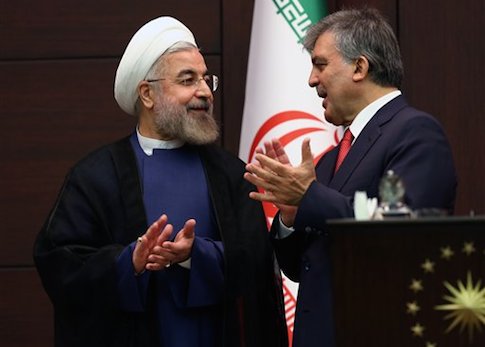
Iranian President Hassan Rouhani addresses reporters during a visit to Turkey, Monday

|

Photo credit: AP

Ya’alon: Land for peace paradigm has brought only terror and rockets

June 10, 2014

Ya’alon: Land for peace paradigm has brought only terror and rockets, Jerusalem Post, June 10, 2014

[Ya’alon] posited that the likely result of the unity deal is not that the Palestinian Authority will gain control of Gaza, but rather that Hamas will gain control of the West Bank, turning [it] into a threat like Gaza.

“There is no conflict in the region that Iran is not involved in,” Ya’alon said, listing Syria, Bahrain and Iraq as examples of countries in which Iran was involved and causing instability. He said that Tehran was also supporting the Islamic Jihad in Gaza and Hezbollah in Lebanon.

He lamented the fact that the current negotiations with Iran over its nuclear program had ended the Islamic Republic’s isolation. Ya’alon said that they would continue to “maneuver” without the continuation of sanctions and pressure.

He said that all the terror threats against Israel within its borders and abroad were directed by Iran. This, he said, was further proof that Israel’s problems with its neighbors were not based on territory.

Defense Minister Moshe Ya’alon on Tuesday said that the “land for peace” paradigm for solving the Israeli-Palestinian conflict has been a mistake which has brought Israel only “terror and rockets” in exchange for territorial concessions.

Speaking at the Herzliya Conference, Ya’alon said that history has proven that the root of the conflict is not Israel’s not returning to the pre-1967 lines, but rather the refusal of the Palestinians to recognize Israel’s right to exist.

He said that, both in the most recent negotiations, and in all other attempts to solve the conflict, the Palestinians had refused to recognize Israel as the nation state of the Jewish people, had refused to give up the right of return and had refused to agree that a peace deal would put an end to all future Palestinian claims.

Ya’alon stated that the Fatah-Hamas unity government would not contribute to the cause of peace as some have suggested. He said that there is “zero percent chance that Hamas will accept the quartet conditions,” and recognize Israel.

He posited that the likely result of the unity deal is not that the Palestinian Authority will gain control of Gaza, but rather that Hamas will gain control of the West Bank, turning into a threat like Gaza.

Ya’alon rejected as “nonsense,” claims that Israel was an apartheid state, saying that Israel’s Arabs did not want to leave Israel for the PA and African workers came to the Jewish state by choice to work. He further rejected claims of apartheid by pointing out the stability enjoyed by Israel’s Arab Christian community as compared to the plight of Christians in the rest of the Middle East.

Ya’alon warned that while the radical Shi’ite axis led by Iran and Global Jihad elements are on the rise, opportunities have been created to make allies with Sunni powers.

“The radical Shi’ite axis, unfortunately is supported by the Russians. We have seen the weapons provided by them in Gaza and in the hands of Hezbollah,” the defense minister stated.

Ya’alon said that World Jihad threatens Israel and Jordan, and should worry the entire world. “We see this in Europe, such as in the Brussels attack,” Ya’alon said, referencing a shooting attack at a Jewish Museum that killed four in Belgium earlier this month.

“Muslims and Muslim converts that go to fight in Syria come back to spread terror,” he said.

He said that Israel has opportunities to make allies among the Sunni camp, who faces common threats with Israel, such as the Shi’ite axis and World Jihad elements.

Ya’alon warned that the Syrian chemical weapons threat, while lessened , had not disappeared and Israel must be wary of them attempting to hide part of the stockpile that they have agreed to destroy.

He spoke of recent struggles between the Defense Ministry and Finance Ministry over the defense budget, saying there was a misconception that if the security situation was relatively quiet, we could stop investing in it.

He said that there was a high price to the defense establishment’s ability to maintain the apparent calm, through good intel and cyber defense.

The defense minister spoke about Iran as the biggest threat to stability in the Middle East.

“There is no conflict in the region that Iran is not involved in,” Ya’alon said, listing Syria, Bahrain and Iraq as examples of countries in which Iran was involved and causing instability. He said that Tehran was also supporting the Islamic Jihad in Gaza and Hezbollah in Lebanon.

He lamented the fact that the current negotiations with Iran over its nuclear program had ended the Islamic Republic’s isolation. Ya’alon said that they would continue to “maneuver” without the continuation of sanctions and pressure.

He said that all the terror threats against Israel within its borders and abroad were directed by Iran. This, he said, was further proof that Israel’s problems with its neighbors were not based on territory.

Off Topic: Drowned out by diplo-speak

June 10, 2014

Drowned out by diplo-speak, Israel Hayom, Ruthie Blum, June 10, 2014

(Is Fatah teaching Hamas how to seem moderately “moderate,” or are both learning that from Iran?  — DM)

[European Commission chief Jose Manuel Barroso] stressed that “any Palestinian government should uphold the principle of non-violence [and accept] previous agreements and obligations, including Israel’s legitimate right to exist. Palestinian reconciliation … if done in strict adherence to [those] principles … will not in any way give a voice to terrorists. On the contrary, it will help our aim of isolating and marginalizing terrorists and their misguided and destructive actions.”

The new Palestinian government was not listening, however. It was too busy celebrating yet another strategic victory over Israel and the West.

No sooner had Barroso finished his speech in Herzliya, than the residents of Ashkelon (less than an hour’s drive away) were treated to air raid sirens that preceded a rocket explosion, courtesy of the terrorists in Gaza.

The 14th annual Herzliya Conference kicked off on Sunday, with esteemed members of the local and foreign political, military and business communities in attendance. This year’s three-day gathering, titled “Israel and the Future of the Middle East,” happened to take place on the heels of the formation of a Palestinian unity government that includes Hamas.

Within hours of the swearing in of the new government last Monday, the United States, the European Union and the United Nations welcomed the move with open arms. While quietly mumbling the need to make ongoing financial aid to the Palestinians conditional on a renouncement of terrorism, the international community shouted platitudes about the new opportunities for peace that internal Palestinian reconciliation has opened up.

Indeed, as the Herzliya Conference entered its first round of morning sessions, Rober Serry, the U.N.’s special coordinator for the Middle East peace process, was off in Gaza, pledging his organization’s ongoing support for the nascent Palestinian government. During his jaunt, he met with the freshly appointed ministers of women’s affairs, labor, public works, and housing and justice.

After warmly congratulating the four Hamas officials, Serry assured them that the U.N. was prepared to increase its cooperation and assistance in the “many practical challenges ahead.”

That evening, European Commission chief Jose Manuel Barroso delivered the keynote address at the Herzliya Conference. Comparing current strife in the Middle East to that of Europe in the past, he explained why it was necessary for everyone to endorse the new Palestinian government, and for Israel to make painful concessions.

“If we received the Nobel Peace Prize in 2012, it was because the nations of Europe finally succeeded in breaking the vicious circle of military offensives and retaliation that was the driving force behind Europe’s history for ages,” he said.

“It is worth remembering the spirit that was behind the steps towards European integration from the first moments: a spirit of ‘lessons learned’ through hardship and war; a spirit of inevitable reconciliation; a spirit of grasping the future together. … Some of those elements are present in the Middle East peace process as well: difficult but inevitable steps towards reconciliation that need to be taken, age-old oppositions that need to be addressed, concrete achievements that serve to rebuild trust.”

Yes, he said, “peace is necessary in the region. Security for Israel and a state for the Palestinians are moral imperatives for the entire international community. Meanwhile, no actions should be taken that would jeopardize the viability of a two-state solution. We are deeply concerned that continued settlement activity renders more remote the two-state solution that is in Israel’s fundamental interest.”

He also stressed that “any Palestinian government should uphold the principle of non-violence [and accept] previous agreements and obligations, including Israel’s legitimate right to exist. Palestinian reconciliation … if done in strict adherence to [those] principles … will not in any way give a voice to terrorists. On the contrary, it will help our aim of isolating and marginalizing terrorists and their misguided and destructive actions.”

The new Palestinian government was not listening, however. It was too busy celebrating yet another strategic victory over Israel and the West.

No sooner had Barroso finished his speech in Herzliya, than the residents of Ashkelon (less than an hour’s drive away) were treated to air raid sirens that preceded a rocket explosion, courtesy of the terrorists in Gaza.

Nor was this the only message from Hamas on Sunday about the true nature of the new unity government.

As Palestinian Media Watch reports, Ihab al-Ghussein — the official government spokesman for Hamas until last week — posted the following description of PA President Mahmoud Abbas’ double dealings on his Facebook page:

“You know what Mahmoud Abbas says behind closed doors? He says: ‘Guys, let me [continue] saying what I say to the media. Those words are meant for the Americans and the occupation [Israel], not for you [Hamas]. What’s important is what we agree on among ourselves.’ In other words, when I go out and say that the government is my government and it recognizes ‘Israel’ and so on, fine — these words are meant to trick the Americans. But we agree that the government has nothing to do with politics [foreign relations]. The same thing happened in 2006, he [Abbas] said: ‘Don’t harp on everything I tell the media, forget about the statements in the media.’

Come on! The problem really isn’t with him [Abbas]; the problem is with whoever believes him. Ha, ha, ha! (I really do want real reconciliation, meaning partnership and achieving unity, but not reconciliation as Abbas means it).”

One doesn’t need the Facebook rants of a disgruntled, outgoing Hamas representative to know that Abbas is pulling the wool over the eyes of the Israeli and international peace camp. The Palestinian National Charter says it all, and the PA-controlled media and education system disseminate it, with the help of multi-millions of dollars and euros, in broad daylight.

“Ha, ha, ha,” writes al-Ghussein about the patsies who put their faith in Abbas.

 But they cannot hear him in Herzliya over the din of diplo-speak.

Iran, Turkey Meet Amid ‘Massive Sanctions Busting’ Schemes

June 10, 2014

Iran, Turkey Meet Amid ‘Massive Sanctions Busting’ Schemes, Washington Free Beacon, , June 9, 2014

(Restoring “effective” sanctions may not be a useful tactic when Iran gets (or keeps) her “moderate” nukes and we notice it. — DM)

First meeting between Iranian president and Turkey in nearly 20 years.

“All of this comes amidst reports of massive sanctions busting facilitated by Turkey on behalf of Iran. First there was the gas-for-gold scheme where Turkey helped Iran pocket some $12 billion in oil sales,” said Jonathan Schanzer, vice president for research at the Foundation for Defense of Democracies (FDD). “This was followed up by revelations of sanctions busting on the part of Iranian businessmen in Turkey to the tune of €87 billion.

Trade between the two nations hit $2.1 billion in January and February and both nations have vowed to increase the level of trade to $30 billion by 2015.

Abdullah Gul, Hassan RouhaniTurkey’s President Abdullah Gul, right, and his Iranian counterpart Hassan Rouhani / AP

Iranian President Hassan Rouhani is in Turkey this week for the first official high-level meeting in nearly 20 years, sparking speculation that the two nations are growing closer as a means to offset U.S. power in the region and further solidify a deal meant to skirt U.S. sanctions on Tehran.

Iranian President Hassan Rouhani landed in Ankara on Monday to meet with Turkish Prime Minister Recep Tayyip Erdogan and other senior Turkish officials about boosting trade ties and fighting extremism in the region.

It is the first time an Iranian president has visited Turkey since 1996, leading regional experts to raise questions about Turkey’s dependability as a U.S. ally in the fight to stop Iran’s nuclear weapons program and its continued efforts to skirt U.S. economic sanctions.

Rouhani’s meeting with Erdogan comes at a critical time, as Western nations are set to resume talks with Iran in Geneva over its contested nuclear program.

As Rouhani and Erdogan meet, the Turkish foreign ministry undersecretary is in Washington for meetings with the State Department and White House National Security Council, according to regional reports. The meetings will reportedly focus on the Syrian civil war, collapsed peace talks between the Israelis and Palestinians, and Iran’s nuclear program.

Turkey has been implicated in multiple sanctions-busting schemes that have helped Iran illicitly rake in cash despite U.S. sanctions.

The two nations have reportedly signed at least 10 new agreements since the meetings began.

“The 10 cooperation pacts signed between Iran and Turkey included agreement on joint film production, agreements on cultural, scientific, and educational exchanges, tourism cooperation programs, cultural heritage programs, cooperation between the two countries’ post organizations and cooperation between the two countries’ standard institutes,” Iran’s semi-official Fars News Agency reported early Monday.

Trade between the two nations hit $2.1 billion in January and February and both nations have vowed to increase the level of trade to $30 billion by 2015.

In a meeting Monday with his Turkish counterpart Abdullah Gul, Rouhani highlighted the need for Iran and Turkey to partner in fostering peace in Syria, where Iran has backed embattled president Bashar al-Assad. This has strained Iran’s relations with Turkey, which opposes the Syrian president.

Turkey and Iran appear to be setting aside their differences in Syria in a bid to grow closer with one another.

“Iran and Turkey are resolved to fight violence, extremism, and terrorism and they use all their possibilities and power to this end and they are determined to increase their cooperation and spare no efforts in this regard,” Rouhani was quoted as saying in a joint press conference Monday with Gul.

Rouhani is being accompanied on his two-day trip by Iranian Foreign Minister Javad Zarif, the lead negotiator in nuclear talks, and several other high level officials, including Iranian Oil Minister Bijan Namdar Zanganeh.

Regional experts say that Rouhani’s trip is a sign that Turkey, once a close U.S. ally, is moving away from the West.

“All of this comes amidst reports of massive sanctions busting facilitated by Turkey on behalf of Iran. First there was the gas-for-gold scheme where Turkey helped Iran pocket some $12 billion in oil sales,” said Jonathan Schanzer, vice president for research at the Foundation for Defense of Democracies (FDD). “This was followed up by revelations of sanctions busting on the part of Iranian businessmen in Turkey to the tune of €87 billion.”

“There may be tension over the civil war in Syria. But there appears to be far more drawing these two neighbors together than driving them apart,” Schanzer said. “This, of course, raises questions about Turkey’s reliability as a U.S. ally and as a NATO ally—questions that FDD continues to raise as it investigates Turkey’s illicit finance activity. This is activity that cannot be ignored. And this visit only punctuates our concerns.”

Erdogan was in Tehran in January to meet with Iranian Supreme Leader Ali Khamenei, another sign of warming ties between the two one-time rivals.

Iranian parliament member Moayed Hosseini Sadr, who heads the country’s Iran-Turkey Parliamentary Friendship Group, expressed optimism about the trip Monday, saying that an increase in ties between Iran and Turkey “will be to the benefit of the entire region.”