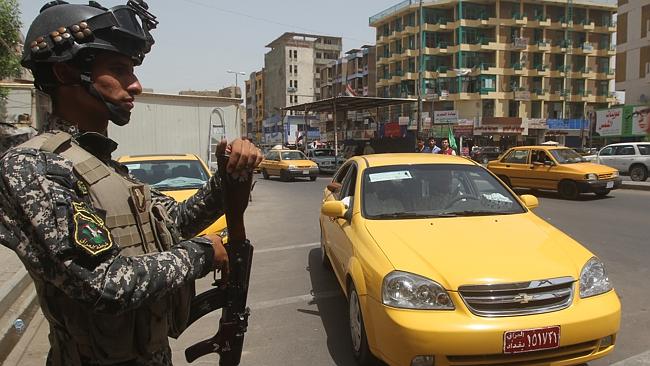
A member of the Iraqi security forces mans a checkpoint in Baghdad. Source: AFP
THE usually bustling streets of the city were quiet yesterday and business almost at a halt as stunned residents feared the imminent arrival in the capital of bands of Islamist militants.
“The gunmen are only 90km away from the capital. This means … they might storm it all of a sudden,”
“Baghdad has been empty for two days,” said Zaid Andulwahab, 33, sitting in a deserted restaurant in the centre of Baghdad.
“The gunmen are only 90km away from the capital. This means … they might storm it all of a sudden,” he said.
Jihadists spearheaded by fighters from the Sunni Muslim Islamic State of Iraq and al-Sham earlier seized the town of Dhuluiyah, 90km north of Baghdad, and the nearby Muatassam area.
Mr Andulwahab appeared shocked by the sudden charge of the militants and the failure of government forces to stop them.
“Where is the army that we spent billions” to build up, he exclaimed, referring to the fact that many soldiers have discarded their uniforms and abandoned their posts when confronted by the powerful and disciplined jihadist force.
“We are in shock and living in a state of anxiety and fear that we have not experienced since 2003,” he said, referring to the year US-led forces invaded Iraq and toppled the regime of dictator Saddam Hussein.
In Baghdad’s Karrada commercial strip, usually teeming with activity, shops were almost deserted. “Business has dropped significantly in the past two days,” said a 25-year-old barber, who gave his name only as Salam.
“We are surely worried about the developments, but we hope that nothing will happen in Baghdad,” he added.
At the entrance to Karrada, Abu Alaa etched a pane in his glassmaking shop, while voicing fear over a lack of security.
“People are confused. Everyone feels left alone and there is no one to provide security,” he said.
“Nobody expected this,” he added, speaking of the swift advances of militants.
He said he was trying to come to terms with the fact he may be forced to flee the city and become a “refugee”.
“Anything could happen in Baghdad now.
“A month ago it was impossible, but now anything is possible,” he said.
As the United States of Obama belatedly mumbles about getting slightly re-involved in the Iraq mess and Iran gets massively involved, the Benghazi clusterdunk remains relevant and should provide useful guidance for those interested in foreign policy and its consequences.
Benghazi
This video by Bill Whittle explains why Benghazi still matters. Please pay close attention to the timeline presented beginning at 00:02:13.
In the next video, the commander of the Air Force plane sent to retrieve the bodies of Ambassador Stevens, the other dead and thirty still alive Americans from Libya explains why and how Ambassador Stevens and others killed in Benghazi could have been retrieved while still alive — had it been authorized on a timely basis. As Bill Whittle’s timeline explains, there were ample time and solid intelligence during the days immediately preceding September 11th to get them out.
We had pretty good intelligence about the Benghazi mess before, during and after its evolution. For political reasons, the Obama Administration ignored it in favor of nonsense about a “spontaneous demonstration” by Muslims rightfully outraged by a YouTube video. Has the Administration behaved in a similar fashion with respect to the Iraq mess?
Iraq
Here’s the Obama Administration position on Iraq back in 2011:
(Tip of the hat to Power Line.) It would be tough for President Obama to admit that he was wrong. Despite ample opportunities, he doesn’t.
Obama declared the war in Iraq over but what he failed to realize is that there is a greater war against Islamism and Iraq was just a singular theater of operations — and of course, the enemy always has a vote.
A lack of strategic vision created a vacuum and it is now being filled. Our options are truly non-existent. When Obama states, there will be no “boots on the ground,” then there cannot be any effective air strikes coordinated as part of a ground assault. The enemy can only move forward on a couple of road networks, so it would be easy to halt their advance. But Obama says he is considering a counter-terrorism fund instead. [Emphasis added.]
I have to ask, why are we denying military support to the current government of Iraq, a nation-state which we helped to form, yet we gave Islamist forces military support in Libya — and in violation of the War Powers Act?
Could it be that in “pivoting away from the Middle East” Obama intentionally sought to enable Islamist forces in the region? He sent military and materiel support to Islamists in Libya along with supporting the Muslim Brotherhood in Egypt while turning his back on combating the resurgent Islamists in Iraq — talk about confusing. [Emphasis added.]
Regardless, history will detail how America turned victory into defeat on the modern battlefield against Islamic terrorism. Iran already has its al-Quds force leader in Baghdad — signs of things to come. Iraq has become a satellite state of Iran and I don’t think they’re willing to see it fall. It’s part of their regional hegemony and would give them an extension from Iran to Iraq to Syria to Lebanon. And when we flee Afghanistan, Iran will seek to extend its regional dominance to the east — of course the Iranians will have to contend with Pakistan — who already has nukes. [Emphasis added.]
Due in large part of President Obama’s premature withdrawal from Iraq, we probably did not have adequate intelligence during the period leading up to the ISIS invasion. If we didn’t then we most likely still don’t. This June 12th interview with General Jack Keane, former Vice Chief of Staff of the U.S. Army, provides useful insights into the new Islamic Caliphate and the current Iraq clusterdunk. We have no comprehensive regional strategy to share intelligence or otherwise.
It should be noted that the principal ISIS leader, Abu Bakr al-Baghdadi, was released in 2009 from the US-run Camp Bucca detention facility in southern Iraq.
The $10 million price [now] on his head, meanwhile, suggests that whoever released him from US custody four years ago may now be regretting it. [Insert added.]
. . . .
Well-organised and utterly ruthless, the ex-preacher is the driving force behind al-Qaeda’s resurgence throughout Syria and Iraq, putting it at the forefront of the war to topple President Bashar al-Assad and starting a fresh campaign of mayhem against the Western-backed government in Baghdad.
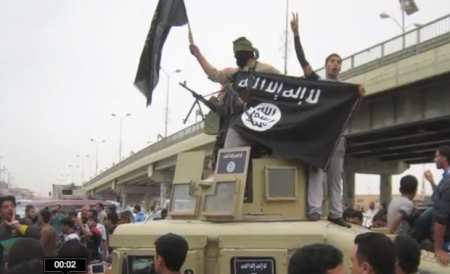
This week, his forces have achieved their biggest coup in Iraq to date, seizing control of government buildings in Mosul, the country’s third biggest city, and marching further south to come within striking distance of the capital, Baghdad. Coming on top of similar operations in January that planted the black jihadi flag in the towns of Fallujah and Ramadi, it gives al-Qaeda control of large swathes of the north and west of the country, and poses the biggest security crisis since the US pull-out two years ago.
. . . .
[W]hen bin Laden himself was killed in May 2011, Baghdadi’s pledge to revenge his death with 100 terrorist attacks across Iraq looked like little more than bluster.
Today, he is already well past that target, thanks to a devastating campaign of car bombings and Mumbai-style killing sprees that has pushed Iraq’s death toll back up to around 1,000 per month.
“Baghdadi is actually more capable than the man he took over from,” said Dr Knights. “It’s one of those unfortunate situations where taking out the previous leadership has made things worse, not better.” [Emphasis added.]
According to this report (thus far unconfirmed elsewhere), evacuation of the U.S. Embassy in Baghdad has already begun. It has also been reported that Iranian forces are now in Iraq, fighting against the ISIS to help the Iraq government.
Iraqi Prime Minister Nuri al-Maliki has been appealing to the White House for months for Apache helicopters and Hellfire air-ground rockets to fight terrorists. These Obama may now release, as well as considering token US drone attacks on ISIS targets in Iraq, for which he is most reluctant..
Thursday afternoon, Iran’s most powerful gun, the Al Qods Brigades chief Gen. Qassem Soleimani, arrived in Baghdad to take over the push against ISIS, in the same way as he has managed Bashar Assad’s war in Syria, and pull together the demoralized and scattered Iraqi army.
Those steps by Washington and Tehran pave the way for the US and Iran to cooperate for the first time in a joint military endeavor.
Since ISIS forces, albeit boosted by tens of thousands of armed Sunnis flocking to the black flag, are not capable of capturing Baghdad and have halted outside the city, President Obama and Iran’s Ayatollah Ali Khamenei have won a small space for deciding how to proceed.
Khamenei must determine whether Gen. Soleimani with the help of American weaponry can stop al Qaeda, save Maliki from collapse and prevent the fall of Baghdad, and whether it is worth sending an Iranian army division over to Iraq, our intelligence sources reported earlier Thursday. They have since entered Iraq and are fighting ISIS forces.
These moves by Tehran will determined how Washington acts in the coming hours.
The developments in Iraq are a stark contrast to Mr. Obama’s frequent pronouncements that al Qaeda is “on the run” and that its leadership has been decimated. In a speech at the U.S. Military Academy at West Point three weeks ago, the president backed a policy of restraint abroad and called for an end to U.S. “military adventures.”
Mr. Obama said Thursday that the crisis in Iraq underscores his approach outlined in the West Point speech — that the U.S. should rely more on partners to fight extremism in the Middle East and in Africa.
“We’re not going to be able to be everywhere all the time,” Mr. Obama said. “But what we can do is to make sure that we are consistently helping to finance, train, advise military forces with partner countries, including Iraq, that have the capacity to maintain their own security.”
He said his proposed $5 billion “counterterrorism partnership fund” would allow the U.S. “to extend our reach without sending U.S. troops to play Whac-A-Mole wherever there ends up being a problem in a particular country.”
“That’s going to be more effective,” Mr. Obama said.
. . . .
“Certainly, we need to help stabilize the country,” Rep. Jackie Speier, California Democrat, said on MSNBC. “The extent to which we can help with airstrikes and drones with no boots on the ground, I think is a good decision. Restoring stability there is in our country’s best interests.”
The president’s options in Iraq do not include troops, said White House press secretary Jay Carney.
Iran would most likely be happy to see America leave Iraq flailing in the wind. This neatly conforms to the Islamic Republic’s pre-existing narratives of American reliability. Moreover, it gives the likes of Brigadier General Qassem Suleimani, the Commander of the IRGC Quds-Force (IRGC-QF), the chance to strut his stuff. Depending on prospective levels of Iranian support to Iraq in this crisis, the maxim of Suleimani’s that was popularized in The New Yorker— “‘We’re not like the Americans. We don’t abandon our friends'” — may once again be proven correct. After all, a photo recently emerged on Farhang News showing him holding hands with Iraqi Parliamentarian Qassem al-Araji in Iraq.
As ISIS forces get closer to Baghdad, which may well not be invincible, the Obama Administration appears to have got in step with Iran’s desires, telling Iraq to solve its own problems.
The Obama administration delivered a message Friday to Iraqi Prime Minister Nouri al-Maliki, as Al Qaeda-inspired militants took control of more cities on their march toward Baghdad, reportedly leaving a trail of decapitated government forces in their wake: “Come together.” [Emphasis added.]
Secretary of State John Kerry delivered the message, putting the onus on the Maliki government to “put sectarian differences aside and to come together in unity to begin to be more representative and inclusive.”
Republican lawmakers and military analysts are urging the administration to get more involved — President Obama appeared to open the door Thursday to the possibility of air strikes, but no decision has been made. The president plans to make brief remarks on the situation in Iraq shortly before noon on the South Lawn.
Kerry said Friday the U.S. has “discussed a range of options including military action to provide support for the Iraqi government.” He predicted “timely decisions” from the president.
The Obama Administration’s position on the Israeli – Palestinian “peace process” has been similar, except that it became massively involved and sided against Israel. Perhaps Secretary Kerry will travel to Iraq and try to make his peace process –which failed in Israel and “Palestine” — more effective there by siding with the ISIS and its friends. Unlikely, at least as long as the fighting rages.
Conlusions
The same incompetent “leader” who, for political purpose, refused to authorize a timely attempt to rescue Ambassador Stevens et al from Benghazi is now stumbling around trying — someday — to decide what, if anything, to do about the mess in Iraq. In all likelihood, if He ever decides what to do it will be too late. Will Iran completely displace the United States as Iraq’s principal ally? It seems that she already is. The future for the entire Middle East does not look rosy as the already waning U.S. influence there approaches zero.
[T]he most significant blowback from this unthinkable jihadist victory will come not in the form of growing Sunni Islamist control over large swaths of Syria and Iraq – which may happen in the short term – but rather the opposite: Iran and Hezbollah emerging as the “answer,” the adult in the region capable of restoring some stability.
He may well have a point. If so, the perception of Iran as “the adult in the region” might help to produce an even better P 5 +1 nukes “deal” for moderate Iran than expected; not necessarily a bad result for President Obama.
NEW YORK – A U.S. contractor in Iraq told WND the Iraqi Air Force has begun evacuations from Balad Air Force Base, where 200 American contractors were trapped by the al-Qaida-inspired jihadists who have seized control of two cities and are now threatening Baghdad. [Emphasis added.]
A contractor with Sallyport Global who asked not to be named told WND through a Skype instant message that he was transported from Balad to Baghdad and was communicating from a C-130 preparing to take off to Dubai.
He said 300 in total have been evacuated from Balad, about 60 miles north of Baghdad, and another 100 are still awaiting airlift. He said the Iraqi Air Force is trying to evacuate everyone by midnight local time. [Emphasis added.]
. . . .
The U.S. contractors were at Balad to help the Pentagon prepare the facilities for the delivery of the F-16 aircraft the Obama administration has agreed to provide the Iraqi government.
The surrounded Americans said they were under ISIS fire from small arms, AK47s, and rocket propelled grenades, or RPGs.
The contractors had been able to hold the base, but those on the scene reported it was only a matter of time before the ISIS terrorists succeeded in breaking through the perimeter. The sources confirmed the contractors were still under siege, despite an Associated Press report Thursday, citing U.S. officials, that three planeloads of Americans were being evacuated from Balad.
WND learned from sources that the jihadists closed down escape routes, and the U.S. Air Force was in a stand-down position. U.S. forces were not assisting even with air cover so a private extradition flight could land for a rescue, the sources said. [Emphasis added.]
Privately scheduled exit flights had fallen through, sources said, as several private pilots originally scheduled to make the flights quit.
The sources contended the U.S. military could provide the necessary air cover to protect C-130s or other air transport craft sufficient to make the evacuation, but far officials had refused to get involved. [Emphasis added.]
What is the meaning of the chaos unfolding in Iraq? Two day after Mosul was overrun by the Salafi terror group the Islamic State of Iraq and the Levant, Tikrit — the birthplace of former Iraqi dictator Saddam Hussein and of the legendary Saladin — fell as well.
Sunnis are now in control of areas stretching from the Iraqi capital of Baghdad to the Syrian city of Aleppo; and as the Iraqi military’s response falters, Kurdish forces have taken over Kirkuk.
Washington has pledged its assistance, Turkey has called for an emergency NATO session, and according to media reports, Iran has dispatched a Revolutionary Guards force to aid the struggling Iraqi regime. The Middle East, it seems, has once again plunged into turmoil.
This kind of regional uncertainty usually calls for exercising two rules: the first, be prepared to counter the enemy’s capabilities, not his intentions; and the second, vigilantly protect your strategic assets, especially your defensible borders.
Defensible borders must afford Israel basic strategic depth and protection against the threat of conventional warfare, as well as the ability to fight terror.
In the southern sector, largely thanks to the demilitarization of Sinai, and in the northern sector, thanks to Israel’s adamant refusal to cede the Golan Heights, Israel has defensible borders. The eastern sector however, only has one border that meets Israel’s security needs — the one stretching across the Jordan Rift Valley.
The distance between the Jordan Rift Valley and the Mediterranean Sea is 64 kilometers (40 miles), making for only minimal strategic depth. The valley, between the Jordan River and the hills overlooking it from the west, constitutes an irreplaceable defense theater against a potential eastern front. Only the valley can serve as a protective buffer against a potential terrorist entity in Judea and Samaria.
An outlook for the immediate future projects several potential scenarios: jihadist terrorism will stretch beyond Syria; Hamas is eyeing a takeover of the Palestinian Authority; Iraq’s disintegration will continue and it will be split between Sunni groups; the Kurds may declare independence (which is good for Israel), and the Shiites will join forces with Iran which, for its part, will continue to make a mockery of the West as it bolsters its nuclear arsenal.
Facing these realities, can those who claim that “topography and territorial control are virtually meaningless in a modern, technological world,” that “there is no ‘eastern front’ and there never will be,” and that “only peace will bring security,” be certain that taking an uncalculated risk and ceding, even if partially, security control over the Jordan Rift Valley, is such a good idea?
The situation in Iraq is difficult and confusing but one thing is certain — only full Israeli control over the entire Jordan Rift Valley, as a security zone running along the Jordanian border, will afford Israel true security.
Maj. Gen. (res.) Uzi Dayan is a former IDF deputy chief of staff and former head of the National Security Council.
Iran’s Deputy Foreign Minister: It’s possible to reach an agreement with the West, but if not we’ll resume uranium enrichment.
By Elad Benari
First Publish: 6/13/2014, 5:13 AM
Bushehr nuclear reactor
Reuters
Iran’s Deputy Foreign Minister Abbas Araqchi said on Thursday that Iran would resume uranium enrichment activities if no agreement is reached with the West, Reuters reports.
Speaking at a conference in Rome, Araqchi said he believed it was possible for Iran to reach an accord with world powers in time for a July 20 deadline, with drafting of final proposals due to begin next week.
“We need hard work and wisdom and logic to overcome disagreements,” Iran’s Fars news agency quoted him as saying.
“Iran will return to 20 percent enrichment if a deal cannot be reached … failure to reach a deal will be a disaster for everyone,” he added.
Iran and six world powers have been holding talks on curbing Tehran’s nuclear program in exchange for an end to western sanctions.
The ongoing talks seek to turn an interim deal reached in November into a permanent agreement by July 20. Under the interim deal, Iran committed to limit its uranium enrichment to five percent and is gradually winning access to $4.2 billion of its oil revenues frozen abroad and some other sanctions relief.
Final agreement has been held up by differences over issues including the number of uranium enrichment centrifuges that would be available to Iran and diplomats have said there may have to be an extension.
Senior U.S. officials met with Araqchi earlier this week in Geneva. U.S. State Department spokeswoman Jen Psaki was asked about a series of bilateral meetings officials from the six-power group held with Iranian officials in Europe this week ahead of next week’s negotiations in Vienna.
Throughout the talks, Iran has declared that it will never give up on what it sees as its right to enrichment.
House prepares a letter to President Obama that will identify specific requirements for their participation in future nuclear deal with Iran; Senate leaders express skepticism on enforcement.
The Obama administration acknowledges the importance of Congress’ role on Iran, and says that any future nuclear deal will likely involve sanctions relief requiring both legislative and executive action.
On Thursday, at a hearing held by the Senate Foreign Relations Committee, leadership from both parties weighed the consequences of a bad deal with Iran and its possible repercussions for a region in borderless turmoil.
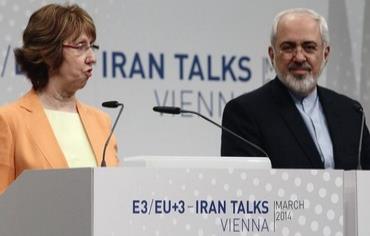
Iranian FM Mohammad Javad Zarif (L) and EE foreign policy chief Catherine Ashton at nuclear talks in Vienna March 19, 2014. Photo: REUTERS
WASHINGTON — Leaders in the House of Representatives have written a letter to US President Barack Obama suggesting a pact with Iran restricted to its nuclear program is not enough for the chamber to lift sanctions on the country.
The leading Democrat and Republican of the House Foreign Affairs Committee, chairman Ed Royce (R-CA) and ranking member Eliot Engel (D-NY), wrote the letter intended to remind the White House of Congress’ role in any future nuclear pact forged with Iran: specifically, the legislature’s role in easing, lifting or repealing sanctions levied against the Islamic Republic.
Attained exclusively by The Jerusalem Post, the letter outlines what Engel has referred to in the past as the “minimum requirements for a good deal,” noting that any deal “demands congressional approval.”
“The concept of an exclusively defined ‘nuclear-related’ sanction on Iran does not exist in US law,” the letter reads. “Almost all sanctions related to Iran’s nuclear program are also related to Tehran’s advancing ballistic missile program, intensifying support for international terrorism, and other unconventional weapons programs.”
An interim deal reached in November with Iran, temporarily freezing the international impasse, requires the Congress to refrain from passing any new “nuclear-related sanctions” as world powers attempt to negotiate a comprehensive solution to the crisis.
“Iran’s permanent and verifiable termination of all of these activities— not just some— is a prerequisite for permanently lifting most congressionally-mandated sanctions,” the letter continues.
The Obama administration acknowledges the importance of Congress’ role on Iran, and says that any future nuclear deal will likely involve sanctions relief requiring both legislative and executive action.
The timeframe for that action, however, is still undefined, as is the nuclear deal in its entirety: drafting was set to begin in May towards completion on July 20, and yet the writing process has yet to begin.
The international community, represented at the table by the US, United Kingdom, France, Russia, China and Germany, suspect Iran’s vast nuclear program has military dimensions.
The letter notes that, in recent testimony before the House Foreign Affairs Committee, US Secretary of State John Kerry has acknowledged any deal with sanctions relief would require Congress’ consent “by law.”
The lawmakers “urge greater consultation with Congress on a potential sanctions relief package,” it reads.
Responding to the Post, administration officials contend that sanctions are, indeed, successfully demarcated based on human rights abuses, sponsorship of terrorism, drug trafficking and proliferation of unconventional weapons by the Treasury Department.
On Thursday, at a hearing held by the Senate Foreign Relations Committee, leadership from both parties weighed the consequences of a bad deal with Iran and its possible repercussions for a region in borderless turmoil.
Committee chairman Robert Menendez (D-NJ) said that any deal should include the dismantlement of thousands of centrifuges, the elimination of a majority of Iran’s low-enriched uranium, a closure of its heavy-water plutonium reactor in Arak and a termination of Iran’s vast nuclear research and development program.
A strict deal with constant inspections should last for more than twenty years, Menendez said, “at least as long as Iran has been lying to the world about its program.”
Furthermore, containment of Iran’s ambitions after the signing of a deal will be yet another struggle for the United States, Menendez noted, as sanctions relief will enable Iran to enrich terrorist proxies across the region serving its interests.
“I think all of us want to see a diplomatic solution. I don’t think there’s anybody on this dais that wants to see anything different from that,” Senator Bob Corker (R-TN), ranking member of the committee, said. “I think all of us have been pretty stunned, on the other hand, at the terms of the interim agreement and find it difficult for us to get to a good end state.”
Testifying before the committee, Dennis Ross, a former diplomat in the Clinton, Bush and Obama administrations now with the Washington Institute for Near East Policy, said he considered the achievement of a deal unlikely.
“Ali Khamenei either is not prepared to roll back Iran’s nuclear program or doesn’t believe he will have to do so in order to produce a serious roll-back in the sanctions regime,” Ross said, adding, “the Iranian negotiators at this point have given no indication of being able to accept such a roll-back.”
Ross, who worked under Clinton as a special coordinator on US foreign policy on the Middle East, suggested that Israel would “welcome” a deal that precludes the Iranians from being able to turn a civil nuclear program into a nuclear weapons capability.
“Unlike the Saudis, the measure for the Israelis is what kind of deal is reached. The Saudis will be suspicious of any nuclear deal; for the Israelis, it depends on the deal.”
[S]teps by Washington and Tehran pave the way for the US and Iran to cooperate for the first time in a joint military endeavor.
[M]oves by Tehran will determined how Washington acts in the coming hours.
[President Obama said] that he was thinking of “short-term military things.”
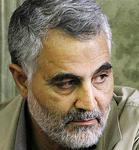
Al Qods chief Gen. Qassem Soleimani
President Barack Obama is close to a decision on a number of US military steps for thwarting the march of Al-Qaeda in Iraq, now halted at Samarra 70 km short of Baghdad. In a comment Thursday night, June 12, he said: “We do have a stake in making sure that these jihadists are not getting a permanent foothold in either Iraq or Syria, for that matter.” He added that he was thinking of “short-term military things.”
Iraqi Prime Minister Nuri al-Maliki has been appealing to the White House for months for Apache helicopters and Hellfire air-ground rockets to fight terrorists. These Obama may now release, as well as considering token US drone attacks on ISIS targets in Iraq, for which he is most reluctant..
Thursday afternoon, Iran’s most powerful gun, the Al Qods Brigades chief Gen. Qassem Soleimani, arrived in Baghdad to take over the push against ISIS, in the same way as he has managed Bashar Assad’s war in Syria, and pull together the demoralized and scattered Iraqi army.
Those steps by Washington and Tehran pave the way for the US and Iran to cooperate for the first time in a joint military endeavor.
Since ISIS forces, albeit boosted by tens of thousands of armed Sunnis flocking to the black flag, are not capable of capturing Baghdad and have halted outside the city, President Obama and Iran’s Ayatollah Ali Khamenei have won a small space for deciding how to proceed.
Khamenei must determine whether Gen. Soleimani with the help of American weaponry can stop al Qaeda, save Maliki from collapse and prevent the fall of Baghdad, and whether it is worth sending an Iranian army division over to Iraq, our intelligence sources reported earlier Thursday. They have since entered Iraq and are fighting ISIS forces.
These moves by Tehran will determined how Washington acts in the coming hours.
The big winner of the ISIS onslaught on Iraq, apart from Al Qaeda, is the semiautonomous Kurdish republic in the north. When the Iraqi army’s 12th division assigned with defending Kirkuk and its oil fields scattered to the four winds Thursday, the Kurdish Peshmerga army rolled right in and snatched the city and oil fields from the control of the Baghdad government, fulfilling an old Kurdish dream.
[T]he evacuation means that the vital training mission at Balad, about an hour northwest of Baghdad, has been suspended indefinitely — despite repeated administration statements that it would continue to support Iraq’s military.
Regarding those assurances, one U.S. official clarified to Fox News: “At the same time, we are not going to do anything stupid.”
Americans were being evacuated Thursday from a major Iraqi air base as Al Qaeda-aligned militants toppled cities in the country’s north and threatened to advance toward Baghdad.
The Iraqi government has been asking for more than a year for surveillance and armed drones to combat a Sunni insurgency that has gained strength from battlefield successes in neighboring Syria.
A senior U.S. official confirmed to Fox News that Americans were being evacuated from a base in Balad, which had been one of the largest training missions in Iraq.
The three planeloads of Americans are mostly contractors and civilians. The State Department said Thursday that the U.S. Embassy in Baghdad is operating as usual.
But the evacuation means that the vital training mission at Balad, about an hour northwest of Baghdad, has been suspended indefinitely — despite repeated administration statements that it would continue to support Iraq’s military.
Regarding those assurances, one U.S. official clarified to Fox News: “At the same time, we are not going to do anything stupid.”
The development signals the worsening security environment in the northern part of the country. One senior official told Fox News that the focus for evacuation at this point is on people outside of Baghdad.
Two senior intelligence sources, though, told Fox News there is serious concern about how to evacuate other Americans out of Iraq if the situation further deteriorates.
“We need places to land, we need safe and secure airfields,” one source said, noting that the militants are “seizing airfields and they have surface-to-air missiles, which very clearly threatens our pilots and planes if we do go into evacuation mode.”
Sources said “all western diplomats in Iraq are in trouble,” and American allies are scrambling to put together an evacuation plan. Military officials said there are “not a lot of good options.”
The Obama administration is still trying to determine how to assist the Nouri al-Maliki government, while making clear it does not want U.S. troops in the middle of the fight.
“We are not contemplating ground troops,” White House Press Secretary Jay Carney said Thursday.
According to the White House, Vice President Biden spoke Thursday with Maliki and expressed “solidarity” with the Iraqi government in its fight against the Islamic State of Iraq and Syria.
Obama promised Thursday to send more military aid, without saying what kind of new assistance would be given to Baghdad. Two U.S. officials who are familiar with ongoing negotiations told The Associated Press the White House is considering air strikes and increased surveillance, requested this week by the Iraqi defense minister, as the insurgency nears Baghdad.
The Iraqi government has been asking for more than a year for surveillance and armed drones to combat a Sunni insurgency that has gained strength from battlefield successes in neighboring Syria.
Republican lawmakers were harshly critical Thursday of the administration’s response. Sen. John McCain, R-Ariz., called for Obama to replace his national security team.
House Speaker John Boehner snapped: “What’s the president doing? Taking a nap.”
Obama commented on the violence shortly afterward.
“What we’ve seen over the last couple of days indicates the degree to which Iraq is going to need more help,” Obama said. “It’s going to need more help from us, and it’s going to need more help from the international community.”
Several thousand Americans remain in Iraq, mostly contractors who work at the U.S. Embassy in Baghdad on programs to train Iraqi forces on American military equipment like fighter jets and tanks. Those being evacuated from Balad on Thursday included 12 U.S. government officials and military personnel who have been training Iraqi forces to use fighter jets and surveillance drones.
Other U.S. contractors are at a tank training ground in the city of Taji, just north of the capital, that is still in operation for now.
In addition to the possible military assistance, State Department spokeswoman Psaki said the U.S. is sending about $12 million in humanitarian aid to help nearly a million Iraqis who have been forced from their homes by recent fighting in the nation’s north and west.
(But see this Stratfor article, speculating that the U.S. will send “vital equipment such as helicopter gunships, Hellfire missiles, communications equipment, large volumes of small arms and ammunition.” — DM)
Obama has two agendas.
1. He does not in any way, shape or form want to be associated with the Iraq War
2. He does not want to offend Muslims, especially the Islamist groups that he has been courting.
Obama . . . claims that conflicts can be ended unilaterally, no matter how much the other side wants to continue them.
I can understand why putting boots on the ground would be unappealing, but air strikes against a terrorist group are low risk and high reward. Obama had no problem signing off on air strikes against Gaddafi. He was contemplating air strikes against Assad.
Both of those were much more high risk, much less legal and much less in our national interest.
On the other hand we are at war with Al Qaeda and this is an Al Qaeda affiliate that we had been directly fighting. There’s no legal issue here, and unlike Syria, it’s not likely to pose a threat to air power. And using drones is on the table.
Why can we use drones against Al Qaeda leaders in Yemen, but not Iraq?
If ISIS manages to set up its own Emirate out of pieces of Iraq and Syria, we’re going to have to end up being dragged into the conflict anyway. It now has a large enemy force. It’s going to come after us. It would be smart to weaken it now.
It would have been smarter to carry out air strikes against it in Syria, instead of talking about bombing the Syrian government.
But Obama has two agendas.
1. He does not in any way, shape or form want to be associated with the Iraq War
2. He does not want to offend Muslims, especially the Islamist groups that he has been courting.
So…
As the threat from Sunni militants in western Iraq escalated last month, Prime Minister Nuri Kamal al-Maliki secretly asked the Obama administration to consider carrying out airstrikes against extremist staging areas, according to Iraqi and American officials.
But Iraq’s appeals for a military response have so far been rebuffed by the White House, which has been reluctant to open a new chapter in a conflict that President Obama has insisted was over when the United States withdrew the last of its forces from Iraq in 2011.
Obama said it’s over, so it’s over. Never mind reality.
Al Qaeda’s attacks grew much worse after the pullout, but Obama kept moving forward and ignoring the problem. And here we are.
ISIS is now taking over major Iraqi cities. But it’s “over”. And Obama, like most liberals, claims that conflicts can be ended unilaterally, no matter how much the other side wants to continue them.
The Obama administration has carried out drone strikes against militants in Yemen and Pakistan, where it fears terrorists have been hatching plans to attack the United States. But despite the fact that Sunni militants have been making steady advances and may be carving out new havens from which they could carry out attacks against the West, administration spokesmen have insisted that the United States is not actively considering using warplanes or armed drones to strike them.
Hoshyar Zebari, Iraq’s foreign minister, last year floated the idea that armed American-operated Predator or Reaper drones might be used to respond to the expanding militant network in Iraq. American officials dismissed that suggestion at the time, saying that the request had not come from Mr. Maliki.
By March, however, American experts who visited Baghdad were being told that Iraq’s top leaders were hoping that American air power could be used to strike the militants’ staging and training areas inside Iraq, and help Iraq’s beleaguered forces stop them from crossing into Iraq from Syria.
“Iraqi officials at the highest level said they had requested manned and unmanned U.S. airstrikes this year against ISIS camps in the Jazira desert,” said Kenneth M. Pollack, a former C.I.A. analyst and National Security Council official, who is a senior fellow at the Brookings Institution and who visited Baghdad in early March. ISIS is the acronym for the Islamic State in Iraq and Syria, as the militant group is known.
As the Sunni insurgents have grown in strength those requests have persisted. In a May 11 meeting with American diplomats and Gen. Lloyd J. Austin III, the head of the Central Command, which oversees American military operations in the Middle East, Mr. Maliki said he would like the United States to provide Iraq with the ability to operate drones. But if the United States was not willing to do that, Mr. Maliki indicated he was prepared to allow the United States to carry out strikes using warplanes or drones.
In a May 16 phone call with Vice President Joseph R. Biden Jr., Mr. Maliki again suggested that the United States consider using American air power. A written request repeating that point was submitted soon afterward, officials said.
So we have clear requests for military aid that the administration has simply been ignoring. Again drone attacks would put no American lives at risk and would undermine ISIS’ momentum by slowing them down and taking out top leaders.
There’s no reason not to do it except the two reasons mentioned above.
But so far, the administration has signaled that it is not interested in such a direct American military role.
“Ultimately, this is for the Iraqi security forces, and the Iraqi government to deal with,” Rear Adm. John F. Kirby, the Pentagon spokesman, said Tuesday.
Except they’re not dealing with it too well, so we’re going to end up having to deal with it.
We waited until Al Qaeda has its own small country with half a billion in money, helicopters, armored vehicles and a huge population. How much longer does Obama want to wait?
Iranian President Hassan Rouhani called the Islamic State of Iraq and Syria “an extremist, terrorist group that is acting savagely.” Reuters
In a stunning development that threatens to further destabilize the Middle East, Iran has deployed an elite unit of its Revolutionary Guard to help the Iraqi government take on ISIS, the al-Qaida offshoot that has seized several areas in the northern part of the country.
Two battalions of the Quds Forces are already making progress in their fight against the Islamic State of Iraq and Syria, or ISIS, the Wall Street Journal reported. The al-Qaida splinter group took control of Saddam Hussein’s hometown of Tikrit on Wednesday, but Revolutionary Guard and Iraqi troops overtook 85 percent of the city on Thursday, Iraqi and Iranian security forces told the paper.
Iran, which is dominated by Shiites, has close ties to Iraq’s Shiite-led government. Iranian President Hassan Rouhani called ISIS “an extremist, terrorist group that is acting savagely” during an appearance on state television, Al Jazeera reported. “For our part, as the government of the Islamic Republic of Iran … we will combat violence, extremism and terrorism in the region and the world.”
The Iranian military is considering shifting troops fighting in Syria, where forces are supporting Syrian President Bashar al-Assad’s government, to Iraq if the deployment of the Quds Forces doesn’t make any progress in the latest offensive.
The Times of London said 150 members of the Quds Forces are in Iraq, where ISIS militants seized Mosul, Iraq’s second-largest city, earlier this week.
Meanwhile, ISIS continue to vow that it would soon march on Baghdad.
“’Our final destination will be Baghdad, the decisive battle will be there,’ that’s what their leader kept repeating,” a tribal figure near Tikrit relayed to Reuters.
 A member of the Iraqi security forces mans a checkpoint in Baghdad. Source: AFP







 anneinpt
 artaxes
 danmillerinpanama
 davidking1530
 Peter Hofman
 Joseph Wouk
 Peter
Peter Louisiana Steve
 WarSclerotic
Recent Comments