Archive for June 2014

Obama’s “up to 300 US military advisers” won’t stop ISIS-Sunni entrenchment in Iraq

June 20, 2014

Obama’s “up to 300 US military advisers” won’t stop ISIS-Sunni entrenchment in Iraq, DEBKAfile, June 19, 2014

ISIS also has plans to send its heavily indoctrinated foreign recruits back to their own countries primed for terror: “The people in that regime, as well as trying to take territory, are also planning to attack us here at home in the United Kingdom.”

Al Qaeda’s success in the face of Obama’s vacillations may infect Iraq’s neighbors with an epidemic of instability..

President Obama announced Thursday, June 19, after meeting his national security team, that the US would send up to 300 military advisers to help, advise and train Iraqi forces, and establish joint operations centers in Baghdad and the North. The US has been conducting “surveillance and reconnaissance missions for a better picture of the locations of ISIS forces,” he said.

US combat troops would not be returning to Iraq, said Obama firmly, but if regimes were in place in Syria and Iraq with inclusive agendas, the US would be willing to establish joint counter-terror platforms for regional partners to fight terrorism. He spoke of “targeted US military action if the situation required it” but only after consulting Congress and regional partners.

We talked to Iranians about their role in Iraq, Obama reported, and told them we hoped it would be constructive – unlike their posture in Syria which was on the side of a sectarian solution.

In its special video report earlier Thursday, DEBKAfile reported:

By dispatching the USS George W.H. Bush to the northern Gulf this week, Obama recalled his tactics at the outset of the Syrian civil war in 2011. He first piled up a menacing armada opposite Syrian shores and told Bashar Assad he must go. But then, he backed away from intervening in the Syrian crisis after all. Is that fro-and-back pattern being repeated in Iraq?

How to interpret the posting of a US warship opposite Iraq on June 15 and, for that matter, Barack Obama’s comment two days earlier: “We do have a stake in making sure these jihadists are not getting a permanent foothold in either Syria or Iraq.”

Has he again developed cold feet? The CIA and Pentagon have explained they have not been able to determine the exact makeup of Al Qaeda’s ISIS  – the Islamist State in Iraq and the Levant which has swallowed up much of Iraq’s Sunni heartland link.

According to DEBKA’s military and intelligence sources, the Islamists advancing on Baghdad are not one, but two armies: The Al Qaeda element has been joined by a hodgepodge of Sufi groups, Saddam Hussein’s old Baath Party guard, and US-trained Sunni Awakening Council tribes.

Iraq Wednesday formally requested US air support, including drone strikes and more surveillance. According to some reports, Washington will hold back anything more substantial that a hundred or so Special Operations personnel as non-combat military instructors for Iraq’s army.

Anyway, Al Qaeda lacks the fixed formations of a professional army, making it an elusive target for pinpointed attacks. So the jihadis’ advance may prove unstoppable and even if Baghdad survives, it may be too beleaguered to function as Iraq’s capital.

Shiite Prime Minister Nuri al Maliki is hardly posed to meet US expectations for setting up a national unity government to heal the strife. The Obama administration would much prefer to see al Maliki step aside and that may be one of its conditions for substantial military aid.

As the situation is developing now, Iraq is more likely to break up into pseudo states as a result of the Al Qaeda led Sunni revolt against Maliki’s regime. A Kurdish state in the north, a Shiite state in the south, and Al Qaeda and Sunni statelets in western, central and eastern Iraq, up to Baghdad’s outskirts.

ISIS also has plans to send its heavily indoctrinated foreign recruits back to their own countries primed for terror: “The people in that regime, as well as trying to take territory, are also planning to attack us here at home in the United Kingdom.”

Al Qaeda’s success in the face of Obama’s vacillations may infect Iraq’s neighbors with an epidemic of instability..

ISIS militants log killings in annual report for financial backers

June 20, 2014

Assassinations, suicide missions and bombings in annual report for financial backers

The annual publication is called al-Naba, which is Arabic for ‘The News’ Reports for 2012 and 2013 were analysed by Institute for the Study of War ISIS claims to have carried out 10,000 operations in Iraq last year alone

These included assassinations, bombings and the freeing of prisoners Isis compiles it to attract donors and present themselves as organised Details emerged as new information about group’s funding came to light

By Leon Watson

Published: 04:50 GMT, 18 June 2014

Updated: 23:55 GMT, 18 June 2014

via ISIS militants log killings in annual report for financial backers | Mail Online.

With its carefully collated facts and figures, it reads like a set of company accounts.

But closer inspection of the 400-page document reveals it is a chilling breakdown of the murderous activities of the fanatics battling for control of Iraq.

For this is the ‘annual report’ of the Al Qaeda-inspired Islamic State of Iraq and Syria (ISIS), designed to demonstrate its power and attract funds from potential donors.

Like any corporate document, it uses computer-generated graphics, details a management strategy, lists performance and targets.


But the jihadists’ statistics chart in numerical and geographical detail its lethal operations – bombings, assassinations, suicide missions and cities taken over.

In the latest edition of ‘al-Naba’ – the News – covering the 12 months up to last November, ISIS claims to have carried out nearly 10,000 operations in Iraq. That includes 1,000 assassinations, planting more than 4,000 roadside bombs and freeing hundreds of prisoners.


ISIS even records the number of people who renounced Islam then repented – and contains one sickening category headed ‘apostates run over’.

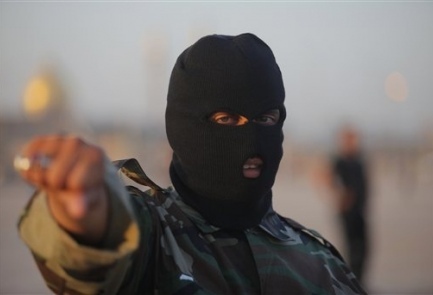
The report, written in Arabic with a photograph of an ISIS gunman on its cover, has been analysed by the US think-tank, the Institute for the Study of War (ISW), which has corroborated much of the information. John Lawrence, of the Washington-based institute said: ‘These numbers are not just purely propaganda figures.’


Taking no prisoners: A man is executed by fighters from the Islamic State of Iraq and the Levant as the Al Qaeda-inspired militants continue their march towards Baghdad
 

Details: The Isis report uses computer-generated graphics to detail the group’s reign of terror in the Middle East. This chart shows the number of explosive devices the group detonated in 2012 and 2013


ISIS’s aim appears to be to demonstrate its record to potential donors, and ISW says the annual report, the second published in as many years, destroys the myth that the insurgents are a rag-tag band of Islamist militants.

The ISW analysis portrays an organisation ‘functioning as a military rather than a terrorist network’ with a clear political strategy aimed to eventually set up a Sunni sectarian state run under harsh Sharia laws.

Jessica Lewis, director of research at the institute, told the Financial Times: ‘The reports provide measures of performance in the way you roll out details for donors.


Numbers: Another set of graphics in the report shows the weaponry Isis now has in its possession
 

Isis claims in the 2013 report to have 15,000 fighters who have carried out 1,000 assassinations
 
 
They affirm that the organisation operates like an army and that it has state-building ambitions.’ The ISW study concludes: ‘This is a military enemy that requires a considered strategy, military as well as involving anti-ISIS Sunni populations, to defeat it, or it will become a permanent fixture in the Middle East.’

The latest annual report does not include the ISIS fanatics’ major gains in recent weeks, where they have swept through northern Iraq, carrying out summary executions. They are now battling government forces close to Baghdad.

This year has also been successful in financial terms for the terror group. Its fighters looted hundreds of millions of pounds from banks in Mosul, Iraq’s second city which was over-run by ISIS last week.

The road to Baghdad: Fierce fighting is currently taking place at Baqubah, the last major city before the capital, as ISIS militants seize control of vast swathes of northern Iraq
 
According to the Council on Foreign Relations, ISIS was already extorting taxes from Mosul businesses before its takeover – to the tune of £4million a month.In its 2013 document, ISIS says it took over eight cities, compared to one the previous year. The ISW warns that the number of attacks reported by ISIS may be exaggerated but month by month, area by area, the document reveals soaring levels of violence.

In 2013, ISIS claims to have executed 1,083 people – almost double the 585 in 2012. Mortar attacks jumped from 359 in 2012 to 607 last year and the number of houses burned or bombed rose from 648 to 1,015.

ISIS massively increased the use of suicide bombers – either wearing bomb vests or driving bomb-laden vehicles – to terrorise Iraqis, with a six-fold increase in the number of attacks to 238. Baghdad bore the brunt of suicide bombers, with an increase from seven to 81 murderous attacks in the capital.

Targeted killings jumped from 16 to 1,047 and are evidence of a disciplined shift in tactics and techniques by ISIS to wrest control of Iraq, says the ISW.

ISIS in Iraq seizes control of Saddam Hussein’s chemical weapons facility

June 19, 2014

ISIS in Iraq seizes control of Saddam Hussein’s chemical weapons facility

VIA    BARE NAKED ISLAM.

Original article :  http://online.wsj.com/articles/sunni-extremists-in-iraq-occupy-saddams-chemical-weapons-facility-1403190600

Officials don’t believe these Sunni militants will be able to create a functional weapon from the material. Are these the same officials who said there were never any WMD’s in Iraq?


1045034-602x292


WSJ  Sunni extremists in Iraq have occupied what was once Saddam Hussein’s premier chemical-weapons production facility, a complex that still contains a stockpile of old weapons, State Department and other U.S. government officials said. The capture of the chemical-weapon stockpile by the forces of the Islamic State of Iraq and al-Sham, known as ISIS or ISIL, the militant group that is seizing territory in the country, has grabbed the attention of the U.S.

“We remain concerned about the seizure of any military site by the ISIL,” Jen Psaki, the State Department spokeswoman, said in a written statement. “We do not believe that the complex contains CW materials of military value and it would be very difficult, if not impossible, to safely move the materials.”


_75638251_5a4f166a-12eb-46b7-9ac2-7dadd9f33878


The takeover underscores the chaos gripping Iraq and the possibility that the growing Sunni rebellion could further destabilize the Middle East. Not lost on U.S. government and military officials is the irony that the latest chapter in a war designed to strip Iraq of chemical weapons could see radical Sunni extremists take control of that same stockpile.

During the Iran-Iraq war of the 1980s, Hussein used the Muthanna complex to make chemical weapons, including sarin, mustard gas, and VX (a nerve agent), according the Iraq Study Group, which conducted the hunt for weapons of mass destruction in the aftermath of the war. The Iraq Study group did find chemical munitions at Muthanna but determined that inspections by United Nations Special Commission, or Unscom, had ensured the facility was dismantled and remaining chemical stocks militarily useless and sealed in bunkers.


a646_iraqi_chem_bomb_2050081722-10861


“Two wars, sanctions and Unscom oversight reduced Iraqi’s premier production facility to a stockpile of old damaged and contaminated chemical munitions (sealed in bunkers), a wasteland full of destroyed chemical munitions, razed structures, and unusable war-ravaged facilities,” the Iraq Study Group’s 2004 report concluded. The Muthanna complex is near Lake Tharthar, roughly 45 miles northwest of Baghdad, an area now firmly in control of the Sunni terrorists. ISIS has taken control of most of Anbar province as well as Mosul, Iraq’s second-largest city.

When the U.S. pulled out of Iraq, it didn’t anticipate a large swath of the country, including numerous military bases, would be overrun by radical Sunni militants. One defense official said that if the U.S. had known the Iraqi government would lose control so soon, it might not have left the old chemical weapons in place.


2


U.S. officials repeatedly emphasized the takeover of the chemical weapons stocks didn’t constitute a significant military gain by ISIS. The group, multiple officials said, would find the weapons militarily useless even if they were to get access to the sealed bunkers where they are stored. Officials said the group hasn’t yet gained access to those bunkers.

ISIS military gains have been aided by other Sunni groups including Baathists and other former loyalists to Hussein. Officers in Hussein’s army have also taken leadership roles in the rebellion. Some of those men may have some working knowledge of the use of chemical weapons from the Iran-Iraq war.


Iraq_sacrifices-990-640x496


If Iran does not have nukes now, how long will it take to get them?

June 19, 2014

If Iran does not have nukes now, how long will it take to get them? Dan Miller’s Blog, June 19, 2014

How long it will take Iran to get nukes — rather than preventing Iran from getting them — seems to be the major issue now being discussed by the P5 + 1 negotiators. What impact, if any, will the mess in Iraq have? 

The P5 + 1 “deal”

a1  Obama and Kahameni -building a toaster

According to a Washington Free Beacon article posted on June 19th titled U.S., Iran Experts Dispute Nuclear Bomb ‘Breakout’ Timeline,

U.S. Secretary of State John Kerry has said that Iran has the ability to produce highly-enriched uranium for one bomb in two months, if it so decided. . . . Western officials and experts say this potential timeline must be substantially extended under any deal to end the decade-old nuclear dispute. [Emphasis added.}

The article assumes that Iran does not already have nukes, despite the non-inspection of military sites where she had allegedly been testing them, machining Uranium for warheads and developing missiles with which to deliver them. Missile development, testing and Iran’s other military activities are not dealt with by the November 2013 framework for the P5 +1 discussions. As I noted in an article titled The Iran Scam continues,

The text of the English language version of the P5+1 “deal” is available here and the text of the January 16th White House summary of the recent agreement to go forward by reducing sanctions and beginning inspections of some (but not all) Iranian nuclear facilities is available here. I posted articles about the November 24th “deal” here and here and the White House summary here. The first two minutes and eleven seconds of the video embedded below provide a concise summary of what has been happening.

An article by Elliot Abrams re-published at Israel Hayom questions whether, in view of the current disagreements between Iran and the United States about what the “deal” means, there is really a deal. I am concerned that there is a “deal” but that it has little to do with Iran’s continued development of nuclear weaponry. There has been substantial albeit unilluminating media praise — particularly outside of Israel – for the “deal.” However, with rare exceptions U.S. and European media have provided little coverage of the omissions of both the P5+1 “deal” and the January 16th White House summary to deal effectively with Iran’s aggression oriented nuclear facilities and efforts – her Parchin military facility, development of nuclear warheads and missiles with which to deliver them.

The Washington Free Beacon article linked above continues with this Iranian perspective:

[A]n Iranian website this month published a report saying it would take at least 18 months to [enrich enough Uranium], a time frame that would reach three years if conversion of the material into uranium metal and moulding – steps required to make a bomb – were included. [Emphasis and insert added.]

Yet more time would be needed to develop a vehicle, a missile for example, for a nuclear warhead to be delivered to its target. “It is impossible for Iran to break out in months through the uranium route. The required time span is in years,” the report published on http://www.nuclearenergy.ir said, stressing that this was a “hypothetical” scenario.

The Institute for Science and International Security (ISIS), a U.S.-based think-tank quoted in the Washington Free Beacon article disagrees:

[T]he Iranian website “expresses common government stances” on nuclear issues. “This study contains mistakes and uses unwarranted assumptions to arrive at its conclusions,” ISIS said of the Iranian report. “Using its data and correcting for mistakes, we arrive at a breakout estimate of 2-3 months in terms of the time to produce 25 kg of WGU (weapons-grade uranium).” That is the amount traditionally seen as sufficient for one bomb. [Emphasis added.]

Iraq — problem or opportunity? Obama and Iraq Substantial concern — which I share — has recently been expressed that if the Obama Administration cooperates with Iran in resolving the current conflict in Iraq then concessions in favor of Iran will be made by the P5 + 1 negotiators. On June 18th, Business Insider posted an article titled Here’s The Hidden Agenda Behind Any US-Iran Cooperation In Iraq. It observed,

The escalating crisis in Iraq comes amid the search a solution for another huge geopolitical dilemma — a nuclear deal among world powers and Iran. With a vested interest in keeping the current Shi’ite government in power in Iraq, Iran has been happy to step up and provide support in its fight against Sunni insurgents of the Islamic State of Iraq and ash-Sham (ISIS). It is a rare situation in which U.S. and Iranian interests somewhat align. A senior State Department official said diplomats from both countries held talks on Iraq on the margins of broader nuclear-program discussions in Vienna. The U.S. expects to work with Iran, though the State Department stressed there will be no military cooperation. [Emphasis added.]

But the cooperation comes with a condition. A top spokesman to Iranian President Hassan Rouhani said Wednesday that it could work with the U.S. if nuclear negotiations are successful.

If that comes to a final resolution, then there might be opportunities for other issues to be discussed,” Rouhani’s chief of staff, Mohammad Nahavandian, told reporters on Wednesday. He added the talks serve as a “test for confidence building.” [Emphasis added.]

During His (typically late) appearance for an address on the Iraq mess, President Obama indicated that the U.S. might provide airstrikes if required but did not say what His requirements might be. He claimed that He would send up to three hundred military advisers to assist the Iraq military but ruled out U.S. combat troops. He also claimed that our intelligence gathering abilities will be enhanced and coordinated with the Iraqis. He emphasized the need for Iraqis to resolve their sectarian differences and noted that Iran has been sending a similar message. He did not appear to have much faith that Iran has been serious in sending that message. He also said that He has “directed Mr. Kerry to lead a diplomatic effort to stabilize Iraq.” Does He contemplate something resembling the Israel – Palestinian “peace process,” which failed due to Palestinian intransigence? Are the Iraqi factions less intransigent the Palestinian factions?

The principal focus of President Obama’s June 19th address seems to have been on the need for the Iraqis to resolve their differences and to unite to achieve a common goal. That seems very unlikely. In a June 18th post by Paul Mirengoff at Powerline titled The world continues to confound our clueless President, it was contended that

The country is disintegrating, Iraqi soldiers are deserting, some of those who aren’t have been executed barbarically, and Baghdad is under serious threat.

What does Obama do? He urges Prime Minister Maliki to make his government more inclusive of his political opponents and to loosen his grip on power.

To appreciate the foolishness of this response, consider how Obama behaves in response to the smallest political crisis here at home. His response is always first to rally the base.

How, then, can Obama suppose that Maliki, in response to an existential crisis, will alienate his base by ceding power to opponents?

It isn’t going to happen. In fact, as the Washington Post reports, Maliki is actually “tightening his grip on power”:

Reinforced by a call to arms from the country’s top Shiite cleric and by promises of support from Iran, Maliki has set about rallying the country’s Shiite majority behind his leadership as Sunni extremists bear down on Baghdad.

Negotiations on the formation of a new government have been suspended, and instead, Shiite factions who had sought to prevent Maliki from securing a third term in office by aligning with Sunni and Kurdish politicians have thrown their support behind him.

That’s how the world works, Mr. President.

Conclusions

The P5 + 1 November 2013 framework for discussions has been worthless as a vehicle for preventing Iran from getting (or keeping) nukes. The apparent current focus of discussions on when, not whether, Iran can have them makes it even worse. If the Obama Administration cooperates with Iran either overtly or covertly in resolving Iraq’s problems — in view of President Obama’s June 19th address covertly is the more likely — and should such cooperation be reflected in further nuke concessions for Iran, what had appeared to be an indecent “deal” will become truly obscene.

Jordan Could Be the Islamic State in Iraq and the Levant’s Next Target

June 19, 2014

Jordan Could Be the Islamic State in Iraq and the Levant’s Next Target, Stratfor, June 19, 2014

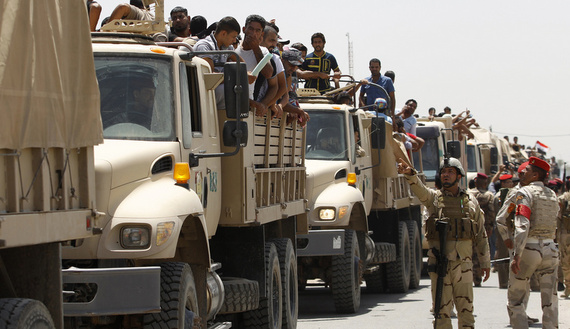
Volunteers who have joined the Iraqi Army to fight against the predominantly Sunni militants travel in army trucks in BaghdadIraqi tribesmen gather in Baghdad to show their readiness to join Iraqi security forces in the fight against militants on June 16. (Photo credit should read AHMAD AL-RUBAYE/AFP/Getty Images)

Summary

The Islamic State in Iraq and the Levant, buoyed by its recent successes in Iraq, wants to expand its regional reach. Reports that Iraq has withdrawn forces from western towns close to its 180-kilometer (110-mile) border with Jordan have left Amman feeling vulnerable, and the Hashemite kingdom, certainly a target of interest for the jihadist movement, has deployed additional security personnel along the border.

However, taking on Jordan would be tough for the Islamic State in Iraq and the Levant. The group has the ability to stage terrorist attacks in the country, but significant constraints will prevent it from operating on the levels seen in Iraq and Syria.

Analysis

The June 15 edition of the Jordan Times reported that Amman had beefed up security along its border with Iraq amid fears that the Islamic State in Iraq and the Levant is inching toward the kingdom. Quoting unnamed Islamist sources, the report added that the jihadist group had established a branch within the kingdom as part of its plans to create a regional emirate.

The militant group’s intent to expand into Jordan follows the region’s geopolitical logic. After its push into Iraq, and already controlling significant swathes of Syrian territory, the jihadist group can try to push into the Hashemite kingdom from two directions. Jordan is the only opening available to Islamic State in Iraq and the Levant — the group cannot move north into Turkey, nor could it move southwest into Lebanon. Even in Jordan, though, the group faces considerable challenges.

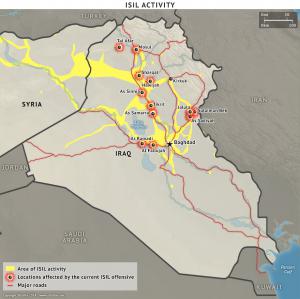
iraq_syria-isis-activity-06-16-2014

For starters, the Jordanian regime is far more stable than Syria or Iraq, and its security forces have proved to be quite effective. Furthermore, Jordan has strong backing from the United States and Saudi Arabia, especially since the kingdom became a critical staging ground for support to Syrian rebels. Washington and Riyadh can extend financial, intelligence and military assistance to Amman. But Jordan is also a key sanctuary for rebels, and this aids the Islamic State in Iraq and the Levant’s cause.

Jordan has long had a substantial Salafist and jihadist presence. Since the start of the civil war in Syria, jihadists have moved frequently across the Jordan-Syria border. Amman has tried to crack down on this cross-border traffic, but it has not brought it to a stop.

Jordan is the native country of Abu Musab al-Zarqawi, the slain founder of the organization that later became the Islamic State in Iraq and the Levant. However, the kingdom’s jihadist landscape is currently dominated by forces that oppose the group and are aligned with al Qaeda and its Syrian ally, Jabhat al-Nusra. Though the Islamic State in Iraq and the Levant has its own supporters in Jordan, the best-known jihadist ideologues in the country — people such as Abu Muhammad al-Maqdisi and Abu Qatada — have criticized the group, especially its revolt against al Qaeda prime, creating dissension within jihadist ranks in Syria.

The Islamic State in Iraq and the Levant’s jihadist opponents are dismayed by what they see as the group’s high-risk maneuvers, such as its mass killings of Shia and its insistence on imposing austere Islamist laws in the areas it controls, actions that risk alienating locals in a given country. In September, al Qaeda leader Ayman al-Zawahiri issued guidance specifically addressing the issue, calling on jihadist fighters to refrain from fighting sects, such as Shia, Ismailis, Qadianis and Sufis, unless elements from those sects begin the fight. He similarly called for noninterference with Christian, Sikh and Hindu communities living in Muslim lands. He also ordered jihadists not to target noncombatant women and children or fellow Muslims via explosions, killings, kidnappings or destruction of property.

The Islamic State in Iraq and the Levant openly rejected this call. The group’s predecessor, al Qaeda in Iraq, despite frictions with Jordan-based jihadists, was able to stage attacks in the country, including suicide bombings in 2005 that targeted three Western hotels in Amman, and the 2002 assassination of U.S. diplomat Lawrence Foley. Now that the group’s capabilities have dramatically expanded, it can certainly carry out attacks in the kingdom if it chooses to do so. The Islamic State in Iraq and the Levant will have to assess its current position, especially in light of its push into Iraq, and decide whether it is in its interest to quickly begin operations in Jordan, or whether it should wait until it has consolidated itself in Iraq and weathered the counteroffensive from Shia and Kurds there.

The Islamic State in Iraq and the Levant certainly will not want to alienate many of its Iraqi Sunni partners who have sanctuary in Jordan. Sunni tribal forces in Iraq would prefer that the group focus on that country and desist from any action in Jordan that could trigger a strong reaction from Amman. It is unclear how the Islamic State in Iraq and the Levant will proceed. The key thing to bear in mind is that while it can carry out terrorist attacks in Jordan, there are too many constraints for the group to act in Jordan as it has in Syria and Iraq.

Jordan Could Be the Islamic State in Iraq and the Levant’s Next Target is republished with permission of Stratfor.”

Israel urges world powers to stay tough on Iran amid Iraq crisis

June 19, 2014

Israel urges world powers to stay tough on Iran amid Iraq crisis, Israel Hayom, Daniel Pipes, June 19, 2014

Israel is concerned by U.S. willingness to work with Iran in beating back Sunni Muslim insurgents in Iraq • Minister Uzi Landau: The threat Iran and Hezbollah pose to stability of Israel and other moderate players in region must not be forgotten.

Peace Brigade southern IraqA volunteer in the newly formed Peace Brigades participates in a parade in the holy Shiite city of Najaf in southern Iraq, Wednesday | Photo credit: AP

Israel is calling on world powers not to ease their pressure on Iran to curb its disputed nuclear program should Iran cooperate with the West in beating back the Sunni Muslim insurgencies that have spiraled from Syria into Iraq.

A lightning advance since last week has seen Sunni fighters rout the army of Iraq’s Shiite-led government and seize the main cities across the north, prompting Iran, the Middle East’s main Shiite power, to state that it is prepared to intervene to defend Shiite holy sites in Iraq.

While echoing global jitters at the Iraqi bloodshed, Israelis are alarmed by America’s willingness to cooperate with Iran in securing Iraq.

A senior U.S. official said on Monday the United States may discuss the security crisis in Iraq with Iran on the sidelines of this week’s nuclear talks in Vienna.

In the Knesset on Wednesday, Tourism Minister Uzi Landau (Yisrael Beytenu) said, “We are working to prevent a situation in which, in light of the increasing danger of global jihad elements, Iran and its allies are portrayed as blocking the spread of such elements in the area.

Israel is concerned about a growing “arc” of Iranian influence from Iraq to Syria, where Iran backs embattled President Bashar Assad, on to Lebanon, where it has a powerful proxy in the Hezbollah terrorist organization.

“The threat Iran and Hezbollah pose to stability, to Israel’s security and to other moderate players in the region must not be forgotten, so it is a two-fold battle,” Landau said.

Israel would “intensify contact with the international and regional powers” on the matter, Landau said.

Iran is negotiating with world powers about rolling back its nuclear program in exchange for an easing of their sanctions.

However, those talks look unlikely to bring an accord by the July 20 deadline, given enduring disputes over the scale of uranium enrichment and other projects Iran would be allowed to retain.

International Relations, Intelligence and Strategic Affairs Minister Yuval Steinitz, who liaises with the United States and European powers about the nuclear diplomacy with Iran, said they had assured him they would hold their course in the negotiations, regardless of any Iranian cooperation in Iraq.

U.S., Iran Experts Dispute Nuclear Bomb ‘Breakout’ Timeline

June 19, 2014

U.S., Iran Experts Dispute Nuclear Bomb ‘Breakout’ Timeline, Washington Free Beacon, June 19, 2014

(The debate is now about how long it will take Iran to get nukes, not whether it will be permitted to have them. How long a breakout time will be agreed upon? Would three years be long enough? That would put the “breakout” date a few months after President Obama leaves office. Please see also Here’s the hidden agenda behind any US – Iran cooperation in Iraq. — DM)

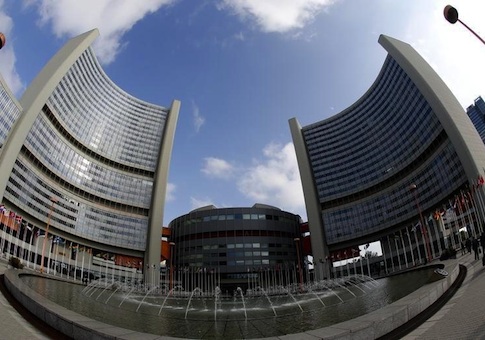
The United Nations headquarters building is pictured in ViennaThe United Nations headquarters building is pictured in Vienna / Reuters

U.S. Secretary of State John Kerry has said that Iran has the ability to produce highly-enriched uranium for one bomb in two months, if it so decided. [ID:nL6N0N010U] Western officials and experts say this potential timeline must be substantially extended under any deal to end the decade-old nuclear dispute.

VIENNA (Reuters) – A U.S. security institute estimates that Iran could amass material for a nuclear bomb in three months or less while Iranian experts cite a time frame six times longer – a dispute going to the heart of talks between Tehran and global powers.

Differences over how fast Iran could “break out” a nuclear weapon complicate the quest for a deal by late July under which Iran would scale back its atomic energy programme in exchange for a lifting of crippling sanctions.

The West wants Iran to significantly cut back its uranium enrichment capacity to ensure it would not be able to quickly produce a nuclear bomb. Iran says it needs to expand its programme to fuel a planned network of atomic energy plants, denying accusations of a secret nuclear weapons agenda.

With only some five weeks to go before the self-imposed July 20 deadline for a deal, the negotiating positions between Tehran and the United States, France, Germany, Russia, China and Britain remain far apart. A fifth round of talks since February is being held in Vienna this week.

U.S. Secretary of State John Kerry has said that Iran has the ability to produce highly-enriched uranium for one bomb in two months, if it so decided. [ID:nL6N0N010U] Western officials and experts say this potential timeline must be substantially extended under any deal to end the decade-old nuclear dispute.

In an apparent attempt to counter that view, an Iranian website this month published a report saying it would take at least 18 months to do so, a time frame that would reach three years if conversion of the material into uranium metal and moulding – steps required to make a bomb – were included.

Yet more time would be needed to develop a vehicle, a missile for example, for a nuclear warhead to be delivered to its target.

“It is impossible for Iran to break out in months through the uranium route. The required time span is in years,” the report published on http://www.nuclearenergy.ir said, stressing that this was a “hypothetical” scenario.

The website says it is “dedicated to providing accurate and factual information” about the Iranian nuclear programme, which the Islamic Republic says is entirely peaceful.

NUCLEAR BREAKOUT “MYTH”

The Institute for Science and International Security (ISIS), a U.S.-based think-tank which closely monitors Iran’s atomic activities, said on Wednesday that the Iranian website “expresses common government stances” on nuclear issues.

“This study contains mistakes and uses unwarranted assumptions to arrive at its conclusions,” ISIS said of the Iranian report. “Using its data and correcting for mistakes, we arrive at a breakout estimate of 2-3 months in terms of the time to produce 25 kg of WGU (weapons-grade uranium).” That is the amount traditionally seen as sufficient for one bomb.

Uranium enriched to a fissile concentration of around 5 percent is used to fuel civilian nuclear power plants, Iran’s stated ambition. If processed to a much higher degree, to about 90 percent, it can provide the fissile core of a nuclear bomb, which the West fears may be Tehran’s covert aspiration.

Iranian Foreign Minister Mohammad Javad Zarif, the country’s chief nuclear negotiator, criticized what he called the breakout “myth”.

“For years, small but powerful constituencies have irrationally advanced the idea that Iran can produce enough fissile material for a bomb in months,” he said in a June 13 article for the Washington Post.

If Iran ever wanted to take such a step, he said, it would have to expel U.N. nuclear inspectors and reconfigure its enrichment programme to make weapon-grade fissile material, which would then need to be turned into metal and “undergo countless other complex weaponisation processes”.

“None of these capabilities exist in Iran and would have to be developed from scratch. This would take several years — not a few months,” Zarif said.

Iraq crisis: US ‘urging Maliki to resign’ – live updates

June 19, 2014

Iraq crisis: US ‘urging Maliki to resign’ – live updates US reported to have told Iraqi PM to step down Maliki’s office rejects calls for his resignation More fighting for control of Baiji oil refinery Iraq formally requests US air strikes Read the latest summary

via Iraq crisis: US ‘urging Maliki to resign’ – live updates | World news | theguardian.com.


The Iraqi prime minister, Nouri al-Maliki, blasts Saudi Arabia and Qatar for providing assistance to insurgents in his country during recent violence. He also warns that fighting will not remain confined to the country as terrorists flee his government’s fight back. Radical Islamist group Isis has been launching deadly attacks in Iraq over the last two weeks.
 
1.51pm BST

Saudi Arabia has warned against foreign meddling in Iraq. Writing in the Telegraph, the Saudi ambassador to the UK, Prince Mohammed bin Nawaf Al Saudi, said:

We oppose all foreign intervention and interference. There must be no meddling in Iraq’s internal affairs, not by us or by the US, the UK or by any other government. This is Iraq’s problem and they must sort it out themselves. Any government that meddles in Iraq’s affairs runs the risk of escalating the situation, creating greater mistrust between the people of Iraq – both Sunni and Shia.

Instead, we urge all the people of Iraq, whatever their religious denominations, to unite to overcome the current threats and challenges facing the country.

Updated at 1.52pm BST

1.18pm BST

In that NBC interview Kerry also insisted the US was not seeking to prop up the Maliki government.

“This is not about Maliki,” AFP quoted Kerry saying.

Nothing that the president decides to do is going to be focused specifically on Prime Minister Maliki. It is focused on the people of Iraq.

1.03pm BST

Summary

Here’s where things currently stand:

12.43pm BST

US Secretary of State John Kerry has confirmed the United States is contemplating communicating with Iran to share information about the insurgency spreading across Iraq, but is not seeking to work together with Iran to address the crisis.
“We are interested in communicating with Iran. That the Iranians know what we’re thinking, that we know what they’re thinking and there is a sharing of information so people aren’t making mistakes,” Kerry said in an interview on NBC News.
Asked if the United States was considering working hand-in-hand with Iran, Kerry said: “No. We’re not sitting around contemplating how we’re going to do that or if we’re going to do that. That’s not on the table,” Kerry added.
Asked about the possibility of US air strikes, Kerry also said that “nothing is off the table”.

John Kerry promises to honor sacrifice of Iraq vets, families http://t.co/jJyTl7baWB via @TODAYshow pic.twitter.com/FzqTpoxUKl

— NBC News (@NBCNews) June 19, 2014

12.09pm BST

Iraq would be better off without Maliki, but now is not the best time to call for his resignation, according to Middle East analyst Juan Cole.

In his latest blog post Cole also cautioned that there is no obvious successor for Maliki.

Washington also has to be careful about trying and failing to get rid of al-Maliki. President Obama and Hillary Clinton wanted to get rid of Hamid Karzai of Afghanistan in 2009; they failed, and therefore had bad relations with Karzai ever after …

There are likely to be months of wrangling before a new PM can be chosen. And maybe it will have to be a minority PM because the parliament is permanently hung. In the meantime, if al-Maliki is deposed, who will command the armed forces?

So if you depose al-Maliki, you can’t be sure who will take his place. His successor may be even worse.

As in Libya, the the government could also collapse.

11.36am BST

Martin Chulov and Spencer Ackerman have more on US calls for Maliki to go as a condition for US military intervention, and Iraq’s defiant response.

Dianne Feinstein, the chair of the Senate intelligence committee, told a hearing on Wednesday that Maliki’s government “has got to go if you want any reconciliation”, and Republican John McCain called for the use of US air power but also urged Obama to ” make very clear to Maliki that his time is up”.

The White House has not called for Maliki to go but spokesman Jay Carney said that whether Iraq was led by Maliki or a successor, “We will aggressively attempt to impress upon that leader the absolute necessity of rejecting sectarian governance.”

Maliki’s spokesman, Zuhair al-Nahar, said that the west should immediately support the Iraqi government’s military operation against Isis rather than demand a change of government. He insisted that Maliki had “never used sectarian tactics”.

See earlier for audio of Nahar’s interview.

11.27am BST

Saudi Arabia and Iraq continue to trade verbal blows over who is to blame for rise of Isis and the crisis in Iraq.

Saudi Arabia has dismissed as “ludicrous” Maliki’s claim that Saudia Arabia backed Sunni militants.
Speaking to reporters in Jeddah, foreign minister Saudi al-Faisal added that the kingdom had criminalised terrorism, especially that perpetrated by Isis and he advised Maliki to follow the policy pursued by the kingdom in eradicating terrorism.

Last night the Saudi embassy in London said it was a “malicious falsehood” of for the Iraqi cabinet to suggest that the kingdom backed Isis.

11.07am BST

Government forces say they have taken control of Baiji oil refinery, but insurgents were still inside the complex and sporadic clashes persisted, AFP reports.

Sunni Arab militants had stormed the complex in Baiji, south of Iraq’s militant-held second city Mosul, on Wednesday, setting fire to several storage tanks for refined products in a move that sent jitters through world oil markets.

“Clashes stopped at about midnight (2100 GMT), but keep breaking out again from time to time,” Dhahi al-Juburi, an employee trapped inside the sprawling complex told AFP by telephone.

“Iraqi forces are still inside the refinery, and they control it,” he said, adding that “insurgents are still in several places in the refinery, and even in some towers.”

Another employee inside Baiji refinery, who spoke on condition of anonymity, echoed Juburi’s account.

Prime Minister Nuri al-Maliki’s security spokesman Lieutenant General Qassem Atta, however, told state television earlier on Thursday that the refinery was fully in government hands and that the militant assault had been repelled.

IDF meets growing resistance from Palestinians in raids to find kidnapped teens

June 19, 2014

IDF meets growing resistance from Palestinians in raids to find kidnapped teens

By YAAKOV LAPPIN 06/19/2014 10:27

Clashes have grown in scope in recent days as soldiers carry out West Bank arrests to gather information on the whereabouts of the abducted youths.

via IDF meets growing resistance from Palestinians in raids to find kidnapped teens | JPost | Israel News.


IDF operation in Hebron

Security forces continued to focus their searches for three kidnapped youths in Hebron overnight Thursday. Meanwhile, soldiers arrested 30 Palestinian suspects in raids, most of them Hamas members, including two who were released in the 2011 Gilad Schalit exchange with Hamas. Intelligence information led to the two prisoners that were released in the Schalit deal, a security source said Thursday morning.

In total, some 280 Palestinians – including 200 Hamas members – have been taken into Israeli custody since the start of the kidnapping crisis. During raids on Thursday morning, 14 Hamas civilian institutions, used to propagate its ideology and spread its influence (known as Da’awa institutions), and a Hamas student university union (known as a Kutla) at Birzeit Univeristy were targeted. At Birzeit, equipment was seized that is linked to managing the student union.

Security forces say there is growing friction with Palestinians during West Bank raids. Clashes broke out overnight at Birzeit, Jenin, and Bethlehem. In Jenin, two Palestinians hurled explosives at soldiers. Soldiers shot and struck the two attackers. Their condition is unknown.

Clashes are not as serious as they were a decade ago, but have grown in scope in recent days, the source said.

The IDF does not expect the coming Friday to be different from past Fridays. The Ramadan holiday, due to begin in eight days, has in recent years seen 250,000 Palestinians arrive at the Temple Mount for prayers, and in past years, during the Eid El-Fitr holiday, Israel gave Palestinian youths access to Tel Aviv beaches. “The coming holiday is expected to be different, this will be determined in the coming days,” said the source.

All the while, an ongoing intelligence effort to gather information on the whereabouts of the abducted youths is taking place, the source stressed. The threat of additional kidnappings “exists all of the time throughout the Judea and Samara sector, effective for these days too,” the source warned.

He provided an explanation into how Hamas uses social services to deepen its control in the West Bank.

“Hamas has based its political support through supporting the population. At first they open a store, but the public fears identifying with Hamas openly, so they open a school, and give all services for free. This causes the population to start supporting. Eventually, the population supports Hamas completely openly,” he said.

Meanwhile, the Israel Air Force struck five terrorist targets in Gaza early on Thursday in response to a Palestinian rocket attack on the Sha’ar Hanegev Regional Council, which damaged a home.

Targets included an underground rocket launcher, and two operational sites in northern Gaza, and two additional sites in central Gaza.

Iran spawns new jihadist group in Gaza

June 19, 2014

Iran spawns new jihadist group in Gaza, The Long War Journal, Jonathan Schanzer & Grant Rumley, June 18, 2014

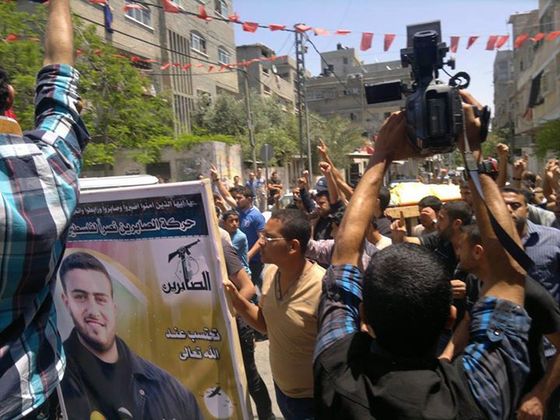
Hesn-Issa-thumb-560x420-3211A banner shows Hesn’s logo, and Nizar Saeed Issa, a Hesn operative who was killed in an explosion.

While the group remains murky, its very existence is a sign that Iran is not prepared to allow for quiet in the Palestinian territories, even as Hamas and Fatah seek time and space to solidify their fragile unity arrangement. This serves only to underscore Iran’s goals in the Palestinian arena. Instead of heeding the will of the overwhelming majority of Palestinians who support the efforts to re-forge a unified national identity after years of fracturing, Iran appears intent to push the Palestinians into conflict with Israel – or even themselves.

Out of the Palestinian unity deal forged between Hamas and Fatah earlier this month, a new splinter has formed. Hesn is a shadowy Iran-backed jihadist faction in the Gaza Strip. The group’s name is an acronym for Harakat as-Sabeereen Nasran li-Filastin, or “The Movement of the Patient Ones for the Liberation of Palestine.”

Hesn (or hosn) means “fortification” or “bulwark.” The implication is that the traditional Palestinian factions have gone weak in the knees. And for these Iran-backed fighters, one can understand why they believe this is so. The Fatah faction, since Mahmoud Abbas took over in 2005, has disavowed violence against Israel. Hamas, after the fall of Mohammed Morsi in Egypt last year, has been severely weakened – both economically and politically – which has curbed its appetite for violence. And now, after the formation of the unity government, even the Iran-backed Palestinian Islamic Jihad (PIJ) is vacillating between an outright campaign of violence and supporting the current fragile calm in the name of Palestinian nationalism.

Vacuums don’t last long in the Middle East. Hesn’s emergence is a case in point. But it’s too soon to tell whether the group will have an impact.

For one thing, Hesn has not been around for very long. The first clues of the group’s existence came in late May, in the northern Gaza refugee camp of Jabaliya, when a funeral was held for a Nizar Saeed Issa. The details surrounding Issa’s death are fuzzy, but it was reported that he died after suffering injuries related to an unspecified explosion.

Issa’s death garnered a substantial amount of support on social media platforms such as Facebook. That is when flags and photos bearing his image appeared alongside the newly created symbol of Hesn. The symbol is the same wielded by the Islamic Revolutionary Guards (IRGC) and Hezbollah. Iran has not claimed ownership of this group. It appears clear, however, that Hesn is yet another proxy group in Iran’s violent orbit.

After Issa’s death, sources indicated that Hisham al Salem is the group’s current leader. Formerly a commander of the military wing of PIJ, the Quds Force Brigades, al Salem has now confirmed to a Gaza journalist from Al Monitor that he was “one of the prominent leaders” of Hesn, and that he had formed the predominantly Shiite group as a way to continue the resistance against Israel during the pause in violence, however informal and tenuous, prompted by the reconciliation agreement.

Al Salem has figured prominently in the Shiite movement in Gaza for years. His name came up a few years ago as the chairman of a now-defunct Shiite charity called al-Baqiyat al Salihat society, based in Jabaliya, the same city where Issa was killed. The charity was purportedly a vehicle to spread Shiite Islam on behalf of Iran in Gaza’s nearly homogenous Sunni society. Amid its deteriorating ties with Iran over the Syrian civil war, the Hamas government in Gaza dismantled the Iranian-backed organization in 2011.

In the Al Monitor interview, al Salem was quick to downplay his alleged sectarian leanings, stressing that he sees “no reason to separate as Sunnis and Shiites.” Al Salem has made a name for himself in Gaza as an outspoken advocate for Shiism, however, which has led to friction with PIJ figures, who accuse him of spreading ‘sectarian strife.’

Perhaps for these reasons, Hesn now appears to be in the crosshairs of Hamas. The Facebook page for Hesn featuring the group’s logo and links to Shiite forums is now defunct, ostensibly taken down by an adversary or removed for the group’s protection.

But this does not mean that the group has dissolved. Al Salem claims the group has a shura council and an armed wing, although he did not reveal their numbers. Al Salem also did not elaborate on their overall mission in his interview with Al Monitor, apart from saying that the objective is “resistance.”

While the group remains murky, its very existence is a sign that Iran is not prepared to allow for quiet in the Palestinian territories, even as Hamas and Fatah seek time and space to solidify their fragile unity arrangement. This serves only to underscore Iran’s goals in the Palestinian arena. Instead of heeding the will of the overwhelming majority of Palestinians who support the efforts to re-forge a unified national identity after years of fracturing, Iran appears intent to push the Palestinians into conflict with Israel – or even themselves.