Archive for June 30, 2014

Netanyahu hints at further Gaza action: Either Hamas reins in rocket fire or we will

June 30, 2014

Netanyahu hints at further Gaza action: Either Hamas reins in rocket fire or we will | JPost | Israel News.

By LAHAV HARKOV, YAAKOV LAPPIN

06/30/2014 14:20

PM warns Hamas that it must stop violations of Operation Pillar of Defense de facto ceasefire or Israel will be forced to act.

Netanyahu

Prime Minister Binyamin Netanyahu at Knesset Foreign Affairs and Defense Committee meeting, June 30, 2014 

If Hamas does not stop rocket fire, Israel will take action, Prime Minister Binyamin Netanyahu said Monday after at least 14 rockets exploded in an an open area in the Eshkol Regional Council in southern Israel.

The rockets fell following a series of Code Red rocket alert sirens throughout Monday morning, the IDF said. A home was lightly damaged from shrapnel caused by one of the rockets, police said.

Earlier, on Monday morning, two rockets exploded in the south in open areas.

The prime minister told the Knesset Foreign Affairs and Defense Committee that “Hamas should take into account that we won’t allow continued shooting.

“We want to make clear that if the silence brought by Operation Pillar of Defense [in 2012] is violated and the shooting continues, there are two options: Either Hamas will stop the rocket fire or we will,” Netanyahu stated.

Still, Netanyahu said his primary goal is to find the three teens who were kidnapped by Hamas operatives in the beginning of June and that he told the IDF and Shin Bet to use any means necessary to bring them home in one piece.

The prime minister’s appearance before the Foreign Affairs and Defense Committee was the panel’s first general meeting since Operation Brother’s Keeper began, and committee chairman Ze’ev Elkin (Likud Beytenu) asked Netanyahu to give MKs an update on where the operation stands and plans for its continuation in the near future.

Finance Minister Yair Lapid visited Sderot Monday morning, saying that residents of the South “must know that we will not allow terrorist organizations’ attempts to harm their daily routine. Hamas is responsible and it will pay the price.”

Lapid pointed out that if the factory in Sderot that was hit by rockets on Saturday night had been attacked during the week, people would have been killed.

“I visited the armored playground. There is something unnatural about the fact that children are playing under a concrete ceiling because someone wants to kill them,” he added.

The rocket attacks from Gaza followed an air force strike that killed a terrorist preparing to fire projectiles into southern Israel on Sunday evening.

The IDF is checking to see whether the terrorist killed  belonged to Hamas, a senior security source said Monday morning. Hamas has announced that the casualty was a member of its military wing.

“We know unequivocally that the terrorist killed in the strike was preparing to fire rockets,” the source added.

The security source noted that a Givati infantry unit operating along the Gaza border came under fire on Sunday as well.

Hamas has not been behind recent rocket attacks on southern Israel, but rather, smaller terrorist groups in the Strip, according to military assessments. “[But] we are more interested in who is responsible [for Gaza],” he added.

“We are weighing our steps and managing a responsible policy regarding all aspects linked to Gaza,” the source said. “We understand that this rocket fire is becoming daily. Our responses are in accordance to that. The policy of the Southern Command is one of escalating responses, both in scope and the quality of targets,” he added.

The IDF is aware of the fact that Hamas has a problem in restraining smaller Gazan terror groups from firing rockets, the source stated, “but we also understand that the motives are less interesting [to Israel], and the results are what count,” he added. “Our aim is to stop this rocket fire.”

‘New reality requires security fence on Jordan border’

June 30, 2014

New reality requires security fence on Jordan border'”

The Sykes-Picot Agreement that shaped the borders around us almost 100 years ago has run its course,” PM Benjamin Netanyahu says •

Netanyahu says Israel needs to support international efforts to strengthen Jordan and support Kurdish independence

Shlomo Cesana, Eli Leon and Israel Hayom Staff

via Israel Hayom | ‘New reality requires security fence on Jordan border’.


Prime Minister Benjamin Netanyahu at the Institute for National Security Studies conference in Tel Aviv, Sunday|
Photo credit: Yehoshua Yosef
 

In light of recent changes in the Middle East, Israel is going to have to construct a security fence along the length of its border with Jordan, Prime Minister Benjamin Netanyahu said Sunday.

Speaking at the Institute for National Security Studies conference in Tel Aviv, Netanyahu said that in any future peace deal with the Palestinians, the Israel Defense Forces would be the entity protecting Israel in Judea and Samaria, including the Jordan Valley.

Israel “must stabilize the region west of the security line in Jordan,” Netanyahu said, adding that the territory of a future Palestinian state, up to the Jordan River, would have to remain under full Israeli security control for many years.

Netanyahu said he was updating his 2009 Bar-Ilan University address, in which he called for a two-state solution. The prime minister said he now advocates the notion that the Palestinians should have “political and economic control in the territories they control, but simultaneously there must be a continuation of Israeli security operations in these territories to ensure the disarmament of terrorist groups.”

“A withdrawal of our forces would likely bring about the fall of the Palestinian Authority, and the rise of Islamist extremists, like in the Gaza Strip, which would pose a serious danger for Israel,” Netanyahu said.

He cited four challenges ahead for Israel: defending its borders, stabilizing the region between the security border with Jordan and the population centers, regional cooperation to stop the spread of Islamist extremism, and preventing Iran from becoming a nuclear threshold state.

“The Middle East is witnessing a historic change, one with serious implications for Israel’s and the world’s safety. The Sykes-Picot Agreement that shaped the borders around us almost 100 years ago has run its course,” Netanyahu said.

With regards to developments in Jordan, and the looming threat of jihadist fighters from the Islamic State of Iraq and the Levant, Netanyahu said Israel needs to “support international efforts to strengthen Jordan and support the Kurdish aspiration for independence.”

“Jordan is a stable country, moderate, has a powerful military and knows how to protect itself, which is in fact why international efforts to support it are worthy,” Netanyahu said.

“Regarding the Kurds, they are a fighting people that have proved their political commitment, political moderation, and deserve political independence,” Netanyahu continued.

Meanwhile, the deputy chairman of Turkey’s ruling party indicated last week that Turkey was willing to accept a Kurdish state in Iraq.

“The Kurds in Iraq can decide for themselves the name and type of state that they want to live in,” Justice and Development Party (AKP) Deputy Chairman Huseyin Celik said.

The statements mark a change of rhetoric for Turkey, which had until now opposed Kurdish independence in Iraq, in fear it would bolster nationalistic aspirations of the Turkish Kurds who make up more than 15 percent of its population

The Islamist Plague

June 30, 2014

The Islamist Plague

By Rachel Ehrenfeld
Monday, June 30th, 2014 @ 3:56AM

via The Islamist Plague.


Many Western commentators have adopted the narrative that al Qaeda and its ilk are the exception to the “religion of peace” — Islam.

However, the rise of “political Islam,” the brainchild of the Muslim Brotherhood, is more akin to a highly infectious disease. No vaccine is available; its spread can only be halted by identifying and eliminating the sources of infection. Yet, despite the mortal danger posed by the increasingly violent global jihadist movement, willful blindness persists in the United States and the West.

Once the Soviet Union imploded and Islamist fundamentalism exploded, Muhammad replaced Marx and Lenin, and radical Islam replaced the socialist-nationalist doctrines of the Arab revolutionaries. The collapse of the Soviet Union served as the catalyst for an alliance between radical Sunni and Shiite movements that helped to revive Islamist fundamentalism. The spread of the Islamist ideology was paid for by the oil-rich Arab/Muslim states, which also used their money to buy Western “opinion makers,” including businessmen, politicians, the media, and academics.

New communication technologies allowed the increasingly vitriolic Islamist rhetoric to spread instantaneously. Instead of taking measures to stop the instructive incitement for murder, the West sank further into appeasement, thus encouraging the spread of the jihadist agenda.

While the bloody attacks of ISIS and Hezbollah in Iraq and Syria are portrayed as a Sunni vs. Shiite struggle, the role of Ayatollah Khomeini, as the leader of the “Islamic Revolution,” should not be forgotten.

After successfully taking over Iran, the Ayatollah Khomeini began calling for the unification of Muslims throughout the world, and for exporting his Muslim Revolution to wherever Muslims live so that Muslim domination could be achieved. “We are at war against Infidels,” the Ayatollah told a large group of Pakistani military officers on a pilgrimage to Qom in January 1980. “Take this message with you … I ask all Muslims [emphasis added] … to join the Holy War. There are many enemies to be killed or destroyed. Jihad must triumph.” He stressed that the “Iranian Experiment” should be followed, and that the realization of the true Islamic State should be carried out forcibly and without compromise.

These plans for Islamic unification were accelerated by the Gulf War. The war helped the leaders of Islamist groups throughout the globe to enforce their vision that jihad, holy war, is the only formula for protecting Islam from extinction by the West — led by the U.S. This opinion was and is repeatedly voiced by every Islamist leader. “Bush and Thatcher have revived in the Muslims the spirit of Jihad and martyrdom,” wrote the Palestinian leader of the Islamic Jihad, Sheikh As’ad Bayyud al-Tamimi. He promised that all Muslims “will fight a comprehensive war and ruthlessly transfer the battle to the heart of America and Europe.” Despite the advancement of the ISIS, many in the West continue to dismiss such statements as pure rhetoric. Instead, they are hanging on to statements, made by Muslim and Arab leaders and politicians, that ISIS and the other jihadists are aberrations that should be eliminated.

Yet, the U.S. and other Western countries are trying, again, to negotiate, i.e., submit to demands of their mortal enemies, supposedly to avoid further escalation, often accepting statements the like of which were made by Egyptian Sunni theologian Mahmud Shaltut (1893-1963), in his al-Qur’an wal-Qitāl:

“Muhammad revealed a book [the Quran] containing the principles of happiness. It commands to judge by reason, it propagate science and knowledge, it gives clear rules, it proclaims mercy, it urges to do good, it preaches peace, it gives firm principles concerning politics and society, it fights injustice and corruption.”

He also declared, “The Islamic community is commanded to do only what is good and are forbidden to do what is reprehensible and evil. The Islamic mission is clear and evident, easy and uncomplicated. It is digestible and intelligible for any mind. It is a call of natural reason, and therefore not alien to human intellect. This is the mission of Muhammad to humanity.”

While Shaltut’s argument that “it is the interest of humanity to gather enthusiastically under Islamic rule,” has not been accepted, yet, the U.S. efforts to ignore the Islamic plague and its sources, only help to spread it.

ISIL jihadist group claims Islamic world leadership

June 30, 2014

ISIL jihadist group claims Islamic world leadership

Spoesman says Abu Bakr al-Baghdadi is ‘leader for Muslims everywhere’; announces establishment of caliphate

By AFP June 29, 2014, 11:24 pm

via ISIL jihadist group claims Islamic world leadership | The Times of Israel.


An image uploaded on June 14, 2014 on the jihadist website Welayat Salahuddin allegedly shows militants of the Islamic State of Iraq and the Levant (ISIL) driving on a street at unknown location in the Salaheddin province. (photo credit: AFP PHOTO / HO / WELAYAT SALAHUDDIN)
 

The Islamic State of Iraq and the Levant jihadist group, which spearheaded a sweeping militant assault that
overran swathes of Iraq, is now claiming leadership of the world’s Muslims.

Known for its ruthless tactics and suicide bombers, ISIL has carried out frequent bombings and shootings in Iraq, and is also arguably the most capable force fighting President Bashar Assad inside Syria.

But it truly gained international attention this month, when its fighters and those from other militant groups swept through the northern city of Mosul, then overran major areas of five provinces north and west of Baghdad.

ISIL is led by the shadowy Abu Bakr al-Baghdadi and backed by thousands of Islamist fighters in Syria and Iraq, some of them Westerners, and it appears to be surpassing al-Qaeda as the world’s most dangerous jihadist group.

In a sign of the group’s confidence, it has now expanded its claim of leadership to encompass all the world’s Muslims.

In an audio recording distributed online Friday, ISIL’s spokesman Abu Mohammad al-Adnani declared Baghdadi “the caliph” and “leader for Muslims everywhere.”

“The Shura (council) of the Islamic State met and discussed this issue (of the caliphate)… The Islamic State decided to establish an Islamic caliphate and to designate a caliph for the state of the Muslims,” Adnani said.

He was referring to a system of rule last used to govern a state almost 100 years ago, before the collapse of the Ottoman Empire.

Western governments fear ISIL could eventually emulate al-Qaeda and strike overseas, but their biggest worry for now is its sweeping gains in Iraq and the likely eventual return home of foreign fighters attracted by ISIL and Baghdadi.

Among them are men like Mehdi Nemmouche, a 29-year-old Frenchman who allegedly carried out a deadly shooting on a Jewish museum in Belgium after spending a year fighting with ISIL in Syria.
12,000 foreign fighters

The Soufan Group, a New York-based consultancy, estimates that 12,000 foreign fighters have traveled to Syria, including 3,000 from the West.

And ISIL appears to have the greatest appeal, with King’s College London professor Peter Neumann estimating around 80 percent of Western fighters in Syria have joined the group.

Unlike other groups fighting Assad, ISIL is seen working toward an ideal Islamic emirate. And compared with al-Qaeda’s franchise in Syria, Al-Nusra Front, it has lower entry barriers.

ISIL has also sought to appeal to non-Arabs, publishing English-language magazines, after having already released videos in English, or with English subtitles.

The jihadist group claims to have had fighters from the Britain, France, Germany and other European countries, as well as the United States, and from the Arab world and the Caucasus.

Much of the appeal also stems from Baghdadi himself — the ISIL leader is touted as a battlefield commander and tactician, a crucial distinction compared with Al-Qaeda chief Ayman al-Zawahiri.

“Baghdadi has done an amazing amount — he has captured cities, he has mobilized huge amounts of people, he is killing ruthlessly throughout Iraq and Syria,” said Richard Barrett, a former counter-terrorism chief at MI6, Britain’s foreign intelligence service.

“If you were a guy who wanted action, you would go with Baghdadi,” Barrett told AFP.

At the time Baghdadi took over what was then known as the Islamic State of Iraq, or ISI, in May 2010, his group appeared to be on the ropes, after the “surge” of US forces combined with the shifting allegiances of Sunni tribesmen to deal him a blow.

But the group has bounced back, expanding into Syria in 2013.

Baghdadi sought to merge with Al-Nusra, which rejected the deal, and the two groups have operated separately since.

Fear Iran, not ISIS

June 30, 2014

Israel Hayom | Fear Iran, not ISIS.

Boaz Bismuth

The abilities of the jihadist terrorist organization Islamic State of Iraq and the Levant, which has notched significant achievements in western Iraq, should not be minimized, but it should also not be given undue credit.

Jordan is still far from falling into the hands of the extremist Sunni group, comprising 10,000 members, which recent reports have warned could happen. Not only does Jordan not need help from Israel and the United States, as reported by the Daily Beast news website, but in light of the balance of forces against ISIS, which primarily consists of several gangs, Jordan can also depend on its small but disciplined and trained army.

ISIS, which was founded in 2003 following the American invasion of Iraq, has grandiose aspirations. To establish the Islamic caliphate they dream of, however, they need the masses to join them in their fight. While they do, in fact, enjoy a Sunni tailwind of support in Syria and Iraq, where the local populations are extremely hostile toward the Shiite regime in Baghdad and the Alawite regime in Damascus, there is still a long road before ISIS rallies the masses to its cause.

The group’s brutality is working against it like a boomerang. While its viciousness does indeed deter the enemy (note how Iraq’s Shiite army conceded without a fight), it also raises sincere concern among those (in the Sunni population) who would otherwise join as partners in the campaign. ISIS’ conduct in Iraq has even deterred the Saudis, who have supported the Syrian rebels as part of their larger struggle against Shiite Iran, but today even they think twice about supporting the group in Iraq.

The Middle East is changing. This is a fact. The concept of the Arab state is crumbling, and something else will rise in its place. The Sykes-Picot agreement of 1916, which gave birth to the Middle East as we have known it, has come to its final station. Something new will be born out of the churning mayhem. Terrorism is today an important element of our Middle East, but it (still) does not have the power to fill the vacuum that has been created. Jihadist terrorism can do damage, but it cannot lead.

Officials in the Hashemite Kingdom are, of course, closely following the situation in western Iraq and eastern Syria, where ISIS is currently in control. The Jordanians, as stated, can count on the loyalty of the local population to the kingdom on both sides of the two main border crossings with Iraq. The Jordanians can also trust, as stated, their army and their effective air force, which can inflict severe damage on the Sunni terrorist group. They can also be encouraged by the reversal of fortunes in Tikrit, where the Iraqi army has regained the upper hand.

Israel in this story needs to be less worried about ISIS and more about Iran. The success of the Sunni organization in western Iraq is a direct result of the changes in our region, and of the fact that Iraq and Syria do not have strong leaders like they once had, who could impose order in their domains. The world also no longer has a policeman, after the U.S. under Barack Obama has willingly forfeited its regional status and ability to influence events.

In a normal world, the Iranian nuclear race should be the main concern. But British diplomat William Patey admitted recently that ISIS is more dangerous than the Iranian nuclear threat. The priorities are changing.

Suddenly Sunni terror is more dangerous than a Shiite nuclear bomb. Suddenly, in order to combat Sunni terror, Iran has become a courted country and is even perceived in Washington as a stabilizing force.

This is precisely the change Israel needs to be wary about. The West is liable to let the Iranian cat watch over the cream.

Back to home page | Newsletters from:

Hamas behind rocket barrage on Israel

June 30, 2014

Hamas behind rocket barrage on Israel – Israel News, Ynetnews.

For first time since Operation Pillar of Defense ended in 2012, Hamas’ military wing fires rockets at Israel

Elior Levy
Published:     06.30.14, 12:09 / Israel News

Hamas’ military wing, the Izz ad-Din al-Qassam Brigades, are responsible for the rocket salvo fired at Israel overnight Sunday and early Monday morning.

This was the first time since Operation Pillar of Defense ended in 2012 that the group fired rockets into Israel. There a number of Palestinian factions active in Gaza and though Israel views Hamas as responsible for any rockets fired from the Gaza territory, the group generally avoids such direct attacks on Israel.

More than a dozen rockets fired from Gaza Strip slammed into Israel early Monday morning, following a violent weekend in the south which saw a rocket hit an Israeli factory and IDF retaliatory attacks kill at least one Gazan.

Since the massive Operation Pillar of Defense ended in November 2012, the majority of rockets fired at Israel – currently standing at over 200 just for 2014 – were launched by either the Islamic Jihad or the Popular Resistance Committees. At time, smaller Salafi groups will also launch rockets or attacks at Israel. However, Monday’s rockets were of an older make known to be Hamas’.

The fact that Hamas – who recently forged a controversial unity government with Palestinian President Abbas’ Fatah movement – is behind the attack could mean the group has chosen to escalate its response to Israel’s retaliatory attacks.

The background to the Monday morning barrage was an IAF attack late Sunday which saw one person killed several others injured along the Israeli border with the Gaza Sunday.

According to the IAF, Muhammad Zaid Abid was killed after the army launched a targeted attack against his rocket launching cell minutes before they planned to fire at Israel. Abid was identified by Palestinian media as a member of Hamas’s military wing.

Hamas is in increasingly dire straits in Gaza, with the group juggling a number of crises.

Morning salvo: 16 rockets fired

The attacks marked more than two weeks of increasing rocket fire from Gaza since the beginning of Operation Brother’s Keeper in the West Bank, to find and bring back to safety the three missing Israeli teens – Eyal Yifrach, Gil-Ad Shaer and Naftali Frenkel.

According to initial assessments 16 rockets were fired overnight Sunday until the early Monday morning hours, the majority of which exploded in open areas of the Eshkol Regional Council.

At roughly 7 am a 10 rocket barrage was fired toward the regional council, with all of the rockets exploding in open areas, causing neither damage nor injuries. At 7:30 am at least one more rocket was fired.

At roughly 8:30 am, another rocket exploded inside a Sedot Negev Regional Council community, causing light damage to a structure.

An additional rocket exploded in an open area in the regional council, joining the massive rocket barrage fired at Israel.

Gaza Terrorists Launch Fifteen-Rocket Barrage

June 30, 2014

Gaza Terrorists Launch Fifteen-Rocket Barrage – Defense/Security – News – Arutz Sheva.

At least fifteen missiles pepper region around Gaza in continuing escalation; ‘Israel’s deterrence has dissipated.’

By Ari Yashar

First Publish: 6/30/2014, 7:18 AM / Last Update: 6/30/2014, 8:53 AM

 Rocket trails streaking out of Gaza (file)

Rocket trails streaking out of Gaza (file)

A total of 15 rockets were fired at Israel by Gaza terrorists overnight and on Monday morning, marking the latest recent missile barrage since the abduction of three teens by Hamas terrorists on June 12.

In the early morning eight rockets fell in uninhabited areas in the Eshkol Regional Council area; no injuries or damage was caused by the blasts. That followed at least two rockets which were fired on the Eshkol region overnight.

Before the rockets struck, “Color Red” missile warning sirens were sounded in the Eshkol Regional Council area.

Minutes later the “Color Red” sirens sounded again, as two more rockets struck the area, again landing in open area and causing no injuries or damage.

Later in the morning, two more rockets were fired into the Sedot Negev Regional Council area.

Two homes in the area were lightly damaged by the shrapnel of one of the rockets; two local residents were treated on the scene for anxiety and shock after the blast.

Eshkol Regional Council head Chaim Yelin spoke to Channel 2 on Monday morning about the rockets, saying “Israel’s deterrence has completely dissipated.”

“The feeling is that we are going back several years. We’re going back to experience the days between Operation Cast Lead and Operation Pillar of Defense,” said Yelin, noting a period of intense rocket fire.

“Residents of the Gaza Belt area are standing up to this challenge because we have to continue our lives. We’ve been living like this for 13 years already, so it isn’t something unknown,” added the regional leader.

Hours before the recent attack, during the course of Sunday night, three rockets were fired into the Eshkol Regional Council area, exploding in open territory and not causing any damage.

Gaza terrorists fired six rockets towards the town of Netivot earlier on Sunday, with two of the rockets being intercepted by Iron Dome missile defense batteries stationed near the town. The four others fell in uninhabited and empty areas and did not cause any injuries or damage.

In response to the Sunday escalation, the IAF conducted a drone airstrike on a terror cell, killing a terrorist right before he launched more missiles.

One of the four rockets fired in on Saturday night directly hit the “Denber” plastics factory in Sderot, burning it down completely and setting an adjacent paint factory on fire as well.

Three injuries were reported in the incident, with one man in his fifties suffering injuries in his limbs from the shock wave of the missile blast and ensuing explosions emanating from the plant. Two others were also evacuated to a hospital for treatment of light burns.

In retaliation, the IAF struck nine terrorist targets in Gaza on Saturday night, including a weapons manufacturing site in northern Gaza, a weapons manufacturing site and a terrorist center in central Gaza, and three concealed rocket launchers and three terrorist centers in southern Gaza.

At least 15 rockets explode in southern Israel as tensions escalate

June 30, 2014

At least 15 rockets explode in southern Israel as tensions escalate | JPost | Israel News.

By JPOST.COM STAFF

LAST UPDATED: 06/30/2014 10:25

Code Red siren alerts citizens of southern Israel throughout the night and morning to take shelter; homes lightly damaged from latest barrage; around 40 rockets have been launched since boys were kidnapped.

gaza rocket

Rocket fired from Gaza toward southern Israel, June 24, 2014. Photo: RAN LO

At least fifteen rockets exploded around southern Israel following a number of Code Red rocket alert sirens that sounded throughout Monday morning, the IDF said.

A number of homes were lightly damaged from the shrapnel of one of the rockets, police said.

Around 40 rockets have been launched into Israel in the past 18 days since 3 Israeli teens, all yeshiva students, went missing in the West bank.

Following an airstrike in Gaza on Saturday in response the rocket fire, the IDF is checking to see whether a terrorist killed during the strike belonged to Hamas, a senior security source said Monday morning. Hamas has announced that the casualty was a member of its military wing.

“We know unequivocally that the terrorist killed in the strike was preparing to fire rockets,” the source added.

The security source noted that a Givati infantry unit operating along the Gaza border came under fire on Sunday as well.

Hamas has not been behind recent rocket attacks on southern Israel, but rather, smaller terrorist groups in the Strip, according to military assessments. “[But] we are more interested in who is responsible [for Gaza],” he added.

Baghdad must accept Kirkuk is now part of Kurdistan—KRG official

June 30, 2014

Baghdad must accept Kirkuk is now part of Kurdistan—KRG official, Asharq Al-Awsat English, June 30, 2014

(Asharq Al-Awsat is a Saudi paper published in London. — DM)

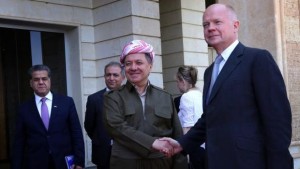
Kurdish leaderIraqi Kurdish leader Massoud Barzani, center, welcomes British Foreign Secretary William Hague, right, in Erbil, the capital of Iraq’s autonomous region of Kurdistan, on June 27, 2014. (AFP Photo/Safin Hamed)

Kurdish President Massoud Barzani says the article in the Iraqi constitution specifying a referendum on the status of the city is now “invalid”

London, Asharq Al-Awsat—The federal government in Baghdad must now accept that Kirkuk is a part of the autonomous Kurdistan region, a senior Kurdistan Regional Government (KRG) official has said, echoing earlier comments by Kurdish President Massoud Barzani.

Speaking exclusively to Asharq Al-Awsat, Mohammed Ihsan said: “Things have changed after June 10 and the Iraqi government must deal with the new reality.”

Sunni Islamist militants led by the Al-Qaeda breakaway group, the Islamic State of Iraq and Syria (ISIS), made a lightening advance throughout Iraqi territory on June 10, capturing vast swaths in the country’s northern and western regions.

After ISIS’s advance into Nineveh province, with the group taking its capital city Mosul, and the subsequent withdrawal of Iraqi government forces from surrounding areas, Kurdish army units—known as the Peshmerga—announced on June 12 they had taken control of the city of Kirkuk, which has a sizable Kurdish population, and lies some 103 miles (166 kilometers) west of Mosul.

“Today, and after June 10 . . . Peshmerga forces had to fill this vacuum to defend the lives of Iraqis in Kirkuk and repel attempts by armed groups to reach the [Kurdistan] region’s territories,” he added.

Ihsan, who is the KRG official in charge of implementing Article 140 of the Iraqi constitution, which specifies that the city’s status, whether Kurdish or Arab, must be decided via a referendum, said that “the Kurds have waited more than 10 years to implement Article 140, but there are . . . [hardliners] in the Iraqi government and parliament who . . . [denied Article 140] existed, and the federal government in Baghdad did not take any steps to implement [it].”

This follows comments by KRG President Barzani, who after a meeting with British Foreign Secretary William Hague in the Kurdistan region’s capital Erbil on Friday announced that “Kurdish control over Kirkuk and other areas disputed with Baghdad is final,” adding that he considered Article 140 no longer valid.

Ihsan, who is in London to attend a conference on Iraq held at the London School of Economics, added: “The [federal] governments which came after 2003, except Iyad Allawi’s government, did not adhere to Article 140, but tried to delay it.”

He said that before the constitution was published, Allawi had formed a committee to implement a mechanism to hold a referendum among the residents of Kirkuk and other disputed areas over whether or not to join the Kurdistan region; however, the committees which came after the Allawi government simply ignored the issue.

Speaking of international reaction to President Barzani’s announcements regarding to status of Kirkuk, Ihsan said: “The international position too will accept these realities, evidenced by the fact that President Barzani announced his decision to take Kirkuk back during a meeting with British Foreign Secretary William Hague, and the fact that the US secretary of state [John Kerry] was in Erbil a few days ago, and I think he was aware of the background of the decision.”

He added: “So far, there have been no reactions, whether negative or positive . . . [regarding] the decision. We are even certain that Turkey and Iran will be satisfied with the decision to incorporate Kirkuk into the region as their borders will be safe from terrorism, and there are joint interests between Turkey and the Kurdistan region, and the same applies to Iran.”

Turkey, whose own Kurdish population has long complained of disenfranchisement, has previously been nervy about Kurdish independence in Iraq for fears this will embolden Kurds within its own territory to seek similar concessions from Ankara.

But relations have warmed in recent years, with Turkish Prime Minister Recep Tayyip Erdoğan using the word “Kurdistan” for the first time during a meeting with President Barzani last November, marking a turning point in Kurdish–Turkish relations. Ankara is now the KRG’s largest trading partner, with the latter using Turkey’s Ceyhan port to store and export its oil independently of Baghdad, another recent sticking point between the KRG and the federal government.

Iran is a supporter of Baghdad’s Shi’ite-dominated government, led by Prime Minister Nuri Al-Maliki, and has promised to support Iraq against the Sunni Islamist advance.

The KRG has been locked in a longstanding dispute over territory with the federal government in Baghdad, with the Kurds seeking complete autonomy from Iraq.