Archive for June 21, 2014

Iraqi forces fighting militants for town on Syrian border

June 21, 2014

Iraqi forces fighting militants for town on Syrian border, CNN, Michael Martinez, Mohammed Tawfeeq and Chelsea J. Carter, June 21, 2014

(Need I say that it’s becoming even harder — and even more ludicrous — to consider Islam “the true religion of peace?” — DM)
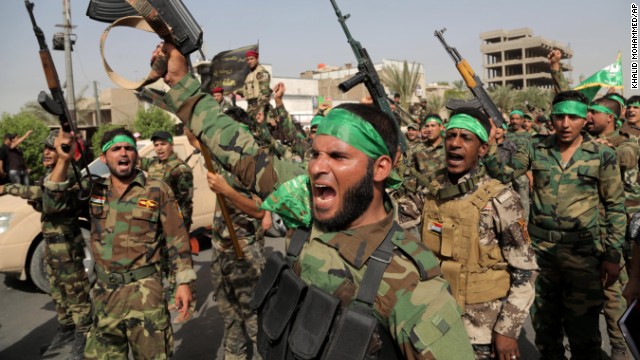
Iraq under seigeVolunteers raise their weapons and chant slogans during a parade in the Shiite stronghold of Sadr City, Baghdad, on Saturday, June 21. Vast swaths of northern Iraq, including the cities of Mosul and Tal Afar, have fallen as the Islamic State in Iraq and Syria, or ISIS, advances toward Baghdad, the capital. The ISIS militants want to establish a caliphate, or Islamic state, in the region, stretching from Iraq into northern Syria.
 

Control of the border crossing would be a significant strategic asset for the militants, allowing them to enter Iraq freely from their bases in Syria, which itself is wracked by civil war.

[S]ome Sunni tribesmen within the Sunni-dominated province of Anbar were aiding and assisting the militants in their successful offensives against Iraqi forces, the officials said. Al-Qaim is in Anbar province, Iraq’s largest geographically.

The Sunni tribesmen’s support is pivotal in the fighting, a senior security official in Ramadi told CNN.


Baghdad, Iraq (CNN) — Iraqi security forces are waging a fierce battle with militants for control of the strategic border with Syria, where the enemy fighters enjoy a stronghold, Iraqi security officials said Saturday.

Since clashes erupted Friday in the border town of Al-Qaim, at least 11 Iraqi soldiers have been killed and 21 more have been wounded. Also, at least 20 militants were killed after Iraqi forces shelled areas from where the extremists launched attacks, two security officials in Ramadi, Iraq, told CNN.

As of early Saturday, large parts of Al-Qaim had been taken over by the militants, suspected to be part of the Islamic State in Syria and Iraq, or ISIS, the officials said.

Control of the border crossing would be a significant strategic asset for the militants, allowing them to enter Iraq freely from their bases in Syria, which itself is wracked by civil war.

Al-Qaim sits across from Syria’s Deir Ezzor province, where ISIS controls at least three towns, including areas near the military airport of Deir Ezzor, which was the headquarters of the military council for rebel battalions, said Syrian Observatory for Human Rights, an opposition group in London that monitors the Syrian conflict.

Why Al-Qaim is important

“This advancement (in Syria) is considered a very important and strategic step because ISIS has tried to take a complete control over areas in the east of Deir Ezzor in order to reach to the Syrian-Iraqi borders, and then to connect its held areas in both Syria and Iraq with each other,” the opposition group said.

Opposite of Al-Qaim is the Syrian town of Al-Bukamal, which is under the control of other Islamist brigades such as Nusra Front, said Rami Abdulrahman of SOHR. ISIS doesn’t control that town, he added Saturday.

Iraqi forces were fighting the suspected ISIS militants on at least two fronts: They faced dozens of militants on the Syrian side of the border, a territory under complete control by the militants, security officials said.

At the same time, some Sunni tribesmen within the Sunni-dominated province of Anbar were aiding and assisting the militants in their successful offensives against Iraqi forces, the officials said. Al-Qaim is in Anbar province, Iraq’s largest geographically.

The Sunni tribesmen’s support is pivotal in the fighting, a senior security official in Ramadi told CNN.

If the Sunni tribes do not decide to help and support Iraqi security forces, then it will be very difficult for Iraqi forces to regain the full control of Al-Qaim, the senior official said.

In the meantime, Iraqi forces were waiting for more troops to arrive in Al-Qaim, located about 500 kilometers (about 310 miles) west of Baghdad.

Falluja fighting, Baghdad bombings

Elsewhere in Iraq’s western Anbar province, Iraqi security forces killed 15 “terrorists” and destroyed four vehicles on Saturday afternoon in Falluja, said Iraqiya State TV, citing security officials.

Falluja is about 60 kilometers west of Baghdad, and Iraqi forces have so far blocked the militants from marching on the nation’s capital. Falluja has been under control of ISIS militants and Sunni tribesmen since January.

The militants in Falluja, however, have been trying to take over Sunni areas close to Baghdad, such as Abu Ghraib and small villages close by, Ramadi security officials told CNN.

Abu Ghraib is a largely Sunni area in the western outskirts of the capital.

Despite the government effort to protect Baghdad, several bomb attacks occurred across the capital city, killing at least seven people and wounding 32 more, officials said Saturday. One of the bomb attacks hit Baghdad’s Sadr City, a predominantly Shiite area in the eastern part of the Iraqi capital, police officials in Baghdad told CNN Saturday.

U.S. advisers due to arrive in Iraq soon

The Iraqi government was waiting for the initial group of U.S. military advisers to arrive in Iraq soon, a senior defense official said, as crowds paraded nationwide in a show of unity for the government.

This first detail is expected to be very small, the official said. The total number of U.S. military advisers who will eventually deploy will be about 300.

In addition, some U.S. military personnel already at the U.S. Embassy in Baghdad will be reassigned and become advisers, Pentagon spokesman Rear Adm. John Kirby said.

The first group of advisers will conduct an initial assessment of Iraqi troop capabilities and of what may be needed for a larger group of U.S. advisers, including additional security measures where they may be deployed, a senior defense official said Friday.

Meanwhile, Shiite cleric Muqtada al-Sadr successfully called on his supporters to hold a military parade nationwide to enhance unity among Iraqis: Thousands of Shiites wore variouis security forces uniforms in a march in Sadr City. The influential Shiite cleric has previously called for people to protect the country’s Shiite and Christian religious sites.

More than 1 million Iraqis have fled their homes this year because of conflict, the United Nations refugee agency said Friday. The number is likely to rise as Islamist militants and Iraqi security forces battle for control.

An estimated 800,000 people left Iraq’s second-largest city of Mosul after it fell to fighters from ISIS, the International Committee of the Red Cross said. The city has a population of 1.6 million.

ISIS, born from an al Qaeda splinter group and supported by Sunni factions, continues its fierce advance in Iraq.

Prime Minister Nuri al-Maliki’s Shiite-dominated government is accused of fostering sectarian tensions by marginalizing Iraq’s Sunni Arab and Kurd minorities.

Obama told CNN on Friday that U.S. military efforts are hopeless without a change in government.

“If we don’t see Sunni, Shia and Kurd representation in the military command structure, if we don’t see Sunni, Shia and Kurd political support for what we’re doing, we won’t do it,” he said.

The complete interview will be aired Monday on CNN’s “New Day.”

The United States withdrew its final troops from Iraq in 2011, nearly nine years after leading the invasion that ousted longtime leader Saddam Hussein.
Netanyahu to Obama: IDF on the Jordan is sole security guarantee against ISIS for Israel, Hashemite kingdom and Palestinians

June 21, 2014

Netanyahu to Obama: IDF on the Jordan is sole security guarantee against ISIS for Israel, Hashemite kingdom and Palestinians, DEBKAfile, June 21, 2014

AL-Qaeqd_Qaim_21.6.14ISIS fighter after capturing Qaim border crossing to Syria

Netanyahu’s main point was that Israel’s armed forces (the IDF) are the only army in the region with the capabilities and counter-terrorism experience for standing up to the Islamic State of Iraq and Syria and therefore buttressing the rule of Jordan’s King Abdullah and Mahmoud Abbas in Ramallah against jihadist incursions.

According to our sources, Netanyahu inserted in his note to Obama a new piece of intelligence, that ISIS liaison officers had recently entered the Sinai Peninsula to embed a branch of their organization in the local Al Qaeda network, known as Ansar Beit Al-Maqdis, which has operational ties with the Palestinian Hamas rulers of the Gaza Strip. 

Prime Minister Binyamin Netanyahu posted notes Friday, June 20, to President Barack Obama, King Abdullah of Jordan and Chairman Mahmoud Abbas of the Palestinian Authority, DEBKAfile’s exclusive sources in Washington and Jerusalem reveal. They dealt with the rapid advances made by Al Qaeda-related Sunni Islamist fighters in Iraq, now heading towards the Iraqi-Syrian-Jordanian border intersection and how they bore on the security of Israel, the Palestinians and Kingdom of Jordan just next door.

Netanyahu’s main point was that Israel’s armed forces (the IDF) are the only army in the region with the capabilities and counter-terrorism experience for standing up to the Islamic State of Iraq and Syria and therefore buttressing the rule of Jordan’s King Abdullah and Mahmoud Abbas in Ramallah against jihadist incursions.

And so it is essential to maintain the fortifications on the River Jordan border manned by the IDF and continue to work in partnership with the Jordanian army to provide a solid bulwark against a potential ISIS push from Iraq toward the west.

Netanyahu cited Obama’s proposition Thursday, June 19, with regard to the Iraq crisis. The president said: “I think that the key to both Syria and Iraq is going to be a combination of what happens inside the country… and us laying down a more effective counterterrorism platform that gets all the countries in the region pulling in the same direction.”

In the prime minister’s view, one of those platforms is already in place in southern Syria as a result of a combined US- Israeli-Jordanian military effort.

Saturday, June 21, the Iraqi jihadists seized the strategic Iraqi-Syrian border crossing at Qaim (pop: a quarter of a million). Witnesses reported hundreds of Iraqi soldiers dropping their weapons and fleeing in all directions after 30 of their number were killed in battle.

This conquest brought ISIS that much closer to the intersection of the Iraqi, Syrian and Jordanian borders, which is situated in terrain marked by deep wadis and dense foliage, and therefore popular with the smugglers of arms, drugs and oil,  who move between Iraq and Jordan.

That being so, the Sunni Islamists’ control of the Qaim crossing point poses a direct threat to Jordan, as well as providing them with an open route for the easy transfer of fighters and heavy weapons between their two battlefields in Iraq and Syria, and of fuel from the Syrian oil fields which they now manage to their brothers fighting in Iraq.

In eastern Jordan, Al Qaeda owns a reserve of adherents, some of whom fought under its flag in Afghanistan, others against American forces in Iraq under the command of their compatriot, Abu Musab al-Zarqawi in the years 2003-2007.

In the last three years, Jordanian extremists have fought with Al Qaeda and other Islamist elements in the Syrian civil uprising against Bashar Assad.

DEBKAfile’s counter-terror sources report that thousands of these Islamists, some after advanced combat training, are concentrated in and around the Jordanian towns of al-Zarqa, al-Rusaifa, Salt and Irbid.

Jordanian security services, concerned to stop them heading out for Iraq, this week opened the jail door for the influential Islamic leader, Sheik Isam al-Barqawi – aka as Abu Muhammad al-Maqdis – who is the head of the Jordanian Salafi movement. In the deal for his early release from a long prison sentence, the sheik undertook to use his sermons to preach against the Jordanian Islamists joining up for the ISIS-led jihad.

According to our sources, Netanyahu inserted in his note to Obama a new piece of intelligence, that ISIS liaison officers had recently entered the Sinai Peninsula to embed a branch of their organization in the local Al Qaeda network, known as Ansar Beit Al-Maqdis, which has operational ties with the Palestinian Hamas rulers of the Gaza Strip.

Column one: The threat is blowback

June 21, 2014

Column one: The threat is blowback | JPost | Israel News.

By CAROLINE B. GLICK

06/19/2014 21:56

It only took the Taliban six months to move from the Bamiyan Buddhas to the World Trade Center. Al-Qaida is stronger now than ever before. And Iran is on the threshold of a nuclear arsenal.

jihadist al-Qaida fighters

ISIS fighters Photo: REUTERS

Watching the undoing, in a week, of victories that US forces won in Iraq at great cost over many years, Americans are asking themselves what, if anything, should be done.

What can prevent the Islamic State of Iraq and Syria (ISIS) – the al-Qaida offshoot that President Barack Obama derided just months ago as a bunch of amateurs – from taking over Iraq? And what is at stake for America – other than national pride – if it does? Muddying the waters is the fact that the main actor that seems interested in fighting ISIS on the ground in Iraq is Iran. Following ISIS’s takeover of Mosul and Tikrit last week, the Iranian regime deployed elite troops in Iraq from the Quds Force, its foreign operations division.

The Obama administration, along with Republican Sen. Lindsay Graham, views Iran’s deployment of forces in Iraq as an opportunity for the US. The US, they argue should work with Iran to defeat ISIS.

The idea is that since the US and Iran both oppose al-Qaida, Iranian gains against it will redound to the US’s benefit.

There are two basic, fundamental problems with this idea.

First, there is a mountain of evidence that Iran has no beef with al-Qaida and is happy to work with it.

According to the 9/11 Commission’s report, between eight and 10 of the September 11 hijackers traveled through Iran before going to the US. And this was apparently no coincidence.

According to the report, Iran had been providing military training and logistical support for al-Qaida since at least the early 1990s.

After the battle of Tora Bora in December 2001, al-Qaida’s leadership scattered. Many senior commanders – including bin Laden’s son Said, al-Qaida’s chief strategist Saif al-Adel and Suleiman Abu Ghaith – decamped to Iran, where they set up a command center.

From Iran, these men directed the operations of al-Qaida forces in Iraq led by Abu Musab Zarqawi. Zarqawi entered Iraq from Iran and returned to Iran several times during the years he led al-Qaida operations in Iraq.

Iran’s cooperation with al-Qaida continues today in Syria.

According to The Wall Street Journal, in directing the defense of Bashar Assad’s regime in Syria, Iran has opted to leave ISIS and its al-Qaida brethren in the Nusra Front alone. That is why they have been able to expand their power in northern Syria.

Iran and its allies have concentrated their attacks against the more moderate Free Syrian Army, which they view as a threat.

Given Iran’s 20-year record of cooperation with al-Qaida, it is reasonable to assume that it is deploying forces into Iraq to tighten its control over Shi’ite areas, not to fight al-Qaida. The record shows that Iran doesn’t believe that its victories and al-Qaida’s victories are mutually exclusive.

The second problem with the idea of subcontracting America’s fight against al-Qaida to Iran is that it assumes that Iranian success in such a war would benefit America. But again, experience tells a different tale.

The US killed Zarqawi in an air strike in 2006.

Reports in the Arab media at the time alleged that Iran had disclosed Zarqawi’s location to the US. While the reports were speculative, shortly after Zarqawi was killed, then-secretary of state Condoleezza Rice floated the idea of opening nuclear talks with Iran for the first time.

The Iranians contemptuously rejected her offer. But Rice’s willingness to discuss Iran’s nuclear weapons program with the regime, even as it was actively engaged in killing US forces in Iraq, ended any serious prospect that the Bush administration would develop a coherent plan for dealing with Iran in a strategic and comprehensive way.

Moreover, Zarqawi was immediately replaced by one of his deputies. And the fight went on.

So if Iran did help the US find Zarqawi, the price the US paid for Iran’s assistance was far higher than the benefit it derived from killing Zarqawi.

This brings us to the real threat that the rise of ISIS – and Iran – in Iraq poses to the US. That threat is blowback.

Both Iran and al-Qaida are sworn enemies of the United States, and both have been empowered by events of the past week.

Because they view the US as their mortal foe, their empowerment poses a danger to the US.

But it is hard for people to recognize how events in distant lands can directly impact their lives.

In March 2001, when the Taliban blew up the Bamiyan Buddhas statues in Afghanistan, the world condemned the act. But no one realized that the same destruction would be brought to the US six months later when al-Qaida destroyed the World Trade Center and attacked the Pentagon.

The September 11 attacks were the blowback from the US doing nothing to contain the Taliban and al-Qaida.

North Korea’s nuclear and ballistic-missile tests, as well as North Korean proliferation of both nuclear weapons and ballistic missiles to rogue regimes, like Iran, that threaten the US, are the beginnings of the blowback from the US decision to reach a nuclear deal with Pyongyang in the 1990s that allowed the regime to keep its nuclear installations.

The blowback from Iran’s emergence as a nuclear power is certain to dwarf what the world has seen from North Korea so far.

Yet rather than act in a manner that would reduce the threat of blowback from Iraq’s disintegration and takeover by America’s worst enemies, the Obama administration gives every indication that it is doubling down on the disastrous policies that led the US to this precarious juncture.

The only strategy that the US can safely adopt today is one of double containment. The aim of double containment is to minimize the capacity of Iran and al-Qaida to harm the US and its interests.

But to contain your enemies, you need to understand them. You need to understand their nature, their aims, their support networks and their capabilities.

Unfortunately, in keeping with what has been the general practice of the US government since the September 11 attacks, the US today continues to ignore or misunderstand all of these critical considerations.

Regarding al-Qaida specifically, the US has failed to understand that al-Qaida is a natural progression from the political/religious milieu of Salafist/Wahabist or Islamist Islam, from whence it sprang. As a consequence, anyone who identifies with Islamist religious and political organizations is a potential supporter and recruit for al-Qaida and its sister organizations.

There were two reasons that George W. Bush refused to base US strategy for combating al-Qaida on any cultural context broader than the Taliban.

Bush didn’t want to sacrifice the US’s close ties with Saudi Arabia, which finances the propagation and spread of Islamism. And he feared being attacked as a bigot by Islamist organizations in the US like the Council on American Islamic Relations and its supporters on the Left.

As for Obama, his speech in Cairo to the Muslim world in June 2009 and his subsequent apology tour through Islamic capitals indicated that, unlike Bush, Obama understands that al-Qaida is not a deviation from otherwise peaceful Islamist culture.

But unlike Bush, Obama blames America for its hostility. Obama’s radical sensibilities tell him that America pushed the Islamists to oppose it. As he sees it, he can appease the Islamists into ending their war against America.

To this end, Obama has prohibited federal employees from conducting any discussion or investigation of Islamist doctrine, terrorism, strategy and methods and the threat all pose to the US.

These prohibitions were directly responsible for the FBI’s failure to question or arrest the Tsarnaev brothers in 2012 despite the fact that Russian intelligence tipped it off to the fact that the 2013 Boston Marathon bombers were jihadists.

They were also responsible for the army’s refusal to notice any of the black flags that Maj. Nidal Hassan raised in the months before his massacre of his fellow soldiers at Fort Hood, or to take any remedial action after the massacre to prevent such atrocities from recurring.

The Muslim Brotherhood is the progenitor of Islamism. It is the organizational, social, political and religious swamp from whence the likes of al-Qaida, Hamas and other terror groups emerged. Whereas Bush pretended the Brotherhood away, Obama embraced it as a strategic partner.

Then there is Iran.

Bush opted to ignore the 9/11 Commission’s revelations regarding Iranian collaboration with al-Qaida. Instead, particularly in the later years of his administration, Bush sought to appease Iran both in Iraq and in relation to its illicit nuclear weapons program.

In large part, Bush did not acknowledge, or act on the sure knowledge, that Iran was the man behind the curtain in Iraq, because he believed that the American people would oppose the expansion of the US operations in the war against terror.

Obama’s actions toward Iran indicate that he knows that Iran stands behind al-Qaida and that the greatest threat the US faces is Iran’s nuclear weapons program. But here as well, Obama opted to follow a policy of appeasement. Rather than prevent Iran from acquiring nuclear weapons, or stem its advance in Syria and Iraq, Obama treats Iran as though it poses no threat and is indeed a natural ally. He blames Iran’s belligerence on the supposedly unjust policies of his predecessors and the US’s regional allies.

For a dual-containment strategy to have any chance of working, the US needs to reverse course. No, it needn’t deploy troops to Iraq. But it does need to seal its border to minimize the chance that jihadists will cross over from Mexico.

It doesn’t need to clamp down on Muslims in America. But it needs to investigate and take action where necessary against al-Qaida’s ideological fellow travelers in Islamist mosques, organizations and the US government. To this end, it needs to end the prohibition on discussion of the Islamist threat by federal government employees.

As for Iran, according to The New York Times, Iran is signaling that the price of cooperation with the Americans in Iraq is American acquiescence to Iran’s conditions for signing a nuclear deal. In other words, the Iranians will fight al-Qaida in Iraq in exchange for American facilitation of its nuclear weapons program.

The first step the US must take to minimize the Iranian threat is to walk away from the table and renounce the talks. The next step is to take active measures to prevent Iran from becoming a nuclear power.

Unfortunately, the Obama administration appears prepared to do none of these things. To the contrary, its pursuit of an alliance with Iran in Iraq indicates that it is doubling down on the most dangerous aspects of its policy of empowering America’s worst enemies.

It only took the Taliban six months to move from the Bamiyan Buddhas to the World Trade Center. Al-Qaida is stronger now than ever before. And Iran is on the threshold of a nuclear arsenal.

Caroline B. Glick is the author of The Israeli Solution: A One-State Plan for Peace in the Middle East.

Off Topic: Egypt court confirms death sentence on Muslim Brotherhood leader, 196 supporters

June 21, 2014

Egypt court confirms death sentence on Muslim Brotherhood leader, 196 supporters | JPost | Israel News.

( Egypt’s  not fucking around… Can you imagine the “balanced” press coverage if it was Israel rather than Egypt? – JW )

By REUTERS

LAST UPDATED: 06/21/2014 11:17

CAIRO – An Egyptian court confirmed on Saturday death sentences against the leader of the outlawed Muslim Brotherhood and 196 of his supporters, Al Arabiya TV said quoting a lawyer involved in the case.

The court’s decision came two months after it referred the case against the Brotherhood’s general guide Mohamed Badie and hundreds of others to the state’s highest religious authority, the Mufti, the first step towards imposing a death sentence.

Badie faces a second death sentence in a separate case.

Iran Could Outsource Its Nuclear-Weapons Program to North Korea

June 21, 2014

Iran Could Outsource Its Nuclear-Weapons Program to North Korea, Wall Street Journal, Claudia Rosett, June 20, 2014

(I’ve been grumbling for more than a year about close North Korea – Iran ties. North Korea can and probably will provide substantial help with Iran’s nuke program and will be delighted to do anything that Iran might not be able to get away with under any P5 + 1 “comprehensive deal” — and probably more. With further relief from sanctions, Iran could easily provide funds badly needed by North Korea.– DM)

As the Iran nuclear talks grind toward a soft July 20 deadline in Vienna, U.S. negotiators and their partners seem oblivious to a loophole that could render any agreement meaningless. Tehran could outsource the completion of a bomb to its longtime ally, North Korea.

As a venue for secretly completing and testing a nuclear bomb, North Korea would be ideal. North Korea is the only country known to have tested any nuclear bombs since India and Pakistan both performed underground tests in 1998. Despite wide condemnation, it has gotten away with three nuclear tests, in 2006, 2009 and 2013.

Pyongyang threatened to carry out a fourth test in March, which it said would take an unspecified “new form.” North Korea’s first test was plutonium-based. The composition of the next two remains unconfirmed, but in 2010 North Korea unveiled a uranium-enrichment plant at its Yongbyon nuclear complex. If North Korea’s next test is uranium-based, that could be neatly compatible with Iran’s refusal at the bargaining table to give up its thousands of centrifuges, which could be used to produce weapons-grade uranium.

Iran and NKIranian President Hasan Rouhani, center, and a top North Korean leader, Kim Yong Nam, right, at a meeting at the Iranian presidency office in Tehran in August. Associated Press

Citing Pyongyang’s proliferation in years past of nuclear materials to Libya and nuclear reactor technology to Syria, the Defense Department noted in a report this March to Congress that “One of our gravest concerns about North Korea’s activities in the international arena is its demonstrated willingness to proliferate nuclear technology.” The report did not say to whom North Korea might next proliferate.

After North Korea’s Feb. 12, 2013, nuclear test, there were a number of media reports that Iranian officials had flown in for the detonation. At a State Department background press briefing following a round of the Iran nuclear talks in Vienna this February, I asked a senior U.S. administration official what is being done to address such issues. That official ducked the question, saying only that the U.S. “is always concerned about reports of shared technology and proliferation of technology and of nuclear weapons technology.” Declining to talk about specifics, the official described North Korea as “an ongoing concern all on its own.”

But the pieces have long been in place for nuclear collaboration between the two countries. North Korea and Iran are close allies, drawn together by decades of weapons deals and mutual hatred of America and its freedoms. Weapons-hungry Iran has oil; oil-hungry North Korea makes weapons. North Korea has been supplying increasingly sophisticated missiles and missile technology to Iran since the 1980s, when North Korea hosted visits by Hasan Rouhani (now Iran’s president) and Ali Khamenei (Iran’s supreme leader since the death of Ayatollah Khomeini in 1989).

North Korea and Iran were both part of Pakistan’s A.Q. Khan nuclear proliferation network, which spread nuclear blueprints and material among its clients until it was exposed by the U.S. a decade ago. In July 2013, a Pentagon report on global missile threats warned that “North Korea has an ambitious ballistic missile development program and has exported missiles and missile technology to other countries, including Iran and Pakistan.” On April 11, 2013, nuclear expert David Albright, president of the Institute for Science and International Security, testified to Congress that given the Iranian-North Korean cooperation on missile delivery systems, the lessons for Iran of North Korea’s work to deploy nuclear warheads on its missiles are “apparent.”

For both countries, versed in dodging sanctions, the illicit networks run through China, Pyongyang’s patron and a hub of illicit procurement. In April the U.S. government offered a $5 million reward for help in apprehending a Chinese national, Li Fangwei, accusing him of running a sanctions-violating international procurement network out of China that has sold Iran both missile and nuclear-related materials. The U.S. has asked China to shut down this network since at least 2006, to no avail.

In February of this year, when Iran’s chief nuclear negotiator and foreign minister, Javad Zarif, returned to Tehran from the first round of Iran nuclear talks in Vienna, one of his first meetings was with a visiting North Korean deputy foreign minister. Iran’s Fars News Agency reported that the meeting was devoted to “bolstering and reinvigorating the two countries’ bilateral ties,” as well as mutually assuring each other of their right to “peaceful nuclear technology.” Less than five weeks later North Korea issued a threat to conduct its fourth test of a nuclear bomb.

North Korea has a record of proliferating nuclear technology even in the midst of its own nuclear climb-down agreements. In February 2007, at the Beijing-hosted six-party talks, North Korea agreed to shut down the plutonium-producing reactor at its Yongbyon nuclear complex. In exchange, it reaped aid and U.S. concessions that greatly eased sanctions.

Meanwhile, North Korea was quietly helping Syria build a secret copy of the Yongbyon reactor, near a remote area called Al Kibar, on the Euphrates River. The project had been going on for years. North Korea helped with the design and by using its networks to help procure materials. The Syrian reactor was nearing completion with no visible purpose except to produce plutonium for nuclear weapons when the Israelis destroyed it with an airstrike in September 2007.

The Bush administration was so eager to salvage a deal to freeze North Korea’s nuclear program that it waited until April 24, 2008, to confirm the nature of the Israeli target, finally disclosing that “the Syrians constructed this reactor for the production of plutonium with the assistance of the North Koreans.” Instead of penalizing Pyongyang, the U.S. offered further concessions, taking North Korea off the list of state sponsors of terrorism.

North Korea made a Potemkin gesture of blowing up an irrelevant cooling tower at Yongbyon but refused to provide the promised full access to its nuclear program. The nuclear-freeze deal collapsed entirely by the end of 2008. In May 2009 North Korea carried out its second nuclear test. In 2013 it conducted a third test and restarted its Yongbyon reactor, alongside the uranium-enrichment facility it had divulged in 2010.

Were Iranian officials present at North Korea’s 2013 nuclear test, or for that matter the earlier ones? Perhaps. But that may not be the relevant question. According to Olli Heinonen, the former deputy director of the International Atomic Energy Agency, all they’d need is the resulting data on a thumb drive.


The religious cleansing of Iraq’s Christians

June 21, 2014

The religious cleansing of Iraq’s Christians, Fox News, June 20, 2014

(Please see also Sharia and Human Rights: those not based on Sharia do not exist. Why has President Obama not condemned, clearly, the murder and worse of Christians and Jews in Iraq? — DM)

Damaged church in Iraq

And now, as ISIS sweeps through Iraq, an estimated 150,000 have had to flee Mosul and their ancient Christian heartland, some for the second time in a decade.

Iraq was once home to 135,000 Jews. Today less than ten Jews remain in the entire country.

Thousands of homeless families have surged into Kurdistan, where they have found provisional shelter and security, thanks to the Kurdish people and their battle-hardened Peshmerga militia.

My Hudson Institute colleague author Nina Shea writes, “The wave of persecution that has been directed at Iraq’s Christians after 2003 has never received much attention by either President Bush or President Obama’s administrations, but it has been a grave human-rights problem. The campaign against Christians has encompassed 70 deliberate church bombings and assaults, as well as assassinations, an epidemic of kidnappings, and other attacks against clergy and laity alike. In recent years, particularly since 2004, a million of Iraq’s Christians have been driven out of the country by such atrocities. This can be rightly called targeted religious cleansing, and it is a crime against humanity.”

Just a year ago, after months of bombings, shootings and kidnappings, Baghdad’s Monsignor Pios Cacha made a grim prediction. He said that his Iraqi Christian community was experiencing the kind of religious cleansing that eradicated the country’s once-thriving Jewish community half a century before.

His rather prophetic words made headlines in Lebanon’s Daily Star: “Iraqi Christians fear fate of departed Jews.”

Iraq’s Christian community is hardly a western innovation or a colonial relic. It dates from the 1st Century, when two of Jesus’ disciples – St. Thomas and St. Thaddeus (also known as St. Jude) – preached the Gospel in what was then Assyria.  There has been a Christian presence in Iraq ever since.

Father Cacha’s reflections couldn’t have been more prescient. As he knew very well, Iraq was once home to 135,000 Jews. Today less than ten Jews remain in the entire country.

And now, with the raging incursion of ISIS – a brutal Al Qaeda affiliated terrorist group – the religious cleansing of Iraq’s Christians is nearing completion as well.

Iraq’s Christian community is hardly a western innovation or a colonial relic. It dates from the 1st Century, when two of Jesus’ disciples – St. Thomas and St. Thaddeus (also known as St. Jude) – preached the Gospel in what was then Assyria.  There has been a Christian presence in Iraq ever since.

The heartland of their community has always been in Mosul and the Nineveh Plain. There, in recent years, the Christian population has swelled, as refugees from Basra and Baghdad have sought protection.

And now, as ISIS sweeps through Iraq, an estimated 150,000 have had to flee Mosul and their ancient Christian heartland, some for the second time in a decade.

Thousands of homeless families have surged into Kurdistan, where they have found provisional shelter and security, thanks to the Kurdish people and their battle-hardened Peshmerga militia.

Yet, strange as it seems, few in the West are aware of the Iraqi Christians’ plight or their uncertain future.

My Hudson Institute colleague author Nina Shea writes, “The wave of persecution that has been directed at Iraq’s Christians after 2003 has never received much attention by either President Bush or President Obama’s administrations, but it has been a grave human-rights problem. The campaign against Christians has encompassed 70 deliberate church bombings and assaults, as well as assassinations, an epidemic of kidnappings, and other attacks against clergy and laity alike. In recent years, particularly since 2004, a million of Iraq’s Christians have been driven out of the country by such atrocities. This can be rightly called targeted religious cleansing, and it is a crime against humanity.”

Christians in the Middle East know very well about the ferocious system of Islam enforced by ISIS terrorists. When the group attacked Raqqa, Syria earlier this year, they gave the Christians three options:  “Convert. Submit to Islam. Or face the sword.”

In order to save lives, Raqqa’s Christian elders chose to submit to ISIS’s 7th Century version of Muslim Sharia law and became dhimmis, a subservient, second-class minority under Islamic rule.

Among other severe demands, particularly about women’s dress, their oppressors also forbade the repair of war-torn churches, worshiping or praying in public, ringing church bells, or wearing crosses or other symbols of faith. Bearing arms is forbidden, and of course alcoholic beverages are banned.

The Christians in Iraq know all too well what they face as ISIS carries out its triumphant assault on Iraq – the terrorists’ vile reputation has preceded them. Images of ISIS beheadings, crucifixions, rapes, torture and mass execution have been widely disseminated on social media, including graphic YouTube videos.

To make matters worse, rather than offer assistance to their Christian neighbors, many Sunni Muslims in the area have simply turned a blind eye or even joined the invaders.

Iraq’s Christians have been left with little choice but to flee.

But where will they go?

In fact, the Middle East is overflowing with refugees. Millions of displaced Syrians are living in tents and shacks, particularly along the borders of Turkey and Jordan.

Thousands of Syria’s Armenian Christians have been relocated to Yerevan and its surrounding communities.

Coptic Christians have fled Egypt by the thousands since the so-called Arab Spring began. Those who remain are hoping and praying for better days under the new President al-Sisi.

And now most of Iraq’s remaining Christians are on the run, too, many of them leaving behind everything they own.

Canon Andrew White, the beloved Anglican “Vicar of Baghdad” reports, “Things are so bad now in Iraq, the worst they have ever been….The army [has] even fled. We urgently need help and support….We are in a desperate crisis.”

Some fifty years ago, Iraq’s Jews were able to flee to Israel when they faced similar terror. But there is no Israel for Christians. Where can they go?

With that in mind, I asked my Hudson Institute colleague Hillel Fradkin, an expert on the Middle East, for his thoughts about their future.

“Considering the present developments in Iraq,” he said, “it is almost certain that Iraq will cease to exist as a united country. It will probably divide into three parts, one of which will be an independent Kurdistan. Since that’s home to another long-oppressed Iraqi minority – the Kurds – the Iraqi Christians’ best hope for surviving in the region may well be found in Kurdistan.”

Indeed, thousands have already found provisional shelter there. And as the rest of Iraq’s terrified Christians rush headlong into an unknown future, we can only pray for them as well.

May they find peace, renewed hope and protection – wherever their tragic journey takes them.


