Archive for June 18, 2014

Here’s The Hidden Agenda Behind Any US-Iran Cooperation In Iraq

June 18, 2014

Here’s The Hidden Agenda Behind Any US-Iran Cooperation In Iraq, Business Insider, June 18, 2014

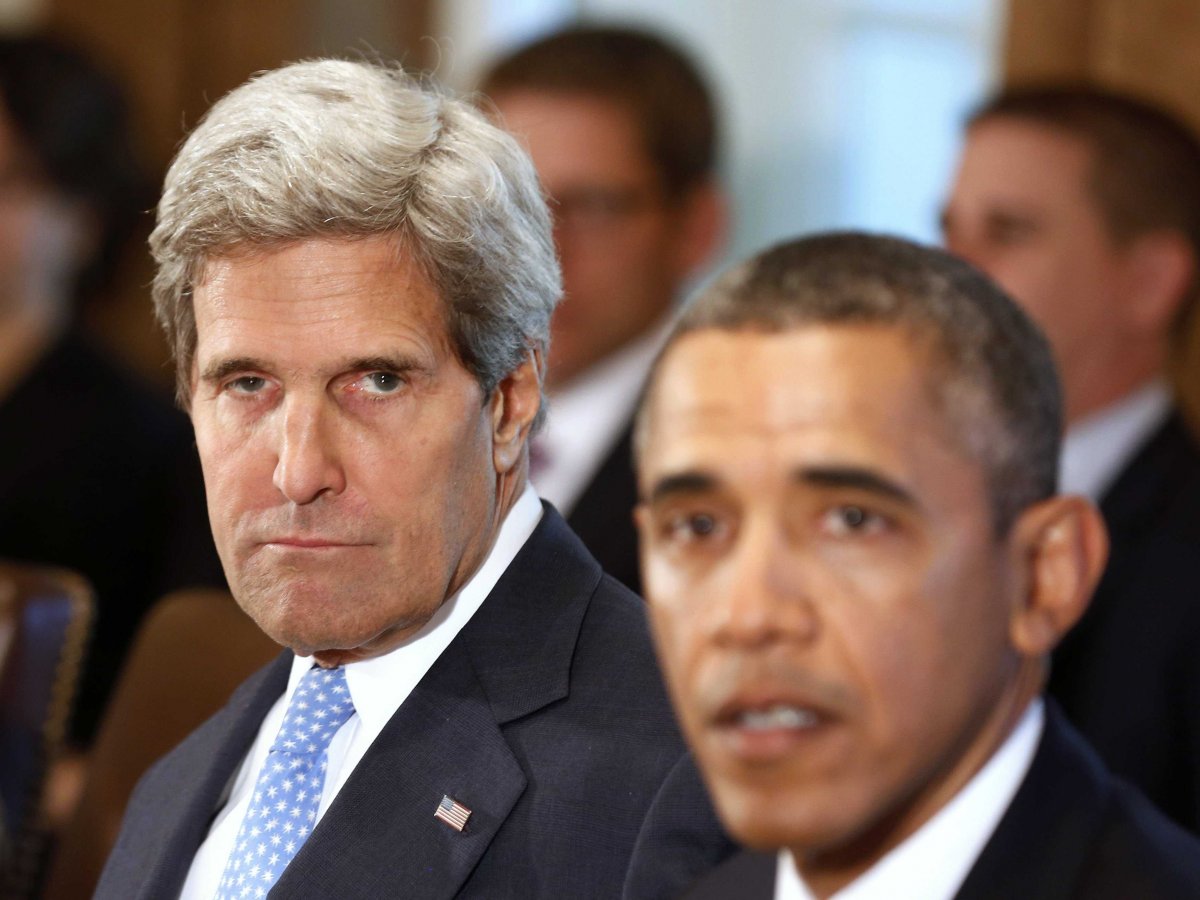
kerry-obama-2REUTERS/Larry Downing. U.S. Secretary of State John Kerry (L) listens as U.S. President Barack Obama hosts a Cabinet meeting in the Cabinet Room of the White House in Washington, September 30, 2013.

[B]oth sides now have greater urgency toward a deal — President Barack Obama has desperately wanted a peaceful resolution to the Iran issue, and Iran now has more of an incentive to get its finances in order with turmoil and instability only growing in the region.

The escalating crisis in Iraq comes amid the search a solution for another huge geopolitical dilemma — a nuclear deal among world powers and Iran.

With a vested interest in keeping the current Shi’ite government in power in Iraq, Iran has been happy to step up and provide support in its fight against Sunni insurgents of the Islamic State of Iraq and ash-Sham (ISIS).

It is a rare situation in which U.S. and Iranian interests somewhat align. A senior State Department official said diplomats from both countries held talks on Iraq on the margins of broader nuclear-program discussions in Vienna. The U.S. expects to work with Iran, though the State Department stressed there will be no military cooperation.

But the cooperation comes with a condition. A top spokesman to Iranian President Hassan Rouhani said Wednesday that it could work with the U.S. if nuclear negotiations are successful.

“If that comes to a final resolution, then there might be opportunities for other issues to be discussed,” Rouhani’s chief of staff, Mohammad Nahavandian, told reporters on Wednesday. He added the talks serve as a “test for confidence building.”

The sides are working to get a permanent Iranian nuclear deal by a July 20 deadline. Until now, that deadline was not expected to be met, with both sides looking toward a possible extension.

But both sides now have greater urgency toward a deal — President Barack Obama has desperately wanted a peaceful resolution to the Iran issue, and Iran now has more of an incentive to get its finances in order with turmoil and instability only growing in the region.

“They really want these sanctions off,” Ian Bremmer, the president of Eurasia Group, told Business Insider. “They don’t want to do anything in Iraq that could potentially scupper that deal.

“It’s not that they’d trust U.S. military cooperation — after all, they’re still on opposite sides on most other issues in the region (Lebanon, Israel, Syria, Egypt). But they’re happy to open lines of communication and potentially even share some useful information tactically if that keeps them on track on the comprehensive nuclear deal.”

The five world powers and Iran are meeting in Vienna this week in the latest round of talks aimed at a permanent solution to the country’s nuclear program.

Jonathan Schanzer, a former terrorism finance analyst at the U.S. Department of Treasury, recently told Business Insider the Iraqi crisis plays “right into Iran’s hand” at a time when it wants greater influence in the region.

“The ISIS crisis in Iraq plays right into Iran’s hand,” Schanzer, a former terrorism finance analyst at the U.S. Department of the Treasury, told Business Insider. “The regime in Tehran and the regime in Syria have been saying for months that they are the regional players that can help the West in its fight against terrorism. Despite the obvious irony — given the grisly terrorism track records of both countries — this may appeal to Washington, which is loathe to enter into new conflicts in the Middle East as it keen to ‘lead from behind.'”

This attitude fits the foreign policy of the Obama administration, which has been increasingly reluctant to engage in Middle East conflict — and in conflict, in general. Amid the escalating crisis in Ukraine, Bremmer called this phenomenon — along with other countries’ general disinclination — the “G-Zero order.”

Bremmer told Business Insider the “G-Zero” phenomenon also applies to Iraq. And if the U.S. doesn’t intervene, he said, no Western countries will.

“Absent American intervention, there’s nobody else outside the region willing to make a serious effort here,” he said. “And the Americans are hardly enthusiastic about intervention. Ukraine, Syria, Iraq — the severity of these conflicts are a direct consequence of the G-Zero.”
 

Iran says could work with US in Iraq if nuclear talks succeed

June 18, 2014

Iran says could work with US in Iraq if nuclear talks succeed, AFP via UK Yahoo News, June 18, 2014

(See also Envoys: Iran refuses to budge on centrifuges and Iran Warns U.S. Against Intervention in Iraq.— DM)

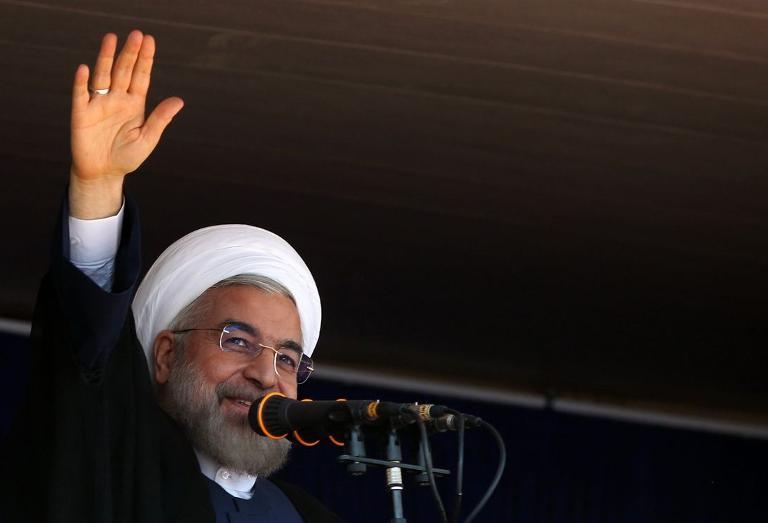
Rouhani etcAFP/Iranian Presidency/AFP – A handout picture released by the official website of the Iranian president show President Hassan Rouhani speaking in Khoramabad, in Iran’s western Lorestan region

A top Iranian official said Wednesday that Tehran could consider working with the United States over the crisis in Iraq if talks on its nuclear programme are successful.

Asked about possible cooperation in Iraq, President Hassan Rouhani’s chief of staff Mohammad Nahavandian told reporters in Oslo that the nuclear talks were a “test for confidence building”.

“If that comes to a final resolution, then there might be opportunities for other issues to be discussed.”

Envoys: Iran refuses to budge on centrifuges

June 18, 2014

Envoys: Iran refuses to budge on centrifuges, Ynet News, June 18, 2014

Tehran adhering to Supreme Leader Khamenei’s instructions, will not compromise on ability to produce nuclear fuel; deal between Iran, West unlikely before July 20 deadline.

Iran is refusing to significantly cut the number of centrifuges it intends to keep to produce nuclear fuel, making it hard to imagine a compromise at this week’s talks with six powers, Western and Iranian officials said on Wednesday.

The remarks from diplomats close to the talks, who spoke on condition of anonymity, came after the initial rounds of meetings in the Austrian capital between Iran and the United States, Britain, France, China, Russia plus Germany.

They are striving for a deal that would limit Iran’s nuclear program, subject it to stricter UN inspections, lift sanctions impairing Iran’s oil-based economy and remove the risk of a wider Middle East war over the dispute.

But with time running out if a precarious extension of the talks past the self-imposed July 20 deadline is to be averted, the two sides remain far apart over the permissible future scope of Iranian nuclear activity.

Perhaps the biggest hurdle to overcome, six-power diplomats said, is Iran’s stance regarding its uranium-enrichment centrifuges, which one negotiator described as a “huge problem”.

Centrifuges are machines that spin at supersonic speed to increase the ratio of the fissile isotope in uranium. Low-enriched uranium is used to fuel nuclear power plants, Iran’s stated goal, but can also provide material for bombs if refined much further, which the West fears may be Iran’s latent goal.

“The Iranians have not yet shown a willingness to reduce their centrifuges to an acceptable number, making it difficult to envision a compromise at this point that we could all live with,” the negotiator told Reuters. Another Western official close to the talks confirmed the remarks as accurate.

A senior Iranian official appeared to confirm the assessment.

“Our Supreme Leader (Ayatollah Ali Khamenei) has set a red line for the negotiators and that cannot change and should be respected,” he told Reuters. “Uranium enrichment should be continued and none of the nuclear sites will be closed.

“What the West offers Iran on the number of centrifuges is like a joke and unacceptable,” he continued. “However, negotiation means trying to overcome disputes and it is what both sides are doing.”

A senior US official said on Monday that all disagreements must be cleared up for a long-term settlement with Iran to be clinched. “Nothing is agreed until everything is agreed.”

Crippling sanctions

The United States, France, Britain and Germany would like the number of centrifuges Iran maintains to be in the low thousands, while Tehran wants to keep tens of thousands of them in operation. It now has about 19,000 installed, of which about 10,000 are spinning to refine uranium.

The more centrifuges Iran has in operation, the more quickly it would be in position to produce sufficient highly-enriched uranium (HEU) for an atomic bomb, if it were to choose to do so. Western powers want the time frame in which Iran could in theory produce atom bomb fuel to be stretched out as much as possible.

Tehran, however, rejects allegations from Western powers and their allies that it is seeking the capability to produce nuclear weapons, insisting its atomic ambitions are limited to peacefully generating electricity.

Iran has refused to heed UN Security Council demands to suspend its enrichment program, leading to crippling US, European Union and UN sanctions that have damaged the Iranian economy and sharply reduced oil exports from the OPEC member.

Centrifuges are not the only sticking point in this week’s talks, which are expected to run until Friday, diplomats say. Others include the types of centrifuges Iran uses, the speed of the lifting of sanctions and the expected duration of curbs that would be imposed on Iran’s nuclear activities.

Two other stumbling blocks are Iran’s planned Arak nuclear reactor – which Western officials suspect could be a source of plutonium, an alternative to HEU as bomb fuel – and Iranian clarification of intelligence indications that it researched how to design bombs in the past – something it also denies doing.

Diplomatic sources have told Reuters that it is increasingly probable Iran will seek a prolongation of the talks deadline. But Western officials insisted the focus now remained on sealing the deal by late July, noting that any extension must be agreed by all sides and would likely be short.

“If there is an extension it will be for a few weeks,” a diplomat from one of the six powers told Reuters. If a deal were really within reach, the sides should not need six more months, the maximum extension approved under a preliminary deal Iran struck with the six powers in Geneva last November.

The ISIS Conquest of Iraq leads to Jerusalem

June 18, 2014

The ISIS Conquest of Iraq leads to Jerusalem, American ThinkerBarry Shaw, June 18, 2014

Israel would be advised to keep a sharp eye on future moves by ISIS to attack or infiltrate Jordan via Syria. Who is to say that radical Palestinians and Islamists in Jordan will not open the gates of that country to ISIS, just as Syrians reached out to them at their cost?

When that scenario is achieved, Israel will be exposed to a threatening and powerful terror enemy stretching from Rosh HaNikra on the northern Mediterranean to Mount Hermon in the northeast of Israel, sweeping through the Golan Heights and down the Jordan Valley to the Dead Sea and the Red Sea in the south.

As we witness the brutalization of Iraq by the ISIS terror organization consider this: this Islamic march of death leads to Jerusalem.

The leading result of the call of the people in the Arab world for the overthrow of unsatisfactory leaders has been their cause being hijacked by insurgent jihadi terrorists. We saw that in Libya with the fall of Gadhafi. We saw it in Egypt where Mubarak was replaced by the Muslim Brotherhood, in this case an in-house jihadi movement. We see it in Syria where the people’s cry against Assad has led to an influx of Al-Qaida type groups vying for dominance. Now we witness the conquest of Iraq by a vicious Islamic terror regime against which Al-Qaida pales into moderation.

The Islamic State of Iraq (ISIS) is headed by Abu Bakr al-Baghdadi. He transformed a few small terror cells into the most brutal and lethal terror group on earth. Mercy is not in this man’s vocabulary. Abu Bakr picked up the mantle after Abu Omar al Baghdadi was killed in a joint U.S.-Iraqi operation in 2010.

Al-Qaida in Iraq was under the leadership of Abu Musab al-Zarqawi who, in a 2005 letter to the head of Al-Qaida, Ayman al-Zawahiri, put the aims of Al-Qaida in Iraq into four stages;

      1. Drive America out of Iraq.
      2. Create a Caliphate in Iraq.
      3. Use that as a base to attack other countries.
      4. Attack Israel.

When both al-Zarqawi and al-Baghdadi were killed by American forces it looked as if Al-Qaida was decimated in Iraq, but Abu Bakr al-Baghdadi reformed a weakening terror group by leading it in battle, honing its fighters’ training and experience in Iraq and Syria, and by using political savvy to link his growing group to local and tribal demands and interests. It became both a fighting force and a social benefactor, winning local hearts and minds along a bloody path of victory. He absorbed the al-Nusra Front terror group in Syria into his ranks, demanding their obedience. Seeing the growing threat, Al-Qaida’s al-Zarqawi, from his hiding place somewhere in Afghanistan or Pakistan, criticized ISIS for not concentrating on Iraq. In response, a confident ISIS hit back, accusing the Al-Qaida chief of “Sheikh Osama (bin Laden) gathered all the mujahedeen with one word, but you divided them and tore them apart.”

ISIS has attracted thousands of foreign fighters to its ranks, increasing its power and size. The shockwaves caused by its Iraqi Blitzkreig in seizing the towns of Mosul, Tikrit, and Fallujah was met by a mocking response by ISIS. “The battle is not yet raging, but it will rage in Baghdad and Karbala. Put on your belts and get ready” as they contemptuously called Iraqi leader, Nouri al-Maliki, an “underwear salesman.”

Clearly, the battle for Iraq is along sectarian lines with the Sunni ISIS, representing the majority of Iraqis, challenging the Shia al-Maliki rule. Clear also was al-Maliki’s refusal to allow American forces to stay on in Iraq, but the ISIS victories were enhanced by the military vacuum in Iraq following the American pullout, and this responsibility can be put at Obama’s White House door.

Obama’s self-proclaimed foreign-policy “achievements” have been U.S. troop withdrawals from Iraq, and “Al-Qaida has been decimated and is on the run!” These two boasts have now come back to haunt him. Al-Qaida has morphed into a bigger monster that is about to take over Iraq. And what was President Obama’s response?  “We don’t have the resources. Let the local leaders deal with them.” This is shortsighted weakness, and dangerous. This was emphasized on Friday, June 13, when Obama, confronted by the deteriorating situation in Iraq, decided to head off to California for a fund-raising event and some golf.

America spilled blood and treasure in Iraq including 4500 lives, $17 billion in military training to Iraqi forces, and $15 billion in military equipment. Now ISIS terrorists are seen driving around in American military Humvees.

The United States embassy in Baghdad is the largest global American embassy. It has 15,000 workers. It would be a mistake to think that they did not pick up intelligence on the gathering Islamic terror storm. They did, and it fed it up the chain to the State Department and the White House, for months. Neither of those bodies acted on the intel. As one staffer told Lt. Colonel Ralph Peters, “We couldn’t convince the President that this is serious!”

Now the Baghdad embassy could be under ISIS fire, making Benghazi look like child’s play. And attack on Americans will not end there.

Abu Bakr al-Baghdadi was captured, imprisoned, and then released by America in Iraq, just as Obama recently released the five top Al-Qaida/Taliban prisoners at Gitmo. America, and others, will pay for both these foolish gestures. As Ken King, the commander of the Bucco Camp that was ordered to release al-Baghdadi, related on the Fox News “Kelly Files” program, as a parting shot the ISIS leader glared at King and warned, “I’ll see you in New York!”

In a strange twist on “the enemy of my enemy is my friend,” Republican lawmakers called for a partnership with Iran to stop ISIS from attacking Baghdad. Senator Lindsey Graham warned that ISIS “will eventually march on Jordan and Lebanon. They’re going to take the King of Jordan down.” The unspoken implication is that Israel will be next.

ISIS is now pumping Iraqi oil. It grabbed half a trillion dollars when it seized Iraq’s central bank in Mosul making it the richest terrorist organization in the world.

ISIS has been called too extreme for Al-Qaida with justification. Al-Baghdadi is being crowned “the next Bin Laden.”

ISIS is guilty of wholesale massacres in Syria, leaving the bodies to rot for all to see. It beheaded a top rival rebel commander, leaving his head in the middle of the market. Amnesty International listed a few of their atrocities in their 18-page report “Rule of fear; ISIS abuses in detention is northern Syria.”  They have conducted hundreds of executions, beheadings, even crucifixions in Mosul, Iraq. They destroy anything that is not Islamic, such as the Assyrian Church in Mosul. Hundreds have been slain for being “infidels.”

Once Islamic ISIS establishes its permanent presence in Iraq, as Hizb’allah has done in Lebanon and Hamas in Gaza, it will strengthen its grip on Syria. While looking down on Israel from the Golan Heights, it is likely to turn its attention to a militarily weak Lebanon, seeking to remove the Shiite Hizb’allah from power, taking over its armory of a hundred thousand rockets, and taking control of that country. From its northern stronghold in Iraq, Lebanon, and Syria it will target Jordan with the intention of deposing, or killing, the Hashemite king, as a preliminary step to taking over his country. If America, Egypt, and Saudi Arabia do not immediately move to strengthen the kingdom, King Abdullah will be exposed to mortal danger, granting ISIS control over Iraq, Syria, Lebanon, and Jordan in their march to a global Caliphate, and Stage 4 of their original plan.

Israel would be advised to keep a sharp eye on future moves by ISIS to attack or infiltrate Jordan via Syria. Who is to say that radical Palestinians and Islamists in Jordan will not open the gates of that country to ISIS, just as Syrians reached out to them at their cost?

When that scenario is achieved, Israel will be exposed to a threatening and powerful terror enemy stretching from Rosh HaNikra on the northern Mediterranean to Mount Hermon in the northeast of Israel, sweeping through the Golan Heights and down the Jordan Valley to the Dead Sea and the Red Sea in the south.

In the turmoil that is the Middle East, where regimes are falling and nations are toppling, who is to say that such a nightmare scenario is not possible unless ISIS is stopped in its tracks now?

Iran Warns U.S. Against Intervention in Iraq

June 18, 2014

Iran Warns U.S. Against Intervention in Iraq, Washington Free Beacon, June 18, 2014

(President Obama is still trying to decide what, if anything, to do. — DM)

The head of Iran’s armed forces on Tuesday called the United States “supporters of terrorists” and warned the Obama administration against any intervention in Iraq, where extremist terrorists are seeking to depose the American-backed government.

Iran’s warning came less than a day after senior Obama administration officials expressed optimism about partnering with Tehran and signals that the White House may be misreading Iran’s intentions in Iraq.

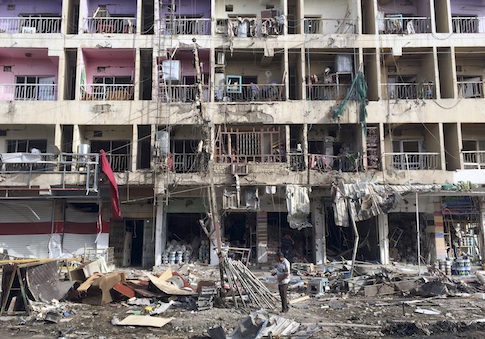
APTOPIX Mideast IraqIraqi civilians inspect the aftermath of a car bombing in the southeastern district of New Baghdad, Iraq, June 8 / AP

As U.S. leaders signal a willingness to partner with Iran in the fight against Iraqi terrorists, senior military officials in Tehran are warning of repercussions for the United States if it meddles in Iraq.

The head of Iran’s armed forces on Tuesday called the United States “supporters of terrorists” and warned the Obama administration against any intervention in Iraq, where extremist terrorists are seeking to depose the American-backed government.

Iran’s warning came less than a day after senior Obama administration officials expressed optimism about partnering with Tehran and signals that the White House may be misreading Iran’s intentions in Iraq.

The State Department in recent days has taken heat for ignoring its own warning about Iran’s efforts to destabilize Iraq. U.S. official have instead conducted a full court press to convince the nation that Iran and America have a “shared interest” in the region.

Senior Iranian military and political officials do not share this rosy view and are now issuing warnings to U.S. leaders as the violence in Iraq hits new highs.

Iranian General Hassan Firouzabadi, chief of staff of the country’s armed forces, slammed the United States and blamed former Secretary of State Hillary Clinton for sponsoring terrorist groups in Iraq and the region.

“By any meddling and military intervention in Iraq, the Americans are seeking to attain ungracious goals, at the top of which undermining the elections in Iraq, and the crocodile tears of the Americans should not receive any attention, as they are still the allies of the sponsors and supporters of terrorists in the region,” Firouzabadi was quoted as saying in Tehran on Tuesday by the country’s state-run press.

Clinton’s State Department, the general claimed, “created terrorist groups” and is now “displeased with the results of the recent elections in Iraq and is cancel election results.”

Iranian officials say that they can handle the Iraq terror group Islamic State of Iraq and the Levant (ISIL) without any U.S. assistance.

“The Iraqi army and nation are mighty enough to overcome terrorists of the ISIL,” according to remarks made earlier this week by Iran’s deputy foreign minister Hossein Amir Abdollahian, who vigorously denied reports that Iranian and U.S. officials are discussing joint tactics in Iraq.

“The Islamic Republic of Iran has had no negotiations with the Americans over mutual cooperation in Iraq,” Abdollahian was quoted as saying.

Iranian nuclear negotiators in Vienna also denied that the United States and Iran discussed Iraq at any point.

“In negotiations with the Americans, merely the nuclear issue was discussed,” Seyed Abbas Araqchi, Iran’s deputy foreign minister and its senior negotiator, said on Monday.

Iran’s Firouzabadi also claimed that the ISIL is an Israeli creation meant to distract the region.

“The ISIL is Israel’s cover up for distancing the revolutionary forces from Israeli borders and creating a margin of security for the Zionists, and the Zionist media have also admitted this fact,” he was quoted as saying.

The comments by top Iranian officials have drastically differed from those made by leading Obama administration figures.

Secretary of State John Kerry has expressed his openness to teaming with Iran, telling reporters in a recent interview, “We’re open to discussions if there is something constructive that can be contributed by Iran, if Iran is prepared to do something that is going to respect the integrity and sovereignty of Iraq and ability of the government to reform.”

Following a meeting between Kerry and Iranian officials, a senior State Department official told reporters that the United States remains “open to engaging the Iranians,” but would not coordinate militarily with Tehran.

Iran is already gearing up to send assets and potentially troops to Iraq.

“We are ready to help Iraq and if the Iraqi government requests, we will help them; we believe that violence and the terrorist groups should be eliminated from the region,” Iranian First Vice-President Eshaq Jahangiri said over the weekend.

Multiple U.S. reports indicate that Iran has already sent military assets and commanders to Iraq, though it remains unclear how they might interact with the 275 U.S. troops recently deployed there.

Terror groups: We won’t stand ‘handcuffed’ during IDF operation

June 18, 2014

At news conference in Gaza, Palestinian terror groups, including Hamas, say IDF operation in Judea and Samaria “has failed in deterring our resistance” •

We stand by any effort to free Palestinian prisoners, terror groups pledge

.Reuters and Israel Hayom Staff

via Israel Hayom | Terror groups: We won’t stand ‘handcuffed’ during IDF operation.


A member of Hamas’ Izzedine al-Qassam Brigades [Illustrative]|
Photo credit: Reuters

Palestinian terrorist groups, including Izzedine al-Qassam Brigades, the military wing of Hamas, said on Tuesday they will not stand “handcuffed” during Israel’s ongoing military operation in Judea and Samaria.

Israel holds Hamas responsible for the kidnapping of three Israeli teens near Hebron last Thursday.

While neither claiming nor denying responsibility, Hamas has said that the kidnapping was a justified response to the plight of thousands of Palestinians imprisoned by Israel.

Following the kidnapping, the Israeli military launched Operation Brother’s Keeper, conducting house-to-house searches and carrying out interrogations and arrests in Hebron and other parts of Judea and Samaria.

At a news conference in the Gaza Strip on Tuesday, Palestinian terror groups said the Israeli military operation “had failed in deterring our resistance.”

“We support and stand by any Palestinian effort of resistance exerted in order to free the hero prisoners who are launching a battle in the face of the occupier by their empty stomach against an enemy and an occupier that had only understood the language of force,” an unidentified man wearing a mask said during the news conference.

Signatories to the statement include the armed wings of Hamas, the Democratic Front for the Liberation of Palestine, the Popular Front of the Liberation of Palestine, Fatah, and the Popular Resistance Committees, as well as the Islamist Tempest and the Sword of Islam.

Hamas and other terrorist groups have in the past seized Israelis to trade for jailed Palestinians.

Scores of Palestinian prisoners are currently on a hunger strike to protest against being held by Israel without charges.

Hamas and ISIS

June 18, 2014

Hamas and ISIS | JPost | Israel News.

By JPOST EDITORIAL

06/17/2014 21:44

The two terrorist organizations share many of the same objectives, such as the establishment of a Muslim caliphate.

jihadist al-Qaida fighters

ISIS fighters Photo: REUTERS

As Israelis unite in collective concern for the fate of the three kidnapped teenagers, it seems the rest of Middle East is deteriorating from day to day.

In Syria, the civil war rages on, and the fighting has spilled over to Iraq, as well.

Since March 2011, when the clashes began, Sunni extremists, particularly of global-jihad variety, have been drawn to the fight against the “apostate” Alawite Bashar Assad and his primarily Druse and Christian supporters. Many of these Islamists now make up the ranks of the Islamic State of Iraq and Syria (ISIS), which has successfully conquered several key cities in Iraq, including Mosul and Tikrit. They are fighting to wrest control of Iraq away from the “infidel” Shi’ite majority.

The real danger of Baghdad falling to ISIS, an offshoot of al-Qaida, is not only a devastating blow to the US, which invested more than a trillion dollars and thousands of American lives in liberating Iraq from Saddam Hussein’s murderous regime between 2003 and 2011,but it is a threat to the stability throughout the region.

ISIS’s leader, Abu Bakr al-Baghdadi has reportedly discussed with his lieutenants the possibility of extending the group’s control beyond Syria and Iraq.

Jordan would be an obvious target because it has shared borders with both Syria and Iraq, where ISIS terrorists are concentrated. Also, Jordan’s Hashemite regime is regarded by the Islamic reactionaries of ISIS as “infidels” and “apostates” who should be fought.

And if Jordan is affected, this might have ramifications for Israel as well.

One of the arguments made by those who support the creation of a Palestinian state in the West Bank was that with the US’s destruction of the Iraqi army, one of the biggest in the region, Israel faces fewer threats from its border with Jordan. But now, with the surprising success of ISIS, this might no longer be as correct.

True, we must not overstate the threat to Jordan.

Both the US and Israel have a cardinal interest in making sure the Hashemite regime remains in power. But the US is increasingly reluctant to assert itself, even in Iraq where it has invested so much.

Another worrying development is the prospect that Washington might cooperate with Iran to fight ISIS.

The Obama administration said this week it was considering talks with Iran about the Iraqi crisis. Iranian officials have voiced openness to working with the Americans in helping Baghdad repel ISIS.

Admittedly, Strategic Affairs Minister Yuval Steinitz told Reuters the US and other major powers have pledged that any cooperation with Iran in Iraq would not set back the drive to curb Tehran’s nuclear weapons program.

Nevertheless, the sudden dovetailing of US and Iranian interests in Iraq, which has a Shi’ite majority, is worrying.

ISIS has no direct connections with Hamas. Indeed, ISIS is a globalized movement that lacks deep roots in any particular society and has no nationalist project.

In contrast, Hamas, as well as Hezbollah, are nationalist movements. What they do have in common, however, is the use of violence and intimidation to implement a reactionary version of Islam that persecutes women and other religions.

Whether or not Hamas leaders are emboldened by ISIS’s victories in Iraq, the two terrorist organizations share many of the same objectives, such as the establishment of a Muslim caliphate that operates according to Shari’a (Islamic law).

In the wake of the kidnapping, Israel has launched a major crackdown on Hamas operatives and affiliates in the West Bank, because, according to Prime Minister Binyamin Netanyahu, Hamas is responsible.

One former military official told The Jerusalem Post that security forces are “taking advantage” of the kidnapping to “clean up” Judea and Samaria.

One wonders why this “clean up” was not launched long ago, before Hamas succeeding, after several foiled attempts, to carry out a kidnapping. Perhaps it is the same sort of self-defeating “wait and see” strategy that has allowed ISIS to grow so dangerous.