Archive for June 12, 2014

Iranian military forces are fighting ISIS in Iraq. Gen. Soleimani is in Baghdad. Obama may send Iraq arms

June 12, 2014

Iranian military forces are fighting ISIS in Iraq. Gen. Soleimani is in Baghdad. Obama may send Iraq arms, DEBKAfile, June 13, 2014

[S]teps by Washington and Tehran pave the way for the US and Iran to cooperate for the first time in a joint military endeavor.

[M]oves by Tehran will determined how Washington acts in the coming hours.

[President Obama said] that he was thinking of “short-term military things.”

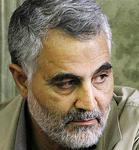
General_Qasem_Soleimani_6.14Al Qods chief Gen. Qassem Soleimani

President Barack Obama is close to a decision on a number of US military steps for thwarting the march of Al-Qaeda in Iraq, now halted at Samarra 70 km short of Baghdad. In a comment Thursday night, June 12, he said: “We do have a stake in making sure that these jihadists are not getting a permanent foothold in either Iraq or Syria, for that matter.” He added that he was thinking of “short-term military things.”

Iraqi Prime Minister Nuri al-Maliki has been appealing to the White House for months for Apache helicopters and Hellfire air-ground rockets to fight terrorists. These Obama may now release, as well as considering token US drone attacks on ISIS targets in Iraq, for which he is most reluctant..

Thursday afternoon, Iran’s most powerful gun, the Al Qods Brigades chief Gen. Qassem Soleimani, arrived in Baghdad to take over the push against ISIS, in the same way as he has managed Bashar Assad’s war in Syria, and pull together the demoralized and scattered Iraqi army.

Those steps by Washington and Tehran pave the way for the US and Iran to cooperate for the first time in a joint military endeavor.

Since ISIS forces, albeit boosted by tens of thousands of armed Sunnis flocking to the black flag, are not capable of capturing Baghdad and have halted outside the city, President Obama and Iran’s Ayatollah Ali Khamenei have won a small space for deciding how to proceed.

Khamenei must determine whether Gen. Soleimani with the help of American weaponry can stop al Qaeda, save Maliki from collapse and prevent the fall of Baghdad, and whether it is worth sending an Iranian army division over to Iraq, our intelligence sources reported earlier Thursday. They have since entered Iraq and are fighting ISIS forces.

These moves by Tehran will determined how Washington acts in the coming hours.

The big winner of the ISIS onslaught on Iraq, apart from Al Qaeda,  is the semiautonomous Kurdish republic in the north. When the Iraqi army’s 12th division assigned with defending Kirkuk and its oil fields scattered to the four winds Thursday, the Kurdish Peshmerga army rolled right in and snatched the city and oil fields from the control of the Baghdad government, fulfilling an old Kurdish dream.

Americans being evacuated from Iraqi air base as militants advance

June 12, 2014

Americans being evacuated from Iraqi air base as militants advance, Fox News, June 12, 2014

[T]he evacuation means that the vital training mission at Balad, about an hour northwest of Baghdad, has been suspended indefinitely — despite repeated administration statements that it would continue to support Iraq’s military. 

Regarding those assurances, one U.S. official clarified to Fox News: “At the same time, we are not going to do anything stupid.” 

Americans were being evacuated Thursday from a major Iraqi air base as Al Qaeda-aligned militants toppled cities in the country’s north and threatened to advance toward Baghdad. 

The Iraqi government has been asking for more than a year for surveillance and armed drones to combat a Sunni insurgency that has gained strength from battlefield successes in neighboring Syria. 

A senior U.S. official confirmed to Fox News that Americans were being evacuated from a base in Balad, which had been one of the largest training missions in Iraq.

But the evacuation means that the vital training mission at Balad, about an hour northwest of Baghdad, has been suspended indefinitely — despite repeated administration statements that it would continue to support Iraq’s military.

Regarding those assurances, one U.S. official clarified to Fox News: “At the same time, we are not going to do anything stupid.”

The development signals the worsening security environment in the northern part of the country. One senior official told Fox News that the focus for evacuation at this point is on people outside of Baghdad.

Two senior intelligence sources, though, told Fox News there is serious concern about how to evacuate other Americans out of Iraq if the situation further deteriorates.

“We need places to land, we need safe and secure airfields,” one source said, noting that the militants are “seizing airfields and they have surface-to-air missiles, which very clearly threatens our pilots and planes if we do go into evacuation mode.”

Sources said “all western diplomats in Iraq are in trouble,” and American allies are scrambling to put together an evacuation plan. Military officials said there are “not a lot of good options.”

The Obama administration is still trying to determine how to assist the Nouri al-Maliki government, while making clear it does not want U.S. troops in the middle of the fight.

“We are not contemplating ground troops,” White House Press Secretary Jay Carney said Thursday.

According to the White House, Vice President Biden spoke Thursday with Maliki and expressed “solidarity” with the Iraqi government in its fight against the Islamic State of Iraq and Syria.

Obama promised Thursday to send more military aid, without saying what kind of new assistance would be given to Baghdad. Two U.S. officials who are familiar with ongoing negotiations told The Associated Press the White House is considering air strikes and increased surveillance, requested this week by the Iraqi defense minister, as the insurgency nears Baghdad.

The Iraqi government has been asking for more than a year for surveillance and armed drones to combat a Sunni insurgency that has gained strength from battlefield successes in neighboring Syria.

Republican lawmakers were harshly critical Thursday of the administration’s response. Sen. John McCain, R-Ariz., called for Obama to replace his national security team.

House Speaker John Boehner snapped: “What’s the president doing? Taking a nap.”

Obama commented on the violence shortly afterward.

“What we’ve seen over the last couple of days indicates the degree to which Iraq is going to need more help,” Obama said. “It’s going to need more help from us, and it’s going to need more help from the international community.”

Several thousand Americans remain in Iraq, mostly contractors who work at the U.S. Embassy in Baghdad on programs to train Iraqi forces on American military equipment like fighter jets and tanks. Those being evacuated from Balad on Thursday included 12 U.S. government officials and military personnel who have been training Iraqi forces to use fighter jets and surveillance drones.

Other U.S. contractors are at a tank training ground in the city of Taji, just north of the capital, that is still in operation for now.

In addition to the possible military assistance, State Department spokeswoman Psaki said the U.S. is sending about $12 million in humanitarian aid to help nearly a million Iraqis who have been forced from their homes by recent fighting in the nation’s north and west.

Video: General Jack Keane on the Iraq kerfuffle

June 12, 2014

Video: General Jack Keane on the Iraq kerfuffle, You Tube, June 12, 2014

The Caliphate exists and we have no comprehensive strategy.


Obama Rejected Iraqi Request for Air Strikes on Al Qaeda

June 12, 2014

Obama Rejected Iraqi Request for Air Strikes on Al Qaeda, Front Page Magazine, June 12, 2014

(But see this Stratfor article, speculating that the U.S. will send “vital equipment such as helicopter gunships, Hellfire missiles, communications equipment, large volumes of small arms and ammunition.” — DM)

Obama has two agendas.

1. He does not in any way, shape or form want to be associated with the Iraq War

2. He does not want to offend Muslims, especially the Islamist groups that he has been courting.

Obama . . . claims that conflicts can be ended unilaterally, no matter how much the other side wants to continue them.

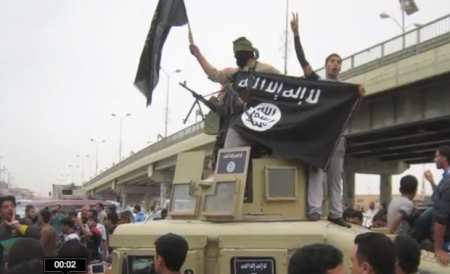
al-qaeda-militants-capture-mosul-620x378-450x274

I can understand why putting boots on the ground would be unappealing, but air strikes against a terrorist group are low risk and high reward. Obama had no problem signing off on air strikes against Gaddafi. He was contemplating air strikes against Assad.

Both of those were much more high risk, much less legal and much less in our national interest.

On the other hand we are at war with Al Qaeda and this is an Al Qaeda affiliate that we had been directly fighting. There’s no legal issue here, and unlike Syria, it’s not likely to pose a threat to air power. And using drones is on the table.

Why can we use drones against Al Qaeda leaders in Yemen, but not Iraq?

If ISIS manages to set up its own Emirate out of pieces of Iraq and Syria, we’re going to have to end up being dragged into the conflict anyway. It now has a large enemy force. It’s going to come after us. It would be smart to weaken it now.

It would have been smarter to carry out air strikes against it in Syria, instead of talking about bombing the Syrian government.

But Obama has two agendas.

1. He does not in any way, shape or form want to be associated with the Iraq War

2. He does not want to offend Muslims, especially the Islamist groups that he has been courting.

So…

As the threat from Sunni militants in western Iraq escalated last month, Prime Minister Nuri Kamal al-Maliki secretly asked the Obama administration to consider carrying out airstrikes against extremist staging areas, according to Iraqi and American officials.

But Iraq’s appeals for a military response have so far been rebuffed by the White House, which has been reluctant to open a new chapter in a conflict that President Obama has insisted was over when the United States withdrew the last of its forces from Iraq in 2011.

Obama said it’s over, so it’s over. Never mind reality.

Al Qaeda’s attacks grew much worse after the pullout, but Obama kept moving forward and ignoring the problem. And here we are.

ISIS is now taking over major Iraqi cities. But it’s “over”. And Obama, like most liberals, claims that conflicts can be ended unilaterally, no matter how much the other side wants to continue them.

The Obama administration has carried out drone strikes against militants in Yemen and Pakistan, where it fears terrorists have been hatching plans to attack the United States. But despite the fact that Sunni militants have been making steady advances and may be carving out new havens from which they could carry out attacks against the West, administration spokesmen have insisted that the United States is not actively considering using warplanes or armed drones to strike them.

Hoshyar Zebari, Iraq’s foreign minister, last year floated the idea that armed American-operated Predator or Reaper drones might be used to respond to the expanding militant network in Iraq. American officials dismissed that suggestion at the time, saying that the request had not come from Mr. Maliki.

By March, however, American experts who visited Baghdad were being told that Iraq’s top leaders were hoping that American air power could be used to strike the militants’ staging and training areas inside Iraq, and help Iraq’s beleaguered forces stop them from crossing into Iraq from Syria.

“Iraqi officials at the highest level said they had requested manned and unmanned U.S. airstrikes this year against ISIS camps in the Jazira desert,” said Kenneth M. Pollack, a former C.I.A. analyst and National Security Council official, who is a senior fellow at the Brookings Institution and who visited Baghdad in early March. ISIS is the acronym for the Islamic State in Iraq and Syria, as the militant group is known.

As the Sunni insurgents have grown in strength those requests have persisted. In a May 11 meeting with American diplomats and Gen. Lloyd J. Austin III, the head of the Central Command, which oversees American military operations in the Middle East, Mr. Maliki said he would like the United States to provide Iraq with the ability to operate drones. But if the United States was not willing to do that, Mr. Maliki indicated he was prepared to allow the United States to carry out strikes using warplanes or drones.

In a May 16 phone call with Vice President Joseph R. Biden Jr., Mr. Maliki again suggested that the United States consider using American air power. A written request repeating that point was submitted soon afterward, officials said.

So we have clear requests for military aid that the administration has simply been ignoring. Again drone attacks would put no American lives at risk and would undermine ISIS’ momentum by slowing them down and taking out top leaders.

There’s no reason not to do it except the two reasons mentioned above.

But so far, the administration has signaled that it is not interested in such a direct American military role.

“Ultimately, this is for the Iraqi security forces, and the Iraqi government to deal with,” Rear Adm. John F. Kirby, the Pentagon spokesman, said Tuesday.

Except they’re not dealing with it too well, so we’re going to end up having to deal with it.

We waited until Al Qaeda has its own small country with half a billion in money, helicopters, armored vehicles and a huge population. How much longer does Obama want to wait?


Iran Deploys Quds Forces To Support Iraqi Troops, Helps Retake Most Of Tikrit

June 12, 2014

Iran Deploys Quds Forces To Support Iraqi Troops, Helps Retake Most Of Tikrit.

Hassan Rouhani
Iranian President Hassan Rouhani called the Islamic State of Iraq and Syria “an extremist, terrorist group that is acting savagely.” Reuters

In a stunning development that threatens to further destabilize the Middle East, Iran has deployed an elite unit of its Revolutionary Guard to help the Iraqi government take on ISIS, the al-Qaida offshoot that has seized several areas in the northern part of the country.

Two battalions of the Quds Forces are already making progress in their fight against the Islamic State of Iraq and Syria, or ISIS, the Wall Street Journal reported. The al-Qaida splinter group took control of Saddam Hussein’s hometown of Tikrit on Wednesday, but Revolutionary Guard and Iraqi troops overtook 85 percent of the city on Thursday, Iraqi and Iranian security forces told the paper.

Iran, which is dominated by Shiites, has close ties to Iraq’s Shiite-led government.  Iranian President Hassan Rouhani called ISIS “an extremist, terrorist group that is acting savagely” during an appearance on state television, Al Jazeera reported. “For our part, as the government of the Islamic Republic of Iran … we will combat violence, extremism and terrorism in the region and the world.”

The Iranian military is considering shifting troops fighting in Syria, where forces are supporting Syrian President Bashar al-Assad’s government, to Iraq if the deployment of the Quds Forces doesn’t make any progress in the latest offensive.

The Times of London said 150 members of the Quds Forces are in Iraq, where ISIS militants seized Mosul, Iraq’s second-largest city, earlier this week.

Meanwhile, ISIS continue to vow that it would soon march on Baghdad.

“’Our final destination will be Baghdad, the decisive battle will be there,’ that’s what their leader kept repeating,” a tribal figure near Tikrit relayed to Reuters.

Satellite photos show construction at Parchin military base in Iran

June 12, 2014

Satellite photos show construction at Parchin military base in Iran, Israel Hayom, Elliot Abrams, June 12, 2014

(The farce continues, but it’s still sad rather than funny. — DM)

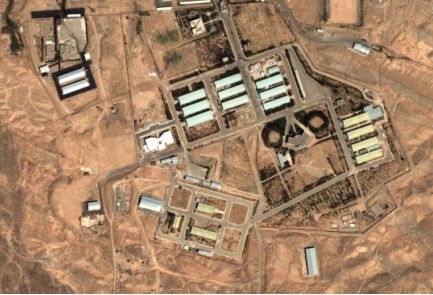
Last week’s IAEA report cites satellite imagery showing “continued construction” at the Parchin compound — a fact that could support suspicions that Iran is trying to hide incriminating nuclear activity at the site.

Iran says it intends construct a compound for 100,000 centrifuges to create a nuclear reactor for medical testing. Western powers have pressured Iran to reduce the number of centrifuges to 4,000, as the proposed compound could also be used to create fuel for nuclear weapons.

Parchin 2004Imagery of the Parchin military complex in 2004 | Photo credit: AP

Classified document presented to the International Atomic Energy Agency says that while Iran agreed to allow an investigation into the claims that it is developing nuclear weapons, it still has not allowed U.N. inspectors into the Parchin complex. The U.S. and Iran ended two days of negotiations without success on Wednesday in making progress toward an agreement over Iran’s nuclear program.

The United Nation’s Nuclear Watchdog reported last week that while Iran has been more cooperative about its nuclear program than in the past, it still will not allow U.N. inspectors in its military installation in Parchin.

A classified document presented to the International Atomic Energy Agency said that while Iran agreed to allow an investigation into the claims that it is developing nuclear weapons, it has yet to allow U.N. inspectors into the Parchin complex, south of Tehran.

Iran says it intends construct a compound for 100,000 centrifuges to create a nuclear reactor for medical testing. Western powers have pressured Iran to reduce the number of centrifuges to 4,000, as the proposed compound could also be used to create fuel for nuclear weapons.

U.S. government officials say it is imperative that Iran answers the council’s questions for the U.S. and the other world powers to reach a comprehensive accord with Iran next month. U.S. representatives have said that Iran has been hesitant to admit violating previous agreements, as to not lose dignity.

Last week’s IAEA report cites satellite imagery showing “continued construction” at the Parchin compound — a fact that could support suspicions that Iran is trying to hide incriminating nuclear activity at the site.

U.S. Deputy Secretary of State William Burns and U.S. negotiation team member Wendy Sherman participated in Wednesday and Tuesday’s meetings with the Iranian negotiators.

The two sides are expected to convene again next week in Vienna in hopes of reaching an agreement by the July 20 deadline.

Chaos and extremism in the Middle East threatens Israel

June 12, 2014

Chaos and extremism in the Middle East threatens Israel, Anneinpt, June 12, 2014

(An excellent summary and analysis by Anneinpt. Aside from nearly the entire region, all is peachy. Will the situation improve or continue to deteriorate? Probably.– DM)

The entire region around us is in utter chaos, and if we are not careful (and even if we are) there is a great danger that Israel might (G-d forbid) be drawn into the same violence.  The danger emanates almost completely from terrorist groups rather than from state actors, particularly Hezbollah and al-Qaeda related Islamic State of Iraq and Syria, known by its acronym ISIS.

The Americans are absolutely determined, almost desperate, to close a deal with Iran to limit their nuclear program –  a deal which will hardly be worth the paper it’s written on.

The IDF Chief of Staff Benny Gantz addressed the “instability in every region” at the Herzlia Conference earlier this week:

Threats from the North

“The situation in Syria is like a house of cards that is about to collapse, and we can see that democracy there is falling apart,” the military chief said of the continuing turmoil on Israel’s northern border. “The radical axis is growing stronger in the area, as is Jihad.”

Lt. Gen. Gantz explained that a range of outcomes in Syria could jeopardize Israel’s security. He stressed that Jihadi organizations and a strong Iranian-led axis pose particular concerns, warning that tens of thousands of Jihadis affiliated with terrorist organizations are dispersed in the north.

[…]

A New Reality in the South

Lt. Gen. Gantz also addressed recent changes in Egypt, where a new regime has taken power under the leadership of President Abdel Fattah el-Sisi. “El-Sisi’s regime is moderate and realistic,” the Chief of Staff said. “Although it may not be ideal, it is better than the regime two years ago.”

In Gaza, he said, terrorists are dramatically increasing their stockpile of mid- to long- range rockets,” adding that “what most characterizes the region is instability.” He reminded the audience that just last night, a rocket fired from Gaza fell about 400 meters south of the Gaza border.

Since Gen. Ganz mentioned Hezbollah, we can start with the dangers from Israel’s northern neighbour and work clockwise round the map:

Lebanon

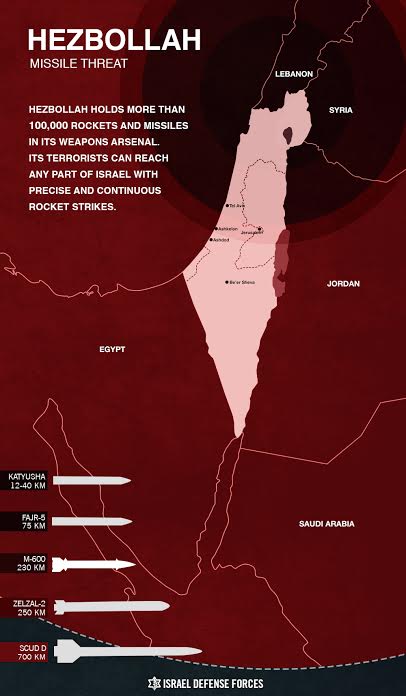
Besides Hezbollah’s missile threat, there is further danger from a Hezbollah unit that is training thousands of terrorists across the Middle East:
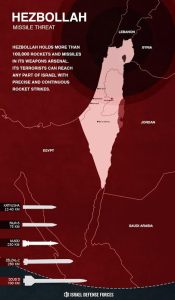
HezbollahThe Hezbollah missile threat

The Lebanon-based, Iranian-backed terrorist group Hezbollah has assembled a new group named Unit 3800” which is tasked with arming and training Shiite militants in Iraq, Yemen, and elsewhere in the region, according to a new report.

Hezbollah, emboldened and battle-hardened by it’s experience fighting alongside President Bashar al-Assad’s regime in Syria’s bloody four-year-old civil war, has set it’s sights on other local conflict zones, the Israel Defense Magazine reported on Tuesday.

[…]

The report tallies with statements by Israel Defense Forces Chief of Staff, Lt.-Gen. Benny Gantz on Monday …

There is “a radical axis developing, led by Iran and Hezbollah,” in Syria, Gantz warned, stressing that “The Lebanese terror organization is up to its neck in everything that is going on in Syria. The global jihad is also gaining strength in that arena.”

The unit, previously known under the designations “1800″ and “2800,” in the past trained Palestinian terrorists in tactics including kidnappings, targeted killings, and intelligence gathering. It’s leadership, however, has  revised and upgraded it’s brief and range of operations in the wake of the so-called “Arab Spring” of popular insurrections across the Mideast.

[…]Gantz noted that only “four or five states” have “more firepower than Hezbollah: the U.S., China, Russia, Israel, France, the UK.”

Syria

The civil war has claimed hundreds of thousands of lives. Assad looks like he is regaining power, albeit in a truncated state, and the rest of the country has been sundered into statelets of terror.  What’s relevant for the Israel is that the escalating violence is threatening Israel:

Earlier this week at the Herzliya Conference, Brig. Gen Itay Brun, Chief of the IDF Military Intelligence Research Division, spoke about the dramatic developments in the Golan Heights.

“The rebels have managed to create territorial contiguity,” he explained. “This has created a tension in the Golan Heights, which is generally a quiet area. The region has recently suffered from three rocket attacks and three explosive device attacks.”

In March alone, two Hezbollah-affiliated terrorists were identified attempting to plant an explosive device near the Israel-Syria border in the northern Golan Heights. Later that month, a concealed explosive device was activated against IDF soldiers patrolling the Israel-Lebanon border. Additionally, four IDF soldiers were injured when an explosive device detonated under their patrol jeep near the Israel-Syria border.

“Israel is not part of this struggle, but the parties involved impose on Israel at all times, and the consequences of their actions spill into Israel’s territory,” said Brig. Gen. Baron. “Sometimes, they force Israel to act in order to eliminate advanced threats.”

Jordan

Jordan, Israel’s second main Arab peace partner after Egypt, is under threat from Jihadi terrorists. The Sunni terrorist group the “Islamic State of Iraq and Syria”, ISIS has threatened to invade Jordan and slaughter King Abdullah:

According to the sources, ISIS leader Abu Baker al-Baghdadi recently discussed with his lieutenants the possibility of extending the group’s control beyond Syria and Iraq.

One of the ideas discussed envisages focusing ISIS’s efforts on Jordan, where Islamist movements already have a significant presence. Jordan was also chosen because it has shared borders with Iraq and Syria, making it easier for the terrorists to infiltrate the kingdom.

Jordanian political analyst Oraib al-Rantawi sounded alarm bells by notingthat the ISIS threat to move its fight to the kingdom was real and imminent.

[…]

The ISIS terrorists see Jordan’s Western-backed King Abdullah as an enemy of Islam and an infidel, and have publicly called for his execution. ISIS terrorists recently posted a video on YouTube in which they threatened to “slaughter” Abdullah, whom they denounced as a “tyrant.” Some of the terrorists who appeared in the video were Jordanian citizens who tore up their passports in front of the camera and vowed to launch suicide attacks inside the kingdom.

[…]

This is all happening under the watching eyes of the U.S. Administration and Western countries, who seem to be uncertain as to what needs to be done to stop the Islamist terrorists from invading neighboring countries.

ISIS is a threat not only to moderate Arabs and Muslims, but also to Israel, which the terrorists say is their ultimate destination. The U.S. and its Western allies need to wake up quickly and take the necessary measures to prevent the Islamist terrorists from achieving their goal.

Failure to act will result in the establishment in the Middle East of a dangerous extremist Islamist empire that will pose a threat to American and Western interests.

Iraq

The situation there has deteriorated beyond all measure.  ISIS has captured the city of Mosul and around half a million Iraqis are fleeing the area.  The scene is ripe for a humanitarian disaster and a civil war all wrapped up into one:

The speed with which the security forces lost control of one of Iraq’s biggest cities was striking, and it was a major humiliation for the government of Prime Minister Nouri al-Maliki. The city of Fallujah was captured in January by ISIS and other insurgents, but Mosul is a bigger and more important prize, located at a strategically vital intersection on routes linking Iraq to Turkey and Syria.

In Baghdad, Maliki announced a “general mobilization” of the country’s security forces and asked parliament to declare a state of emergency, saying that the government would not allow Mosul to fall “under the shadow of terror and terrorists.”

But the Iraqi security forces have not succeeded in winning back Fallujah, suggesting that it may be even tougher to reclaim Mosul, a city of 1.5 million that was once held out as a success story for the U.S. counterinsurgency effort in Iraq.

Compounding the challenge, ISIS fighters seized large quantities of weaponry from the security forces when they overran their bases, including vehicles, arms and ammunition that will help the group to press further offensives. Much of the equipment was probably supplied by the United States, Iraq’s biggest provider of weapons.

[…]
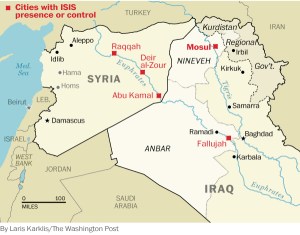
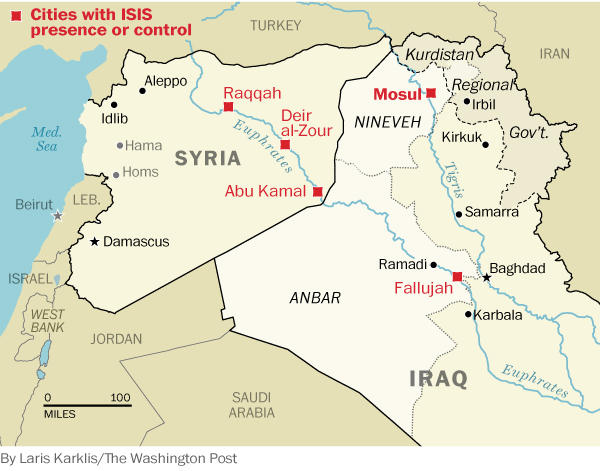
ISIL controlled citiesCities under control of ISIS

ISIS later said its forces were continuing to advance south and east from Mosul, overrunning several smaller towns that would enable its fighters to link up with their counterparts across the border in Syria. There, the organization controls what amounts to an unofficial state across swaths of the north and east from which government forces have been ejected.

The Iraqi site Niqash has  a detailed analysis of why and how Mosul fell so quickly. They also give a horrifying view of the appaling humanitarian crisis already developing:

Eyewitnesses inside Mosul report that there are long queues of those fleeing the province at checkpoints to Dohuk, which is controlled by Iraqi Kurdish forces, as well as Shikhan, Badriya and roads into places like Erbil, the capital of Iraqi Kurdistan.

Many of the people fleeing potential violence in Mosul have actually been turned back at checkpoints and they’ve had no option but to return to their homes in Ninawa; they now say they are afraid that the Iraqi government might use barrel bombs or bomb indiscriminately, in order to fight the extremists. They are also very worried about supplies to the city of between 1.5 and 1.8 million inhabitants running out.

 At the time of writing, the scene in Mosul could be summarised as follows: In some areas, there are many corpses on the streets, especially in the western part of the city. The local morgue says it is unable to accept any more dead bodies because it is full. It seems probable that locals in the city will begin burying bodies themselves in local parks and gardens, something they did before during bad times in the city.

The city streets also have plenty of evidence of how easily the city fell to ISIS: Burned out military vehicles and discarded uniforms lay strewn on the ground. In the distance there are columns of smoke coming from security headquarters that formerly belonged to army and police, but which are now controlled by ISIS.

 And the extremists appear to be busy fortifying these buildings – which seems to indicate that these confrontations are highly unlikely to be over as quickly as they began; this may go on for months.

Egypt

This is one of the few countries where stability might return. 

General Abdul al-Sisi was elected as President last week and Middle East Forum tells us 3 interesting about the new “Pharaoh”:.

On Sunday June 8, Egypt’s former defense minister, Field Marshal Abdel Fattah el-Sissi, was inaugurated as the sixth president–a de facto pharaoh, though chosen by the people–of the oldest nation-state on earth.

[…]

From the moment he ousted Morsi–who had turned a narrow electoral mandate in June 2012 into a brutal Islamist dictatorship almost overnight, alienating the vast majority of the country–the hugely popular El-Sissi has been ceaselessly attacked by a wide array of forces both at home and abroad.

These attacks have come not only from the Al Qaeda-allied MB and its Salafi allies in an increasingly violent insurgency that has so far claimed nearly 2,000 lives, but also from many Western journalists, Middle East experts, government officials and even key members of Congress, who have accused him of being just another military strong man who has usurped an elected leader.

[…]

1. Despite claims to the contrary, El-Sissi does have an electoral mandate.

… In the end, participation officially reached 47.5%–and a delegation of monitors from the European Parliament declared the election was run in a “democratic and free” manner, though it was “not necessarily fair,” due to self-censorship among some in the media.

This compares well with the 46% who turned out for the first round of presidential voting in May 2012, and the 52% in the second round that June—when there were no major boycotts, amid considerable suspense about who would win, while in this case, El-Sissi was a shoo-in. …

2. Despite excesses, El-Sissi’s war against the Islamists is ours as well.

Some have argued that Morsi’s removal and El-Sissi’s election prove the validity of Al Qaeda’s objection to the MB’s strategy of gaining power through democratic means.

[…]

… the MB — wrongly considered “moderate” — and its Salafi allies are in fact radical groups committed to the overthrow of less militant regimes and the destruction of America and the West, even while gladly accepting our assistance in the meantime.

Yet instead of cutting aid to the Muslim Brotherhood government, Obama increased it, while his then-Secretary of State Hillary Clinton, overrode human rights objections from Democratic Senator Patrick Leahy, who tried to put it on hold pending review.

3. El-Sissi is pious, but probably not–as some have claimed–a “secret Islamist.”

In August 2012, Morsi appointed then-General al-El-Sissi as defense minister, based on his seemingly pro-MB views—and was no doubt shocked when his protégé turned on him for behaving like a president from the MB.

However, though born into a conservative, not militant, religious family in the Gamaliyah district in the heart of the Islamic Cairo, the native district of the late Egyptian Nobel laureate in literature, Naguib Mahfouz, El-Sissi, like Mahfouz, was also raised as a fervent nationalist.

Al-Sisi is not exactly your average liberal humanist, but if he can quell Jihadi terrorists and bring back a measure of calm to Egypt, the Sinai and Israel’s southern border, all the better for the region.

Gaza

At least Israel has the ability to keep a lid on the worst of the violence by targeted killings and tight border controls. Just yesterday a senior jihadi was killed by the IAF.

Mahmed Awwar, 33 years old, a resident of Beit Lahia, has been involved in many rocket attacks against Israel over the past few years and during the past month especially. While taking part in these attacks, Awwar was employed by Hamas as a policeman.

The infrastructure Awwar was a part of carried out the rocket attackagainst the city of Sderot and the communities in southern Israel during the Passover holiday on April 21, 2014.

Unfortunately that hasn’t stopped the terrorists from launching rockets into southern Israel.

The Palestinian Authority

The unity government is a disaster for Israel and a disaster for the Palestinians too, if they would only use their sense and think about the outcome.  Hamas is aiming to build an alternative civilian infrastructure to replace the PA. This new authority will have an extremist Islamic ideology as opposed to the secular Fatah, with all the attached implications:

Gaza-based terror group Hamas is planning to encourage attacks against Israel as well as sap support in the West Bank from the Palestinian Authority (PA) by exploiting the Islamist “Dawa” social and cultural movement, a security source told the Ma’ariv daily on Sunday.

[…]

“In the long run, Hamas intends to create an alternative civilian infrastructure that will enable the replacement of the PA’s secular government with an Islamic government whose ideology will be similar to that of Hamas,” according to the Israel Security Agency (ISA) – aka the Shabak.

Hamas is aided by supporters who use their “civilian” career as an innocent cover for their nefarious activities. Next time you hear protests at Israel barring Palestinian soccer players from attending the World Cup, bear this story in mind:

The Israel Security Agency (ISA or Shin Bet Security Service) announced Wednesday that a Palestinian soccer player recently attempted to transfer funds to the Hamas terrorist organization in Qalqilya. During an ISA interrogation, the Palestinian athlete, Samah Bars Mahmad Maraaba, admitted that he had met Hamas terrorists on several occasions and accepted money to be transferred into Judea and Samaria.

Maraaba, a member of the Palestinian national soccer team, left Israel inApril with his teammates to compete abroad. In Qatar, he met Talal Ibrahim Abd Alrahman Sharim, a Hamas terrorist Israel released as part of the Gilad Shalit prisoner exchange deal in October 2011. Since leaving prison, Sharim has continued his involvement with Hamas and in its terror-related activities.

[…]

As a result of the interrogation, the ISA on May 21 arrested Muid Sharim, who otherwise would have received the illegal funds from Maraaba. Officials found a cell phone and messages connected to the illegal transfer in Muid Sharim’s possession.

Iran

All these dismal reports are bad enough but we have been skirting around the biggest elephant in the room: Iran. The Americans are absolutely determined, almost desperate, to close a deal with Iran to limit their nuclear program –  a deal which will hardly be worth the paper it’s written on.

This week Iran announced it has missiles with a 5,000 km range – long enough to hit American Indian Ocean bases:

Tehran has ballistic missiles able to pound targets over twice as distant as previously thought, and can reach the American mid-ocean strategic base at Diego Garcia, a senior Iranian official has explicitly warned.

“In the event of a mistake on the part of the United States, their bases in Bahrain and (Diego) Garcia will not be safe from Iranian missiles,” said an Iranian Revolutionary Guard adviser to Iranian leader Ayatollah Ali Khamenei, Majatba Dhualnuri.

[…]

The revelation suggests the validity of statements by Israeli leaders in recent years cautioning that the goal of Iran’s missile program and “ballistic umbrella” was to threaten a far wider circle of countries than Israel alone.

[…]

“Iran’s ballistic missile program is a major threat to the Middle East and beyond,” according to a just released report by the Tel Aviv University-based Institute for National Security Studies (INSS).

“Iran already has operational missiles with ranges of 1,500 to 2,500 km that can reach targets in the Middle East, Turkey, and southeast Europe,” the report charged.

“In addition, it has been working on an extended range version of the Shahab-3 and a 2000 km medium range ballistic missile, the Sejil-2, and may soon be able to produce missiles with a range of 3000 km,” the report said.

“Iran continues to develop long range ballistic missiles that reach beyond its regional adversaries, and may be technically capable of flight testing an ICBM by 2015,” according to a 2012 US Department of Defense report.

“US Director of National Intelligence James Clapper told the Senate Armed Services Committee in February 2014 that Iran was expected to test ‘a missile system that could potentially have ICBM-class range.’

“Tehran has also enhanced the lethality and the effectiveness of its existing missile systems with improvements of accuracy and new sub-munition payloads,” the INSS report said.

All of which makes the US urgency to sign a deal with Iran as soon as possible verge on the criminally insane. However there is a method to the madness – US politics:

If there will be a deal with Iran over its nuclear program, it will be signed in the winter, just after US congressional elections and just before the new Congress is sworn in in January.

The reason derives from the fact that President Obama doesn’t want his policy on Iran to be the focal point of elections and he will try to push through a deal before the swearing in of Congress when the Democrats are likely to lose their majority on Capitol Hill.

This is all according to Robert Einhorn, one of Obama’s former senior nuclear specialists, who spoke to Ynet in an exclusive interview.

Despite the US assuring Israel that it can take its own measures to protect itself, Israel is alarmed at the developing deal, and Intelligence Minister Yuval Steinitz pleaded with the world not to a sign a bad deal.

And if such a deal is signed, what is to stop the Iranians running amok the day after? The JPost reports that his question was analysed at the Herzliya Conference without any final consensus:

In other words, without taking a stance on if the deal is good or bad, the session discussed the implications of any deal. Would it free up Iran to act more aggressively? And would a deal allow Iran to use the status of a threshold nuclear- weapons state as a shield from resistance? Also, if Iran did act more aggressively, would the US or Israel be afraid to confront it for fear of the impact on the deal? And how would the deal impact other major powers’ perspectives – such as Russia and China – on Iranian assertiveness? Gary Samore, a former top White House official on nuclear- weapons issues, said that even if the Obama administration signed a deal, there would be significant push-back from the US Congress.

Luckily (if sadly) Israel is used to hunkering down and battening its hatches (to mix some metaphors) in order to withstand threats from outside. What has changed from the past is that besides Iran,  in most of the cases quoted above, the dangers from Jihadi terrorists are pointed at other Arab nations, with Israel for the moment being “only” collateral damage. But if ISIS and Hezbollah score more successes you can be sure they will turn their sights onto Israel too.

We must constantly keep up our guard.
Worsening Violence in Iraq Threatens Regional Security

June 12, 2014

Worsening Violence in Iraq Threatens Regional Security, Stratfor, June 11, 2014

(To whom might U.S. “vital equipment” provided to the Iraq Government eventually go? — DM)

The United States will avoid sending significant forces back into Iraq, but Washington will ramp up its efforts to contain the ISIL threat by delivering vital equipment such as helicopter gunships, Hellfire missiles, communications equipment, large volumes of small arms and ammunition.

[T]he fact that a significant portion of [Iraq security] forces fled [from the Mosul fighting] — abandoning their uniforms, equipment and vehicles — indicates serious structural and morale issues within the force . . . . 

Iran can . . .  be expected to further bolster its support for al-Maliki as well as for Shiite proxies across Iraq. In supporting al Maliki’s fight, Tehran finds itself very much aligned with Washington.

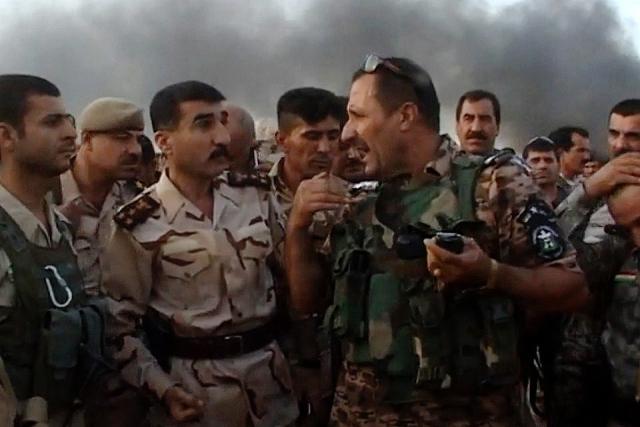
Iraq army officersSenior officers from the Iraqi Army and Ministry of the Interior discuss the ongoing security situation as smoke billows behind them. Hawijah, west of Kirkuk, June 11. (STR/AFP/Getty Images)

Summary

Battles continue to rage across northern Iraq, pitting jihadist group the Islamic State in Iraq and the Levant against Iraqi security forces and their allies. The growing reach of the Islamic State in Iraq and the Levant has escalated an already brutal campaign in Iraq. Alarmingly quick advances by the militants across an important region of the Middle East could draw in regional powers as well as the United States.

Analysis

Using hit-and-run tactics, the Islamic State in Iraq and the Levant, also known as ISIL, has sought to keep Iraqi security forces dispersed and under pressure. ISIL has achieved this by striking at areas where security forces are weak and withdrawing from areas where Baghdad has concentrated its combat power. The jihadists have been working hard to improve their tradecraft by developing skill sets ranging from staging complex ambushes to using Iraqi army equipment effectively in surprise raids. ISIL has also sought to better develop its ties with local Sunni communities.

As far back as the days of al Qaeda in Iraq and its predecessor, Jamaat al-Tawhid and Jihad, founded by Abu Musab al-Zarqawi, militancy has had a presence in Anbar province — and indeed in Mosul. During the Iraq War, the U.S. military considered Mosul one of the key gateways for foreign al Qaeda in Iraq fighters to enter the country. ISIL operations in Mosul and the wider Nineveh province are unsurprising. What is surprising is the degree of success that ISIL has managed to achieve in its latest offensive in the region.

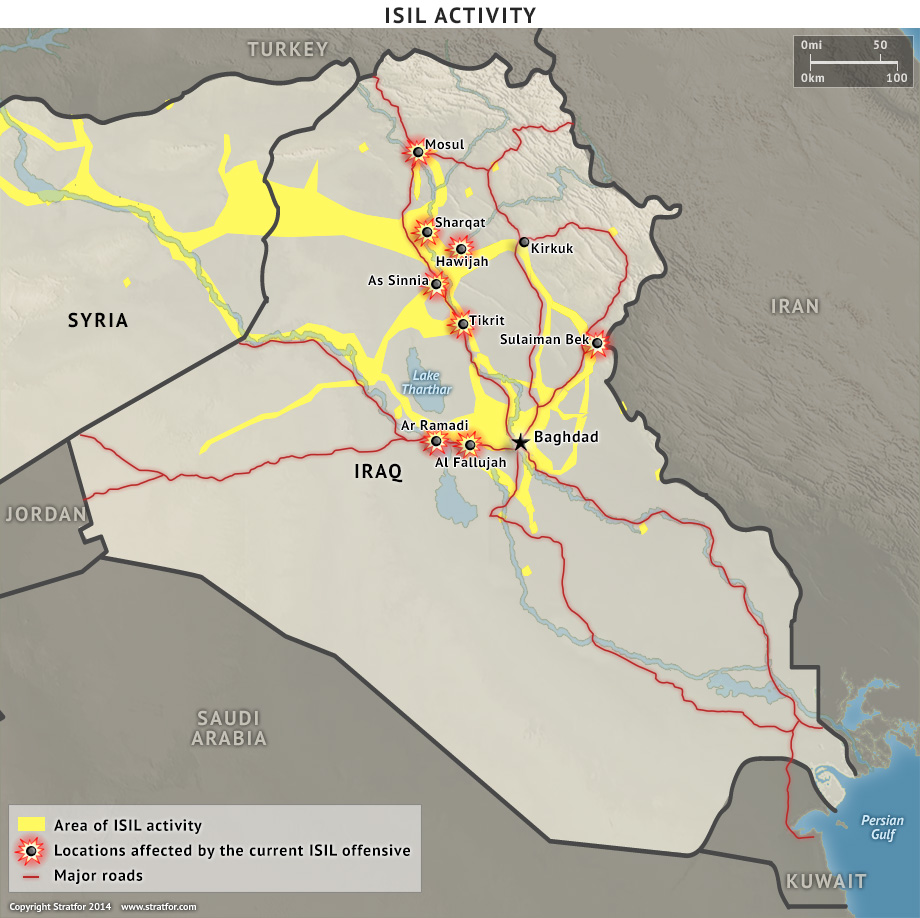
ISIL activityISIL activity

This success undoubtedly has much to do with local forces and tribes who have either facilitated ISIL or elected not to fight the group’s incursion into Mosul. In a city of almost 2 million, had ISIL received no local sympathy, it would have been unable to rout the Iraqi forces in the area with only 1,000 to 2,000 fighters. Social media contains several reports of local Sunnis welcoming ISIL forces, and even of local fighters supporting ISIL in attacks against government positions.

Furthermore, Iraqi security forces reportedly had around 10,000 personnel in and around Mosul. Despite the ferociousness of the ISIL attack, the fact that a significant portion of these forces fled — abandoning their uniforms, equipment and vehicles — indicates serious structural and morale issues within the force, which could attributed in part to a high number of Sunni soldiers in the ranks who are unwilling to stand up to ISIL for Iraqi Prime Minister Nouri al-Maliki.

Having succeeded in its Mosul operations, ISIL will continue to take advantage of its momentum and push its gains at a time when the Iraqi government is scrambling to recover from significant losses. As well as taking large portions of the city, ISIL militants seized many weapons and military vehicles as well as the contents of Mosul’s central bank. They also freed several thousand prisoners from a local prison, potentially adding more fighters to their cause.

Stretching from the north of Mosul through Tikrit to the south and toward Baghdad along the Tigris River Valley, ISIL is striving to maintain a continuous line of pressure running through what is practically the northern spine of populated Iraq. The Tigris River Valley contains a number of key strategic energy areas, including the oil refinery near Baiji. Although the refinery is still under state control at this time, the areas where ISIL is operating largely match areas where al Qaeda in Iraq was active during the height of the Sunni insurrection in Iraq from 2004-2006. As opposed to a first-time assault or new offensive, ISIL’s actions speak more of a resurgence into historical areas of operations.

As well as continuing to push forward, the Islamic State in Iraq and the Levant will largely seek to avoid stand-up fights against well-equipped and determined Iraqi army units, though they have held their ground against such forces in Al Fallujah and Ar Ramadi. The wide-ranging, mobile and rapidly dispersed ISIL forces have a key advantage when it comes to maneuvering in battle over the slower, mechanized units of the Iraqi army. While ISIL maximizes its impact against a disorganized Baghdad, the jihadist group seeks to consolidate its control over territory in heavily Sunni areas, where it has already made significant inroads with the local population. Ambitiously, these areas of control could include large portions of the north as well as Anbar Province. More realistically, it would mean greater ISIL presence in the longer term and, in some cases, direct control in Anbar and possibly other provinces such as Nineveh and Salah ad Din. Working toward this goal, the Islamic State in Iraq and the Levant will continue to focus on its revitalized effort to dismantle the Awakening movement, a coalition of tribal elements that was instrumental in pushing al Qaeda in Iraq out of Anbar the first time, drawing Sunni tribes back into its fold in the process.

The Iraqi army is attempting to contain the ISIL threat that is rapidly spreading into Salah ad Din and Kirkuk provinces. Iraqi forces, supported by allied tribal elements, have reportedly struck back against ISIL outside As Samarra and in Tikrit. A number of Iraqi army units are also supposedly withdrawing from Anbar province, which will further reduce pressure on ISIL-held cities there. These forces are reportedly focusing on the northern approaches to Baghdad, while the Iraqi government is attempting to pull together all reserve units capable of quickly moving to the fight. For all intents and purposes the Iraqi army is overstretched, the geographic dispersion of threats outmatching its resources. This means that Baghdad must prioritize its goals in the fight against ISIL.

Protect the Core

The most important priority for Baghdad right now is to secure its capital and oil infrastructure and begin pushing north to meet ISIL units approaching from Mosul down the Tigris River Valley. This does not mean that the Islamic State in Iraq and the Levant can be eradicated from these areas: Small ISIL cells will continue to operate across the region, and indeed in Baghdad itself. It does mean, however, that the Iraqi army will try to disrupt large mobile ISIL columns seeking to raid and to establish control over towns and cities. By concentrating its forces, the Iraqi army campaign in Anbar, especially around Ar Ramadi and Al Fallujah, will inevitably be at a disadvantage as it falls to a level of secondary importance. The campaign to rid Iraq of ISIL, which was never realistic so long as the jihadists held a virtual sanctuary in eastern Syria, becomes even more tenuous over the long term.

IRAQ-UNRESTMembers of the Kurdish Peshmerga force secure an area west of the nort…

In the fight against the Islamic State in Iraq and the Levant, Baghdad holds a potential advantage, but one which the al-Maliki government has been loath to use so far. This advantage is a greater reliance and cooperation with the Peshmerga (Kurdish security forces) in a combined fight against the jihadists. For political reasons ranging from disputes over territory to energy resources distribution, the central government in Baghdad had sought to maximize its direct control over the north, while minimizing the Kurdish security presence beyond Kurdistan Regional Government-administered areas. With ISIL making alarming gains in the north, it is now far more possible that the central government in Iraq would seek to cooperate with the Peshmerga in a combined push on ISIL in Kirkuk and Mosul. To that end, the Iraqi parliamentary speaker reportedly mentioned the possibility of coordinating with Kurdistan Regional Government President Massoud Barzani. Kurdish Peshmerga forces are reportedly mobilizing in preparation for defensive as well as offensive operations against ISIL.

The Bigger Picture

Beyond Iraq, a number of countries are immediately affected by ISIL. The Syrian battle space bleeds heavily into Iraq due to a porous border, accelerated by the almost total collapse of Syrian army border crossing posts. Since January, ISIL has been heavily involved in fighting with more moderate Syrian rebel factions, as well as with Jabhat al Nusra, the official al Qaeda franchise in Syria. As the fighting has worn on, ISIL has gradually released its hold in western Syria and turned its attention to the Raqqah and Deir el-Zour governorates. Deir el-Zour was particularly important for ISIL as it allowed it to maintain a direct supply link with its established presence in western and northern Iraq, especially in Anbar province. Through this supply link, ISIL has been able to transfer experienced foreign fighters and captured Syrian army equipment to Iraq, including vehicles and anti-tank guided munitions. It has also replenished its stock of ammunition and explosives, greatly aiding operations in Iraq.

The Syrian conflict is affected by the ISIL push in Iraq in two ways. The first is that the jihadists may divert large numbers of fighters from Syria to its Iraq push, which would open ISIL to more pressure in Syria. The second impact is the withdrawal of large numbers of Iraqi Shiite militants — men that have been fighting alongside the Syrian army — leaving to concentrate their efforts back home against ISIL. Such a withdrawal would be unpopular in the Syrian regime because it would take away an important source of manpower.

Regional Interest

Ankara is also watching the events in Iraq with considerable attention. Not only are Turkish citizens directly implicated in the conflict, with a number of Turks reportedly seized by ISIL militants, but the Turkish government also maintains an important stake in energy development in northern Iraq. Ankara has long been involved in politics between Baghdad and the Kurdistan Regional Government on issues surrounding the delivery of energy. Turkey is also increasingly concerned about the growing reach of ISIL and has already clashed with militants on its border with Syria. Turkey is especially wary of the potential for attacks by ISIL — attacks that would exploit the long border that runs from the Mediterranean to Iran. While Turkey has been hesitant to directly send forces against ISIL in Syria, the fact that the Islamic State in Iraq and the Levant has seized large numbers of Turks — including the consulate staff from Mosul — may push Ankara to become more directly involved in the crisis.

Iran has long sustained the regime in Syria, as well as indirectly supporting al-Maliki’s government in its fight against Sunni jihadists in Syria and Iraq. The growing reach of ISIL, and its ever-closer presence to Iran, is sure to raise considerable anxiety in Tehran. Iran can therefore be expected to further bolster its support for al-Maliki as well as for Shiite proxies across Iraq. In supporting al Maliki’s fight, Tehran finds itself very much aligned with Washington.

The United States will avoid sending significant forces back into Iraq, but Washington will ramp up its efforts to contain the ISIL threat by delivering vital equipment such as helicopter gunships, Hellfire missiles, communications equipment, large volumes of small arms and ammunition. This assistance, coupled with a common regional interest to contain the Islamic State in Iraq and the Levant, will likely contain the threat to northern and western Iraq. Though Iraq’s southern energy corridor will probably be spared, the Sunni belt in central Iraq and the territories disputed between the central government and the Kurdistan Regional Government will face rising sectarian stress, in line with ISIL’s designs for the region.

Worsening Violence in Iraq Threatens Regional Security is republished with permission of Stratfor.”

Middle East chaos

June 12, 2014

Israel Hayom | Middle East chaos.

Elliot Abraams

The fall of Mosul, Iraq to a terrorist group should change the American perceptions of developments in the Middle East.

Although the Obama administration has spent its efforts in the region on the Israeli-Palestinian conflict, that front is actually stable: No one is predicting or expecting a massive collapse into violence.

But look north and east. Today’s news is of the capture of Iraq’s second largest city by the terrorist group the Islamic State of Iraq and the Levant (abbreviated ISIS), an al-Qaida offshoot. Meanwhile in Syria, roughly 12,000 jihadis are now gathered, producing chaos in that country and sowing seeds of trouble for neighboring countries and our own. The estimate now is that 70 Americans are among the jihadis in Syria, one of whom recently engaged in a suicide bombing, so the question arises: What will they do when they come home?

There is a common thread here, in my view: These developments were not inevitable. The situation in Syria is the product in good part of America’s failure to act when we had a chance, in 2011 and 2012, and even in 2013 when President Barack Obama backed away at the last minute from bombing Syria to punish Assad for his murderous use of chemical weapons. In 2012, the president rejected the advice of most of his top advisers (using the term loosely, because he does not seem to value their advice), then-Defense Secretary Leon Panetta, then-Secretary of State Hillary Clinton, and then-CIA Director David Petraeus, to give the Syrian rebels significant amounts of nonlethal and lethal assistance. The massive refugee flow from Syria threatens the stability of Jordan and of Lebanon, and the concentration of 12,000 jihadis there is a danger to them and to the United States and all our allies.

In Iraq, Obama withdrew all U.S. troops as soon as he could. Would an American presence have avoided today’s debacle? It’s quite possible, because the United States was often able to broker deals between Sunnis and Shiites that headed off the kind of violence we see today. David Rothkopf describes where we are now, in an article titled “We are losing the war on terror”:

“This compounds ISIS gains in Fallujah and across Anbar province. Should the Iraqi government fail to regain control of this region, the consequences of an extremist rump state on Jordan’s eastern border and of conflict with Kurds in the north are grave. Such a scenario is quite possible, in fact; 11 years after the United States went to war with Iraq we could be on the verge of seeing it fracture into an extremist Sunni state in the west and an Iranian puppet state in the east — perhaps the worst possible outcome we could have envisioned.”

So, the worst possible outcomes in Syria and in Iraq, after five years of Obama foreign policy designed to get us out of Middle East morasses. What is the current policy for addressing these dangers? As Rothkopf added, “President Barack Obama’s West Point speech — which suggested that we could now safely start to hand off such issues to partners on the ground — has, in the case of Pakistan and Iraq, been debunked within the last few days.” And I would add, is being debunked in Syria every day.

Implementing a serious and effective counterterror policy will be far more difficult now, with a variety of al-Qaida linked groups such as ISIS, al-Qaida in the Arabian Peninsula, and al-Qaida in the Islamic Maghreb growing in strength, than it would have been five years ago. We have lost influence in Iraq and in fact have lost influence throughout the Middle East with friends and enemies alike. The beginning of a more effective policy is an acknowledgement that the current one is not working. We need the functional equivalent of Jimmy Carter’s clear realization after the Soviet invasion of Afghanistan that he needed an entirely new approach to the USSR, and of George W. Bush’s realization in 2006 that we were losing the war in Iraq and needed a new war plan there. The West Point speech points in the opposite direction: self-congratulation and more of the same. Perhaps the disaster in Mosul will force the president and his advisers (or perhaps the more accurate term is “and other high officials”) to recognize the need for change. Two and a half more years of disasters in the Middle East will create too much more damage.

A final note: All this bad news can, logically, lead the administration to seek a great piece of good news: an Iran nuclear deal.

Of course a bad deal would be bad news, but the administration may be tempted to make compromises it should not make in order to have some accomplishment in the region, some way of combating the argument that things are falling apart. After all, a “bad” deal is in the eye of the beholder. Perhaps it is not coincidental that just yesterday, the French foreign minister insisted that Iran must not be allowed thousands of centrifuges in any deal, but must hold only hundreds. He is trying to stiffen the P5+1 negotiating position, for which we should thank him.

But a deal that adds to the current witches’ brew a belief in the region that Iran will escape sanctions and move, slowly but steadily, toward the bomb would create even more dangers. One can only hope that Iran’s role in Iraq and in Syria stiffens the U.S. negotiating posture, and hope that disasters in Syria and Iraq do not in fact lead to a weakening of the American demands at the negotiating table.

Iran to cut plutonium creation capability in attempt to reach deal with West

June 12, 2014

Iran to cut plutonium creation capability in attempt to reach deal with West | JPost | Israel News.

By REUTERS, JPOST.COM STAFF

06/12/2014 13:45

Tehran’s nuclear chief sends conciliatory message to West, says it will “redesign” Arak heavy water reactor to cut plutonium output.

Arak

Iran’s heavy-water production plant in Arak, southwest of Tehran. Photo: REUTERS

Iran is “busy redesigning” a planned research reactor to sharply cut its potential output of plutonium – a potential nuclear bomb fuel, a senior Iranian official said in comments that seemed to address a key dispute in negotiations with world powers.

The future of the Arak plant is among several issues that negotiators from Iran and six world powers need to resolve if they are to reach a deal by late July on curbing the country’s nuclear program in exchange for an end to sanctions.

The West is worried that Arak, once operational, could provide a supply of plutonium – one of two materials, along with highly enriched uranium, that can trigger a nuclear explosion.

Israel has argued that any nuclear deal with Iran should demand the complete shutdown of the Arak reactor.

Former Military Intelligence chief Amos Yadlin explained last year that, if the Arak reactor was allowed to become operational, it would effectively be immune from attack and the West would “be deprived of its primary ‘stick’ in its efforts to persuade Iran to forgo a military nuclear capability.”

Yadlin said that the West “would likely seek to avoid an attack on a ‘hot’ reactor, lest it cause widespread environmental damage.”

Iran says the 40-megawatt Arak reactor is intended to produce isotopes for cancer and other medical treatments. It agreed to halt installation work at Arak under a six-month interim deal struck with the powers last November that was geared to buy time for negotiations on a comprehensive accord.

After the latest round of talks in Vienna in May, a diplomat from one of the powers said Iran had appeared to row back on its previous openness to address Western fears about the nuclear weapons potential of Arak. Iran has since dismissed as “ridiculous” one mooted solution to such worries.

But the head of Iran’s atomic energy organization, Ali Akbar Salehi, appeared to send a more conciliatory signal in comments to the official IRNA news agency late on Wednesday.

The amount of plutonium the reactor will be able to yield will be reduced to less than 1 kg (2.2 pounds) from 9-10 kg (20-22 pounds) annually in its original design, he said. Western experts say 9-10 kg would be enough for 1-2 nuclear bombs and that Arak’s capacity should be scaled back.

“We are currently busy redesigning that reactor to arrange for that alteration,” Salehi was quoted by IRNA as saying.

After talks with senior US officials earlier this week, Iran questioned whether the July 20 deadline for a permanent settlement with the powers was feasible. If not, Tehran said the negotiations could be extended for six months.