Burned vehicles are seen during clashes between Iraqi security forces and al-Qaeda-linked Islamic State in Iraq and al-Sham in the northern Iraq city of Mosul, June 10, 2014. (photo by REUTERS)
The fall of Mosul, Iraq’s second-largest city, to Islamic militants has Iranian officials concerned.
Ali Shamkhani, the secretary of Iran’s Supreme National Security Council, addressed the victories of the Islamic State of Iraq and al-Sham (ISIS) against a fleeing Iraqi military in a meeting with Syria’s ambassador to Iran. “The expansion of terrorist elements of [ISIS] and their violent acts in Iraq was a warning for the region,” Shamkhani said. “There is a need for attention and action from governments and the international community.”
Without naming names, Shamkhani said that those who support these terrorist groups would eventually be affected by them as well.
Iran’s Foreign Ministry spokesperson Marzieh Afkham condemned the ISIS attacks in Mosul, calling them a danger that reaches beyond Iraq’s borders. “The threat to the world of terrorism requires governments and the international community, in the current dangerous situation, to stand with the people of Iraq,” said Afkham. She expressed Iran’s readiness to help the Iraqi people and the Iraqi government in confronting terrorism.
Ismael Kowsari, a member of the Iranian Parliament’s National Security and Foreign Policy Committee, said that the ISIS victories were not a direct threat to Iran, but would cause the disintegration of Iraq. “[ISIS] is after the goals of its supporters and Israel, and their goals are to cause differences and disintegrate Iraq,” Kowsari said. He called on Iraq’s neighbors to help secure the country’s territorial integrity.
Iran has strong relations with Iraqi Prime Minister Nouri al-Maliki. Tehran has also supported various militias, most notably Asa’ib Ahl al-Haq (AAH), a Shiite militia that reportedly operates under Iran’s Quds Force Commander Qasem Soleimani. AAH has reportedly cooperated with the Iraqi military in specific operations. Powerful Shiite cleric Muqtada al-Sadr also asked for forces to protect religious sites. Sadr once commanded the Mahdi Army and has spent time in Iran’s holy city of Qom.
News that this religiously and ethnically mixed city had fallen into the hands of some of the most extreme Sunni militants, causing approximately 500,000 to flee, concerns Iranians of all stripes. Mosul is in the western Iraqi province of Ninevah, which shares a 300-mile border with Syria. Iran has spent considerable political and economic capital to support Syrian President Bashar al-Assad against the rebels and militants. The victory of militants with purported backing of former Baathists has also sparked bitter memories of those who remember Iran’s eight-year war with Iraq.
Liberal religious blogger Ali-Ashraf Fathi wrote a note on Facebook in response to the ISIS attack that was shared widely and surprised with its strong tone. “The savages of [ISIS] who have become the inheritors of the Baathists in Iraq — and it is not clear which Western or Eastern country supports them — after an unsuccessful attack in Samarra, their destination is to attack the shrines in Najaf and Karbala,” he wrote. “The news is extremely worrying. If the Iraqi government cannot control the holy shrines and the defenseless people of Iraq, it is a duty of all Shiites and Iran to take action to prevent the desecration of holy shrines.” He added that the situation in Iraq is different from protecting an individual such as Assad in Syria. He asked that if the Iraqi government is unable to take action, that the Iranian government should begin accepting volunteers.
(The U.S. has wasted whatever leverage she might once have been able to apply in Iraq and elsewhere in the Middle East. The suggestions in the article about what the U.S. might be able to do, aside from no longer providing financial aid, seem to be in the realm of fantasy. See, e.g., the Israel – Palestinian “peace process” and the P5 + 1 debacle. — DM)
Not satisfied with seizing control of Fallujah and Mosul, the Islamic State of Iraq and Syria (ISIS) continues to advance from victory to victory. In a lightning fast offensive–the terrorist version of a blitzkrieg–its fighters have now taken control of Tikrit, Saddam Hussein’s hometown, and Baiji, home to Iraq’s largest oil refinery. We can expect that they will next march on Baqubah, capital of Diyala province, and then on Baghdad itself. Indeed, in some ways the battle for Baghdad has already begun with ISIS regularly setting off massive car bombs in the capital and with Shiite extremist groups retaliating with atrocities against innocent Sunnis. The Sunni Triangle is rapidly falling under the control of a group so radical and violent that even al-Qaeda’s leader, Ayman al Zawahiri, disowned it.
Instead of lobbying for such extensive changes the U.S. might be better off lobbying for a new prime minister.
Perhaps most dismaying of all is that the Iraqi army appears to be falling apart under the sustained assault it is receiving. Its soldiers evacuated Mosul so fast that many left their uniforms behind. Obviously they did not see, much less emulate, Sunday’s episode of Game of Thrones in which an embattled garrison of the Night’s Watch managed to throw back a much larger wildling horde. In Iraq the wildlings are on the march and there is little to stop them before they get to the Shiite heartland.
I have previously pointed out that this was not fated to happen–that this dire situation might have been averted if President Obama had kept U.S. troops in Iraq after 2011. But he didn’t. Now what? In today’s Wall Street Journal, Ken Pollack of the Brookings Institution offers some inventive ideas for reforms that can transform the Iraqi political system to enable it to meet this threat.
For example, he argues for “a constitutional amendment imposing a two-term limit on the presidency and prime ministership,” “a new national-unity government, including a leading Kurd as defense minister and a leading Sunni from one of the opposition parties as interior minister,” and “a constitutional amendment that redefines Iraq’s executive authority, with security and foreign affairs under the president, and the economy and domestic politics under the prime minister.”
These are good ideas but unlikely to be realized, as Pollack himself acknowledges, given the current state of Iraqi politics and given the weakness of American influence in Iraq today. Instead of lobbying for such extensive changes the U.S. might be better off lobbying for a new prime minister. Maliki’s political party came out on top in the April parliamentary elections but it lacks the votes to form a government on its own. It needs the support of other parties, especially other Shiite parties and the Kurds. The U.S. should exert whatever influence it still has to prevent that from happening.
Maliki has presided over the disintegration of Iraq. He doesn’t deserve a third term. The country desperately needs a new leader. Until a change of leadership happens, there is little point in sending more U.S. aid which, if Mosul is anything to go by, is likely to wind up arming the insurgents.
By late Wednesday there were unconfirmed reports that the Sunni militants, many aligned with the radical Islamic State of Iraq and Syria, were battling loyalist forces at the northern entrance to the city of Samarra, about 70 miles north of Baghdad. The city is known for a sacred Shiite shrine that was bombed in 2006, during the height of the American-led occupation, touching off sectarian mayhem between the Sunni minority and Shiite majority.
An influential Iraqi Shiite cleric, Moktada al-Sadr, called for the formation of a special force to defend religious sites in Iraq. The authorities in neighboring Iran, which is predominantly Shiite, canceled all visas and flights for pilgrims to Baghdad and intensified border security, Iran’s official Islamic Republic News Agency reported.
The remarkably fast advance of the Sunni militants, who now control strategically important swaths of northern and western Iraq, reflects the spillover of the Sunni insurgency in Syria and the inability of Iraq’s Shiite-led government to pacify the country in the more than two years since American forces departed after eight years of war and occupation.
Insurgents also raided the Turkish consulate in Mosul and seized the consul general and 47 other Turkish citizens, including special-forces soldiers and three children of diplomats, the Turkish prime minister’s office said. The development raised the possibility that Turkey, a NATO ally that borders both Syria and Iraq, would become directly entangled in the fast-moving crisis.
Prime Minister Recep Tayyip Erdogan of Turkey was holding an emergency meeting with top security officials on Wednesday to discuss the crisis, and the Turkish foreign minister cut short a trip to New York and was returning to Ankara, government statements said.
Turkey has long taken an interest in northern Iraq for economic reasons and because of the sizable and often restive Kurdish minority, which straddles the border and controls a region of Iraq east of Mosul.
Amid the collapse of the Iraqi army in Mosul, Tikrit and other northern cities, questions began to be raised about the possibility of a conspiracy in the military to deliberately surrender. Witnesses reported some remarkable scenes in Tikrit, where soldiers handed over their weapons and uniforms peacefully to militants who ordinarily would have been expected to kill government soldiers on the spot.
Prime Minister Nuri Kamal al-Maliki, a Shiite, himself suggested the possibility of a disloyal military himself in his exhortations on Tuesday for citizens to take up arms against the Sunni insurgents.
Citizens in Baiji, a city of 200,000 about 110 miles south of Mosul, awoke Wednesday to find that government checkpoints had been abandoned and that insurgents, arriving in a column of 60 vehicles, were taking control of parts of the city without firing a shot, the security officials said. Peter Bouckaert, the emergency services director for Human Rights Watch, said in a post on Twitter that the militants had seized the Baiji power station, which supplies electricity to Baghdad, Kirkuk and Salahuddin Province.
In Tikrit, famous as the hometown of Saddam Hussein, residents said the militants attacked in the afternoon from three directions: east, west and north. Residents said there were brief exchanges of gunfire, and then police officers and soldiers shed their uniforms, put on civilian clothing and fled through residential areas to avoid the militants, while others gave up their weapons and uniforms willingly.
The militants’ advance spread alarm in Baghdad, 110 miles south. Though the city seemed calm, residents said they were shocked by the news and feared that the Islamic State of Iraq and Syria would push on toward the capital.
Shiite militias and security forces loyal to the Shiite-led government of Prime Minister Maliki were on high alert, and residents in Baghdad began stockpiling food, fuel and small arms in fear of a rebel assault. A senior provincial official said the authorities had a plan to recapture Mosul, according to news agency reports, but it was unclear how.
On Wednesday, the insurgents claimed to have taken control of the entire province of Nineveh, Agence France-Presse reported, and there were reports of militants executing government soldiers in the Kirkuk region. Atheel al-Nujaifi, the governor of the province, criticized the Iraqi army commanders in Mosul, saying they had misled the government about the situation in the city.
Iraq’s foreign minister, Hoshyar Zebari, was quoted on Wednesday as saying his country’s Kurdish minority would “work together” with Baghdad’s forces to “flush out these foreign fighters.”
At a meeting of Arab and European foreign ministers in Athens, Mr. Zebari, himself a Kurd, called the insurgents’ strike “a serious, mortal threat,” adding: “The response has to be soon. There has to be a quick response to what has happened.”
Iraqi Kurds are concentrated in the autonomous region of Kurdistan, where security is maintained by a disciplined and fiercely loyal fighting force, the pesh merga, that has not yet become involved in the latest clashes.
The Growing Strength of ISIS
A broader Sunni insurgency that has been growing in neighboring Syria has shown increased audacity in Iraq.
The Islamic State in Iraq and Syria, or ISIS, is an expanded version of Al Qaeda in Iraq that controls a number of cities in northeastern Syria and western Iraq. Its brutal tactics alienated it from the Syrian rebel movement, as did the fact it has emphasized the establishment of an Islamic state over the fight against Mr. Assad. It was officially disowned by Al Qaeda in February.
Al Qaeda’s central leadershipcut ties with ISIS earlier this year as it rushed to build an Islamic state on its own terms, antagonizing the wider Syrian rebel movement.
In a further indication of the regional dimensions of the crisis, the government of President Bashar al-Assad in Syria, facing the same jihadist adversary in its civil war against a broader array of armed foes, expressed solidarity with the Iraqi authorities and armed forces, the official SANA news agency reported.
Word of the latest militant advance came as a United Nations agency reported that 500,000 people had fled Mosul — Iraq’s second-largest city, with a population of about 2 million — after the militants, spilling over the border from Syria, captured military bases, police stations, banks and provincial headquarters.
The International Organization for Migration, based in Geneva, said the civilians had mainly fled on foot, because the militants would not let them use vehicles and had taken control of the airport. Roughly the same number were displaced from Anbar Province in western Iraq as the militants gained ground there, the organization said.
On Tuesday the insurgents, reinforced with captured weaponry abandoned by the fleeing government forces, raised their black banner over streets in Mosul littered with the bodies of soldiers, police officers and civilians. The success of the militant attack was the most stunning development in a rapidly widening insurgency straddling the porous border of Iraq and Syria.
Mr. Maliki has ordered a state of emergency for the entire country and called on friendly governments for assistance in a quickly deteriorating situation. His weak central government is struggling to mount a defense, a problem made markedly more dangerous by the defections of hundreds of trained soldiers and the loss of their vehicles, uniforms and weapons.
Security officials said the militant drive toward Baiji began late on Tuesday with brief clashes a few miles north of the town before the insurgents overran a security post, captured vehicles and set buildings on fire.
“They did not kill the soldiers or policemen who handed over their weapons, uniform and their military I.D.,” a security official in Tikrit said on Wednesday before the militants reached that city; he spoke on the condition of anonymity. “They just took these things and asked them to leave,” the official said.
The swift advances offered a new milestone in Iraq’s unraveling since the withdrawal of American forces at the end of 2011.
The rising insurgency also presented a new quandary for the Obama administration, which has faced sharp criticism for its recent swap of five Taliban officers for Sgt. Bowe Bergdahl and must now answer questions about the death of five Americans by friendly fire in Afghanistan on Monday night.
Critics have long contended that America’s withdrawal of troops from Iraq, without leaving even a token force, invited an insurgent revival.
Suadad al-Sahly reported from Baghdad, Alan Cowell from London and Rick Gladstone from New York. Tim Arango and Sebnem Arsu contributed reporting from Istanbul, and Thomas Erdbrink from Tehran.
Islamists attack Turkish embassy in Tikrit, the birthplace of Saddam Hussein, as politicians blame weakened Maliki government.The Al Qaeda-linked Islamic State in Iraq and the Levant (ISIS) has attacked the central Iraqi city of Tikrit, security sources told BBC News Wednesday, less than 48 hours after taking over the northern city of Mosul.
The Islamists have attacked the Turkish embassy there, officials said, and are holding at least 49 people hostage. Reuters reports Wednesday evening that all 49 have been taken to an ISIS hideout and are, allegedly, unharmed; Ankara has vowed to respond if any one of the captives are harmed.
Police officials also told the British Telegraph that the group had freed some 300 inmates in a city prison there and made advances in parts of Kirkuk; local authorities have reported mass beheadings throughout the city.
Tikrit, located in Salaheddin province, is dictator Saddam Hussein’s birthplace, and is located just 150 km (95 miles) north of Baghdad.
Reports of Tikrit’s takeover surface less than 24 hours after Iraqi parliament speaker Osama al-Nujaifi predicted that the ISIS were turning south – specifically toward the Salaheddin province.
Security sources also told AFP early Wednesday evening that the Islamists have extended beyond Tikrit, now fighting Iraqi forces in Samarra.
Who’s to blame? Politicians point fingers at security forces, Maliki
Earlier Wednesday, the governor of Iraq’s Nineveh Province held Prime Minister Nouri al-Maliki personally responsible for Mosul’s takeover by the ISIS, insisting that the coup is the result of a systemically weak government.
Ethyl Najafi, speaking in a press conference, accused Iraqi military leaders of pulling out of the northern city and giving al-Maliki false reports just hours before the Islamists seized the city. Najafi also demanded that military leaders be put on trial for the failure.
“Military commanders and the Iraqi army in Mosul vanished,” he said.
“What happened in Nineveh is a collapse of the Maliki government,” Najafi said. “The absence of security and military forces in Mosul made it easier for ISIS and all groups that reject al-Maliki’s policy to overtake the city.”
Najafi cited previous reports alleging that ISIS has been cooperating with other Sunni militias, as well as unconfirmed rumors that the group is cooperating with the Syrian regime.
Najafi also said civilians in Mosul would form popular committees – or leave – and not look to the Iraqi government for protection.
“Tens of thousands of people fled from Mosul, and there are no accurate statistics for the numbers so far,” the governor said. He called for the city’s residents to “go back to their business.”
In the meantime, he said, he would not conduct talks with ISIS.
“We will hold no talks with the militant group ISIS; we will only kick them out of Mosul,” he said.
Refugee crisis
Over 500,000 Mosul natives reportedly fled to Tikrit after Tuesday’s takeover in Nineveh province, and hundreds more have flooded into Iraq’s Kurdistan region, officials said.
Save the Children’s Acting Country Director in Iraq, Aram Shakaram, stated Wednesday that the refugee crisis in northern Iraq has reached unprecedented proportions.
“As terrified families and children flee violence in Mosul, we are witnessing one of the largest and swiftest mass movements of people in the world in recent memory,” Shakaram stated. “This shocking escalation of violence is forcing hundreds of thousands of people to flee for their lives towards the Kurdistan region.”
Shakaram noted that transportation has become a serious issue over the past several days, worsening the humanitarian crisis.
“Massive traffic jams and blocked roads are seriously hindering access and movement of aid, as hundreds of thousands flee from the raging violence and chaos,” he said. “The most vulnerable families are those left behind and it’s extremely difficult to reach them right now as the violence continues. We are also extremely concerned over how the Kurdistan region of Iraq will cope with the influx.”
Takeover snowballing
ISIS, which also seized an international airport and captured US-made weapons and equipment during its rout of Iraqi security forces, has dealt a spectacular blow to Baghdad’s Shia-led government by cementing its effective control over the entirety of the country’s western Nineveh Province, and now poses a clear threat across the Middle East.
In a desperate attempt to fend off the threat posed by the group – who will now surely be eyeing further territorial gains – Iraqi Prime Minister Nouri al-Maliki called a state of emergency and has offered to arm local tribes and citizens opposed to ISIS. World leaders have also reacted with alarm to the news.
The ISIS has already controlled the Iraqi city of Fallujah for five months, and has also led one of the strongest rebel movements fighting Syrian President Bashar Assad in Syria.
Will “moderate” Iran be moderate in its development and use of nukes? As the Iran Scam pushed by President Obama continues to fester, there is little reason to expect actual moderation.
Prologue
In November of last year, soon after the English language text of the “deal” with Iran became available, I posted One small Lurch for Obama, Giant Leaps for Iran. It pointed out that the “deal” guaranteed Iran’s right to continue enriching Uranium. The preamble states:
This comprehensive solution would enable Iran to fully enjoy its right to nuclear energy for peaceful purposes under the relevant articles of the NPT in conformity with its obligations therein. This comprehensive solution would involve a mutually defined enrichment programme with practical limits and transparency measures to ensure the peaceful nature of the programme. [Emphasis added.]
In later articles about the Iran Scam, here, here, here and here, I observed that the “deal” involves neither Iran’s military sites nor its continued development of missiles to deliver nukes. With neither of those involved, it cannot reasonably be expected that it will terminate Iran’s “moderate” nukes program.
Here’s what Israel Prime Minister Netanyahu told the United Nations several months ago. Please listen to what he said then; it remains true today.
Unfortunately and as noted above, last November’s “deal” with Iran expressly contemplates Iran’s continued enrichment of Uranium
Here’s what “moderate” Iranian President Rouhani said shortly before being elected about how Iran had tricked negotiators and continued its nuke development during earlier negotiations which he had led.
Did he have an epiphany just before or during the P5 +1 negotiations? Did his Supreme Leader? Not likely.
With President Rouhani’s Charmin offensive, the situation continues to evolve in “moderate” Iran’s favor.
The Charmin originated where it usually goes after being used.Where will it go when Iran finishes with it?
Internationally, the Islamic Republic of Iran is still basking in having falsely attained a “moderate” status for President Hassan Rouhani and a seat on five sub-committees of the United Nations Economic and Social Council, including the Commission on the Status of Women. Inside Iran, however, daily life still consists of systematic arrest, torture, persecution of minorities and accelerated executions. [Emphasis added.]
. . . .
According to the Boroumand Foundation in Washington D.C., there have been 11 unofficial executions reported for June, and a total of 340 officially documented for 2014.
. . . .
That comes to, on average, 17 persons hanged each week by the Islamic Republic — a number equal to the executions in 2010 after the 2009 uprisings during President Mahmoud Ahamdinejad’s far-from-moderate-reign.
The Islamic Republic continues to exterminate its political prisoners silently, through well-planned and prolonged torture that includes denial of medications and medical treatment — to kill the prisoner without formal execution. This practice has not changed since Rouhani’s election; many prisoners claim that since his arrival, the situation is even worse. [Emphasis added.]
The only difference seems to be that now prisoners are taken to hospital, photographed in an examination gown and returned to prison without treatment. This charade is intended to create the appearance that the prisoner was treated in order to appease human rights organizations. [Emphasis added.]
The sanctions relief comes on the heels of Iran’s Ayatollah openly stating that he did not believe the U.S. would ever consider a military strike to thwart Tehran’s nuclear capabilities. The Ayatollah stood on a podium surrounded by banners that read, “America cannot do a damn thing.”
Recently, the Ayatollah, Iran’s chief decision maker and ultimate authority, stressed that Iran would defeat “evil” America through endless “battle and jihad.”
After Khamenei announced for the world to hear that he intends to defeat America, while at West Point, President Obama spoke of the Iranian nuclear program. He stated, “Now we have an opportunity to resolve our differences peacefully.”
Turkey has been implicated in multiple sanctions-busting schemes that have helped Iran illicitly rake in cash despite U.S. sanctions.
. . . .
Trade between the two nations hit $2.1 billion in January and February and both nations have vowed to increase the level of trade to $30 billion by 2015. [Emphasis added.]
. . . .
“All of this comes amidst reports of massive sanctions busting facilitated by Turkey on behalf of Iran. First there was the gas-for-gold scheme where Turkey helped Iran pocket some $12 billion in oil sales,” said Jonathan Schanzer, vice president for research at the Foundation for Defense of Democracies (FDD). “This was followed up by revelations of sanctions busting on the part of Iranian businessmen in Turkey to the tune of €87 billion.”
China has exported arms to Iran, and last month expressed anger after Washington laid charges against a Chinese businessman accused of allegedly procuring missile parts for Iran.
Last month, Iran terminated China National Petroleum Corp’s (CNPC) contract to develop the Azadegan oilfield after the Chinese energy giant ignored repeated appeals to work on it.
China and Iran have close energy and trade ties, and Beijing has repeatedly resisted US-led demands to impose tougher economic sanctions on Iran to curb its nuclear ambitions.
At this moment, it would make sense for Iran’s rulers to soothe and reassure their American interlocutors. Why are they provoking and taunting them instead?
Because they can. Because they are convinced that the U.S. government is as feckless and self-deluding today as it was when “America cannot do a damn thing” was first proclaimed, 35 years ago this fall, by Iran’s revolutionary leader, Ayatollah Ruhollah Khomeini, after his followers seized the American Embassy in Tehran and took the diplomats working there hostage. [Emphasis added.]
At the mausoleum last week, the current supreme leader triumphantly told Iran’s uniformed, religious and political elites that the military option President Barack Obama has often said is “on the table” is now in the trash bin of history. [Emphasis added.]
Continuing His own misguided role in accommodating Iran, President Obama has been instrumental in helping Iran to seduce Saudi Arabia.
Last month, U.S. Defense Secretary Chuck Hagel visited Saudi Arabia’s capital Riyadh in a quest to establish a détente between Iran and Saudi Arabia. Hagel got his cue from earlier remarks made by Iran’s President Rouhani, suggesting that Iran would like to improve its ties with Saudi Arabia.
It seems that the Obama administration is now serving as an agent for Iran. The Islamic Republic that has encouraged street demonstrations calling for “death to America,” is the same regime that has been working hard to remove U.S. influence in the region. Iran is an oppressive and radical Islamic state backing the Assad regime in Syria which murdered over 200,000 of its own people, and used chemical agents to poison thousands of innocent civilians. The Obama administration has hitherto not been able to stop the Tehran regime from producing advanced centrifuges. Iran has continued its quest for nuclear weapons, despite its ongoing nuclear talks with the P5+1 (U.S. China, Russia, Britain, France, and Germany).
Saudi-Iranian reconciliation talks are scheduled to take place in the middle of June, and the Obama administration hopes for a new era in the relationship between the two Gulf powers. The Saudis are less than thrilled about the impending talks. Jamal Khashoggi, a Saudi political analyst, is skeptical about the talks, pointing out that “Iran has occupied Syria,” and is backing the Assad regime. He added that, the “Iranians want to drag us into an extended dialogue and divert attention from the core issue of Syria.” [Emphasis added.]
. . . .
Iran’s efforts to cozy up to the Gulf States and Saudi Arabia in particular, are aimed at isolating Israel and preventing what has been rumored to be a secret Israeli-Saudi understanding that would enable Israel to use Saudi airspace in an attack against Iran’s nuclear facilities. [Emphasis added.]
. . . .
In entering negotiations and signing the interim nuclear agreement with the P5+1, Iran has neutralized the U.S. and its allies from using the military option against it. This one-sided détente between the U.S. and Iran has apparently convinced the Saudis to change course. Pressured by its so-called ally, the U.S., to improve relations with Iran, Riyadh has realized that it is time to play along with Washington. [Emphasis added.]
. . . .
In legitimizing Iran, the Obama administration is either naïve in its belief that it can change the nature of the Iranian regime, or miscalculating in its attempt to create a “new equilibrium.” Iran will continue to support Hezbollah and Hamas’ terror against Israel, and deny Israel’s right to exist.
Here’s a YouTube video of a November 2013 interview with Robert Perry that seems favorable to President Obama’s goals and His animosity toward Saudi Arabia back when she aligned with Israel in opposition to the P5 + 1 “deal.”
With the first deadline for either concluding or extending the talks — as delineated in an earlier interim deal between Iran and world powers – looming less than six weeks away, the US negotiating team brought in veteran negotiators on Monday to help tie up loose ends.
State Department deputy spokeswoman Marie Harf said that the inclusion of Deputy Secretary of State William Burns and Jake Sullivan, the vice president’s national security adviser, was due to their history of negotiating with the Iranians, and their familiarity with the people involved in the talks.
“This is just another diplomatic avenue through which we are trying to test whether we can get this done by the 20th [of July],” Harf explained during a press briefing Monday. She added that while US officials were still comfortable with the talks’ current timeline, they knew that they “don’t have a lot of time left” and thus planned to step up diplomacy to encourage “tough choices.”
Iran has around 19,000 centrifuges, of which roughly 10,000 are operating, according to the U.N. nuclear agency.[Emphasis added.]
. . . .
“We are still hitting a wall on one absolutely fundamental point which is the number of centrifuges which allow enrichment,” Foreign Minister Laurent Fabius told France Inter radio. “We say that there can be a few hundred centrifuges, but the Iranians want thousands so we’re not in the same framework.” [Emphasis added.]
The Obama Administration’s position, if any, is unclear.
Why do President Obama, et al, desperately want a “deal” with Iran that will not keep it from becoming a nuclear power? Is that part of the Obama Doctrine? Just as His visceral reaction to the ransoming of Sgt. Bergdahl was abnormal,
Obama didn’t have a normal visceral reaction to the 9/11 attack in Benghazi, either. Any normal person would have rushed to his post in the Situation Room to oversee a rescue attempt. On that one, Obama skipped the Situation Room entirely, and the rescue attempt, and went to bed to get his beauty sleep for a Vegas fundraiser. Something is off.
. . . .
Obama does not have normal visceral reactions to jihadi groups.
Our president worked to install terrorists in power in Egypt, where they had been successfully suppressed for sixty years. He helped depose our ally Mubarak and did his best to hand over Egypt to the Muslim Brothers, a Nazi-jihadi group dedicated to sharia law, the worldwide caliphate, and killing all the Jews on the planet. Obama is still punishing Egypt for rising up and getting rid of the Brothers, by withholding military aid. This is not appeasement; it is not even collaboration – it is working for your enemy’s cause.
Likely consequences?
Here’s an Iranian video with a simulation of an Iranian nuclear attack on Israel:
If Iran gets (or gets to keep) nukes, will it stop with Israel? Why, in Iran’s view, should it?
The P5 +1 November 2013 deal established the framework for the clusterdunk that the negotiations have become. The “deal” started out bad and continues to worsen. The only way it can contribute to world peace is through its termination, accompanied by credible threats of military action.
Iran’s supreme leader reiterated the claim that “America can’t do a damn thing.” He was partially right: American could but the United States of Obama won’t. By January of 2017, when President Obama leaves office, it may well be too late.
Gazprom Neft had signed additional agreements with consumers on a possible switch from dollars to euros for payments under contracts, the oil company’s head Alexander Dyukov told a press conference.“Additional agreements of Gazprom Neft on the possibility to switch contracts from dollars to euros are signed. With Belarus, payments in roubles are agreed on,” he said.Dyukov said nine of ten consumers had agreed to switch to euros.
ITAR-TASS reported earlier that Gazprom Neft considered the possibility to make payments in roubles under contracts. Some contracting parties agree to switch from dollars to euros and Yuans.
“The so-called Plan B is already partially worked out. The switch of dollar contracts to euros and Yuans is agreed on with some of our contracting parties. Under consideration is the possibility to switch contracts to roubles,” Dyukov said at the St. Petersburg International Economic Forum.
Former National Security Adviser provides a pessimistic forecast regarding Israel’s ability to evade future wars.
–
–
Former Israeli National Security Adviser Yaakov Amidror gave a pessimistic forecast on Sunday, when he told the annual Herzliya Conference that Israel will “continue to live by the sword” for the foreseeable future.
“During the Third Lebanon War we will have no choice but to strike civilians who live above the rocket launching facilities,” he said. ”We’ll have to say it openly, and the world cannot come to us with complaints.”
“You don’t prevent Hezbollah from forming a state within a state, you don’t prevent them from gathering arms and deploying among civilian population, so you cannot blame us when there are civilian casualties. We have shown evidence of this to the UN and the Red Cross and they did not do anything,” said Amidror.
“We will continue to live by the sword even if we do not use it,” he continued, revealing that there are about 50 thousand missiles and rockets in Lebanon, and that Israel has no way to remove this threat.
“The Sudanese threat that focuses on the Sinai Peninsula is another threat [Israel faces],” he said. “Our success in dealing with it in Judea and Samaria is tremendous. We have created a deterrence in Gaza, but it will not last forever,” predicted Amidror.
He said that Israel might ultimately have to be the one to prevent Iran from obtaining nuclear weapons and added that Israel must also work to destroy Hezbollah’s capability to launch rockets towards it.
“The potential of Iran becoming a nuclear power and not only the realization has to be prevented. This burden could ultimately fall on Israel’s shoulders,” said Amidror. ”It is important to destroy Hezbollah’s infrastructure because Hezbollah is no longer as it once was and it will be difficult for them to rebuild. Failing to prevent Hezbollah from firing rockets at Israeli civilians will result in many casualties,” he warned.
Amidror concluded his speech by rejecting recent reports that Israel was spying on the United States.
“I want to say here on this public stage: Israel does not spy on the United States, this is a baseless and irresponsible claim,” he said.
Illustrative photo of an airplane taking off from Eilat’s airport, December 2012. (photo credit: Moshe Shai/Flash90)
The Egyptian military recently deployed a large military force near the border crossing with Israel at Taba in order to prevent rocket and missile attacks on Israel.
Egyptian sources estimate the force is about the size of a battalion, or several hundred men. The move was coordinated with Israel.
Egypt is concerned that jihadist operatives in the Sinai Peninsula who are affiliated with al-Qaeda may try to down an Israeli civilian aircraft flying near the border during its approach for landing in the resort town of Eilat.
In January, members of Ansar Bayt al-Maqdis, an Egyptian Islamist militant group, downed an Egyptian military helicopter, killing the five officers aboard. Investigation of the incident found that the jihadist group used SA-7 anti-aircraft missiles smuggled from Libya.
Since that incident, Israeli, Egyptian and Jordanian concerns have increased that such groups will try to down a civilian aircraft within range of such missiles. For that reason the Egyptian Third Army decided to deploy a battalion of soldiers near the Israeli border just outside Eilat in order to prevent similar occurrences.
January’s incident was not the first in which jihadist groups used missiles of this kind. During the attack on an Israeli bus near Eilat in August 2011, an IAF helicopter pilot reported that an RPG was fired at his aircraft. An Israeli investigation found that an SA-7 was used in that attack as well.
The threat of anti-aircraft weapons has the potential to inflict serious harm on the tourism industries of Egypt, Israel and Jordan in the Gulf of Eilat.
Over the past several years, numerous rockets have been fired at the southern port city of Eilat from the Sinai Peninsula. The Egyptian force will also serve to prevent similar attacks on Israeli civilians.
(Does the Iranian Supreme Leader understand America’s past and present better than President Obama, et al? — DM)
At this moment, it would make sense for Iran’s rulers to soothe and reassure their American interlocutors. Why are they provoking and taunting them instead?
Because they can. Because they are convinced that the U.S. government is as feckless and self-deluding today as it was when “America cannot do a damn thing” was first proclaimed, 35 years ago this fall, by Iran’s revolutionary leader, Ayatollah Ruhollah Khomeini, after his followers seized the American Embassy in Tehran and took the diplomats working there hostage.
At the mausoleum last week, the current supreme leader triumphantly told Iran’s uniformed, religious and political elites that the military option President Barack Obama has often said is “on the table” is now in the trash bin of history.
“America cannot do a damn thing.”
A bannerdisplaying that slogan adorned the stage of an elegant mausoleum in Tehran where Iranian Supreme Leader Ayatollah Ali Khamenei appeared last week. Negotiations to conclude a deal ending Western sanctions on the Islamic republic, the world’s foremost sponsor of terrorism, in exchange for a verifiable halt to its nuclear weapons program, are now in a critical phase with a new round of talks to begin Monday in Geneva. At this moment, it would make sense for Iran’s rulers to soothe and reassure their American interlocutors. Why are they provoking and taunting them instead?
Because they can. Because they are convinced that the U.S. government is as feckless and self-deluding today as it was when “America cannot do a damn thing” was first proclaimed, 35 years ago this fall, by Iran’s revolutionary leader, Ayatollah Ruhollah Khomeini, after his followers seized the American Embassy in Tehran and took the diplomats working there hostage.
Doing so was not just a violation of international law. It was a casus belli — an act that unquestionably would have justified going to war against the fledgling Islamic republic. Instead, U.S. President Jimmy Carter launched a rescue attempt that failed. After that, he utilized diplomacy to no effect.
Khomeini would go on to hold America’s diplomats hostage for 444 days, the remainder of Carter’s tenure, releasing them only as Ronald Reagan was entering the White House. An important lesson was taught: When the threat of force is credible, the use of force often becomes unnecessary.
But teaching is not synonymous with learning. At the mausoleum last week, the current supreme leader triumphantly told Iran’s uniformed, religious and political elites that the military option President Barack Obama has often said is “on the table” is now in the trash bin of history. A “military attack is not a priority for Americans now,” he said. “They have renounced the idea of any military actions.” That he believes this represents a defeat for the U.S. and a victory for the Iranian revolution goes without saying.
In recent days, developments have bolstered his analysis. For example, on May 27, Obama announced the withdrawal of American troops from Afghanistan, a conflict he once called a ”necessary war” that he intended to win but which he now is content merely to “wind down.” (Would you really be surprised if, sometime after the next American presidential election, the Taliban returned to power?)
A day later, Obama was at West Point disconnecting the dots linking Afghanistan, Iraq, Yemen, Somalia, Syria, Libya, Mali, Kenya, Pakistan, India, Nigeria and so on. After all these years, he appears not to see the big picture: a global jihad against the West with various actors — Iran and al-Qaida most prominent among them — competing to lead it.
Next, the president released five senior Taliban officials, all of whom have ties to al-Qaida, in exchange for an American soldier who had abandoned his post on June 30, 2009 and was subsequently taken prisoner by those it was his duty to fight. Obama might at least have made this deal with regret, acknowledging that a steep price was being paid, both by the U.S. and, almost certainly, by those Afghans who have supported the American mission in their country. Instead, he held a celebration in the Rose Garden. His national security advisor, Susan Rice, exulted that it was “an extraordinary day for America … a joyous day.”
It needs to be emphasized: “Leave no soldier behind” is a commendable principle. But, like most principles, it is neither absolute nor inviolable. To prove I’m right try this thought experiment: If the Taliban had said they would trade Sgt. Bowe Bergdahl not for five Guantanamo Bay detainees but just one — and that one was Khalid Sheikh Mohammed, the mastermind behind the Sept. 11, 2001 attack, would Obama have taken the deal? What if the Taliban had asked for no detainees but a tactical nuke, or chemical weapons, or even just a dozen Apache helicopters? Would anyone say that Obama had no choice but to agree — because he could not leave Sgt. Bergdahl behind?
Other evidence that Khamenei has no doubt been mulling: In Syria, Obama drew a red line, then erased it, then cut a diplomatic deal that saved dictator Bashar Assad, whose regime he had vowed must end. Last week, Robert Ford, who months ago resigned as American ambassador to Syria, acknowledgedthat he had done so because he could no longer support the administration’s inept and damaging policies.
As if to illustrate his point, Secretary of State John Kerry respectfully asked Hezbollah, Iran’s Lebanon-based terrorist proxy, to help bring the war in Syria “to an end.” And of course Hezbollah will — so long as the war ends with them as winners, and the U.S. diminished.
Khamenei also saw the Obama administration decide last week to support the Palestinian ”unity” government, which means American taxpayers will be funding Hamas, a designated terrorist organization, one to which Iran has sent money and weapons, one openly committed to a genocidal war against Israel, America’s most reliable ally.
Going back further, the supreme leader knows that despite many carrots and a few sticks, U.S. negotiations with North Korea eventually ended with the hermit kingdom becoming nuclear-armed. The American diplomats who got beaten have either been promoted or given prestigious academic positions.
For all these decisions and failures there are explanations and justifications aplenty. But there also is a pattern. America’s enemies and allies perceive it. And they are responding.
Mofaz: Israel Can’t Handle Iran AloneIt’s a ‘quiet period’ in Iran, and the Iranians are using the opportunity to continue to develop its nuclear program.
Speaking at the Herzliya Conference Monday, former Defense Minister and Chief of Staff Shaul Mofaz discussed Iran’s nuclear program. While many Israelis want the country’s leaders to face the Iranian threat head-on, Mofaz said that Israel “cannot stick to the doctrine of we are all alone. We have to do what is best for us. We need to have good relations with the West and United States.”
Mofaz was giving the concluding address of the session on “Facing Turbulent Global and Regional Arenas: reformulating Israel’s National Security Doctrine” at the 14th annual Herzliya Conference.
He said that the United States had negotiated with Iran for over a year, behind closed doors, on their nuclear situation, but Israel, to whom this is “perhaps one of the most important issues to do with existential threats” was not privy to these meetings.
He said that because of Israel’s attitude of wanting to “attack Iran tomorrow” and standing alone, “we missed the opportunity to be in that closed room” and to be a part of the solution to this issue.
“We need a joint political agenda with the United States,” he added.
Regarding Israel’s national security doctrine, Mofaz felt that it was something that needed updating every decade.
“We need a refreshment of the mind not every year or every month but every decade,” he said. Referring to the address of Lt. Gen. Benny Gantz, Chief of the IDF General Staff, who spoke at the conference earlier in the day, Mofaz said he felt the idea of a national multi-plan was “too big a challenge for the State of Israel, at this time … our security doctrine needs to be based on a long-term view and budgeting.”
He stressed, “When the army has a horizon of one year [thinks only a year ahead], it wastes money because it doesn’t know what is to be.” He said that it was a mistake for the army to talk of the uncertainties in order to increase its budget. “We need money to be earmarked for our capabilities … a protected flower that exists every year and every year it needs to be budgeted for.”
Mofaz also mentioned that Israel’s defense community needed to work on its deterrence capabilities. “When did Khaled Mashal ever dream of reaching the Gaza strip? … If our deterrence were so good, how did we enable him to reach the Gaza strip with such trumpets?”
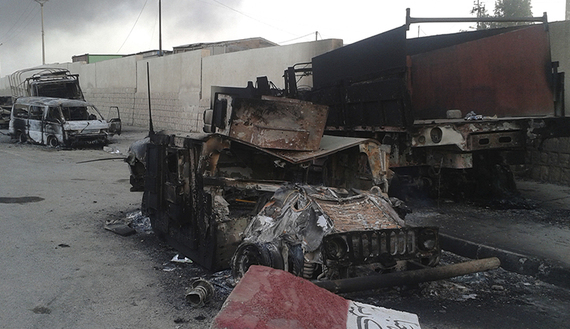 Burned vehicles are seen during clashes between Iraqi security forces and al-Qaeda-linked Islamic State in Iraq and al-Sham in the northern Iraq city of Mosul, June 10, 2014. (photo by REUTERS)






 anneinpt
 artaxes
 danmillerinpanama
 davidking1530
 Peter Hofman
 Joseph Wouk
 Peter
Peter Louisiana Steve
 WarSclerotic
Recent Comments