In a world where our enemy’s friend is our bitter enemy, Israel must not hurt Egypt’s credibility by forming ties that are too strong with the new regime in Cairo. Simultaneously, Israel must take advantage of the opportunities created by the ‘Arab Spring’ and foster good relations with out [sic] neighbors.
[I]t is better that Israel aids the new regime in Egypt quietly, and it will in turn quietly work for its own interests, which serve Israel as well.
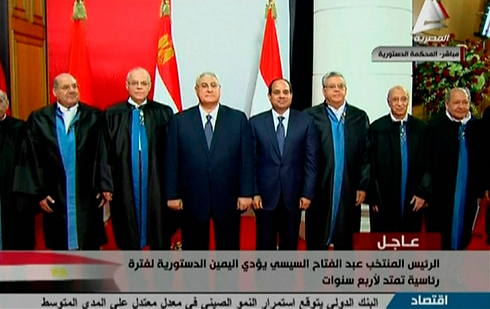
The newly-elected Egyptian President, Abdel Fattah al-Sisi, did Benjamin Netanyahu and Shimon Peres a favor for in not inviting them to his swearing-in ceremony. Until the tensions in Egypt, and in fact the entire Arab world, calm down, Israel must keep a low political profile in its relations with Cairo.
This should not only be done with the new regime in Egypt, but in Israel’s relations with all countries in the region, some of which we converse with behind closed doors.
Israel should be open to taking advantage of the opportunities created by the “Arab Spring” to nurture and develop good relations with its neighbors, while at the same time not overly identify with one of them.
In the current state of affairs, if Jerusalem’s relationship with an Arab regime or organization, with which we seek to establish an infrastructure of understandings and cooperation, is overly visible, it is liable to hamper the move.
It is damaging for us in both the international arena and the regional arena to be identified with this or that regime in the Arab world, as long as the dust still hasn’t settled over the regional upheaval.
It is important to keep in mind that in this world, the enemy’s friend is our bitter enemy, and so we must not damage the credibility of the Egyptians by forming ties that are too tight or strong with the military regime that al-Sisi leads.
We must remember that Egyptians need to retain their status as fair mediators in the context of the Palestinian conflict and as a fighter for the Egypt’s security interests against Salafi-Jihadis groups in Sinai.
Egypt should also be considered a stabilizing factor in our area and that helps us, because it is in its interest to uphold the peace agreement with Israel in order to maintain its good relations with the US and continue receiving assistance.
In regards to Israel’s relations with Syria, Jerusalem’s interest is that the current regime in Egypt will overcome the country’s economic problems and that Egypt will reattain its status as a leader in the Arab world.
But Israel does not need, as a puzzling statement from Foreign Minister Avigdor Lieberman indicates, for Arab countries to openly declare their strong relations with Israel.
Al-Sisi sworn in as Egypt’s president (Photo: Reuters)
In fact, following the Arab upheaval, a silent partnership of interests has been formed between Israel, Jordan, Saudi Arabia and Egypt, but that doesn’t need to be yelled from rooftops. Why? Because there is also the possibility that Egypt’s economy continues to deteriorate and then the angry masses direct their sentiments against Israel, which might require the Egyptian army to take action.
That is why it is better that Israel aids the new regime in Egypt quietly, and it will in turn quietly work for its own interests, which serve Israel as well.
Adjusting security doctrine to regional development
The matter at hand demands of Israel a new security doctrine, in which its small partnerships with the countries of the region play a part. This is according to Professor Alex Mintz, who wrote a report on the topic in conjunction with the Institute for Policy and Strategy.
They claim that the traditional three-legged concept of Israel’s security doctrine – deterrence, warning and defeating – is not enough. The regional upheaval that is still far from the finish line requires the State of Israel to add a few more limbs to the security doctrine, including regional cooperation, and what Professor Mintz terms as adaptability, meaning the need to frequently adjust the security doctrine to regional developments.
In Egypt’s case it is extremely important, considering that the new regime in Egypt constitutes a rare instance in which Israel holds for this regime its entry ticket to Washington and, in extension, to the economic and military assistance it can provide. At the same time, the Egyptian regime holds the key to peace on Israel’s western border.
William Burns is under orders from the White House to clinch an “improved interim accord” in Geneva. This is vitally important in order to turn the failed nuclear negotiations around and hold them up as a success.
3. Iranian Deputy Foreign Minister Abbas Araghchi announced Saturday that Iran would take part in the bilateral talks, but would go straight from the meeting with the US delegation to a separate one with Russian negotiators in Rome on June 11-12.
Tehran has thus provided itself with the option of improving on Washington’s offer by getting a better deal from Moscow. This maneuver also brings to the attention of the Obama administration that Iran means henceforth to line up its Middle East policy and strategy with Moscow.
The American source commented wryly that the two-day Geneva encounter would undoubtedly provide the stage for further US concessions if the delegation wishes to come out with any sort of accord in hand.
William Burns leads last-ditch US nuclear diplomacy
The US delegation to the bilateral talks with Iranian officials taking place in Geneva on June 9-10 has been directed by the White House not to leave the table empty-handed. The meeting was initiated for a supreme effort to cover up the fact that the P5+1 negotiations with Iran are at an impasse, with no chance of achieving their goal of a final nuclear accord by the July deadline – or even by the extended timeline of Jan. 15, 2015 (first revealed by DEBKAfile on May 24.), and have something to show for the venture into nuclear diplomacy.
A US official said that the bilateral stage was fitted in ahead of the full-dress round between all six powers and Iran on June 16-20 “to engage in as much active diplomacy a we can to test whether we can reach a diplomatic solution with Iran on its nuclear program.”
The avowed objective which the negotiations started out with, of a comprehensive agreement finally setting to rest the issues of Iran’s nuclear program, has obviously been dropped from US officialese. But the optimistic comments of “progress” accompanying round after round of failed discussions had to be explained away.
To this end, US President Barack Obama whipped out the undercover team which had been running his back-channel to Tehran from Oman in the past year. It was on that track that the real business was contracted between Washington and Tehran, whereas the P5+1 forum was pretty much a showpiece (as DEBKAfile reported.)
Therefore, for the Geneva meeting starting Monday, US Deputy Secretary of State Bill Burns, who headed the back-channel team in Oman, was brought out in the open. He supersedes Under Secretary of State Wendy Sherman, who failed to make any headway in the formal rounds of talks. With him is another team member, Vice President Biden’s national security advisor Jake Sullivan.
President Obama brought the team out for a last-ditch effort to save the day because of four developments:
1. Iranian Supreme Leader Ayatollah Ali Khamenei has forbidden President Hassan Rouhani and Foreign Minister Mohamed Javad Zarif to make any further concessions, especially on uranium enrichment and nuclear-capable ballistic missiles, thus foredooming to failure the diplomatic process Obama so cherished. Khamenei dug in his heels after he heard the US president virtually rescinding America’s option against Iran in his West Point speech.
2. Obama and his advisers came to the conclusion that the most the Iranians can be expected to cede – and only then in the second half of 2014 – is an improved version of the interim nuclear accord struck by the six powers and Iran last November.
DEBKAfile’s Washington sources report that William Burns is under orders from the White House to clinch an “improved interim accord” in Geneva. This is vitally important in order to turn the failed nuclear negotiations around and hold them up as a success.
3. Iranian Deputy Foreign Minister Abbas Araghchi announced Saturday that Iran would take part in the bilateral talks, but would go straight from the meeting with the US delegation to a separate one with Russian negotiators in Rome on June 11-12.
Tehran has thus provided itself with the option of improving on Washington’s offer by getting a better deal from Moscow. This maneuver also brings to the attention of the Obama administration that Iran means henceforth to line up its Middle East policy and strategy with Moscow.
The American source commented wryly that the two-day Geneva encounter would undoubtedly provide the stage for further US concessions if the delegation wishes to come out with any sort of accord in hand.
Anthony Cordesman, a chairman at the Center for Strategic and International Studies, testifies during a 2007 hearing before the House Foreign Affairs Committee. (Alex Wong / Getty Images)
HERZLIYA, ISRAEL — US strategic analyst Anthony Cordesman warned June 8 that a unilateral Israeli attack on Iran — despite repeated calls for restraint from its key ally in Washington — “better damn well be successful to an extraordinary degree.”
Otherwise, the veteran scholar told an Israeli audience at the annual Herzliya Conference here, “We’ll have to ask you, ‘What part of the word NO do you not understand.”
Cordesman, the Arleigh A. Burke Chair in Strategy at the Washington-based Center for Strategic and International Studies, said Israel’s decision to act on its oft-threatened right to attack Iran would have “major impact” on bilateral relations.
“You need to understand that your unilateral action could have a critical impact on US-Israel relations,” he said.
Speaking here as top US State Department officials were engaged in direct talks with Iranian counterparts in Geneva, Cordesman urged Israelis not to assume that the prospective agreement with Tehran “would be a wrong one.”
The US, he said, “can deal very easily with failure of the peace process [with the Palestinians] and with unilateral tactical action by Israel for its own defense.” However, he insisted the US “cannot easily deal with an Israel that assumes this deal is a failure before it is made.”
Speaking at the same June 8 session, US Ambassador to Israel Dan Shapiro said US President Barack Obama has laid out two “nonnegotiable” objectives vis-a-vis the Iranian nuclear program: “That Iran will not be able to develop a nuclear weapon” and that the agreement provide “credible assurances that Iran’s nuclear program will be peaceful.”
He attempted to ease Israeli angst over prospects that world powers would conclude a deal with Iran, perhaps by the July 20 deadline set for the current round of talks. “We’re heading into a critical period. And we will restate that no deal is better than a bad deal.”
Shapiro insisted, “We’re working on a package, not a checklist.”
Washington could accede only to a “comprehensive agreement that addresses all aspects and meets our objectives,” Shapiro said.
Speaking at the same June 8 session, Ya’akov Amidror, former Israeli National Security Advisor, reiterated Israel’s obligation to be prepared to go it alone against Iran.
Despite repeated US assurances that it would not support a so-called bad deal, Amidror said Washington and other world powers “are ready for almost any type of agreement with Iran.”
Amidror insisted Tehran “is not prepared to give up its nuclear program” and that Israel must be prepared to deal with the consequences of an agreement that does not meet its demands for a full dismantling of Tehran’s nuclear weapon project.
“There is a lack of willingness by many in the world, also in the US” to use force against Iran, Amidror said.
Amidror hailed US-Israel strategic ties and insisted “there is nobody else” that would stand by Israel as Washington has done for decades. Nevertheless, he insisted: “We need to be ready to do things by ourselves.”
Is He stupid, out of touch, Preparing to close Gitmo, or did He just do His best to emulate Joe Btfspik? Does it augur well for a good outcome of the continuing Iran Scam?
I wrote an article about the ransoming of Sgt. Bergdahl on June 2nd and updated it through June 6th. The thrust of that article is that Sgt. Bergdahl must be tried by general court martial so that legally cognizable evidence (not opinion and not speculation) can be presented and made public. Unfortunately, for the reasons stated, I do not think that will happen. There has been more speculation since June 6th, but little if any significant, adequately verified and legally admissible evidence has become available since then.
Here’s a YouTube video of a June 6th PJTV discussion about why “our” Commander in Chief ransomed Sgt. Bergdahl by returning five high-ranking Taliban commanders to active duty. The discussion includes Tammy Bruce, a conservative talk radio hostess and Ebony K. Williams, an attorney, radio show hostess and Democrat who voted for President Obama in 2008 and 2012. The consensus seems to be that He screwed up royally and appears to have acted for political reasons, hoping for popular approval. Ms. Williams’ conclusion is that He is not necessarily evil but lives in an echo chamber, where He now receives undiluted support from His underlings regardless of what He wants to do or how incredibly incompetent or worse He will seem if He does it.
There are any number of other reasons why He may have acted as He did, including these:
He hates America and wants to destroy transform her in His own image;
He hates the U.S. military and approves of Sgt. Bergdahl and others who also hate it;
He wants to help Vice President Biden seem competent by comparison;
All of the above;
None of the above.
There are doubtless other possibilities. What do you think?
The Iran Scam
Whatever may have been His reasons, they are important if for no reason other than that by ransoming a probable deserter or worse by freeing five extremely dangerous terrorists — likely to result in the killing of honorable U.S. military personnel serving with distinction — and the taking of more hostages, He may well have suggested the outcome of His dealings with Iran.
TEHRAN — Iran’s chief negotiator said Sunday that direct talks agreed between Tehran and Washington are essential, as discussions on his country’s disputed nuclear program are entering a “serious phase.”
. . . .
“We have always had bilateral discussions with the United States in the margin of the P5+1 group discussions, but since the talks have entered a serious phase, we want to have separate consultations,” said Abbas Araqchi, Iran’s chief negotiator in comments reported by state news agency IRNA.
. . . .
Araqchi said the talks with the US in Geneva will only address the nuclear issue, referring to Iran’s ballistic missile program that Washington had hoped to include in negotiations. [Emphasis added.]
The US delegation will be led by Deputy Secretary of State Bill Burns and Jake Sullivan, a White House adviser, previously part of a tiny team whose months of secret talks in Oman brought Iran back to the P5+1 negotiating table last year.
Having apparently agreed with Iran that its missile delivery systems development is none of the business of the P5 + 1 negotiators, what else will the Obama Administration agree is unworthy of discussion because it might undermine the Iran Scam? What does President Obama seek? The public approval of an amorphous “deal” that prevents Iran from having nukes — or, if she has or gets them, from using them — until after He leaves office in January of 2017? Peace in His time?
Until President Obama leaves office in January of 2017 we are unlikely to learn what happened in Geneva or its consequences for the P6 + 1 negotiations. We can expect Him to tell us only pleasant fairy stories. Reasons not to accept them will be deemed racist and therefore unworthy of serious consideration.
Kreitner refers “vicious commentary” about Bergdahl, who, he writes, was only guilty of having “served on the front lines of the American imperial machine with the unenviable misfortune of doing so with eyes wide open.” Let us put this another way. What he is saying is that because he thinks Bergdahl rightfully opposed the U.S. mission, he was a hero for deserting. Bergdahl wrote his parents an e-mail before deserting, in which he famously said: “I am ashamed to be an American. And the title of US soldier is just the lie of fools. I am sorry for everything. The horror that is America is disgusting.” To The Nation, that position makes him a hero. [Emphasis added.]
That e-mail by Bergdahl is most revealing of his disdain for his country. Kreitner , however, sees it as candid and true. As he puts it, Bergdahl only “saw reality too clearly.” He was doing nothing more than “struggling with issues of conscience.” The Army, he writes, was wrong to not inform Bergdahl that he could be let out of duty for issues of conscience, thus forcing him to desert. Got that? It’s the U.S. Army that put him in this position. Of course, Kreitner confuses what this sergeant did — deserting — with an act of conscience. Hatred of the U.S. and disdain for his comrades, which he made clear in his e-mail, is definitely not grounds for leaving the U.S. Army because of conscience. If it were, anyone could leave the armed forces for which he or she volunteered because they changed their mind about their mission.
Kreitner ends by writing that putting “slugs into human flesh” is not the “promotion of democracy.” Only a Nation author could think there is something immoral about fighting America’s sworn enemies on the battlefield.
Is that President Obama’s perception as well? By how many libruls is it shared?
Follow the timeline to understand the impact on Benghazi. It’s provided in the linked article.
…. and now we have the specific tracking of Stinger Missile serial numbers showing they were delivered from the CIA to the government of Qatar; while intended for Libyan “rebels”, but delivered to the Taliban…. and used to kill our guys.
…. AND where do we choose to send the GITMO-5 ?
Although probably more competent, are they President Obama’s kind of guys?
UPDATE, June 9th
In an article at PJ Media titled Fictions as Truth, Victor Davis Hanson lists fantasies President Obama has asked us to accept as reality concerning (along with five other subjects) the ransoming of Sgt. Bergdahl. He lists these:
1. Sgt. Bergdahl was in ill health; thus the need for alacrity. Surely we will expect to see him in an enfeebled state on his return to the U.S.
2. Sgt. Bergdahl was in grave and sudden danger from his captors; thus the need for alacrity. We expect to see proof of that on his return to the U.S.
3. The five Taliban detainees will be under guard in Qatar for a year. We expect in June 2015 to know that they are still there in Qatar.
5. Sgt. Bergdahl served with “honor and distinction.” We expect to have confirmation of that fact once his intelligence file is released and more evidence is adduced that all of his platoon-mates were wrong (or perhaps vindictive and partisan) in stating that he voluntarily left their unit — deserted — to meet up with the Taliban.
6. Sgt. Bergdahl was captured on the “field of battle”; we expect to have confirmation that he was taken unwillingly by the enemy amid a clash of arms.
7. Sgt. Bergdahl was not a collaborator. We expect to learn confirmation of the fact that he did not disclose information to his captors.
8. Bergdahl’s fellow soldiers in his platoon are either partisan operatives or sorely misinformed, and we will shortly learn that their accounts of Bergdahl’s disappearance were erroneous.
9. The U.S. has traditionally negotiated to bring home even deserters, and did so frequently, for example, both during and after the Korean War when GIs crossed into North Korea.
11. There is no law stopping the president from releasing terrorists from Guantanamo, only legal fictions promulgated by right-wing critics of the president.
12. The five Taliban terrorists are now old outliers, rusty, and mostly irrelevant to the war in Afghanistan.
Does President Obama, who prefers fantasy to reality, actually believe them? The pattern continues to become clearer.
Israel should be worried, because the American government, on its way to its goal, is cynically changing horses and abandoning Afghanistan’s elected government. The Taliban is working with Washington via an independent channel. When Afghan Prime Minister Hamid Karzai visited Qatar (ahead of elections the U.S. labored to secure), he had no meetings scheduled with members of the Taliban Embassy.
If we add Obama’s ongoing policy of not intervening or using force against hotbeds of terrorism or those committing war crimes in Syria to the latest move, we get a very worrying picture for Israel. The American stick, which in the past used necessary force against terror organizations and terrorist states, has been replaced by a diplomacy of constantly changing horses and making shady pacts. This is a combination that should be a red light for anyone who believes the Obama administration’s promises.
The U.S. government’s recognition of the Palestinian Authority-Hamas unity government, while sticking a finger in its friend Israel’s eye, matches the behavioral pattern described above. Israel should draw one conclusion: American guarantees cannot replace an independent Israeli stance on its security needs.
The deal for the release of captive U.S. soldier Bowe Berghdahl in exchange for five terrorist members of the Taliban is bad news for America’s friends in the Middle East. Not because of the deal itself — even Israel frees terrorists in exchange for soldiers — but because of what stood behind the dramatic about-face in the American policy of not negotiating with terrorists for the release of kidnapping victims. This rule has been in place for many years and has cut back on the number of U.S. abductees.
The American public has lived happily with this iron dictate. The story of the “American Gilad Schalit,” who was imprisoned by the Taliban for five years, did not spark the massive public activism that Schalit’s capture did in Israel. Journalists did not write about Bergdahl every day. Ironically enough, it seems that Schalit’s name was better known in Congress than Bergdahl’s.
Bergdahl’s family didn’t set up a protest tent outside the White House. They kept themselves in check and didn’t work to stir up significant public support for the government to give in to Taliban demands, even though the Taliban was asking a much lower price from America than Hamas demanded from Israel. The Taliban wanted to free a few prisoners, not a thousand.
So what, then, prompted the U.S. to change its approach and negotiate with terrorists? Not the fate of the abducted soldier: The America of President Barack Obama and Secretary of State John Kerry is setting up a diplomatic channel for talks with the Taliban about the future of Afghanistan. The American government has already set up a sort of “Taliban Embassy” in Doha, and it agreed that senior Taliban members and their families would reach Qatar. The release of the five senior Taliban members is an addition to the delegation. This all comes as part of planned withdrawal of Allied forces from Afghanistan, which Obama declared and even set a target date for — the end of 2014.
The five top figures who were released, all of whom have experience organizing terror attacks (which is what they were imprisoned for), are strong backup for the “Taliban Embassy.” They were returned for a year in prison in Qatar, with the promise they would be released soon. Trust the Qataris that the members of the delegation will be allowed out a revolving door for work meetings with the Americans.
Israel should be worried, because the American government, on its way to its goal, is cynically changing horses and abandoning Afghanistan’s elected government. The Taliban is working with Washington via an independent channel. When Afghan Prime Minister Hamid Karzai visited Qatar (ahead of elections the U.S. labored to secure), he had no meetings scheduled with members of the Taliban Embassy.
Karzai and other senior members of his government are concerned, and rightfully so. The minute the U.S. conducts policy that circumvents their government and tries to close a “deal” with the Taliban for its withdrawal, along with NATO forces, from the country, the Afghan government loses more and more power. This situation will allow the Taliban back into areas now controlled by Western military forces.
If we add Obama’s ongoing policy of not intervening or using force against hotbeds of terrorism or those committing war crimes in Syria to the latest move, we get a very worrying picture for Israel. The American stick, which in the past used necessary force against terror organizations and terrorist states, has been replaced by a diplomacy of constantly changing horses and making shady pacts. This is a combination that should be a red light for anyone who believes the Obama administration’s promises.
The U.S. government’s recognition of the Palestinian Authority-Hamas unity government, while sticking a finger in its friend Israel’s eye, matches the behavioral pattern described above. Israel should draw one conclusion: American guarantees cannot replace an independent Israeli stance on its security needs.
( The NY Times continues to distance itself from the wasting asset that is the Obama administration. This pattern has become more and more evident over the last few weeks… – JW )
The recent collapse of Israeli-Palestinian peace talks has sharpened tensions and put the two sides on a collision course.
The feuding Palestinian factions, Fatah and Hamas, formed a government this week, prompting Israel to retaliate with plans for hundreds of new housing units in the West Bank and East Jerusalem. The Palestinians threatened unspecified countermeasures. It is clearly time for all sides to think hard about where this is headed.
Israel’s prime minister, Benjamin Netanyahu, has condemned the Fatah-Hamas reconciliation, at one point accusing the Palestinian president, Mahmoud Abbas, of saying “yes to terrorism and no to peace” and insisting that Israel will never negotiate with a government backed by Hamas.
Mr. Netanyahu is correct that Hamas, the Iran-backed group that took control of the Gaza Strip in 2007, is a violent, extremist organization committed to Israel’s destruction. Gaza militants regularly fire rockets into Israel; in 2012, Hamas fought an eight-day war with Israel.
It is also true that Fatah has renounced violence, recognized Israel and cooperated for years in administering the West Bank through the Palestinian Authority. Mr. Abbas has promised that the new government will abide by those principles, set out in 2006 by the United States and other major powers. To make it more palatable to Israel and the West, the new government, which is supposed to organize elections within six months, is composed of technocrats not affiliated with Hamas or other partisans.
Mr. Netanyahu has scoffed at that distinction — and some skepticism is warranted. While Hamas cannot simply be wished away, the United States and other countries that consider Hamas a terrorist group may find it impossible to continue aiding the Palestinians if Hamas plays a more pronounced role.
The reconciliation between Fatah and Hamas is risky for Fatah, but Mr. Abbas apparently felt he had nothing to lose. Nine months of American-mediated peace talks with Israel produced no progress. Nearing retirement, at age 79, he saw value in trying to reunite the West Bank and the Gaza Strip after seven years of bitter division.
This is a long shot, since previous reconciliation efforts have quickly collapsed, and there are the inescapable facts of Hamas’s hatred of Israel and its heavily armed militia. Given that Mr. Abbas’s call for Palestinian elections in the West Bank and Gaza within six months could bring Hamas to power, this new government could also be Mr. Abbas’s way to make trouble for Mr. Netanyahu.
Israel’s position is not so clear-cut. Even as Mr. Netanyahu demanded that the United States cut off aid to the new government, Israel continued to send tax remittances to the Palestinian Authority. And Mr. Netanyahu is not above negotiating with Hamas himself. In 2011, he traded more than 1,000 Palestinian prisoners for Gilad Shalit, the Israeli soldier held by Hamas for five years. In 2012, working through the United States and Egypt, he negotiated a cease-fire with Hamas that ended a brief war.
Mr. Netanyahu’s failure to persuade the international community not to recognize the new government reflects a growing breach between Israel and its most important allies. On Monday, the United States announced plans to work with and fund the unity government; it typically gives the Palestinians about $500 million annually. The European Union, another major donor, and the United Nations secretary general, Ban Ki-moon, also declared their support. China, India and Russia welcomed the unity government, despite Israel’s efforts to build closer ties with all three.
Many experts say that if there is ever to be an Israeli-Palestinian peace agreement, admittedly a distant dream at this point, the Palestinians must be united. But the United States has to be careful to somehow distinguish between its support for the new government and an endorsement of Hamas and its violent, hateful behavior. To have some hope of doing that, the United States and Europe must continue to insist that Mr. Abbas stick to his promises and not allow Hamas to get the upper hand.
Iranian Deputy Foreign Minister Abbas Araqchi (photo credit: YouTube/Press TV/File)
TEHRAN — Iran’s chief negotiator said Sunday that direct talks agreed between Tehran and Washington are essential, as discussions on his country’s disputed nuclear program are entering a “serious phase.”
The two countries will hold their first full-scale bilateral talks in decades on Monday and Tuesday, an unprecedented move toward securing a comprehensive nuclear deal between Iran and the West.
Iranian officials will then hold discussions with Russia in Rome on Wednesday and Thursday.
The Iranian foreign ministry said it was “working to arrange” other bilateral meetings with members of the P5+1 group — Britain, China, France, Russia, the US and Germany — before the powers meet in Vienna from June 16-20.
The talks are aimed at securing a comprehensive agreement on the Islamic republic’s nuclear program, which the west says is aimed at developing weapons, ahead of a July 20 deadline imposed under an interim deal agreed last November.
In return, Iran wants an end to wide-ranging economic sanctions, imposed as punishment for its atomic program and resisting extensive international inspections, that devastated its economy.
“We have always had bilateral discussions with the United States in the margin of the P5+1 group discussions, but since the talks have entered a serious phase, we want to have separate consultations,” said Abbas Araqchi, Iran’s chief negotiator in comments reported by state news agency IRNA.
“Most of the sanctions were imposed by the US and other countries from the P5+1 group were not involved,” he added.
Araqchi said the talks with the US in Geneva will only address the nuclear issue, referring to Iran’s ballistic missile program that Washington had hoped to include in negotiations.
A senior US administration official said the talks “will give us a timely opportunity to exchange views in the context of the next P5+ 1 round in Vienna.”
The US delegation will be led by Deputy Secretary of State Bill Burns and Jake Sullivan, a White House adviser, previously part of a tiny team whose months of secret talks in Oman brought Iran back to the P5+1 negotiating table last year.
Araqchi welcomed Burns’s presence, saying he hoped it would be “as positive during these negotiations.”
After decades of hostility, Iran and the US made the first tentative steps towards rapprochement after the election of self-declared moderate Hassan Rouhani as president last June.
Rouhani called his US counterpart Barack Obama shortly after he took office, which was followed by a meeting between Secretary of State John Kerry and Foreign Minister Mohammad Javad Zarif.
Cairo is meting out harsh treatment not only to Hamas, but also to the pro-Iranian Palestinian Jihad Islami. Egyptian military intelligence made it clear to these extremists that, since their military wing now rivals Hamas’s militia, the Ezz a-Din Al-Qassam, its leader Mohammed Al-Hindi, a personal enemy of El-Sisi, must go.
Egyptian President Abdel-Fattah El-Sisi
President of Egypt Abdul-Fattah El-Sisi, even before taking the oath of office Tuesday June 10, became the first regime head to strike out at the Palestinian unity government installed in Ramallah on June 24, by intensifying the siege on its Gaza partner, Hamas. His steps threaten to stir up strife between the two newly reconciled Palestinian partners over who calls the shots in the Gaza Strip,DEBKAfile’s Middle East sources report.
El-Sisi acted expeditiously to refute the claims by Palestinian Authority sources in Ramallah and Hamas officials in Gaza City that he would open the Rafah crossing from Gaza to Egyptian Sinai as soon as the new Palestinian government was in place, as a gesture of support.
The answer they received from from Cairo to their request was that the border terminals would remain open only if PA security forces from Ramallah assumed control of the borders and officiated at the crossings.
But Hamas has no intention of handing this strategic resource over to Mahmoud Abbas and his Fatah. A standoff has therefore developed between the two partners, souring the amity they have strived to display. Any PA bid to take over control of the Gaza crossings would be forcibly resisted by Hamas, a clash that could spell the end of their reconciliation and power-sharing deal.
Not only has Cairo kept the Rafah crossing shut, it has beefed up military oversight on its borders with Gaza to prevent incursions at any point. A law has been drafted moreover by the Egyptian authorities setting out long prison sentences for anyone attempting to “prepare, dig or use” a tunnel connecting Egypt to a foreign “entity” or nation (i.e. Hamas or the Palestinian government) for the passage of goods or persons.
By these actions, Egypt has begun tightening its blockade of the Gaza Strip.
Friday, June 6, Israel’s President Shimon Peres and Prime Minister Binyamin Netanyahu phoned the incoming Egyptian president to congratulate him on winning the national election. Both Israeli and Egyptian officials declined to comment on the supposition that Cairo’s steps for sealing the Gaza borders and taken inside the enclave had been coordinated with Israel.
The former Egyptian general only stated pointedly that new opportunities had opened up for strengthening the peace pact with Israel. He did not elaborate on this. But DEBKAfile’s sources reveal that Israel has contracted to supply Egypt with 4.5 billion cubic meters of gas annually from its Tamar offshore field, to meet the economy’s desperate shortage of energy. Israel, which already sells gas to Jordan, will shortly become Egypt’s biggest gas supplier.
Our sources add that El-Sisi’s clampdown on Hamas ties in with the heavy Egyptian military deployment on its western border with Libya, and his determination to put a stop to the flow of smuggled weapons to the Sinai Peninsula and Gaza Strip into the hands of Islamist terrorists.
Cairo recently received an intelligence tip-off that a number of Muslim Brotherhood leaders on the run had set up base in the Gaza Strip to engineer terrorist attacks on the Egyptian army, especially in Cairo and the Suez coastal cities.
Cairo is meting out harsh treatment not only to Hamas, but also to the pro-Iranian Palestinian Jihad Islami. Egyptian military intelligence made it clear to these extremists that, since their military wing now rivals Hamas’s militia, the Ezz a-Din Al-Qassam, its leader Mohammed Al-Hindi, a personal enemy of El-Sisi, must go.
If not, Cairo will bar its members’ travel between Egypt and the Gaza Strip, thereby cutting them off from their ties to Iran and the Arab world. This week, Jhad Islami knuckled under and replaced Al-Hindi with a new Gaza leader, Nafez Assam.
Mahmoud Abbas will try, when he visits Cairo next Tuesday to attend El-Sisi’s inauguration as president, to obtain clear answers about his intentions. If Egypt mainains its current restrictions on the Gaza Strip and Hamas into the future, the Palestinians will be unable to hold the elections for president and parliament that are scheduled for Jan. 2, 2015 in the two territories. This will place the survival of the power-sharing government in Ramallah in grave doubt.
 Al-Sisi sworn in as Egypt’s president (Photo: Reuters)







 anneinpt
 artaxes
 danmillerinpanama
 davidking1530
 Peter Hofman
 Joseph Wouk
 Peter
Peter Louisiana Steve
 WarSclerotic
Recent Comments