Archive for June 4, 2014

Iran Killing More than Two People Per Day

June 4, 2014

Iran Killing More than Two People Per Day, Washington Free Beacon, June 4, 2014

(Why should anyone be concerned about the newly “moderate” Iran and its “moderately” peaceful nukes? Iran hangs, and wants to nuke, only those deemed to deserve it. Hang tough, Israel; it’s darkest just before the dawn storm. — DM)

Group: At least 320 executions in 2014

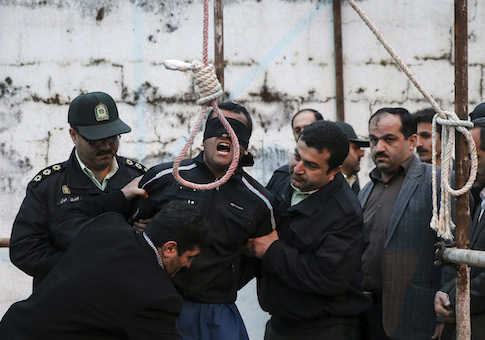
Mideast Iran Saved From The GallowsA man is prepared to be hanged in Iran / AP

Executions in Iran continue to soar to record-breaking levels in 2014, as more than two people are being killed every day and some 320 executions have taken place in the first five months of 2014 alone, according to human rights observers.

Iran is on track to eclipse the number of executions committed in 2013, when they killed around 687 prisoners, including political dissidents and others charged with minor crimes, according to the group Iran Human Rights (IHR), which tracks human rights atrocities in Iran.

Iran hanged a prominent political dissident early Sunday for refusing to renounce his ties to an Iranian opposition group, and hanged another inmate earlier this week, bringing the average to “more than two executions everyday,”according to an IHR tally of both publicized and secret executions in Iran.

With the number of executions growing each week, human rights advocates have expressed horror at the lack of attention brought to these issues by the international community and Obama administration, which continues to negotiate with Tehran over its controversial nuclear program.

“Iranian authorities have once again broken their own records with regards to the extensive use of the death penalty,” IHR spokesman Mahmood Amiry-Moghaddam said in a statement issued on Tuesday.

“The United Nations and the international community must take serious measures to stop the unprecedented wave of the executions in Iran,” said Amiry-Moghaddam, who further urged Western nations to quit remaining silent about the Iranian execution rate.

IHR has determined that Iranian authorities reported at least 147 executions from Jan. 1 to June of this year. It also found that another 180 or more unreported executions have taken place in this time period.

While Iran does not publicly report every execution, IHR and others believe that at least 320 executions have been carried out, despite a three-week halt in all executions that took place in March after the United Nations and others expressed concern about the matter.

Over the weekend, Iranian authorities shocked opposition members by hanging49-year-old Gholamreza Khosravi, who had been imprisoned six years ago for donating money to a satellite television station affiliated with the People’s Mujahideen Organization of Iran (PMOI), an opposition group that seeks to overthrow the ruling regime.

The Obama administration has remained largely silent about these killings and has not been known to broach the subject in talks with Iranian negotiators, prompting criticism from opposition leaders.

“The international community, and in particular the Obama administration, must end their inexcusable silence vis-à-vis the egregious rights abuses in Iran, which have dramatically increased since the so-called moderate Hassan Rouhani became president,” Ali Safavi, the U.S. spokesman for the National Council of Resistance of Iran, a PMOI affiliate, told the Washington Free Beacon on Sunday.

First negotiate with terrorists, then free terrorists

June 4, 2014

First negotiate with terrorists, then free terrorists, Times of Israel, Ops and Blogs, , June 4, 2014

President Obama negotiates with terrorists, frees terrorists, and protects terrorists (i.e. Assad). Americans miss this reality because of the high decibel spin this White House has been practicing that puts Joseph Goebbels to shame.

These three separate actions, if viewed collectively, show clearly a US President feeding terror, not helping curb it. Why are we surprised at the terror against Jewish targets in Brussels, Paris, and so many other places since our own ignorant Millennials elected Mr. Obama?

Step back and consider a Birdseye view of three actions President Obama has not considered their consequences with the same diligence and scrutiny the Bush Administration rarely failed to apply.

One action deals with negotiating with a regime of terror in Iran, which continues to kill innocent Syrian women and children, while Mr. Obama feigns ignorance of their plight.

Another action deals with freeing five hardcore Islamists from Guantanamo, in return for a suspicious US Army deserter, in all likelihood all five may re-emerge in Syria, sooner than we can imagine, in order to train more followers to set their eyesight on the US and Europe.

Lastly is the President’s unequivocal and illogical refusal to help the moderate Syrian opposition our allies in the region have been seeking for over three years.

In summation, President Obama negotiates with terrorists, frees terrorists, and protects terrorists (i.e. Assad). Americans miss this reality because of the high decibel spin this White House has been practicing that puts Joseph Goebbels to shame.

These three separate actions, if viewed collectively, show clearly a US President feeding terror, not helping curb it. Why are we surprised at the terror against Jewish targets in Brussels, Paris, and so many other places since our own ignorant Millennials elected Mr. Obama?

I shudder to imagine all the secretive deals this President may have concluded the public is unfamiliar with; I am talking about secret and concluded negotiations, secret back channels giveaways, and secret decisions that we will only learn about once Mr. Obama leaves office. Any doubts the election of Barack Obama will be haunting the US for a long time.

Honestly, I am starting to believe the real President of the United States is Valerie Jarrett, a minor Chicago political operative whose only fame is to catch Barrack Obama when he fell in her lap. My sense is that Ms. Jarrett believes the world stage is her play-dough to twist and bend as she pleases. Do we all remember her first failure, out of the gate in 2009, when she pressed the President to bid Chicago for the Olympics just to feed the windy city corrupt political machine she grew up in its shadows? The red flag bearers, in the mainstream media, were dormant on that one.

The fact she is the only confidante Mr. Obama allows her the latitude to visit the private quarters of the White House should be a sign of her influence over Mr. Obama’s misguided actions and incoherent policies.

Appeasement has long-term consequences far beyond the spin stories our own attention span is able to absorb. Unless we expose their results, from time to time, to demonstrate their fallibility, Americans may never be able to perceive danger correctly in the same span of time it took them to believe spin and propaganda.

Perception is a powerful conscientious element that plays a role in how people elect their officials. This is why exposure of disconnected detrimental actions, collectively, is essential to change their course.

Many Americans perceive President Obama as attempting to extract the US from costly wars when in fact he is building the foundation to compel the US to go into Europe, Africa, and the Middle East to start new wars in the future that have an existential element.

One that Valerie Jarrett’s lack of elementary understanding is feeding by creating the right environments for terror to flourish across many regions simultaneously.


Off Topic: Hamas opts for the Hezbollah model

June 4, 2014

Hamas opts for the Hezbollah model, Times of IsraelEhud Yaari, June 4, 2014

(How likely is it that the western powers will re-think their apparent love affairs with Hamas and stop blaming Israel for the death of the “peace process?”– DM)

Gaza’s Islamists aim to use Nasrallah’s Lebanese ‘bullets plus ballots’ approach to gain a military and political foothold in the West Bank, the PA, and the PLO.

Hamas seems determined to exploit the reconciliation agreement as a means of resuscitating its political organization and clandestine terrorist activities in the West Bank.

Outgoing Hamas prime minister Ismail Haniyeh described the new formula best, declaring this week, “We leave the government but stay in power… We give up the chair but not the role we play.”

If the current electoral and transitional timetable holds, by this time next year Hamas could have not only an intact military force and terrorist agenda in Gaza, but also a solid foothold in the West Bank and at least a say in — if not veto power over — PA and PLO decisions. In that case, a new system would take shape in the Palestinian territories in which an armed-to-the-teeth political party gradually overshadows the central government and begins to take over numerous institutions.

Western countries quick to endorse the Hamas-Fatah reconciliation should be aware of what is really happening here.

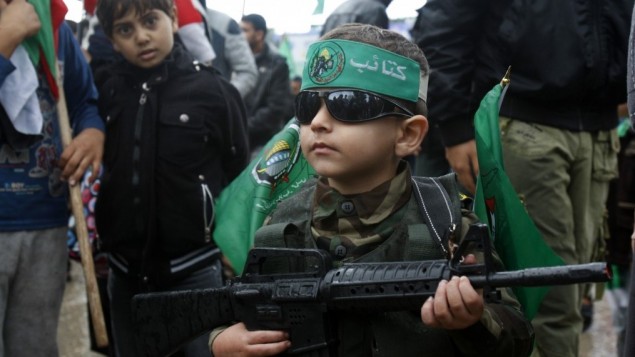
Pal boy with rifleA Palestinian boy wears a green headband with the Arabic slogan “‘Ezz Al-Din Al Qassam brigade” and green Islamic flags while holding a toy gun during a rally to commemorate the 25th anniversary of the Hamas militant group, in Gaza City, December 2012. (photo credit: Adel Hana/AP)

On June 2, Hamas and Fatah formed a unity government in the Palestinian Authority after many months of reconciliation talks, with Hamas nominally dissolving its government in the Gaza Strip. The move represents the fruit of a long internal debate within the group’s higher echelons regarding its future course. Rather than adhering to the seven-year-old strategy of prioritizing exclusive control of “Fortress Gaza” with no serious effort to heal the rift with Fatah in the West Bank, Hamas leaders have now changed tack toward a different program: transplanting the Hezbollah model from Lebanon to Palestine.

For Hamas, this means integrating into the general political system while retaining independent, well-equipped armed forces and striving to maintain control of Gaza through its existing grip on local bureaucracy, its wide network of social institutions, and, of course, its 20,000 well-trained military cadres and security personnel.

The group has recruited no less than 50,000 employees to the public sector since its June 2007 military takeover of the territory. At the same time, Hamas seems determined to exploit the reconciliation agreement as a means of resuscitating its political organization and clandestine terrorist activities in the West Bank.

Outgoing Hamas prime minister Ismail Haniyeh described the new formula best, declaring this week, “We leave the government but stay in power… We give up the chair but not the role we play.”

The shift in Hamas strategy — from emphasizing a monopoly of power in Gaza to reaching a deal that allows some PA presence there, and from harsh criticism of PA president Mahmoud Abbas to cautious cooperation with him — has been the result of agonizing soul searching among the group’s leaders. This internal questioning was spurred by several recent setbacks: the loss of a friendly Muslim Brotherhood regime in neighboring Egypt, the cessation of weapons smuggling through the Sinai Peninsula, the decline of financial subsidies from Iran and Qatar, and the growing resentment of Gaza inhabitants due to rising unemployment, economic hardship, and constant repression.

Western countries quick to endorse the Hamas-Fatah reconciliation should be aware of what is really happening here.

Amid these bleak circumstances, Hamas leaders held a number of meetings in recent weeks with Iranian officials in Tehran and Hezbollah leaders in Beirut. There, the group’s representatives were advised to adopt a more ambitious plan than merely defending Gaza, namely, by contesting Fatah in its own West Bank territory instead. Hezbollah’s modus operandi in Lebanon — which can be summed up as “add ballots to your bullets” — was pushed as a model to be emulated.

Subsequently, Tehran praised the initial reconciliation pact between Hamas and Fatah; on April 26, an Iranian Foreign Ministry spokeswoman stated, “The Islamic Republic of Iran welcomes solidarity among Palestinian groups against the Zionist regime [of Israel], as well as any kind of national reconciliation that results in Palestinian unity.” The statement was one of several signals that Iran had approved the deal in advance.

Similar to Hezbollah’s longstanding stance in Lebanon, statements by numerous Hamas leaders over the past few days make clear that the group’s military branch — the Izz al-Din al-Qassam Brigades — will not be disarmed or come under any PA supervision and will continue to grow as a powerful “resistance.” The same applies to its intelligence and security apparatus. Just as Hezbollah maintains armed forces far superior to the Lebanese army and various secret services, so does Hamas intend to expand its independent military units, which are already far larger and better equipped than the PA’s National Security Forces.

For example, Gaza workshops will continue production of M-75 missiles — which are capable of reaching Tel Aviv and Jerusalem — even though Abbas has previously accepted the principle of a demilitarized Palestinian state. Hamas also has no intention of disbanding its intelligence organs, which will allow it to preserve de facto control of Gaza in much the same manner that Hezbollah forces control southern Beirut, southern Lebanon, and the Beqa Valley. Although some PA units will be introduced into Gaza, their main role will be to man the border terminals with Egypt and Israel; they are unlikely to change the overall situation on the ground.

Political infiltration

If Hamas opts to fully implement the Hezbollah model, it will also seek to integrate itself as fast as possible into all PA institutions in the hope of taking over some of them. Currently, Hamas leaders have accepted that they will not have any ministers in the reshuffled semi-technocratic cabinet of PA prime minister Rami Hamdallah. Yet the group’s real focus is on the elections promised by Abbas six months down the road, and on the establishment of a newly agreed “Leadership Body” in the Palestine Liberation Organization (PLO), which will include top figures from Hamas and Palestinian Islamic Jihad for the first time ever.

Similar to Hezbollah, Hamas aspires to operate as a political party. It is eager to take part in presidential, parliamentary, and municipal elections in the hope of securing a majority or at least a plurality of the vote and thus forming a government or becoming a coalition partner. For now, Hamas leaders are skeptical that they can win the presidency or a Legislative Council majority, mainly because Abbas unilaterally modified the elections law to suit Fatah candidates better than the previous law, which was in force when Hamas won the 2006 elections. At the same time, they have indicated their ambition to take over important ministerial portfolios — as Hezbollah did in Lebanon — and influence parliamentary motions.

The reconciliation agreement has already produced important gains for the group. The PA has quietly removed the ban on Hamas political activities in the West Bank, and the movement has resumed public rallies, campaign meetings, and distribution of literature. This revival of open Hamas activities is affecting the PA’s security organs: despite their standing orders to foil terrorist activity, many mid-level officers and their subordinates are no longer certain if and when to intervene in Hamas gatherings. For example, Hamas-sponsored Quran reading sessions have often been a cover for recruitment into underground terrorist cells.

The group’s resurgence in the West Bank is especially noted in the refugee camps outside the main cities. PA security forces rarely risk entering these camps, leaving room for local youths to organize into lightly armed militias capable of challenging the PA. Hamas will obviously be more tempted to link to these groups, convert them to its doctrine, and supply them with financing and, when possible, better arms.

No less important to Hamas is the coveted goal of capturing the PLO, “the sole representative of the Palestinian people” and the entity in charge of negotiating with Israel. If Hamas leader Khaled Mashaal were to one day succeed Abbas at the PLO’s helm, he would have to decide whether to back away from the Oslo Accords, among other things.

Thus far, senior Hamas officials have not referred to this potential dilemma in public, mainly because there are still numerous obstacles to the group joining the PLO, let alone taking it over. For now, it is noteworthy that Hamas did not protest too loudly when Abbas asserted that the new unity government will recognize Israel and support the two-state solution, despite the group’s insistence that no political platform was agreed on as part of the unity deal.

The West should look deeper

The emergence of a Hezbollah model in the Palestinian Authority is a major threat to any prospect of resuming serious negotiations with Israel. If the current electoral and transitional timetable holds, by this time next year Hamas could have not only an intact military force and terrorist agenda in Gaza, but also a solid foothold in the West Bank and at least a say in — if not veto power over — PA and PLO decisions. In that case, a new system would take shape in the Palestinian territories in which an armed-to-the-teeth political party gradually overshadows the central government and begins to take over numerous institutions.

Western countries quick to endorse the Hamas-Fatah reconciliation should be aware of what is really happening here: Instead of the PA regaining its “southern provinces” in Gaza, it is in fact Hamas reentering the “northern provinces” in the West Bank.


July deadline for Iran nuclear deal appears in jeopardy – envoys

June 4, 2014

July deadline for Iran nuclear deal appears in jeopardy – envoys, Iran Aware, Louis Charbonneau and Parisa Hafezi, June 4, 2014

(Please see also The big charade: Nuclear diplomacy is a flop, the finale is secretly postponed to 2015.

As the centrifuges continue to spin and sanctions relief continues, Iran continues to do well. Iran will continue to do well regardless of whether there ultimately is a deal because effective sanctions will be difficult if not impossible to reinstate; the longer the negotiations continue the more difficult it will become. Nor is the Obama Administration likely to use its military option. — DM)

Vienna talks

NEW YORK/ANKARA (Reuters) – It is increasingly unlikely that six world powers and Iran will meet their July 20 deadline to negotiate a long-term deal for Iran to curb its nuclear programme in return for an end to economic sanctions, diplomats and analysts say. [Emphasis added.]

In theory, an extension to the high-stakes talks should not be a problem if all sides want it. But President Barack Obama would need to secure Congress’ consent at a time of fraught relations between the administration and lawmakers.

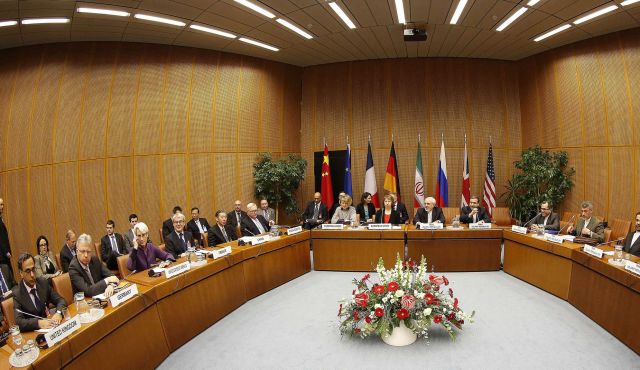
Iran, the United States, Britain, France, Germany, Russia and China included the July 20 deadline to reach a comprehensive agreement in an interim deal they reached in Geneva on Nov. 24.

The November agreement allowed for a six-month extension if more time was needed for a final deal to end sanctions on Iran and remove the threat of war.

An extension would allow up to half a year more for limited sanctions relief and limits on Iranian nuclear work as agreed in Geneva. To avoid an open conflict with Congress, Obama would want U.S. lawmakers’ approval to extend that sanctions relief.

The latest round of talks in Vienna last month ran into difficulties when it became clear that the number of enrichment centrifuges Iran wanted to maintain was well beyond what would be acceptable to the West. That disagreement, envoys said, can be measured in tens of thousands of centrifuges.

As a result, the latest round of Vienna talks broke off last month with Tehran and Western powers accusing each other of being unrealistic.

While talk of an extension could be a negotiating tactic, members of both sides appeared to favour the idea.

EXTENSION A “FOREGONE CONCLUSION”

Barring a surprise breakthrough in the next round in Vienna on June 16 to 20, Western officials said an extension was virtually a foregone conclusion. “We’re far apart,” one diplomat said, adding that the talks would be “long and complicated.”

The sides said last month that they had intended to start drawing up a final pact but the full-scale drafting did not actually start.

French foreign ministry spokesman Romain Nadal said the priority for France was to reach a good deal rather than to rush through an agreement.

An Iranian official told Reuters, “We have to get rid of the sanctions immediately. Therefore, the talks will end when this issue is totally resolved. A few more months will kill no one.” Pushing the deadline to October would be fine, he said.

Tehran insists it needs to maintain a domestic uranium enrichment capability to produce fuel for nuclear power plants without having to rely on foreign suppliers.

Western governments and their allies suspect Iran wants the ability to produce atomic weapons, an allegation Tehran denies.

No one had an interest in letting the negotiations collapse and boosting the risk of war, said Gary Samore of Harvard University, who was the National Security Council’s top nuclear security official in the first Obama administration.

“Although there will be strong opposition in both Washington and Tehran, I don’t think either side can afford to take the blame for walking away from the table if the other side is prepared to continue,” said Samore.

IRAN REFORMS AT STAKE

Failure of the talks would strengthen the position of hard-liners in Iran’s clerical establishment against President Hassan Rouhani, a pragmatist who has sought to improve relations with the United States. The countries broke off ties during a hostage crisis after the 1979 Islamic Revolution.

“Rouhani has put all his eggs in this basket. Failure of the talks means failure of reforms in Iran,” an Iranian official close to Rouhani’s government said.

If there is an extension, the Obama administration will seek the blessing of Congress. U.S. officials voiced confidence to Reuters they would ultimately get it, but it appears it would not come without a fight.

Members of Congress are already expressing concern about a possible delay. Republican Representative Kerry Bentivolio said last week that Obama had not updated lawmakers on the Vienna talks frequently enough.

To get an extension, he said, “Iran must make real and meaningful concessions and convince us it is not simply stalling.”

Privately, administration officials said they believed members of Congress were unlikely to risk the blame for torpedoing the talks. “They (Congress) don’t want to take the blame for destroying a deal,” one U.S. official said.

Benghazi, Bergdahl and Hamas

June 4, 2014

Benghazi, Bergdahl and Hamas, Front Page Magazine, June 4, 2014

(My views on the Bergdahl mess are presented here. What Sgt. Bergdahl did or did not do and why are less important than the implications for future terrorist attacks and why the Obama Administration agreed to ransom him by returning five very dangerous Gitmo detainees. — DM)

Why the rush [to recognize the Fatah- Hamas government]? Why was the issue of legitimizing a terror organization, dedicated to the annihilation of one of our closest allies, not worth more than a few seconds thought?

The answer is that for President Obama, it was just business as usual. His top priority is not delegitimizing terrorists and fighting to win, but avoiding stirring up local resentments. And Palestinians have made fabricating resentment for every imaginable affront into an art form. “A house is being built!” is a favorite, while Palestinian rocket-launchers and kidnappers and would-be suicide bombers are plying their wares.

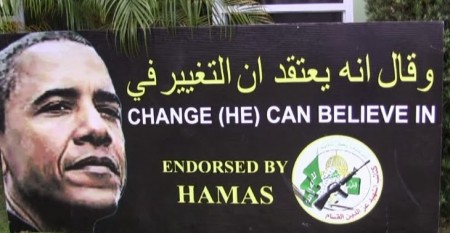
Obama-change-he-can-believe-in-450x233

It is about time that pundits stop describing President Obama’s foreign policy as weak. There is a straight line between emboldening Syria’s Assad by calling him a reformer, Egypt’s Morsi a democrat, Turkey’s Erdogan a friend, Iran’s Rouhani a moderate, and now a Palestinian government that includes Hamas, a peace partner.

Monday’s speedy announcement that the United States will work with and pay for a PLO-Hamas coalition government is a strong and predictable step in an alarming pattern.

Every one of these moves has deliberately driven a wedge between Obama and Israel. President Obama’s priority is, and always has been, the Muslim world. It has made no difference to this partiality that in the latter world American hostages are languishing in prison cells, the killers of Americans are government insiders, official anti-Semitism is flourishing, and the locals are brutalized.

At the same time, President Obama has a recurring problem with his choice of best friends. There is an inconvenient discord between the terrorism and violence emanating from his BFF’s and his putative job as commander-in-chief.

The difficulty presents itself, for example, in the context of Benghazi. The anger over Benghazi is more than justified, but not because it is still a mystery why the president sent no one to bomb Libya in order to save Americans under attack. He may have hurt somebody on the ground who was not American, or he may have stirred up local resentment.

President Obama has never made a secret of his “counter-terrorism” policy. In May 2013 he said quite clearly that even in the face of “terrorists who pose a continuing and imminent threat to the American people,” “before any strike is taken, there must be near-certainty that no civilians will be killed or injured.”

Speaking at West Point on May 28, 2014 he reiterated that in taking direct action “against terrorism,” we may strike “only where there is near certainty of no civilian casualties.”

The problem is not that he’s unclear. It’s that he isn’t right. International law does not require planning for zero civilian casualties – which would simply encourage combatants to use more civilians as human shields. The Geneva Conventions test is one of proportionality: “An attack which may be expected to cause incidental loss of civilian life [or] injury to civilians” is prohibited if it “would be excessive in relation to the concrete and direct military advantage anticipated.”

So international law is not what is driving President Obama’s foreign policy. What’s really eating him is that he believes we are our own worst enemy. As he said at West Point: “our actions should meet a simple test: We must not create more enemies than we take off the battlefield.” He is worried that if we defend ourselves, we “stir up local resentments.”

That’s a green light for the political enablers of terrorists everywhere to start writing UN speeches, mount new phony demonstrations, and concoct more bogus Islamophobia charges. If we are the ones responsible for creating more terrorists by fighting terrorists, then we may as well just go golfing.

The President’s release of top five Taliban terrorists from Guantanamo this past weekend fits the dogma. As early as May 21, 2009, the President told us: “the existence of Guantanamo…created …terrorists…It is a rallying cry for our enemies.” Unsurprisingly, they prefer their terrorist buddies back in the field.

Similarly, our drone program is dwindling – nothing in Pakistan’s tribal areas since last December – because our enemies don’t like it either. But then, why would they?

Which brings us back to the President’s embrace of a Palestinian government that includes the terror organization, Hamas – just hours after the PLO-Hamas deal was done.

Why the rush? Why was the issue of legitimizing a terror organization, dedicated to the annihilation of one of our closest allies, not worth more than a few seconds thought?

The answer is that for President Obama, it was just business as usual. His top priority is not delegitimizing terrorists and fighting to win, but avoiding stirring up local resentments. And Palestinians have made fabricating resentment for every imaginable affront into an art form. “A house is being built!” is a favorite, while Palestinian rocket-launchers and kidnappers and would-be suicide bombers are plying their wares.

Furthermore, the President never seriously tried to stop it. He could have threatened and ensured harsh economic and political repercussions, which Congress would have supported. But he didn’t. Just as he didn’t make any such threats when the Palestinians went to the UN in November 2012 to become a non-member observer state. And just as he didn’t when the Palestinians started signing treaties this past April that legally are only open to states.

The ugly truth is that President Obama is happy to let the UN turn Palestine into a state, and thereby allow Palestinians to avoid negotiation, avoid recognition of the Jewish state, and avoid genuine commitment to peaceful coexistence with its Jewish neighbor. Unilateralism and the UN was always the back-up plan to Kerry’s egoistic globe-hopping.

Asked about Hamas’ continued commitment to militarism, Psaki responded “we’ll continue to evaluate the specifics here.”

The specifics are simple. One more Jew-hating, Israel-bashing, American foe has been welcomed into Obama’s Islamist inner circle.

Originally published by FoxNews.

Off Topic: Reversing the Tide of the Muslim Word Purge

June 4, 2014

via Blog: Varda Epstein, Reversing the Tide of the Muslim Word Purge – Arutz Sheva.

By Varda Epstein

6/1/2014, 3:06 PM

Miloš Zeman

A remarkable statement on the state of Muslim theology by Czech President Miloš Zeman two weeks ago went largely unnoticed. These remarks, offered at a reception for Israel’s Independence Day, only came to my attention as the result of the blogging efforts of my colleague at Israellycool, Brian of London, also known as Brian Thomas. The weeks would otherwise have flown by with Zeman’s remarks having sunk into obscurity, a single blip on the screen, unseen and unheard forever.

The brief speech was not only given behind closed doors at a private reception, but also appeared on the government website of the Czech Republic. That is how we know Zeman’s words are not just words, but a groundbreaking wakeup call by a national leader to the world at large.

If only they were listening.

Brian found a translation of Zeman’s speech at the Gates of Vienna and cited it in its entirety. It is well worth taking five minutes to read these remarks:

Speech by the president of the Czech Republic at the reception held to celebrate Israel’s Independence Day

May 26, 2014

Ladies and gentlemen,

Let me thank you for the invitation to celebrate Israel’s Independence Day. There are dozens of days of independence being celebrated every year in the Czech Republic. Some I may attend, others I cannot. There is one I can never miss, however: it’s the Israeli Independence Day.

There are states with whom we share the same values, such as the political horizon of free elections or a free market economy. However, no one threatens these states with wiping them off the map. No one fires at their border towns; no one wishes that their citizens would leave their country. There is a term, political correctness. This term I consider to be a euphemism for political cowardice. Therefore, let me not be cowardly.

It is necessary to clearly name the enemy of human civilization. It is international terrorism linked to religious fundamentalism and religious hatred. As we may have noticed after 11th of September, this fanaticism has not been focused on one state exclusively. Muslim fanatics recently kidnapped 200 young Christian girls in Nigeria. There was a hideous assassination in the flower of Europe in the heart of European Union in a Jewish museum in Brussels. I will not let myself being calmed down by the declaration that there are only tiny fringe groups behind it. On the contrary, I am convinced that this xenophobia, and let’s call it racism or anti-Semitism, emerges from the very essence of the ideology these groups subscribe to.

So let me quote one of their sacred texts to support this statement: “A tree says, there is a Jew behind me, come and kill him. A stone says, there is a Jew behind me, come and kill him.” I would criticize those calling for the killing of Arabs, but I do not know of any movement calling for mass murdering of Arabs. However, I know of one anti-civilization movement calling for the mass murder of Jews.

After all, one of the paragraphs of the statutes of Hamas says: “Kill every Jew you see.” Do we really want to pretend that this is an extreme viewpoint? Do we really want to be politically correct and say that everyone is nice and only a small group of extremists and fundamentalists is committing such crimes?

Michel de Montaigne, one of my favorite essayists, once wrote: “It is gruesome to assume that it must be good that comes after evil. A different evil may come.” It started with the Arab Spring which turned into an Arab winter, and a fight against secular dictatorships turned into fights led by Al-Qaeda. Let us throw away political correctness and call things by their true names. Yes, we have friends in the world, friends with whom we show solidarity. This solidarity costs us nothing, because these friends are not put into danger by anyone.

The real meaning of solidarity is a solidarity with a friend who is in a trouble and in danger, and this is why I am here.

— Miloš Zeman, president of the Czech Republic, Hilton Hotel, 26th of May 2014

Those of us who love Israel have been pleased and touched by ex‎pressions of friendship offered by leaders such as Stephen Harper of Canada or Julie Bishop of Australia. Zeman’s comments, however, go much further. This phrase, in particular, stands out for its stunning clarity and unashamed candor:

I am convinced that this xenophobia, and let’s call it racism or anti-Semitism, emerges from the very essence of the ideology these groups subscribe to.

In this single sentence, Zeman does something that no leader in the Western world has yet dared to do. He identified the nature of the threat to Israel—the equivalent of loudly breaking wind at a party. And at the risk of repeating myself, Zeman did the deed out loud, daring not only to voice his brave words behind closed doors at a private reception, but subsequently posting them for all the world to see on his government’s website.

Zeman comes right out and says it: Jew-hatred is enshrined as a central tenet of the Muslim faith.

No one else will say it. Not only won’t they say it, but they, the leaders of the West, serve up a wicked and most effective platter of lies at every opportunity. President Obama tells us that Islam is a religion of peace and that we must respect it.

President Obama’s star-struck followers include the mainstream media, so this is the narrative served up to Americans stuck in rush-hour traffic on their way to work, at the dinner table, and at every opportunity in between. The President is adored as a god and woe betide anyone who dares contradict him on any subject at all; Benghazi, the IRS, and Edward Snowden notwithstanding.

The idea that Islam is a religion of peace—as opposed to one of overwhelming hatred—is the lie that is reflected in current U.S. policy from the top down. This false narrative was perpetuated by the Department of Justice on December 19, 2011, when Deputy Attorney General James M. Cole addressed a DOJ conference with these words:

I recently directed all components of the Department of Justice to re-ev‎aluate their training efforts in a range of areas, from community outreach to national security, to make sure they reflect that sensitivity.

Cole was referring to the removal of all words and sentences that accurately reflect the truth about Jihad and Islamic violence from U.S. law enforcement manuals.

The President’s philosophy on Islam was also evident in remarks by Dwight C. Holton, who once served as interim U.S. Attorney, when he spoke of the “egregiously false” training given to FBI agents at Quantico:

I want to be perfectly clear about this: training materials that portray Islam as a religion of violence or with a tendency towards violence are wrong, they are offensive, and they are contrary to everything that this president, this attorney general and Department of Justice stands for. They will not be tolerated.

Holton said such training materials, “pose a significant threat to national security, because they play into the false narrative propagated by terrorists that the United States is at war with Islam,” and talked about his discussions with Attorney General Eric Holder about this issue.

He is firmly committed to making sure that this is over,” Holton said. “Now the reality is it is going to take a bit to go back and figure out what trainings have happened in the past that we need to go back and fix — we’re a big organization, we’ve got lots going on with lots of people and lots of contractors — but Attorney General Holder is firmly committed to it, and we’re going to fix it.

In fact, the Obama powers-that-be have been “fixing” the narrative as far back as 2008, by purging law enforcement materials of such words as:

Jihadist
Islamic Terrorist
Islamofascist, Islamofascism
Islamist
Holy Warrior

President Obama’s commitment to revising the U. S. narrative on Islam was evident once again in 2009, when the Department of Homeland Security issued a draft of its glossary on domestic extremist groups. The glossary listed several Christian and Jewish organizations as possible “threats” but included not a single Muslim group under this heading. Judicial Watch has documented the entire history of the various Obama Administration word purges and language revisions.

And of course most of us picked up on the false portrayal of the 2009 Fort Hood Massacre as a “work accident” rather than an act of terror, even though witnesses stated for the record that the perpetrator, Nidal Malik Hasan, shouted out, “Allahu Akbar,” as he opened fire.

Nidal Malik Hasan

The list goes on but Zeman’s simple truth has blown away the smoke screen and revealed the truth in the full light of day, if only we will notice his words and spread them far and wide. Here is someone unafraid to say the truth!

Zeman isn’t as important a leader perhaps as President Obama, but his words wash away all the dirt, all the falsehoods of the pervasive revisionist portrayal of Muslim theology and ideology.

President Obama would have us believe that there are two different versions of Islam: the supposedly mainstream “moderate Islam” and “radical Islam.” The President claims that only a minority of Muslims adhere to the latter form of Islam. Zeman, however, isn’t prepared to leave the world bare and unprotected in the face of the one true Islam, the one that threatens Israel, the U.S., and the entire free world. This is the Islam that is adhered to by 1.5 billion contemporary Muslims and should be the only one that concerns us, because our sole task should be, must be, to confront the beliefs of what the 1.5 billion believers believe TODAY.

President Obama is free to believe there are two sides to Islam if he so chooses. All evidence, however, points to the opposite idea, the idea that Zeman so neatly expounded upon in his Israeli Independence Day address. President Obama has no right to impose his revisionist narrative regarding Islam on Israel or on anyone else. Because the real Islam is the one staring the world in the face: the one that rules Muslim countries and that is overwhelmingly what we now want to call “extreme.”

It is this Islam that puts our very existence in danger.

So now we have a choice: we can listen to Obama and remain blissfully unaware of the danger. Or we can listen to Zeman, identify the enemy, and prepare for the fight of our lives.

Because if we can’t identify the enemy, can’t name the enemy, we’ll never win this war.

It is said that if you know your enemies and know yourself, you will not be imperiled in a hundred battles; if you do not know your enemies but do know yourself, you will win one and lose one; if you do not know your enemies nor yourself, you will be imperiled in every single battle. (Sun Tzu, The Art of War)

Art of War, Sun Tzu
The EU on Palestinian Unity: “We Welcome the New Government”

June 4, 2014

The EU on Palestinian Unity:

“We Welcome the New Government”Following US statements reaffirming US unchanged commitment to the unified Palestinian government; the EU added its support. “We welcome the new government,” said a statement released by the EUJun

04, 2014, 12:52PM | Jacob Northbrook

via Israel News – The EU on Palestinian Unity: “We Welcome the New Government” – JerusalemOnline.


EU Parliament, archives Moshe Millner
 

Following US commitments to continue cooperation with the Palestinian unity government, between Hamas and Fatah, the EU added its support this evening (Wednesday) to the unity. According to a statement released by the organization, the unity will afford new opportunities in peace negotiations.

“We welcome the unity government,” said the statement. “We welcome Abbu Mazen’s statement according to which the new government will be committed to a two state solution on the basis of 67’ boundaries. The relations between the EU and the new Palestinian government will be based on the new government’s adherence to these values.”

Tensions between the US and Israel continued to rise yesterday regarding the Palestinian unity government when deputy spokeswoman for the State Department, Marie Harf, emphasized that the American position is that “the Palestinian unity government is not supported by Hamas” and therefore the US will not change its position regarding the Palestinian unity government.

Iran: False Assumptions

June 4, 2014


by Peter Huessy June 4, 2014 at 5:00

Gatestone institute

via Iran:False Assumptions .

The U.S. already failed to detect nuclear programs on four other occasions: Iraq – 1991, Syria – 2009, North Korea – 2000-1 and Libya – 2005. That is quite a record.

Terrorist groups, such as Hezbollah and Hamas, regularly launch rocket attacks on Israel, but because they are not “recognized state actors” launching rocket attacks on another sovereign state, we do not put the min the same category. All terrorist groups attacking a state therefore get a free pass.

A nuclear device in the hands of such terrorist groups — chosen precisely because they cannot be readily identified as working for, or connected to, a state — can therefore be used in an attack with impunity, totally undermining the assumption that such weapons in the hands of Iran are “only for deterrence.”

Unless we end the Iranian nuclear weapons program now, we will probably only know if a threat is “real” after it is too late.

The Iranian Supreme Leader announced last week that further negotiations on Tehran’s nuclear program are ended, asserting that “jihad” will continue until America is destroyed.

Whatever the future of a nuclear “deal” with Iran, still missing are both an analysis of what specific deal is technically required to end the Iranian nuclear weapons program compared to what is now on the table, and whether the assumptions many in the West bring for an agreement to succeed hold up under scrutiny.

To answer the first problem, an analysis by Gregory Jones of the Nonproliferation Policy Education Center (NPEC) explores the faults with the current proposals.

First, according to Jones, Iran can still quickly produce Highly Enriched Uranium [HEU], the stuff from which nuclear weapons are built. As Jones emphasizes, “this means Iran is already a de facto nuclear weapon state.” Any agreements, therefore, must “deny Iran access to HEU either in the short or long term,” as well as prevent Iran’s Arak nuclear reactor from being “reconverted to be able to produce” plutonium from which nuclear bomb fuel can be made.


The Arak heavy water reactor, in Iran. (Image source: Wikimedia Commons)
 

Second, under the terms of the interim deal, Iran “will have an unrestricted centrifuge enrichment program,” thus legitimizing Iran’s desire for such a program, as well as any other country that desires nuclear weapons. Jones explains that IAEA inspections also must provide for the “timely detection” of any diversion of produced nuclear fuel.

Third, Iran should therefore have no “centrifuge enrichment capability” precisely because “commercial scale centrifuge enrichment facilities can produce HEU so quickly that these facilities are unsafeguardable as timely detection of diversion is impossible.” Jones also emphasizes that just because there has not been any diversion of nuclear fuel to date, does not mean that no such diversion will ever take place in Iran in the future.

The second critical issue is whether the assumptions of those convinced an agreement with Iran is possible at all are correct. These assumptions vary but they usually fall into six categories.

1) Iran will never use a nuclear weapon, even if it has one.

2) Iran is simply trying to defend itself from a bullying United States that has a history of pushing for regime change.

3) Any use of a nuclear device would easily be detected as to the country of origin, including Iran.

4) Similarly, Iran’s ballistic missiles — designed to deliver a nuclear warhead — are simply a deterrent needed in a bad neighborhood and their use could be readily attributed to Tehran.

5) Should Iran decide to build a nuclear warhead, US intelligence will readily detect such a move.

6) There are no real options other than “diplomacy,” and if we could talk to the Soviets during the Cold War, we can certainly talk to the Iranian mullahs now.

But are these assumptions true?

On assumptions #1 and #2: Iran has repeatedly called for the destruction of Israel and a “world without” the United States. Akbar Hashemi Rafsanjani, Iran’s former President, for example, has stated that “the use of even one nuclear bomb inside Israel will destroy everything. However, it will only harm the Islamic world. It is not irrational to contemplate such an eventuality.”

On assumption #3: The U.S. has made progress on nuclear forensics but does not have the ability accurately to detect the origin of a nuclear explosion. Worse, an electromagnetic pulse [EMP] bomb would not leave any nuclear debris to be analyzed.

On assumption #4: Iran’s ballistic missiles can be instruments of coercion, blackmail and terror, even if never launched. Tens of thousands of Iranian-built rockets and missiles have been transferred to Hamas and Hezbollah for just that purpose.

Also, such weapons can be launched surreptitiously, masking the country of origin, for instance if launched from an ocean-going freighter. Terrorist groups, such as Hezbollah and Hamas, regularly launch rocket attacks on Israel, but because they are not “recognized state actors” launching rocket attacks on another sovereign state, we do not put them in the same category. All terrorist groups, therefore, get a free pass when attacking a state. Where is any international outcry?

On assumption #5: Detecting a nuclear weapons program is not easy: the U.S. intelligence community already failed to detect the Iraqi nuclear program in 1991; the construction of a Syrian nuclear reactor in 2009; the North Korean nuclear enrichment program in 2000-1, and the Libyan nuclear centrifuge purchases in 2005. That is quite a record.

Major elements of Iran’s nuclear program were discovered by internal Iranian dissidents who shared the information with the West. Can one count on such help in the future?

And as to assumption #6: Terrorism is Iran’s tool of choice. Iran’s affiliated terror groups, such as Hamas and Hezbollah, attack, or threaten to attack, the U.S., U.S. “interests” and U.S. allies.

An Iranian nuclear device in the hands of such terror groups — chosen precisely because they cannot be readily identified as working for, or connected to, a state — can therefore be used in an attack with impunity, totally undermining the assumption that such weapons in the hands of Iran are “only for deterrence.”

A rocket launched from mid-ocean has no return address. Detonated 70 miles above the eastern seaboard of the United States, a nuclear device leaves no signature.

Such an EMP attack – – its origin always unknowable — would plunge millions of Americans into a pre-industrial stone-age, equivalent to the early 19th century, according to both former Director of Central Intelligence, Ambassador R. James Woolsey and EMP expert Peter Pry.

Unless we end the Iranian nuclear weapons program now, we will probably only know if a threat is “real” after it is too late.

Iran Threatens to Annihilate Israel

June 4, 2014

Iran Threatens to Annihilate Israel if U.S. AttacksSenior Iranian commander says that any American attack on Iran will result in “the annihilation of the Israeli regime”.

By Elad Benari, CanadaFirst Publish: 5/30/2014, 11:41 PM

via Iran Threatens to Annihilate Israel – Middle East – News – Arutz Sheva.

Iranian Armed Forces march in Tehran

A senior Iranian commander threatened on Friday that any American attack on Iran will result in “the annihilation of the Israeli regime”.

“They know that aggression against the Islamic Republic of Iran would mean annihilation of Tel Aviv and spread of war into the United States,” the commander, Massoud Jazayeri, was quoted by the Fars news agency as having said.

His remarks came after U.S. President Barack Obama said on Wednesday that there is an opportunity to resolve disputes over Iran’s nuclear energy program but reiterated that Washington reserves “all options” against Iran, alluding to military action.

Jazayeri described Obama’s remarks as “childish dreams which may not come true”.

“Had the U.S. and its allies the capability to attack Iran they would not hesitate a moment to carry out their barbaric act; and, of course, it is surprising that Obama is not embarrassed to rehash his empty words,” he said.

The Iranian commander said that the era of global hegemony has ended, adding that the “empire of money and weapons” will soon collapse.

Over the years, Iran has threatened Israel and the United States on more than one occasion.

In March, a senior commander in Iran’s Revolutionary Guards said that Iran is keeping its finger on the trigger and is ready to destroy Israel.

The commander, Brigadier General Hossein Salami, said that Iranian military commanders are prepared to attack and destroy “the Zionist regime of Israel” as soon as they receive such an order.

Previously, Salami said that Iran “could minimize the breathing room of the U.S. and the West until the Zionist regime would no longer have room to breathe.”

Iran’s Supreme Leader, Ayatollah Ali Khamenei, has in the past threatened to “annihilate” the Israeli cities of Tel Aviv and Haifa.

In February, the official site of the Iranian Revolutionary Guards warned the U.S. that its warships in the Persian Gulf were in range of their Karrar combat drones, as well as their Kowsar anti-ship missiles, both domestically produced.

Several weeks ago, the commander of the Iranian Navy stated that his forces were trained to destroy U.S. warships.

U.S. rejects Netanyahu’s concerns: Palestinian gov’t isn’t backed by Hamas

June 4, 2014

U.S. rejects Netanyahu’s concerns: Palestinian gov’t isn’t backed by Hamas – Diplomacy and Defense Israel News | Haaretz.

State Dept. reiterates that, despite Israel’s protestations, the U.S. will judge the new Palestinian unity government on its actions.

By | Jun. 3, 2014 | 10:29 PM
Prime Minister Benjamin Netanyahu.

Prime Minister Benjamin Netanyahu. Photo by Emil Salman

The U.S. State Department rejected on Tuesday Prime Minister Benjamin Netanyahu’s protestations over the fact that Washington decided to maintain ties with the new Palestinian unity government.

“It is not a government backed by Hamas,” said deputy spokesperson Marie Harf, in the State Department’s daily press briefing. “There are no members of Hamas in the government.”

Secretary of State John Kerry said on Monday that Washington intends to work with the new government. State Department spokeswoman Jen Psaki said Washington would work with the new government as long as it upholds the Quartet principles – to recognize Israel, reject terror, and honor previously signed agreements.

Netanyahu said that he was both “deeply disappointed” and “deeply troubled” by the U.S. decision.

Harf told reporters that the new Palestinian government is a transitional one that is comprised of people who are not associated politically with any party, and that its main role is to prepare for parliamentary elections. The interim government’s prime minister, his two deputies and the finance minister are people who were in the previous government, she added.

“Hamas is a designated terror organization in the U.S. and we will not provide it with any assistance. We don’t have any contacts with Hamas,” she said.

Acording to Harf, the United States will judge the new government by its actions and will follow closely in order to see that it does indeed uphold the Quartet principles.

On Tuesday, endorsement for the new Palestinian government came in thick and fast from around the world, with Russia, China, India, Turkey, France and the U.K. expressing their backing. The European Union and the United Nations also stated their endorsement.