Archive for June 2, 2014

US will work with Palestinian unity government

June 2, 2014

US will work with Palestinian unity government, Jerusalem Post,  Michael Wilner, June 2, 2014

(How expectedly “unexpected.” — DM)

Kerry speaks to Netanyahu by phone; State Department says no plans to cut off aid despite some US lawmakers’ comments to the contrary, says the US “will be judging this government by its actions.”

Psaki said the Obama administration has no intention of cutting off aid to the Palestinian Authority, which amounts to roughly $500 million a year– pivotal funding for the cash-strapped organization.
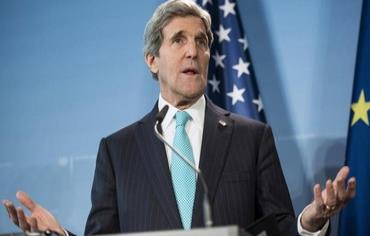
KerryUS Secretary of State John Kerry. Photo: REUTERS

WASHINGTON — The United States will work with a new Palestinian Authority that has unified Hamas and Fatah, the State Department said on Monday, hours after Palestinian President Mahmoud Abbas swore in the new government.

“Based on what we know now, we intend to work with this government,” State Department spokeswoman Jen Psaki told reporters. “We will continue to evaluate the composition and policies of the new government, and if needed, we will recalibrate our approach.”

Ministers in the new administration, whom Abbas has said would be politically unaffiliated, took the oath of office in a televised ceremony in Ramallah.

Psaki said the Obama administration has no intention of cutting off aid to the Palestinian Authority, which amounts to roughly $500 million a year– pivotal funding for the cash-strapped organization.

The ministers in the government “appear to be technocratic,” she said, adding that the US “will be judging this government by its actions.”

US Secretary of State John Kerry spoke with Prime Minister Benyamin Netanyahu by phone moments before Psaki’s announcement.

On Sunday, Netanyahu called on the international community not to “run to recognize” the government which “rests of Hamas,” a terrorist organization as listed by the US, European Union, and Israel.

US financial aid to the Palestinian Authority through 2014 has already been appropriated by the US Congress, but not obligated; the State Department must approve requests for how the funds are spent, and the PA must file those requests.

Funding for 2015 has not yet been drafted, and already, members of the appropriations committees on Capitol Hill are suggesting a cut in aid because of the deal.

“As long as Hamas rejects the Quartet principles and the existence of the State of Israel, United States funding for this unity government is in jeopardy,” said Congresswoman Nita Lowey (D-NY), ranking member on the House Appropriations Committee, expressing “deeply disappointment” with the development.

“Hamas is no partner for peace, nor a legitimate recipient of aid,” Congressman Ed Royce (R-CA), chairman of the House of Representatives Foreign Affairs Committee, said in a statement. “While the ‘unity government’ hides behind the facade of nonpartisan bureaucrats, it was only born out of support from Hamas – a terrorist organization that continues to call for Israel’s annihilation.”

American Jewish organizations reacted to the announcement in its own unified alignment on Monday, roundly condemning the move.

“The Fatah-Hamas unity government is a marriage involving an unabashed terrorist partner and, therefore, another setback to any prospect for peace,” said David Harris, executive director of the American Jewish Committee.

In a statement released by the American Israel Political Action Committee (AIPAC), the group said it was “greatly concerned and disappointed” with the formation of the Fatah-Hamas unity government, adding that, “The embrace of the notorious Islamist terrorist organization is a disturbing setback to peace.”

AIPAC added that US law says that no funds can be transferred to a Palestinian government that includes, or is influenced by, Hamas, and urged Congress to review American aid to the Palestinian Authority.

“The potential benefit of political unification is that it allows the Palestinian president to negotiate with Israel on behalf of all Palestinians,” J Street, a Washington lobby focused on the two-state solution, published in a statement. Echoing the State Department, the J Street statement continued: “the true test of the new Palestinian government should be the policies it follows.”
Russia urges western powers to adopt more practical stances against Iran – ambassador

June 2, 2014

Russia urges western powers to adopt more practical stances against Iran – ambassador, Trend, June 2, 2014

(“More practical stances” — for whom? Iran and Russia perhaps? — DM)

Negotiations have reached a more complicated phase, he said, adding that the international sanctions have negatively affected the volume of trade between Iran and Russia.

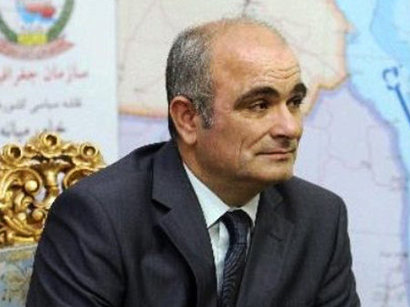
Russian guy

Russian ambassador to Iran Levan Jagarian said that Russia urges for fast resolution of Iran’s nuclear dispute.

“We want that Iran nuclear dispute to be resolved as soon as possible,” Jagarian said, Iran’s Fars news agency reported on June 2.

“Russia urges western powers to adopt more practical stances against Iran in the nuclear issue in order to reach a reliable and stable deal,” the ambassador added.

Negotiations have reached a more complicated phase, he said, adding that the international sanctions have negatively affected the volume of trade between Iran and Russia.

Iran and the six world powers have been discussing ways to iron out differences and start drafting a final deal that would end the West’s dispute with Iran over the country’s nuclear energy program.

The two sides wrapped up their latest round of nuclear talks in the Austrian capital Vienna on May 16.

Condemn and wait

June 2, 2014

Condemn and wait, Israel Hayom, Dan Margalit, June 2, 2014

The U.S. has been angry at Israel, as it has been perceived as the main culprit that stifled the peace effort. Secretary of State John Kerry channeled this anger by arranging a meeting with Abbas just after the latter had announced a new unity government with Hamas. Washington did not unequivocally state that it would cut its ties with Abbas over his deal with Hamas. It only went so far as to say that it would have to reassess its relations with the new government. Such language could result in the U.S. recognizing a Hamas-PA government despite its terrorist hues.

But Israel has no interest in making things worse with the Americans and the Europeans. It should bide its time. Assuming the EU and the U.S. need a time-out before they accept the Palestinian dictate, why antagonize them by discussing explosive issues at the Diplomatic-Security Cabinet. There would be ample time left to pick up a fight with President Barack Obama.

A year ago, the Obama administration manhandled Palestinian Authority President Mahmoud Abbas into saying yes to a new peace process. It presented him with a rhetorical question, “Would you be willing to restart talks?”

Nine months passed, and just before the negotiations were to conclude, Abbas bolted and partnered with Hamas. He did not have enough stamina to wait until the deadline arrived. He was all too willing to be swayed by the terrorist group. Even Justice Minister Tzipi Livni, who represents the moderates in the Israeli government, would agree with this depiction of Abbas. In short, Israel was right to cut its ties with Abbas.

Last week, Abbas spoke before a sympathetic crowd of Israelis, vowing that the security cooperation between the Palestinian Authority and the Israel Defense Forces was “sacred.” According to Abbas, he is well aware of the fact that if there was no Israel to support him, Hamas might make him disappear. That is why continued cooperation was one of his first priorities, he told the crowd.

He has only one ace in the hole: The EU and the U.S. usually prefer Palestinian dictates. They know that Abbas has tried to dodge every attempt to strike a permanent peace deal, and they suspect Prime Minister Benjamin Netanyahu does not want such a deal either. But the world could not be bothered by the truth. As far as the international community is concerned, it is the Israelis who are to blame. This is yet another chapter in what is a long history of preferential treatment.

The U.S. has been angry at Israel, as it has been perceived as the main culprit that stifled the peace effort. Secretary of State John Kerry channeled this anger by arranging a meeting with Abbas just after the latter had announced a new unity government with Hamas. Washington did not unequivocally state that it would cut its ties with Abbas over his deal with Hamas. It only went so far as to say that it would have to reassess its relations with the new government. Such language could result in the U.S. recognizing a Hamas-PA government despite its terrorist hues.

But Israel has no interest in making things worse with the Americans and the Europeans. It should bide its time. Assuming the EU and the U.S. need a time-out before they accept the Palestinian dictate, why antagonize them by discussing explosive issues at the Diplomatic-Security Cabinet. There would be ample time left to pick up a fight with President Barack Obama.

Israel’s conduct is like a self-inflicted wound. The leaders of Judea and Samaria settlements claim that Prime Minister Benjamin Netanyahu caved in to U.S. pressure and essentially ground all settlement construction to a halt. If that is true, why hasn’t Israel come out with an official announcement? Wouldn’t that shift the onus to the Palestinians? If, as Netanyahu claims, this is not true, then the EU and the U.S. can once again claim that Israel is the “bad guy” when it comes to the faltering peace process (even though we all know this is not true). Such a pity.

Economy and Trade Minister Naftali Bennett, Housing and Construction Minister Uri Ariel, and the far Right in the Likud have acted irresponsibly and have been unwise: instead of putting on a show and pretending that they were saddened by the deadlocked peace talks, they were overcome with joy because they had finally realized they could demand a gradual annexation of Judea and Samaria and the dismantling of the life-saving security fence. Those who doubt Israel’s sincerity when it comes to peace have been reinforced by this far-right bare-knuckles approach and they can now use this as solid evidence in their indictment against Israel.

For now, Israel should simply condemn the new Palestinian government and stress that it will only hold talks with Abbas. Israel must realize that patience and silence are politically viable options as well. “Therefore the prudent shall keep silence in that time” (Amos 5:13).

Palestinian unity government moves forward while Israel and US equivocate

June 2, 2014

Palestinian unity government moves forward while Israel and US equivocate, DEBKAfile, June 2, 2014

US Secretary of State John Kerry stated after his Sunday night phone call to Palestinian Authority Chairman Mahmoud Abbas (Abu Mazen) that the Obama administration would judge the Palestinian unity government, due to be sworn in Monday afternoon, June 2, by its deeds. Recognition would depend on the new regime recognizing Israel, upholding previously-signed Palestinian international undertakings and abstaining from terrorism and other violence.

Kerry must realize, after a year of being messed about in an abortive peace process, that Abu Mazen is a chameleon, apt to trot out different words and decisions as the moment takes him.

By its reconciliation with Abbas’ Fatah, this extremist Islamic group gains respect in Tehran and Moscow, after losing its allies in Damascus and Cairo, as well qualifying for international legitimacy without compromising its basic tenets and practices.

Netanyahu_goverment_1.6.14Binyamin Netanyahu weighs his Palestinian options

US Secretary of State John Kerry stated after his Sunday night phone call to Palestinian Authority Chairman Mahmoud Abbas (Abu Mazen) that the Obama administration would judge the Palestinian unity government, due to be sworn in Monday afternoon, June 2, by its deeds. Recognition would depend on the new regime recognizing Israel, upholding previously-signed Palestinian international undertakings and abstaining from terrorism and other violence.

Abbas sidestepped those commitments by assuring the Secretary that the new Palestinian ministers were appointed by him and they would conform with his wishes and policies.

Kerry must realize, after a year of being messed about in an abortive peace process, that Abu Mazen is a chameleon, apt to trot out different words and decisions as the moment takes him.

But how to explain the acceptance of this sliding scale by the Secretary of State and Prime Minister Binyamin Netanyahu and their equivocations in the face of the most outrageous Palestinian pretences?

DEBKAfile offers three possible explanations for their meekness:

1. John Kerry has chosen to put a brave face on the crash of his Middle East initiatives in late April and carry on as though his efforts may yet bring Israel and the Palestinians together for a peace accord – even though it is clear to the region and even Washington that the process is dead.

2. Netanyahu Sunday issued a dramatic call to the world not to recognize the new Palestinian unity government. “Hamas is a terrorist organization that seeks Israel’s destruction,” he said. “Such a government would not bolster peace but strengthen terror.” He added later that he couldn’t understand how when terrorism raised its head in Europe, in the form of the vile murders at the Brussels Jewish Museum, there were European leaders who had friendly words for the Palestinian terrorists, Hamas.

The same night, another Palestinian rocket landed on the Israeli side of the Gaza border.

Later, the prime minister was quoted as telling the security cabinet that he had been assured that Washington would not extend “immediate” recognition to the new Palestinian government.

This phrasing betrayed Netanyahu’s awareness that the Obama administration did not propose to put up a fight against dialogue with Hamas, notwithstanding its terrorist record.

Therefore, while condemning the Palestinian government of reconciliation and promising to cut off ties, the Israeli prime minister has not suspended the transfer of funds to Ramallah or abandoned cooperation with Palestinian security services.

And so, as Abu Mazen’s new government goes forward, Israel’s high rhetoric will lose its resonance.

3.  DEBKAfile’s Washington and Jerusalem sources report that Washington did inform Jerusalem that it stands by a written US commitment not to recognize or cooperate with a Palestinian regime which has a Hamas component. It was first given in May 2011 by Hillary Clinton as Secretary of State, and endorsed by her successor John Kerry at the outset of Israel-Palestinian peace talks last year.

Nonetheless, Netanyahu can’t avoid seeing that the Obama administration is looking for a way to wriggle out of this pledge.

Hamas too, had to grapple with Abu Mazen’s prevarications. It did so by staging a crisis every few hours up to the last minute before the final installment of the new government at 1 o’clock Monday.

The union, if it finally comes to be, will stand on shaky legs and be only skin deep.

Hamas has no intention of giving up its control of the Gaza Strip and subsuming its rule into the joint government, or of giving up its autonomous military arm, the Ezz e-Din Al-Qassam.

Even Palestinian daydreamers can’t imagine Hamas and Fatah agreeing on conditions for holding free elections in the West Bank and the Gaza Strip for a new parliament and president to succeed Abbas.

Therefore, John Kerry, Binyamin Netanyahu, Abu Mazen and Hamas Prime Minister Ismail Haniyeh are all playing along with a political game, although even play-acting may have consequences when politicians are on the stage.

One is the postponement of the agonizing decisions the Israeli and Palestinian leaders would have been compelled to make for a peace accord. But the big winner is Hamas – which is why it is willing to put up with a lot – although it dug in its feet at the last moment over the office of Palestinian prisoners and demanded that all Palestinian security agencies declare war on “the Zionists.”

By its reconciliation with Abbas’ Fatah, this extremist Islamic group gains respect in Tehran and Moscow, after losing its allies in Damascus and Cairo, as well qualifying for international legitimacy without compromising its basic tenets and practices.

Off Topic: Palestinians hail unity as new government sworn in

June 2, 2014

Palestinians hail unity as new government sworn in, Times of Israel, June 2, 2014

Abbas praises ‘end of Palestinian division,’ indicates Ramallah will continue statehood drive; ceremony goes ahead after last-minute dispute.

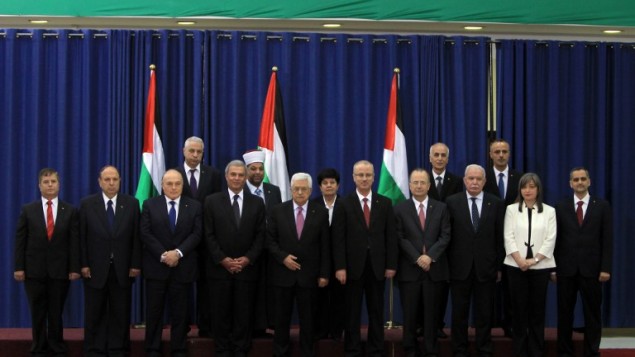
Pal unity govt sworn inPalestinian Authority President Mahmud Abbas (C) poses for a picture with the members of the new Palestinian unity government in the West Bank city of Ramallah, Monday, June 2, 2014 (photo credit: AFP/ABBAS MOMANI)
 

Palestinian Authority President Mahmoud Abbas swore in the ministers of a new unity government Monday afternoon after Gaza’s Hamas rulers and Abbas’s Fatah resolved a last-minute disagreement over a key government ministry.

Abbas hailed the “end” of Palestinian division, saying: “Today, with the formation of a national consensus government, we announce the end of a Palestinian division that has greatly damaged our national case.

“This black page in the history (of the Palestinians) has been turned forever, and we will not allow it to come back,” he added

Hamas praised the “national consensus government, which represents all the Palestinian people,” the movement’s spokesman, Sami Abu Zuhri, told AFP.

The swearing in marked the end of years of division between the rival Palestinian factions, with the technocratic government planned to set up elections in the next six months.

Israel has skewered the unity deal, accusing Abbas of preferring a pact with the Islamist Hamas movement over peace with Israel and threatening punitive measures.

At the swearing in, Abbas lashed out as Israel’s refusal to recognize the government, indicating the Palestinians would continue efforts for statehood, put on hold over the past year during peace talks with Israel. “We won’t stand with our hands folded in the face of punitive measures, and we will use every legal and diplomatic tool at our disposal in the international community,” he said according to a Haaretz report.

In Gaza, Hamas leader Ismail Haniyeh praised the “historic” move.

Hours before the swearing-in ceremony, Hamas had said that it would not recognize the unity government if it did not include a minister for prisoners affairs. At the last minute, the two sides agreed to have Prime Minister Rami Hamdallah man the post.

Abbas had left the position off the roster with the intention of delegating the matter to a committee.

The new government has 17 ministers, five of them from Gaza. Hamdallah, the current premier in the West Bank, will also hold the interior portfolio.

Abbas has already pledged that the new administration will abide by the principles laid down by the Middle East peace Quartet that call for recognizing Israel, rejecting violence and abiding by all existing agreements. However, Hamas has yet to ratify those conditions.

Abbas’s Fatah party and Hamas ended several years of animosity when they reached an agreement in late April to form an interim unity government of technocrats, with full elections by year’s end.

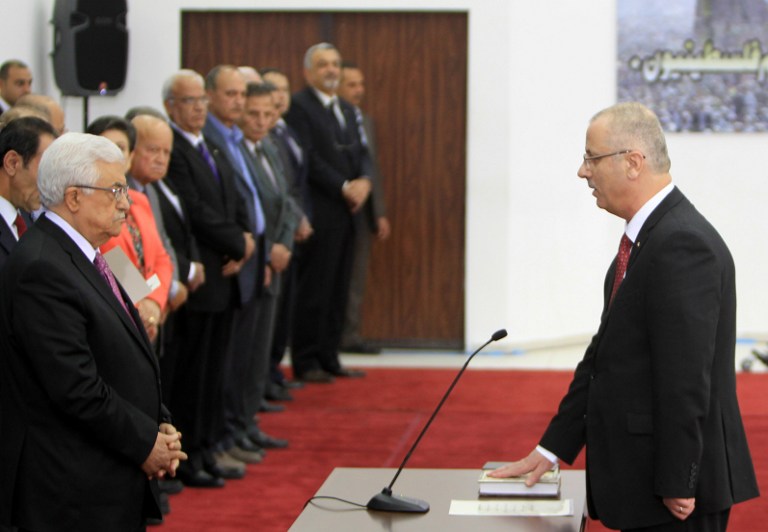
PALESTINIAN-POLITICS-GOVERNMENT-HAMAS-ABBASPalestinian Prime Minister Rami Hamdallah (R) is sworn in along with the new Palestinian unity government in the presence of PA President Mahmud Abbas (L) in the West Bank city of Ramallah, Monday, June 2, 2014 (photo credit: AFP/ABBAS MOMANI)

Prime Minister Benjamin Netanyahu ended peace talks with Abbas after the unity government was announced, and has repeatedly stated that Israel will not work with a Palestinian leadership that includes Hamas, which Israel and much of the West consider a terror group. On Monday, Netanyahu hit out at European governments for condemning a shooting attack on the Jewish museum in Brussels while responding with “ambiguity” to Palestinian reconciliation.

“It is puzzling to me that governments in Europe that strongly criticize this act of murder speak with ambiguity and even friendliness about a unity government with Hamas, a terror organisation that carries out crimes like these,” he said.

Ahead of the swearing-in ceremony, US Secretary of State John Kerry telephoned Abbas to express “concern about Hamas’s role in any such government,” State Department spokeswoman Jen Psaki told reporters Sunday, saying he had again stressed the importance of its acceptance of the Quartet principles.


Off Topic: The color of the Russian ‘green card’

June 2, 2014

The color of the Russian ‘green card’ | JPost | Israel News.

( An angry denunciation of Putin as well as Israel’s “appeasement” of Russia. – JW )

By TAL HARRIS

06/01/2014 22:03

Three years ago “elections” were held in Russia which were essentially a game of musical chairs between Vladimir Putin and Dmitry Medvedev in the roles of president and prime minister.

Vladimir Putin. [File]

Vladimir Putin. [File] Photo: REUTERS

Three years ago “elections” were held in Russia which were essentially a game of musical chairs between Vladimir Putin and Dmitry Medvedev in the roles of president and prime minister.

Israel’s foreign minister at the time (and currently), Avigdor Liberman, surprised his own office by immediately standing behind Putin. Since independence, David Ben-Gurion – Israel’s “Old Man” – advocated an alliance with the West. The voices of the hard Left which were sounding praises of Stalin were drowned by supporters of the democratic part of the hemisphere. In recent years it seems as though that strategic choice is being reconsidered – not for the false promise of a workers’ revolution, but for one of the darkest, most oppressive, corrupted and self-serving regimes on earth.

Last month the US administration tabled a resolution in the UN General Assembly on Russian’s aggression in the Ukraine. The democratic bloc of states rallied in favor, but Israel skipped the vote. State Department spokeswoman Jen Paski said “the US was surprised,” while others expressed their shock about Israel’s choice in blunter terms.

This was followed by an important statement made last week by Alexander Romanovich, vice chairman of the Committee on International Affairs in the Russian Duma: “Nothing can harm the good relations between our two countries, as long as another power doesn’t intervene,” implying the expectation that Israel choose between the US and Russia, that it can’t have both.

The trend seems to go beyond the bizarre conduct and interests of Liberman. A couple of weeks ago, former prime minister Ehud Barak gave a rare 25-minute-long interview to Putin’s mouthpiece, Russia Today, in which he claimed that the president is “one of the most open and normal leaders Russia had in the past 500 years.”

In other countries there is ideological support for Putin. In Germany, for example, there seems to be an almost blind and deeply rooted anti-American sentiment.

Some Israeli leaders support Putin for equally short-sighted interests.

There is no room for rethinking the alliance between Israel and the West, and not only because Russia’s national resilience is far inferior to that of the US – militarily, technologically, economically and demographically.

Charles De Gaulle once said, “France has no friends, only interests,” and there cannot be doubt regarding who best serves Israel’s interests as a Jewish democracy. The US fervently defends Israel diplomatically, while Russia is ready to condemn the Jewish state, ever since the Soviet Union voted yes to “determine that Zionism is a form of racism” (UN General Assembly resolution 3379, 1975).

Putin’s supporters also need to recall the arms shipments he made to Iran and Syria. On the other hand, it is necessary to recall the $3.4 billion of approved aid for Israel’s defense budget for the fiscal year 2014. That’s $9.3 million a day – in dollars, not in rubles. Finally, the greatest Jewish Diaspora lives in North America – Jews fled Russia and the former Soviet Union as soon as they could. Choosing the Duma over the Congress, as implied by vice chairman Romanovich, could put at least 5,425,000 American-Jews in an unenviable position.

Perhaps most importantly, choosing Russia would also have profound moral consequences. One doesn’t have to read through Human Rights Watch’s last report on Russia, which depicts a reality where non-governmental organizations, freedom of assembly and expression are restricted, 76 anti-gay laws are enforced, and Kremlin critics and human rights defenders are harassed or sometimes mysteriously disappear. One can and should criticize America’s policies. However, when it comes to advocates of Putin, all it takes to tell right from wrong is to know that while the US Green Card lottery has more than 10 million applicants a year, there’s only a select few that even know the color of the Russian “green card.”

The writer had been the executive director of OneVoice Israel and is currently living and working in Washington, DC.