Archive for April 2014

Obama signs law designed to bar Iran’s UN envoy

April 19, 2014

Obama signs law designed to bar Iran’s UN envoy | The Times of Israel.

Amid hostage crisis controversy, US leader endorses ban of any representative ‘engaged in terrorist activity’

April 19, 2014, 2:01 am
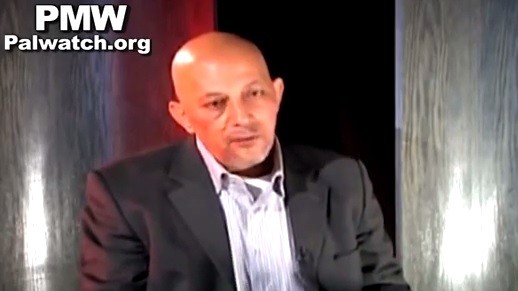
Iran's newly appointed UN ambassador Hamid Aboutalebi (screen capture: YouTube)

Iran’s newly appointed UN ambassador Hamid Aboutalebi (screen capture: YouTube)

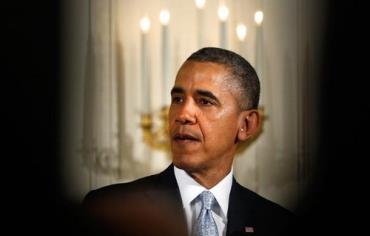
US President Barack Obama signed into law Friday a bill designed to bar Iran’s pick for UN ambassador from US soil over his links to the 1979 American embassy hostage siege.

But Obama also issued a statement saying that he would only regard the legislation as guidance, warning it could infringe upon his executive powers as president.

The spat over Hamid Aboutalebi’s nomination has blown up amid a cautious thaw in relations between the US and Iran as Tehran’s new leadership seeks to negotiate a nuclear treaty with global powers.

The United States said earlier this week that it would not issue a visa to Aboutalebi because he was involved in the hostage crisis at the US embassy in Tehran.

The move followed outrage in Congress over his selection by Iran and reflected the extent to which the episode in 1979, which was seen as a humiliation for the United States, still challenges Obama’s efforts to improve relations with Tehran.

The law bars from US soil “any representative to the United Nations who the president determines has been engaged in terrorist activity against the United States or its allies and may pose a the US at to US national security interests.”

Despite signing the bill Obama made plain his reservations about its implications in other potential cases.

Citing precedent established by former president George H.W. Bush, Obama wrote that the law could restrict his powers to accept or reject the credentials of foreign ambassadors.

“Acts of espionage and terrorism against the United States and our allies are unquestionably problems of the utmost gravity,” Obama said in signing the measure.

“I share the Congress’s concern that individuals who have engaged in such activity may use the cover of diplomacy to gain access to our nation.”

But he added that he would treat the new law as an “advisory” only.

Presidents sometimes release signing statements when they believe that a new law infringes on their executive powers as defined by the US Constitution.

In 1979, dozens of American diplomats and staff were held for 444 days by radical Iranian students at the US embassy in Tehran.

The protracted standoff profoundly shocked the United States and led to the severing of all diplomatic ties between the US and Iran for the past three decades.

As the host government, the United States is generally obliged to issue visas to diplomats who serve at the United Nations.

Aboutalebi, a veteran diplomat who currently heads Iranian President Hassan Rouhani’s political affairs bureau, has insisted he was not part of the hostage-taking in November 1979, when a Muslim student group seized the US embassy after the overthrow of the pro-Western shah.

He has acknowledged he served a limited role as a translator for the students who took the Americans.

Off Topic: Freed terrorist: Israel interfered with my stamp-collecting

April 18, 2014

Freed terrorist: Israel interfered with my stamp-collecting, Times of Israel, Lazar Berman, April 18, 2014

(As the “peace process” draws to a close due solely to Israeli intransigence, Israel’s inhumanity will continue to become increasingly obvious. Depriving Saint Mr. Rabbo of his clear right to humane arrangements for stamp collecting — for no better reason than his murder of two vile Israeli imperialists to avenge “Muhammad’s blood!” That disgusting lack of regard for human rights is simply another horrid example of Israel’s lack of proportionality in dealing with peace-loving Palestinians. It’s no wonder that the civilized world is upset with the Israeli invaders. — DM)

Issa Abd Rabbo, who murdered two hikers in 1984, complains that he couldn’t get ‘special albums’ in prison

RabboIssa Abd Rabbo speaks about the murder he committed during an interview on Ma’an TV (Photo courtesy: Palestinian Media Watch)

Palestinians have long accused Israel of a range of human rights violations. But recently freed Palestinian terrorist Issa Abd Rabbo came up with a new one — infringing on his philatelic rights while he was incarcerated, and thus keeping him from attaining high quality stamps and “special albums.

Abd Rabbo was released from an Israeli prison in October 2013 as part of peace talks between Israel and the Palestinian Authority. He was serving two life sentences for murdering two Israelis, Ron Levi and Revital Seri, as they were hiking south of Jerusalem in 1984.

Abd Rabbo happened upon the two university students as they rested under a pine tree. He tied them up at gunpoint, covered their heads with bags and fatally shot them both.

According to a Palestinian Media Watch translation Friday, Abd Rabbo told Al Hayat al Jadida, a PA daily newspaper,  in an April 8 interview, ‘I’m proud of the stamps I collected in prison, but it was difficult for me to pursue [my] hobby in prison, because there were many restrictions, few letters arrived, and the quality of the stamps. Prison also affects our hobbies, and I had no special albums to put the stamps in properly, so I put them in an envelope — the same one that left prison with me.’”

“I have resumed my hobby of stamp collecting with enthusiasm, to make up for what I lost during my time in prison…” Abd Rabbo continued.

“I asked each prisoner to save the envelope for me so I could cut out the stamp or stamps attached to it. During my long time in prison, I collected 100 stamps, which accompanied me whenever I moved between nearly all of the occupation’s prisons…”

Abd Rabbo and other released murderers were welcomed by Palestinian Authority President Mahmoud Abbas  as “heroes.”

In a January 9 interview with Palestinian Ma’an news agency, Abd Rabbo calmly recounted the murder of the two Israelis.

“There was supposed to be a military operation shooting at a bus transporting Israeli soldiers…,” he remembered. “I was surprised when on my way to the area, I waited, waited and waited and the bus didn’t come. I was forced to carry out an operation on my own, an improvisation, I took it upon myself. An Israeli car approached, with two in it. I said, here’s a chance and I don’t want to return empty-handed.”

They left the car… and walked towards the valley, and sat down under a pine tree. I went down to them. Of course I was masked and was carrying a rifle. He asked me: ‘Are you a guard here?’ I told him: ‘No, I’m in my home.’ I told him: ‘You are not allowed here. This is our land and our country. You stole it and occupied our land and I’m going to act against you.’”

“They were surprised by what I told them. I tied them up of course and then sentenced them to death by shooting, in the name of the revolution. I shot them, one bullet each, and went [hiding] in the mountains… I went to my aunt and told her: ‘We have avenged Muhammad’s blood.’”

I told her: ‘Instead of one, we got two.’ She cried out in joy.”


Dead wrong

April 18, 2014

Dead wrong, Israel Hayom, Ruthie Blum, April 18, 2014

(As I have commented before, the Kerry “peace process” has far more to do with the process, and extending it ad nauseam, than with bringing peace. Even assuming that the PA wants some species of peace, Hamas prefers dead Israelis.– DM)

[The purpose of a “puff piece” in the Palestinian Press was] to convey the message that it is always worthwhile to kill innocent Israelis, since incarceration at the hands of the Zionist enemy is not so bad; and as long as Israelis crave peace, there is a good chance of getting released from prison when yet another round of “negotiations” to “negotiate” is in the air.

Israel must cease proving the PA right and start showing the U.S. that it is wrong. Dead wrong.

On Thursday, Israel and the Palestinian Authority agreed to continue “negotiating” the terms that would enable both sides to extend “negotiations” on whether to enter “negotiations” for Palestinian statehood. The farce has become so tedious that its latest act wasn’t even mentioned in the Israeli media.

This is not surprising.

Like the boy who cried wolf, representatives of the United States, the PA and Israel keep pretending that a deal of some kind is around the corner. And, as in Aesop’s fable, when it does arrive, its deadly fangs will likely go unnoticed until it’s too late.

Though Prime Minister Benjamin Netanyahu blamed PA incitement for Monday’s terrorist attack (in which Israel Police Chief Superintendent Baruch Mizrahi, traveling with his pregnant wife and five children to a Passover Seder, was killed), this does not mean he is done making concessions. And now that the U.S. is cynically using Jonathan Pollard as bait, Netanyahu is really in a bind. His constituents want Pollard’s freedom. In order to obtain it for the incarcerated spy, however, he would have to accept an American framework according to which all Jewish construction beyond the 1949 armistice lines is halted and 400 additional Palestinian terrorists are released from prison.

In her eulogy to her dead husband on Wednesday, Hadas Mizrahi — healing from two bullet wounds — called on Netanyahu to stop releasing terrorists “while more and more families are murdered.” Since her own family’s attackers have yet to be apprehended, she could not know whether they were among the Palestinian prisoners recently freed by Israel as an enticement to the PA to “negotiate” a new round of “negotiations.”

But she is certainly not alone in her view of the matter. In fact, the prevailing position across the Zionist political spectrum is that terrorists should remain in jail forever. This is not solely due to the statistical probability that, once released, they are likely to resume committing or instigating the bloody activities for which they are hailed in Ramallah and Gaza. It is also an issue of morality.

Most Israelis believe that anyone who slaughters innocent civilians does not deserve mercy, let alone leniency, even if he was acting out of an ideological-religious imperative. In the absence of the death penalty (the only person ever civilly executed in Israel was Nazi war criminal Adolf Eichmann, hanged in 1962; Meir Tobianski, an IDF soldier falsely accused of treason during the 1948 War of Independence, was court-martialed and killed by firing squad), the attitude in Israel is that terrorists should at the very least rot behind bars.

It is no wonder, then, that when given a glimpse into the prison conditions of the monsters in question, the general public prefers to look the other way. The victims of terrorism and their loved ones, on the other hand, are forced at such moments to have salt poured into their ever-present wounds.

A recent case in point is that of Palestinian terrorist Issa Abd Rabbo, which was brought to light by Palestinian Media Watch this week.

In 1984, Abd Rabbo ambushed and executed two Israeli college students while they were hiking near Jerusalem.

He recounted the murder matter-of-factly: “I tied them up, of course, and then sentenced them to death by shooting, in the name of the revolution. I shot them, one bullet each, and went [hiding] in the mountains.”

For his heinous act, Abd Rabbo was sentenced to two consecutive life terms.

But in October, he was one of 104 terrorists released as part of Israel’s attempt to fulfill the PA precondition for “negotiating” a resumption of “negotiations.” And, like his compatriots, he was welcomed home with great fanfare by the PA leadership.

Earlier this month, on April 8, he was treated to a glowing profile in the PA-controlled daily newspaper Al-Hayat Al-Jadida.

Here is a choice excerpt from the article, outlining the torture the terrorist had to endure:

“Before his arrest, Abd Rabbo collected stamps … among them … a collection of Jordanian stamps he had cut out of postal envelopes. After his arrest, he tried to pursue his hobby in prison. … Abd Rabbo said: ‘I asked each prisoner to save the envelope for me so I could cut out the stamp or stamps attached to it. During my long time in prison, I collected 100 stamps, which accompanied me whenever I moved between nearly all of the occupation’s prisons … but it was difficult for me to pursue [my] hobby in prison, because there were many restrictions, few letters arrived, and the quality of the stamps [was poor]. Prison also affects our hobbies, and I had no special albums to put the stamps in properly.'”

This is but one of many such puff pieces in the Palestinian press. Their purpose is to convey the message that it is always worthwhile to kill innocent Israelis, since incarceration at the hands of the Zionist enemy is not so bad; and as long as Israelis crave peace, there is a good chance of getting released from prison when yet another round of “negotiations” to “negotiate” is in the air.

Israel must cease proving the PA right and start showing the U.S. that it is wrong. Dead wrong.

Rouhani talks peace, outreach at army parade

April 18, 2014

Rouhani talks peace, outreach at army parade | The Times of Israel.

‘We are not after war,’ Iranian president says, but warns that the Islamic Republic will crush any aggressors

April 18, 2014, 12:28 pm
Iranian President Hassan Rouhani attends a joint press conference with his Azeri counterpart Ilham Aliyev, after their meeting in Tehran, Iran, on April 9, 2014. (photo credit: AP/Ebrahim Noroozi)

Iranian President Hassan Rouhani attends a joint press conference with his Azeri counterpart Ilham Aliyev, after their meeting in Tehran, Iran, on April 9, 2014. (photo credit: AP/Ebrahim Noroozi)

Iran’s president underscored his moderate policies and outreach to the West in a speech Friday during a military parade on the country’s National Army Day.

Referring to the ongoing negotiations between Iran and the world powers over Tehran’s controversial nuclear program, President Hassan Rouhani said Iran has shown it has no hostile intentions toward anyone in the world, including the United States, which has long been considered an enemy.

“During the talks, we announced to the world and we say so again… we are not after war, we are after logic, we are after talks,” Rouhani said.

He touted Iran’s diplomatic outreach and said the backing of the military and the nation was crucial. “Support by the armed forces and support by our brave people have empowered the officials in charge of the talks on the diplomatic front.”

The Iranian president made no mention of archfoe Israel, but said Iran “will not invade any country,” although it would “resist any invasion.”

The tone in the Iranian state-run media, however, was more aggressive. The semi-official Fars news agency quoted Rouhani as saying that Iran possessed a strong deterrent power against the “greedy eyes of others.

“There is no doubt that Iran, with such brave sons, will never allow any aggression against its soil,” he said. Press TV reported Rouhani as saying Iran would “crush any aggression.”

Rouhani also assured neighboring countries that Iran seeks better ties with them, saying that “neighbors should know that our army supports peace and stability.”

The remarks were a stark contrast to Rouhani’s belligerent predecessor, Mahmoud Ahmadinejad.

Since he was elected last June, Rouhani has pledged to resolve the nuclear dispute with the West and end painful economic sanctions imposed over Tehran’s controversial nuclear program, which the West fears could result in the making of a nuclear weapon.

Tehran denies the charge, saying its nuclear activities — mainly those surrounding its uranium enrichment, which is a possible pathway to nuclear arms — are meant for peaceful purposes only, such as power generation and cancer treatment. Iran also asserts it has a right to enrich uranium under international law.

Iran and six world powers — the five permanent members of the UN Security Council plus Germany — reached an interim deal in November 2013 that put limits on Tehran’s enrichment levels in exchange for an easing of some sanctions.

Talks are ongoing for a final deal that would remove all possibilities that the Islamic Republic could use its capabilities to build a nuclear weapon.

In Friday’s parade, Iran showcased its air defense systems, including the S-200 Russian-made, medium to high altitude surface-to-air missile system designed primarily to track, target, and destroy aircraft and cruise missiles.

Also on display were fighter jets such as the US-made F-4 and F-14, the Russian-made MIG-29 and Sukhoi-24, as well as Iran’s indigenous fighter plane, the Saegheh. The parade also showed off a newer version of the short-range, surface-to-surface Fajr-5, Nazeat and Zelzal missiles.

Iran has tried to achieve military self-sufficiency since 1992 and has also produced light submarines and torpedoes. Navy Commander Rear Admiral Habibollah Sayyari announced Friday that Iran would unveil a new submarine “with high capabilities” — dubbed Fateh — later this year, as well as several new destroyers, Fars reported.

Column one: The disappearance of US will

April 17, 2014

Column one: The disappearance of US will, Jerusalem Post,  Caroline B. Glick, April 17, 2014

(A good summary of the foreign policy “successes” of the United States of Obama. — DM)

In Europe, in Asia, in the Middle East and beyond, the America’s most dangerous foes are engaging in aggression and brinkmanship unseen in decades.

Obama on PassoverObama on Passover Photo: REUTERS

The most terrifying aspect of the collapse of US power worldwide is the US’s indifferent response to it.

In Europe, in Asia, in the Middle East and beyond, the America’s most dangerous foes are engaging in aggression and brinkmanship unseen in decades.

As Gordon Chang noted at a symposium in Los Angeles last month hosted by the David Horowitz Freedom Center, since President Barack Obama entered office in 2009, the Chinese have responded to his overtures of goodwill and appeasement with intensified aggression against the US’s Asian allies and against US warships.

In 2012, China seized the Scarborough Shoal from the Philippines. Washington shrugged its shoulders despite its mutual defense treaty with the Philippines. And so Beijing is striking again, threatening the Second Thomas Shoal, another Philippine possession.

In a similar fashion, Beijing is challenging Japan’s control over the Senkaku Islands in the East China Sea and even making territorial claims on Okinawa.

As Chang explained, China’s recent application of its Air-Defense Identification Zone to include Japanese and South Korean airspace is a hostile act not only against those countries but also against the principle of freedom of maritime navigation, which, Chang noted, “Americans have been defending for more than two centuries.”

The US has responded to Chinese aggression with ever-escalating attempts to placate Beijing.

And China has responded to these US overtures by demonstrating contempt for US power.

Last week, the Chinese humiliated Defense Secretary Chuck Hagel during his visit to China’s National Defense University. He was harangued by a student questioner for the US’s support for the Philippines and Japan, and for opposition to Chinese unilateral seizure of island chains and assertions of rights over other states’ airspace and international waterways.

As he stood next to Hagel in a joint press conference, China’s Defense Chief Chang Wanquan demanded that the US restrain Japan and the Philippines.

In addition to its flaccid responses to Chinese aggression against its allies and its own naval craft, in 2012 the US averred from publicly criticizing China for its sale to North Korea of mobile missile launchers capable of serving Pyongyang’s KN-08 intercontinental ballistic missiles. With these easily concealed launchers, North Korea significantly upgraded its ability to attack the US with nuclear weapons.

As for Europe, the Obama administration’s responses to Russia’s annexation of Crimea and to its acts of aggression against Ukraine bespeak a lack of seriousness and dangerous indifference to the fate of the US alliance structure in Eastern Europe.

Rather than send NATO forces to the NATO member Baltic states, and arm Ukrainian forces with defensive weapons, as Russian forces began penetrating Ukraine, the US sent food to Ukraine and an unarmed warship to the Black Sea.

Clearly not impressed by the US moves, the Russians overflew and shadowed the US naval ship. As Charles Krauthammer noted on Fox News on Monday, the Russian action was not a provocation. It was “a show of contempt.”

As Krauthammer explained, it could have only been viewed as a provocation if Russia had believed the US was likely to respond to its shadowing of the warship. Since Moscow correctly assessed that the US would not respond to its aggression, by buzzing and following the warship, the Russians demonstrated to Ukraine and other US allies that they cannot trust the US to protect them from Russia.

In the Middle East, it is not only the US’s obsessive approach to the Palestinian conflict with Israel that lies in shambles. The entire US alliance system and the Obama administration’s other signature initiatives have also collapsed.

After entering office, Obama implemented an aggressive policy in Pakistan, Yemen and elsewhere of killing al-Qaida operatives with unmanned drones. The strategy was based on the notion that such a campaign, that involves no US boots on the ground, can bring about a rout of the terrorist force at minimal cost human cost to the US and at minimal political cost to President Barack Obama.

The strategy has brought about the demise of a significant number of al-Qaida terrorists over the years. And due to the support Obama enjoys from the US media, the Obama administration paid very little in terms of political capital for implementing it.

But despite the program’s relative success, according to The Washington Post, the administration suspended drone attacks in December 2013 after it endured modest criticism when one in Yemen inadvertently hit a wedding party.

No doubt al-Qaida noticed the program’s suspension. And now the terror group is flaunting its immunity from US attack.

This week, jihadist websites featured an al-Qaida video showing hundreds of al-Qaida terrorists in Yemen meeting openly with the group’s second in command, Nasir al-Wuhayshi.

In the video, Wuhayshi threatened the US directly saying, “We must eliminate the cross,” and explaining that “the bearer of the cross is America.”

Then there is Iran.

The administration has staked its reputation on its radical policy of engaging Iran on its nuclear weapons program. The administration claims that by permitting Iran to undertake some nuclear activities it can convince the mullahs to shelve their plan to develop nuclear weapons.

This week brought further evidence of the policy’s complete failure. It also brought further proof that the administration is unperturbed by evidence of failure.

In a televised interview Sunday, Iran’s nuclear chief Ali Akhbar Salehi insisted that Iran has the right to enrich uranium to 90 percent. In other words, he said that Iran is building nuclear bombs.

And thanks to the US and its interim nuclear deal with Iran, the Iranian economy is on the mend.

The interim nuclear deal the Obama administration signed with Iran last November was supposed to limit its oil exports to a million barrels a day. But according to the International Energy Agency, in February, Iran’s daily oil exports rose to 1.65 million barrels a day, the highest level since June 2012.

Rather than accept that its efforts have failed, the Obama administration is redefining what success means.

As Strategic Affairs Minister Yuval Steinitz noted, in recent months US officials claimed the goal of the nuclear talks was to ensure that Iran would remain years away from acquiring nuclear weapons. In recent remarks, Secretary of State John Kerry said that the US would suffice with a situation in which Iran is but six months away from acquiring nuclear weapons.

In other words, the US has now defined failure as success.

Then there is Syria.

Last September, the US claimed it made history when, together with Russia it convinced dictator Bashar Assad to surrender his chemical weapons arsenal. Six months later, not only is Syria well behind schedule for abiding by the agreement, it is reportedly continuing to use chemical weapons against opposition forces and civilians. The most recent attack reportedly occurred on April 12 when residents of Kafr Zita were attacked with chlorine gas.

The growing worldwide contempt for US power and authority would be bad enough in and of itself. The newfound confidence of aggressors imperils international security and threatens the lives of hundreds of millions of people.

What makes the situation worse is the US response to what is happening. The Obama administration is responding to the ever-multiplying crises by pretending that there is nothing to worry about and insisting that failures are successes.

And the problem is not limited to Obama and his advisers or even to the political Left. Their delusional view that the US will suffer no consequences for its consistent record of failure and defeat is shared by a growing chorus of conservatives.

Some, like the anti-Semitic conservative pundit Patrick Buchanan, laud Putin as a cultural hero. Others, like Sen. Rand Paul, who is increasingly presenting himself as the man to beat in the 2016 Republican presidential primaries, indicate that the US has no business interfering with Russia’s aggression against Ukraine.

Iran as well is a country the US should be less concerned about, in Paul’s opinion.

Leaders like Sen. Ted Cruz who call for a US policy based on standing by allies and opposing foes in order to ensure US leadership and US national security are being drowned out in a chorus of “Who cares?” Six years into Obama’s presidency, the US public as a whole is largely opposed to taking any action on behalf of Ukraine or the Baltic states, regardless of what inaction, or worse, feckless action means for the US’s ability to protect its interests and national security.

And the generation coming of age today is similarly uninterested in US global leadership.

During the Cold War and in the immediate aftermath of the September 11 attacks, the predominant view among American university students studying international affairs was that US world leadership is essential to ensure global stability and US national interests and values.

Today this is no longer the case.

Much of the Obama administration’s shuttle diplomacy in recent years has involved sending senior officials, including Obama, on overseas trips with the goal of reassuring jittery allies that they can continue to trust US security guarantees.

These protestations convince fewer and fewer people today.

It is because of this that US allies like Japan, South Korea and Saudi Arabia, that lack nuclear weapons, are considering their options on the nuclear front.

It is because of this that Israeli officials are openly stating for the first time that the US cannot be depended on to either secure Israel’s eastern frontier in the event that an accord is reached with the Palestinians, or to prevent Iran from acquiring nuclear weapons.

It is because of this that the world is more likely than it has been since 1939 to experience a world war of catastrophic proportions.

There is a direct correlation between the US elite’s preoccupation with social issues running the narrow and solipsistic gamut from gay marriage to transgender bathrooms to a phony war against women, and America’s inability to recognize the growing threats to the global order or understand why Americans should care about the world at all.

And there is a similarly direct correlation between the growing aggression of US foes and Obama’s decision to slash defense spending while allowing the US nuclear arsenal to become all but obsolete.

America’s spurned allies will take the actions they need to take to protect themselves. Some will persevere, others will likely be overrun.

But with Americans across the ideological spectrum pretending that failure is success and defeat is victory, while turning their backs on the growing storm, how will America protect itself? 


Kerry : Ukranian Anti-Semitism Allegations ‘Grotesque’ – YouTube

April 17, 2014

Kerry : Ukranian Anti-Semitism Allegations ‘Grotesque’ – YouTube.

Secretary of State John Kerry calls allegations that Jews were required to register by pro-Russian forces “grotesque,” as he also condemned threats against the Russian Orthodox Church in Ukraine.

Off Topic: Making a case for space

April 17, 2014

Making a case for space | JPost | Israel News.

By REUVEN BEN-SHALOM

04/17/2014 15:51

Israel must lead in space exploration for maintaining its qualitative military edge, for national prestige, for promoting technological innovation and for leading humanity in pushing the boundaries of the next frontier.

The Final Frontier

The Final Frontier Photo: AMIT BAR-YOSEF

Last week, Israel successfully launched the Ofek 10 satellite, adding another essential intelligence asset and reinforcing Israel’s place in the prestigious club of space exploration leaders. Besides military applications, Israel is also involved in many space exploration initiatives with commercial and scientific goals.

Space exploration is a highly debatable issue. Here are some questions, addressing the matter from an international, as well as Israeli perspective.

Why invest in space? Aren’t there enough problems here on earth requiring our tax money?

Space is important for defense applications, such as reconnaissance and communication satellites. Missile defense requires operating in space in order to detect and shoot down threats even before they reenter the atmosphere. In the future, we may have other space-based capabilities, such as the ability to strike targets, either by laser or by dispensing precision guided munitions.

As for civilian uses, without satellites there would be no cell phones, no internet, no weather forecasting and no navigational data for WAZE. The need for cutting-edge technology aboard spacecrafts has stimulated progress and innovation, making life on earth easier and better, through a multitude of technologies adapted from spaceflight to everyday use.

It is difficult to predict what other implementations or spin-offs space exploration may someday produce. We may eventually master the ability not only to forecast, but to alter weather systems. We may solve the earth’s energy deficits by harvesting sustainable energy in space. We might need to protect earth from an existential threat such as an inbound asteroid or sun flare. Maybe we will dispose of our waste in some remote planet. And of course, we may simply want to take a vacation on Mars.

The pursuit of pure science and abstract knowledge also motivates us. We need to satisfy our curiosity, and deepen our understanding of the universe, our planet and ourselves. We are inspired by space exploration. Steven Hawking said it best: “To confine our attention to terrestrial matters would be to limit the human spirit.”

So operating in space is important. But why risk the lives of astronauts, when robots could do it safer, better, and cheaper?
Life support systems built to withstand the harsh and unforgiving environment in space make spaceships bigger and much more expensive. Unmanned platforms would give us much more science for the same money.

In his book Breakout Into Space, George Henry Elias presents a detailed argument on why the human race, led by the United States, must develop and settle space as the next frontier. Our species may someday need to leave earth and find a new habitat, due to overpopulation, natural catastrophes such as an asteroid impact, or if we render the planet inhabitable by nuclear or environmental disasters.

His case may sound somewhat apocalyptic, but in my opinion it is sadly very realistic.

Since we are a generation that has grown into relative stability, it’s hard for us to grasp this, but reviewing global trends, and even looking across the border at our neighbors, teaches us how vulnerable our world really is.

In order to enable this human migration, we had better work on acquiring the means and methods for establishing a self-sufficient interplanetary civilization.

Data accumulated by scientists from the biomedical aspects of extended human presence in microgravity at the International Space Station (ISS) will someday enable long duration trips, such as to Mars and beyond.

Some prosperous and popular areas in the world were uninhabited and dangerous not too long ago, but people moved there, seeking a new life. We humans must always push the boundaries and boldly go where no man (or woman) has gone before. It’s who we are, it’s what we’re about, and history has taught us that this explorative attitude ultimately pays off.

But even before we leave earth, human spaceflight is essential for promoting life on earth. It is a fact that human space flight has significantly contributed to aviation safety. NASA has had an enormous influence on world aviation, introducing safety methodologies and technological improvements which were developed for space flight but found their way to passenger planes.

Seeing spaceflight and aviation as two separate entities is a mistake. There is no doubt that suborbital flight will eventually replace current methods for flying long distances, facilitating a trip from Israel to Australia in about one hour.

Why should Israel invest in space? Shouldn’t we leave this for countries with more resources?
First and foremost, it is crucial for our defense. A country as challenged as Israel must utilize and dominate space in order to keep its qualitative military edge, as we do on land, at sea and in the air.

Israel is a world leader in technological innovation, and it is only natural that we lead humanity in pushing the boundaries of the next frontier. The world needs our spirit and skills and we have a responsibility to contribute to making the world a better place. We know how to invent stuff. We believe in breaking ground and breaking the rules. We think outside of the box. We are explorers, inventors, entrepreneurs, pioneers and settlers.

Recent development of private space initiatives also opens up enormous markets and business opportunities.

Leading in space is also a matter of geopolitical leverage and national prestige. Prime Minister Netanyahu recently announced that Israel would send another astronaut to the ISS within a few years. Some commentators mentioned as-a-matter-of fact that it would be another Air Force pilot.

Colonel Ilan Ramon, the first Israeli astronaut, tragically perished along with his crewmembers aboard the Space Shuttle Colombia. He proved to be a wonderful ambassador for Israel, demonstrating not only remarkable professionalism, but a captivating personality.

The Mercury astronauts selected by NASA in 1959 were all military test pilots. The idea was to select people who had already proven their ability to withstand extreme physical and mental challenges.

In the novel Space, James Michener described the selection process of his imaginary “solid six” astronauts, where great emphasis was put on their public image.

PR was, and still is, an essential tool in garnering public support for the promotion of space exploration.

However, I believe that the next Israeli astronaut should be a scientist, not a pilot.

The advantages of an aviator’s skills are vastly outweighed by the need to choose someone who can promote scientific objectives. Moreover, this would be a wonderful opportunity for showing a side of Israel that is detached from defense aspects. If it were up to me, I would choose a woman scientist.

There is another aspect of space exploration which I find most appealing. It can serve as a collective human endeavor, characterized by neutrality, harmony and peace. The ISS is an incredible international collaboration, serving not only as a scientific lab, but as an experiment in multicultural coexistence and partnership.

It is fascinating to hear astronauts describe their feelings as they gaze down at earth.

Ilan Ramon wrote: “We are working this mission for the benefit of all mankind, and from space our world looks as one unity with no borders. So let me call from up here in space – let’s work our way for peace and better life for everyone on Earth.”

The writer is a former pilot in the IAF, founder of Cross-Cultural Strategies Ltd. and International Project Manager at CockpitRM.

www.CCSt.co.il

Former Iran atomic agency head tells about sabotaged material, deceiving IAEA

April 17, 2014

Former Iran atomic agency head tells about sabotaged material, deceiving IAEA | JPost | Israel News.

By HERB KEINON

04/17/2014 20:45

Israeli official says comments “should serve as a wake-up call to anyone who has any doubt about the duplicity of the Iranian regime.

Fereydoon Abbasi-Davani

Former head of Iran Atomic Energy Organization Fereydoon Abbasi-Davani Photo: REUTERS

The former head of Iran’s anomic energy organization admitted in a recent interview to an Iranian paper that Tehran lied to the International Atomic Energy Agency, and also described the ways the west subverted the country’s nuclear program by selling sabotaged parts.

Fereydoon Abbasi, who headed the Iranian agency under former president Mahmoud Ahmadinejad, told the Khorasan newspaper that at one point Iran stopped submitting the Design Information Questionnaire that the IAEA routinely requested to chart the planning and progress of Iran’s nuclear facilities.

This decision was taken, he said, because of Iran’s concern that the information of what parts Iran was seeking was transferred to western intelligence agencies which would then ensure that faulty or sabotaged parts were supplied.

“The IAEA inspector would honestly report, for instance, that a certain part or a certain pump had yet to arrive [in Iran], or to be installed,” he said, according to a translation of the interview by MEMRI, the Middle East Media Research Institute.

“As a result, the intelligence agency receives this information [from the IAEA and then] searches the globe for companies that make the pump, and pressures them. They would pressure that country or company not to transfer the parts or equipment to Iran, or would allow them to do so [only] after sabotaging [the parts]… For instance, if it was an electronic system, they would infect it with a virus, or plant explosives in it, or even alter the type of components, in order to paralyze [Iran’s] system.”

Abbasi said that this was the way in which western intelligence agencies infected Iranian computers with the Stuxnet worm, which set back the country’s nuclear program for months.  He said that western intelligence agencies closed Iran’s purchasing channels so that “no one [besides them] could sell us anything. [At the same time, they] opened the channels that they [personally] control, in order to provide Iran with equipment that would also benefit them. This, for example, [is how]… they got the Stuxnet virus [into Iran]. They planted it in equipment that Iran purchased.”

Abbasi said that on the basis of the information that Iran provided the IAEA, “they knew how many centrifuges we intend to install, and what parts we need, and therefore they prevented this equipment [from getting to Iran] – for instance, a hollow pump that was supposed to be purchased from AEG. The company itself is [probably] not at fault – these intelligence agencies carry out the sabotage and then transfer the equipment to Iran via that [company].”

This was the reason, he said, why Iran stopped providing information to the IAEA. “[We] would give the DIQ [to the IAEA] but only after the fact [in violation of the Non-Proliferation Treaty and IAEA regulations],” he said. “When we wanted to move the Arak reactor’s main warehouse, we concealed it, so that [IAEA inspectors] would not notice which workshop [the activity was being conducted in], since they might have carried out assassinations or sabotage there. [So] for several years we concealed warehouse, so that that company could do its work…”

With negotiations over Iran’s nuclear program continuing, one Israeli government official said that Abbasi’s comments “should serve as a wake-up call to anyone who has any doubt about the duplicity and mendacity of the Iranian regime, and their desire to hoodwink the international community.”

Off Topic: The Ukrainian exodus, let it be so

April 17, 2014

Israel Hayom | The Ukrainian exodus, let it be so.

Dan Margalit

Where is the right balance between Israel’s conflicting interests as they pertain to the events in Ukraine? It has no claim or stake in the future of Crimea, which has been essentially annexed unilaterally by Russia. It also has no vested interests in the actions of the separatists, who are acting on Russia’s behalf to tear the eastern part of the country from the capital Kiev. Is it a hostile takeover? Is it a domestic uprising? As it was said long ago, “It’s their problem.”

Not exactly though; while Israel has no preference on the outcome of the Ukrainian crisis, no one can ignore the fact that the United States expects Israel to support it, and when the U.S. is disappointed in this regard, it comes at a certain diplomatic price. For example, that Washington would not come to Jerusalem’s aid in the United Nations, on the Palestinian front, were Jerusalem to remain neutral on the Ukrainian issue.

But one can say that Israel’s interest lies in the other direction. Russian President Vladimir Putin is proving himself a dynamic leader, practical, able to create new facts on the ground. This is the situation as it currently appears, unless the pendulum swings against him somehow. A direct clash with Moscow, while it is notching victories (again, for the time being) no less, seems like an unnecessary headache.

In more sensitive talks, veteran diplomats have called into memory U.N. Resolution 242 issued in November 1967, which since then has been the basis for all Israeli-Arab negotiations, successful and unsuccessful alike. The starting point, according to its creators, and which has always been used to agitate Israel, includes the key sentence that has been ingrained into the mind of every Israeli diplomat since: “Inadmissibility of the acquisition of territory by war.”

The annexation of territories as a result of war is impermissible? The situations are not similar. Israel conquered Judea and Samaria in what was clearly a war of self-defense.

Even Israel’s harshest critic, Yeshayahu Leibowitz, accepted this. In contrast, Ukraine never provoked Russia, which justified its “price-tag” gangs taking to the city streets to undermine the government in Kiev.

They acted when Ukraine was holding tense debates over whether to democratically join the West, if at all, and Putin, with guile, moved to block the move while declaring he would enter a war of defense to protect the Russian-speaking population in the neighboring country. A government fell and rose in Kiev as a consequence. Nevertheless, Israel has been inclined to stay out of the matter, which provides an inherent bitter reminder of its own diplomatic issues.

Under these circumstances it is wise to take a modest approach. It is wise not to stick out; Israel needs to explain to Washington and Moscow that it wants no part in what is happening.

There is just one decidedly Israeli interest, which it gave up on years ago already and ceased properly fighting for: The welcomed increase — two and a half or three times the norm — of Jewish immigration to Israel from Ukraine.

Unfortunately, the land of Israel has always done a poor job attracting Jews. They came here mainly because they were rejected and pushed here by the Diaspora. Like the hooligans in one Ukrainian city who hung a poster that the time has come to expel the Jews. These are not ideal circumstances, but our arms are open regardless. Let them come en masse and let the Rabbinate refrain from raising difficulties. The Ukrainian exodus, 2014, this is what needs to interest Israel. Let it be so.


Off Topic: Jordanian air strike destroyed Al Qaeda raider force heading for US military base

April 17, 2014

Jordanian air strike destroyed Al Qaeda raider force heading for US military base.

DEBKAfile Exclusive Report April 17, 2014, 12:20 PM (IDT)

Jordanian air strike destroyed combat veihicles

Jordanian air strike destroyed combat veihicles

The Royal Jordanian Air force strike Wednesday, April 16, against a combat vehicle convoy from Syria destroyed an Al Qaeda raider force on its way to attack US military targets in the kingdom, debkafile’s military sources reveal.

Jordan’s first assault on a target outside the country took place on the Syrian side of the border opposite the eastern town of Ruwaished.

This episode brought to the fore how dramatically the threat al Qaeda-Iraq poses to Jordan, the US forces based their and Israel has escalated.

Amman has not disclosed where the air strike took place, who rode in the destroyed armored vehicles and where they came from.

According to debkafile’s counterterrorism sources, they were driven by Islamic State of Iraq and the Levant (ISIS) fighters, coming from the western Iraqi province of Anbar. To avoid running into Jordanian military formations around Ruwaished, the group moved through Syria in the Abu Kemal region and, after refueling and collecting extra fighters and arms, turned south and aimed for the Jordanian border, where their expedition was abruptly brought to a close.

Our intelligence sources report that their target was a secret US-Jordanian training facility situated west of Ruwaished, where Iraqi army troops are being instructed in advanced counter terror combat tactics. At the end of these courses, the graduates return to their units, better able to put up a fight against the al Qaeda forces continuing to overrun large swathes of their country, and posing a real danger to Baghdad.

This episode broke new ground in more than one area.

It was the first ISIS operation directed against the American military presence in Jordan, and also the first time the jihadists used stealth to creep through a crack between the Jordanian, Iraqi and Syrian borders.

ISIS planners were well aware of the two full divisions the Jordanian army had strung out along its borders with Syria and Iraq, to seal the kingdom off from Islamist terrorist incursions. Those planners were crafty enough to find away around this barrier.

However, many Jordanians have joined up with the Al Qaeda branches of Iraq and Syria. It is thought to be only a matter of time before they return to home ground fired up with the jihadist doctrine of terror.

The Jordanians don’t say how they knew the ISIS vehicle convoy was heading their way. It stands to reason that US or Jordanian surveillance aircraft detected the vehicles on the move. Since there was no time to drop Jordanian commandos to apprehend the terrorists in Syria before they crossed the border, it was decided in a hurried conference between Amman and Washington to send the Jordanian air force into action. The commanders likely used the US Command and Control Headquarters established near Amman a year ago to maintain close US-Jordanian military coordination.