Archive for April 2014

Off Topic: Abbas: Unity Deal No Contradiction to Peace Deal

April 25, 2014

Abbas: Unity Deal No Contradiction to Peace Deal, Israel National News, Yaakov Levi,  April 25, 2014

(Peace with a non-entity called Israel? That’s not what the peace process is about. — DM)

“We can have an agreement without recognizing Israel. We do not need to play these political games of rights and recognition,” [a Hamas]  spokesperson said.

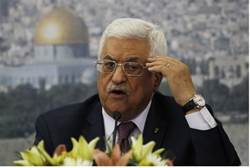
1PA AbbasPalestinian Authority Chairman Mahmoud Abbas Reuters

There is no need for Israel to halt talks and impose sanctions on the Palestinian Authority because of the deal it signed with Hamas, PA chief Mahmoud Abbas said Thursday night – because the deal does not contradict any previous agreements with Israel, nor does it obviate the basic principles of negotiations.

Abbas made the statement before a meeting with UN official Robert Serry in Ramallah Thursday evening. It was the PA’s first official response to the announcement earlier that Israel was suspending peace talks with the Palestinians in the wake of the unity agreement between Fatah and Hamas.

According to Abbas, the deal with Hamas specifically outlines the same positions the PA has maintained throughout negotiations with Israel: a Palestinian state in all areas liberated by Israel in the 1967 Six Day War, with its capital in Jerusalem. Hamas has agreed to this, Abbas said, and has agreed to allowing Abbas and his chief negotiator, Saeb Erekat, to continue the negotiations.

Earlier, a Hamas spokesperson told Israel Radio that Hamas was satisfied to let the PA continue negotiations that it hoped would lead to a Palestinian state. Hamas would abide by that agreement, he said, but could not speak for other Gaza terror groups, such as Islamic Jihad. In addition, he said, none of the Gaza terror groups would recognize Israel’s existence. “We can have an agreement without recognizing Israel. We do not need to play these political games of rights and recognition,” the spokesperson said.

Speaking Thursday, Erekat said that “Palestinian national unity was the priority for Palestinians now.” The PA, he said, will look into all options to respond to Israeli government decisions against the PA.” Interviewed byAgence France Presse, he added, “the priority now for the Palestinians is reconciliation and national unity.”

security cabinet meeting on Thursday decided to suspend the talks following a unity deal reached between the PA and Hamas on Wednesday. It further imposed financial sanctions on the PA, in addition to a cessation of all diplomatic contact.


Secret Unit at Front Lines of Israel’s Cyber-War

April 25, 2014

Secret Unit at Front Lines of Israel’s Cyber-War – Defense/Security – News – Israel National News.

Officials speak about the ISA’s involvement in protecting Israel’s cyberspace for the first time.

By Tova Dvorin

First Publish: 4/25/2014, 3:17 PM

Anonymous

Anonymous
Reuters

Several weeks ago, a vigilante by the name of “Buddhax” made waves when he exposed the true faces – and names and passwords – of several anti-Israel hackers who participated in the #OpIsrael project to launch a cyber-attack against Israel.

Now, nearly one month later, Channel 2 revealed Friday the existence of another party responsible for keeping Israel’s cyberspace safe: a secret unit of the Israeli Security Agency (ISA), or Shin Bet.

Tens of hackers work in S-74, the codename for the Shin Bet unit which protects Israeli cyberspace. For days, they will cluster around their computers, tracking the suspicious movements of “Anonymous” hacktivists around the world. Then, just moments before a hack will disrupt a system, they will strike – without anyone even knowing the Shin Bet was involved.

“We have prepared well in advance, we follow networks around the world closely and collect intelligence through HUMINT and SIGINT [human intelligence and signals intelligence, respectively – ed.],” Alon, an S-74 member, revealed to the daily Friday.

Alon, 39, has been a member of the unit for eight years and is responsible for for teaching institutions who use critical servers how to prevent cyber-attacks. “We approached internet providers, conducted [a simulation of] the attack with safeguards, and then analyzed the seriousness of the threat. We here in the Shin Bet then opened an operations room and our people ran through a number of simulations of the event before operating against [a cyber-attack] in real-time.”

“Timing is critical,” he continued. “Your opponent is sitting in advance to make sure a cyber-attack succeeds; all he has to do is press a button and the system begins to fail.”

Timing was also crucial before #OpIsrael. Several weeks before, the Shin Bet opened an operations room to explore advanced, unique, and intensive solutions to prevent the lives of Israeli citizens from being disrupted. #OpIsrael had released a list of government sites, including websites in the security sector, and distributed a list of targets which included some 1,300 Israeli websites for its hackers to breach – including  the sites for government agencies, banks, defense industries, academic institutions and media organizations.

Following that, S-74 raised the alert level. Employees met with mentors and the unit’s best computer experts conducted a series of counter-terrorism simulations repeatedly until they could say, for certain, that “Anonymous” could not succeed.

“The unique thing about Anonymous is their motivation to act openly,” Alon noted. “They put out a call to action and recruit thousands [of hackers] to help them [execute] a cyber-attack. The more participants there are, the greater likelihood that someone will force his way into a critical website and cause it to fail.”

Research, research, research

Yuval, now 29, began working for the Shin Bet 12 years ago.  He works in intelligence and is the co-founder of the SIGINT unit to gather intelligence ahead of a cyber-attack. He rarely speaks about the unit and its abilities to protect Israel.

“In the event of an ‘Anonymous’ attack, we need to know context about the world of our target,” he revealed. “I study and research it, get a report on whether this is an organization or a real terror threat, and as I gather intelligence we begin to manage the process of preventing the future attack.”

“This means combining the abilities of [cyber-attack units] SIGINT and HUMINT and attacking the opponent’s ‘home’ – using information about the attacker or his environment to our advantage.”

“The cyber-world constantly features glitches – incidents which could either be technical problems or a real cyber-attack,” he continued. “It can be very difficult to tell how many people are hacking us at once.”

Luckily, Yuval stated, there are ways of reducing the likelihood of a real attack.

“There are a lot of incidents that we can classify as an attack or disruption in the system, and we can test and analyze them to see if they’re targeted specifically toward Israel,” he said. “For example, Israel’s biometric database can be a common target. In the meantime, we have secured the database, [. . .] [but] we do not know who is attempting to look at it.”

Intelligence at Large

S-74 was established several years ago and has changed rapidly with the fast-paced changes in technological development, according to the report.

In addition to protecting Israel, the unit collects intelligence to launch its own attacks against Israel’s enemies, according to Yuval.

“This is a classified area, normally, but we received special permission to give you a small glimpse into the world of intelligence,” Yuval stated.

“In order to make critical decisions about Israel’s security, we perform operations across the globe to hack into computers, databases, and networks – including personal computers,” he explained. “We collect data from everywhere in every area.”

“There are many institutions that work strategically against the State of Israel; we work quietly against them. Then, an intelligence officer will call me and ask me for that information and that can drastically change the character of an operation.”

Branching Out

Another dimension is collecting intelligence before physical operations against terrorists. For example, S-74 was involved in collecting much of the relevant information to kill senior Hamas terrorist Hamza Abu Alheja last month in Jenin.

Yet another approach to cyber-intelligence includes education on cyber-safety.

“We have developed tools to identify anomalous networks, abnormal movements, and to isolate and contain them,” Alon explained. He stated that he often presents CEOs of major institutions with information on real cyber-attacks to “scare” them into increasing their cyber-security.

“After Israeli entities are defined as being at risk, they should protect their critical systems immediately,” he explained. “Cyber-attacks on certain institutions could cause serious damage.”

“For example, Israel Railways transports tens of thousands of people per day,” he explained. “The monitoring process thus begins right from the control room of the Israel Railways office. Vulnerable computer systems, if damaged, could ‘black out’ Israel’s cell towers, its electricity, and other vital resources.”

Changes Needed?

S-74’s work may be extensive, but not everyone is impressed with Israel’s cyber-security.

Dr. Michael Orlov, head of the cyber-engineering department of Shamoon College Engineering in Be’er Sheva, explained to Arutz Sheva earlier this month that Israel needs to step up its efforts to train more hackers to keep up with the attacks, which are becoming more and more organized.

As Orlov explained, the hacking projects against Israel by Anonymous – a loosely organized group of hackers worldwide, but for #OpIsrael mostly localized to Middle-Eastern Muslim countries – is a childish attempt to “feel important,” and nothing more. Currently, cyber-attacks against Israel largely focus on replacing a site’s content with propaganda, and leaving a site alone after it is fixed. This, he said, “is not a serious problem.”

Future attacks may be, however. Orlov emphasizes that if a major country – e.g. Iran – were to set aside the “relatively small amount” of $50 million dollars to establish a professional hacking team, Israel could be in trouble.

“We have seen Iran do this in the past to other countries, like Saudi Arabia,” Orlov stated, “Hackers attacked, broke into [websites] and deleted information. If this happens, we cannot dismiss the impact of attacks.”
The curse of political correctness

April 25, 2014

Israel Hayom | The curse of political correctness.

Pat Condell speaks only verifiable facts about modern Islam that are known by all.  What prevents most of us from sounding like him is fear of retributory violence or of treading on ideological “political correctness.

For an Islamic woman’s perspective see Wafa Sultan on Al Jazeera.

– JW

________________________________________

Dror Eydar

1. It is with unbearable ease that the foundations of free society can be shaken.

Not too long ago, Brendan Eich, the CEO of Mozilla, was fired from the company, which is responsible for the Firefox browser, among other things. The poor guy was fired because gay and lesbian groups found out that he had once donated $1,000 to the campaign for California Proposition 8, which sought to make same-sex marriage unconstitutional in California by defining marriage as a union between a man and woman.

Though everyone agrees that he never discriminated against anyone in the company on the basis of sexual orientation, he believes that a marriage should be between a man and a woman, heaven forbid. As a result, the liberal fundamentalists threatened to boycott, a move that quickly led to the Eich’s termination.

Moving on. Brandeis University recently decided to award Somalian rights activist Ayaan Hirsi Ali, who became famous for her brave battle for women’s rights in the Muslim world, an honorary degree.

But then, the liberal fundamentalists, with freedom of speech burning their throats and the sword of boycotts glistening in their hands, decided to apply immense pressure on the “Jewish” university. They argued that Hirsi Ali was an “Islamophobe” and “racist.” In actuality, Hirsi Ali is an amazing intellectual who, as a Muslim, was subjected to nine circles of hell (she was circumcised and forced to marry against her will, among other things) before she was able to flee to the West. Since then, she has published several books and articles on the big lie often obscured by Western culture: the shameful status of women in the Muslim world and Western naivete when it comes to Islam’s totalitarian aspirations. One of the more vocal feminist leaders, Germaine Greer, coined the saying, “One man’s beautification is another man’s mutilation.” This is true mainly the other way around: Female circumcision, considered to be crime in Western society, is actually completely legitimate in terms of global tyranny of thought. She compared it to our Jewish circumcision.

Unfortunately for her, Hirsi Ali believes something that deviates from the leftist chorus that dictates what is good and right to all of us. The weapon of boycott and silencing was used against her too. And indeed, the cowardly heads of Brandeis University caved to the pressure and rescinded the degree. A great victory for the silencing bullies, but a huge disgrace for the university for being so narrow-minded.

2. Only a year ago, not too far from Brandeis, the Boston Marathon bombing occurred. Three people were murdered and hundreds were hurt. So who was responsible for the attack?

If we use President Barack Obama’s speech last week in commemoration of the event as a reference, we might deduce that it was merely an unfortunate accident, an unspeakable “tragedy.” Predictably, Obama’s speech included a pile of well-known American, Hollywood-style cliches about the Boston spirit and love and a new day and “sing love, not war.”

The leader of the world’s biggest superpower didn’t utter a single word about what really happened there: a terror attack carried out by Muslims in the name of Islam against Americans, and actually against the West. This is the curse of political correctness and the stringent monitoring of language aimed at controlling public opinion. In this instance, one must never mention the words “terror” and “Islam” together. It is under this idea that the global Left is acting feverishly to silence its ideological rivals, even though they would be better served if they joined forces to fight for the existence of the free world.

About 18 months ago, I interviewed Prof. Afshin Ellian, an Iranian law expert and thinker living in Holland after fleeing the ayatollah regime in Iran. Like Hirsi Ali, Ellian has warned the West of the dangers of radical Islam. He, too, has suffered at the hand of the liberal elite, which is consistently unwilling to hear any criticism of Islam, clinging to fanatic multiculturalism where all cultures are equal. Even the most barbaric customs possess a relative truth, and all that tiresome liberal mumbo jumbo.

Isn’t a true liberal society supposed to contain opposing opinions? One can safely assume that the views of Hirsi Ali and Ellian represent a substantial portion of Western society. Do these views not rightfully belong in the legitimate public debate? And what about views denying the idea of global warming? Or the debate surrounding the family unit and the institution of marriage? Is it forbidden to listen to anyone who believes that a marriage should be only between a man and a woman? If so, what, then, is the point of a public debate? No one is asking the global Left for permission to sound these contrary opinions, but a university is supposed to be a pluralistic fortress, a true marketplace of ideas, isn’t it? I guess not.

3. George Orwell wrote his book “1984” about a Soviet-style communist society.

Sixteen years earlier, in 1932, Aldous Huxley published his book “A Brave New World,” which also revolved around a totalitarian society, but in this case, one that was ostensibly democratic and liberal. Its totalitarianism manifested itself in its intolerance for any deviation from the dictated liberal line. Later, in the 1960s, everyone wanted to be individualists. But anyone who sought to be an individualist in a way that was different from the herd of the individualists around them, was rejected.

Part of the leftist doctrine on the silencing of rivals holds that they must never be given any public platform to air their views, to avoid granting them “normalcy” within public discourse. Thus the Israeli media consistently prevents radio and television personalities with conservative or right-wing views, not to mention settlers, heaven forbid, from hosting shows during prime time.

During the 1990s, the Left took action to shut down the only channel run by settlers living in Judea and Samaria and Gaza. Today, the Left (together with useful idiots from the Right) is trying to silence Israel Hayom. In the humanities departments of Israel’s universities, they make sure not to open up teaching positions to conservative right-wing lecturers, and they hand out awards only to the people they deem suitable, and so on.

On the other hand, the national radio and television channels are filled with hosts whose world views hail more or less from the same leftist school (to the point of anti-Zionism and radicalism). It is easy to see how civics teacher Adam Verete (who was threatened with dismissal after a student accused him of expressing extreme leftist views in class) quickly became a media darling while the 17-year-old student who dared challenge him became the victim of ridicule. What counts is their respective alignment with rival political camps. From a political perspective, if the situation had been reversed, and a student had refused to bow down to authority and insisted on exercising free thought and criticism , they would have been extolled like a local Jeanne D’Arc. There is no shortage of examples.

It is not Republicans or conservatives who implement McCarthyism — the idea that they do is simply part of the Left’s propaganda machine. The truth is actually exactly the opposite: An overwhelming majority of evil regimes in the world, places where genocide is a matter of routine, were and are regimes with a left-wing orientation. Any company that today dismisses a CEO over his objection to same-sex marriage, will dismiss someone else for possessing other views tomorrow. Anyone who today revokes an honorary degree over critical views of Islam, will revoke a man’s freedom for refusing to agree to some other idea tomorrow.

The danger is that this situation will quickly devolve into violence, because in the absence of a public voice representing common views, and especially the absence of room for radical views of all types — including express denial of the Left’s main beliefs — all that will remain in the public arena will be one, unified legitimate voice with solely leftist nuances. It is over this freedom that the battle is fought.

Off Topic: The right decision

April 25, 2014

The right decision, Israel Hayom, Dr. Haim Shine, April 25, 2014

Suspending the talks with the Palestinians was the responsible, logical and necessary choice for the Israeli government to make • As in the past, U.S. leaders have learned the hard way about reality in the Middle East.

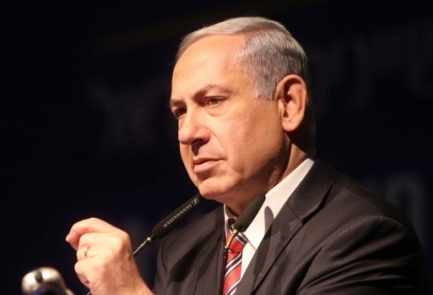
Netanuahu on HamasPrime Minister Benjamin Netanyahu says Israel will not talk with Hamas-backed government | Photo credit: Marc Israel Sellem

The unanimous decision of the Israeli government to suspend the talks with the Palestinians was not dramatic. It was the responsible, logical and necessary decision to make after Palestinian Authority President Mahmoud Abbas embraced Hamas, with malicious defiance, at a decisive time in the negotiations with Israel.

Abbas stood at a fork in the road. At the end of one path was a peace agreement with Israel. And at the end of the other path was a partnership with a group of vicious murderers led by Ismail Haniyeh. Abbas chose the second path, and for this he should be made to pay the full political and economic price. It is now more clear than ever that Abbas’ main motive for holding talks with Israel was the release of murderers, who are held dear by Palestinian society.

On the walls of the conference room in Gaza, where the reconciliation talks took place and Hamas and PA officials shook hands, were pictures of martyred Hamas members — terrorists. There was also a picture of the Temple Mount compound, with the Al-Aqsa mosque in the center. These pictures well represent the clear and sole Palestinian narrative — kill as many Jews as possible, launch missiles and attack innocents. All of this to expel the Jews from Jerusalem and return them to the 1967 borders, steps on the way to the ultimate goal of eliminating the Jewish entity in the land of Israel.

The entire people of Israel want peace, but, as Holocaust Remembrance Day approaches, Jewish leaders cannot be tempted by the illusion of peace. The Israeli government calmly and wisely managed to expose the true face of Abbas, the disciple and successor of Yasser Arafat. It has again been proved that the Palestinians do not want peace or a state alongside Israel. Rather, they want a state in Israel’s place.

It is a shame that the post-Zionist opposition in Israel continues to support Abbas and blames the Israeli government for the failure of the negotiations. The opposition is incapable of rising above petty considerations at moments that require national unity. During his decades as opposition leader, the late Menachem Begin always had the good of the country in mind. Labor leader Isaac Herzog and Meretz leader Zehava Gal-On must learn that even the opposition can display responsibility and leadership.

The American government will hopefully internalize that its efforts were in vain, that Israel has no partner for peace. As in the past, American leaders learned the hard way about the reality in the Middle East. They should use what determination they have left to resolve the Iranian nuclear issue.

Israel’s Sustainable Success – NYTimes.com

April 25, 2014

Israel’s Sustainable Success – NYTimes.com.

( Even Roger Cohen, one of the most poisonously anti-Israel columnists from “The Times” is being forced to recognize Israel’s new place on the world stage and its ability to “sustain” absent a deal with Abbas.  He attacks Obama and Kerry for failing to acknowledge this. – JW )

LONDON — Hearing an Indian official talk the other day about Delhi’s booming arms trade and ever-closer relationship with Israel, I had a thought that also struck me while listening to Israeli businessmen in Beijing. The idea may be summed up in three words: It is sustainable.

“Pivot to Asia” is a term that might be applied to Israel. Its trade with China has boomed, reaching more than $8 billion in 2013 from a pittance when diplomatic relations were established in 1992 (the same year as with India). Europe huffs and puffs about the West Bank settlements; Asia does business. India has already bought sea-to-sea missiles, radar for a missile-intercept system and communications equipment from Israel.

Tel Aviv, one of the world’s most attractive cities, has a boom-time purr about it. For all the talk of its isolation — and all the efforts of the Boycott, Divestment and Sanctions (B.D.S.) movement — Israel has an economy as creative as it is successful. Yes, it is sustainable.

Behind its barriers and wall, backed by military might, certain of more or less unswerving American support, technologically innovative and democratically stable, Israel has the power to prolong indefinitely its occupation of the West Bank and its dominion over several million Palestinians. The Jewish state has grown steadily stronger in relation to the Palestinians since 1948. There is no reason to believe this trend will ever be reversed. Holding onto all the land between the Mediterranean and the Jordan River, while continuing to prosper, is feasible. This, after all, is what Israel has already done for almost a half-century.

It is time to retire the unsustainability nostrum. Facile and inaccurate, it distracts from the inconvenient truth of Israel’s sustainable success.

Throughout this year the Obama administration has pushed the unsustainability argument to make its case for peace. “Today’s status quo, absolutely to a certainty, I promise you 100 percent, cannot be maintained,” Secretary of State John Kerry said in February. “It is not sustainable. It is illusionary. There’s a momentary prosperity, there’s a momentary peace.”

More recently, President Obama told Jeffrey Goldberg of Bloomberg View that his question to Benjamin Netanyahu was: “If not now, when? And if not you, Mr. Prime Minister, then who?”

Obama also said of Israel: “There comes a point where you can’t manage this anymore, and then you start having to make very difficult choices. Do you resign yourself to what amounts to a permanent occupation of the West Bank?”

But that “point” of unmanageability is a vanishing one. Permanent occupation is what several ministers in Netanyahu’s coalition government advocate. Backed by the evidence, they are certain it can be managed. They are right.

Of course, manageability does not equal desirability. There is no consent of the governed in the West Bank. Dominion over another people is morally corrosive; Jews, of all people, know that. The nationalist-religious credo that the West Bank was land promised to Abraham’s descendants has intensified over the past half-century. Settlers see their work as the culmination of the Zionist idea of settlement. The opposite is true. Israel has undermined its Zionist founders’ commitment to a democratic state governed by laws. The occupation undercuts Israel’s own Founding Charter of 1948, which promised a state based on “complete equality of social and political rights to all its inhabitants irrespective of religion, race or sex.”


These, too, are uncomfortable facts. But the evidence is that Israelis, in their majority, prefer to live with them than believe in a sustainable peace with Palestinians. Trust your neighbor? Been there, tried that. Which brings us to the agreement (yet another) reached this week between Mahmoud Abbas, the president of the Palestinian Authority, and Hamas, the militant Islamist group, to form a unity government and hold elections within six months.

Netanyahu leapt on it to inter the already half-buried peace talks: “Does he want peace with Hamas, or peace with Israel? You can have one but not the other.” But Israelis are smarter than that. They know that any peace with only one Palestinian faction would not amount to peace at all; that without elections, eight years after the last vote, Abbas has no real legitimacy; and that bringing a weakened Hamas under Egyptian suasion into a unity government (if that happens) would increase pressure on Hamas to meet international demands that it recognize Israel’s right to exist, renounce violence and accept previous signed agreements.

Moving toward a two-state peace — the best outcome for both nations — cannot be based either on the myth that Israel’s current situation is unsustainable or on the myth that the Palestinian Authority, as currently constituted, represents the Palestinian national movement. It can only emerge when a majority on both sides believes, based on the facts, that painful compromise in the name of a better future is preferable to manageable conflict fed by the wounds of the past.

What Is Abbas Trying to Achieve?

April 25, 2014

What Is Abbas Trying to Achieve?, Gatestone InstituteKhaled Abu Toameh, April 26, 2014

(What will Washington tell Israel to do to appease Abbas this time? — DM)

Abbas seems to be enjoying that each time he does something dramatic, the U.S. launches another big diplomatic offensive to try to convince him to backtrack. Abbas wants his people and the Arabs to see him as a hero who can stand up to the Americans.

Abbas’s biggest fear is that the U.S. will cut off financial aid to the Palestinian Authority and work toward isolating him, as the Bush Administration did to Yasser Arafat in 2002. He is aware that neither the Europeans nor the Russians nor the Chinese will be able to replace American sponsorship.

Abbas is now waiting to see what the Americans will offer him for rescinding his plan to join forces with Hamas. When this happens, Abbas will most probably come up with new demands and conditions, as he has done all these past weeks.

Palestinian Authority [PA] President Mahmoud Abbas has once again surprised Israel and the U.S. Administration, this time by signing a “reconciliation” agreement with Hamas.

On April 23, Abbas dispatched a high-level delegation of PLO officials to the Gaza Strip to sign the “historic” deal with Hamas Prime Minister Ismail Haniyeh.

The deal calls for the formation of a Palestinian unity government, headed by Abbas, within five weeks.

Six months after the creation of the new government, according to the agreement, the Palestinians would hold presidential and parliamentary elections.

Abbas’s decision to join forces with Hamas is seen as a tactical move aimed at putting pressure on Israel and the U.S. to accept his conditions for extending the peace talks after their April 29 deadline.

Despite the signing ceremony, however, held at the home of Haniyeh, the gap between Abbas’s Fatah faction and Hamas remains as wide as ever.

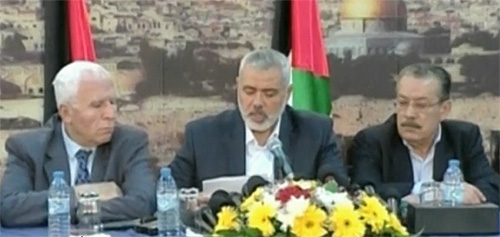
Hamas Fatah signing ceremonyIsmail Haniyeh (center) speaks at the signing ceremony for the Hamas-Fatah unity agreement. (Image source: Screenshot of AlJazeera video)

There are no indications whatsoever that, as a result of the rapprochement with Fatah, Hamas is about to change its ideology or abandon terrorism.

Nor is there any sign that Hamas is willing to allow the Palestinian Authority security forces to return to the Gaza Strip, which fell into the hands of the Islamist movement in 2007.

Hamas leaders and spokesmen have made it clear that the “reconciliation” agreement does not mean that Hamas will abandon the path of terrorism to achieve its goals. “The option of negotiations has failed,” said Ra’fat Murra, a Hamas official in Lebanon. “Palestinian resistance remains the right option.”

Ibrahim Hamami, a Palestinian writer closely associated with Hamas, said he does not believe that a reconciliation with “Israel’s agents” [Abbas and the PA] is possible. “There should be no meetings or reconciliation with the traitors and collaborators,” he said.

This week’s “reconciliation” agreement is not about ending the Hamas-Fatah dispute so much as it is about exerting pressure on the Israeli government and the U.S. Administration.

Neither Hamas nor Fatah is interested in sharing power or sitting in the same government.

The “reconciliation” agreement is just the latest in a series of moves taken by Abbas since the eruption of the crisis in the peace talks a few weeks ago. Abbas’s moves started with the application to join 15 international treaties, and continued with threats to resign and dissolve the Palestinian Authority.

These moves, like the “reconciliation” agreement with Hamas, have all caught Israel and the U.S. Administration by surprise.

Abbas has concluded that the U.S. Secretary of State, John Kerry, is so desperate to achieve a peace agreement between the Palestinians and Israelis that he will be willing to do almost anything to salvage the peace process.

Abbas apparently did not feel that the U.S. Administration was completely opposed to his decision to file requests to join 15 international treaties. Nor, apparently, did he sense a serious response from Washington to his threats to resign and dismantle the Palestinian Authority.

That is why he has now decided to put the U.S. Administration to the test by signing a “historic” agreement with Hamas — one that Abbas himself knows is unlikely to materialize.

Abbas does not seem worried at all over Israel’s decision to suspend the peace talks with the Palestinian Authority. In fact, he was expecting a harsh response from Israel. But he knows that Israel’s measures would be limited and that Israel has no interest in bringing about the collapse of the Palestinian Authority.

He would be far more worried if the U.S. Administration actually came out in full force against the agreement with Hamas. Abbas’s biggest fear is that the U.S. will cut off financial aid to the Palestinian Authority and work toward isolating him, as the Bush Administration did to Yasser Arafat in 2002.

Also, Abbas wants the U.S. to continue to play the role of the major mediator in the conflict with Israel because he is aware that neither the Europeans nor the Russians nor the Chinese will be able to replace American sponsorship.

Abbas is convinced that it is only a matter of time before Kerry or top U.S. diplomats rush to Ramallah to try to persuade him not to make peace with Hamas.

Abbas seems to be enjoying that each time he does something dramatic, the U.S. Administration launches another big diplomatic offensive to convince him to backtrack. In a way, he appears to be enjoying humiliating the largest superpower. Abbas wants his people and the Arabs to see him as hero who can stand up to the Americans.

Abbas is now waiting to see what the U.S. Administration will offer him in return for rescinding his plan to join forces with Hamas. When this happens, Abbas will most probably come up with new demands and conditions, just as he has been doing during these past few weeks.

▶ The Bedouin Tracking Unit of The IDF – YouTube

April 25, 2014

▶ IDF Stories: The Bedouin Tracking Unit – YouTube.

Meet Lt. Col. Majdi Mazarib, the commander of the Northern Tracking Unit, a special unit that operates near the Lebanese border to combat Hizballah and consists only of Bedouin soldiers.

Off Topic: BOLTON: A ‘three-state solution’ for Middle East peace

April 25, 2014

BOLTON: A ‘three-state solution’ for Middle East peace, Washington Times, John R. Bolton, April 25, 2014

The only logic underlying the demand for a Palestinian state is the political imperative of Israel’s opponents to weaken and encircle the Jewish state, thereby minimizing its potential to establish secure and defensible borders. The cruelest irony is that by using the Palestinian people as the tip of the spear against Israel, their supposed advocates have caused the Palestinians extensive suffering. Their economic well-being, their potential for development and the prospect of living under a noncorrupt, representative government have been lost in the shuffle of challenging Israel’s very right to exist.

Reality calls for attaching Gaza to Egypt and the West Bank to Jordan

The collapse of President Obama’s efforts to force a “negotiated” settlement between Israel and the Palestinians should prompt a thorough rethinking of his administration’s entire Middle East strategy.

The chances of the initiative, which is predicated far more on ideology and illusion than on the region’s hard realities, were always essentially negligible. While Mr. Obama’s impending failure will cost us dearly because it fosters the perception of American impotence and incompetence, there are important lessons to be learned.

Although Mr. Obama will almost certainly not rethink his policies, it is entirely appropriate for others to recalibrate our objectives in the Israel-Palestinian dispute, so the next president will not make the same mistakes.

For more than two decades, U.S. policymakers have generally acceded to Palestinian insistence that a new state be created for them, stitching together the Gaza Strip and the West Bank. These territories have no particular history either of national identity or of economic interdependence. They are simply bits and pieces of the collapsed Ottoman Empire and the failed League of Nations’ post-World War I mandate system.

The only logic underlying the demand for a Palestinian state is the political imperative of Israel’s opponents to weaken and encircle the Jewish state, thereby minimizing its potential to establish secure and defensible borders. The cruelest irony is that by using the Palestinian people as the tip of the spear against Israel, their supposed advocates have caused the Palestinians extensive suffering. Their economic well-being, their potential for development and the prospect of living under a noncorrupt, representative government have been lost in the shuffle of challenging Israel’s very right to exist.

As long as Washington’s diplomatic objective is the “two-state solution” — Israel and “Palestine” — the fundamental contradiction between this aspiration and the reality on the ground will ensure it never comes into being. There simply cannot be “two states living side by side in peace and security” when one of the “states,” for the foreseeable future, cannot meet the basic, practical requirements for entering into and upholding international commitments, including, unfortunately, the glaring lack of its own legitimacy.

Instead of pursuing the misguided notion of “two states,” U.S. policymakers should instead ask what other solutions are possible that would provide Palestinians with personal dignity and security, economic growth and the prospect of living under a responsible, responsive government. Concededly, there is no perfect alternative, but the most attractive prospect is to attach the disparate Palestinian communities in the West Bank and Gaza Strip to their neighboring contiguous Arab states, Jordan and Egypt, respectively. We might call this a “three-state solution.”

After the late 1940s collapse of the League of Nations’ Middle East mandates, Jordan successfully governed the West Bank until the 1967 Arab-Israeli War. Today, IsraelJordan and Palestinians should draw new West Bank boundaries embodying Security Council Resolution 242’s “land for peace” formula. Jordan could, with relative ease, resume sovereignty over those portions of the West Bank not incorporated into Israel.

The contentious issue of Jerusalem’s status as the purported capital of “Palestine” would disappear, since Amman would obviously be the seat of government for an enlarged Jordan. Palestinians could be rapidly integrated into the Jordanian economy, and participate in its ongoing political development. Such a solution would enormously benefit the Palestinian people by providing political stability and the prospect of enhanced economic security. The existing Israel-Jordanian peace agreement would help ensure that Israel and an expanded Jordan could continue to live together peacefully.

Gaza is a harder problem, but incorporating it into Egypt is clearly a better solution than allowing it to remain the headquarters for Hamas and other terrorist groups. Merging Gaza with Egypt under the Muslim Brotherhood was not an acceptable option, since Hamas, a Brotherhood subsidiary, would simply have acquired even greater capabilities for terrorist attacks against Israel, Arab states friendly to America, and beyond.

Cairo’s current (and likely future) military government may not be made up of Jeffersonian democrats, but it is a sterling alternative to Hamas, and will presumably not tolerate terrorism emanating from behind new Egyptian borders. Gaza’s economic integration with Egypt will be more difficult than the West Bank into Jordan, but no other alternative is feasible.

For many, ending the quest for the “two-state solution” will be like renouncing the search for the Golden Fleece. Moreover, Egypt and Jordan will be understandably reluctant to take control of the troubled territories, which therefore warrants significant international assistance for their efforts. Nonetheless, our experience over the past several decades proves conclusively that neither Palestinians nor Israel, nor (most importantly for us) the United States, can benefit from continuing to pursue an illusion.

The “three-state solution” will not be achieved easily, but it at least has the virtue of being realistic and workable. Those who truly have the best interests of the Palestinians at heart should consider it.


Read more: http://www.washingtontimes.com/news/2014/apr/16/bolton-a-three-state-solution-for-middle-east-peac/#ixzz2ztzf65XG
Follow us: @washtimes on Twitter

Off Topic: ‘Netanyahu was ready for border talks, settlement freeze’

April 25, 2014

‘Netanyahu was ready for border talks, settlement freeze’ | The Times of Israel.

( Obama: ” Both Israeli and Palestinian leaders unwilling to ‘make hard choices’.” Really?  Both sides excepting one you must mean. – JW )

Palestinian leadership knew of PM’s new stance before announcing Hamas-Fatah reconciliation deal, TV report says

April 25, 2014, 2:34 am Prime Minister Benjamin Netanyahu visiting the Jordan Valley with IDF officers in 2011. (photo credit: Moshe Milner/GPO/Flash90)

Prime Minister Benjamin Netanyahu visiting the Jordan Valley with IDF officers in 2011. (photo credit: Moshe Milner/GPO/Flash90)

Prime Minister Benjamin Netanyahu was ready to begin final border discussions and also to implement a construction ban in the settlements, before the Wednesday Hamas-Fatah reconciliation agreement prompted Jerusalem to suspend the Israeli-Palestinian peace talks, it was reported on Thursday.

The prime minister did not intend to present a final border proposal, but rather had planned to present to the Palestinians, via the Israeli negotiating team, a map that would have served as a starting point for comprehensive final border discussions, according to a Thursday Channel 10 report, which did not cite a source for the claim.

In addition, Netanyahu was prepared to halt new construction in the settlements, but insisted that building continue for projects already underway, the report said. This was a provision the Palestinians did not accept, saying that the Palestinian public would not be able to distinguish between new constructions and the continuation of already begun projects.

According to the TV report, the fact that Netanyahu was formally prepared to begin negotiations over the borders of a Palestinian state was known to the Palestinian Authority before the Fatah-Hamas reconciliation agreement was announced in Gaza on Wednesday.That announcement paved the way for Hamas and Fatah to form a technocratic unity government within five weeks, and hold new elections six months later, after years of bitter rivalry. Similar agreements have been announced several times in recent years, but not implemented.

The reconciliation deal is a “direct continuation of the Palestinian refusal to advance the talks,” Netanyahu said Thursday, citing what he said was the Palestinian rejection last month of a US framework agreement to extend negotiations, PA President Mahmoud Abbas’s refusal to recognize Israel as a Jewish state, and Abbas’s recent application to join UN and other international treaties.

Abbas had demanded a settlement freeze and an intensive focus on border negotiations among preconditions for an extension of peace talks, before the Fatah-Hamas unity pact scuppered efforts to get the talks back on track.

Israeli officials said Thursday that the government decision to suspend peace talks, which was approved by a unanimous vote in the top-level security cabinet, was carefully worded so as not to rule out a possible resumption if, in the next five weeks, Abbas fails to agree with Hamas on the composition of a unity government as scheduled. At the same time, the wording was also designed to make plain that Israel will not negotiate with any Palestinian government that rests on Hamas support, even if there are actually no Hamas ministers sitting around the cabinet table.

Times of Israel staff contributed to this report.

Israel can’t accept the emerging US-Iran accord

April 24, 2014

Israel can’t accept the emerging US-Iran accord, Jerusalem Post, Yaakov Amidror, April 24, 2014

(The Iran Scam continues. Processes, not results, matter. — DM)

With such a flimsy agreement, I wonder what will be left of Western commitment to preventing Iran from obtaining a nuclear weapon. And Israel will have to draw its own conclusions.

Nuke talks and talksIran nuclear talks at the Palais des Nations in Geneva, November 24, 2013. Photo: REUTERS

Ostensibly, official US policy on Iran’s nuclear program is clear: The US will not allow Iran to produce a nuclear bomb. Moreover, US President Barack Obama has said that, for this purpose, “all options are on the table” – implying a military option as well. In addition, according to many reports in American newspapers, Obama has ordered the development of diversified US military capabilities with which to attack Iranian nuclear facilities, far beyond what existed in the previous administration – providing further evidence of the president’s seriousness.

But many people do not understand the meaning behind the vague statement, “We will not allow Iran to manufacture a nuclear bomb.” When will this happen? Who will decide that this is the time for action? How? What does “manufacture” mean? Robert Einhorn seeks to answer these questions in a 56-page comprehensive paper, just published by the Brookings Institution, titled “Preventing a Nuclear-Armed Iran: Requirements for a Comprehensive Nuclear Agreement.”

This paper cannot be ignored, since until a few months ago Einhorn was one of the top officials on Iran in the Obama administration, and he is very knowledgeable on the topic. (Einhorn was the secretary of state’s special adviser for nonproliferation and arms control. During the Clinton administration, he was assistant secretary for nonproliferation.) In addition to analyzing Iran’s intentions toward nuclear weapons and discussing the principal issues in the negotiations, Einhorn outlines the key requirements for an acceptable comprehensive agreement that, in his view, “would prevent Iran from having a rapid nuclear breakout capability and deter a future Iranian decision to build nuclear weapons.”

According to Einhorn, the essence of an agreement between Iran and the P5+1 could be as follows: Iran will retain the capability to produce the material necessary for a bomb (full fuel cycle), so theoretically it will be able to produce a bomb should it decide to do so. But the agreement that the US should try to reach will include the most sophisticated and exacting controls and monitoring, which will immediately spot any breakthrough in Iran’s nuclear program. The capability that Iran will be permitted under the agreement will be greatly reduced compared with its current capability (for example, far fewer centrifuges), so that from the moment of the breach and its identification, the US will have enough time to respond with very severe sanctions, and with force too, if necessary.

In order to dissuade the Iranians from advancing toward a bomb, it will be made clear to them by various means that Iran will pay a heavy price for violating the agreement, and that the US will respond quickly in the event of a violation to prevent any possibility of the Iranians reaping the rewards of the violation.

Einhorn proposes a new world of “deterrence” – not against the use of nuclear weapons, but against producing nuclear weapons. This deterrence is needed because this approach would permit the Iranians to keep the capability to produce a nuclear weapon. The West (and Israel) will have to live with this Iranian production capability, because it is a fact that, Einhorn says, cannot be change.

In short, violating the agreement will be cause for penalizing Iran, not the fact that Iran will have the capability to produce a nuclear weapon.

In my opinion, Israel should oppose such an agreement for three reasons.

• The proposal assumes that it will be possible to build a control and monitoring system that the Iranians won’t be able to deceive. This system will be partly built on the basis of monitoring arrangements agreed to by the Iranians, stricter than what the International Atomic Energy Agency currently carries out; and partly based on covert intelligence efforts that have been in place for many years.

However, the reality in other places as well as Iran itself indicates that there is no such thing as a monitoring system that cannot be sidestepped. There is no way to guarantee that the world will spot Iran’s efforts to cheat. American intelligence officials have publicly admitted that they cannot guarantee identification in real time of an Iranian breakout move to produce a nuclear weapon.

The Iraqis, Syrians, Libyans, and North Koreans, just like the Iranians, succeeded in tricking the world and concealing large parts of their system for building nuclear capabilities – for a very long time. Israel, too, failed to discover these nuclear programs for a long time. In each of these cases, there are specific reasons how and why the West did not see what was happening. But the accumulation of cases forces the assessment that Iran, too, will be able to deceive the West even after signing a monitoring agreement, and in my opinion is likely to do so, with a high degree of probability.

• Assuming that a violation of a nuclear agreement is identified, will the US respond immediately or begin a plodding process to clarify, verify, and confirm the alleged violation? Afterward, won’t the US, with or without its P5+1 partners, enter into negotiations with Iran about the situation? Would not the US, in line with international practice, compromise under the new circumstances? Such compromise can be expected to further facilitate slow but steady progress of the Iranian nuclear effort, to the point where it will be completely impossible to stop Iran’s program.

Anyone who thinks that a US administration would respond immediately to an Iranian agreement violation, without negotiations, is deluding himself. This will be especially true of a US administration years down the road in the indeterminate future, which will undoubtedly be less committed to the dictates of the agreement than its predecessor. Israel cannot accept the existential threat caused by this delusion. Our experience in this matter is clear and unequivocal.

How do I know that such an erosion in P5+1 determination to halt the Iranians will develop in the future? Doesn’t everyone want to prevent Iran from going nuclear? From a thorough study of the ongoing chain of P5+1 concessions ever since the negotiations with Iran began 15 years ago, I fear, and am certain of, an erosion of P5+1 resolve.

Over time, first the Europeans, and then the P5+1, together and separately, including the US, repeatedly lowered their demands of Iran.

The current excuse for a lower threshold of demands on Iran is not that the threshold is sufficient, but rather the very sad admission that “the Iranians will not agree to a higher and more strict threshold.” This statement reveals the defeatist mind-set of today’s P5+1 negotiators. In other words, for the world, the agreement is more important than the content; and in order to secure this desired agreement, it is worth waiving or forgoing the demands of Iran that two or three years earlier were considered essential. And thus, instead of asking how to bring the Iranians to an agreement, the threshold of world demands is constantly lowered.

The Iranians understand this, which is why they are dragging out the negotiations as long as possible while intensifying their efforts to get closer to the bomb. Over the years they have won significant concessions even before starting serious discussions about an agreement.

According to US Secretary of State John Kerry, the Iranians are just two months away from a bomb, a reality which is the end result of years of negotiations.

• The third leg on which the conciliatory approach rests is deterrence. The assumption is that Iran will understand that, if a breach is identified, the US will get into the thick of things and respond extremely harshly, up to and including the use of force against Iran.

Is this assumption valid in the contemporary world? Does anyone believe that the use of force is a possible option for the US? What are the chances that the US would obtain the support of the Security Council for the use of force against Iran? What are the chances that Washington would act without UN support? Is there any reason to think that, at the moment of truth, Iran would truly fear American military action for violating the agreement in a way that does not include an act of war or violation of the sovereignty of a neighboring state? What if the circumstances that will be chosen for violating the agreement by the Iranians will be when the US is engaged in another international crisis? In that case, would the administration really have the necessary energy to apply military force? Today, we more or less know that the Iranians assess the likelihood of an American military action against Iran’s nuclear program as very, very low, close to negligible – unless Iran precipitates hostilities in the Persian Gulf. Why should Iran think that the chances of this will increase in the future? If the past proves anything, it proves that the chances of American force in the future will only diminish.

Finally, we cannot ignore the fact that the world is dealing with Iran, a murderous Shi’ite revolutionary regime that seeks regional and even global hegemony; that sponsors international terrorism and stands behind the slaughter in Syria on Syrian President Bashar Assad’s side; and that has purposefully deceived the West time and time again regarding its nuclear program. Thus, Iran cannot at all be trusted to abide by any accord with the West.

Thus, the solution to the Iranian crisis proposed in the Brookings Institution paper – which I fear represents mainstream administration thinking – is unsound. None of its assumptions can be used as a good basis for an agreement: neither the assumption that a monitoring regime can guarantee identification, in real time, of Iranian violations; nor the assumption that the US will act with alacrity if a breach is identified; nor the assumption that, in the real world, Iran will truly be deterred by US threats.

Einhorn’s proposals for an agreement with Iran are important because of his expertise, and they are worrying because they probably represent mainstream thinking in today’s Washington. In any case, the proposals fall far from meeting the needs of Israel on this very existential matter. An agreement along the lines proposed in the Brookings paper would be far worse than the absence of an agreement, because it would improperly calm the nations of the world and permit full commercial relations with Iran.

With such a flimsy agreement, I wonder what will be left of Western commitment to preventing Iran from obtaining a nuclear weapon. And Israel will have to draw its own conclusions.