Archive for April 2014

Full transcript of Netanyahu speech for Holocaust Remembrance Day

April 28, 2014

Full transcript of Netanyahu speech for Holocaust Remembrance Day | The Times of Israel.

( Superb speech… – JW )

Drawing lesson 70 years after Shoah, prime minister warns of the dangers of failing to confront Iranian threat

April 27, 2014, 10:23 pm
Prime Minister Benjamin Netanyahu at the Holocaust Memorial Day Ceremony at Yad Vashem, Jerusalem on April 27, 2014. (photo credit: Yonatan Sindel/Flash90)

“Look at the remarkable achievements we have made in our 66 years of independence. All of us together – scientists, writers, teachers, doctors, entrepreneurs, employees, artists, farmers – the entire people of Israel, each one in their own field – together we have built a glorious state. The spirit of the people of Israel is supreme, our accomplishments tremendous. Seven decades after the destruction of the Holocaust, the State of Israel is a global wonder.’

Address by Prime Minister Benjamin Netanyahu at the Yad Vashem Holocaust Memorial Museum, April 27, 2014:

The last time I visited Yad Vashem was with the Prime Minister of Canada Stephen Harper, a great friend of Israel and the Jewish people. We went through the exhibition rooms which present heartbreaking documentation of the destruction of European Jewry.

Today in my office, I met Felah, an 82 year old Holocaust survivor. It was important to her to tell me on this day of all days how her memories as a child of seven who was forced to leave her two year old sister behind to die, how those memories are always with her. She told me, “I don’t remember what happened yesterday or the day before that, but as is the way of memories from that age, I remember the tearing, sad eyes of my two year old sister”.

I met Shalom, an 89 year old Holocaust survivor, who told me how he left home at 18. He was 13 and the conditions in the ghetto were deteriorating so he, a young boy, decided to leave. He said, “Mother objected and wailed and Father was quiet. He stood and put his hand on my heard and blessed me and told me to save myself”.

All the exhibition rooms here are filled with such heartbreaking stories. When we left Yad Vashem, I told the Canadian Prime Minister that the primary duty of the Prime Minister of Israel is to ensure that there will be no more memorial sites like this, that there will never be another Holocaust.

I have said many times in this place that we must identify an existential threat in time and take action in time. Tonight, on the eve of Holocaust Remembrance Day, I ask myself: why, in the years preceding the Holocaust, did the overwhelming majority of world leaders and Jewish leaders fail to detect the danger in time? In retrospect, all the warning signs were there: the strengthening of the Nazi regime year after year; the horrific anti-Semitic propaganda which grew stronger with each passing month; and the murderous attacks on Jews which began as a trickle and transformed into a huge wave.

In retrospect, there is a direct line connecting the racial laws and the gas chambers.

Very few world leaders understood the enormity of the threat to humanity posed by Nazism. Churchill was one of them. Few among our leaders, primarily Jabotinsky, warned against the imminent destruction facing our nation, but they were widely criticized and their warnings were disregarded, and they were treated as merchants of doom and war mongers.

So I ask: How is it possible that so many people failed to understand the reality? The bitter and tragic truth is this: it is not that they did not see it. They did not want to see it. And why did they choose not to see the truth? Because they did not want to face the consequences of that truth.

During the 1930′s, when the Nazis were gaining momentum, the influence of the trauma of the First World War was still fresh. Twenty years earlier, the people of the West experienced a terrible trench war, a war which claimed the lives of 16 million people. Therefore, the leaders of the West operated on the basis of one axiom: avoid another confrontation at any cost, and thus they laid the foundation for the most terrible war in human history. This axiom of avoiding conflict at any cost, this axiom was adopted not only by the leaders. The people themselves, primarily the educated ones, shared it too.

In 1933, for example, the year Hitler rose to power, there was a meeting of the Oxford University student organization – an institute from which generations of British leaders had emerged. Following a heated debate, the students voted for a resolution stating that they “would under no circumstances fight for their King and Country”. This resolution passed by an overwhelming majority only ten days after Hitler entered the Chancellery of Germany.

And believe me: that message reverberated in Berlin.

This example illustrates the West’s feeble attitude vis-à-vis the rise of Nazism.

Month after month, year after year, more and more information was received in London, Paris and Washington regarding the capabilities and intentions of the Nazi regime. The picture was becoming clear to everybody. However, “they have eyes, but cannot see; they have ears, but cannot hear.”

When you refuse to accept reality as it is, you can deny it. And this is precisely what the leaders of the West did. They dismissed the murderous Nazi rhetoric as internal German politics; they downplayed the seriousness of the danger of the military build-up of the Nazis, claiming that it was the result of the natural will of a proud nation, that it should be taken into consideration, that it should be accepted.

The reality was clear, but it was cloaked in a bubble of illusions. This bubble was burst by the stealth attack by the Nazis on Europe. And the price of the illusion and desire was very heavy because by the time the leaders of the West finally acted, their people paid a terrible price. World War II claimed the lives not of 16 million people, the unimaginable number of victims during World War I, but of 60 million, including one third of our people, who were butchered by the Nazi beast.

Citizens of Israel, my brothers and sisters,

Has the world learned from the mistakes of the past? Today, we are again facing clear facts and a tangible threat.

Iran is calling for our destruction. It is developing nuclear weapons. This is the reason it is building underground bunkers for the enrichment of uranium. This is the reason it is establishing a plutonium-producing heavy water facility. This is the reason it continues to develop inter-continental ballistic missiles that can carry nuclear warheads to threaten the entire world.

Today, just like then, there are those who dismiss Iran’s extreme rhetoric as one that serves domestic purposes. Today, just like then, there are those who view Iran’s nuclear ambitions as the result of the natural will of a proud nation – a will that should be accepted.

And just like then, those who make such claims are deluding themselves. They are making an historic mistake.

We are currently in the midst of fateful talks between Iran and the world powers. This time too, the truth is evident to all: Iran is seeking an agreement that will lift the sanctions and leave it as a nuclear threshold state, in other words, the capability to manufacture nuclear weapons within several months at most.

Iran wants a deal that will eliminate the sanctions and leave their nuclear capabilities intact. Such a deal, which will enable Iran to be a nuclear threshold state, will bring the entire world to the threshold of an abyss.

I hope that the lessons of the past will be learned and that the desire to avoid confrontation at any cost will not lead to a deal that will exact a much heavier price in the future.

I call on the leaders of the world powers to insist on a full dismantling of Iran’s capability to manufacture nuclear weapons, and to persist until this goal is achieved.

In any event, the people of Israel are strong. When faced with an existential threat, the situation of our people today is entirely different than it was during the Holocaust.

Today, we have a sovereign Jewish state. As Prime Minister of Israel, I do not hesitate to speak the truth to the world, even when faced with so many blind eyes and deaf ears. It is not only my right, it is my duty. It is a duty I am mindful of at all times, but particularly on this day, in this place.

On the eve of the Holocaust, there were Jews who avoided crying out to the world’s nations out of fear that the fight against the Nazis would become a Jewish problem. Others believed that if they kept silent, the danger would pass. The kept silent and the disaster struck. Today, we are not afraid to speak the truth to world leaders, as is written in our Bible: “I will speak of your testimonies before kings, and I will not be ashamed…listen, for I will speak noble thoughts; the opening of my lips will reveal right things.”

Unlike our situation during the Holocaust, when we were like leaves on the wind, defenseless, now we have great power to defend ourselves, and it is ready for any mission. This power rests on the courage and ingenuity of the soldiers of the IDF and our security forces. It is this power that enabled us, against all odds, to build the State of Israel.

Look at the remarkable achievements we have made in our 66 years of independence. All of us together – scientists, writers, teachers, doctors, entrepreneurs, employees, artists, farmers – the entire people of Israel, each one in their own field – together we have built a glorious state. The spirit of the people of Israel is supreme, our accomplishments tremendous. Seven decades after the destruction of the Holocaust, the State of Israel is a global wonder.

On this day, on behalf of the Jewish people, I say to all those who sought to destroy us, to all those who still seek to destroy us: you have failed and you will fail.

The State of Israel is stronger than ever. It is a state that seeks peace with all its neighbors – a state with a will of iron to ensure the future of its people.

“The people will arise like a lion cub and raise itself like a lion; it will not lie down until it consumes prey, and drinks the blood of the slain.”
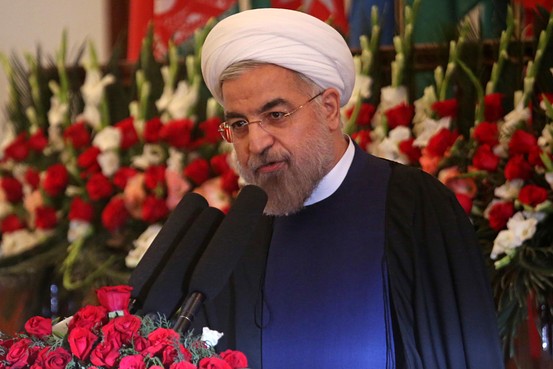
Letter From a Tehran Jail

April 28, 2014

Letter From a Tehran Jail, Wall Street Journal, April 25, 2014

(Nevertheless, political prisoners in Iranian prisons are treated humanely. Unlike some political prisoners in Israeli prisons, they are permitted, even encouraged, to collect postage stamps efficiently. To suggest otherwise could be Islamophobic, anti-peace process and even anti-Iranian; probably even “racist.” — DM)

Political prisoners report savage beatings at Evin prison last week.

Perhaps a regime, and a president, that can brutalize political dissidents as a matter of routine can prove reasonable at the nuclear negotiating table. We wouldn’t count on it, and neither should the West.

1aPresident Rouhani

Ward 350 of Tehran’s Evin prison houses some of Iran’s most prominent dissidents, including human-rights lawyers, labor leaders and opposition bloggers. The Islamic Revolutionary Guard Corps and the intelligence ministry raided the ward last week and administered a mass beating to its residents, landing dozens of prisoners in the hospital.

That’s according to family members of the prisoners and news accounts from Kalame, a website associated with opposition leader Mir Hossein Mousavi. Kalame on Tuesday published what it claimed was a firsthand account of the assault on Ward 350 written by Emad Bahavar, a supporter of the opposition Green movement serving a 10-year sentence.

Mr. Bahavar’s letter, sent from Evin, is worth quoting at length for the portrait it paints of a supposedly reforming Iran. “It feels as though pain has engulfed my entire body,” Mr. Bahavar writes. “They covered our eyes and cuffed our wrists. . . . They lined us up in the Ward 350 corridor, our faces to the wall. I could hear some crying in pain. . . . They started beating our backs very severely with batons. The screaming and crying got louder.”

The security forces next formed a “tunnel” running from the ward’s main entrance to a minibus outside, according to Mr. Bahavar. The guards, some uniformed and some in civilian clothes, beat the prisoners as they ran down this tunnel. The whole route “was covered in blood,” Mr. Bahavar reports. The minibus drove some prisoners away, while others like Mr. Bahavar were returned to the ward and eventually allowed to see a prison medic.

Mr. Bahavar, like many Green-movement supporters, initially embraced Hasan Rouhani’s candidacy for president: “Rouhani came, and we thought we’d forgive what had happened to us if he improves the people’s condition.” But the beating he and the other inmates received last week convinced Mr. Bahavar that “the hatred in their black hearts is much greater than the Greens’ kindness and forbearance.”

Western governments have treated President Rouhani as the great moderate hope—an Iranian version of China’s Deng Xiaoping. They forget that Mr. Rouhani has been a lifelong security apparatchik, having helped engineer the regime’s bloody 1999 crackdown on Iran’s student movement. His government also bans TwitterTWTR -7.16% (except for public officials) and is setting modern records for the number of public executions. And unlike Deng, whom Mao purged, Mr. Rouhani has always been part of the regime’s inner circle.

Perhaps a regime, and a president, that can brutalize political dissidents as a matter of routine can prove reasonable at the nuclear negotiating table. We wouldn’t count on it, and neither should the West.

Hamas-Abbas: A reality check

April 27, 2014

Hamas-Abbas: A reality check, Israel Hayom, Prof. Ron Breiman, April 27, 2014

(What was that about a leopard and its spots? Have President Obama and Secretary Kerry heard the story? — DM)

The blood bond between the leader of the “good” terrorists from Ramallah and the leader of the “bad” terrorists from Gaza once again proves that they both share the same goal: destroying the State of Israel, not just expelling the Jewish residents of Judea and Samaria. They differ only in style. Whereas Hamas has made its objectives painfully clear, Abbas has assumed a deceptive posture that has won him many supporters in the enlightened world, including the Obama-Kerry duo and radical Israeli lefties. These pro-Abbasites won’t let the facts get in the way; it won’t be long before they ask us to bury our heads in the sand and continue the “peace process.”

The events that took place over the past week — and especially the renewed alliance between Palestinian Authority President Mahmoud Abbas and Hamas — should make us rethink the underlying assumptions that have guided Israel’s conduct; it is time to wake up to the sobering reality. The “peace process” was premised on the notion that there are “good” terrorists that could be engaged, and “bad” terrorists that had no place around the negotiating table. That myth was debunked once and for all last week.

The blood bond between the leader of the “good” terrorists from Ramallah and the leader of the “bad” terrorists from Gaza once again proves that they both share the same goal: destroying the State of Israel, not just expelling the Jewish residents of Judea and Samaria. They differ only in style. Whereas Hamas has made its objectives painfully clear, Abbas has assumed a deceptive posture that has won him many supporters in the enlightened world, including the Obama-Kerry duo and radical Israeli lefties. These pro-Abbasites won’t let the facts get in the way; it won’t be long before they ask us to bury our heads in the sand and continue the “peace process.”

The new reality requires each player to rethink their strategy. The Americans should stop banging their heads (and our heads) against the wall in search of the right formula for peace. They should also shed the false premise that has guided their Middle East policy and address other foreign policy challenges (Ukraine, for example). The Arab world has already begun to focus on the Abbas/Hamas twins, analyzing their points of agreement and disagreement. Israel should not pick a favorite; both are our enemy.

Israel is now presented with a golden opportunity to unshackle itself from the false notion that a two-state solution can be implemented west of the Jordan River. This concept was doomed from the start. Israel, like the Arabs, should take care of its own interests by making aliyah (immigration to Israel) its top concern. With anti-Semitism on the rise, Israel should focus on its Zionist raison d’etre: the ingathering of the exiles in the land of the Jewish people. Whatever it does, Israel must make it clear that it will not uproot Jews from their homes.

Israel has already agreed to a far-reaching territorial compromise when it signed the peace treaty with Jordan. Israel must now sit back and wait until the Palestinian majority in Jordan decides to exercise its rights.

The difference between Israeli Arabs and the Arabs of Judea and Samaria is artificial: the former group has lived under the auspices of the Jewish state longer. A period of nineteen years — the interlude between the War of Independence and the Six-Day War — is all that separates them. That period represents just one half of one percent of the time encapsulated by the history of the Jewish people. By asking for the release of Israeli-Arab prisoners, Abbas cast himself as the leader of all the Arabs in the Land of Israel, both within the Green Line and beyond. The Israeli-Arab journalist who was recently dispatched to Beirut with documents from Ramallah underscored this.

On the same token, the Jewish people have been arbitrarily divided into two sets of people. The first, which lies east of the Green Line, has temporary residence in Judea and Samaria. Their human and property rights are compromised and regularly infringed upon. It has become commonly accepted that they could — and should — be forcefully evicted from their homes and be approached with racist baits so that they willingly relocate in exchange for monetary compensation.

The second, which lives west of the Green Line, enjoys permanent status, knowing that its property and homes will not be taken away. Anyone who is concocting “peace” plans based on this arbitrary distinction is not a peace-loving individual, nor is he or she a true champion of human rights.

Israel would be well-served by leaving “the valley of Achor for a door of hope” (Hosea 2:17); Israel must make lemonade out of the lemons of the peace talks. The “peace” trend has run its course. There is no point in dancing around this modern-day golden calf chanting “This is thy god, O Israel” (Exodus 32:8).

Netanyahu compares Iran nuclear threat to Nazi menace

April 27, 2014

Netanyahu compares Iran nuclear threat to Nazi menace | The Times of Israel.

At Remembrance Day ceremony, PM implores world not to repeat mistakes; Peres warns of resurgence of anti-Semitism in Europe

April 27, 2014, 8:06 pm Updated: April 27, 2014, 8:49 pm

Benjamin Netanyahu speaking at Yad Vashem Sunday, April 27, 2014. (photo credit: Yonatan Sindel/Flash90)

Benjamin Netanyahu speaking at Yad Vashem Sunday, April 27, 2014. (photo credit: Yonatan Sindel/Flash90)

The world turned a blind eye to the rising Nazi threat over 75 years ago, and today Iran is being allowed to develop its nuclear program and menace Israel, Prime Minister Benjamin Netanyahu said Sunday as the country marked Holocaust Remembrance Day.

Declaring that Iran was determined to acquire nuclear weapons, and urging international negotiators to insist that Iran’s enrichment and other nuclear capabilities be completely dismantled, Netanyahu warned: “A deal that leaves Iran as a threshold nuclear state will bring the world to the threshold of the abyss.”

Israeli leaders gathered at the Yad Vashem Holocaust memorial Sunday night to remember the 6 million victims of the Nazi genocide.

On Monday morning, an air raid siren will ring out for two minutes as the nation comes to a standstill to mark Holocaust Martyrs and Heroes Remembrance Day, as the memorial day is official known.

Six survivors of the Shoah lit torches at Yad Vashem Sunday night, and Netanyahu and President Shimon Peres spoke at the ceremony.

Netanyahu said the world had failed to act against the rising Nazi threat, despite being warned about it, drawing a line to current tensions with the Iranian regime.

“It’s not that they did not see. It’s that they did not want to see,” he said of world leaders before the Holocaust.

“Today we are facing real threats and immediate dangers,” he said. “I call on the world power to insist that Iran completely give up its abilities to make nuclear weapons.”

He added that Israel would not stand by silently.

“In contrast to our situation in the Holocaust today we have a tremendous power to protect ourselves,” he said. “Israel is stronger than ever.”

“On behalf of the Jewish people, I say to those who have sought and still seek to destroy us: You have failed and you will fail.”

The speech was a familiar echo of years past, when Netanyahu has also warned of the Iranian threat and vowed to defend the country from suffering another holocaust.

“Iran is warning openly about its intentions to destroy us and is working with all its might to carry it out,” the prime minister said at the same ceremony in 2013. “The hate against Jews hasn’t disappeared, but has morphed into a murderous hate against the Jewish state. We won’t leave our fate in the hands of others, even the best of our friends.”

Peres devoted part of his speech to the resurgence of European anti-Semitism, particularly in Hungary, where he said the Jewish community was destroyed with “brutal efficiency” 70 years ago.

“We must not ignore any occurrence of anti-Semitism, any desecration of a synagogue, any tomb stone smashed in a cemetery in which our families are buried,” he said. ”We must not ignore the rise of extreme right wing parties with neo-Nazi tendencies who are a danger to each of us and a threat to every nation.”

He added that Israel had to be strong because of anti-Semitism around the world, but “must not give up on peace.”

“A strong Israel is our response to the horrors of anti-Semitism but it does not excuse the rest of the world from its responsibility to prevent this disease from returning to their own homes,” he said. “We are strong enough to repel dangers, we should not be scared of threats and we must not give up on peace.”

Netanyahu wrote on Twitter Sunday that Iran was seeking to wipe out the Jewish people as the Nazis did some 70 years ago. He also drew a line to Gazan terror group Hamas, which he said was denying the Holocaust while trying to create a new one.

Earlier, Netanyahu dismissed a statement by Palestinian Authority President Mahmoud Abbas condemning the Holocaust as the “most heinous crime” of the modern era. Netanyahu told CNN Abbas was attempting to “damage control” after signing a unity deal with Hamas last week.

Among the torchlighters at the Yad Vashem ceremony was Asher Aud (Sieradski), 86.

Over six years, he was separated from his parents and siblings in his native Polish town of Zdunska Wola and then scavenged for scraps of bread and staved off a debilitating illness alone in the Lodz ghetto before he was deported to the Auschwitz death camp.

There, he avoided the gas chambers and crematoria, and after a long incarceration, he weathered the notorious death march through the snow to Mauthausen, where those who fell behind were shot dead on the spot. After the war, he passed through a series of displaced person camps before he boarded a ship to the Holy Land where he did his best to forget the past for the next half century.

Of all the atrocities he endured, Aud said the strongest memory is the one that was most traumatic — parting from his mother at the age of 14.

It was September 1942. The Nazis had rounded up the Jewish community inside the local cemetery and were preparing to deport them. His father and older brother had already been taken and he was left with his mother and younger brother, Gavriel.

“I remember looking down and I happened to be standing on my grandmother’s tombstone,” he recalled. “The Germans walked among us and anytime they saw a mother with a child, they tore the child from her arms and threw them into the back of trucks.”

That’s when he realized life as he knew it was over.

“I looked around and I just said ‘mother, this is where we are going to be separated,’” he said.

Soon after they were marched through two lines of German soldiers. “I didn’t even feel it when the Germans hit me but every time they struck my mother and brother it was like they were cutting my flesh,” he said.

Israel is home to some 200,000 survivors, over a quarter of whom live in poverty, according to a report released last week.

On Sunday, government ministers approved a plan to fund an additional NIS 1 billion to expand benefits to survivors.

The Associated Press contributed to this report

Abbas says Holocaust ‘most heinous crime’ of modern era

April 27, 2014

Abbas says Holocaust ‘most heinous crime’ of modern era | The Times of Israel.

Netanyahu rejects statement, claims Abbas’s new unity partner, Hamas, is ‘trying to achieve another Holocaust’

April 27, 2014, 11:02 am
Palestinian Authority President Mahmoud Abbas (photo credit: Alain Jocard/AFP)

Palestinian Authority President Mahmoud Abbas (photo credit: Alain Jocard/AFP)

The mass killing of Jews in the Holocaust was “the most heinous crime” against humanity of the modern era, Palestinian Authority President Mahmoud Abbas said Sunday, in his strongest remarks yet on the Nazi genocide.

Prime Minister Benjamin Netanyahu promptly rejected Abbas’s statements and accused him of collaborating with the Hamas organization’s efforts “to achieve another Holocaust.”

The statement comes at a sensitive time for US-led peace efforts, with Israel having suspended faltering talks last week after Abbas reached an agreement with the Islamist Hamas movement to form a unity government.

In a statement in English released just hours before Israel is to begin marking Holocaust Remembrance Day, the Palestinian leader expressed sympathy for the families of the six million Jews who were killed by the Nazi regime.

“What happened to the Jews in the Holocaust is the most heinous crime to have occurred against humanity in the modern era,” Abbas said.

He also expressed his “sympathy with the families of the victims and many other innocent people who were killed by the Nazis.”

The Palestinian leader’s remarks, made in a statement following talks with an American rabbi promoting Jewish-Muslim understanding, came as Israel and the Palestinians fought a bitter war of words over the collapse of the peace talks.

“On the incredibly sad commemoration of Holocaust Day, we call on the Israeli government to seize the current opportunity to conclude a just and comprehensive peace in the region, based on the two-states vision, Israel and Palestine living side by side in peace and security,” he said.

Netanyahu dismissed Abbas’s statement and accused him of being dishonest in his treatment of the Holocaust and contemporary threats against Israel.

He said that the Palestinian leader “last week chose to forge a pact with Hamas… a terror organization that calls for the destruction of Israel and denies the Holocaust.” Hamas, he accused, “attempts to achieve another Holocaust through the destruction of the State of Israel.”

Abbas, whose 1982 doctoral dissertation was titled “The Other Side: the Secret Relationship Between Nazism and Zionism,” has in the past been accused of denying the scope of the Holocaust.

Israel will at sundown begin marking Holocaust Remembrance Day, holding memorial events and maintaining two minutes of silence to remember the victims of the Nazi genocide.

Off Topic: Waiting for the Palestinian Godot

April 27, 2014

Waiting for the Palestinian Godot, Haaretz, April 24, 2014

(An illuminating bit of history that stutters while repeating itself. — DM)

Why are we repeatedly surprised every time Mahmoud Abbas fails to sign a peace agreement with Israel?

Take heed: Twenty years of fruitless talks have led to nothing. There is no document that contains any real Palestinian concession with Abbas’ signature. None. There never was, and there never will be.

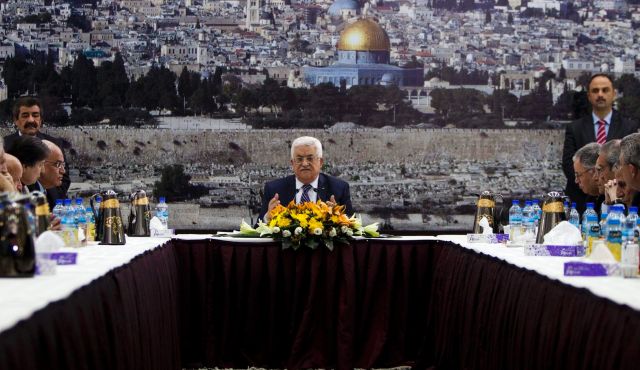
Abbas AprilPalestinian President Mahmoud Abbas at a leadership meeting in Ramallah, in April. Photo by AP

There are some moments a journalist will never forget. In early 1997, Yossi Beilin decided to trust me, and show me the document that proved that peace was within reach. The then-prominent and creative politician from the Labor movement opened up a safe, took out a stack of printed pages, and laid them down on the table like a player with a winning poker hand.

Rumors were rife about the Beilin-Abu Mazen agreement, but only a few had the opportunity to see the document with their own eyes or hold it in their hands. I was one of those few. With mouth agape I read the comprehensive outline for peace that had been formulated 18 months earlier by two brilliant champions of peace — one, Israeli, and one, Palestinian. The document left nothing to chance: Mahmoud Abbas is ready to sign a permanent agreement. The refugee from Safed had overcome the ghosts of the past and the ideas of the past, and was willing to build a joint Israeli-Palestinian future, based on coexistence. If we could only get out from under the Likud’s thumb, and get Benjamin Netanyahu out of office, he will join us, hand in hand, walking toward the two-state solution. Abbas is a serious partner for true peace, the one with whom we can make a historic breakthrough toward reconciliation.

We understood. We did what was necessary. In 1999, we ousted Likud and Netanyahu. In 2000, we went to the peace summit at Camp David. Whoops, surprise: Abbas didn’t bring the Beilin-Abu Mazen plan to Camp David, or any other draft of a peace proposal. The opposite was true: He was one of the staunchest objectors, and his demand for the right of return prevented any progress.

But don’t believe we’d give up so quickly. During the fall of 2003, as the Geneva Accord was being formulated, it was clear to us that there were no more excuses, and that now, Abbas would sign the new peace agreement and adopt its principles. Whoops, surprise: Abu Mazen sent Yasser Abed Rabbo (a former Palestinian Authority minister) instead, while he stayed in his comfy Ramallah office. No signature, no accord.

But people as steadfast as us don’t give up on our dreams. So in 2008 we got behind Ehud Olmert, and the marathon talks he held with Abbas, and the offer that couldn’t be refused. Whoops, surprise: Abu Mazen didn’t actually refuse, he just disappeared. He didn’t say yes, he didn’t say no, he just vanished without a trace.

Did we start to understand that we were facing the Palestinian Yitzhak Shamir? No, no, no. In the summer of 2009, we even supported Netanyahu, when he made overtures to Abbas with his Bar-Ilan speech, and the settlement freeze. Whoops, surprise: the sophisticated objector didn’t blink, or trip up. He simple refused to dance the tango of peace with the right-wing Israeli leader.

Have we opened our eyes? Of course not. Again, we blamed Netanyahu and Likud, and believed that in 2014, Abu Mazen wouldn’t dare to say no, not to John Kerry. Whoops, surprise: In his own sophisticated, polite way, Abbas has said no in recent months to both Kerry and Barack Obama. Again, the Palestinian president’s position is clear and consistent: The Palestinians must not be required to make concessions. It’s a complicated game – squeezing more and more compromises out of the Israelis, without the Palestinians granting a single real, compromise of their own.

Take heed: Twenty years of fruitless talks have led to nothing. There is no document that contains any real Palestinian concession with Abbas’ signature. None. There never was, and there never will be.

During the 17 years that have gone by since Beilin took that document out of his safe, he’s gotten divorced, remarried, and had grandchildren. I also divorced, remarried, and brought (more) children into the world. Time passes and the experiences we’ve accumulated have taught both Beilin and me more than a few things. But many others haven’t learned a thing. They’re still allowing Abbas to make fools of them, as they wait for the Palestinian Godot, who will never show up.

Off Topic: Two Mid East intelligence chiefs, Gen. Kochavi and Prince Bandar, were wrong about Syria

April 26, 2014

Two Mid East intelligence chiefs, Gen. Kochavi and Prince Bandar, were wrong about Syria, DEBKAfile, April 26, 2014

Maj.-Gen._Aviv_Kochavi_Northen_Commaned25.4.14

The appointment of Military Intelligence Director Maj. Gen. Aviv Kochavi to OC Northern Command, announced Friday, April 25, raised some eyebrows in top IDF command circles. During the three years he served as AMAN chief, Kochavi was credited with enhancing the corps’ operational capabilities to the highest standard in its history and transforming it into a combat force.

But, on the debit side, Kochavi was also responsible for three major miscalculations.

In 2012, he overestimated the Muslim Brotherhood’s Mohamed Morsi’s prospects of lasting the course as Egyptian’s first elected president and failed to pick up on the coup to unseat him when it was hatched by strongman Gen. Abdel-Fatah El-Sisi, who is himself running for the presidency next month.

In judging Islamist rule in Cairo was there to stay, Kochavi did not appreciate the force of the antagonism to the Brotherhood which contributed to Morsi’s overthrow, as it built up in much of the Arab world.

This misjudgment affected Israeli policy-making adversely up to the present with regard to the Brotherhood’s Palestinan offspring Hamas and the Gaza Strip.

His second mistake was the opposite of the first. While overrating Morsi’s chances of survival, he underrated those of the Syrian president Bashar Assad. In that error, he was in august company. Prince Bandar Bin Sultan made the same mistake and paid for it by losing his job as Director of Saudi General Intelligence on April 15.

From the early days of the civil war in 2011, the AMAN chief stuck to the conviction that Assad was riding for a fall, refusing to acknowledge that the war had turned in his favor from the beginning of 2013.

Kochavi’s third slip-up was his acceptance of the Netanyahu government’s decision to let the Iran’s Lebanese Shiite proxy Hizballah lend its fighting strength to Assad. This increment became a strong factor in bringing about Syrian military successes against the Syrian insurgency.

This Israeli policy, which drew heavily on AMAN’s recommendations and assessments, was motivated by two objectives:

1. To get Hizballah’s forces removed far from the Lebanese border with Israel, and

2. To let Hizballah drain its strength by its division between the two fronts.
Israeli strategists calculated that to keep Hizballah’s strength down, it would be enough to apply the brakes to its supply of high-quality and quantities of weapons, by bombing consignments ad hoc as they were transferred from Syria to Hizballah bases in Lebanon.

Neither objective was achieved.

The fighting in Syria did not weaken Hizballah but, to the contrary, toughened its operatives by hard combat conditions. The IDF has not been exposed to operations of comparable intensity since the 2006 Lebanese war.

Israel’s bid to show that its heavy losses and many wounded fighters were undermining Hizballah at home also misfired. Hizballah is emerging with a high reputation as the dominant force in Lebanon, facing no real challenge from any Western or Middle Eastern political, military or intelligence quarter.

Its intervention in the Syrian conflict has given Hizballah strategic depth, a great asset in the event of a war with Israel.

All these benefits accrued from – and contributed to – Iran’s tightening grip on Syria and the enhancement of their three-way alliance in the region.

Prince Bandar lost his job mainly because he was unable to deliver on the personal promise he gave King Abdullah to bring about the downfall of President Assad at the hands of Saudi-backed rebels. He was also criticized for seeking to attain this goal by associating with extremist Islamist elements in the Syrian rebel movement, including some tied to al Qaeda.

Prince Bandar, like Kochavi, showed brilliance in much of his accomplishments – notably the project he engineered in conjunction with the US and Jordan to build a defense system inside Syria for keeping al Qaeda at bay from the Golan and the Syrian-Israeli and Syrian-Jordanian borders.

Unlike the Saudi prince, the Israeli intelligence chief was not kicked out but sideways. His new appointment as OC Northern Command takes him out of the back rooms at General Command headquarters in Tel Aviv and puts him on the front lines against Syria and Hizballah.

There, he will have to grapple with the consequences of the mistakes he made far from the action.

DEBKAfile’s military sources learn that this appointment was approved by the Deputy Chief of Staff Maj. Gen. Gady Eisenkott, who is slated to succeed Lt. Gen. Benny Gantz Chief of Staff next year.

Gen. Eisenkott is a veteran of the northern front. As Head of Operations at the General Command in the 2006 Lebanese war, he won kudos for the offensive operations he initiated to correct wrong decisions made by Lt. Gen. Dan Halutz, the chief of staff who led that war.

In the course of that conflict, Eisenkott was promoted to OC Northern command, a post he held for five years until his elevation to Deputy Chief of Staff in 2011.

In recommending Kochavi for the sensitive northern command, he took into account the latter’s varied and successful career as a combat officer prior to his work in intelligence, including his experience in undercover operations behind Syrian lines.

Some critics regard Kochavi’s successor Brig. Gen. Hertzi Levy, whose appointment as Head of Military Intelligence was unveiled at the same time, would have been a better choice for the Northern Command. The brigadier comes from Sayeret Matkal and the Paratroop Corps.

But the final decision was approved by Israel’s three security czars, Defense Minister Moshe Ya’alon and the two Generals Gantz and Eisenkott.

Hamas Underlines Iran’s Constructive Role in Uniting Palestinian Factions

April 26, 2014

Hamas Underlines Iran’s Constructive Role in Uniting Palestinian Factions, FARS News Agency, April 26, 2014

TEHRAN (FNA) – Senior Hamas official Mahmoud al-Zahar voiced satisfaction in the close and strategic relations between the Palestinian resistance movement and Iran, and praised Tehran’s unsparing efforts as a main cause of the recent agreement cut by Hamas and the Palestine Liberation Organization (PLO).

Hamas Iran

Al-Zahar termed the relations of the Hamas Movement and Islamic Republic of Iran as strategic.He further pointed out that Iran has never conditioned its support for Hamas Movement, which in turn has led to formation of appropriate relations between the two Palestinian parties.

The Hamas official added that the Islamic Ummah should follow a common strategy.

On Wednesday, the PLO and the Hamas signed a reconciliation agreement.

They agreed to form a “national consensus” government under Abbas within weeks.

Israel’s security cabinet announced in response on Thursday it would “not negotiate with a Palestinian government backed by Hamas” and vowed “measures” in response, but did not elaborate.

Any new measures would follow a raft of financial sanctions unveiled this month by the Israeli regime when the Palestinians applied to join 15 international treaties, which followed after Israel refused to release a fourth and final batch of Palestinians who have been in Israeli prisons for more than two decades.

Off Topic – Abbas : Palestinian unity government will recognize Israel

April 26, 2014

Abbas: Palestinian unity government will recognize Israel | The Times of Israel.

PA president says he wants to extend peace talks, tells PLO Central Council that joint Hamas-Fatah authority will reject violence

April 26, 2014, 1:40 pm

Palestinian Authority President Mahmoud Abbas speaks during a meeting of the Palestinian Central Council, a top decision-making body, at his headquarters in the West Bank city of Ramallah, Saturday, April 26, 2014. Abbas said any unity government with the Islamic extremist Hamas would follow his political program, an apparent attempt to reassure the West. Israel’s leaders have accused Abbas of choosing Hamas over possible peace with Israel. (photo credit: AP Photo/Majdi Mohammed)

Palestinian Authority President Mahmoud Abbas speaks during a meeting of the Palestinian Central Council, a top decision-making body, at his headquarters in the West Bank city of Ramallah, Saturday, April 26, 2014. Abbas said any unity government with the Islamic extremist Hamas would follow his political program, an apparent attempt to reassure the West. Israel’s leaders have accused Abbas of choosing Hamas over possible peace with Israel. (photo credit: AP Photo/Majdi Mohammed)

Palestinian Authority President Mahmoud Abbas on Saturday said the Palestinian unity government Hamas and Fatah will form as part of their reconciliation deal will recognize Israel and respect its international agreements.

Speaking at a meeting of the PLO Central Council in Ramallah, Abbas spoke for over an hour in a mostly impromptu address that covered a range of topics, focusing on the peace talks with Israel and the reconciliation deal reached between Hamas and Fatah earlier this week. A member of the Islamist movement Hamas attended the meeting.

Abbas said that the unity government which he is to lead will be an independent, technocratic government without Hamas or Fatah politicians. He emphasized that it would not deal with the negotiations with Israel.

“That is not its concern, that [falls within] the PLO’s authority,” the PA president said. “At the same time, I recognize Israel and it will recognize Israel. I reject violence and it will reject violence. I recognize the legitimacy of international agreements and it will recognize them. The government is committed to what I am committed. No one should claim now that it’s a government of terror.”

Abbas said, however, that the Palestinians would never recognize Israel as a Jewish state.

Concerning the impending expiration of the peace talks with Israel, Abbas said he was still interested in extending the negotiations beyond their April 29 deadline, but reiterated his demand that Israel freeze settlement construction in the West Bank and east Jerusalem, free the final group of 26 Palestinian prisoners, and begins discussions on the future borders of a Palestinian state.

The PA president lambasted Israel, saying Prime Minister Benjamin Netanyahu’s government was determined not to reach a peace deal with the Palestinians and that Israel’s refusal to negotiate with a Palestinian government that includes Hamas is proof it is not committed to a two-state solution. He praised US Secretary of State John Kerry’s efforts, saying he was serious about helping the two sides reach a negotiated peace.

Abbas claimed that Israel wanted the political division between the West Bank and Gaza Strip which has endured since Hamas violently took over the latter territory in 2007.

“The Israelis agreed to the rift, supported and loved the division. And why? Because every time that we came to negotiate with Israel, it said ‘But with whom will we speak, with Gaza or the West Bank?’ So we made reconciliation. Now they tell us to choose between Gaza and negotiations. But this is our people, this is our land.”

Noting that Israel considered Hamas a terrorist organization, Abbas pointed out that Israel held indirect negotiations with Hamas on multiple occasions, including in late 2012 to reach a ceasefire to end Operation Pillar of Defense.

“But you Israelis made deals with them, no? You reached a ceasefire agreement with the mediation of [ousted Egyptian president] ‘Sheikh’ [Mohammed] Morsi,” Abbas said. “We are not opposed to a truce, but you made the deal and now you’re telling me, ‘You must not go with Hamas?’”

Abbas said that in the past two days hope was renewed with the unity deal reached by Fatah and Hamas.

The last time the PCC convened was three years ago.

Israel suspended the peace talks over the deal, saying it would have no dealings with a Palestinian government backed by Hamas, which is pledged to the destruction of the Jewish state.

Israel and the United States had been hoping to extend the faltering peace talks beyond their April 29 deadline, but the efforts hit a wall last month when Israel refused to release a final batch of Palestinian prisoners.

The Palestinians retaliated by applying to adhere to 15 international treaties and then Abbas, who heads the PLO, the Palestinian Authority (PA) and Fatah, listed conditions for extending the talks beyond the April 29 deadline.

In the unity deal penned this week, Hamas and the Fatah-led PLO agreed to establish a “national consensus” government under Abbas within weeks.

The reconciliation deal infuriated Israel, which said it would “not negotiate with a Palestinian government backed by Hamas, a terror organization that calls for the destruction of Israel,” and vowed unspecified “measures” in response.

On Friday, State Department spokeswoman Jen Psaki said US efforts to broker a peace deal had not failed, but were currently in a “holding period” as Palestinians and Israelis decide their next move.

She noted Abbas had insisted that any government formed with Hamas backing would “represent his policies, and that includes recognition of Israel, commitment to non-violence, adherence to prior agreements and commitment to peaceful negotiations toward a two-state solution.”

Abbas spokesman Nabil Abu Rudeineh said, however, that the Palestinians received no official statement from Washington about a change in the US’s aid policy vis-á-vis the Palestinians in light of the reconciliation deal, according to Israel Radio. Congressional Republicans and Democrats signaled Friday that any permanent agreement between the PA and Hamas, which the US designates a terrorist organization, would force the US to end some $400 million in economic and security aid provided annually.

Palestinian Prime Minister Rami Hamdallah informed Abbas Friday he would resign if the president deemed it necessary for the formation of the new unity government, official Palestinian news agency Wafa reported.

AFP and AP contributed to this report. 


Congress gives PA aid warning over Hamas deal

April 26, 2014

Congress gives PA aid warning over Hamas deal, Ynetnews, April 26, 2014

(Will President Obama ignore the law or find a way to evade it? — DM)

Hundreds of millions of dollars in US aid at risk, as Congress reconsiders relationship with PA because of Fatah-Hamas unity agreement.

The Palestinian Authority’s latest push to establish a reconciliation government with the terrorist group Hamas jeopardizes hundreds of millions of dollars in US aid that the self-ruling body has consistently received for nearly two decades.

The Palestinian Authority’s latest push to establish a reconciliation government with the terrorist group Hamas jeopardizes hundreds of millions of dollars in US aid that the self-ruling body has consistently received for nearly two decades.

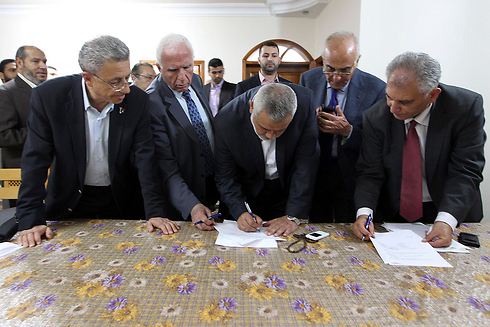
Hamas Fatah unityHamas, Fatah members signing reconciliation agreement (Photo: Reuters)

Congressional Republicans and Democrats signaled that any permanent arrangement between the Western-backed Palestinian Authority and Hamas, the US-designated terrorist organization that has called for the destruction of Israel, would force the United States to end some $400 million in economic and security aid provided annually.

The law states that no foreign aid can be provided to “any entity effectively controlled by Hamas, any power-sharing government of which Hamas is a member, or that results from an agreement with Hamas and over which Hamas exercises undue influence.”

 The leaders of the House Appropriations subcommittee that oversees foreign aid – Reps. Kay Granger, a Republican, and Nita Lowey, a Democrat, – said the agreement clearly threatens the money the Palestinian Authority has grown accustomed to receiving.

Since the mid-1990s, the United States has provided some $5 billion in bilateral aid to the Palestinians.

“Not only does this action potentially derail any hope of a peace agreement between Israel and the Palestinians, it puts in jeopardy future US assistance to the Palestinian Authority,” Granger, who was traveling in Asia, said in a statement. “This is an irresponsible path forward and this agreement should be abandoned immediately if the Palestinian Authority is serious about the peace process.”

Lowey said she would be working with the State Department on the logistics of suspending aid unless Palestinian President Mahmoud Abbas reverses course. “At this point the law is clear, their actions are clear and the path forward is clear,” Lowey said in an interview Thursday with the Jewish Telegraphic Agency.

‘Provocative act’

The top Republican on the Senate panel responsible for determining foreign aid – Lindsey Graham – called the Palestinian Authority’s move a “provocative act” and said he hoped Congress “will take a forceful stand against this decision.”

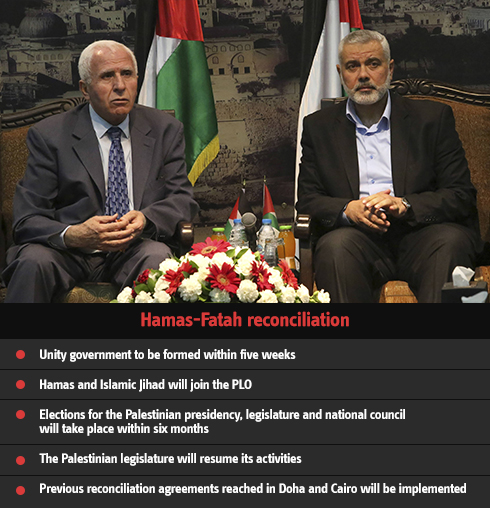
fatah_hamas_EN

The State Department said it was premature to discuss the status of foreign aid to the Palestinians. Similar reconciliation agreements between Abbas’ Fatah party and Hamas have collapsed in the past. The current timetable calls for the formation of an interim unity government within five weeks, close to the time that US lawmakers will be deciding on foreign assistance in the fiscal year 2015 budget.

Republicans and Democrats have threatened to cut off aid in the past in response to previous, unsuccessful reconciliation agreements and efforts by the Palestinians to secure statehood recognition in the United Nations.

Amid the criticism, lawmakers have recognized that the aid provides humanitarian and economic assistance while ensuring a degree of security and stability in the West Bank. Israel has typically supported the aid money for the Palestinians.

Renounce violence

But any aid to a government entity with Hamas is out of the question for Congress, not only as a violation of the law barring aid to a terrorist organization but as an affront to Israel. The law carries no waivers that would allow the Obama administration to move ahead with the money.

The aid could only flow if Hamas recognizes the state of Israel and renounces violence, moves no one expects.

The latest pact forced the collapse of already tenuous peace talks between Israel and the Palestinians, with negotiations suspended and prospects increasingly dim for the elusive two-state solution.

Republicans made it clear that the Obama administration cannot pressure Israel to revive the talks as long as Hamas is part of the equation. “Israel cannot be reasonably expected to negotiate with a terrorist organization that refuses to recognize Israel’s right to exist, permits its territories to be used to launch rockets against Israeli civilians, and continues to seek Israel’s destruction,” said Sen. Kelly Ayotte, a Republican and a member of the Armed Services Committee. “We would not expect that of our government, and we should not expect it of Israel either.”

Sen. Tim Kaine, a Democrat, said if the reconciliation agreement holds, an independent Palestine must affirm Israel’s right to exist.