Archive for April 2014

Will Israel Save Hamas and Fatah Again?

April 29, 2014

Will Israel Save Hamas and Fatah Again? Gatestone InstituteShoshana Bryen, April 29, 2014

(How about the United States? — DM)

A better system was the one both sides had before the U.S. intervened. Both were working on day-to-day security issues and employment. That is where SodaStream came from. The Israeli leadership figured that if the next generation of Palestinians had a stake in the system, they would negotiate more seriously. The Palestinian leadership figured that if people were eating, they would not overthrow the current government. It was working before the U.S. demanded an end to the conflict.

It’s an old song, and they haven’t even gotten to the chorus. Hamas and Fatah have not “reconciled.” They appear to have come close to agreeing that they will hold talks to create a “unity government.” After the government is created, there will be talks about elections, and only after that will there be talks about the distribution of portfolios under unified leadership. According to a Fatah spokesman, an interim government could be finalized in the next five weeks, with elections possible by early 2015.

This has been tried five times before. The failure of each attempt appears linked to the circumstance that the only principle they share is the belief that the establishment of Israel in 1948 was a mistake by the international community that needs rectification. In all other ways, they are rivals, not partners.
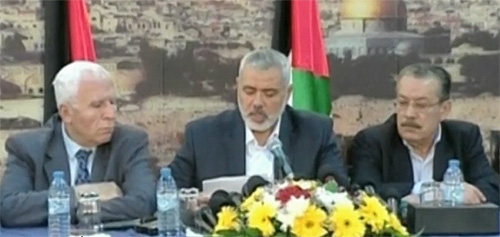
Pals meetIsmail Haniyeh (center) speaks at the signing ceremony for the Hamas-Fatah unity agreement. (Image source: Screenshot of AlJazeera video

But in a fit of wholly unwarranted optimism, let us say that this time Hamas (religious, kleptocratic, Iranian-supported, openly bloodthirsty) and Fatah (secular, kleptocratic, U.S. and EU-supported, and formally committed to diplomacy while stoking the flames of raw anti-Semitism in schools and Palestinian media) actually do figure out how to divide the spoils of the West Bank and Gaza.

That is when the problems begin.

U.S. demands of the Palestinians were, essentially two — the requirement that the Palestinians explicitly accept Israel as a Jewish state is not new, it was a clarification of the original language of the 1947 UN Partition of Palestine into an “Arab State” and a “Jewish State.” Mahmoud Abbas and Fatah were asked:

  • To concede sovereignty over their part of the larger Arab/Moslem patrimony to the Jews and — perhaps more important — to agree that Palestinian national aspirations would be forever satisfied with a split rump state squeezed in between a hostile Israel and an even more hostile Jordan; and
  • To concede that Palestinians who left the areas that became Israel in 1948 (and their descendants) would accept citizenship in the abovementioned rump state instead of having what they believe is their original property restored as promised by the Palestinian leadership. That the leadership had no authority to make such a promise is irrelevant to those who want to believe it, and to those who use it as “code” for destroying Israel.

Abbas could agree to neither — and what he could not do, Hamas certainly cannot do. So either Abbas moves Fatah closer to Hamas and abandons its American and European political and financial backers, or Hamas moves closer to Fatah, abandoning its Charter and its Iranian allies. Considering that each side has an army (Fatah’s is U.S. trained; Hamas’s is Iranian trained) and that there has been no discussion about who will be responsible for security either in the West Bank or Gaza under a “unity government,” a repeat of the 2007 short and brutal Palestinian civil war is a distinct possibility. “Peace” is not a distinct possibility.

The United States and the Europeans claim to be unhappy with the new state of affairs, but the proposal by Rep. Ros-Lehtinen (R-FL) and Rep. Ted Deutsch (D-FL) to cut off aid under the Palestinian Terrorism Act was not well-received by the State Department. Secretary of State Kerry said Israeli and Palestinian leaders needed to be willing to make compromises to keep the negotiations alive — as if it was Israel that had joined forces with a U.S.-designated terrorist organization. Spokesman Jen Psaki said, “Well, obviously, there would be implications. I don’t have those all in front of me … but what we’re going to watch and see here is what happens over the coming hours and days to see what steps are taken by the Palestinians.”

And watch what they do with their money.

The total Palestinian Authority [PA] budget for 2014 is planned to be $4.3 billion with a deficit of $1.2 billion. Income from taxes and other fees is estimated at $2.7 billion and another $1.6 billion will come in the form of foreign aid. That would be an expectation of almost 33% of the budget coming in the form of aid, and a deficit planned to be 28% of spending. (The U.S. budget deficit, by comparison was 8.7% of GDP in 2011, and it has fallen with the effects of sequestration and other decisions.)

Where does it come from and where does it go?

In January, the Administration announced that, linked to the “peace process,” American aid to the PA — not including security assistance of approximately $100 million annually — would be increased from $426 million in 2013 to $440 million in 2014. The Europeans, the largest financial backers of the Palestinian Authority, have provided more than $7 billion since 1994. Interestingly, although all other EU aid is tied both to the human rights record and transparency of the recipient, the PA faces no such restraints.

Nearly half of the budget will pay salaries — a 4.9% increase over last year (this may come as a surprise to European government employees who are still in the throes of austerity budgeting). In addition, according to EU auditors in December, the EU is paying salaries for approximately 61,000 civil servants and members of the security forces who stopped reporting for work after the 2007 civil war. In one office, they found 90 out of the 125 staff members absent.

According to The Wall Street Journal, the PA allocates a significant portion of its budget to salaries for Palestinians convicted of terrorism by Israel. These salaries are up to five times higher than the average salary in the West Bank. According to Israel’s Ministry of Foreign Affairs, in 2012 the PA’s payments to convicted terrorists in Israeli prisons and to the families of deceased terrorists (including suicide bombers) together accounted for more than 16% of the annual foreign donations and grants to the budget of the Palestinian Authority. The Palestinian minister for prisoners’ affairs announced that [approximately $41 million] would be allocated to current or former prisoners in 2014.

It other words, the Palestinians use an astonishing amount of foreign money to bribe and coerce the potentially recalcitrant.

Despite Palestinian corruption, abuse and support for terrorism, Israel has been unwilling to see Palestinian institutions collapse. While the Palestinians are nominally responsible for social services, Israel has ensured that there is no widespread hunger, disease, or power outages. The examples are legion – at the height of the so-called “second intifada,” when Palestinians were blowing up buses in the middle of cities and shooting civilians, Israel continued to coordinate food aid through a variety of NGOs. In 2012, to help the PA solve its financial crisis, Israel sought $1 billion in loans from the International Monetary Fund, intending to transfer the money to the PA. The IMF rejected the proposal because it feared setting a precedent of making IMF money available to non-state entities even through a state sponsor. Israel has also taken up much of the slack in supporting Hamas with gasoline and electricity since Egypt has been bombing and closing the Sinai tunnels. Israeli medical care has always been available to Palestinians.

Israel evidently believes a) it has a humanitarian obligation regarding Palestinian civilians; b) that should the institutions collapse, so will foreign aid to the Palestinians, leaving Israel with the entire bill for Palestinian social services; and c) at some point, there should be peace with the Palestinians, who will need a capable government to ensure the terms of whatever agreement is reached.

The announcement of “reconciliation” may actually be an attempt to form a united front. Or more likely, it could be a mechanism for Abbas to end negotiations that cannot succeed. If that is so, it could serve as a great clarifying moment in which Israel comes to see that perpetuating the fraud of a competent Palestinian government is more of a losing proposition for Israel than for its adversaries. Perpetuating the fraud of a competent Palestinian government carries no chance of a negotiated peace. There will always be a John Kerry who says the Israelis have to do more, therefore Israel will always be subject to the disapproval of those who expect Israel alone to fix the problem.

A better system was the one that both sides had before the U.S. Administration intervened with its pipe-dreams. Both were working on day-to-day security issues and employment. That is where SodaStream came from. The Israeli leadership figured that if the next generation of Palestinians had a stake in the system, they would negotiate more seriously. The Palestinian leadership figured that if people were eating, they would not overthrow the current government. It was working until the U.S. demanded an end to the conflict.

US vowed support for Israel on talks with Palestinian unity government, source claims

April 29, 2014

US vowed support for Israel on talks with Palestinian unity government, source claims, Ynet News, April 29, 2014

(Did the commitment have an expiration date? — DM)

Israeli official tells NYT that White House gave ‘specific commitment’ to back Israeli refusal to talk to PA government that includes Hamas.

Israel has received “a specific commitment from the American administration” that it supports Jerusalem’s vehement opposition to peace talks with any Palestinian government that includes Hamas, the New York Times on Monday quoted an Israeli official as saying.

The official told the Times that the commitment had been given to Israel during US President Barack Obama’s first term, and that it had been given once more following his re-election in 2012.

A senior State Department official refused comment to the Times, saying the administration was “not going to reveal the details of private conversations.”

The US, which has expressed disappointment at Fatah and Hamas’s announcement last week of reconciliation and the intention to form a unity government, said the new government would have to adhere to the same three principles as Palestinian Authority Mahmoud Abbas’s current government: a commitment to non-violence, recognition of the State of Israel and acceptance of previous agreements and obligations between Israel and the Palestinians.

While Hamas is willing to accept a Palestinian state within the 1967 borders, it has vowed to never recognize Israel. Recognition, a Hamas official said, would be between two states.

“You don’t need organizations to recognize Israel. It’s enough that the Palestinian Liberation Organization – the representative of the Palestinian people – recognizes the State of Israel. Besides, (Israel) has yet to recognize the rights and borders of a Palestinian state,” Hamas’ deputy foreign minister Ghazi Hamad told Ynet on Sunday.

As for the condition to adhere to non-violence, Hamad said the decision on whether or not to continue the armed resistance against Israel has yet to be made.

“We will discuss this – among other issues – at the negotiations between Fatah and Hamas,” Hamad noted

Israeli envoy in US: Iran doesn’t need a nuclear program

April 29, 2014

Israeli envoy in US: Iran doesn’t need a nuclear program | The Times of Israel.

Ron Dermer warns that world powers are on the verge of a bad deal with Tehran, says settlements aren’t main obstacle to peace

April 28, 2014, 11:50 pm

Israel's ambassador to Washington, Ron Dermer, formerly senior adviser to Prime Minister Benjamin Netanyahu (photo credit: Miriam Alster/Flash90)

Israel’s ambassador to Washington, Ron Dermer, formerly senior adviser to Prime Minister Benjamin Netanyahu (photo credit: Miriam Alster/Flash90)

WASHINGTON — With only a day left before the nine months allotted the US-mediated Israeli Israeli-Palestinian peace process were set to run out, Israel’s representative in Washington told participants in an Anti-Defamation League summit that Iran’s nuclear program, not the Palestinians, “is by far the single most important issue facing Israel.”

“The single greatest challenge Israel faces is Iran’s pursuit of nuclear weapons,” Ambassador Ron Dermer told an audience of hundreds at the annual ADL event. “Our policy is simple: Let Iran have only a peaceful nuclear program and nothing more.”

Dermer warned, however, that Tehran was not truly interested in developing a nuclear program for peaceful purposes – nor did it need to do so. “The truth is that we know that Iran doesn’t need a peaceful nuclear program,” he said. “Iran is awash in oil and natural gas… If Iran stopped being a rogue terrorist regime they could take advantage of their natural resources to their heart’s delight.”

The ambassador said that a state interested in pursuing a program for peaceful purposes alone had no need to enrich its own uranium or to build underground facilities and heavy water plants, all things that Iran has done and seeks to retain as part of a final agreement with the P5+1 world powers. He also noted that Iran’s development of intercontinental ballistic missile technology could only be logically applied to the delivery of nuclear payloads.

“Their only purpose is to carry a nuclear warhead,” warned Dermer. “If Iran wants a peaceful nuclear program, it has no need at all for ICBMs.”

Dermer said that “Israel is very concerned about the current discussions with Iran because all signs point to the P5+1 accepting a deal that will leave Iran’s nuclear weapons capability intact” by allowing Iran to maintain its heavy water facility at Arak, its ICBM program, thousands of uranium-enriching centrifuges and stockpiles of enriched uranium. Israel and the P5+1 powers have had open disagreements throughout the past five months since an interim deal was reached with Iran regarding the language – and obligations – necessary to reach an end goal of preventing its nuclear armament.

Israel has long insisted that any final deal must seriously curtail Iran’s capability to produce a single nuclear warhead. Other Western powers have merely emphasized that Iran not be allowed to actually produce a nuclear weapon.

The difference, Dermer argued, was one of expanding the already-brief breakout time: the amount of time it would take Iran — if it decided to violate the interim agreement — to deploy a single nuclear device.

“The international community must not allow Iran to keep its nuclear weapons infrastructure,” he insisted. “The only deal that should be acceptable is the one that dismantles Iran’s nuclear weapons production capability.”

In a rare nod to the US administration on a topic that has frequently generated friction between Jerusalem and Washington, Dermer said that “Israel appreciates that the Obama regime is working hard to make sure that the sanctions regime doesn’t unravel,” but expressed concern that a final agreement would remove incentives from Iran for good behavior, even as the current interim agreement has impacted the sanctions regime more than initially estimated by Obama administration officials.

Only after his comments on Iran did Dermer redirect his speech to address the topic of the recent breakdown in talks between Israel and the Palestinian Authority. Dermer began by explaining why Israel froze talks late last week after Palestinian Authority President Mahmoud Abbas announced that Hamas would join a new technocratic Palestinian government.

“It is said you make peace with enemies,” Dermer said, invoking a famous quote by assassinated prime minister Yitzhak Rabin. “You make peace with enemies who want peace. Hamas does not want peace.”

Dermer said that if Hamas were to recognize Israel’s right to exist and renounce terrorism, Israel would be willing to negotiate with a government that included the organization, but then added that in that case “Hamas would not be Hamas.”

Reiterating statements made by Prime Minister Benjamin Netanyahu on prominent US Sunday morning news talk shows this week, Dermer emphasized that Israel was unwilling to negotiate in a situation in which there are “technocrats” in the front office who support talks, while Hamas sits in the back office.

“Abbas has to choose – peace with Israel or a pact with Hamas,” Dermer continued. “He chose Hamas and so Israel suspended the talks.”

Dermer responded to a question from the audience regarding the role of continued construction in the West Bank, asserting that “the argument that because of settlements there is no peace is absurd. There was 50 years of conflict before there were settlements.”

According to the ambassador, “the heart of the conflict between Israel and the Palestinians is the refusal of the Palestinians to recognize a Jewish state in any borders.” Dermer said that Netanayhu recognized that fact, and it was why he placed Palestinian recognition of the “right of a Jewish people to a nation state” as a precondition for reaching a final agreement.

Although he described the question of settlements as a “sideshow” to the “true nature of the conflict,” Dermer acknowledged that Israel will eventually “have to resolve the issue of the settlements.”

“It is going to be part of the negotiations,” he continued. “It is going to require difficult decisions, but when we deal with an Arab leader who is ready to make peace, we have made such decisions in the past.”

US lawmakers lambaste Kerry over ‘apartheid’ remarks

April 29, 2014

US lawmakers lambaste Kerry over ‘apartheid’ remarks | The Times of Israel.

Sen. Ted Cruz calls for secretary of state’s resignation in wake of comments saying Israel risks following path of South Africa

April 29, 2014, 10:56 am US Secretary of State John Kerry (photo credit: AP Photo/J. Scott Applewhite)

US Secretary of State John Kerry (photo credit: AP Photo/J. Scott Applewhite)

WASHINGTON (AP) — Several US Congressmen spoke out again Secretary of State John Kerry after the Daily Beast reported Sunday that Kerry had told a closed-door meeting of the Trilateral Commission in Washington on April 25 that Israel risked becoming an “apartheid state” with two classes of citizens if negotiations to forge a peace deal fail and a two-state solution is not reached.

House GOP leader Eric Cantor, R-Va., said Kerry should apologize, while the powerful American Israel Public Affairs Committee described his use of the term as “offensive.”

Another pro-Israel lobby group demanded that Kerry resign, a call echoed by Republican Sen. Ted Cruz of Texas in a speech on the Senate floor.

Democratic Sen. Barbara Boxer of California was also critical of Kerry’s comment, saying in a tweet that: “Israel is the only democracy in the Middle East and any linkage between Israel and apartheid is nonsensical and ridiculous.”

Veteran Republican Senator John McCain also said Kerry should clarify his comments immediately and apologize, but laughed at the suggestion the top US diplomat should step down.

Kerry said Monday he had chosen the wrong word in describing Israel’s potential future after coming under withering criticism for saying the Jewish state could become an “apartheid state” if it doesn’t reach a peace deal with the Palestinians.

In a statement released by the State Department, Kerry lashed out against “partisan political” attacks against him, but acknowledged his comments last week to a closed international forum could have been misinterpreted. While he pointedly did not apologize for the remarks, he stressed he was, and is, a strong supporter of Israel, which he called a “vibrant democracy.”

He said his remarks were only an expression of his firm belief that a two-state resolution is the only viable way to end the long-running conflict. And, he stressed, he does not believe Israel is, or is definitely track to become, an “apartheid state.”

“I will not allow my commitment to Israel to be questioned by anyone, particularly for partisan, political purposes, so I want to be crystal clear about what I believe and what I don’t believe,” Kerry said.

“First, Israel is a vibrant democracy and I do not believe, nor have I ever stated, publicly or privately, that Israel is an apartheid state or that it intends to become one,” he said.

“Second, I have been around long enough to also know the power of words to create a misimpression, even when unintentional, and if I could rewind the tape, I would have chosen a different word to describe my firm belief that the only way in the long term to have a Jewish state and two nations and two peoples living side by side in peace and security is through a two state solution,” Kerry added.

In his statement, Kerry defended his general point, noting that numerous Israeli officials, including Prime Minister Benjamin Netanyahu and predecessors, Ehud Barak and Ehud Olmert, have offered similar assessments in the past.

But, he said while Barak and Olmert, and Israeli Justice Minister Tzipi Livni, “have all invoked the specter of apartheid to underscore the dangers of a unitary state for the future, it is a word best left out of the debate here at home.”

Kerry has invested significant time and energy he became America’s top diplomat last year into bringing the two sides to the negotiating table with the goal of reaching a deal in nine months. That deadline expires on Tuesday with the parties having failed to reach that settlement, a less ambitious framework deal or even an agreement to extend the negotiations. The State Department said on Monday that US envoy for Mideast peace, Martin Indyk, had returned home from the region and had no immediate plans to return.

President Barack Obama, along with Kerry and other US officials, has blamed the impasse on negative steps taken by both sides over the course of the last several months.

On the Israeli side, those include a decision not to release a group of Palestinian prisoners it had earlier agreed to free and announcements of new Jewish settlement construction on land claimed by the Palestinians. On the Palestinian side, they include a move to join numerous UN conventions they had agreed not to join while the negotiations were underway and, most recently, the announcement of a unity government with the radical Hamas movement, which Israel, the US and Europe regard as a terrorist organization.

___

Associated Press writer Brad Klapper contributed to this report.

Copyright 2014 The Associated Press.

Promoting propaganda

April 29, 2014

Israel Hayom | Promoting propaganda.

Ruthie Blum

At Tel Aviv University on Monday, Baroness Caroline Cox, a cross-bench member of the British House of Lords, gave a talk sponsored by the Yuval Ne’eman Workshop for Science, Technology and Security and the Israel Institute for Strategic Studies, run by Martin Sherman.

A passionate defender of human rights and the rule of law, Cox has spent the bulk of her career fighting forces that threaten to undermine Western democracy in general, and that of her country in particular. The focus of her lecture was the spread of political Islam in the U.K. and Africa, a phenomenon that has taken up much of her parliamentary and humanitarian work.

Though her pro-Israel positions are well-known (she is a co-founder of the One Jerusalem organization and co-president of the Jerusalem Summit), she purposely left the Jewish state out of the discussion. Nevertheless, she made a point of mentioning the symbolic relevance of her topic to the timing of her speech, which happened to fall on Holocaust Remembrance Day.

Her message was that jihad is being waged through an Islamist infiltration of the political, cultural, legal and economic systems of non-Muslim countries. It is being accomplished, she said, by pushing to have Shariah law written into, if not replace, the law of the land; by manipulating democracy to destroy it; by investing in educational institutions and making it impossible for anyone to criticize their teachings; and — as in the case of African countries — by preventing anyone who does not convert to Islam from getting a job or receiving government aid, including food for starving children.

The list goes on, and it is as ugly as the honor killings and female genital mutilation practiced by Shariah-abiding citizens and accepted by Western apologists. Even more shocking is the extent to which Britain has willingly resigned itself to this barbarism. Indeed, recounted Cox, the situation is so “schizophrenic” that while bigamy is prohibited in the U.K., polygamy among its Muslim citizens is accepted as a religious-cultural norm.

This, she explained, is not only dangerous for Britain; it is devastating for Muslims seeking the protection of British law. They are abandoned by the system in the name of diversity, and sent to Shariah courts to settle their issues.

Shariah, thus, is managing to thrive in the U.K., thanks to concessions made by the establishment to an ever-growing Islamic population. And it’s no wonder, with Muslim men being left to marry multiple wives with whom they sire dozens of children.

Admitting that educating and rallying her peers and the public against this crack in civilized society is a Sisyphean task, she concluded by urging that we all tell ourselves, “I cannot do everything, but I must not do nothing.”

Such an appeal often falls on deaf ears. Ignorance is partly to blame. Then there’s the fear — of being accused of Islamophobia on the one hand, and of violent repercussions on the other. It is far easier to empathize with the enemy and confront a less daunting culprit.

Which brings us, of course, to Israel.

One key element of global jihad is propaganda aimed at turning lies into truth and vice versa. Trained by the Soviets masters of this art, Arab-Muslim apparatchiks have taken it to a whole new level. Their success lies in their two-pronged self-portrayal as downtrodden victims of Western imperialism and as destined victors against the “infidels.” Chief among these are the “Great Satan” (America) and the “Small Satan” (Israel).

That Europe’s response is to sell its soul to appease the beast is bad enough. But when the administration in Washington follows suit, the sense among the sane is that even science fiction couldn’t do justice to the horror of it all.

Yes, President Barack Obama is looking the other way during bogus negotiations with Iran, thereby enabling the Islamic republic to develop nuclear weapons. Meanwhile, Secretary of State John Kerry is blaming Israel for not acting in a similar fashion with the Palestinian Authority.

Not only has Kerry chided Israel on several occasions for its inability to persuade the PA to engage in peace talks toward the establishment of a Palestinian state, but he has made public statements to that effect. Buoyed by the moral relativism that the State Department has been applying to “both sides,” the PA signed a treaty with Hamas.

Fuming, Kerry outdid himself on Friday. During a closed meeting of the Trilateral Commission — a tape of which was obtained and released by the Daily Beast — Kerry told officials from Europe, Russia and Japan that in the absence of a two-state solution, Israel “winds up either being an apartheid state with second-class citizens, or it ends up being a state that destroys the capacity of Israel to be a Jewish state.”

Though Kerry now says he regrets using the word “apartheid,” it was no mere slip of the tongue. Rather, it revealed the depth of his hostility to Israel. It also served as proof of the power of propaganda. When repeated often enough, such a blatant falsehood can even roll easily off the lips of the world’s highest-ranking diplomat.

Baroness Cox would not be the least bit surprised.

Ruthie Blum is the author of “To Hell in a Handbasket: Carter, Obama, and the ‘Arab Spring.'”

Kerry backtracks on apartheid comment following criticism

April 29, 2014

Israel Hayom | Kerry backtracks on apartheid comment following criticism.

Politicians, Jewish leaders call on U.S. Secretary of State John Kerry to apologize for comments • ADL Director Abe Foxman: It is disappointing that a diplomat so knowledgeable about democratic Israel chose to use such an inaccurate and incendiary term.

Shlomo Cesana, Yoni Hirsch, Daniel Siryoti, The Associated Press and Israel Hayom Staff
U.S. Secretary of State John Kerry

|

Photo credit: Reuters

Secret US-Hizballah talks. Washington plans to include Lebanon, Syria deals in Iran nuclear pact

April 29, 2014

Secret US-Hizballah talks. Washington plans to include Lebanon, Syria deals in Iran nuclear pact.

DEBKAfile Exclusive Report April 29, 2014, 9:12 AM (IDT)
US in secret talks with Hassan Nasrallah

US in secret talks with Hassan Nasrallah

Palestinian leader Mahmoud Abbas’ initiation of a unity pact with the Hamas extremists last week did not come out of the blue. It was prompted by the direct contacts the Obama administration has secretly established with the Lebanese Hizballah. Abbas reasoned that if Washington can start a dialogue with a terrorist organization, so too can his own PLO and Fatah.

debkafile’s Washington sources report that the Obama administration appears to have carried over to Lebanon the doctrine set out by the late Richard Holbrooke for Afghanistan, whereby dialogue with Taliban should be made the centerpiece of Washington’s strategy for US troop withdrawal. Holbrooke’s influence on Secretary of State John Kerry dated back to his run for the presidency in 2004.

In Lebanese terms, Hizballah’s Hassan Nasrallah has become the equivalent of Taliban’s Mullah Mohammad. Hizballah has scored high in the Syrian war. Its military intervention on the side of Bashar Assad in the last year is credited with turning the Syrian army’s fortunes around from near defeat in 2013 to partial triumph in key areas of Syria this year. Nasrallah is able to boast that his movement’s commitment to the Syrian conflict is its central mission and will remain so until rebel and al Qaeda forces are finally vanquished.

What the Hizballah leader is trying to put across, in terms of the Holbrooke doctrine, is that like Mullah Omar in Afghanistan, he, Nasrallah, holds the key to resolving the Syrian civil war.

The Obama administration bought this premise and decided to apply it to broadening the rapidly progressing dialogue with Tehran to related areas. The plan developed in Washington was to seize the momentum of the nuclear track and ride it to a broad US-Iranian understanding that embraces a comprehensive nuclear accord with Tehran as well as understandings for resolving the Syrian and Lebanese questions.

Administration officials figure that Nasrallah heeds no one but the ayatollahs in Tehran. He may talk big but he knows that his fate is in the hands of his Iranian masters. If Iran decides it is time for him to go, it will be curtains for him. His involvement in the Syrian war is considered to be contingent on the strategic decisions of Iran’s leaders. (He was a lot less confident in the winter of 2013 when Hizballah’s home bases were being smashed in lethal suicide bombings.)

Iran also determines which weapons are supplied to the Hizballah units fighting in Syria, in which sectors they fight and how to respond to his pleas for reinforcements.

In Washington’s view, Hizballah’s involvement in the Syrian war has increased its leader’s dependence on Tehran. He accordingly has little room for maneuver in contacts with US representatives and if he turns difficult, they are sure they can turn to Tehran to force him in line.

It is also believed in administration circles that the secret Saudi exchanges with Tehran (first revealed by DEBKA Weekly) will eventually produce Riyadh’s acceptance of Hizballah as a dominant factor in Syria and Lebanon.

However, many Middle East experts find the US take on Hizballah to be naïve and simplistic and strongly doubt that the path it has chosen will bring Nasrallah – or Tehran – around to serving America’s will or purposes. They draw a parallel with the underlying US assumptions which ultimately led the Palestinians-Israeli talks off track.

But expectations of the Hizballah track are high and strongly guide the actions of President Obama, John Kerry, National Security Advisor Susan Rice and CIA Director John Brennan. And so, in early March, the first secret rendezvous took place in Cyprus between CIA officers and Hizballah intelligence and security operatives.

According to a number of Mid East intelligence sources, two such meetings have since been conducted and initial US-Hizballah understandings reached relating to the volatile situations in Syria and Lebanon.

Our intelligence sources add that US Ambassador to Beirut David Hale has been in charge of preparing these meetings and implementing the understandings reached.

John Kerry’s Jewish best friends

April 29, 2014

Our World: John Kerry’s Jewish best friends | JPost | Israel News.

By CAROLINE B. GLICK

04/29/2014 09:41

John Kerry’s recent use of the term “Apartheid” in reference to Israel’s future was an anti-Semitic act.

John Kerry

John Kerry Photo: REUTERS

Anti-Semitism is not a simple bigotry. It is a complex neurosis. It involves assigning malign intent to Jews where none exists on the one hand, and rejecting reason as a basis for understanding the world and operating within it on the other hand.

John Kerry’s recent use of the term “Apartheid” in reference to Israel’s future was an anti-Semitic act.

In remarks before the Trilateral Commission a few days after PLO chief Mahmoud Abbas signed a unity deal with the Hamas and Islamic Jihad terror groups, Kerry said that if Israel doesn’t cut a deal with the Palestinians soon, it will either cease to be a Jewish state or it will become “an apartheid state.”

Leave aside the fact that Kerry’s scenarios are based on phony demographic data. As I demonstrate in my book The Israeli Solution: A One-State Plan for Peace in the Middle East, Israel will maintain a strong and growing Jewish majority in a “unitary state” that includes the territory within the 1949 armistice lines and Judea and Samaria. But even if Kerry’s fictional data were correct, the only “Apartheid state” that has any chance of emerging is the Palestinian state that Kerry claims Israel’s survival depends on. The Palestinians demand that the territory that would comprise their state must be ethnically cleansed of all Jewish presence before they will agree to accept sovereign responsibility for it.

In other words, the future leaders of that state – from the PLO, Hamas and Islamic Jihad alike — are so imbued with genocidal Jew hatred that they insist that all 650,000 Jews living in Jerusalem, Judea and Samaria must be forcibly ejected from their homes. These Jewish towns, cities and neighborhoods must all be emptied before the Palestinians whose cause Kerry so wildly champions will even agree to set up their Apartheid state.

According to the 1998 Rome Statute, Apartheid is a crime of intent, not of outcome. It is the malign intent of the Palestinians –across their political and ideological spectrum — to found a state predicated on anti-Jewish bigotry and ethnic cleansing. In stark contrast, no potential Israeli leader or faction has any intention of basing national policies on racial subjugation in any form.

By ignoring the fact that every Palestinian leader views Jews as a contaminant that must be blotted out from the territory the Palestinians seek to control, (before they will even agree to accept sovereign responsibility for it), while attributing to Jews malicious intent towards the Palestinians that no Israeli Jewish politician with a chance of leading the country harbors, Kerry is adopting a full-throated and comprehensive anti-Semitic position.

It is both untethered from reason and libelous of Jews.

Speaking to the Daily Beast about Kerry’s remarks on Sunday, State Department spokeswoman Jen Psaki was quick to use the “some of his best friends are Jewish,” defense.

In her words, “Secretary Kerry, like Justice Minister [Tzipi] Livni, and previous Israeli Prime Ministers [Ehud] Olmert and [Ehud] Barak, was reiterating why there’s no such thing as a one-state solution if you believe, as he does, in the principle of a Jewish state. He was talking about the kind of future Israel wants.”

So in order to justify his own anti-Semitism – and sell it to the American Jewish community – Kerry is engaging in vulgar partisan interference in the internal politics of another country. Indeed, Kerry went so far as to hint that if Prime Minister Binyamin Netanyahu is forced from power, and Kerry’s Jewish best friends replace him, then things will be wonderful.  In his words, if “there is a change of government or a change of heart, something will happen.” By inserting himself directly into the Israeli political arena, Kerry is working from his mediator Martin Indyk’s playbook.

Since his tenure as US ambassador to Israel during the Clinton administration, Indyk has played fast and dirty in Israeli politics, actively recruiting Israelis to influence Israeli public opinion to favor the Left while castigating non-leftist politicians and regular Israeli citizens as evil, stupid and destructive.

Livni, Olmert, Barak and others probably don’t share Kerry’s anti-Semitic sensitivities. Although their behavior enables foreigners like Kerry to embrace anti-Semitic positions, their actions are most likely informed by their egotistical obsessions with power. Livni, Olmert and Barak demonize their political opponents because the facts do not support their policies. The only card they have to play is the politics of personal destruction. And so they use it over and over again.

This worked in the past. That is why Olmert and Barak were able to form coalition governments. But the cumulative effects of the Palestinian terror war that began after Israel offered the PLO statehood at Camp David in 2000, the failure of the 2005 withdrawal from Gaza, and the 2006 war with Lebanon have brought about a situation where the Israeli public is no longer willing to buy what the Left is selling.

Realizing this, Barak, Livni and others have based their claim to political power on their favored status in the US. In Netanyahu’s previous government, Barak parlayed the support he received from the Obama administration into his senior position as Defense Minister. Today, Livni’s position as Justice Minister and chief negotiator with the PLO owes entirely to the support she receives from the Obama administration.

Neither Barak nor Livni ever lost sight of the cause for their political elevation, despite their electoral defeats.
Like Barak in Netanyahu’s previous government, today Livni provides Kerry and Indyk with “Israeli” cover for their anti-Israeli policies. And working with Kerry and Indyk, she is able to force herself and her popularly rejected policies on the elected government.

Livni – again, like Barak in Netanyahu’s previous government – has been able to hold her senior government position and exert influence over government policy by claiming that only her presence in the government is keeping the US at bay. According to this line of thinking, without her partnership, the Obama administration will turn on Israel.

Now that Kerry has given a full throated endorsement of anti-Semitic demagoguery, Livni’s leverage is vastly diminished. Since Kerry’s anti-Semitic statements show that Livni has failed to shield Israel from the Obama administration’s hostility, the rationale for her continued inclusion in the government has disappeared.

The same goes for the Obama administration’s favorite American Jewish group J Street. Since its formation in the lead up to the 2008 Presidential elections, J Street has served as the Obama administration’s chief supporter in the US Jewish community. J Street uses rhetorical devices that were relevant to the political realities of the 1990s to claim that it is both “pro-peace and pro-Israel.” Twenty years into the failed peace process, for Israeli ears at least, these slogans ring hollow.

But the real problem with J Street’s claim isn’t that its rhetoric is irrelevant. The real problem is that its rhetoric is deceptive.

J Street’s record has nothing to do with either supporting Israel or peace. Rather it has a record of continuous anti-Israel agitation. J Street has continuously provided American Jewish cover for the administration’s anti-Israel actions by calling for it to take even more extreme actions. These have included calling for the administration to support an anti-Israel resolution at the UN Security Council, and opposing sanctions against Iran for its illicit nuclear weapons program. J Street has embraced the PLO’s newest unity pact with Hamas and Islamic Jihad. And now it is defending Kerry for engaging in rank anti-Semitism with his “Apartheid” remarks.

J Street’s political action committee campaigns to defeat pro-Israel members of Congress. And its campus operation brings speakers to US university campuses that slander Israel and the IDF and call for the divestment of university campuses from businesses owned by Israelis.

On Wednesday, the Conference of Presidents of Major American Jewish Organizations is set to vote on J Street’s application to join the umbrella group as a “pro-peace, pro-Israel” organization.

Kerry’s “Apartheid” remarks are a watershed event. They represent the first time a sitting US Secretary of State has publically endorsed an anti-Semitic caricature of Jews and the Jewish state.

The best response that both the Israeli government and the Jewish community can give to Kerry’s act of unprecedented hostility and bigotry is to reject his Jewish enablers. Livni should be shown the door. And the Conference of Presidents of Major American Jewish Organizations should reject J Street’s bid for membership.

Caroline B. Glick is the author of The Israeli Solution: A One-State Plan for Peace in the Middle East.

Kerry’s Regime-Change Fantasy

April 29, 2014

Kerry’s Regime-Change Fantasy « Commentary Magazine.

It wasn’t the only controversial comment on the Middle East that Kerry made during his remarks to the Trilateral Commission, a recording of which was obtained by The Daily Beast. Kerry also repeated his warning that a failure of Middle East peace talks could lead to a resumption of Palestinian violence against Israeli citizens. He suggested that a change in either the Israeli or Palestinian leadership could make achieving a peace deal more feasible. He lashed out against Israeli settlement-building. And Kerry said that both Israeli and Palestinian leaders share the blame for the current impasse in the talks.

The key part in that parade of nonsense is: “He suggested that a change in either the Israeli or Palestinian leadership could make achieving a peace deal more feasible.” The most harmful effect of such comments is not that they insult Israeli and Palestinian leaders–they do, but Kerry doesn’t care, and they’re all adults anyway and can roll with the punches. The real danger here is that Kerry is revealing that he doesn’t know anything about Israeli or Palestinian politics if he thinks that “regime change,” so to speak, on either side might get him closer to his Nobel Prize.

On the Israeli side, the idea of helping to collapse Benjamin Netanyahu’s governing coalition to get more obedient peaceniks in office is an ongoing farce during the Obama presidency. Even the president’s staunch defenders noticed quite early on that he was intent on spending energy and political capital trying to compel change in the Israeli coalition so he could get what he wanted. (This is the same administration that legitimized Mahmoud Ahmadinejad’s “election” “victory” in Iran.)

Barack Obama’s irrational hatred of Netanyahu was mirrored by the left in general, so he didn’t get quite the pushback such a scheme deserved. Putting aside the moral implications of destabilizing an ally in order to control it, the Obama administration should have learned by now that it would fail anyway. There has been an election since Obama’s early Mideast foibles, and that election produced a governing coalition that reflected precisely what I talked about last week: There is a broad political consensus in Israel, especially regarding the peace process, and Israeli democracy, however imperfect, tends to keep that consensus in office.

What the Obama administration wants for Israel is not what the Israeli people want for their country. The beauty of democracy is that this can be expressed at the ballot box for all to see. Kerry, then, has no excuse. We all know he’s wrong about Israeli politics, and thanks to regular parliamentary elections there’s no hiding it. Kerry, for obvious reasons, did not have much credibility on this issue to begin with; he would be foolish to bury whatever’s left of it with such pronouncements.

He is no less wrong about the Palestinians, but for different reasons. I can understand any frustration he might have with Mahmoud Abbas. The PA leader demanded pricey preconditions even to participate in talks, and then abandoned them to run into the arms of Hamas. Though it should have been obvious from the beginning that Abbas was not going to make peace and that he was playing Kerry, it probably still stings.

But who, exactly, does Kerry think is waiting in the wings to replace Abbas? Palestinian society is shot-through with hatred for Jews and anti-Semitic propaganda, and the high-profile alternative to Abbas’s crew has always been the more extreme Hamas. Additionally, Salam Fayyad’s exit from the PA government proved that the Palestinian Authority couldn’t even tolerate a reformer whose hands they had already tied. The mere presence of a man with liberalizing ideas was enough for the antibodies to attack the infection.

The Fayyad fiasco shows something else: it’s not true that there aren’t Palestinian moderates or Palestinians who want peace (or would at least prefer it to their leaders’ bombs-and-poverty governance). But they do not appear to be in the majority and, even more significantly, they do not reside in a democracy. Abbas governs by suffocating authoritarianism. There is simply no institutional structure to empower moderates.

This is one reason Fayyad’s departure was so deeply mourned in the West. Even when stymied by his rivals, Fayyad accomplished something modest by simply existing within the Palestinian bureaucracy. Though he couldn’t put his ideas into practice, he could infuse the internal debate with them and perhaps even hire likeminded staffers who, in the future, would be nearer the levers of power and greater in number. It might have been a long shot, but it was something.

As the American aid to the PA and Israeli military cooperation with it demonstrates, the alternatives to Abbas currently are unthinkable as peace partners and almost uniformly more enamored of violence. Abbas is no hero, but if Kerry thinks a change in Palestinian leadership would benefit his quest for peace, he’s even more confused than he appears.

Exclusive: Kerry Warns Israel Could Become ‘An Apartheid State’

April 28, 2014

Exclusive: Kerry Warns Israel Could Become ‘An Apartheid State’, Daily Beast, Josh Rogan, April 27, 2014

(It might be best if he had kept his mouth shut. However his comments, like other “goofs,” show the bases of his thoughts and actions. They need to be considered in dealing with him. — DM)

The secretary of state said that if Israel doesn’t make peace soon, it could become ‘an apartheid state,’ like the old South Africa. Jewish leaders are fuming over the comparison.

The secretary of state also implied, but did not say outright, that if the governments of Israeli Prime Minister Bibi Netanyahu or Palestinian Authority President Mahmoud Abbas left power, there could be a change in the prospects for peace. If “there is a change of government or a change of heart,” Kerry said, “something will happen.”

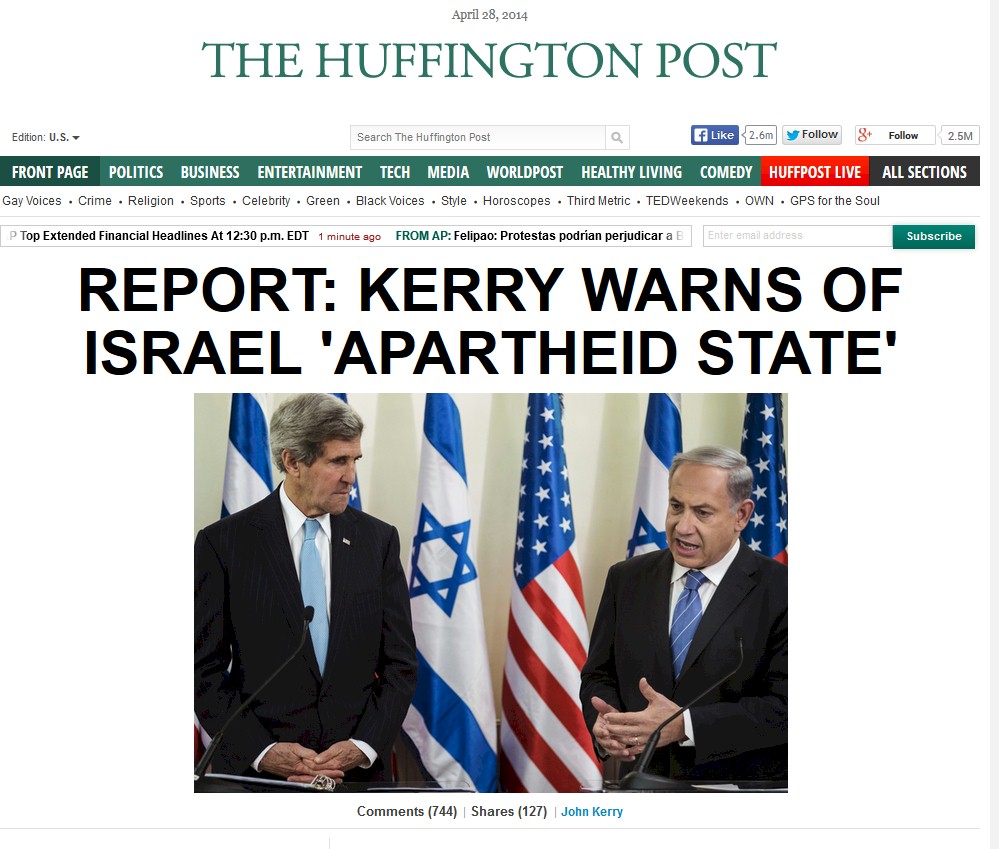
huff

(You too, Brutus…? – JW )
 
Brendan Smialowski/Reuters

If there’s no two-state solution to the Israeli-Palestinian conflict soon, Israel risks becoming “an apartheid state,” Secretary of State John Kerry told a room of influential world leaders in a closed-door meeting Friday.

Senior American officials have rarely, if ever, used the term “apartheid” in reference to Israel, and President Obama has previously rejected the idea that the word should apply to the Jewish state. Kerry’s use of the loaded term is already rankling Jewish leaders in America—and it could attract unwanted attention in Israel, as well.

It wasn’t the only controversial comment on the Middle East that Kerry made during his remarks to the Trilateral Commission, a recording of which was obtained by The Daily Beast. Kerry also repeated his warning that a failure of Middle East peace talks could lead to a resumption of Palestinian violence against Israeli citizens. He suggested that a change in either the Israeli or Palestinian leadership could make achieving a peace deal more feasible. He lashed out against Israeli settlement-building. And Kerry said that both Israeli and Palestinian leaders share the blame for the current impasse in the talks.

Kerry also said that at some point, he might unveil his own peace deal and tell both sides to “take it or leave it.”

“A two-state solution will be clearly underscored as the only real alternative. Because a unitary state winds up either being an apartheid state with second-class citizens—or it ends up being a state that destroys the capacity of Israel to be a Jewish state,” Kerry told the group of senior officials and experts from the U.S., Western Europe, Russia, and Japan. “Once you put that frame in your mind, that reality, which is the bottom line, you understand how imperative it is to get to the two-state solution, which both leaders, even yesterday, said they remain deeply committed to.”

According to the 1998 Rome Statute, the “crime of apartheid” is defined as “inhumane acts… committed in the context of an institutionalized regime of systematic oppression and domination by one racial group over any other racial group or groups and committed with the intention of maintaining that regime.” The term is most often used in reference to the system of racial segregation and oppression that governed South Africa from 1948 until 1994.

Former president Jimmy Carter came under fire in 2007 for titling his book on Middle East peace Palestine: Peace or Apartheid. Carter has said publicly that his views on Israeli treatment of the Palestinians are a main cause of his poor relationship with President Obama and his lack of current communication with the White House. But Carter explained after publishing the book that he was referring to apartheid-type policies in the West Bank, not Israel proper, and he was not accusing Israel of institutionalized racism.

“Apartheid is a word that is an accurate description of what has been going on in the West Bank, and it’s based on the desire or avarice of a minority of Israelis for Palestinian land,” Carter said.

Leading experts, including Richard Goldstone, a former justice of the South African Constitutional Court who led the United Nations fact-finding mission on the Gaza conflict of 2008 and 2009, have argued that comparisons between the Israeli treatment of the Palestinians and “apartheid” are offensive and wrong.

“One particularly pernicious and enduring canard that is surfacing again is that Israel pursues ‘apartheid’ policies,” Goldstone wrote in The New York Times in 2011. “It is an unfair and inaccurate slander against Israel, calculated to retard rather than advance peace negotiations.”

In a 2008 interview with Jeffrey Goldberg, then-Sen. Barack Obama shot down the notion that the word “apartheid” was acceptable in a discussion about Israel’s treatment of the Palestinians:

“There’s no doubt that Israel and the Palestinians have tough issues to work out to get to the goal of two states living side by side in peace and security, but injecting a term like apartheid into the discussion doesn’t advance that goal,” Obama said. “It’s emotionally loaded, historically inaccurate, and it’s not what I believe.”

State Department spokeswoman Jen Psaki told The Daily Beast that Kerry was simply repeating his view, shared by others, that a two-state solution is the only way for Israel to remain a Jewish state in peace with the Palestinians.

“Secretary Kerry, like Justice Minister Livni, and previous Israeli Prime Ministers Olmert and Barak, was reiterating why there’s no such thing as a one-state solution if you believe, as he does, in the principle of a Jewish State. He was talking about the kind of future Israel wants and the kind of future both Israelis and Palestinians would want to envision,” she said. “The only way to have two nations and two peoples living side by side in peace and security is through a two-state solution. And without a two-state solution, the level of prosperity and security the Israeli and Palestinian people deserve isn’t possible.”

But leaders of pro-Israel organizations told The Daily Beast that Kerry’s reference to “apartheid” was appalling and inappropriately alarmist because of its racial connotations and historical context.

“One particularly pernicious and enduring canard that is surfacing again is that Israel pursues ‘apartheid’ policies,” Goldstone wrote in The New York Times in 2011. “It is an unfair and inaccurate slander against Israel, calculated to retard rather than advance peace negotiations.”

Yet Israel’s leaders have employed the term, as well. In 2010, for example, former Prime Minister and Defense Minister Ehud Barak used language very similar to Kerry’s. “As long as in this territory west of the Jordan River there is only one political entity called Israel it is going to be either non-Jewish, or non-democratic,” Barak said. “If this bloc of millions of ­Palestinians cannot vote, that will be an apartheid state.”

“While we’ve heard Secretary Kerry express his understandable fears about alternative prospects for Israel to a two-state deal and we understand the stakes involved in reaching that deal, the use of the word ‘apartheid’ is not helpful at all. It takes the discussion to an entirely different dimension,” said David Harris, executive director of the American Jewish Committee, an organization that has been supportive of Kerry’s peace process initiative. “In trying to make his point, Kerry reaches into diplomatic vocabulary to raise the stakes, but in doing so he invokes notions that have no place in the discussion.”

Kerry has used dire warnings twice in the past to paint a picture of doom for Israel if the current peace process fails. Last November, Kerry warned of a third intifada of Palestinian violence and increased isolation of Israel if the peace process failed. In March, Democrats and Republican alike criticized Kerry for suggesting that if peace talks fail, it would bolster the boycott, divestment and sanctions (BDS) movement against Israel.

“It’s in the Palestinian playbook to tie Israel to these extreme notions of time being on the Palestinian side, that demographics are on the Palestinian side, and that Israel has to confront notions of the Jewishness of the state,” Harris said.

Kerry on Friday repeated his warning that a dissolution of the peace process might lead to more Palestinian violence. “People grow so frustrated with their lot in life that they begin to take other choices and go to dark places they’ve been before, which forces confrontation,” he said.

The secretary of state also implied, but did not say outright, that if the governments of Israeli Prime Minister Bibi Netanyahu or Palestinian Authority President Mahmoud Abbas left power, there could be a change in the prospects for peace. If “there is a change of government or a change of heart,” Kerry said, “something will happen.”

Kerry criticized Israeli settlement construction as being unhelpful to the peace process and he also criticized Palestinian leaders for making statements that declined to recognize the right of Israel to exist as a Jewish state.

“There is a fundamental confrontation and it is over settlements. Fourteen thousand new settlement units announced since we began negotiations. It’s very difficult for any leader to deal under that cloud,” Kerry said.

He acknowledged that the formal negotiating process that he initiated and led since last summer may soon stop. But he maintained that his efforts to push for a final settlement will continue in one form or another.

“The reports of the demise of the peace process have consistently been misunderstood and misreported. And even we are now getting to the moment of obvious confrontation and hiatus, but I would far from declare it dead,” Kerry said. “You would say this thing is going to hell in a handbasket, and who knows, it might at some point, but I don’t think it is right now, yet.”

Kerry gave both Israeli and Palestinian leaders credit for sticking with the peace process for this long. But he added that both sides were to blame for the current impasse in the talks; neither leader was ready to make the tough decisions necessary for achieving peace.

“There’s a period here where there needs to be some regrouping. I don’t think it’s unhealthy for both of them to have to stare over the abyss and understand where the real tensions are and what the real critical decisions are that have to be made,” he said. “Neither party is quite ready to make it at this point in time. That doesn’t mean they don’t have to make these decisions.”

Kerry said that he was considering, at some point, publicly laying out a comprehensive U.S. plan for a final agreement between the Israelis and the Palestinians, in a last-ditch effort to forge a deal before the Obama administration leaves office in 2017.

“We have enough time to do any number of things, including the potential at some point in time that we will just put something out there. ‘Here it is, folks. This is what it looks like. Take it or leave it,’” Kerry said.