Archive for April 2014

Hezbollah reorganizes ranks in light of leaks

April 3, 2014

Hezbollah reorganizes ranks in light of leaks – The Daily Star.

April 01, 2014 12:38 AM 
The Daily Star

File - Hezbollah members parade in Teffahta during a ceremony commemorating three slain Hezbollah leaders, Imad Mughniyeh, Abbas Musawi and Sheikh Ragheb Harb, Friday, Feb. 14, 2014. (The Daily Star/Mohammed Zaatari)

File – Hezbollah members parade in Teffahta during a ceremony commemorating three slain Hezbollah leaders, Imad Mughniyeh, Abbas Musawi and Sheikh Ragheb Harb, Friday, Feb. 14, 2014. (The Daily Star/Mohammed Zaatari)

Information made available to The Daily Star revealed that a high-ranking Iranian lieutenant colonel, identified as Mahmoud A., arrived recently in Lebanon to provide counsel as Hezbollah radically reforms its security apparatus.

The changes are a response to violations committed within party ranks, documented by Israeli as well as Western intelligence, as well as the party’s missteps in dealing with the sensitive security situation in Lebanon – not to mention the conflict in neighboring Syria, where the party has suffered from almost daily information leaks.

The colonel is expected to be involved in a series of changes and new appointments in a number of leading security posts, as well as reorganizing groups and cells in line with amendments relating to the party’s communication structure.

Information made available by reliable sources said that Hezbollah arrested one of its field commanders in Syria, after it was alleged that he was dealing with the Israeli Mossad and played a role in leaking information to agents, leading to the Israeli raid on the Janta area.

The commander has been moved to Haret Hreik and his case – supervised by the Iranian colonel – is being investigated.

The sources also confirmed that Hezbollah’s security apparatus was able to detect a cell within the party working for Israeli agents. The cell included a Lebanese man identified as M.A., who hails from the southern Nabatieh town of Harouf, and is thought to be a notorious Israeli informant within the party’s electronic communications department.

The sources said the detainee’s maternal uncle was assassinated in Germany by jihadist organizations charged with working for Israel after he fled Lebanon following the withdrawal of Israeli forces from south Lebanon in 2000.

His grandfather was also assassinated by a Palestinian resistance faction in 1980.

According to the information available, among those involved with working for Israel is a Hezbollah sheikh who is still being investigated but whose name has not yet been released, because identifying him publicly could have a negative impact on the party’s political, military and social environment.

The sources add that an Iranian intelligence official, known as “Habari,” was the one who first relayed information about these informant cells to the party. Habari also discovered that Russian intelligence had uncovered a Palestinian double agent working for both Mossad and Russian intelligence services.

In the meantime, Hezbollah has worked to reinforce its positions in Yabroud after taking control of the border city, and has placed Burkan rockets and military units in the area.

Additionally, an engineering team is working to clear landmines placed in the area by Syrian rebels. The party has also found tens of stolen cars carrying Lebanese license plates, some of which had already been rigged with explosives and were ready to be detonated by suicide bombers.

Hezbollah has also been able to apprehend Abu Zahraa, a Nusra Front leader whose real name is Mahmoud Abdallah and who is believed by Iran to be in possession of “delicate information.”

Meanwhile, a number of Iranian military officials reached Yabroud to study how the geography of the area can be exploited in the future. Hezbollah sources believe the city could be a valuable launching pad for military operations toward Rankous and Flita, as well as a strategic stronghold vis-a-vis the Lebanese village of Arsal.

Off Topic: Admiral Warns that Risk of Nuclear Conflict Is Growing

April 3, 2014

Off Topic: Admiral Warns that Risk of Nuclear Conflict Is Growing – The Washington Free Beacon.

(Hope and Change works like a charm. But hey, there’s nothing you can’t fix with the famous reset button. Meanwhile: House Lawmakers Push to Keep Ballistic Missile Silos Viable. – Artaxes)

Stratcom: Large-scale Russian strategic nuclear buildup has been underway for over a decade

The Russian navy's Varyag missile cruiser / AP

The Russian navy’s Varyag missile cruiser / AP 

BY:
April 3, 2014 4:59 am

Russia is engaged in a large-scale buildup of strategic nuclear forces that has been underway for a decade, the commander of the U.S. Strategic Command (Stratcom) told Congress on Wednesday.

“Russia has maintained and continues to modernize their strategic deterrent capability,” Adm. Cecil Haney, the Stratcom commander told the House Armed Services Committee.

The blunt comments came in response to reports that Russian strategic nuclear forces recently held a large-scale nuclear exercise coinciding with saber-rattling conventional military deployments close to Russia’s eastern border with Ukraine.

Haney said the Russians conduct periodic nuclear war games and in 2013 produced a YouTube video that highlighted “every aspect of their capability.”

“But on a day-to-day basis, they exercise and have a readiness posture of their capability, which we monitor very closely,” Haney said.

State Department cables sent to Washington earlier this year included dire warnings that Russia is vastly increasing its nuclear arsenal under policies similar to those Moscow followed during the Soviet era.

The cables, according to officials familiar with them, also stated that the Russian strategic nuclear forces buildup appears aimed at achieving nuclear superiority over the United States and not nuclear parity.

The nuclear modernization has been “continuous” and includes adding fixed intercontinental ballistic missiles (ICBMs) and mobile ICBMs, along with a new class of strategic missile submarines, Haney said in testimony.

“Russia has articulated their value in having strategic capability, and as such, each area they have invested in both in terms of nuclear strategic capability as well as space capability and cyberspace capability in terms of things,” Haney said.

“And as a result, we have seen them demonstrate their capability through a variety of exercises and operations. They maintain their readiness of that capability on a continuous fashion. And it’s a capability I don’t see them backing away from.”

By contrast, Haney testified to the committee that U.S. nuclear forces are in urgent need of modernization to update aging nuclear weapons, delivery systems, and support and production infrastructure, most of which were made decades ago.

Under budget sequestration, which could be re-imposed in 2016, U.S. nuclear force modernization will be undermined.

Russia “drew down” some conventional military forces since the end of the Cold War but “the one area that they maintained was their strategic capability,” the four-star admiral said, adding: “Their modernization has been occurring over the last decade or so.”

While Moscow has been aggressively upgrading its nuclear forces, “in our case we have sustained existing programs,” he said.

“I want to be careful in terms of comparing apples to oranges. It’s just as we look to our future, you can only sustain what we have for so long.”

Asked by Rep. Mike Rogers (R., Ala.) if the U.S. nuclear modernization program is insufficient, Haney said: “I would say we have plans for our modernization that we must continue to work through and as long as we stay on course on those plans, we will be fine.”

“Sequestration as written today puts uncertainty in those plans in terms of what will be funded into the future, he added.

Rep. Michael Turner (R., Ohio) told Haney at the hearing that Russian actions in Ukraine should prompt the United States to quickly upgrade its nuclear forces.

“Putin has allowed us, in his most recent actions, to understand that we have been pursuing a false narrative with respect to Russia — both with respect to our conventional forces in Europe and our strategic forces,” Turner said.

“We now see that there have been some actions that Russia has been taking, specifically under the leadership of Putin, that perhaps we have ignored or that we have diminished in importance,” Turner added. “As we review those issues again, certainly our nuclear deterrent comes to mind as an issue that needs to be reviewed, in light of Russia’s actions and Russia’s doctrine.”

U.S. officials have identified the new weapons in the Russian strategic arsenal as a new mobile ICBM called the Yars-M to be deployed later this year that will use a more powerful fuel, allowing it to better defeat missile defenses. The missile will have a range of up to 6,835 miles and have 10 warheads.

Additionally, Moscow announced plans for a new rail-mobile ICBM to be fielded by 2020. The Soviet Union was the first to deploy a rail-mobile SS24 in the 1980s.

New missile submarines that have been deployed include a more modern Bulava missile.

A Russian strategic nuclear bomber is set for deployment by 2020. The bomber will be equipped with a new Kh-102 air-launched cruise missile. Moscow also is working on a new Kaliber submarine-launched cruise missile.

Russian strategic forces also are working on a new hypersonic strategic vehicle that is designed to be launched by a ballistic missile and maneuvers at very high speed. The vehicle is designed to defeat U.S. missile defenses.

On other issues, Haney described the current security environment as “more complex, dynamic, and uncertain than at any time in recent history.”

“Nation states such as Russia and China are investing in long-term and wide-ranging military modernization programs to include extensive modernization of their strategic capabilities,” he stated in prepared testimony.

“Nuclear weapons ambitions and the proliferation of weapon and nuclear technologies continues, increasing risk that countries will resort to nuclear coercion in regional crises or nuclear use in future conflicts.”

Although a major conflict with nuclear arms is remote, “the existential threat posed by a nuclear attack requires the U.S. to maintain a credible and capable deterrent force,” he said.

Building new strategic submarines is the “top modernization priority,” Haney said.

Missile submarines and the Trident II D5 missile is the most survivable leg of the U.S. three-pronged nuclear deterrent. The other two are strategic bombers and Minuteman III ICBMs.

Haney also said further arms talks with Russia and resulting cuts, an Obama administration national security priority, should be mutual and not unilateral.

“I agree with the statement you made there: Any additional reductions in nuclear weapons require it to be non-unilateral and it has to be in a verifiable manner so that we can get the benefits such as those we have gotten from the New START Treaty where we have had access and the ability to be able to verify what Russia has in a very methodical way and a very open and transparent way,” Haney said in response to questioning from Committee Chairman Rep. Buck McKeon (R., Calif.).

Rep. Doug Lamborn (R., Colo.) said that under the 2010 New START arms treaty with Russia, the United States cut its warhead arsenal by 103 while Russia increased its warheads.

“To me, it is a remarkable situation that we’re decreasing and they are increasing,” Lamborn said.

Haney responded by stating that Russia has a large tactical nuclear arsenal and that arms agreements so far were limited to strategic arms that have “come down appropriately” and allowed for information exchanges and other details of the strategic forces.

“But is the imbalance roughly 10-to-1 when it comes to tactical warhead and weapons?” Lamborn asked.

“I would rather not put a number to it in this open forum, sir,” Haney said.

Obama’s Mideast Nightmare

April 3, 2014

Obama’s Mideast Nightmare, Front Page Magazine, April 3, 2014

Bush’s Axis of Evil had consisted of “rogue states”. Obama’s Axis was made up of allied governments. Bush had set out to stabilize the Middle East by clearing out rogue states while Obama set out to empower rogue states by clearing out stable allied governments… which left the rogue states in charge.

ali

A man sits holding a cup of coffee in a restaurant. He drops the cup and it cracks. Everyone around him berates him for his thoughtless stupidity.

Then a second man enters and after delivering a fine speech on the virtues of making this into the best restaurant that it can be, begins smashing all the cups and then the plates. He overturns the tables, tears down the curtains, breaks the lights, tumbles all the food to the floor and sets the whole place on fire.

The first man was named George. The second man was named Barack.

During George W. Bush’s last month in office, thirty-one Americans had died in Iraq and Afghanistan. By June, the month of Obama’s infamous Cairo speech, that number had climbed to forty. And by that same time next year, it was at sixty-eight.

When Bush left office at the end of his second term, the region was mostly stable aside from Iran’s nuclear program. By the time Obama had finished his first term, it was in a state of endless war.

It is still in a state of war today.

While Bush only overthrew Saddam, Obama overthrew Mubarak, Ben Ali, Gaddafi and Saleh. The difference lay not only in the scale of their respective regime change operations, but in their relative impacts on regional stability.

Saddam had invaded other countries and cultivated terrorists, while the governments that Obama helped overthrow, aside from Gaddafi, were not expansionistic, were not obsessed with building up WMD’s and had helped maintain regional stability,.

Bush had sought to stabilize the Middle East by removing Saddam. Obama instead destabilized it by trying to remove every government that was in any way friendly to the United States and was not covered by the umbrella of the Saudi GCC.

Bush’s Axis of Evil had consisted of “rogue states”. Obama’s Axis was made up of allied governments. Bush had set out to stabilize the Middle East by clearing out rogue states while Obama set out to empower rogue states by clearing out stable allied governments… which left the rogue states in charge.

The fall of more modern pro-Western governments left the Middle East divided sharply between Sunni and Shiite Islamists in Iran and Saudi Arabia. The Democratic Party’s sabotage of Bush’s efforts to stop Iran had created a regional power imbalance. The Sunnis had numbers, but the Shiites were going nuclear. And a nuclear bomb is a blunt instrument for reducing population numbers by the millions.

Obama’s abandonment of Iraq had pushed it through another violent sectarian split that revived Al Qaeda and combined with his Arab Spring, consumed Syria.

Unable to match Iran on purely military terms and with the United States unwilling to do anything about its nuclear program, the Sunnis turned to insurgency. The Arab Spring had been disastrous for Sunni military powers like Egypt, but helped revive Sunni insurgencies. Syria, with a Sunni majority, was a perfect platform for taking on the Shiite axis and alienating it from the rest of the region.

Saudi Arabia tied down Obama’s “regional reforms” in a civil war exchanging his vision of populist Islamist regime change for violent sectarian conflict and killing his “Arab Spring”. Then killing a second bird with that same stone, it dragged Iran into a brutal insurgency, doing to Iran, what it and the Saudis had done to the United States in Iraq.

Except that it was no longer just about Syria. Syria had become a Sunni-Shiite fracture point stretching into Iraq and Lebanon.

Obama’s abandonment of Iraq led to a comeback for Al Qaeda in Iraq. Al Qaeda in Iraq had always been the most feral Middle Eastern franchise in the Al Qaeda family. The most brutal, the most senselessly violent and the likeliest to kill just for the sake of killing; its members seemed sociopathic even to hardened Al Qaeda leaders. And Bush had succeeded in burying it until Obama dug it up again.

The sectarian split in Iraq and Syria turned Al Qaeda in Iraq from a defeated footnote to a resurgent army with tens of thousands of fighters and a grip on two major countries.

When Obama boasts that the core of Al Qaeda is on the path to defeat, he neglects to mention that the most dangerous part of Al Qaeda is now more powerful than it ever was before. Or that Al Qaeda now has more numbers, more territory and more experience than ever before.

Obama could do nothing meaningful about Al Qaeda in Syria because he feared empowering Assad. And he couldn’t do anything about Assad because he feared alienating Iran. It was a Catch 22 situation forcing him to choose between the Arab Spring and outreach to Iran.

After a long midnight struggle of the soul, he chose Iran.

The Arab Spring had been Obama’s international ObamaCare. It was the project that he was most identified with and the one that he could most take credit for. But by the time the Arab Spring had come down to bombing Syria, it was about as popular as ObamaCare. Russia, Iran and Syria offered Obama a way out. A new, new beginning to replace the old new beginning that had gone wrong in Cairo.

Having sold out Iraq, Egypt and Tunisia, Obama finished the job by dumping the rest of his Sunni allies and taking a ride on the Shiite nuclear express.

Bush had often been blamed for isolating the United States, but it was Obama who thoroughly isolated the United States in the Middle East.

The United States had set out to isolate Iran, but Obama’s nuclear pandering to Iran instead allowed Iran to isolate the United States from its allies. No country in the Middle East still trusts the United States. Egypt despises Obama. The Saudis insult him. The rest don’t even bother to do that much. The Israeli Defense Minister talks of dealing with Iran alone.

The United States has become a fading shadow in the Middle East; a power vacuum waiting to be filled by a nuclear arms race and battlefields of the dead.

Obama inflicted severe damage on American influence and interests, and on the Middle East, with nothing but an inchoate notion that the Islamists who would take over when he was done would embrace democracy over terrorism.  Instead there is less democracy and more terror than ever before.

Obama’s foreign policy was a self-fulfilling prophecy. The left had insisted for decades that the Arab Street was angry because of the damage wrought by our interference in their domestic politics. And he attempted to “right that error” by interfering so much that the accusation was finally proven true.

The one thing that all the parties in Egypt, that Sunni and Shiite from Syria to Iraq to Lebanon, that Christian, Jew and Muslim can agree on, is that the Middle East would have been better off if Obama had kept his mouth shut and stayed away.

Disastrous outcome of the ‘peace negotiations’

April 3, 2014

Disastrous outcome of the ‘peace negotiations,’ Israel Hayom, Isi Leibler, April 3, 2014

(The notion that “the end justifies the means” has been turned upside down through the “peace process” to the extent that the process has itself become the objective, rather than any peace it might otherwise yield. In consequence, it will yield none. — DM)

( “The objective of the Palestinian leaders is not the acquisition of land, but the end of Jewish sovereignty in the region. This explains their adamant refusal to recognize Israel as a Jewish state.” Sums it up… – JW )

The persistent pressure on Israel to make unilateral concessions without reciprocity has merely empowered the Palestinian extremists who smugly demonstrate that intransigence pays off.

. . . .

The PA believes that their strategy of diplomacy and the dismantling of Israel in stages is a far more effective tactic than terrorism (to which they repeatedly threaten to revert). But both the PA and Hamas share the same goal — the elimination of Israel.

As anticipated, the Obama administration’s efforts to impose a peace settlement have proved to be a disastrous failure. It is immaterial whether the negotiations formally break down or a face-saving formula is adopted which is nonbinding and incorporates sufficient reservations to make it meaningless. Regrettably, the U.S. intervention has only exacerbated the situation and even undermined the chances of low-profile interim progress and economic cooperation.

The peace settlements between Israel and Egypt and Jordan were achieved because both parties sought to come to an accommodation. The U.S. did not then seek to impose solutions. It only became involved as a facilitator and honest broker after both parties had taken the initial steps and invited them.

The flawed initiatives by the Obama administration have resulted in the standing of the U.S. in both Israel and the Arab world plummeting to its lowest level.

U.S. Secretary of State John Kerry has blustered and zigzagged between intimidating and occasionally placating Israel. The pressure was exerted overwhelmingly toward Israel while the Palestinians, who were treated with kid gloves, refused to make a single meaningful compromise. This generated enormous frustration and resentment of the U.S. among Israelis.

The positive memories of U.S. President Barack Obama’s visit to Israel and the ongoing defense support and cooperation — now at an all-time high — were overshadowed by Israeli anger against the U.S. for bullying its government into releasing brutal mass murderers who were subsequently glorified as heroes by the Palestinian Authority.

The PA demanded this as a prerequisite even to agreeing to negotiate. An uninformed observer would assume that Israel was the supplicant and would be unaware that the territories were acquired only after Israel vanquished an Arab conglomerate that had initiated a war to annihilate it.

American and European leaders still delude themselves that the Israeli-Palestinian conflict relates to two hostile people fighting over real estate. They seem unaware that both Yassir Arafat and Mahmoud Abbas rejected Israeli offers of 95% of territories over the Green Line, without even making counteroffers.

By now, they should recognize that the objective of the Palestinian leaders is not the acquisition of land, but the end of Jewish sovereignty in the region. This explains their adamant refusal to recognize Israel as a Jewish state.

The U.S. administration ignores the reality that the corrupt and duplicitous PA chairman, Abbas, even if he desired, has no mandate to make any concession and if he deviated, would likely be assassinated.

The persistent pressure on Israel to make unilateral concessions without reciprocity has merely empowered the Palestinian extremists who smugly demonstrate that intransigence pays off.

The U.S. policymakers also fail to appreciate that the differences between the PA and openly genocidal Hamas are primarily tactical. The PA believes that their strategy of diplomacy and the dismantling of Israel in stages is a far more effective tactic than terrorism (to which they repeatedly threaten to revert). But both the PA and Hamas share the same goal — the elimination of Israel.

It is now time for the Obama administration to accept the reality that the PA has evolved into a criminal society. How else to define a regime which brainwashes kindergarten age children into believing that Israel and the Jews are evil parasites and continuously calls for the elimination of the Jewish state? This demonization of Israel is reinforced daily by the mullahs in the mosques and the PA-controlled media. In addition, terrorists are sanctified, treated as heroes and awarded state pensions. There are obvious similarities between the Nazi brainwashing of the German people and what Arafat and now Abbas have imposed on the Palestinians.

Due to Obama’s initial personal intervention, the settlements — a mere 3-4% of territories over the Green Line — have now become a central issue. While Israelis differ over the role of settlements in remote areas, they are frustrated that home constructions in Jewish suburbs of east Jerusalem and within the settlement blocs that will remain in Israel generate infinitely greater global condemnation than the mass slaughter in Syria.

Yet despite all the efforts and concessions Israel has made, there are signals that the Obama administration will cast the blame on us for the failure of negotiations, which we realized from the outset were doomed as a hopeless charade. The recent histrionic U.S. attacks against Defense Minister Moshe Ya’alon for expressing concerns with aspects of American foreign policy impacting on Israel testify to this.

That Israel is again being pressured over prisoner releases is scandalous. The government was bludgeoned by the U.S. into releasing these mass murderers on the clear understanding that the four phases of release would only be fulfilled if there was progress in the negotiations. Abbas has made it abundantly clear that he will not compromise on anything and yet the Americans persist in exerting pressure.

To further muddy the waters, in order to induce Israel to concede to further Palestinian demands including the release of more prisoners and the imposition of a form of construction freeze on settlements, Kerry offered to free Jonathan Pollard. There were outraged protests in the U.S. as well as in Israel condemning this trade-off between freeing Pollard (who by any benchmark should have been released a long time ago) and mass murderers. For the time being it is no longer on the agenda. Should it proceed, it will be scandalous for Israel to have agreed and represents an obscene lapse in morality on the part of the Obama administration.

Our government must be aware that irrespective of what concessions Israel makes, once the Palestinians feel that they have squeezed to the maximum, they will then proceed to the United Nations and canvass the international courts at The Hague to charge us with breaches of international law in order to initiate boycotts and delegitimize us.

We are not privy to the threats the government is facing from the U.S. administration. But Netanyahu must now consider biting the bullet, rejecting American pressure and, if necessary, presenting our case directly to the American people.

We would reiterate that there is no desire to rule over Palestinians — emphasizing that the overwhelming majority are effectively already ruling themselves.

It must be stressed that Israel is located in a regional scorpion’s den, drawing attention to the barbaric and bestial crimes in which over 150,000 people were butchered in Syria. Missiles are still being launched against our civilians from neighboring Palestinians.

We should remind them that we face barbarians at our gates and that our principal concern is to ensure the security of our children and grandchildren. For that reason, if we cannot reach a meaningful agreement, we must reluctantly live with the status quo.

Israel will continue to promote economic relations with the Palestinians, hoping that in the course of time, new leaders will emerge who are willing to make concessions and recognize our security requirements. Then the two-state solution could become an overnight reality and joint Israel Palestinian cooperation would enable us all to prosper and enjoy a bright future. This is the distant dream to which most Israelis still aspire but alas, as of now, is not even on the horizon.

Abbas to U.S.: Get lost – Washington Post

April 3, 2014

Abbas to U.S.: Get lost | Right Turn.

By Jennifer Rubin, Updated: April 2 at 8:45 am

The Post reports: “Palestinian Authority President Mahmoud Abbas defied American diplomats Tuesday by unilaterally signing more than a dozen United Nations treaties, endangering the U.S.-brokered peace talks between Israel and the Palestinians.

With the stroke of a pen, a pall of confusion descended as diplomats could not answer basic questions about how and when the negotiations will continue. Efforts to forge a final and lasting peace between Israel and the Palestinians is a centerpiece of the Obama administration’s foreign policy.”

After five years of endless meetings in the region and in Washington, frayed relations between the U.S. and Israel, countless boasts by the Obama administration about the potential for a peace deal, Obama officials’ constant harangues about the building of Israeli housing and the forced resignation of the only true Palestinian reformer (Salam Fayyad), it was a fitting end to – or, at least, rupture of — the “peace process.”

It is stunning that such an utterly useless exercise could be the center of the Obama administration’s foreign policy; but it is indicative of the cluelessness and immense ego of the Obama-Clinton-Kerry foreign policy that so much prestige would be invested in something so fruitless, especially with real crises and challenges popping up around the globe.

I don’t mean to suggest that it is the Obama administration’s fault that the process did not lead to a peace agreement, although its obsession with settlements convinced Abbas that he could hold out for a deal to be delivered at his doorstep.

In fact, as a former U.S. official critical of the administration relates, there was never a deal to he had: “Abbas will never sign anything. Never. He is the old man serving between Arafat and the next generation, and he will not sign a peace agreement that necessarily requires strong leadership and selling difficult compromises. His decision to leave the table may be reversible, but he is showing his view of American leadership: Defying the Americans is nothing to be afraid of. In this he is following Putin and Iran.”

We will see if the rift can be mended, but the administration needs to think seriously about its next move if Abbas plays his unilateral cards. The U.S. should make clear that anybody that accepts the Palestinian Authority will lose America as a member. Perhaps that will defuse the latest gambit.

If nothing else, this development personifies how warped is the president’s judgment of leaders and flawed is his assessment of the potential for success and failure. It also confirms how little weight President Obama carries with leaders who’ve come to see him as far too accommodating with enemies and too eager to kick friends to the curb.

Kerry Lauds Nonexistent Iranian Fatwa Banning Nuclear Weapons – MEMRI

April 3, 2014

Kerry Lauds Nonexistent Iranian Fatwa Banning Nuclear Weapons – MEMRI.

(Yet another phantasy on which the phantasy based approach of current US foreign policy is based. – Artaxes)

U.S. Secretary Of State Kerry In New And Unprecedented Statement: ‘President Obama And I Are Both Extremely Welcoming And Grateful For The Fact That [Iranian] Supreme Leader [Khamenei] Has Issued A [Nonexistent] Fatwa’ Banning Nuclear Weapons

Introduction

In a March 22, 2014 Voice of America interview marking Norooz, the Persian New Year, U.S. Secretary of State John Kerry said that he and President Obama were “grateful” that Iranian Supreme Leader Ali Khamenei had issued a fatwa banning the possession, development, and use of nuclear weapons. The following are excerpts from the interview:

Question: Supreme Leader Khamenei, who is [sic] fatwa is mentioned, is being mentioned again in the President’s Norwuz message, [but he] still says Americans are not trustworthy. How important is this fatwa in your opinion, the nuclear fatwa?

John Kerry: Well, I have great respect for a fatwa. A fatwa is a very highly regarded message of religious importance. And when any fatwa is issued, I think people take it seriously, and so do we, even though it’s not our practice. But we have great respect for what it means. And – but the trick here – the trick – the art, the requirement here, is to translate the fatwa into a legally binding, globally recognized, international understanding. And so I hope that’s achievable. And I think it’s a good starting place. And President Obama and I both are extremely welcoming and grateful for the fact that the supreme leader has issued a fatwa declaring that [emphasis MEMRI’s]. That’s an important statement. But now we need to take that and put it into a sort of understandable legal structure, if you will, that goes beyond an article of faith within a religious belief or a process into a more secular process that everybody can attach a meaning to.”[1]

No Such Fatwa Was Ever Issued; No One Ever Saw It And The U.S. Administration Never Asked To See It

While U.S. administration officials affirm, praise, and frequently refer to a fatwa issued by Iranian Supreme Leader Ali Khamenei that bans nuclear weapons, this fatwa has never been seen, and as a number of MEMRI reports have pointed out, the fatwa in fact does not exist. Additionally, the U.S. administration has never even requested to see this fatwa or sought to have it published in a public forum.

MEMRI has published the following reports on the nonexistent fatwa:

Kerry Calls For “Translat[ing] The [Nonexistent] Fatwa Into A Legally Binding, Globally Recognized, International Understanding”

It should be mentioned that while Secretary of State Kerry skips the step of obtaining proof of the fatwa’s existence, he calls on Iran to “translate the fatwa into a legally binding, globally recognized, international understanding” and to “put it into a sort of understandable legal structure… that goes beyond an article of faith within a religious belief or a process into a more secular process that everybody can attach a meaning to.”

Iran’s Official Position: The Fatwa Is An Alternative To Everything Kerry Proposes In His Statement

However, the official Iranian position is that this fatwa – which MEMRI has proven to be nonexistent – is an actual alternative to everything that Kerry proposes in his statements above, and that it is also a preferred alternative to international law.

For example, Iranian Atomic Energy Organization director and former foreign minister Ali Akbar Salehi, who is very well acquainted with the nuclear negotiations, said at a February 19, 2014 Iranian National Conference on Nuclear Law in Tehran marking “Khamenei’s issuing of his historic fatwa banning nuclear weapons”: “This historic fatwa can be treated as a legitimate document, with validity equal to the validity of the text of international treaties.”[2]

Majlis speaker Ali Larijani, who is close to Khamenei, told the Omani parliamentary speaker on December 5, 2013 that Khamenei’s nuclear fatwa “is more important than [state] law, because unlike the law it cannot be changed.”[3]

Additionally, in an article in the Iranian Review of Foreign Affairs periodical, Iranian Foreign Ministry official Sirjani-Shahabi Farhad[4] stated that this fatwa means that Iran’s commitment to a ban on nuclear weapons is greater and more comprehensive than what the NPT requires. Furthermore, he claimed that the fatwa “complements and offers additional and incontrovertible assurances nationally and internationally over and above those provided by the NPT,” because while the NPT is “intrinsically discriminatory” the fatwa is not.

He wrote: “The commitment undertaken by Iran via the fatwa, is, in some important respects, more comprehensive and more long-lasting than that [which] Iran has undertaken under the NPT… The fatwa’s commitment is unilateral and unconditional. Moreover, the commitment undertaken by Iran, via the fatwa is, in some respects, more comprehensive than that via the NPT.

“Guided by the Supreme Leader’s fatwa, the Islamic Republic of Iran would unilaterally, for all times and under all circumstances, refrain from producing, acquiring, stockpiling and using all sorts of WMD, including nuclear weapons. Although [its] terminology differ[s] from [that of] the NPT, to which Iran has been committed since its inception in 1968, the fatwa bans Iran from acquiring nuclear weapons, with measures and wordings clearly both not less comprehensive or less restrictive than those set by the NPT.

“In this sense, I believe, with regards to Iran, [that] the fatwa complements and offers additional and incontrovertible assurances nationally and internationally over and above those provided by the NPT. Though the NPT is intrinsically discriminatory – dividing the member states into nuclear-haves and nuclear-have-nots, this weakness is further amplified, through a politically selective treatment of its articles…”[5]


Endnotes:

[1] State.gov, March 22, 2014.

[2] Kayhan (Iran), February 19, 2014.

[3] ISNA (Iran), December 5, 2013.

[4] Sirjani-Shahabi Farhad served as Deputy Permanent Representative at the Geneva Mission (1982-1985) and Ambassador to Zimbabwe (1986-1989). He was Director of the United Nations Department (1989-1993) and Director of Disarmament and International Security Department, Ministry of Foreign Affairs (1996-1998). He also served as Special Assistant to the Executive Secretary of the Preparatory Commission for Comprehensive Nuclear-Test-Ban Treaty Organization, Vienna (1998-2008). Currently he serves as Senior Expert at the Legal and International Department of the Iranian Foreign Ministry, and is also a member of the academic board of the School of International Relations affiliated with the Foreign Ministry.

[5] Iranian Review of Foreign Affairs, Summer 2013.

Israeli Iron Beam laser air defense system ‘brings down mortars like flies’ creator says

April 3, 2014

Israeli Iron Beam laser air defense system ‘brings down mortars like flies’ creator says | JPost | Israel News.

By YAAKOV LAPPIN

 04/02/2014 16:16

Innovation of Rafael Advanced Defense Systems company is designed for threats too small to be dealt with by existing systems.

US laser weapon technology

US laser weapon technology Photo: US Navy Illustration

A new air defense system being developed by Rafael Advanced Defense Systems, which uses lasers to shoot down low altitude threats, is able to bring down “mortars like flies,” Rafael’s CEO told the Israel Defense website on Wednesday.

Vice Admiral (Ret.) Yedidia Yaari, former chief of the Israel Navy, said the Iron Beam system will be “very effective” once it becomes operational.

Israel Defense cited Yaari as saying that that Iron Beam successfully passed a feasibility test, and is currently in development stages.

Iron Beam fires lasers at mortar shells, and has proven a high rate of accuracy, Yaari said, describing the system as “highly impressive.” It was first unveiled formally by state-owned Rafael during the Singapore Air Show last month.

The system is designed to deal with threats that fly on too small a trajectory to be engaged efficiently by Iron Dome anti-rocket batteries.

Iron Dome is complemented by Arrow II, an Israeli interceptor designed to shoot down ballistic missiles at atmospheric heights. Israel plans to integrate them with the more powerful rocket interceptors Arrow III – which will intercept ballistic missiles in space – and David’s Sling – designed for large rockets and cruise missiles – both of which are still under development.

The United States has extensively underwritten the projects, seeing them as a means of reassuring its Middle East ally as instability rocks the region.

An industry official, who asked not to be named, told Reuters in January that Iron Beam would form the “fifth layer” of integrated missile defense.

Reuters contributed to this report

Iran, Russia working to seal $20bn oil-for-goods deal, sources say

April 2, 2014

Iran, Russia working to seal $20bn oil-for-goods deal, sources say, Al Arabiya News, April 2, 2014

(An important U.S. partner in the P5+1 farce apparently thinks either that the “deal” will result in the lifting of all sanctions or does not much care. — DM)

Iran and Russia have made progress towards an oil-for-goods deal sources said would be worth up to $20 billion, which would enable Tehran to boost vital energy exports in defiance of Western sanctions, people familiar with the negotiations told Reuters.

Russia's President Vladimir Putin meets with his Iranian counterpart Rouhani during Shanghai Cooperation Organization (SCO) summit in BishkekRussia’s President Vladimir Putin (R) meets with his Iranian counterpart Hassan Rowhani during the Shanghai Cooperation Organization (SCO) summit in Bishkek last September. (File photo: Reuters)

Iran and Russia have made progress towards an oil-for-goods deal sources said would be worth up to $20 billion, which would enable Tehran to boost vital energy exports in defiance of Western sanctions, people familiar with the negotiations told Reuters.

In January Reuters reported Moscow and Tehran were discussing a barter deal that would see Moscow buy up to 500,000 barrels a day of Iranian oil in exchange for Russian equipment and goods.

The White House has said such a deal would raise “serious concerns” and would be inconsistent with the nuclear talks between world powers and Iran.

A Russian source said Moscow had “prepared all documents from its side”, adding that completion of a deal was awaiting agreement on what oil price to lock in.

The source said the two sides were looking at a barter arrangement that would see Iranian oil being exchanged for industrial goods including metals and food, but said there was no military equipment involved. The source added that the deal was expected to reach $15 to $20 billion in total and would be done in stages with an initial $6 billion to $8 billion tranche.

The Iranian and Russian governments declined to comment.

Two separate Iranian officials also said the deal was valued at $20 billion. One of the Iranian officials said it would involve exports of around 500,000 barrels a day for two to three years.

“Iran can swap around 300,000 barrels per day via the Caspian Sea and the rest from the (Middle East) Gulf, possibly Bandar Abbas port,” one of the Iranian officials said, referring to one of Iran’s top oil terminals.

“The price (under negotiation) is lower than the international oil price, but not much, and there are few options. But in general, a few dollars lower than the market price.”

Oil is currently priced around $100 a barrel.

Iran and world powers reached an interim deal in November to ease some sanctions restrictions, which went into effect in January, in exchange for a curb to Iran’s nuclear programme. Work continues to reach a final settlement.

Under the sanctions accord, Iran’s exports are supposed to be held at an average of 1 million barrels a day for six months to July 20, but sales have stayed above that level for five straight months, oil tanker tracking sources told Reuters last week.

“The deal would ease further pressure on Iran’s battered energy sector and at least partially restore Iran’s access to oil customers with Russian help,” said Mark Dubowitz of Foundation for Defense of Democracies, a U.S. think-tank.

“If Washington can’t stop this deal, it could serve as a signal to other countries that the United States won’t risk major diplomatic disputes at the expense of the sanctions regime,” he added.

The Iranian official said missiles would also be part of the deal, together with Russia providing assistance with building two nuclear plants in Iran. The Iranian official did not produce any documentation, and Russian government officials declined to comment.

Kerry’s Hubris Leads to a Great Fall

April 2, 2014

Kerry’s Hubris Leads to a Great Fall, Commentary Magazine, April 2, 2014

(Not surprisingly, President Obama and “hubris” also have often been linked in the same sentence.– DM)

[W]hile Kerry’s self-image is sufficiently grandiose to insulate him against criticisms, those who will pay the price for his failures will not be so fortunate. The Ukrainians know they cannot count on the U.S., and by raising expectations that were inevitably dashed the secretary has increased the chances of violence in the wake of his Middle East fiasco. Nor will those who may eventually be faced with the reality of an Iranian bomb remember him kindly. Not long ago liberal pundits were singing his praises. Now he should consider himself lucky if he is not soon considered a consensus choice for the title of the worst secretary of state in recent memory.

It was just a couple of months ago that Secretary of State John Kerry was being lauded as, in the words of CNN,“a surprise success.” He was hailed by the chattering classes as having exceeded Hillary Clinton’s record by showing daring instead of her instinctive caution. After all, hadn’t he managed to preside over a nuclear deal with Iran, saved President Obama’s face by negotiating a good deal with Russia about Syrian chemical weapons, and made progress on a withdrawal agreement in Afghanistan? Most of all, his audacious decision to restart Middle East peace talks when everyone was warning him it was a fool’s errand was seen as having great promise. As the Atlantic gushed, “It’s looking more and more possible that when the history of early-21st-century diplomacy gets written, it will be Kerry who is credited with making the State Department relevant again.”

But that was then. Today, Kerry is being rightly lambasted by the left, right, and center for his idiotic decision to introduce the issue of convicted spy Jonathan Pollard’s release into the Middle East peace negotiations. The collapse of those talks and Kerry’s frantic and desperate Hail Mary pass merely to keep the sides talking after Palestinian Authority leader Mahmoud Abbas’s decision to scuttle the effort illustrates the secretary’s flawed strategy and lack of a coherent backup plan. But the Middle East is not the only place where Kerry’s supposedly inspired leadership has failed. Kerry ignored and then mishandled unrest in Egypt and alienated allies across the Middle East. The special relationship that Kerry had cultivated with Russian Foreign Minister Sergei Lavrov (according to the Times the two had bonded over their love of ice hockey) has also not only proved useless in getting the Russians to do what they promised in Syria but has led to further humiliations for the U.S. as the Putin regime overran Crimea and threatened the rest of the Ukraine. Kerry’s dependence on the Russians is also likely to lead to more failure on the Iranian nuclear front since Moscow is even less inclined than it already was to pressure Tehran to sign an agreement that can be represented as a victory for U.S. diplomacy.

A generous evaluation of Kerry’s actions might merely ascribe this to a string of bad luck. But luck has nothing to do with it. The common thread between these various diplomatic dead-ends isn’t that small-minded and recalcitrant foreign leaders thwarted Kerry’s bold initiatives. It’s that in all these situations, Kerry believed the force of his personality and his tenacity was equal to the task of solving problems that had flummoxed all of his predecessors. Aaron David Miller perceptively wrote last fall at a moment when Kerry’s fortunes seemed to be on the rise, “Rarely have I encountered anyone — let alone a secretary of state — who seemed more self-confident about his own point of view and not all that interested in somebody else’s.” It was this hubris that has led to his current humiliation.

In a rare example of agreement between the editorial boards of the New York Times and the Wall Street Journal, both ridiculed Kerry’s use of Pollard as a pathetic Hail Mary pass to revive the peace negotiations that had been scuttled by Abbas. Though the two papers came at the issue from different perspectives—the Journal correctly thought it was wrong to trade a spy for the terrorist murderers Abbas wanted Israel to free while the Times thought that the gesture would advance the negotiations—they spoke for just about everybody inside and outside the U.S. foreign-policy establishment in declaring the Pollard gambit to be a sign of desperation on the part of the secretary.

The problem here isn’t just that including Pollard in the talks was wrong-headed and unlikely to yield positive results. It’s that Kerry is so invested in trying to prop up a process that never had a chance of success that he’s willing to gamble with America’s credibility. While he proved able to pressure Israel to make concessions to the Palestinians, Kerry’s naïve miscalculation about Abbas being willing or able to make peace has led to the current stalemate. Even worse, Kerry’s desperation has emboldened Abbas to keep asking for more and more with no sign that he will ever risk signing a deal that will end the conflict. The talk about Pollard is significant not just because it’s a bad idea but because it reflects American weakness rather than boldness.

But while Kerry’s self-image is sufficiently grandiose to insulate him against criticisms, those who will pay the price for his failures will not be so fortunate. The Ukrainians know they cannot count on the U.S., and by raising expectations that were inevitably dashed the secretary has increased the chances of violence in the wake of his Middle East fiasco. Nor will those who may eventually be faced with the reality of an Iranian bomb remember him kindly. Not long ago liberal pundits were singing his praises. Now he should consider himself lucky if he is not soon considered a consensus choice for the title of the worst secretary of state in recent memory.

Ahmadinejad Urges Iranians to ‘Raise the Flag of Martyrs Over the White House’

April 2, 2014

Ahmadinejad Urges Iranians to  ‘Raise the Flag of Martyrs  Over the White House,’ Washington Free Beacon, April 2, 2014

“This was Ahmadinejad’s first political comment after a long silence, more importantly it is reported by a news agency controlled by [Iran’s] powerful Basij forces, the Iranian version of SS forces,” Saeed Ghasseminejad, cofounder of Iranian Liberal Students and Graduates, told the Washington Free Beacon.

“Ahmadinejad also got the chance to sit close to Khamenei, as Khamenei’s website and IRGC-run Fars News reported,” Ghasseminejad said.

This may be seen as “a significant sign in Iran’s politics showing that Ahmadinejad’s relation with Khamenei is improving,” he said. “It seems that Khamenei and powerful forces in his office have decided not to keep Ahmadinejad totally out of the loop.”

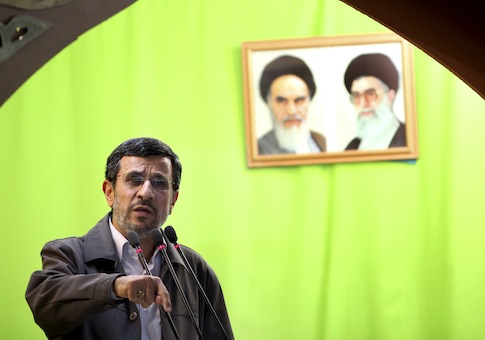
Mahmoud AhmadinejadFormer Iranian President Mahmoud Ahmadinejad / AP

Former Iranian President Mahmoud Ahmadinejad emerged from hiding on Wednesday to deliver a rare public speech in which he told Iranians, “We can rest the day that we raise the flag of martyrs over the White House,” according to an independent translation of Persian language media reports.

Ahmadinejad, most notorious for his Holocaust denial and militaristic rhetoric, visited war zones in southern Iran just a week after Iranian Supreme Leader Ali Khamenei made a similar visit to the region.

The comments were initially reported by Iran’s Basij News Agency, an official state organ controlled by the country’s powerful Iranian Revolutionary Guard Corps (IRGC).

Ahmadinejad’s reappearance on the public stage comes as Iran continues to negotiate with Western powers over its contested nuclear weapons program. The former president’s violent rhetoric is being viewed as a sign that Iranian hardliners are making a political comeback in Tehran.

“This was Ahmadinejad’s first political comment after a long silence, more importantly it is reported by a news agency controlled by [Iran’s] powerful Basij forces, the Iranian version of SS forces,” Saeed Ghasseminejad, cofounder of Iranian Liberal Students and Graduates, told the Washington Free Beacon.

“Ahmadinejad also got the chance to sit close to Khamenei, as Khamenei’s website and IRGC-run Fars News reported,” Ghasseminejad said.

This may be seen as “a significant sign in Iran’s politics showing that Ahmadinejad’s relation with Khamenei is improving,” he said. “It seems that Khamenei and powerful forces in his office have decided not to keep Ahmadinejad totally out of the loop.”

Khamenei exerts total control over Iranian politics and its figureheads, meaning that if the Supreme Leader gives the go-ahead, Ahmadinejad could regain political power.

“If Khamenei’s office gives Ahmadinejad the permission to become more active, it is a sign that Khamenei is planning to strengthen the revolutionary hardliner’s position, who surprisingly lost the presidential election to a coalition of reformists and conservatives,” Ghasseminejad said.

“Khamenei’s recent speeches and Ahmadinejad’s return show that hardliners are planning to strike back, of course after Khamenei’s permission,” he said.

Ahmadinejad’s violent rhetoric and public appearance with Khamenei may also be a signal to Iran’s political elite, particularly the Larijani brothers, who have warred with Ahmadinejad in the past and attempted to discredit him.

The Khamenei-Ahmadinejad alliance “sends a signal to the Larijani brothers who deeply hate Ahmadinejad and continuously have been seeking permission to take Ahmadinejad down,” explained Ghasseminejad.

“Recently Ahmadinejad’s vice president was summoned to court, a sign that the Larijani brothers who control legislative and judiciary branches are eager to go after Ahmadinejad himself,” he said. “Ahmadinejad is a powerful figure among hardliners and one of the few politicians in conservative camps who really enjoys popular support.”

Khamenei, in a speech last week before Ahmadinejad’s appearance in Iran’s southern region, focused on “resistance in the face of what he called ‘estekbar,’” otherwise known as “a religious translation of imperialism” that typically refers to the West and, more narrowly, the United States, Ghasseminejad explained.