Archive for April 2014

Iran: 30,000 new centrifuges needed for fuel

April 13, 2014

Iran: 30,000 new centrifuges needed for fuel | The Times of Israel.

Nuclear chief Ali Akbar Salehi says program intended to meet domestic energy needs

April 13, 2014, 7:59 pm

Illustrative photo of centrifuges enriching uranium (photo credit: US Department of Energy/Wikimedia Commons)

Illustrative photo of centrifuges enriching uranium (photo credit: US Department of Energy/Wikimedia Commons)

TEHRAN — Iran will need 30,000 of its new generation centrifuges to meet domestic fuel demands, far more than the current number, its nuclear chief said Sunday.

Ali Akbar Salehi’s comments came just days after the latest round of international talks in Vienna aimed at securing a long-term deal over Iran’s disputed nuclear program.

The capability and number of centrifuges at Tehran’s disposal has been a key concern among countries which suspect the Islamic republic’s eventual goal is to build an atomic bomb.

Iran currently has nearly 19,000 centrifuges, including 10,000 of the so-called first generation being used to enrich uranium.

The country insists its nuclear activities are solely for civilian purposes.

“If we want to use the Natanz enrichment facility to produce the annual fuel of Bushehr nuclear power plant, we need to build 30,000 new centrifuges,” Salehi was quoted by the Fars news agency as saying.

Under an interim agreement reached last year that expires on July 20, Iran froze key parts of its nuclear program in return for limited sanctions relief and a promise of no new sanctions.

Under the deal, Iran cannot increase its number of centrifuges, but in February it announced it was developing new ones that are 15 times more powerful than those currently used.

Any final deal with the West may involve Iran slashing its number of centrifuges, changing the design of a new reactor at Arak and giving UN inspectors more oversight.

The Bushehr plant, which produces 1,000 megawatts of electricity, came into service in 2011 after several delays blamed on technical problems. Tehran took control of the plant from Russia last year.

In October, Salehi said Iran had built a fuel production line for its sole nuclear power plant which would go on stream within three months.

However, he did not specify a date after which Iran could use locally produced fuel instead of that provided by Russia.

Iran has said it wants to produce 20,000 megawatts of electricity from nuclear power, which would require building 20 reactors.

US: Row over Iran ambassador won’t harm nuke talks

April 13, 2014

US: Row over Iran ambassador won’t harm nuke talks | The Times of Israel.

( Natch… Whats one got to do with the other?  Right…? – JW )

Tehran’s UN envoy faces possible ban from entering New York over his part in the 1979 takeover of the US embassy

April 13, 2014, 8:03 pm

Iran's newly appointed UN ambassador Hamid Aboutalebi (screen capture: YouTube)

Iran’s newly appointed UN ambassador Hamid Aboutalebi (screen capture: YouTube)

WASHINGTON — The United States’ ambassador to the United Nations says talks about Iran’s nuclear program are continuing undisturbed by Washington’s decision to block Tehran’s ambassador to the diplomatic body.

US Ambassador Samantha Power on Sunday told ABC’s “This Week” that Iran’s selection of Hamid Aboutalebi (ah-boo-TAH’-leh-bee) to be its United Nations envoy is not acceptable. She says Tehran should pick someone else.

President Barack Obama’s administration had previously said only that it opposed the nomination of Hamid Aboutalebi, who was a member of the group responsible for the 1979 takeover of the US Embassy in Tehran as a revolution erupted in Iran. US officials had hoped the issue could be resolved by Tehran simply withdrawing the nomination.

“We’ve communicated with the Iranians at a number of levels and made clear our position on this — and that includes our position that the selection was not viable,” White House spokesman Jay Carney said last week. “Our position is that we will not be issuing him a visa.”

Iran has rejected that suggestion following Washington’s refusal to give Aboutalebi a visa to enter the United States.

Aboutalebi was a member of the group responsible for the 1979 takeover of the US embassy in Tehran that held 52 Americans hostage for 444 days. His nomination has outraged members of Congress, who passed a bill barring entry to the US to an individual found to be engaged in espionage, terrorism or a threat to national security. Aboutalebi has insisted his involvement in the Muslim Students Following the Imam’s Line was limited to translation and negotiation.

Iran has called US rejection of Aboutalebi “not acceptable,” with Iranian state television quoting Foreign Ministry spokeswoman Marzieh Afkham as saying Aboutalebi is one of the country’s best diplomats and arguing that he previously received a US visa.

Iranian officials said they had submitted a visa application for Aboutalebi, but it was unclear whether the US actually denied the request or simply decided not to act on it. State Department spokeswoman Jennifer Psaki has said the administration was prohibited from discussing the matter in detail because visa cases are confidential.

In past problematic visa cases for ambassadors and even heads of state — such as with a previous Iranian nominee in the early 1990s and more recently with Sudanese President Omar el-Bashir — the US has either signaled opposition to the applicant and the request has been withdrawn, or the State Department has simply declined to process the application. Those options, as well as approving or denying the application, are available in the current case.

US immigration law allows broad rejection of visas to foreigners and, in many cases, authorities do not have to give an explicit reason why other than to deem the applicant a threat to national security or American policy.

The law bars foreigners whose entry or activity in the US would “have potentially serious adverse foreign policy consequences for the United States.”

Copyright 2014 The Associated Press.

Off Topic: Israeli Hackers Expose ‘Amateur’ Anonymous Hackers

April 13, 2014

Israeli Hackers Expose ‘Amateur’ Anonymous Hackers – Technology, Science, Health – News – Israel National News.

‘Israel Elite Force’ takes the fight to anti-Israel hackers behind #OpIsrael attack – using their own webcams to expose them.

By Ari Soffer

First Publish: 4/13/2014, 12:08 PM

Busted: One of the hackers behind #OpIsrael

Busted: One of the hackers behind #OpIsrael

Courtesy

Israeli hackers have gone on the offensive against their anti-Israel opponents in revenge for the #OpIsrael hacking attack against Israeli sites and servers.

After the failed “operation” by members of the “Anonymous” hacker network, Israeli hackers from Israel Elite Force took the fight to them – robbing them of their anonymity by posting details and even photos of some of the hackers on their website.

The hacker behind the counterattack, an Israeli known as “Buddhax”, said that he did it to make anti-Israel hackers “think twice” before attacking Israeli sites, and to expose them as amateurs.

Israeli hackers had already responded to attempts last week to infiltrate Israeli and Jewish sites by taking down or defacing anti-Zionist and Muslim sites.

But Buddhax has gone a step further.

After infiltrating the target computers via a Trojan horse, he managed to lure the hapless hackers to their computers and take pictures of them using their own webcams – which he promptly posted online together with a list of personal information and a direct message to his targets: “Next time don’t take part in OpIsrael. Long live Israel.”

“I’m not a great hacker, but I’m at least good enough to expose you,” he wrote, and signed off with a message for anti-Israel hackers:

“Israel will stay ISRAEL so forget about “Palestine”. Long Live Israel.”

Lior Pollack, CTO of information security at 2BSecure, told Geektime that the “exposure carried out by a team of hackers shows that the level of sophistication is very high as shown by the use of advanced tools to reach PC attackers to obtain information, photographs from their cameras through a Trojan horse.

“It’s not easy, they had to lure the attackers to press all kinds of links to get the Trojan horse in… there is a challenge even in recognizing which tools used can be accessed. Their methods suggests they are much more sophisticated and experienced than those attacking from OpIsrael, who are basically just kids who do basic things.”

The exposed anti-Israel hackers hailed from a variety of countries in Europe, the Middle East and Asia, most prominently from Indonesia and Malaysia.

Off Topic: American academia bites the dust: Brandeis University’s historic mistake

April 13, 2014

American academia bites the dust: Brandeis University’s historic mistake | JPost | Israel News.

By PHYLLIS CHESLER

04/12/2014 23:59

Ayaan Hirsi Ali has just been dishonored by Brandeis University, which withdrew its offer of a Distinguished Professorship because the Muslim Brotherhood in America mounted a successful campaign against the award.

hirsi ali brandeis

Ayaan Hirsi Ali Photo: REUTERS

By now, we all know that Brandeis University was about to bestow an honor on the elegant and distinguished author and activist Ayaan Hirsi Ali, best known for her critique of Islam, her decision to leave Islam, and her championship of Muslim women’s rights.

One might understand why an apostate intellectual might be in danger in Somalia, the country of her birth, or in Saudi Arabia, where she once lived.

However, she has just been dishonored by Brandeis University, which withdrew its offer of a Distinguished Professorship because the Muslim Brotherhood in America, known to us as the Council on American-Islamic Relations (CAIR), and its national student group, the Muslim Students Association, which is also allied with the Islamic Society of North America (ISNA), mounted a successful campaign against the award.

Both CAIR and ISNA are unindicted co-conspirators in the Holy Land Foundation terrorist financing case.

CAIR provided the Muslim Student Association (MSU) at Brandeis with outdated, out-of-context and highly inflammatory quotes from Hirsi Ali. They did not provide her thought-provoking, stirring, moving passages of which there are many.

Brandeis simply caved to the lynch mob.

This is a terrible moment for academic freedom and critical inquiry on the American campus.

Yale University drove the first nail into the coffin of academic freedom, freedom of thought, and critical inquiry, when Yale’s University Press refused to publish the Danish “Mohammed” cartoons to accompany Jytte Klausen’s 2009 book on the subject: The Cartoons That Shook The World.

Yale drove a second nail into that coffin when it ousted Dr.

Charles Small, who dared to focus on contemporary anti-Semitism, not merely on safely dead Jews. Dr. Small’s major international conference on this subject in 2010 had over 100 speakers and 600 in attendance.

The conference did not demonize the Jewish or American states and it did look at Jew-hatred and the persecution of Christians in Islamic countries today. However, official Palestinians and student Palestinians insisted this was an “Islamophobic” conference. A campaign was mounted and Yale administrators and professors dismissed Dr. Small’s Institute for the Study of Global Antisemitism, although it was independently funded.

Brandeis University, the “Jewish” university, (in terms of liberal values), has driven the third nail into the coffin of academic freedom and intellectual diversity, when it bowed to student and faculty pressure and rescinded its offer to Hirsi Ali.

I am outraged, saddened and frightened all at the same time. I have sentimental ties to Brandeis and I am suffering from its betrayal of its own stellar values.

I understand that perfectly peaceful Muslim students at Brandeis may not wish to be associated with the hate propaganda and terrorist atrocities being committed in Islam’s name. They should be standing outside the mosque that indoctrinated the Boston bomber with signs reading “Not in my Name,” and listing the gender and religious apartheid that characterize Islam today, and the Muslim-on-Muslim and Muslim-on-infidel violence being committed in the name of a religion that is dear to them.

They should be holding teachins at mosques and within Muslim communities about human rights in Islam and wrestling with the question of whether radical Islam is compatible with modern Western values.

Hirsi Ali is a consummate intellectual. Students should hear what she has to say.

Instead, Brandeis and the Muslim Student Association have taken a Sharia-like position about apostates and the anti-Islamist position she has adopted.

The Brandeis MSA student Facebook page is filled with an attitude of offended Islamist supremacism and rage over alleged “Islamophobia.”

Ironically, none other than Brandeis Professor Jytte Klausen, the author of The Cartoons That Shook the World, published her views in the Brandeis student newspaper The Justice. In her (Stockholm-syndrome?) view, giving Hirsi Ali a degree “undermines years of careful work to show that Brandeis University promotes the ideals of shared learning, religious toleration and coexistence, irrespective of religion.”

Klausen was joined by Brandeis Professors Mary Baine Campbell and Susan Lanser of the English Department. Campbell told Justice that “Hirsi Ali represents values that Brandeis, in naming itself after Justice [Louis] Brandeis … was founded in noble opposition to.” Professor Lanser said that Hirsi Ali’s (outspoken views on Islam) foment an intolerance that is wholly antithetical to Brandeisian values.”

Women’s and Gender Studies Professor Mitra Shavarini told Justice that offering this award to Hirsi Ali is not in line with the university’s mission, unless it wishes to “incite hate, mistrust and division among its community.”

She further stated that Hirsi Ali’s approach to discourse “collapses thought in obscure, non-contextualized allegations that have no intellectual merit.”

Alas, this is the language being used these days by professors on American campuses.

I have been told that over 40 professors signed a petition against honoring Hirsi Ali.

American campuses have long welcomed critiques of Judaism, Christianity, Mormonism etc. on the grounds of misogyny and biblical-era atrocities. Secularists, atheists, anti-religionists have been lionized. Great thinkers have, historically, condemned religion – all religion.

Over the years, Brandeis has awarded Distinguished Professorships to a wide variety of worthy people. The awards are wide-ranging, balanced and reasonable.

In 1987, the award was given to Adrienne Rich who said, “With initial hesitation but finally strong conviction I endorse the Call for a US Cultural and Academic Boycott of Israel.” In 2000, Brandeis also gave this award to Desmond M. Tutu, who has been quoted as saying that the “Jewish lobby” is too “powerful and scary.” In 2006, Brandeis also gave this award to Tony Kushner who is on record saying that he can “unambivalently say that I think it’s a terrible historical problem that modern Israel came into existence.”

There was no groundswell of protest against these awards; if there were, they were not successful.

The conclusion: One can criticize Judaism, the Jewish state, America, real apartheid in South Africa, but one cannot criticize Islam, Islamic Jihad, Islamic supremacism and Islamic gender and religious apartheid without being attacked and silenced.

Missile issues not to be part of nuclear talks: Iranian lawmaker

April 12, 2014

Missile issues not to be part of nuclear talks: Iranian lawmaker, Tehran Times, April 12, 2014

(Nothing new, but at least they try to appear consistent when not threatening to use their “defensive” assets to eliminate Israel and other enemies. — DM)

He went on to say that Iran’s military and missile issues have nothing to do with the West.

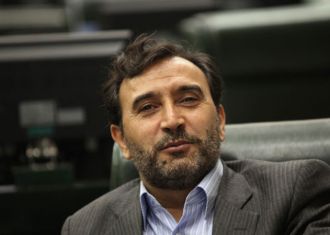
Iranian guy

TEHRAN – Mohammad Dehghan, a member of the Iranian Parliament Presiding Board, says the Westerners, specifically the U.S., want to put missile issues on the agenda of nuclear talks, the Mehr News Agency reported on Saturday.

Under Secretary of State for Political Affairs and the lead U.S. negotiator with Iran, Wendy Sherman told a Senate hearing in February that Iran’s ballistic missile program would be addressed as part of a comprehensive nuclear deal.

Iran and the 5+1 group (the five permanent members of the UN Security Council plus Germany) held their last round of talks in Vienna on Tuesday and Wednesday. They agreed to meet again on May 13 in Vienna to work on a final solution to the dispute over Tehran’s nuclear program.

The West is seeking to use the nuclear talks as an excuse to interfere in Iran’s national security issues in order to undermine the country’s national independence, the lawmaker opined.

He went on to say that Iran’s military and missile issues have nothing to do with the West.

As part of its military strategy Iran is developing long range missiles for defensive purposes, he noted.

Neither the Foreign Ministry nor an official has the right to show leniency over military and missile issues, because these are Iran’s red lines, he added.

He stated that military and missile issues should not be discussed in nuclear talks and the Iranian Parliament is sensitive toward this issue and monitors the negotiations.

On March 16, a number of Iranian MPs issued a statement saying that Iran’s defense capabilities should not be discussed during the negotiations.

Kerry Offers Himself as a Martyr for the Administration’s Failed Foreign Policy

April 11, 2014

Kerry Offers Himself as a Martyr for the Administration’s Failed Foreign Policy, Heritage Organization, April 11, 2014

(Strength through weakness; success through failure. What could be wrong with that? Would the results be better, or worse, if President Obama were to lead from the front rather than from behind?  — DM)

[T]he Obama doctrine has crashed and burned. While Kerry may want credit for effort, no amount of wishful thinking will yield positive results until the U.S. decides to lead—and not from behind.

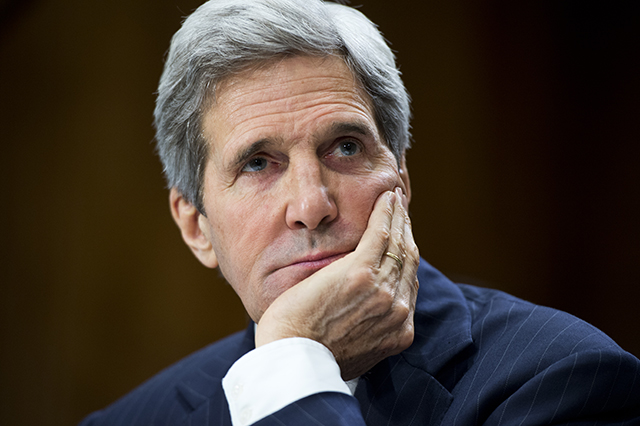
Senate Foreign Relations CommitteePhoto: Tom Williams/CQ Roll Call/Newscom

During a recent Senate hearing, Secretary of State John Kerry said he would take the blamefor any failures of the Obama Administration’s foreign policy, all the while denying American foreign policy was “spinning out of control.” The administration’s approach to foreign policy—leading from behind—has been an abject failure. It is time for the administration to enact policies that will protect the strategic interests of the U.S., project strength and resolve abroad, and convince allies and adversaries alike that America can be still counted on to lead.

Responding to a suggestion from Senator John McCain (R–Ariz.) that the Israeli-Palestinian peace talks have failed, and that it was time for Kerry to face reality, the secretary of state defended the administration’s efforts and said he was to blame for any failures:

Sure we may fail, you want to dump it on me, I may fail. I don’t care, it’s worth doing, it’s worth the effort, and the United States has a responsibility to lead.

Under President Obama, however, the United States has not led. Indeed, in nearly every region of the globe, the United States’ position has deteriorated. On the Middle East peace talks, for example, Kerry recently offered the release of a convicted Israeli spy in the U.S. as a bargaining chip to salvage a flawed peace process that has become more of a legacy obsession for Kerry rather than an opportunity to shape a strong, coherent policy.

In regards to Syria, Kerry himself reportedly privately admitted the administration’s policy has failed—charges he publicly denies.

Furthermore, U.S. policy toward Russia and Eastern Europe has been one of disengagement and weakness. Following Russia’s aggression toward Ukraine, it is clear that the Russian reset is dead, a fact recently acknowledged by architect of the reset. The U.S. needs a new strategic policy toward Russia, one based on reality, not wishful thinking. Even New START, hailed by Kerry as the one success of the Russian reset, has only strengthened Russia whileweakening the United States.

From an empty Pacific pivot to weakness in Latin America and the Middle East, the Obama doctrine has failed spectacularly.

Speaking at the hearing, Idaho Senator James Risch (R–Idaho) told Kerry “You can’t help but get the impression that our foreign policy is just spinning out of control, and we’re losing control in virtually every area we’re trying to do something in.” McCain echoed these comments when he stated “On the major issues, the administration is failing very badly.”

Risch and McCain are right: the Obama doctrine has crashed and burned. While Kerry may want credit for effort, no amount of wishful thinking will yield positive results until the U.S. decides to lead—and not from behind.

Iran Nuclear Chief: Whoever Has Nuclear Technology Gains ‘Inherent Power’

April 11, 2014

Iran Nuclear Chief: Whoever Has Nuclear Technology Gains ‘Inherent Power,’ Washington Free Beacon, April 14, 2014

Salehi curiously does not explain how nuclear technology translates to “inherent power,” although one can reasonably infer the “power” he is referring to is nuclear deterrence.

Iran’s Nuclear Chief Ali Akbar Salehi said whoever has nuclear technology gains an “inherent power” in a video posted on an Iranian affiliated YouTube account. The video is translated with English subtitles.

Salehi contended the West is pressuring Iran on its nuclear program because they fear Iran also gaining this “inherent power”:

ALI AKBAR SALEHI: Whoever has nuclear technology also gains an inherent power. Why is the West putting so much pressure on us when they know we are not seeking nuclear weapons? They say that these people are becoming an example to the world. They have resisted and have advanced so much in this technology that they have created this inherent power for themselves spontaneously. Regardless, this is a power.

Salehi curiously does not explain how nuclear technology translates to “inherent power,” although one can reasonably infer the “power” he is referring to is nuclear deterrence.

In order for a state to practice nuclear deterrence, a country must have nuclear weapons to deter or influence actions by other states.

While the Iranian nuclear chief tried to execute a careful rhetorical dance, all he really did was tacitly reaffirm his nation’s desire for a nuclear weapon.

Iranian Navy Thumbs Nose at America

April 11, 2014

Iranian Navy Thumbs Nose at America, Commentary Magazine, April 11, 2014

(Iran thumbs her nose at America constantly. That others in the region are doing so may well be of greater significance. — DM)

Thanks to Mehrdad Moarefian for flagging, but an Iranian battle group earlier this week docked in Djibouti for a three-day port call. While previously the Iranian navy docked in Port Sudan, the move to Djibouti should be a wake-up call regarding America’s shrinking military and diplomatic standing. After all, Djibouti is the site of a hugely important U.S. facility and serves as an important hub and logistical base for American activities throughout the region. It’s one thing for Iran to work with a rejectionist, failing state like Sudan; it’s quite another to enjoy port calls on the doorstep of an American base and with a government which so closely partners with the United States.

In the Persian original, the story gets worse, however: The Iranian ships had also paid a port call in Salaleh, Oman’s second most important city. That port call highlights Oman’s slow turn away from the past few decades when it was a reliable U.S. and pro-Western ally; I had previously talked about Oman’s growing flirtation with the Islamic Republic of Iran here, including its discussions of basing rights for Iran in exchange for cheap gas.

Lastly, the Persian article notes that the Iranian navy’s mission was to help secure the Islamic Republic of Iran Shipping Lines (IRISL). Given the IRISL’s involvement in proliferation, shipping of arms, and use of false flags and false documents to cover up cargo and operations–all of which it has been sanctioned for–that the Iranian Navy now expedites and facilitates the activities of this sanctioned entity certainly suggests that reform of behavior is not on the Iranian regime’s agenda, despite Obama administration claims that its strategy is working to bring Iran in from the cold.

Scare Tehran, Please

April 11, 2014

Scare Tehran, Please, The Weekly Standard Reuel Marc Gerecht, April 11,2014

(President Obama’s ability to escape (congressionally imposed) handcuffs would shame Harry Houdini. — DM)

As July draws nearer, the White House should show that it wants the nuclear deal less than Khamenei and Rouhani do. . . . Sanctions alone were never going to stop the mullahs’ nuclear quest. Given the enormous progress Tehran has made in the last five years, an honest analyst would have to conclude that sanctions are probably no longer relevant to rolling back the program. But nothing could be more helpful—intimidating to Tehran—than to have Congress “handcuff” the president through legislation now clearly defining the terms of successful nuclear negotiations and the consequences for Iran of failure. [Emphasis added.]

Is Barack Obama’s threat of preventive military action against the Iranian regime’s nuclear program credible? Would a one-year, six-month, or even three-month nuclear breakout capacity at the known nuclear sites be acceptable to him? Is he prepared to attack if Tehran denies the International Atomic Energy Agency, the U.N.’s nuclear watchdog, entry into undeclared facilities that may be hiding nuclear-weapons research or centrifuge production? Is he prepared to strike if the regime denies inspectors access to the personnel and documents that would allow the West to see whether—how much—the regime has been lying about weaponization? 
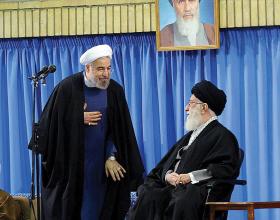
Not nervousTHEY’RE NOT NERVOUS ENOUGH TO NEGOTIATE.

These are questions that Iran’s leaders—Supreme Leader Ali Khamenei, the commanders of the Revolutionary Guards, who oversee the nuclear program, and Hassan Rouhani, who before becoming president served on the Supreme National Security Council as Khamenei’s personal representative—have undoubtedly asked since 2008. The answers they reached surely shape Tehran’s approach to the current negotiations with the West. Khamenei, Rouhani, and others have stated since the Joint Plan of Action was signed in November that Tehran has no intention of rolling back its nuclear progress. Here’s how Khamenei put it on April 9 in a meeting with officials of Iran’s Atomic Energy Organization: “But all should know that despite the continuation of these talks, the Islamic Republic’s activities in the fields of nuclear research and development will in no way be halted, and not a single nuclear accomplishment will be suspended or stopped.” 

Participants in the Vienna nuclear talks have described the proceedings so far as a take-and-give exchange, where the Iranian negotiating team grimaces and the Americans back off. The Obama administration hasn’t yet wanted to push, for example, on an inspections regime that would allow the IAEA to visit undeclared Revolutionary Guard sites that may house nuclear-weapons-related research. Since the guards oversee the entire atomic program, as well as ballistic-missile development, paramilitary expeditionary efforts (see Syria, Yemen, Iraq, Sudan, the Gaza Strip, Afghanistan), and terrorism, a rational person might conclude that a nuclear deal denying the IAEA spot inspections at Revolutionary Guard facilities is, to put it politely, defective.

President Obama’s intellectual soulmates, the left-of-center nonproliferation crowd in Washington, who have been in constant retreat over the last decade about what should be demanded of the Islamic Republic, appear to be defaulting to a position where an Iranian “freeze” would be just fine and an intrusive inspections regime covering undeclared sites unnecessarily provocative. It likely won’t be long before the soft nonproliferation voices at the Ploughshares Fund, the Carnegie Endowment, the New America Foundation, and the Brookings Institution tell us that pushing the “moderates” in Tehran—Rouhani and Foreign Minister Mohammad Javad Zarif—against the Revolutionary Guards would be counterproductive since the guards are prickly nationalists who could torpedo everything.

The nonproliferation experts often remind us that the Islamic Republic hasn’t been defeated in war, which apparently limits the West’s and the IAEA’s acceptable inquisitiveness. Increased “transparency” of known sites, which the Iranian regime is allowing, will have to be enough—even though the capacity and proclivity to lie and cheat has been a hallmark of the Islamic Republic since the 2002 disclosure of the then-hidden Natanz and Arak nuclear facilities. We will assuredly hear some nonproliferation folks again emphasize the competence of American intelligence, playing off the public remarks of the director of national intelligence, James Clapper, who suggested the intelligence community would know if Iran decided to build a bomb. Downplayed will be the unpleasant history of the Central Intelligence Agency, which has missed every successful clandestine nuclear weaponization (the USSR, Communist China, India, Pakistan, North Korea, and probably Israel and South Africa, too) since the end of World War II, along with the possibility that the Islamic Republic’s final dash to the bomb might not be conducted at a monitored site.

In other words, the final comprehensive deal that Washington should accept, so the nonproliferation left will likely argue, will contain: no dismantling of centrifuges (the new preferred terms appear to be “disabling” and “decommissioning”); no explicit ban on the future production of centrifuges; no reduction in the low-enriched uranium stockpile, allowing Tehran sufficient LEU to refine further into a half-dozen bombs; no closure of the bomb-resistant underground enrichment plant at Fordow; no dismantling of the heavy-water plant at Arak or even its conversion to a light-water reactor that can’t produce bomb-grade plutonium; no meaningful, verifiable restrictions on centrifuge research; no linkage between the development of intercontinental ballistic missiles and the nuclear program; no serious debriefings of Iranian nuclear personnel with their paperwork in hand; and certainly no acknowledgment by Tehran of its past efforts at nuclear weaponization (the nonproliferation cognoscenti call this the “possible military dimensions” of the program or PMD).

It wouldn’t be surprising to see Khamenei finally authorize an inspection of the Parchin Revolutionary Guard facility, where IAEA inspectors and Western intelligence services strongly suspect that the regime’s scientists once experimented with implosion devices and nuclear triggers. The IAEA was allowed a cursory visit in 2005; the suspect buildings have since been destroyed and paved over. Despite the uselessness of inspectors’ examining a cleansed site, Khamenei’s acquiescence would likely be greeted with great relief in many quarters and be seen as further proof of the Islamic Republic’s turn toward moderation.

If a private poll were held, it would most likely show that the vast majority of liberal nonproliferation experts    would strongly prefer a nuclear-armed Islamic Republic to  preventive military strikes unleashed by Barack Obama. This nonproliferation establishment will probably wrap itself ever more tightly in the technicalities of nuclear deal-making, as if all parties to the negotiations operated from the assumption that a nuclear weapon is no longer in the interests of the Islamic Republic, never mind the countervailing evidence of an arduous, expensive 30-year effort. The determined and deceitful nature of the regime will take a back seat, as one French official has put it, to the “right logarithm that will solve the strategic problem.”

Too-eager American diplomats and their expert assistants will attempt to find a technocratic answer to a problem that probably has no technocratic solution. The West could get utterly lost in measuring the ultimate nonproliferation desideratum: Iranian SWUs (“separative work units”—the amount of uranium separation done by an enrichment process). The surreality of this whole discussion is best seen in the “formula for success” seriously put forth by Joseph Cirincione, the president of the Ploughshares Fund, the preeminent left-wing funder of nonproliferation studies. Here is his answer to the supreme leader and the Revolutionary Guards:

C = f (Qc + Cc + Lc + QLEU + Pu + R&D + V + HPMD + D + PW)

where Confidence (C) is a function (f) of

Qc = Quantity of centrifuges

Cc = Capability of centrifuges

Lc = Locations of centrifuges

QLEU = Quantity of low-enriched uranium

Pu = Plutonium production capabilities

R&D = Research and development

V = Verification of all of Iran’s activities

HPMD = History of programs with possible military dimension

D = Duration of the deal

PW = Political willingness to enforce the deal.

So let’s consider one pivotal component of the equation, PW. This is best translated as President Obama’s willingness to bomb the ball bearings out of the Iranian regime’s nuclear facilities. At this point, most liberal nonproliferation discussions get even weirder. In January, to stop Democratic senators from passing legislation that would have mandated new sanctions against Tehran if it failed to conclude a verifiable termination of its nuclear-weapons program through the Joint Plan of Action, or if Tehran engaged in a terrorist act at any time, the administration let loose the animadversion most feared among liberals, to be labeled a warmonger. The tactic worked brilliantly: Democratic senators caved en masse.

But the nuclear negotiations ultimately hinge, as even Cirincione sees, on the president’s willingness to unleash the Air Force and Navy. The rub is that the White House doesn’t want to use the threat of force before the negotiations end; it only wants do so after a deal has been signed, when the threat of force has no leverage. But the Iranian regime always uses Machtpolitik to get what it wants, and if we don’t, we’re not serious. It’s quite likely that the administration and its partners in the think-tank community will actually call on Congress to authorize the use of force after a deal is approved by Khamenei—not because they want to scare the supreme leader and his men (that possibility will have already been lost), but to provide Democratic politicians domestic cover, a show of toughness for the electorate and perhaps a bit of psychological salve for themselves.

It’s a pity. There is still a chance that if the president seriously threatened to use force before the informal deadline for the Joint Plan of Action in July—and it would be a hard sell in Tehran after his red-line debacle in Syria—he might be able to push the supreme leader into a corner where he’d have to make crippling nuclear compromises. If the Iranian regime is “rational” when it comes to American military power, and Khamenei has clearly shown that he is, then the supreme leader would likely prove flexible so long as he were sure that an American president would strike. The United States’ armed might—not economic coercion or reward—has always been the best trump that Washington could use to neutralize Tehran’s atomic aspirations.

Look at the past. The Islamic Republic’s clandestine nuclear-weapons program was publicly revealed by an Iranian opposition group in August 2002 (Western intelligence services were aware of it earlier). The 2007 National Intelligence Estimate asserted that Tehran’s development of a nuclear trigger, which is used only in bombs, was probably halted in 2003, the year of the Iraq invasion. Other aspects of the weapons program—the development and deployment of centrifuges and uranium enrichment—also slowed or were temporarily frozen. All of Tehran was then noisily wondering whether the Islamic Republic would be the next member of the “axis of evil” to be taken down. Karim Sadjadpour of the Carnegie Endowment, who was then in Tehran with the International Crisis Group, has recounted how Iranian officials were fearfully mesmerized by the display of American will and muscle. Rouhani took great pride in his memoirs and on the stump in his presidential campaign that he, as Iran’s nuclear negotiator, had kept the regime’s atomic quest alive in those trying times through concessions that were only temporary. Iran’s nuclear program accelerated after 2005 with Mahmoud Ahmadinejad’s presidential triumph, which Khamenei celebrated, and with the floundering of the Bush administration in Iraq.

The Obama administration—the president in particular—has had great difficulty in handling the fact that George W. Bush’s decision to eliminate Saddam Hussein altered Tehran’s nuclear calculations. It has been an article of faith for this president that the Iraq war was an egregious mistake. Early in his presidency, he sincerely tried to reach out to Khamenei, suggesting that the enmity between the two countries was surmountable. Obama has consistently resisted or diluted bipartisan congressional efforts to strengthen sanctions against the Islamic Republic. Such hesitancy had various causes, but the supreme leader clearly could have read it as a sign that the White House preferred a less confrontational approach.

The president’s good intentions and restraint—which survived even an Iranian plan to blow up the Saudi ambassador in a Georgetown restaurant in 2011 and Khamenei’s all-out support of Bashar al-Assad’s savage rampage in Syria—have been reciprocated by Iranian nuclear advances and zealously nasty anti-American rhetoric from the supreme leader. Since 2008, Tehran has ramped up its centrifuge production, uranium enrichment, heavy-water reactor construction, and ballistic-missile development. Iran has probably made more progress in its nuclear-weapons program on Obama’s watch than at any earlier time.

Yet some Iranian fear remains. Tehran hasn’t ejected the IAEA inspectors and cameras at the known nuclear sites. It has installed and tested but not thrown into full-throttle its advanced centrifuges (this may be more a question of imported parts than fear). It has been careful about how much medium-enriched uranium, which is a small step from bomb-grade, it stockpiles. Progress at the heavy-water reactor at Arak, which if completed could produce plutonium, has been constant—but not a damn-the-consequences mad dash (again, parts may be a factor).

As July draws nearer, the White House should show that it wants the nuclear deal less than Khamenei and Rouhani do. Above all else, the president and senior officials should be playing on the supreme leader’s longstanding insecurity vis-à-vis American might. Sanctions alone were never going to stop the mullahs’ nuclear quest. Given the enormous progress Tehran has made in the last five years, an honest analyst would have to conclude that sanctions are probably no longer relevant to rolling back the program. But nothing could be more helpful—intimidating to Tehran—than to have Congress “handcuff” the president through legislation now clearly defining the terms of successful nuclear negotiations and the consequences for Iran of failure. Those who fear American preventive military action more than they do a nuclear weapon in the hands of the supreme leader don’t really care what kind of deal is concluded with Tehran. In the end, they would accept an agreement that neither dismantles nor intrusively monitors the Iranian regime’s atomic achievements. If President Obama isn’t in this camp, then he needs to overcome his aversion to seeing diplomacy as an adjunct to the threat of war. The Iranian regime plays hardball. To win now, we have to openly prepare to fight.

Off Topic – Dershowitz: Palestinians must come to the table for peace

April 11, 2014

Palestinians must come to the table for peace | JPost | Israel News.

By ALAN DERSHOWITZ

04/10/2014 21:18

The burden is on the Palestinians to come to the negotiating table, not as equal partners, but as claimants, seeking to obtain something that they do not have.

Palestinians confront Israeli troops at the West Bank village of Silwad, near Ramallah, on January 1

Palestinians confront Israeli troops at the West Bank village of Silwad, near Ramallah, on January 10 Photo: ISSAM RIMAWI / FLASH 90

As Secretary of State John Kerry tries to place primary blame on Israel for the stalled negotiations, it is important to look at the big picture and go back to first principles.

A little history always helps to understand the present.

In 1937-1938, the Peel Commission proposed a two-state solution in which the Jewish community of Palestine would receive a relatively small percentage of the land on which to establish the nation-state of the Jewish people.

The majority of the land was allocated to the Arab population, with the hope that they would establish their own state. The Jewish Agency, the predecessor to the Israeli government, reluctantly accepted the division.

The Arabs quickly rejected it.

In 1947-1948, the United Nations once again proposed a division of the land, with the Palestinians again getting the majority of the arable area and the Israelis getting the majority of the total area, including the Negev Desert. Israel accepted and established its state. The Palestinians rejected the proposal and joined the surrounding Arab armies in a genocidal war against the newly formed nationstate of the Jewish people.

The Jews lost 1 percent of their population, including many Holocaust survivors, in their successful effort to defend the nascent state.

In 1967, Jordan, which had occupied the West Bank since 1949, attacked Israel despite Israeli efforts to keep Jordan out of the war. Defending itself, Israel captured the West Bank.

Its leaders made it clear that it would return most of what it captured in exchange for peace and recognition.

The UN Security Council adopted Resolution 242 which essentially accepted the Israeli formulation. The Palestinians went to Khartoum where they and all the Arab countries issued their three famous nos: No peace. No negotiation. No recognition.

This led Israel’s ambassador to the United Nations, Abba Eban, to quip: “I think that this is the first war in history that on the morrow the victors sued for peace and the vanquished called for unconditional surrender.”

In 2000-2001, the Israelis once again offered to withdraw from more than 90 percent of the West Bank in exchange for peace. Yasser Arafat rejected that offer and initiated a series of terrorist attacks that left thousands dead.

In 2007, Prime Minister Ehud Olmert offered an even better deal that included land swaps under which the Palestinians would obtain part of Israel in exchange for land that Israel retained in the West Bank. Once again, the Palestinian leadership did not accept that offer.

It is clear therefore that the Israelis and the Palestinians do not stand in equivalent positions — morally, legally, diplomatically or politically — when it comes to negotiating Israel’s withdrawal from the West Bank.

Israel captured this territory in an entirely lawful defensive war.

The Palestinians want it.

Unless they are prepared to negotiate with the Israelis, they can’t get it.

The burden is on the Palestinians to come to the negotiating table, not as equal partners, but as claimants, seeking to obtain something that they do not have.

Possession is 9/10th of the law, and in this case, 9/10th of morality as well.

Those who seek a change in the status quo have the burden of coming forward and showing a willingness to negotiate.

It would be as if there was a dispute over a car, or a painting, or a piece of land. The person who was lawfully in possession of the item need do nothing unless the person seeking it offers to negotiate. If the claimant walks away from the negotiation, the status quo remains.

Of course captured land is not the same as a car or a painting, but the principles underlying negotiation are similar. The land at issue was never part of a Palestinian state. It was lawfully captured from Jordan in a defensive war.

The Jordanians have now given their rights over to the Palestinian Authority, but the Palestinian Authority has refused to take yes for an answer since 2001. And before that, the surrounding Arab states refused to accept yes for an answer over the course of three-quarters of a century.

The Palestinians deserve to have a state, but their claim is no greater than that of the Tibetans, the Kurds, the Chechens and other stateless groups. Indeed, these other groups, unlike the Palestinians, have never been offered statehood and turned it down. Nor would these groups refuse to sit down and negotiate for a state.

The two-state solution would be good for the Palestinians, for Israel, and for peace in the region. But it is the Palestinians who need it most.

They are demanding of Israel substantial territorial compromises.

They are also demanding prisoner releases, an end to construction in the settlements and a termination of Israel’s military presence in the vulnerable Jordan Valley.

To get these and other concessions from Israel, the Palestinians must be prepared to make sacrifices as well.

They must give up all claims against the nation-state of the Jewish people, including the so-called right of return.

And they must assure Israel’s security against attacks from within the areas under their control.

Most important, they must be prepared to negotiate without preconditions and to stop taking unilateral actions that may satisfy their street but that will get them no closer to achieving a state.

So let the Palestinian Authority come back to the negotiating table, and if they refuse, let the world understand why they have not achieved their goal of statehood.

Alan M. Dershowitz is the Felix Frankfurter Professor of Law at Harvard Law School. He is a graduate of Brooklyn College and Yale Law School. His latest book is his autobiography, Taking the Stand: My Life in the Law.