Archive for April 29, 2014

Farewell Mahmoud, Mon Amour

April 29, 2014

Farewell Mahmoud, Mon Amour, Commentary Magazine, April 29, 2014

(Maybe it’s been a learning experience, better than those that preceded it. Of course, some never learn. — DM)

The concept of a peace agreement with Mahmoud Abbas was always a romantic idea, featuring the triumph of hope over experience, the repeated pursuit of a “peace partner” who kept saying “no,” and the failure of peace processors to understand every part of that answer.

Today marks the official end of the Kerry Process–initiated July 30, 2013 with a White House meeting and State Department press conference proclaiming an effort to achieve a “final status agreement” in nine months; then simply a non-binding “framework”; then just an agreement to talk beyond nine months. The end result: no agreement, no framework, no talks.

The concept of a peace agreement with Mahmoud Abbas was always a romantic idea, featuring the triumph of hope over experience, the repeated pursuit of a “peace partner” who kept saying “no,” and the failure of peace processors to understand every part of that answer. If there has been any benefit from the Kerry Process, it’s that it has made it clear that the Palestinians do not want a state – not if it requires recognizing a Jewish one, or releasing the specious “right” of “return” to the state they repeatedly tried to destroy, or an end-of-claims agreement that would actually resolve the conflict. You can’t have a “two state solution” when one of the parties refuses to acknowledge “two states for two peoples” as the goal.

The romance has been a bad romance not just for nine months but ten years. In 2003, Abbas accepted the Roadmap and then later that year bragged to the Palestinian Legislative Council about refusing to dismantle terrorist groups, as the Roadmap required. In 2005, he was given Gaza without a single settler or soldier remaining, announced “from this day forward, there will be no more security turmoil and weapons chaos and abductions, which are not characteristic of our culture”and then did nothing as Gaza turned into Hamastan in one week.

In 2006, after his corrupt party lost the election, he cancelled all future ones, including his own. In 2007, after Hamas took over half of the putative state, he was reduced to being the mayor of Ramallah. In 2008, he was offered a state on land equivalent to all of the West Bank and Gaza, with a capital in Jerusalem, and he walked away. In 2010, after Netanyahu became the fourth Israeli prime minister to endorse a Palestinian state and implemented an unprecedented ten-month construction freeze, Abbas did nothing for nine months, had to be dragged to the negotiating table in the tenth, and then simply demanded the freeze be continued.

In 2013, he demanded pre-negotiation concessions to return to the table to discuss the Palestinian state that is purportedly his goal, got a promise of prisoner releases as long as he stayed at the table, and made it clear he would leave the table as soon as he finished collecting them. Now he has come full circle, agreeing again to form a government with the terrorist group he promised to dismantle in 2003.

You don’t have to have been a Jewish mother to know this guy was not going to be the guy.

President Obama recently suggested that Israel transfer more land to him, because the next Palestinian leader could be worse. The larger question is why the United States should continue to support creation of a Palestinian state if this is the best leader the Palestinians can present. He has essentially been a concession-reception device – a receptacle for concessions from those with the romantic belief that concessions would produce peace – while never making any concessions himself. In Ari Shavit’s words in Haaretz last week, “There is no document that contains any real Palestinian concession with Abbas’ signature. None. There never was, and there never will be.”

Lost in the process over the past ten years has been the recognition that American support for a Palestinian state was, at least at the beginning, conditional. When President Bush announced U.S. support for a Palestinian state in 2002, he made it contingent on the Palestinians first building “a practicing democracy, based on tolerance and liberty,” with democratically elected leaders and “new institutions” that would promise a peaceful state. A Palestinian state, from an American standpoint, was intended as a means to an end, not as an end in itself.

Somewhere along the line, the means and the end got confused. Perhaps it was after the Gaza disengagement produced not peace but new rocket wars. Perhaps it was after the Palestinian failure to complete even Phase I of the three-phase Roadmap, when Condoleezza Rice responded by deciding to “accelerate” it and skip the first two phases. Perhaps it was after President Obama ignored the written and oral promises to Israel from prior peace processes and made new demands on Israel, but none on the Palestinians. Perhaps it was when Kerry decided that, notwithstanding the refusal of Mahmoud Abbas even to endorse a Jewish state as one of the two states in the “solution,” the U.S. should proceed with the process anyway. In any event, as Ari Shavit’s article last week indicated, the affair is over.

Saudis parade nuclear missiles for the first time in defiance of US-Iranian nuclear accord

April 29, 2014

Saudis parade nuclear missiles for the first time in defiance of US-Iranian nuclear accord.

DEBKAfile Special Report April 29, 2014, 10:49 PM (IDT)
DF-3 nuclear missiles at Saudi military parade

DF-3 nuclear missiles at Saudi military parade

Saudi Arabia became the first Middle East nation to publicly exhibit its nuclear-capable missiles. The long-range, liquid propellant DF-3 ballistic missile (NATO designated CSS-2), purchased from China 27 years ago, was displayed for the first time at a Saudi military parade Tuesday, April 29, in the eastern military town of Hafar Al-Batin, at the junction of the Saudi-Kuwaiti-Iraqi borders.

The DF-3 has a range of 2,650 km and carries a payload of 2,150 kg. It is equipped with a single nuclear warhead with a 1-3 MT yield.

Watched by a wide array of Saudi defense and military dignitaries, headed by Crown Prince and Deputy Prime Minister Salman bin Abdulaziz, the parade marked the end of the large-scale “Abdullah’s Sword” military war game.

Conspicuous on the saluting stand was the Pakistani Chief of Staff Gen. Raheel Sharif alongside eminent visitors, including King Hamad of Bahrain and Sheikh Muhammad bin Zayed, the crown prince of Abu Dhabi.

debkafile’s military and intelligence sources report the event was deliberately loaded with highly-significant messages, the foremost of which was that the Middle East is in the throes of a nuclear arms race in the wake of the Iranian program.

1. The oil kingdom was saying loud and clear that it has obtained nuclear missiles and is ready to use them in the event of an armed conflict with Iran.

2.  The message for Washington was that Riyadh adheres to its adamant objections to the comprehensive accord for resolving the Iranian nuclear question which is racing toward its finale with the six world powers led by the US. The Saudis share Israel’s conviction that this pact – far from dismantling Iran’s nuclear capacity – will seal the Islamic Republic’s elevation to the status of pre-nuclear power. The result will be a Middle East war in which the Saudis will take part.

3.  The participation of the nuclear DF-3 missiles in the “Abdullah’s Sword” exercise signified Riyadh’s estimate that the coming conflict will see the use of nuclear weapons.

4.  By showing off their ageing Chinese missiles, the Saudis intimated that they had acquired the more advanced generation of this weapon, which they are keeping under wraps.  debkafile’s intelligence sources report that in recent visits to Beijing, high-ranking Saudi officials negotiated the purchase of Dong-Feng 21 (DF-21), whose range is shorter, 1,700 km, but more precise and effective in view of its terminal radar guidance system. The West has no information about when the new Chinese missiles were delivered to Saudi Arabia.

5.  The presence of the top Pakistani soldier at the parade of military and nuclear hardware was meant as corroboration of Islamabad’s active role as the source of the Saudi nuclear arsenal.

6.   The Saudis no longer rely on the American nuclear umbrella. They are developing their own nuclear strike force with the help of China and Pakistan.

Krauthammer’s Take: Kerry’s ‘Pernicious’ Israeli Apartheid Comment A ‘Resigning-Type Statement.”

April 29, 2014

Krauthammer’s Take: Kerry’s ‘Pernicious’ Israeli Apartheid Comment A ‘Resigning-Type Statement.” YouTube, April 29, 2014

(But doesn’t President Obama have his back? Who would take Secretary Kerry’s place? — DM)

Will Israel Save Hamas and Fatah Again?

April 29, 2014

Will Israel Save Hamas and Fatah Again? Gatestone InstituteShoshana Bryen, April 29, 2014

(How about the United States? — DM)

A better system was the one both sides had before the U.S. intervened. Both were working on day-to-day security issues and employment. That is where SodaStream came from. The Israeli leadership figured that if the next generation of Palestinians had a stake in the system, they would negotiate more seriously. The Palestinian leadership figured that if people were eating, they would not overthrow the current government. It was working before the U.S. demanded an end to the conflict.

It’s an old song, and they haven’t even gotten to the chorus. Hamas and Fatah have not “reconciled.” They appear to have come close to agreeing that they will hold talks to create a “unity government.” After the government is created, there will be talks about elections, and only after that will there be talks about the distribution of portfolios under unified leadership. According to a Fatah spokesman, an interim government could be finalized in the next five weeks, with elections possible by early 2015.

This has been tried five times before. The failure of each attempt appears linked to the circumstance that the only principle they share is the belief that the establishment of Israel in 1948 was a mistake by the international community that needs rectification. In all other ways, they are rivals, not partners.

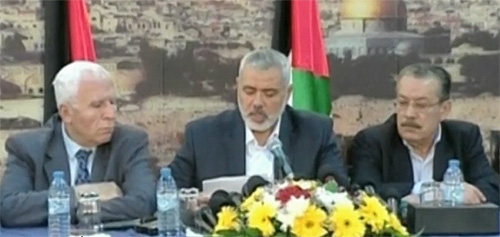
Pals meetIsmail Haniyeh (center) speaks at the signing ceremony for the Hamas-Fatah unity agreement. (Image source: Screenshot of AlJazeera video

But in a fit of wholly unwarranted optimism, let us say that this time Hamas (religious, kleptocratic, Iranian-supported, openly bloodthirsty) and Fatah (secular, kleptocratic, U.S. and EU-supported, and formally committed to diplomacy while stoking the flames of raw anti-Semitism in schools and Palestinian media) actually do figure out how to divide the spoils of the West Bank and Gaza.

That is when the problems begin.

U.S. demands of the Palestinians were, essentially two — the requirement that the Palestinians explicitly accept Israel as a Jewish state is not new, it was a clarification of the original language of the 1947 UN Partition of Palestine into an “Arab State” and a “Jewish State.” Mahmoud Abbas and Fatah were asked:

  • To concede sovereignty over their part of the larger Arab/Moslem patrimony to the Jews and — perhaps more important — to agree that Palestinian national aspirations would be forever satisfied with a split rump state squeezed in between a hostile Israel and an even more hostile Jordan; and
  • To concede that Palestinians who left the areas that became Israel in 1948 (and their descendants) would accept citizenship in the abovementioned rump state instead of having what they believe is their original property restored as promised by the Palestinian leadership. That the leadership had no authority to make such a promise is irrelevant to those who want to believe it, and to those who use it as “code” for destroying Israel.

Abbas could agree to neither — and what he could not do, Hamas certainly cannot do. So either Abbas moves Fatah closer to Hamas and abandons its American and European political and financial backers, or Hamas moves closer to Fatah, abandoning its Charter and its Iranian allies. Considering that each side has an army (Fatah’s is U.S. trained; Hamas’s is Iranian trained) and that there has been no discussion about who will be responsible for security either in the West Bank or Gaza under a “unity government,” a repeat of the 2007 short and brutal Palestinian civil war is a distinct possibility. “Peace” is not a distinct possibility.

The United States and the Europeans claim to be unhappy with the new state of affairs, but the proposal by Rep. Ros-Lehtinen (R-FL) and Rep. Ted Deutsch (D-FL) to cut off aid under the Palestinian Terrorism Act was not well-received by the State Department. Secretary of State Kerry said Israeli and Palestinian leaders needed to be willing to make compromises to keep the negotiations alive — as if it was Israel that had joined forces with a U.S.-designated terrorist organization. Spokesman Jen Psaki said, “Well, obviously, there would be implications. I don’t have those all in front of me … but what we’re going to watch and see here is what happens over the coming hours and days to see what steps are taken by the Palestinians.”

And watch what they do with their money.

The total Palestinian Authority [PA] budget for 2014 is planned to be $4.3 billion with a deficit of $1.2 billion. Income from taxes and other fees is estimated at $2.7 billion and another $1.6 billion will come in the form of foreign aid. That would be an expectation of almost 33% of the budget coming in the form of aid, and a deficit planned to be 28% of spending. (The U.S. budget deficit, by comparison was 8.7% of GDP in 2011, and it has fallen with the effects of sequestration and other decisions.)

Where does it come from and where does it go?

In January, the Administration announced that, linked to the “peace process,” American aid to the PA — not including security assistance of approximately $100 million annually — would be increased from $426 million in 2013 to $440 million in 2014. The Europeans, the largest financial backers of the Palestinian Authority, have provided more than $7 billion since 1994. Interestingly, although all other EU aid is tied both to the human rights record and transparency of the recipient, the PA faces no such restraints.

Nearly half of the budget will pay salaries — a 4.9% increase over last year (this may come as a surprise to European government employees who are still in the throes of austerity budgeting). In addition, according to EU auditors in December, the EU is paying salaries for approximately 61,000 civil servants and members of the security forces who stopped reporting for work after the 2007 civil war. In one office, they found 90 out of the 125 staff members absent.

According to The Wall Street Journal, the PA allocates a significant portion of its budget to salaries for Palestinians convicted of terrorism by Israel. These salaries are up to five times higher than the average salary in the West Bank. According to Israel’s Ministry of Foreign Affairs, in 2012 the PA’s payments to convicted terrorists in Israeli prisons and to the families of deceased terrorists (including suicide bombers) together accounted for more than 16% of the annual foreign donations and grants to the budget of the Palestinian Authority. The Palestinian minister for prisoners’ affairs announced that [approximately $41 million] would be allocated to current or former prisoners in 2014.

It other words, the Palestinians use an astonishing amount of foreign money to bribe and coerce the potentially recalcitrant.

Despite Palestinian corruption, abuse and support for terrorism, Israel has been unwilling to see Palestinian institutions collapse. While the Palestinians are nominally responsible for social services, Israel has ensured that there is no widespread hunger, disease, or power outages. The examples are legion – at the height of the so-called “second intifada,” when Palestinians were blowing up buses in the middle of cities and shooting civilians, Israel continued to coordinate food aid through a variety of NGOs. In 2012, to help the PA solve its financial crisis, Israel sought $1 billion in loans from the International Monetary Fund, intending to transfer the money to the PA. The IMF rejected the proposal because it feared setting a precedent of making IMF money available to non-state entities even through a state sponsor. Israel has also taken up much of the slack in supporting Hamas with gasoline and electricity since Egypt has been bombing and closing the Sinai tunnels. Israeli medical care has always been available to Palestinians.

Israel evidently believes a) it has a humanitarian obligation regarding Palestinian civilians; b) that should the institutions collapse, so will foreign aid to the Palestinians, leaving Israel with the entire bill for Palestinian social services; and c) at some point, there should be peace with the Palestinians, who will need a capable government to ensure the terms of whatever agreement is reached.

The announcement of “reconciliation” may actually be an attempt to form a united front. Or more likely, it could be a mechanism for Abbas to end negotiations that cannot succeed. If that is so, it could serve as a great clarifying moment in which Israel comes to see that perpetuating the fraud of a competent Palestinian government is more of a losing proposition for Israel than for its adversaries. Perpetuating the fraud of a competent Palestinian government carries no chance of a negotiated peace. There will always be a John Kerry who says the Israelis have to do more, therefore Israel will always be subject to the disapproval of those who expect Israel alone to fix the problem.

A better system was the one that both sides had before the U.S. Administration intervened with its pipe-dreams. Both were working on day-to-day security issues and employment. That is where SodaStream came from. The Israeli leadership figured that if the next generation of Palestinians had a stake in the system, they would negotiate more seriously. The Palestinian leadership figured that if people were eating, they would not overthrow the current government. It was working until the U.S. demanded an end to the conflict.

US vowed support for Israel on talks with Palestinian unity government, source claims

April 29, 2014

US vowed support for Israel on talks with Palestinian unity government, source claims, Ynet News, April 29, 2014

(Did the commitment have an expiration date? — DM)

Israeli official tells NYT that White House gave ‘specific commitment’ to back Israeli refusal to talk to PA government that includes Hamas.

Israel has received “a specific commitment from the American administration” that it supports Jerusalem’s vehement opposition to peace talks with any Palestinian government that includes Hamas, the New York Times on Monday quoted an Israeli official as saying.

The official told the Times that the commitment had been given to Israel during US President Barack Obama’s first term, and that it had been given once more following his re-election in 2012.

A senior State Department official refused comment to the Times, saying the administration was “not going to reveal the details of private conversations.”

The US, which has expressed disappointment at Fatah and Hamas’s announcement last week of reconciliation and the intention to form a unity government, said the new government would have to adhere to the same three principles as Palestinian Authority Mahmoud Abbas’s current government: a commitment to non-violence, recognition of the State of Israel and acceptance of previous agreements and obligations between Israel and the Palestinians.

While Hamas is willing to accept a Palestinian state within the 1967 borders, it has vowed to never recognize Israel. Recognition, a Hamas official said, would be between two states.

“You don’t need organizations to recognize Israel. It’s enough that the Palestinian Liberation Organization – the representative of the Palestinian people – recognizes the State of Israel. Besides, (Israel) has yet to recognize the rights and borders of a Palestinian state,” Hamas’ deputy foreign minister Ghazi Hamad told Ynet on Sunday.

As for the condition to adhere to non-violence, Hamad said the decision on whether or not to continue the armed resistance against Israel has yet to be made.

“We will discuss this – among other issues – at the negotiations between Fatah and Hamas,” Hamad noted

Israeli envoy in US: Iran doesn’t need a nuclear program

April 29, 2014

Israeli envoy in US: Iran doesn’t need a nuclear program | The Times of Israel.

Ron Dermer warns that world powers are on the verge of a bad deal with Tehran, says settlements aren’t main obstacle to peace

April 28, 2014, 11:50 pm

Israel's ambassador to Washington, Ron Dermer, formerly senior adviser to Prime Minister Benjamin Netanyahu (photo credit: Miriam Alster/Flash90)

Israel’s ambassador to Washington, Ron Dermer, formerly senior adviser to Prime Minister Benjamin Netanyahu (photo credit: Miriam Alster/Flash90)

WASHINGTON — With only a day left before the nine months allotted the US-mediated Israeli Israeli-Palestinian peace process were set to run out, Israel’s representative in Washington told participants in an Anti-Defamation League summit that Iran’s nuclear program, not the Palestinians, “is by far the single most important issue facing Israel.”

“The single greatest challenge Israel faces is Iran’s pursuit of nuclear weapons,” Ambassador Ron Dermer told an audience of hundreds at the annual ADL event. “Our policy is simple: Let Iran have only a peaceful nuclear program and nothing more.”

Dermer warned, however, that Tehran was not truly interested in developing a nuclear program for peaceful purposes – nor did it need to do so. “The truth is that we know that Iran doesn’t need a peaceful nuclear program,” he said. “Iran is awash in oil and natural gas… If Iran stopped being a rogue terrorist regime they could take advantage of their natural resources to their heart’s delight.”

The ambassador said that a state interested in pursuing a program for peaceful purposes alone had no need to enrich its own uranium or to build underground facilities and heavy water plants, all things that Iran has done and seeks to retain as part of a final agreement with the P5+1 world powers. He also noted that Iran’s development of intercontinental ballistic missile technology could only be logically applied to the delivery of nuclear payloads.

“Their only purpose is to carry a nuclear warhead,” warned Dermer. “If Iran wants a peaceful nuclear program, it has no need at all for ICBMs.”

Dermer said that “Israel is very concerned about the current discussions with Iran because all signs point to the P5+1 accepting a deal that will leave Iran’s nuclear weapons capability intact” by allowing Iran to maintain its heavy water facility at Arak, its ICBM program, thousands of uranium-enriching centrifuges and stockpiles of enriched uranium. Israel and the P5+1 powers have had open disagreements throughout the past five months since an interim deal was reached with Iran regarding the language – and obligations – necessary to reach an end goal of preventing its nuclear armament.

Israel has long insisted that any final deal must seriously curtail Iran’s capability to produce a single nuclear warhead. Other Western powers have merely emphasized that Iran not be allowed to actually produce a nuclear weapon.

The difference, Dermer argued, was one of expanding the already-brief breakout time: the amount of time it would take Iran — if it decided to violate the interim agreement — to deploy a single nuclear device.

“The international community must not allow Iran to keep its nuclear weapons infrastructure,” he insisted. “The only deal that should be acceptable is the one that dismantles Iran’s nuclear weapons production capability.”

In a rare nod to the US administration on a topic that has frequently generated friction between Jerusalem and Washington, Dermer said that “Israel appreciates that the Obama regime is working hard to make sure that the sanctions regime doesn’t unravel,” but expressed concern that a final agreement would remove incentives from Iran for good behavior, even as the current interim agreement has impacted the sanctions regime more than initially estimated by Obama administration officials.

Only after his comments on Iran did Dermer redirect his speech to address the topic of the recent breakdown in talks between Israel and the Palestinian Authority. Dermer began by explaining why Israel froze talks late last week after Palestinian Authority President Mahmoud Abbas announced that Hamas would join a new technocratic Palestinian government.

“It is said you make peace with enemies,” Dermer said, invoking a famous quote by assassinated prime minister Yitzhak Rabin. “You make peace with enemies who want peace. Hamas does not want peace.”

Dermer said that if Hamas were to recognize Israel’s right to exist and renounce terrorism, Israel would be willing to negotiate with a government that included the organization, but then added that in that case “Hamas would not be Hamas.”

Reiterating statements made by Prime Minister Benjamin Netanyahu on prominent US Sunday morning news talk shows this week, Dermer emphasized that Israel was unwilling to negotiate in a situation in which there are “technocrats” in the front office who support talks, while Hamas sits in the back office.

“Abbas has to choose – peace with Israel or a pact with Hamas,” Dermer continued. “He chose Hamas and so Israel suspended the talks.”

Dermer responded to a question from the audience regarding the role of continued construction in the West Bank, asserting that “the argument that because of settlements there is no peace is absurd. There was 50 years of conflict before there were settlements.”

According to the ambassador, “the heart of the conflict between Israel and the Palestinians is the refusal of the Palestinians to recognize a Jewish state in any borders.” Dermer said that Netanayhu recognized that fact, and it was why he placed Palestinian recognition of the “right of a Jewish people to a nation state” as a precondition for reaching a final agreement.

Although he described the question of settlements as a “sideshow” to the “true nature of the conflict,” Dermer acknowledged that Israel will eventually “have to resolve the issue of the settlements.”

“It is going to be part of the negotiations,” he continued. “It is going to require difficult decisions, but when we deal with an Arab leader who is ready to make peace, we have made such decisions in the past.”

US lawmakers lambaste Kerry over ‘apartheid’ remarks

April 29, 2014

US lawmakers lambaste Kerry over ‘apartheid’ remarks | The Times of Israel.

Sen. Ted Cruz calls for secretary of state’s resignation in wake of comments saying Israel risks following path of South Africa

April 29, 2014, 10:56 am US Secretary of State John Kerry (photo credit: AP Photo/J. Scott Applewhite)

US Secretary of State John Kerry (photo credit: AP Photo/J. Scott Applewhite)

WASHINGTON (AP) — Several US Congressmen spoke out again Secretary of State John Kerry after the Daily Beast reported Sunday that Kerry had told a closed-door meeting of the Trilateral Commission in Washington on April 25 that Israel risked becoming an “apartheid state” with two classes of citizens if negotiations to forge a peace deal fail and a two-state solution is not reached.

House GOP leader Eric Cantor, R-Va., said Kerry should apologize, while the powerful American Israel Public Affairs Committee described his use of the term as “offensive.”

Another pro-Israel lobby group demanded that Kerry resign, a call echoed by Republican Sen. Ted Cruz of Texas in a speech on the Senate floor.

Democratic Sen. Barbara Boxer of California was also critical of Kerry’s comment, saying in a tweet that: “Israel is the only democracy in the Middle East and any linkage between Israel and apartheid is nonsensical and ridiculous.”

Veteran Republican Senator John McCain also said Kerry should clarify his comments immediately and apologize, but laughed at the suggestion the top US diplomat should step down.

Kerry said Monday he had chosen the wrong word in describing Israel’s potential future after coming under withering criticism for saying the Jewish state could become an “apartheid state” if it doesn’t reach a peace deal with the Palestinians.

In a statement released by the State Department, Kerry lashed out against “partisan political” attacks against him, but acknowledged his comments last week to a closed international forum could have been misinterpreted. While he pointedly did not apologize for the remarks, he stressed he was, and is, a strong supporter of Israel, which he called a “vibrant democracy.”

He said his remarks were only an expression of his firm belief that a two-state resolution is the only viable way to end the long-running conflict. And, he stressed, he does not believe Israel is, or is definitely track to become, an “apartheid state.”

“I will not allow my commitment to Israel to be questioned by anyone, particularly for partisan, political purposes, so I want to be crystal clear about what I believe and what I don’t believe,” Kerry said.

“First, Israel is a vibrant democracy and I do not believe, nor have I ever stated, publicly or privately, that Israel is an apartheid state or that it intends to become one,” he said.

“Second, I have been around long enough to also know the power of words to create a misimpression, even when unintentional, and if I could rewind the tape, I would have chosen a different word to describe my firm belief that the only way in the long term to have a Jewish state and two nations and two peoples living side by side in peace and security is through a two state solution,” Kerry added.

In his statement, Kerry defended his general point, noting that numerous Israeli officials, including Prime Minister Benjamin Netanyahu and predecessors, Ehud Barak and Ehud Olmert, have offered similar assessments in the past.

But, he said while Barak and Olmert, and Israeli Justice Minister Tzipi Livni, “have all invoked the specter of apartheid to underscore the dangers of a unitary state for the future, it is a word best left out of the debate here at home.”

Kerry has invested significant time and energy he became America’s top diplomat last year into bringing the two sides to the negotiating table with the goal of reaching a deal in nine months. That deadline expires on Tuesday with the parties having failed to reach that settlement, a less ambitious framework deal or even an agreement to extend the negotiations. The State Department said on Monday that US envoy for Mideast peace, Martin Indyk, had returned home from the region and had no immediate plans to return.

President Barack Obama, along with Kerry and other US officials, has blamed the impasse on negative steps taken by both sides over the course of the last several months.

On the Israeli side, those include a decision not to release a group of Palestinian prisoners it had earlier agreed to free and announcements of new Jewish settlement construction on land claimed by the Palestinians. On the Palestinian side, they include a move to join numerous UN conventions they had agreed not to join while the negotiations were underway and, most recently, the announcement of a unity government with the radical Hamas movement, which Israel, the US and Europe regard as a terrorist organization.

___

Associated Press writer Brad Klapper contributed to this report.

Copyright 2014 The Associated Press.

Promoting propaganda

April 29, 2014

Israel Hayom | Promoting propaganda.

Ruthie Blum

At Tel Aviv University on Monday, Baroness Caroline Cox, a cross-bench member of the British House of Lords, gave a talk sponsored by the Yuval Ne’eman Workshop for Science, Technology and Security and the Israel Institute for Strategic Studies, run by Martin Sherman.

A passionate defender of human rights and the rule of law, Cox has spent the bulk of her career fighting forces that threaten to undermine Western democracy in general, and that of her country in particular. The focus of her lecture was the spread of political Islam in the U.K. and Africa, a phenomenon that has taken up much of her parliamentary and humanitarian work.

Though her pro-Israel positions are well-known (she is a co-founder of the One Jerusalem organization and co-president of the Jerusalem Summit), she purposely left the Jewish state out of the discussion. Nevertheless, she made a point of mentioning the symbolic relevance of her topic to the timing of her speech, which happened to fall on Holocaust Remembrance Day.

Her message was that jihad is being waged through an Islamist infiltration of the political, cultural, legal and economic systems of non-Muslim countries. It is being accomplished, she said, by pushing to have Shariah law written into, if not replace, the law of the land; by manipulating democracy to destroy it; by investing in educational institutions and making it impossible for anyone to criticize their teachings; and — as in the case of African countries — by preventing anyone who does not convert to Islam from getting a job or receiving government aid, including food for starving children.

The list goes on, and it is as ugly as the honor killings and female genital mutilation practiced by Shariah-abiding citizens and accepted by Western apologists. Even more shocking is the extent to which Britain has willingly resigned itself to this barbarism. Indeed, recounted Cox, the situation is so “schizophrenic” that while bigamy is prohibited in the U.K., polygamy among its Muslim citizens is accepted as a religious-cultural norm.

This, she explained, is not only dangerous for Britain; it is devastating for Muslims seeking the protection of British law. They are abandoned by the system in the name of diversity, and sent to Shariah courts to settle their issues.

Shariah, thus, is managing to thrive in the U.K., thanks to concessions made by the establishment to an ever-growing Islamic population. And it’s no wonder, with Muslim men being left to marry multiple wives with whom they sire dozens of children.

Admitting that educating and rallying her peers and the public against this crack in civilized society is a Sisyphean task, she concluded by urging that we all tell ourselves, “I cannot do everything, but I must not do nothing.”

Such an appeal often falls on deaf ears. Ignorance is partly to blame. Then there’s the fear — of being accused of Islamophobia on the one hand, and of violent repercussions on the other. It is far easier to empathize with the enemy and confront a less daunting culprit.

Which brings us, of course, to Israel.

One key element of global jihad is propaganda aimed at turning lies into truth and vice versa. Trained by the Soviets masters of this art, Arab-Muslim apparatchiks have taken it to a whole new level. Their success lies in their two-pronged self-portrayal as downtrodden victims of Western imperialism and as destined victors against the “infidels.” Chief among these are the “Great Satan” (America) and the “Small Satan” (Israel).

That Europe’s response is to sell its soul to appease the beast is bad enough. But when the administration in Washington follows suit, the sense among the sane is that even science fiction couldn’t do justice to the horror of it all.

Yes, President Barack Obama is looking the other way during bogus negotiations with Iran, thereby enabling the Islamic republic to develop nuclear weapons. Meanwhile, Secretary of State John Kerry is blaming Israel for not acting in a similar fashion with the Palestinian Authority.

Not only has Kerry chided Israel on several occasions for its inability to persuade the PA to engage in peace talks toward the establishment of a Palestinian state, but he has made public statements to that effect. Buoyed by the moral relativism that the State Department has been applying to “both sides,” the PA signed a treaty with Hamas.

Fuming, Kerry outdid himself on Friday. During a closed meeting of the Trilateral Commission — a tape of which was obtained and released by the Daily Beast — Kerry told officials from Europe, Russia and Japan that in the absence of a two-state solution, Israel “winds up either being an apartheid state with second-class citizens, or it ends up being a state that destroys the capacity of Israel to be a Jewish state.”

Though Kerry now says he regrets using the word “apartheid,” it was no mere slip of the tongue. Rather, it revealed the depth of his hostility to Israel. It also served as proof of the power of propaganda. When repeated often enough, such a blatant falsehood can even roll easily off the lips of the world’s highest-ranking diplomat.

Baroness Cox would not be the least bit surprised.

Ruthie Blum is the author of “To Hell in a Handbasket: Carter, Obama, and the ‘Arab Spring.'”

Kerry backtracks on apartheid comment following criticism

April 29, 2014

Israel Hayom | Kerry backtracks on apartheid comment following criticism.

Politicians, Jewish leaders call on U.S. Secretary of State John Kerry to apologize for comments • ADL Director Abe Foxman: It is disappointing that a diplomat so knowledgeable about democratic Israel chose to use such an inaccurate and incendiary term.

Shlomo Cesana, Yoni Hirsch, Daniel Siryoti, The Associated Press and Israel Hayom Staff
U.S. Secretary of State John Kerry

|

Photo credit: Reuters

Secret US-Hizballah talks. Washington plans to include Lebanon, Syria deals in Iran nuclear pact

April 29, 2014

Secret US-Hizballah talks. Washington plans to include Lebanon, Syria deals in Iran nuclear pact.

DEBKAfile Exclusive Report April 29, 2014, 9:12 AM (IDT)
US in secret talks with Hassan Nasrallah

US in secret talks with Hassan Nasrallah

Palestinian leader Mahmoud Abbas’ initiation of a unity pact with the Hamas extremists last week did not come out of the blue. It was prompted by the direct contacts the Obama administration has secretly established with the Lebanese Hizballah. Abbas reasoned that if Washington can start a dialogue with a terrorist organization, so too can his own PLO and Fatah.

debkafile’s Washington sources report that the Obama administration appears to have carried over to Lebanon the doctrine set out by the late Richard Holbrooke for Afghanistan, whereby dialogue with Taliban should be made the centerpiece of Washington’s strategy for US troop withdrawal. Holbrooke’s influence on Secretary of State John Kerry dated back to his run for the presidency in 2004.

In Lebanese terms, Hizballah’s Hassan Nasrallah has become the equivalent of Taliban’s Mullah Mohammad. Hizballah has scored high in the Syrian war. Its military intervention on the side of Bashar Assad in the last year is credited with turning the Syrian army’s fortunes around from near defeat in 2013 to partial triumph in key areas of Syria this year. Nasrallah is able to boast that his movement’s commitment to the Syrian conflict is its central mission and will remain so until rebel and al Qaeda forces are finally vanquished.

What the Hizballah leader is trying to put across, in terms of the Holbrooke doctrine, is that like Mullah Omar in Afghanistan, he, Nasrallah, holds the key to resolving the Syrian civil war.

The Obama administration bought this premise and decided to apply it to broadening the rapidly progressing dialogue with Tehran to related areas. The plan developed in Washington was to seize the momentum of the nuclear track and ride it to a broad US-Iranian understanding that embraces a comprehensive nuclear accord with Tehran as well as understandings for resolving the Syrian and Lebanese questions.

Administration officials figure that Nasrallah heeds no one but the ayatollahs in Tehran. He may talk big but he knows that his fate is in the hands of his Iranian masters. If Iran decides it is time for him to go, it will be curtains for him. His involvement in the Syrian war is considered to be contingent on the strategic decisions of Iran’s leaders. (He was a lot less confident in the winter of 2013 when Hizballah’s home bases were being smashed in lethal suicide bombings.)

Iran also determines which weapons are supplied to the Hizballah units fighting in Syria, in which sectors they fight and how to respond to his pleas for reinforcements.

In Washington’s view, Hizballah’s involvement in the Syrian war has increased its leader’s dependence on Tehran. He accordingly has little room for maneuver in contacts with US representatives and if he turns difficult, they are sure they can turn to Tehran to force him in line.

It is also believed in administration circles that the secret Saudi exchanges with Tehran (first revealed by DEBKA Weekly) will eventually produce Riyadh’s acceptance of Hizballah as a dominant factor in Syria and Lebanon.

However, many Middle East experts find the US take on Hizballah to be naïve and simplistic and strongly doubt that the path it has chosen will bring Nasrallah – or Tehran – around to serving America’s will or purposes. They draw a parallel with the underlying US assumptions which ultimately led the Palestinians-Israeli talks off track.

But expectations of the Hizballah track are high and strongly guide the actions of President Obama, John Kerry, National Security Advisor Susan Rice and CIA Director John Brennan. And so, in early March, the first secret rendezvous took place in Cyprus between CIA officers and Hizballah intelligence and security operatives.

According to a number of Mid East intelligence sources, two such meetings have since been conducted and initial US-Hizballah understandings reached relating to the volatile situations in Syria and Lebanon.

Our intelligence sources add that US Ambassador to Beirut David Hale has been in charge of preparing these meetings and implementing the understandings reached.


