Archive for April 16, 2014

Prepare for a bad Iran deal

April 16, 2014

Prepare for a bad Iran deal – Artaxes’ brainbench.

Why the likelyhood of a bad deal with Iran has increased

By Charles Artaxes

Before I begin I want to make clear for the reader not familiar with my writings that the name Obavez refers to the US president who reminds me more of Hugo Chavez than of an US president.

We are living in a strange world. While in the recent weeks we were hearing and reading statements from the US, China and Iran expressing optimism that a deal with Iran could be struck by the deadline set for July 20, 2014 we see no indication that the positions of both sides have moved even nearly close enough to bridge the gap between them.
Far from it, the Iranians have moved further away by increasing their demands by claiming that they need substantially more centrifuges and by claiming that they have the right to enrich uranium up to 90%.

Of particular interest were the statements of Rouhani who said “We will witness the sanctions shattering in the coming months.” and the statements made in an opinion piece published in the Russian online edition of RIA Novosti claiming that “The head of the Center for Modern Iranian Studies, Radzhab Safarov, said he was “90 percent sure” that an agreement to lift sanctions against Iran will be reached during the April 7-9 meeting in Vienna, paving the way for military cooperation between Moscow and Tehran.”.
Now, all these statements could just be expressions made for politcal purposes not grounded in reality or it could be that these people know something that we don’t know.
Be it as it may. Although April 9 has passed and although such optimism seems to fly in the face of reality there are recent global developments that have increased the likelyhood of an US deal with Iran considerably.

Of these developments the two most important are the the crisis in Ukraine and the collapse of the MidEast peace process.
With the annexation of Crimea being a fait accompli Putin seems well on his way to annexing more parts of Ukraine since the recent escalation in eastern Ukraine and the massive concentration of Russian troops inidicates that a Russian invasion is just a matter of time.
This of course will have implications for the P5+1 negotiations with Iran because Russia has already indicated that it might retaliate by sabotaging the negotiations if the West tries to punish Russia for its intervention in Ukraine.
But in contrast to many commenters and op-ed writers I see Russia not sabotaging the negotiations directly but in indirect ways.
It would be bad publicity for the Russians to sabotage the negotiations directly.
It would be much smarter to undermine the sanctions regime and simultaniously encourage the Iranians in secret to be more intransigent and to increase their demands and also play for time.
If the sanctions were to be undermined there would be less economic pressure on the Iranians enabling them to drag the the negotiations for much longer.
As Reuters reported Russia and Iran are working on a oil-for-goods deal worth $20 billion. That would be precisely the way to undermine sanctions.
The other possible way for Russia to retaliate is to encourage Assad to stall the implementation of the deal on the destruction of his chemical weapons.
Assad just missed yet another deadline for handing over his vast bulk of chemical weapons which means that their removal falls further behind schedule.
From the Balkan wars in the 1990s to Syria to Iran, Russia used such crises to present itself as an important global player whose help is needed to resolve these crises thus compensating for its loss of superpower status.
But in all these crises Russia was never a part of the solution but part of the problem. In the case of Syria and Iran Russia is not interested in solving these crises (except on its terms). On the contrary, the crises ensure that Russia is needed as a ‘partner’ who ‘helps solving’ these crises and moreover they provide them a means to blackmail the West. If the West takes actions against Russia’s expansion in the Ukraine, Russia can retaliate by withdrawing its ‘cooperation’ or worsening these crises.
In the case of the former Yugoslavia the Gordian knot was cut by unilateral NATO action but absent Obavez’ willingness for military action this option is not available.
This leaves the West helpless against Russia’s moves.

So far the record of the Obavez administration has been atrocious, with disaster piling upon disaster and scandal piling upon scandal and the greatest of all disasters, ObavezCare, is assumed by many to cost the Democrats dearly in the 2014 elections.
Like many presidents before him Obavez has in his second term only one field were he could score major political points: foreign policy.
But the problem is that his foreign policy is equally disastrous and one of the two major foreign policy initiatives, the MidEast peace process, is already a total failure.
While some have declared the MidEast peace process already dead and others say that it was a stillbirth I think we can savely say that it is in a deep coma from which it’s not going to wake up anytime soon and even if it wakes up it will be so badly damaged that it can never sufficiently recover.
Therefore we don’t need to wait for the official death certificate to aknowledge that it is a total disaster for the Obavez administration.
That leaves only one field where the Obavez administration could be successful: a deal with Iran.
This increases the chances that the US administration might be so desperate for a success that it might accept any deal, a very bad deal even by their own standards.

All these developments might lead to a surprising result where Iran sides with the US and not with Russia.
If Iran were to strike a deal with the US it would achieve a tremendous result: It would be totally free from sanctions and would be treated not much differently from any other nuclear state like for example Japan.
Iran would be free to trade unhindered with the rest of the world enabling the mullah regime to end its dependence on Russia and buy military hardware and expertise from whichever country is willing to sell it.
The economic boost would not only stabilize the mullah regime but it would also provide the money to develop its nuclear program and all the military aspects of it even faster.
Of course an acceptable deal for Iran would have to be ‘an offer they can’t refuse’ giving them pretty much everything they want.
Needless to say that such a deal would bring not more freedom to the Iranian people and neither would Iran cease to see America as ‘the big satan’ and enemy number one.
There are those who see Iran as a mere pawn of Russia but I beg to differ. The Iranians have much bigger ambitions and taking their history with the mighty Persian empires of the past into account they certainly see themselves not as pawns but as a great power rising again and taking its rightful place in the world.
They are just cunningly playing their game.

Does all this sound strange to you?
Well, it might after all be not that farfetched.
I want to quote the Russian op-ed I mentioned earlier: “The expert said that the standoff over Crimea, the worst since the end of the Cold War, would contribute to the Iranian talks, because “there will be a bitter struggle between Russia and the West to win Iran round.”.
Given that Putin has tight control over the Russian media and given that RIA Novosti is run by the Russian state it is reasonable to assume that it does not contradict the views of the Russian goverment.

What does this mean for Israel?

In a very interesting interview with the New York Time’s Ethan Bronner Israel’s former military intelligence chief Amos Yadlin spoke on a wide range of topics (including Syria, Egypt and Iran).

He repeated his four conditions that are necessary for a military strike on Iran.
1. Israel can do it.
2. Bombing Iran is less dangerous than all the other alternatives.
3. Legitimacy (meaning there are no other alternatives)
4. No red light from the US

With regards to #4 he said that a red light would have to be taken very seriously into consideration.
Interestingly he mentioned also that a bad deal could be defined as a good deal.
As we have seen with the interrim deal this deal would be sold to the public as a great or at least an acceptable deal.
And that is the danger for the legitimacy of any Israeli strike.
This is why Israel must prepare for such an outcome ahead of time and plan accordingly.

Here is the full interview with Amos Yadlin.

 

May be Satire: Kerry Spokeswoman Protests Israeli Claim that he is a “Lapdog of the Arabs”

April 16, 2014

Kerry Spokeswoman Protests Israeli Claim that he is a “Lapdog of the Arabs,” Front Page Magazine,   , April 16, 2014

“John doesn’t even care about Arabs unless they’re Muslims. He certainly won’t be curling up in the laps of any Arab Christians. And Muslims are opposed to lapdogs for religious reasons as John found out when he tried to curl up in the lap of the Saudi monarch.”

KerryPoodle-1a

Kerry spokeswoman Jen Psaki, who has frequently taken issue with negative references by Israeli political figures to Secretary of State John Kerry denounced another claim from an Israeli political commentator that the respected diplomat was a “lapdog of the Arabs.

“I would just like to point out that it is completely false that the Secretary is a lapdog of the Arabs,” Psaki said. “That’s just the kind of extremist political rhetoric that we have come to expect from the Israeli far right which spends all of its time building settlements in the oldest city in the world instead of surrendering to terrorists like they should.”

“John doesn’t even care about Arabs unless they’re Muslims. He certainly won’t be curling up in the laps of any Arab Christians. And Muslims are opposed to lapdogs for religious reasons as John found out when he tried to curl up in the lap of the Saudi monarch.”

“Furthermore, it’s simplistic to reduce the career of a capable public servant and longtime senator to being a ‘lapdog for the Arabs’ when the Secretary has also been a lapdog for the Viet Cong, the Sandinistas, the Iranians and really anyone who would have him.”

“John Kerry is just naturally attracted to lying down in the laps of terrorists, Communists and any totalitarian movement while making a low purring sound.”

“If you’re a tyrant, John Kerry will come down and lie in your lap if you want him to. And if you don’t, he’ll wait outside your country, occasionally scratching at the door while making a high whining noise.”

It’s just who he is.”

While the preceding events did not actually take place, it was only because of the consistent refusal of Ms. Psaki to accurately and honestly comment on the Secretary of State’s attitude and behavior.

poodle-330x350

Iran Unveils New Anti-Ship Cruise Missile

April 16, 2014

Iran Unveils New Anti-Ship Cruise Missile, Washington Free Beacon, April 16, 2014

(As the United States disarm, Iran will surely follow; Iran is an Islamic, and therefore peaceful, republic. Clear now?  — DM)

U.S. to significantly cut back stock of missiles

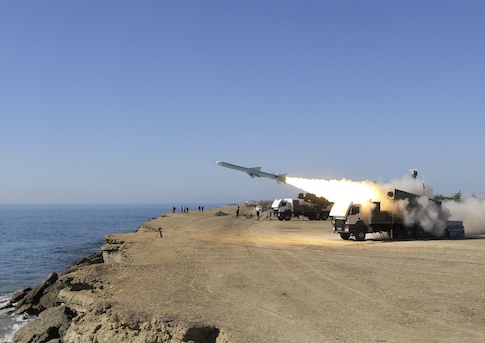
APTOPIX Mideast Iran Naval DrillIranian naval exercises / AP

Iran announced that it has armed its warships with a new generation of cruise missiles and warned the West that its response to “any threat” will be “more deadly and heavier,” according to regional media reports.

A top Iranian naval commander revealed on Monday that Iran has armed its coastal defenses and warships with a new, domestically produced cruise missile primarily used to destroy enemy ships.

These new “Ghadir cruise missiles” have been loaded onto “both destroyers and missile-launching warships of the Navy, and they are also used as coast-to-sea missiles,” Iranian Navy Commander Rear Adm. Habibollah Sayyari wasquoted as telling the state-run Press TV.

The new weapons were unveiled just a day before a top Iranian Army Commander “downplayed the U.S. and its allies,” warning them that “in case of any threat, our response will be more deadly and heavier,” according to Iran’s Fars News Agency.

Iran’s military moves come as the United States moves to significantly cut its own cruise missile stockpiles, including the full elimination of the well-known Tomahawk and Hellfire missiles.

Iran’s new Ghadir cruise missile has been described as a “state of the art” weapon that can be fired “surface-to-surface.” Iranian officials said that they primarily aim to fire it from the coast to the sea. 

“Ghadir cruise missiles have been mounted on both Navy destroyers and missile-launching warships and they are also used as coast-to-sea missiles,” Sayyari later told Fars.

The cruise missile is reported to have “great precision and high destructive power” compared to several other types of cruise missiles that are currently being produced in Iran.

The Iranian military employs at least six other types of cruise missiles that have been domestically produced.

As Iran increases its stock of cruise missiles, the United States is currently gearing up to significantly cut a wide range of missiles that have been employed for decades.

President Barack Obama’s 2015 budget proposal aims to abolish both the Tomahawk and Hellfire missiles, as well as scale back the procurement of many others.

Obama’s proposal slashes funding for the Tomahawk by $128 million and fully eliminates procurement by 2016.

The U.S. Navy also will be forced to end its acquisition of Hellfire missiles by 2015.

The Navy has long relied heavily on both of the missiles.

Some 220 Tomahawks were fired during the 2011 military incursion into Libya. Nearly 100 Tomahawks are used on average each year, leading defense experts to warn that the stock could be completely depleted by around 2018.

Meanwhile, Iran has upped its air defense surveillance and installed a “data gathering” system onto several sites, according to Fars.

The reconnaissance tools reportedly “send the data pertaining to the direction, altitude and speed of flying targets to the control centers” several miles away, according to Iranian Brig. Gen. Farzad Esmaili, who serves as commander of the country’s Khatam ol-Anbia Air Defense Base.

These transmission systems would allow Iran to more closely track flying objects and target them.

Keeping our eye on the ball

April 16, 2014

Keeping our eye on the ball | JPost | Israel News.

By RUTHIE BLUM

04/15/2014 22:41

The Ofek 10 launch served as a reminder that the Netanyahu government is not succumbing to international inaction with regard to the Islamic Republic and its proxies.

Ofek 10 satellite

Ofek 10 satellite Photo: DEFENSE MINISTRY

After Secretary of State John Kerry’s anti-Israel “poof speech” last Tuesday before the Senate Foreign Relations Committee – and the subsequent suggestion last Thursday by his spokeswoman, Jen Psaki, that progress was being made in the negotiations between Israel and the Palestinians (a euphemism for additional, unreciprocated Israeli concessions) – it was a huge relief to be treated to some good news.

Since it is extremely demoralizing to have one’s government pressured into pandering to the Obama administration, it has become increasingly easy to sink into despair about the fate of the Jewish state. This leads to thoughts, aroused by the upcoming Passover holiday, that maybe we Israelites never really escaped Egyptian bondage, and that the only thing left of our yearning for Jerusalem is matza-induced indigestion.

Last Wednesday night, this sense of doom suddenly dissipated – poof! – with the successful launch of the Ofek 10 spy satellite into space.

The Ofek 10 is the latest in a long line of radar satellites developed in Israel. This one is equipped with even more advanced technology, which enables observation and imaging at any time of the day or night, and under any weather conditions.

It is also quicker, more durable and less expensive than its predecessors, thanks to the know-how, hard work and cooperative efforts of hundreds of experts in the Defense Ministry, Israel Aircraft Industries, Israel Military Industries and other participants in the project.

BUT IT is not merely pride in the venture that is uplifting; after all, the wonders of Israeli innovation are old hat by now, eliciting barely a yawn among the public responsible for it.

No, the reason for the surge in national spirit has to do with the purpose of this particular satellite: to monitor the activities of Iran and the rest of the terrorist organizations in the region. It is these entities that constitute the true and present danger to the state of Israel – not the hyped-up demography problem behind the “two-state solution” hysteria; not the inability of young people to purchase apartments; not the issue of foreign workers; not the fight over whether women can pray at the Western Wall as they please or how long haredim should serve in the army; not Sara Netanyahu’s alleged abuse of the staff at the Prime Minister’s Residence; and certainly not the coalition crises created by all of the above.

Indeed, contrary to what Haaretz and its ilk would have everybody believe, the most palpable existential threat to Israel is external. And it is only because of the vigilance of the IDF and resourcefulness of civil society that the world sees only the start-up nation Goliath, rather than the war-torn David, fending off rocket fire on the one hand, and boycotts, divestment and sanctions on the other.

So watching the American administration belittle Netanyahu while allowing Iran to buy time to build a nuclear bomb has had a terrible effect on the country that the regime in Tehran wishes to wipe off the map. That the Palestinian Authority, which is on board with this goal, is able to dictate its terms to Washington has made the whole farce all the more frightening.

The Ofek 10 launch served as a reminder that the Netanyahu government is not succumbing to international inaction with regard to the Islamic Republic and its proxies. Though an intelligence-gathering satellite, not a weapon, its highly publicized lift-off contained two messages. The first was for the mullahs – to let them know that their every military move is being monitored.

The second was for the citizens of Israel, frantically preparing for Passover – to let us know that someone’s got our back.

The writer is the author of To Hell in a Handbasket: Carter, Obama, and the “Arab Spring.”

Off Topic: The Kansas tragedy

April 16, 2014

The Kansas tragedy | JPost | Israel News.

By JPOST EDITORIAL

04/15/2014 22:29

Today, we stand together in solidarity with our Jewish family in the US in mourning the dead and wounded.

Jewish Community Center Kansas City

Jewish Community Center in Greater Kansas City calls for solidarity. Photo: YOUTUBE SCREENSHOT

America is no stranger to senseless shootings.

That being the sad case, it is easy to place the targeting of two Kansas City-area Jewish institutions into that “senseless” category and thereby eventually put it out of mind.

Besides, some of the shooting sprees across the US in recent years have exacted far greater tolls than the three lives taken in Overland Park, Kansas, on the eve of Passover.

But this shooting was not “senseless.” The targets were not random and the killer came to do his evil deed with a brazenly touted motive. “Heil Hitler,” he hollered This was a crime directed against Jews and committed in the name of the most unspeakable barbarity ever unleashed on the Jewish people. If this was not a hate crime, it is impossible to define what one is.

The Jewish community in Kansas and American Jews throughout the country were given bitter food for thought this Passover. One of the most meaningful passages in the Haggada holds that “in every generation, they rise upon us to destroy us.” This is an indisputable fact of Jewish existence at all times and in all places – the American Midwest included.

US Jews may not wish to acknowledge that reality.

But the ancient, noxious hate against the people of Israel still exists in some places.

It is difficult to confront such truths in places where Jews enjoy uprecedented liberty and freedom and have made their mark in every facet of the American landscape.

Perhaps because of that sense of security and well being, an increasing proportion of the American Jewish population prefers to make believe that they are immune to the Jewish lot of yesteryear and of other lands. That’s why the Kansas shooting can’t be seen as an isolated incident and why it is far from simple to compare the Kansas atrocity to the Toulouse one of two years ago. The French Jewish community is vastly different from the American and the Toulouse shooter was an Arab and a jihadist. His American counterpart was a Ku Klux Klan activist, apparently impelled by the more old-style anti-Semitism, even though he too railed against “the Zionists.”

But the bottom line is the same. In both cases the aim was to kill Jews for the crime of being Jews (although in Kansas this did not quite go to plan).

In both cases the shootings cannot be divorced from other acts of violence and most of all from words. The World Wide Web makes the most virulent anti-Semitic invective easier to disseminate and more incendiary than ever.

The Web is a scary space. The amount and degree of incitement against Jews and the Jewish state boggles the mind. Ignoring it is no answer.

There is no denying that anti-Semitism flourishes.

A teacher at the prestigious North London Collegiate School recently warned a Jewish pupil that she would send her to “one your gas chambers” for jumping the queue at the dining hall.

In that vein but immeasurably higher on the viciousness scale was an article the Ukrainian Misto Vecherniye (“Evening City”) newspaper printed in the past week. In apparent earnestness, its author warns readers to beware of the Jewish ritual of slaughtering Christian children to bake Passover matzot with their blood. The feature then rehashed the infamous 1913 Beilis blood libel in Kiev. This is not the first time this has happened in the Ukrainian media. In 2006, the Personnel Plus magazine saw fit to revive the same Beilis blood libel.

Examples abound from many countries. The tone may differ from country to country but Judeophobes seethe with hostility, irrespective of their argumentations and pretexts.

As the tragedy in Kansas demonstrates, no Jewish community is immune. Today, we stand together in solidarity with our Jewish family in the US in mourning the dead and wounded, and in outrage that the evil history of anti-Semitism is still being written.

Off Topic: Israel to land on THE MOON !! – 2015

April 16, 2014

▶ Israel to land on THE MOON !! – 2015 – YouTube.

After testing the spacecraft’s navigation sensor in a rocket experiment conducted in 2011, and after completing several preliminary design reviews over the last three years to finalize the spacecraft’s design, SpaceIL is now moving from the design stage into full scale development.

In December, 2013, SpaceIL purchased the largest and most significant part of the spacecraft: the propulsion system (the engine and the fuel tanks), which comprises 80% of the spacecraft. This is a huge milestone on the way to the moon.  A launch will be finalized in the first part of 2014.

Budget The estimated budget for the entire project, including overhead and education programs, is $36M, with $20M in cash and in-kind support already raised.

Launch Date The team is working to launch by the end of 2015, in accordance with the competition rules. However, none of the teams has finalized their launch date, and, given the project’s ambitious goal, there is speculation that the official deadline may move to mid-2016.