( Happy Passover. From Israel and Kansas City… – JW )
By JPOST.COM STAFF
LAST UPDATED: 04/14/2014 19:40
In the second pre-Passover shooting incident against Jews in the last two days, a family on their way to a Seder was attacked on the road. The father was killed, and the mother and son received light to moderate wounds.
Israel police. Photo: Wikimedia Commons
An Israeli family was the target of a shooting attack on Route 35 near the Tarkumia checkpoint west of Hebron that left one dead and two others wounded, according to MDA.
A 40-year-old man was pronounced dead after attempts at resuscitation, while a 28-year-old woman was in moderate condition after suffering injuries to her upper body, according to MDA. She was taken to Shaare Zedek Medical Center in Jerusalem for further treatment.
A nine-year-old boy suffered light wounds from shrapnel in his chest. He was taken to Hadassah University Medical Center at Ein Kerem.
The victims were in their vehicle at the time of the shooting. The shooters fired at three different vehicles on Route 35, according to MDA.
IDF officials said there was no military intelligence that hinted at an attack on Jews on the eve of Passover.
MK Orit Struck (Bayit Yehudi) told Army Radio that she has no doubt the attack was “a direct result of releasing [Palestinian] prisoners that help turn the wheels of terror…releasing prisoners leads to terrorist attacks.”
The Islamic Jihad released a statement commending the attack as “a natural response to Israel’s crimes,” though the terrorist group did not claim responsibility.
IDF security forces, police, and Border Police were carrying out a search for the shooters.
According to various media reports, shots were initially fired at an army post before they were fired at civilians. No injuries were reported.
After cascade of Israeli criticism over US secretary of state’s comments on peace process, Steinitz takes aim at his Iran policy.
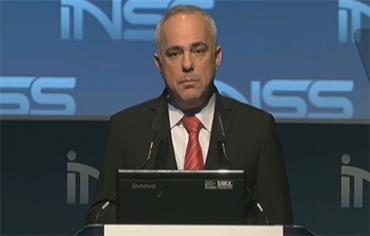
Minister of Strategic Affairs Yuval Steinitz Photo: INSS
Strategic Affairs Minister Yuval Steinitz (Likud) described as “unacceptable” on Monday remarks by US Secretary of State John Kerry suggesting cautious openness to negotiating a nuclear deal that would keep Iran six to 12 months away from bomb-making capability.
“In the past, and also recently, what we heard from the Americans, including publicly, and from the Europeans and even from the Russians, was that Iran must be distanced years – not months but years – from nuclear weaponry,” said Steinitz.
Iran, which denies seeking nuclear arms, is in talks with Washington and five other world powers on rolling back its work on uranium enrichment and a potentially plutonium-yielding reactor.
Briefing US senators last week, Kerry stopped short of saying negotiators would “settle for” a timeline of six to 12 months in which Iran could amass enough fissile material for a nuclear device but said it would be “significantly more” than the current two months it would take.
“The things that Kerry said … are worrying. They are surprising. They are not acceptable,” Steinitz told Israel Radio.
The Israelis, widely assumed to have the Middle East’s sole atomic arsenal, see Tehran’s nuclear program as a deadly threat and have long threatened to launch pre-emptive war against Iran if they deem international diplomacy a dead end.
The censure of Kerry’s remarks follows a cascade of Israeli criticism of the US statesman’s mediation of peace talks with the Palestinians, which are now deadlocked.
“We will not be able to adopt and accept any agreement that keeps Iran within a range of months to a year from nuclear weaponry, because such an agreement would not hold water,” Steinitz said, reiterating Israel’s demand that its arch-enemy be stripped of nuclear capabilities.
“It would also prompt Iran to get nuclear weaponry, and Sunni Arab countries like Algeria, Egypt, Saudi Arabia, perhaps also Turkey and the UAE, to seek to launch a nuclear arms race.”
(The official line, apparently swallowed whole by the P5+1 group, is that Iran neither has nor wants nukes; only peaceful stuff. — DM)
Iranians believe the negotiations to limit Iranian nuclear research and development are an effort to block Iran from getting nuclear weapons and to keep Iran weak and vulnerable. Most Iranians see nukes as a necessity for maintaining Iranian dominance in the region. Iran has been the regional superpower for thousands of years.
April 14, 2014: Iran has been following Russian operations in Ukraine closely. It was noted that Russia violated a 1994 agreement to protect Ukrainian borders in return for Ukraine getting rid of its Cold War era nukes. Russia insists that the 1994 agreement does not apply. What really interests Iran about the Russian violation of the 1994 agreement is the implication that if you really want to keep invaders out you need nukes. Treaties are simply not as effective as nukes. Iranians believe the negotiations to limit Iranian nuclear research and development are an effort to block Iran from getting nuclear weapons and to keep Iran weak and vulnerable. Most Iranians see nukes as a necessity for maintaining Iranian dominance in the region. Iran has been the regional superpower for thousands of years. Once you get a taste of superpower status, it’s a hard thing to put behind you. Iranians dismiss foreign nervousness about Iranian radicals threatening to use nukes against Israel. To most Iranians that’s just the sort of wild talk Iranian politicians sometimes indulge in and is nothing worry about. The Israelis don’t agree and many Westerners don’t either.
In mid-March American officials revealed that Iran was still operating its smuggling network that has been obtaining components for its nuclear weapons and ballistic missile programs over the last few decades. There is still a lot of activity in this network that does not actually involve smuggled components. This includes setting up and maintaining shell companies to hide shipments and cultivating contacts with smuggling gangs or individuals as well as forgers (to create documents to get smuggled goods moved) and keeping key officials (especially customs inspectors in some countries) happy and bribed. While none of this technically violates a recent agreement to halt nuclear research, it does show Iran is not thinking of shutting down these illegal activities permanently.
Meanwhile Iran is declaring (at least inside Iran) that its January 20th interim deal with the UN over its nuclear program is a victory. One Iranian official pointed out that Iran could reverse the effects of concessions within a month and that Iran was not really giving up anything. At first UN officials and many Western governments dismissed all this as Iranian efforts to improve domestic morale. The UN still believes that the January agreement, which merely gives Iran some concessions ($4.2 billion in frozen funds are released and some sanctions eased) in return for agreeing to negotiate a more permanent deal, is worth it for the rest of the world. But Iranian officials are telling Iranians that there will be no permanent changes in the nuclear program and that full scale uranium enrichment could be resumed within 24 hours. Meanwhile the existing deal only allows for six months of negotiations. The way these things work the Iranians will demand more concessions to extend the negotiations after no deal is achieved within the first six months. Western officials report that Iran is conceding nothing and there has been little progress in the negotiations. Iran is now complaining that while billions in Iranian assets have been unfrozen Iran is having a hard time actually getting any cash. Iran is being told that as long as they refuse to actually negotiate there will be little actual release of unfrozen funds. This sort of thing has increased the cash shortages the government is suffering. This is being felt by some Iranian allies. In south ern Lebanon Hezbollah is suffering a cash-flow crises as international efforts to curb Hezbollah fund raising becomes more effective and Iran cuts back on cash aid because of the continuing sanctions on Iranian oil sales. Iran feels that Hezbollah can tolerate these cuts more than Syria, which is barely hanging on financially.
The Syrian government and its principal allies Russia and Iran see eventual victory over the rebels although it may take years. Iranian media and officials are now openly declaring this as fact. The Assads have announced that the main fighting will end this year, followed by “counter-terrorist” operations for as long as it takes. The Syriangovernment has made it clear that it can play rough. In addition to the use of chemical weapons, the Assads are also accused to running brutal prison camps and regularly executing or torturing prisoners who do not provide information on rebel activities. This has produced calls for war crimes investigations against the Assads. This has not deterred the Assads, who are still in “fighting for survival” mode and confident that Iran and Russia will stick by them . Iran does not want to lose a key ally in the region. The Assads have been on the Iranian payroll since the 1980s and Iran wants to keep it that way. Assad backers now believe that foreign intervention is unlikely and that the best thing the Assads have going for them are the Islamic terrorist groups who fight for (and increasingly against) the rebels. As bad as the Assads are, many of the Islamic terrorist groups make the Assads look more acceptable as the continued rulers of Syria. While the war could continue into the next decade, the Assads are willing to inflict that much suffering on Syria to remain in power. Iran has contributed billions of dollars and sent in several thousand advisors and specialists to organize a force of fanatic foreign mercenaries (largely from the Lebanese Hezbollah militia and from Iraqi Shia militias) who match the ferocity of the Sunni Islamic terror groups that are the fiercest fighters on the rebel side. Iran also helped organize militias among pro-Assad civilians and these defensive forces tie down nearby rebels.
Elsewhere in the region Iranian allies are not doing so well. This is particularly the case in Gaza, where pro-Iran Islamic terrorists have been firing more rockets into Israel. There have been about 90 rocket and mortar attacks from Gaza since March 12th compared to 11 for all of 2013. This is largely due to Islamic terrorist group Islamic Jihad (an Iran backed terror group that is a Hamas rival in Gaza) threatening armed rebellion against Hamas because of perceived treason by Hamas against Islam. Meanwhile Islamic Jihad continues to take aid, and instructions, from Iran. Islamic Jihad takes credit for most of these rocket attacks. This aggression got Islamic Jihad criticized by the UN, which is usually condemning Israel for defending itself. The consensus is that Islamic Jihad is trying to goad Israel into attacking Gaza again. Such an attack would force Hamas to try to defend Gaza which would cause heavy Hamas casualties and make it easier for Islamic Jihad to oust Hamas by force. Many in Hamas see this as an effort by Iran to weaken Hamas, because Hamas began openly supporting the Syrian rebels in late 2013 and Iran was not pleased. That cost Hamas over a million dollars a month in Iranian cash and caused a lot of dissent within Hamas. Some Hamas men have gone to Syria to fight against the rebels and Hamas is trying to work out some kind of deal that would allow them to maintain support from both Iran and the Sunni Arab oil states that fund and arm many of the Syrian rebels. Meanwhile Israel has become so concerned about the continued activity of Islamic terrorists inside Gaza that senior Israeli military leaders are openly calling for Israel to resume control of Gaza. That would involve a lot of combat and there’s not a lot of support for going that far, at least not yet.
Without much fanfare or media coverage Iranian security forces continue to go after real or imagined dissidents inside Iran. Those calling for more democracy and less religious dictatorship are considered traitors and over the last few years more have been arrested and the number executed has increased as well. Nearly 200 people have been executed so far this year. While most were killed because of drug offenses, a growing number are being accused of terrorism or treason and executed for that. Internet censorship has grown more intense, yet millions of Iranians continue to use the Internet to complain about the government and call for change. The official government line is that this is all part of a Western plot to overthrow the Iranian government and harm Islam. Many members of the government realize what is really going on and that many Iranians are not happy with the way Iran is run and how they are forced to live. Trying to eliminate this dissent is a growing problem for the government.
While Iran officially pretends otherwise the U.S. is still strenuously enforcing the economic sanctions against them. Many American leaders believe that the Iranians are trying to play the Western nations and get sanctions gradually lifted without really giving anything up. So the U.S. is seeking to keep up the economic pressure. The rest of the West is not so eager and many of Iran’s major oil customers (especially India and China) are ready to get around the sanctions any way they can. The American threats work, as in the case of the proposed Iran-Russia barter deal that is meant to enable Iran to sell its oil despite the sanctions. Russia keeps insisting this deal will go forward but so far it hasn’t. The Iranians believe that the Americans will eventually tire of the cost (financial, political and diplomatic) of maintaining the intense sanctions and be forced to ease up.
April 13, 2014: The Iranian official in charge of nuclear energy said Iran was entitled to enrich uranium to 90 percent, which was far more enrichment than needed for nuclear power plants but what was needed for nuclear weapons. To support this Iran must be able to buy 30,000 new centrifuges to expand the enrichment program. He also said work on four new Russian built nuclear power plants was moving forward. He said actual construction of the first of these four plants would begin this year.
Iran announced that a court had overturned the death sentence of an American (Amir Hekmati) whose parents were born in Iran. Amir Hekmati was arrested while visiting relatives in Iran during 2011 and accused of spying. His sentence has now been changed to ten years imprisonment. The U.S. protested this prosecution and threatened retaliation. The Iranians apparently considered Hekmati’s guilt obvious because he had once served in the U.S. Marine Corps. But Hekmati was simply visiting relatives and many Western countries warn their citizens that they risk arrest and imprisonment if they are of Iranian ancestry (and speak Farsi, the language of Iran) and visit Iran. Dozens of such arrests have been made over the years and some of these visitors have died in custody. Iran considers anyone born in Iran or to parents who were to still be Iranian and subject to Iranian law. Most Iranians who left Iran and settled in the West are considered traitors. The only exceptions are those who are secretly working for the Iranian government and the arrests of ethnic Iranian visitors is seen as part of the secret program to recruit and control expatriate Iranians used as agents. However, some of these arrests are simply the work of paranoid security officials. The security agencies are run by Islamic hardliners who believe paranoia is a virtue.
April 11, 2014: The U.S. refused to let the new Iranian UN ambassador into the United States because the man in question, Hamid Abutalebi, prominently participated in the seizure of the American embassy in Iran in 1979 and holding 52 American diplomats captive for over a year. Iran never apologized for this serious breach if international law. Iran never criticized or punished any of the Iranians involved. Abutalebi says he was only an interpreter and should not be punished for a youthful indiscretion. Many in the U.S. do not agree and consider Abutalebi a very willing member of a government that regularly announces it will eventually destroy the United States.
In the northwest (Kordestan province) three people were wounded by landmines. One was herding animals and another was working his farmland. Kurds are the majority up here and there are a lot of minefields used to protect military bases and block smuggling routes used by armed Kurdish separatists.
April 8, 2014: Some 30,000 tons of Iranian food aid arrive d in Syria. Iran has become the pillar of the Syrian economy providing cash, weapons and a willingness to fly or ship in essentials.
April 7, 2014: The IRGC (Iranian Islamic Revolutionary Guard Corps) announced it had broken up another terrorist cell that was responsible for bombing attacks inside Iran. Few details were given. The IRGC, which is personally loyal to the clerics who hold the ultimate power in Iran, often make announcements like this to reassure the population that the nation is safe from foreign attack. IRGC members believe they are on a Mission From God and that this means Iran cannot fail in its sacred mission to lead Islam into a glorious future. These fanatics are a minority in the national leadership and not the most capable politicians. But since many of these guys supply the IRGC muscle that keeps the clerics in power, they must be tolerated and treated with some respect.
April 4, 2014: The government announced that the five Iranian border guards had been released inside Pakistan, although initial reports were that one of them was dead. Later the government said four of the guards had been released and reached Iran but that a fifth was still being held, alive, in Pakistan. Thus after more than two months this kidnapping crises has not yet been fully resolved. For two months the government demanded that Pakistan do something about the five Iranian border guards kidnapped on February 6th inside Iran. Pakistan insisted it was doing all it could and that the five men are not being held in Pakistan. The Islamic terrorists claiming to hold the guards insisted that one of the Iranians has been executed. Iran believed that the five Iranian border police were held just across the border in Pakistan (Baluchistan). There are Baluchi tribes on both sides of the border and the religious dictatorship in Iran has long been hostile to Sunnis and the Iranian Baluchis do not like this at all. During the last few years the Iranian Baluchi rebels have become bolder and more successful in their attacks on Iranian security forces. Iran responded by executing more captured Baluchi rebels and that resulted in even more Baluchi violence. Iran demanded that the Pakistani government find the five Iranian border guards fast or Iran would send its own troops into Pakistan to find and free the captive border guards. These threats intensified in March. On March 1st a senior Pakistani general announced (without providing much detail) that the five Iranian border guards had been released. This was a false claim but did indicate that the Pakistanis were making an effort.
April 3, 2014: The U.S. has given American aircraft manufacturer Boeing permission to export some aircraft parts to Iran. Boeing has not delivered any aircraft to Iran since 1979, when the current religious dictatorship took power. Since then even spare parts exports have been banned, but these rules have been changed to allow legal export of parts that help keep elderly Boeing aircraft Iran still uses safe in the air. Iran has been using its smuggling network to obtain needed spares and even some new aircraft.
April 2, 2014: The IMF (International Monetary Fund) believes that the Iranian GDP shrank 1.7 percent in the last twelve months. This was an improvement over the previous twelve months when GDP declined 5.8 percent. This is all the result of the more severe sanctions placed on Iran in an effort to halt the Iranian nuclear weapons program. Before the increased sanctions hit in 2013 Iranian GDP was growing at about three percent a year.
The Jewish Community Center of Greater Kansas City, where a gunman killed two people.Credit Dave Kaup/Reuters
A man opened fire outside a Jewish Community Center and a nearby retirement community in a suburb of Kansas City, Mo., on Sunday afternoon, killing three people before he was taken into custody.
The man, who was identified as Frazier Glenn Cross of Aurora, Mo., in Johnson County booking records, yelled “Heil Hitler!” while sitting in a police car.
The suspect, 73, is a former Ku Klux Klan leader with a history of anti-Semitism and racism, according to the Southern Poverty Law Center, a civil rights organization that tracks hate groups. It identified him as Frazier Glenn Miller, 73, commonly known as Glenn Miller, and said I he was the founder and grand dragon of the Carolina Knights of the Ku Klux Klan.
The shootings took place in Overland Park, Kan., a major suburb located just across the state line from Kansas City, Mo. Overland Park is the second biggest city in Kansas and has a population of about 170,000.
A doctor and his 14-year-old grandson were killed in the parking lot at the Jewish Community Center of Greater Kansas City and a woman was killed a short time later in a parking lot at Village Shalom, a senior living community about a mile away, the police said.
Mr. Miller was taken into custody on Sunday afternoon at a local elementary school near Village Shalom, the police said.
The Southern Poverty Law Center said it sued Mr. Miller in the 1980s for intimidating African-Americans, and he has had several run-ins with the law since then. He served six months in prison after he was held in criminal contempt for violating the terms of the court order that settled that lawsuit. He also served three years in federal prison for weapons charges and for plotting robberies and the assassination of the center’s founder, Morris Dees. As part of his plea bargain, he testified against other Klan leaders in a 1988 trial.
Heidi Beirich, the director of the Southern Poverty Law Center’s Intelligence Project, said she spoke with Mr. Miller’s wife, Marge, on Sunday and Ms. Miller said that the police told her that her husband had been arrested as the gunman.
Ms. Miller, who has no apparent ties to the white supremacist community, according to Ms. Beirich, told her that she last saw her husband at about 3 p.m. on Saturday, when he left to go to a casino. He called her at about 10:30 on Sunday morning to say that his winnings were up, Ms. Beirich said, and that was the last Ms. Miller heard of him. At a news conference several hours after the shootings, the Overland Park police chief, John Douglass, said that the suspect was not a local resident and was not known to the Police Department before Sunday’s attacks.
“Today is a very sad and tragic day,” Chief Douglass said. “There are no words to express the senselessness of what happened this afternoon.”
Two of the victims were identified on Sunday night as Dr. William Lewis Corporon and his grandson Reat Griffin Underwood. Reat was a freshman at Blue Valley High School and an Eagle Scout, according to a statement from their family. Dr. Corporon was a “well-loved physician in the Johnson County community,” and he and his wife had been married for almost 50 years. Both victims were members of the nearby United Methodist Church of the Resurrection.
President Obama released a statement on Sunday evening, saying he offered his thoughts and prayers to the families of the victims.
“I have asked my team to stay in close touch with our federal, state and local partners and provide the necessary resources to support the ongoing investigation,” he said. “While we do not know all of the details surrounding today’s shooting, the initial reports are heartbreaking.”
The Anti-Defamation League called the attacks a “cowardly, unspeakable and heinous act of violence.”
“While it is too early to label these shootings as a hate crime, the fact that two Jewish institutions were targeted by the same individual just prior to the start of the Passover holiday is deeply troubling and certainly gives us pause,” Karen Aroesty, the group’s St. Louis regional director, said in a statement.
The attacks came during an unusually busy day at the Jewish Community Center because of the holiday.
First-round auditions were planned for the afternoon for a singing competition called KC SuperStar. When the shooting was reported around 1 p.m., more than 100 people fled into a hall inside the center, where they were held for about an hour and a half.
A high school student, Sophia Porter, arrived at the center for her singing audition only five minutes after the shooting. Sophia, 17, said she saw police cars arriving before she was ushered into the lockdown area with dozens of adults and children.
“I was definitely shell shocked when I heard what had happened,” she said. “It was horrifying to think of the person who would be responsible for that.”
The Jewish Community Center is the main hub for about 20,000 Jewish people living in the Kansas City metropolitan area, said Herbert Mandl, a retired rabbi and a local police chaplain.
“It’s a very trying time for the community,” he said. “We’ll pull together. We’ll survive.”
The attacks started at a parking lot in the back of the sprawling community center near a theater, the police said. The suspect fired several shots and left. Several minutes later, an emergency call came from the retirement community reporting shots fired.
Images from local television stations showed a heavyset, bearded man wearing glasses being led away in handcuffs by police officers.
At the news conference, when reporters asked Chief Douglass whether Mr. Miller had yelled “Heil Hitler!” as he was arrested, as some local news media outlets reported, Chief Douglass said it was too early to discuss what the suspect did or did not say.
Mr. Mandl said he thought it was “suspicious” that both of the targets were places used mostly by the Jewish community, but said he understood that officials were being cautious in determining a motive.
Village Shalom representatives said Sunday evening that they had few details about what had happened. The retirement community was established in 1912 by a benevolent society of Orthodox Jews in Kansas City, according to their website. The campus has a cafe with kosher food, a dental clinic, a day spa and a library.
At the Jewish Community Center, the back doors had substantial damage from gunfire, the police said. The center released a statement on Sunday evening saying it would be closed on Monday.
“Our hearts go out to the families who have suffered loss on this tragic day,” the statement read. “Our heartfelt gratitude as well to all those in Kansas City and around the world who have expressed sympathy, concern and support.”
The New York Times has been a notable advocate for this position on both its editorial and news pages, but it surpassed itself today with the publication of a remarkable piece by two scholars alleging that not only is the Islamist regime changing but that Iran and Israel are like two ships passing in the night as the Jewish state becomes an extremist theocracy.
The decision of the Obama administration to take a firm stand on Iran’s decision to send one of the participants in the 1979 seizure of the U.S. embassy in Tehran to serve as its ambassador to the United Nations may have surprised the Islamist regime. A year of diplomacy aimed at appeasing the Iranians and allowing them to keep their nuclear infrastructure must have convinced Tehran that there was almost nothing it could do to get a rise out of Washington. By denying the terrorist turned diplomat a visa, the president indicated that he understood there are limits to how far he can go toward accommodating the ayatollahs in an effort to get out of having to keep his campaign pledges on the nuclear issue. The dismay among some of the foreign-policy establishment about the latent hostility toward Iran that was illustrated by the anger over the appointment was palpable.
But those determined to push the dubious theory that the election of Hassan Rouhani in Iran’s faux presidential election last year indicates a shift to moderation are undaunted. The New York Times has been a notable advocate for this position on both its editorial and news pages, but it surpassed itself today with the publication of a remarkable piece by two scholars alleging that not only is the Islamist regime changing but that Iran and Israel are like two ships passing in the night as the Jewish state becomes an extremist theocracy. That its thesis is an absurd libel of Israel and a whitewash of Iran is so obvious it is barely worth the effort to refute it. In short, Israel is a pluralist democracy where the rule of law prevails despite the ongoing war being waged against its existence by most of the Arab and Muslim world. Iran is a theocratic tyranny where free expression and freedom of religion are forbidden and women, gays, and minorities are brutally oppressed. Iran is also the world’s leading state sponsor of terror and its foreign policy is aimed at propping up one of the world’s worst tyrants in Syria’s Bashar Assad as well as Hezbollah and other terrorists seeking to destabilize the Middle East.
So while the argument that the Times featured today is so risible as to merit satire rather than a lengthy response, it is worth asking why the newspaper gives space to such laughable arguments. The answer is both simple and not particularly funny. Some portions of the foreign-policy establishment in this country—of which the Times remains a leading outlet—are deeply unhappy about the resilience of the U.S.-Israel alliance even after more than five years of Obama administration efforts to downgrade these ties and desirous of détente with Iran. Such articles say more about confidence in the success of the slow-motion betrayal of President Obama’s promise to stop Iran’s nuclear program than they do about either Israel or Iran.
As for the notion that Israel is becoming more extremist and Iran more moderate, only by cherry-picking scattered facts about either nation can one possibly justify such an absurd pair of arguments. Suffice it to say that while Israel’s Orthodox population is growing and the conflict between some elements of the Haredi community and the rest of the country is troubling, there is simply no coherent analogy to be drawn between even the ultra-Orthodox parties and the Islamist leadership in Iran. While the Haredi leadership deserves criticism for the way it has discredited Judaism in the eyes of Israel’s secular majority as well its stances on education and universal military service, it is not guilty of terrorism. Moreover, despite the assumption that Israel is becoming more extreme, it must be pointed out that the political influence of the Haredim is at its lowest point in the country’s recent history as their parties have, for the first time in decades, been excluded from the government, even one led from the right by Benjamin Netanyahu. The authors assume that criticism from that government of U.S. pressure to make concessions to the Palestinians is a sign of extremism. But such sentiments merely represent realism on the part of an Israeli public—both secular and religious—that understands that the Palestinians aren’t interested in peace. Far from Israels government and people abandoning democracy as the authors charge, it is those Israelis who rationalize the anti-Semitic boycotts of the state who are seeking to overturn the verdicts of the ballot box by foreign pressure and economic warfare.
As for Iran, the authors can cite no real evidence that Rouhani’s election has changed the country. That’s because there is none. It remains a vicious tyranny and the clerics and their military followers show no sign of loosening the grip on power as the reaction to the 2009 Tehran protests illustrated.
But the willingness of the Times to give such prominent play to the authors’ ridiculous assertions does tell us a lot about how important the smearing of Israel and the whitewashing of Iran is to the success of a foreign policy aimed at détente with Tehran. While seemingly unimportant in the great scheme of things, the dustup about Iran’s U.N. appointment shows that Americans and in particular Congress has not yet been persuaded by Kerry to think well of Iran. Those who confidently predict, as do the authors of this travesty, that Israel’s alliance with the U.S. will not stand the test of time understand neither the lasting bonds between these two great democracies nor the difference between Israeli freedom and Iranian despotism.





 anneinpt
 artaxes
 danmillerinpanama
 davidking1530
 Peter Hofman
 Joseph Wouk
 Peter
Peter Louisiana Steve
 WarSclerotic
Recent Comments