Archive for April 11, 2014

Kerry Offers Himself as a Martyr for the Administration’s Failed Foreign Policy

April 11, 2014

Kerry Offers Himself as a Martyr for the Administration’s Failed Foreign Policy, Heritage Organization, April 11, 2014

(Strength through weakness; success through failure. What could be wrong with that? Would the results be better, or worse, if President Obama were to lead from the front rather than from behind?  — DM)

[T]he Obama doctrine has crashed and burned. While Kerry may want credit for effort, no amount of wishful thinking will yield positive results until the U.S. decides to lead—and not from behind.

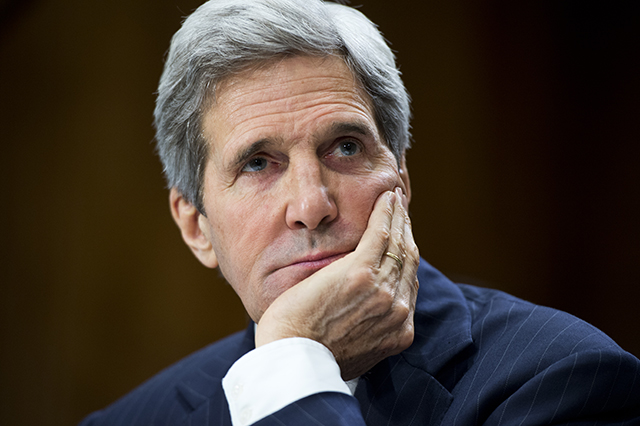
Senate Foreign Relations CommitteePhoto: Tom Williams/CQ Roll Call/Newscom

During a recent Senate hearing, Secretary of State John Kerry said he would take the blamefor any failures of the Obama Administration’s foreign policy, all the while denying American foreign policy was “spinning out of control.” The administration’s approach to foreign policy—leading from behind—has been an abject failure. It is time for the administration to enact policies that will protect the strategic interests of the U.S., project strength and resolve abroad, and convince allies and adversaries alike that America can be still counted on to lead.

Responding to a suggestion from Senator John McCain (R–Ariz.) that the Israeli-Palestinian peace talks have failed, and that it was time for Kerry to face reality, the secretary of state defended the administration’s efforts and said he was to blame for any failures:

Sure we may fail, you want to dump it on me, I may fail. I don’t care, it’s worth doing, it’s worth the effort, and the United States has a responsibility to lead.

Under President Obama, however, the United States has not led. Indeed, in nearly every region of the globe, the United States’ position has deteriorated. On the Middle East peace talks, for example, Kerry recently offered the release of a convicted Israeli spy in the U.S. as a bargaining chip to salvage a flawed peace process that has become more of a legacy obsession for Kerry rather than an opportunity to shape a strong, coherent policy.

In regards to Syria, Kerry himself reportedly privately admitted the administration’s policy has failed—charges he publicly denies.

Furthermore, U.S. policy toward Russia and Eastern Europe has been one of disengagement and weakness. Following Russia’s aggression toward Ukraine, it is clear that the Russian reset is dead, a fact recently acknowledged by architect of the reset. The U.S. needs a new strategic policy toward Russia, one based on reality, not wishful thinking. Even New START, hailed by Kerry as the one success of the Russian reset, has only strengthened Russia whileweakening the United States.

From an empty Pacific pivot to weakness in Latin America and the Middle East, the Obama doctrine has failed spectacularly.

Speaking at the hearing, Idaho Senator James Risch (R–Idaho) told Kerry “You can’t help but get the impression that our foreign policy is just spinning out of control, and we’re losing control in virtually every area we’re trying to do something in.” McCain echoed these comments when he stated “On the major issues, the administration is failing very badly.”

Risch and McCain are right: the Obama doctrine has crashed and burned. While Kerry may want credit for effort, no amount of wishful thinking will yield positive results until the U.S. decides to lead—and not from behind.

Iran Nuclear Chief: Whoever Has Nuclear Technology Gains ‘Inherent Power’

April 11, 2014

Iran Nuclear Chief: Whoever Has Nuclear Technology Gains ‘Inherent Power,’ Washington Free Beacon, April 14, 2014

Salehi curiously does not explain how nuclear technology translates to “inherent power,” although one can reasonably infer the “power” he is referring to is nuclear deterrence.

Iran’s Nuclear Chief Ali Akbar Salehi said whoever has nuclear technology gains an “inherent power” in a video posted on an Iranian affiliated YouTube account. The video is translated with English subtitles.

Salehi contended the West is pressuring Iran on its nuclear program because they fear Iran also gaining this “inherent power”:

ALI AKBAR SALEHI: Whoever has nuclear technology also gains an inherent power. Why is the West putting so much pressure on us when they know we are not seeking nuclear weapons? They say that these people are becoming an example to the world. They have resisted and have advanced so much in this technology that they have created this inherent power for themselves spontaneously. Regardless, this is a power.

Salehi curiously does not explain how nuclear technology translates to “inherent power,” although one can reasonably infer the “power” he is referring to is nuclear deterrence.

In order for a state to practice nuclear deterrence, a country must have nuclear weapons to deter or influence actions by other states.

While the Iranian nuclear chief tried to execute a careful rhetorical dance, all he really did was tacitly reaffirm his nation’s desire for a nuclear weapon.

Iranian Navy Thumbs Nose at America

April 11, 2014

Iranian Navy Thumbs Nose at America, Commentary Magazine, April 11, 2014

(Iran thumbs her nose at America constantly. That others in the region are doing so may well be of greater significance. — DM)

Thanks to Mehrdad Moarefian for flagging, but an Iranian battle group earlier this week docked in Djibouti for a three-day port call. While previously the Iranian navy docked in Port Sudan, the move to Djibouti should be a wake-up call regarding America’s shrinking military and diplomatic standing. After all, Djibouti is the site of a hugely important U.S. facility and serves as an important hub and logistical base for American activities throughout the region. It’s one thing for Iran to work with a rejectionist, failing state like Sudan; it’s quite another to enjoy port calls on the doorstep of an American base and with a government which so closely partners with the United States.

In the Persian original, the story gets worse, however: The Iranian ships had also paid a port call in Salaleh, Oman’s second most important city. That port call highlights Oman’s slow turn away from the past few decades when it was a reliable U.S. and pro-Western ally; I had previously talked about Oman’s growing flirtation with the Islamic Republic of Iran here, including its discussions of basing rights for Iran in exchange for cheap gas.

Lastly, the Persian article notes that the Iranian navy’s mission was to help secure the Islamic Republic of Iran Shipping Lines (IRISL). Given the IRISL’s involvement in proliferation, shipping of arms, and use of false flags and false documents to cover up cargo and operations–all of which it has been sanctioned for–that the Iranian Navy now expedites and facilitates the activities of this sanctioned entity certainly suggests that reform of behavior is not on the Iranian regime’s agenda, despite Obama administration claims that its strategy is working to bring Iran in from the cold.

Scare Tehran, Please

April 11, 2014

Scare Tehran, Please, The Weekly Standard Reuel Marc Gerecht, April 11,2014

(President Obama’s ability to escape (congressionally imposed) handcuffs would shame Harry Houdini. — DM)

As July draws nearer, the White House should show that it wants the nuclear deal less than Khamenei and Rouhani do. . . . Sanctions alone were never going to stop the mullahs’ nuclear quest. Given the enormous progress Tehran has made in the last five years, an honest analyst would have to conclude that sanctions are probably no longer relevant to rolling back the program. But nothing could be more helpful—intimidating to Tehran—than to have Congress “handcuff” the president through legislation now clearly defining the terms of successful nuclear negotiations and the consequences for Iran of failure. [Emphasis added.]

Is Barack Obama’s threat of preventive military action against the Iranian regime’s nuclear program credible? Would a one-year, six-month, or even three-month nuclear breakout capacity at the known nuclear sites be acceptable to him? Is he prepared to attack if Tehran denies the International Atomic Energy Agency, the U.N.’s nuclear watchdog, entry into undeclared facilities that may be hiding nuclear-weapons research or centrifuge production? Is he prepared to strike if the regime denies inspectors access to the personnel and documents that would allow the West to see whether—how much—the regime has been lying about weaponization? 
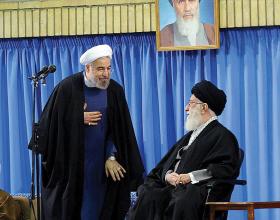
Not nervousTHEY’RE NOT NERVOUS ENOUGH TO NEGOTIATE.

These are questions that Iran’s leaders—Supreme Leader Ali Khamenei, the commanders of the Revolutionary Guards, who oversee the nuclear program, and Hassan Rouhani, who before becoming president served on the Supreme National Security Council as Khamenei’s personal representative—have undoubtedly asked since 2008. The answers they reached surely shape Tehran’s approach to the current negotiations with the West. Khamenei, Rouhani, and others have stated since the Joint Plan of Action was signed in November that Tehran has no intention of rolling back its nuclear progress. Here’s how Khamenei put it on April 9 in a meeting with officials of Iran’s Atomic Energy Organization: “But all should know that despite the continuation of these talks, the Islamic Republic’s activities in the fields of nuclear research and development will in no way be halted, and not a single nuclear accomplishment will be suspended or stopped.” 

Participants in the Vienna nuclear talks have described the proceedings so far as a take-and-give exchange, where the Iranian negotiating team grimaces and the Americans back off. The Obama administration hasn’t yet wanted to push, for example, on an inspections regime that would allow the IAEA to visit undeclared Revolutionary Guard sites that may house nuclear-weapons-related research. Since the guards oversee the entire atomic program, as well as ballistic-missile development, paramilitary expeditionary efforts (see Syria, Yemen, Iraq, Sudan, the Gaza Strip, Afghanistan), and terrorism, a rational person might conclude that a nuclear deal denying the IAEA spot inspections at Revolutionary Guard facilities is, to put it politely, defective.

President Obama’s intellectual soulmates, the left-of-center nonproliferation crowd in Washington, who have been in constant retreat over the last decade about what should be demanded of the Islamic Republic, appear to be defaulting to a position where an Iranian “freeze” would be just fine and an intrusive inspections regime covering undeclared sites unnecessarily provocative. It likely won’t be long before the soft nonproliferation voices at the Ploughshares Fund, the Carnegie Endowment, the New America Foundation, and the Brookings Institution tell us that pushing the “moderates” in Tehran—Rouhani and Foreign Minister Mohammad Javad Zarif—against the Revolutionary Guards would be counterproductive since the guards are prickly nationalists who could torpedo everything.

The nonproliferation experts often remind us that the Islamic Republic hasn’t been defeated in war, which apparently limits the West’s and the IAEA’s acceptable inquisitiveness. Increased “transparency” of known sites, which the Iranian regime is allowing, will have to be enough—even though the capacity and proclivity to lie and cheat has been a hallmark of the Islamic Republic since the 2002 disclosure of the then-hidden Natanz and Arak nuclear facilities. We will assuredly hear some nonproliferation folks again emphasize the competence of American intelligence, playing off the public remarks of the director of national intelligence, James Clapper, who suggested the intelligence community would know if Iran decided to build a bomb. Downplayed will be the unpleasant history of the Central Intelligence Agency, which has missed every successful clandestine nuclear weaponization (the USSR, Communist China, India, Pakistan, North Korea, and probably Israel and South Africa, too) since the end of World War II, along with the possibility that the Islamic Republic’s final dash to the bomb might not be conducted at a monitored site.

In other words, the final comprehensive deal that Washington should accept, so the nonproliferation left will likely argue, will contain: no dismantling of centrifuges (the new preferred terms appear to be “disabling” and “decommissioning”); no explicit ban on the future production of centrifuges; no reduction in the low-enriched uranium stockpile, allowing Tehran sufficient LEU to refine further into a half-dozen bombs; no closure of the bomb-resistant underground enrichment plant at Fordow; no dismantling of the heavy-water plant at Arak or even its conversion to a light-water reactor that can’t produce bomb-grade plutonium; no meaningful, verifiable restrictions on centrifuge research; no linkage between the development of intercontinental ballistic missiles and the nuclear program; no serious debriefings of Iranian nuclear personnel with their paperwork in hand; and certainly no acknowledgment by Tehran of its past efforts at nuclear weaponization (the nonproliferation cognoscenti call this the “possible military dimensions” of the program or PMD).

It wouldn’t be surprising to see Khamenei finally authorize an inspection of the Parchin Revolutionary Guard facility, where IAEA inspectors and Western intelligence services strongly suspect that the regime’s scientists once experimented with implosion devices and nuclear triggers. The IAEA was allowed a cursory visit in 2005; the suspect buildings have since been destroyed and paved over. Despite the uselessness of inspectors’ examining a cleansed site, Khamenei’s acquiescence would likely be greeted with great relief in many quarters and be seen as further proof of the Islamic Republic’s turn toward moderation.

If a private poll were held, it would most likely show that the vast majority of liberal nonproliferation experts    would strongly prefer a nuclear-armed Islamic Republic to  preventive military strikes unleashed by Barack Obama. This nonproliferation establishment will probably wrap itself ever more tightly in the technicalities of nuclear deal-making, as if all parties to the negotiations operated from the assumption that a nuclear weapon is no longer in the interests of the Islamic Republic, never mind the countervailing evidence of an arduous, expensive 30-year effort. The determined and deceitful nature of the regime will take a back seat, as one French official has put it, to the “right logarithm that will solve the strategic problem.”

Too-eager American diplomats and their expert assistants will attempt to find a technocratic answer to a problem that probably has no technocratic solution. The West could get utterly lost in measuring the ultimate nonproliferation desideratum: Iranian SWUs (“separative work units”—the amount of uranium separation done by an enrichment process). The surreality of this whole discussion is best seen in the “formula for success” seriously put forth by Joseph Cirincione, the president of the Ploughshares Fund, the preeminent left-wing funder of nonproliferation studies. Here is his answer to the supreme leader and the Revolutionary Guards:

C = f (Qc + Cc + Lc + QLEU + Pu + R&D + V + HPMD + D + PW)

where Confidence (C) is a function (f) of

Qc = Quantity of centrifuges

Cc = Capability of centrifuges

Lc = Locations of centrifuges

QLEU = Quantity of low-enriched uranium

Pu = Plutonium production capabilities

R&D = Research and development

V = Verification of all of Iran’s activities

HPMD = History of programs with possible military dimension

D = Duration of the deal

PW = Political willingness to enforce the deal.

So let’s consider one pivotal component of the equation, PW. This is best translated as President Obama’s willingness to bomb the ball bearings out of the Iranian regime’s nuclear facilities. At this point, most liberal nonproliferation discussions get even weirder. In January, to stop Democratic senators from passing legislation that would have mandated new sanctions against Tehran if it failed to conclude a verifiable termination of its nuclear-weapons program through the Joint Plan of Action, or if Tehran engaged in a terrorist act at any time, the administration let loose the animadversion most feared among liberals, to be labeled a warmonger. The tactic worked brilliantly: Democratic senators caved en masse.

But the nuclear negotiations ultimately hinge, as even Cirincione sees, on the president’s willingness to unleash the Air Force and Navy. The rub is that the White House doesn’t want to use the threat of force before the negotiations end; it only wants do so after a deal has been signed, when the threat of force has no leverage. But the Iranian regime always uses Machtpolitik to get what it wants, and if we don’t, we’re not serious. It’s quite likely that the administration and its partners in the think-tank community will actually call on Congress to authorize the use of force after a deal is approved by Khamenei—not because they want to scare the supreme leader and his men (that possibility will have already been lost), but to provide Democratic politicians domestic cover, a show of toughness for the electorate and perhaps a bit of psychological salve for themselves.

It’s a pity. There is still a chance that if the president seriously threatened to use force before the informal deadline for the Joint Plan of Action in July—and it would be a hard sell in Tehran after his red-line debacle in Syria—he might be able to push the supreme leader into a corner where he’d have to make crippling nuclear compromises. If the Iranian regime is “rational” when it comes to American military power, and Khamenei has clearly shown that he is, then the supreme leader would likely prove flexible so long as he were sure that an American president would strike. The United States’ armed might—not economic coercion or reward—has always been the best trump that Washington could use to neutralize Tehran’s atomic aspirations.

Look at the past. The Islamic Republic’s clandestine nuclear-weapons program was publicly revealed by an Iranian opposition group in August 2002 (Western intelligence services were aware of it earlier). The 2007 National Intelligence Estimate asserted that Tehran’s development of a nuclear trigger, which is used only in bombs, was probably halted in 2003, the year of the Iraq invasion. Other aspects of the weapons program—the development and deployment of centrifuges and uranium enrichment—also slowed or were temporarily frozen. All of Tehran was then noisily wondering whether the Islamic Republic would be the next member of the “axis of evil” to be taken down. Karim Sadjadpour of the Carnegie Endowment, who was then in Tehran with the International Crisis Group, has recounted how Iranian officials were fearfully mesmerized by the display of American will and muscle. Rouhani took great pride in his memoirs and on the stump in his presidential campaign that he, as Iran’s nuclear negotiator, had kept the regime’s atomic quest alive in those trying times through concessions that were only temporary. Iran’s nuclear program accelerated after 2005 with Mahmoud Ahmadinejad’s presidential triumph, which Khamenei celebrated, and with the floundering of the Bush administration in Iraq.

The Obama administration—the president in particular—has had great difficulty in handling the fact that George W. Bush’s decision to eliminate Saddam Hussein altered Tehran’s nuclear calculations. It has been an article of faith for this president that the Iraq war was an egregious mistake. Early in his presidency, he sincerely tried to reach out to Khamenei, suggesting that the enmity between the two countries was surmountable. Obama has consistently resisted or diluted bipartisan congressional efforts to strengthen sanctions against the Islamic Republic. Such hesitancy had various causes, but the supreme leader clearly could have read it as a sign that the White House preferred a less confrontational approach.

The president’s good intentions and restraint—which survived even an Iranian plan to blow up the Saudi ambassador in a Georgetown restaurant in 2011 and Khamenei’s all-out support of Bashar al-Assad’s savage rampage in Syria—have been reciprocated by Iranian nuclear advances and zealously nasty anti-American rhetoric from the supreme leader. Since 2008, Tehran has ramped up its centrifuge production, uranium enrichment, heavy-water reactor construction, and ballistic-missile development. Iran has probably made more progress in its nuclear-weapons program on Obama’s watch than at any earlier time.

Yet some Iranian fear remains. Tehran hasn’t ejected the IAEA inspectors and cameras at the known nuclear sites. It has installed and tested but not thrown into full-throttle its advanced centrifuges (this may be more a question of imported parts than fear). It has been careful about how much medium-enriched uranium, which is a small step from bomb-grade, it stockpiles. Progress at the heavy-water reactor at Arak, which if completed could produce plutonium, has been constant—but not a damn-the-consequences mad dash (again, parts may be a factor).

As July draws nearer, the White House should show that it wants the nuclear deal less than Khamenei and Rouhani do. Above all else, the president and senior officials should be playing on the supreme leader’s longstanding insecurity vis-à-vis American might. Sanctions alone were never going to stop the mullahs’ nuclear quest. Given the enormous progress Tehran has made in the last five years, an honest analyst would have to conclude that sanctions are probably no longer relevant to rolling back the program. But nothing could be more helpful—intimidating to Tehran—than to have Congress “handcuff” the president through legislation now clearly defining the terms of successful nuclear negotiations and the consequences for Iran of failure. Those who fear American preventive military action more than they do a nuclear weapon in the hands of the supreme leader don’t really care what kind of deal is concluded with Tehran. In the end, they would accept an agreement that neither dismantles nor intrusively monitors the Iranian regime’s atomic achievements. If President Obama isn’t in this camp, then he needs to overcome his aversion to seeing diplomacy as an adjunct to the threat of war. The Iranian regime plays hardball. To win now, we have to openly prepare to fight.

Off Topic – Dershowitz: Palestinians must come to the table for peace

April 11, 2014

Palestinians must come to the table for peace | JPost | Israel News.

By ALAN DERSHOWITZ

04/10/2014 21:18

The burden is on the Palestinians to come to the negotiating table, not as equal partners, but as claimants, seeking to obtain something that they do not have.

Palestinians confront Israeli troops at the West Bank village of Silwad, near Ramallah, on January 1

Palestinians confront Israeli troops at the West Bank village of Silwad, near Ramallah, on January 10 Photo: ISSAM RIMAWI / FLASH 90

As Secretary of State John Kerry tries to place primary blame on Israel for the stalled negotiations, it is important to look at the big picture and go back to first principles.

A little history always helps to understand the present.

In 1937-1938, the Peel Commission proposed a two-state solution in which the Jewish community of Palestine would receive a relatively small percentage of the land on which to establish the nation-state of the Jewish people.

The majority of the land was allocated to the Arab population, with the hope that they would establish their own state. The Jewish Agency, the predecessor to the Israeli government, reluctantly accepted the division.

The Arabs quickly rejected it.

In 1947-1948, the United Nations once again proposed a division of the land, with the Palestinians again getting the majority of the arable area and the Israelis getting the majority of the total area, including the Negev Desert. Israel accepted and established its state. The Palestinians rejected the proposal and joined the surrounding Arab armies in a genocidal war against the newly formed nationstate of the Jewish people.

The Jews lost 1 percent of their population, including many Holocaust survivors, in their successful effort to defend the nascent state.

In 1967, Jordan, which had occupied the West Bank since 1949, attacked Israel despite Israeli efforts to keep Jordan out of the war. Defending itself, Israel captured the West Bank.

Its leaders made it clear that it would return most of what it captured in exchange for peace and recognition.

The UN Security Council adopted Resolution 242 which essentially accepted the Israeli formulation. The Palestinians went to Khartoum where they and all the Arab countries issued their three famous nos: No peace. No negotiation. No recognition.

This led Israel’s ambassador to the United Nations, Abba Eban, to quip: “I think that this is the first war in history that on the morrow the victors sued for peace and the vanquished called for unconditional surrender.”

In 2000-2001, the Israelis once again offered to withdraw from more than 90 percent of the West Bank in exchange for peace. Yasser Arafat rejected that offer and initiated a series of terrorist attacks that left thousands dead.

In 2007, Prime Minister Ehud Olmert offered an even better deal that included land swaps under which the Palestinians would obtain part of Israel in exchange for land that Israel retained in the West Bank. Once again, the Palestinian leadership did not accept that offer.

It is clear therefore that the Israelis and the Palestinians do not stand in equivalent positions — morally, legally, diplomatically or politically — when it comes to negotiating Israel’s withdrawal from the West Bank.

Israel captured this territory in an entirely lawful defensive war.

The Palestinians want it.

Unless they are prepared to negotiate with the Israelis, they can’t get it.

The burden is on the Palestinians to come to the negotiating table, not as equal partners, but as claimants, seeking to obtain something that they do not have.

Possession is 9/10th of the law, and in this case, 9/10th of morality as well.

Those who seek a change in the status quo have the burden of coming forward and showing a willingness to negotiate.

It would be as if there was a dispute over a car, or a painting, or a piece of land. The person who was lawfully in possession of the item need do nothing unless the person seeking it offers to negotiate. If the claimant walks away from the negotiation, the status quo remains.

Of course captured land is not the same as a car or a painting, but the principles underlying negotiation are similar. The land at issue was never part of a Palestinian state. It was lawfully captured from Jordan in a defensive war.

The Jordanians have now given their rights over to the Palestinian Authority, but the Palestinian Authority has refused to take yes for an answer since 2001. And before that, the surrounding Arab states refused to accept yes for an answer over the course of three-quarters of a century.

The Palestinians deserve to have a state, but their claim is no greater than that of the Tibetans, the Kurds, the Chechens and other stateless groups. Indeed, these other groups, unlike the Palestinians, have never been offered statehood and turned it down. Nor would these groups refuse to sit down and negotiate for a state.

The two-state solution would be good for the Palestinians, for Israel, and for peace in the region. But it is the Palestinians who need it most.

They are demanding of Israel substantial territorial compromises.

They are also demanding prisoner releases, an end to construction in the settlements and a termination of Israel’s military presence in the vulnerable Jordan Valley.

To get these and other concessions from Israel, the Palestinians must be prepared to make sacrifices as well.

They must give up all claims against the nation-state of the Jewish people, including the so-called right of return.

And they must assure Israel’s security against attacks from within the areas under their control.

Most important, they must be prepared to negotiate without preconditions and to stop taking unilateral actions that may satisfy their street but that will get them no closer to achieving a state.

So let the Palestinian Authority come back to the negotiating table, and if they refuse, let the world understand why they have not achieved their goal of statehood.

Alan M. Dershowitz is the Felix Frankfurter Professor of Law at Harvard Law School. He is a graduate of Brooklyn College and Yale Law School. His latest book is his autobiography, Taking the Stand: My Life in the Law.

The United States of Obama are imploding

April 11, 2014

The United States of Obama are imploding, Danmillerinpanama, Dan Miller, April 9, 2014

What, if anything, do “we” now stand for and why?

obama1_unicorn_fantasy

An article published on April 9th by the Gatestone Institute International Policy Council is titled U.S.: The Great Problem that Needs to be Solved. Written by Elliot Abrams, it contends that the problem has at its center the world view of President Obama. His world view is based primarily on ideology rather than reality; its bases are evident in all that He and His minions do and fail to do.

The problem also impacts domestic policy, implemented by Executive Decree when He “won’t wait.” If the Democrats control neither house of the Congress following the November elections, there will likely be increasing numbers of Executive Decrees. There will also probably be more Executive refusals to enforce Federal laws the Obama Administration does not like. Attorney General Holder testified before the House Judiciary Committee on April 8th that

There is a vast amount of discretion that a president has — and, more specifically, that an attorney general has . . . .  But that discretion has to be used in an appropriate way so that your acting consistent with the aims of the statute but at the same time making sure that you are acting in a way that is consistent with our values, consistent with the Constitution and protecting the American people. [Emphasis added.]

Whose values are “our values?” Which “American people” are to be protected from what and whom?

Executive Decrees and the increasing dominance of Executive “values” over those on which our laws are based are among the consequences of elections, about which President Obama once bragged but now complains. When weak, He has to appear to His followers to be strong in asserting their values. Our RINOs frequently oblige by cowering before Him.

This article, however, is about foreign policy — an area in which He evidently considers American weakness more effective than American strength in bringing and keeping peace. It is not.

According to the Gatestone article,

When the Iranians started building a nuclear weapons program, it was the United States that said — three presidents have said — “You are not permitted to do that.” There was at least someone saying, “No, this is not a Hobbesian ‘war of all against all’: there are certain rules here that everyone will live by, and we, the United States, will enforce them.”

This started a long time ago — certainly after World War II, when the U.S. effected these rules against the Soviet Union. Obviously that is not the way the current U.S. Administration views the Middle East or its role there.

. . . .

You hear this from the president over and over again. “Global citizen;” “new era of engagement.” He used that line in about 10 different speeches starting with his first State of the Union “reset.”

In the Administration’s analysis of the world situation, there seems to be a great problem that needs to be solved; and the problem is the United States. It needs to break and overcome these old habits. Some of you might think instead that we have a great problem with Islamic extremism. That is not the  president’s view. The president made this really quite remarkable statement in his Cairo speech: “I consider it as part of my responsibility as president of the United States is to fight against negative stereotypes of Islam wherever they appear.” [Emphasis added.]

Think about that. It’s really quite astonishing. I would say that if a president made that comment about Judaism or Christianity most of us would say, “That’s really quite bizarre. It is actually not his job.” [Emphasis added.]

To pick out and isolate Islam as the one religion, criticisms of which he has the responsibility to correct, is actually amazing. [Emphasis added.]

You look at the Administration’s policy: what is the goal here? What is he trying to achieve? It is certainly not a human rights policy; he seems remarkably indifferent to human rights everywhere.

Start with June 2009 in Iran: completely indifferent to the uprising that could conceivably have overthrown the Ayatollahs. Maybe it could not, but we shall never know. Or China: Secretary of State Hillary Clinton’s first trip there. When she was asked, “Why don’t you say more about human rights?” she said, “We know what they’ll say in response.” So much for human rights in China, for human rights in Russia.

. . . .

One of the things that have changed in this administration is that people who are fighting for democracy in places such as Turkey, Russia or China, do not feel that they have any moral or political support coming from Washington, in a way that they have over the years. [Emphasis added.]

They are just not interested. On the humanitarian side, also not interested. When the president visited Africa, there were a fairly good number of articles in the newspapers talking about how disappointed Africans were. After all, they had gotten a lot of attention from President Bush. Now they had an African American president. Surely the amount of attention would be doubled, tripled. Instead, of course, it had largely disappeared. [Emphasis added.]

The key job for humanitarian activities in Africa is the Africa desk at USAID, the Assistant Administrator for Africa. It has been vacant for over a year and a half. The president did not even bother to fill the job.

What is he interested in doing? Military strength? Clearly not.

The Gatestone article is long but well worth reading and considering.

The Israel – Palestinian “peace process.”

Kerry SalutesPeace has to be out there somewhere.
I’ll find it using my magic Process!


On April 3rd, in an article titled Secretary Kerry and his Israel – Palestinian “peace process,” I argued that the process has become more important than peace, which will not in any event be among its results. Secretary Kerry, evidently backed by President Obama, consistently maintains that any failure of the process will be mainly the fault of Israel — not of the Palestinians and certainly not of the process.

During hearings on April 8th before the Senate Foreign Relations Committee, Secretary Kerry

performed a post-mortem on the recent collapse of the Middle East peace talks. According to Kerry, the Palestinian refusal to keep negotiating past April and their decision to flout their treaty commitments by returning to efforts to gain recognition for their non-existent state from the United Nations was all the fault of one decision made by Israel. [Emphasis added.]

That “fatal” decision was to announce seven hundred new apartments for Jewish settlers in East Jerusalem. “Poof, that was the moment,” Mr. Kerry said. 

[T]o blame the collapse on the decision to build apartments in Gilo—a 40-year-old Jewish neighborhood in Jerusalem that would not change hands even in the event a peace treaty were ever signed and where Israel has never promised to stop building—is, to put it mildly, a mendacious effort to shift blame away from the side that seized the first pretext to flee talks onto the one that has made concessions in order to get the Palestinians to sit at the table. But why would Kerry utter such a blatant falsehood about the process he has championed? [Emphasis added.]

The answer is simple. Kerry doesn’t want to blame the Palestinians for walking out because to do so would be a tacit admission that his critics were right when they suggested last year that he was embarking on a fool’s errand. The division between the Fatah-run West Bank and Hamas-ruled Gaza has created a dynamic which makes it almost impossible for Abbas to negotiate a deal that would recognize the legitimacy of a Jewish state no matter where its borders were drawn even if he wanted to.

Or perhaps it’s necessary because Kerry sees the making of increasing demands as the proper function of the Palestinians and bowing to those demands, with her destruction to follow, as the proper functions of Israel. That is the view which the Palestinian Authority demands as its price for pursuing the process. At some point, however, Israel cannot continue to yield to increasing demands and the process fails. That appears to be where things now stand.

Or perhaps the underlying delusion is necessary due to President Obama’s Cairo promise, one of the very few that He meant and has kept:

I consider it as part of my responsibility as president of the United States is to fight against negative stereotypes of Islam wherever they appear.

“Negative stereotypes” or reality?

The P5+1 nuke farce

a1  Obama and Kahameni -building a toaster

The Iran Scam continues and is likely to get worse. During the testimony of Secretary Kerry before the Senate Foreign Relations Committee on April 8th, Chairman Menendez (D-N.J.)

panned a recent Wall Street Journal headline: “Obama Administration Shows Optimism on Iran Nuclear Talks.”

“I’m trying to glean where that’s from,” he said. “…With no sanctions regime in place, and understanding that every sanctions that we have pursued have needed at least a six-month lead time to become enforceable, and then a greater amount of time to actually enforce, that the only option left to the United States to this or any other president, and to the West, would be either to accept a nuclear-armed Iran or to have a military option.”

Kerry dismissed breakout as “just having one bomb’s worth, conceivably, of material, but without any necessary capacity to put it in anything, to deliver it, to have any mechanism to do so, and otherwise.”

He then admitted that “our goal” is not eliminating nuclear capability as much as “proving that this is a peaceful program.” [Emphasis added.]

He said WHAT?

He said WHAT?

Did he really say that? Was it a Freudian slip? What ever it was, it appears to reflect Obama Administration policy: start with assumptions that with “moderate” Iranian President Rouhani now in charge (he isn’t; to the extent that anyone is, it’s Supreme Leader Ali Khamenei) and that his charm offensive was and is sincere (it wasn’t and isn’t). Those assumptions easily evolve into sufficient “proof” for the P5+1 process that Iran has and wants only a “peaceful program.” Is the P5+1 farce, like the Israel – Palestinian “peace process,” all about the process? It seems to have little to do with keeping Iran from having, getting or using nuclear weapons.

Conclusions

Foreign policy under President Obama and Secretary Kerry is a mess. The policy is to negotiate regardless of the costs, and to require the only reasonably free and democratic nation in the region, Israel, to negotiate with Palestinians who “merely” desire to eliminate her. Israel does not even have a recognized part to play in the P5+1 farce. If something — anything — works, good; Obama – Kerry will claim the credit. If negotiations fail, if there is another Intifada and/or if Iran gets (or keeps) and uses nuclear weapons resulting in many thousands or millions of deaths? Oh well, Obama – Kerry tried real hard so it couldn’t be their fault. Perhaps they will get Nobel Peace consolation prizes

The “peace process” and the P5+1 scam are only two of many available examples of the implosion of the United States of Obama as a principal force for international good –stability and democracy with freedom. As she continues to implode and to create a vacuum, something(s) will take her place. Stability may eventually come, but with neither democracy nor freedom. That seems to be the direction in which the United States of Obama are themselves headed.

Ofek 10 Enters Orbit: “Intelligence in Any Condition”

April 11, 2014

Ofek 10 Enters Orbit: “Intelligence in Any Condition”.

The Ministry of Defense and the participating defense industries are celebrating the successful launch of the “Ofek 10” satellite. Defense Minister Moshe Ya’alon: “Remarkable ability to reach every time a new peak”


The Ofek 10 Satellite was successfully launched last night (Wednesday) from Palmahim airbase. Head of MAFAT’s Space Administration, Amnon Harari said that “at ten o’clock we launched the Ofek 10 satellite after an effort of several years of development and production. The launch is a continued process. Until now everything we had planned works flawlessly. There are still quite a few steps before we can say that the success is a full one”.

Harari further said that “the satellite is a radar-based observation satellite that should give us intelligence in any visibility condition, day, night and all weather conditions. The satellite was launched using an Israeli Shavit launcher. Over the years there have been required changes due to the need to raise the spacecraft weight. A satellite is a strategic element and we work according to a multi-year plan. It has performed a series of autonomous actions.”

On the entry of the satellite into operational service Harari said: “We are beginning a process of several months of tests and then it will enter operational service. Every hour and a half it orbits around the Earth. Dozens of engineers and personnel of the Intelligence Corps will sit tonight in front of the monitors to pick it up. The difference between it and other satellites is that Ofek 10 very flexible in its maneuvering and it can be directed to collect real-time targets. The Intelligence Corps’ Satellite Unit personnel tell it to leap from one target to the other; it finds them and keeps going. We can change where it looks at. The radar is its camera that gives a picture visibility similar to an optical image. We are also working on optical satellites and radar satellites. The satellite is cruising at an altitude of 400 to 600 kilometers”.

Ofer Doron , CEO of the Israel Aerospace Industries’ Space Division said the “We have developed the satellite over years. Elta made the radar. The satellite has exceptional photographic ability, but it is very small and it’s designed to deliver very precise, high quality images under all conditions”.

Defense Minister Moshe (Bogie) Ya’alon said that “the successful launch of the Ofek 10 satellite last night is a further testimony to Israel’s impressive ability to develop and lead at the forefront of technology. Ofek 10 is meant to improve Israel’s intelligence capabilities and allow the defense establishment to better deal with threats both close and far, all hours of the day and in all weather conditions. We continue to increase the vast qualitative and technological advantage over our neighbors.

This is the time to congratulate those involved in the making in the Ministry of Defense, the members of the Space Administration of MAFAT and people of IAI, IMI, Elbit and Rafael, for continuing the development of sophisticated and unique systems, world –leading ones, aimed to protect the State of Israel and its citizens. Israel is blessed with a defense industry that is exceptional in its quality, its creativity and its commitment to the security of the state and its citizens, and a remarkable ability to reach every time a new peak and reach another record.

The project is led by the Space Administration of MAFAT (the Administration for the Development of Weapons and Technological Infrastructure) at the IMOD and Israel Aerospace Industries (IAI) is its main contractor. Other defense industries, including IMI (which developed the two rocket engines of the satellite launcher and pyrotechnic systems that are in it) and Elbit Systems were involved in the making of the launcher, the satellite and the photographic equipment installed on it

▶ Dror Yikra – PROCLAIM FREEDOM ! – דְּרוֹר יִקְרָא

April 11, 2014

▶ Dror Yikra – PROCLAIM FREEDOM ! – דְּרוֹר יִקְרָא by the Macabeats – YouTube.

( Shabbat shalom & Happy Pesach!  – JW )

He will proclaim freedom for all his children
And will keep you as the apple of his eye
Pleasant is your name and will not be destroyed
Repose and rest on the Sabbath day.

Seek my sanctuary and my home.
Give me a sign of deliverance.
Plant a vine in my vineyard.
Look to my people, hear their laments.

Tread the wine-press in Bozrah,
And in Babylon that city of might
Crush my enemies in anger and fury.
On the day when I cry, hear my voice.

Plant, Oh God, in the mountain waste
Fir and acacia, myrtle and elm
Give those who teach and those who obey
Abundance peace, like the flow of a river.

Repel my enemies, Oh zealous God.
Fill their hearts with fear and despair.
Then we shall open our mouths,
And fill our tongues with Your praise.

Know wisdom, that your soul may live,
And it shall be a diadem for your brow.
Keep the commandment of your Holy One
Observe the Sabbath, your sacred day.

__________________________________________

Transliteration:
Dror Yikra l’ven im bat
V’yintsorchem k’mo vavat.
Na’im shimchem velo yushbat.
Sh’vu venuchu b’yom Shabbat.

D’rosh navi v’ulami
Va’ot yesha ase imi
Neta sorek b’toch karmi
She’e shav’at b’nei ami.

Dror pora b’toch botsra
Vegam bavel asher gavra
Netots tsarai be’af evra
Sh’ma koli beyom ekra.

Elohim ten bamidbar har
Hadas, shita brosh tidhar.
Velamazhir velanizhar
Shlomim ten k’mei nahar.

Hadof kamai el kana
B’mog Levav uvimgina
V’narchiv pe unemalei’ina
L’shoneinu l’cha rina.

De’ei chochma lenafshecha
Vehi keter l’roshecha
N’tsor mitsvat kdoshecha
Shmor Shabbat kodshecha.

______________________________

דְּרוֹר יִקְרָא לְבֵן עִם בַּת.
וְיִנְצָרְכֶם כְּמוֹ בָבַת.
נְעִים שִׁמְכֶם וְלֹא יֻשְׁבַּת.
שְׁבוּ נוּחוּ בְּיוֹם שַׁבָּת:

דְּרוֹשׁ נָוִי וְאוּלַמִי.
וְאוֹת יֶשַׁע עֲשֵׂה עִמִּי.
נְטַע שׂוֹרֵק בְּתוֹךְ כַּרְמִי.
שְׁעֵה שַׁוְעַת בְּנֵי עַּמִּי:

דְּרוֹךְ פּוּרָה בְּתוֹךְ בָּצְרָה.
וְגַם אֱדוֹם אֲשֶׁר גָּבְרָה.
נְתוֹץ צָרַי בְּאַף וְעֶבְרָה.
שְׁמַע קוֹלִי בְּיוֹם אֶקְרָא:

אֱלֹהִים תֵּן בַּמִּדְבָּר הַר.
הֲדַס שִׁטָּה בְּרוֹשׁ תִּדְהָר.
וְלַמַזְהִיר וְלַנִּזְהָר.
שְׁלוֹמִים תֵּן כְּמֵי נָהָר:

הֲדוֹךְ קָמַי חַי אֵל קַנָּא.
בְּמוֹג לֵבָב וּבִמְגִנָּה.
וְנַרְחִיב פֶּה וּנְמַלֶּאנָה.
לְשׁוֹנֵנוּ לְךָ רִנָּה:

דְּעֵה חָכְמָה לְנַפְשֶׁךָ.
וְהִיא כֶתֶר לְרֹאשֶׁךָ.
נְצֹר מִצְוַת אֱלֹהֶיךָ.
שְׁמֹר שַׁבָּת קָדְשֶׁךָ: